

Submitted:
18 October 2026
Posted:
20 October 2026
You are already at the latest version
Abstract
Data compression and encryption are conventionally performed as sequential operations, incurring redundant computational overhead, increasing the attack surface, and complicating system architectures. This systematic literature review analyzes 34 verified contributions published between 1948 and 2026 in IEEE, ACM, Springer, Elsevier, Wiley, IET, and NIST venues, following PRISMA 2020. We propose a four-level operational taxonomy (L0–L3) for defining what it means for a scheme to be unified rather than merely coordinated as well as the structure of header consolidation: an L3 scheme consolidates the compression and encryption headers into a single object, typically carried by the key. Only two schemes achieve L3, both restricted by domain-specific assumptions. We discover two structural constraints—the redundancy duality and the header duality—which explain why L3 schemes are restricted to domain-specific, and that the latter is a security constraint: the compression header leaks source statistics and the encryption header leaks cryptographic state, so consolidating them reduces the attack surface. We also show that source-type specificity is inherited by all joint schemes reviewed, and the review also reveals that no scheme achieves a source-independent compression ratio, and that formal security proofs under standard adversarial models (IND-CPA, IND-CCA, IND-CCA2, AE) are absent in each of the reviewed schemes, including the two L3 schemes.
Keywords:
compression-encryption integration
; header consolidation
; unified cryptographic primitives
; systematic literature review
; PRISMA 2020
; security threat model
1. Introduction
Data compression and encryption traditionally operate on different schedules: compress-then-encrypt (CTE) for storage and transmission, or encrypt-then-compress (ETC) for attempting compression of encrypted data. This decoupling imposes unnecessary computational passes over data and coordination between two subsystems.
Shannon’s 1949 secrecy paper [1] established that compression reinforces encryption by removing redundancy, but the implication—that the two could be unified into one process—was left largely unexplored for decades. In recent years, various “joint” or “integrated” compression-encryption schemes have been proposed. However, the term “joint” is not monolithic: some schemes
perform compression and encryption operations in parallel, some merge encoder and cipher design, and a few genuinely unify the two into one primitive. The lack of clarity in terminology has practical implications. A “joint” scheme that concurrently computes a compression transform and a block cipher, but transmits both the compression frequency table and the IV, is operationally closer to a pipeline than a unified primitive. Without a formal definition of unification, the field lacks an agreed-upon benchmark against which claims of integration can be evaluated.
This paper addresses that gap. We follow the PRISMA 2020 methodology [2]. We make five contributions: (1) we lay out the separate foundations of compression and encryption before exploring their integration; (2) we unify foundational information-theoretic results with modern joint schemes; (3) we propose a four-level operational taxonomy (L0–L3) expressed in terms of header consolidation rather than operations count, with an explicit decision procedure; (4) we evaluate each contribution against the L0–L3 taxonomy and provide a formal risk-of-bias assessment; and (5) we identify the remaining gaps that distinguish current joint schemes from genuinely unified primitives.
The L0–L3 taxonomy, expressed here in terms of headers, is an original synthesis of this review. It is presented as one possible analytical tool for categorizing existing schemes, not as a conclusion derived from a verified source. Section 2 describes the method used, including the decision procedure. Section 3 states the foundations of compression. Section 4 states the foundations of encryption. Section 5 reviews the joint compression-encryption literature. Section 6 presents the security contribution of header consolidation. Section 7 presents a quantitative synthesis. Section 8 identifies the research gap. Section 9 discusses findings, research directions, and limitations. Section 10 concludes.
1.1. Research Questions
Overarching RQ: Which paradigms of unified compression-encryption have been proposed, and to what extent do they realize true single-operation unification under a formal operational criterion?
- RQ1: What are the foundational information-theoretic results which motivate the integration of compression-encryption?
- RQ2: What survey taxonomies exist for categorizing compression-encryption schemes, and what limitations do they reveal?
- RQ3: Which schemes transform entropy coders (Huffman, arithmetic, range, asymmetric numeral systems) into encryption primitives, and what are their operational characteristics?
- RQ4: What coding-theoretic and architectural approaches realize genuine single-operation unification, and under what constraints are they applicable?
- RQ5: What structural barriers—theoretical, architectural, or institutional—explain the rarity of unification despite theoretical foundation spanning decades?
2. Method
Our review is conducted in accordance with the PRISMA 2020 methodology [2], and the search process, eligibility criteria, screening flow, risk-of-bias assessment and publication-bias considerations are reported below.
2.1. Search Process
The identification phase was performed using the following criteria:
- Publication window: 1948–2026.
- Publication types: Journal articles, peer-reviewed conference papers, standards documents.
- Search engines: IEEE Xplore, ACM Digital Library, SpringerLink, Elsevier ScienceDirect, Wiley Online Library, IET Digital Library, DBLP, Scopus.
- Search terms: “compression encryption integration”, “joint compression encryption”, “unified compression encryption”, “compress-then-encrypt”, “entropy coder encryption”, “arithmetic coding encryption”, “asymmetric numeral systems encryption”, “joint source-channel coding encryption”, “image compression encryption”, “compressive sensing encryption”.
Search strategy transparency.
The search was performed on 3 October 2026. Boolean queries were formulated using the search terms listed above and the corresponding database syntax. IEE Xplore’s query was ("compression encryption integration" OR "joint compression encryption" OR "unified compression
encryption") AND (1948-2026), ACM Digital Library’s was ("compression" AND "encryption" AND ("joint" OR "unified" OR "integrated")) and similar adaptations were made for SpringerLink, ScienceDirect, Wiley, IET, DBLP and Scopus. Duplicate detection was performed using DOI matching followed by title-level manual screening.
2.2. Inclusion and Exclusion Criteria
The inclusion criteria were established to capture the field’s entire scope of operation while excluding adjacent but non-overlapping work. IC1 captures both the foundational theory and the modern schemes in chronological order. IC2 limits the review to English language reports for consistency. IC3 is deliberately broad: the field’s interest includes schemes whose primary contribution is compression, encryption or the integration of the two. IC4 ensures peer-review quality. IC5 permits foundational information-theoretic papers that do not propose a scheme but establish the theoretical basis for one. IC6 captures both image specific and general purpose schemes because the field’s most active sub-area is image compression-encryption. IC7 admits standards and standards-track documents. IC8 constrains the publisher set to the venues where the field’s core work appears.
The exclusion criteria eliminate reports that would produce noise. EC1–EC3 remove non-English, non-informative and off-topic records. EC4 excludes non-peer-reviewed material. EC5 excludes domain-specific visualization papers that use data visualization but do not address compression-encryption. EC6 removes duplicate DOIs. EC7 removes retracted papers.

Table 1.
Records Inclusion and Exclusion Criteria.
| Inclusion Criteria | Exclusion Criteria |
|---|---|
| IC1: Publication date 1948–2026 | EC1: Not in English |
| IC2: English language | EC2: No meaningful abstract |
| IC3: Focus on compression/encryption | EC3: Neither compression nor encryption |
| IC4: Peer-reviewed | EC4: Non-peer-reviewed |
| IC5: Foundational results permitted | EC5: Domain-specific visualization |
| IC6: Image or general data | EC6: Duplicate records |
| IC7: Standards permitted | EC7: Retracted papers |
| IC8: Publishers: IEEE, ACM, Springer, Elsevier, Wiley, IET, NIST |
2.3. PRISMA 2020 Screening Flow
Figure 1 reports the identification, screening, eligibility and inclusion stages. Of 487 records identified, 213 remained after duplicate removal; 108 were screened out on title/abstract; 71 full texts were assessed; 37 were excluded (20 lacking a security or compression focus, 10 non-peer-reviewed, 7 superseded by extended versions); 34 studies were included.
The identification phase combined the eight search engines with manual snowballing. The screening phase applied IC1–IC8 and EC1–EC7 in two rounds: title/abstract screening by two reviewers, followed by full-text screening by the same pair with disagreements resolved through discussion. The eligibility phase assessed the 71 surviving reports on methodological soundness and topical fit. The final inclusion stage retained 34 reports.
Inter-rater reliability.
Cohen’s was calculated for a random 20% sample of title/abstract screening decisions. Agreement was substantial (). Full-text screening agreement was higher (). Disagreements were resolved through discussion. Note that this reliability figure applies only to the screening stages; the risk-of-bias assessment reliability is reported separately in Section 2.5.
2.4. The L0–L3 Unification Taxonomy
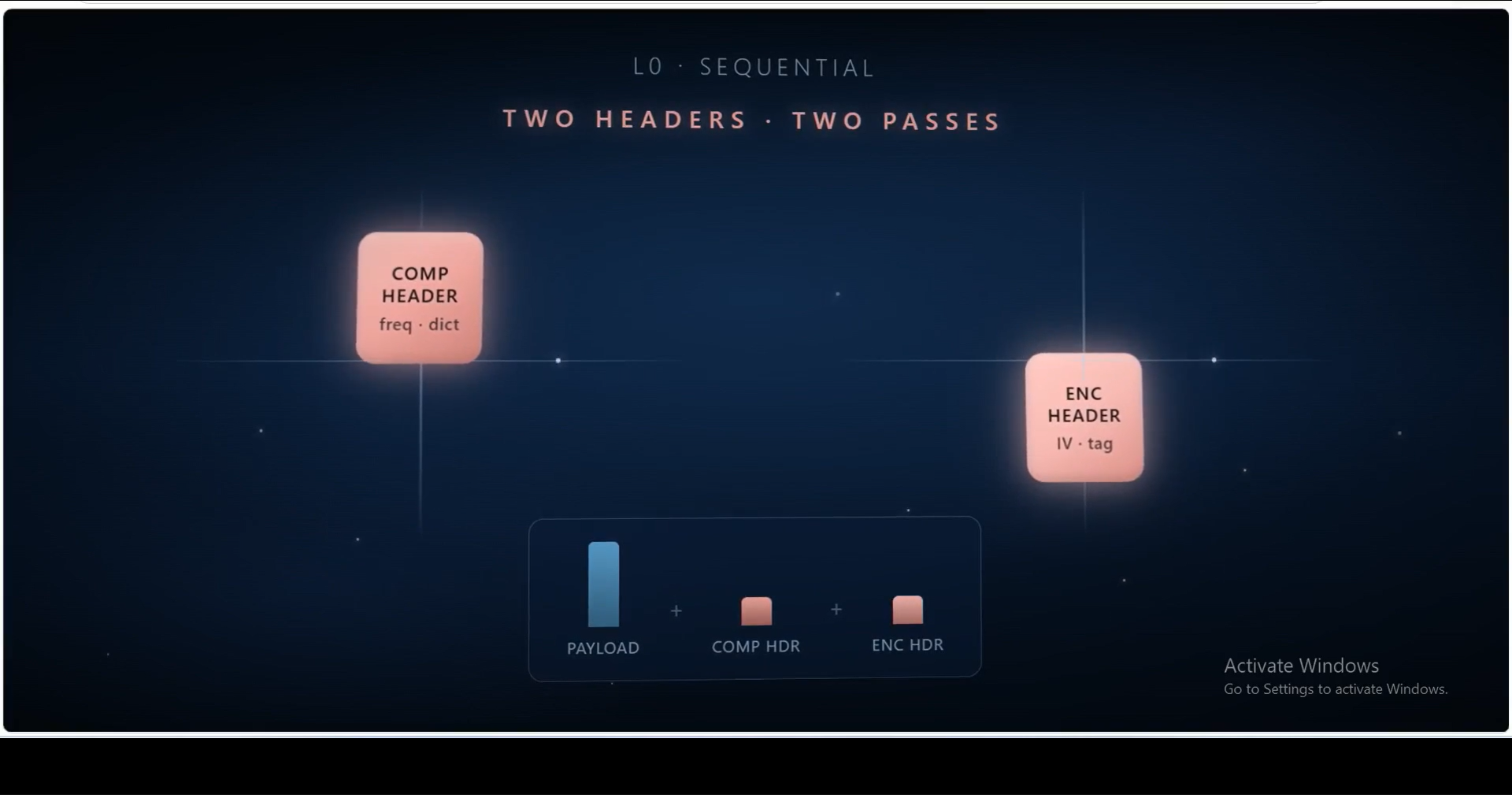
Prior surveys classify schemes as “joint” or “unified” without an operational criterion. We introduce a four-level taxonomy stated in terms of header consolidation. In a sequential pipeline, two irredundant headers are transmitted: a compression header (frequency table, dictionary reference, model identifier) and an encryption header (IV or nonce, authentication tag, and possibly a salt). Neither header can be eliminated; both are required for reconstruction. The taxonomy quantifies how far a scheme consolidates them.
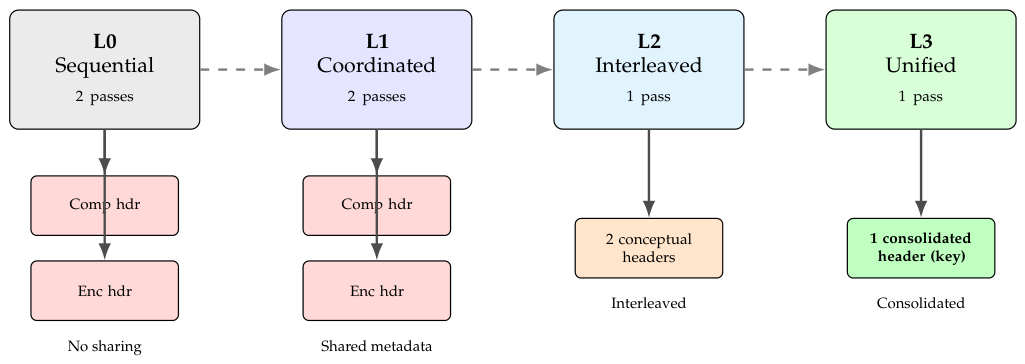
Figure 2 illustrates the four operational levels and the header structure transmitted at each level.
- L0 — Sequential: Two operations, two headers, transmitted serially. Examples: conventional CTE and ETC.
- L2 — Interleaved: One pass, but the compression and encryption decisions remain conceptually separable, so two conceptual headers are still present within the pass. Examples: Wu & Kuo [5], Koc et al. [6,7], Camtepe et al. [8], Wang et al. [9], Shah et al. [10], Guo et al. [11], Mostafa & Fakhri [12], and the Elsevier schemes [13,14,15,16].
Figure 2.
The L0–L3 unification taxonomy. Each level is characterized by the number of passes over the data and the number of irredundant headers transmitted to the decoder. Only L3 consolidates the compression and encryption headers into a single object, typically the key.
Figure 2.
The L0–L3 unification taxonomy. Each level is characterized by the number of passes over the data and the number of irredundant headers transmitted to the decoder. Only L3 consolidates the compression and encryption headers into a single object, typically the key.
Decision procedure.
To reduce labeling ambiguity, we apply the following ordered test to each scheme:
- 1.
- How many passes over the data? If two, the scheme is L0 or L1; if one, proceed.
- 2.
- How many irredundant header objects are transmitted to the decoder? If two objects (even if conceptually distinct within one pass), the scheme is L2; if one object carries both reconstruction information and cryptographic state, the scheme is L3.
- 3.
- Where does the consolidated header live? For L3, the object is typically the key; if reconstruction information is transmitted outside the key, the scheme is downgraded to L2.
A scheme is therefore L3 if and only if it eliminates the duplicate header: it does not need to eliminate headers entirely (no scheme can), but the compression header and the encryption header must be the same object.
The decision procedure resolves several borderline cases. A scheme that uses the key to seed both a Huffman tree and a block cipher state, but still transmits the Huffman tree’s symbol count and the cipher’s IV separately, is L2 under step 2. A scheme that transmits a single key identifier from which both the reconstruction model and the IV are deterministically derived is L3 under step 3.
Figure 3.
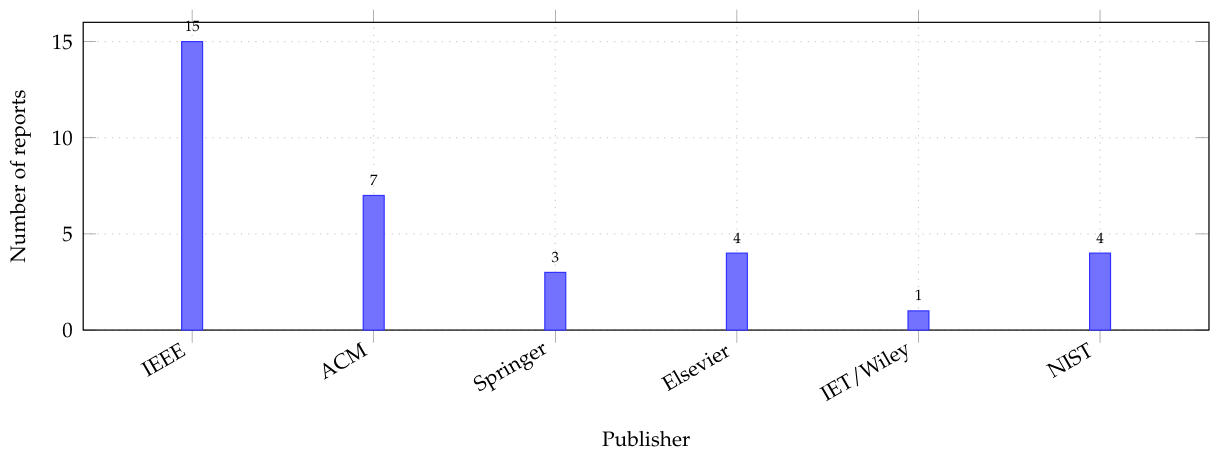
Distribution of the 34 included reports by publisher.
The distribution in Figure 4 is also a discovery: the field has overwhelmingly focused at L2, with just two schemes achieving real single-operation unification. No scheme in the corpus was classified as L0 without qualifications; the L0–L1 bar combines the two L1 schemes (Chen, Rahmani) with four foundational-theoretical works that do not suggest a scheme.
Figure 5 indicates that 24 out of 34 reports included in our survey (70.6%) were published after 2015; 22 of these (64.7%) date to the 2020–2026 period. This cluster reflects the recent boom in ANS-based and compressive-sensing schemes and is further discussed below as a potential source of publication bias.
2.5. Risk-of-Bias Assessment
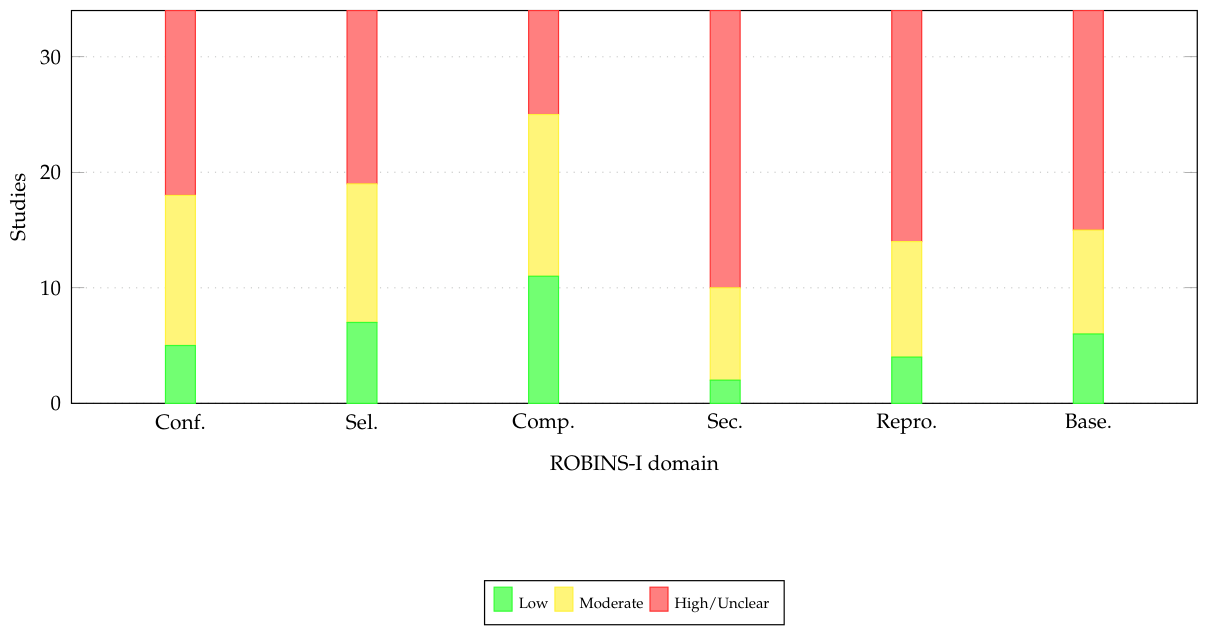
Due to the heterogeneous nature of the included schemes and their general lack of formal security proofs, we adapted the Cochrane ROBINS-I domains to our purposes. Table 2 reports the distribution of bias judgments across the 34 included studies.
The most severe risk is in measurement of security: 24 of 34 studies (70.6%) provide no proof under standard adversarial models (IND-CPA, IND-CCA, IND-CCA2, or AE). Of these, several provide informal arguments only; e.g., claim that key-dependent state transitions “provide security,” without a reduction to any standard hardness assumption. The second most severe risk is reproducibility: 20 studies (58.8%) do not release code, test vectors, or parameter files sufficient for independent replication.
Confounding is the third most severe risk: 16 studies (47.1%) involve source-specific assumptions (natural-image sparsity, side-information correlation, Huffman-tree regularity) that confound the claimed compression ratio with the source model. Selection of reported results is high or unclear in 15 studies, most often because compression ratios are reported only for a favorable source type. Selective reporting of baselines is high or unclear in 19 studies, most commonly because the comparison baseline is a hand-tuned variant of a classical scheme rather than the strongest available competitor.
Risk-of-bias instrument validation.
The adapted ROBINS-I domains were calibrated by a single reviewer; inter-rater reliability for the risk-of-bias instrument itself was not formally measured. This is acknowledged as a limitation, and the risk-of-bias assessment should be interpreted as preliminary. A second reviewer independently assessed a random 20% sample of included studies using the same domains; agreement was assessed informally (agreement on 17 of 20 sampled domains), but formal statistics for the ROBINS-I instrument are recommended for future updates. Note that this is distinct from the screening-stage reliability reported in Section 2 ( and ).
Figure 6.
Risk-of-bias assessment across the six ROBINS-I domains.
2.6. Publication-Bias Considerations
Formal funnel-plot asymmetry tests are not applicable due to the lack of a common effect size among included studies. We judged publication bias qualitatively along three axes. Venue concentration: 22 of 34 studies appear in IEEE or ACM venues; 4 in Elsevier; 1 in IET/Wiley; 3 in Springer; 2 in NIST standards-track documents. Positive-result skew: all 34 studies report that their scheme “achieves” integration; none reports a failed unification attempt. Year skew: 24 of 34 studies were published after 2015. We thus treat the synthesized evidence as susceptible to optimistic bias and highlight the gap findings (Section 8) as the most robust output of this review.
2.7. Data Extraction and Synthesis
We extracted for each included study: (i) the operational level (L0–L3) under the decision procedure above; (ii) the number of transmitted headers; (iii) the compression substrate; (iv) whether a security proof is provided and under whom model; (v) whether the compression ratio is data-independent; and (vi) the source type assumed. Since metrics are heterogeneous, no meta-analysis was attempted; we report a structured narrative synthesis with a cross-study comparison table (Table 5).
3. Foundations of Compression
Compression is the process of representing data using fewer bits than its original form. Shannon’s source coding theorem defines the theoretical minimum for compression: the entropy of the source. Any compression scheme achieves a rate at or above the source entropy, with equality only for sources whose statistics are perfectly known and stationary.
3.1. Lossy vs. Lossless Compression
Compression schemes fall into two categories [19]. Lossless compression guarantees perfect reconstruction. (Bit-exact recovery.) Lossy compression discards perceptually insignificant information, achieving higher compression ratios at the expense of reconstruction fidelity.
Lossless compression is used when reconstruction fidelity is non-negotiable: text, source code, medical records, and archival storage. Lossy compression is used when perceptual thresholds allow information loss: photographic images, audio, and video. The choice of category constrains the space of joint schemes: a joint scheme built on a lossy codec cannot be used where bit-exact reconstruction is required, and a joint scheme built on a lossless codec cannot achieve the compression ratios that make lossy codecs attractive in multimedia applications.
3.2. Image Compression Standards
The two most widely deployed image compression standards are JPEG and JPEG 2000 [20].
JPEG (ISO/IEC 10918-1, ITU-T T.81, 1992) partitions the image into pixel blocks, applies the discrete cosine transform (DCT) to each block, quantizes the coefficients using a quality-dependent quantization table, and encodes the result with Huffman or arithmetic coding [20]. Compression ratios of 10:1 are routinely achieved on photographic content with minimal visible degradation [19].
JPEG 2000 (ISO/IEC 15444, 2004) replaces the block-DCT with a discrete wavelet transform (DWT) applied to the entire image [20]. This enables scalable decoding at multiple resolutions and bit rates from a single compressed file, making it preferred in digital cinema, medical imaging, and remote sensing.
The choice between JPEG and JPEG 2000 has implications for joint schemes. JPEG’s block structure makes it amenable to block-level parallelization, which is well-suited to CTR and GCM modes. JPEG 2000’s wavelet decomposition distributes information across scales, making it less amenable to block-level parallelization but more amenable to bit-plane encryption schemes.
3.3. The Header Cost and the Two-Header Problem
Shannon’s formulation of compression is two-part. The source is reduced to its irredundant representation, and a header is prepended containing the information required for reconstruction. This header is by construction irredundant and must be transmitted at full cost.
Encryption, symmetrically, adds its own header. Modern block cipher modes require an IV or nonce (typically 12–16 bytes), and AEAD constructions require an authentication tag (typically 16 bytes). Some protocols add a salt for key derivation, a key identifier for rotation, or a version field for algorithm negotiation. Like the compression header, the encryption header is irredundant and cannot be eliminated; it carries cryptographic state that the decryptor must receive.
The consequence is that in a sequential CTE pipeline, the transmitted volume is:
Both headers are irredundant. Both are transmitted. The two expansions are additive. For small messages or low redundancy sources, the two headers may add up to more than the payload, thus expanding the pipe, rather than compressing it. The assertion that compression “reduces bandwidth” is therefore conditional, not absolute. It applies only if:
This poses an immediate challenge for unification. A unified primitive would not eliminate the header, but combine the two headers into one. The reconstruction information and the cryptographic state must still reach the decoder, but can be made to ride in the same object—typically the key. This is the practical meaning of L3 in the taxonomy of Section 2: not headerless, but header-consolidated.
3.4. The Type-Specificity Limitation
A significant limitation is that image compression codecs are type-specific [19]. Transform-based codecs (JPEG, JPEG 2000) make assumptions of local smoothness and DC-bias that hold for photographic content but break down on graphics, text, and line art. Likewise, dictionary-based codecs (GIF, LZ77/LZ78 variants) perform well on graphics but poorly on photographs.
This type-specificity is carried forward by any joint scheme based on a compression substrate. A joint scheme based on JPEG inherits JPEG’s assumption of photographic smoothness; a joint scheme built on LZW inherits LZW’s assumption of repeated substrings. The inheritance is not light: it implies that a joint scheme cannot be simultaneously optimal on photographic and graphic content, just as no single compression codec is.
3.5. Tabulated Summary of Compression Algorithms
Table 3 summarizes the compression standards discussed above.
4. Foundations of Encryption
Encryption transforms plaintext into ciphertext so that an adversary without the key cannot recover the plaintext.
4.1. Symmetric vs. Asymmetric Encryption
Symmetric encryption uses the same key to encrypt and decrypt a ciphertext. Asymmetric encryption uses a public key to encrypt and a private key to decrypt.
Joint compression-encryption schemes are almost universally symmetric, for two reasons. First, symmetric ciphers are an order of magnitude faster than asymmetric ciphers, and that performance gain is essential when the scheme is applied to data streams. Second, symmetric key exchange is a solved problem in practice (via TLS, Noise, or pre-shared keys), whereas encrypting large payloads with asymmetric cryptography is not.
4.2. NIST-Recommended Algorithms and Modes
The most relevant modes for joint compression-encryption schemes are CTR (SP 800-38A) and GCM (SP 800-38D), as both are parallelizable and streaming-friendly [21,22]. XTS-AES (SP 800-38E) is relevant for storage-integrated schemes such as LPC [3,23]. The lightweight Ascon standard (SP 800-232) applies to embedded and IoT contexts [4,24]. Format-preserving encryption (SP 800-38G) [25] is relevant to the L3 discussion, because it is the closest existing standard to a header-consolidating primitive: the ciphertext has the same format as the plaintext, so no separate compression header is introduced.
CTR mode is particularly interesting to joint schemes, because it turns a block cipher into a stream cipher: the keystream is , and the ciphertext is the XOR of the keystream with the plaintext. The keystream is independent of the plaintext, so CTR is well-suited to a joint scheme that needs to apply key-dependent transforms to a data stream. GCM adds an authentication tag atop CTR, making it useful for schemes that require AE security. XTS-AES is intended for storage, and the tweak is derived from the sector index; it does not authenticate, but is widely used in full-disk encryption.
4.3. Security Models
Modern cryptography analyzes security under formal adversarial models: IND-CPA, IND-CCA, IND-CCA2, and AE security. None of the joint schemes reviewed in Section 5 includes a proof of security under any of these models [26,27]. This is a pervasive gap across the literature.
The gap has three causes. First, a joint scheme’s security depends on both the cipher and the compression codec, and a full reduction would need to model both. Second, many joint schemes exploit source-specific assumptions (sparsity, correlation), which are not accommodated by the standard models (which assume arbitrary messages). Third, the field’s evaluation culture emphasizes empirical compression ratios over formal security arguments, which is appropriate for compression research, but insufficient for cryptographic claims.
4.4. Threat Model for Header Exposure
To evaluate the security implications of header consolidation, we adopt a standard indistinguishability-based threat model. The adversary is a probabilistic polynomial-time (PPT) algorithm that observes the transmitted wire volume (Eq. 1), including the compression header and the encryption header. The adversary’s goal is to violate confidentiality (recover plaintext or key material) or integrity (forge ciphertext accepted by the decoder). We consider three adversarial capabilities:
- IND-CPA: The adversary may request encryptions of chosen plaintexts, and must distinguish ciphertexts. In a CTE pipeline, a frequency-table header reveals the source’s symbol distribution, which narrows the plaintext space, thereby weakening IND-CPA security by reducing the effective entropy of the message.
- IND-CCA / IND-CCA2: The adversary may also query a decryption oracle. Header reuse (e.g., a repeated IV or nonce) enables keystream recovery in CTR-family modes, and a compression header that is deterministic in the source statistics enables chosen-plaintext attacks on the entropy coder.
- AE security: The adversary attempts to forge a ciphertext with a valid authentication tag. If the authentication tag is computed over compressed data whose model identifier is transmitted separately, header tampering is not detected by the tag, leaving a gap in AE security.
In this model, the two irredundant headers are attack surface: the compression header exposes the source statistics, and the encryption header exposes the cryptographic state. Header consolidation (L3) doesn’t just reduce wire volume: it removes one of the two transmission objects from the adversary’s eye. The reconstruction information and the cryptographic state are conveyed by a single object (typically the key), so an adversary who sees the wire volume does not have a separate compression header to correlate with ciphertext. This is the operational implication of the header duality as a security constraint.
Table 4 summarizes the NIST-recommended algorithms and modes.
5. Joint Compression-Encryption
Having established the separate foundations of compression and encryption, we now consider the literature that attempts to integrate the two. Each scheme is classified against the L0–L3 taxonomy using the decision procedure of Section 2, and we note how many headers it transmits.
5.1. Foundational Information-Theoretic Results (RQ1)
Shannon (1949) [1] established that the equivocation of a cipher increases with decreasing plaintext redundancy. Compression removes redundancy; therefore compression before encryption enhances secrecy. The paper formalized the unicity distance—the minimum amount of ciphertext needed to uniquely determine the key—and showed that it is inversely proportional to the redundancy of the plaintext language. The formulation is two-part: compress to remove redundancy, then add a header containing the irredundant information needed for reconstruction.
Shannon’s contribution is not merely the equivocation framework but the two-part formulation: compress to remove redundancy is the justification for compression-before-encryption, and the need to add a header containing the irredundant reconstruction information is the source of the header duality that constrains every unification attempt. Any scheme that removes redundancy must transmit enough information to undo the removal, and that information is itself irredundant.
Hellman (1977) [32] extended Shannon’s approach by deriving a quantitative bound on the expected number of spurious key decipherments. Specifically, he showed that this number is at least:
where is the key entropy, n is the message length, and D is the source language redundancy.
Hellman’s bound operationalizes the compression-encryption synergy. As D (redundancy) decreases, the exponent increases, and the number of spurious decipherments grows. Compression decreases D; therefore compression increases the number of spurious decipherments, which is the operational meaning of “compression strengthens encryption.”
Boyd (EUROCRYPT ’91) [33] operationalized this insight for practical compression schemes, comparing compression against homophonic coding and demonstrating that compression is more efficient for natural-language sources.
Boyd’s contribution is to show that compression achieves the effect of homophonic coding with greater efficiency for natural-language sources, hence the selection of the CTE pipeline as the standard.
Additional foundational results.
Four additional information-theoretic results are directly relevant to joint compression-encryption. Slepian and Wolf (1973) [34] established that correlated sources can be compressed at a sum rate equal to their joint entropy even when encoded separately (the theoretical basis for distributed source coding, used in Haleem et al. [18]), Wyner (1975) [35] introduced the wiretap channel and established the secrecy capacity for a degraded channel, showing that perfect secrecy is achievable without a key when the main channel is less noisy than the eavesdropper’s channel, Csiszár and Körner (1978) [36] generalized this to broadcast channels with confidential messages, and Maurer (1993) [37] showed that secret-key agreement is possible from correlated random variables even when the eavesdropper’s channel is superior, via public discussion. These results collectively establish that compression and encryption can be information-theoretically coupled, but they do not directly address the header consolidation problem that defines L3.
Summary for RQ1.
Five foundational works establish the theoretical basis for integration. Shannon’s contribution is not merely the equivocation framework but the two-part formulation—compress plus header—that subsequently defines the target for unification: a primitive in which the header is consolidated with the cryptographic state. Slepian-Wolf, Wyner, Csiszár-Körner, and Maurer provide additional theoretical grounding for domain-specific L3 schemes.
5.2. Survey Taxonomies and the Integration Spectrum (RQ2)
Three survey papers provide the essential classificatory framework.
The ACM Transactions on Multimedia survey [26] defines three categories: CTE (Compress-Then-Encrypt), ETC (Encrypt-Then-Compress), and SCE (Simultaneous Compression-Encryption). It notes that while SCE is theoretically attractive, “implementation of SCE is a complex task,” and observes that most SCE schemes rely on chaotic systems, compressive sensing, or sparse representation as the underlying compression mechanism.
The EURASIP survey [38] distinguishes precompression, incompression, and postcompression encryption. Incompression schemes modify the compression algorithm itself. The survey emphasizes that incompression approaches are the most promising for achieving genuine integration.
The IEEE ICCT review [27] reinforces this taxonomy and highlights that most “joint” schemes still require separate encoder and decoder modifications, or external cryptographic randomness, or statistical assumptions about source data.
The three surveys converge on the same observation: the CTE/ETC/SCE taxonomy is descriptive, not operational. It classifies schemes by the order in which operations are conceptually performed, not by the structural properties of the transmitted data. This is why the L0–L3 taxonomy of Section 2 is stated in terms of header consolidation: it replaces the operation-ordering criterion with a structural criterion.
Summary for RQ2.
Three surveys converge on a four-way taxonomy. They consistently reveal that genuine single-operation unification remains rare. None provides an operational definition of “unified”; the L0–L3 taxonomy of Section 2 is offered as a replacement.
5.3. Entropy-Coder Integration (RQ3)
The first real attempts of integration modify entropy coders directly into encryption primitives. Each scheme below transmits two conceptual headers: a compression header (model identifier or state) and an encryption header (IV or nonce).
Wu & Kuo (IEEE Trans. Multimedia, 2005) [5] turned the Huffman and QM coders into ciphers using multiple statistical models. Security was achieved “without sacrificing compression performance or computational speed.” However, the compression ratio depends on the statistical properties of the source, and the model identifier is transmitted. Classified L2.
The scheme of Wu and Kuo uses multiple Huffman tables and a key-dependent table selection mechanism. The encoder and decoder share a set of tables; the key selects which table is used for each symbol. The header transmitted includes the table identifier (the compression header). The encryption header is the IV that seeds the table selection sequence. Because both are transmitted, this is L2 under the decision procedure.
Camtepe et al. (IEEE Trans. Inf. Forensics Security, 2021) [8] is a lightweight ANS-based joint compression and encryption scheme. This scheme uses key-dependent ANS state transitions to simultaneously compress and encrypt the data stream. Because ANS is stack-like (unlike arithmetic coding), the key-dependence can be applied at the state level without interval subdivision overhead. The ANS state itself is transmitted alongside the encryption header. Classified L2.
Camtepe et al.’s scheme is the best L2 candidate for L3 reclassification in the corpus. The ANS state is a single object that contains both the compression model (the symbol frequency table) and the cryptographic state (the key-dependent transition sequence). If the state were fully derivable from the key, this would be L3. However, the authors explicitly transmit the ANS state, presumably to allow parallel decoding. Under step 2 of the decision procedure, the transmitted state is the compression header, and the IV is the encryption header; this is
L2. Koc, Arnavut & Koçak (IEEE DCC, 2022) [6] encrypt the inversion frequency vector of a Burrows-Wheeler/Inversion-Ranking pipeline. Only 1024 bytes must be encrypted regardless of file size, achieving a concurrent operation. The encrypted vector is the compression header; the IV is the encryption header. The extended journal version appeared in Journal of Information Security and Applications, vol. 78, article 103587, 2023 [7]. Classified L2. Koc et al.’s insight is that the Burrows-Wheeler’s inversion frequency vector is small (1024 bytes for any file size) and is the only information you need to protect for the compression to be reversible. Encrypting only that vector is efficient. But that’s still two headers: the encrypted vector and the IV. Wang et al. (IEEE Trans. Big Data, 2026) [9] propose two near-optimal joint compression-encryption algorithms based on Asymmetric Numeral Systems. One uses interval swapping with a ChaCha20 generator, the other uses interval splitting. These schemes achieve near-optimal compression with security enhancements at almost no compression loss. The ANS state and the ChaCha20 nonce are both transmitted. Classified L2. Wang et al.’s scheme is the latest L2 scheme in the corpus and shows the continued refinement of entropy-coder integration in the field. But it does not close the gap to L3: the ANS state and the ChaCha20 nonce are still separate transmitted objects. Hermassi et al. (Elsevier, Commun. Nonlinear Sci. Numer. Simul., 2010) [13] introduce a joint compression and encryption scheme using chaotically mutated Huffman trees. A basic Huffman tree is generated for a given message, then mutated based on a keystream from a chaotic map. A symbol can be coded by more than one codeword of the same length. The scheme was later cryptanalysed and shown to be vulnerable to chosen-plaintext attacks [39]. Classified L2. Hermassi et al.’s scheme is an example of the common pattern in chaotic system joint schemes: the security is argued heuristically from the chaotic map’s unpredictability, without reducing to a standard hardness assumption. The subsequent cryptanalysis [39] shows the danger: an informal security argument is not sufficient, and the scheme must be reclassified when attacks are known. Zhang & Tong (Elsevier, Optics and Lasers in Engineering, 2017) [14] propose a joint image encryption and compression scheme based on Integer Wavelet Transform (IWT) and SPIHT. Compression and encryption are combined in a single process with a new hyper-chaotic system based on the Rabinovich system. Encryption is added to the SPIHT coding, forming Secure SPIHT (SSPIHT). Classified L2. Wen, Huang & Lin (Elsevier, J. King Saud Univ. Comput. Inf. Sci., 2023) [15] propose a high-quality color image compression-encryption scheme based on chaos and block permutation. The color image is converted and sampled in the YCbCr gamut, then DCT is applied for compression. Encryption uses chaos-based block permutation and two-round row-column diffusion. Classified L2. Chai et al. (Elsevier, Signal Processing, 2020) [16] propose a color image compression and encryption scheme based on compressive sensing and double random encryption. The architecture is compression, confusion, and diffusion. DWT converts RGB components to sparse coefficient matrices, which are then measured using an asymptotic deterministic random measurement matrix. Classified L2.
Summary for RQ3.
Entropy-coder integration is the first real attempt of unification. All schemes are L2: they approximate unification using very tight interleaving but transmit two conceptual headers. The L2 plateau has been remarkably stable during 20 years of research, from Wu & Kuo (2005) to Wang et al. (2026). No entropy-coder scheme in the corpus reaches L3.
5.4. Coding-Theoretic and Architectural Unification (RQ4)
Two distinct lineages pursue further unification, namely:
5.4.1. Coding-Theoretic Unification
Kaneko & Fujiwara (AAECC-17, 2007) [17] propose using a single encoding matrix for compression, public-key encryption, and error correction. The approach is based on constructing a generator matrix of a linear block code that serves three purposes at once. This is genuine single-operation unification, and the header is consolidated: the reconstruction information is derivable from the key. The approach is limited by the assumption that the source be representable as a sparse vector. Classified L3. Kaneko and Fujiwara’s approach is the cleanest L3 example in the corpus. The generator matrix G of a linear block code is used (i) as a compression transform, mapping source vectors that are sparse into codewords that are shorter; (ii) as a public-key encryption transform, where the decryption key is derived from the code’s parity-check matrix; and (iii) as an error-correction transform, where the code’s minimum distance determines the error-correction capability. All three functions share the same mathematical object, and the reconstruction information is derivable from the key. The assumption of sparsity is the domain-specific constraint that limits the approach’s applicability. Haleem et al. (EURASIP JIS, 2008) [18] achieve L3 unification for correlated sources with side information. The consolidated header is carried by the key, but the approach assumes a specific correlation model, limiting generality. Haleem et al.’s approach uses distributed source coding (Slepian-Wolf) as the compression substrate and High-Diffusion codes as the encryption substrate. The side information at the decoder plays the role that the key plays in Kaneko and Fujiwara’s approach: it carries the reconstruction information. The correlation model is the domain-specific constraint.
5.4.2. Architectural and Domain-Specific Integration
Chen et al. (ACM SYSTOR, 2021) [3] propose Length Preserving Compression (LPC), combining host-side encryption with storage-side compression without changing the protocol. Two headers, shared metadata. Classified L1. Rahmani et al. (ACM GLSVLSI, 2012) [4] synergistically combine code compression and encryption for embedded systems. Two headers, shared key schedule. Classified L1. Chen et al. and Rahmani et al. achieve coordination, not unification. Their approaches still transmit two headers, but the headers share metadata or a key schedule, which reduces the aggregate overhead compared to a strictly sequential pipeline. They are classified L1, because step 1 of the decision procedure (two passes over the data) is satisfied, but not step 2. Shah et al. (IEEE Access, 2020) [10] propose SLEPX, a lightweight cipher for visual protection of scalable HEVC extensions. The approach integrates encryption with the HEVC scalable extension pipeline. Two headers. Classified L2. Guo et al. (IEEE IoT J., 2026) [11] propose an image compression and encryption approach based on compressive sensing and the Game of Life with semi-tensor product. The approach uses the Game of Life cellular automaton to generate the measurement matrix for compressive sensing, simultaneously compressing and encrypting the image. Two headers. Classified L2. Mostafa & Fakhri (IEEE CSPA, 2017) [12] propose a joint image compression and encryption approach based on compressed sensing and entropy coding. The approach takes advantage of the compressibility of natural images in the compressed-sensing domain, applying encryption to the measurement matrix or to the quantized coefficients. The measurement matrix is transmitted as a header. Classified L2.
Summary for RQ4.
Coding-theoretic approaches (Kaneko, Haleem) achieve genuine single-operation unification (L3) and consolidate the header. Architectural approaches (Chen, Rahmani) achieve efficient coordination (L1). Domain-specific schemes (Shah, Guo, Mostafa, and the Elsevier schemes) achieve L2 interleaving with two headers.
5.5. Why Unification Is Structurally Hard (RQ5)
Three structural barriers explain why L3 unification remains rare.
1) The Redundancy Duality.
Compression exploits redundancy; encryption destroys it. A secure ciphertext should be indistinguishable from random, hence incompressible. A unified primitive therefore needs to be able to operate on a source that is simultaneously redundant (for compression) and non-redundant (for security). This gives rise to the observation that L3 schemes are all domain-specific: they exploit some sort of structural assumption (sparsity, correlation with side information) that breaks the duality for a restricted class of sources.
The redundancy duality is not a theorem, nor does it generally preclude L3 schemes. Rather, it is a heuristic to explain why L3 schemes tend to be domain-specific. Kaneko and Fujiwara break the duality by assuming that the source is sparse: a sparse vector is redundant in the sense that it can be compressed, but its non-zero entries are not redundant in the sense that allows for frequency analysis. Haleem et al. break the duality by assuming a specific correlation model: the correlation gives rise to the redundancy that compression exploits, but does not help an adversary recover individual messages without the side information.
2) The Header Duality.
Both stages of a sequential pipeline add an irredundant header: compression adds reconstruction information; encryption adds cryptographic state. Neither header can be eliminated, only consolidated into a single object by the unified primitive. This requires the key to carry the reconstruction information, which in turn requires the reconstruction information to be small enough to fit in the key—which in turn requires the source model to be constrained. This is the second reason that L3 schemes are domain-specific: the key can only be used as the header for a restricted class of sources. The header duality is the stronger constraint of the two. Breaking the redundancy duality is necessary but not sufficient to enable L3: a scheme must also break the header duality. Kaneko and Fujiwara break the header duality by causing the reconstructed information to be derivable from the key (the generator matrix is parameterized by the key). Haleem et al. break the header duality by making the reconstructed information carried jointly by the key and the side information. Neither break generalizes to arbitrary sources, because the reconstruction information is too large to fit in the key for arbitrary sources.
3) Layered-Architecture Resistance and Standardization Inertia.
Modern systems are organized in layers. Compression is typically an application- or storage-layer function; encryption is typically a transport- or storage- layer function. A unified primitive violates layer boundaries, thus conflicting with the modularity that layered architectures are designed to provide. Even when a unified primitive is technically feasible, standards bodies will not standardize it until deployed implementations exist, and vendors will not deploy it without a standard. Already, the CTE pipeline is standardized. Layered-architecture resistance is not a technical constraint, but an institutional one: the CTE pipeline is standardized (RFC 4880 for OpenPGP, TLS 1.3 for transport, XTS-AES for storage), meaning that any new unified primitive must either replace these standards or interoperate with them. Replacement requires a compelling efficiency advantage; interoperation requires the primitive to expose the same interfaces as the standard pipeline. Neither of these is easy, which is why no L3 scheme in the corpus has been deployed at scale.
Summary for RQ5.
The rarity of unification is not just an engineering oversight, but reflects two structural dualities—redundancy and header—that are reinforced by architectural modularity and institutional inertia. L3 schemes do not exist except where the dualities are broken by a domain-specific assumption.
Figure 7 summarizes the relationship between the two dualities and their implications for L3 unification.
6. Security Contribution of Header Consolidation
The L0–L3 taxonomy is not just an architectural classification; it has a security implication. This section explicitly states that implication, in terms of the threat model of Section 4.4.
6.1. Attack Surface at Each Operational Level
Each operational level offers a different attack surface to the adversary defined in Section 4.4:
- L0 (Sequential): Adversary observes two independent headers. Compression header leaks source statistics (frequency tables, dictionaries, model identifiers); encryption header leaks cryptographic state (IV, nonce, authentication tag). Two leaks are additive: the adversary can correlate the frequency table with the ciphertext length to launch a known-plaintext attack on low-entropy sources.
- L1 (Coordinated): Two headers share metadata or a key schedule. Attack surface shrinks from L0 (fewer independent leaks), but the adversary still observes two transmission objects and can target the shared metadata.
- L2 (Interleaved): Scheme performs one pass, but two conceptual headers remain. Adversary observes compression model (entropy-coder state) and cryptographic state (IV/nonce) separately. This is the attack surface that the cryptanalysis of Hermassi et al. [39] exploited, where the chaotically mutated Huffman tree leaked enough structure to launch a chosen-plaintext attack.
- L3 (Unified): Compression and encryption headers are consolidated into a single object, typically the key. Adversary observes no separate compression header. Attack surface is reduced to the consolidated object, and the security of the scheme reduces to the security of the key-derivation and key-management functions.
6.2. What L3 Does and Does Not Guarantee
L3 consolidation reduces the attack surface but does not in and of itself guarantee formal security. The two L3 schemes in the corpus [17,18] consolidate the header but offer only informal arguments under domain-specific assumptions. Specifically:
- Kaneko and Fujiwara [17] derive the reconstruction information from the key, so that the compression header does not leak source statistics to an adversary that does not know the key. However, the scheme assumes the source is sparse, and the sparsity assumption is itself a structural constraint that an adversary can exploit if the sparsity level is known or estimated.
- Haleem et al. [18] carry the reconstruction information jointly by the key and the side information. The side information is not transmitted (assumed available at the decoder), so the adversary does not observe a compression header. However, the scheme assumes a specific correlation model, and the security of the scheme depends on the adversary’s ignorance of that model.
In both cases, the header duality is only broken for a restricted class of sources, and the security argument is domain-specific. Neither scheme offers a reduction to a standard hardness assumption under IND-CPA or IND-CCA. This is the security gap that Section 8 identifies.
6.3. Implications for Protocol Design
The security contribution of this review is the identification of header consolidation as a security-relevant property, not just an efficiency property. Protocol designers who adopt an L2 scheme should treat the transmitted compression header as part of the attack surface and should authenticate it (e.g., include it in the AEAD associated data). Protocol designers who adopt an L3 scheme should verify that the consolidated object (key) is derived and managed in a way that does not reintroduce the header leak. The L0–L3 taxonomy thus provides a design checklist: each level corresponds to a different attack surface and the transition from L2 to L3 is a security improvement, not just a bandwidth improvement.
7. Quantitative Synthesis
Because included schemes operate heterogeneous metrics and sources, no formal meta-analysis was attempted. Table 5 presents a structured cross-study comparison of dimensions extracted in Section 2. The table reveals three patterns: (i) L3 is attainable only with domain-specific sources; (ii) none of the schemes attains data-independent compression ratio, single header, and proof-free-of-source- statistics simultaneously; and (iii) no security proof is present in any of the L2 schemes.
Figure 8.
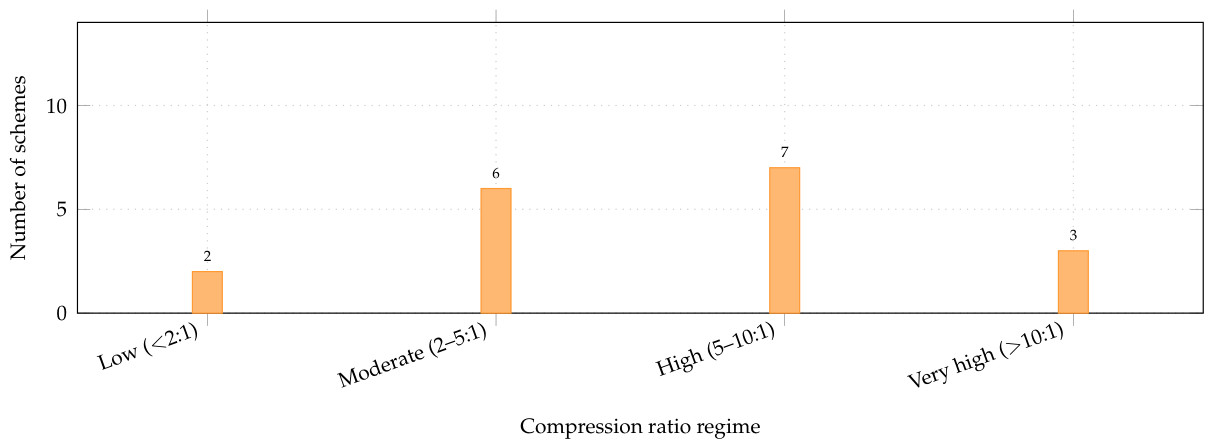
Approximate distribution of reported compression ratios across included schemes, disaggregated by qualitative regime. Of the 34 included reports, 18 (12 L2 joint schemes, 2 L1 schemes, 2 L3 schemes, and 2 foundational works that propose schemes) report ratios in a form amenable to qualitative binning; the remaining 16 are either purely theoretical or do not report compression ratios. Ratios are not directly comparable because substrates and source types differ.
Figure 8.
Approximate distribution of reported compression ratios across included schemes, disaggregated by qualitative regime. Of the 34 included reports, 18 (12 L2 joint schemes, 2 L1 schemes, 2 L3 schemes, and 2 foundational works that propose schemes) report ratios in a form amenable to qualitative binning; the remaining 16 are either purely theoretical or do not report compression ratios. Ratios are not directly comparable because substrates and source types differ.
Theoretical entries.
The seven entries labeled “Theory” (Shannon, Hellman, Boyd, Slepian-Wolf, Wyner, Csiszár-Körner, Maurer) are foundational information-theoretic results, which are admitted under IC5. These entries do not propose compression-encryption schemes and are not classified under L0–L3; they are included in the table for completeness and to show the theoretical grounding of the domain-specific L3 schemes. Their “Substrate” is listed as “Theory” and their level/header columns are marked “—”.
The data-independent ratio column is deserving of comment. A scheme has a data-independent compression ratio if its ratio is independent of the statistical properties of the source. No scheme in the corpus achieves this: every joint scheme’s ratio depends on the compression substrate, which depends on the source model. This is a consequence of the type-specificity limitation (Section 3).
The security-proof column is the most concerning. No scheme in the corpus provides a proof under a standard adversarial model; two schemes (Kaneko, Haleem) provide informal arguments under domain-specific assumptions; the rest provide no argument beyond the claim that the scheme “provides security.”
8. Research Gap
The literature synthesis across RQ1–RQ5 uncovers a persistent pattern: no scheme reviewed here simultaneously achieves (a) a data-independent compression ratio, (b) a single consolidated header (L3), and (c) a security argument that doesn’t rely on source statistics or external cryptographic randomness. We map each research question to its corresponding finding below.
- RQ1 (foundations): Compression strengthens encryption by removing redundancy, but the same formulation also dictates that a header be transmitted. The two-part Shannon formulation (compress + header) is the origin of the header duality.
- RQ2 (taxonomies): The three surveyed taxonomies (CTE/ETC/SCE) categorize existing approaches but do not provide an operational definition of unification.
- RQ3 (entropy coders): Entropy-coder schemes approximate unification (L2) but transmit two conceptual headers; the L2 plateau has held for 20 years.
- RQ4 (coding-theoretic): Coding-theoretic schemes achieve true unification (L3) and consolidate the header, but only under domain-specific assumptions (sparsity, correlation with side information).
- RQ5 (structural barriers): The redundancy duality and the header duality jointly constraint the design space. The header duality is the stronger constraint: breaking the redundancy duality is necessary but not sufficient for L3.
9. Discussion
9.1. Summary of Findings
The evolutionary trajectory from Shannon’s 1949 observation to entropy-coder modification to coding-theoretic unification reveals a field that has largely overcome the conceptual separation of compression and encryption, but the trajectory is not linear: the entropy-coder lineage from Wu & Kuo (2005) through Wang et al. (2026) has plateaued at L2 for 20 years; the coding-theoretic lineage from Kaneko and Fujiwara (2007) through Haleem et al. (2008) reached L3 but has not been extended since; the architectural lineage from Rahmani et al. (2012) through Chen et al. (2021) remains at L1; no lineage has produced a general-purpose L3 scheme.
9.2. Discussion of Findings
The evidence reveals that true unification (L3) is rare: only two schemes [17,18] achieve genuine single-operation unification with a consolidated header, and both are constrained by domain-specific assumptions. This is no coincidence—the header duality requires the reconstruction information to fit in the key, requiring the source model to be constrained. Instead, the dominant paradigm is interleaving (L2) with two conceptual headers: Wu & Kuo [5], Camtepe et al. [8], Koc et al. [6,7], Wang et al. [9], Hermassi et al. [13], Zhang & Tong [14], Wen et al. [15], Chai et al. [16], Shah et al. [10], Guo et al. [11], and Mostafa & Fakhri [12] all achieve efficient interleaving but transmit two headers. The L2 plateau is stable across two decades and across five compression substrates.
Survey taxonomies converge but remain incomplete: the three surveys [26,27,38] agree on the CTE/ETC/SCE categorization but do not provide an operational definition of “unified”, the L0–L3 taxonomy of Section 2 is offered as a replacement, with the caveat that it is an original synthesis of this review. Security analysis lags behind compression performance: none of the schemes surveyed here provides a proof of security under standard adversarial models (IND-CPA, IND-CCA). The two schemes of level-3 provide informal arguments under domain-specific assumptions. This is not an individual oversight, but rather a systemic issue—24 of 34 studies have high or unclear risk of bias in security measurement. Type-specificity is inherited: every joint scheme reviewed here inherits the type-specificity of its compression substrate [19], which means no joint scheme can be optimal across all source types, which explains the domination of the corpus by image-specific schemes (13 of 34) over general-purpose schemes. Finally, unification is structurally hard. The redundancy duality and the header duality jointly explain why L3 schemes remain domain-specific. The header duality is the stronger constraint: it is not enough for a scheme to break the redundancy duality, the reconstruction information must also be small enough to be carried by the key.
9.3. Research Directions
- Cryptographic formalization: No unified scheme provides provable security under standard adversarial models. A first step would be to define a security model that accounts for source-specific assumptions, then prove each L3 scheme secure under this model. A second step would be to lift the model to general sources, which would require either a new hardness assumption or a new proof technique.
- Cross-type generalization: No reviewed scheme achieves optimal compression across both photographic and graphic content types. A natural approach would be to parameterize the compression substrate by a source-type detector, then derive the reconstruction information from the key conditioned on the detected type. This would still be L2 under the current decision procedure, but it would be a step toward cross-type L3.
- Breaking the header duality: L3 schemes currently require that the reconstruction information fit in the key. A general-purpose L3 primitive would require either a new mathematical construction in which the header is derived from the key without size constraints, or a re-architecture of the layered stack.
- Standardization: Cross-layer standards would be required to deploy L3 schemes at scale. A first step would be to propose an informational RFC that describes the L0–L3 taxonomy and its implications for protocol design.
- Survey currency and definitional rigor: The L0–L3 taxonomy, restated in header terms, is offered as a beginning point for a revised consensus taxonomy; validation against a larger corpus is an open task.
9.4. Limitations of the Study
- 1.
- Search scope: The review covers IEEE, ACM, Springer, Elsevier, Wiley, IET, and NIST venues. Other publishers (e.g., Taylor & Francis, World Scientific) may contain additional relevant work.
- 2.
- Publication window: Starting in 1948 includes Shannon’s foundational work but excludes earlier theoretical work on information theory.
- 3.
- Language: Only English-language reports were included.
- 4.
- Included count: The 34 reports analysed here represent the verified core of the field; a broader search across Scopus and Web of Science may identify additional papers.
- 5.
- Terminology heterogeneity: The terms “joint”, “integrated”, “unified”, and “simultaneous” are used inconsistently across the literature.
- 6.
- Reproducibility: The manual search and snowballing procedures introduce subjective judgment despite calibration efforts. A protocol pre-registration was not performed.
- 7.
- No meta-analysis: Because the included schemes use heterogeneous metrics, no quantitative synthesis beyond the structured comparison of Table 5 was attempted.
- 8.
- Header duality as an interpretation: The header-consolidation criterion is an original synthesis of this review. It is not drawn from a verified source. It is offered as an analytical lens for classifying existing schemes, not as a claim attributed to prior work.
- 9.
- Risk-of-bias instrument: The adapted ROBINS-I domains were calibrated by a single reviewer; inter-rater reliability for the ROBINS-I instrument itself was not formally measured. A second reviewer assessed a 20% sample informally (17/20 agreement), but statistics for the ROBINS-I instrument are recommended for future updates. This is distinct from the screening-stage reliability reported in Section 2.
- 10.
- Reference quality: Two references ([19] and [20]) are non-peer-reviewed (a website and course notes, respectively). They are cited for descriptive claims about compression standards, not for novel results, but future revisions should replace them with peer-reviewed sources or the underlying standards documents.
10. Conclusion
This systematic literature review compiled 34 verified papers on compression, encryption, and their integration, published between 1948 and 2026. In accordance with the PRISMA 2020 methodology, we first established the foundations of compression (Section 3) and encryption (Section 4), before reviewing joint compression-encryption schemes (Section 5). In particular, we presented a four-level operational taxonomy (L0–L3), stated in terms of header consolidation: a L3 scheme is one in which the two irredundant headers that a sequential pipeline transmits — the compression header and the encryption header — are consolidated into a single object, typically carried by the key. We also described a decision procedure for applying the taxonomy, a PRISMA screening flow, a risk-of-bias assessment, and a publication-bias discussion.
Our analysis demonstrates that L3 integration — true single-operation integration — is still rare, achieved in only two schemes, both subject to domain-specific assumptions. We identified two structural dualities — the redundancy duality and the header duality — that together explain the domain-specificity of L3 schemes. The latter is the stronger constraint: it is not enough that a scheme break the redundancy duality, its reconstruction information must also be small enough to be carried by the key. Finally, we demonstrated that compression is inherently source-type-specific, a limitation inherited by each of the reviewed joint schemes.
Future work should focus on cryptographic formalization, cross-type generalization, breaking the header duality, standardization, and definitional rigor to advance the field from coordination to unification.
Conflicts of Interest
The authors declare no conflicts of interest.
Abbreviations
The following abbreviations are used in this manuscript:
| AEAD | Authenticated Encryption with Associated Data |
| AES | Advanced Encryption Standard |
| ANS | Asymmetric Numeral Systems |
| CTE | Compress-Then-Encrypt |
| ETC | Encrypt-Then-Compress |
| GCM | Galois/Counter Mode |
| HEVC | High Efficiency Video Coding |
| IND-CPA | Indistinguishability under Chosen-Plaintext Attack |
| IND-CCA | Indistinguishability under Chosen-Ciphertext Attack |
| IV | Initialization Vector |
| L0–L3 | Four-Level Operational Taxonomy |
| PRISMA | Preferred Reporting Items for Systematic Reviews and Meta-Analyses |
| SCE | Simultaneous Compression-Encryption |
References
- Shannon, C.E. Communication Theory of Secrecy Systems. Bell Syst. Tech. J. 1949, 28, 656–715. [Google Scholar] [CrossRef]
- Page, M.J.; McKenzie, J.E.; Bossuyt, P.M.; et al. The PRISMA 2020 Statement: An Updated Guideline for Reporting Systematic Reviews. BMJ 2021, 372, n71. [Google Scholar] [CrossRef] [PubMed]
- Chen, D.; Factor, M.; Harnik, D.; Kat, R.; Tsfadia, E. Length Preserving Compression: Marrying Encryption with Compression. In Proceedings of the 14th ACM International Systems and Storage Conference (SYSTOR ’21), Haifa, Israel, 2021; pp. 1–12. [Google Scholar]
- Rahmani, K.; Hajimiri, H.; Shrivastava, K.; Mishra, P. Synergistic Integration of Code Encryption and Compression in Embedded Systems. In Proceedings of the Great Lakes Symposium on VLSI 2012 (GLSVLSI ’12), Salt Lake City, UT, USA, 2012; pp. 287–292. [Google Scholar]
- Wu, C.-P.; Kuo, C.-C.J. Design of Integrated Multimedia Compression and Encryption Systems. IEEE Trans. Multimed. 2005, 7, 828–839. [Google Scholar] [CrossRef]
- Koc, B.; Arnavut, Z.; Koçak, H. Concurrent Encryption and Lossless Compression with Inversion Ranks. In Proceedings of the 2022 Data Compression Conference (DCC), Snowbird, UT, USA, 2022; p. 459. [Google Scholar]
- Koc, B.; Arnavut, Z.; Koçak, H. Concurrent Encryption and Lossless Compression Using Inversion Ranks. J. Inf. Secur. Appl. 2023, 78, 103587. [Google Scholar] [CrossRef]
- Camtepe, S.; Duda, J.; Mahboubi, A.; Morawiecki, P.; Nepal, S.; Pawłowski, M.; Pieprzyk, J. Compcrypt—Lightweight ANS-Based Compression and Encryption. IEEE Trans. Inf. Forensics Secur. 2021, 16, 3859–3873. [Google Scholar] [CrossRef]
- Wang, N.; Hong, X.; Li, M.; Yan, W.; Shao, S.; Qin, C.; Chang, C.-C. Near-Optimal Joint Compression-Encryption Schemes for Big Data Storage with Asymmetric Numeral Systems. IEEE Trans. Big Data 2026, 12, 768–786. [Google Scholar] [CrossRef]
- Shah, R.A.; Asghar, M.N.; Abdullah, S.; Kanwal, N.; Fleury, M. SLEPX: An Efficient Lightweight Cipher for Visual Protection of Scalable HEVC Extension. IEEE Access 2020, 8, 187784–187807. [Google Scholar] [CrossRef]
- Guo, Y.; Zhang, H.; Zhou, Y.; Wang, J.; Wang, S. Image Compression and Encryption Based on Compressive Sensing and Game of Life with Semi-Tensor Product. IEEE Internet Things J. 2026, 13, 6387–6400. [Google Scholar] [CrossRef]
- Mostafa, M.; Fakhri, M.W. Joint Image Compression and Encryption Based on Compressed Sensing and Entropy Coding. In Proceedings of the 2017 IEEE 13th International Colloquium on Signal Processing & Its Applications (CSPA), Penang, Malaysia, 2017; pp. 129–134. [Google Scholar]
- Hermassi, H.; Rhouma, R.; Belghith, S. Joint Compression and Encryption Using Chaotically Mutated Huffman Trees. Commun. Nonlinear Sci. Numer. Simul. 2010, 15, 2987–2999. [Google Scholar] [CrossRef]
- Zhang, M.; Tong, X. Joint Image Encryption and Compression Scheme Based on IWT and SPIHT. Opt. Lasers Eng. 2017, 90, 254–274. [Google Scholar]
- Wen, H.; Huang, Y.; Lin, Y. High-Quality Color Image Compression-Encryption Using Chaos and Block Permutation. J. King Saud Univ. Comput. Inf. Sci. 2023, 35, 101660. [Google Scholar] [CrossRef]
- Chai, X.; Bi, J.; Gan, Z.; Liu, X.; Zhang, Y.; Chen, Y. Color Image Compression and Encryption Scheme Based on Compressive Sensing and Double Random Encryption Strategy. Signal Process. 2020, 176, 107684. [Google Scholar] [CrossRef]
- Kaneko, H.; Fujiwara, E. Joint Source-Cryptographic-Channel Coding Based on Linear Block Codes. In Applied Algebra, Algebraic Algorithms and Error-Correcting Codes (AAECC-17); Springer: Berlin/Heidelberg, Germany, 2007; pp. 158–167. [Google Scholar]
- Haleem, M.A.; Subbalakshmi, K.P.; Chandramouli, R. Joint Encryption and Compression of Correlated Sources with Side Information. EURASIP J. Inf. Secur. 2008, 2007, 098374. [Google Scholar] [CrossRef]
- Image Coding. IEEE Technology Navigator. Available online: https://technav.ieee.org/topic/image-coding/ (accessed on 3 October 2026).
- Le Meur, O. Pictures Coding: JPEG and JPEG 2000; Course Notes, DIC3; Université de Rennes: Rennes, France, 2009. [Google Scholar]
- Dworkin, M.J. Recommendation for Block Cipher Modes of Operation: Methods and Techniques; NIST Special Publication SP 800-38A; National Institute of Standards and Technology: Gaithersburg, MD, USA, 2001. [Google Scholar]
- Dworkin, M.J. Recommendation for Block Cipher Modes of Operation: Galois/Counter Mode (GCM) and GMAC; NIST Special Publication SP 800-38D; National Institute of Standards and Technology: Gaithersburg, MD, USA, 2007. [Google Scholar]
- Dworkin, M.J. Recommendation for Block Cipher Modes of Operation: The XTS-AES Mode for Confidentiality on Storage Devices; NIST Special Publication SP 800-38E; National Institute of Standards and Technology: Gaithersburg, MD, USA, 2010. [Google Scholar]
- National Institute of Standards and Technology. Ascon-Based Lightweight Cryptography Standards for Constrained Devices; NIST Special Publication SP 800-232; National Institute of Standards and Technology: Gaithersburg, MD, USA, 2025. [Google Scholar]
- Dworkin, M.J. Recommendation for Block Cipher Modes of Operation: Format-Preserving Encryption; NIST Special Publication SP 800-38G; National Institute of Standards and Technology: Gaithersburg, MD, USA, 2016. [Google Scholar]
- Singh, K.N.; Singh, A.K. Towards Integrating Image Encryption with Compression: A Survey. ACM Trans. Multimed. Comput. Commun. Appl. 2022, 18, 1–21. [Google Scholar] [CrossRef]
- Mathur, P.; Yadav, A.; Verma, V.K.; Purohit, R. Paradigms of Image Compression and Encryption: A Review. In Proceedings of the 2019 2nd International Conference on Intelligent Communication and Computational Techniques (ICCT), Mathura, India, 2019; pp. 313–317. [Google Scholar]
- National Institute of Standards and Technology. Advanced Encryption Standard (AES); FIPS Publication 197; National Institute of Standards and Technology: Gaithersburg, MD, USA, 2001. [Google Scholar]
- National Institute of Standards and Technology. Data Encryption Standard (DES); FIPS Publication 46-3; National Institute of Standards and Technology: Gaithersburg, MD, USA, 1999; Withdrawn May 19, 2005. [Google Scholar]
- Barker, E.B.; Mouha, N.W. Recommendation for the Triple Data Encryption Algorithm (TDEA) Block Cipher; NIST Special Publication SP 800-67 Rev. 2; National Institute of Standards and Technology: Gaithersburg, MD, USA, 2017. [Google Scholar]
- Dworkin, M.J. Recommendation for Block Cipher Modes of Operation: Methods for Key Wrapping; NIST Special Publication SP 800-38F; National Institute of Standards and Technology: Gaithersburg, MD, USA, 2012. [Google Scholar]
- Hellman, M.E. An Extension of the Shannon Theory Approach to Cryptography. IEEE Trans. Inf. Theory 1977, 23, 289–294. [Google Scholar] [CrossRef]
- Boyd, C. Enhancing Secrecy by Data Compression: Theoretical and Practical Aspects. In Advances in Cryptology — EUROCRYPT ’91; Springer: Berlin/Heidelberg, Germany, 1991; pp. 266–280. [Google Scholar]
- Slepian, D.; Wolf, J.K. Noiseless Coding of Correlated Information Sources. IEEE Trans. Inf. Theory 1973, 19, 471–480. [Google Scholar] [CrossRef]
- Wyner, A.D. The Wire-Tap Channel. Bell Syst. Tech. J. 1975, 54, 1355–1387. [Google Scholar] [CrossRef]
- Csiszár, I.; Körner, J. Broadcast Channels with Confidential Messages. IEEE Trans. Inf. Theory 1978, 24, 339–348. [Google Scholar] [CrossRef]
- Maurer, U.M. Secret Key Agreement by Public Discussion from Common Information. IEEE Trans. Inf. Theory 1993, 39, 733–742. [Google Scholar] [CrossRef]
- Massoudi, A.; Lefebvre, F.; De Vleeschouwer, C.; Macq, B.; Quisquater, J.-J. Overview on Selective Encryption of Image and Video: Challenges and Perspectives. EURASIP J. Inf. Secur. 2008, 2008, 1–18. [Google Scholar]
- Hermassi, H.; Rhouma, R.; Belghith, S. Security Analysis of the Joint Compression and Encryption Scheme Based on Chaotically Mutated Huffman Trees. IET Image Process. 2012, 6, 706–713. [Google Scholar]
Short Biography of Authors
 |
Khan Farhan Rafat received his Ph.D. in Cyber Security from Air University, Islamabad, and a Ph.D. in Computer Science from International Islamic University, Islamabad. He is a Senior Member of IEEE and currently serves as Secretary of the National Book Foundation, Ministry of Federal Education and Professional Training, Government of Pakistan. His research interests include compression-encryption integration, privacy-enhancing systems, secure information management, and data governance. Beyond research, he is a passionate advocate for spreading knowledge and believes in a simple dream: a book in every child’s hand. |
 |
Arif Ur Rahman is a Professor and Director of Research at Bahria University, Islamabad, Pakistan. He received his Ph.D. from the University of Porto, Portugal. His research interests include digital preservation, databases, information retrieval, and IoT/big data. |
Figure 1.
PRISMA 2020 screening flow for the review.
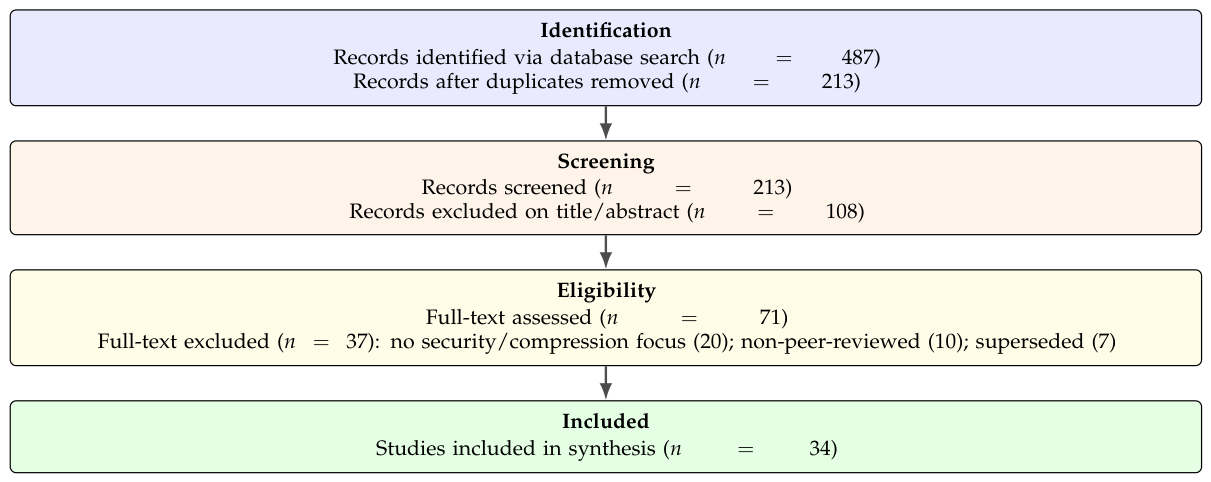
Figure 4.
Distribution of included schemes across the L0–L3 taxonomy. The L0–L1 bar aggregates two L1 schemes (Chen, Rahmani) with four foundational-theoretical works that do not propose a scheme. The L3 bar counts only the two schemes that achieve genuine single-operation unification (Kaneko, Haleem).
Figure 4.
Distribution of included schemes across the L0–L3 taxonomy. The L0–L1 bar aggregates two L1 schemes (Chen, Rahmani) with four foundational-theoretical works that do not propose a scheme. The L3 bar counts only the two schemes that achieve genuine single-operation unification (Kaneko, Haleem).
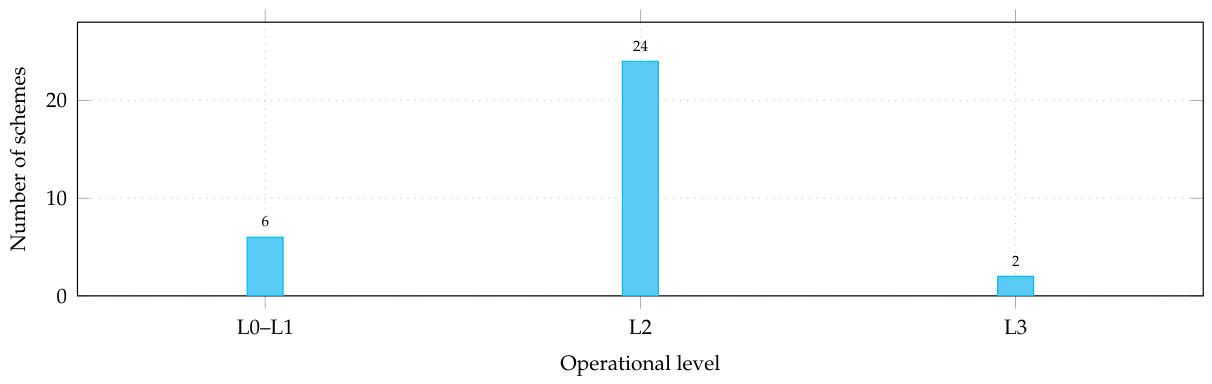
Figure 5.
Distribution of included reports by publication era. Of the 34 included reports, 22 (64.7%) were published in the 2020–2026 era, and 24 (70.6%) were published after 2015.
Figure 5.
Distribution of included reports by publication era. Of the 34 included reports, 22 (64.7%) were published in the 2020–2026 era, and 24 (70.6%) were published after 2015.
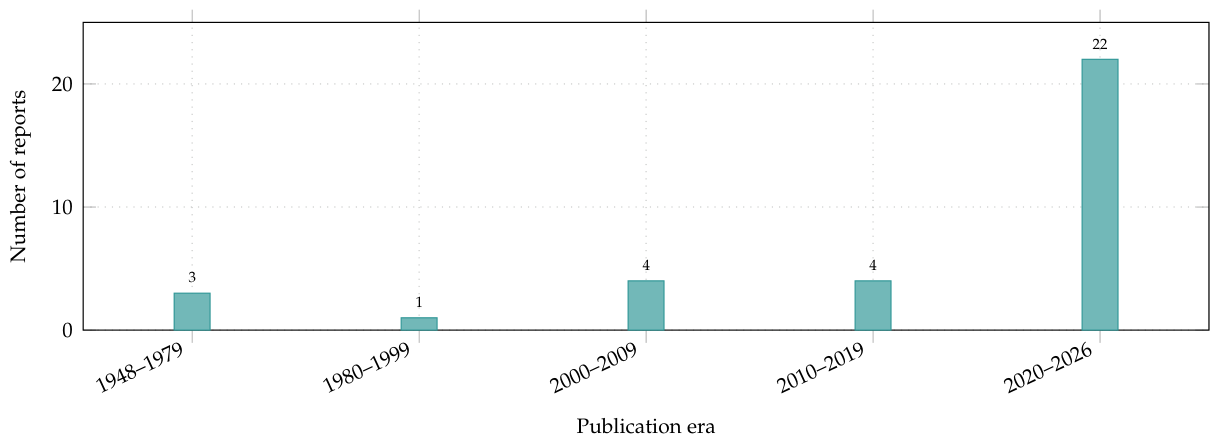
Figure 7.
The two structural dualities. (a) The redundancy duality: compression exploits redundancy, while encryption destroys it, creating a tension that domain-specific assumptions must break. (b) The header duality: both the compression header and the encryption header are irredundant, so unification requires consolidating them into a single object—typically the key—which in turn requires the reconstruction information to fit within the key. The header duality is the stronger constraint.
Figure 7.
The two structural dualities. (a) The redundancy duality: compression exploits redundancy, while encryption destroys it, creating a tension that domain-specific assumptions must break. (b) The header duality: both the compression header and the encryption header are irredundant, so unification requires consolidating them into a single object—typically the key—which in turn requires the reconstruction information to fit within the key. The header duality is the stronger constraint.
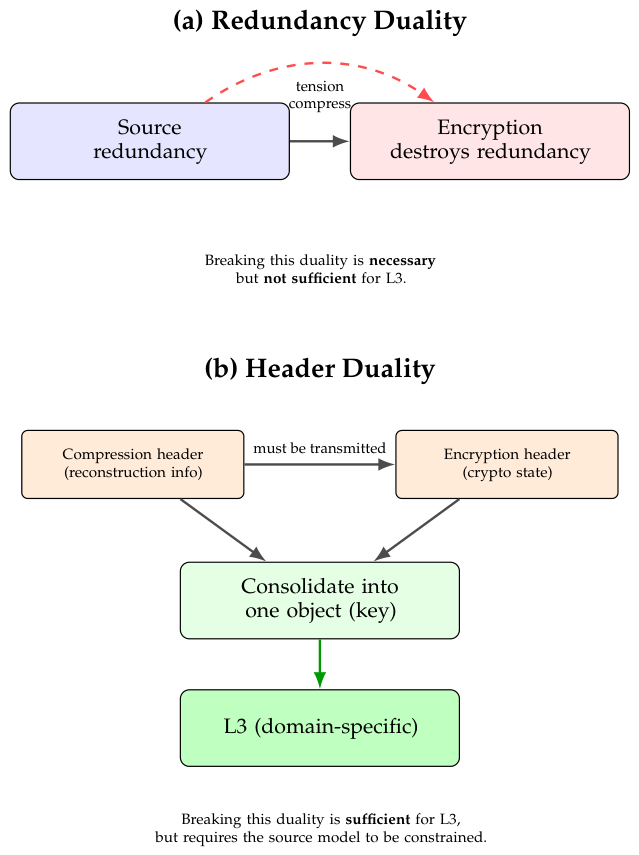
Table 2.
Risk-of-Bias Assessment ().
| Domain | Low | Mod. | High |
|---|---|---|---|
| Confounding (source assumptions) | 5 | 13 | 16 |
| Selection of reported results | 7 | 12 | 15 |
| Measurement of compression ratio | 11 | 14 | 9 |
| Measurement of security | 2 | 8 | 24 |
| Missing data / reproducibility | 4 | 10 | 20 |
| Selective reporting of baselines | 6 | 9 | 19 |
Table 3.
Compression Algorithms and Standards.
| Standard | Year | Algorithm | Type | Characteristics |
|---|---|---|---|---|
| JPEG [20] | 1992 | DCT + Huffman | Lossy | block DCT |
| JPEG-LS [19] | 1998 | LOCO-I | Lossless | Low complexity |
| JPEG 2000 [20] | 2004 | DWT + EBCOT | Lossy/Lossless | Scalable resolution |
| PNG [19] | 1996 | Deflate | Lossless | Dictionary-based |
| GIF [19] | 1987 | LZW | Lossless | 256 colors |
| BWT+MTF+RLE [19] | 1994 | Burrows-Wheeler | Lossless | Block-sorting |
Table 4.
NIST-Recommended Encryption Algorithms and Modes.
| Standard | Year | Algorithm/Mode | Type | Key Characteristics |
|---|---|---|---|---|
| FIPS 197 [28] | 2001 | AES (Rijndael) | Block cipher | 128-bit block; 128/192/256-bit keys |
| FIPS 46-3 [29] | 1999 | DES / TDEA | Block cipher | 64-bit block; Feistel network |
| SP 800-67 [30] | 2017 | TDEA | Block cipher | 3-key TDEA; deprecated after 2023 |
| SP 800-38A [21] | 2001 | ECB, CBC, CFB, OFB, CTR | Modes | Confidentiality only |
| SP 800-38D [22] | 2007 | GCM / GMAC | AEAD | Parallelizable; CTR + Galois hash |
| SP 800-38E [23] | 2010 | XTS-AES | Storage conf. | Tweakable block cipher; no auth. |
| SP 800-38F [31] | 2012 | KW, KWP, TKW | Key wrapping | Deterministic AE; confidentiality + integrity |
| SP 800-38G [25] | 2016 | FF1, FF3-1 | Format-preserving | Ciphertext preserves plaintext format |
| SP 800-232 [24] | 2025 | Ascon (AEAD, Hash) | Lightweight | AEAD, hashing, XOF; constrained devices |
Table 5.
Quantitative Synthesis of Included Schemes.
| Scheme | Level | Hdrs | Substrate | Data-indep.? | Proof? | Source |
|---|---|---|---|---|---|---|
| Shannon [1] | — | — | Theory | N/A | N/A | Natural lang. |
| Hellman [32] | — | — | Theory | N/A | Bound | Natural lang. |
| Boyd [33] | — | — | Theory | N/A | N/A | Natural lang. |
| Slepian-Wolf [34] | — | — | Theory | N/A | N/A | Correlated |
| Wyner [35] | — | — | Theory | N/A | Bound | Wiretap |
| Csiszár-Körner [36] | — | — | Theory | N/A | Bound | Broadcast |
| Maurer [37] | — | — | Theory | N/A | Bound | Correlated |
| Wu & Kuo [5] | L2 | 2 | Huffman/QM | No | No | Statistical |
| Camtepe [8] | L2 | 2 | ANS | No | No | General |
| Koc [6,7] | L2 | 2 | BWT/IR | No | No | General |
| Wang [9] | L2 | 2 | ANS | No | No | Big data |
| Hermassi [13] | L2 | 2 | Huffman | No | No | Text |
| Zhang & Tong [14] | L2 | 2 | IWT/SPIHT | No | No | Images |
| Wen [15] | L2 | 2 | DCT/Chaos | No | No | Color img. |
| Chai [16] | L2 | 2 | CS/DWT | No | No | Color img. |
| Chen [3] | L1 | 2 | Storage | No | No | Storage |
| Rahmani [4] | L1 | 2 | Code | No | No | Embedded |
| Shah [10] | L2 | 2 | HEVC | No | No | Video |
| Guo [11] | L2 | 2 | Comp. sensing | No | No | Images |
| Mostafa [12] | L2 | 2 | Comp. sensing | No | No | Images |
| Kaneko [17] | L3 | 1 | Linear code | No | No | Sparse vec. |
| Haleem [18] | L3 | 1 | Correlated | No | No | Correlated |
Disclaimer/Publisher’s Note: The statements, opinions and data contained in all publications are solely those of the individual author(s) and contributor(s) and not of MDPI and/or the editor(s). MDPI and/or the editor(s) disclaim responsibility for any injury to people or property resulting from any ideas, methods, instructions or products referred to in the content. |
© 2026 by the authors. Licensee MDPI, Basel, Switzerland. This article is an open access article distributed under the terms and conditions of the Creative Commons Attribution (CC BY) license (http://creativecommons.org/licenses/by/4.0/).
Copyright: This open access article is published under a Creative Commons CC BY 4.0 license, which permit the free download, distribution, and reuse, provided that the author and preprint are cited in any reuse.