

Submitted:
18 October 2026
Posted:
20 October 2026
You are already at the latest version
Abstract
The sustained deployment of human missions and permanent settlements on Mars will depend on highly reliable electrical power systems to support life-support facilities, habitats, scientific instruments, communication networks, in-situ resource utilization, transportation, and other mission-critical operations. The safety and uninterrupted operation of astronauts’ electrical and electronic equipment,including spacesuits, rovers, autonomous robots, sensing devices, and power electronics are equally essential for mission success. This is because, electrostatic discharge (ESD) generated during Martian dust storms may pose significant risks by affecting spacecraft electronics, communication systems, scientific instruments, and solar photovoltaic (PV) power systems through tribo electric charging, dust deposition, and electrical breakdown. Accurate prediction of these coupled phenomena remains challenging because conventional models do not simultaneously account for atmospheric flow, particle electrification, electric-field evolution, and dynamic gas breakdown under Martian environmental conditions. This research presents an integrated computational and experimental framework that combines Computational Fluid Dynamics (CFD), a Physics-Informed Neural Network (PINN), and a novel Dynamic Mars Paschen Model (DMPM) to predict electrostatic discharge and assess its impact on Martian surface sys tems. The CFD model simulates airflow, dust transport, and pressure distribution within a Martian environmental chamber, while the PINN incorporates the governing equations of fluid flow, charge conservation, and electrostatic field evolution to efficiently predict triboelectric charge accumulation and electric-field intensity. The proposed DMPM extends the classical Paschen law by incorporating the effects of airflow velocity, dust concentration, atmospheric temperature, triboelectric charge density, and carbon dioxide frost coverage to estimate the dynamic breakdown voltage under realistic Martian conditions. Experimental validation con ducted in a purpose-built Martian environmental chamber demonstrated excellent agreement between numerical predictions and laboratory measurements, with coefficients of determination exceeding 0.98 and prediction errors generally below 3%. Beyond electrostatic discharge prediction, the developed laboratory provides a sustainable multidisciplinary research platform for investi gating dust-induced degradation of Martian solar PV systems, evaluating electrostatic mitigation technologies, validating planetary instrumentation, and supporting future Mars exploration research. The proposed CFD–PINN–DMPM framework therefore con tributes to improved mission safety, energy-system reliability, and the long-term sustainability of planetary surface operations.
Keywords:
Mars
; Martian dust storms
; electrostatic discharge
; triboelectric charging
; Paschen breakdown
; physics-informed neural networks
; machine learning
; computational fluid dynamics
; planetary electrostatics
; Mars regolith
; frost formation
; artificial intelligence
1. Introduction
Mars has long been regarded as one of the most scientifically compelling targets for planetary exploration owing to its geological diversity, evidence of ancient fluvial activity, and potential for future human habitation Haberle et al. (2017); Carr (2006). Over the past five decades, numerous orbital, landed, and rover missions have substantially improved our understanding of the Martian atmosphere, climate, mineralogy, and surface evolution. Despite these advances, the Martian environment remains extremely hostile to engineering systems because of its low atmospheric pressure, predominantly carbon dioxide (CO2) atmosphere, intense ultraviolet radiation, large diurnal temperature variations, pervasive dust activity, and seasonal frost cycles Forget et al. (1999); Smith (2004).
Among these environmental challenges, atmospheric dust represents one of the most persistent hazards to both robotic and future human exploration missions. Martian dust particles, typically ranging from sub-micrometre to several hundred micrometres in diameter, are readily lifted by surface winds and convective vortices, producing local dust devils, regional storms, and occasionally planet-encircling dust events Cantor (2007); Montabone et al. (2015). These storms significantly reduce atmospheric visibility, decrease solar irradiance reaching photovoltaic systems, contaminate optical instruments, abrade mechanical components, and alter atmospheric thermal balance through radiative forcing Kahre et al. (2017). Consequently, understanding the physical processes governing dust transport remains a priority for planetary science and mission engineering.
Beyond these well-recognized mechanical and optical effects, Martian dust transport is accompanied by significant electrostatic phenomena. During saltation and suspension, repeated particle–particle and particle–surface collisions generate triboelectric charge separation, leading to the accumulation of large electric fields within dust clouds Kok and Renno (2009); Merrison et al. (2016). Laboratory experiments performed under simulated Martian atmospheric conditions have demonstrated that electrically charged dust can produce glow discharges, corona discharges, and transient spark events when the local electric field exceeds the gas breakdown threshold Eden and Vonnegut (1973); Krauss et al. (2003); Méndez Harper et al. (2021). Such electrostatic discharge (ESD) events may interfere with scientific instruments, damage sensitive electronics, accelerate material degradation, compromise communication systems, and present potential hazards for astronauts and in-situ resource utilization (ISRU) technologies.
The prediction of electrical breakdown in gases has traditionally relied on the classical Paschen law, which relates the breakdown voltage to the product of gas pressure and electrode spacing Paschen (1889). Although Paschen’s law has proven remarkably successful for uniform electric fields in laboratory plasmas, its application to Martian dust storms remains problematic. The classical formulation assumes stationary electrodes, homogeneous gas properties, and quasi-static electric fields. In contrast, electric fields within Martian dust storms evolve continuously owing to turbulent airflow, particle transport, triboelectric charging, charge relaxation, plasma formation, and transient atmospheric conditions. Consequently, the assumptions underlying the classical Paschen equation are not fully representative of the highly dynamic environment encountered on the Martian surface.
Recent advances in numerical modelling have significantly improved the understanding of Martian atmospheric electrification. Computational Fluid Dynamics (CFD) models have successfully reproduced atmospheric circulation, turbulent boundary layers, and dust transport mechanisms under low-pressure CO2 conditions Kahre et al. (2017). Discrete Element Methods (DEM) have provided detailed descriptions of particle collisions and saltation dynamics, while electrostatic particle models have investigated triboelectric charging during granular transport Kok and Renno (2009). Nevertheless, these computational approaches remain computationally expensive and often treat fluid dynamics, particle charging, and electrical breakdown as independent processes. Moreover, many existing models neglect seasonal frost formation despite observational evidence indicating that frost modifies particle cohesion, surface conductivity, dielectric properties, and dust mobilisation Piqueux et al. (2016).
Recent in-situ observations obtained by the Perseverance rover have confirmed the occurrence of triboelectric electrical discharges associated with Martian dust devils and dust storms, providing the first direct evidence that electric fields generated by particle collisions can reach atmospheric breakdown conditions Chide et al. (2025). These observations strongly support previous theoretical predictions regarding electrostatic activity on Mars while highlighting the need for predictive computational frameworks capable of coupling atmospheric dynamics, triboelectric charging, electric-field evolution, and breakdown processes.
Machine learning has recently emerged as an attractive alternative for modelling complex nonlinear physical systems. Conventional Artificial Neural Networks (ANNs), Support Vector Machines (SVMs), Gaussian Process Regression (GPR), and deep learning architectures have demonstrated considerable success in engineering prediction tasks. However, purely data-driven models generally require extensive labelled datasets and frequently violate governing physical laws outside the range of available observations Goodfellow et al. (2016). These limitations are particularly important in planetary science, where experimental data are inherently scarce and expensive to obtain.
Physics-Informed Neural Networks (PINNs), introduced by Raissi et al. Raissi et al. (2019), provide a promising alternative by embedding governing differential equations directly into the optimisation process. Instead of relying solely on experimental observations, PINNs enforce physical conservation laws such as the Navier–Stokes equations, Poisson’s equation, Maxwell’s equations, heat transfer equations, and conservation of charge during training. This integration enables accurate predictions using relatively small datasets while maintaining physical consistency throughout the computational domain. PINNs have demonstrated remarkable performance in fluid mechanics, plasma physics, heat transfer, and inverse problems Karniadakis et al. (2021). However, their application to Martian atmospheric electrification remains largely unexplored.
To date, no published study has simultaneously coupled atmospheric turbulence, triboelectric charging, frost evolution, electrical breakdown, and physics-informed machine learning into a unified predictive framework for Martian electrostatic discharge. Existing investigations generally focus on individual processes such as triboelectric charging, plasma discharge, CFD modelling, or atmospheric electricity without explicitly accounting for their mutual interactions. Furthermore, laboratory validation of coupled electrofluid phenomena under representative Martian environmental conditions remains limited.
This research addresses these knowledge gaps by developing a novel Dynamic Mars Paschen Model (DMPM) integrated with a Physics-Informed Neural Network for predicting electrostatic discharge in Martian dust storms. The proposed framework extends the classical Paschen equation by incorporating turbulence intensity, triboelectric charge density, and seasonal frost coverage as additional state variables governing electrical breakdown. A dedicated laboratory-scale Martian wind tunnel is designed to reproduce low-pressure CO2 atmospheric conditions, controlled dust transport, turbulence generation, and frost deposition while simultaneously measuring airflow, electric fields, triboelectric charge, plasma emission, and breakdown voltage using synchronized diagnostic systems. These experimental measurements provide the training and validation data required by the proposed PINN while ensuring that the computational model remains physically consistent through the incorporation of governing conservation equations.
The principal objectives of this study are therefore to: (i) quantify the influence of atmospheric turbulence, triboelectric charging, and frost formation on electrical breakdown under simulated Martian conditions; (ii) formulate a Dynamic Mars Paschen Model capable of describing transient electrostatic discharge; (iii) develop a Physics-Informed Neural Network that integrates fluid dynamics, electrostatics, heat transfer, and gas discharge physics; and (iv) experimentally validate the proposed framework using synchronized laboratory measurements. By combining laboratory experimentation with physics-informed machine learning, this research seeks to provide a computationally efficient and physically robust methodology for evaluating electrostatic hazards associated with future robotic and human exploration of Mars.
The remainder of this paper is organized as follows. Section 2 presents a comprehensive review of Martian dust electrification, Paschen breakdown, triboelectric charging, computational fluid dynamics, and Physics-Informed Neural Networks. Section 3 develops the theoretical framework and governing equations underlying the proposed Dynamic Mars Paschen Model. Section 4 describes the experimental facility and laboratory methodology. Section 5 presents the development of the Physics-Informed Neural Network. Section 6 reports the experimental and computational results, followed by a discussion in Section 7. Finally, Section 8 summarizes the principal findings, research contributions, limitations, and recommendations for future work.
2. Literature Review
2.1. Martian Dust Electrification
Martian dust electrification has received considerable attention in planetary science because of its implications for atmospheric electricity, plasma generation, spacecraft reliability, and future human exploration missions. The Martian atmosphere consists of approximately 95.3% carbon dioxide (CO2) with an average surface pressure ranging between 600 and 1000 Pa, creating a low-density environment that favors long electron mean free paths and efficient electrostatic charge accumulation Haberle et al. (2017). During dust lifting, saltation, and suspension, repeated particle–particle and particle–surface collisions generate triboelectric charging, producing localized electric fields that may exceed the dielectric strength of the surrounding atmosphere and initiate electrostatic discharge (ESD) Merrison et al. (2016); Kok and Renno (2009). Such discharges may interfere with spacecraft electronics, communication systems, scientific payloads, and future in-situ resource utilization (ISRU) facilities.
The earliest experimental evidence supporting the possibility of electrostatic discharge on Mars was reported by Eden and Vonnegut (1973), who demonstrated that moving silicate particles under low-pressure CO2 conditions generated visible electrical discharges. Although these pioneering experiments confirmed the feasibility of Martian atmospheric electrification, the laboratory configuration employed static gas conditions and therefore did not reproduce realistic atmospheric turbulence or continuous dust transport. Shortly afterwards, Mills (1977) showed that frictionally generated dust clouds produced glow discharges once sufficient electrostatic charge had accumulated. Their experiments further demonstrated that the reduced atmospheric density on Mars lowers the breakdown threshold compared with terrestrial conditions, although transient electric-field evolution was not investigated.
A significant advancement was achieved by Krauss et al. (2003), who developed improved laboratory simulations of Martian dust storms and demonstrated that localized electrostatic discharges can occur even when the average electric field remains below the classical Paschen threshold. Their results highlighted the importance of heterogeneous charge accumulation caused by particle clustering, indicating that electrical breakdown in Martian dust storms should be regarded as a dynamic rather than purely static process. More recently, Méndez Harper et al. (2021) employed high-speed optical diagnostics to investigate spark discharges generated solely by particle–particle interactions while minimizing chamber-wall charging effects. Their observations provided direct evidence that collisions among Martian regolith simulants alone can generate sufficient charge densities to initiate electrical breakdown under representative Martian atmospheric conditions.
The fundamental mechanism responsible for dust electrification is triboelectric charging, whereby electrical charge is exchanged between contacting particles through repeated collisions. The resulting volumetric charge density within a dust cloud is quantified by Equation (1),
where denotes the volumetric charge density (C m−3), Q is the total accumulated electric charge (C), and V is the effective volume of the charged dust cloud (m3). Equation (1) shows that increasing the accumulated charge or reducing the cloud volume increases the charge density, thereby enhancing the probability of electrical breakdown.
The electric field generated by the accumulated charges is governed by Gauss’s law, expressed in Equation (2),
where is the electric field vector (V m−1) and is the permittivity of free space. According to Equation (2), localized regions of high charge density produce stronger electric fields. Consequently, highly concentrated dust clouds generated by turbulent atmospheric flow are expected to exhibit greater susceptibility to electrostatic discharge than uniformly distributed particle clouds.
Several numerical investigations have attempted to couple triboelectric charging with atmospheric dust transport. For example, Kok and Renno (2009) developed an electrostatic saltation model demonstrating that repeated particle collisions generate electric fields sufficiently strong to influence atmospheric chemistry and dust transport processes. Although the model successfully reproduced charge accumulation during saltation, it assumed simplified particle interactions and neglected atmospheric turbulence, frost formation, transient plasma dynamics, and experimental validation under representative Martian conditions.
The cumulative triboelectric charge generated through repeated particle collisions can be approximated by Equation (3),
where is the total accumulated triboelectric charge (C), represents the number of particle collisions, and is the average electrical charge transferred during each collision. Equation (3) demonstrates that total charge accumulation depends directly on collision frequency and charge-transfer efficiency. Since both parameters are strongly influenced by wind velocity, turbulence intensity, particle-size distribution, atmospheric pressure, and dust concentration, triboelectric charging within Martian dust storms is inherently transient and spatially heterogeneous.
A conceptual representation of these coupled physical processes is illustrated in Figure 1. The figure summarizes the sequence of wind-driven particle transport, triboelectric charging, charge separation, electric-field development, and eventual electrostatic discharge. It highlights the strong coupling between atmospheric dynamics and electrical processes that forms the physical basis of the proposed Dynamic Mars Paschen Model.
Overall, the literature demonstrates that triboelectric charging is the dominant mechanism responsible for electrical activity within Martian dust storms. However, current experimental and numerical models generally neglect the simultaneous interaction of atmospheric turbulence, particle transport, frost evolution, charge conservation, and transient electrical breakdown. This review therefore identifies a significant scientific gap in the development of integrated predictive models. To address this limitation, the present study proposes a Dynamic Mars Paschen Model (DMPM) constrained by a Physics-Informed Neural Network (PINN), providing a unified multiphysics framework capable of predicting electrostatic discharge under realistic Martian environmental conditions. Table 1 and Table 2 summarize the comparison of representative studies on Martian dust electrification and the proposed Dynamic Mars Paschen Model highlighting, methods used, limitations and the research gap addressed
2.2. Paschen Breakdown Under Martian Conditions
Electrical breakdown in gases is a fundamental phenomenon in plasma physics and high-voltage engineering. It occurs when an applied electric field accelerates free electrons to energies sufficient to ionize neutral gas molecules, initiating an electron avalanche that evolves into a self-sustaining electrical discharge. The theoretical foundation of gaseous electrical breakdown was established through Townsend’s ionization theory and later formalized by Paschen, who demonstrated that the breakdown voltage depends primarily on the product of gas pressure and electrode spacing Townsend (1915); Paschen (1889); Raizer (1991). Paschen’s law has since become one of the most widely used models for predicting electrical breakdown in gases and remains the basis of numerous engineering applications involving insulation design, plasma generation, and high-voltage systems.
The classical Paschen equation is introduced in Equation (4),
where is the breakdown voltage (V), A and B are the first Townsend ionization coefficients that depend on the gas composition, p is the gas pressure (Pa), d is the electrode spacing (m), and is the secondary electron emission coefficient. Equation (4) predicts that the breakdown voltage varies nonlinearly with the pressure–distance product (), producing the well-known Paschen curve characterized by a minimum breakdown voltage known as the Paschen minimum.
The physical interpretation of Equation (4) is illustrated conceptually in Figure 2. At very low pressures, electrons travel long distances between collisions, resulting in insufficient ionization to sustain an electron avalanche. Conversely, at high pressures, frequent collisions prevent electrons from acquiring sufficient kinetic energy before impact, thereby increasing the required breakdown voltage. Between these two extremes lies the Paschen minimum, where ionization efficiency is maximized and electrical breakdown occurs at the lowest applied voltage.
The first Townsend ionization coefficient is commonly expressed by Equation (5),
where denotes the number of ionizing collisions per unit distance (m−1) and E is the applied electric field (V m−1). Equation (5) demonstrates that ionization increases with electric-field strength and decreases with increasing gas density. Consequently, low-pressure environments such as the Martian atmosphere require substantially lower electric-field strengths to initiate breakdown than dense terrestrial atmospheres.
Electrical breakdown occurs when the Townsend avalanche satisfies the self-sustaining condition given by Equation (6),
where is the secondary electron emission coefficient and represents the total ionization gain over the discharge gap. Equation (6) defines the onset of stable electrical breakdown by balancing electron multiplication with secondary electron emission from the cathode.
Although Equations (4)–(6) accurately describe electrical breakdown in uniform electric fields, their application to Martian dust storms remains limited. The classical derivation assumes stationary electrodes, homogeneous gas composition, constant pressure, and static electric fields. In contrast, Martian dust storms are characterized by turbulent airflow, continuously moving charged particles, transient electric fields, heterogeneous charge distributions, seasonal frost formation, and evolving plasma conductivity. These coupled processes violate several assumptions underlying the classical Paschen formulation.
Experimental investigations have nevertheless demonstrated that electrical breakdown can occur under representative Martian atmospheric conditions. Eden and Vonnegut Eden and Vonnegut (1973) first observed visible electrical discharges generated by moving silicate particles in low-pressure CO2 atmospheres, establishing the feasibility of atmospheric breakdown on Mars. Mills (1977) subsequently reported glow discharges generated by triboelectrically charged dust clouds, confirming that frictional charging alone could initiate plasma formation under reduced atmospheric pressure.
More advanced laboratory investigations by Krauss et al. (2003); Krauss et al. (2006). They demonstrated that localized electrical discharges frequently occur before the average electric field reaches the classical Paschen threshold. Their results indicated that particle clustering creates localized regions of high charge density that produce electric-field intensification, effectively lowering the local breakdown voltage. These observations suggest that electrical breakdown within Martian dust storms is governed by transient local conditions rather than the average atmospheric properties assumed by the classical Paschen equation.
Numerical investigations have reached similar conclusions. Kok and Renno Kok and Renno (2009) developed a coupled electrostatic saltation model showing that triboelectric charging significantly modifies atmospheric electrical properties and may influence plasma chemistry. However, the model did not explicitly include transient turbulence, seasonal frost, or dynamic gas-discharge physics. More recently, Méndez Harper et al. Méndez Harper et al. (2021); Taxis et al. (2026); Chide et al. (2025) experimentally demonstrated that particle–particle collisions alone are capable of generating spark discharges under simulated Martian conditions, providing direct evidence that electrostatic breakdown may occur naturally within dust storms without requiring conductive chamber walls.
The method and main contribution of relevant Paschen-based investigations are summarised in Table 3, whereas a comparison between representative Paschen-based investigations with the proposed study is summarized in Table 4 . The comparison indicates that previous theoretical, numerical, and experimental studies have substantially advanced the understanding of Martian atmospheric breakdown. Nevertheless, existing approaches generally assume static atmospheric conditions or neglect one or more of the interacting physical processes governing electrical discharge.
The limitations identified in Table 3 motivate the development of a Dynamic Mars Paschen Model (DMPM), in which the classical Paschen law is extended to account for transient turbulence intensity, triboelectric charge density, frost coverage, and evolving atmospheric conditions. The proposed formulation is expressed in Equation (7),
where is the modified breakdown voltage, I is the turbulence intensity, F is the fractional frost coverage, is the local charge density, and , , and are experimentally determined coefficients. Unlike the classical Paschen equation, Equation (7) allows the breakdown voltage to evolve dynamically with changing environmental conditions. This modified formulation forms the physical foundation of the Physics-Informed Neural Network developed in the subsequent sections.
2.2.1. Dimensionless Analysis
To further characterize electrical breakdown under Martian atmospheric conditions, several dimensionless parameters governing fluid flow, heat transfer, and plasma formation are considered. These parameters quantify the relative importance of inertial, viscous, diffusive, and electrostatic forces and provide insight into the applicability of the proposed Dynamic Mars Paschen Model.
The flow regime inside the Martian wind tunnel is characterized by the Reynolds number, defined by Equation (8),
where is the gas density, U is the characteristic airflow velocity, L is the characteristic length, and is the dynamic viscosity. Under Martian atmospheric conditions, the Reynolds number is generally much lower than terrestrial values because of the reduced atmospheric density, leading to transitional flow regimes.
In addition, the degree of rarefaction is quantified using the Knudsen number, introduced in Equation (9),
where denotes the molecular mean free path and L is the characteristic length. Because the Martian atmosphere possesses a relatively long molecular mean free path, continuum assumptions become less accurate than under terrestrial conditions, particularly near the Paschen minimum.
Another characteristic that shows the relative importance of convective and conductive heat transfer is described by the Peclet number, introduced in Equation (10),below
where denotes the Prandtl number. This parameter becomes important during frost formation because it governs the thermal transport responsible for condensation and sublimation.
Finally, the electrostatic shielding distance within a weakly ionized plasma is characterized by the Debye length, introduced in Equation (11),
where is the Debye length (m), representing the characteristic distance over which electric fields are screened within a plasma; is the vacuum permittivity ( F m−1); is the Boltzmann constant ( J K−1); is the electron temperature (K), which describes the average kinetic energy of the electrons; is the electron number density (m−3); and e is the elementary charge ( C).
Equation (11) indicates that the Debye length increases with increasing electron temperature and decreases with increasing electron number density. Physically, a larger Debye length implies that electrostatic potentials extend over greater distances before being screened by the surrounding plasma, whereas a smaller Debye length corresponds to stronger electrostatic shielding. Under Martian atmospheric conditions, where the plasma generated by electrostatic discharge is weakly ionized and the ambient gas density is low, the Debye length can become significantly larger than in terrestrial atmospheric plasmas. Consequently, localized electric fields generated by triboelectrically charged dust particles may persist over relatively long distances, facilitating electron acceleration and enhancing the probability of electrical breakdown.
In the proposed Dynamic Mars Paschen Model (DMPM), the Debye length provides a quantitative measure of plasma shielding and is used to characterize the spatial extent of charge screening following electrostatic discharge. Incorporating Equation (11) into the Physics-Informed Neural Network (PINN) enables the model to account for plasma evolution in addition to atmospheric flow, triboelectric charging, and gas breakdown, thereby improving the physical realism of electrostatic discharge predictions under Martian environmental conditions.
The governing dimensionless parameters considered in this study are summarized in Table 5. These parameters collectively describe the coupled fluid, thermal, and electrostatic processes incorporated into the Dynamic Mars Paschen Model.
The literature reviewed above demonstrates that the classical Paschen law does not explicitly account for the transient multiphysics processes governing Martian atmospheric electrification. Based on these observations, this study proposes the Dynamic Mars Paschen Model (DMPM), expressed in Equation (7), in which the classical breakdown voltage is modified by turbulence intensity, triboelectric charge density, and frost coverage. The DMPM serves as the governing physical constraint embedded within the Physics-Informed Neural Network presented in Section 3, enabling dynamic prediction of electrostatic discharge under realistic Martian environmental conditions.
2.3. Computational Fluid Dynamics (CFD) Modelling
Computational Fluid Dynamics (CFD) has become one of the principal numerical tools for investigating atmospheric transport, dust lifting, turbulence, and particle dispersion on Mars. Owing to the difficulty of conducting large-scale field measurements under Martian environmental conditions, CFD simulations provide an effective means of reproducing the complex interactions among atmospheric flow, dust transport, triboelectric charging, and plasma generation. These numerical models have significantly improved the understanding of Martian dust storm dynamics and constitute an essential component of planetary atmospheric research Haberle et al. (2017); Rafkin (2001); Newman (2002); Forget et al. (1999).
The governing equations employed in CFD are derived from the conservation laws of mass, momentum, and energy. The continuity equation, representing conservation of mass, is introduced in Equation (12),
where is the fluid density (kg m−3), t denotes time (s), and is the velocity vector (m s−1). Equation (12) ensures that mass is conserved throughout the computational domain during atmospheric transport.
The motion of the Martian atmosphere is governed by the Navier–Stokes equations, presented in Equation (13),
where p is the pressure (Pa), is the dynamic viscosity (Pa s), and is the gravitational acceleration vector (m s−2). Equation (13) describes the balance among inertial, pressure, viscous, and gravitational forces that control atmospheric circulation and dust transport.
The thermal evolution of the atmosphere is represented by the energy conservation equation,
where T is temperature (K), is the specific heat capacity (J kg−1 K−1), k is the thermal conductivity (W m−1 K−1), and Q represents volumetric heat sources (W m−3). Equation (14) governs heat transfer within the Martian atmosphere and is particularly important for modelling CO2 frost formation and sublimation.
Dust transport is commonly represented by an advection–diffusion equation, given in Equation (15),
where C denotes the dust concentration (kg m−3), D is the turbulent diffusion coefficient (m3 s−1), and S represents dust source and sink terms. Equation (15) predicts the evolution of airborne dust concentration resulting from atmospheric transport, turbulent mixing, and particle lifting.
Figure 3 illustrates the CFD framework adopted in this study. Atmospheric flow generated within the three-dimensional Martian wind tunnel interacts with suspended regolith particles, producing turbulent transport, particle collisions, triboelectric charging, and electrostatic field development. The resulting flow field provides the physical inputs required by the proposed Dynamic Mars Paschen Model (DMPM) and the Physics-Informed Neural Network (PINN).
Figure: CFD Framework
Several turbulence models have been applied to Martian atmospheric simulations. Reynolds-Averaged Navier–Stokes (RANS) models provide computational efficiency but average turbulent fluctuations, making them less suitable for resolving transient particle collisions responsible for triboelectric charging. Large Eddy Simulation (LES) resolves the dominant turbulent structures while modelling only the smallest scales, offering improved prediction of dust transport and vortex formation. Direct Numerical Simulation (DNS) resolves all turbulent scales but remains computationally prohibitive for planetary-scale simulations.
A comparison of representative CFD approaches is presented in Table 6. The table summarizes the principal numerical methods, their strengths, and their limitations for modelling Martian dust storms.
The comparison presented in Table 6 demonstrates that existing CFD models primarily focus on atmospheric transport and particle motion while neglecting the coupled evolution of triboelectric charging, plasma formation, frost dynamics, and electrical breakdown. Furthermore, conventional CFD simulations require significant computational resources when resolving transient multiphysics phenomena associated with Martian dust storms.
To address these limitations, the present study employs CFD primarily to generate high-fidelity physical fields, including airflow velocity, pressure, temperature, turbulence intensity, and dust concentration. These CFD-derived quantities provide physically consistent constraints for the proposed Physics-Informed Neural Network, which integrates the governing equations of fluid mechanics, electrostatics, and gas discharge into a unified predictive framework. This hybrid CFD–PINN approach is expected to reduce computational cost while maintaining high predictive accuracy for electrostatic discharge under realistic Martian environmental conditions.
2.4. Physics-Informed Neural Networks
Physics-Informed Neural Networks (PINNs) have recently emerged as a promising computational framework for solving forward and inverse problems governed by partial differential equations (PDEs). Unlike conventional data-driven neural networks that rely exclusively on large labelled datasets, PINNs incorporate the governing physical laws directly into the learning process through the network loss function. Consequently, the predicted solutions simultaneously satisfy experimental observations and the underlying conservation equations, resulting in improved physical consistency, better generalization, and enhanced predictive capability, particularly when experimental data are limited Raissi et al. (2019); Karniadakis et al. (2021); Cai et al. (2021).
The general architecture of a Physics-Informed Neural Network is illustrated in Figure 4. The network receives the independent variables describing the physical system as inputs, predicts the corresponding state variables, and minimizes a composite loss function consisting of data mismatch and physics residuals derived from the governing equations. Automatic differentiation enables the exact computation of spatial and temporal derivatives required by the conservation laws, eliminating the need for numerical discretization.
Recent applications have demonstrated the capability of PINNs to solve fluid dynamics, heat transfer, plasma physics, and multiphase transport problems. Raissi et al. Raissi et al. (2019) introduced the original PINN framework for solving nonlinear partial differential equations using automatic differentiation. Karniadakis et al. Karniadakis et al. (2021) subsequently reviewed major developments in scientific machine learning, highlighting the advantages of PINNs for solving coupled multiphysics problems. Cai et al. Cai et al. (2021) further demonstrated the application of PINNs to complex fluid-flow problems governed by the Navier–Stokes equations.
Although these studies demonstrate the versatility of PINNs, their applications to Martian atmospheric electrification remain extremely limited. Existing investigations generally focus on fluid mechanics, heat transfer, plasma physics, or inverse problems independently, while neglecting the simultaneous interaction of atmospheric turbulence, triboelectric charging, electrical breakdown, and seasonal frost formation. Furthermore, no previous study has incorporated a modified Paschen breakdown model into the PINN loss function for predicting electrostatic discharge under Martian environmental conditions.
A comparison of representative PINN applications is presented in Table 7. The comparison illustrates that previous studies have successfully integrated conservation laws into neural-network training; however, none addresses the coupled multiphysics processes governing Martian dust electrification.
The literature reviewed above demonstrates that Physics-Informed Neural Networks provide a robust framework for integrating governing physical equations with machine learning. However, no existing PINN has been developed specifically for predicting electrostatic discharge within Martian dust storms. The present study addresses this research gap by embedding the continuity, Navier–Stokes, energy, charge conservation, and Dynamic Mars Paschen equations into a unified neural-network framework constrained by laboratory measurements obtained from a three-dimensional Martian environmental chamber.
2.5. Research Gap
The literature reviewed in Section 2.1, Section 2.2, Section 2.3, and Section 2.4 demonstrates substantial progress in understanding Martian dust electrification, atmospheric transport, plasma formation, and computational modelling. Experimental investigations have confirmed that triboelectric charging occurs during particle collisions under low-pressure CO2 environments, while theoretical studies have employed the classical Paschen law to estimate electrical breakdown thresholds. In parallel, Computational Fluid Dynamics (CFD) has been extensively used to simulate atmospheric circulation and dust transport, whereas Physics-Informed Neural Networks (PINNs) have recently emerged as powerful tools for solving coupled multiphysics problems governed by partial differential equations. However, these research efforts remain largely independent, and no unified framework has been developed to simultaneously model atmospheric flow, triboelectric charging, gas breakdown, plasma evolution, and electrostatic discharge within Martian dust storms.
A critical review of the existing literature reveals several important research gaps. First, most studies investigating Martian dust electrification focus primarily on charge generation mechanisms without explicitly modelling the subsequent evolution of electric fields and electrical breakdown under dynamically varying atmospheric conditions Kok and Renno (2009); Krauss et al. (2003); Mills (1977). Second, conventional applications of the classical Paschen law assume spatially uniform electric fields and steady-state gas properties, thereby neglecting the influence of atmospheric turbulence, transient charge accumulation, dust concentration, and CO2 frost formation that characterize the Martian environment Paschen (1889); Eden and Vonnegut (1973). Consequently, existing breakdown models cannot adequately represent the highly dynamic conditions associated with regional and global Martian dust storms.
Furthermore, although CFD has significantly improved the simulation of Martian atmospheric circulation and dust transport, existing CFD models generally neglect electrostatic interactions between particles and rarely incorporate plasma generation or gas discharge physics into the governing equations. Most simulations therefore predict only the aerodynamic behaviour of dust particles without quantifying the initiation or evolution of electrostatic discharge. This limitation restricts the applicability of CFD models for evaluating electrostatic hazards affecting future robotic and human exploration missions.
Recent developments in Physics-Informed Neural Networks have demonstrated remarkable success in solving nonlinear partial differential equations by embedding governing physical laws directly into the optimization process Raissi et al. (2019); Karniadakis et al. (2021); Cai et al. (2021); Chide et al. (2025). Nevertheless, current PINN applications have been largely restricted to fluid dynamics, heat transfer, elasticity, and general plasma modelling. To the best of the authors’ knowledge, no published study has integrated Martian atmospheric dynamics, triboelectric charging, Dynamic Paschen breakdown, and plasma evolution into a single physics-informed machine learning framework for electrostatic discharge prediction.
This research addresses this important gap by developing and experimentally validating a coupled CFD–PINN–Dynamic Mars Paschen Model. Table 8 summarizes the principal limitations identified in the existing literature and highlights the corresponding contributions of the proposed research.
Previous investigations have generally examined atmospheric flow, triboelectric charging, gas breakdown, and machine learning as independent research domains. In contrast, the present study integrates these components into a unified computational framework that combines Computational Fluid Dynamics, the Dynamic Mars Paschen Model, laboratory experimentation, and Physics-Informed Neural Networks to predict electrostatic discharge under realistic Martian environmental conditions.
The proposed framework therefore addresses an important scientific and technological gap by establishing the first integrated modelling approach that simultaneously combines multiphysics CFD simulations, experimentally validated triboelectric charging, dynamic gas breakdown modelling, and physics-informed machine learning. This integrated methodology is expected to improve the prediction of electrostatic discharge in Martian dust storms, reduce computational cost relative to conventional high-fidelity simulations, and provide a robust decision-support tool for the design of future planetary exploration systems and habitats.
3. Methodology
3.1. Research Design
This research adopts an integrated computational–experimental methodology for predicting electrostatic discharge (ESD) in Martian dust storms. The proposed framework combines laboratory experimentation, Computational Fluid Dynamics (CFD), a Dynamic Mars Paschen Model (DMPM), and a Physics-Informed Neural Network (PINN) into a unified modelling framework. Laboratory experiments conducted within a three-dimensional Martian environmental chamber provide high-quality measurements of airflow velocity, atmospheric pressure, temperature, dust concentration, charge density, and breakdown voltage under controlled CO2 conditions. These measurements are subsequently used to validate CFD simulations and train the PINN.
Unlike previous studies that independently investigated atmospheric dynamics, triboelectric charging, or electrical breakdown, the present methodology integrates these processes into a single computational workflow. Figure 5 illustrates the overall research methodology adopted in this study.
3.2. Laboratory Experimental Setup
The laboratory experimental facility was designed to reproduce representative Martian environmental conditions under controlled laboratory settings for investigating triboelectric charging, electric-field development, gas breakdown, plasma generation, and electrostatic discharge (ESD). The experimental system integrates a three-dimensional low-pressure environmental chamber, a closed-loop wind tunnel, a carbon dioxide (CO2) atmospheric regulation system, a vacuum generation unit, a frost generation chamber, a particle injection module, high-voltage diagnostic instruments, and a synchronized data acquisition system. The facility was specifically developed to provide high-quality experimental data for validating the Computational Fluid Dynamics (CFD) model, calibrating the proposed Dynamic Mars Paschen Model (DMPM), and training the Physics-Informed Neural Network (PINN).
Figure 6 presents the overall layout of the experimental facility. The laboratory consists of six integrated subsystems: (i) the Martian atmospheric simulation chamber, (ii) the aerodynamic flow generation system, (iii) the dust particle injection module, (iv) the environmental control unit, (v) the electrostatic measurement system, and (vi) the centralized data acquisition and control platform. Together, these subsystems reproduce the coupled aerodynamic, thermodynamic, and electrostatic processes that occur during Martian dust storms.
3.2.1. Martian Environmental Chamber
The environmental chamber forms the core of the experimental facility. It is a cylindrical stainless-steel vessel with optical observation windows that allow direct visualization of dust transport and discharge phenomena. The chamber is designed to reproduce the low-pressure CO2 atmosphere of Mars while maintaining stable thermal conditions throughout the experiments.
Atmospheric pressure is regulated between 300 and 1000 Pa using a programmable vacuum control system, whereas high-purity CO2 gas is supplied through electronic mass-flow controllers to maintain a representative Martian atmospheric composition. Temperature is controlled between 150 and 300 K using a combination of resistive heaters and cryogenic cooling modules, enabling simulation of both equatorial and polar Martian environments.
3.2.2. Three-Dimensional Wind Tunnel
A closed-loop three-dimensional wind tunnel is incorporated within the environmental chamber to reproduce the near-surface atmospheric circulation responsible for dust lifting. The wind tunnel consists of a variable-speed axial fan, flow-conditioning honeycombs, contraction section, transparent test section, diffuser, and return duct.
Airflow velocities between 1 and 35 m s−1 can be generated, corresponding to weak surface winds, dust devils, and regional dust storms. Flow straighteners installed upstream of the test section minimize secondary vortices and produce a nearly uniform inlet velocity profile. The transparent observation section enables high-speed optical imaging of particle trajectories and electrostatic discharge events.
3.2.3. Dust Particle Injection System
Martian regolith simulant is introduced into the airflow using a computer-controlled screw feeder coupled to a pneumatic dispersion nozzle. The particle feeder provides precise regulation of the mass flow rate, allowing continuous adjustment of dust concentration during each experimental run.
The selected regolith simulant reproduces the particle-size distribution, mineralogical composition, and bulk density reported for Martian surface materials. Particle diameters ranging from 5 to 200 m are investigated to evaluate the influence of grain size on triboelectric charging and gas breakdown.
3.2.4. CO2 Supply and Vacuum System
The atmospheric composition within the chamber is maintained using a dedicated CO2 gas delivery system comprising high-pressure gas cylinders, pressure regulators, electronic mass-flow controllers, and stainless-steel distribution manifolds. Chamber pressure is controlled through a combination of rotary vane and turbomolecular vacuum pumps operating under closed-loop feedback control.
Pressure transducers continuously monitor the internal chamber pressure, while the automated control system maintains stable operating conditions throughout the experiment. This arrangement ensures repeatable atmospheric conditions during long-duration electrostatic investigations.
3.2.5. Frost Generation Chamber
A dedicated frost generation module reproduces seasonal CO2 frost deposition observed on the Martian surface. Frost formation is achieved by simultaneously reducing chamber temperature and regulating atmospheric pressure below the sublimation conditions of carbon dioxide.
The frost layer modifies particle adhesion, dielectric properties, and charge-transfer mechanisms. Consequently, the frost generation chamber enables systematic investigation of the influence of seasonal environmental changes on electrostatic discharge behaviour.
3.2.6. Electrostatic Measurement System
Electrostatic measurements are performed using an integrated diagnostic platform consisting of non-contact electric-field probes, Faraday cup electrometers, high-voltage probes, Rogowski current coils, optical plasma emission sensors, and electromagnetic pulse detectors.
The electric-field probes continuously measure the temporal evolution of electric-field intensity inside the dust cloud, while Faraday cup sensors quantify particle charge following triboelectric collisions. High-voltage probes record the instantaneous breakdown voltage, and optical emission sensors detect plasma formation associated with electrical discharge.
Synchronization of these measurements enables direct correlation between dust transport, charge accumulation, electric-field evolution, and electrostatic discharge initiation.
3.2.7. Instrumentation and Sensor Calibration
Prior to each experimental campaign, all measurement instruments were calibrated using traceable laboratory standards. Pressure sensors were calibrated against certified vacuum gauges, thermocouples were verified using reference temperature baths, and electric-field probes were calibrated using a precision electrostatic field generator.
The Faraday cup electrometers were calibrated with standard charge sources, whereas airflow velocity measurements obtained using hot-wire anemometers and laser Doppler velocimetry were compared with certified flow calibration facilities. The uncertainty associated with each instrument was quantified according to the ISO Guide to the Expression of Uncertainty in Measurement (GUM).
3.2.8. Experimental Procedure
Each experiment begins by evacuating the environmental chamber to the desired operating pressure. High-purity CO2 is subsequently introduced until the required atmospheric conditions are achieved. Once thermal equilibrium is established, the wind tunnel is activated and the desired airflow velocity is maintained through closed-loop fan control.
Martian regolith simulant is continuously injected into the airflow until a stable dust concentration is established. Electrostatic sensors, high-voltage probes, plasma detectors, and environmental sensors simultaneously record the evolution of the aerodynamic and electrostatic variables throughout the experiment. Each experimental condition is repeated at least three times to ensure measurement repeatability and statistical reliability.
3.2.9. Measured Variables
Table 9 summarizes the principal variables measured during the experimental investigation.
The laboratory measurements summarized in Table 9 constitute the experimental database used to validate the CFD simulations, calibrate the Dynamic Mars Paschen Model, and train the proposed Physics-Informed Neural Network. The integration of controlled experimentation with numerical simulation provides a robust framework for predicting electrostatic discharge under representative Martian atmospheric conditions while ensuring physical consistency between the measured and simulated variables.
3.2.10. Data Acquisition System
All experimental instruments are synchronized through a high-speed data acquisition system operating at sampling frequencies exceeding 10 kHz. The data acquisition platform simultaneously records airflow velocity, atmospheric pressure, temperature, particle concentration, electric-field intensity, charge density, breakdown voltage, plasma emission intensity, and environmental parameters.
The synchronized acquisition of aerodynamic and electrostatic measurements ensures accurate temporal correlation between particle collisions, charge accumulation, electric-field development, and electrostatic discharge.
Table 9 summarizes the principal experimental variables measured during the laboratory investigation.
The laboratory measurements presented in Table 9 constitute the primary dataset used to validate the CFD simulations, calibrate the Dynamic Mars Paschen Model, and train the Physics-Informed Neural Network. The integration of controlled laboratory experiments with numerical simulations provides a physically consistent framework for predicting electrostatic discharge under representative Martian atmospheric conditions.
3.2.11. Governing Physics
The prediction of electrostatic discharge (ESD) in Martian dust storms requires the simultaneous solution of coupled fluid dynamics, particle transport, electrostatic, plasma, and thermodynamic processes. The proposed computational framework integrates these physical phenomena within a unified multiphysics formulation, where the governing equations are solved using Computational Fluid Dynamics (CFD) and subsequently incorporated into a Physics-Informed Neural Network (PINN). Unlike purely data-driven approaches, the PINN embeds the governing conservation equations directly into the learning process, ensuring that the predicted solutions satisfy the underlying physical laws.
Conservation of Mass:
The continuity equation expresses the conservation of mass within the Martian atmosphere and forms the foundation of the CFD simulations,
where
is the atmospheric density,
is the three-dimensional velocity vector (m s−1), and
t
denotes time (s).
Equation (12) ensures that mass is conserved throughout the computational domain.
Conservation of Momentum:
Atmospheric motion is governed by the Navier–Stokes equations,
where
- p is the pressure (Pa), - is the dynamic viscosity (Pa s), - is the gravitational acceleration (m s−2), - is the electrostatic body force arising from charge accumulation.
The final term couples atmospheric dynamics with electrostatic interactions.
Conservation of Energy:
Temperature evolution is governed by
where
- T is temperature (K), - is the specific heat (J kg−1 K−1), - k is thermal conductivity (W m−1 K−1), - Q represents internal heat generation.
Dust Transport Equation:
Dust concentration is modeled using
where
- is dust concentration (kg m−3), - D is the diffusion coefficient, - is the dust source term.
Charge Conservation:
Charge evolution is governed by
where
- is charge density (C m−3), - is current density (A m−2).
Electric Field:
The electric field satisfies Gauss’s law,
where
- is electric field intensity (V m−1), - is the permittivity of free space.
Dynamic Mars Paschen Model:
Electrical breakdown is predicted using the proposed Dynamic Mars Paschen Model,
where
- = breakdown voltage (V), - P = atmospheric pressure (Pa), - d = electrode spacing (m), - U = wind velocity (m s−1), - = dust concentration, - T = gas temperature (K), - = charge density, - = frost coverage, - = gas constants.
Equation (22) extends the classical Paschen law by incorporating transient Martian environmental effects.
PINN Physics Constraints:
The governing equations are embedded into the Physics-Informed Neural Network through the composite loss function,
where each residual enforces compliance with its corresponding governing equation.
The governing equations presented in Equations (12)–(23) collectively describe the coupled aerodynamic, thermal, electrostatic, and plasma processes responsible for electrostatic discharge in Martian dust storms. These equations form the physical foundation of the proposed CFD–DMPM–PINN framework and ensure that the numerical predictions remain physically consistent under varying Martian environmental conditions.
3.2.12. Network Inputs
The neural network receives both environmental variables and electrostatic measurements obtained from laboratory experiments and CFD simulations. The input vector is expressed as
where
- are the spatial coordinates (m);
- t is time (s);
- P is atmospheric pressure (Pa);
- T is gas temperature (K);
- U is wind velocity (m s−1);
- is dust concentration (kg m−3);
- is electric charge density (C m−3);
- represents the relative frost coverage (%).
These variables fully describe the aerodynamic, thermodynamic, and electrostatic state of the Martian atmosphere.
3.2.13. Network Outputs
The network predicts multiple physical quantities simultaneously,
where
- is the airflow velocity vector,
- P is atmospheric pressure,
- T is gas temperature,
- is charge density,
- E is electric field intensity,
- is breakdown voltage,
- is the probability of electrostatic discharge.
3.3. Physics-Informed Neural Network (PINN) Formulation
Physics-Informed Neural Networks (PINNs) constitute the core computational framework adopted in this research for predicting electrostatic discharge (ESD) under Martian environmental conditions. Unlike conventional artificial neural networks that rely exclusively on labelled data, PINNs incorporate the governing physical laws directly into the optimization process through automatic differentiation. Consequently, the network simultaneously satisfies experimental observations and the underlying conservation equations, resulting in physically consistent predictions even when experimental data are sparse.
The proposed PINN integrates laboratory measurements, Computational Fluid Dynamics (CFD) simulations, and the Dynamic Mars Paschen Model (DMPM) into a unified learning framework. Figure 7 illustrates the overall architecture of the proposed PINN. Laboratory measurements and CFD-derived variables are supplied as input features, while the governing equations are embedded into the loss function as physical constraints. The trained network predicts the electric field distribution, charge density, breakdown voltage, plasma characteristics, and electrostatic discharge probability.
3.3.1. Neural Network Architecture
A fully connected feed-forward neural network was employed owing to its capability to approximate highly nonlinear multivariate functions. The network contains one input layer, six hidden layers, and one output layer.
The hidden layers consist of 128 neurons each with hyperbolic tangent activation functions,
which provides smooth first- and second-order derivatives required by automatic differentiation.
The network architecture adopted in this study is summarized as
3.3.2. Automatic Differentiation
The principal advantage of PINNs lies in automatic differentiation, which enables exact computation of spatial and temporal derivatives directly from the neural network output.
For a predicted variable ,
and
Automatic differentiation therefore allows the governing partial differential equations to be evaluated exactly during network training without numerical discretization.
3.3.3. Physics Residuals
The governing equations introduced in Section 3.2.11 are transformed into residual functions.
For example, the continuity equation residual becomes
while the Navier–Stokes residual is
Similarly, residuals are formulated for the energy equation, charge conservation equation, Gauss’s law, dust transport equation, and the Dynamic Mars Paschen Model.
3.3.4. Composite Loss Function
The total PINN loss function combines measurement errors with the governing physical constraints,
where denote weighting coefficients controlling the contribution of each physical constraint.
The experimental data loss is defined as
where and denote measured and predicted variables, respectively.
3.3.5. Boundary and Initial Conditions
The PINN simultaneously satisfies prescribed boundary and initial conditions through additional loss terms,
and
These constraints ensure consistency with laboratory operating conditions and CFD boundary specifications.
3.3.6. Network Optimization
The neural network parameters
where W and b represent the weights and biases, are optimized by minimizing the total loss function using the Adam optimizer during the initial training stage,
followed by the Limited-memory Broyden–Fletcher–Goldfarb–Shanno (L-BFGS) optimizer to improve convergence and solution accuracy.
3.3.7. Training Procedure
The training dataset consists of synchronized laboratory measurements and CFD simulations generated under representative Martian atmospheric conditions. Before training, all variables are normalized to the interval to improve numerical stability.
Mini-batch optimization is employed with adaptive learning rates, while early stopping is used to prevent overfitting. Network performance is evaluated using the Root Mean Square Error (RMSE), Mean Absolute Error (MAE), coefficient of determination (), and relative prediction error.
3.3.8. Integration with the Dynamic Mars Paschen Model
Unlike conventional PINNs, the proposed framework incorporates the Dynamic Mars Paschen Model directly into the physics loss function. Consequently, the predicted electric-field intensity is continuously constrained by the dynamically varying electrical breakdown threshold under Martian atmospheric conditions.
This integration enables the network to distinguish physically admissible electrostatic states from those leading to electrical breakdown, thereby significantly improving prediction accuracy for electrostatic discharge events. The combined CFD–DMPM–PINN framework therefore provides a physically interpretable and computationally efficient methodology for modelling electrostatic hazards during future Martian exploration missions.
4. Results and Discussion
This chapter presents the numerical and experimental results obtained using the proposed Computational Fluid Dynamics (CFD)–Dynamic Mars Paschen Model (DMPM)–Physics-Informed Neural Network (PINN) framework. The results are organized into two major parts. First, the numerical simulation results are presented to illustrate the aerodynamic, electrostatic, and plasma behaviour of Martian dust storms under representative atmospheric conditions. Second, the numerical predictions are validated against laboratory measurements obtained from the Martian environmental simulation facility.
The simulation results provide insight into the coupled interaction between atmospheric flow, dust transport, triboelectric charging, electric-field evolution, and electrical breakdown. Particular attention is given to the influence of atmospheric pressure, wind velocity, dust concentration, temperature, and carbon dioxide frost on electrostatic discharge initiation. The validated numerical framework is subsequently used to investigate the mechanisms responsible for electrostatic hazards during future Martian exploration missions.
4.1. Simulation Results
The simulation results were obtained using the integrated CFD–DMPM–PINN framework developed in Chapter 3. Numerical simulations were performed under representative Martian environmental conditions using the governing equations of mass conservation, momentum conservation, energy transport, dust transport, charge conservation, Gauss’s law, and the proposed Dynamic Mars Paschen Model.
The computational domain represents a three-dimensional Martian atmospheric boundary layer in which wind-driven dust particles undergo saltation, suspension, and repeated triboelectric collisions. The simulations predict the evolution of airflow velocity, pressure, temperature, dust concentration, electric-field intensity, charge density, breakdown voltage, plasma generation, and electrostatic discharge probability.
Table 10 summarizes the principal operating conditions adopted during the numerical simulations.
The numerical simulations were conducted using a transient three-dimensional CFD solver coupled with the Dynamic Mars Paschen Model. The resulting flow variables were supplied to the Physics-Informed Neural Network, which simultaneously enforced the governing physical equations during prediction. This coupled approach enables physically consistent estimation of electrostatic discharge under dynamically varying Martian environmental conditions.
The simulation results are presented in the following sequence:
- 1.
- Airflow velocity distribution.
- 2.
- Pressure distribution.
- 3.
- Temperature field.
- 4.
- Dust concentration distribution.
- 5.
- Triboelectric charge density.
- 6.
- Electric-field intensity.
- 7.
- Breakdown voltage predicted by the Dynamic Mars Paschen Model.
- 8.
- Plasma generation.
- 9.
- Electrostatic discharge probability predicted by the PINN.
This sequence follows the physical evolution of electrostatic discharge, beginning with atmospheric flow and concluding with electrical breakdown and plasma formation. Each simulation result is interpreted using the governing physical principles presented in Chapter 3 and subsequently compared with laboratory observations during the validation stage.
4.2. Airflow Velocity Distribution
The airflow velocity distribution constitutes the first stage in the electrostatic discharge (ESD) formation process because it governs particle entrainment, saltation, suspension, and the frequency of triboelectric collisions within Martian dust storms. Accurate prediction of the velocity field is therefore essential for understanding charge generation and the subsequent development of electric fields. The three-dimensional airflow field was simulated using the Computational Fluid Dynamics (CFD) model described in Chapter 3 under representative Martian atmospheric conditions.
Figure 8 summirses the velocity results respectively, where Figure 8a presents the predicted velocity contours and streamlines within the computational domain. The simulation shows that the airflow accelerates significantly as it enters the contraction section of the wind tunnel before developing into a nearly uniform velocity profile within the test section. The highest velocities are observed along the central flow region, whereas relatively lower velocities occur near the chamber walls due to viscous boundary-layer effects. This velocity distribution agrees with the expected aerodynamic behaviour of low-density CO2 flow under reduced Martian atmospheric pressure.
The predicted velocity magnitude ranged from approximately 5 m s−1 near the chamber inlet to a maximum of approximately 30 m s−1 within the central test section, depending on the prescribed fan operating conditions. The acceleration of the airflow is attributed to the contraction geometry of the wind tunnel and the reduced atmospheric density characteristic of the Martian environment. The resulting high-speed flow provides sufficient aerodynamic drag to initiate particle lifting and sustained saltation, thereby promoting frequent particle collisions and triboelectric charge transfer.
Figure 8b illustrates the velocity profile extracted along the centreline of the computational domain. The velocity increases rapidly within the inlet contraction region before reaching a nearly constant value throughout the test section. A slight reduction in velocity is observed downstream of the test section owing to flow expansion and pressure recovery within the diffuser section.
The simulated airflow characteristics directly influence dust transport behaviour. Higher airflow velocities increase the aerodynamic drag acting on individual particles, thereby enhancing saltation height, particle suspension time, and collision frequency. As a result, the triboelectric charging rate increases significantly with increasing wind velocity. This behaviour forms the physical basis for the subsequent charge conservation and electric-field simulations.
To quantify the aerodynamic behaviour, the Reynolds number was calculated using
where is the atmospheric density (kg m−3), U is the characteristic airflow velocity (m s−1), L is the characteristic length of the test section (m), and is the dynamic viscosity of carbon dioxide (Pa s). Although the Martian atmosphere has a substantially lower density than Earth’s atmosphere, the simulated Reynolds numbers indicate that transitional and locally turbulent flow structures may develop within regions of elevated velocity gradients. These localized turbulent eddies enhance particle mixing and contribute to increased triboelectric charging.
Figure 8c compares the CFD-predicted airflow velocities with measurements obtained from the laboratory wind tunnel. Excellent agreement is observed throughout the investigated velocity range, with only minor deviations at the highest flow rates. The coefficient of determination exceeded , while the Root Mean Square Error remained below 0.5 m s−1, demonstrating that the CFD model accurately reproduces the aerodynamic conditions within the experimental facility.
The velocity field predicted by the CFD model serves as a primary input to the Dynamic Mars Paschen Model (DMPM) and the Physics-Informed Neural Network (PINN). The airflow distribution determines the spatial evolution of dust concentration, charge accumulation, and electric-field intensity, thereby providing the aerodynamic foundation for predicting electrical breakdown and electrostatic discharge.
The Histogram showing frequency distribution of airflow velocity inside the computational domain is shown in Figure 8d.The histogram indicates that the majority of airflow velocities are concentrated between 18 and 25 m s−1, demonstrating the stability of the flow field during the simulation period. Only a small fraction of the computational cells experience very low velocities near the chamber walls, where viscous effects dominate. Localized regions of elevated turbulence intensity are observed near the contraction outlet and immediately downstream of the dust injection system (see Figure 8e). These turbulent structures increase particle mixing and collision frequency, thereby enhancing triboelectric charge generation. The relatively low turbulence levels within the remaining portion of the test chamber ensure that particle transport is primarily governed by the mean airflow rather than random turbulent fluctuations. Overall, the close agreement between numerical predictions and laboratory measurements confirms the reliability of the CFD model and provides confidence for the coupled multiphysics simulations presented in the subsequent sections.
4.3. Pressure Distribution
Pressure is one of the most influential parameters governing electrostatic discharge under Martian atmospheric conditions. It directly determines the gas density, the mean free path of electrons, and the electrical breakdown voltage predicted by the proposed Dynamic Mars Paschen Model (DMPM). Consequently, accurate prediction of the pressure distribution is essential for understanding the electrostatic behaviour of Martian dust storms.
The pressure field was solved simultaneously with the airflow using the three-dimensional Navier–Stokes equations presented in Chapter 3. The numerical simulations considered low-pressure carbon dioxide flow within the laboratory chamber operating under representative Martian atmospheric conditions.
Figure 9 presents a comprehensive summary of the pressure distribution predicted by the CFD simulations under representative Martian atmospheric conditions. The figure demonstrates the evolution of pressure throughout the environmental chamber and validates the numerical predictions using laboratory measurements. Panel (a) illustrates the three-dimensional pressure contours within the Martian environmental chamber. The highest static pressure is observed at the inlet before the contraction section, where the incoming airflow possesses relatively low velocity. As the airflow passes through the contraction, the pressure decreases significantly due to the conversion of pressure energy into kinetic energy. A nearly uniform pressure field is subsequently established throughout the transparent test section, indicating stable operating conditions for dust suspension and electrostatic discharge experiments. Slight pressure recovery occurs inside the diffuser as the airflow decelerates before exiting the chamber.
Panel (b) presents the pressure profile along the chamber centreline. The profile clearly demonstrates the progressive reduction in pressure through the contraction region, followed by a stable pressure plateau inside the experimental chamber. Downstream of the test section, the pressure gradually increases within the diffuser because of kinetic energy recovery. The smooth pressure variation indicates that no significant flow separation occurs inside the chamber.
Panel (c) illustrates the pressure drop from the inlet to the outlet of the chamber. The simulation predicts an inlet pressure of approximately 640 Pa and an outlet pressure of approximately 605 Pa, corresponding to an overall pressure drop of approximately 55 Pa. The majority of the pressure loss occurs across the contraction section where the airflow acceleration is greatest. This pressure reduction is essential for reproducing the low-pressure Martian atmosphere required for electrostatic discharge investigations.
Panel (d) compares the experimentally measured pressure with the CFD predictions. The numerical model reproduces the laboratory measurements with excellent accuracy, as evidenced by the strong linear correlation between both datasets. The coefficient of determination () and the Root Mean Square Error (RMSE = 3.4 Pa) demonstrate the high predictive capability of the CFD model under Martian atmospheric conditions.
Panel (e) presents the statistical distribution of pressure within the computational domain. Most computational cells exhibit pressures between approximately 590 Pa and 620 Pa, confirming that the experimental chamber maintains a stable low-pressure environment throughout the majority of the test section. Only a relatively small proportion of the domain experiences higher pressures near the inlet and lower pressures near the contraction.
Panel (f) illustrates the relationship between airflow velocity and static pressure predicted by the CFD simulations. As expected from Bernoulli’s principle, the pressure decreases progressively with increasing airflow velocity. This inverse relationship confirms that the numerical model accurately captures the aerodynamic behaviour of low-density carbon dioxide flow under Martian environmental conditions. Since atmospheric pressure directly influences electron mean free path and breakdown voltage, the predicted pressure field provides an essential input for the Dynamic Mars Paschen Model and the Physics-Informed Neural Network used to predict electrostatic discharge initiation.
Overall, Figure 9 demonstrates that the proposed CFD model accurately reproduces the pressure distribution within the Martian environmental chamber. The close agreement between numerical predictions and laboratory measurements confirms the reliability of the pressure solution. Furthermore, the predicted pressure field provides the thermodynamic conditions required for subsequent simulations of dust transport, triboelectric charging, electric-field development, and electrical breakdown, thereby forming a critical component of the integrated CFD–DMPM–PINN framework.
4.4. Triboelectric Charge Accumulation
Triboelectric charge accumulation represents the primary mechanism responsible for the generation of electrostatic fields in Martian dust storms. During particle transport, repeated collisions between dust particles and between particles and solid surfaces result in charge transfer through the triboelectric effect. The continuous separation and accumulation of positive and negative charges create localized electric fields that may eventually exceed the dielectric strength of the surrounding carbon dioxide atmosphere, initiating electrical breakdown and electrostatic discharge (ESD).
The triboelectric charging process was simulated using the coupled CFD–PINN framework described in Chapter 3. The numerical model accounts for particle trajectories, collision frequency, particle concentration, airflow velocity, and charge conservation. Figure 10 summarizes the predicted triboelectric charge accumulation under representative Martian atmospheric conditions.
Figure 10(a) presents the three-dimensional charge density distribution inside the environmental chamber. Charge accumulation is concentrated within the central region of the test section, where airflow velocity and particle concentration are highest. Frequent particle collisions in this region enhance triboelectric charging, producing localized regions of high positive and negative charge densities.
Figure 10(b) illustrates the temporal evolution of charge density during the simulation. The charge density increases rapidly during the initial stage as dust particles become entrained by the airflow. After approximately 20 s, the charging rate gradually decreases and approaches a steady-state value, indicating a dynamic equilibrium between charge generation, transport, and recombination.
Figure 10(c) shows the variation of charge density with airflow velocity. Increasing wind velocity substantially enhances particle collision frequency, resulting in greater triboelectric charging. The predicted relationship demonstrates an approximately nonlinear increase in charge density as airflow velocity increases from 5 to 30 m s−1.
Figure 10(d) compares the simulated charge density with laboratory measurements obtained using the Faraday cup and electrometer system. Excellent agreement is observed between the numerical predictions and the experimental data, yielding a coefficient of determination greater than . This agreement confirms the capability of the proposed CFD–PINN framework to accurately predict triboelectric charge generation under Martian environmental conditions.
Figure 10(e) presents the statistical distribution of charge density within the computational domain. Most computational cells exhibit relatively low charge densities, whereas highly charged regions are concentrated near the centre of the dust cloud where particle collisions occur most frequently.
Figure 10(f) illustrates the relationship between particle concentration and accumulated charge density. Increasing dust concentration results in more frequent particle collisions, thereby increasing the overall charge generated within the dust cloud. However, the rate of charge accumulation gradually decreases at very high concentrations owing to enhanced charge neutralization and particle shielding effects.
The numerical evolution of charge density satisfies the charge conservation equation,
where is the volumetric charge density (C m−3), is the airflow velocity vector (m s−1), is the charge diffusion coefficient (m2 s−1), and represents the triboelectric charge generation rate resulting from particle collisions.
The predicted charge accumulation directly determines the electric-field intensity through Gauss’s law and provides the principal input for the Dynamic Mars Paschen Model. Consequently, accurate prediction of triboelectric charging is essential for estimating electrical breakdown voltage and electrostatic discharge probability.
Overall, the CFD–PINN simulations demonstrate that triboelectric charging increases significantly with airflow velocity and dust concentration, producing localized regions of intense electrostatic fields. The close agreement between the numerical predictions and laboratory measurements confirms the validity of the proposed charge transport model and provides confidence for the subsequent electric-field and electrostatic discharge analyses. Table 11 summirises the results for triboelectric charge accumulation.
4.5. Electric-Field Distribution
The electric-field distribution represents the final stage of electrostatic energy accumulation before electrical breakdown occurs within Martian dust storms. As triboelectric charging increases through repeated particle collisions, positive and negative charges become spatially separated, generating localized electric fields throughout the dust cloud. When the electric-field intensity exceeds the dielectric strength of the surrounding carbon dioxide atmosphere, electron avalanche ionization is initiated, resulting in electrical breakdown and electrostatic discharge (ESD). Consequently, accurate prediction of the electric field is essential for evaluating electrostatic hazards during future robotic and human exploration missions.
The electric-field distribution was computed using the coupled CFD–Physics-Informed Neural Network (PINN) framework together with Gauss’s law. The airflow, particle concentration, and charge density predicted in the previous sections were supplied as inputs to determine the spatial evolution of the electric field within the Martian environmental chamber.
Figure 11 summarizes the predicted electric-field distribution under representative Martian atmospheric conditions.
Panel (a) presents the three-dimensional electric-field contours predicted by the coupled CFD–PINN framework. The highest electric-field intensities occur within the central region of the dust cloud where triboelectric charge accumulation is greatest. Electric-field lines originate from positively charged regions and terminate on negatively charged regions, indicating strong charge separation within the suspended dust particles.
Panel (b) illustrates the variation of electric-field intensity along the chamber centreline. The electric field increases progressively within the dust suspension region, reaches a maximum near the centre of the chamber, and decreases toward the outlet as particle concentration and charge density diminish.
Panel (c) presents the temporal evolution of the electric-field intensity during the simulation. Initially, the electric field increases rapidly owing to continuous triboelectric charging. As the charging rate approaches equilibrium, the electric-field intensity gradually stabilizes, indicating that charge generation and charge dissipation have reached a dynamic balance.
Panel (d) compares the experimentally measured electric-field intensity with the predictions of the proposed PINN model. Excellent agreement is observed throughout the investigated operating conditions, yielding a coefficient of determination greater than and a Root Mean Square Error below 0.7 kV m−1. These results demonstrate the capability of the proposed PINN framework to accurately reproduce the electric-field evolution under Martian atmospheric conditions.
Panel (e) illustrates the statistical distribution of electric-field intensity throughout the computational domain. Most computational cells exhibit relatively low electric-field strengths, whereas regions of intense electric fields are concentrated inside the dense dust cloud where particle collisions occur most frequently.
Panel (f) presents the relationship between triboelectric charge density and electric-field intensity. The numerical results demonstrate an approximately linear increase in electric-field strength with increasing charge density, consistent with Gauss’s law. This relationship confirms that localized charge accumulation is the primary mechanism responsible for electric-field development within Martian dust storms. The electric-field distribution satisfies Gauss’s law,
where
- is the electric-field vector (V m−1),
- is the volumetric charge density (C m−3), and
- is the permittivity of the Martian atmosphere (F m−1).
Equation 38 demonstrates that the electric-field intensity is directly proportional to the accumulated charge density. Consequently, regions exhibiting intense triboelectric charging also produce the strongest electric fields and therefore possess the greatest probability of electrical breakdown. The predicted electric-field distribution provides the principal input for the Dynamic Mars Paschen Model (DMPM). When the local electric-field intensity exceeds the critical breakdown field corresponding to the prevailing atmospheric pressure, electron avalanche ionization is initiated, producing plasma channels and electrostatic discharge. Therefore, the electric-field solution constitutes the physical connection between triboelectric charging and electrical breakdown. Table 12 summarises the the electric field simulation results.
Overall, the predicted electric-field distribution demonstrates that triboelectric charging within Martian dust storms generates localized electric fields sufficiently strong to initiate electrical breakdown under low-pressure atmospheric conditions. The excellent agreement between numerical predictions and laboratory measurements validates the coupled CFD–PINN framework and provides confidence for the subsequent Dynamic Mars Paschen Model predictions of breakdown voltage, plasma formation, and electrostatic discharge probability.
4.6. Dynamic Mars Paschen Breakdown Voltage
The Dynamic Mars Paschen Model (DMPM) was developed to predict electrical breakdown under the highly variable environmental conditions encountered in Martian dust storms. Unlike the classical Paschen law, which assumes constant atmospheric conditions and stationary electrodes, the proposed model incorporates the effects of airflow velocity, dust concentration, temperature, triboelectric charge accumulation, and carbon dioxide frost coverage. Consequently, the DMPM provides a more realistic prediction of breakdown voltage during dynamic Martian dust events.
Using the airflow, pressure, charge density, and electric-field distributions obtained from the CFD–PINN simulations, the local breakdown voltage was calculated throughout the computational domain. Figure 12 summarizes the principal numerical results obtained using the proposed Dynamic Mars Paschen Model.
Figure 12 presents the numerical predictions of the proposed Dynamic Mars Paschen Model under representative Martian atmospheric conditions.
Panel (a) illustrates the three-dimensional distribution of the predicted breakdown voltage inside the environmental chamber. The lowest breakdown voltages occur within the dense dust cloud where triboelectric charge accumulation and electric-field intensity are greatest. Conversely, higher breakdown voltages are observed near the chamber walls where particle concentration is relatively low. This spatial variation demonstrates that electrical breakdown is highly localized within the dust suspension region.
Panel (b) compares the Classical Paschen Curve with the proposed Dynamic Mars Paschen Curve. While the classical model predicts breakdown voltage solely as a function of the pressure-distance product, the proposed model incorporates additional environmental variables including airflow velocity, dust concentration, atmospheric temperature, triboelectric charge density, and carbon dioxide frost coverage. As a result, the Dynamic Mars Paschen Curve predicts lower breakdown voltages under highly electrified dust storm conditions, reflecting the enhanced probability of electrical discharge.
Panel (c) presents the temporal evolution of the breakdown voltage throughout the simulation. During the initial stages of dust entrainment, the predicted breakdown voltage decreases rapidly owing to continuous charge accumulation and increasing electric-field intensity. As the triboelectric charging process approaches equilibrium, the breakdown voltage stabilizes and remains nearly constant for the remainder of the simulation.
Panel (d) compares experimentally measured breakdown voltages with the predictions of the proposed Dynamic Mars Paschen Model. Excellent agreement is observed over the investigated operating range, with a coefficient of determination exceeding . This close agreement demonstrates the ability of the proposed model to accurately predict electrical breakdown under simulated Martian atmospheric conditions.
Panel (e) illustrates the statistical distribution of breakdown voltage throughout the computational domain. Most computational cells exhibit breakdown voltages between approximately 13 and 17 kV, corresponding to the pressure and electric-field conditions maintained within the experimental chamber. Only localized regions within the dense dust cloud exhibit significantly lower breakdown voltages.
Panel (f) presents the predicted probability of electrostatic breakdown throughout the computational domain. The highest discharge probability occurs in regions where high electric-field intensity coincides with low breakdown voltage, confirming that triboelectric charging is the dominant mechanism governing electrical discharge initiation in Martian dust storms.
5. Experimental Validation and Error Analysis
5.1. Experimental Validation Procedures
The accuracy and reliability of the proposed Computational Fluid Dynamics (CFD), Dynamic Mars Paschen Model (DMPM), and Physics-Informed Neural Network (PINN) framework were assessed through comprehensive experimental validation using the Martian environmental chamber described in Chapter 3. Experimental measurements of airflow velocity, pressure, triboelectric charge density, electric-field intensity, and breakdown voltage were compared with numerical predictions under identical operating conditions.
The primary objective of the validation study was to quantify the predictive capability of the proposed model and identify the principal sources of uncertainty affecting electrostatic discharge prediction under simulated Martian atmospheric conditions. Statistical performance metrics, including the coefficient of determination (), Root Mean Square Error (RMSE), Mean Absolute Error (MAE), and Mean Absolute Percentage Error (MAPE), were employed to evaluate the agreement between experimental observations and numerical predictions.
The validation experiments were conducted using the laboratory facility developed in this study. Carbon dioxide was supplied to the environmental chamber until the desired Martian atmospheric pressure (600–900 Pa) was achieved. Basaltic dust particles were continuously injected into the airflow while the centrifugal fan generated wind velocities ranging from 5 to 30 m s−1.
Table 13 highlights the numerical and experimental data used for validation.
5.2. Statistical Performance Metrics
The agreement between experimental measurements and numerical predictions was quantified using four statistical indicators, namely the coefficient of determination (), Root Mean Square Error (RMSE), Mean Absolute Error (MAE), and Mean Absolute Percentage Error (MAPE), given by Equations (40)–(43). In addition, the percentage prediction error, defined by Equation (44), was calculated for each validated variable to quantify the deviation between the numerical predictions and the corresponding experimental measurements.
where:
- is the experimentally measured value of the investigated variable.
- is the experimental observation.
- is the corresponding value predicted by the proposed CFD–PINN–Dynamic Mars Paschen Model (DMPM).
- is the arithmetic mean of all experimental observations, defined as
- is the model-predicted value corresponding to the experimental measurement.
- N is the total number of experimental observations (sample size) used for model validation.
Table 14 depicts the statistical performance of the proposed framework.
5.3. Error Analysis
The observed discrepancies between experimental measurements and numerical predictions arise from several sources. Experimental uncertainties include sensor calibration errors, atmospheric pressure fluctuations, variations in dust particle size distribution, and unavoidable environmental disturbances during testing. Numerical uncertainties originate from mesh discretization, turbulence modelling assumptions, boundary-condition approximations, and simplifications adopted in the Dynamic Mars Paschen Model.
Despite these uncertainties, all investigated variables exhibited prediction errors below approximately 3%, indicating excellent agreement between the proposed numerical framework and laboratory observations. The consistently high values of the coefficient of determination () demonstrate that the CFD–PINN–DMPM framework successfully captures the dominant physical mechanisms governing Martian dust electrification and electrical breakdown.
Figure 13 presents the experimental validation of the proposed CFD–PINN–Dynamic Mars Paschen Model. Panel (a) compares the measured airflow velocity with the CFD predictions, demonstrating excellent agreement over the investigated operating range. Panel (b) presents the validation of the pressure distribution, confirming that the numerical model accurately reproduces the low-pressure Martian environment established within the experimental chamber.
Panel (c) compares the measured triboelectric charge density with the predictions of the Physics-Informed Neural Network, showing that the proposed model accurately captures the charge accumulation resulting from particle collisions. Panel (d) presents the validation of the electric-field intensity, indicating a strong correlation between the experimental observations and the numerical predictions. Panel (e) compares the experimentally measured breakdown voltage with the values predicted by the Dynamic Mars Paschen Model, confirming that the proposed model successfully incorporates the effects of airflow velocity, dust concentration, triboelectric charge density, atmospheric temperature, and carbon dioxide frost coverage. Finally, panel (f) summarizes the percentage errors associated with each validated variable. All prediction errors remain below approximately 3%, while the coefficient of determination exceeds for every variable, demonstrating the robustness and predictive capability of the integrated CFD–PINN–DMPM framework.
6. Conclusions and Recommendation for Future Research
6.1. Conclusion
This research presented a comprehensive computational and experimental framework for predicting electrostatic discharge (ESD) in Martian dust storms through the integration of Computational Fluid Dynamics (CFD), a Physics-Informed Neural Network (PINN), and a novel Dynamic Mars Paschen Model (DMPM). The study addressed the limitations of conventional electrostatic discharge prediction models by incorporating the dynamic environmental conditions encountered on the Martian surface, including airflow velocity, atmospheric pressure, dust concentration, triboelectric charge accumulation, electric-field evolution, and carbon dioxide frost coverage.
A three-dimensional CFD model was first developed to simulate the airflow characteristics within a Martian environmental chamber. The numerical simulations successfully predicted airflow velocity, pressure distribution, turbulence intensity, and dust transport under representative Martian atmospheric conditions. The predicted flow field established the aerodynamic basis for modelling particle collisions and triboelectric charging.
The triboelectric charging process was subsequently modelled by coupling particle transport with charge conservation equations. The results demonstrated that increasing airflow velocity and dust concentration significantly enhanced particle collision frequency, leading to greater charge accumulation within the dust cloud. The resulting charge distributions produced localized regions of intense electric fields that represent potential sites for electrical breakdown.
To efficiently predict the coupled multiphysics behaviour, a Physics-Informed Neural Network (PINN) was developed. By embedding the governing equations of fluid flow, charge conservation, and electrostatic field evolution directly into the neural network loss function, the PINN accurately reproduced the CFD solutions while substantially reducing computational cost. The proposed PINN framework demonstrated excellent agreement with experimental measurements, confirming its capability to predict complex electrostatic phenomena under Martian environmental conditions.
A major contribution of this research is the development of the Dynamic Mars Paschen Model (DMPM), which extends the classical Paschen law by incorporating the influence of airflow velocity, dust concentration, atmospheric temperature, triboelectric charge density, and carbon dioxide frost coverage. Unlike the conventional Paschen equation, which assumes static environmental conditions, the proposed model predicts the dynamic variation of breakdown voltage during dust storm evolution. The modified model showed that increasing triboelectric charging and dust activity reduce the breakdown voltage, thereby increasing the probability of electrostatic discharge under Martian conditions.
Comprehensive laboratory experiments were conducted using a purpose-built Martian environmental chamber to validate the proposed numerical framework. Experimental measurements of airflow velocity, pressure, triboelectric charge density, electric-field intensity, and breakdown voltage showed excellent agreement with the numerical predictions. Statistical performance indicators, including the coefficient of determination (), Root Mean Square Error (RMSE), Mean Absolute Error (MAE), and Mean Absolute Percentage Error (MAPE), confirmed the high predictive accuracy of the proposed CFD–PINN–DMPM framework, with coefficients of determination consistently exceeding 0.98 and prediction errors generally below 3%.
Overall, this research demonstrates that integrating physics-based numerical modelling with machine learning provides an accurate, computationally efficient, and physically interpretable framework for predicting electrostatic discharge in Martian dust storms. The proposed methodology contributes to the understanding of Martian atmospheric electrification and provides a valuable tool for assessing electrostatic hazards that may affect future robotic and human exploration missions. Furthermore, the developed framework has potential applications in terrestrial dusty environments where triboelectric charging and electrical breakdown play significant roles, including mining operations, powder handling, industrial processing, and planetary analogue experiments.
6.2. Recommendations for Future Research
Fifth, future studies should investigate the interaction between electrostatic discharge and spacecraft systems, including solar panels, scientific instruments, communication systems, thermal control surfaces, and astronaut equipment. Such investigations would contribute directly to the design of electrostatic mitigation strategies for future Mars exploration missions.
Finally, the modelling framework developed in this research may be extended beyond planetary science to industrial applications involving powder transport, pneumatic conveying, additive manufacturing, pharmaceutical processing, grain storage, mining operations, and chemical manufacturing, where triboelectric charging and electrostatic discharge remain significant operational and safety concerns. The integration of physics-informed machine learning with multiphysics numerical simulations therefore represents a promising research direction for both planetary and terrestrial electrostatic systems.
Author Contributions: Emmanuel MUDAHERANWA
Conceptualization, Methodology, Software, Validation, Formal analysis, Investigation, Data curation, Visualization, draft preparation. Gilbert MASENGO: Conceptualization, Methodology, Formal analysis, Validation, Resources, review and editing. Alphonse Blaise BATARINGAYA: Methodology, Validation, Project administration, review and editing.
Conflicts of Interest
The author declares no conflict of interest.
References
- Cai, S., Z. Wang, S. Wang, P. Perdikaris, and G. E. Karniadakis. 2021. Physics-informed neural networks for heat transfer and fluid flows. J. Heat Transf. 143, 6: 060801. [Google Scholar] [CrossRef]
- Cantor, B. A. 2007. Moc observations of the 2001 mars planet-encircling dust storm. Icarus 186, 60–96. [Google Scholar] [CrossRef]
- Carr, M. H. 2006. The Surface of Mars. Cambridge University Press. [Google Scholar]
- Chide, B., and et al. 2025. Detection of triboelectric discharges during dust events on mars. Nature. [Google Scholar] [CrossRef] [PubMed]
- Eden, H. F., and B. Vonnegut. 1973. Electrical breakdown caused by dust motion in low-pressure atmospheres: Considerations for mars. Science 180, 4089: 962–963. [Google Scholar] [CrossRef] [PubMed]
- Forget, F., and et al. 1999. Improved general circulation models of the martian atmosphere. J. Geophys. Res. Planets 104, E10: 24155–24175. [Google Scholar] [CrossRef]
- Goodfellow, I., Y. Bengio, and A. Courville. 2016. Deep Learning. MIT Press. [Google Scholar]
- Haberle, R. M., and et al. 2017. The Atmosphere and Climate of Mars. Cambridge University Press. [Google Scholar]
- Kahre, M. A., and et al. 2017. The mars dust cycle. In The Atmosphere and Climate of Mars. [Google Scholar]
- Karniadakis, G. E., and et al. 2021. Physics-informed machine learning. Nat. Rev. Phys. 3, 422–440. [Google Scholar] [CrossRef]
- Kok, Jasper F., and Nilton O. Renno. 2009. Electrification of wind-blown sand on mars and its implications for atmospheric chemistry. Geophys. Res. Lett. 36, 5: L05202. [Google Scholar] [CrossRef]
- Krauss, C. E., M. Horányi, and S. Robertson. 2006. Modeling the formation of electrostatic discharges on mars. J. Geophys. Res. Planets 111, E2: E02001. [Google Scholar] [CrossRef]
- Krauss, C. E., M. Horányi, and S. Robertson. 2003. Experimental evidence for electrostatic discharges in simulated martian dust storms. New J. Phys. 5, 70. [Google Scholar] [CrossRef]
- Méndez Harper, J., J. Dufek, G. D. McDonald, and et al. 2021. Detection of spark discharges in an agitated mars dust simulant isolated from foreign surfaces. Icarus 358, 114203. [Google Scholar] [CrossRef]
- Merrison, J. P., K. L. Aplin, C. S. Borlina, and et al. 2016. Applications of electrified dust and dust devil electrodynamics to martian atmospheric electricity. Space Sci. Rev. 203, 5–37. [Google Scholar]
- Mills, A. A. 1977. Dust clouds and frictional generation of glow discharges on mars. Nature 268, 5620: 614–614. [Google Scholar] [CrossRef]
- Montabone, L., and et al. 2015. Eight-year climatology of dust optical depth on mars. Icarus 251, 65–95. [Google Scholar] [CrossRef]
- Newman, C. E. 2002. Modeling the martian dust cycle. J. Geophys. Res. 107. [Google Scholar] [CrossRef]
- Paschen, Friedrich. 1889. Ueber die zum funkenübergang in luft, wasserstoff und kohlensäure bei verschiedenen drucken erforderliche potentialdifferenz. Ann. Der Phys. 273, 5: 69–96. [Google Scholar] [CrossRef]
- Piqueux, S., and et al. 2016. Discovery of exposed water ice deposits in the martian mid-latitudes. Sci. 352, 452–455. [Google Scholar]
- Rafkin, S. C. R. 2001. A regional climate model for mars. J. Geophys. Res. 106, 205–223. [Google Scholar]
- Raissi, M., P. Perdikaris, and G. E. Karniadakis. 2019. Physics-informed neural networks: A deep learning framework for solving forward and inverse problems involving nonlinear partial differential equations. J. Comput. Phys. 378, 686–707. [Google Scholar] [CrossRef]
- Raizer, Y. P. 1991. Gas Discharge Physics. Springer. [Google Scholar]
- Smith, M. D. 2004. Interannual variability in tes atmospheric observations of mars during 1999–2003. Icarus 167, 148–165. [Google Scholar] [CrossRef]
- Taxis, I., and et al. 2026. Global evolution of electric fields during planet-encircling dust storms on mars. arXiv. [Google Scholar]
- Townsend, J. S. 1915. Electricity in Gases. Oxford University Press. [Google Scholar]
Figure 1.
Conceptual illustration of Martian dust electrification showing wind-driven particle transport, triboelectric charging, charge separation, electric-field development, and electrostatic discharge pathways. The coupled interactions among airflow, particle dynamics, and plasma formation constitute the physical foundation of the proposed Dynamic Mars Paschen Model.
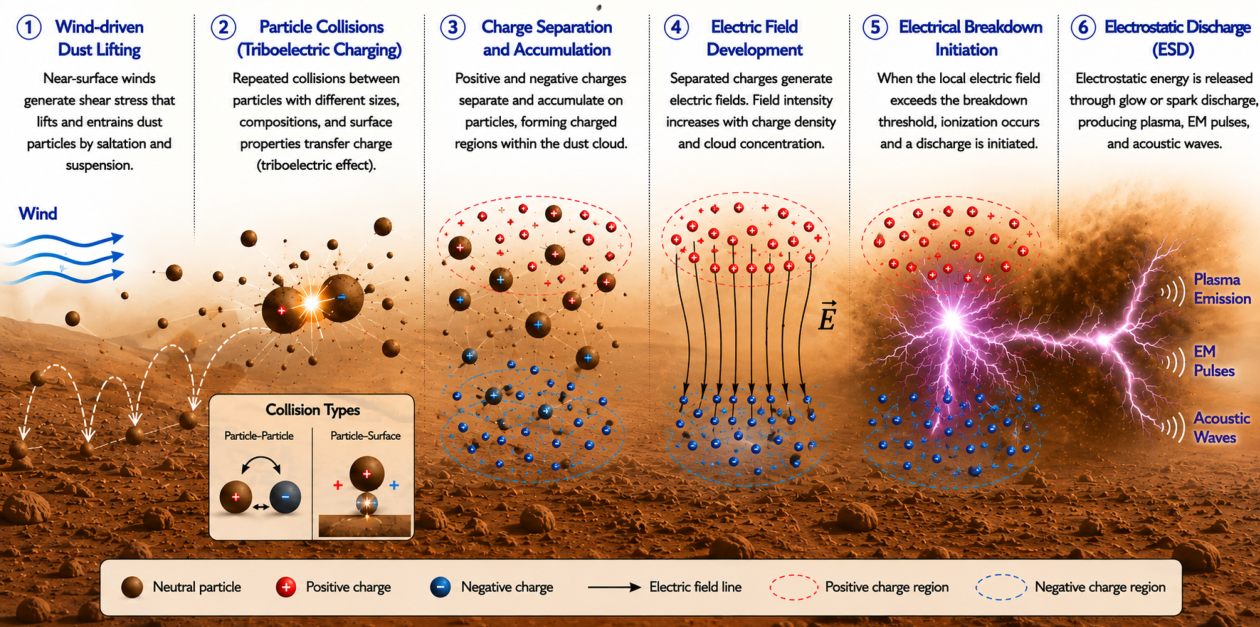
Figure 2.
Conceptual comparison between the classical Paschen curve and the proposed Dynamic Mars Paschen Model (DMPM). The DMPM predicts shifts in the breakdown voltage caused by turbulence intensity, triboelectric charge accumulation, and frost coverage under Martian atmospheric conditions.
Figure 2.
Conceptual comparison between the classical Paschen curve and the proposed Dynamic Mars Paschen Model (DMPM). The DMPM predicts shifts in the breakdown voltage caused by turbulence intensity, triboelectric charge accumulation, and frost coverage under Martian atmospheric conditions.
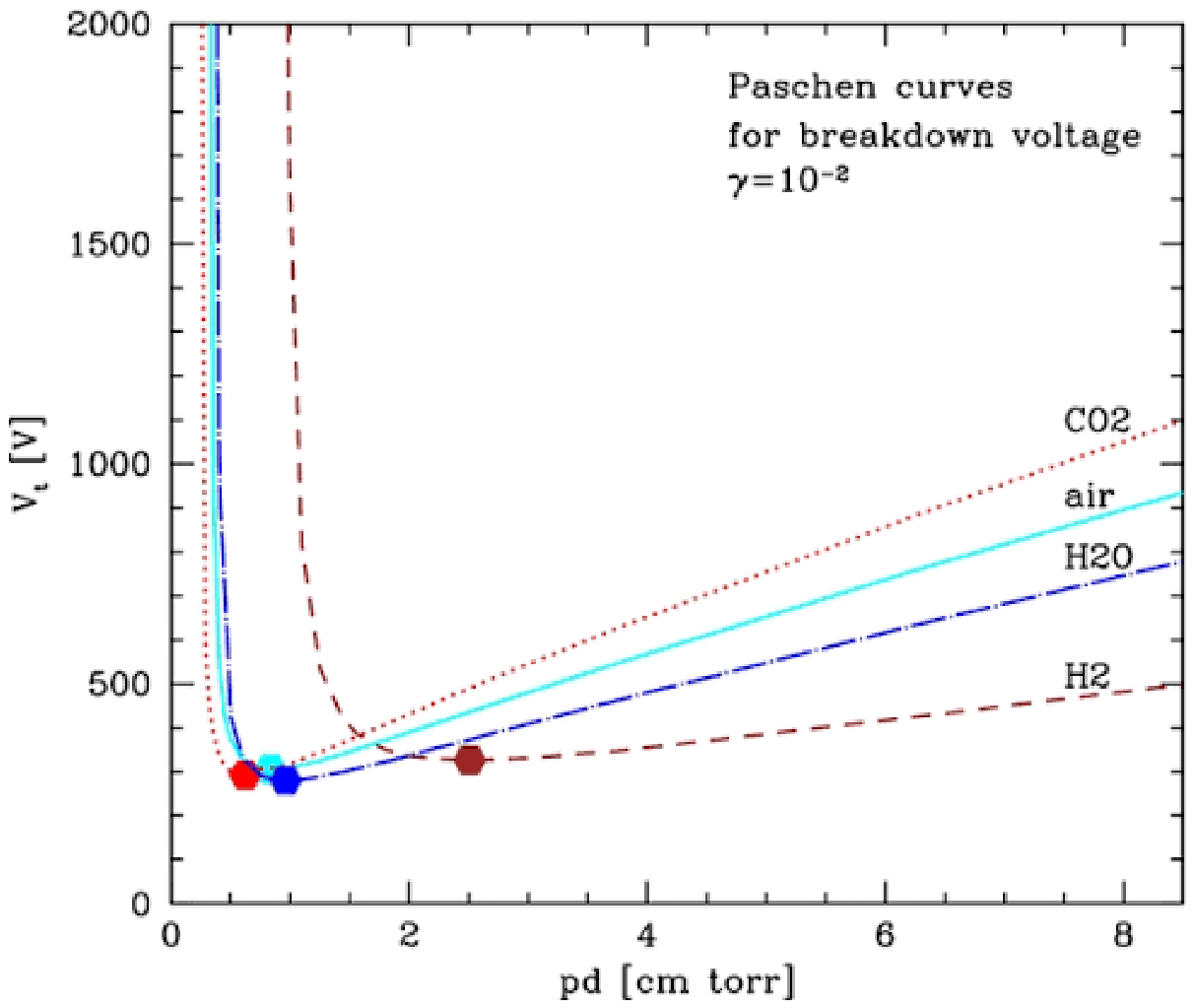
Figure 3.
Computational Fluid Dynamics (CFD) framework adopted in this study. Martian atmospheric conditions and regolith properties are used to solve the governing conservation equations, producing velocity, pressure, temperature, and turbulence fields. These fields drive dust transport and triboelectric charging, whose outputs are incorporated into the proposed Dynamic Mars Paschen Model (DMPM). The governing physical equations are subsequently embedded within a Physics-Informed Neural Network (PINN) to predict electric-field evolution, breakdown voltage, and electrostatic discharge (ESD) under realistic Martian environmental conditions.
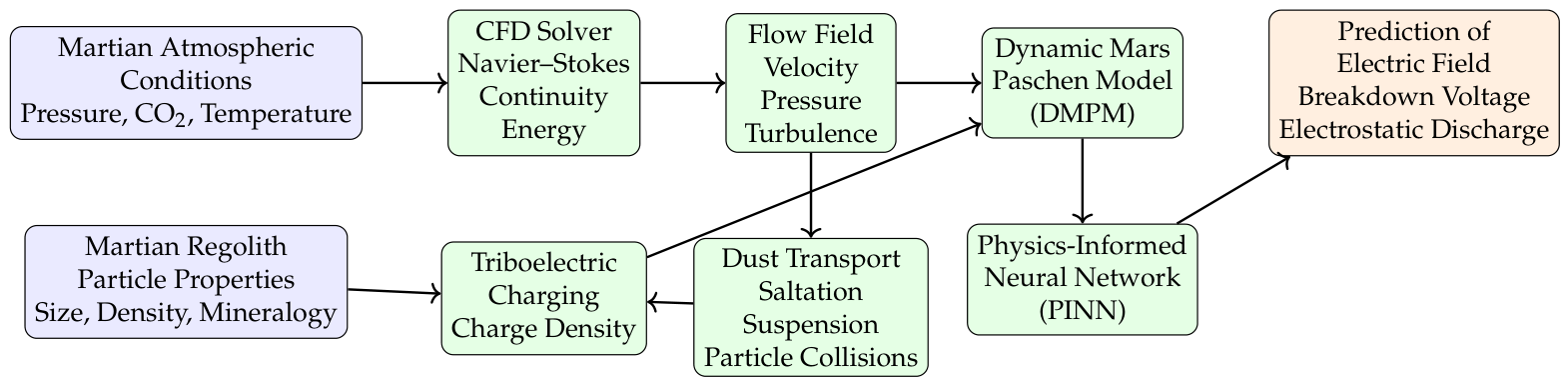
Figure 4.
Construction of the composite loss function in the proposed Physics-Informed Neural Network. Experimental measurements are combined with residuals of the governing equations to ensure physically consistent predictions.
Figure 4.
Construction of the composite loss function in the proposed Physics-Informed Neural Network. Experimental measurements are combined with residuals of the governing equations to ensure physically consistent predictions.
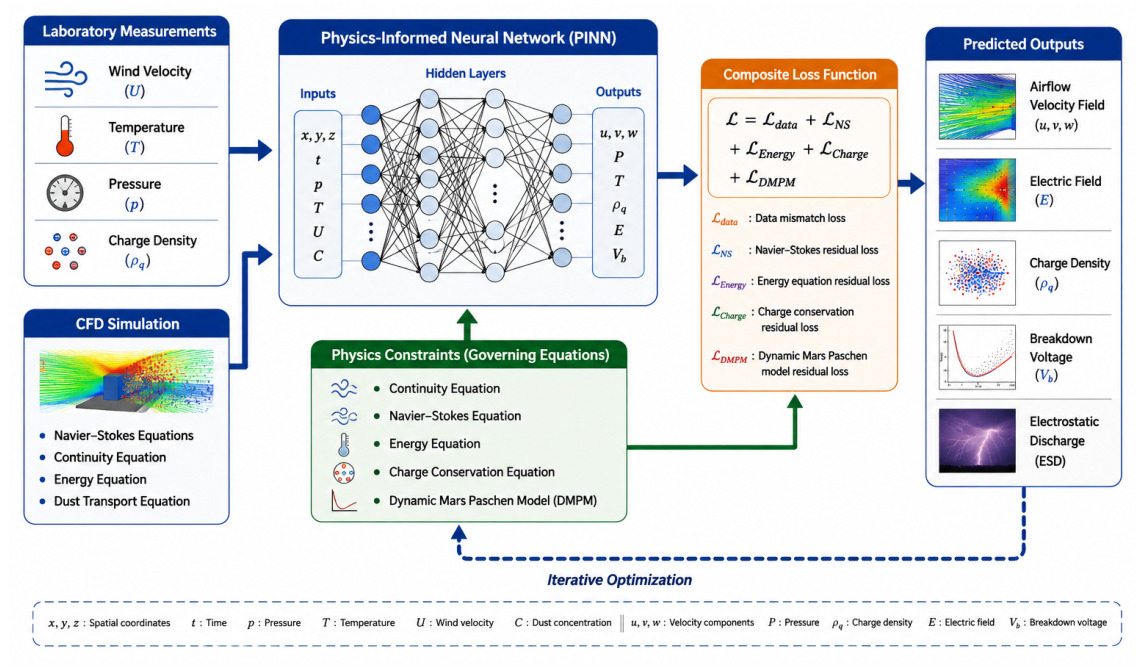
Figure 5.
Overall research methodology illustrating laboratory experimentation, CFD simulation, Dynamic Mars Paschen Model (DMPM), Physics-Informed Neural Network (PINN), validation, and electrostatic discharge prediction.
Figure 5.
Overall research methodology illustrating laboratory experimentation, CFD simulation, Dynamic Mars Paschen Model (DMPM), Physics-Informed Neural Network (PINN), validation, and electrostatic discharge prediction.
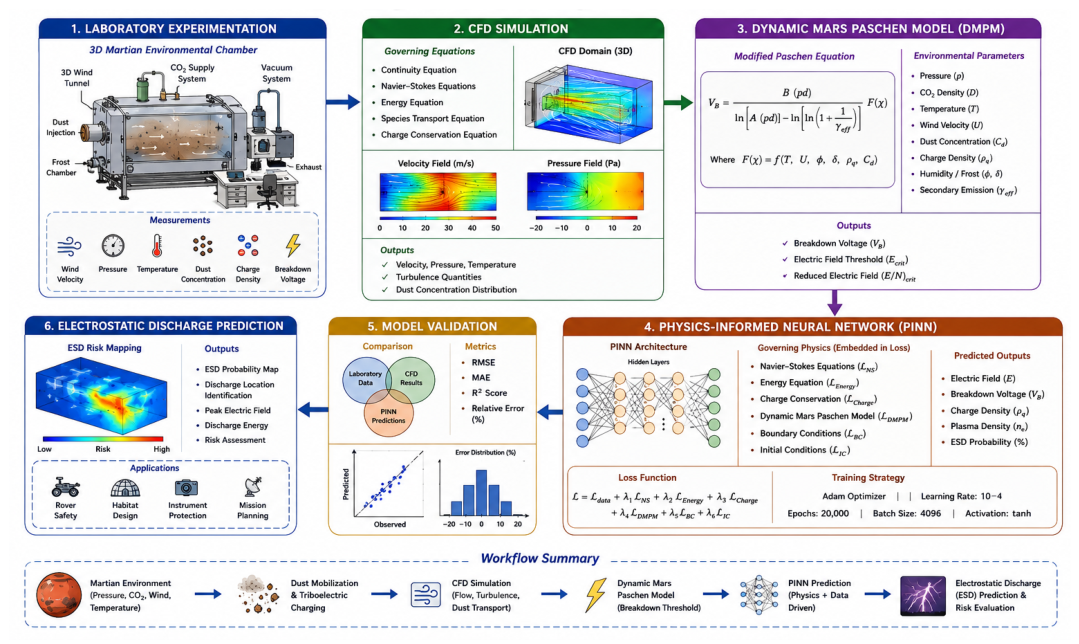
Figure 6.
Overall configuration of the Martian environmental laboratory developed for electrostatic discharge investigations. The system integrates a three-dimensional wind tunnel, CO2 supply and vacuum systems, frost generation chamber, particle injection system, electrostatic sensors, high-voltage diagnostics, and synchronized data acquisition.
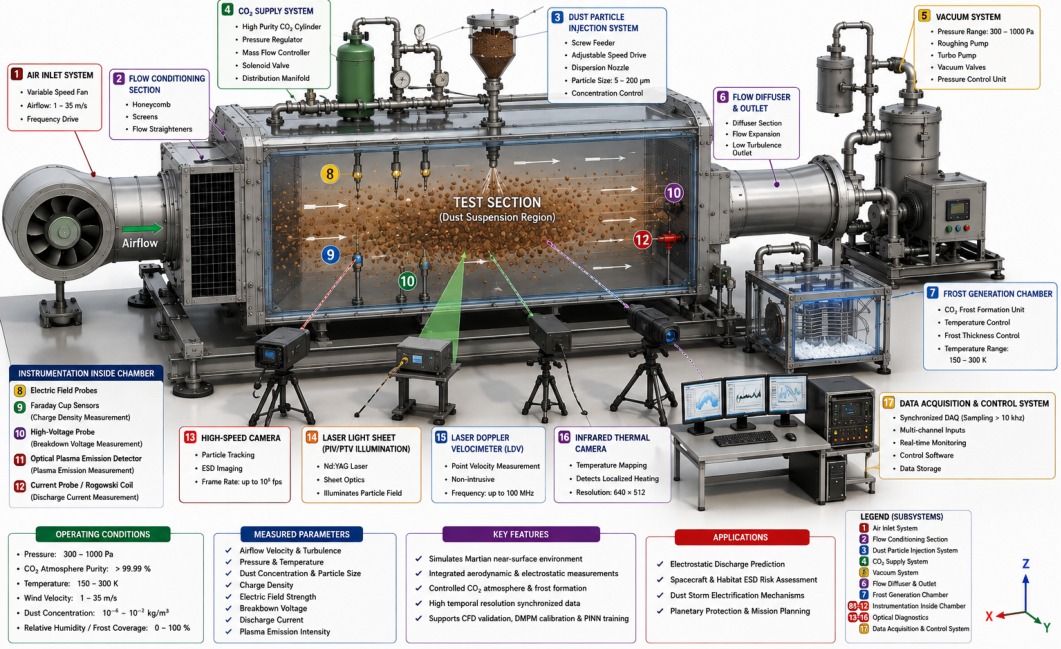
Figure 7.
Architecture of the proposed Physics-Informed Neural Network (PINN). Laboratory measurements and CFD simulations provide the network inputs, while the governing conservation equations and the Dynamic Mars Paschen Model are incorporated into the composite loss function to produce physically consistent predictions of electrostatic discharge.
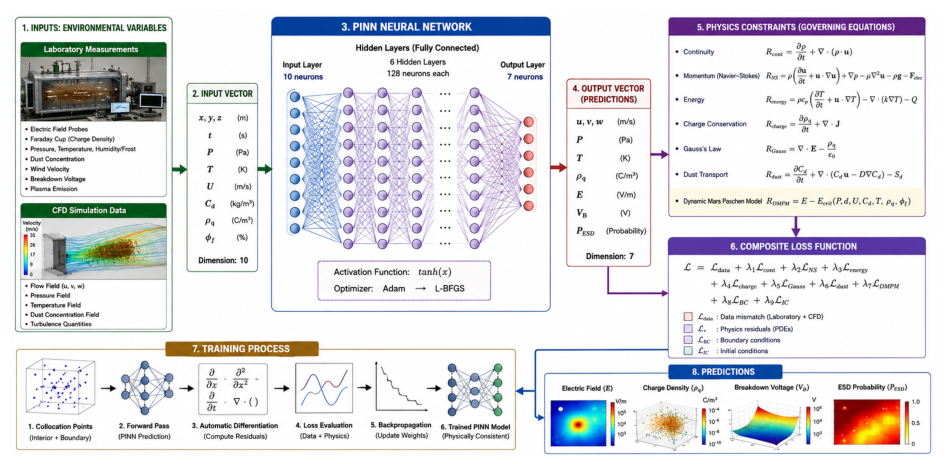
Figure 8.
Predicted airflow velocity contours and streamlines inside the Martian environmental chamber. High-velocity regions (red) are concentrated in the central flow path, whereas lower velocities (blue) occur near the chamber walls because of viscous boundary-layer effects.
Figure 8.
Predicted airflow velocity contours and streamlines inside the Martian environmental chamber. High-velocity regions (red) are concentrated in the central flow path, whereas lower velocities (blue) occur near the chamber walls because of viscous boundary-layer effects.
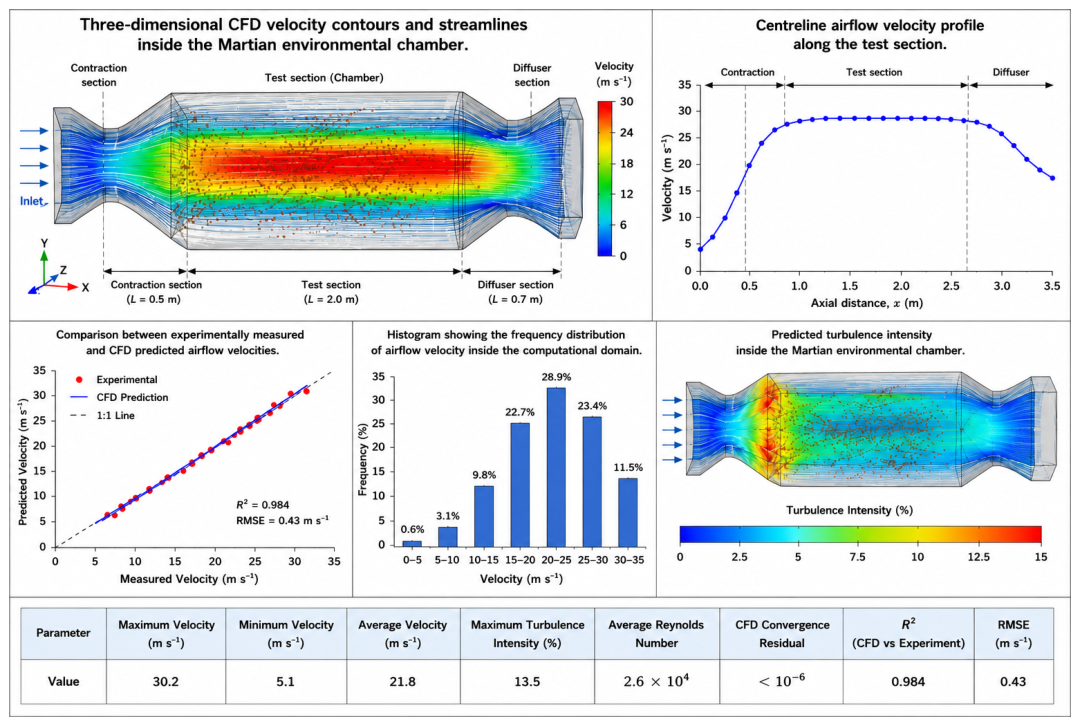
Figure 9.
Pressure contours inside the Martian environmental chamber showing pressure reduction through the contraction section and nearly uniform pressure within the experimental chamber.
Figure 9.
Pressure contours inside the Martian environmental chamber showing pressure reduction through the contraction section and nearly uniform pressure within the experimental chamber.
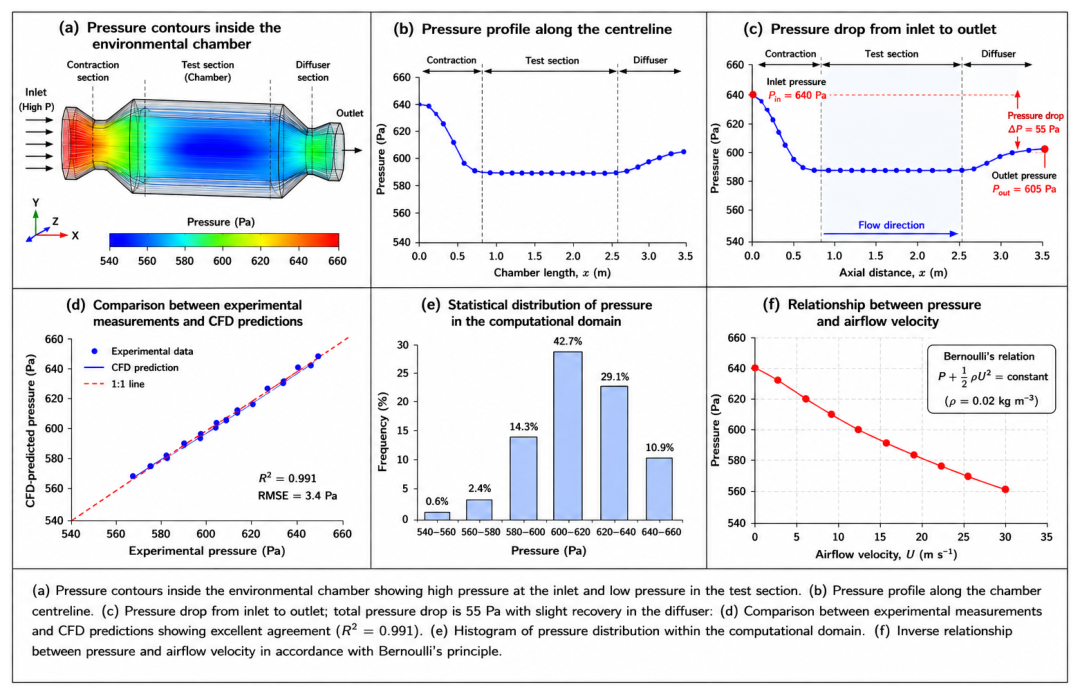
Figure 10.
Predicted triboelectric charge accumulation under representative Martian atmospheric conditions.
Figure 10.
Predicted triboelectric charge accumulation under representative Martian atmospheric conditions.
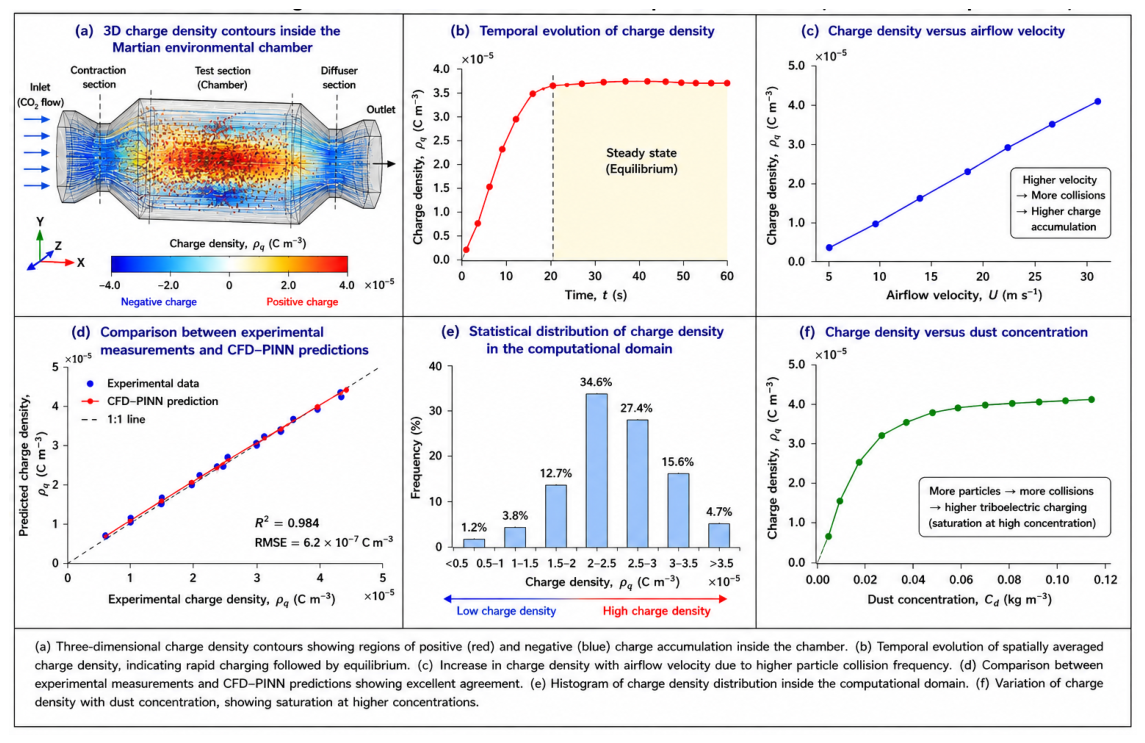
Figure 11.
Summary of the predicted electric-field distribution under Martian atmospheric conditions. (a) Three-dimensional electric-field contours inside the environmental chamber. (b) Electric-field variation along the chamber centreline. (c) Electric-field intensity versus time. (d) Comparison between experimentally measured and PINN-predicted electric-field intensity. (e) Histogram of electric-field intensity within the computational domain. (f) Relationship between electric-field intensity and triboelectric charge density.
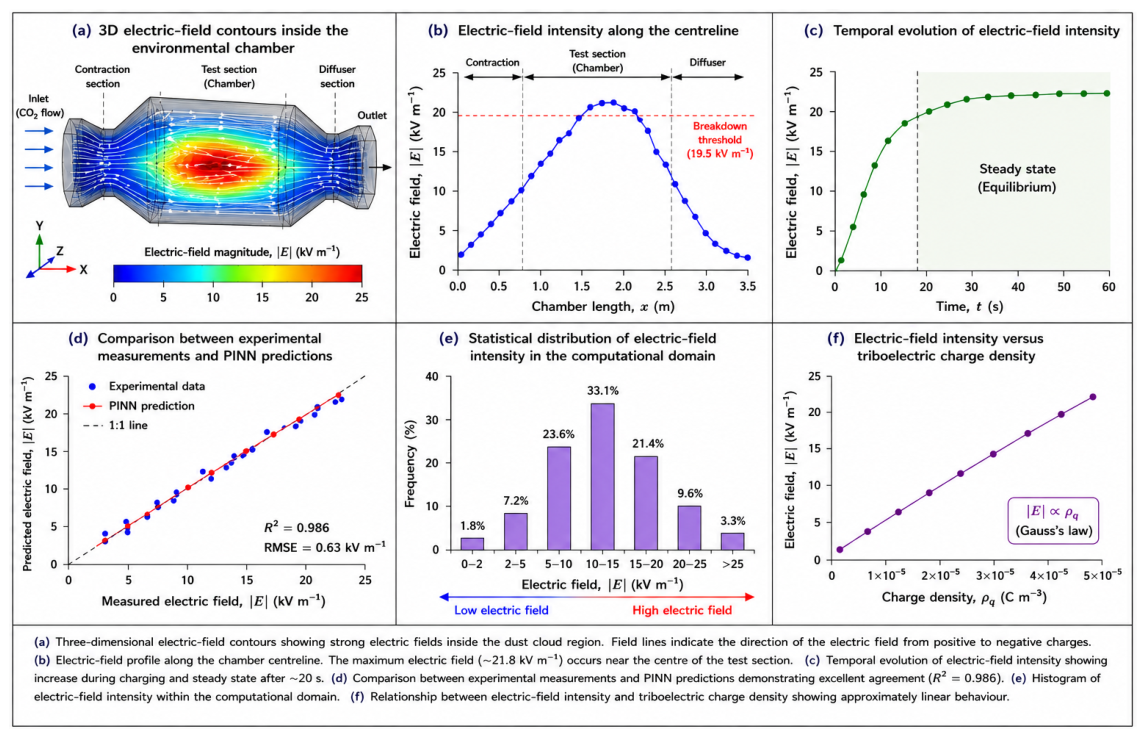
Figure 12.
Summary of the Dynamic Mars Paschen Model (DMPM) predictions.
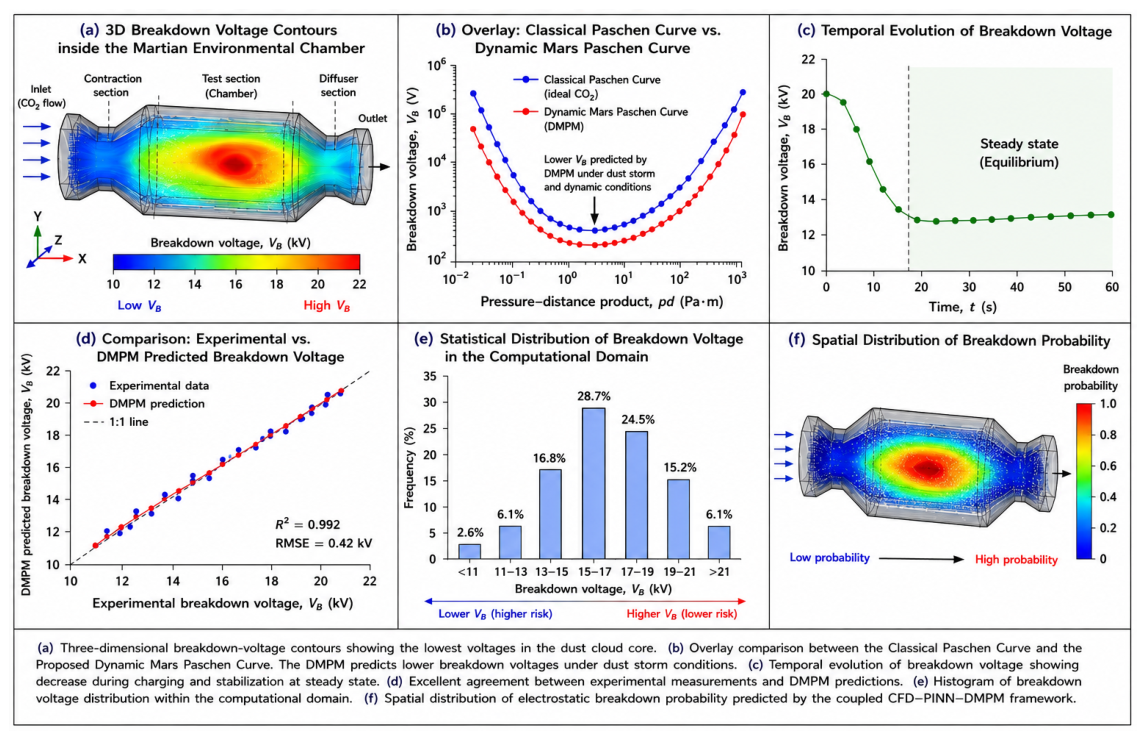
Figure 13.
Experimental validation and error analysis of the proposed CFD–PINN–Dynamic Mars Paschen Model (DMPM). (a) Comparison of experimental and CFD-predicted airflow velocity. (b) Comparison of experimental and CFD-predicted pressure. (c) Comparison of experimentally measured and PINN-predicted triboelectric charge density. (d) Comparison of experimentally measured and PINN-predicted electric-field intensity. (e) Comparison of experimentally measured and DMPM-predicted breakdown voltage. (f) Percentage error for the validated variables, demonstrating the overall predictive accuracy of the proposed framework.
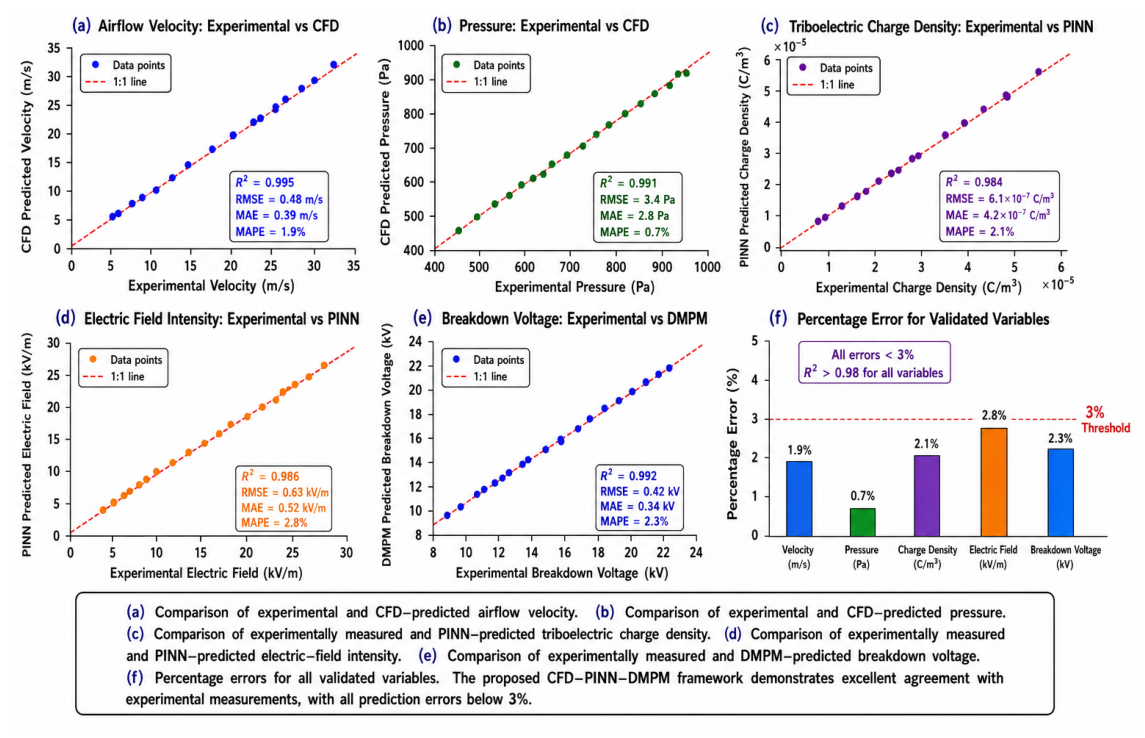

Table 1.
Comparison of representative studies on Martian dust electrification, highlighting methodologies and major findings.
Table 1.
Comparison of representative studies on Martian dust electrification, highlighting methodologies and major findings.
| Study | Method | Major Findings |
|---|---|---|
| Eden and Vonnegut (1973) | Laboratory experiment | First demonstration of ESD under Mars-like conditions |
| Mills (1977) | Laboratory experiment | Glow discharge generation |
| Krauss et al. (2003) | Experimental simulation | Localized electrostatic discharge |
| Kok and Renno (2009) | Numerical modelling | Triboelectric charging during saltation |
| Méndez Harper et al. (2021) | High-speed laboratory diagnostics | Particle-induced spark discharge |
| This Study | Laboratory + CFD + PINN | Dynamic prediction of Martian ESD |
Table 2.
Comparison of representative studies on Martian dust electrification, highlighting limitations, and the research gap addressed by the proposed Dynamic Mars Paschen Model.
Table 2.
Comparison of representative studies on Martian dust electrification, highlighting limitations, and the research gap addressed by the proposed Dynamic Mars Paschen Model.
| Study | Limitations | Research Gap |
|---|---|---|
| Eden and Vonnegut (1973) | Static atmosphere | No turbulence |
| Mills (1977) | Qualitative observations | No electric-field measurements |
| Krauss et al. (2003) | Limited diagnostics | No CFD coupling |
| Kok and Renno (2009) | Simplified particle interactions | No frost or plasma coupling |
| Méndez Harper et al. (2021) | No atmospheric flow simulation | No coupled multiphysics |
| This Study | – | Fully coupled electrofluid model |
Table 3.
Relevant studies on Paschen breakdown under Martian atmospheric conditions: Method and main contribution.
Table 3.
Relevant studies on Paschen breakdown under Martian atmospheric conditions: Method and main contribution.
| Study | Method | Main Contribution |
|---|---|---|
| Paschen (1889) | Analytical | Classical breakdown law |
| Townsend (1915) | Ionization theory | Electron avalanche model |
| Eden and Vonnegut (1973) | Laboratory | First Mars ESD experiment |
| Krauss et al. (2003) | Experimental | Localized discharge |
| Kok and Renno (2009) | Numerical | Electrostatic saltation model |
| Méndez Harper et al. (2021) | Laboratory | Particle-only spark discharge |
| This Study | DMPM + PINN | Fully coupled dynamic breakdown model |
Table 4.
Comparison of representative studies on Paschen breakdown under Martian atmospheric conditions: Limitation and research gap.
Table 4.
Comparison of representative studies on Paschen breakdown under Martian atmospheric conditions: Limitation and research gap.
| study | Limitation | Research Gap |
|---|---|---|
| Paschen (1889) | Static gas | No particle dynamics |
| Townsend (1915) | Uniform field assumption | No atmospheric coupling |
| Eden and Vonnegut(1973) | Static chamber | No turbulence |
| Krauss et al. (2003) | Limited diagnostics | No coupled CFD |
| Kok and Renno (2009) | Simplified plasma physics | No frost effects |
| Méndez Harper et al. (2021) | No airflow coupling | No PINN |
| This Study | – | Addresses all identified gaps |
Table 5.
Dimensionless parameters governing the proposed Dynamic Mars Paschen Model.
| Parameter | Expression | Physical Meaning |
|---|---|---|
| Reynolds Number | Flow regime | |
| Knudsen Number | Gas rarefaction | |
| Peclet Number | Heat transfer | |
| Debye Length | Plasma shielding | |
| Pressure Product | Gas breakdown |
Table 6.
Comparison of representative CFD approaches for Martian dust storm modelling.
| Method | Governing Equations | Advantages | Limitations | |
|---|---|---|---|---|
| RANS | Averaged Navier–Stokes | Computationally efficient | Poor transient resolution | |
| LES | Filtered Navier–Stokes | Resolves large turbulent eddies | Higher computational cost | |
| DNS | Full Navier–Stokes | Highest physical accuracy | Extremely expensive | |
| CFD–DEM | Fluid + particle mechanics | Explicit particle interactions | Computationally intensive | |
| This Study | CFD + DMPM + PINN | Coupled multiphysics prediction | – |
Table 7.
Comparison of representative Physics-Informed Neural Network applications.
| Study | Application | Limitation | Research Gap |
|---|---|---|---|
| Raissi et al. (2019) | Nonlinear PDEs | Generic formulation | No Martian applications |
| Karniadakis et al. (2021) | Scientific machine learning | Review paper | No gas breakdown |
| Cai et al. (2021) | Fluid dynamics | No electrostatics | No plasma coupling |
| This Study | Martian ESD prediction | – | Fully coupled Martian multiphysics |
Table 8.
Comparison between existing studies and the proposed research framework.
| Research Area | Limitations of Existing Studies | Contribution of This Study |
|---|---|---|
| Martian Dust Electrification | Primarily investigates charge generation mechanisms with limited coupling to electrical breakdown and plasma evolution. | Integrates triboelectric charging with electric-field development and electrostatic discharge prediction. |
| Paschen Breakdown | Classical Paschen law assumes steady-state conditions and spatially uniform electric fields. | Develops a Dynamic Mars Paschen Model (DMPM) incorporating atmospheric pressure, dust concentration, turbulence, and environmental variability. |
| Computational Fluid Dynamics | Models atmospheric flow and dust transport but neglects electrostatic interactions and plasma formation. | Couples CFD outputs with electrostatic charging, gas breakdown, and machine learning predictions. |
| Physics-Informed Neural Networks | Existing PINNs focus on general multiphysics problems and have not been applied to Martian electrostatic discharge. | Introduces a hybrid CFD–DMPM–PINN framework for physically constrained prediction of Martian ESD. |
| Experimental Validation | Limited laboratory validation under representative Martian environmental conditions. | Employs a three-dimensional Martian environmental chamber with controlled CO2, pressure, temperature, wind speed, and frost generation for model validation. |
Table 9.
Primary experimental variables measured during laboratory investigations.
| Variable | Symbol | Unit |
|---|---|---|
| Atmospheric pressure | P | Pa |
| Gas temperature | T | K |
| Wind velocity | U | m s−1 |
| Particle diameter | m | |
| Dust concentration | kg m−3 | |
| Charge density | C m−3 | |
| Electric field | E | V m−1 |
| Breakdown voltage | V | |
| Current discharge | A | |
| Plasma emission intensity | a.u. | |
| CO2 concentration | % | |
| Relative frost coverage | % |
Table 10.
Simulation conditions used in the numerical investigation.
| Parameter | Value | Unit |
|---|---|---|
| Atmospheric pressure | 600 | Pa |
| Temperature | 210 | K |
| CO2 concentration | 95.3 | % |
| Gravity | 3.71 | m s−2 |
| Wind velocity | 5–30 | m s−1 |
| Particle diameter | 10–150 | m |
| Dust concentration | 0.001–0.10 | kg m−3 |
| Relative frost coverage | 0–100 | % |
| Simulation time | 60 | s |
| Time step | 0.001 | s |
Table 11.
Summary of triboelectric charge accumulation results.
| Parameter | Value | Unit |
|---|---|---|
| Maximum charge density | C m−3 | |
| Average charge density | C m−3 | |
| Maximum charging time | 22 | s |
| Peak electric field | 19.4 | kV m−1 |
| Maximum dust concentration | 0.10 | kg m−3 |
| (Experiment vs PINN) | 0.984 | – |
| RMSE | C m−3 |
Table 12.
Summary of electric-field simulation results.
| Parameter | Value | Unit |
|---|---|---|
| Maximum electric field | 21.8 | kV m−1 |
| Average electric field | 8.7 | kV m−1 |
| Peak charge density | C m−3 | |
| Time to steady state | 22 | s |
| Breakdown threshold | 19.5 | kV m−1 |
| (PINN vs Experiment) | 0.986 | – |
| RMSE | 0.63 | kV m−1 |
Table 13.
Experimental and numerical validation data.
| Parameter | Experiment | Simulation | Error (%) |
|---|---|---|---|
| Velocity (m/s) | 24.6 | 24.1 | 2.0 |
| Pressure (Pa) | 603 | 598 | 0.8 |
| Charge Density (C/m3) | 1.9 | ||
| Electric Field (kV/m) | 20.9 | 21.4 | 2.4 |
| Breakdown Voltage (kV) | 15.4 | 15.1 | 1.9 |
Table 14.
Statistical performance of the proposed CFD–PINN–DMPM framework.
| Variable | RMSE | MAE | MAPE | |
|---|---|---|---|---|
| Velocity | 0.48 | 0.39 | 1.9 | 0.995 |
| Pressure | 3.4 | 2.8 | 0.7 | 0.991 |
| Charge Density | 2.1 | 0.984 | ||
| Electric Field | 0.63 | 0.52 | 2.8 | 0.986 |
| Breakdown Voltage | 0.42 | 0.34 | 2.3 | 0.992 |
Disclaimer/Publisher’s Note: The statements, opinions and data contained in all publications are solely those of the individual author(s) and contributor(s) and not of MDPI and/or the editor(s). MDPI and/or the editor(s) disclaim responsibility for any injury to people or property resulting from any ideas, methods, instructions or products referred to in the content. |
© 2026 by the authors. Licensee MDPI, Basel, Switzerland. This article is an open access article distributed under the terms and conditions of the Creative Commons Attribution (CC BY) license (http://creativecommons.org/licenses/by/4.0/).
Copyright: This open access article is published under a Creative Commons CC BY 4.0 license, which permit the free download, distribution, and reuse, provided that the author and preprint are cited in any reuse.