

Submitted:
16 October 2026
Posted:
19 October 2026
You are already at the latest version
Abstract
Maritime disruptions increasingly redirect vessels and cargo towards alternative routes and ports. Although rerouting can preserve connectivity, its effectiveness can-not be assessed through route availability or port capacity alone, as redirected flows may generate new constraints and dependencies within the resulting logistics config-uration. This study examines how maritime rerouting reconfigures logistics dependen-cies and under which conditions alternative ports provide effective rather than merely nominal substitutability. A comparative case-study approach is applied to five Euro-pean ports—Algeciras, Valencia, Barcelona, Rotterdam and Sines—following the Red Sea crisis. The study develops a Post-Rerouting Sequential Stress Test (PR-SST) com-bining maritime connectivity and port capacity with function-specific gateway and transhipment pathways, while incorporating sustainability as a cross-cutting dimen-sion. The analysis distinguishes nominal capacity from effective substitutability and introduces post-rerouting dependency to capture dependencies that emerge or inten-sify following adaptation. The comparative assessment shows that the effectiveness of an alternative port depends not only on its capacity to receive redirected flows, but al-so on its functional role and the continuity of the subsequent logistics pathway. The PR-SST therefore extends resilience assessment beyond maritime rerouting and indi-vidual port capacity towards the integrated logistics configuration through which re-directed flows continue.
Keywords:
maritime rerouting
; port–hinterland logistics
; resilience
; effective substitutability
; post-rerouting dependency
; transhipment
; sustainable logistics
1. Introduction
Maritime transport is a fundamental component of global supply chains, connecting production centres and consumer markets through increasingly interdependent transport and logistics networks [1]. Within these networks, ports function not merely as interfaces between sea and land, but as critical nodes linking maritime services to hinterland transport, logistics infrastructure and inland markets [2,3]. Their performance therefore depends on the effective integration of maritime connectivity, terminal capacity, inland transport networks and logistics services [2]. Accordingly, the sustainability of port logistics increasingly encompasses the capacity of port–hinterland systems to maintain functionality under disruption and adapt to changing trade and transport patterns [2,4].
Recent disruptions affecting major maritime corridors have highlighted the vulnerability of global supply chains to geopolitical conflict, climate-related events, infrastructure failures and operational constraints [5,6]. When established routes become unavailable, unsafe or economically unattractive, shipping networks adapt through rerouting, alternative ports and the redistribution of cargo flows [5,6,7]. While such responses can preserve connectivity and mitigate immediate disruption [6,7], they also change the geography of logistics, increasing the strategic importance of alternative ports and subsequent maritime and inland connections while placing additional pressure on the logistics systems through which redirected cargo must continue [6,7,8].
Much of the literature on maritime and port resilience has focused on network redundancy, alternative routes and infrastructure, port capacity, and the ability to maintain or recover functionality following disruption [9,10,11]. However, these dimensions do not fully capture what happens after redirected flows reach an alternative port. A port may have sufficient capacity to accommodate additional traffic while the wider logistics system lacks the ability to redistribute the resulting cargo efficiently. Depending on the function performed by the port, this redistribution may occur through hinterland transport systems or through onward maritime services. Port–hinterland resilience depends on interconnected infrastructure and services, including road and rail networks, intermodal terminals and inland logistics facilities [2,4,12]. Constraints within these components may limit the ability of the wider logistics chain to absorb additional flows [2,12]. Consequently, the existence of an alternative port does not necessarily imply the existence of an effective alternative logistics configuration.
This distinction suggests the need to differentiate between nominal capacity and effective substitutability. Nominal capacity refers to the ability of an alternative node to accommodate additional flows, whereas effective substitutability requires the resulting logistics configuration to absorb and redistribute those flows without generating disproportionate congestion, inefficiency or new critical dependencies. This distinction also has sustainability implications: port–hinterland transport generates externalities associated with emissions, congestion and infrastructure pressure [13,14,15], while crisis-induced rerouting can increase transport distances, operating costs and emissions while redistributing environmental pressures across ports and corridors [16,17]. An adaptive response that preserves maritime flows may therefore maintain immediate connectivity while reconfiguring network dependencies and generating additional costs elsewhere in the logistics system [16,18].
Against this background, this study develops a conceptual and analytical framework for assessing resilience and dependency in sustainable logistics following maritime rerouting. It addresses two research questions: (1) How does maritime rerouting reconfigure dependencies across the logistics systems that follow alternative ports? and (2) Under what conditions does an alternative port provide effective rather than merely nominal substitutability? The study contributes to the literature by introducing post-rerouting dependency as an analytical perspective for examining how redirected flows reconfigure logistics networks; distinguishing nominal capacity from effective substitutability at the system level; and proposing a Post-Rerouting Sequential Stress Test (PR-SST) that follows redirected flows through common maritime and port dimensions and subsequent gateway and transhipment pathways, with sustainability incorporated as a cross-cutting dimension.
2. Conceptual Background: From Maritime Rerouting to Port–Hinterland Dependency
2.1. Maritime Disruption, Rerouting and Network Resilience
Maritime transport networks are increasingly exposed to disruptions arising from geopolitical tensions, extreme weather events, infrastructure failures and operational constraints, whose effects can propagate across interconnected transport and supply chain networks [19,20]. In this context, resilience refers to the capacity of maritime transport systems to withstand disruption, maintain essential functions and adapt or recover while preserving the movement of goods [19]. Redundancy, route diversification and the availability of alternative corridors and nodes therefore constitute important mechanisms through which maritime networks can respond to disturbances and maintain connectivity [19,20].
Rerouting represents one of the most visible forms of such adaptation. When established maritime corridors become unavailable, unsafe or operationally unattractive, vessels and cargo may be redirected through alternative routes, modifying sailing distances, transit times, service configurations and patterns of port connectivity [18,20]. Recent evidence from the Red Sea crisis illustrates these effects particularly clearly. The diversion of services around the Cape of Good Hope altered the structure of European maritime connectivity and produced differentiated effects across gateway, hub and feeder ports [18]. From a network perspective, rerouting can therefore preserve the movement of goods without reproducing the original configuration of the transport system, as traffic is redistributed across routes and nodes and the relative importance of individual ports and corridors changes [18].
This distinction is important for the assessment of resilience. The successful continuation of maritime flows demonstrates adaptive capacity, but does not necessarily imply that the resulting logistics configuration is equally resilient or sustainable. Rerouting may increase sailing distances and transport costs and modify the distribution of traffic across ports and corridors [18,20]. Empirical evidence from the Red Sea crisis shows that these changes can affect both maritime connectivity and transport-chain costs, while port-level responses to the same disruption can differ substantially [7,18]. Resilience assessment should therefore consider not only whether connectivity is maintained, but also how and through which configuration that connectivity is maintained.
While maritime rerouting constitutes the initial adaptive response examined in this study, the analysis focuses particularly on what occurs once redirected flows reach an alternative port. At this point, the effectiveness of the alternative depends not only on maritime connectivity and port performance, but also on the capacity of the subsequent logistics system to accommodate and redistribute additional flows, either through hinterland connections or onward maritime services. Recent port-resilience research supports the relevance of this transition by identifying hinterland connectivity, alongside geographical location and network embedding, as a factor influencing port resilience under geopolitical disruption [7]. The port therefore represents the interface between maritime adaptation and the wider logistics response, shifting the analytical focus from the availability of an alternative maritime route towards the capacity of the resulting logistics configuration to support that alternative.
2.2. Ports as Integrated Maritime–Hinterland Nodes
Ports are no longer understood solely as maritime terminals where cargo is transferred between ships and land-based transport. Their role has progressively evolved towards that of integrated logistics nodes embedded in wider transport and supply chain networks, connecting maritime services with inland transport corridors, intermodal terminals, logistics platforms and final markets [2,21]. The concept of port regionalization captured this evolution by showing that the functional development of ports increasingly extends beyond the traditional port perimeter and depends on their integration with inland freight distribution systems [21].
However, the role performed by ports within these networks is not uniform. Ports may function as gateways, connecting maritime flows with their hinterlands, or as transhipment hubs, where containers are transferred between maritime services before continuing towards another port. Major container ports may combine both functions, although their relative importance varies according to network configuration and shipping strategies [26]. The distinction is particularly relevant under rerouting conditions because additional flows reaching an alternative port do not necessarily generate equivalent pressure on its hinterland: gateway cargo must be transferred towards inland destinations, whereas transhipment cargo may be redistributed through onward maritime services [22,23].
For gateway flows, port performance depends not only on terminal infrastructure and handling capacity but also on the quality and configuration of hinterland connections. Road and rail accessibility, inland terminals and intermodal logistics facilities influence how efficiently cargo can move between the maritime gateway and inland origins and destinations [2,22]. For transhipment flows, by contrast, the effectiveness of the port depends more strongly on terminal transfer capacity and onward maritime connectivity [23]. The logistics implications of additional traffic therefore depend not only on how much cargo a port receives, but also on the function performed by that port within the adapted network.
The resulting logistics system is therefore characterised by functional interdependence across maritime, port and inland components. Constraints affecting one component can influence the performance of the wider chain, while additional port capacity may provide limited benefits if either onward maritime connections or inland logistics systems become the binding constraint [2,25]. For the purposes of this study, the port is consequently considered an interface at which redirected maritime flows may either be redistributed through maritime services or transferred into the hinterland logistics system. This distinction provides the basis for assessing whether an alternative port represents an effective substitute within the reconfigured transport network
2.3. From Port Capacity to Effective Substitutability
Port capacity is a critical factor in determining the ability of a port to accommodate additional cargo flows, particularly when disruptions alter established traffic patterns and generate unexpected increases in demand. Terminal throughput, berth and yard capacity, storage availability and operational efficiency influence the extent to which additional traffic can be handled without generating excessive congestion or delays [8,24]. Under disruption, these constraints become particularly relevant because redirected flows may produce sudden peaks in demand at receiving ports, potentially affecting port operations and subsequent cargo movements [8].
However, the ability of a port to physically accommodate additional traffic does not necessarily mean that it can function as an effective substitute within the reconfigured logistics network. What happens after cargo reaches the port depends partly on the function performed by that port. Gateway cargo must be transferred efficiently through inland transport networks, intermodal terminals, logistics facilities and distribution systems, whereas transhipment cargo depends on terminal transfer capacity and the availability and connectivity of onward maritime services [23]. Capacity constraints may therefore emerge either within the hinterland system or in subsequent maritime connections, even when sufficient terminal capacity is available [9,25]. In this sense, port capacity represents a necessary but not sufficient condition for effective substitution.
Building on this distinction, this study differentiates between nominal capacity and effective substitutability. Nominal capacity refers to the ability of an alternative port to receive and handle additional flows based primarily on its available infrastructure and operational capacity. Effective substitutability, by contrast, refers to the ability of the wider logistics configuration to absorb and redistribute redirected flows towards their subsequent destinations while maintaining acceptable levels of functionality and without generating critical bottlenecks or disproportionate new dependencies. Effective substitutability is therefore conceptualized here as a system-level property, rather than an attribute of the port considered in isolation.
Importantly, effective substitutability is both sequential and function-dependent. For gateway traffic, the relevant sequence extends from maritime access and terminal operations through inland transport, logistics facilities and ultimately market connectivity. For transhipment traffic, the sequence continues from terminal operations through onward maritime services and subsequent port connections. Research on port–hinterland networks demonstrates that capacity constraints can arise at different links and nodes and that limitations in one component can affect the performance of the wider logistics chain [9,25,26]. Adequate capacity at one stage cannot therefore compensate indefinitely for a critical constraint at another. A port may appear to provide a viable alternative when assessed through terminal capacity alone, while a bottleneck emerges at the next stage of the adapted logistics chain.
This perspective changes the analytical question posed by maritime rerouting. Rather than asking only whether an alternative port exists or possesses sufficient capacity, the relevant question becomes whether the resulting logistics configuration can sustain and redistribute redirected flows according to the function performed by the alternative port. Effective substitutability thus provides the conceptual link between maritime adaptation and the post-rerouting dependencies that may emerge within the reconfigured transport system. This sequential perspective provides the conceptual basis for the assessment framework developed in Section 3.
2.4. Post-Rerouting Dependency and Sustainable Logistics
Maritime rerouting changes more than the geographical path followed by vessels. By redirecting cargo towards alternative corridors and ports, it can also modify the distribution of flows, infrastructure utilisation and logistics activity across the wider transport system [7,18,20]. These changes may reduce exposure to the initial disruption while simultaneously increasing reliance on alternative ports, onward maritime services, inland corridors and logistics infrastructure. The resulting configuration may therefore preserve connectivity while creating a different pattern of dependencies across the transport network [7,20].
This study refers to this phenomenon as post-rerouting dependency: the set of dependencies that emerges or becomes more significant after maritime flows are redirected through an alternative logistics configuration. The concept shifts attention from the immediate success of rerouting towards the structure that results from adaptation. A redirected flow may bypass the original disruption successfully but become increasingly dependent on a particular port, onward maritime service, rail corridor, road connection, intermodal terminal or logistics node. Post-rerouting dependency does not therefore imply that adaptation has failed; rather, it recognises that successful adaptation can alter where and how the system becomes dependent.
These reconfigured dependencies also have implications for sustainability. Maritime rerouting can increase sailing distances, fuel consumption, transport costs and emissions, while the concentration of additional cargo at alternative ports may increase congestion and place additional pressure on the subsequent logistics system [16,17]. The environmental consequences may extend beyond the maritime leg of the journey. If redirected flows depend more heavily on road transport, require longer inland distances or generate congestion at ports and logistics corridors, the alternative configuration may preserve supply chain continuity while producing additional environmental and operational externalities [13,17]. Resilience and sustainability should therefore not be treated as independent properties of the adapted logistics system.
From this perspective, a sustainable response to maritime disruption requires more than the availability of an alternative route or sufficient capacity at an alternative port. It requires an integrated logistics configuration capable of accommodating and redistributing redirected flows without generating disproportionate operational, infrastructural or environmental pressures elsewhere in the system. The concepts of effective substitutability and post-rerouting dependency are therefore complementary: the former evaluates whether an alternative configuration can effectively support redirected flows, while the latter identifies the dependencies that arise from doing so. Together, they provide the conceptual basis for assessing whether rerouting contributes to system-wide resilience and sustainability or primarily relocates constraints within the logistics network.
3. Methodology
3.1. Research Design and Case Selection
This study adopts a comparative case-study design to examine whether maritime rerouting translates into effective substitutability within reconfigured logistics networks. The empirical setting is provided by the reorganisation of container shipping services following the Red Sea crisis, which led major carriers to divert services from the Suez Canal towards the Cape of Good Hope, altering sailing distances, service patterns and port connectivity between Asia and Europe [18,20]. Rather than assessing the maritime disruption itself, the analysis focuses on what occurs when redirected flows reach alternative ports and how the subsequent movement of cargo is conditioned by the function performed by those ports within the adapted network.
The case selection follows a purposive, variation-oriented approach. Ports are selected according to four criteria: (i) documented exposure to changes in maritime connectivity associated with the Red Sea rerouting; (ii) differences in geographical position and maritime network role; (iii) differences in the relative importance of gateway and transhipment functions; and (iv) availability of comparable secondary data on maritime connectivity, port activity and onward maritime or hinterland connections. This approach allows the analysis to examine whether effective substitutability differs according to both the capacity of the alternative port and the function it performs within the reconfigured logistics network.
The comparative analysis includes Algeciras, Valencia, Rotterdam, Barcelona and Sines. The first four provide variation in geographical position, network embeddedness and hinterland configuration and have been examined in previous research on the effects of the Red Sea crisis on European port resilience and connectivity [7,18]. Sines is included as a complementary case because of the importance of transhipment in its container traffic and its strategic position on major deep-sea shipping routes, allowing the analysis to examine more explicitly the relationship between transhipment and hinterland dependency. The comparison therefore does not assume that all redirected cargo follows the same logistics pathway after reaching an alternative port.
The study relies on secondary data obtained from port authorities, Eurostat, UNCTAD, European transport databases and published scientific literature. Where available, indicators are examined before and after the onset of the Red Sea crisis to identify changes associated with the rerouting episode. The purpose is not to rank ports according to overall performance, but to identify where constraints and dependencies emerge after rerouting and whether these differ between gateway-oriented and transhipment-oriented logistics configurations.
3.2. Post-Rerouting Sequential Stress Test
To operationalize the concepts of effective substitutability and post-rerouting dependency, this study develops a Post-Rerouting Sequential Stress Test (PR-SST). The framework assesses whether an alternative logistics configuration can accommodate and redistribute cargo flows following maritime rerouting and identifies the stages at which constraints or new dependencies may emerge. Rather than evaluating port capacity as an isolated attribute, the PR-SST follows redirected flows sequentially through the interconnected components required for their continued movement towards subsequent destinations [2,7].
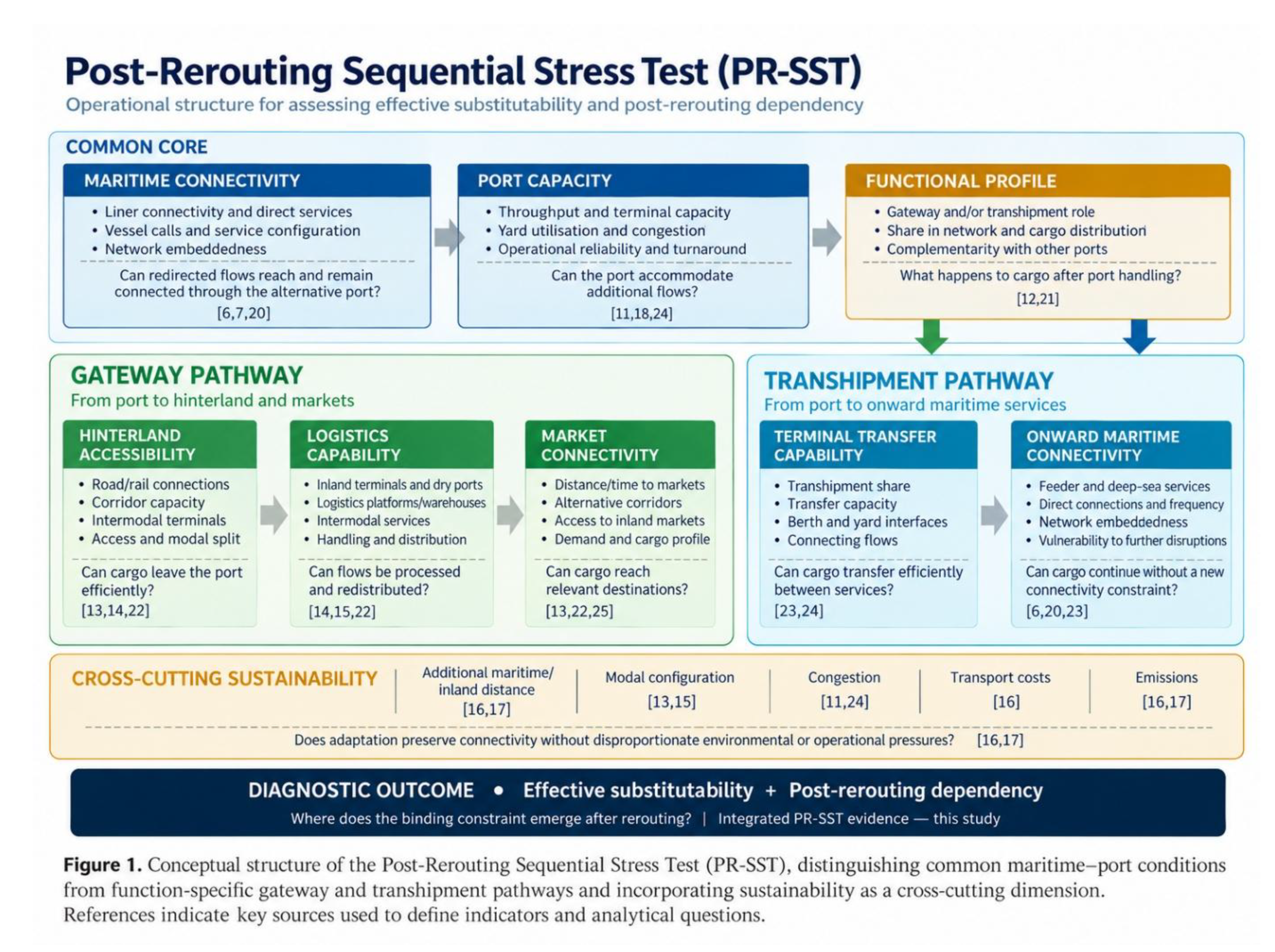
The assessment begins with two dimensions common to all redirected flows: maritime connectivity and port capacity. Maritime connectivity captures the ability of the alternative port to receive redirected services and remain connected to relevant shipping networks, whereas port capacity assesses whether terminal infrastructure and operations can accommodate additional traffic without creating critical congestion or delays [7,24]. These dimensions establish whether redirected flows can reach and be processed by the alternative port.
Beyond the port, the assessment follows two possible functional pathways according to the role performed by the port within the adapted network. For gateway flows, the sequence continues through hinterland accessibility, logistics capability and market connectivity. Hinterland accessibility evaluates the availability and capacity of road, rail and intermodal connections; logistics capability considers the infrastructure and services required to store, consolidate, transfer and redistribute cargo; and market connectivity assesses the ability of the resulting configuration to connect cargo efficiently with relevant inland production and consumption areas [2,22,25].
For transhipment flows, the post-port sequence is different. The assessment considers terminal transfer capability and onward maritime connectivity, including the availability of connecting services and the port’s integration within feeder and deep-sea networks [23]. In this configuration, the continuity of redirected flows depends less immediately on inland transport capacity and more strongly on whether cargo can be transferred efficiently between maritime services and continue towards subsequent ports and destinations. Ports combining gateway and transhipment functions may therefore require both pathways to be assessed [23]. This distinction is well established in the literature on container shipping networks, where gateway traffic is associated with hinterland-generated flows whereas transhipment involves ship-to-ship redistribution and may coexist with gateway functions within the same port [23].
The PR-SST applies a sequential rather than compensatory logic. Strong performance in one dimension does not offset a critical constraint at another stage of the logistics chain. A port with substantial terminal capacity, for example, cannot constitute an effective substitute if redirected gateway cargo cannot be accommodated by its hinterland connections or if transhipment cargo lacks sufficient onward maritime connectivity [9,25,26]. Effective substitutability is consequently determined by the ability of the entire relevant pathway to sustain redirected flows, while the stage at which a significant constraint emerges identifies a potential source of post-rerouting dependency.
Sustainability is incorporated as a cross-cutting dimension rather than as an additional sequential stage. Changes in sailing distance, inland transport distance, modal configuration, congestion, transport costs and associated emissions are considered across the relevant pathway [13,16,17]. This makes it possible to distinguish between an adaptive configuration that merely preserves cargo movement and one that does so without generating disproportionate environmental or operational pressures elsewhere in the transport system.
3.3. Assessment Procedure and Indicators
The PR-SST is operationalized through a set of indicators corresponding to the sequential dimensions defined in Section 3.2. Indicator selection reflects the multidimensional nature of port and logistics resilience, combining maritime connectivity, port operational capacity and the ability of the wider transport network to accommodate and redistribute cargo flows [7,9]. Rather than assessing these components independently, the procedure follows the movement of redirected cargo across the relevant logistics pathway, allowing constraints emerging at different stages of the adapted configuration to be identified.
For each case, the assessment begins by characterizing the functional profile of the port, particularly the relative importance of gateway and transhipment activities [23]. The two common dimensions of the PR-SST—maritime connectivity and port capacity—are subsequently assessed for all ports. Maritime connectivity is examined through indicators describing the port’s position and connections within liner shipping networks, while port capacity is assessed through available evidence on container throughput, terminal capacity and operational conditions [7,8,24]. These dimensions determine whether redirected flows can reach and be accommodated by the alternative port.
The subsequent assessment depends on the function performed by the port within the reconfigured logistics network. For gateway-oriented flows, the analysis considers hinterland accessibility, logistics capability and market connectivity. Indicators relating to road and rail accessibility, intermodal connections, inland terminals and logistics infrastructure are used to assess whether additional cargo can be transferred efficiently from the maritime gateway towards inland destinations [2,9,22,25]. For transhipment-oriented flows, the analysis focuses on terminal transfer capability and onward maritime connectivity, including the availability of connecting maritime services and the port’s integration within feeder and deep-sea networks [23]. Where gateway and transhipment functions coexist, both pathways are examined.
The operational structure of the PR-SST is presented in Figure 1. The framework combines the two common assessment dimensions with function-specific gateway and transhipment pathways. Sustainability is incorporated as a cross-cutting dimension across both pathways, while the final diagnostic stage integrates the evidence to assess effective substitutability and identify post-rerouting dependencies.
The indicators are not aggregated into a composite index or overall port score. Instead, the PR-SST applies a sequential diagnostic approach in which evidence is examined across successive stages of the relevant pathway. This makes it possible to identify the point at which the capacity to accommodate or redistribute redirected flows becomes constrained. Strong performance at one stage is therefore not assumed to compensate for a critical limitation elsewhere in the logistics configuration. The analytical emphasis is placed on the identification of binding constraints and post-rerouting dependencies, rather than on the comparative ranking of ports [9,25,26].
Where comparable temporal data are available, indicators are examined in relation to conditions before and after the onset of rerouting in order to identify changes in traffic patterns, capacity utilisation, connectivity or logistics pressure. The analysis does not attribute every observed change exclusively to the disruption; rather, temporal comparison is used together with documentary and contextual evidence to assess whether changes are consistent with the reconfiguration of maritime and logistics flows. This approach reduces the risk of interpreting coincident changes as direct effects of rerouting.
Finally, sustainability is assessed across the relevant logistics pathway as a cross-cutting dimension. Changes in maritime and inland transport distances, modal configuration, congestion, transport costs and associated emissions are considered where comparable evidence is available [13,16,17]. This enables the analysis to distinguish between configurations that preserve cargo movement and those that do so while generating additional environmental or operational pressures elsewhere in the network. The PR-SST therefore evaluates effective substitutability not solely in terms of continuity of flows, but in relation to the wider logistics configuration and the dependencies and sustainability implications produced by adaptation.
The evidence generated through the PR-SST is interpreted according to three interrelated elements: flow continuity, binding constraints and dependency reconfiguration. Flow continuity reflects the ability of the adapted configuration to maintain cargo movement across the relevant pathway, while binding constraints identify the stage at which limited capacity, connectivity or operational capability restricts that movement [9,25,26]. Dependency reconfiguration captures situations in which rerouting increases reliance on particular ports, onward maritime services, inland corridors or logistics nodes, even when cargo continuity is preserved [7,20]. Sustainability evidence is considered alongside these operational dimensions to determine whether adaptation is associated with additional transport distances, congestion, costs or emissions [13,16,17]. The resulting interpretation therefore distinguishes between configurations that effectively absorb redirected flows and those in which continuity is maintained at the expense of new constraints, dependencies or sustainability pressures.
4. Results
4.1. Port Profiles and PR-SST Assessment
The Red Sea crisis altered established Asia–Europe shipping patterns, redirecting services around the Cape of Good Hope and producing heterogeneous effects across European ports [18,20]. Changes in maritime connectivity were not uniformly distributed, reflecting differences in geographical position, network embeddedness and the role performed by individual ports within liner shipping networks [18]. Evidence from the crisis period further shows substantial variation in port-level responses, including differences in congestion intensity and recovery patterns, confirming that exposure to the same maritime disruption does not translate into equivalent operational effects across ports. Liu et al. [7], for example, identified markedly different resilience responses among the European ports included in their analysis and highlighted hinterland connectivity and maritime network embeddedness as relevant determinants of port resilience.
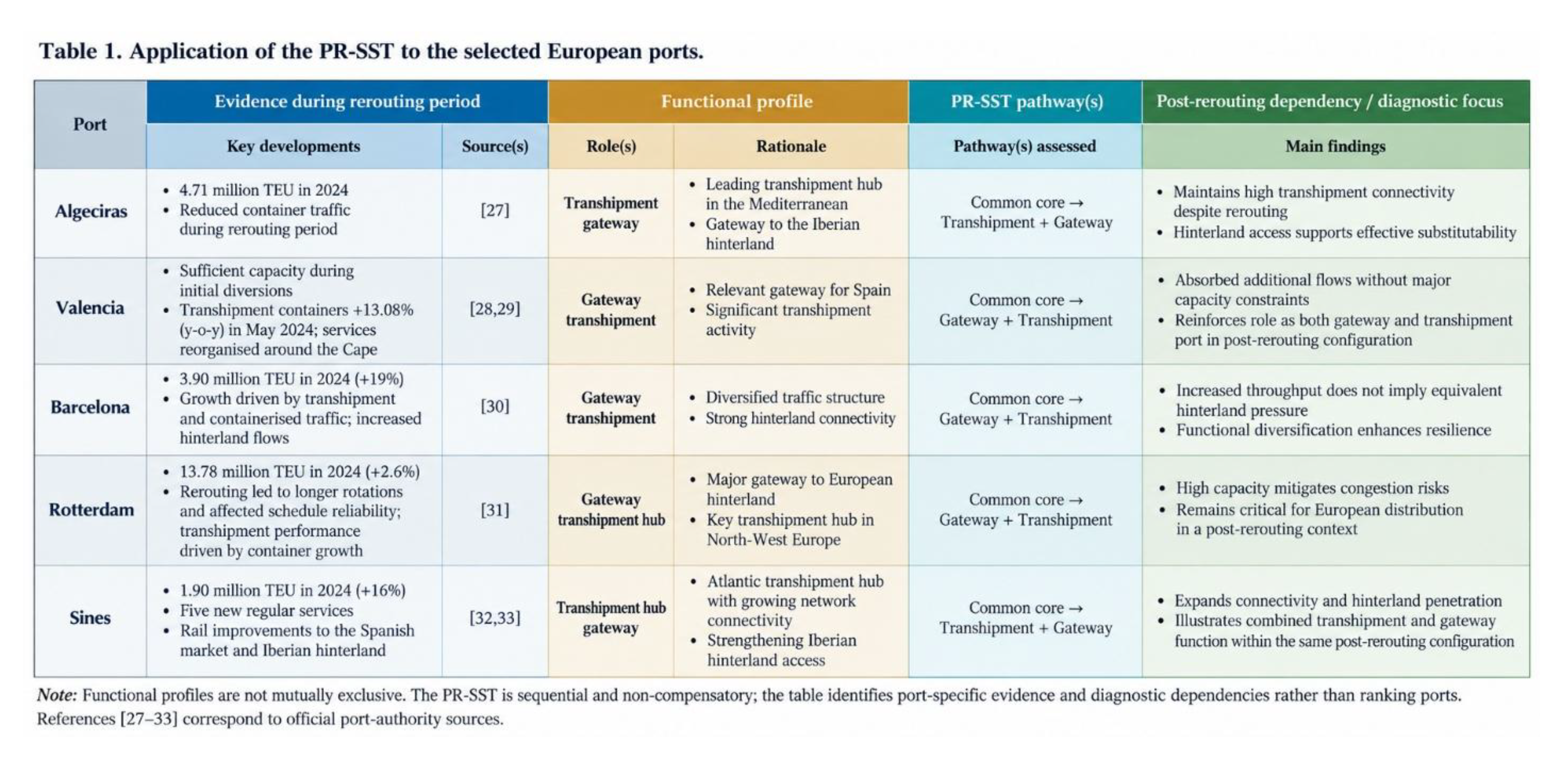
Against this background, the five ports selected for the PR-SST—Algeciras, Valencia, Barcelona, Rotterdam and Sines—provide contrasting configurations through which the consequences of rerouting can be examined. Algeciras, Valencia, Barcelona and Rotterdam differ in geographical position, maritime connectivity and hinterland integration, while available evidence from the Red Sea crisis indicates heterogeneous congestion and resilience responses among these ports [7,18]. In particular, the port-level analysis conducted by Liu et al. [7] identified Algeciras as displaying relatively low congestion and rapid recovery, whereas Barcelona experienced a comparatively less favourable resilience response; Rotterdam and Valencia were also included in the 20-port empirical assessment.
Sines provides an additional configuration of particular relevance to the present analysis because of its role as a container hub combining maritime connectivity with transhipment and access to the Iberian hinterland. Container throughput reached approximately 1.9 million TEU in 2024, 16% above 2023, while five new regular services were added to its connectivity network. At the same time, ongoing rail improvements are intended to strengthen access to the Spanish market and expand the port’s penetration into the Iberian hinterland [32,33]. These characteristics make Sines particularly relevant for examining the interaction between transhipment and gateway functions within the same post-rerouting logistics configuration.
The selected cases therefore represent different combinations of maritime connectivity, port capacity and post-port logistics functions. The PR-SST is applied comparatively to determine whether these differences influence the ability of each configuration to accommodate and redistribute redirected flows and, critically, where constraints and dependencies emerge along the gateway or transhipment pathway. The comparative evidence is summarized in Table 1.
4.2. Effective Substitutability and Post-Rerouting Dependencies
The comparative application of the PR-SST indicates that the ability of an alternative port to accommodate redirected maritime flows cannot be inferred from port capacity or maritime connectivity alone. Across the selected cases, the implications of rerouting depend on the function performed by the port and, consequently, on the logistics pathway through which cargo continues after reaching the terminal [7,18]. Ports combining gateway and transhipment functions illustrate this particularly clearly, as additional flows may simultaneously increase requirements for inland distribution and onward maritime connectivity.
For gateway-oriented flows, effective substitutability depends increasingly on the capacity of the hinterland system to absorb and redistribute additional cargo. Rail and road accessibility, intermodal connections and inland logistics capacity therefore become potential binding constraints once maritime and terminal capacity have been secured [2,9,22,25]. In this configuration, an alternative port may provide sufficient handling capacity while the resulting logistics chain becomes more dependent on specific inland corridors or transport modes. The constraint is consequently displaced from the maritime or terminal stage towards the port–hinterland interface.
For transhipment-oriented flows, the dependency structure is different. Cargo continuity depends primarily on terminal transfer capability and the availability of onward maritime services [23]. The ability to receive additional vessels or containers is therefore insufficient if connecting services, terminal interfaces or subsequent maritime links cannot accommodate the redistributed traffic. In mixed ports, both pathways may operate simultaneously, meaning that the same rerouting episode can generate different dependencies according to the subsequent destination and function of the redirected cargo.
The comparison therefore supports a distinction between nominal capacity and effective substitutability. The existence of available capacity at an alternative port represents only the first condition of substitution; effective substitutability depends on the continuity of the relevant post-port pathway. Rerouting may consequently preserve maritime connectivity while increasing reliance on particular maritime services, terminals, inland corridors or logistics nodes. These post-rerouting dependencies do not necessarily imply failure of the adaptive response, but they reveal where the reconfigured system may become increasingly constrained or exposed.
Sustainability further qualifies this assessment. Longer maritime or inland distances, changes in modal configuration, congestion and additional transport requirements may allow cargo continuity to be maintained while increasing costs, emissions or infrastructure pressure [13,16,17]. An alternative logistics configuration can therefore be operationally effective without necessarily representing the most sustainable adaptation. Effective substitutability should consequently be assessed not only by whether redirected flows continue to move, but also by the dependencies and sustainability pressures generated by the resulting configuration.
5. Discussion
The findings of this study suggest that the resilience implications of maritime rerouting extend beyond the availability of alternative routes and ports. While rerouting can preserve maritime connectivity during disruption, the effectiveness of the resulting adaptation depends on the logistics configuration that emerges after redirected flows reach an alternative port. This finding extends existing research on maritime and port resilience, which has emphasised redundancy, network connectivity, alternative routing and recovery capacity [7,18,19,20], by showing that the availability of an alternative maritime node does not, by itself, ensure the continuity of the wider logistics chain. The relevant unit of analysis therefore shifts from the alternative port considered in isolation to the post-rerouting logistics configuration through which cargo must subsequently move.
A central implication is the distinction between nominal capacity and effective substitutability. Previous research has demonstrated the importance of port capacity, connectivity and hinterland accessibility for port and supply-chain resilience [2,7,9,22,25,26]. The present analysis brings these dimensions together sequentially and suggests that capacity available at one stage cannot be interpreted independently from the ability of subsequent stages to accommodate redirected flows. A port may therefore possess sufficient terminal capacity and maritime connectivity while failing to provide full effective substitutability if constraints emerge in inland corridors, intermodal facilities or onward maritime services. In this sense, substitutability is not an intrinsic characteristic of an alternative port, but a system-level and function-dependent property of the reconfigured logistics pathway.
The distinction between gateway and transhipment functions further qualifies this interpretation. Much of the discussion surrounding port resilience implicitly assumes that additional cargo reaching an alternative port must subsequently be absorbed by its hinterland. However, the cases examined here show that redirected flows may follow fundamentally different post-port pathways. Gateway cargo transfers pressure towards road, rail, intermodal and inland logistics systems, whereas transhipment cargo remains dependent primarily on terminal transfer capability and onward maritime connectivity [26]. Ports combining both functions may therefore experience simultaneous but different forms of stress. This distinction is particularly relevant for ports such as Sines, where transhipment activity coexists with ambitions to strengthen access to the Iberian hinterland. The resilience implications of additional traffic consequently depend not only on how much cargo reaches a port, but on what happens to that cargo afterwards.
This perspective also provides a basis for interpreting post-rerouting dependency. Adaptation can maintain cargo continuity while altering the nodes, corridors and services on which the transport system depends. Such dependency reconfiguration should not automatically be interpreted as a failure of resilience: it may be the mechanism through which continuity is achieved. However, increasing reliance on a particular inland corridor, terminal interface, feeder connection or alternative maritime service may create new concentration points within the adapted network. This complements existing evidence that maritime disruptions can redistribute traffic and alter network centrality and port exposure [7,18,20], while extending the analysis beyond the immediate maritime response. The relevant resilience question is therefore not only whether the original disruption has been bypassed, but where dependency is located after the system has adapted.
The findings also reinforce the need to consider resilience and sustainability jointly. Rerouting can preserve supply-chain continuity while increasing sailing distances, inland transport requirements, congestion, costs and emissions [13,16,17]. Conversely, an operationally effective alternative may become more sustainable where redirected flows can be absorbed through efficient rail or intermodal connections rather than through additional road transport. Resilience and sustainability should therefore not be assumed to evolve in parallel. This is consistent with emerging literature calling for resilience indicators to be integrated with environmental and cost considerations in port–hinterland assessment [2]. The PR-SST contributes to this integration by treating sustainability as a cross-cutting property of the adapted pathway rather than as an independent outcome considered after resilience has been assessed.
From a practical perspective, these findings suggest that preparedness for maritime disruption should extend beyond identifying alternative routes and spare port capacity. Port authorities, infrastructure managers and logistics operators need to consider whether the entire relevant pathway can accommodate redirected flows, including inland corridors for gateway traffic and connecting maritime services for transhipment traffic. The PR-SST provides a structured means of identifying where such constraints and dependencies may emerge without reducing resilience to a single composite score. This is particularly relevant for investment and contingency planning, where expanding terminal capacity alone may provide limited systemic benefit if the next stage of the logistics chain remains constrained.
6. Conclusions
Maritime rerouting is a fundamental adaptive response to disruptions affecting global shipping networks, but maintaining cargo movement does not necessarily mean that the resulting logistics configuration is equally resilient or sustainable. This study shows that the effectiveness of rerouting depends on what happens after redirected flows reach an alternative port. Port capacity and maritime connectivity are necessary conditions for adaptation, but they are insufficient to determine whether the alternative configuration can effectively absorb and redistribute additional flows.
The study contributes to this debate through three interrelated concepts. First, it distinguishes nominal capacity from effective substitutability, conceptualizing the latter as a system-level and function-dependent property of the post-rerouting logistics configuration. Second, it introduces post-rerouting dependency to identify how adaptation can preserve continuity while increasing reliance on particular ports, inland corridors, intermodal facilities or onward maritime services. Third, the proposed Post-Rerouting Sequential Stress Test (PR-SST) provides a structured approach for tracing these constraints and dependencies across gateway and transhipment pathways while incorporating sustainability as a cross-cutting dimension.
The analysis has practical implications for port and transport planning. Preparedness for maritime disruption should not be limited to identifying alternative routes or available terminal capacity. For gateway flows, contingency planning must consider the ability of hinterland infrastructure and logistics systems to accommodate additional traffic; for transhipment flows, terminal transfer capability and onward maritime connectivity become critical. Investments intended to strengthen resilience should therefore consider the continuity of the entire adapted logistics pathway, as improvements at one stage may provide limited systemic benefit when constraints remain elsewhere.
The study is subject to limitations associated with its comparative case-study design and reliance on secondary data, whose availability and comparability vary across ports and logistics dimensions. Future research should therefore apply the PR-SST to additional disruption episodes and port systems and further develop quantitative indicators capable of measuring capacity buffers, dependency concentration and environmental consequences across post-rerouting pathways. Such applications would allow the framework to be tested under different network configurations and contribute to a more integrated assessment of resilience and sustainability in maritime logistics.
Author Contributions
Conceptualization, A.N.B. and F.C.G.; methodology, A.N.B. and F.C.G.; validation, A.N.B. and F.C.G.; investigation, A.N.B. and F.C.G.; data curation, A.N.B. and F.C.G.; writing—original draft preparation, A.N.B. and F.C.G.; writing—review and editing, A.N.B. and F.C.G.; project administration, F.C.G. All authors have read and agreed to the published version of the manuscript.
Institutional Review Board Statement:.
Informed Consent Statement:.
Data Availability Statement:.
Acknowledgments:.
Conflicts of Interest:.
Funding
This research received no external funding.
References
- United Nations Conference on Trade and Development (UNCTAD). Review of Maritime Transport 2025: Staying the Course in Turbulent Waters; United Nations: Geneva, Switzerland, 2025. [Google Scholar]
- Zhang, H.; Poo, M.C.-P.; Lau, Y.-Y.; Fan, S. Integration Mechanisms and Performance in Port–Hinterland Supply Chains: A Systematic Review. J. Mar. Sci. Eng. 2026, 14, 1434. [Google Scholar] [CrossRef]
- Li, C.; Yang, X.; Yang, D. Port Vulnerability to Natural Disasters: An Integrated View from Hinterland to Seaside. Transp. Res. Part D. Transp. Environ. 2025, 139, 104563. [Google Scholar] [CrossRef]
- Gao, S.; Liu, N. Improving the Resilience of Port–Hinterland Container Logistics Transportation Systems: A Bi-Level Programming Approach. Sustainability 2022, 14, 180. [Google Scholar] [CrossRef]
- United Nations Conference on Trade and Development (UNCTAD). Review of Maritime Transport 2024: Navigating Maritime Chokepoints; United Nations: Geneva, Switzerland, 2024. [Google Scholar]
- United Nations Conference on Trade and Development (UNCTAD). Navigating Troubled Waters: Impact to Global Trade of Disruption of Shipping Routes in the Red Sea, Black Sea and Panama Canal. In UNCTAD Rapid Assessment; UNCTAD: Geneva, Switzerland, 2024. [Google Scholar]
- Liu, J.; Yu, W.; Fu, X.; Liu, J. Assessing the Port Resilience under the Red Sea Crisis. J. Transp. Geogr. 2026, 130, 104474. [Google Scholar] [CrossRef]
- United Nations Conference on Trade and Development (UNCTAD). Red Sea Crisis and Implications for Trade Facilitation in Africa. Transp. Trade Facil. Newsl. 2024, 101. [Google Scholar]
- Chen, H.; Cullinane, K.; Liu, N. Developing a Model for Measuring the Resilience of a Port-Hinterland Container Transportation Network. Transp. Res. Part E Logist. Transp. Rev. 2017, 97, 282–301. [Google Scholar] [CrossRef]
- Li, K.X.; Wang, H.; Yang, Y.; Li, M. Resilience in Maritime Logistics: Theoretical Framework, Research Methodology, and Indicator System. Ocean Coast. Manag. 2024, 259, 107465. [Google Scholar] [CrossRef]
- Zhang, H.; Zhao, X.; Wang, J.; Huang, R. Dynamic Port Resilience Assessment in the Maritime Network: Modeling Flow Evolution and Cascading Failure. Reliab. Eng. Syst. Saf. 2026, 267, 111927. [Google Scholar] [CrossRef]
- International Transport Forum. Port Investment and Container Shipping Markets: Roundtable Summary and Conclusions; International Transport Forum Discussion Papers; OECD Publishing: Paris, France, 2015; Volume No. 2015/03. [Google Scholar]
- Guo, T.; Liu, P.; Wang, C.; Xie, J.; Du, J.; Lim, M.K. Toward Sustainable Port-Hinterland Transportation: A Holistic Approach to Design Modal Shift Policy Mixes. Transp. Res. Part A Policy Pract. 2023, 174, 103746. [Google Scholar] [CrossRef]
- Zgonc, B.; Jakšič, M. Modelling Modal Split for Sustainable Port-Hinterland Transport: The Case of the North Adriatic Ports. Eur. Transp. Res. Rev. 2025, 17, 46. [Google Scholar] [CrossRef]
- Mokhtari-Moghadam, A.; Nguyen, T.T.; Mohsendokht, M.; Wang, J.; et al. A Sustainability-Aware Optimization Framework for Port-Hinterland Truck Scheduling. Ann. Oper. Res. 2026. [Google Scholar] [CrossRef]
- Sun, R.; Abouarghoub, W.; Demir, E.; Potter, A. Geopolitical Disruptions and Maritime Transitions: Environmental and Economic Costs of Rerouting. Transp. Res. Part A Policy Pract. 2026, 203, 104737. [Google Scholar] [CrossRef]
- Zhao, P.; Kong, W.; Kang, T.; Chi, Y.; Wang, M. The Red Sea Crisis Exacerbates Air Pollution and Environmental Hazards in African Port Cities. Ocean Coast. Manag. 2026, 280, 108300. [Google Scholar] [CrossRef]
- Bedoya-Maya, F.; Beckers, J.; Cant, J.; Martínez-Moya, J.; van Hassel, E.; Vanelslander, T. Container Port Competitiveness amid Disruptions: Insights from the European Maritime Network during the Red Sea Crisis. J. Transp. Geogr. 2025, 128, 104304. [Google Scholar] [CrossRef]
- Liu, J.; Wu, J.; Gong, Y. Maritime Supply Chain Resilience: From Concept to Practice. Comput. Ind. Eng. 2023, 182, 109366. [Google Scholar] [CrossRef]
- Notteboom, T.; Haralambides, H.; Cullinane, K. The Red Sea Crisis: Ramifications for Vessel Operations, Shipping Networks, and Maritime Supply Chains. Marit. Econ. Logist. 2024, 26, 1–20. [Google Scholar] [CrossRef]
- Notteboom, T.E.; Rodrigue, J.-P. Port Regionalization: Towards a New Phase in Port Development. Marit. Policy Manag. 2005, 32, 297–313. [Google Scholar] [CrossRef]
- Deshmukh, A.; Song, D.-W. Probing into Hinterland Connectivity with a Web of Transport Modes and Logistics Nodes: A Case of Indian Container Ports. Transp. Res. Part A Policy Pract. 2024, 189, 104200. [Google Scholar] [CrossRef]
- Slack, B.; Gouvernal, E. Container Transshipment and Logistics in the Context of Urban Economic Development. Growth Change 2016, 47, 406–415. [Google Scholar] [CrossRef]
- Wang, H.; Ruan, Y.; Niu, B.; Zhang, H. Intra-Port Demand Coordination and Inter-Port Competition: Ports’ Pricing Strategies with Congestion Concerns. Ocean Coast. Manag. 2024, 248, 106918. [Google Scholar] [CrossRef]
- Wu, Y.; Zhang, R. Evaluation Model for a Port Hinterland Intermodal Freight Network Considering Environmental Impacts and Capacity Constraints. Transp. Res. Rec. 2023, 2677, 462–478. [Google Scholar] [CrossRef]
- Pan, W.; Zhu, X. Optimization of Port-Rail Intermodal Transshipment Operations Considering Shipment Reallocation in the Railway Network. J. Adv. Transp. 2026, 2026, 6352112. [Google Scholar] [CrossRef]
- Autoridad Portuaria de la Bahía de Algeciras (APBA). Informe de Gestión 2024. In APBA – Informe de Gestión 2024; Available online; APBA: Algeciras, Spain, 2025; (accessed on 1 October 2026). [Google Scholar]
- Autoridad Portuaria de València (APV). The Capacity of the Port of València Guarantees the Import/Export of Spanish Foreign Trade. Valenciaport – official article. Available online. 19 January 2024. (accessed on 1 October 2026).
- Autoridad Portuaria de València (APV). The Export Sector and Transhipments Gain Prominence in May. Valenciaport. Available online. 20 June 2024. (accessed on 1 October 2026).
- Port de Barcelona. Annual Report 2024 Port de Barcelona – Annual Report 2024; Available online; Barcelona Port Authority: Barcelona, Spain; Port de Barcelona, 2025; (accessed on 1 October 2026). [Google Scholar]
- Port of Rotterdam Authority. Highlights Annual Report 2024. Port of Rotterdam Authority: Rotterdam, The Netherlands, 2025 Port of Rotterdam – Highlights Annual Report 2024; Available online; Havenbedrijf Rotterdam; (accessed on 1 October 2026).
- Administração dos Portos de Sines e do Algarve (APS). 2024 Is the Best Year Ever for the Port of Sines. APS – Port of Sines official article; Available online. Apsines Algarve, 9 January 2025. (accessed on 1 October 2026).
- Administração dos Portos de Sines e do Algarve (APS). Sines Strengthens Its Position in the Ranking of the Main Container Ports in the European Union in 2024. APS – Port of Sines official article. Available online. 26 February 2025. (accessed on 1 October 2026).
Disclaimer/Publisher’s Note: The statements, opinions and data contained in all publications are solely those of the individual author(s) and contributor(s) and not of MDPI and/or the editor(s). MDPI and/or the editor(s) disclaim responsibility for any injury to people or property resulting from any ideas, methods, instructions or products referred to in the content. |
© 2026 by the authors. Licensee MDPI, Basel, Switzerland. This article is an open access article distributed under the terms and conditions of the Creative Commons Attribution (CC BY) license.
Copyright: This open access article is published under a Creative Commons CC BY 4.0 license, which permit the free download, distribution, and reuse, provided that the author and preprint are cited in any reuse.