

Submitted:
17 October 2026
Posted:
19 October 2026
You are already at the latest version
Abstract
Photonic molecules are systems of coupled optical resonators, or of deliberately coupled modes within one resonator, whose collective states have engineered frequencies, lifetimes and optical access. Integration on silicon, silicon nitride, thin-film lithium niobate and hybrid platforms has turned them from spectroscopic objects into circuit elements for filtering, frequency conversion, nonlinear light generation, lasing and sensing. This review covers the physics and the state of the art of integrated photonic molecules. We first introduce the temporal coupled-mode description of a two-resonator molecule and the quantities used to characterize it: mode splitting, linewidth and their ratio. We then review each platform: thermally tuned and photonic-crystal molecules in silicon for compact spectral processing, spectrometry and sensing; low-loss silicon nitride molecules for soliton and parametric generation, squeezed light and narrow-linewidth Brillouin lasing; and electro-optic molecules in lithium niobate and hybrid stacks for programmable two-level dynamics, frequency shifting, comb generation and transduction. Non-Hermitian and active molecules, including exceptional-point devices and coupled lasers, are treated separately. Comparison tables collect the reported metrics together with their operating conditions. We close with the open problems of calibration, stability and packaging and with prospects in microwave photonics and quantum technologies.
Keywords:
photonic molecules
; coupled resonators
; microring resonators
; silicon photonics
; silicon nitride
; thin-film lithium niobate
; exceptional points
; integrated nonlinear photonics
1. Introduction
Optical microcavities store light in discrete modes whose frequencies, lifetimes and field distributions can be engineered [1]. When two or more cavities are coupled, their modes hybridize into collective states, or supermodes, much as atomic orbitals combine into the bonding and antibonding orbitals of a diatomic molecule. Bayer et al. used the term photonic molecule (PM) for two lithographically defined square photonic dots joined by a semiconductor bridge [2]. Resonant bispheres and coupled microcavities then revealed tight-binding supermodes, their fine structure and molecular lasing [3,4,5]. The same physics was already at work in integrated optics: coupled microrings form channel-dropping filters and coupled-resonator optical waveguides [6,7], and the interference between a strongly and a weakly accessed resonance produces coupled-resonator-induced transparency and slow light [8,9], demonstrated on chip in silicon rings and photonic-crystal cavities [10,11]. Hybrid silica, polymer and adjustable-gap molecules extended this control [12,13,14], and a tunable two-level optical system even mediated phonon laser action [15]. Low-loss photonic integrated circuits (PICs) have since made molecular spectra a design variable. Silicon nitride (, here SiN) offers ultralow propagation loss with wafer-scale yield and sub-milliwatt parametric oscillation thresholds [16,17,18]. Lithium niobate (LN) adds electro-optic (EO) tuning of microrings [19], and thin-film LN (TFLN) provides ultrahigh-Q resonators and modulators driven at CMOS-compatible voltages [20,21]. Silicon (Si) brings dense integration with thermo-optic and microelectromechanical tuning, including independent control of coupling and phase [22,23], and programmable photonics supplies the control architecture around such elements [24]. On these platforms PMs now perform defined circuit functions: electronically programmable two-level dynamics and frequency conversion [25,26], efficient EO and Kerr comb generation [27,28], squeezed-light generation [29], Brillouin lasing with a sub-100-mHz fundamental linewidth [30], chip-scale spectrometry [31,32] and self-referenced sensing [33,34]. Gain and loss open a further, non-Hermitian design space for mode-selective lasing and exceptional-point (EP) sensing [35,36,37,38]. Earlier reviews cover the foundations: three-dimensional whispering-gallery molecules [39], spectral engineering of coupled microcavities [40], PM quantum optics [41], EPs in optics [42] and programmable circuits [24]. Most integrated SiN and TFLN molecules appeared after these works, and this review gives a concise, device-level account of them. Each platform section states the operating principle, then the state of the art, and a table collects the reported metrics. We take a PM to be a set of identifiable resonant modes that interact to form collective states serving a function; it may consist of separate cavities or of coupled mode families within one cavity. Extended coupled-resonator lattices [43] and bound photon states in atomic media [44] fall outside the scope. The literature covered extends to 30 September 2026, and experimental preprints and theoretical proposals are identified as such. Section 2 introduces the coupled-mode description and the architectures. Section 3, Section 4 and Section 5 review Si and photonic-crystal, SiN, and LN and hybrid molecules. Section 6 treats non-Hermitian, active and quantum molecules, and Section 7 closes with an outlook. Figure 1 places the milestones discussed here on a common timeline.
2. Principle of Photonic Molecules
2.1. Coupled-Mode Description of a Dimer
Temporal coupled-mode theory (TCMT) treats the resonant modes and their external ports together [45,46]. Consider two single-mode resonators with amplitudes and , normalized so that is the stored energy, and a bus waveguide coupled only to the first resonator (Figure 2a). With the time convention ,
where are the uncoupled resonance frequencies, and are energy decay rates that include intrinsic loss and bus coupling , J is the coherent inter-resonator coupling rate and is the guided power. All frequencies and rates are angular. A single Lorentzian mode then has loaded quality factor and a power full width at half maximum (FWHM) of . Some papers quote amplitude decay rates, which are half the energy decay rates, so the convention must be checked before linewidths are compared. Setting the input to zero and seeking solutions gives the complex supermode frequencies
with mean frequency and detuning . For equal decay rates the two supermodes are separated by
which reduces to the minimum gap at , where the supermodes are the symmetric and antisymmetric combinations . Tuning through zero produces the avoided crossing of Figure 2b, along which the supermodes exchange character. At large detuning the separation mostly reflects the uncoupled mismatch, so the coupling is read from the gap at alignment. The ratio
compares the splitting with the common loaded linewidth and tells whether the doublet is spectrally resolved. For unequal losses, Equation (4) shows that the real splitting vanishes below a coupling threshold; this exceptional point is discussed in Section 6 (Figure 2c).
2.2. Transmission and Optical Access
What a circuit measures is the port response. Solving Equations (1)–() in steady state, with , gives the through-port transmission
which reduces to the familiar single-ring response for . The second resonator enters only through the self-energy . When is small, this term opens a narrow transparency window inside the broad resonance of the bus-coupled ring, the coupled-resonator analogue of electromagnetically induced transparency (EIT) [8,10]. Two structures with the same supermode frequencies can therefore differ widely in extinction, insertion loss and phase response, depending on which mode the bus addresses and how strongly. A supermode that couples weakly to the bus is often called dark, but it is dark only for that port. Multiport and multimode cases follow from the matrix form of TCMT, in which passivity and reciprocity constrain the coupling matrices [45,46].
2.3. Spatial and Modal Molecules
The resonant basis of a PM need not consist of separate cavities. Figure 3 groups the architectures reviewed here. In spatial molecules the basis is formed by the modes of side-coupled, embedded, nested or fully connected rings, or of photonic-crystal (PhC) nanocavities joined by a barrier. In single-ring molecules it is formed by the clockwise and counterclockwise waves of one ring, coupled by an engineered grating, or by two transverse mode families coupled by a mode converter. The second class removes the intercavity gap but makes the scatterer or converter part of the molecular design. Li et al., for instance, use a PhC microring in which thermo-optic tuning shifts the grating reflection relative to the ring resonance, and report signal and idler tuning over more than 5 THz with forward signal-plus-idler conversion above 25% relative to the on-chip pump power [47]. De Goede et al. use engineered counterpropagating-mode splitting in one ring for self-referenced biosensing [34]. Spreeuw et al. had already shown that coupled optical modes realize a classical driven two-level system [48], the basis of the driven molecules of Section 5. Two cautions apply. First, the number of states is not the number of lithographic objects: propagation direction, polarization and transverse order can enlarge the basis, as in the six-state spectrum of a three-ring SiN molecule [49]. Second, random backscattering also splits ring resonances. A doublet alone therefore does not identify an engineered molecule; a detuning-dependent avoided crossing or a controlled exchange of mode character does. A three-cavity system adds further detunings and coupling paths, so its spectrum depends on topology as well as on cavity count [50].
2.4. Static Coupling and Driven Transitions
Two kinds of control act on a molecule. A fabricated coupler fixes J, and actuators that shift and set the detuning and the common frequency; together they define a level structure. A periodic perturbation at the supermode difference frequency then drives transitions between the levels, in direct analogy with a two-level atom [25,48]. The first process is a configuration step and the second an operation, and they have different bandwidth and power requirements. The two-mode description is local: a ring has repeated longitudinal orders separated by its free spectral range (FSR), and the model must be enlarged when coupling or modulation reaches neighboring orders [6,7].
3. Silicon and Photonic-Crystal Molecules
3.1. Principle
Silicon offers high index contrast, compact rings and PhC cavities, and mature fabrication. Its large thermo-optic coefficient makes heaters the standard actuator. For a ring of effective index and group index , a temperature change shifts the resonance wavelength by
so independent heaters on the constituent rings set the detuning of Equation (4) while the gap fixes J. Efficient, compact thermo-optic phase shifters [22] and microelectromechanical (MEMS) rings with independent control of coupling and phase [23] extend this control. Embedded and nested rings give closely spaced resonances without the large radius an isolated ring would need for the same spacing. PhC molecules rely on small mode volumes and barrier engineering, and their geometry sets both the magnitude and the sign of the coupling [51]. Two-photon and free-carrier absorption near 1550 nm limit Si at high intracavity intensity, which is why most Kerr molecules use SiN (Section 4).
3.2. State of the Art
Q. Xu et al. realized an all-optical on-chip analogue of EIT with two thermally aligned Si microrings [10], and X. Yang et al. obtained the analogous response in multiple coupled PhC cavities [11]. Barea et al. then used embedded rings to obtain doublet and triplet resonances compatible with Si technology and extracted a 34.2-GHz signal by filtering modulation sidebands [52]. Souza et al. demonstrated embedded rings with high finesse and resonance spacings of 40–60 GHz at , and used them for four-channel wavelength multicasting with 1 mW of optical control power in the input waveguide [53]. In both works the interaction sets spacings that a single compact ring cannot provide. Molecules also control nonlinear processes in Si. Borghi et al. tuned the detuning and the inter-ring phase of two coupled rings to enhance or suppress stimulated four-wave mixing (FWM), and measured an enhancement of dB, about fivefold, relative to an isolated constituent ring, associated with a subradiant collective state [54]. The gain comes from shaping the nonlinear field distribution and its output interference; a larger splitting adds little. Single-ring Si molecules use transverse modes. Tao et al. demonstrated a thermally switched multimode microresonator in which the splitting is controlled from 5.74 to 1.76 GHz and the device can be switched to an effectively single-mode state with [55]. In that high-Q state they reported microwave-photonic filter tuning up to 57.5 GHz with a 32-MHz passband and an optoelectronic oscillator (OEO) operating up to 50 GHz, with a phase noise of about dBc/Hz at 10-kHz offset measured near 12 GHz. Lu et al. instead fixed the intermode coupling with transmissive mode converters in a single ring. Their two-mode experiment shows a 21.8-GHz separation, loaded quality factors of and for the two transverse modes, bright-dark behavior and EP signatures; a three-mode extension is analyzed numerically [56]. PhC molecules were the first to show dynamic control of photon exchange on a chip. Sato et al. obtained strong coupling between distant nanocavities linked by a waveguide and controlled it dynamically [57], and Konoike et al. transferred trapped photons between nanocavities on demand [58]. Caselli et al. showed that generalized Fano lineshapes in PhC molecules reveal EPs, so linewidth and lineshape must accompany peak positions whenever non-Hermitian behavior is claimed [59]. The spectral diversity of coupled rings has made computational spectrometers possible. H. Xu et al. engineered the wavelength dependence of the coupling so that each FSR shows a distinct splitting; a calibrated thermal scan over one FSR then reconstructs spectra on a 40-pm resolution grid across a 100-nm span [31]. Y. Zhang et al. used a disordered PM as the encoder and reported 8-pm resolution over more than 100 nm with a optical encoder [32]. In both cases the resolution characterizes the encoder, calibration and reconstruction together. For sensing, Boriskina predicted enhanced quality factors and sensitivity in spectrally engineered molecules and proposed self-referenced sensors [33,60,61].
A numerical topology comparison by Fallahi et al. provides a useful single-cavity benchmark [62]. Using two-dimensional finite-difference time-domain simulations of Si-rod PhC micro-hexagonal rings, they compared waveguide access and multi-ring arrangements. Their single-ring, two-waveguide design gives a 0.31-nm FWHM and 96.8% transmission near 819.8 nm; adding a horizontal second ring changes these to 0.47 nm and 78%, while some other arrangements narrow the response but introduce multiple peaks. Their preferred sensor therefore retains one ring. For PM sensing, this comparison highlights the need to benchmark linewidth, throughput and spectral ambiguity together against a single-cavity reference. The simulated structures still require validation of vertical confinement, material absorption and fabrication tolerance before their performance can be compared with fabricated PIC sensors.
Costa et al. recently validated an effective-index design model against a Si molecule with an encapsulated reference ring and a partly exposed sensing ring; they report a sensitivity above 55 nm per refractive-index unit (RIU) and deviations below 3.2% between modeled and measured sensitivity [63]. The protected reference rejects common drift, provided the two responses are weighted correctly. Routing is another application: Geints designed a molecule-based multiway splitter whose division ratio is set by supermode-selective excitation, not yet fabricated [64]. Table 1 summarizes these devices.
4. Silicon Nitride Molecules
4.1. Principle
SiN combines low propagation loss, a broad transparency window and a Kerr nonlinearity free of two-photon absorption in the telecom band [16,17,18]. It has no Pockels effect, so its molecules are tuned by heaters or stress-optic actuators. In Kerr and Brillouin devices the molecule acts as a local control of dispersion and loss. The resonances of a single ring follow the integrated dispersion
where is the mode number relative to the pumped mode, is the FSR and the second-order dispersion. Coupling one longitudinal mode of the main ring to an auxiliary resonance splits that mode by about and leaves the others nearly unchanged. This local shift can supply the phase matching that normal dispersion denies, move the pumped resonance relative to the comb lines, or detune an unwanted resonance. For parametric processes the shifted modes must still satisfy energy conservation, for degenerate pumping, which a tunable triplet of collective modes can provide directly.
4.2. State of the Art
Coupling between transverse mode families was used early on to initiate mode-locked dark-pulse combs in normal-dispersion microresonators [65]. B. Y. Kim et al. then controlled the avoided mode crossing with an auxiliary ring and obtained turn-key normal-dispersion combs with about 41% pump-to-comb conversion [66]. Helgason et al. demonstrated dissipative solitons in PMs [67], and Tikan et al. showed emergent nonlinear phenomena in a driven dissipative dimer [68]. Later studies generated solitons on both sides of an EP [69], in protected supermodes [70], and as platicons in normal-dispersion molecules [71]. Helgason et al. then went past the usual efficiency of soliton microcombs: by shifting only the pump resonance they decoupled the pump detuning from that of the comb lines and reached more than 50% conversion, against a typical single-resonator efficiency of about 1% cited by the authors [28]. Their efficiency divides the comb power, excluding the residual pump, by the continuous-wave power measured at the same output with the pump detuned from resonance, which removes common coupling losses. Noise can be engineered as well. Skehan et al. reduced the thermorefractive noise of a PM comb with an all-optical servo loop, in which a secondary laser on the blue side of a resonance offsets thermal drift. The frequency-noise amplitude spectral density decreased by about 50%, averaged over 10 kHz–1 MHz, relative to the uncooled comb [72]. The clearest molecular advantage comes from detuning a competing process. Y. Zhang et al. detuned parasitic nonlinear resonances with an auxiliary ring and measured 1.65(1) dB of squeezing at a 20-MHz sideband frequency; correcting for a 38(2)% collection and detection efficiency gives 8(1) dB at the on-chip output [29]. K. Liu et al. split the second-order Stokes resonance of a nested-ring Brillouin laser by a designed 198 MHz, suppressing cascaded lasing while preserving the first-order Stokes output. The unsplit resonances have and . The laser reaches a fundamental linewidth of mHz at 80 mW of on-chip pump and delivers about 11 mW of output at 170 mW; these are two different operating points [30]. Tomazio et al. used a heater-tuned three-ring molecule for tunable degenerate parametric oscillation: two phase-coherent pumps address the outer collective modes and light is generated in the central mode [73]. Programmable SiN molecules have followed. J. Wang et al. fabricated a fully connected three-ring molecule with three bus waveguides and a lead-zirconate-titanate (PZT) actuator on each ring [49]. A single reference ring of the same geometry has , and a 43-MHz linewidth, and the six collective modes have linewidths of 46–58 MHz. The actuators tune at 0.16 GHz/V with about 90 nW of static power each. The authors quote a splitting-to-linewidth ratio of 58, obtained from the 2.5-GHz detuning range and the 43-MHz reference linewidth. Table 2 lists these devices.
5. Lithium Niobate and Hybrid Molecules
5.1. Principle
LN combines the Pockels effect with a second-order nonlinearity, and TFLN resonators reach intrinsic quality factors in the millions [20,21]. An electrode can apply either a static resonance shift or a microwave drive, and its placement decides which operation is available. Write the resonator frequencies as with a differential modulation , and the aligned dimer in the Pauli-matrix notation . In the resonator basis and in the supermode basis , the frequency matrices are
A differential modulation thus acts as an off-diagonal drive between the supermodes, whereas a common shift is proportional to the identity and only moves the molecule relative to the laser. A drive at the splitting produces Rabi oscillations of light between the supermodes, with a Rabi frequency set by the modulation amplitude. Coherent transfer survives decay when the Rabi frequency is large compared with the supermode linewidths. Because one supermode can couple strongly to the bus and the other weakly, driven transfer switches optical access without changing a gap. The same structure underlies EO frequency shifters, beam splitters and microwave-to-optical transducers, in which the drive or a microwave resonance bridges two optical states [26,74]. Wade et al. showed that modulated coupled-resonator converters can be designed through an equivalent linear filter [75].
5.2. State of the Art
M. Zhang et al. demonstrated an electronically programmable PM in TFLN [25]. The two rings show a 7-GHz splitting and a 96-MHz linewidth, with near 1630 nm. From the DC avoided crossing they extracted a coupling-tuning coefficient GHz/V. Under microwave driving they observed Rabi oscillations, at 1.1 GHz for a 1.1-V peak drive, Ramsey interference, and the storage and on-demand retrieval of light, using the weakly accessed supermode as the storage state. These experiments show controllable access to a cavity excitation. Storage time is still limited by intrinsic loss, and no quantum-memory fidelity was measured. The same driven two-level structure enables operations in the frequency domain. Y. Hu et al. demonstrated EO frequency shifters with shifts up to 28 GHz and about 90% on-chip conversion, a cascaded configuration reaching 119.2 GHz with a 29.8-GHz drive, and frequency-domain beam splitters [26]. In a second work they addressed a limit of EO combs: strong modulation adds an effective loss channel to the pump mode and breaks its critical coupling. An auxiliary resonator restores efficient pump loading, and the coupled-resonator EO comb reaches 30% waveguide-to-waveguide pump-to-comb efficiency with a 132-nm span measured at the -dBm level, for 2 mW of pump and a 30.925-GHz drive [27]. This efficiency excludes the electrical drive power. Frequency crystals in EO microcombs carry the same ideas to high-dimensional synthetic lattices [76]. Microwave-to-optical transduction adds a microwave resonance to the optical pair. McKenna et al. and Holzgrafe et al. demonstrated triply resonant LN transducers with superconducting microwave resonators, on sapphire and in TFLN respectively [74,77]. In these devices the optical pump enhances an EO interaction that links a microwave excitation to the other optical supermode. In a theoretical design, Singh et al. placed a passive middle ring between two active modulator cavities, so that detuning the middle ring tunes the effective coupling and hence the RF carrier selected for conversion [78]; an erratum corrects the eigenvector normalization in the efficiency expressions without changing the conclusions [79]. Other LN geometries widen the design space. M. Wang et al. fabricated coupled LN microdisks by femtosecond-laser processing and focused-ion-beam milling and observed strong nonlinear optics [80]. Hwang et al. coupled two TFLN Fabry–Pérot cavities with PhC mirrors, so that the barrier geometry sets the interaction and EO detuning sets the operating point [81]. In an experimental preprint, T. Zhang et al. used a photorefractively written grating to couple co-propagating and modes within one LN racetrack. The coupling envelope has a FWHM of THz, the dominant post-writing relaxation time is min, and seven write-erase cycles span about 10 h. The written molecule then performs single-sideband millimeter-wave transduction around 107 GHz with a 5-GHz tuning bandwidth [82]. Hybrid stacks separate low-loss storage from EO control. Churaev et al. wafer-bonded TFLN onto SiN circuits and demonstrated 50-GHz-FSR dimers with a zero-bias splitting of 4.6 GHz, DC tuning near 30 MHz/V and intrinsic quality factors up to across the platform [83]. The same platform supports ultrafast tunable lasers [84]. Z. Peng et al. implemented a PhC microring on a SiN-on-LN stack. In a 400-m-radius ring, periodic corrugation gives a 14.6-GHz separation with near 1620 nm; a 300-m ring shows an EO response of 0.85 pm/V near 1581 nm, about 0.102 GHz/V, which shifts both resonances without appreciably changing their separation [85]. Table 3 compares these devices.
6. Non-Hermitian, Active and Quantum Molecules
6.1. Principle
An EP is a degeneracy at which both the eigenvalues and the eigenvectors of a non-Hermitian system coalesce. For the dimer of Equation (4) with real coupling, the square root vanishes when
which for real detuning requires and (Figure 2c). Below this coupling the supermodes share one frequency and differ in decay; above it they share one decay rate and split in frequency. In a balanced gain-loss dimer the mean decay vanishes and the spectrum beyond the EP is real, which is the parity-time-symmetric case; a passive loss-contrast dimer reaches the same EP with a common decay offset [42]. Two identical uncoupled modes are degenerate but keep independent eigenvectors, so they do not form an EP. Near an EP of order n, a perturbation can split the eigenvalues in proportion to , which motivated EP sensing [37,38,86]. In single-ring molecules the same algebra applies to asymmetric backscattering between counterpropagating waves, where the vanishing of one off-diagonal coefficient gives a chiral EP [37,42].
6.2. State of the Art
Gain-loss contrast first served as a mode selector. Hodaei et al. obtained single-mode lasing in parity-time-symmetric coupled microring lasers [35], and Feng et al. through parity-time symmetry breaking in a microring laser [36]. B. Peng et al. realized parity-time-symmetric whispering-gallery microcavities and loss-induced suppression and revival of lasing [87,88], and Chang et al. used active-passive coupled microresonators for variable optical isolation [89]. Hamel et al. observed spontaneous mirror-symmetry breaking in coupled PhC nanolasers [90]. Molecular lasing now reaches the mid-infrared: Kacmoli et al. formed a PM from two evanescently coupled racetrack quantum-cascade lasers [91]. Polymeric supermode lasers on Si are an earlier example [13]. Above threshold, gain saturation and noise select the emitted field, so threshold selection alone does not establish linewidth or stability over the pump range. EP sensing was demonstrated with scatterer-induced EPs in a microcavity [37] and with a ternary laser molecule at a higher-order EP [38]. Theoretical work then showed that a larger eigenvalue splitting does not by itself improve estimation precision, because broadening, mode nonorthogonality and noise also enter the signal-to-noise ratio [86,92,93]. A fair comparison therefore fixes measurement time, optical power and readout noise. In integrated molecules, EP signatures have been identified through Fano lineshapes in PhC molecules [59] and through bright-dark behavior in a single Si ring [56], and Kerr solitons have been generated on both sides of an EP in a SiN dimer [69]. Dynamically encircling an EP produces asymmetric mode switching, so far shown only in a microwave waveguide [94]. Quantum operation requires direct evidence of nonclassical light. Theory predicts strong antibunching in weakly nonlinear molecules [95,96], and Nigro et al. proposed an asymmetric two-ring molecule in which strong pumping enhances an effective nonlinearity and blockades a weak probe [97]. On the experimental side, a micropillar molecule produced an ultrabright source of entangled photon pairs [98], and a SiN molecule produced squeezed light (Section 4) [29]. Pumped molecules also need a stability analysis: H.-J. Chen et al. showed theoretically that coupling to an auxiliary cavity reshapes optical bistability and FWM in an optomechanical molecule [99]. Driven molecules can further emulate topological physics in synthetic frequency dimensions: quantized pumping with a driven dissipative PM has been analyzed and tested in preliminary fiber experiments, but not yet in a PIC [100]. Table 4 summarizes these studies.
7. Conclusions and Outlook
Integrated PMs give controlled interaction among a small set of resonant modes. Spatial dimers, embedded and nested rings, trimers, PhC cavities and single-ring modal devices realize it with different optical access and controls. In the reviewed demonstrations, Si molecules provide compact spectral processing, modal switching, spectrometry and sensing; SiN molecules provide narrow resonances and selective engineering of nonlinear processes; LN molecules provide fast EO manipulation of collective states; hybrid stacks join low-loss storage to electrical control; and active semiconductor molecules extend mode selection to lasing. Whatever the platform, the auxiliary mode earns its place in one of three ways: it changes access to a state, as in bright-dark storage and pump loading; it corrects a resonance relationship, as in phase matching and pump-resonance shifts; or it suppresses a competing process, as in squeezing and Brillouin lasing. The ratio of Equation (6) spans more than an order of magnitude across the reviewed devices. Si molecules with loaded quality factors of order sit at modest values, about 5 to 7 for the 21.8-GHz split of Lu et al. [56]. Low-loss SiN and TFLN molecules reach several tens: 58 is reported for the SiN trimer [49], and the 7-GHz splitting and 96-MHz linewidth of the TFLN dimer give [25]. Coherent driving needs supermodes resolved well beyond their linewidths, which is why the Rabi and storage experiments sit at the high end. Spectrometers and sensors draw instead on spectral diversity and lineshape, for which a large is not the figure of merit. The ratio therefore classifies a molecule only when read together with its control mechanism (thermal, EO, piezoelectric or fabricated) and the optical access to each supermode. Several problems still limit the use of molecules as reusable circuit components. Fabrication shifts resonances and couplings, and independent frequency actuators correct detuning but not a coupling set by a gap, so the available controls must match the errors that matter for the function. Actuator count is not control dimension: shared heaters or electrodes that shift several modes together leave fewer independent parameters than actuators, and embedding a molecule in a larger programmable mesh requires its detuning and drive ports to be addressable without disturbing neighboring elements. Reported figures are hard to compare because splitting, linewidth, quality factor and tuning slope are often given for different devices or operating states, and efficiencies use different reference planes; Table 1, Table 2, Table 3 and Table 4 keep those conditions explicit. Stability and packaging, including drift, photorefractive relaxation in LN, optical coupling and RF delivery, remain largely untested at the subsystem level. For satellite payloads, qualification must cover the relative frequencies and under radiation and thermal cycling, in addition to the quality factors of individual resonators, because selective detuning, bright-dark storage and pump loading depend on mode relationships rather than absolute frequencies. None of the studies reviewed here addresses this. This review has concentrated on Si, SiN and LN, where molecular demonstrations are mature. Emerging wide-bandgap platforms (aluminum nitride, silicon carbide and scandium-doped aluminum nitride hybrids), together with acoustic or piezoelectric drive, offer further ways to combine low-loss storage with fast or non-thermal control, but they have so far produced far fewer engineered PMs. Microwave photonics is the nearer-term application. Filter tuning to 57.5 GHz and OEO operation to 50 GHz [55], EO frequency shifters [26] and millimeter-wave transduction near 107 GHz [82] show that molecular spectra can select, shift and convert RF signals on a chip. Quantum technologies are the second direction. Measured squeezing [29], microwave-to-optical transduction [74,77] and frequency-domain beam splitting [26] supply the needed components, while photon blockade in integrated molecules remains a theoretical proposal [97]. A coherently driven, low-loss molecule that keeps its storage advantage under fast EO control, demonstrated with full reporting of loss, noise and calibration, would serve both directions.
Funding
This work was supported by the European Space Agency ESA under project number AO/1-11796/NL/KK, “Next generation architectures and technologies for telecom digital processors (NEATECH)”.
Conflicts of Interest
The authors declare no competing interests.
Use of Artificial Intelligence
Gen-AI tools (ChatGPT, DeepSeek) were used for language editing , consistency checks, equations, and reference refinement. All technical content, mathematical expressions, literature selection, comparative analysis, and conclusions were verified and approved by the authors.
Abbreviations
The following abbreviations are used in this manuscript:
| EIT | Electromagnetically induced transparency |
| EO | Electro-optic |
| EP | Exceptional point |
| FSR | Free spectral range |
| FWHM | Full width at half maximum |
| FWM | Four-wave mixing |
| LN | Lithium niobate |
| MEMS | Microelectromechanical systems |
| OEO | Optoelectronic oscillator |
| OPO | Optical parametric oscillation |
| PhC | Photonic crystal |
| PIC | Photonic integrated circuit |
| PM | Photonic molecule |
| PZT | Lead zirconate titanate |
| RF | Radio frequency |
| RIU | Refractive-index unit |
| Si | Silicon |
| SiN | Silicon nitride |
| TCMT | Temporal coupled-mode theory |
| TFLN | Thin-film lithium niobate |
References
- Vahala, K.J. Optical microcavities. Nature 2003, 424, 839–846. [Google Scholar] [CrossRef] [PubMed]
- Bayer, M.; Gutbrod, T.; Reithmaier, J.P.; Forchel, A.; Reinecke, T.L.; Knipp, P.A.; Dremin, A.A.; Kulakovskii, V.D. Optical Modes in Photonic Molecules. Phys. Rev. Lett. 1998, 81, 2582–2585. [Google Scholar] [CrossRef]
- Mukaiyama, T.; Takeda, K.; Miyazaki, H.; Jimba, Y.; Kuwata-Gonokami, M. Tight-Binding Photonic Molecule Modes of Resonant Bispheres. Phys. Rev. Lett. 1999, 82, 4623–4626. [Google Scholar] [CrossRef]
- Rakovich, Y.P.; et al. Fine structure of coupled optical modes in photonic molecules. Phys. Rev. A 2004, 70, 051801. [Google Scholar] [CrossRef]
- Hara, Y.; Mukaiyama, T.; Takeda, K.; Kuwata-Gonokami, M. Photonic molecule lasing. Opt. Lett. 2003, 28, 2437–2439. [Google Scholar] [CrossRef] [PubMed]
- Little, B.E.; Chu, S.T.; Haus, H.A.; Foresi, J.; Laine, J.P. Microring resonator channel dropping filters. J. Light. Technol. 1997, 15, 998–1005. [Google Scholar] [CrossRef]
- Yariv, A.; Xu, Y.; Lee, R.K.; Scherer, A. Coupled-resonator optical waveguide: a proposal and analysis. Opt. Lett. 1999, 24, 711–713. [Google Scholar] [CrossRef] [PubMed]
- Smith, D.D.; Chang, H.; Fuller, K.A.; Rosenberger, A.T.; Boyd, R.W. Coupled-resonator-induced transparency. Phys. Rev. A 2004, 69, 063804. [Google Scholar] [CrossRef]
- Totsuka, K.; Kobayashi, N.; Tomita, M. Slow Light in Coupled-Resonator-Induced Transparency. Phys. Rev. Lett. 2007, 98, 213904. [Google Scholar] [CrossRef] [PubMed]
- Xu, Q.; Sandhu, S.; Povinelli, M.L.; Shakya, J.; Fan, S.; Lipson, M. Experimental Realization of an On-Chip All-Optical Analogue to Electromagnetically Induced Transparency. Phys. Rev. Lett. 2006, 96, 123901. [Google Scholar] [CrossRef] [PubMed]
- Yang, X.; Yu, M.; Kwong, D.L.; Wong, C.W. All-Optical Analog to Electromagnetically Induced Transparency in Multiple Coupled Photonic Crystal Cavities. Phys. Rev. Lett. 2009, 102, 173902. [Google Scholar] [CrossRef] [PubMed]
- Peng, B.; Özdemir, Ş.K.; Zhu, J.; Yang, L. Photonic molecules formed by coupled hybrid resonators. Opt. Lett. 2012, 37, 3435–3437. [Google Scholar] [CrossRef] [PubMed]
- Grossmann, T.; et al. Polymeric photonic molecule super-mode lasers on silicon. Light Sci. Appl. 2013, 2, e82. [Google Scholar] [CrossRef]
- Siegle, T.; et al. Photonic molecules with a tunable inter-cavity gap. Light Sci. Appl. 2017, 6, e16224. [Google Scholar] [CrossRef] [PubMed]
- Grudinin, I.S.; Lee, H.; Painter, O.; Vahala, K.J. Phonon Laser Action in a Tunable Two-Level System. Phys. Rev. Lett. 2010, 104, 083901. [Google Scholar] [CrossRef] [PubMed]
- Bauters, J.F.; et al. Ultra-low-loss high-aspect-ratio Si3N4 waveguides. Opt. Express 2011, 19, 3163–3174. [Google Scholar] [CrossRef] [PubMed]
- Liu, J.; et al. High-yield, wafer-scale fabrication of ultralow-loss, dispersion-engineered silicon nitride photonic circuits. Nat. Commun. 2021, 12, 2236. [Google Scholar] [CrossRef] [PubMed]
- Ji, X.; et al. Ultra-low-loss on-chip resonators with sub-milliwatt parametric oscillation threshold. Optica 2017, 4, 619–624. [Google Scholar] [CrossRef]
- Guarino, A.; Poberaj, G.; Rezzonico, D.; Degl’Innocenti, R.; Günter, P. Electro-optically tunable microring resonators in lithium niobate. Nat. Photonics 2007, 1, 407–410. [Google Scholar] [CrossRef]
- Zhang, M.; Wang, C.; Cheng, R.; Shams-Ansari, A.; Lončar, M. Monolithic ultra-high-Q lithium niobate microring resonator. Optica 2017, 4, 1536–1537. [Google Scholar] [CrossRef]
- Wang, C.; et al. Integrated lithium niobate electro-optic modulators operating at CMOS-compatible voltages. Nature 2018, 562, 101–104. [Google Scholar] [CrossRef] [PubMed]
- Harris, N.C.; et al. Efficient, compact and low loss thermo-optic phase shifter in silicon. Opt. Express 2014, 22, 10487–10493. [Google Scholar] [CrossRef] [PubMed]
- Edinger, P.; et al. Vacuum-sealed silicon photonic MEMS tunable ring resonator with an independent control over coupling and phase. Opt. Express 2023, 31, 6540–6551. [Google Scholar] [CrossRef] [PubMed]
- Bogaerts, W.; et al. Programmable photonic circuits. Nature 2020, 586, 207–216. [Google Scholar] [CrossRef] [PubMed]
- Zhang, M.; Wang, C.; Hu, Y.; Shams-Ansari, A.; Ren, T.; Fan, S.; Lončar, M. Electronically programmable photonic molecule. Nat. Photonics 2019, 13, 36–40. [Google Scholar] [CrossRef]
- Hu, Y.; et al. On-chip electro-optic frequency shifters and beam splitters. Nature 2021, 599, 587–593. [Google Scholar] [CrossRef] [PubMed]
- Hu, Y.; et al. High-efficiency and broadband on-chip electro-optic frequency comb generators. Nat. Photonics 2022, 16, 679–685. [Google Scholar] [CrossRef]
- Helgason, Ó.B.; Girardi, M.; Ye, Z.; Lei, F.; Schröder, J.; Torres-Company, V. Surpassing the nonlinear conversion efficiency of soliton microcombs. Nat. Photonics 2023, 17, 992–999. [Google Scholar] [CrossRef] [PubMed]
- Zhang, Y.; Menotti, M.; Tan, K.; Vaidya, V.D.; Mahler, D.H.; Helt, L.G.; Zatti, L.; Liscidini, M.; Morrison, B.; Vernon, Z. Squeezed light from a nanophotonic molecule. Nat. Commun. 2021, 12, 2233. [Google Scholar] [CrossRef] [PubMed]
- Liu, K.; Wang, J.; Chauhan, N.; Harrington, M.W.; Nelson, K.D.; Blumenthal, D.J. Integrated photonic molecule Brillouin laser with a high-power sub-100-mHz fundamental linewidth. Opt. Lett. 2024, 49, 45–48. [Google Scholar] [CrossRef] [PubMed]
- Xu, H.; Qin, Y.; Hu, G.; Tsang, H.K. Breaking the resolution-bandwidth limit of chip-scale spectrometry by harnessing a dispersion-engineered photonic molecule. Light Sci. Appl. 2023, 12, 64. [Google Scholar] [CrossRef] [PubMed]
- Zhang, Y.; et al. Miniaturized disordered photonic molecule spectrometer. Light Sci. Appl. 2025, 14, 144. [Google Scholar] [CrossRef] [PubMed]
- Boriskina, S.V.; Dal Negro, L. Self-referenced photonic molecule bio(chemical)sensor. Opt. Lett. 2010, 35, 2496–2498. [Google Scholar] [CrossRef] [PubMed]
- de Goede, M.; et al. Mode-splitting in a microring resonator for self-referenced biosensing. Opt. Express 2021, 29, 346–358. [Google Scholar] [CrossRef] [PubMed]
- Hodaei, H.; Miri, M.A.; Heinrich, M.; Christodoulides, D.N.; Khajavikhan, M. Parity-time-symmetric microring lasers. Science 2014, 346, 975–978. [Google Scholar] [CrossRef] [PubMed]
- Feng, L.; Wong, Z.J.; Ma, R.M.; Wang, Y.; Zhang, X. Single-mode laser by parity-time symmetry breaking. Science 2014, 346, 972–975. [Google Scholar] [CrossRef] [PubMed]
- Chen, W.; Özdemir, Ş.K.; Zhao, G.; Wiersig, J.; Yang, L. Exceptional points enhance sensing in an optical microcavity. Nature 2017, 548, 192–196. [Google Scholar] [CrossRef] [PubMed]
- Hodaei, H.; et al. Enhanced sensitivity at higher-order exceptional points. Nature 2017, 548, 187–191. [Google Scholar] [CrossRef] [PubMed]
- Rakovich, Y.P.; Donegan, J.F. Photonic atoms and molecules. Laser Photonics Rev. 2010, 4, 179–191. [Google Scholar] [CrossRef]
- Boriskina, S.V. Photonic molecules and spectral engineering. In Photonic Microresonator Research and Applications; Chremmos, I., Schwelb, O., Uzunoglu, N., Eds.; Springer, 2010; pp. 393–421. [Google Scholar] [CrossRef]
- Liao, K.; et al. Photonic molecule quantum optics. Adv. Opt. Photonics 2020, 12, 60–134. [Google Scholar] [CrossRef]
- Miri, M.A.; Alù, A. Exceptional points in optics and photonics. Science 2019, 363, eaar7709. [Google Scholar] [CrossRef] [PubMed]
- Hafezi, M.; Mittal, S.; Fan, J.; Migdall, A.; Taylor, J.M. Imaging topological edge states in silicon photonics. Nat. Photonics 2013, 7, 1001–1005. [Google Scholar] [CrossRef]
- Firstenberg, O.; et al. Attractive photons in a quantum nonlinear medium. Nature 2013, 502, 71–75. [Google Scholar] [CrossRef] [PubMed]
- Fan, S.; Suh, W.; Joannopoulos, J.D. Temporal coupled-mode theory for the Fano resonance in optical resonators. J. Opt. Soc. Am. A 2003, 20, 569–572. [Google Scholar] [CrossRef] [PubMed]
- Suh, W.; Wang, Z.; Fan, S. Temporal coupled-mode theory and the presence of non-orthogonal modes in lossless multimode cavities. IEEE J. Quantum Electron. 2004, 40, 1511–1518. [Google Scholar] [CrossRef]
- Li, J.; Zhang, Y.; Zeng, J.; Yu, S. Broadband and accurate electric tuning of on-chip efficient nonlinear parametric conversion. Optica 2025, 12, 424–432. [Google Scholar] [CrossRef]
- Spreeuw, R.J.C.; van Druten, N.J.; Beijersbergen, M.W.; Eliel, E.R.; Woerdman, J.P. Classical realization of a strongly driven two-level system. Phys. Rev. Lett. 1990, 65, 2642–2645. [Google Scholar] [CrossRef] [PubMed]
- Wang, J.; Liu, K.; Isichenko, A.; Rudy, R.Q.; Blumenthal, D.J. Integrated programmable strongly coupled three-ring resonator photonic molecule with ultralow-power piezoelectric control. Opt. Lett. 2023, 48, 2373–2376. [Google Scholar] [CrossRef] [PubMed]
- Yang, C.; Hu, Y.; Jiang, X.; Xiao, M. Analysis of a triple-cavity photonic molecule based on coupled-mode theory. Phys. Rev. A 2017, 95, 033847. [Google Scholar] [CrossRef]
- Haddadi, S.; Hamel, P.; Beaudoin, G.; Sagnes, I.; Sauvan, C.; Lalanne, P.; Levenson, J.A.; Yacomotti, A.M. Photonic molecules: tailoring the coupling strength and sign. Opt. Express 2014, 22, 12359–12368. [Google Scholar] [CrossRef] [PubMed]
- Barea, L.A.M.; Vallini, F.; Jarschel, P.F.; Frateschi, N.C. Silicon technology compatible photonic molecules for compact optical signal processing. Appl. Phys. Lett. 2013, 103, 201102. [Google Scholar] [CrossRef]
- Souza, M.C.M.M.; Barea, L.A.M.; Vallini, F.; Rezende, G.F.M.; Wiederhecker, G.S.; Frateschi, N.C. Embedded coupled microrings with high-finesse and close-spaced resonances for optical signal processing. Opt. Express 2014, 22, 10430–10438. [Google Scholar] [CrossRef] [PubMed]
- Borghi, M.; Trenti, A.; Pavesi, L. Four Wave Mixing control in a photonic molecule made by silicon microring resonators. Sci. Rep. 2019, 9, 408. [Google Scholar] [CrossRef] [PubMed]
- Tao, Z.; et al. Versatile photonic molecule switch in multimode microresonators. Light Sci. Appl. 2024, 13, 51. [Google Scholar] [CrossRef] [PubMed]
- Lu, J.; Benea-Chelmus, I.C.; Ginis, V.; Ossiander, M.; Shchepanovich, D.; Capasso, F. Multimode Single-Ring Photonic Molecule. Phys. Rev. Lett. 2026, 136, 103803. [Google Scholar] [CrossRef] [PubMed]
- Sato, Y.; Tanaka, Y.; Upham, J.; Takahashi, Y.; Asano, T.; Noda, S. Strong coupling between distant photonic nanocavities and its dynamic control. Nat. Photonics 2012, 6, 56–61. [Google Scholar] [CrossRef]
- Konoike, R.; et al. On-demand transfer of trapped photons on a chip. Sci. Adv. 2016, 2, e1501690. [Google Scholar] [CrossRef] [PubMed]
- Caselli, N.; et al. Generalized Fano lineshapes reveal exceptional points in photonic molecules. Nat. Commun. 2018, 9, 396. [Google Scholar] [CrossRef] [PubMed]
- Boriskina, S.V. Theoretical prediction of a dramatic Q-factor enhancement and degeneracy removal of whispering gallery modes in symmetrical photonic molecules. Opt. Lett. 2006, 31, 338–340. [Google Scholar] [CrossRef] [PubMed]
- Boriskina, S.V. Spectrally engineered photonic molecules as optical sensors with enhanced sensitivity: a proposal and numerical analysis. J. Opt. Soc. Am. B 2006, 23, 1565–1573. [Google Scholar] [CrossRef]
- Fallahi, V.; Kordrostami, Z.; Hosseini, M. Sensitivity and quality factor improvement of photonic crystal sensors by geometrical optimization of waveguides and micro-ring resonators combination. Sci. Rep. 2024, 14, 2001. [Google Scholar] [CrossRef] [PubMed]
- Costa, A.C.T.; Pires, M.V.A.; Somera, D.P.; Silva, A.A.; Moras, A.L.; Zuben, A.A.G.V.; Frateschi, N.C.; Nogueira, S.L.; Ferreira, P.H.D.; Barea, L.A.M. Design-oriented modeling and experimental validation of photonic molecule refractive index sensors using the effective index method. Opt. Lasers Eng. 2026, 205, 109934. [Google Scholar] [CrossRef]
- Geints, Y.E. Design of Photonic Molecule-Based Multiway Beam Splitter/Coupler with Variable Division Ratio. Photonics 2024, 11, 600. [Google Scholar] [CrossRef]
- Xue, X.; Xuan, Y.; Liu, Y.; Wang, P.H.; Chen, S.; Wang, J.; Leaird, D.E.; Qi, M.; Weiner, A.M. Mode-locked dark pulse Kerr combs in normal-dispersion microresonators. Nat. Photonics 2015, 9, 594–600. [Google Scholar] [CrossRef]
- Kim, B.Y.; Okawachi, Y.; Jang, J.K.; Yu, M.; Ji, X.; Zhao, Y.; Joshi, C.; Lipson, M.; Gaeta, A.L. Turn-key, high-efficiency Kerr comb source. Opt. Lett. 2019, 44, 4475–4478. [Google Scholar] [CrossRef] [PubMed]
- Helgason, Ó.B.; et al. Dissipative solitons in photonic molecules. Nat. Photonics 2021, 15, 305–310. [Google Scholar] [CrossRef]
- Tikan, A.; et al. Emergent nonlinear phenomena in a driven dissipative photonic dimer. Nat. Phys. 2021, 17, 604–610. [Google Scholar] [CrossRef]
- Komagata, K.; Tikan, A.; Tusnin, A.; Riemensberger, J.; Churaev, M.; Guo, H.; Kippenberg, T.J. Dissipative Kerr solitons in a photonic dimer on both sides of exceptional point. Commun. Phys. 2021, 4, 159. [Google Scholar] [CrossRef]
- Tikan, A.; Tusnin, A.; Riemensberger, J.; Churaev, M.; Ji, X.; Komagata, K.N.; Wang, R.N.; Liu, J.; Kippenberg, T.J. Protected generation of dissipative Kerr solitons in supermodes of coupled optical microresonators. Sci. Adv. 2022, 8, eabm6982. [Google Scholar] [CrossRef] [PubMed]
- Rebolledo-Salgado, I.; et al. Platicon dynamics in photonic molecules. Commun. Phys. 2023, 6, 303. [Google Scholar] [CrossRef]
- Skehan, J.C.; Karunakaran, A.N.; Varming, P.; Helgason, Ó.B.; Montague, P.B.; Schröder, J.; Pu, M.; Yvind, K.; Torres-Company, V.; Andrekson, P.A. Thermorefractive noise reduction of photonic molecule frequency combs using an all-optical servo loop. Opt. Express 2023, 31, 35208–35217. [Google Scholar] [CrossRef] [PubMed]
- Tomazio, N.B.; et al. Tunable Degenerate Optical Parametric Oscillation with Coupled Microresonators. ACS Photonics 2025, 12, 227–235. [Google Scholar] [CrossRef]
- Holzgrafe, J.; Sinclair, N.; Zhu, D.; Shams-Ansari, A.; Colangelo, M.; Hu, Y.; Zhang, M.; Berggren, K.K.; Lončar, M. Cavity electro-optics in thin-film lithium niobate for efficient microwave-to-optical transduction. Optica 2020, 7, 1714–1720. [Google Scholar] [CrossRef]
- Wade, M.T.; Zeng, X.; Popović, M.A. Wavelength conversion in modulated coupled-resonator systems and their design via an equivalent linear filter representation. Opt. Lett. 2015, 40, 107–110. [Google Scholar] [CrossRef] [PubMed]
- Hu, Y.; Reimer, C.; Shams-Ansari, A.; Zhang, M.; Lončar, M. Realization of high-dimensional frequency crystals in electro-optic microcombs. Optica 2020, 7, 1189–1194. [Google Scholar] [CrossRef]
- McKenna, T.P.; Witmer, J.D.; Patel, R.N.; Jiang, W.; Van Laer, R.; Arrangoiz-Arriola, P.; Wollack, E.A.; Herrmann, J.F.; Safavi-Naeini, A.H. Cryogenic microwave-to-optical conversion using a triply resonant lithium-niobate-on-sapphire transducer. Optica 2020, 7, 1737–1745. [Google Scholar] [CrossRef]
- Singh, M.; Zhang, X.; Zhang, B.; Onural, D.; Gevorgyan, H.; Wang, R.; Stojanović, V.M.; Popović, M.A. Efficient wideband tunable radio frequency–optical conversion via triply resonant photonic molecules. Opt. Lett. 2024, 49, 3930–3933. [Google Scholar] [CrossRef] [PubMed]
- Singh, M.; Zhang, X.; Zhang, B.; Onural, D.; Gevorgyan, H.; Wang, R.; Stojanović, V.M.; Popović, M.A. Efficient wideband tunable radio frequency–optical conversion via triply resonant photonic molecules: erratum. Opt. Lett. 2026, 51, 3919–3920. [Google Scholar] [CrossRef]
- Wang, M.; Yao, N.; Wu, R.; Fang, Z.; Lv, S.; Zhang, J.; Lin, J.; Fang, W.; Cheng, Y. Strong nonlinear optics in on-chip coupled lithium niobate microdisk photonic molecules. New J. Phys. 2020, 22, 073030. [Google Scholar] [CrossRef]
- Hwang, H.; Go, S.; Kim, G.; Kim, H.S.; Moon, K.; Ju, J.J.; Lee, H.; Seo, M.K. Photonic molecules via coupled thin-film lithium niobate Fabry–Pérot photonic crystal micro-resonators. Opt. Lett. 2025, 50, 7416–7419. [Google Scholar] [CrossRef] [PubMed]
- Zhang, T.; Primo, A.G.; Liu, J.; Gaier, A.; Benea-Chelmus, I.C. Reconfigurable Single-Ring Photonic Molecule on Lithium Niobate. arXiv:2606.06637, 2026, [2606.06637]. Preprint, not peer reviewed as of 8 October 2026. [CrossRef]
- Churaev, M.; Wang, R.N.; Riedhauser, A.; Snigirev, V.; Blésin, T.; Möhl, C.; Anderson, M.H.; Siddharth, A.; Popoff, Y.; Drechsler, U.; et al. A heterogeneously integrated lithium niobate-on-silicon nitride photonic platform. Nat. Commun. 2023, 14, 3499. [Google Scholar] [CrossRef] [PubMed]
- Snigirev, V.; et al. Ultrafast tunable lasers using lithium niobate integrated photonics. Nature 2023, 615, 411–417. [Google Scholar] [CrossRef] [PubMed]
- Peng, Z.; Krishna, R.; Wu, X.; Hosseinnia, A.H.; Fan, T.; Adibi, A. Photonic crystal microring resonators on a hybrid silicon nitride-on-lithium niobate platform. Opt. Lett. 2025, 50, 4886–4889. [Google Scholar] [CrossRef] [PubMed]
- Wiersig, J. Prospects and fundamental limits in exceptional point-based sensing. Nat. Commun. 2020, 11, 2454. [Google Scholar] [CrossRef] [PubMed]
- Peng, B.; et al. Parity-time-symmetric whispering-gallery microcavities. Nat. Phys. 2014, 10, 394–398. [Google Scholar] [CrossRef]
- Peng, B.; et al. Loss-induced suppression and revival of lasing. Science 2014, 346, 328–332. [Google Scholar] [CrossRef] [PubMed]
- Chang, L.; et al. Parity-time symmetry and variable optical isolation in active-passive-coupled microresonators. Nat. Photonics 2014, 8, 524–529. [Google Scholar] [CrossRef]
- Hamel, P.; et al. Spontaneous mirror-symmetry breaking in coupled photonic-crystal nanolasers. Nat. Photonics 2015, 9, 311–315. [Google Scholar] [CrossRef]
- Kacmoli, S.; Sivco, D.L.; Gmachl, C.F. Photonic molecule based on coupled ring quantum cascade lasers. Optica 2023, 10, 1210–1216. [Google Scholar] [CrossRef]
- Langbein, W. No exceptional precision of exceptional-point sensors. Phys. Rev. A 2018, 98, 023805. [Google Scholar] [CrossRef]
- Lau, H.K.; Clerk, A.A. Fundamental limits and non-reciprocal approaches in non-Hermitian quantum sensing. Nat. Commun. 2018, 9, 4320. [Google Scholar] [CrossRef] [PubMed]
- Doppler, J.; Mailybaev, A.A.; Böhm, J.; Kuhl, U.; Girschik, A.; Libisch, F.; Milburn, T.J.; Rabl, P.; Moiseyev, N.; Rotter, S. Dynamically encircling an exceptional point for asymmetric mode switching. Nature 2016, 537, 76–79. [Google Scholar] [CrossRef] [PubMed]
- Liew, T.C.H.; Savona, V. Single Photons from Coupled Quantum Modes. Phys. Rev. Lett. 2010, 104, 183601. [Google Scholar] [CrossRef] [PubMed]
- Bamba, M.; İmamoğlu, A.; Carusotto, I.; Ciuti, C. Origin of strong photon antibunching in weakly nonlinear photonic molecules. Phys. Rev. A 2011, 83, 021802. [Google Scholar] [CrossRef]
- Nigro, D.; Clementi, M.; Brès, C.S.; Liscidini, M.; Gerace, D. Single-photon nonlinearities and blockade from a strongly driven photonic molecule. Opt. Lett. 2022, 47, 5348–5351. [Google Scholar] [CrossRef] [PubMed]
- Dousse, A.; et al. Ultrabright source of entangled photon pairs. Nature 2010, 466, 217–220. [Google Scholar] [CrossRef] [PubMed]
- Chen, H.J.; Wu, H.W.; Yang, J.Y.; Li, X.C.; Sun, Y.J.; Peng, Y. Controllable Optical Bistability and Four-Wave Mixing in a Photonic-Molecule Optomechanics. Nanoscale Res. Lett. 2019, 14, 73. [Google Scholar] [CrossRef] [PubMed]
- Sridhar, S.K.; Ghosh, S.; Srinivasan, D.; Miller, A.R.; Dutt, A. Quantized topological pumping in Floquet synthetic dimensions with a driven dissipative photonic molecule. Nat. Phys. 2024, 20, 843–851. [Google Scholar] [CrossRef]
Figure 1.
Selected milestones of photonic molecules, grouped by platform or regime. Each marker is one study, labeled by first author and year; references are given in the text and in Table 1, Table 2, Table 3 and Table 4. The asterisk marks an experimental preprint.
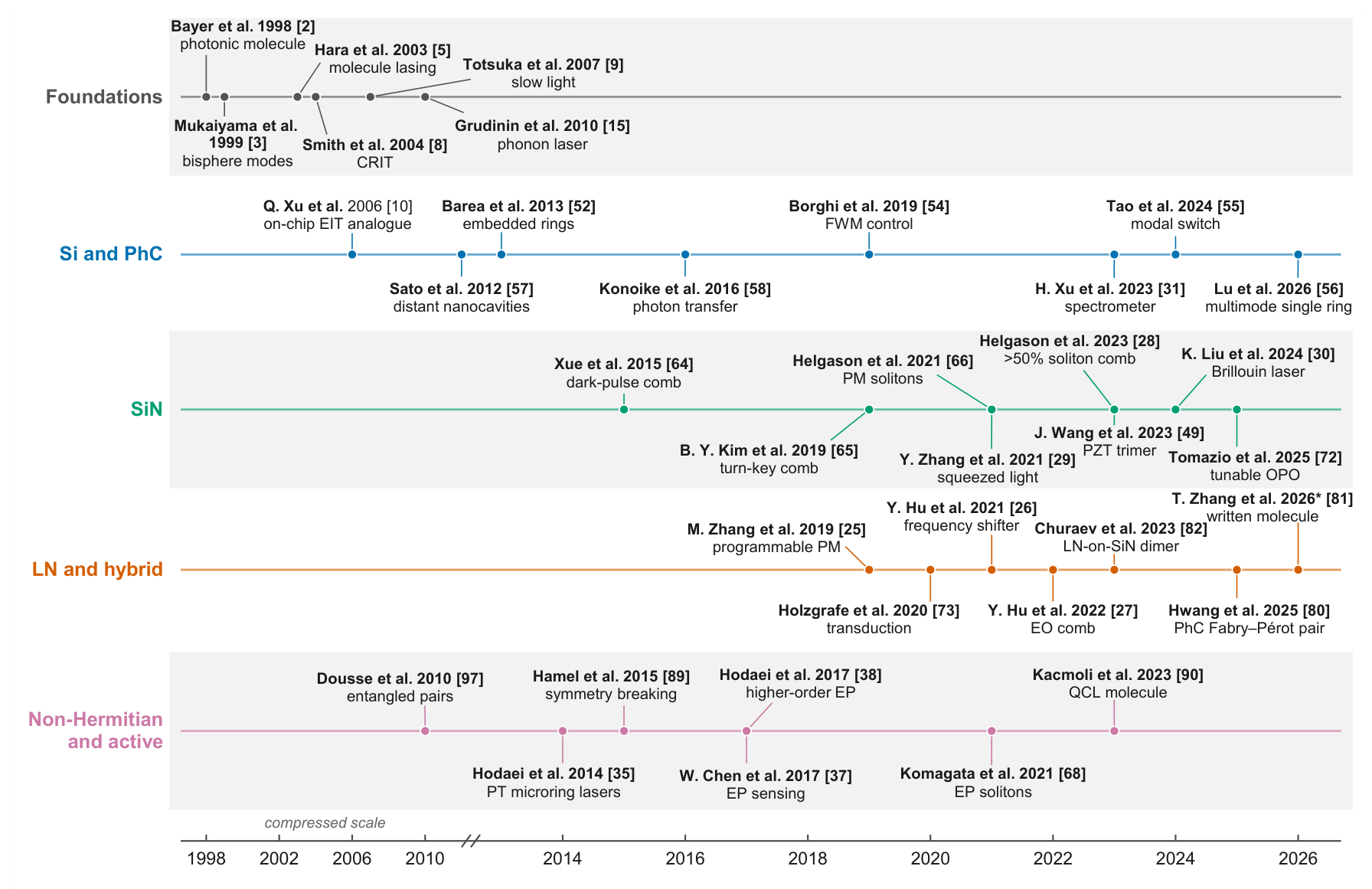
Figure 2.
Principle of a two-resonator photonic molecule. (a) Two rings with resonance frequencies coupled at rate J; only ring 1 couples to the bus, at rate . (b) Supermode frequencies from Equation (4) versus detuning for equal losses, showing the avoided crossing with minimum gap ; dashed lines are the uncoupled resonances. (c) Real and imaginary parts of the supermode frequencies at versus coupling for unequal losses ; the branches coalesce at the exceptional point . Curves are evaluated analytically from Equation (4) with illustrative parameters.
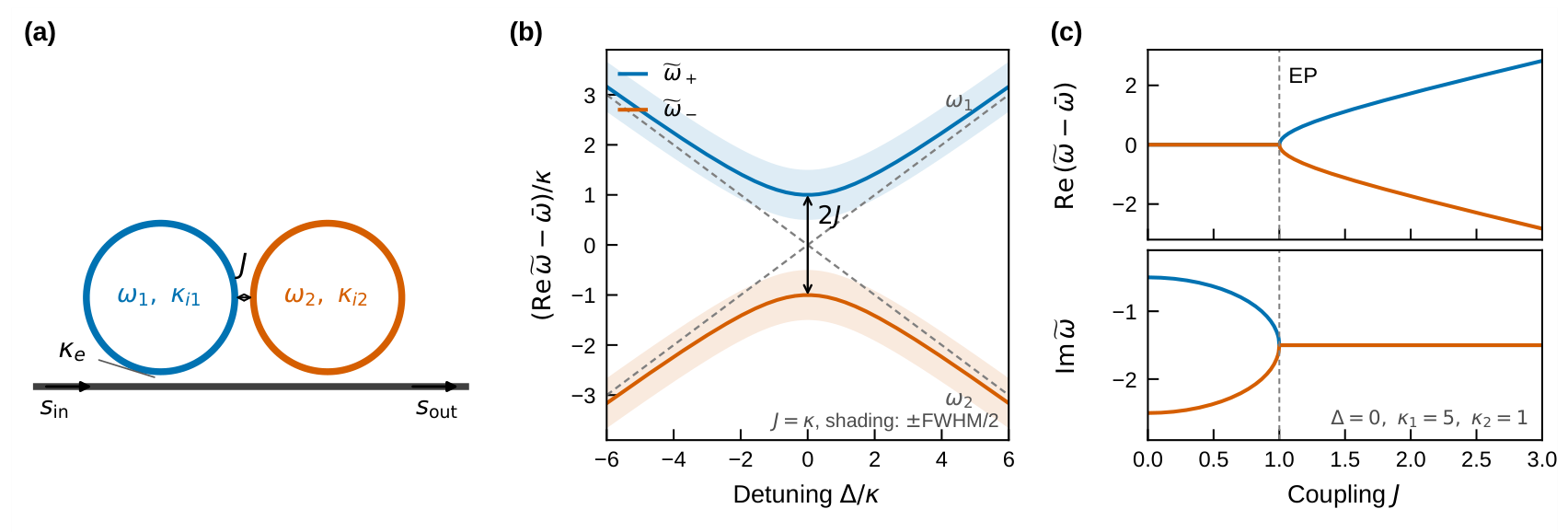
Figure 3.
Architectures of integrated photonic molecules. Spatial molecules: (a) side-coupled dimer, (b) embedded rings, (c) fully connected three-ring molecule with three bus waveguides, (d) two PhC nanocavities separated by a barrier. Single-ring molecules: (e) clockwise and counterclockwise waves coupled by an engineered grating, (f) two transverse mode families coupled by a mode converter. Schematics are not to scale and omit electrodes and heaters.
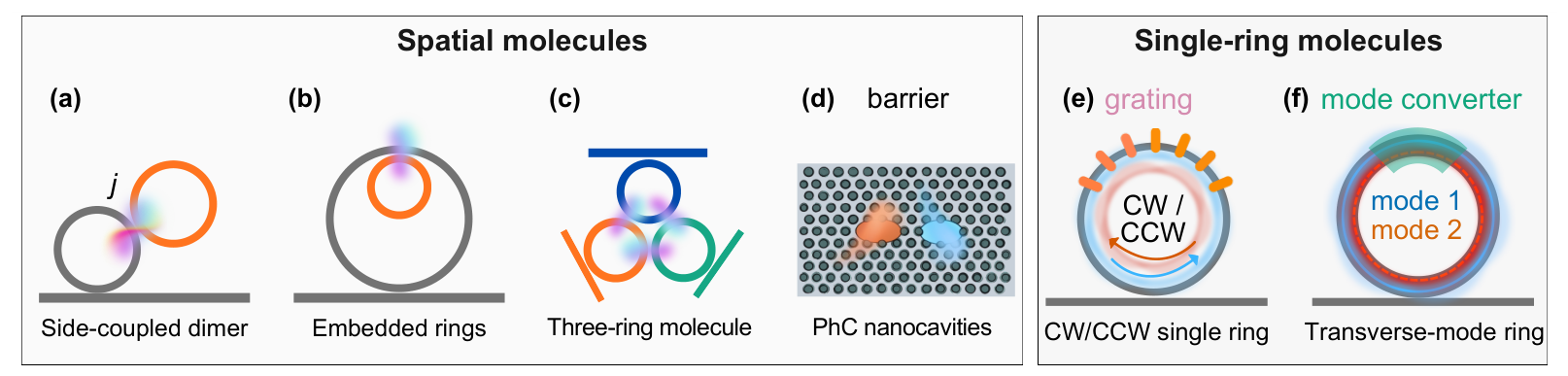

Table 1.
Selected Si and PhC photonic molecules, with a numerical sensor-topology comparison. : intrinsic; : loaded; unqualified Q follows the source. E: experiment; T: theory or design.
Table 1.
Selected Si and PhC photonic molecules, with a numerical sensor-topology comparison. : intrinsic; : loaded; unqualified Q follows the source. E: experiment; T: theory or design.
| Ref. | Structure | Reported optical parameters | Control | Function |
|---|---|---|---|---|
| Xu 2006 [10] (E) | Two Si rings | Transparency window narrower than the constituent linewidths | Thermal alignment | On-chip EIT analogue |
| Barea 2013 [52] (E) | Embedded Si rings | Doublet and triplet resonances | Fabricated coupling | 34.2 GHz sideband selection |
| Souza 2014 [53] (E) | Embedded Si rings | ; 40–60 GHz spacing | Optical control, 1 mW | Four-channel wavelength multicasting |
| Borghi 2019 [54] (E) | Two Si rings | Subradiant collective state | Thermal detuning and inter-ring phase | FWM enhanced by dB vs. single ring |
| Tao 2024 [55] (E) | One multimode Si ring | Splitting 5.74 to 1.76 GHz; in single-mode state | Thermal modal switching | Filter tuning to 57.5 GHz; OEO to 50 GHz |
| Lu 2026 [56] (E) | One Si ring with mode converters | 21.8 GHz split; , | Fabricated converters | Bright-dark states; EP signatures |
| Sato 2012 [57] (E) | Distant PhC nanocavities | Strong coupling via waveguide | Dynamic tuning | Dynamic control of coupling |
| Konoike 2016 [58] (E) | Coupled PhC nanocavities | Trapped photons | Dynamic tuning | On-demand photon transfer |
| Caselli 2018 [59] (E) | PhC molecule | Generalized Fano lineshapes | Geometry | EP identification |
| H. Xu 2023 [31] (E) | Dispersion-engineered coupled rings | Distinct splitting per FSR | Thermal scan over one FSR | Spectrometer: 40 pm over 100 nm |
| Y. Zhang 2025 [32] (E) | Disordered PM | encoder | Calibrated reconstruction | Spectrometer: 8 pm over nm |
| Fallahi 2024 [62] (T) | Si-rod PhC ring arrays | Single-ring reference: 0.31 nm FWHM; 96.8% transmission at 819.8 nm | Waveguide access and array geometry | Sensor topology comparison; preferred design uses one ring |
| Costa 2026 [63] (E) | Si reference and sensing rings | nm/RIU | Encapsulated reference | Validated sensor model ( deviation) |
| Geints 2024 [64] (T) | Two coupled cavities, two inputs | Bonding and antibonding resonances | Input phase | Variable-ratio multiway splitter |
Table 2.
Selected SiN photonic molecules. Efficiencies retain the reference plane of the source; none is a wall-plug value. The reported ratio of 58 for Wang et al. is derived from the 2.5-GHz detuning range and the 43-MHz reference linewidth.
Table 2.
Selected SiN photonic molecules. Efficiencies retain the reference plane of the source; none is a wall-plug value. The reported ratio of 58 for Wang et al. is derived from the 2.5-GHz detuning range and the 43-MHz reference linewidth.
| Ref. | Structure | Molecular mechanism | Control | Reported result |
|---|---|---|---|---|
| Xue 2015 [65] | One ring, two mode families | Transverse-mode coupling | Mode-crossing position | Dark-pulse comb initiation, normal dispersion |
| B. Y. Kim 2019 [66] | Main and auxiliary rings | Controlled avoided mode crossing | Auxiliary-ring tuning | Turn-key comb, ∼41% pump-to-comb |
| Helgason 2021 [67], Tikan 2021 [68] | Coupled rings | Supermode Kerr dynamics | Resonance alignment | Dissipative solitons in PMs; driven-dimer phenomena |
| Helgason 2023 [28] | Coupled rings | Selective pump-resonance shift | Auxiliary-ring alignment | >50% soliton conversion (output-referenced) |
| Skehan 2023 [72] | Normal-dispersion PM | Thermal locking by servo laser | All-optical servo | ∼50% lower frequency noise, 10 kHz–1 MHz |
| Y. Zhang 2021 [29] | Main and auxiliary rings | Detuning of parasitic processes | Auxiliary-ring detuning | 1.65(1) dB measured; 8(1) dB inferred on chip |
| K. Liu 2024 [30] | Nested rings | 198-MHz split of second Stokes | Fabricated | mHz fundamental linewidth; ∼11 mW output |
| Tomazio 2025 [73] | Three rings | Tunable collective triplet | Individual heaters | Tunable degenerate OPO |
| J. Wang 2023 [49] | Fully connected three rings | Six collective modes, 46–58 MHz | PZT, 0.16 GHz/V, ∼90 nW | Programmable spectrum; reported ratio 58 |
Table 3.
Selected LN and hybrid photonic molecules. E: experiment; P: experimental preprint; T: theory.
Table 3.
Selected LN and hybrid photonic molecules. E: experiment; P: experimental preprint; T: theory.
| Ref. | Structure | Reported optical parameters | Control | Function |
|---|---|---|---|---|
| M. Zhang 2019 [25] (E) | Two TFLN rings | 7-GHz split; 96-MHz linewidth; | DC: GHz/V; microwave drive | Rabi (1.1 GHz at 1.1 V), Ramsey, storage and retrieval |
| Y. Hu 2021 [26] (E) | Coupled TFLN rings | Shifts up to 28 GHz | Microwave-driven transfer | ∼90% on-chip conversion; beam splitters |
| Y. Hu 2022 [27] (E) | Coupled TFLN rings | 132-nm span at dBm | EO modulation, selective pump loading | 30% pump-to-comb (optical) |
| Holzgrafe 2020 [74], McKenna 2020 [77] (E) | LN optical pair and superconducting resonator | Triple resonance | Optical pump | Microwave-to-optical transduction |
| M. Wang 2020 [80] (E) | Coupled LN microdisks | Whispering-gallery supermodes | Fabricated | Strong nonlinear optics |
| Hwang 2025 [81] (E) | Two TFLN PhC Fabry–Pérot cavities | Standing-wave supermodes | Mirror geometry; EO detuning | Standing-wave PM |
| T. Zhang 2026 [82] (P) | One LN racetrack, | -THz coupling envelope | Photorefractive write and erase; EO | Single-sideband transduction near 107 GHz |
| Churaev 2023 [83] (E) | LN-on-SiN dimer | 4.6-GHz split; up to (platform) | DC EO, ∼30 MHz/V | Electrically controlled hybridization |
| Z. Peng 2025 [85] (E) | PhC ring, SiN-on-LN | 14.6-GHz split; | Corrugation; EO 0.85 pm/V | Splitting and DC tuning (two geometries) |
| Singh 2024 [78,79] (T) | Two active rings and a passive middle ring | Triply resonant | Middle-ring detuning | Tunable RF-optical conversion |
Table 4.
Selected non-Hermitian, active and quantum photonic molecules. E: experiment; T: theory.
| Ref. | System | Non-Hermitian or quantum resource | Reported result |
|---|---|---|---|
| Hodaei 2014 [35],Feng 2014 [36] (E) | Coupled and single microring lasers | Gain-loss contrast | Single-mode lasing |
| B. Peng 2014 [87,88] (E) | Coupled whispering-gallery microcavities | Parity-time symmetry; added loss | Asymmetric transmission; loss-induced revival of lasing |
| Chang 2014 [89] (E) | Active-passive microresonators | Parity-time symmetry | Variable optical isolation |
| Hamel 2015 [90] (E) | Coupled PhC nanolasers | Gain and coupling | Spontaneous symmetry breaking |
| Chen 2017 [37],Hodaei 2017 [38] (E) | Microcavity with scatterers; ternary laser molecule | Second- and third-order EPs | Enhanced spectral response |
| Komagata 2021 [69] (E) | SiN dimer | EP in a Kerr dimer | Solitons on both sides of the EP |
| Kacmoli 2023 [91] (E) | Two racetrack quantum-cascade lasers | Coupled gain cavities | Mid-infrared molecular lasing |
| Dousse 2010 [98] (E) | Micropillar molecule | Molecular cavity modes | Ultrabright entangled photon pairs |
| Liew 2010 [95],Bamba 2011 [96],Nigro 2022 [97] (T) | Weakly nonlinear or strongly pumped molecules | Interference of excitation paths | Predicted antibunching and blockade |
Disclaimer/Publisher’s Note: The statements, opinions and data contained in all publications are solely those of the individual author(s) and contributor(s) and not of MDPI and/or the editor(s). MDPI and/or the editor(s) disclaim responsibility for any injury to people or property resulting from any ideas, methods, instructions or products referred to in the content. |
© 2026 by the authors. Licensee MDPI, Basel, Switzerland. This article is an open access article distributed under the terms and conditions of the Creative Commons Attribution (CC BY) license (http://creativecommons.org/licenses/by/4.0/).
Copyright: This open access article is published under a Creative Commons CC BY 4.0 license, which permit the free download, distribution, and reuse, provided that the author and preprint are cited in any reuse.