

Submitted:
15 October 2026
Posted:
19 October 2026
You are already at the latest version
Abstract
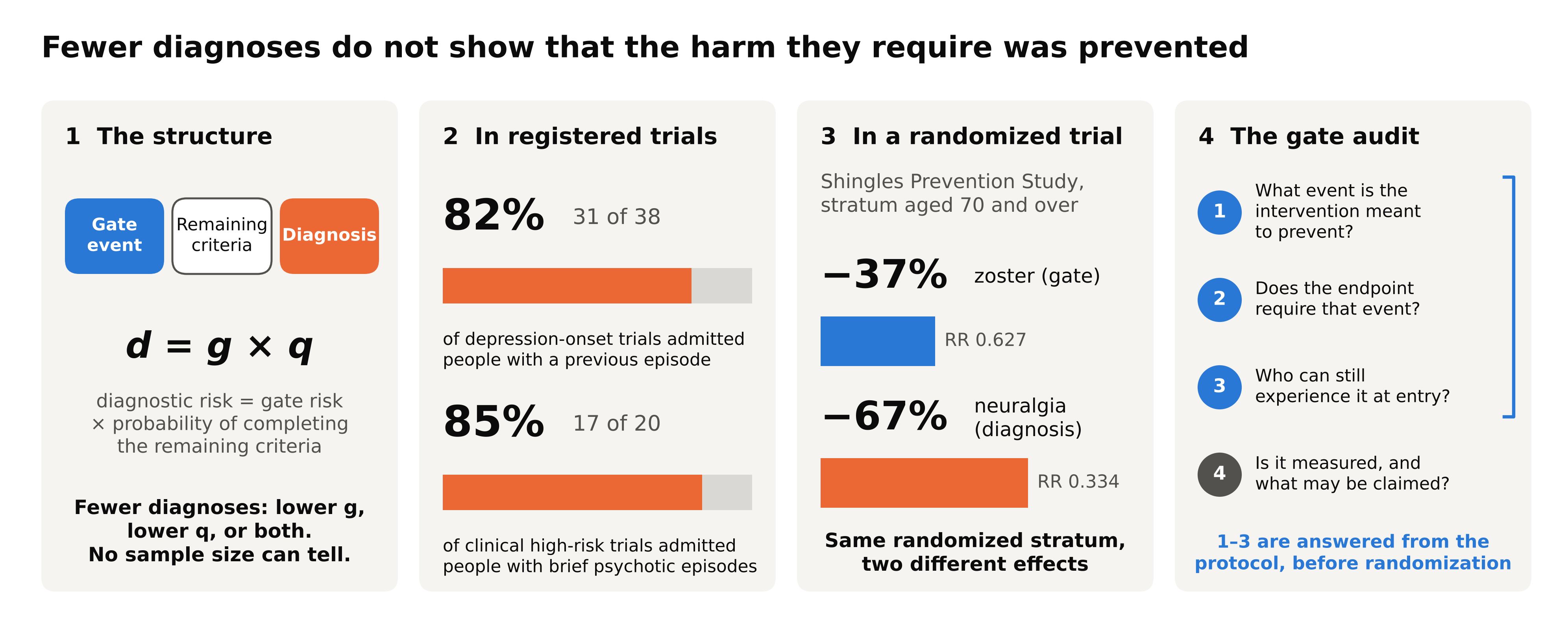
Prevention trials promise to prevent an event, such as a first depressive episode, a first psychotic episode or the first use of a drug, but most count a diagnosis that requires that event, and many enrol people who have already had it. In surveys of ClinicalTrials.gov, 31 of 38 randomized trials framed as preventing the onset or incidence of depression (82%, 95% CI 67–91) admitted people who had already had a depressive episode, and 68 of the 72 trials across all framings that did so registered a single estimate for first and recurrent episodes. Seventeen of 20 trials of transition to psychosis (85%, 64–95) admitted people who had already had brief psychotic episodes, and only one registered psychotic episodes regardless of duration. A meta-analysis of depression onset pooled a trial in which 80% of participants had had a previous episode, recording the share as 55%. The problem is structural: diagnostic risk is the product of the risk of the gate event and the probability of completing the remaining criteria, so fewer diagnoses cannot, at any sample size, show that the event was prevented. In a randomized zoster-vaccine stratum, the nested endpoint fell by 67% while the event it requires fell by 37%. A four-question gate audit, three of whose questions are answered from the protocol before randomization, detects the mismatch and states what each trial can claim. It applies wherever a diagnosis requires a prior event and can be built into trial registration, protocol review, reporting and synthesis.
Keywords:
prevention trials
; diagnostic endpoints
; estimands
; eligibility criteria
; trial registration
; principal stratification
Copyright: This open access article is published under a Creative Commons CC BY 4.0 license, which permit the free download, distribution, and reuse, provided that the author and preprint are cited in any reuse.