
Submitted:
15 October 2026
Posted:
19 October 2026
You are already at the latest version
Abstract
Dendritic cells (DCs) play an important role in coordinating innate and adaptive immunity through antigen processing, presentation and activation of immune effectors. However, DC vaccine-induced immune activation has not consistently translated into clinical benefit. In this review, we discuss the potential of engineered allogeneic DC vaccines, with emphasis on CD34+ progenitor-derived DCs expressing CD93, CD40 ligand (CD40L) and CXCL13. These preparations were found to enhance lymphocyte activation and reduce pancreatic tumor burden in humanized mouse models. Vector optimization retained tumor-inhibitory activity, although small cohorts and substantial attrition limit interpretation of the advanced-disease findings. We also discuss the differential effects of osteoclasts and DCs on natural killer (NK)-cell function and CD4+ and CD8+ T-cell expansion, and the importance of separating donor-directed alloreactivity from tumor-antigen-specific responses. Clinical studies in pancreatic cancer support the induction of antigen-specific immunity, whereas randomized DC studies in prostate cancer, melanoma and mesothelioma demonstrate the continuing challenge of translating immune activation into improved outcomes. We propose that further development should focus on recipient-human leukocyte antigen (HLA)-compatible tumor recognition, the contribution of individual transgenes, reproducible product potency, post-thaw function and product-specific safety. Together, these findings support continued investigation of engineered allogeneic DC vaccination as a strategy to coordinate antitumor immune responses, while clinical benefit remains to be established in controlled studies.
Keywords:
dendritic cells
; therapeutic cancer vaccines
; allogeneic cell therapy
; CD34
; CD40 ligand
; CD93
; CXCL13
; pancreatic cancer
; natural killer cells
; antigen presentation
1. Introduction
Dendritic cells (DCs) acquire tumor-derived antigens, present antigenic peptides and provide the costimulatory signals required for activation of T cells. These functions have led to the development of DC-based vaccines for cancer immunotherapy. However, effective vaccination also requires expansion of tumor-reactive lymphocytes, their recruitment into tumors and maintenance of effector function within the immunosuppressive tumor microenvironment. Thus, the ability to stimulate lymphocytes in vitro represents only one component of therapeutic activity. Engineered donor-derived DCs have been investigated to improve the availability and functional properties of vaccine preparations, including in humanized mouse models of pancreatic cancer [1,2].
Allogeneic DC manufacture allows donor-derived preparations to be generated, characterized and stored before treatment. This approach could reduce dependence on patient leukapheresis and the functional condition of patient-derived cells. However, donor variability, recipient immune competence and tumor-antigen expression remain important determinants of activity. Human leukocyte antigen (HLA) relationships between the donor product, recipient immune cells and tumor also influence antigen recognition. Therefore, the potential manufacturing advantages of allogeneic vaccination must be evaluated together with its biological compatibility and product-specific costs [1,2].
Pancreatic cancer presents a particular challenge because deficient antigen presentation and restricted immune-cell access can limit antitumor responses. Hegde and colleagues demonstrated that conventional DC paucity contributed to dysfunctional immune surveillance in experimental pancreatic cancer [3]. These findings provide a rationale for investigating strategies that restore antigen presentation and support immune-effector function. In this review, we discuss the mechanisms, preclinical findings and translational considerations of engineered allogeneic DC vaccination, with particular attention to the coordination of natural killer (NK) cells and T cells.
This focused narrative review prioritizes primary mechanistic, preclinical and clinical studies relevant to engineered allogeneic DC vaccination. Targeted searches of PubMed/PMC-indexed records and publisher websites were updated through 12 October 2026, including CD34-derived DCs, pancreatic vaccination, NK–DC interactions, antigen presentation, engineered progenitors and controlled DC trials.
2. Dendritic Cell’s Function and the Requirements for Therapeutic Vaccination
The functional activity of DC vaccines depends on antigen processing, peptide presentation, costimulatory signaling and the cytokines that regulate lymphocyte differentiation. Increased expression of HLA-DR or CD86 may indicate activation, but functional assays are required to determine whether the cells cross-present tumor antigens and induce recipient-compatible tumor killing. The first-generation engineered DC study combined phenotypic characterization with lymphocyte-activation and tumor-cell cytotoxicity assays, providing evidence of functional activity beyond surface-marker expression [1].
The requirement for cross-presenting DCs is supported by the foundational study of Hildner et al., in which Batf3 deficiency impaired development of CD8α+ DCs, cross-presentation and rejection of immunogenic tumors in mice [4]. This establishes a mechanistic basis for evaluating functions associated with conventional type 1 DCs (cDC1)-associated function, but does not imply that every CD34-derived preparation has acquired a cDC1 identity. Lineage, antigen processing and recipient-compatible T-cell priming should therefore be assessed separately.
Theisen et al., demonstrated that repeat and FYVE domain-containing protein 4 (WDFY4)-deficient murine cDC1 retained several DC functions but exhibited defective cross-presentation of cell-associated antigens, impaired CD8+ T-cell priming and reduced capacity to support tumor rejection [5]. Subsequent experiments identified a WDFY4-dependent, transporter associated with antigen processing (TAP)-independent vacuolar antigen-processing route [6]. These findings indicate that antigen uptake, maturation and cross-presentation can be regulated separately. Thus, evaluation of CD34-derived DC vaccines should include presentation of defined tumor antigens and activation of antigen-specific T cells. Whether the same processing pathway operates in the final human vaccine preparation requires direct investigation.
Conventional DCs, plasmacytoid DCs and monocyte-derived DCs differ in lineage and functional properties, whereas CD34-derived describes the starting population used for manufacture. A CD34-derived preparation should therefore be characterized by both lineage-associated markers and antigen-presenting function before it is assigned to a particular DC subset. Follicular DCs are stromal antigen-retaining cells and differ from the hematopoietic DC populations used for vaccination. These distinctions are important when comparing the effects of different DC preparations on immune-cell activation.
Balan et al. established a culture system generating human plasmacytoid DCs, cDC1 and cDC2 from CD34+ progenitors and identified Notch-dependent differentiation and heterogeneity [7]. These findings reinforce the need to define the lineage composition of progenitor-derived preparations. High cell yield alone does not establish the identity or potency of the final vaccine.
Human investigation of CD34-derived DC vaccination predates the current engineered platform. Banchereau et al., evaluated an autologous CD34+ progenitor-derived DC vaccine in patients with metastatic melanoma [8]. This early clinical study provides historical context for the cell source, while differing in donor relationship, antigen preparation and engineering from the allogeneic pancreatic product. It should therefore be considered evidence of prior clinical investigation rather than validation of the three-gene construct.
The migration and persistence of administered DCs can influence the location and duration of immune priming. Viable cells may present antigens directly, whereas donor-cell material may also provide antigen to recipient antigen-presenting cells (APCs). Accordingly, donor-cell clearance could either support antigen transfer or limit the duration of stimulation. The pancreatic studies used intradermal administration [1,2], but the route of administration alone does not establish migration to lymphoid tissues or identify the cells responsible for priming.
Roberts et al., demonstrated that CCR7-dependent trafficking of tumor-associated CD103+ DCs supported delivery of tumor antigens to draining lymph nodes and CD8+ T-cell priming in murine melanoma, with corresponding human DC analyses [9]. These findings connect antigen acquisition to the anatomical site of priming. For an intradermally administered allogeneic vaccine, migration, antigen transfer and persistence should be measured directly rather than inferred from the injection route.
Direct tracking has also been investigated in patients. De Vries et al., used magnetic resonance imaging to assess delivery and intra- and internodal migration of labeled autologous DCs after intranodal injection in melanoma patients [10]. The study supports direct measurement of administered-cell distribution, but its injection route and cell preparation differ from intradermal allogeneic vaccination. Tracking signals should also be interpreted together with measures of cell viability and functional persistence.
Tumor-associated metabolic changes may also impair DC function. Cubillos-Ruiz et al., demonstrated an association between endoplasmic reticulum stress, XBP1 activation, lipid accumulation and defective support of antitumor T cells in ovarian cancer models and human tumor-associated DC analyses [11]. These findings suggest that the tumor microenvironment can alter the function of an initially competent antigen-presenting population. For the engineered pancreatic vaccine, functional testing after exposure to tumor-conditioned environments would help determine whether antigen presentation and viability are retained under suppressive conditions.
Maturation also need not indicate an exclusively immunostimulatory state. Maier et al., identified mature DCs enriched in immunoregulatory molecules in human and murine lung cancer, showing that maturation and inhibitory programs can coexist [12]. Thus, phenotypic release markers should be accompanied by functional assessment of cytokine production and T-cell stimulation after tumor-associated stress. Together, the cross-presentation, trafficking and regulatory-state studies define the functions that engineered vaccination should preserve.
3. Innate and Adaptive Immune Coordination
Natural killer (NK) cells contribute to antitumor immunity through cytotoxicity and the secretion of cytokines and chemokines that regulate other immune cells. Böttcher et al., demonstrated that NK-derived CCL5 and XCL1 promoted recruitment of cDC1 into experimental tumors, whereas tumor-derived prostaglandin E2 disrupted this interaction [13]. Thus, NK function may influence the availability of DCs for antigen presentation. In engineered DC vaccination, increases in NK-cell frequency should be accompanied by measurements of cytotoxicity, chemokine secretion and contribution to tumor control.
Barry et al., demonstrated that NK-derived FLT3 ligand supported stimulatory DC populations in experimental tumors and found associations between the NK–DC axis and anti-PD-1 responsiveness in human melanoma [14]. Together, these studies suggest that NK cells can regulate both recruitment and maintenance of antigen-presenting populations. Functional NK measurements, endogenous cDC1 abundance and the spatial distribution of DCs and T cells may therefore provide useful mechanistic information during vaccine evaluation. Their predictive value in pancreatic cancer remains to be established.
Salmon et al., further demonstrated that expansion and activation of tumor-associated CD103+ DC progenitors enhanced responses to PD-L1 and BRAF inhibition in mouse melanoma models [15]. This provides intervention-based support for the importance of endogenous DC availability. It complements the NK–DC studies, while differing from administration of a banked, antigen-loaded donor DC product.
CD4+ T cells, CD8+ T cells and NK cells provide complementary functions. CD4+ T cells can support DC licensing and the development of sustained responses, whereas regulatory CD4 subsets may suppress antitumor immunity. CD8+ T cells can mediate tumor-antigen-specific cytotoxicity, but expanded populations may also contain donor-reactive or nonspecifically activated cells. Therefore, both functional phenotype and antigen specificity should be evaluated when interpreting changes in immune-cell numbers or CD4-to-CD8 ratios.
Ferris et al., demonstrated that cDC1 can prime CD4+ T cells and receive CD40-dependent licensing required for effective antitumor CD8 responses [16]. These findings support the rationale for investigating CD40L-mediated coordination of helper and cytotoxic responses. Evaluation should determine whether relevant tumor antigens induce linked CD4 and CD8 responses and whether recipient DCs participate in priming. General T-cell stimulation with anti-CD3/anti-CD28 does not resolve this antigen-specific interaction.
In our comparative study of osteoclasts (OCs) and DCs, OCs induced higher levels of NK-cell expansion and functional activation than DCs under the tested culture conditions [17]. Differences were also found in the distribution of expanded T-cell subsets: OC-supported cultures preferentially expanded CD8+ T cells, whereas DC-supported cultures favored CD4+ T cells. Overall T-cell expansion and activation did not show the same separation observed in NK cells. In addition, cancer-patient-derived accessory cells were less effective than healthy-donor-derived cells in supporting NK responses, and allogeneic and autologous OCs induced similar expansion and activation in the reported comparisons. These findings reflect the complete stimulation conditions used in the study. NK cells were pre-stimulated with IL-2 and anti-CD16, whereas T cells received IL-2 and anti-CD3/anti-CD28; cocultures also included sonicated probiotic material and continued cytokine supplementation [17]. The study therefore identifies differences between accessory-cell-supported culture systems rather than an isolated effect of OCs or DCs. It did not evaluate the engineered CD34-derived vaccine, direct OC administration or tumor-antigen-specific T-cell priming.
Together, these findings suggest that the choice of accessory cells should depend on the immune function required. Preparations that support NK-cell expansion may differ from those that support antigen presentation and helper responses. For engineered DC vaccines, parallel assessment of NK, CD4+ and CD8+ T-cell function would provide a more complete evaluation than measurement of one expanded population. We propose that combining NK-directed interventions with DC vaccination warrants investigation, provided that complementary activity is demonstrated in controlled comparisons.
4. Allogeneic Vaccination and Antigen Specificity
Recipient T cells may respond strongly to donor HLA molecules independently of tumor-antigen recognition. This alloreactivity can contribute to immune stimulation, but a mixed lymphocyte reaction alone does not demonstrate tumor specificity. Therapeutic responses require recognition of the recipient tumor. This distinction is particularly important in humanized xenograft studies because the donor DCs, human immune-cell donor and implanted tumor line may have different HLA backgrounds [1,2].
Several antigen-presentation pathways may contribute to allogeneic vaccination. Donor DCs can present tumor-derived peptides on donor HLA, provided that the induced effectors can recognize the intended tumor target. Alternatively, recipient APCs may acquire tumor-derived antigen from donor-cell material and present it on recipient HLA, including through cross-presentation to CD8+ T cells. Transfer of intact peptide–HLA complexes provide another possible pathway. The relative contribution of direct presentation, recipient processing and intact-complex transfer remains unresolved for the engineered product.
MacNabb et al., demonstrated that acquisition of intact tumor-derived peptide–MHC class I complexes by DCs could contribute to CD8+ T-cell priming in murine models [18]. This process, termed cross-dressing, retains the HLA or MHC restriction of the transferred complex. In contrast, cross-presentation generates antigenic peptides on the acquiring APC’s own molecules. Therefore, cross-dressing should be distinguished from recipient-HLA-restricted processing when evaluating an allogeneic vaccine, and should not be assumed to overcome donor–recipient incompatibility.
Recent semi-allogeneic studies clarify how alloreactivity might be used without losing tumor-target compatibility. Seishima et al., found that altered MHC class II could provide allogeneic CD4+ help while syngeneic MHC class I retained tumor-peptide presentation in murine DC vaccines [19]. Benefit depended on tumor stage, and regulatory T-cell depletion improved later-stage activity. This controlled design supports investigation of allogeneic help, but cannot be extrapolated to unrestricted donor–recipient HLA mismatch in the human engineered product.
Mechanistic experiments should define HLA relationships among the product, immune donor, and tumor. Relevant assays include HLA blocking during priming and killing, depletion or inhibition of recipient APCs, and tracking of antigen acquisition. Tumor-cell targets should include antigen-negative and HLA-controlled comparators. Recipient-derived tumor organoids or well-characterized matched targets would provide stronger evidence than comparisons between unrelated tumor lines alone. Although the first pancreatic study reported selective killing of pancreatic rather than unrelated hepatocellular carcinoma targets, differences in HLA, baseline susceptibility, and antigen expression can contribute to that contrast [1].
Repeated vaccination may alter donor-directed immunity and the persistence of administered cells. Longitudinal assessment should therefore include donor-cell clearance, recipient APC activation, tumor-reactive T-cell clones and anti-donor responses. These measurements would help determine whether alloreactivity supports antigen-specific immunity or predominates without meaningful tumor recognition. Recruitment and maintenance of DCs can be supported by NK cells, while CD4-dependent licensing promotes productive CD8 responses [13,14,15]. The allogeneic setting adds the requirement that activated effectors recognize the recipient tumor. Cross-dressing and semi-allogeneic models provide testable mechanisms for this coordination, while leaving the responsible pathway in the three-gene product unresolved [18,19].Figure 1 summarizes these immune interactions and candidate antigen-presentation pathways.
5. Engineering CD34-Derived DCs with CD93, CD40L and CXCL13
Huerta-Yepez et al., generated DCs by cytokine-directed differentiation of lentivirally modified CD34+ hematopoietic progenitors, followed by maturation and tumor-lysate loading [1]. The preparation expressed CD93, CD40L, and CXCL13, and was characterized through flow cytometry, molecular assays, protein measurements, and cell-based tests. The reported average yield was approximately 60 ± 28 DCs per starting CD34+ cell across five preparations. This supports feasibility of expansion in the investigated process, while the variability cautions against treating the yield as a universal manufacturing specification. CD40L was selected to support CD40-dependent activation of antigen-presenting cells. Foundational studies demonstrated that CD40 signaling can provide an important component of CD4+ T-cell help during cross-priming [20]. For an engineered vaccine, further studies should identify the responding CD40-positive cells and determine the contribution of membrane-associated and soluble CD40L. Contact dependence, recipient APC activation and downstream signaling should be assessed together with exposure-related toxicity. CD40 signaling can also act through populations other than DCs. Beatty et al., reported a macrophage-dependent, T-cell-independent mechanism of stromal remodeling and tumor regression after CD40 agonism in experimental pancreatic cancer, alongside an early patient study [21]. Accordingly, effects attributed to vaccine-derived CD40L should be resolved across DCs, macrophages and other CD40-expressing cells. Systemic agonistic antibodies and cell-associated CD40L differ in exposure and cannot be assumed to have equivalent activity or toxicity. CXCL13 regulates recruitment of CXCR5-expressing populations, including B cells [22]. Recruitment and organization of lymphocytes could support local adaptive responses, but CXCL13 secretion alone does not demonstrate formation of functional tertiary lymphoid structures. Evaluation of this mechanism requires spatial characterization of B-cell and T-cell compartments and supporting stromal populations. Whether CXCL13-dependent organization contributes to tumor control in the engineered platform remains to be determined [1,2].
Helmink et al., associated B-cell and tertiary lymphoid structure features with checkpoint-treatment responses, while Cabrita et al., reported associations between tertiary lymphoid structures, immune organization and favorable outcomes in melanoma [23,24]. These findings support the inclusion of B-cell responses and spatial immune organization in vaccine studies. For pancreatic cancer, direct evidence is needed to determine whether administered CXCL13 produces organized structures with local antigen-reactive function.
The biological effects of CD93 depend on the expressing cell and tissue context. Blockade of endothelial CD93 was found to normalize tumor vasculature and facilitate immunotherapy [25]; this mechanism differs from overexpression of CD93 in vaccine DCs. In the vector-optimization study, some configurations with greater CD93 expression also exhibited increased cell death during screening [2]. Thus, optimal expression should be determined in relation to product viability and function, and the specific contribution of DC-associated CD93 requires further investigation [1,2].
The combined CD93, CD40L and CXCL13 construct provides a strategy for modifying several properties of the vaccine preparation. However, the contribution of each gene should be examined using single-gene, two-gene and complete constructs matched for differentiation state and viable-cell dose. Receptor-blocking and loss-of-function studies could help distinguish additive activity, interactions and effects on cell fitness. Figure 2 summarizes the preparation of the platform and the mechanisms proposed for its components.
These component-specific uncertainties also make comparison with alternative engineering strategies useful. Such comparisons can identify shared development requirements without treating different constructs as interchangeable.
5.1. Related Engineered Progenitor Strategies
Ghasemi et al., developed DC progenitors engineered to produce IL-12 and FLT3 ligand, which supported antitumor activity in preclinical models without ex vivo antigen loading [26]. A subsequent study engineered progenitors with extracellular-vesicle–internalizing receptors and IL-12, enhancing tumor-antigen acquisition and activity in mouse models, including tumors resistant to PD-1 blockade [26]. These studies broaden the rationale for progenitor-based engineering, but address different cytokines, antigen-acquisition strategies and cell preparations from the CD93/CD40L/CXCL13 platform. Antigen-agnostic manufacture does not mean antigen-independent T-cell recognition; it removes the requirement to select and load antigens ex vivo.
Figure 2 illustrates why expression of the three transgenes should be interpreted in relation to the function of the complete vaccine. CD40L and CXCL13 provide biologically plausible mechanisms, but the recipient cells responding to these signals and the contribution of CD93 require direct testing [1,2,20,22,23,24,25]. We propose that functional potency should combine viability, antigen-specific activation and tumor-target recognition, rather than depend on transgene expression alone.
6. Preclinical Evidence in Pancreatic Cancer
The first full-length report evaluated the engineered DC product in orthotopic MIA PaCa-2 tumors in bone marrow–liver–thymus (BLT)- and peripheral blood mononuclear cell (PBMC)-humanized NOD-scid IL2 receptor gamma-chain-deficient (NSG) mice [1]. The methods describe 23 BLT-humanized animals allocated to two control groups of seven and an engineered-DC group of nine, together with nine PBMC-humanized animals allocated to three groups of three. Two intradermal doses of one million antigen-pulsed cells were administered, generally on days 7 and 14 after tumor implantation, with assessment at day 35. Comparators included untreated tumor-bearing animals and control-vector DCs. In these studies, engineered DC treatment was associated with approximately 70.46% lower tumor weight and 81.7% lower tumor volume relative to untreated controls [1]. Control-vector DCs also reduced tumor volume by approximately 41.69%, suggesting that the antigen-loaded donor-cell preparation contributed activity independently of the three-gene construct. These measurements represent between-group differences at the study endpoint. They support tumor-inhibitory activity but do not establish regression of every individual tumor relative to its pretreatment size.
Enhanced lymphocyte activation, tumor-cell cytotoxicity and higher frequencies of CD4+ T cells, CD8+ T cells and NK cells were also reported [1]. These findings indicate immune engagement, although a change in frequency does not necessarily represent an increase in absolute cell number. Effector depletion, receptor blocking and time-resolved functional analyses would help determine which populations are required for tumor control and whether the observed changes reflect expansion, recruitment or altered survival.
Gonzalez et al., then evaluated a second-generation vector incorporating changes in promoter, transgene arrangement, codon optimization, and backbone elements [2]. The selected arrangement placed CD40L before CD93 and CXCL13. Screening considered expression, viability, secretion, and vector yield, emphasizing that engineering is a balance among attributes rather than a search for the highest single marker. Some screening measurements were conducted in Jurkat cells, so their fold changes cannot automatically be translated into clinical DC potency. Confirmatory characterization in the intended final cell product remains essential.
In early-stage humanized-BLT mouse studies, first- and second-generation products produced similar reported reductions in tumor volume, approximately 76.5% and 78.3%, and tumor weight, approximately 65.7% and 65.9%, respectively [2]. These observations support retention of tumor-inhibitory function after vector modification. They do not establish statistical equivalence or noninferiority, because those conclusions require appropriately powered designs and prespecified margins. The authors also reported fewer observed metastatic lesions with the optimized product; the small groups and limited mechanistic analysis make this a preliminary signal.
The advanced-disease experiment used luciferase-expressing MIA PaCa-2 tumors, with treatment on days 29 and 36 and three animals per group [2]. Two treated animals reached endpoint after events described by the authors as unrelated to treatment. By day 55, one animal remained in each group. The surviving treated mouse had no detectable bioluminescent signal on days 63 and 73, whereas the surviving control showed progressive signal. This is an important observation, but it is not evidence of complete regression throughout the treated cohort. Without larger cohorts, adequate attrition analysis, and corroborating pathology, loss of detectable signal should not be equated with universal eradication or cure.
Humanized mice provide access to human immune components but incompletely reproduce pancreatic tumor stroma, lymphoid architecture, myeloid development, and human cytokine networks. PBMC-humanized systems also face xenogeneic responses and graft-versus-host effects. These limitations interact with the HLA relationships of an allogeneic vaccine and a human tumor line. Future studies should prespecify humanization criteria, characterize baseline immune composition, report allocation and blinding, retain all animals in outcome accounting, and distinguish biological replication from technical measurements (Table 1). Diverse patient-derived tumor systems and independent replication would increase confidence in the observed activity.Table 1 summarizes the preclinical and mechanistic evidence and its interpretive limits.
7. Clinical Context and Limits of Cross-Platform Inference
The randomized IMPACT trial demonstrated a 4.1-month improvement in median overall survival with sipuleucel-T in metastatic castration-resistant prostate cancer [27]. Sipuleucel-T is an autologous APC-enriched preparation and differs from a purified engineered allogeneic DC product. The study provides clinical evidence that therapeutic immune priming can improve outcomes in a defined setting, while the efficacy of each DC platform must be established separately.
Allogeneic DC preparations have also entered early clinical testing. A leukemia-derived DC vaccine, DCP-001, was evaluated in a phase I post-remission acute myeloid leukemia (AML) study [28]. A plasmacytoid DC-line vaccine was studied in nine patients with metastatic melanoma, using irradiated cells loaded with melanoma peptides [29]. These investigations support feasibility and immune activity in specific products and disease settings. They do not establish a class-wide survival benefit. HLA selection, tumor-derived antigen, irradiation, origin, and clinical context differ from the CD34-derived pancreatic product.
The randomized phase II MERECA trial provides additional evidence directly relevant to an allogeneic product. Lindskog et al. evaluated intratumoral ilixadencel, an allogeneic monocyte-derived inflammatory DC preparation, before nephrectomy followed by sunitinib in 88 patients with metastatic renal cell carcinoma [30]. Median overall survival was 35.6 months with the combination and 25.3 months with sunitinib alone (hazard ratio 0.73; 95% confidence interval 0.42–1.27; p = 0.25). The study was not adequately powered to detect modest survival differences. Its in situ immune-priming strategy differs from an ex vivo antigen-loaded CD34-derived vaccine, and the numerical survival difference does not establish benefit.
Interpretation of clinical activity should account for the product, patient population, treatment setting and study design. Immune responses and measurable residual disease changes can inform mechanism, but uncontrolled observations and historical comparisons provide limited estimates of treatment benefit. Similarly, tolerability of an earlier DC product cannot establish the safety of a lentivirally engineered preparation with a different composition.
7.1. Pancreatic Cancer Clinical Evidence
Earlier pancreatic studies also examined defined-antigen DC vaccination. Koido et al. conducted a phase I study combining gemcitabine with DCs loaded with WT1 peptides restricted by MHC class I, class II or both [31]. The combined class I/II strategy supported WT1-specific helper and cytotoxic responses, providing clinical context for linked CD4+ and CD8+ priming. Small, nonrandomized groups and concurrent chemotherapy limit efficacy inference; these findings do not establish the activity of an engineered allogeneic product.
A later WT1-DC study combined multifunctional WT1 peptides with multiagent chemotherapy in patients with unresectable pancreatic ductal adenocarcinoma [32]. The investigators reported immune responses and conversion to surgical resection in a subset of patients. The small, uncontrolled combination study cannot separate vaccine activity from chemotherapy or selection for surgery. It nonetheless extends the clinical context for testing antigen-specific responses alongside tissue changes, rather than using circulating immune activation alone as evidence of benefit.
Van ’t Land et al., evaluated autologous monocyte-derived DCs loaded with an allogeneic mesothelioma tumor-cell lysate containing antigens shared with pancreatic cancer [33]. In the single-center, single-arm phase I/II study, 38 patients entered the primary endpoint analysis after resection and standard-of-care treatment without imaging evidence of recurrence. At a median follow-up of 25.5 months, 26 patients had no recurrence. Immune analyses supported vaccine-specific activity, including T-cell tracking in a resected lung metastasis from one patient. The selected disease-free population and absence of a randomized control limit efficacy inference. Importantly, the antigen source was allogeneic, whereas the administered DCs were autologous; this study does not validate donor-derived engineered DCs.
Personalized RNA vaccination supplies complementary evidence that pancreatic cancer can support vaccine-induced tumor-antigen-specific immunity. Rojas et al., reported high-magnitude neoantigen-specific responses in 8 of 16 vaccinated patients receiving sequential atezolizumab, autogene cevumeran and mFOLFIRINOX after surgery [34]. Sethna et al., subsequently documented persistent functional CD8+ clones with a tissue-resident memory-like phenotype at follow-up extending to approximately three years [35]. Longer clone lifespans reported by the investigators were computational estimates, not observed decades of persistence. These publications concern the same early-phase program, not independent efficacy trials. Immune-response associations with recurrence cannot isolate vaccine benefit from patient selection or companion treatments. Their principal relevance to DC development is the value of antigen-specific clonotype tracking and sustained functional testing.
7.2. Controlled Studies and the Immune Response–Efficacy Gap
In the phase III MIND-DC study, 148 patients with resected stage IIIB/C melanoma were randomized to autologous natural DCs or placebo [36]. The 2-year recurrence-free survival rates were 36.8% and 46.9%, respectively, with no significant difference (p = 0.31). Recruitment was stopped early after adjuvant anti-PD-1 treatment became standard, reducing the planned sample size. Thus, the immunological activity observed with this preparation did not establish clinical benefit, highlighting the need to evaluate immune responses together with controlled clinical outcomes.
The DENIM study randomized 176 patients with nonprogressing pleural mesothelioma after chemotherapy to autologous DCs loaded with allogeneic tumor lysate plus best supportive care or supportive care alone [37]. Median overall survival was 16.8 and 18.3 months, respectively (hazard ratio 1.10; 95% confidence interval 0.77–1.57; p = 0.62). The tested maintenance regimen therefore did not improve survival. Together with MIND-DC, this study demonstrates the importance of controlled outcome assessment despite encouraging immune activity in earlier investigations. The effects of engineered donor-derived DCs and alternative combinations require separate evaluation.
The larger VIABLE phase III trial randomized 1182 patients with metastatic castration-resistant prostate cancer to DCVAC/PCa or placebo alongside docetaxel and prednisone [38]. Median overall survival was 23.9 versus 24.3 months (hazard ratio 1.04; 95% confidence interval 0.90–1.21; p = 0.60). This result reinforces the distinction between the positive IMPACT outcome and the efficacy of a different DC preparation in the same broad disease setting. A clinical benefit demonstrated for one APC product should not be transferred to another.
The ADAPT phase III study is particularly relevant to CD40L-based engineering because rocapuldencel-T comprised autologous DCs electroporated with amplified tumor RNA and CD40L RNA [39]. Among 462 randomized patients with metastatic renal cell carcinoma, adding this product to standard care did not improve overall survival; median survival was 27.7 versus 32.4 months. This result does not directly test the allogeneic three-gene platform, but demonstrates that antigen loading and CD40L expression alone do not establish clinical efficacy.
Positive associations should also be considered with attention to comparator design. Liau et al., reported an association between DCVax-L vaccination and longer survival in newly diagnosed and recurrent glioblastoma using externally controlled analyses [40]. Although clinically encouraging, external comparators introduce uncertainty from cohort selection, treatment differences and unmeasured confounding. The analysis therefore contributes a different level of causal evidence from a contemporaneously randomized survival comparison. Taken together, the clinical literature supports product-specific development rather than a uniformly positive or negative conclusion about DC vaccination (Table 2).
8. Manufacturing, Safety and Translational Potential
A clinically usable process must define the final product rather than relying on its starting population. Proposed release attributes include viable DC identity, differentiation state, contaminating cell populations, sterility, endotoxin, mycoplasma, transgene expression, and a functional potency measurement. CD34+ residual cells deserve attention because the starting progenitors are transduced before differentiation. Donor qualification and traceability must accompany lot characterization. The intended dose should refer to viable functional cells after thawing and preparation, not only to the number frozen during manufacturing.
Integrating-vector manufacture adds requirements for vector copy number, residual vector, replication-competent lentivirus testing, and assessment of insertion-related risks. Short expected donor-cell persistence does not automatically eliminate risk, especially if progenitor contamination or proliferative potential remains. Similarly, describing an optimized vector as suitable for clinical development is not equivalent to documenting regulatory authorization or a fully validated commercial manufacturing process. Product-specific biodistribution and persistence experiments are needed to evaluate where cells and their secreted products act [1,2].
Potency assays should represent the proposed mode of action. A mixed lymphocyte reaction is useful for general activation, but it can be dominated by alloreactivity. A stronger strategy would combine antigen-dependent recipient-HLA-compatible T-cell activation with relevant cytokine output and tumor-target killing. Migration or chemotaxis tests may be needed if trafficking is central to the product claim. Transgene measurements should be interpreted against functional performance and viability rather than used as substitutes for them. Assay variability across immune donors should be characterized explicitly (Table 3).
Scalability should be assessed across donors and manufactured lots, including cell yield, batch failure, post-thaw recovery, storage stability, dose consistency and transport tolerance. Patient-specific tumor lysate may retain substantial customization even when donor cells are banked. Shared antigen preparations could simplify distribution but require evidence of adequate tumor coverage. Economic evaluation should include donor procurement, vector manufacture, release testing, antigen sourcing, cryostorage, wastage and distribution. The reviewed studies do not establish a cost-effectiveness advantage.
9. Combination Strategies, Biomarkers and Trial Design
Combination strategies should be selected according to the mechanisms limiting vaccine activity. Garris et al., demonstrated that IFN-γ–IL-12 communication between T cells and DCs contributed to experimental anti-PD-1 activity [41]. This provides a rationale for combining immune priming with checkpoint blockade. However, the effects of a particular vaccine–checkpoint combination on antigen presentation, immune access and toxicity require direct investigation.
Pancreatic CD40 trials provide a direct clinical test of a related mechanism. In PRINCE, patients were randomized among chemotherapy combined with nivolumab, sotigalimab or both; each arm was evaluated against a historical 1-year survival benchmark [42]. The sotigalimab-containing arms did not meet that prespecified benchmark. By contrast, the single-arm OPTIMIZE-1 study of mitazalimab with mFOLFIRINOX met its response-rate endpoint [43]. These differing designs and regimens do not establish a comparative CD40 benefit, and neither tests CD40L-expressing DC vaccination. They emphasize the importance of treatment sequence, companion therapy and controlled confirmation.
We propose that complementary treatments could improve DC vaccination by increasing antigen availability, supporting immune-cell recruitment or supplying additional effectors. Treatment sequence is important because cytotoxic therapy may release tumor antigens while also reducing lymphocyte numbers. NK-directed combinations could be investigated where NK dysfunction is documented, with separate measurements of recruitment, cytotoxicity and cytokine secretion. Our comparative OC–DC findings provide a rationale for functional assessment, but do not demonstrate synergy with the engineered vaccine [17]. Vaccine-alone, partner-alone and combination groups are required to establish complementary activity.
A distinct combination mechanism was reported by Navarre and colleagues: irradiation promoted transfer of intact tumor antigens onto DC surfaces, which supported CAR T-cell expansion through the chimeric receptor and enhanced activity in preclinical lung-metastasis models [44]. This antigen dressing differs from transfer of intact peptide–MHC complexes and from conventional cross-presentation. It provides a rationale for testing DC–effector interactions in selected combinations, while requiring separate validation for the engineered pancreatic vaccine.
Biomarker development should connect product function with recipient immune competence and tumor biology. Candidate measurements include lymphocyte function, tumor HLA expression, antigen availability, endogenous DC abundance and spatial immune-cell distribution. These measurements remain investigational for the three-gene platform. On-treatment analyses should distinguish tumor-reactive clonotypes from donor-directed responses and relate circulating changes to tumor tissue whenever feasible. Increased serum IFN-γ or CD8+ T-cell frequency alone does not establish therapeutic benefit.
The subsequent OPTIMIZE-1 biomarker report associated tumor and circulating features with outcomes after mitazalimab-based treatment [45]. These analyses concern the same single-arm program and require independent confirmation; they should not be counted as an additional efficacy trial. Their relevance to DC vaccination is the value of prespecified longitudinal sampling and the need to distinguish treatment-associated signatures from validated predictive markers.
Immune monitoring should therefore distinguish pharmacodynamic activity from predictive or surrogate endpoints. The pancreatic RNA-vaccine studies illustrate longitudinal antigen-specific clonotype and functional analyses [34,35], whereas MIND-DC and DENIM show why immune engagement does not replace randomized outcome assessment [36,37]. For an allogeneic DC trial, paired blood and tissue measurements should track tumor-reactive and donor-reactive populations separately, document persistence after repeat dosing, and relate changes to clinical outcomes using prespecified analyses. Exploratory associations require validation in an independent cohort before they can guide patient selection.
Early clinical studies should prioritize dose feasibility, product-specific toxicity, and mechanistic evidence, while preserving interpretable clinical follow-up. Eligibility, prior therapy, disease burden, antigen source, HLA relationships, and immunosuppressive medication should be documented. Dose escalation should account for repeat administration and altered anti-donor immunity. Attribution of inflammatory events requires evaluation of both the vaccine and any partner therapy. Demonstration of a favorable profile with one schedule should not be extrapolated to substantially different doses or combinations.
Controlled studies should determine benefit in the intended clinical setting. Advanced pancreatic cancer and postoperative residual disease differ in tumor burden, timing and treatment objectives. Although vaccination at lower disease burden could support effective priming, this hypothesis requires clinical testing. Recurrence-free survival, overall survival, durable disease control, symptoms and treatment burden should be selected according to trial context. Immune endpoints can clarify mechanism, while clinical outcomes establish benefit. Figure 3 summarizes the proposed translational framework.
Figure 3 connects these findings to a staged development strategy. Antigen-specific immune monitoring can document biological activity [33,34,35], while IMPACT, VIABLE, MIND-DC, DENIM and externally controlled DCVax-L analyses show why product identity and comparator design determine the interpretation of clinical benefit [27,36,37,38,40]. Mechanism, reproducible manufacture and patient outcomes should therefore be evaluated as connected requirements.
10. Conclusions and Future Directions
In this review, we have discussed the potential of engineered allogeneic DC vaccines to coordinate antigen presentation with innate and adaptive immune responses. CD34-derived preparations expressing CD93, CD40L and CXCL13 were found to reduce pancreatic tumor burden and enhance immune activation in humanized mouse models [1,2]. Our comparative OC–DC study further demonstrates that accessory-cell preparations differ in their capacity to support NK-cell function and CD4+ and CD8+ T-cell expansion [17]. Together, these findings support functional evaluation of the complete vaccine preparation and the immune populations that contribute to its activity.
Figure 4 integrates the manufacturing rationale with the immune mechanisms discussed in this review. The central implication is that coordinated activation may broaden the antitumor response, provided that the induced effectors recognize the intended tumor and retain function in the recipient. The clinical literature supports continued investigation while emphasizing that immune activation and reduced mouse tumor burden must be followed by product-specific demonstration of safety and meaningful patient benefit [1,2,33,34,35,36,37].
Author Contributions
KK wrote the manuscript, prepared the figures, and finalized the manuscript.
Funding
This article received no external funding.
Institutional Review Board Statement
Not applicable. This narrative review reports no new human-participant or animal experiments.
Informed Consent Statement
Not applicable.
Data Availability Statement
No new datasets were generated or analyzed for this narrative review. The evidence discussed is available in the cited publications and trial records.
Acknowledgments
During the preparation of this manuscript, the author used http://www.biorender.com to create figures. The authors have reviewed and edited the output and take full responsibility for the content of this publication.
Conflicts of Interest
Authors declare no conflicts. The authors declare that the work reviewed in this article was conducted in the absence of any commercial or financial relationships that could be construed as potential conflicts of interest. ImmuneLink, LLC, declares that ImmuneLink, LLC, is not involved in the production or development of any commercial products related to the present paper.
Abbreviations
| Abbreviation | Definition |
| ADCC | Antibody-dependent cellular cytotoxicity |
| AML | Acute myeloid leukemia |
| APC | Antigen-presenting cell |
| BATF3 | Basic leucine zipper ATF-like transcription factor 3 |
| BLT | Bone marrow–liver–thymus humanized mouse model |
| CAR | Chimeric antigen receptor |
| CCR7 | C-C chemokine receptor type 7 |
| CD40L | CD40 ligand |
| cDC1 | Conventional type 1 dendritic cell |
| CRediT | Contributor Roles Taxonomy |
| DC | Dendritic cell |
| DCP | Dendritic cell progenitor |
| EV | Extracellular vesicle |
| FLT3 | FMS-like tyrosine kinase 3 |
| FLT3L | FLT3 ligand |
| HLA | Human leukocyte antigen |
| IFN-γ | Interferon gamma |
| IL | Interleukin |
| mFOLFIRINOX | Modified fluorouracil, leucovorin, irinotecan and oxaliplatin regimen |
| MHC | Major histocompatibility complex |
| NK | Natural killer |
| NSG | NOD-scid IL2 receptor gamma-chain-deficient mouse |
| OC | Osteoclast |
| PBMC | Peripheral blood mononuclear cell |
| PD-1 | Programmed cell death protein 1 |
| PD-L1 | Programmed death ligand 1 |
| pMHC | Peptide–major histocompatibility complex |
| RFS | Recurrence-free survival |
| TCR | T-cell receptor |
| Treg | Regulatory T cell |
| WDFY4 | WD repeat and FYVE domain-containing protein 4 |
| WT1 | Wilms’ tumor 1 |
| XBP1 | X-box-binding protein 1 |
References
- Huerta-Yepez, S.; Gonzalez, J.D.; Sheik, N.; Beraki, S.; Kathirvel, E.; Rodriguez-Frandsen, A.; et al. Therapeutic Efficacy of CD34-Derived Allogeneic Dendritic Cells Engineered to Express CD93, CD40L, and CXCL13 in Humanized Mouse Models of Pancreatic Cancer. Vaccines 2025, 13(7). [Google Scholar] [CrossRef] [PubMed]
- Gonzalez, J.D.; Mahammad, S.; Beraki, S.; Rodriguez-Frandsen, A.; Sheik, N.; Kathirvel, E.; et al. Modified Hematopoietic Stem Cell-Derived Dendritic Cell Therapy Retained Tumor-Inhibitory Function and Led to Regression of Primary and Metastatic Pancreatic Tumors in Humanized Mouse Models. Vaccines 2025, 13(11). [Google Scholar] [CrossRef] [PubMed]
- Hegde, S.; Krisnawan, V.E.; Herzog, B.H.; Zuo, C.; Breden, M.A.; Knolhoff, B.L.; et al. Dendritic Cell Paucity Leads to Dysfunctional Immune Surveillance in Pancreatic Cancer. Cancer Cell 2020, 37(3), 289–307.e9. [Google Scholar] [CrossRef] [PubMed]
- Hildner, K.; Edelson, B.T.; Purtha, W.E.; Diamond, M.; Matsushita, H.; Kohyama, M.; et al. Batf3 deficiency reveals a critical role for CD8alpha+ dendritic cells in cytotoxic T cell immunity. Science 2008, 322(5904), 1097–100. [Google Scholar] [CrossRef] [PubMed]
- Theisen, D.J.; Davidson, JTt; Briseño, C.G.; Gargaro, M.; Lauron, E.J.; Wang, Q.; et al. WDFY4 is required for cross-presentation in response to viral and tumor antigens. Science 2018, 362(6415), 694–9. [Google Scholar] [CrossRef] [PubMed]
- Postoak, J.L.; Koch, A.; Shan, S.; Ohara, R.A.; Jo, S.; Chen, J.; et al. WDFY4-dependent cross-presentation proceeds via a vacuolar antigen-processing route. Proc. Natl. Acad. Sci. U S A 2025, 122(50), e2519922122. [Google Scholar] [CrossRef] [PubMed]
- Balan, S.; Arnold-Schrauf, C.; Abbas, A.; Couespel, N.; Savoret, J.; Imperatore, F.; et al. Large-Scale Human Dendritic Cell Differentiation Revealing Notch-Dependent Lineage Bifurcation and Heterogeneity. Cell Rep. 2018, 24(7), 1902–15.e6. [Google Scholar] [CrossRef] [PubMed]
- Banchereau, J.; Palucka, A.K.; Dhodapkar, M.; Burkeholder, S.; Taquet, N.; Rolland, A.; et al. Immune and clinical responses in patients with metastatic melanoma to CD34(+) progenitor-derived dendritic cell vaccine. Cancer Res. 2001, 61(17), 6451–8. [Google Scholar] [CrossRef]
- Roberts, E.W.; Broz, M.L.; Binnewies, M.; Headley, M.B.; Nelson, A.E.; Wolf, D.M.; et al. Critical Role for CD103(+)/CD141(+) Dendritic Cells Bearing CCR7 for Tumor Antigen Trafficking and Priming of T Cell Immunity in Melanoma. Cancer Cell 2016, 30(2), 324–36. [Google Scholar] [CrossRef] [PubMed]
- de Vries, I.J.; Lesterhuis, W.J.; Barentsz, J.O.; Verdijk, P.; van Krieken, J.H.; Boerman, O.C.; et al. Magnetic resonance tracking of dendritic cells in melanoma patients for monitoring of cellular therapy. Nat. Biotechnol. 2005, 23(11), 1407–13. [Google Scholar] [CrossRef] [PubMed]
- Cubillos-Ruiz, J.R.; Silberman, P.C.; Rutkowski, M.R.; Chopra, S.; Perales-Puchalt, A.; Song, M.; et al. ER Stress Sensor XBP1 Controls Anti-tumor Immunity by Disrupting Dendritic Cell Homeostasis. Cell 2015, 161(7), 1527–38. [Google Scholar] [CrossRef] [PubMed]
- Maier, B.; Leader, A.M.; Chen, S.T.; Tung, N.; Chang, C.; LeBerichel, J.; et al. A conserved dendritic-cell regulatory program limits antitumour immunity. Nature 2020, 580(7802), 257–62. [Google Scholar] [CrossRef] [PubMed]
- Böttcher, J.P.; Bonavita, E.; Chakravarty, P.; Blees, H.; Cabeza-Cabrerizo, M.; Sammicheli, S.; et al. NK Cells Stimulate Recruitment of cDC1 into the Tumor Microenvironment Promoting Cancer Immune Control. Cell 2018, 172(5), 1022–37.e14. [Google Scholar] [CrossRef] [PubMed]
- Barry, K.C.; Hsu, J.; Broz, M.L.; Cueto, F.J.; Binnewies, M.; Combes, A.J.; et al. A natural killer-dendritic cell axis defines checkpoint therapy-responsive tumor microenvironments. Nat. Med. 2018, 24(8), 1178–91. [Google Scholar] [CrossRef] [PubMed]
- Salmon, H.; Idoyaga, J.; Rahman, A.; Leboeuf, M.; Remark, R.; Jordan, S.; et al. Expansion and Activation of CD103(+) Dendritic Cell Progenitors at the Tumor Site Enhances Tumor Responses to Therapeutic PD-L1 and BRAF Inhibition. Immunity 2016, 44(4), 924–38. [Google Scholar] [CrossRef] [PubMed]
- Ferris, S.T.; Durai, V.; Wu, R.; Theisen, D.J.; Ward, J.P.; Bern, M.D.; et al. cDC1 prime and are licensed by CD4(+) T cells to induce anti-tumour immunity. Nature 2020, 584(7822), 624–9. [Google Scholar] [CrossRef] [PubMed]
- Kaur, K.; Jewett, A. Distinct profiles of osteoclast and dendritic cell-mediated expansion and functional activation of NK and T cells. Cancer Immunol. Immunother. 2025, 74(4), 127. [Google Scholar] [CrossRef] [PubMed]
- MacNabb, B.W.; Tumuluru, S.; Chen, X.; Godfrey, J.; Kasal, D.N.; Yu, J.; et al. Dendritic cells can prime anti-tumor CD8(+) T cell responses through major histocompatibility complex cross-dressing. Immunity 2022, 55(6), 982–97.e8. [Google Scholar] [CrossRef] [PubMed]
- Seishima, N.; Becker, W.; Olkhanud, P.B.; Maeng, H.M.; Lopez-Lago, M.A.; Williams, W.V.; et al. Enhancing DC cancer vaccine by allogeneic MHC class II expression and Treg depletion. JCI Insight 2025, 10(16). [Google Scholar] [CrossRef] [PubMed]
- Bennett, S.R.; Carbone, F.R.; Karamalis, F.; Flavell, R.A.; Miller, J.F.; Heath, W.R. Help for cytotoxic-T-cell responses is mediated by CD40 signalling. Nature 1998, 393(6684), 478–80. [Google Scholar] [CrossRef] [PubMed]
- Beatty, G.L.; Chiorean, E.G.; Fishman, M.P.; Saboury, B.; Teitelbaum, U.R.; Sun, W.; et al. CD40 agonists alter tumor stroma and show efficacy against pancreatic carcinoma in mice and humans. Science 2011, 331(6024), 1612–6. [Google Scholar] [CrossRef] [PubMed]
- Gunn, M.D.; Ngo, V.N.; Ansel, K.M.; Ekland, E.H.; Cyster, J.G.; Williams, L.T. A B-cell-homing chemokine made in lymphoid follicles activates Burkitt's lymphoma receptor-1. Nature 1998, 391(6669), 799–803. [Google Scholar] [CrossRef] [PubMed]
- Helmink, B.A.; Reddy, S.M.; Gao, J.; Zhang, S.; Basar, R.; Thakur, R.; et al. B cells and tertiary lymphoid structures promote immunotherapy response. Nature 2020, 577(7791), 549–55. [Google Scholar] [CrossRef] [PubMed]
- Cabrita, R.; Lauss, M.; Sanna, A.; Donia, M.; Skaarup Larsen, M.; Mitra, S.; et al. Tertiary lymphoid structures improve immunotherapy and survival in melanoma. Nature 2020, 577(7791), 561–5. [Google Scholar] [CrossRef] [PubMed]
- Sun, Y.; Chen, W.; Torphy, R.J.; Yao, S.; Zhu, G.; Lin, R.; et al. Blockade of the CD93 pathway normalizes tumor vasculature to facilitate drug delivery and immunotherapy. Sci. Transl. Med. 2021, 13(604). [Google Scholar] [CrossRef] [PubMed]
- Ghasemi, A.; Martinez-Usatorre, A.; Liu, Y.; Demagny, H.; Li, L.; Mohammadzadeh, Y.; et al. Dendritic cell progenitors engineered to express extracellular-vesicle-internalizing receptors enhance cancer immunotherapy in mouse models. Nat. Commun. 2025, 16(1), 9148. [Google Scholar] [CrossRef] [PubMed]
- Kantoff, P.W.; Higano, C.S.; Shore, N.D.; Berger, E.R.; Small, E.J.; Penson, D.F.; et al. Sipuleucel-T immunotherapy for castration-resistant prostate cancer. N Engl. J. Med. 2010, 363(5), 411–22. [Google Scholar] [CrossRef] [PubMed]
- van de Loosdrecht, A.A.; van Wetering, S.; Santegoets, S.; Singh, S.K.; Eeltink, C.M.; den Hartog, Y.; et al. A novel allogeneic off-the-shelf dendritic cell vaccine for post-remission treatment of elderly patients with acute myeloid leukemia. Cancer Immunol. Immunother. 2018, 67(10), 1505–18. [Google Scholar] [CrossRef] [PubMed]
- Charles, J.; Chaperot, L.; Hannani, D.; Bruder Costa, J.; Templier, I.; Trabelsi, S.; et al. An innovative plasmacytoid dendritic cell line-based cancer vaccine primes and expands antitumor T-cells in melanoma patients in a first-in-human trial. Oncoimmunology 2020, 9(1), 1738812. [Google Scholar] [CrossRef] [PubMed]
- Lindskog, M.; Laurell, A.; Kjellman, A.; Melichar, B.; Rey, P.M.; Zieliński, H.; et al. Ilixadencel, a Cell-based Immune Primer, plus Sunitinib Versus Sunitinib Alone in Metastatic Renal Cell Carcinoma: A Randomized Phase 2 Study. Eur. Urol. Open Sci. 2022, 40, 38–45. [Google Scholar] [CrossRef] [PubMed]
- Koido, S.; Homma, S.; Okamoto, M.; Takakura, K.; Mori, M.; Yoshizaki, S.; et al. Treatment with chemotherapy and dendritic cells pulsed with multiple Wilms' tumor 1 (WT1)-specific MHC class I/II-restricted epitopes for pancreatic cancer. Clin. Cancer Res. 2014, 20(16), 4228–39. [Google Scholar] [CrossRef] [PubMed]
- Koido, S.; Taguchi, J.; Shimabuku, M.; Kan, S.; Bito, T.; Misawa, T.; et al. Dendritic cells pulsed with multifunctional Wilms' tumor 1 (WT1) peptides combined with multiagent chemotherapy modulate the tumor microenvironment and enable conversion surgery in pancreatic cancer. J. Immunother. Cancer 2024, 12(10). [Google Scholar] [CrossRef] [PubMed]
- van 't Land, F.R.; Willemsen, M.; Bezemer, K.; van der Burg, S.H.; van den Bosch, T.P.P.; Doukas, M.; et al. Dendritic Cell-Based Immunotherapy in Patients With Resected Pancreatic Cancer. J. Clin. Oncol. 2024, 42(26), 3083–93. [Google Scholar] [CrossRef] [PubMed]
- Rojas, L.A.; Sethna, Z.; Soares, K.C.; Olcese, C.; Pang, N.; Patterson, E.; et al. Personalized RNA neoantigen vaccines stimulate T cells in pancreatic cancer. Nature 2023, 618(7963), 144–50. [Google Scholar] [CrossRef] [PubMed]
- Sethna, Z.; Guasp, P.; Reiche, C.; Milighetti, M.; Ceglia, N.; Patterson, E.; et al. RNA neoantigen vaccines prime long-lived CD8(+) T cells in pancreatic cancer. Nature 2025, 639(8056), 1042–51. [Google Scholar] [CrossRef] [PubMed]
- Bol, K.F.; Schreibelt, G.; Bloemendal, M.; van Willigen, W.W.; Hins-de Bree, S.; de Goede, A.L.; et al. Adjuvant dendritic cell therapy in stage IIIB/C melanoma: the MIND-DC randomized phase III trial. Nat. Commun. 2024, 15(1), 1632. [Google Scholar] [CrossRef] [PubMed]
- Aerts, J.G.; Belderbos, R.; Baas, P.; Scherpereel, A.; Bezemer, K.; Enninga, I.; et al. Dendritic cells loaded with allogeneic tumour cell lysate plus best supportive care versus best supportive care alone in patients with pleural mesothelioma as maintenance therapy after chemotherapy (DENIM): a multicentre, open-label, randomised, phase 2/3 study. Lancet Oncol. 2024, 25(7), 865–78. [Google Scholar] [CrossRef] [PubMed]
- Vogelzang, N.J.; Beer, T.M.; Gerritsen, W.; Oudard, S.; Wiechno, P.; Kukielka-Budny, B.; et al. Efficacy and Safety of Autologous Dendritic Cell-Based Immunotherapy, Docetaxel, and Prednisone vs Placebo in Patients With Metastatic Castration-Resistant Prostate Cancer: The VIABLE Phase 3 Randomized Clinical Trial. JAMA Oncol. 2022, 8(4), 546–52. [Google Scholar] [PubMed]
- Figlin, R.A.; Tannir, N.M.; Uzzo, R.G.; Tykodi, S.S.; Chen, D.Y.T.; Master, V.; et al. Results of the ADAPT Phase 3 Study of Rocapuldencel-T in Combination with Sunitinib as First-Line Therapy in Patients with Metastatic Renal Cell Carcinoma. Clin. Cancer Res. 2020, 26(10), 2327–36. [Google Scholar] [CrossRef] [PubMed]
- Liau, L.M.; Ashkan, K.; Brem, S.; Campian, J.L.; Trusheim, J.E.; Iwamoto, F.M.; et al. Association of Autologous Tumor Lysate-Loaded Dendritic Cell Vaccination With Extension of Survival Among Patients With Newly Diagnosed and Recurrent Glioblastoma: A Phase 3 Prospective Externally Controlled Cohort Trial. JAMA Oncol. 2023, 9(1), 112–21. [Google Scholar] [PubMed]
- Garris, C.S.; Arlauckas, S.P.; Kohler, R.H.; Trefny, M.P.; Garren, S.; Piot, C.; et al. Successful Anti-PD-1 Cancer Immunotherapy Requires T Cell-Dendritic Cell Crosstalk Involving the Cytokines IFN-γ and IL-12. Immunity 2018, 49(6), 1148–61.e7. [Google Scholar] [CrossRef] [PubMed]
- Padrón, L.J.; Maurer, D.M.; O'Hara, M.H.; O'Reilly, E.M.; Wolff, R.A.; Wainberg, Z.A.; et al. Sotigalimab and/or nivolumab with chemotherapy in first-line metastatic pancreatic cancer: clinical and immunologic analyses from the randomized phase 2 PRINCE trial. Nat. Med. 2022, 28(6), 1167–77. [Google Scholar] [CrossRef] [PubMed]
- Van Laethem, J.L.; Borbath, I.; Prenen, H.; Geboes, K.P.; Lambert, A.; Mitry, E.; et al. Combining CD40 agonist mitazalimab with mFOLFIRINOX in previously untreated metastatic pancreatic ductal adenocarcinoma (OPTIMIZE-1): a single-arm, multicentre phase 1b/2 study. Lancet Oncol. 2024, 25(7), 853–64. [Google Scholar] [CrossRef] [PubMed]
- Navarre, S.; Ishibashi, M.N.; Nair, A.; Reyes-Torres, I.; Belabed, M.; Halasz, L.; et al. Tumor irradiation promotes antigen dressing of dendritic cells to enhance CAR T cell persistence and efficacy in lung metastases. Nat. Cancer 2026, 7(7), 1104–20. [Google Scholar] [CrossRef] [PubMed]
- Van Laethem, J.L.; Geboes, K.; Borbath, I.; Macarulla Mercade, T.; Lambert, A.; Cassier, P.; et al. CD40 agonist mitazalimab with mFOLFIRINOX in untreated metastatic pancreatic cancer: Biomarkers associated with outcomes from OPTIMIZE-1. Cell Rep. Med. 2025, 6(10), 102407. [Google Scholar] [CrossRef] [PubMed]
Figure 1.
Schematic presentation of immune coordination and antigen-presentation pathways in allogeneic DC vaccination. (A) NK cells produce signals that support recruitment and maintenance of host cDC1, which process antigens and activate CD8+ T cells. CD4+ T-cell help supports CD40-dependent DC licensing. (B) Antigen-loaded donor DCs may present peptides on donor HLA or provide antigens to recipient APCs for presentation on recipient HLA. Direct presentation requires compatible recognition of the intended tumor target. Solid arrows represent established immune relationships, whereas dashed arrows identify candidate pathways requiring validation in the engineered vaccine. DC, dendritic cell; cDC1, conventional type 1 DC; NK, natural killer; APC, antigen-presenting cell; HLA, human leukocyte antigen. Created in https://BioRender.com.
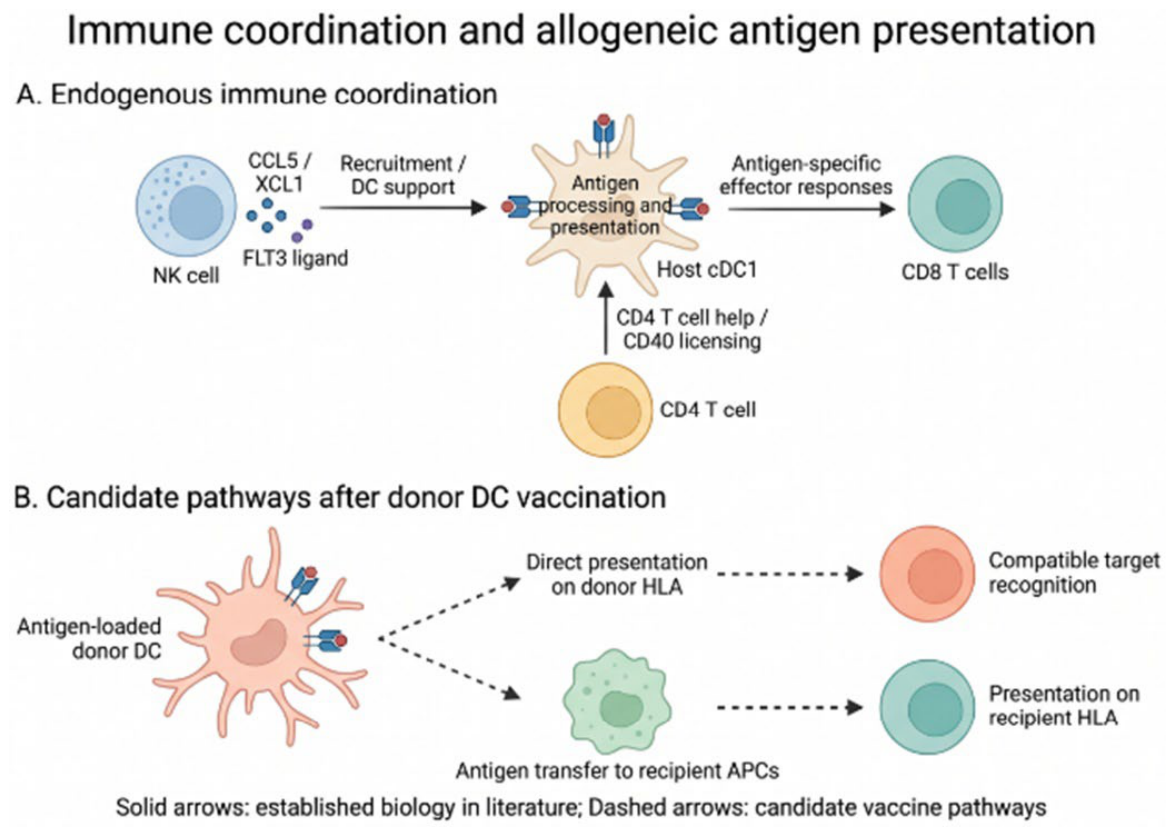
Figure 2.
Schematic presentation of the engineered CD34-derived allogeneic DC platform. (A) Donor CD34+ progenitors undergo lentiviral engineering, differentiation, maturation and tumor-lysate loading. (B) CD40L and CXCL13 provide rationales for APC licensing and recruitment of CXCR5-positive populations, respectively; the contribution of DC-associated CD93 remains to be determined. CXCL13 secretion alone does not demonstrate functional lymphoid organization, and DC CD93 expression differs from endothelial CD93 blockade. (C) Immune activation and reduced tumor burden observed in preclinical models are separated from unresolved questions concerning individual gene contributions, recipient specificity and clinical benefit. DC, dendritic cell; APC, antigen-presenting cell; CD40L, CD40 ligand. Created in https://BioRender.com.
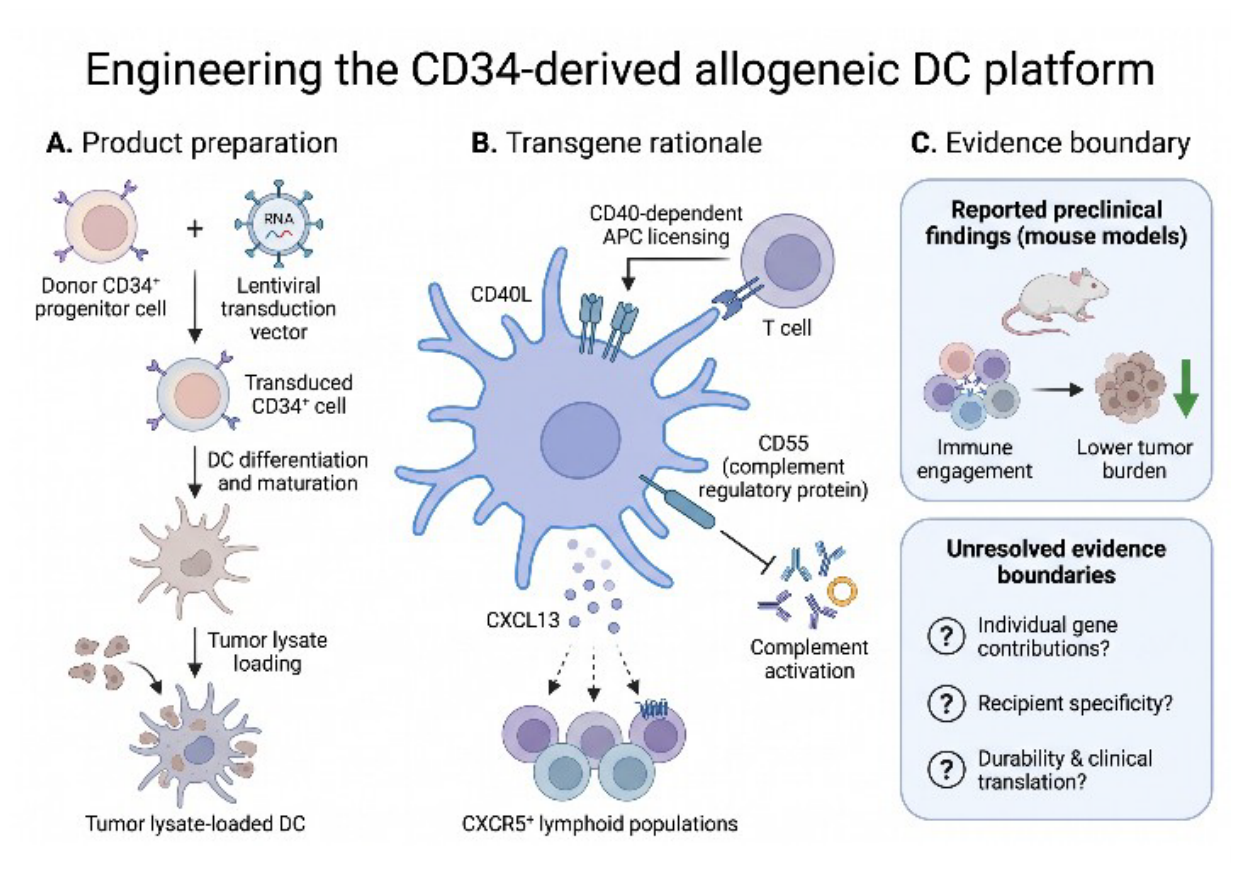
Figure 3.
Proposed framework for translation of DC vaccination from preclinical studies to clinical evaluation. Mechanistic studies define antigen specificity and the contribution of host APCs and immune effectors. Product evaluation determines post-thaw potency, lot consistency and cell- and vector-associated risks, while in vivo studies assess reproducibility, persistence and distribution. Early clinical studies evaluate dose feasibility, safety and tumor-specific immune responses. Controlled studies subsequently determine benefit using disease-appropriate outcomes. The workstreams may proceed iteratively, and immune activation is not presented as a validated surrogate for survival. DC, dendritic cell; APC, antigen-presenting cell; HLA, human leukocyte antigen. Created in https://BioRender.com.
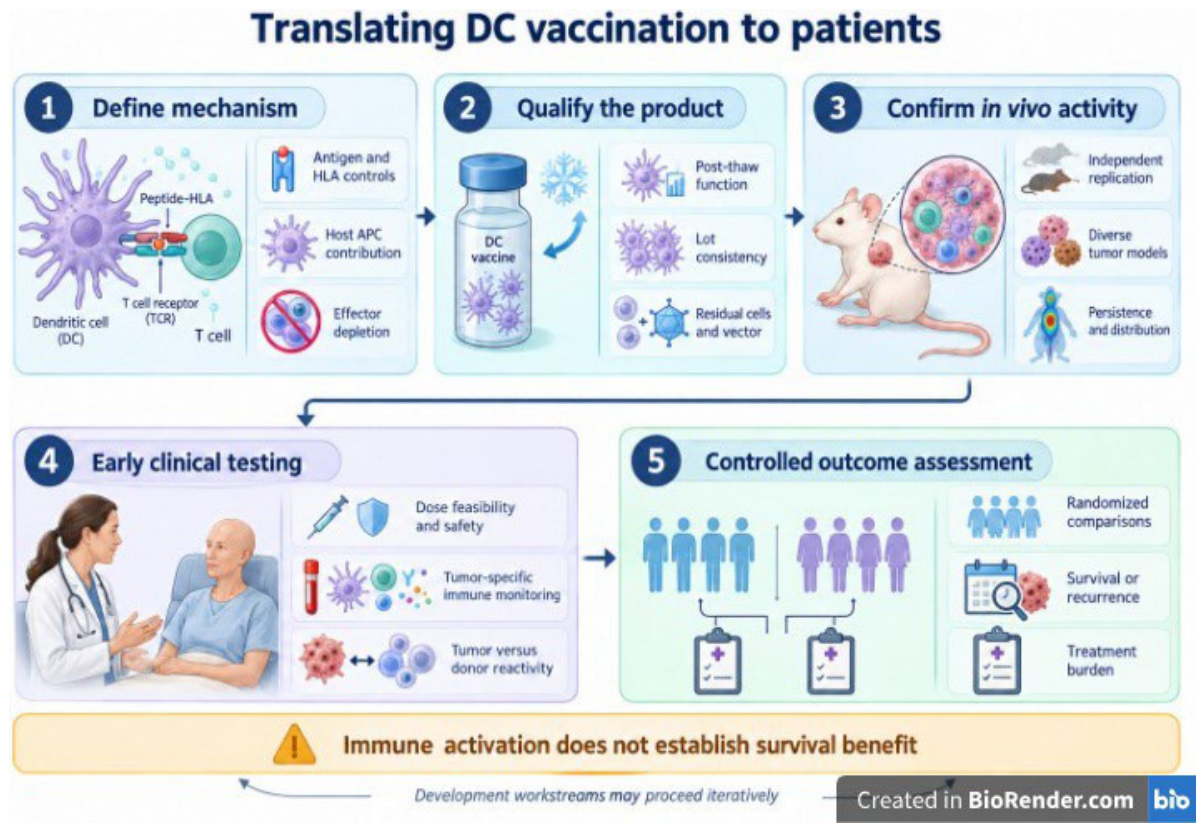
Figure 4.
Summary of the rationale and translational priorities for engineered allogeneic DC vaccination. (A) Donor CD34+ progenitors are engineered to express CD40L, CXCL13 and CD93 and differentiated into antigen-loaded DCs. (B) Proposed interactions with recipient APCs, CD4+ T cells, CD8+ T cells and NK cells may contribute to tumor-directed immune responses. Dashed arrows represent candidate mechanisms requiring validation. (C) Further development requires confirmation of antigen specificity, reproducible product potency, safety and clinical benefit in controlled trials. Immune activation and reduced tumor burden have been reported in preclinical models, whereas clinical benefit of the engineered platform remains unestablished. DC, dendritic cell; APC, antigen-presenting cell; NK, natural killer; CD40L, CD40 ligand.
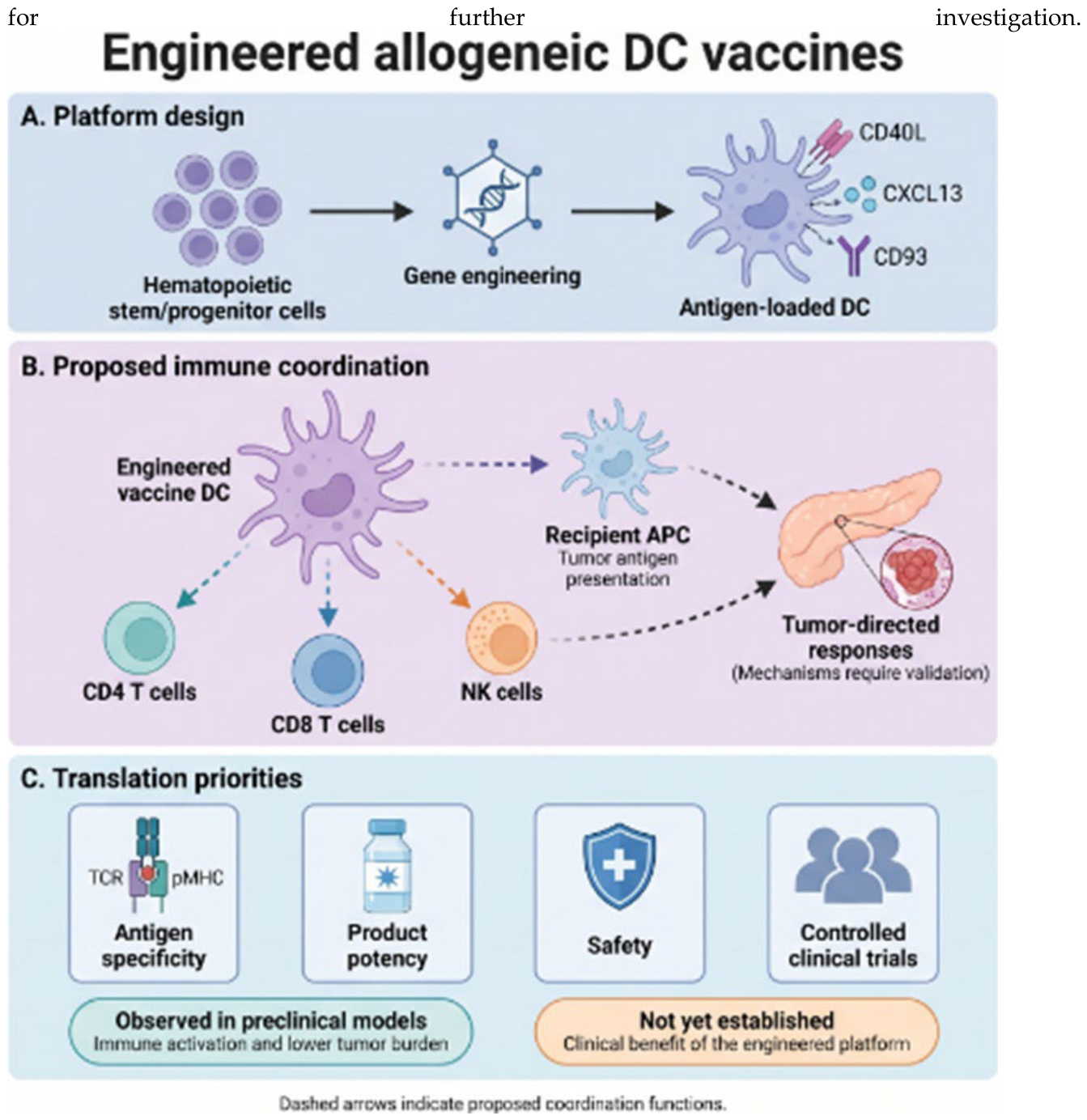

Table 1.
Selected preclinical and mechanistic studies relevant to DC vaccination.
| References | Evidence and principal observation | Interpretive boundary |
| [1] | Engineered CD34-derived DCs; lymphocyte activation and lower pancreatic tumor burden in two humanized systems. | Preclinical efficacy; endpoint reductions do not establish human benefit or cure. |
| [2] | Vector optimization retained early-model activity; advanced model used three animals per group. | One surviving treated animal lost detectable signal; marked attrition limits generalization. |
| [17] | Human cocultures showed greater OC-supported NK activation and differing CD4/CD8 expansion patterns. | Composite stimulation conditions; not a comparison with the engineered vaccine. |
| [4,5] | Cytokine-armed or antigen-acquisition-engineered DC progenitors supported antitumor activity in mouse models | Distinct engineered platforms; not independent validation of the CD93/CD40L/CXCL13 product. |
Table 2.
Selected clinical studies informing DC vaccine translation.
| References | Vaccine cells and antigen | Design and setting | Finding and limitation |
| [27] | Autologous APC-enriched sipuleucel-T | Randomized phase III; metastatic castration-resistant prostate cancer | Overall survival benefit; a different product and disease setting. |
| [33] | Autologous DCs; allogeneic mesothelioma lysate | Single-arm phase I/II; resected pancreatic cancer; 38 analyzed | Immune activity and recurrence follow-up; no randomized efficacy estimate. |
| [36] | Autologous natural DCs; melanoma antigens | Randomized phase III; resected melanoma; 148 randomized | No significant 2-year RFS improvement; stopped before planned recruitment. |
| [37] | Autologous DCs; allogeneic tumor lysate | Randomized phase II/III; mesothelioma; 176 randomized | No overall survival improvement with the tested regimen. |
| [38] | Autologous DCVAC/PCa | Randomized phase III; prostate cancer; 1182 patients | No overall survival benefit when added to docetaxel/prednisone. |
| [40] | Autologous tumor lysate-loaded DCs | Externally controlled survival analyses; glioblastoma | Longer survival association; external comparison limits causal inference. |
| [34,35] | RNA neoantigen vaccine; no administered DC product | Phase I pancreatic cancer program and longitudinal follow-up | Antigen-specific durable T cells; same cohort and combination regimen; contextual comparator. |
| [30] | Allogeneic intratumoral ilixadencel | Randomized phase II; metastatic renal cell carcinoma; 88 patients | No significant overall survival difference; limited power. |
| [31] | DCs loaded with WT1 class I/II peptides | Phase I; pancreatic cancer; combined with gemcitabine | Antigen-specific immune responses; nonrandomized and combination treatment. |
| [39] | Autologous DCs with tumor RNA and CD40L RNA | Randomized phase III; renal cell carcinoma; 462 patients | No overall survival benefit when added to standard care. |
DC vaccination and adoptive effector-cell therapies address different components of antitumor immunity. DC vaccines primarily support endogenous antigen-specific responses, whereas NK-cell and CAR-based approaches provide immune effectors with distinct recognition properties. Multi-antigen loading may broaden vaccine coverage, but recipient immune dysfunction and defective tumor antigen presentation can still limit activity. These mechanistic differences support investigation of complementary combinations; comparative safety, durability and efficacy require direct evidence.
Table 3.
Proposed development questions and supporting measurements.
| Development question | Proposed evidence |
| Is killing tumor antigen dependent? | Defined antigen and HLA controls; recipient-compatible tumor targets; blocking assays. |
| Which cells and transgenes drive activity? | Effector depletion; host APC perturbation; single- and combined-gene constructs. |
| Does the final dose retain function? | Post-thaw identity, viability, potency, stability and lot consistency. |
| Is exposure acceptably controlled? | Persistence, biodistribution, cytokine exposure, residual progenitors and vector safety. |
| Does immune activation improve outcomes? | Longitudinal immune sampling linked to prespecified clinical endpoints and appropriate controls. |
Disclaimer/Publisher’s Note: The statements, opinions and data contained in all publications are solely those of the individual author(s) and contributor(s) and not of MDPI and/or the editor(s). MDPI and/or the editor(s) disclaim responsibility for any injury to people or property resulting from any ideas, methods, instructions or products referred to in the content. |
© 2026 by the authors. Licensee MDPI, Basel, Switzerland. This article is an open access article distributed under the terms and conditions of the Creative Commons Attribution (CC BY) license (http://creativecommons.org/licenses/by/4.0/).
Copyright: This open access article is published under a Creative Commons CC BY 4.0 license, which permit the free download, distribution, and reuse, provided that the author and preprint are cited in any reuse.