

Submitted:
15 October 2026
Posted:
16 October 2026
You are already at the latest version
Abstract
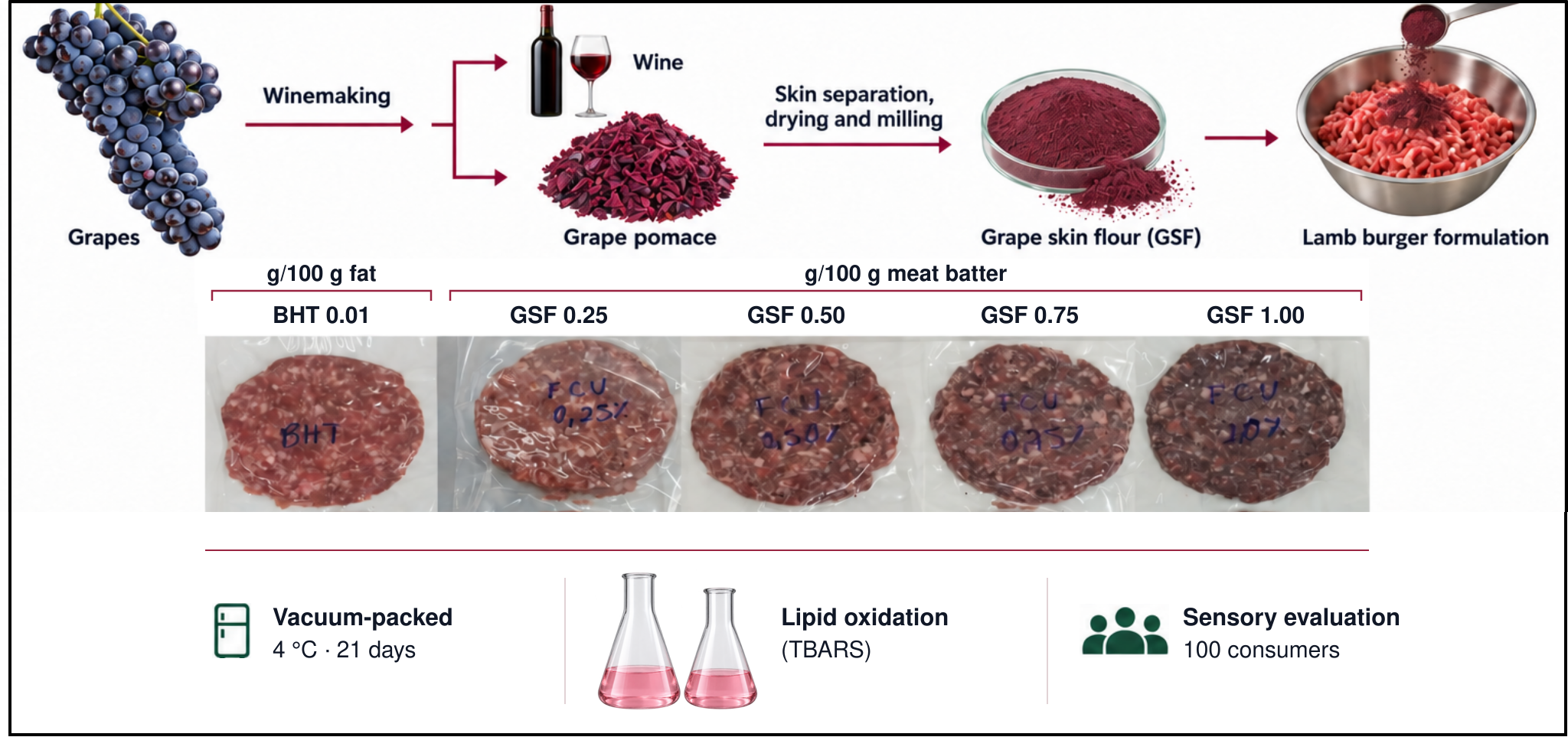
Oxidative deterioration compromises the quality of meat products, motivating the use of antioxidants. This study evaluated grape skin flour (GSF) as an alternative to butylated hydroxytoluene (BHT) in lamb burgers. The antioxidant properties of GSF were characterized, and burgers containing BHT (0.01 g/100 g fat) or GSF (0.25, 0.50, 0.75, or 1.00 g/100 g meat batter) were vacuum-packed and stored at 4 °C for 21 days. Physicochemical and technological properties were measured, and 100 consumers assessed sensory attributes and purchase intention. The flour had a total phenolic content of 84.37 mg gallic acid equivalents/g. On day 21, all GSF burgers had lower thiobarbituric acid reactive substances than BHT burgers (0.552–0.614 versus 0.755 mg malondialdehyde/kg), without significant differences among GSF levels. GSF0.25 scored higher for appearance than the other GSF formulations but lower for appearance, colour, and water-holding capacity than BHT. GSF1.00 showed greater diameter shrinkage than all other formulations. Cooking loss, aroma, flavour, tenderness, juiciness, and purchase intention did not differ significantly among formulations. At 0.25 g/100 g, GSF provided the most favourable balance of oxidative stability and product quality among the tested levels, supporting its further development as an ingredient for lamb burgers.
Keywords:
by-product valorization
; lipid oxidation
; phenolic compounds
; purchase intention
; sensory acceptance
; sustainability
1. Introduction
Lipid oxidation is a major cause of quality deterioration in meat products, leading to undesirable changes in colour, aroma, and flavour during storage [1,2]. Comminution disrupts muscle structure and can increase contact among oxidizable lipids, oxygen, and endogenous pro-oxidants [2,3]. Lamb meat has a fatty-acid profile distinct from beef and pork, with a lower n-6:n-3 ratio in retail samples and measurable long-chain n-3 polyunsaturated fatty acids [4]. Lipid composition is relevant to its oxidative stability: experimentally increasing n-3 fatty acids in lamb meat was associated with greater lipid oxidation during refrigerated display [5]. Synthetic antioxidants such as butylated hydroxytoluene (BHT) are used to limit this deterioration [1]. Consumer interest in processed meats containing natural compounds has encouraged the evaluation of plant-derived alternatives [6]. Their inclusion may support clean-label formulations when oxidative protection, technological performance and sensory quality are maintained.
The wine industry generates substantial quantities of solid by-products. Grape pomace, its major solid residue, represents an estimated 20–30% of the mass of grapes processed for wine, with approximately 9 million tonnes generated annually worldwide [7]. Comprising mainly skins and seeds, with a variable stalk fraction, it retains phenolic compounds after winemaking [7,8]. Grape skin flour (GSF) provides a potential source of antioxidant constituents while promoting the use of this winemaking by-product as a food ingredient [8,9]. The technological potential of grape residues in meat products has been reviewed [10], but successful valorization depends on whether the ingredient performs in the final food and remains acceptable to consumers.
Plant-derived ingredients have produced distinct responses in lamb burgers. Guarana-seed and pitanga-leaf extracts delayed lipid and protein oxidation in refrigerated lamb burgers formulated with a chia-oil emulsion without impairing the evaluated sensory characteristics [11]. Microencapsulated Hymenaea martiana bark extract reduced lipid oxidation during refrigerated storage [1], while Hibiscus rosa-sinensis flower powder improved colour and sensory attributes in frozen lamb burgers [12].
Grape-derived ingredients have also shown potential as natural antioxidants in meat products. De Alencar et al. [13] reported antioxidant protection in frozen beef burgers containing GSF, with an effect already observed at 0.5%, the lowest inclusion level tested. This finding raises the question of whether antioxidant protection could also be achieved at a lower GSF concentration. Andrés et al. [14] reported lower lipid and protein oxidation in refrigerated lamb patties containing an aqueous red-grape-pomace extract. However, whole GSF differs from an aqueous extract because it retains insoluble components and pigments that may also affect product characteristics. Moreover, the antioxidant effect previously observed with GSF in frozen beef burgers does not establish whether lower inclusion levels would remain effective in lamb burgers under refrigerated storage.
Therefore, we hypothesized that GSF could provide antioxidant protection in refrigerated lamb burgers even at an inclusion level below the lowest concentration previously tested in beef burgers. This study aimed to evaluate GSF obtained from winemaking as an alternative to BHT in lamb burgers by determining the effects of different inclusion levels on lipid oxidation during refrigerated storage, physicochemical and technological properties, sensory acceptance, and purchase intention.
2. Materials and Methods
2.1. Experimental Site
The experiment was conducted at the Laboratory of Animal Product Technology (Meat and Fish), Agricultural Sciences Campus, Universidade Federal do Vale do São Francisco (UNIVASF), Petrolina, Pernambuco, Brazil.
2.2. Production of Grape Skin Flour
Syrah grape (Vitis vinifera L.) pomace from organic wine processing was supplied by Terra Nova Winery (Miolo), Casa Nova, Bahia, Brazil. The pomace was placed in sterile plastic bags and stored at −20 °C until processing. After thawing at room temperature, skins were manually separated from seeds and stems. The skins were dried in a forced-air oven (SolidSteel SSDc 30L, Osasco, São Paulo, Brazil) at 50 °C for 24 h, ground in a food processor (Philco All In One, Manaus, Amazonas, Brazil), and passed through a 28-mesh sieve (Bertel, Caieiras, São Paulo, Brazil). The resulting GSF was stored at −20 °C until characterization and incorporation into the burgers.
2.3. Antioxidant Capacity and Total Phenolic Content of the Flour
The antioxidant capacity of GSF was evaluated using the ABTS radical-cation decolourization, DPPH radical-scavenging, and ferric reducing antioxidant power (FRAP) assays. Total phenolic content was quantified using the Folin–Ciocalteu method.
ABTS radical-cation scavenging capacity was determined according to Re et al. [15], with modifications. Radical cations were generated by reacting 7 mM ABTS with 2.45 mM potassium persulfate for 12–16 h in the dark at room temperature. The solution was diluted with phosphate-buffered saline (pH 7.4) to an absorbance of 0.70 at 734 nm and equilibrated at 30 °C. A 20 µL aliquot of sample solution was mixed with 980 µL of the ABTS working solution. Absorbance was measured at 734 nm after 10 min in the dark. Antioxidant capacity was expressed as µmol Trolox equivalents (TE) per gram of flour.
DPPH radical-scavenging capacity was determined according to Brand-Williams et al. [16], with modifications. Sample solution (100 µL) was mixed with 3.9 mL of DPPH solution (60 µM in methanol). After incubation at 37 °C for 10 min, absorbance was measured at 515 nm. Trolox was used for calibration, and results were expressed as µmol TE per gram of flour.
FRAP was determined according to Benzie and Strain [17]. The freshly prepared reagent contained 0.3 M acetate buffer (pH 3.6), 10 mM 2,4,6-tripyridyl-s-triazine in 40 mM HCl, and 20 mM FeCl3·6H2O, mixed in a 10:1:1 volume ratio. Sample solution (30 µL) was mixed with 900 µL of reagent and 90 µL of distilled water. After incubation at 37 °C for 20 min, absorbance was measured at 593 nm. Quantification used an FeSO4 calibration curve, and results were expressed as µmol Fe2+ equivalents per 100 g of dry matter.
Total phenolic content was determined using the Folin–Ciocalteu method of Singleton et al. [18]. An aliquot of 0.5 mL of appropriately diluted sample solution was mixed with 2.5 mL of Folin–Ciocalteu reagent diluted 1:10 with water and 2.0 mL of 7.5% Na2CO3 solution. The mixture was incubated at 50 °C for 15 min, and absorbance was measured at 760 nm. Gallic acid was used for calibration, and results were expressed as mg gallic acid equivalents (GAE) per gram of flour.
2.4. Burger Preparation and Formulations
Lamb meat was obtained from a slaughterhouse operating under municipal inspection and stored at −20 °C until processing. Before burger manufacture, the meat was thawed overnight at 4 °C and ground through an 8 mm plate using an industrial meat grinder (Metvisa, Santa Catarina, Brazil).
The base meat batter (MB) consisted of 95.9% lamb meat, 1.25% onion powder, 1.25% garlic powder, and 1.60% salt. The ingredients were mixed manually to obtain a homogeneous batter, without the addition of fat.
Five formulations were prepared from this base batter. The positive-control formulation, designated BHT, contained the synthetic antioxidant BHT at 0.01 g per 100 g fat (100 mg/kg fat). The BHT dose was calculated relative to the fat content of the formulation, using the fat-basis expression specified in Note 15 of the Codex General Standard for Food Additives (CXS 192-1995) [19]. BHT was selected as the reference antioxidant because of its use in food processing and in comparative studies of natural antioxidants in meat products [1,12,13]. The other four formulations contained GSF, prepared as described in Section 2.2.
The flour-containing formulations were designated GSF0.25 (0.25 g GSF/100 g MB), GSF0.50 (0.50 g GSF/100 g MB), GSF0.75 (0.75 g GSF/100 g MB), and GSF1.00 (1.00 g GSF/100 g MB). BHT or GSF was incorporated into the corresponding portion of the base batter and mixed manually before shaping. GSF inclusion levels were expressed relative to the mass of the MB, whereas the BHT concentration was expressed relative to the fat mass.
Burgers weighing approximately 90 g were shaped manually using a burger mould (model 3126, Decor Útil, São Paulo, Brazil). The initial assessment (day 0) was performed immediately after antioxidant incorporation and burger preparation. Burgers assigned to subsequent assessments were vacuum-packed using a Sulpack SVC 200 sealer (Brazil) and stored at 4 °C until analysis on days 7, 14, and 21.
2.5. Proximate Composition and Flour Characterization
Moisture, crude protein, and ash contents were determined according to AOAC International [20], following the analytical procedures used in previous studies by the research group [1,12]. Lipid content was determined with an ANKOM TX-10 extractor (ANKOM Technology, Macedon, NY, USA), following AOCS method Am 5-04 [21].
The flour was characterized for moisture, crude protein, lipids, pH, and instrumental colour. Its pH and CIELAB colour coordinates (L*, a*, and b*) were evaluated using the procedures reported for powdered plant ingredients by de Lira Alencar et al. [12].
2.6. pH and Instrumental Colour
Burger pH was measured by inserting the electrode of a portable pH meter (Hanna Instruments HI99163, Brazil) directly into the sample after calibration with pH 4.0 and 7.0 buffers. For instrumental colour, refrigerated burgers were removed from their vacuum packages and exposed to ambient oxygen for 30 min before measurement. Colour was measured using a HunterLab MiniScan EZ 4500 colorimeter (Virginia, USA), with illuminant D65, a 10° standard observer, and a 25 mm aperture. Six readings were taken at different points on each burger surface and averaged to obtain one value per experimental unit. Results were expressed as lightness (L*), redness (a*), and yellowness (b*).
2.7. Lipid Oxidation
Lipid oxidation was assessed using the thiobarbituric acid reactive substances (TBARS) procedure of Raharjo et al. [22], as applied by Cordeiro et al. [1]. Approximately 10 g of sample was homogenized with 5% trichloroacetic acid containing BHT. The filtrate was reacted with thiobarbituric acid in a boiling water bath for 5 min. After cooling, absorbance was measured at 532 nm against a reagent blank. Results were expressed as mg malondialdehyde (MDA) per kg of burger.
2.8. Water-Holding Capacity and Cooking Properties
Water-holding capacity was evaluated by the pressure method described by Honikel and Hamm [23], as applied in previous lamb burger studies [1,12]. A 0.5 g sample was placed between filter papers and compressed between acrylic plates under a 5 kg load for 5 min. Samples were weighed before and after compression, and water-holding capacity was determined from the compression-induced mass change and expressed as a percentage.
For cooking loss, burgers were weighed and cooked on an electric grill (Mondial Smart Grill G-04, Brazil) on both sides until the internal temperature reached 72 ± 2 °C, monitored using a type K thermocouple (Hanna HI935005, Portugal). After cooling to room temperature, burgers were weighed again. Cooking loss was calculated as the difference between raw and cooked weights divided by raw weight and multiplied by 100, following the cooking evaluation framework described by AMSA [24].
Burger diameter was measured before and after cooking with a digital calliper (MTX 316119, Brazil). Diameter shrinkage was calculated as 100 multiplied by the difference between raw and cooked diameters, divided by raw diameter [25].
2.9. Texture Profile Analysis
Texture profile analysis was performed on cooked burgers using a texture analyser (Stable Micro Systems, Godalming, UK), following the procedure reported by Cordeiro et al. [1]. Cylindrical pieces, 3.0 cm in diameter and 1.0 cm high, underwent two compression cycles to 50% of their original height with a 45 mm aluminium probe. Pre-test and post-test speeds were 1 and 5 mm/s, respectively, with a 1 g trigger force. Hardness, cohesiveness, springiness, and chewiness were obtained from the compression curves according to Bourne [26].
2.10. Sensory Evaluation
Sensory evaluation followed the approach of Cordeiro et al. [1] and the AMSA guidelines [24]. One hundred untrained adult consumers evaluated samples in individual booths. Grilled burgers were cooked to 72 °C, portioned, and presented monadically in randomized order under three-digit codes. Water was provided between samples for palate cleansing.
Appearance, colour, aroma, flavour, tenderness, and juiciness were scored on a nine-point hedonic scale, from 1 (dislike extremely) to 9 (like extremely). Purchase intention was scored from 1 (definitely would not buy) to 5 (definitely would buy).
The sensory study was approved by the Research Ethics Committee under protocol (No. 57337022.3.0000.8267). Participants provided informed consent before the evaluation.
2.11. Experimental Design and Statistical Analysis
A completely randomized design was used, with five formulations and three replicates. Each burger was considered an experimental unit for physicochemical and technological analyses. For pH, instrumental colour, and lipid oxidation during storage, a 5 × 4 factorial arrangement combined the five formulations with four storage times (0, 7, 14, and 21 days), with three burgers per formulation at each time. Different burgers were used at each sampling time. Data were analysed using SAS software (version 9.4; SAS Institute Inc., Cary, NC, USA). Residual normality was assessed using the Shapiro–Wilk test.
Traits evaluated at a single sampling time were analysed with formulation as a fixed effect. The storage models included formulation, storage day, and their interaction as fixed effects, with a common residual variance. Significant interactions were examined by comparing formulations within each storage day and storage days within each formulation, with Tukey adjustment. For traits assessed at a single sampling time, means were compared by Tukey’s test when the formulation effect was significant, following the analysis-of-variance approach used by Cordeiro et al. [1]. Statistical significance was set at P < 0.05. Means and standard errors were reported separately, and storage figures present estimated marginal means with pointwise 95% confidence intervals.
Sensory scores and purchase intention were analysed separately, and formulation means were compared using Tukey–Kramer-adjusted pairwise comparisons at the 5% significance level.
Principal component analysis (PCA) was used to explore relationships among appearance, colour, aroma, flavour, tenderness, and juiciness. Ratings were centred within assessors, and these six active variables were standardized to unit variance. Purchase intention was projected as a supplementary variable and did not contribute to component estimation. The first two components were represented by attribute–component correlations and formulation centroids, calculated as the mean individual component scores for each formulation.
3. Results
3.1. Characteristics and Antioxidant Capacity of Grape Skin Flour
The GSF contained 84.37 mg gallic acid equivalents (GAE)/g of total phenolics. Its ABTS and DPPH radical-scavenging capacities were 174.71 and 1020.4 µmol Trolox equivalents (TE)/g, respectively, whereas ferric reducing antioxidant power was 2056.4 µmol Fe2+ equivalents/100 g of dry matter (Table 1).
The flour contained 5.63 g moisture, 2.48 g crude protein, and 4.39 g lipids per 100 g. Its pH was 4.10, and the CIELAB coordinates were L* = 20.75, a* = 10.00, and b* = 6.43 (Table 2).
3.2. Proximate Composition of Lamb Burgers
Moisture, crude protein and lipid contents did not differ significantly among formulations (P ≥ 0.1887; Table 3). Ash content differed among treatments (P = 0.0045), with higher values in BHT burgers (2.57%) than in GSF0.50, GSF0.75, and GSF1.00 burgers (2.04%, 2.07%, and 1.99%, respectively). GSF0.25 had an intermediate ash content (2.36%) and did not differ from any other formulation.
3.3. Lipid Oxidation and Physicochemical Changes During Refrigerated Storage
There was a significant treatment × storage time interaction for TBARS (P < 0.0001), L* (P = 0.0028), a* (P = 0.0165), and b* (P = 0.0041). The interaction was not significant for pH (P = 0.0778), although treatment and storage time each affected this variable (P < 0.0001; Table 4). The significant interactions were therefore examined through comparisons within storage days and within formulations (Table 5).
On day 0, TBARS were higher in GSF0.50, GSF0.75, and GSF1.00 than in BHT burgers, whereas GSF0.25 did not differ from BHT. No differences among formulations were detected on days 7 or 14. By day 21, all GSF formulations had lower TBARS than BHT: 0.614, 0.614, 0.572, and 0.552 mg MDA/kg for GSF0.25, GSF0.50, GSF0.75, and GSF1.00, respectively, compared with 0.755 mg MDA/kg for BHT (Figure 1). These endpoint values were 18.7–26.9% lower than BHT, with no significant differences among the four GSF formulations. Within BHT, TBARS were higher on days 14 and 21 than on days 0 and 7. No significant differences among storage days were detected for GSF0.25 or GSF0.75. GSF0.50 had lower TBARS on day 7 than on day 0, while GSF1.00 had lower values on days 7 and 21 than on day 0.
Legend: TBARS: thiobarbituric acid reactive substances, expressed as mg malondialdehyde (MDA)/kg burger; BHT: positive control containing 0.01 g butylated hydroxytoluene/100 g fat in the base formulation; GSF0.25, GSF0.50, GSF0.75, and GSF1.00, respectively, contain 0.25, 0.50, 0.75, and 1.00 g grape skin flour/100 g meat batter (MB). Symbols represent treatment × day least-squares means; error bars represent pointwise 95% confidence intervals from the common-variance model. Storage was at 4 °C under vacuum. The treatment × storage-day interaction was significant (P < 0.0001).
Lightness (L*) was lower in GSF1.00 than in BHT throughout storage. GSF0.25 and GSF0.50 did not differ from BHT on days 0, 7, or 21, but both were darker than BHT on day 14. GSF0.75 was darker than BHT at every sampling time. Redness (a*) showed a different temporal pattern: all GSF formulations had lower a* than BHT on day 7, whereas on day 21 GSF1.00 and BHT had similar values (7.33 and 7.73, respectively), both exceeding GSF0.75 (3.73). GSF0.25 and GSF0.50 did not differ from either group at that time. Yellowness (b*) was lower in GSF0.50, GSF0.75, and GSF1.00 than in BHT on every sampling day. GSF0.25 did not differ from BHT for b* on days 0 or 21, but had lower values on days 7 and 14 (Figure 2).
Legend. BHT: positive control containing 0.01 g butylated hydroxytoluene/100 g fat in the base formulation; GSF0.25, GSF0.50, GSF0.75, and GSF1.00, respectively, contain 0.25, 0.50, 0.75, and 1.00 g grape skin flour/100 g MB. (A) L*, lightness; (B) a*, red–green coordinate; (C) b*, yellow–blue coordinate. Symbols represent treatment × day least-squares means; bars indicate pointwise 95% confidence intervals from the common-variance model. Different samples were evaluated at 0, 7, 14, and 21 days of vacuum storage at 4 °C. Interaction P-values were 0.0028, 0.0165, and 0.0041 for L*, a*, and b*, respectively.
Across storage days, mean pH was lower in GSF0.50, GSF0.75, and GSF1.00 (5.719, 5.668, and 5.671, respectively) than in BHT (5.798). GSF0.25 (5.748) did not differ from BHT or GSF0.50. Across formulations, pH decreased from 5.776 on day 0 to 5.634 on day 21, which was lower than on all preceding sampling days (Table 4).
3.4. Water Holding Capacity and Cooking and Texture Properties
Water-holding capacity differed among formulations (P = 0.0262), with a lower value for GSF0.25 than for BHT (68.55% versus 73.86%). GSF0.50, GSF0.75, and GSF1.00 did not differ from either treatment (Table 6). Cooking loss did not differ significantly among formulations (P = 0.1397). Diameter shrinkage was greater in GSF1.00 (23.11%) than in all other formulations (9.27–15.69%; P = 0.0012).
Hardness, springiness, and cohesiveness did not differ significantly among formulations (P ≥ 0.2412). Chewiness differed among treatments (P = 0.0467), with a higher value in GSF0.75 than in GSF0.25 (17.61 versus 10.89). BHT, GSF0.50, and GSF1.00 were intermediate and did not differ from either formulation.
3.5. Sensory Responses and Multivariate Relationships
BHT received higher appearance and colour scores than all GSF formulations in the Tukey–Kramer comparisons (Table 7). For appearance, GSF0.25 scored higher than the other flour formulations, whereas GSF0.50, GSF0.75, and GSF1.00 did not differ from one another. For colour, GSF0.25 scored higher than GSF0.75, with GSF0.50 and GSF1.00 intermediate. No significant pairwise differences were detected for aroma, flavour, tenderness, juiciness, or purchase intention. Mean scores ranged from 6.62 to 6.94 for aroma, 6.81 to 7.33 for flavour, 7.13 to 7.32 for tenderness, and 6.99 to 7.36 for juiciness. Purchase intention ranged from 3.33 to 3.64 on the five-point scale.
The first two principal components accounted for approximately 73.2% of the variance in sensory ratings, with PC1 explaining 47.50% and PC2 explaining 25.71% (Figure 3). All six active attributes correlated positively with PC1. Appearance and colour had positive correlations with PC2, whereas flavour, tenderness, and juiciness had negative correlations; aroma was positioned close to the horizontal axis. Purchase intention, projected as a supplementary variable, correlated positively with PC1 and had a small negative correlation with PC2. The BHT centroid occupied the positive region of both components, while GSF0.25 was closer to the origin with a positive PC2 score. GSF0.50 and GSF1.00 had similar positions at negative PC2 scores, and GSF0.75 had the most negative PC1 centroid.
Legend. (A) Correlations of sensory attributes with the first two principal components. Six sensory attributes were included as active variables; purchase intention was projected as a supplementary variable and did not contribute to component estimation. (B) Treatment centroids were calculated as mean individual component scores. Ratings were centred within assessors, and active variables were standardised to unit variance. PC1 and PC2 explained 47.50% and 25.71% of the variance, respectively, for a cumulative 73.20%. BHT: positive control containing 0.01 g butylated hydroxytoluene/100 g fat in the base formulation; GSF0.25, GSF0.50, GSF0.75, and GSF1.00, respectively, contain 0.25, 0.50, 0.75, and 1.00 g grape skin flour/100 g meat batter (MB).
4. Discussion
This study evaluated GSF as an alternative to BHT in refrigerated lamb burgers and compared inclusion levels to identify a suitable balance between oxidative stability and product quality. The absence of significant differences in moisture, protein and lipids among treatments indicates that GSF inclusion did not measurably alter the proximate composition within the tested range (Table 3). Its principal benefit was improved oxidative stability on day 21, when GSF burgers exhibited lower TBARS than the BHT control, indicating lower accumulation of secondary lipid oxidation products.
The reductions were 18.7% at both 0.25% and 0.50%, 24.2% at 0.75%, and 26.9% at 1.00% (Figure 1). Despite this numerical ordering, the four GSF treatments did not differ significantly, so the lowest numerical TBARS at 1.00% does not establish superior antioxidant efficacy. GSF0.25 also did not differ from BHT on days 0, 7, or 14, whereas GSF0.50–GSF1.00 initially had higher values (Figure 1). Thus, the results support an antioxidant contribution without detectable macronutrient enrichment, with an advantage over BHT demonstrated at day 21 and no consistent improvement from increasing inclusion above 0.25% across the sampling times.
The flour’s phenolic content of 84.37 mg GAE/g, together with its radical-scavenging and reducing activity, provides a plausible basis for this protection (Table 1). Phenolic hydroxyl groups can donate hydrogen or electrons and interrupt oxidation reactions. Their effectiveness in meat also depends on molecular structure and protein interactions: Xu et al. [27] found that different phenolics improved oxidative stability while producing different changes in myofibrillar-protein conformation and functionality. Consequently, increasing total flour addition need not proportionally increase the fraction of antioxidant compounds acting at oxidation sites. The current results support using the measured response in burgers, rather than in vitro antioxidant capacity alone, to select the inclusion level.
De Alencar et al. [13] reported that 0.5–1.0% GSF could replace BHT in frozen beef burgers, whereas 1.5–2.0% produced poorer oxidative and sensory outcomes. Karslıoğlu [28] subsequently found no additional oxidative protection from 1.0% grape pomace over 0.5–0.75% in refrigerated beef systems. These studies support selecting a concentration that controls oxidation with the least disturbance of product quality. Under the present refrigerated-lamb conditions, that useful response was already obtained at 0.25%.
Across treatments and sampling days, TBARS ranged from 0.520 to 0.755 mg MDA/kg, below the approximately 2 mg MDA/kg associated with a sensory acceptability limit in the beef experiment of Campo et al. [29]. Thus, TBARS remained below this previously reported reference value in all treatments throughout refrigerated storage.
The flour itself was dark (L* = 20.75), and GSF0.75 and GSF1.00 were darker than BHT from day 0 onward (Figure 2). The immediate differences support a contribution from the added plant pigments, rather than storage-induced oxidation alone. Karslıoğlu [28] observed reduced metmyoglobin formation together with darker grape-pomace-containing beef systems, demonstrating that lipid or pigment protection can coexist with a darker product. Pereira et al. [30] likewise found lower colour coordinates in beef patties containing red-wine pomace.
The sensory comparisons identify the clearest reason to prefer 0.25% over the higher additions. GSF0.25 received an appearance score of 6.15, significantly higher than the 5.18–5.49 recorded for GSF0.50–GSF1.00, although still below BHT at 6.87 (Table 7). Thus, increasing inclusion beyond 0.25% worsened appearance without a statistically detectable additional day-21 antioxidant benefit. Aroma, flavour, tenderness, juiciness, and purchase intention did not differ significantly among formulations. The flour therefore primarily affected visual attributes rather than overall eating quality. This is a more favourable sensory response than that reported at 1.5–2.0% by de Alencar et al. [13], where several eating-quality attributes also deteriorated. The PCA supports the distinction between visual attributes and flavour, tenderness, and juiciness, while the nonsignificant purchase-intention comparison indicates that the visual penalty did not produce a detectable difference in that response under the test conditions.
The principal technological disadvantage of GSF0.25 was its lower water-holding capacity compared with BHT, 68.55% versus 73.86% (Table 6). This reduction of 5.31 percentage points is undesirable for water retention under the pressure test. However, it was not accompanied by greater cooking loss or lower perceived juiciness. These measurements evaluate different processes: mechanical water release, mass loss during heating, and moisture perceived during consumption. Furthermore, GSF0.25 did not differ in water-holding capacity from the higher flour concentrations. The intermediate value of GSF0.50 therefore does not establish that 0.50% is technologically superior to 0.25%.
The absence of improved water retention despite antioxidant activity is consistent with recent mechanistic studies. Wang et al. [31] found that several phenolic treatments reduced myofibrillar-protein oxidation, but only ellagic acid improved gel properties. Yang et al. [32] showed that grape-seed proanthocyanidins reduced oxidation in lamb sausages while weakening network polymerisation at 0.10%; a polysaccharide addition improved water immobilisation. These findings demonstrate that oxidative protection and water-retaining structure are distinct formulation responses. In the present burgers, phenolic–protein interactions and the acidity of the flour (pH 4.10) are plausible contributors. Lower pH can reduce protein charge repulsion and the space available to accommodate water. However, although 0.50–1.00% GSF lowered pH relative to BHT, water-holding capacity did not decline progressively with inclusion. Acidification alone therefore does not explain the water-retention response, and increasing flour addition did not establish a hydration benefit.
GSF1.00 provided further evidence against increasing the inclusion level: diameter shrinkage reached 23.11%, significantly exceeding every other formulation, including BHT at 14.32%. Greater contraction is undesirable for maintaining burger dimensions and portion appearance. It did not result in greater cooking mass loss, which did not differ among treatments. Hardness, springiness, and cohesiveness were also unaffected statistically, and the chewiness difference between GSF0.75 and GSF0.25 did not distinguish either from BHT. There is therefore no evidence that 0.75% improved texture or that 1.00% made the burgers generally tougher.
The PCA provided a multivariate view of the sensory response. PC1 (47.50%) was positively associated with all six active sensory attributes, whereas PC2 (25.71%) contrasted appearance and colour with flavour, tenderness, and juiciness; together, the axes explained 73.21% of the variance in assessor-centred ratings (Figure 3). BHT had positive scores on both axes. GSF0.25 lay closer to the origin but retained a positive PC2 score, while GSF0.50 and GSF1.00 had negative PC2 scores. This pattern is consistent with the greater decline in appearance scores above 0.25% (Table 7), but the positions of the formulation centroids do not establish significant differences or superior eating quality. Purchase intention, projected as a supplementary variable, aligned mainly with PC1 and only weakly with PC2. Although GSF altered instrumental colour and sensory appearance scores, purchase intention did not differ significantly among formulations. The visual changes therefore were not accompanied by a detectable difference in purchase intention under the study conditions, consistent with the similar ratings for aroma, flavour, tenderness, and juiciness.
At 0.25 g GSF/100 g MB, equivalent to 2.5 kg of flour per tonne of base batter, day-21 TBARS were 18.7% lower than with BHT, while flavour, tenderness, juiciness, cooking loss, and purchase intention showed no significant differences among formulations. This concentration therefore offers a practical starting point for replacing BHT with a plant-derived ingredient, consistent with research on natural antioxidants in meat products [12,13,14]. It also creates a food use for grape skins from winemaking: grape pomace is rich in organic matter, and its disposal requires appropriate management to avoid environmental problems [33].
5. Conclusions
GSF showed potential as a natural antioxidant for lamb burgers, providing effective protection against lipid oxidation at all tested inclusion levels, including the lowest level evaluated (0.25 g/100 g meat batter). Among the tested concentrations, 0.25% represents a practical level for further application, combining antioxidant protection with limited effects on product quality. Its use also supports the valorization of a winemaking by-product, contributing to more sustainable meat product development.
Author Contributions
Conceptualization, Mariana Gardenia de Lucena Reis, Francisco Allan Leandro de Carvalho, Mário Adriano Ávila Queiroz, and Rafael Torres de Souza Rodrigues; methodology, Francisco Allan Leandro de Carvalho, Mário Adriano Ávila Queiroz, and Rafael Torres de Souza Rodrigues; validation, Mariana Gardenia de Lucena Reis, Matheus Rodrigues de Souza, Maria Gracileide de Alencar, Glayciane Costa Gois, Talita Raquel Rodrigues da Silva, and Luana Candelaria Ramos; formal analysis, Matheus Rodrigues de Souza, Luana Candelaria Ramos, Francisco Allan Leandro de Carvalho, Mário Adriano Ávila Queiroz, and Rafael Torres de Souza Rodrigues; investigation, Mariana Gardenia de Lucena Reis, Matheus Rodrigues de Souza, Maria Gracileide de Alencar, Glayciane Costa Gois, and Talita Raquel Rodrigues da Silva; data curation, Mariana Gardenia de Lucena Reis, Matheus Rodrigues de Souza, Maria Gracileide de Alencar, Glayciane Costa Gois, and Talita Raquel Rodrigues da Silva; writing—original draft preparation, Mariana Gardenia de Lucena Reis, Matheus Rodrigues de Souza, Maria Gracileide de Alencar, Glayciane Costa Gois, Talita Raquel Rodrigues da Silva, Luana Candelaria Ramos, Francisco Allan Leandro de Carvalho, Mário Adriano Ávila Queiroz, and Rafael Torres de Souza Rodrigues; writing—review and editing, Mariana Gardenia de Lucena Reis, Matheus Rodrigues de Souza, Maria Gracileide de Alencar, Glayciane Costa Gois, Talita Raquel Rodrigues da Silva, Luana Candelaria Ramos, Francisco Allan Leandro de Carvalho, Mário Adriano Ávila Queiroz, and Rafael Torres de Souza Rodrigues; supervision, Francisco Allan Leandro de Carvalho, Mário Adriano Ávila Queiroz, and Rafael Torres de Souza Rodrigues; project administration, Rafael Torres de Souza Rodrigues. All authors have read and agreed to the published version of the manuscript.
Funding
This research was supported by the Fundação de Amparo à Ciência e Tecnologia do Estado de Pernambuco (FACEPE; Grant No. IBPG-0778-5.04/21) and the Conselho Nacional de Desenvolvimento Científico e Tecnológico (CNPq, Brazil; Research Productivity Grant PQ-2, Process No. 315128/2023-2).
Institutional Review Board Statement
The sensory evaluation involving human participants was conducted in accordance with the Declaration of Helsinki and approved by the Research Ethics Committee (approval No. 57337022.3.0000.8267).
Informed Consent Statement
Informed consent was obtained from all participants in the sensory evaluation.
Data Availability Statement
The raw data supporting the conclusions of this article will be made available by the authors on request.
Conflicts of Interest
The authors declare no conflicts of interest.
Abbreviations
The following abbreviations are used in this manuscript:
| ABTS | 2,2′-Azinobis(3-ethylbenzothiazoline-6-sulfonic acid) |
| AMSA | American Meat Science Association |
| AOCS | American Oil Chemists’ Society |
| BHT | Butylated hydroxytoluene |
| CAAE | Certificado de Apresentação para Apreciação Ética |
| CIELAB | CIE L*a*b* colour space |
| DPPH | 2,2-Diphenyl-1-picrylhydrazyl |
| FRAP | Ferric reducing antioxidant power |
| GAE | Gallic acid equivalents |
| GSF | Grape skin flour |
| MB | Meat batter |
| MDA | Malondialdehyde |
| PC1 | First principal component |
| PC2 | Second principal component |
| PCA | Principal component analysis |
| SEM | Standard error of the mean |
| TBARS | Thiobarbituric acid reactive substances |
| TE | Trolox equivalents |
| WHC | Water-holding capacity |
References
- Cordeiro, J.C.P.; de Alencar, M.G.; da Silva, J.A.; Batista Alves, N.V.; de Souza, M.R.; Neto, J.P.; da Silva Almeida, J.R.G.; de Brito Araújo Carvalho, A.J.; De Carvalho, F.A.L.; de Souza Rodrigues, R.T. Microencapsulated Hymenaea martiana Bark Extract Improves Oxidative Stability and Sensory Quality of Lamb Burgers. J. Food Process. Preserv. 2026, 2026, 9166762. [Google Scholar] [CrossRef]
- Muíño, I.; de la Fuente, J.; Pérez, C.; Apeleo, E.; Pérez-Santaescolástica, C.; Cañeque, V.; Lauzurica, S.; Bermejo-Poza, R.; Díaz, M.T. Use of Red Wine Polyphenols as a Natural Preservative in Health-Promoting Omega-3 Fatty Acids-Enriched Lamb Patties. Molecules 2018, 23, 3080. [Google Scholar] [CrossRef] [PubMed]
- Spanos, D.; Tørngren, M.A.; Christensen, M.; Baron, C.P. Effect of oxygen level on the oxidative stability of two different retail pork products stored using modified atmosphere packaging (MAP). Meat Sci. 2016, 113, 162–169. [Google Scholar] [CrossRef] [PubMed]
- Enser, M.; Hallett, K.; Hewitt, B.; Fursey, G.A.J.; Wood, J.D. Fatty acid content and composition of English beef, lamb and pork at retail. Meat Sci. 1996, 42, 443–456. [Google Scholar] [CrossRef] [PubMed]
- Moloney, A.P.; Kennedy, C.; Noci, F.; Monahan, F.J.; Kerry, J.P. Lipid and colour stability of M. longissimus muscle from lambs fed camelina or linseed as oil or seeds. Meat Sci. 2012, 92, 1–7. [Google Scholar] [CrossRef] [PubMed]
- Hung, Y.; de Kok, T.M.; Verbeke, W. Consumer attitude and purchase intention towards processed meat products with natural compounds and a reduced level of nitrite. Meat Sci. 2016, 121, 119–126. [Google Scholar] [CrossRef] [PubMed]
- Karastergiou, A.; Gancel, A.-L.; Jourdes, M.; Teissedre, P.-L. Valorization of Grape Pomace: A Review of Phenolic Composition, Bioactivity, and Therapeutic Potential. Antioxidants 2024, 13, 1131. [Google Scholar] [CrossRef] [PubMed]
- Wang, C.; You, Y.; Huang, W.; Zhan, J. The high-value and sustainable utilization of grape pomace: A review. Food Chem. X 2024, 24, 101845. [Google Scholar] [CrossRef] [PubMed]
- Almanza-Oliveros, A.; Bautista-Hernández, I.; Castro-López, C.; Aguilar-Zárate, P.; Meza-Carranco, Z.; Rojas, R.; Michel, M.R.; Martínez-Ávila, G.C.G. Grape Pomace—Advances in Its Bioactivity, Health Benefits, and Food Applications. Foods 2024, 13, 580. [Google Scholar] [CrossRef] [PubMed]
- dos Santos Silva, M.E.; Grisi, C.V.B.; da Silva, S.P.; Madruga, M.S.; da Silva, F.A.P. The technological potential of agro-industrial residue from grape pulping (Vitis spp.) for application in meat products: A review. Food Biosci. 2022, 49, 101877. [Google Scholar] [CrossRef]
- de Carvalho, F.A.L.; Lorenzo, J.M.; Pateiro, M.; Bermúdez, R.; Purriños, L.; Trindade, M.A. Effect of guarana (Paullinia cupana) seed and pitanga (Eugenia uniflora L.) leaf extracts on lamb burgers with fat replacement by chia oil emulsion during shelf life storage at 2 °C. Food Res. Int. 2019, 125, 108554. [Google Scholar] [CrossRef] [PubMed]
- de Lira Alencar, N.R.C.; Figueiredo Neto, A.; Queiroz, M.A.A.; de Carvalho, F.A.L.; Viana, A.C.; da Silva Júnior, E.B.; Nunes, X.P.; Batista Alves, N.V.; Batista, A.S.M.; Paiva, F.V.; de Oliveira, L.P.; Prado, L.M.; Gois, G.C.; de Souza, M.R.; Rodrigues, R.T.S. Effects of Hibiscus rosa-sinensis flower powder as a natural colorant and antioxidant on the physicochemical and sensory properties of frozen lamb burgers. J. Food Sci. Technol. 2026. [Google Scholar] [CrossRef]
- de Alencar, M.G.; de Quadros, C.P.; Luna, A.L.L.P.; Figueirêdo Neto, A.; da Costa, M.M.; Queiroz, M.A.A.; de Carvalho, F.A.L.; da Silva Araújo, D.H.; Gois, G.C.; dos Anjos Santos, V.L.; da Silva Filho, J.R.V.; de Souza Rodrigues, R.T. Grape skin flour obtained from wine processing as an antioxidant in beef burgers. Meat Sci. 2022, 194, 108963. [Google Scholar] [CrossRef] [PubMed]
- Andrés, A.I.; Petrón, M.J.; Adámez, J.D.; López, M.; Timón, M.L. Food by-products as potential antioxidant and antimicrobial additives in chill stored raw lamb patties. Meat Sci. 2017, 129, 62–70. [Google Scholar] [CrossRef] [PubMed]
- Re, R.; Pellegrini, N.; Proteggente, A.; Pannala, A.; Yang, M.; Rice-Evans, C. Antioxidant activity applying an improved ABTS radical cation decolorization assay. Free Radic. Biol. Med. 1999, 26, 1231–1237. [Google Scholar] [CrossRef] [PubMed]
- Brand-Williams, W.; Cuvelier, M.E.; Berset, C. Use of a free radical method to evaluate antioxidant activity. LWT—Food Sci. Technol. 1995, 28, 25–30. [Google Scholar] [CrossRef]
- Benzie, I.F.F.; Strain, J.J. The ferric reducing ability of plasma (FRAP) as a measure of “antioxidant power”: The FRAP assay. Anal. Biochem. 1996, 239, 70–76. [Google Scholar] [CrossRef] [PubMed]
- Singleton, V.L.; Orthofer, R.; Lamuela-Raventós, R.M. Analysis of total phenols and other oxidation substrates and antioxidants by means of Folin–Ciocalteu reagent. Methods Enzymol. 1999, 299, 152–178. [Google Scholar] [CrossRef]
- Codex Alimentarius Commission. General Standard for Food Additives; CXS 192-1995, revised 2026; Available online: https://www.fao.org/gsfaonline/docs/CXS_192e.pdf (accessed on 29 September 2026).
- AOAC International. Official Methods of Analysis of AOAC International, 20th ed.; AOAC International: Rockville, MD, USA, 2016. [Google Scholar]
- American Oil Chemists’ Society. Official Methods and Recommended Practices of the AOCS, 7th ed.; AOCS: Urbana, IL, USA, 2017. [Google Scholar]
- Raharjo, S.; Sofos, J.N.; Schmidt, G.R. Improved speed, specificity, and limit of determination of an aqueous acid extraction thiobarbituric acid-C18 method for measuring lipid peroxidation in beef. J. Agric. Food Chem. 1992, 40, 2182–2185. [Google Scholar] [CrossRef]
- Honikel, K.O.; Hamm, R. Measurement of water-holding capacity and juiciness. In Quality Attributes and Their Measurement in Meat, Poultry and Fish Products; Pearson, A.M., Dutson, T.R., Eds.; Springer: Boston, MA, USA, 1994; Volume 9, pp. 125–161. [Google Scholar] [CrossRef]
- American Meat Science Association. Research Guidelines for Cookery, Sensory Evaluation, and Instrumental Tenderness Measurements of Meat, 2nd ed.; American Meat Science Association: Champaign, IL, USA, 2015. [Google Scholar]
- Berry, B.W. Low fat level effects on sensory, shear, cooking, and chemical properties of ground beef patties. J. Food Sci. 1992, 57, 537–540, 574. [Google Scholar] [CrossRef]
- Bourne, M.C. Food Texture and Viscosity: Concept and Measurement, 2nd ed.; Academic Press: San Diego, CA, USA, 2002. [Google Scholar]
- Xu, Q.-D.; Yu, Z.-L.; Zeng, W.-C. Structural and functional modifications of myofibrillar protein by natural phenolic compounds and their application in pork meatball. Food Res. Int. 2021, 148, 110593. [Google Scholar] [CrossRef] [PubMed]
- Karslıoğlu, B. Effect of grape pomace on oxidative and microbial quality of chill-stored beef model systems. LWT 2025, 231, 118344. [Google Scholar] [CrossRef]
- Campo, M.M.; Nute, G.R.; Hughes, S.I.; Enser, M.; Wood, J.D.; Richardson, R.I. Flavour perception of oxidation in beef. Meat Sci. 2006, 72, 303–311. [Google Scholar] [CrossRef] [PubMed]
- Pereira, A.; Lee, H.C.; Lammert, R., Jr.; Wolberg, C., Jr.; Ma, D.; Immoos, C.; Casassa, F.; Kang, I. Effects of red-wine grape pomace on the quality and sensory attributes of beef hamburger patty. Int. J. Food Sci. Technol. 2022, 57, 1814–1823. [Google Scholar] [CrossRef]
- Wang, J.; Zhou, L.; Xing, L.; Zhou, G.; Zhang, W. Mechanism of Toona sinensis seed polyphenols inhibiting oxidation and modifying physicochemical and gel properties of pork myofibrillar protein under oxidation system. Food Chem. 2025, 464, 141666. [Google Scholar] [CrossRef] [PubMed]
- Yang, D.; Zhang, L.; Luo, Y.; Luo, R.; Hou, Y. Grape seed proanthocyanidin and sesbania gum: A novel strategy to enhance antioxidant capacity and reduce fat while maintaining the physicochemical, sensory, and processability of lamb sausage. Meat Sci. 2026, 231, 109973. [Google Scholar] [CrossRef] [PubMed]
- Bustamante, M.A.; Moral, R.; Paredes, C.; Pérez-Espinosa, A.; Moreno-Caselles, J.; Pérez-Murcia, M.D. Agrochemical characterisation of the solid by-products and residues from the winery and distillery industry. Waste Manag. 2008, 28, 372–380. [Google Scholar] [CrossRef] [PubMed]
Figure 1.
Lipid oxidation of lamb burgers formulated with grape skin flour during refrigerated storage.
Figure 1.
Lipid oxidation of lamb burgers formulated with grape skin flour during refrigerated storage.
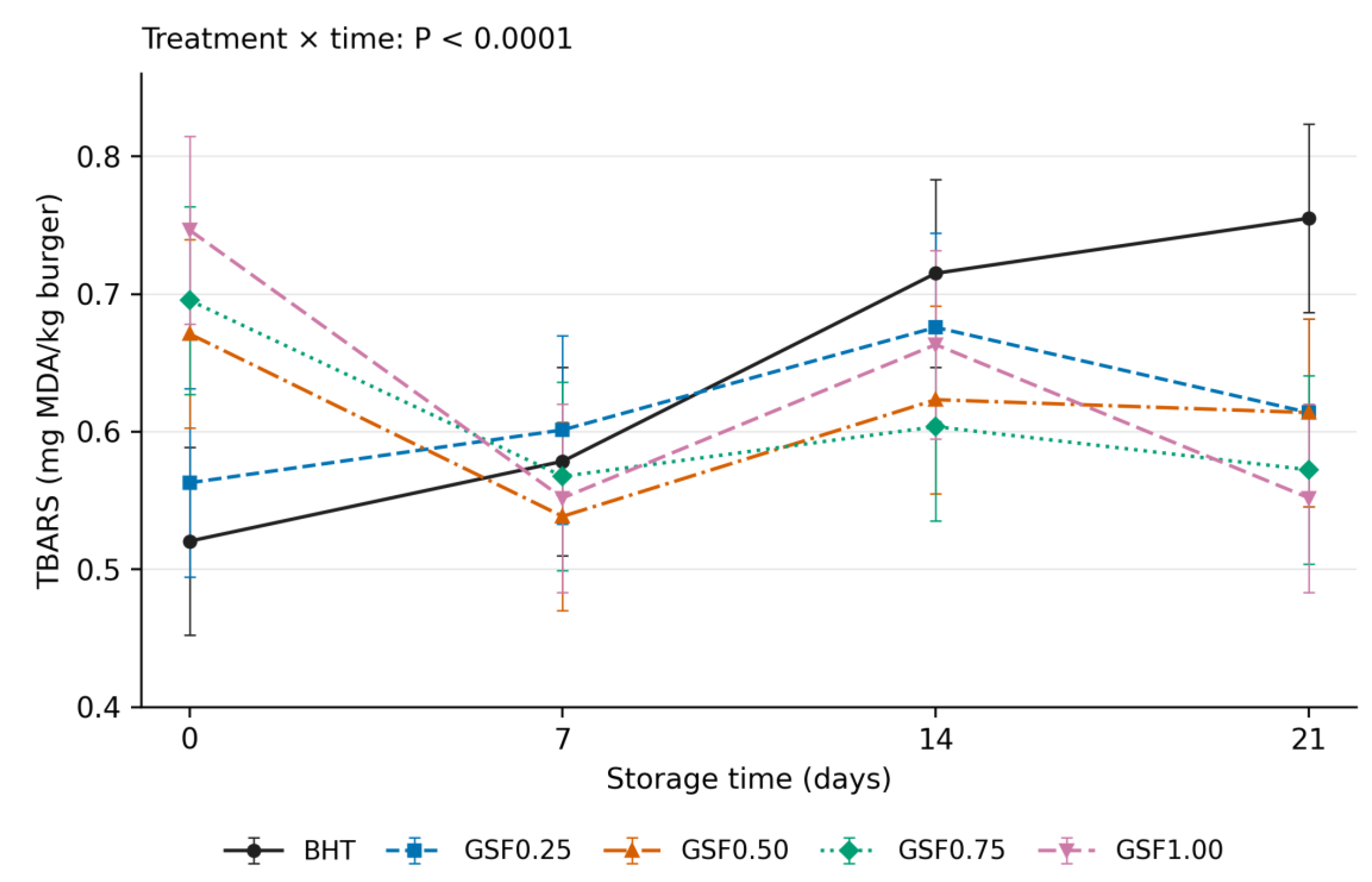
Figure 2.
Changes in instrumental colour of lamb burgers formulated with grape skin flour during refrigerated storage.
Figure 2.
Changes in instrumental colour of lamb burgers formulated with grape skin flour during refrigerated storage.
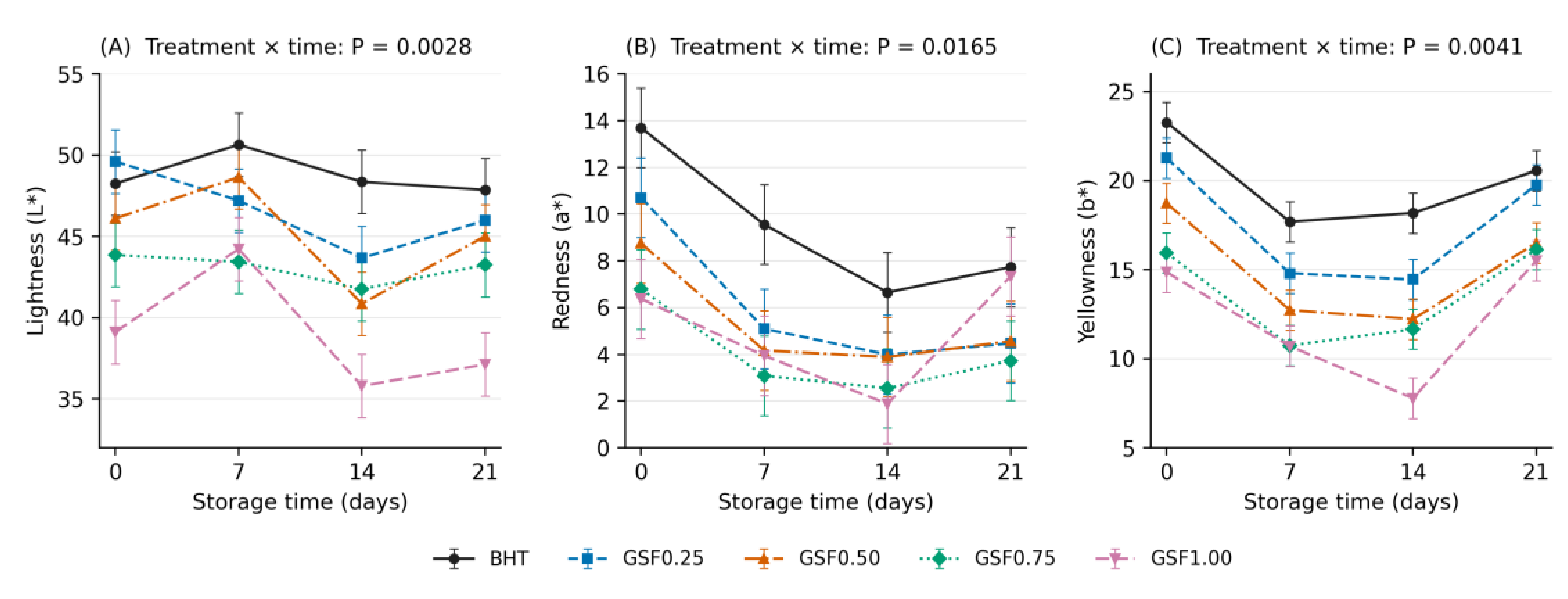
Figure 3.
Principal component analysis of sensory ratings of lamb burgers formulated with grape skin flour.
Figure 3.
Principal component analysis of sensory ratings of lamb burgers formulated with grape skin flour.
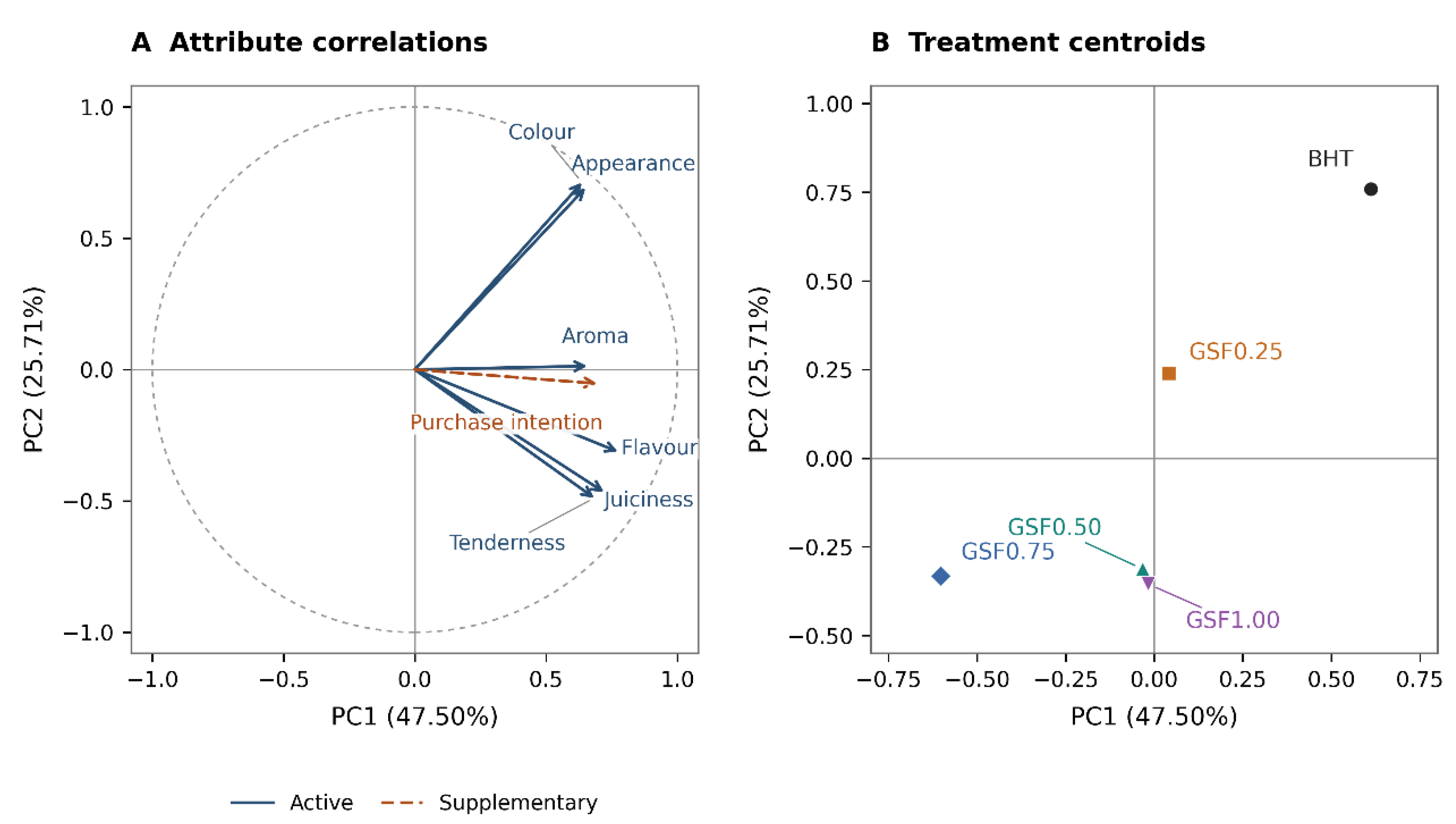

Table 1.
In vitro antioxidant capacity and total phenolic content of grape skin flour obtained from wine processing.
Table 1.
In vitro antioxidant capacity and total phenolic content of grape skin flour obtained from wine processing.
| Assay | Result | Unit |
| ABTS radical-cation scavenging capacity | 174.71 | µmol TE g−1 |
| DPPH radical-scavenging capacity | 1020.4 | µmol TE g−1 |
| Ferric reducing antioxidant power (FRAP) | 2056.4 | µmol Fe2+ (100 g)−1 |
| Total phenolic content (Folin–Ciocalteu) | 84.37 | mg GAE g−1 |
TE: Trolox equivalents; GAE: gallic acid equivalents; ABTS: 2,2′-azinobis(3-ethylbenzothiazoline-6-sulfonic acid); DPPH: 2,2-diphenyl-1-picrylhydrazyl. FRAP results are expressed as ferrous ion equivalents per 100 g of dry matter.
Table 2.
Physicochemical characteristics of grape skin flour obtained from wine processing.
| Characteristic | Value |
| Chemical composition (g/100 g) | |
| Moisture | 5.63 |
| Crude protein | 2.48 |
| Lipids | 4.39 |
| pH | 4.1 |
| Color parameters (CIELAB) | |
| Lightness (L*) | 20.75 |
| Red–green coordinate (a*) | 10.00 |
| Yellow–blue coordinate (b*) | 6.43 |
Table 3.
Proximate composition of lamb burgers formulated with grape skin flour from wine processing.
Table 3.
Proximate composition of lamb burgers formulated with grape skin flour from wine processing.
| Parameters | Treatments | SEM | P-value | ||||
| BHT | GSF0.25 | GSF0.50 | GSF0.75 | GSF1.00 | |||
| Moisture (%) | 65.81 | 63.15 | 62.83 | 66.61 | 66.29 | 1.42 | 0.2473 |
| Crude protein (%) | 19.90 | 18.23 | 20.18 | 25.29 | 19.88 | 2.94 | 0.5332 |
| Lipids (%) | 12.56 | 10.43 | 8.65 | 12.39 | 8.18 | 1.48 | 0.1887 |
| Ash (%) | 2.57a | 2.36ab | 2.04b | 2.07b | 1.99b | 0.09 | 0.0045 |
BHT: positive control containing 0.01 g butylated hydroxytoluene/100 g fat in the base formulation; GSF0.25, GSF0.50, GSF0.75, and GSF1.00, respectively, contain 0.25, 0.50, 0.75, and 1.00 g grape skin flour/100 g meat batter (MB). SEM: standard error of the mean. Within a row, means sharing no lowercase superscript differ by Tukey’s test (P < 0.05). Superscripts are shown only where the overall treatment test was significant.
Table 4.
Colour parameters, pH, and lipid oxidation of lamb burgers formulated with grape skin flour during refrigerated storage.
Table 4.
Colour parameters, pH, and lipid oxidation of lamb burgers formulated with grape skin flour during refrigerated storage.
| Parameters | Treatments | SEM | Storage time (days) | SEM | P-value | |||||||||
| BHT | GSF0.25 | GSF0.50 | GSF0.75 | GSF1.00 | 0 | 7 | 14 | 21 | T | D | T × D | |||
| TBARS | 0.642 | 0.613 | 0.612 | 0.610 | 0.628 | 0.017 | 0.639a | 0.568b | 0.656a | 0.621ab | 0.015 | 0.6098 | 0.0011 | <0.0001 |
| L* | 48.78a | 46.62b | 45.15b | 43.08c | 39.07d | 0.48 | 45.39ab | 46.83a | 42.09c | 43.85b | 0.43 | <0.0001 | <0.0001 | 0.0028 |
| a* | 9.41a | 6.07b | 5.34bc | 4.04c | 4.88bc | 0.42 | 9.26a | 5.17bc | 3.79c | 5.57b | 0.38 | <0.0001 | <0.0001 | 0.0165 |
| b* | 19.93a | 17.57b | 15.05c | 13.62d | 12.22e | 0.28 | 18.82a | 13.34c | 12.86c | 17.69b | 0.25 | <0.0001 | <0.0001 | 0.0041 |
| pH | 5.798a | 5.748ab | 5.719bc | 5.668c | 5.671c | 0.014 | 5.776a | 5.760ab | 5.713b | 5.634c | 0.013 | <0.0001 | <0.0001 | 0.0778 |
TBARS: thiobarbituric acid reactive substances, expressed as mg malondialdehyde (MDA)/kg burger; L*: lightness; a*: red–green coordinate; b*: yellow–blue coordinate; BHT: positive control containing 0.01 g butylated hydroxytoluene/100 g fat in the base formulation; GSF0.25, GSF0.50, GSF0.75, and GSF1.00, respectively, contain 0.25, 0.50, 0.75, and 1.00 g grape skin flour/100 g meat batter (MB). SEM: standard error of the mean. T: treatment effect; D: storage time effect; T×D: interaction between treatment and storage time. Different samples were used on days 0, 7, 14 and 21; the design does not involve repeated measurements of the same sample. Burgers were vacuum-packed and stored at 4 °C. Within a row and each factor block separately, means sharing no lowercase superscript differ (Tukey-adjusted P < 0.05).
Table 5.
Interaction between treatment and storage time on lipid oxidation and instrumental color of lamb burgers formulated with grape skin flour.
Table 5.
Interaction between treatment and storage time on lipid oxidation and instrumental color of lamb burgers formulated with grape skin flour.
| Storage day | BHT | GSF0.25 | GSF0.50 | GSF0.75 | GSF1.00 | SEM | P-value |
| TBARS (mg MDA/kg burger) | P < 0.0001 | ||||||
| 0 | 0.520cB | 0.563bcA | 0.671abA | 0.695abA | 0.746aA | 0.034 | |
| 7 | 0.579aB | 0.601aA | 0.539aB | 0.568aA | 0.552aB | 0.034 | |
| 14 | 0.715aA | 0.676aA | 0.623aAB | 0.604aA | 0.663aAB | 0.034 | |
| 21 | 0.755aA | 0.614bA | 0.614bAB | 0.572bA | 0.552bB | 0.034 | |
| Lightness (L*) | 0.0028 | ||||||
| 0 | 48.26aA | 49.61aA | 46.11abA | 43.85bA | 39.13cB | 0.97 | |
| 7 | 50.65aA | 47.20abAB | 48.64aA | 43.44bA | 44.23bA | 0.97 | |
| 14 | 48.36aA | 43.67bB | 40.86bB | 41.77bA | 35.81cB | 0.97 | |
| 21 | 47.86aA | 45.99abAB | 45.01abA | 43.25bA | 37.13cB | 0.97 | |
| Redness (a*) | 0.0165 | ||||||
| 0 | 13.69aA | 10.71abA | 8.75bcA | 6.78cA | 6.37cAB | 0.84 | |
| 7 | 9.55aB | 5.09bB | 4.17bB | 3.08bB | 3.94bBC | 0.84 | |
| 14 | 6.65aB | 3.99abB | 3.89abB | 2.55bB | 1.88bC | 0.84 | |
| 21 | 7.73aB | 4.47abB | 4.56abB | 3.73bAB | 7.33aA | 0.84 | |
| Yellowness (b*) | 0.0041 | ||||||
| 0 | 23.27aA | 21.28aA | 18.74bA | 15.94cA | 14.86cA | 0.56 | |
| 7 | 17.70aC | 14.80bB | 12.74bcC | 10.74cB | 10.71cB | 0.56 | |
| 14 | 18.18aC | 14.45bB | 12.23bcC | 11.66cB | 7.78dC | 0.56 | |
| 21 | 20.56aB | 19.76aA | 16.50bB | 16.13bA | 15.50bA | 0.56 | |
TBARS: thiobarbituric acid reactive substances, expressed as mg malondialdehyde (MDA)/kg burger; BHT: positive control containing 0.01 g butylated hydroxytoluene/100 g fat in the base formulation; GSF0.25, GSF0.50, GSF0.75, and GSF1.00, respectively, contain 0.25, 0.50, 0.75, and 1.00 g grape skin flour/100 g meat batter (MB). SEM: standard error of the mean. Reported P values refer to the treatment × storage-day interaction. For each parameter, means sharing no lowercase superscript letter within a row differ among treatments, and means sharing no uppercase superscript letter within a column differ among storage days (Tukey-adjusted P < 0.05).
Table 6.
Technological and texture properties of lamb burgers formulated with grape skin flour.
| Parameters | Treatments | SEM | P-value | ||||
| BHT | GSF0.25 | GSF0.50 | GSF0.75 | GSF1.00 | |||
| WHC (%) | 73.86a | 68.55b | 71.90ab | 73.21ab | 70.43ab | 1.02 | 0.0262 |
| Cooking loss (%) | 20.37 | 16.75 | 15.22 | 15.97 | 23.47 | 2.33 | 0.1397 |
| Diameter shrinkage (%) | 14.32b | 15.69b | 9.27b | 14.40b | 23.11a | 1.52 | 0.0012 |
| Hardness (N) | 21.11 | 15.37 | 21.77 | 18.47 | 18.08 | 2.26 | 0.3340 |
| Chewiness | 14.75ab | 10.89b | 15.47ab | 17.61a | 14.18ab | 1.29 | 0.0467 |
| Springiness | 0.968 | 0.931 | 0.945 | 1.028 | 0.989 | 0.030 | 0.2412 |
| Cohesiveness | 0.724 | 0.782 | 0.793 | 0.798 | 0.803 | 0.026 | 0.2733 |
BHT: positive control containing 0.01 g butylated hydroxytoluene/100 g fat in the base formulation; GSF0.25, GSF0.50, GSF0.75, and GSF1.00, respectively, contain 0.25, 0.50, 0.75, and 1.00 g grape skin flour/100 g meat batter (MB). N: Newton; SEM: standard error of the mean. Within a row, means sharing no lowercase superscript differ by Tukey’s test (P < 0.05).
Table 7.
Sensory scores and purchase intention for lamb burgers formulated with grape skin flour.
| Attribute | Treatments | SEM | P-value | ||||
| BHT | GSF0.25 | GSF0.50 | GSF0.75 | GSF1.00 | |||
| Appearance | 6.87ᵃ | 6.15ᵇ | 5.49ᶜ | 5.18ᶜ | 5.44ᶜ | 0.19 | <0.0001 |
| Colour | 6.67ᵃ | 5.90ᵇ | 5.53ᵇᶜ | 5.13ᶜ | 5.52ᵇᶜ | 0.20 | <0.0001 |
| Aroma | 6.94 | 6.79 | 6.89 | 6.62 | 6.94 | 0.16 | 0.4145 |
| Flavour | 7.12 | 6.81 | 7.07 | 6.81 | 7.33 | 0.17 | 0.0628 |
| Tenderness | 7.20 | 7.24 | 7.32 | 7.13 | 7.30 | 0.15 | 0.8238 |
| Juiciness | 7.27 | 7.18 | 7.36 | 6.99 | 7.24 | 0.15 | 0.2124 |
| Purchase intention | 3.64 | 3.48 | 3.57 | 3.33 | 3.59 | 0.12 | 0.2359 |
BHT: positive control containing 0.01 g butylated hydroxytoluene/100 g fat in the base formulation; GSF0.25, GSF0.50, GSF0.75, and GSF1.00, respectively, contain 0.25, 0.50, 0.75, and 1.00 g grape skin flour/100 g meat batter (MB). SEM: standard error of the mean. Means within a row sharing no superscript letter differ according to Tukey–Kramer comparisons (P < 0.05). Sensory attributes were scored on a 1–9 scale and purchase intention on a 1–5 scale.
Disclaimer/Publisher’s Note: The statements, opinions and data contained in all publications are solely those of the individual author(s) and contributor(s) and not of MDPI and/or the editor(s). MDPI and/or the editor(s) disclaim responsibility for any injury to people or property resulting from any ideas, methods, instructions or products referred to in the content. |
© 2026 by the authors. Licensee MDPI, Basel, Switzerland. This article is an open access article distributed under the terms and conditions of the Creative Commons Attribution (CC BY) license (http://creativecommons.org/licenses/by/4.0/).
Copyright: This open access article is published under a Creative Commons CC BY 4.0 license, which permit the free download, distribution, and reuse, provided that the author and preprint are cited in any reuse.