
Submitted:
15 October 2026
Posted:
16 October 2026
You are already at the latest version
Abstract
Rabies virus, transmitted mainly through animal bites and scratches, causes an almost invariably fatal disease. Guangxi is among the regions of China with a high rabies burden, yet large clinical datasets on exposure patterns and post-exposure prophylaxis (PEP) remain limited. We retrospectively analyzed the records of 19,239 patients with mammal-related injuries treated at the animal injury clinic of the International Zhuang Medicine Hospital Affiliated to Guangxi University of Chinese Medicine from 2020 to 2024. Cats (53.94%) and dogs (39.38%), predominantly owned animals, caused most injuries, and the proportion of cat-related injuries increased from 44.12% in 2020 to 56.66% in 2024 (p for trend < 0.001). Category III exposures accounted for 68.02% of cases, and repeat exposure rose from 7.81% to 18.47% (p for trend < 0.001). Overall, 32.98% of patients presented more than 24 h after injury. Standardized wound management was provided to 71.36% of patients; all patients received rabies vaccination, whereas human rabies immunoglobulin was administered in 44.86% of category III exposures and remained below 47% in every year. Delayed presentation and persistently incomplete passive immunization suggest gaps in PEP delivery. Targeted health education, animal vaccination and management, and standardized wound care and passive immunization may strengthen rabies prevention.
Keywords:
rabies virus
; zoonosis
; animal-related injuries
; epidemiology
; rabies post-exposure prophylaxis
; human rabies immunoglobulin
1. Introduction
Rabies, caused by rabies virus, is a zoonotic disease that is almost invariably fatal once clinical signs appear and causes an estimated 59,000 human deaths each year, most of them following dog bites [1,2]. Animal-related injuries are a common presentation in emergency surgery and an important public health concern encompassing trauma care, wound infection, and rabies prevention [3]. Bites and scratches from mammals such as dogs and cats can damage the skin, soft tissues, tendons, blood vessels, nerves, and bones, and may result in wound infection, tetanus, or rabies virus exposure [4]. Prompt, standardized wound management, active immunization, and passive immunization when indicated are essential for reducing the risk of infection after exposure [5].
Previous studies in China have identified dogs and cats as the predominant causes of animal-related injuries, with distinct distributions by age, sex, season, injury site, and exposure category. Differences in climate, animal husbandry, public awareness of protective measures, and healthcare resources contribute to regional variation in case profiles and post-exposure management [6,7,8,9,10].
Guangxi is among the regions with a high burden of rabies in China [11]. However, large clinical studies spanning consecutive years remain limited, restricting the evidence available for targeted prevention. We therefore retrospectively analyzed 19,239 patients with mammal-related injuries treated at the International Zhuang Medicine Hospital Affiliated to Guangxi University of Chinese Medicine during 2020–2024. We examined demographic characteristics, temporal distribution, offending animals, injury sites, exposure categories, and post-exposure management to inform health education for priority populations, the standardization of animal injury clinics, and regional rabies prevention and control.
2. Materials and Methods
2.1. Study Population
This study included 19,239 patients with mammal-related injuries who presented to the animal injury clinic of the Department of Emergency Surgery at the International Zhuang Medicine Hospital Affiliated to Guangxi University of Chinese Medicine between January 2020 and December 2024. Follow-up visits and cases with incomplete records were excluded. Clinical data were obtained from the archived database of the Guangxi International Zhuang Medicine Hospital Physician Workstation. The study was approved by the hospital ethics committee (approval no. NO202415802), which waived the requirement for informed consent owing to the retrospective design and the use of de-identified data. All data processing complied with the Personal Information Protection Law of the People’s Republic of China, and patient privacy was protected.
Patients were eligible if they presented to the clinic for an initial visit, met the criteria for category I, II, or III rabies exposure following an animal-related injury, had complete medical records, and underwent diagnosis, exposure classification, and management in accordance with the Rabies Exposure Prophylaxis Standard (2023 Edition) [12] and the Expert Consensus on Animal-Related Injuries [13]. Patients were also required to have completed their post-injury care at the study hospital. Rabies exposure was classified as category I (touching or feeding animals, or licks on intact skin), category II (nibbling of uncovered skin, or minor scratches or abrasions without bleeding), or category III (single or multiple transdermal bites or scratches, contamination of mucous membranes or broken skin with saliva, or exposure to bats) [12].
Exclusion criteria were non-bite injuries inflicted by another person, including blows or scratches, and injuries caused by non-mammalian animals.
2.2. Management Protocol
Wound care was performed according to standardized procedures by healthcare professionals who had completed training and certification provided by the Guangxi Zhuang Autonomous Region Center for Disease Control and Prevention. Patients with category I or II exposure received a freeze-dried rabies vaccine for human use; for those with category III exposure, passive immunization was additionally indicated.
2.3. Study Variables
Clinic records were retrospectively reviewed and analyzed. Variables included characteristics of the offending animal (species and ownership status), injury mechanism, patient age and sex, exposure site and category, time of injury and time to presentation, wound management, human rabies immunoglobulin (HRIG) administration among patients with category III exposure, and infection.
2.4. Statistical Analysis
Microsoft Excel 2021 was used for data processing and management. Categorical variables were expressed as frequencies and percentages. Differences in annual proportions across 2020–2024 were assessed using the chi-square test, and linear trends were assessed using the chi-square test for trend (Cochran–Armitage test). A two-sided p-value < 0.05 was considered statistically significant. Statistical tests were performed on the aggregated annual counts in Python (version 3.13) using SciPy (version 1.18).
3. Results
3.1. Demographic Characteristics
Among the 19,239 patients, 9,045 (47.01%) were male and 10,194 (52.99%) were female. Ages ranged from 1 to 101 years, with a mean ± standard deviation of 27.11 ± 17.26 years. Patients aged 20–29 years accounted for the largest proportion (4,803/19,239; 24.96%), followed by those aged 0–9 years (3,898/19,239; 20.26%) and 30–39 years (3,648/19,239; 18.96%) (Figure 1).
3.2. Temporal and Seasonal Distribution
Cases were relatively concentrated in summer and autumn (June–September), when 6,869 of the 19,239 injuries (35.70%) occurred. The monthly peak was recorded in May 2020 (474 cases), after low attendance in January–March 2020. This peak may have been related to the resumption of routine care-seeking after the COVID-19 restrictions in early 2020 and to the characteristics of patient attendance at our institution, which established the first animal injury clinic in Guangxi; however, these explanations were not further examined in the present study (Figure 2).
3.3. Offending Animals and Injury Characteristics
Dogs and cats caused 17,954 injuries (93.32%). Dogs accounted for 7,577 cases (39.38%), comprising 5,626 injuries caused by owned dogs (29.24%) and 1,951 by stray dogs (10.14%). Cats accounted for 10,377 cases (53.94%), comprising 7,474 injuries caused by owned cats (38.85%) and 2,903 by stray cats (15.09%). Other animals caused 1,285 injuries (6.68%) and included rabbits, hamsters, pigs, horses, deer, monkeys, bats, raccoons, alpacas, rats, squirrels, and red pandas. Regarding injury mechanism, 8,276 patients (43.02%) sustained scratches, 8,157 (42.40%) sustained bites, and 2,806 (14.58%) sustained both. A total of 12,894 patients (67.02%) presented within 24 h of injury, whereas 6,345 (32.98%) presented after 24 h (Figure 3 and Table 1).
3.4. Anatomical Distribution of Injuries
Among the 19,239 patients, injuries most frequently involved the extremities (8,923 cases; 46.38%), followed by the hands (8,884; 46.18%); the trunk was involved in 462 cases (2.40%). High-risk anatomical sites, as defined in the Technical Guidelines for Rabies Prevention and Control (2016 Edition) [14], included the head and face (818 cases; 4.25%), neck (144; 0.75%), and external genitalia (8; 0.04%). The anatomical distribution is presented in Table 2.
3.5. Exposure Categories, Exposure History, and Post-Exposure Prophylaxis
Category I, II, and III exposures were recorded in 105 (0.55%), 6,047 (31.43%), and 13,087 (68.02%) patients, respectively. First-time exposure was reported in 16,392 patients (85.20%) and repeat exposure in 2,847 (14.80%). Details of exposure categories and post-exposure management are provided in Table 3.
3.6. Injury Severity, Surgical Management, and Infection
Most injuries were mild and involved superficial skin damage, with some extending into the subcutaneous tissue. However, a subset of patients sustained more severe injuries. Most patients were treated as outpatients, while 38 patients with more severe injuries were hospitalized. Standardized post-exposure wound irrigation was the principal surgical management measure and was provided to 13,729 patients (71.36%). Some patients received dressing changes after surgical debridement, and 55 underwent surgical debridement and suturing. Wound infection occurred in five patients.
3.7. Temporal Trends, 2020–2024
The distribution of offending animals changed significantly over the study period (χ² = 287.72, p < 0.001). The proportion of cat-related injuries increased from 44.12% in 2020 to 56.66% in 2024, whereas that of dog-related injuries decreased from 51.81% to 35.89% (both p for trend < 0.001). The proportion of patients reporting repeat exposure increased steadily from 7.81% to 18.47%, and the proportion presenting within 24 h increased from 63.24% to 68.28% (both p for trend < 0.001). In contrast, HRIG administration among patients with category III exposure ranged from 43.27% to 46.77% across years without a significant linear trend (p for trend = 0.266). Annual proportions were calculated using the corresponding annual patient totals, or the annual number of category III exposures for HRIG administration.
4. Discussion
Animal-related injuries are an important cause of morbidity and mortality worldwide and represent a substantial public health concern [15,16]. The high case-fatality rate of rabies warrants particular attention, together with the risks of rabies virus exposure, tetanus, and infection with bacterial and other pathogens following animal-related injuries [13]. This retrospective study examined 19,239 patients with mammal-related injuries who attended our animal injury clinic between January 2020 and December 2024. Women slightly outnumbered men; the predominant age groups were 20–29, 0–9, and 30–39 years. Cases were relatively concentrated during June–September. Dogs and cats caused most injuries, with cat-related injuries exceeding dog-related injuries and increasing in proportion over time. Injuries predominantly involved the extremities and hands, and category III and first-time exposures accounted for large proportions of cases. These findings characterize the local clinical epidemiology of animal-related injuries across demographic, temporal, animal, anatomical, and management dimensions. They support comprehensive care encompassing rabies vaccination, standardized wound management, passive immunization, infection prevention and treatment, and the management of severe tissue injuries.
Women accounted for 52.99% of patients, consistent with the higher proportions of female patients reported in Lishui [17] and the single-center study by Liu et al. [18]. Greater involvement in pet ownership and care may increase women’s opportunities for exposure. However, this study examined the composition of clinic attendees and cannot establish sex-specific population incidence or explain the reasons for the observed sex distribution. Patients aged 20–29 years formed the largest group (24.96%), followed by those aged 0–9 years (20.26%) and 30–39 years (18.96%), indicating that young adults and children constituted the principal populations attending our clinic. A study in Tianjin [19] similarly reported a high proportion of adults aged 20–39 years, while an analysis of 105 patients with severe rabies exposure following animal-related injuries found that 43.8% were younger than 15 years [20]. Although age distributions vary across studies, these findings support age-specific preventive measures. Children require close supervision to prevent them from approaching or provoking animals alone, while adults need education about risks associated with contact, feeding, and handling.
The concentration of 35.70% of cases during June–September suggests some seasonal clustering. This distribution may be associated with Nanning’s subtropical climate, animal activity, and changes in outdoor activities and opportunities for human–animal contact [21,22]. Nevertheless, our seasonal analysis was descriptive, with no inferential testing of monthly differences and no inclusion of temperature, holidays, or animal population variables. The mechanisms underlying the seasonal distribution therefore cannot be determined. For service planning, historical attendance patterns could inform staffing, vaccine and passive immunization product inventories during busier months, and targeted health education before these periods.
Most injuries in this study were mild, and dogs and cats were responsible for 17,954 cases (93.32%), identifying these animals as priorities for local prevention. This proportion was close to the 93.89% reported by Cheng et al. [23] and consistent with the findings of Yang et al. [24], who also identified dogs and cats as the predominant offending animals. Cat-related injuries accounted for 53.94% of cases, exceeding the 39.38% caused by dogs. Moreover, the proportion of cat-related injuries increased during the study period, whereas that of dog-related injuries declined. A study in Xiamen [7] likewise reported more cat-related than dog-related injuries, whereas dog-related injuries were more prominent in Shaanxi Province [25]. These differences suggest that region, healthcare setting, and the severity of included cases may influence the distribution of offending animals. Regional prevention should consequently draw on continuous local surveillance, with careful consideration of the applicability of findings from other regions. Injuries caused by owned dogs and cats exceeded those caused by stray animals, supporting safe contact, animal immunization, and responsible pet management alongside stray animal management.
The predominance of extremity and hand injuries was consistent with the 91.18% reported for these sites by Wu et al. [10] and the predominance of upper-limb injuries in Lanzhou [6]. The hands and extremities are readily exposed during feeding, petting, restraint, or defense against attacks. Preventive advice should therefore emphasize minimizing unprotected contact and avoiding animals that are anxious or aggressive [26]. Although injuries involving high-risk sites such as the head and face, neck, and external genitalia were relatively uncommon, their anatomical complexity means that deep tissue damage may compromise appearance and function. Their clinical importance extends beyond their frequency. Injuries at these sites, deep bites, and injuries involving bones, tendons, blood vessels, or nerves warrant detailed specialist assessment alongside rabies post-exposure prophylaxis.
Category III exposures accounted for 13,087 cases (68.02%), exceeding category II exposures and constituting a large proportion of presentations. This proportion was lower than the 88.67% reported by Cheng et al. [23] but higher than the 23.41% reported in Guangzhou [27]. Such variation may reflect differences in case sources, classification criteria, study periods, and the case mix of specialized clinics; comparisons require careful consideration of population comparability. Repeat exposure was reported in 2,847 patients (14.80%), and its annual proportion more than doubled from 2020 to 2024, highlighting the risk of recurrent exposure during the study period. Initial consultations should therefore include behavioral advice to prevent further exposure, as well as accurate ascertainment and documentation of previous rabies vaccination to guide management after subsequent exposure.
Public knowledge of rabies post-exposure prophylaxis may influence care-seeking behavior. In this study, 67.02% of patients presented within 24 h, while 32.98% presented later. The proportion presenting within 24 h was substantially lower than the 90.93% reported by Liu et al. [19]. These findings suggest a need to strengthen local awareness of prompt medical assessment and early wound care after animal-related injuries. Health education should clearly communicate the importance of seeking care as soon as possible, receiving standardized wound management, and completing the appropriate immunization regimen.
Wound management and HRIG administration rates were 71.36% and 44.86%, respectively, suggesting scope for improving standardized wound care and passive immunization [28]. HRIG coverage also showed no improvement over the five years, indicating a persistent rather than transient gap. The monoclonal antibody cocktail SYN023 also provides an alternative to HRIG for passive immunization [29]. The reasons for non-receipt of wound management or HRIG were not analyzed, so the findings cannot be attributed to public awareness, economic constraints, or regional differences. Conversely, rabies vaccination was provided to all patients, including the 105 with category I exposure and those injured by rodents (n = 1,015) or rabbits (n = 145), although post-exposure prophylaxis is not required for category I exposure and is not routinely recommended after rodent or rabbit exposure [1,14]; this indicates scope for more risk-based use of rabies vaccine. Healthcare institutions should improve verification of exposure categories, communication of treatment indications, administration procedures, and vaccination records, establishing a standardized pathway that connects wound care, active immunization, passive immunization, and follow-up.
Although most patients had mild injuries and were treated as outpatients, 38 required hospitalization for injuries including extremity soft-tissue avulsion, muscle and tendon damage, fractures, and injuries to the head and face or perineum. These cases illustrate the clinical consequences of animal-related injuries, including tissue loss, functional impairment, and secondary infection, alongside rabies virus exposure. A study of 105 patients with severe exposure [20] recommended that surgical management of complex animal-related wounds be selected according to wound location, depth, and infection risk after standardized irrigation, debridement, and passive immunization, with attention to multidisciplinary collaboration. The severe injuries observed in our study support the need for this approach. Emergency animal injury clinics should be equipped to identify complex injuries early and arrange timely referral or consultation. Infection risk assessment should consider the offending animal, wound depth and location, contamination, delay in presentation, and the patient’s underlying condition. Established infection or deep tissue involvement requires targeted treatment guided by clinical findings and microbiological investigations when indicated.
These findings suggest three priorities for regional prevention. First, age- and exposure-specific education should focus on children, young and middle-aged adults, and people in contact with dogs and cats. Education should cover safe animal contact, timely care-seeking, wound management, passive immunization, and rabies vaccination. Second, immunization and responsible management of owned dogs and cats should be strengthened, together with stray animal management, to reduce opportunities for exposure. Third, animal injury clinics should implement standardized clinical and registration procedures, with continuous monitoring of exposure category, time to presentation, wound management, active and passive immunization, repeat exposure history, and infection outcomes.
This study has several limitations. First, it was a single-center retrospective study of patients who sought care at the study hospital. Individuals who did not seek care or attended other facilities were not included; the findings therefore cannot directly represent the population incidence of animal-related injuries in Nanning or Guangxi. Second, the analysis primarily described case proportions, without population denominators for incidence estimation or multivariable analyses of differences across years, months, or population groups. Causal inference is consequently not possible. Third, the rabies vaccination status of the offending animals and completion of the vaccination schedule were not analyzed, other factors potentially affecting post-exposure management and infection outcomes were not fully examined in stratified analyses, and long-term follow-up data were unavailable. Fourth, the study period overlapped with the COVID-19 pandemic, which may have influenced care-seeking behavior and clinic attendance, particularly in 2020. Future multicenter prospective studies using harmonized case definitions and data collection standards, combined with regional population and animal management data, could further evaluate exposure risks, adherence to management, and clinical outcomes across population groups.
5. Conclusions
Among patients presenting to our animal injury clinic with animal-related injuries during 2020–2024, women, young adults, and children accounted for relatively large proportions of cases. Cases were relatively concentrated in summer and autumn, dogs and cats were the main offending animals, the extremities and hands were the predominant injury sites, and category III exposure was common. The proportions of cat-related injuries and repeat exposures increased over time, whereas HRIG coverage for category III exposures remained below 47% in every year. Targeted health education and animal management should reflect the local distribution of patients and offending animals. Further standardization of wound care, active immunization, passive immunization, and comprehensive management of severe wounds is warranted. Continuous surveillance and multicenter collaboration may help improve rabies post-exposure prophylaxis and clinical care for animal-related injuries.
Author Contributions
Conceptualization, J.X. and R.T.; methodology, J.X., S.G. and X.W.; investigation, J.X., S.G., X.W., Z.T., G.Q., Z.B., R.T. and H.T.; formal analysis, J.X., S.G., R.T. and H.T.; writing—original draft preparation, J.X.; writing—review and editing, all authors; supervision, R.T. All authors have read and agreed to the published version of the manuscript.
Funding
This research was funded by the Self-Funded Scientific Research Project of the Health Commission of Guangxi Zhuang Autonomous Region (“Application of a Multidisciplinary Collaborative Diagnosis and Treatment Model in the Management of Patients with Severe Animal-Related Injuries”), grant number Z20210097, and by the Hospital-Level Key Discipline of Emergency Medicine program of Guangxi International Zhuang Medicine Hospital (Hospital Document [2025] No. 214).The APC was funded by authors.
Institutional Review Board Statement
The study was conducted in accordance with the Declaration of Helsinki, and approved by the Ethics Committee of the International Zhuang Medicine Hospital Affiliated to Guangxi University of Chinese Medicine (protocol code NO202415802 and date of approval 16 September 2024).
Informed Consent Statement
Patient consent was waived by the ethics committee owing to the retrospective design and the use of de-identified data.
Data Availability Statement
The de-identified data supporting the findings of this study are available from the corresponding author upon reasonable request and subject to applicable institutional and ethical requirements.
Conflicts of Interest
The authors declare no conflicts of interest. The funders had no role in the design of the study; in the collection, analyses, or interpretation of data; in the writing of the manuscript; or in the decision to publish the results.
References
- World Health Organization. Rabies vaccines: WHO position paper—April 2018. Wkly. Epidemiol. Rec. 2018, 93, 201–220. [Google Scholar]
- Hampson, K.; Coudeville, L.; Lembo, T.; Sambo, M.; Kieffer, A.; Attlan, M.; Barrat, J.; Blanton, J.D.; Briggs, D.J.; Cleaveland, S.; et al. Estimating the global burden of endemic canine rabies. PLoS Negl. Trop. Dis. 2015, 9, e0003709. [Google Scholar] [CrossRef] [PubMed]
- Ali, M.I.; Jamali, S.; Ashraf, T.; Ahmed, N. Patterns and outcomes of dog bite injuries presenting to emergency department in a tertiary care hospital at Karachi. Pak. J. Med. Sci. 2021, 37, 794–799. [Google Scholar] [CrossRef] [PubMed]
- Abrahamian, F.M.; Goldstein, E.J.C. Microbiology of animal bite wound infections. Clin. Microbiol. Rev. 2011, 24, 231–246. [Google Scholar] [CrossRef] [PubMed]
- Dong, R.; He, Y.; Ma, Z.; et al. Epidemiological characteristics of rabies exposure in Fangshan District, Beijing, 2020–2023. Cap. J. Public Health (In Chinese) 2025, 19, 113–117. [Google Scholar]
- Ma, F.; Yan, X.; Xu, S.; et al. Epidemiological characteristics of animal-related injuries in Lanzhou. J. Med. Pest Control (In Chinese) 2026, 42, 318–321. [Google Scholar]
- Gong, H.; Kang, Y.; Li, P.; et al. A single-center survey of animal-related injuries in Xiamen. China J. Emerg. Resusc. Disaster Med. (In Chinese) 2026, 21, 700–703. [Google Scholar]
- Yu, G.; Zhou, C.; Xia, D. Comparison of epidemiological characteristics across age groups in patients with animal-related injuries. China J. Emerg. Resusc. Disaster Med. (In Chinese) 2025, 20, 257–259. [Google Scholar]
- Wang, D.; Kang, X.; Liu, S.; et al. Animal-related injuries in China: An overview and outlook. China J. Emerg. Resusc. Disaster Med. (In Chinese) 2025, 20, 270–275. [Google Scholar]
- Wu, X.; Zhou, J.; Du, W. Epidemiological characteristics of animal-related injuries in Jiangsu Province, 2006–2022. Chin. J. Prev. Control Chronic Dis. (In Chinese) 2024, 32, 624–628. [Google Scholar]
- Zhou, H.; Vong, S.; Liu, K.; Li, Y.; Mu, D.; Wang, L.; Yin, W.; Yu, H. Human rabies in China, 1960–2014: A descriptive epidemiological study. PLoS Negl. Trop. Dis. 2016, 10, e0004874. [Google Scholar] [CrossRef] [PubMed]
- National Bureau of Disease Control and Prevention; National Health Commission. Rabies exposure prophylaxis standard (2023 edition). Int. J. Epidemiol. Infect. Dis. (In Chinese) 2023, 50, 301–303. [Google Scholar] [CrossRef]
- Expert Group of the Animal Injury Treatment Branch of the China Association for Disaster and Emergency Rescue Medicine; Chen, Q.; Wang, C.; et al. Expert consensus on animal-related injuries. China J. Emerg. Resusc. Disaster Med. (In Chinese) 2018, 13, 1056–1061. [Google Scholar]
- Zhou, H.; Li, Y.; Chen, R.; Tao, X.; Yu, P.; Cao, S.; Li, L.; Chen, Z.; Zhu, W.; Yin, W.; et al. Technical guideline for human rabies prevention and control (2016). Chin. J. Epidemiol. (In Chinese) 2016, 37, 139–163. [Google Scholar] [CrossRef] [PubMed]
- World Health Organization. Animal Bites. Available online: https://www.who.int/news-room/fact-sheets/detail/animal-bites (accessed on 9 October 2026).
- Wang, C. Seizing opportunities to establish standards and improve animal injury management in China. China J. Emerg. Resusc. Disaster Med. (In Chinese) 2018, 13, 1037–1038. [Google Scholar]
- Lai, L.; Chen, Y.; Du, W.; et al. Epidemiological characteristics of 6471 individuals with rabies exposure in Lishui, Zhejiang. Chin. J. Exp. Clin. Virol. (In Chinese) 2024, 38, 383–387. [Google Scholar]
- Liu, X.; Zhang, X.; Li, H. Epidemiological characteristics of 664 individuals with rabies exposure in Beijing, 2023–2024. Cap. Food Med. (In Chinese) 2026, 33, 88–91. [Google Scholar]
- Liu, Y.; Lü, J.; Lu, T.; et al. Epidemiological characteristics of rabies exposure in Tianjin, 2009–2024. Chin. J. Epidemiol. (In Chinese) 2025, 46, 2131–2136. [Google Scholar]
- Zhan, Z.; Yang, H.; Luo, K.; et al. Clinical analysis of standardized management of 105 patients with severe rabies exposure following animal-related injuries. J. Trauma. Surg. (In Chinese) 2025, 27, 942–947. [Google Scholar]
- Murphy, J.; Qaisi, M. Management of human and animal bites. Oral Maxillofac. Surg. Clin. N. Am. 2021, 33, 373–380. [Google Scholar] [CrossRef] [PubMed]
- Song, G.; Xu, C.; Wang, Y.; et al. Analysis of management in 7267 cases of rabies exposure. China J. Emerg. Resusc. Disaster Med. (In Chinese) 2019, 14, 1216–1218. [Google Scholar]
- Cheng, Y.; Guo, C.; Wang, W.; et al. Epidemiological analysis and management of 25436 patients with animal-related injuries. China J. Emerg. Resusc. Disaster Med. (In Chinese) 2023, 18, 1516–1520. [Google Scholar]
- Yang, Z.; Wang, J.; Cai, C.; et al. Retrospective analysis of 1266 patients with animal-related injuries based on emergency department electronic medical records. Chin. Crit. Care Med. (In Chinese) 2024, 36, 1311–1314. [Google Scholar]
- Liu, R.; Sarina; Qiu, L.; et al. Epidemiological characteristics of animal-related injuries in Shaanxi Province, 2017. Chin. J. Prev. Control Chronic Dis. (In Chinese) 2021, 29, 155–158. [Google Scholar]
- Rabies Prevention and Control Committee of the Chinese Preventive Medicine Association; Study Group on Post-Traumatic Special Infections and Biting and Stinging Injuries, Trauma Surgeons Branch of the Chinese Medical Doctor Association; Animal Injury Treatment Branch of the China Association for Disaster and Emergency Rescue Medicine; et al. Chinese expert consensus on fine suturing of mammal-related wounds (2025 edition). Chin. J. Pract. Surg. (In Chinese) 2025, 45, 378–385. [CrossRef]
- Xu, J.; Fan, L.; Liu, Q.; et al. Epidemiological characteristics of rabies cases and exposure management in Guangzhou, 2014–2024. Chin. J. Hyg. Insectic. Equip. (In Chinese) 2026, 32, 432–436. [Google Scholar]
- Emergency Physicians Branch of the Chinese Medical Doctor Association; Emergency Medicine Professional Committee of the Chinese People’s Liberation Army; Beijing Society of Emergency Medicine; et al. Chinese expert consensus on emergency management of dog bites (2019). Chin. J. Crit. Care Med. (In Chinese) 2019, 39, 819–824. [Google Scholar] [CrossRef]
- Liu, X.; Li, J.; Zha, Y.; et al. The efficacy and safety of SYN023 (Zamerovimab and Mazorelvimab injection), the recombinant humanized anti-rabies virus monoclonal antibody mixture, combined with rabies vaccine in a WHO category III rabies post-exposure population: A randomized, double-blind, positive control, phase III clinical trial. Vaccine 2025, 61, 127289. [Google Scholar] [CrossRef] [PubMed]
Figure 1.
Age distribution of patients attending the animal injury clinic, January 2020–December 2024.
Figure 1.
Age distribution of patients attending the animal injury clinic, January 2020–December 2024.
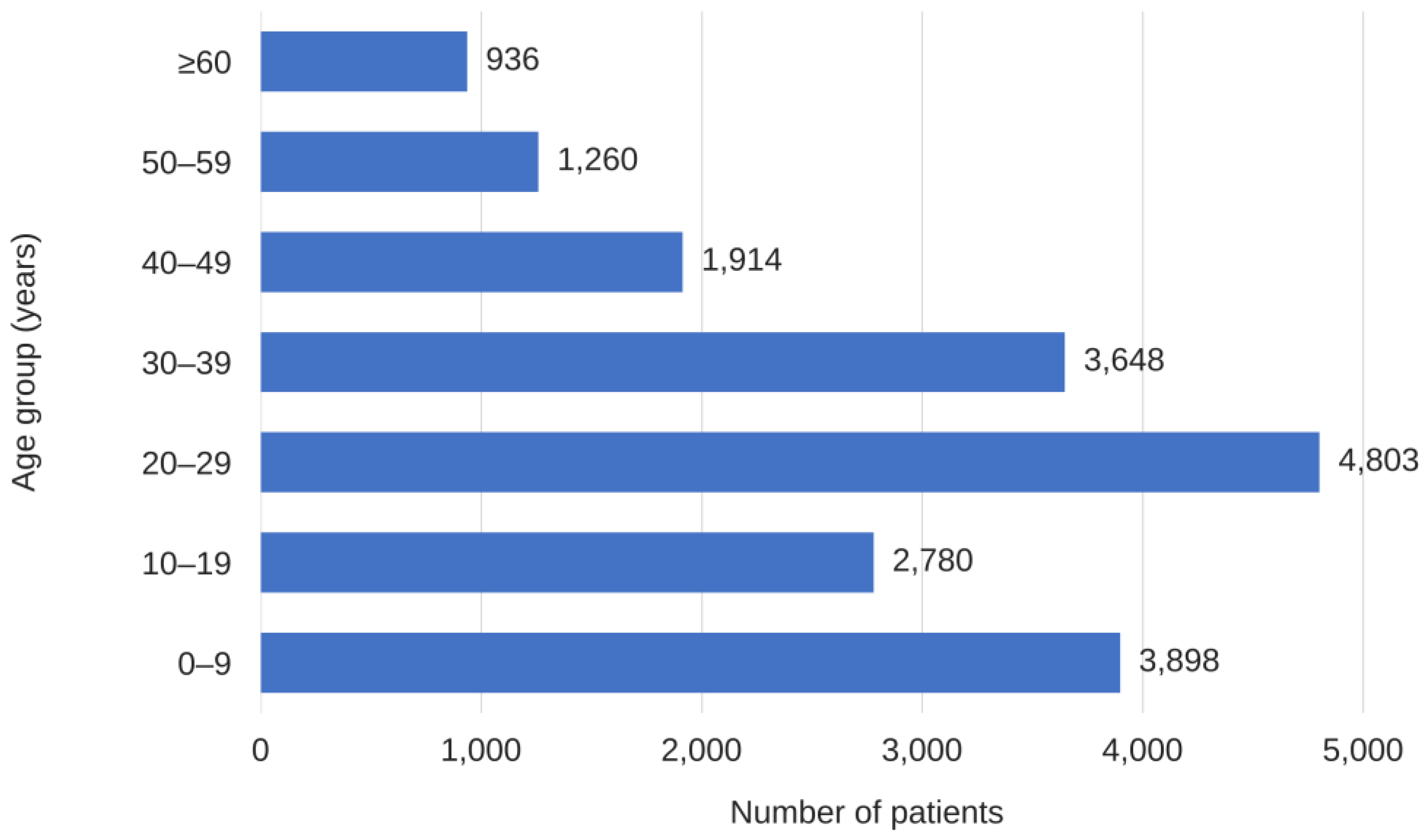
Figure 2.
Monthly distribution of patients with animal-related injuries, January 2020–December 2024.
Figure 2.
Monthly distribution of patients with animal-related injuries, January 2020–December 2024.
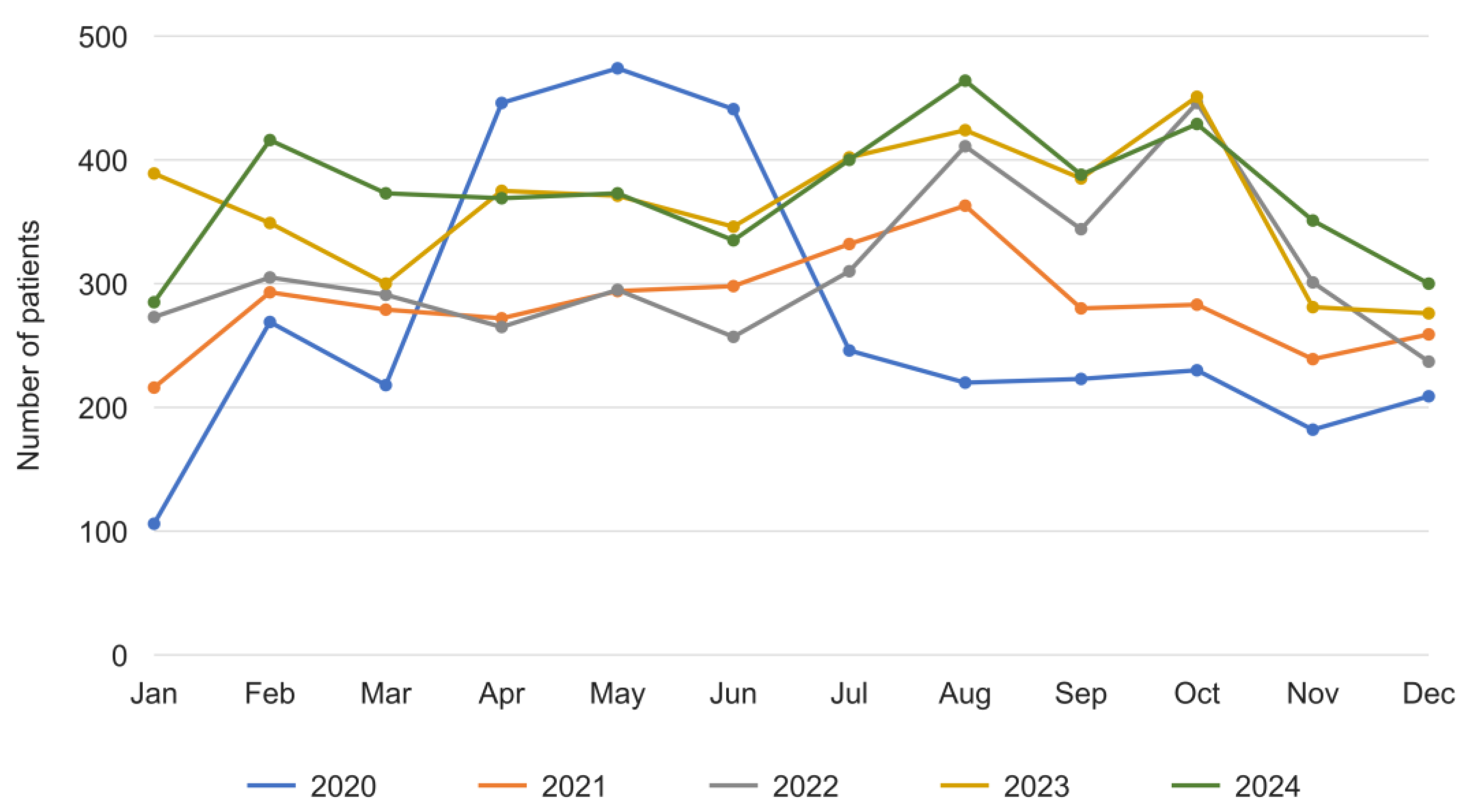
Figure 3.
Distribution of animals responsible for injuries, January 2020–December 2024.
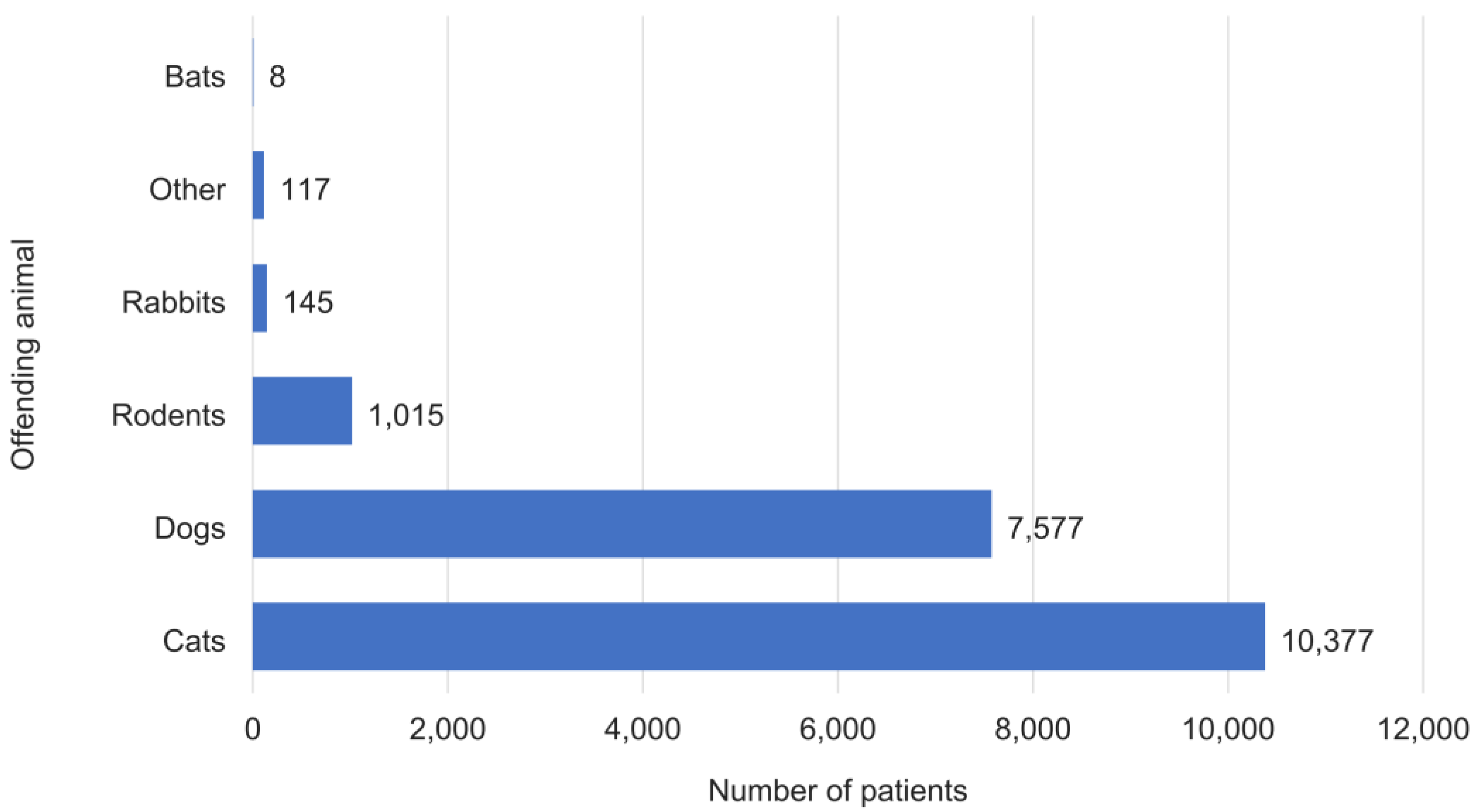

Table 1.
Demographic and injury characteristics of 19,239 patients with animal-related injuries.
| Characteristic |
2020 n |
2021 n |
2022 n |
2023 n |
2024 n |
Total n |
% |
| Sex | |||||||
| Male | 1,595 | 1,612 | 1,765 | 2,021 | 2,052 | 9,045 | 47.01 |
| Female | 1,669 | 1,796 | 1,970 | 2,328 | 2,431 | 10,194 | 52.99 |
| Time to presentation | |||||||
| ≤24 h | 2,064 | 2,334 | 2,508 | 2,927 | 3,061 | 12,894 | 67.02 |
| >24 h | 1,200 | 1,074 | 1,227 | 1,422 | 1,422 | 6,345 | 32.98 |
| Offending animal | |||||||
| Dogs | |||||||
| Owned | 1,281 | 967 | 989 | 1,083 | 1,306 | 5,626 | 29.24 |
| Stray | 410 | 393 | 372 | 473 | 303 | 1,951 | 10.14 |
| Cats | |||||||
| Owned | 1,024 | 1,219 | 1,568 | 1,876 | 1,787 | 7,474 | 38.85 |
| Stray | 416 | 601 | 561 | 572 | 753 | 2,903 | 15.09 |
| Other | 133 | 228 | 245 | 345 | 334 | 1,285 | 6.68 |
Table 2.
Anatomical distribution of injuries among 19,239 patients.
| Injury site |
2020 n |
2021 n |
2022 n |
2023 n |
2024 n |
Total n |
% |
| Head and face | 135 | 161 | 127 | 181 | 214 | 818 | 4.25 |
| Neck | 18 | 32 | 28 | 35 | 31 | 144 | 0.75 |
| Trunk | 78 | 78 | 90 | 104 | 112 | 462 | 2.40 |
| Extremities | 1,701 | 1,538 | 1,783 | 1,917 | 1,984 | 8,923 | 46.38 |
| Hands | 1,329 | 1,599 | 1,707 | 2,110 | 2,139 | 8,884 | 46.18 |
| External genitalia | 3 | 0 | 0 | 2 | 3 | 8 | 0.04 |
| Total | 3,264 | 3,408 | 3,735 | 4,349 | 4,483 | 19,239 | 100.00 |
Table 3.
Exposure categories and post-exposure management among 19,239 patients.
| Characteristic | Measure | 2020 | 2021 | 2022 | 2023 | 2024 | Total |
| Category I | n | 13 | 13 | 20 | 23 | 36 | 105 |
| % | 0.07 | 0.07 | 0.10 | 0.12 | 0.19 | 0.55 | |
| Category II | n | 1,141 | 1,016 | 1,424 | 1,446 | 1,020 | 6,047 |
| % | 5.93 | 5.28 | 7.40 | 7.52 | 5.30 | 31.43 | |
| Category III | n | 2,110 | 2,379 | 2,291 | 2,880 | 3,427 | 13,087 |
| % | 10.97 | 12.37 | 11.91 | 14.97 | 17.81 | 68.02 | |
| First-time exposure | n | 3,009 | 2,955 | 3,163 | 3,610 | 3,655 | 16,392 |
| % | 15.64 | 15.36 | 16.44 | 18.76 | 19.00 | 85.20 | |
| Repeat exposure | n | 255 | 453 | 572 | 739 | 828 | 2,847 |
| % | 1.33 | 2.35 | 2.97 | 3.84 | 4.30 | 14.80 | |
| Wound management | n | 2,212 | 2,348 | 2,710 | 3,323 | 3,136 | 13,729 |
| % | 67.77 | 68.90 | 72.56 | 76.41 | 69.95 | 71.36 | |
| HRIG administration | n | 982 | 1,033 | 1,026 | 1,347 | 1,483 | 5,871 |
| % | 46.54 | 43.42 | 44.78 | 46.77 | 43.27 | 44.86 |
HRIG, human rabies immunoglobulin. Percentages for exposure category and exposure history use the total study population (N = 19,239) as the denominator. Wound management percentages use the corresponding annual or overall patient total; HRIG percentages use the corresponding annual or overall number of category III exposures.
Disclaimer/Publisher’s Note: The statements, opinions and data contained in all publications are solely those of the individual author(s) and contributor(s) and not of MDPI and/or the editor(s). MDPI and/or the editor(s) disclaim responsibility for any injury to people or property resulting from any ideas, methods, instructions or products referred to in the content. |
© 2026 by the authors. Licensee MDPI, Basel, Switzerland. This article is an open access article distributed under the terms and conditions of the Creative Commons Attribution (CC BY) license (http://creativecommons.org/licenses/by/4.0/).
Copyright: This open access article is published under a Creative Commons CC BY 4.0 license, which permit the free download, distribution, and reuse, provided that the author and preprint are cited in any reuse.