

Submitted:
14 October 2026
Posted:
15 October 2026
You are already at the latest version
Abstract
Insect infestation can alter the quality and nutritional composition of cereal and legume grains during storage. This study evaluated the nutrient changes in common bean and maize cultivars infested with Acanthoscelides obtectus and Sitophilus zeamais, respectively, after six months of storage. The common bean cultivar NUV6 and the maize cultivar CMS 8704 were highly susceptible, whereas the common bean cultivar FEB-190 and the maize cultivar CMS 8501 were moderately resistant. Adults of A. obtectus emerged earlier in common bean cultivars than adults of S. zeamais in maize cultivars. Infestation significantly altered the nutritional composition of maize, markedly reducing macronutrients such as protein and crude fat; this decline was consistent across cultivars, highlighting the destructive impact of pests on grain quality. The relative increase in ash content of infested samples indicated degradation and possible contamination with insect by-products rather than a gain in beneficial minerals. Whereas most nutrients were depleted, copper content remained relatively stable, suggesting that nutrients differ in their vulnerability to insect activity. The effect of infestation was significant overall, but the cultivar × infestation interaction was not significant for the macronutrients. Principal component analysis (PCA) revealed relationships among nutrients and nutritional patterns that differentiated the cultivars. Overall, insect infestation strongly affected the nutritional quality of stored grains. These findings can support the development of improved postharvest storage and pest management strategies that protect household food security and preserve the value of stored staple crops.
Keywords:
Acanthoscelides obtectus
; grain infestation
; nutritional changes
; Phaseolus vulgaris
; postharvest storage
; Sitophilus zeamais
; Zea mays
1. Introduction
The common bean (Phaseolus vulgaris L.) is a major source of plant-based protein and an important dietary complement to maize (Zea mays L.) in the diets of many low- and middle-income countries, particularly in Sub-Saharan Africa (SSA) [1]. Both grains are nutritious staples widely consumed in SSA, particularly in Cameroon, where they are cultivated across the country’s agro-ecological zones and farming systems, typically as intercrops or mixed stands. Storing common bean and maize grains as food and seeds for planting, extends their availability throughout the year, contributing thereby to food security [2]. Beyond human consumption and animal feeding, maize and common bean grains are used as clean materials in food processing, pharmaceutical formulations, biodegradable materials, and biofuel production [3]. Contrary to the nature of their seasonal production, common bean and maize grains are consumed and sold throughout the year. Hence, effective post-harvest storage is essential to ensure food availability and market stability. Unfortunately, these grains are attacked by insect pests during storage, generating losses and depriving households of food and nutritional security [4].
The insect pests Acanthoscelides obtectus and Sitophilus zeamais are amongst the main pests of stored common bean and maize grains in warehouses worldwide [5], generating losses exceeding 50% for both grains, and often obliging producers to sell their grains prematurely [6]. The pest's high reproductive potential, rapid population growth during storage, and the resulting losses are estimated in sub-Saharan Africa at more than USD 1 billion annually [6,7]. Indeed, after infestation, the emerging larvae attack the stored grains, reduce their nutritional and commercial value, compromise their quality by reducing the concentration of essential macronutrients and minerals [8], and eventually alter their integrity and the concentration of nutritionally important compounds [9], with some nutrients and minerals being affected more severely than others [10]. In Cameroon, as in many other developing countries, A. obtectus can cause losses of up to 100%, while S. zeamais can damage more than 50% of unprotected stored grains, particularly where moisture content is not controlled [11,12]. Insect infestation may also indirectly increase health risks by promoting fungal proliferation and subsequent mycotoxin production during storage [13]. Post-harvest losses are mostly assessed through grain damage and weight reduction [5], and very few studies have quantified infestation-induced changes in mineral and macronutrient composition, particularly across contrasting cultivars under tropical storage conditions, although such deterioration may substantially affect their dietary quality [14]. Reducing insect infestation during storage is essential to preserve the nutritional quality and safety of maize and common bean grains intended for human consumption. In Cameroon, where these crops play a central role in daily diets and household food security, understanding the variation in nutrient levels after insect infestation has remained particularly important, like in common bean seeds infested with A. obtectus [15] or insect-infested maize and common beans [15]. However, cultivar-resolved, paired nutrient profiling across both a legume and a cereal under the same experimental infestation conditions has not yet been reported. This study was therefore conducted to determine the nutritional changes induced by infestation and their dynamics, factors that are critical in the development of efficient and effective storage and pest management strategies.
2. Results
2.1. Number of Insects Emerged in Seed Cultivars
In the first generation (F1), the emergence of A. obtectus in the common bean cultivars (NUV6 - black and FEB 190- red) started after 40 days of infestation, while S. zeamais in the maize cultivars (CMS 8704 - yellow and CMS 8501- white) began after about 35 days. Figure 1 shows the number of insects that emerged from the seeds of the maize and common bean cultivars, with significant differences (p < 0.05), among the cultivars in the number of insects emerged and median development periods of the F1 progeny. Common bean seeds showed higher infestation levels by A. obtectus, whereas maize cultivars showed comparatively lower emergence of S. zeamais.
2.2. Dobie Susceptibility Index of Cultivars to Insect Pests
Significant differences (p < 0.05) in the Dobie Susceptibility Index (DSI) were observed among maize and common bean seeds (Table 1). Here, FEB-190 and CMS 8501 were the more resistant cultivars, while NUV6 and CMS 8704 were the more susceptible. In common bean, the DSI of the susceptible cultivar-NUV6 (20.02), was roughly 3.5-fold higher than that of the resistant cultivar-FEB-190 (5.68). In maize, the gap is proportionally smaller; the DSI of the susceptible cultivar-CMS 8704 (13.56) was just about double that of the resistant cultivar-CMS 8501 (7.02).
2.2. Nutrient Changes in Infested-Grains
2.2.1. Changes in Infested Common Bean
The radar charts (Figure 2) illustrate nutrient changes in clean and infested common bean grains over a six-month storage period. The corresponding percentage changes are provided in Table 2.
Positive values indicate an increase, and negative values indicate a decrease. The corresponding micromineral contents (Table S1), macromineral contents (Table S3), and macronutrient contents (Table S5) of the common bean cultivars are detailed in the Supplementary Materials.
As concerns the composition of microminerals, zinc (Zn) levels declined in both cultivars, with a larger relative loss in the NUV6 cultivar (-40.0%) compared to FEB-190 (-27.2%). Non-infested NUV6 contained about 22% more Zn than clean FEB-190. Copper (Cu) remained stable under infestation in both cultivars, with clean NUV6 containing 131.2% more Cu than clean FEB-190. Manganese (Mn) declined substantially in both cultivars: by -37.1% in FEB-190 and -41.2% in NUV6. Clean NUV6 contained 81% more Mn than clean FEB-190. Iron (Fe) was highly sensitive to infestation, particularly in NUV6, where the decline was more dramatic (-55%) than a -24.2% reduction in FEB-190. Clean NUV6 contained 34.7% more Fe than clean FEB-190
On the part of macrominerals, calcium (Ca) was highly sensitive to insect infestation, decreasing by -57.3% in FEB-190 and -33.3% in NUV6. Clean NUV6 contained 30.1% less Ca than clean FEB-190. Magnesium (Mg) and Potassium (K) also decreased substantially in both cultivars, with NUV6 showing larger percentage losses (Mg: -41.2%; K: -40.1%). Clean NUV6 contained significantly higher Mg and K contents, 88.4% and 70.1% more than FEB-190. Sodium (Na) showed a dramatic reduction, particularly in NUV6 (-97.9%), compared to a drop of -57.8% in FEB-190. Clean NUV6 contained 20.6% more Na than clean FEB-190. Phosphorus (P) declined in both cultivars after infestation (FEB-190: -23.8%; NUV6: -27.6%), and remained quite similar between the two cultivars.
As for the composition of macrominerals, the moisture content consistently increased in both cultivars (FEB-190: +7.4%; NUV6: +2.3%), with NUV6 having 3.5% more moisture than clean FEB-190. Protein decreased in both (FEB-190: -6.2%; NUV6: -2.6%), as did crude fat (FEB-190: -7.0%; NUV6: -1.0%). Clean FEB-190 contained 16.0% and 40.1% more protein and crude fat than clean NUV6. Carbohydrate changes were minimal in FEB-190 (-0.6%) but increased slightly in NUV6 (+2.2%). Clean FEB-190 contained 8.1% more carbohydrate than clean NUV6. Ash content decreased marginally in FEB-190 (-0.5%) but increased in NUV6 and contained 11.3% more ash than clean FEB-190 (+6.3%). Energy declined modestly in FEB-190 (-1.3%) but remained stable with a slight increase in NUV6 (+0.4%). Clean FEB-190 contained 1.5% more energy than clean NUV6.
2.2.2. Changes in Infested Maize
Figure 3 shows the changes in nutrient content between non-infested and infested maize grains after six months of storage, while the percent changes are given in Table 3. In the latter, the positive and negative percentage changes indicate, respectively, increases or decreases in the micromineral, macromineral, and macronutrient contents (Tables S2, S4 and S6 of the supplementary materials) of the maize cultivars.
As concerns changes in the composition of microminerals, Zn declined in both clean cultivars, with a larger relative loss in cultivar CMS 8501 (-56.4%) than in CMS 8704 (-43.3%), although clean CMS 8704 contained 11.5% more Zn than clean CMS 8501. Cu remained stable, with a marginal decrease in CMS 8501 (-1.6%) and no change in CMS 8704, although clean CMS 8704 contained significantly more Cu, 96.8% higher than clean CMS 8501. Mn declined substantially in both clean cultivars (CMS 8501: -55.6%; CMS 8704: -40.7%), but its content was similar between the two cultivars. Fe was most sensitive, showing a huge decline in CMS 8704 (-82.4%) and a significant decrease in CMS 8501 (-59.5%). Clean CMS 8501 contained 24.6% more Fe than clean CMS 8704.
As for changes in the composition of macrominerals, Ca was highly sensitive to infestation, decreasing by -42.3% in CMS 8501 and -64.9% in CMS 8704. Clean CMS 8704 contained 203.5% more Ca than clean CMS 8501. Mg also decreased substantially (CMS 8501: -61.2%; CMS 8704: -44.6%). Clean CMS 8704 contained only 3.3% more Mg than CMS 8501. K showed similar percentage declines of -47.9% in both cultivars; however, clean CMS 8704 had a higher baseline K content, approximately 26.4% more than Clean CMS 8501. Na declined markedly, by -71.1% in CMS 8501 and -42.3% in CMS 8704. Clean CMS 8501 contained 27.8% more Na than clean CMS 8704. P levels decreased by -51.2% in CMS 8501 and -46.6% in CMS 8704. Clean CMS 8704 had a higher P content, 28.9% more than clean CMS 8501.
With regards to the composition of macronutrients, moisture consistently increased in both cultivars by +8.4% in CMS 8501 and by +8.3% in CMS 8704, with very similar magnitudes between cultivars. Protein decreased noticeably, by -12.2% in CMS 8501 and -5.3% in CMS 8704. Clean CMS 8704 contained 11.5% more protein than clean CMS 8501. Crude fat also decreased (CMS 8501: -14.7%; CMS 8704: -8.1%), but CMS 8501 had 28.3% more fat than clean CMS 8704. Carbohydrate changes were minimal in both cultivars (-1.9%) and very similar between the two clean cultivars. Ash content increased significantly after infestation (CMS 8501: +32.2%; CMS 8704: +34.8%), but CMS 8704 had 47.1% more ash than clean CMS 8501. Energy decreased modestly in both cultivars (CMS 8501: -2.9%; CMS 8704: -1.9%). Clean CMS 8501 contained 3.7% more energy than clean CMS 8704
2.3. Effects of Cultivars and Infestation Status
2.3.1. Effects of Common Bean Cultivars and Infestation Status
The two-way ANOVA indicates significant effects of cultivars, infestation, and their interaction for microminerals Zn, Mn, and Fe, except Cu that only shows a significant cultivar effect (Table S7 of the supplementary materials). Macrominerals Ca, Mg, K, Na, and P also present significant effects for cultivars, infestation, and the interaction between cultivars and infestation (Table S9 of the supplementary materials). Cultivars significantly affected macronutrients protein, crude fat, and carbohydrate, but infestation status significantly affected protein and moisture (Table 11 of the supplementary materials). No significant interaction between cultivar and infestation was observed in common bean grains, except for a marginal tendency in moisture content.
2.3.2. Effects of Maize Cultivars and Infestation Status
Two-way ANOVA revealed significant cultivars, infestation, and interaction effects for microminerals Zn, Mn, and Fe, but only a significant cultivar effect for Cu (Table S8 of the supplementary materials). Macromineral Ca, Mg, K, Na, and P showed significant effects of cultivars, infestation, and interaction (Table S10 of the supplementary materials). Macronutrients Energy, protein, crude fat, moisture, and ash contents were significantly affected by cultivars and infestation status, while carbohydrate content was significantly influenced only by infestation status (Table S12 of the supplementary materials). No significant interaction between cultivar and infestation was observed for any maize grain macronutrients.
2.4. Distribution of Nutrients in Clean and Infested Grains
2.4.1. Distribution of Nutrients in Common Bean
Figure 4 shows ellipse bootstraps and PCA biplots, used to illustrate the distribution of nutrients within clean and infested common bean grains after six months of infestation in the two principal components.
Figure 4a, on its part, showed the bootstrap confidence ellipses in PC1–PC2 space. Clean FEB-190 occupied the upper-left quadrant (negative PC1, positive PC2) and was the most spatially isolated of the four ellipses. Clean NUV6 occupied the right side of the plot (positive PC1, mildly positive PC2). Infested FEB-190 shifted downward and slightly to the right relative to its clean counterpart, into the lower-left quadrant. Infested NUV6 shifted downward and to the left relative to clean NUV6, ending up close to the origin/lower-middle region and partially overlapping with the infested FEB-190 ellipse.
Figure 4b showed that the protein, crude fat, energy, and carbohydrate vectors pointed towards the upper-left, aligning closely with the position of clean FEB-190. Ca, P, Fe, and Zn cluster tightly together, pointing towards the upper-right along PC2. Na, K, Mn, and Mg pointed towards the right, roughly aligned with the position of clean NUV6. Cu pointed downwards and to the right, fairly isolated from the other mineral and moisture vectors that sharply pointed downwards (negative PC2) and nearly perpendicular to the protein/fat/energy cluster.
2.4.2. Distribution of Nutrients in Maize
Figure 5 illustrating the ellipse bootstraps and PCA biplots on the distribution of nutrients among clean and infested maize grains after six months of storage and infestation, was based on the first two principal components (PC1 and PC2).
The four ellipses in Figure 5a overlapped partially: the two infested ellipses (CMS 8501 and CMS 8704) lay close to one another on the left side of the plot, while the two clean ellipses lay close to one another on the right side. The PC1 primarily separated the clean from infested samples, while PC2 tracked the effect of infestation. Figure 5b showed that the ash and Cu vectors pointed towards the top of the plot (high positive PC2), clearly separated from the main vector bundle and most strongly associated with PC2 rather than PC1. Protein and Ca were close together, moderately positive on both axes, near the clean CMS 8704 centroid. The elements K, P, Zn, Mg, and Mn formed a tight cluster pointing to the right, at a lower PC2 position than protein/Ca, near the infested CMS 8704 centroid; this broad mineral group was strongly loaded on PC1 and less so on PC2. Na, carbohydrate, Fe, and energy point further to the right and downward, aligning with clean CMS 8501. Moisture points toward the left (negative PC1), away from nearly the entire mineral/macronutrient bundle, aligning instead with the infested cluster. Crude fat points sharply downward (strongly negative PC2), making it the most isolated vector in the plot. The varimax-rotated factor loadings of the principal components for nutrients across the different cultivars, presented in Table 4, associated with Kaiser normalization, were used to identify the critical factors for further interpretation.
Both the common bean and maize datasets yielded eigenvalues greater than 1, accounting for 94.43% and 96.95% of the total variance, respectively. For common bean, PC1 explained 58.15% of the total variance, with dominant loadings for crude fat (0.742), carbohydrate (0.871), ash (0.511), energy (0.764), Mg (0.934), K (0.897), Na (0.756), Cu (0.787), Mn (0.919), and protein (0.565). PC2, which captured a distinct cluster explaining 36.28% of the variance, was dominated by moisture (0.738), Ca (0.833), P (0.871), Zn (0.526), and Fe (0.535).
For maize, PC1 accounted for 66.64% of the total variance and dominated nearly all variables, including moisture (0.954), carbohydrate (0.911), energy (0.602), Ca (0.440), Mg (0.973), K (0.904), Na (0.844), P (0.901), Zn (0.953), Mn (0.978), and Fe (0.787). PC2, explaining 30.31% of the variance, was dominated by protein (0.591), crude fat (0.869), ash (0.696), and Cu (0.986).
3. Discussion
3.1. Insect Emergence in Maize and Common Bean Seed Cultivars
The proportion of insects that completed their development and emerged as adults varied with the inherent ability of each cultivar to resist attack by A. obtectus and S. zeamais. Weevils developed and emerged faster on common beans than on maize seeds over a shorter period of time. Among the cultivars tested, yellow maize CMS 8704 and black common bean NUV6 seeds recorded the highest proportion of emerged insects, indicating greater susceptibility to infestation. In contrast, CMS 8501 showed the lowest insect emergence, suggesting a comparatively higher level of resistance. Variations in insect emergence among cultivars could be associated with differences in grain physicochemical characteristics that influence insect development, survival, and reproductive success [17].
3.2. Dobie Susceptibility Index of Cultivars to Insect Pests
Common bean cultivar NUV6 (20.02) was highly susceptible to A. obtectus, whereas the FEB-190 cultivar (5.68) exhibited moderate resistance. Similarly, the maize cultivar CMS 8704 (13.56) showed a higher susceptibility to S. zeamais attacks than CMS 8501 (7.02), which appeared moderately resistant after prolonged storage. The differences observed among cultivars may be associated with variations in grain physicochemical and nutritional characteristics influencing insect development and reproduction. In particular, the higher protein content of CMS 8704 grains (8.76g/100g) compared with CMS 8501 may have contributed to their higher susceptibility to S. zeamais infestation [18].
3.3. Nutrient Dynamics in Infested Common Bean Cultivars
As concerns the variation in micromineral composition, both Fe and Zn experienced significant losses, with NUV6 showing a much greater reduction in Fe (-54.9%) compared to FEB-190 (-24.2%), and a larger loss in Zn (-40.0%) than FEB-190 (-27.2%). The differential losses of these micronutrients could highlight cultivar-specific vulnerabilities and the impact of insect feeding on their bioavailability [19]. In contrast to all other measured nutrients, Cu remained completely stable in both cultivars (no change), probably because of its adherence to proteins (as cuproenzymes), rendering it resistant to insect-feeding depletion [20]. Mn decreased across both cultivars, with NUV6 generally showing larger percentage losses (Mn: -41.2% vs -37.1%), consistent with its distribution within the seed’s cotyledons and embryo [21].
As for the macrominerals (Ca, Mg, K, Na, P), all their compositions declined. This reduction was most outstanding for Na in NUV6 (-97.9%), indicating thereby a profound depletion or redistribution in NUV6 upon infestation [20]. The greater loss of Ca in FEB-190 (-57.3%) compared with NUV6 (-33.3%) may be related to its distribution in the outer seed coat, suggesting that insect feeding patterns in this cultivar cause greater damage to that layer [21]. Mg and K also declined substantially in both cultivars, with NUV6 generally showing larger percentage losses (Mg: -41.2% vs. -36.6%; K: -40.1% vs. -30.4%), consistent with their distribution throughout the cotyledons and embryo [21]; the greater losses in NUV6 indicated more extensive consumption of these internal tissues by the insects. P declined in both cultivars (FEB-190: -23.8%; NUV6: -27.6%), probably because, this element is largely stored as phytate in the embryo and aleurone layer, and its reduction reflects consumption of these nutrient-rich tissues [22].
As for the macronutrients, infestation increased their moisture content in both cultivars, probably due to insect metabolic activity, where respiration produces metabolic water that raises the stored grains’ moisture content [6]. Such increases could promote microbial growth and mycotoxin production, which are toxic to humans and compromise grain quality and safety. Ash content remained rather constant in FEB-190 (-0.5%) but increased slightly in NUV6 (+6.3%); an increase that could likely reflect the contribution of insect frass and exoskeletal fragments to measured ash content, indicating a depletion of organic matrix rather than a gain in mineral nutrition [23].
Protein, crude fat, and energy contents decreased in both cultivars, though to different extents. The protein content reduced slightly (-6.2% in FEB-190, -2.6% in NUV6), which may reflect the poor ability of A. obtectus larvae to consume and degrade storage proteins within the seed [15]. The larger loss of crude fat in FEB-190 (-7.0%) compared with NUV6 (-1.0%) may relate to the role of the embryo as a high-energy reserve and the known feeding preferences of bruchid larvae [24]; the greater stability of fat in NUV6 could indicate that its lipid reserves were less accessible or better protected. In all, energy and carbohydrate contents remained virtually constant (-1.3% in FEB-190 and +0.4% in NUV6 for the former) and +0.6% in FEB-190 and +2.2% in NUV6 for the latter; this decrease is likely linked to insect consumption of starch for energy, whereas the slight increase in NUV6 may reflect a relative effect of the more pronounced loss of other components, or cultivar-specific metabolic responses to infestation [20]. These changes collectively reflect the combined shifts in protein, fat, and carbohydrate content.
On the whole, changes in the composition of macronutrients were minimal in both common bean cultivars. FEB-190 showed small but mostly significant declines (protein: -6.2%; fat: -7.0%; energy: -1.3%), whereas NUV6 remained almost unchanged, with a small increase in ash (+6.3%) and carbohydrates (+2.2%). In contrast, macrominerals declined sharply and consistently in both cultivars, with the drop in Na content of NUV6 (-97.9%) representing the single largest observed change in the common bean cultivars. Microminerals also declined substantially in both cultivars (-24% to -55%), with the notable exception of copper, which showed no change in either cultivar.
3.4. Nutrient Dynamics in Infested Maize Cultivars
As concerns the composition of microminerals, Fe was the exception within this group, where CMS 8704 showed the largest loss (-82.4%), highlighting its extreme vulnerability. Substantial losses of Zn and Mn were observed in both cultivars (CMS 8501: -56.4%; CMS 8704: -43.3%) and (CMS 8501: -55.6%; CMS 8704: -40.7%), inherent to their presence in metabolically active, phytate-rich germ tissue [25]. Cu in both cultivars (CMS 8501: -1.6%; CMS 8704: 0.0%) was less affected by infestation compared to other minerals, a stability that could reflect its tight bonding to proteins and little susceptibility to degradation or consumption by S. zeamais [26].
For the macrominerals, there was a significantly greater decline in Ca in CMS 8704 (-64.9%) compared with CMS 8501 (-42.3%). Conversely, Na and Mg declined more in CMS 8501 (Na: -71.1%; Mg: -61.2%) than in CMS 8704 (Na: -42.3%; Mg: -44.6%), possibly reflecting their strong association with germ tissue and its greater accessibility to feeding in CMS 8501 [25]. The quasi-identical declines in K and P in both cultivars (K: approximately -48%; P: -47% to -51%) likely reflected general metabolic processes, such as leaching or broad tissue degradation, rather than highly specific insect feeding patterns [6].
For the macronutrients, moisture and ash contents increased similarly in both cultivars, respectively at ~ +8.4% and ~ +33%), indicating thereby that these changes were driven less by insect load and more by general storage-related deterioration. This pattern likely reflected the combined effects of insect metabolic water release, respiration-driven humidity within the storage containers, and the accumulation of frass and debris, which inflates the inorganic residue measured as ash [27]. The resulting increase in moisture, together with insect fragments and frass, negatively affects storage stability by creating conditions favorable to microbial growth and grain spoilage [28,29]. Protein and crude fat losses were about twice as much in CMS 8501 as in CMS 8704 (protein: -12.2% vs. -5.3%; crude fat: -14.7% vs. -8.1%), even though CMS 8704 exhibited higher insect emergence and a higher DSI classification; this pattern may reflect the disproportionate accessibility of protein and fat in the germ to insect feeding in CMS 8501 [30]. Carbohydrate loss was essentially identical in both cultivars (-1.9%), the smallest proportional change observed for any macronutrient in either cultivar. Energy losses were slight in both cultivars (CMS 8501: -2.9%; CMS 8704: -1.9%).
Macronutrients such as moisture and ash rose similarly in both maize cultivars (~+8.3 and ~+34), while protein, fat, and energy declined unevenly; carbohydrate was the exception, dropping uniformly in both. Macrominerals reduced throughout, but with varying magnitudes, from about -42.3% (Ca in CMS 8501, Na in CMS 8704) to -71.1% (Na in CMS 8501). Among microminerals, iron showed the largest overall loss (-82.4% in CMS 8704, -59.5% in CMS 8501), while copper remained essentially unchanged in both cultivars.
3.5. Common Bean Cultivars and Infestation Status
Significant effects of cultivar, infestation and their interaction were revealed for microminerals and macrominerals, indicating a serious reduction in nutrition between FEB-190 and NUV6. The lack of significant effects of infestation and interaction is due to the stability of Cu in the raw and infested grains. The non-significant effects of the cultivars and infestation, as well as their interaction, indicate that there is no evidence that the two cultivars differ in their energy response to infestation. The cultivar significantly affected the contents of protein, crude fat and carbohydrates, whereas infestation status significantly affected the contents of protein and moisture. This infestation reduces protein content and increases moisture content, suggesting possible deterioration during storage [6]. The cultivar effect was highly significant, whereas infestation did not significantly affect crude fat content. The interaction was also non-significant, as genetic differences were the principal source of variation in crude fat content rather than infestation.
3.6. Maize Cultivars and Infestation Status
Significant effects of cultivars, and infestation as well as their interaction on micromineral and macromineral content suggests that the reduction compromise the nutritional and storage quality of CMS 8501 and CMS 8704. For macronutrients, the cultivar and infestation status significantly affected the contents of energy, protein, crude fat, moisture and ash, while the carbohydrate content was significantly influenced only by the infestation status. The lack of a significant interaction effect between cultivar and infestation status for any macronutrient indicates that the two cultivars showed broadly similar responses to infestation. The increase in ash after infestation could reflect concentration effects resulting from the loss of organic matter, insect residues, or changes in the mineral fraction. However, the absence of a significant interaction indicates that the pattern was not statistically different between the cultivars. The reduction in protein content in both cultivars, without significant interaction, is related to infestation rather than a cultivar-specific effect [6]. The cultivar effect was not significant, but infestation was, suggesting that the latter is the main factor responsible for the reduction in carbohydrates.
3.7. Multivariate Differentiation of Nutrients in Raw and Infested Grains
Principal components analysis (PCA) was used to identify the nutrients that contributed most to variation among clean and infested common bean and maize grains, to determine patterns of similarity or differentiation between cultivars [31], and to evaluate relationships among nutrients in clean and infested grains. These plots accounted for 94.43% and 96.95% of the total variance in clean and infested common bean (Figure 4) and maize cultivars (Figure 5), respectively. Both PCA models accounted for more than 70% of the entire nutritional dataset with negligible loss [32].
3.7.1. Differentiation in Common Bean Grains
The ellipses (Figure 4a) showed a clear separation of the two common bean cultivars along the horizontal axis (PC1). The non-overlapping FEB-190 and NUV6 ellipses along PC1 indicated that cultivar identity was a primary driver of nutritional variation in common bean. This difference reflects the distinct genetic make-up and nutrient-accumulation capacity of the two varieties [33]. The vertical axis (PC2) separated the clean cultivars from the infested ones. The clear non-overlap between the clean and infested ellipses of each cultivar indicated that insect infestation caused a consistent shift in the nutritional profiles of common bean grains, regardless of cultivar. This impact underscores the destructive nature of A. obtectus for grain quality [34].
The protein, energy, crude fat and carbohydrate vectors pointing towards the upper quadrants (positive PC2) corresponded to the clean cultivars FEB-190 and NUV6 (Figure 4b), indicating that these macronutrients were higher in clean common bean grains and were substantially depleted after infestation. These results agree with reports that pests consume these energy-rich components for their own development and survival [35]. The moisture and Cu vectors pointed towards the lower quadrants (negative PC2), aligning with the infested cultivars, which indicates a lack of correlation with the macronutrients and an association with insect activity [16].
3.7.2. Differentiation in Maize Grains
The ellipses presented in Figure 5a demonstrated a robust discrimination of both maize cultivars along the horizontal axis (PC1). The non-overlapping nature of the CMS 8501 ellipses with the CMS 8704 ellipses along PC1 signified that cultivar type was a primary driver of differences in nutritional variation of both varieties [36]. The vertical axis (PC2) distinctly differentiated the clean from the infested samples. The non-overlap between the clean cultivars (CMS 8501 and CMS 8704) situated in the upper quadrants (positive PC2), and their infested CMS 8501 and CMS 8704 in the lower quadrants (negative PC2) indicated a consistent shift in the nutritional profile of infested maize grains, regardless of the cultivar [16].
From Figure 5b, the vectors for protein and crude fat pointing towards the upper quadrants corresponded to both clean cultivars, indicating their higher levels in clean maize grains, that are substantially depleted upon infestation [16]. The vectors for ash and Cu point towards the lower quadrants, aligning with the infested samples, which could imply the absence of correlation with the other nutrients [37].
On the whole, the PCA clearly demonstrated that insect infestation altered the nutrients of both maize and common bean cultivars during storage.
4. Materials and Methods
4.1. Collection and Screening of Grain Species and Insect Pests
Grains of two common bean cultivars (FEB 190 - red and NUV6 - black) and two maize cultivars (CMS 8501 - white and CMS 8704 - yellow) were obtained in June 2024 from the Crop Production Division of the Institute of Agricultural Research for Development (IRAD) in Yaoundé, Cameroon. The grains, with an initial moisture content of about 12% w/w, were taken to the Institute’s Food Technology Laboratory in Yaoundé (Cameroon) for experimentation. Cleaned and sorted grain species were thermally disinfected at 50°C for 2 h in an air-circulating oven (NEWLIFE, NL -9023A) to kill insects and their different developmental stages (eggs, larvae, pupae, and adults).
From the same initial batch of each cultivar, thermally disinfected grains were divided into two portions: one remained clean (without insect infestation), while the other was infested and set as an experimental unit. Both portions were then maintained for six months under identical storage conditions, during which the clean grains were thermally disinfected twice a month.
The susceptibility of the grain cultivars to insect infestation was evaluated under controlled laboratory conditions (23-26°C and 70-75% relative humidity) using a no-choice artificial infestation assay. The grains were separately tested in aerated glass jars fitted with 2 mm mesh lids and exposed to newly emerged juvenile (two-day-old) couples of two common insect pests: Acanthoscelides obtectus for both common bean species and Sitophilus zeamais for maize seed cultivars.
4.2. Evaluation of F1 Progeny Development and Persistence in Grains
These trials were conducted as a choice-free study, in which 50 g of each grain variety/species was separately infested with 20 adult insects, and the whole was maintained for 15 days of mating and oviposition. Thereafter, the insects were discarded, and their F1 generation was determined. All trials were conducted in triplicate. The dates of infestation and emergence were recorded to determine the median development period (MDP) using Eq. 1.
where Di represents the number of days to adult emergence and n, the number of insects emerged.
Based on the life cycle of each insect species, the counting period for the F1 progeny was established to avoid overlap between generations and recorded at weekly intervals for 03 months. This was achieved by sieving the plant seeds to separate the insects that emerged. The total number of insects that emerged (F1) from the seeds was then used to determine the Dobie Susceptibility Index (DSI) using Eq. 2.
where F1 corresponds to the total number of emerged adult insects and MDP to the median development period.
Cultivars were classified according to their DSI values as resistant (0–4), moderately resistant (4.1–7), susceptible (7.1–10) or highly susceptible (>10), following the classification system described by Ngom et al. [38].
4.3. Determination of Nutrient Contents
The proximate composition and mineral content of the clean and infested grain species were determined using standard methods of the American Association of Cereal Chemists (AACC) and Association of Official Analytical Chemists (AOAC) [39,40] before and after six months of insect infestation. Here, 200 g samples were separately milled into flour using a DFY-400C universal mill (Toption Instrument Co. Ltd., Xi’an, China), and the resulting flour samples were characterized for their moisture, crude protein, lipids, ash, total carbohydrate, and mineral contents, including calcium (Ca), zinc (Zn), iron (Fe), magnesium (Mg), potassium (K), manganese (Mn), copper (Cu), phosphorus (P), and sodium (Na).
- Moisture content was determined using the hot-air drying (Method 925.10) in an oven (NEWLIFE, NL -9023A).
- Crude protein content was determined using the Kjeldahl method for total nitrogen, applying a conversion factor of 6.25 (Method 920.87). Here, samples were digested in a laboratory digester (DK 20, VELP Scientifica) and distilled using an automatic distillation unit (UDK 149, VELP Scientifica), connected to a titrator.
- Crude lipid content was determined by Soxhlet extraction (Method 920.85) on a FOSS Soxtec™ 2043 unit (Foss Analytical AB).
- Ash determination was done by incineration in a muffle furnace (Vectars Carbolite 1500) at 550°C (Method 923.03).
- Total carbohydrate content was obtained by calculating the percentage remaining after ash, protein, and crude fat had been measured.
- For the mineral content: calcium (Ca), zinc (Zn), iron (Fe), magnesium (Mg), potassium (K), manganese (Mn), copper (Cu), phosphorus (P), and sodium (Na), a mixture of nitric acid and perchloric acid (5:1, v/v) was used to wet-digest around 0.5 g of dried samples. After filtering, the digested solution was diluted with distilled water to a predetermined level, and the different mineral contents were determined using a fast sequential atomic absorption spectrometer (Agilent 240FS AA).
Thereafter, their calorific values for 100 g of grains were calculated using Eq. 3 for common bean and Eq. 4 for maize [16]:
KCal/100g = [(4.07 * carbohydrate g/100g) + (8.37 * fat g/100g) + (3.47 * protein g/100g)] (03)
KCal/100g = [(4.03 * carbohydrate g/100g) + (8.37 * fat g/100g) + (2.73 * protein g/100g)] (04)
Different protein-energy conversion factors were applied to common bean (3.47 kcal/g) and maize (2.73 kcal/g) to account for differences in protein digestibility and amino acid completeness between the two food matrices [41].
For each nutrient, the change was calculated as the percentage ratio of the difference between the infested and clean grain values to the clean grain value. All biological assays and analytical tests were performed in triplicate, using analytical-grade chemicals and reagents throughout.
4.4. Data Analysis
Data on insect emergence (F1 Progeny), median development period, susceptibility index, and chemical analyses (for clean and infested grain cultivars after six months of storage) were statistically analyzed using XLSTAT software Version 2019.02.27444.
Two-way ANOVA was performed to assess the main effects of cultivar and infestation status, and the cultivar × infestation interaction, within each grain species (maize and common bean), based on p-values. An independent t-test was used to compare mean DSI values between the two cultivars of each grain species at the 5% probability level and 95% confidence limits.
Variable and biplot Principal Components Analyses (PCA), as well as other multiple analyses, were performed using the Spearman method to determine the interactions between nutrient levels in clean and infested seeds for each cultivar. The original variables were first standardized to have a mean of 0 and a standard deviation of 1, and then a covariance matrix was computed based on the standardized data matrix and subjected to eigenvalue decomposition to produce eigenvalues and eigenvectors. The number of significant principal components was determined using a conventional criterion, selecting only those that explained at least 70% of the cumulative variance.
The suitability of the data for PCA was assessed using the Kaiser-Meyer-Olkin (KMO) measure of sampling adequacy and Bartlett’s test of sphericity; a KMO value of 0.6 or higher was considered adequate to proceed with PCA. In this study, KMO values were 0.61 for maize and 0.75 for common bean, indicating adequate suitability for PCA. Principal components with eigenvalues greater than 1 were retained for extraction. Different graphs were plotted with the software OriginPro 2024 (version 10.1.0.178).
5. Conclusions
This study quantified the impact of A. obtectus and S. zeamais infestation on the nutritional profiles of common bean and maize cultivars. The results revealed significant cultivar-specific differences in susceptibility and nutrient retention. While moderately resistant cultivars like FEB-190 and CMS 8501 showed better nutrient preservation, but for maize CMS 8501 lost more protein, fat, Mg and Na than CMS 8704. Highly susceptible varieties like NUV6 and CMS 8704 experienced considerable losses, particularly in essential minerals like Fe and Ca. Insect activity consistently led to increased moisture and ash, indicating contamination and reduced storage stability. This multivariate approach by PCA explored relationships among correlated nutrient variables, identified the dominant factors driving sample variation, and enabled dimensionality reduction and clearer differentiation. Overall, the results showed that storage pests could reduce key macronutrients and minerals, alter moisture and ash content, and change the multivariate nutrient profiles of grains, thereby lowering both their nutritional and commercial value. These findings emphasized the critical need for integrating cultivar selection with robust post-harvest protection strategies to maintain the nutritional integrity of staple grains. Future research should explore the long-term implications of these nutrient shifts on consumer health and broader food security, as well as the implications on food quality, consumer acceptability, and household food security.
Supplementary Materials
The following are available online at www.mdpi.com/xxx/s1, Figure S1: title, Table S1: title, Video S1: title.
Author Contributions
BZZ: Proposed methodology, conceptualized, performed statistical analyses, funding acquisition, formal analysis, investigated the study, and wrote the original draft. AA, JEGM, NSNNE, FEM and EFE: Reviewed and edited the original draft. EEE: Corrected methodology, contributed to data curation, reviewed and edited the original draft. PDBB and CMK: Supervised, reviewed, and edited the original draft.
Funding
This research was funded by the Royal Society of Chemistry through their Research Fund grant R24-9789259332 and Researcher Development and Travel Grant D25-6011584183.
Data Availability Statement
The data will be freely available upon reasonable request.
Acknowledgments
We also thank the management of the Institute of Agricultural Research for Development (IRAD), Cameroon, for their generous support.
Conflicts of Interest
The authors declare no competing interests relevant to article.
References
- Zing, B. Z.; Messi, M. L. A.; Ehabe, E. E.; Belibi, D. P. B.; Kede, C. M. Protection of stored common bean and maize grains using optimally synthesized biosilica from rice husk ash. J. Food Biochem 2024, 1, 3741615. [Google Scholar] [CrossRef]
- Taddese, M.; Dibaba, K.; Bayissa, W.; Hunde, D.; Mendesil, E.; Kassie, M.; Mutungi, C.; Tefera, T. Assessment of quantitative and qualitative losses of stored grains due to insect infestation in Ethiopia. J. Stored Prod. Res. 2020, 89, 101689. [Google Scholar] [CrossRef]
- Goudoungou, J. W.; Nukenine, N. E.; Suh, C.; Gangué, T.; Ndjonka, D. Effectiveness of binary combinations of Plectranthus glandulosus leaf powder and Hymenocardia acida wood ash against Sitophilus zeamais (Coleoptera: Curculionidae). Agric. Food Secur 2018, 7, 26. [Google Scholar] [CrossRef]
- Groote, H. D.; Muteti, F. N.; Bruce, A. Y. On-farm storage loss estimates of maize in Kenya using community survey methods. J. Stored Prod. Res. 2023, 102, 102107. [Google Scholar] [CrossRef] [PubMed]
- Zing, Z. B.; Mvongo, M. C. R.; Voula, V. A.; Messi, M. L. A.; Ehabe, E. E.; Belibi, D. P. B.; Kede, C. M. Influence of biosilica treatments and storage receptacles on the quality of maize (Zea mays L.) and common bean (Phaseolus vulgaris L.) seeds during long-term storage. PLoS ONE 2026, 21(3), e0344033. [Google Scholar] [CrossRef] [PubMed]
- Stathers, T. E.; Sarah, E. J. A.; Corinne, J. R.; Clare, H. Measuring the nutritional cost of insect infestation of stored maize and cowpea. Food Secur 2020, 12, 285–308. [Google Scholar] [CrossRef]
- Stathers, T.E.; Holcroft, D.; Engelbert, M.; Ravat, Z.; Marion, P. The evidence on crop postharvest loss reduction interventions for sub-Saharan African and South Asian food systems: a systematic scoping review update 2024. J. Stored Prod. Res. 2025, 114, 102727. [Google Scholar] [CrossRef]
- Cortese, D.; de Silva, O. G.; Fernandes, M. G. Influence of temperature and maize cultivars on the population dynamics of Sitophilus zeamais Motschulsky 1885 (Coleoptera: Curculionidae) and grain quality during storage. J. Stored Prod. Res. 2025, 111, 102564. [Google Scholar] [CrossRef]
- Souza, A. S.; Bezerra, M. A.; Cerqueira, U. M. F. M.; Rodrigues, C. J. O.; Santos, B. C.; Novaes, C. G.; Almeida, E. R. V. An introductory review on the application of principal component analysis in the data exploration of the chemical analysis of food samples. Food Sci. Biotechnol. 2024, 33, 1323–1336. [Google Scholar] [CrossRef] [PubMed]
- Bechoff, A.; Shee, A.; Mvumi, M. B.; Ngwenyama, P.; Debelo, H.; Ferruzzi, G. M.; Nyanga, L. K.; Mayanja, S.; Tomlins, I. K. Estimation of nutritional post-harvest losses along food value chains: A case study of three key food security commodities in Sub-Saharan Africa. Food Secur 2022, 14, 571–590. [Google Scholar] [CrossRef]
- Suleiman, M.; Sani, I.; Yusuf, A. M.; Abdullahi, B. K. Entomocidal activity of some plant extracts against Sitophilus zeamais Motschulsky (Coleoptera: Curculionidae). Afr. J. Agric. Res. 2019, 14(34), 1862–1869. [Google Scholar] [CrossRef]
- Sserumaga, J. P.; Makumbi, D.; Oikeh, O. S.; Otim, M.; Machida, L.; Anani, B. Y.; Nhamucho, E.; Beyene, Y.; Mugo, S. Evaluation of early-generation tropical maize testcrosses for grain-yield potential and weevil (Sitophilus zeamais Motschulsky) resistance. Crop Prot. 2021, 139, 105384. [Google Scholar] [CrossRef] [PubMed]
- Walker, S.; Jaime, R.; Kagot, V.; Probst, C. Comparative effects of hermetic and traditional storage devices on maize grain: Mycotoxin development, insect infestation and grain quality. J. Stored Prod. Res. 2018, 77, 34–44. [Google Scholar] [CrossRef]
- Zing, B. Z.; Guemfo, W. V. N.; Nana, C. T.; Halimatou, S.; Ehabe, E. E. Use of essential and vegetable oil-impregnated rice husk silica to control Sitophilus zeamais (Motschulsky) on stored maize (Zea Mays L.) seeds. Bull. Natl. Res. Cent. 2026, 50(2), 1–9. [Google Scholar] [CrossRef]
- Nta, A. I.; Mofunanya, A. J.; Ogar, V. B.; Omara-Achong, T.; Azuike, P. A. Comparative effect of Acanthoscelides obtectus (Say) infestation on nutrients of Phaseolus vulgaris (Linn.) and Phaseolus acutifolius (Gray). Pak. J. Biol. Sci. 2019, 22(10), 494–501. [Google Scholar] [CrossRef] [PubMed]
- Mutungi, C.; Tungu, J.; Amri, J.; Gaspar, A.; Abass, A. Nutritional benefits of improved post-harvest handling practices for maize and common beans in Northern Tanzania: A quantitative farm-level assessment. J. Stored Prod. Res. 2022, 95, 101918. [Google Scholar] [CrossRef]
- Acheampong, A.; Ayertey, J. N.; Eziah, V. Y.; Ifie, B. E. Susceptibility of selected maize seed cultivars to Sitophilus zeamais (Coleoptera: Curculionidae). J. Stored Prod. Res. 2019, 81, 62–68. [Google Scholar]
- Brilinger, D.; Wille, C. L.; da Rosa, J. M.; Franco, C. R.; Boff, M. I. C. Susceptibility of Brazilian maize landraces to the attack of Sitophilus zeamais (Coleoptera: Curculionidae). J. Stored Prod. Res. 2020, 88, 101677. [Google Scholar] [CrossRef]
- Huertas, R.; William Allwood, J.; Hancock, R.D.; Stewart, D. Iron and zinc bioavailability in common bean (Phaseolus vulgaris L.) germplasm: The influence of cultivar and domestic processing. Food Chem. 2022, 387, 132900. [Google Scholar] [CrossRef]
- Ribeiro, N.D.; Maziero, S.M.; Prigol, M.; Nogueira, C.W.; Rosa; D.P. Possobom, M.T. Mineral concentrations in the embryo and seed coat of common bean (Phaseolus vulgaris L.) cultivars. J. Food Compos. Anal. 2012, 26, 89–95. [Google Scholar] [CrossRef]
- Moraghan, J. T.; Grafton, K. Distribution of selected elements between the seed coat and embryo of two black bean cultivars. J. Plant Nutr. 2007, 25(1), 169–176. [Google Scholar] [CrossRef]
- Blair, M. W.; Izquierdo, P.; Astudillo, C.; Grusak, M. A. A legume biofortification quandary: variability and genetic control of iron and zinc distribution in common bean (Phaseolus vulgaris L.) seeds. Front Plant Sci. 2013, 29(4), 275. [Google Scholar] [CrossRef] [PubMed]
- Gabi, U. A.; Salihu, I. M.; Hamza, U. I.; Yahaya, I.; Muhammad, H. M.; Aliyu, A. D.; Hauwa, H. N. Effects of Callosobruchus maculatus Infestation on the Proximate Composition of Cowpea (Vigna unguiculata L.) Sold in Lapai Market. UMYU Sci. 2022, 1(1), 204–210. [Google Scholar] [CrossRef]
- Keszthelyi, S.; Egri, H. B.; Horvath, D.; Csoka, A.; Kovacs, A.; Donko, T. Nutrient content restructuring and CT-measured density, volume attritions on damaged beans caused by Acanthoscelides obtectus Say (Coleoptera: Chrysomelidae). J. Plant Prot. Res. 2018, 58(1), 91–95. [Google Scholar] [CrossRef]
- Madsen, C. K.; Brinch-Pedersen, H. Globoids and Phytase: The Mineral Storage and Release System in Seeds. Int. J. Mol. Sci. 2020, 21(20), 7519. [Google Scholar] [CrossRef] [PubMed]
- Hrdina, A.; Iatsenko, I. The roles of metals in insect–microbe interactions and immunity. Curr. Opin. Insect Sci. 2022, 49, 71–77. [Google Scholar] [CrossRef] [PubMed]
- Stathas, I. G.; Sakellaridis, A. C.; Papadelli, M.; Kapolos, J.; Papadimitriou, K.; Stathas, G. J. The Effects of Insect Infestation on Stored Agricultural Products and the Quality of Food. Foods 2023, 12, 2046. [Google Scholar] [CrossRef] [PubMed]
- Kassa, M. G.; Asemu, A. M.; Habtu, N. G. Impact of threshing moisture content, threshing methods, and storage structures on storability of maize grain. Discov. Food 2025, 5, 107. [Google Scholar] [CrossRef]
- Arya, P. S.; Srivastava, C.; Rajna, S.; Hagalavadi, V. R.; Sabtharishi, S. Physicochemical grain properties of wheat cultivars and insect biology drive resistance to Sitophilus oryzae L. Sci. Rep. 2025, 15, 35308. [Google Scholar] [CrossRef] [PubMed]
- Sethi, M.; Singh, A.; Kaur, H.; Phagna, R. K.; Rakshit, S.; Chaudhary, D. P. Expression profile of protein fractions in the developing kernel of normal, Opaque-2 and quality protein maize. Sci. Rep. 2021, 11, 2469. [Google Scholar] [CrossRef] [PubMed]
- Zing, Z. B.; Mounoumeck, P. V.; Belibi, B. P. D.; Nono, L. R. C.; Fatimatou, Z.; Amina, A.; Moussima, Y. D. A.; Nzeket, A. B.; Ketcha, J. M.; Mfopou, M. C. Y. Assessment of physicochemical parameters and trace metal elements from untreated and treated wastewater of an analysis laboratory, Yaoundé-Cameroon. Int. J. Environ. Anal. Chem. 2022, 104(1), 1–19. [Google Scholar] [CrossRef]
- Lu, Y.; Tang, Y.; Zhang, J.; Liu, S.; Liang, X.; Li, M.; Li, R. Variations and Trends in Rice Quality across Different Types of Approved Varieties in China. Agronomy 2024, 14(6), 1234. [Google Scholar] [CrossRef]
- Mehta, V.; Chandel, R. S.; Jayaram, C. S. Comparative susceptibility of various pulses and their impact on the biological traits of pulse beetle, Callosobruchus chinensis (Linn.) (Coleoptera: Chrysomelidae). Sci. Rep. 2026, 16(1), 10561. [Google Scholar] [CrossRef]
- Rodríguez, M. R.; Campa, N. A.; Ferreira, F. J. J. Modulation of the nutritional and functional values of common bean by farming system: organic vs. conventional. Front. Sustain. Food Syst. 2024, 7, 1282427. [Google Scholar] [CrossRef]
- Mofunanya, A. J. Changes in Germination and Biochemical Composition of Phaseolus lunatus (Lima bean) as Affected by Acanthoscelides obtectus Say Infestation. J. Appl. Life Sci. Int. 2017, 11(2), 1–11. [Google Scholar] [CrossRef]
- Kalantan, Z. I.; Alharbi, L. S.; Al-Zahrani, M. H.; Binhimd, S. M. S. Robust Dimensionality Reduction: A Bootstrap-Based Evaluation of PCA with Applications in Nutritional and Environmental Sciences. Contemp. Math. 2025, 6(1), 923–42. [Google Scholar] [CrossRef]
- Margetts, B. M.; Nelson, M. Exploration of the Principal Component Analysis (PCA) Method in Nutritional Epidemiology. Nutrients 2020, 12(1), 243. [Google Scholar] [CrossRef] [PubMed]
- Ngom, D.; Fauconnier, M.-L.; Malumba, P.; Dia, C. A. K. M.; Thiaw, C.; Sembène, M. Varietal susceptibility of maize to larger grain borer, Prostephanus truncatus (Horn) (Coleoptera: Bostrichidae), based on grain physicochemical parameters. PLoS ONE 2020, 15(4), e0232164. [Google Scholar] [CrossRef] [PubMed]
- A.A.C.C. Approved Methods of Analysis. Methods 08-12.01 and 44-15A., 10th Ed. ed; American Association of Cereal Chemists; Saint Paul.; Minnesota, USA, 2000; p. 1040 p. [Google Scholar]
- AOAC. Official Methods of Analysis. Methods 976.06, 996.01, 998.05 and 990.02., 17th Ed. ed; The Association of Official Analytical Chemists; Gaithersburg.; Maryland, USA, 2000; p. 702 p. [Google Scholar]
- Tomassi, G.; Merendino, N. Energy Values of Foods. In Cachexia and Wasting: A Modern Approach; Mantovani, G., et al., Eds.; Springer: Milano, 2006; pp. 47–52. [Google Scholar] [CrossRef]
Figure 1.
Number of A. obtectus and S. zeamais emerged on 50g seed species after 90 days of infestation.
Figure 1.
Number of A. obtectus and S. zeamais emerged on 50g seed species after 90 days of infestation.
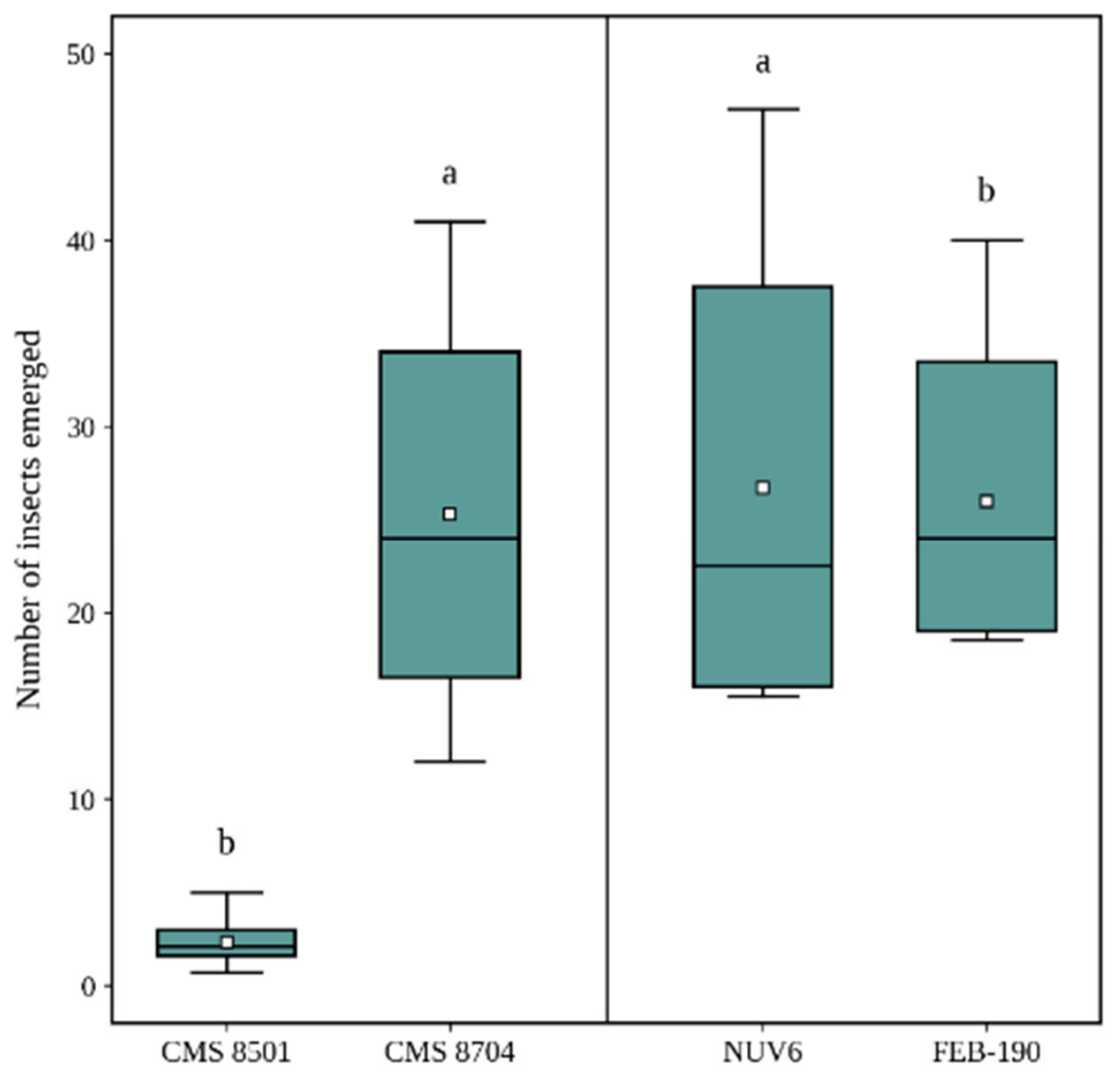
Figure 2.
Nutrient changes in the clean and infested common bean (a) FEB-190 and (b) NUV6 grains.
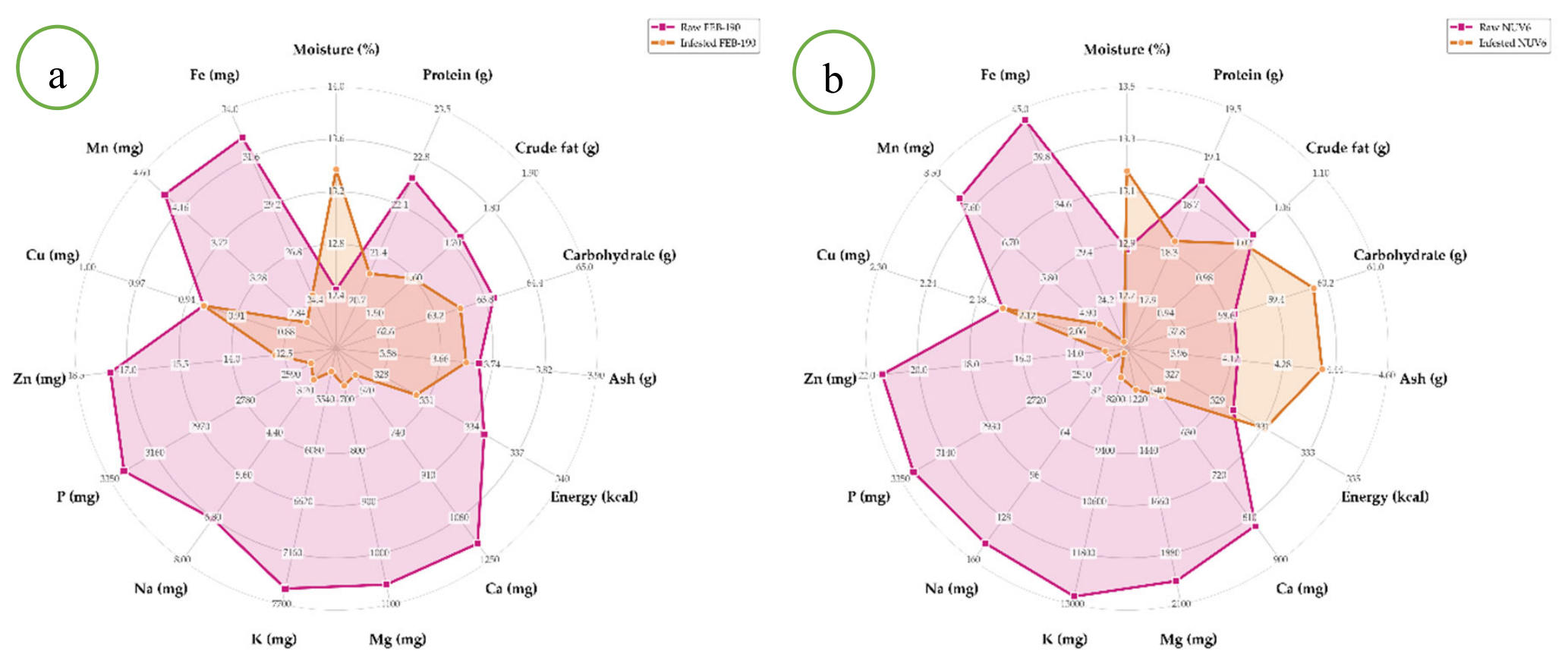
Figure 3.
Nutrient variation in the clean and infested maize (a) CMS 8501 and (b) CMS 8704 grains.
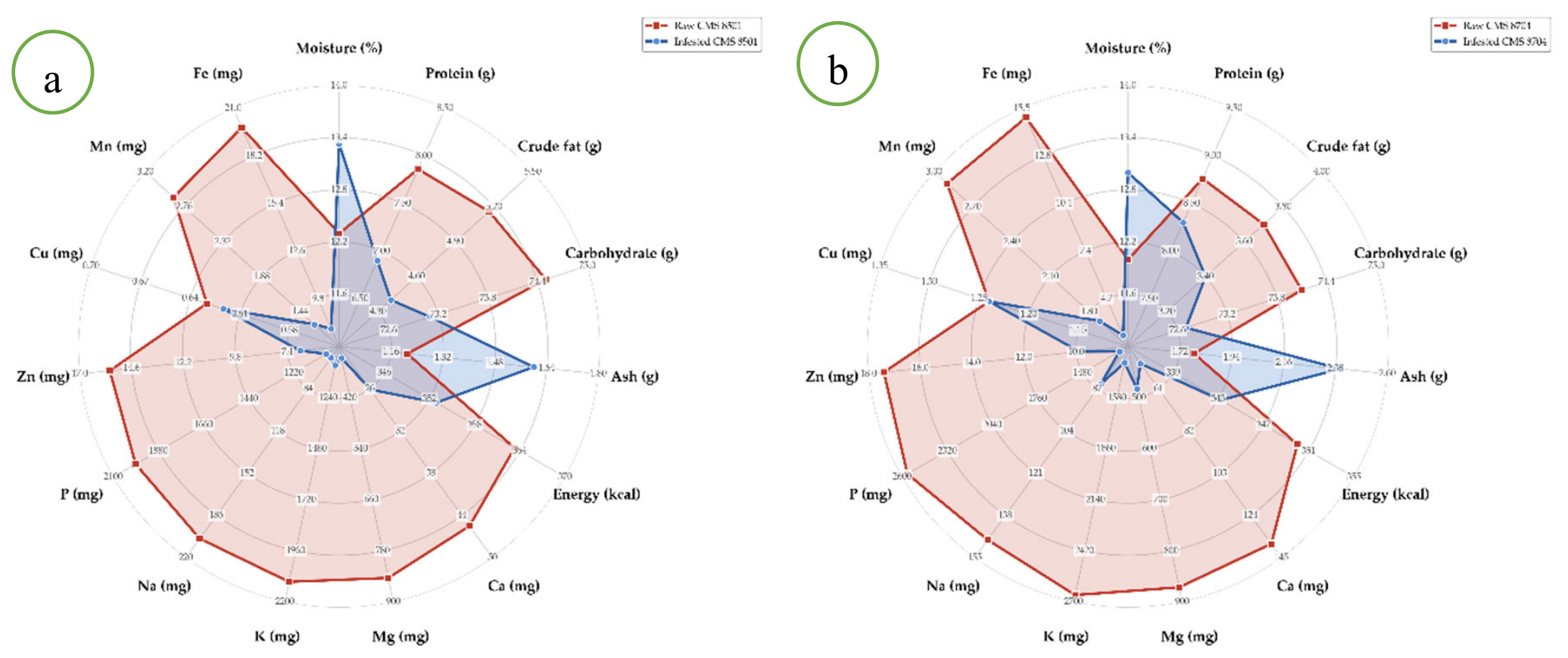
Figure 4.
(a) Ellipse bootstraps and (b) biplot of nutrients in the first two principal components of clean and infested common bean grains.
Figure 4.
(a) Ellipse bootstraps and (b) biplot of nutrients in the first two principal components of clean and infested common bean grains.
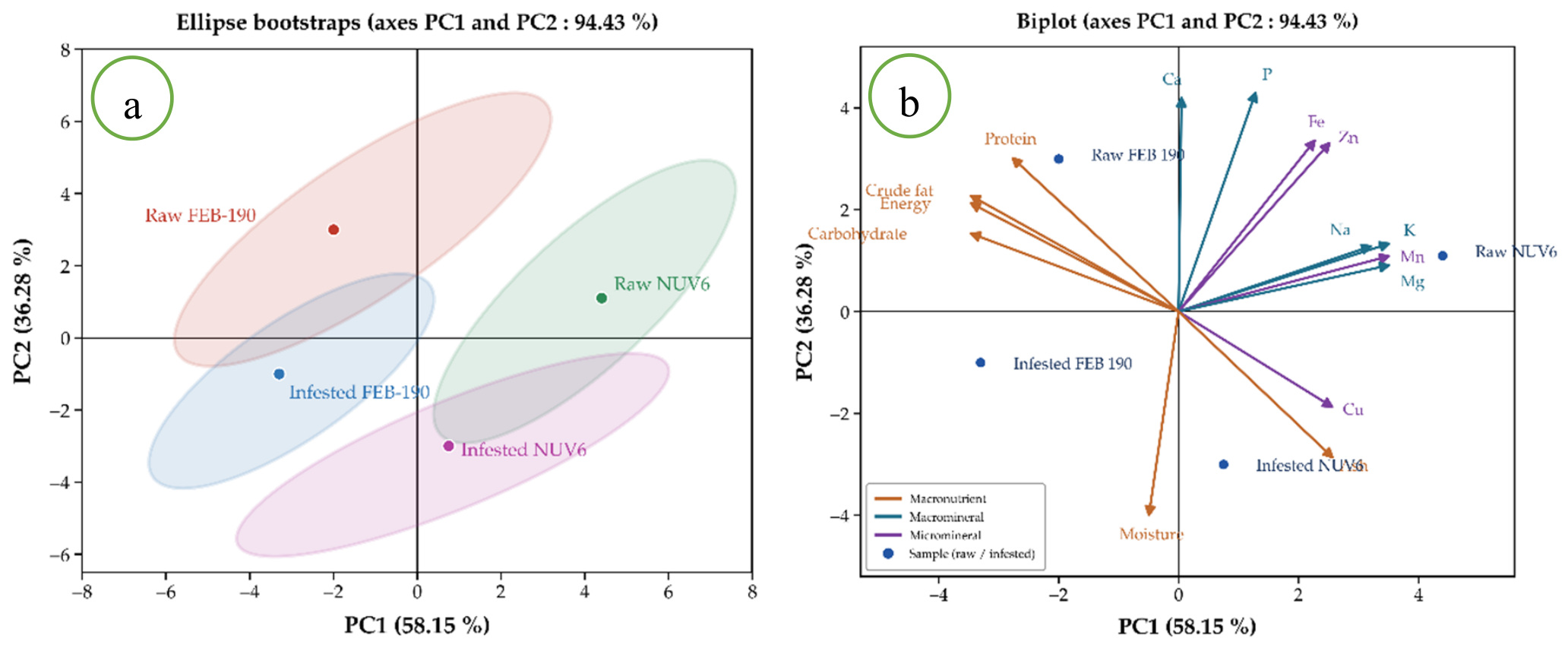
Figure 5.
(a) Ellipse bootstraps and (b) biplot of nutrients in the first two principal components of clean and infested maize grains.
Figure 5.
(a) Ellipse bootstraps and (b) biplot of nutrients in the first two principal components of clean and infested maize grains.
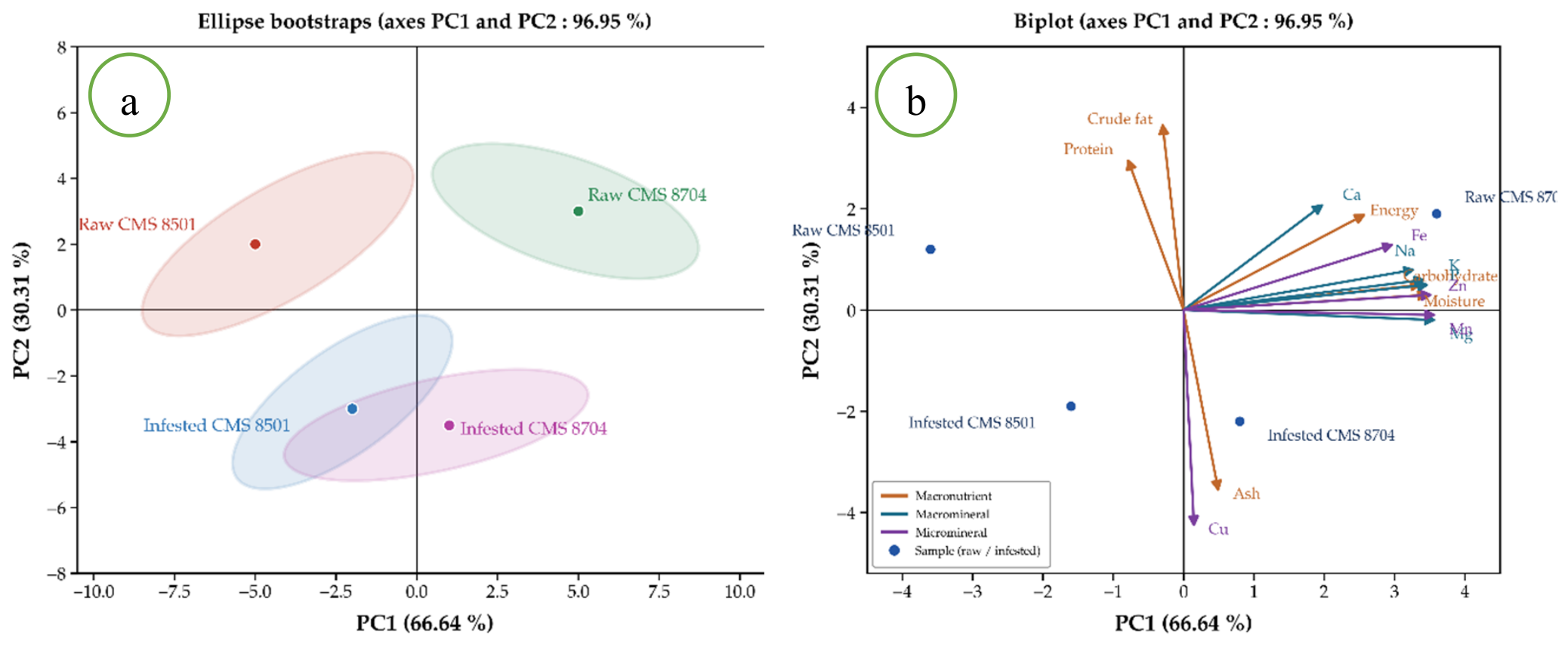

Table 1.
DSI values for common bean and maize grains.
| Grain species | Cultivars | DSI Values |
| Common bean | FEB-190 | 5.68 ± 1.69 b |
| NUV6 | 20.02 ± 3.09 a | |
| P (T ≤ t) | 0.002 | |
| Maize | CMS 8501 | 7.02 ± 2.45 b |
| CMS 8704 | 13.56 ± 0.47 a | |
| P (T ≤ t) | 0.015 |
Means followed by the same letters in each column were not significantly different according to the independent t-test at p < 0.05.
Table 2.
Changes, in %, in nutrients for common bean cultivars.
| Type | Nutrients | FEB-190 | NUV6 |
| Macronutrients | Moisture | +7.4 | +2.3 |
| Protein | -6.2 | -2.6 | |
| Crude fat | -7.0 | -1.0 | |
| Carbohydrate | -0.6 | +2.2 | |
| Ash | -0.5 | +6.3 | |
| Energy | -1.3 | +0.4 | |
| Macrominerals | Ca | -57.3 | -33.3 |
| Mg | -36.6 | -41.2 | |
| K | -30.4 | -40.1 | |
| Na | -57.8 | -97.9 | |
| P | -23.8 | -27.6 | |
| Microminerals | Zn | -27.2 | -40.0 |
| Cu | 0.0 | 0.0 | |
| Mn | -37.1 | -41.2 | |
| Fe | -24.2 | -54.9 |
Table 3.
Changes, in %, of nutrients in maize cultivars.
| Type | Nutrients | CMS 8501 | CMS 8704 |
| Macronutrients | Moisture | +8.4 | +8.3 |
| Protein | -12.2 | -5.3 | |
| Crude fat | -14.7 | -8.1 | |
| Carbohydrate | -1.9 | -1.9 | |
| Ash | +32.2 | +34.8 | |
| Energy | -2.9 | -1.9 | |
| Macrominerals | Ca | -42.3 | -64.9 |
| Mg | -61.2 | -44.6 | |
| K | -48.3 | -47.9 | |
| Na | -71.1 | -42.3 | |
| P | -46.6 | -51.2 | |
| Microminerals | Zn | -56.4 | -43.3 |
| Cu | -1.6 | 0.0 | |
| Mn | -55.6 | -40.7 | |
| Fe | -59.5 | -82.4 |
Table 4.
Varimax rotated factor matrix for the principal components in common bean and maize seeds.
| Parameters | Common bean | Maize | ||
| PC1 | PC2 | PC1 | PC2 | |
| Moisture | 0.013 | 0.738 | 0.954 | 0.046 |
| Protein | 0.565 | 0.435 | 0.365 | 0.591 |
| Crude fat | 0.742 | 0.246 | 0.122 | 0.869 |
| Carbohydrate | 0.871 | 0.127 | 0.911 | 0.074 |
| Ash | 0.511 | 0.371 | 0.257 | 0.696 |
| Energy | 0.764 | 0.234 | 0.602 | 0.392 |
| Ca | 0.001 | 0.833 | 0.440 | 0.418 |
| Mg | 0.934 | 0.066 | 0.973 | 0.014 |
| K | 0.897 | 0.101 | 0.904 | 0.083 |
| Na | 0.756 | 0.098 | 0.844 | 0.051 |
| P | 0.128 | 0.871 | 0.901 | 0.070 |
| Zn | 0.463 | 0.526 | 0.953 | 0.044 |
| Cu | 0.787 | 0.179 | 0.007 | 0.986 |
| Mn | 0.919 | 0.081 | 0.978 | 0.006 |
| Fe | 0.371 | 0.535 | 0.787 | 0.206 |
| Eigenvalues | 8.722 | 5.442 | 9.997 | 4.546 |
| Explained variance % | 58.146 | 36.281 | 66.644 | 30.307 |
| Cumulative % of variance | 58.146 | 94.427 | 66.644 | 96.950 |
Bold values indicate strong and moderate loadings.
Disclaimer/Publisher’s Note: The statements, opinions and data contained in all publications are solely those of the individual author(s) and contributor(s) and not of MDPI and/or the editor(s). MDPI and/or the editor(s) disclaim responsibility for any injury to people or property resulting from any ideas, methods, instructions or products referred to in the content. |
© 2026 by the authors. Licensee MDPI, Basel, Switzerland. This article is an open access article distributed under the terms and conditions of the Creative Commons Attribution (CC BY) license (http://creativecommons.org/licenses/by/4.0/).
Copyright: This open access article is published under a Creative Commons CC BY 4.0 license, which permit the free download, distribution, and reuse, provided that the author and preprint are cited in any reuse.