

Submitted:
13 October 2026
Posted:
14 October 2026
You are already at the latest version
Abstract
The stability of hollow-section columns remains a central issue in structural engineering because they are widely used in buildings, bridges, industrial frames, and offshore systems. This study investigates the buckling resistance of square hollow section columns (SHS) made of S235, EN 1.4401/1.4404, and EN 1.4462 steels at ambient temperature and under elevated temperatures up to 800°C. A Eurocode-based analytical framework was employed to evaluate elastic buckling, plastic resistance, and buckling resistance for fixed-free members with varying cross-section size, thickness, and length. The results show that stainless steels retain a much larger proportion of their original resistance at elevated temperatures than S235 carbon steel. At 800°C, the mean normalized buckling resistance at elevated temperature to plastic resistance at ambient temperature was 2.56% for S235, 13.59% for EN 1.4401/1.4404, and 8.52% for EN 1.4462. Among the stainless steels studied, EN 1.4401/1.4404 exhibited the best normalized resistance retention at 800°C. The transition between elastic-buckling and plastic resistance dominated regimes was strongly influenced by both temperature and slenderness, with S235 exhibiting non-monotonic behavior due to the competing effects of stiffness degradation and strength loss, while stainless steels showed more gradual and favorable transitions.
Keywords:
SHS columns
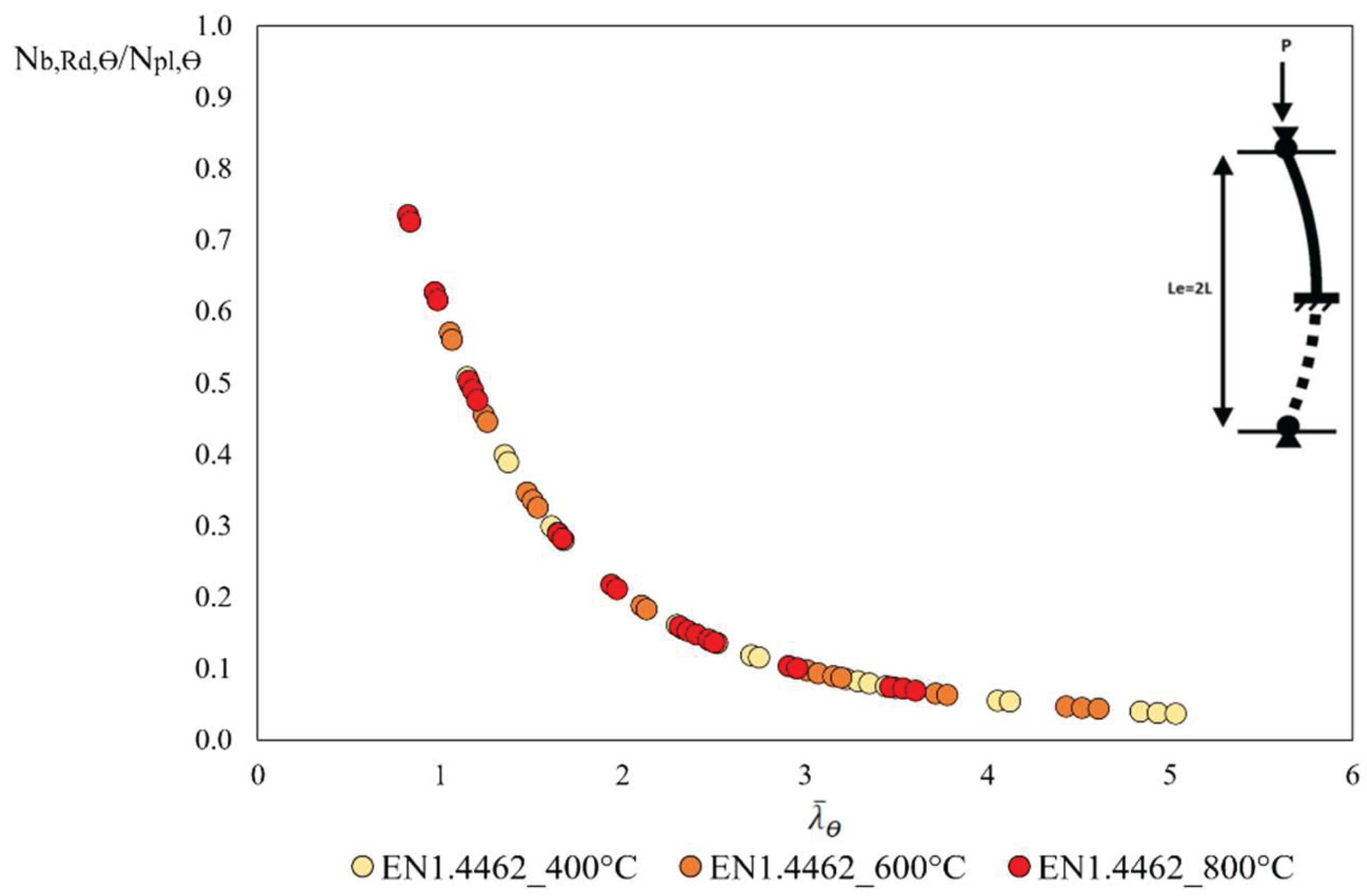
; carbon steel
; stainless steel
; Eurocode 3
; buckling resistance
; elevated temperatures
; fire design
1. Introduction
Hollow section columns are widely used in structural engineering because they combine high structural efficiency with fabrication simplicity and architectural versatility. They are therefore common in buildings, bridges, industrial frames, offshore structures, and other applications where resistance, durability, and constructability are essential design requirements. In this context, the Eurocode framework provides a unified basis for assessing the stability of compression members under both ambient and fire conditions.
The behavior of tubular columns under elevated temperatures is a complex problem because heating affects not only strength, but also stiffness, thermal expansion, and the overall stability path of the member. Carbon steels and stainless steels degrade in fundamentally different ways, and this has direct implications on design [1]. Previous studies have shown that stainless steel columns may preserve a larger fraction of their load-bearing capacity under fire than carbon steel columns, while the stability of hollow sections at elevated temperatures remains highly sensitive to the adopted material model, geometric imperfections, residual stresses, and boundary conditions.
Within this context, the present study focuses on fixed-free SHS columns made of S235 carbon steel and EN 1.4401/1.4404 and EN 1.4462 stainless steels. For stainless steels, a consistent yield-type stress was adopted at elevated temperature to enable a physically meaningful comparison with carbon steel. This approach follows the recommendation that stainless steel design should be based on proof-stress concepts rather than on an abrupt yield plateau.
Recent research has shown that the fire response of stainless steel hollow-section columns cannot always be represented accurately by design approaches originally developed for carbon steel members. Numerical investigations covering circular, elliptical, square, and rectangular hollow-section stainless steel columns have indicated that the fire-design provisions of EN 1993-1-2 [2] may lead to inaccurate predictions of flexural buckling resistance, particularly for austenitic and duplex stainless steels. Consequently, refined design approaches specifically calibrated for stainless steel hollow sections have been proposed to improve the accuracy, safety, and reliability of resistance predictions at elevated temperatures [3,4].
Experimental and numerical studies have also confirmed that stainless steel generally retains strength and stiffness more effectively than carbon steel at elevated temperatures, particularly in the range between 500°C and 800°C [5]. Nevertheless, this material advantage does not automatically translate into a proportional increase in member resistance, because the structural response is also governed by the interaction between temperature-dependent material degradation, member slenderness, geometric imperfections, residual stresses, and end restraints. In particular, axial restraint may generate additional thermally induced compressive forces and reduce the failure temperature of stainless steel columns, whereas rotational restraint can improve their fire resistance by limiting lateral deformation and rotation [6].
The reliability of analytical fire-design models should therefore be assessed against experimental and numerical evidence. Finite-element studies of hollow-section columns at elevated temperature have shown that accurate representation of initial geometric imperfections, residual stresses, nonlinear material properties, and boundary conditions is essential for reproducing the observed buckling response. Furthermore, recent investigations of stainless steel members exposed to high temperatures have emphasized that residual resistance and flexural buckling behavior depend not only on the peak temperature but also on the stainless steel grade, cross-section geometry, and the structural response during heating and cooling. These observations support the need for systematic comparative studies that distinguish clearly between carbon steel and stainless steel behavior under elevated-temperature conditions [3,7].
Although previous studies have examined the behavior of steel columns at elevated temperatures, several gaps remain in the literature. Limited comparative studies exist that simultaneously assess carbon steel and multiple stainless steel grades over a broad range of slenderness values and temperatures. The interaction between material type, cross-section geometry, and temperature-dependent degradation on buckling resistance is not fully characterized for SHS columns. The transition between elastic buckling versus plastic resistance as a function of temperature and slenderness requires further clarification for design purposes.
This paper provides a systematic comparison of the ambient and elevated-temperature stability of fixed-free SHS columns made of carbon steel and two stainless steel grades, using a unified Eurocode-based framework. The contribution lies in the combined assessment of material type, slenderness, section geometry, and temperature level, with emphasis on transition mode and residual resistance. Unlike previous studies that focus on a single material family or a narrower temperature and slenderness range, the present work quantifies how stainless steel preserves a larger fraction of its load-bearing capacity and how this affects design interpretation under fire conditions.
The specific objectives of this study are:
- -
- To evaluate the buckling resistance of SHS columns made of S235, EN 1.4401/1.4404, and EN 1.4462 steels at ambient and elevated temperatures.
- -
- To analyze the influence of cross-section geometry, member length, and slenderness on buckling behavior.
- -
- To compare the temperature-dependent degradation of buckling resistance between carbon and stainless steels.
- -
- To identify transitions between elastic-buckling and plastic-resistance regimes as a function of temperature and slenderness.
- -
- To assess the applicability of Eurocode design expressions for elevated-temperature stability assessment of SHS columns.
The novelty of this study is not the development of a new buckling design model, but the systematic comparison of the temperature-dependent normalized stability response of carbon, austenitic and duplex SHS columns using a common geometry set, a common effective-length condition and a consistent 2% proof-stress-based resistance definition for stainless steels.
2. Materials and Methods
2.1. Column Geometry and Boundary Conditions
The study considered SHS columns with fixed-free boundary conditions, corresponding to an effective buckling length of Le=2L, where L is the physical column length. The fixed-free configuration was selected as an idealized and relatively flexible boundary condition, providing a consistent basis for comparison. It should not be interpreted as representative of all practical column applications.
Three nominal cross-section sizes were analyzed: 50x50, 60x60, and 70x70 mm. For each size, three wall thicknesses were studied: 3, 4, and 5 mm. Three member lengths were considered: 1000, 2000, and 3000 mm. This produced a comprehensive set of 27 geometric configurations (3 sizes x 3 thicknesses x 3 lengths) and 81 material geometry combinations (27 x 3 materials) suitable for studying the interaction between slenderness, temperature, and material type.
The fixed-free boundary condition was selected to represent columns with one end fully restrained against rotation and translation and the other end free. This condition corresponds to a buckling length factor equal to 2.0 and represents a conservative scenario for stability assessment. While this condition may not be representative of all practical applications, it provides a consistent basis for comparative analysis across materials and geometries.
2.2. Material Properties
The material set included one carbon steel grade, S235, and two stainless steel grades, austenitic EN 1.4401/1.4404 and duplex EN 1.4462. Ambient-temperature properties followed the Eurocode values for elastic modulus E, Poisson’s ratio ν, and yield stress fy, as summarized in Table 1.
Elevated-temperature properties were obtained from the temperature-dependent reduction factors in EN 1993-1-2 [2] for carbon steel and EN 1993-1-4 [8] for stainless steels. The reduction factors for yield stress ky,θ and elastic modulus kE,θ were used to determine the temperature-dependent material properties listed in Table 2.
fy,θ = ky,θ ⋅ fy
Eθ = kE,θ ⋅ E
Because stainless steels are characterized by a continuous stress-strain curve without a sharp yield point, the study adopted the Eurocode conversion to an equivalent yield stress type, considering stress at 2% total strain for consistent comparison with carbon steel. In equations 1 and 2, fy denotes the ambient temperature for stainless steel. If considering 2% plastic deformation, as in this study, the parameter fy is corrected by ky,ϴ_recalc. The values shown for ky,ϴ_recalc correspond to the results obtained by [10] for cold rolled strips of stainless steels, EN 10088-2 [11]. This choice is consistent with the high-temperature procedures discussed by Martins et al. [12] and with the design approach, summarized by Quan and Kucukler [13]. The correction factors ky,ϴ_recalc for stainless steels are presented in Table 2, based on experimental data for cold-rolled stainless steel [10,11].
2.3. Cross-Section Classification
Cross-section classification was carried out according to Eurocode rules for classes 1 to 4, although the present work was restricted to classes 1, 2, and 3. This restriction was necessary because the comparison was based on a common yield resistance parameter, and class 4 sections would require an effective area treatment that would add a level of complexity without changing the main focus of the study. The c/t ratios for all sections were verified to ensure compliance with the limits for classes 1-3 according to EN 1993-1-1 [9] and EN 1993-1-4 [8]. All sections analyzed in this study satisfied the requirements for class 3 or better at ambient temperature.
The scope of the study is restricted to sections classified as class 1, 2, or 3 at ambient temperature. No independent reassessment of local buckling at elevated temperature was performed; accordingly, the results should be interpreted as member-buckling predictions within the adopted Eurocode framework and should not be extrapolated to cases in which local buckling may govern.
2.4. Analytical Framework
The analytical calculations were performed using Eurocode expressions for compression members. The following subsections present the governing equations for ambient and elevated temperature design.
2.4.1. Ambient Temperature Design
The plastic resistance of a cross-section at ambient temperature was calculated as [5]:
where A is the cross-sectional area and fy is the yield stress.
Npl = A fy
The Euler critical load was calculated according to equation 4 [9]:
where E is the elastic modulus, I is the second moment of area, and Le is the effective buckling length.
The buckling resistance Nb,Rd [9] was calculated according to the equation 5.
where χ is the reduction factor for buckling and γMi is the partial safety factor for instability. For comparative purposes in this study, γMi=1.0 was adopted for all materials to enable direct comparison without the influence of different safety factors.
For members susceptible to buckling, the design resistance was obtained using the reduction factor χ (dimensionless), equation 6, which depends on the generalized slenderness and the imperfection factor α defined by EN 1993-1-1 [9] and Trahair et al. [14].
Φ is the reduction coefficient (dimensionless) calculated as follows [9], for carbon steel and stainless steel, respectively:
where α is the imperfection factor (dimensionless) and is the limit slenderness (dimensionless) by [9]. The generalized slenderness ratio (dimensionless) for class 1, 2, or 3 sections [9] is determined by:
(carbon steel)
(stainless steel)
2.4.2. Elevated Temperature Design
For fire design, the same general framework was applied using temperature-dependent reduction factors for strength and stiffness.
Equations 3 and 4 were used to calculate the Euler critical load Ncr,θ and the plastic resistance Npl,θ, both at temperature θ. For these calculations, equations 1 and 2 are used to calculate fy,θ and Eθ.
The buckling resistance in fire, Nb,Rd,θ, was evaluated using the reduced material properties and the reduction factor of the specific fire χfi defined in EN 1993-1-2 [2]. For class 1, 2 and 3 sections [2,15], the buckling resistance in fire for carbon steels and stainless steels is given by:
where γM,fi = 1.0 for comparative purposes, ky,θ is the reduction factor for yield stress at temperature θ, and ky,ϴ_recalc is the correction factor for 2% strain in stainless steel.
(carbon steel)
(stainless steel)
The design buckling reduction factor in case of fire χfi is calculated by [2,15]:
where Φϴ is the reduction factor of χfi dimensionless, and can be calculated by [2,15], for carbon steels and stainless steels, equations 13 and 14 respectively.
(carbon steel)
(stainless steel)
The imperfection factor α for fire design is obtained by [2]:
2.5. Evolution of Generalized Slenderness with Temperature
Figure 1 presents the evolution of the generalized slenderness correction parameter This parameter governs the temperature-dependent change in effective slenderness. For S235, the parameter increases up to intermediate temperatures (approximately 400-500°C) because stiffness degradation occurs before substantial strength loss becomes dominant. Beyond this range, the material strength decreases more rapidly, leading to a change in the trend and consequently a decrease in the parameter. The stainless steel grades show a more consistent behavior, with the generalized slenderness correction parameter lowering with increasing temperature throughout the full range analyzed. This indicates that, for stainless steels, strength degradation is more gradual and better synchronized with stiffness reduction, resulting in a more stable structural response.
2.6. Parametric Study
The parametric study included the following variables:
- Material: S235, EN 1.4401/1.4404, EN 1.4462
- Cross-section size: 50x50, 60x60, 70x70 mm
- Wall thickness: 3, 4, 5 mm
- Column length: 1000, 2000, 3000 mm
- Temperature: 20°C (ambient), 100, 200, 300, 400, 500, 600, 700, 800°C
This resulted in a total of 729 analytical cases (3 materials x 3 sizes x 3 thicknesses x 3 lengths x 9 temperatures). For each case, the following quantities were calculated:
- Cross-sectional area A and second moment of area I
- Plastic resistance Npl
- Euler critical load Ncr
- Generalized slenderness
and
- Reduction factors χ and χfi
- Buckling resistance Nb,Rd and Nb,Rd,θ
- Ratios Nb,Rd/Npl, Ncr/Npl, and Nb,Rd,θ/Npl
The study is restricted to SHS columns for which local buckling is not expected to govern under the adopted cross-section classification assumptions. The findings should not be extrapolated to class 4 sections or members governed by local buckling.
3. Results and Discussion
3.1. Columns at Ambient Temperature
Figure 2 presents the ratio Ncr/Npl for all columns at ambient temperature as a function of generalized slenderness . This ratio indicates the tendency for elastic buckling relative to plastic resistance.
At room temperature, S235 carbon steel has a higher Ncr/Npl ratio than the stainless steels under study, resulting in a tendency towards a plastic resistance mode, especially for sections with a generalized slenderness ratio of less than 1.0. This behavior is attributed to the lower yield stress of S235 relative to its elastic modulus, which reduces the slenderness at which buckling becomes critical. In contrast, all EN 1.4462 columns exhibit, due to their very high mechanical strength, an elastic buckling dominated response at room temperature. EN 1.4401/1.4404 shows intermediate behavior, with transition modes depending on the specific combination of cross-section geometry and column length. For compact sections with low slenderness, plastic resistance dominates, while slender sections exhibit elastic buckling.
3.2. Critical Buckling Resistance Ratio
Figure 3 illustrates the ratio Ncr,θ/Npl,θ for S235 at different temperatures, where Ncr,θ is the Euler critical load at temperature θ and Npl,θ is the plastic resistance at temperature θ. The figure shows a clear shift in structural response as temperature increases, with a non-monotonic behavior between intermediate and high temperature levels. This indicates that the transition mode is strongly affected by the combined influence of temperature and slenderness, and not by strength reduction alone.
For S235, the ratio initially decreases with temperature up to approximately 500°C, then increases at higher temperatures. This behavior is consistent with the evolution of the slenderness correction parameter and reflects the changing balance between stiffness and strength degradation. In the case of stainless steels under study, the generalized slenderness correction parameter decreases with increasing temperature. This translates to a general decrease in effective slenderness with increasing temperature, shifting the trend curve of the profiles to the left and thereby increasing in Ncr,θ/Npl,θ. That is, the relative influence of elastic buckling decreases in stainless steels with increasing temperature, and the material can recruit a larger portion of its mechanical strength before the transition mode than carbon steels.
Figure 4 shows the corresponding ratio for EN 1.4401/1.4404. The results indicate that the stainless steel columns can mobilize a larger portion of their resistance over the considered temperature range. The evolution is smoother than in S235, confirming that the material retains a more stable structural response under elevated temperature conditions. Furthermore, a change in transition mode from elastic buckling to plastic-dominated is observed for sections with close to 1.0 as temperature increases. This transition is more gradual in stainless steels than in carbon steel.
Figure 5 presents the same comparison for EN 1.4462. Although this grade also performs better than S235 in terms of residual resistance, its response is more sensitive to temperature than EN 1.4401/1.4404. This behavior is consistent with its higher initial strength and the associated sensitivity of stability response to the reduction of material stiffness and strength at elevated temperature. On the other hand, since EN 1.4462 steel exhibits a greater reduction in mechanical strength with increasing temperature when compared to EN 1.4401/1.4404 profiles, it shows a greater variation of Ncr,θ/Npl,θ, in the sense that elastic instability has less impact at high temperatures.
3.3. Buckling Resistance at Ambient Temperature
Figure 6 shows the buckling resistance ratio Nb,Rd/Npl at ambient temperature as a function of generalized slenderness .
The results confirm that resistance decreases as generalized slenderness increases, which is the expected behavior for compression members governed by instability. Compact members show a larger proportion of their cross-section resistance, while more slender members become increasingly governed by buckling effects. The buckling curves for all three materials follow the expected Eurocode formulations, with stainless steels exhibiting slightly different curve shapes due to the different imperfection factors and limit slenderness values.
3.4. Temperature Effect on Buckling Resistance
As in the previous analysis for Ncr,θ/Npl,θ, once again, there is a change in the behavior of S235 steel for the buckling resistance ratio Nb,Rd,θ/Npl,θ. From 400 to 600°C, a shift to the right and downwards in the results is observed, i.e., an increase in effective slenderness and a consequent decrease in normalized buckling resistance. In turn, from 600°C to 800°C, there is exactly the opposite behavior, as shown in Figure 7.
Figure 7 shows the temperature effect on the buckling resistance ratio for S235. The response is non-monotonic, with a marked change between intermediate and higher temperatures. This suggests that the interaction between stiffness reduction and strength degradation governs the structural response, and that the effect of temperature cannot be deduced from strength loss alone.
For both EN 1.4401/1.4404 and EN 1.4462, the curves shift progressively to the left and upward as the temperature increases, as shown in Figure 8 and Figure 9. This behavior is more noticeable the lower the generalized slenderness . As with carbon steel, a decrease in Nb,Rd,θ/Npl,θ is evident with increasing column slenderness.
However, compared to EN 1.4401/1.4404 steel, the EN 1.4462 sections are displaced to lower resistance ratios and to the right (higher effective slenderness). This behavior is associated with its greater mechanical strength, which leads to an increased susceptibility to instability due to elastic buckling at ambient temperature, combined with more pronounced strength degradation at elevated temperatures.
Figure 8 shows the buckling resistance ratio for EN 1.4401/1.4404 at different temperatures. The curves shift in a way that indicates better retention of resistance with increasing temperature. The material preserves a larger fraction of its load-carrying capacity than S235, especially for the less slender members.
Figure 9 presents the same results for EN 1.4462. The overall trend is similar to EN 1.4401/1.4404, but the response is slightly more affected by temperature and slenderness. Even so, the material still demonstrates substantially better elevated-temperature performance than S235, which supports its suitability for fire-sensitive structural applications.
3.5. Normalized Buckling Resistance at 800∘C
The previous results allow the elevated temperature axial resistance of the studied members to be quantified by comparing Nb,Rd,θ and Npl,Rd,θ for each column. However, to quantify the buckling resistance at 800 °C relative to the ambient-temperature cross-sectional resistance, the ratio Nb,Rd(800∘C)/Npl(20∘C) was computed, with the results summarized in Table 3. Ratios represent the buckling resistance at 800°C relative to the plastic resistance at ambient temperature.
Both stainless steel grades retain a larger normalized buckling resistance than S235 under the assumptions adopted in this study. It should also be noted that the lowest result for all materials was observed in the 50x50x5x3000 mm column (most slender configuration). The best result for S235 and EN 1.4401/1.4404 was obtained in the 70x70x3x1000 mm column (most compact configuration), while for EN 1.4462 the best result was for the 70x70x4x1000 mm column.
The results indicate that:
- -
- Stainless steels retain 3.3 to 5.3 times more of their original buckling resistance at 800°C compared to S235 carbon steel.
- -
- EN 1.4401/1.4404 exhibits the best overall residual performance among the materials studied.
- -
- EN 1.4462, despite its higher ambient-temperature strength, shows lower residual resistance than EN 1.4401/1.4404 at 800°C due to more pronounced strength degradation.
- -
- The variation between minimum and maximum values is substantial, highlighting the importance of slenderness and cross-section geometry in elevated-temperature design.
3.6. Implications for Design
Within the adopted Eurocode-based analytical framework, the results indicate the practical stability assessment of SHS columns at elevated temperatures. Furthermore, it was possible to verify their sensitivity to slenderness, temperature, and material, while the distinct behaviors of carbon and stainless steel were noticeable, highlighting the need for specific structural considerations for each material. This agrees with the general conclusion reached by Martins et al. [12], namely that elevated-temperature stability in stainless steel columns should not be considered with the same assumptions used for carbon steel without careful verification.
The main design implications are related to the following topics. The material selection for fire-sensitive applications, stainless steels (particularly EN 1.4401/1.4404) offer superior residual resistance compared to carbon steel. The slenderness effect of stainless steel is more pronounced for compact sections with low slenderness. The advantage of stainless steel increases with temperature, becoming most significant above 600°C. The transition between elastic-buckling-dominated and plastic-resistance-dominated regimes is relevant to allow designers to be aware that the dominant transition mode may change with temperature, particularly for carbon steel.
4. Conclusions
This study investigated the ambient- and elevated-temperature buckling behaviour of fixed-free square hollow-section columns made of S235 carbon steel, EN 1.4401/1.4404 austenitic stainless steel, and EN 1.4462 duplex stainless steel. A Eurocode-based analytical framework was used to assess the influence of material grade, cross-section geometry, member length, and temperature on Euler buckling load, cross-sectional resistance, generalized slenderness, and member buckling resistance. The analysis was limited to uniformly heated SHS columns classified as Class 1, 2, or 3 at ambient temperature.
The main conclusions are as follows:
- -
- the superior high-temperature performance of stainless steels, which retain a significantly larger proportion of their original resistance at elevated temperature than S235 carbon steel. At 800°C, the average ratio Nb,Rd,θ(800∘C)/Npl(20∘C) was 2.56% for S235, 13.59% for EN 1.4401/1.4404, and 8.52% for EN 1.4462, confirming the superior high-temperature stability of the stainless steel grades considered;
- -
- the temperature-dependent transition between elastic-buckling-dominated and plastic-resistance-dominated regimes, which were strongly influenced by both temperature and slenderness. For S235, the response exhibited a non-monotonic evolution with temperature, reflecting the competition between stiffness degradation (dominant at intermediate temperatures) and strength loss (dominant at high temperatures). In contrast, the stainless steels showed a more gradual and favorable transition in structural response, with effective slenderness decreasing monotonically with temperature;
- -
- the performance among stainless steel grades studied, EN 1.4401/1.4404 generally demonstrated the best residual performance at elevated temperatures, while EN 1.4462 showed higher sensitivity to the reduction of material properties. This is attributed to the more gradual degradation of mechanical properties in austenitic stainless steel compared to duplex stainless steel at temperatures above 600°C;
- -
- the influence of slenderness and geometry, where the beneficial effect of stainless steel over carbon steel is more pronounced for compact sections with low slenderness. The slenderest column (50x50x5x3000 mm) exhibited the lowest residual resistance ratios for all materials, emphasizing the importance of slenderness control in fire design.
- -
- within the adopted Eurocode-based analytical framework, the results indicate practical assessment of SHS columns at elevated temperatures. However, their reliability must be interpreted with care when high temperature and high slenderness act simultaneously, particularly for carbon steel where non-monotonic behavior was observed.
- -
- and design recommendations. The stainless steel SHS columns provide a clear advantage in fire-related stability performance, but their design must still account carefully for slenderness, section geometry, and temperature-dependent material degradation. Within the unprotected, uniformly heated and fixed-free SHS cases considered, EN 1.4401/1.4404 provided the highest normalized resistance at 800 °C. This result should not be interpreted as a general material-selection recommendation without considering ambient-temperature requirements, exposure conditions, cost, fabrication and the complete fire design scenario.
4.1. Future Research
Future work should investigate, according to different proposals. For the boundary conditions, only fixed-free boundary conditions were considered. Other boundary conditions (pinned-pinned, fixed-fixed, fixed-pinned) should be investigated, as end restraint has a major influence on buckling resistance and may change the relative performance of the materials. The cross-section shapes examined were only SHS. Other cross-section shapes (rectangular hollow sections, circular hollow sections, I-sections) and slenderness ranges should be examined to determine whether the observed trends remain valid beyond SHS columns. The temperature distribution was assumed to be uniform throughout the column length. A further useful extension would be the study of non-uniform temperature fields, which are closer to real fire exposure conditions than uniform heating. This would allow a more realistic assessment of temperature gradients, thermal bowing, and local instability effects.
Author Contributions
Validation, D.A.M.S.; investigation, D.A.M.S.; writing-original draft, D.A.M.S.; conceptualization, E.M.M.F.; methodology, E.M.M.F.; writing-review and editing, E.M.M.F. All authors have read and agreed to the published version of the manuscript.
Funding
This research received no external funding.
Institutional Review Board Statement
Not applicable.
Informed Consent Statement
Not applicable.
Data Availability Statement
The original contributions presented in the study are included in the article, further inquiries can be directed to the corresponding author.
Acknowledgments
The authors acknowledge Fundação para a Ciência e a Tecnologia (FCT) for its financial support to LAETA via the project UID/50022/2025 (DOI: https://doi.org/10.54499/UID/50022/2025).
Conflicts of Interest
The authors declare no conflicts of interest.
References
- Arrais, F.; et al. Fire design of stainless steel columns with hollow circular and elliptical sections. J. Constr. Steel Res. 2023. [Google Scholar] [CrossRef]
- EN 1993-1-2; Eurocode 3: Design of steel structures - Part 1-2: General rules - Structural fire design. CEN: Bruxelles, Belgium, 2005.
- Afshan, S.; Kucukler, M.; Gardner, L. Numerical modelling and fire design of stainless steel hollow section columns. Thin-Walled Struct. 2020, vol. 157, Art. no. 107080. [Google Scholar] [CrossRef]
- Mohammed, A.; Afshan, S. Numerical modelling and fire design of stainless steel hollow section columns. Thin-Walled Struct. 2019. [Google Scholar] [CrossRef]
- Quan, Chun-Yan; Kucukler, M. Simulation and cross-section resistance of stainless steel SHS and RHS at elevated temperatures. Thin-Walled Struct. 2023. [Google Scholar] [CrossRef]
- International Molybdenum Association, «A Fire Engineering Approach to the Design of Stainless Steel Structures»; IMOA: London, U.K., 2014.
- Mohammed, A.; Afshan, S. Numerical modelling and fire design of stainless steel hollow section columns. Thin-Walled Struct. 2019. [Google Scholar] [CrossRef]
- EN 1993-1-4; Eurocode 3 - Design of steel structures - Part 1-4: General rules - Supplementary rules for stainless steels. CEN: Bruxelles, Belgium, 2006.
- EN 1993-1-1; Eurocode 3: Design of steel structures - Part 1-1: General rules and rules for buildings. CEN: Bruxelles, Belgium, 2002.
- Finnish Constructional Steelwork Association Ltd. Stainless Steel Hollow Sections Handbook. 2008. [Google Scholar] [CrossRef]
- EN 10088-2; Stainless steels - Part 2: Technical delivery conditions for sheet/plate and strip of corrosion resisting steels for general purposes. CEN: Bruxelles, Belgium, 2005.
- Martins, D.; Gonçalves, R.; Camotim, D. Numerical simulation and design of stainless steel columns under fire conditions. Eng. Struct. n. November 2020, 2021, vol. 229. [Google Scholar] [CrossRef]
- Quan, M. Kucukler, «Stability and design of stainless steel hollow section columns at elevated temperatures. Eng. Struct. vol. 297, 116935. [CrossRef]
- Trahair, N.S.; Bradford, M.A.; Nethercot, D.A.; Gardner, L. The Behaviour and Design of Steel Structures to EC3, 4th Ed. ed; Taylor & Francis, 2008. [Google Scholar]
- Associação Portuguesa de Construção Metálica e Mista, Manual de dimensionamento de estruturas em aço inoxidável, 4a ed.; CMM – Associação Portuguesa de Construção Metálica e Mista: Coimbra, 2017.
Figure 1.
Evolution of the generalized slenderness correction parameter with temperature for S235, EN 1.4401/1.4404, and EN 1.4462.
Figure 1.
Evolution of the generalized slenderness correction parameter with temperature for S235, EN 1.4401/1.4404, and EN 1.4462.
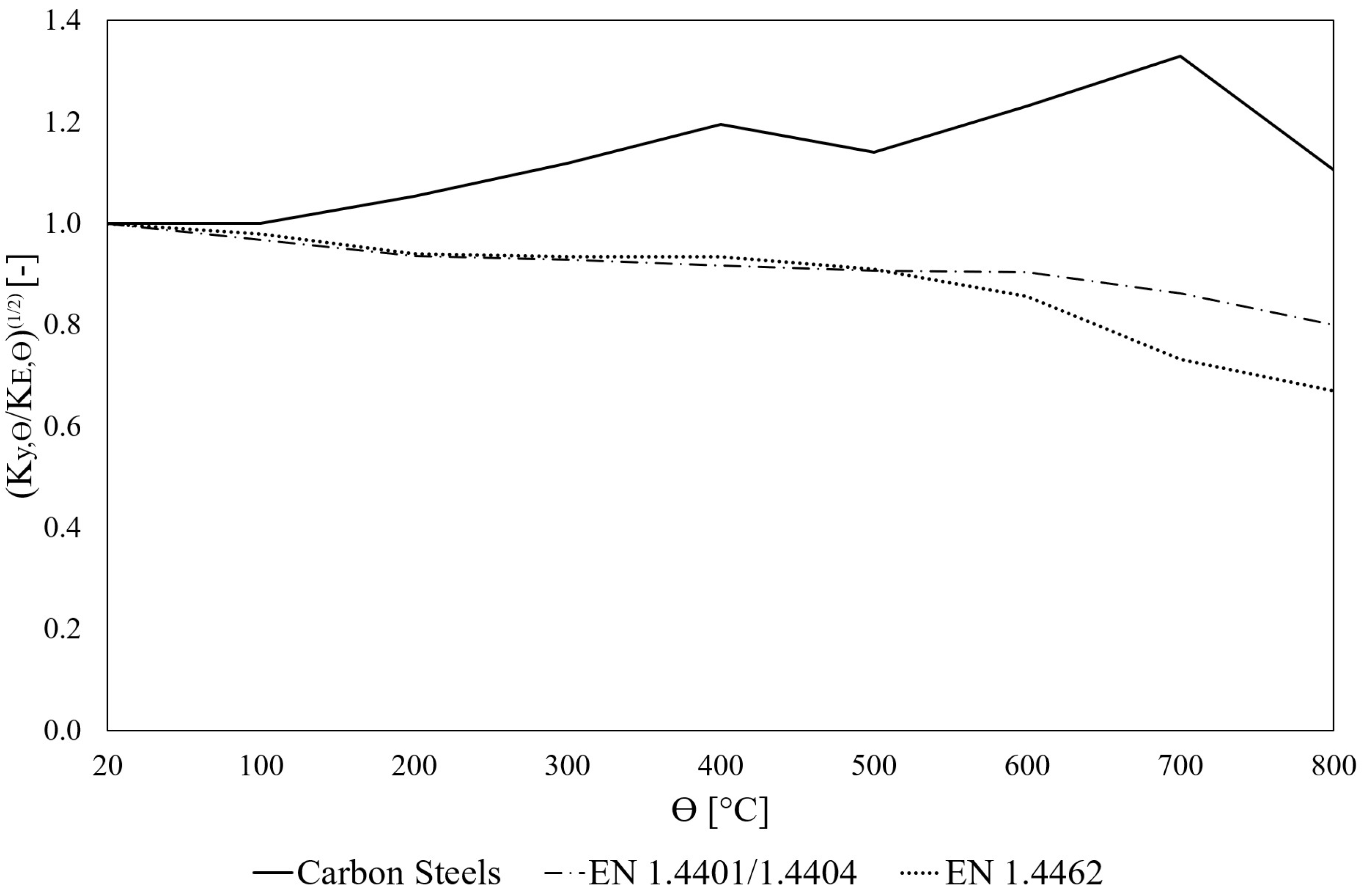
Figure 2.
Ratio of Ncr/Npl for columns at ambient temperature as a function of generalized slenderness
Figure 2.
Ratio of Ncr/Npl for columns at ambient temperature as a function of generalized slenderness
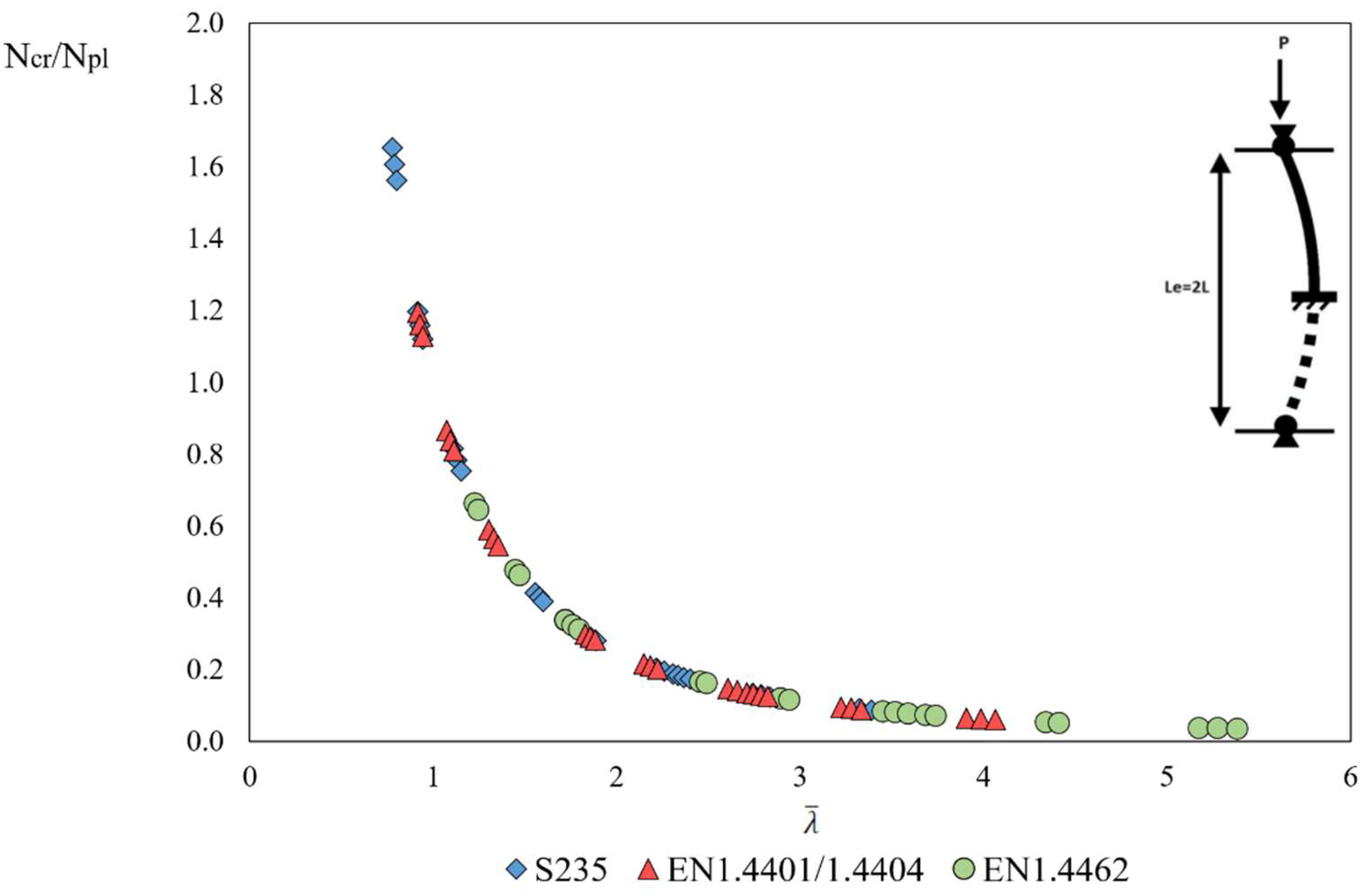
Figure 3.
Ncr,ϴ/Npl,ϴ for S235 at different temperatures.
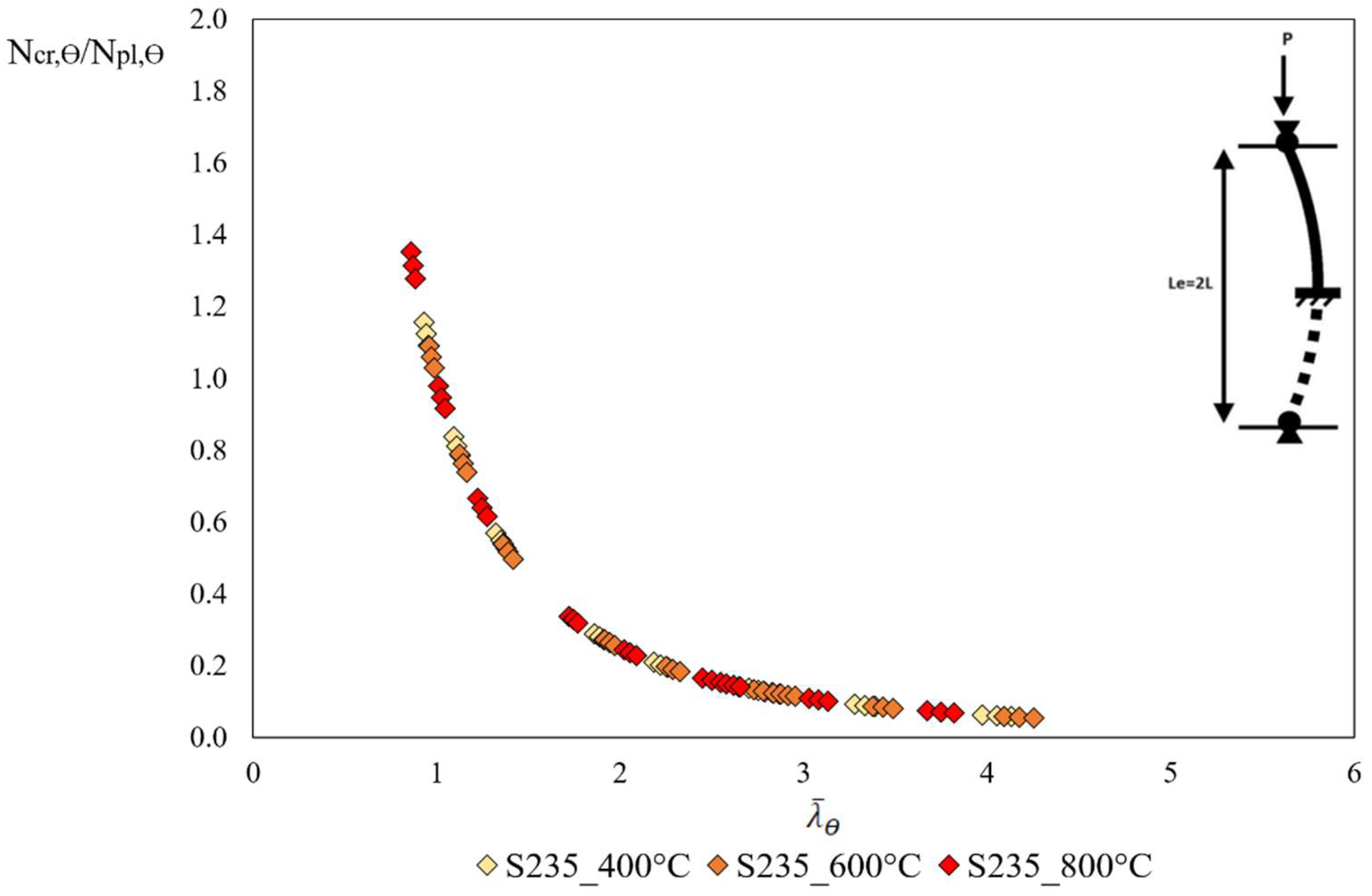
Figure 4.
Ratio Ncr,ϴ/Npl,ϴ for EN 1.4401/1.4404 at different temperatures.
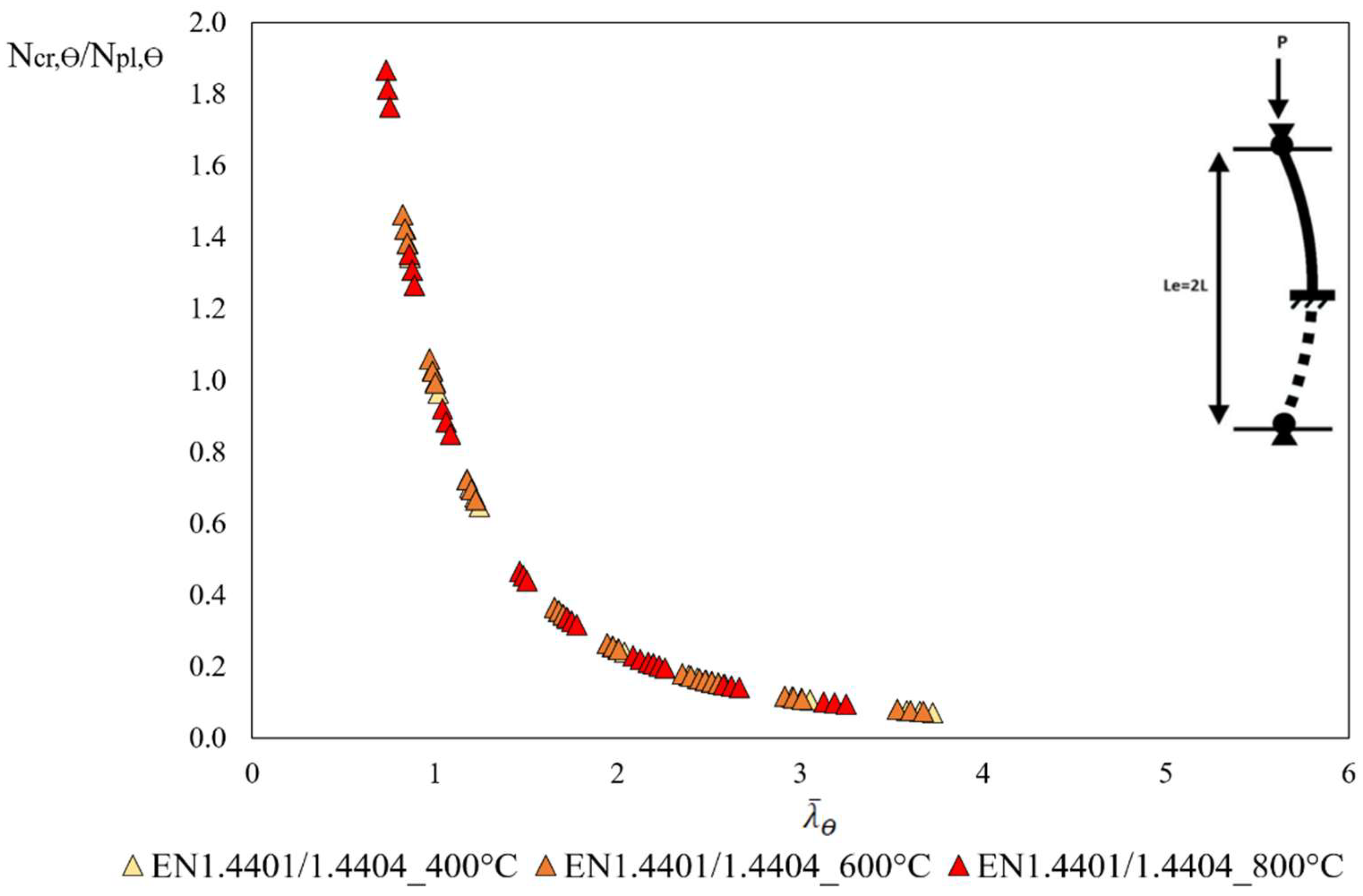
Figure 5.
Ratio Ncr,ϴ/Npl,ϴ for EN 1.4462 at different temperatures.
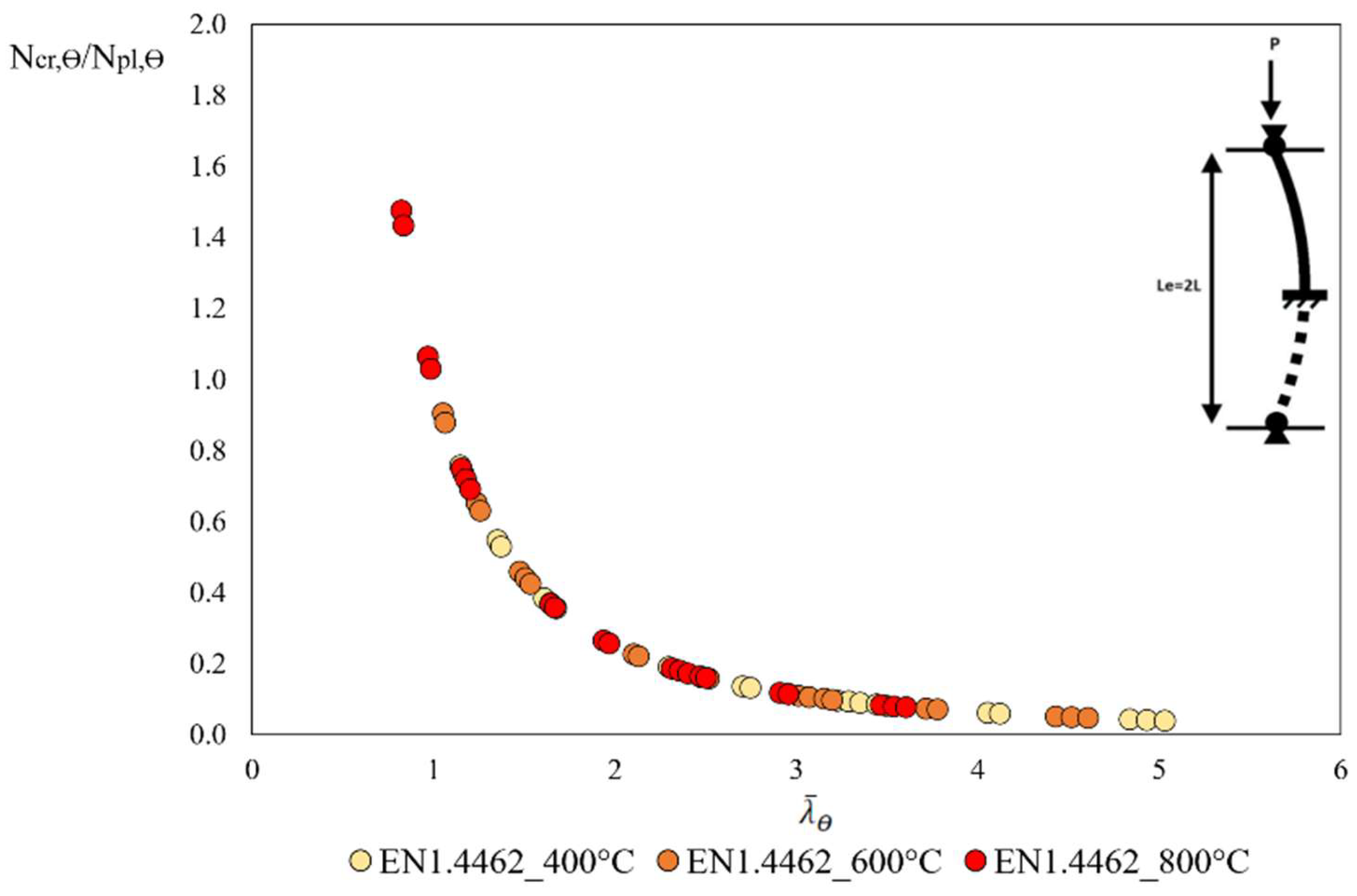
Figure 6.
Buckling resistance ratio Nb,Rd/Npl for columns at ambient temperature.
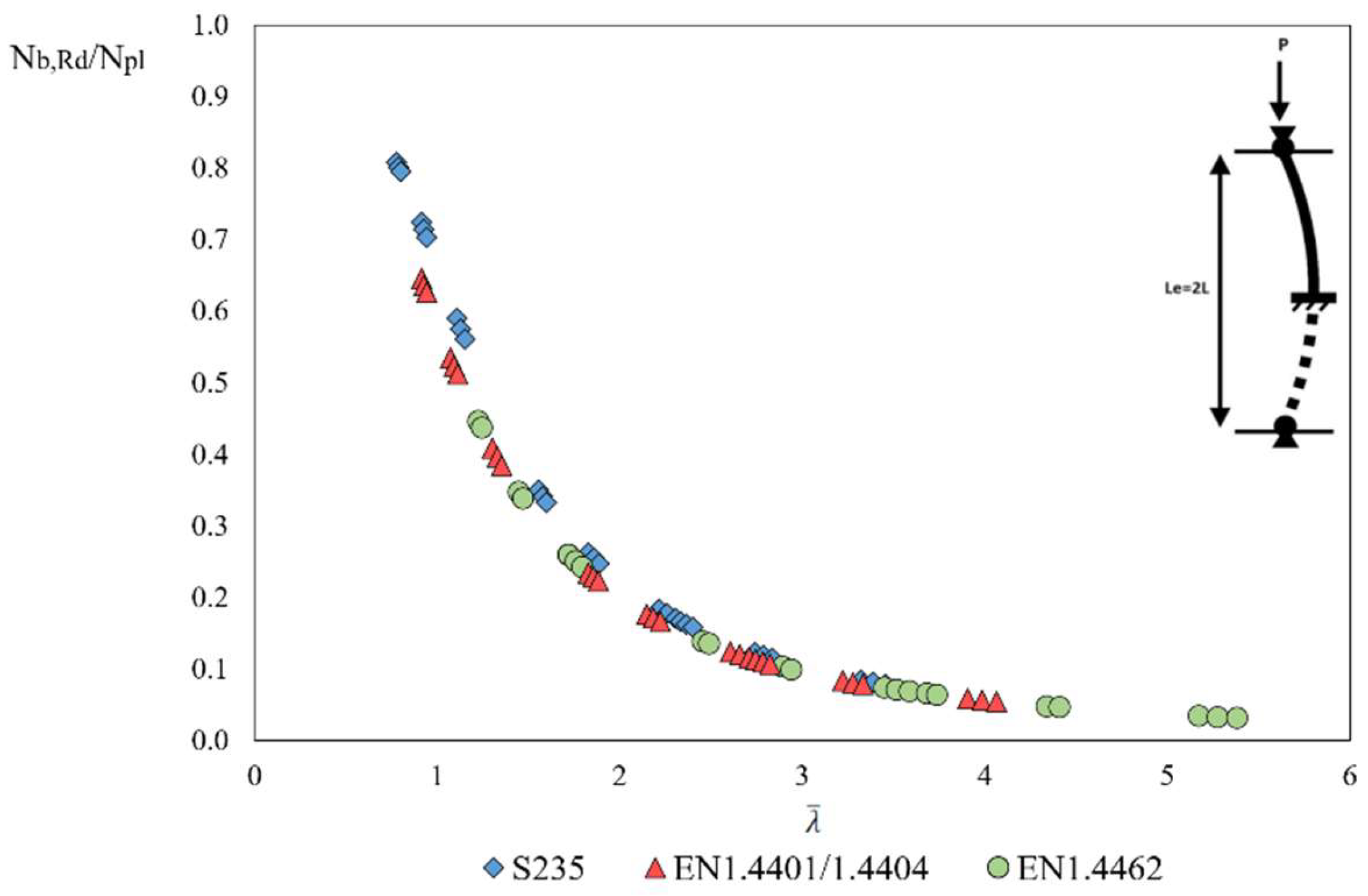
Figure 7.
Buckling resistance ratio Nb,Rd,ϴ/Npl,ϴ for S235 at different temperatures.
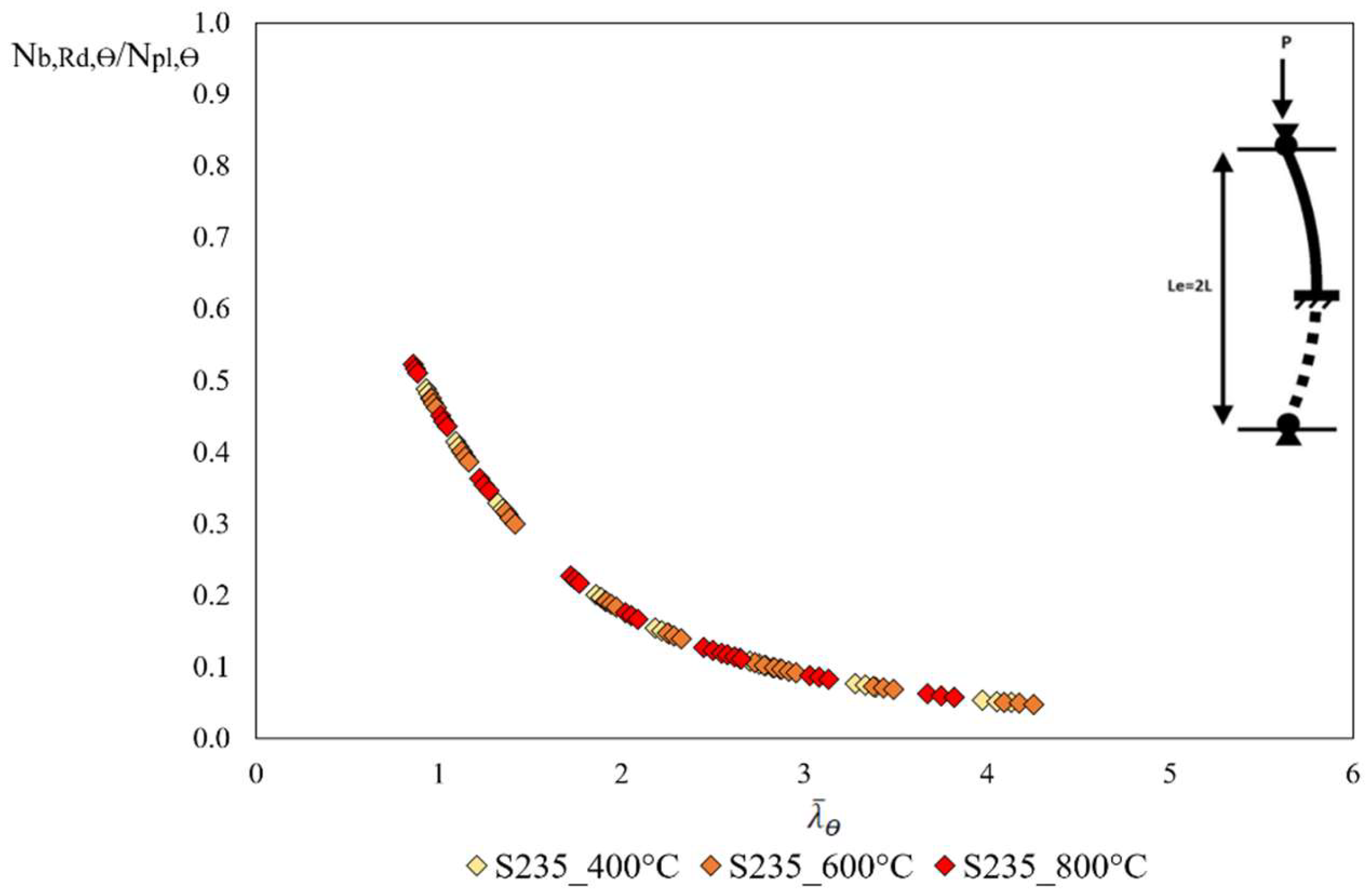
Figure 8.
Buckling resistance ratio Nb,Rd,ϴ/Npl,ϴ for EN 1.4401/1.4404 at different temperatures.
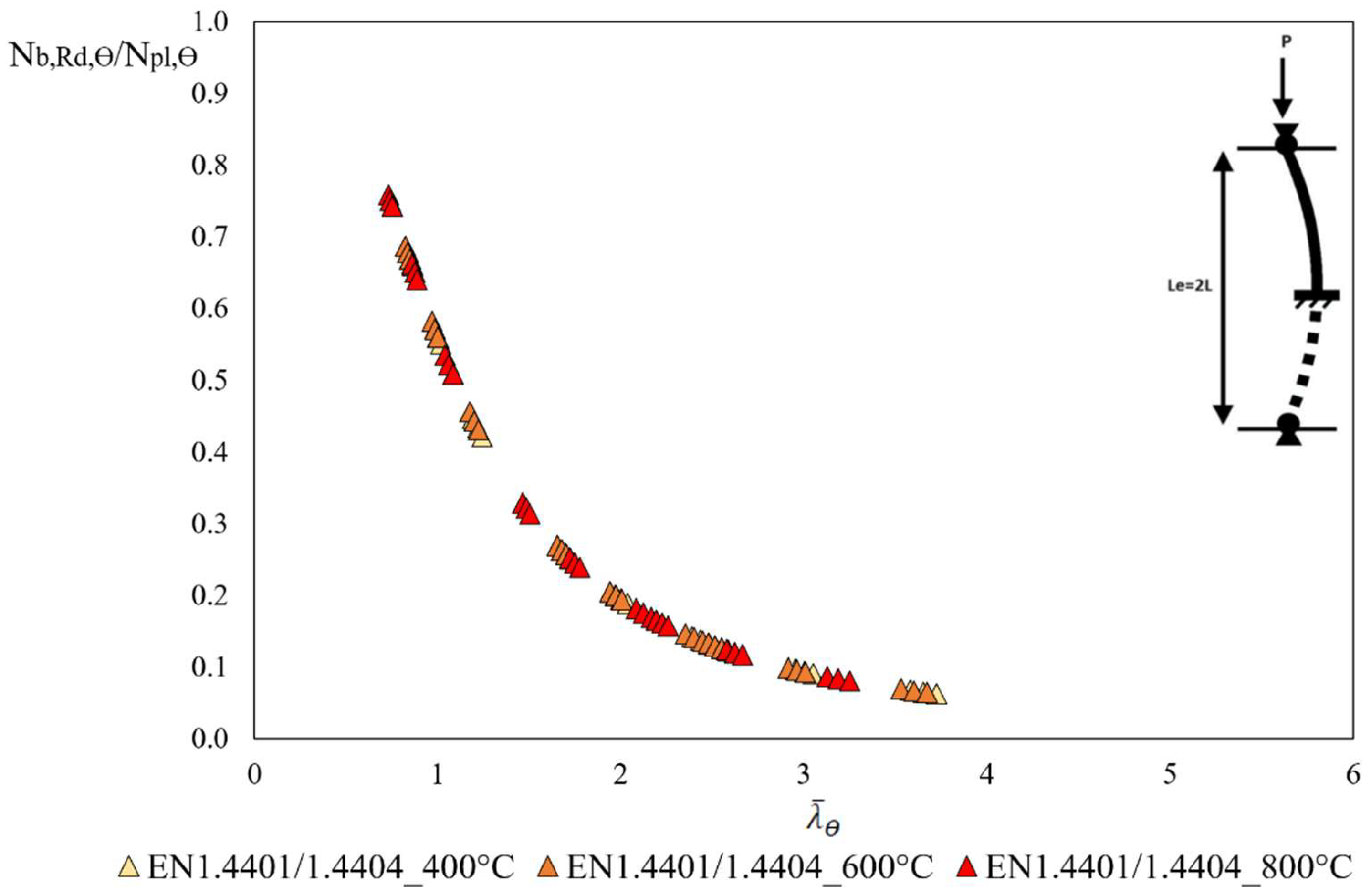
Figure 9.
Buckling resistance ratio Nb,Rd,ϴ/Npl,ϴ for EN 1.4462 at different temperatures.

| Material | E | n | fy, MPa |
|---|---|---|---|
| S235 | 210 | 0.30 | 235 |
| EN 1.4401/1.4404 | 200 | 0.30 | 309.6 |
| EN 1.4462 | 195 | 0.30 | 543 |
Table 2.
Values of the correction factors at elevated temperatures.
| Temperature θ, °C | S235 | EN 1.4401/1.4404 | EN 1.4462 | |||
|---|---|---|---|---|---|---|
| ky,θ | kE,θ | ky,θ_recalc | kE,θ | ky,θ_recalc | kE,θ | |
| 20 (ambient) | 1.00 | 1.00 | 1.00 | 1.00 | 1.00 | 1.00 |
| 100 | 1.00 | 1.00 | 0.90 | 0.96 | 0.92 | 0.96 |
| 200 | 1.00 | 0.90 | 0.81 | 0.92 | 0.81 | 0.92 |
| 300 | 1.00 | 0.80 | 0.76 | 0.88 | 0.77 | 0.88 |
| 400 | 1.00 | 0.70 | 0.71 | 0.84 | 0.73 | 0.84 |
| 500 | 0.78 | 0.60 | 0.66 | 0.80 | 0.66 | 0.80 |
| 600 | 0.47 | 0.31 | 0.62 | 0.76 | 0.56 | 0.76 |
| 700 | 0.23 | 0.13 | 0.53 | 0.71 | 0.38 | 0.71 |
| 800 | 0.11 | 0.09 | 0.40 | 0.63 | 0.28 | 0.63 |
Table 3.
Ratio Nb,Rd(800∘C)/Npl(20∘C) for all materials, representing the buckling resistance at 800°C relative to the ambient plastic cross-section resistance.
Table 3.
Ratio Nb,Rd(800∘C)/Npl(20∘C) for all materials, representing the buckling resistance at 800°C relative to the ambient plastic cross-section resistance.
| Material | Mean, % | Minimum, % | Maximum, % |
|---|---|---|---|
| S235 | 2.56 | 0.64 | 5.75 |
| EN 1.4401/1.4404 | 13.59 | 3.27 | 30.62 |
| EN 1.4462 | 8.52 | 1.95 | 20.79 |
Disclaimer/Publisher’s Note: The statements, opinions and data contained in all publications are solely those of the individual author(s) and contributor(s) and not of MDPI and/or the editor(s). MDPI and/or the editor(s) disclaim responsibility for any injury to people or property resulting from any ideas, methods, instructions or products referred to in the content. |
© 2026 by the authors. Licensee MDPI, Basel, Switzerland. This article is an open access article distributed under the terms and conditions of the Creative Commons Attribution (CC BY) license (http://creativecommons.org/licenses/by/4.0/).
Copyright: This open access article is published under a Creative Commons CC BY 4.0 license, which permit the free download, distribution, and reuse, provided that the author and preprint are cited in any reuse.