

Submitted:
13 October 2026
Posted:
14 October 2026
You are already at the latest version
Abstract
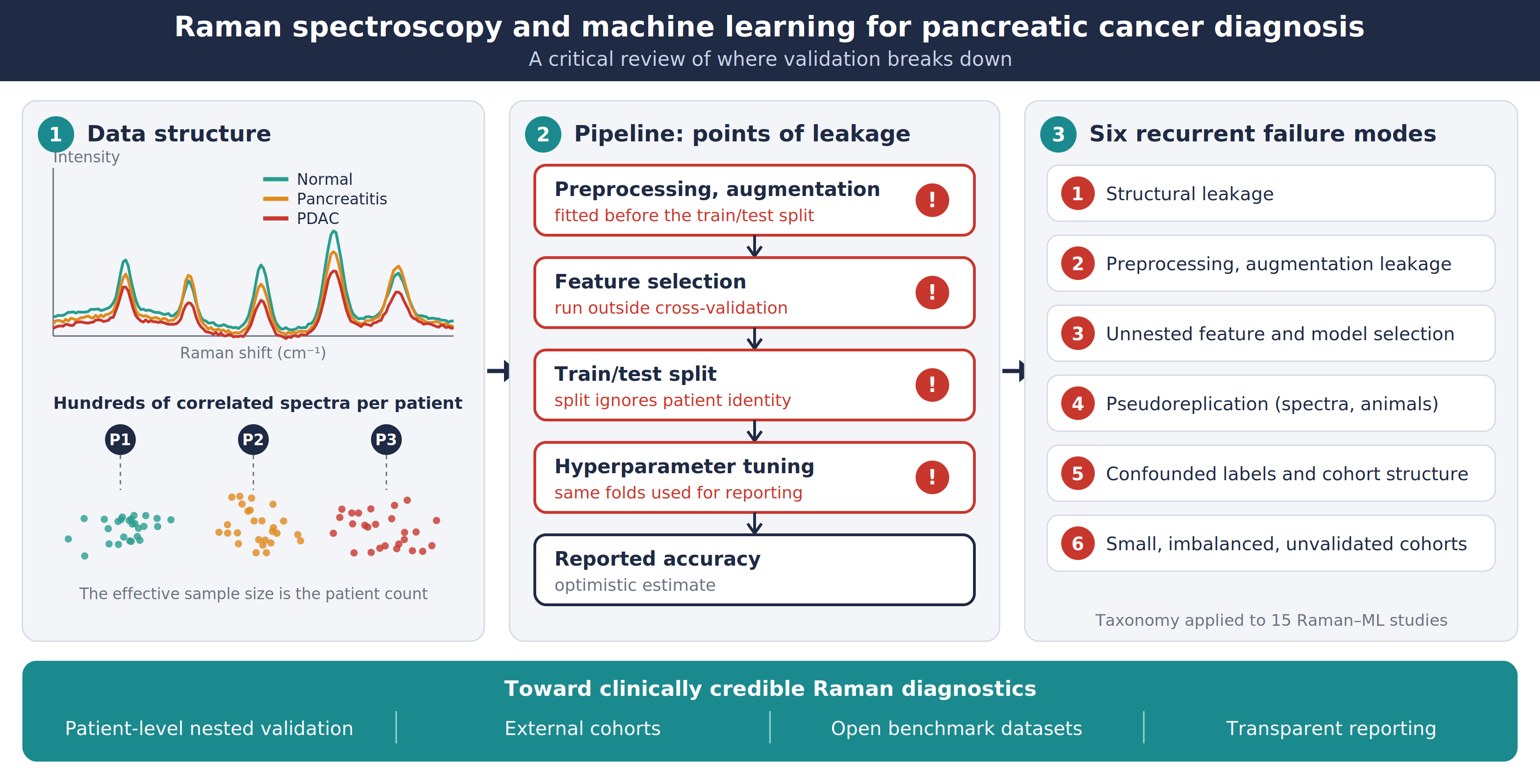
Pancreatic cancer remains difficult to diagnose at an early stage, motivating the development of label-free methods capable of detecting biochemical changes in tissue, cells, and biofluids. Raman spectroscopy provides molecularly specific measurements, but their diagnostic interpretation increasingly relies on chemometric, machine-learning, and deep-learning methods. This review critically examines Raman-based studies related to pancreatic cancer, with particular attention to acquisition modalities, preprocessing, feature extraction, classification, and validation design. Across the reviewed literature, high internal classification performance is frequently accompanied by small numbers of independent biological units, spectral pseudoreplication, unclear patient- or specimenlevel partitioning, data-dependent processing outside training folds, and limited external validation. Differences among instruments and preprocessing pipelines further restrict direct comparison across studies. We therefore distinguish evidence of spectral separability within a dataset from evidence of diagnostic generalization to independent patients. Priorities for the field include transparent reporting, patient-grouped evaluation, training-only preprocessing and model selection, harmonized acquisition and processing procedures, and shared benchmark datasets with sequestered test sets. Raman spectroscopy remains a promising source of biochemical information for pancreatic cancer research, but clinical translation requires reproducible performance across independent patients, laboratories, and acquisition conditions.
Keywords:
Raman spectroscopy
; machine learning
; pancreatic ductal adenocarcinoma
; cancer
; pancreatitis
Copyright: This open access article is published under a Creative Commons CC BY 4.0 license, which permit the free download, distribution, and reuse, provided that the author and preprint are cited in any reuse.