

Submitted:
13 October 2026
Posted:
14 October 2026
You are already at the latest version
Abstract
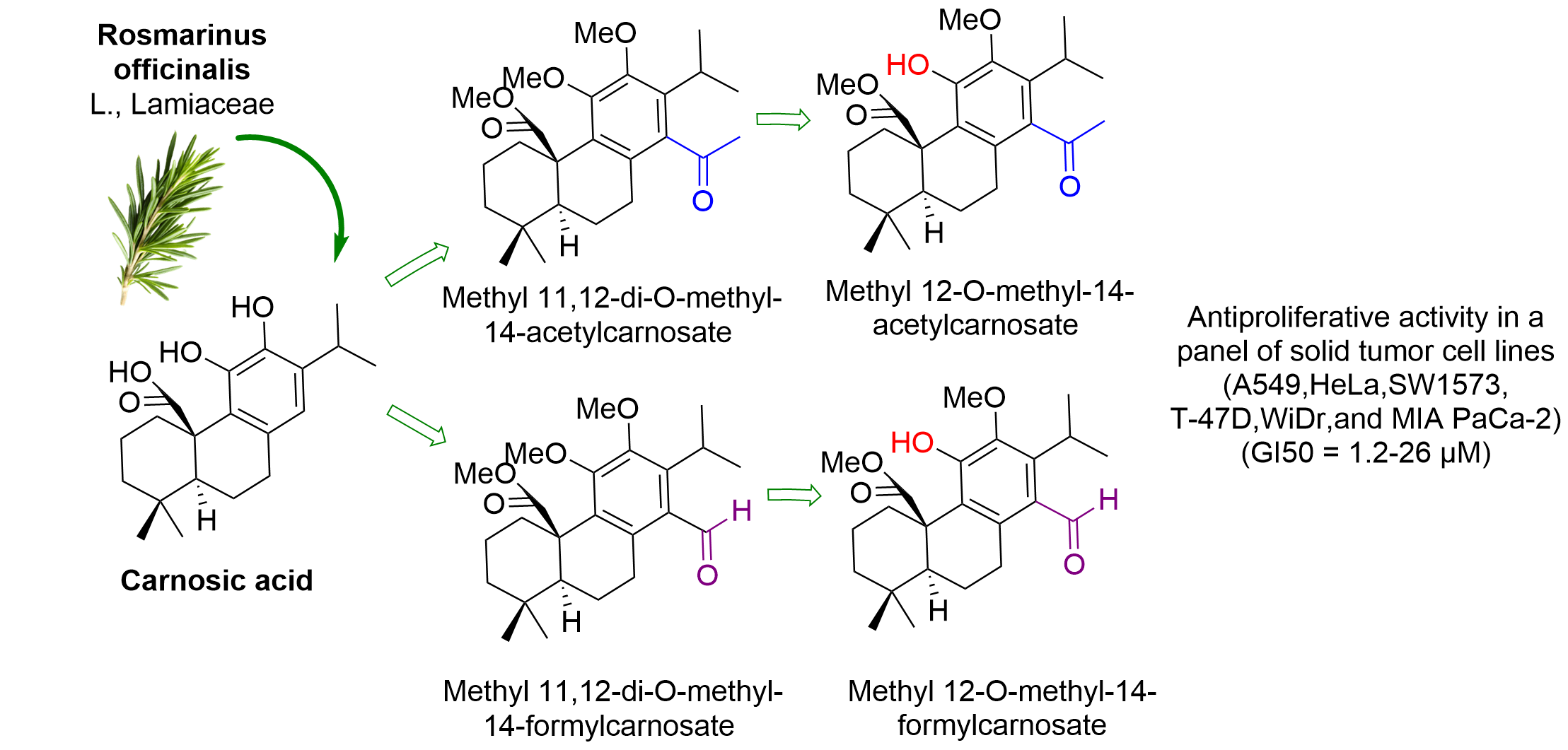
Four new derivatives of bioactive natural carnosic acid were obtained during a planned project of target synthesis starting from readily available natural products. In this work, we describe the synthesis of methyl 11,12-di-O-methyl-14-acetylcarnosate and methyl 11,12-di-O-methyl-14-formylcarnosate from methyl 11,12-di-O-methylcarnosate, which was obtained from commercial carnosic acid, by Friedel-Crafts acylation and formylation, respectively. Despite the low yield of the acylation reaction, 17% (56% brsm) yield, alternative formylation worked well which followed by Grignard addition and oxidation increased to 53% the overall yield of the 14-acetyl derivative. Subsequent selective 11-O-demethylation at low temperature afforded in high yield the corresponding hydroxy derivatives. The structure assignment of the newly synthesized compounds was established by 1H and 13C NMR, 2D-NMR and mass spectrometry. The proximity of the acetyl group at C14 to the characteristic isopropyl group of abietane-type diterpenes at C13 resulted in unusual signals in the 1H and 13C NMR spectra. These four novel compounds were screened in a panel of tumor cell lines and basic structure-activity relationships were deduced. They showed improved antiproliferative activity in comparison with natural carnosic acid, even in the low micromolar range for certain cells.
Keywords:
carnosic acid
; abietane
; NMR
; acetylation
; formylation
; antiproliferative
1. Introduction
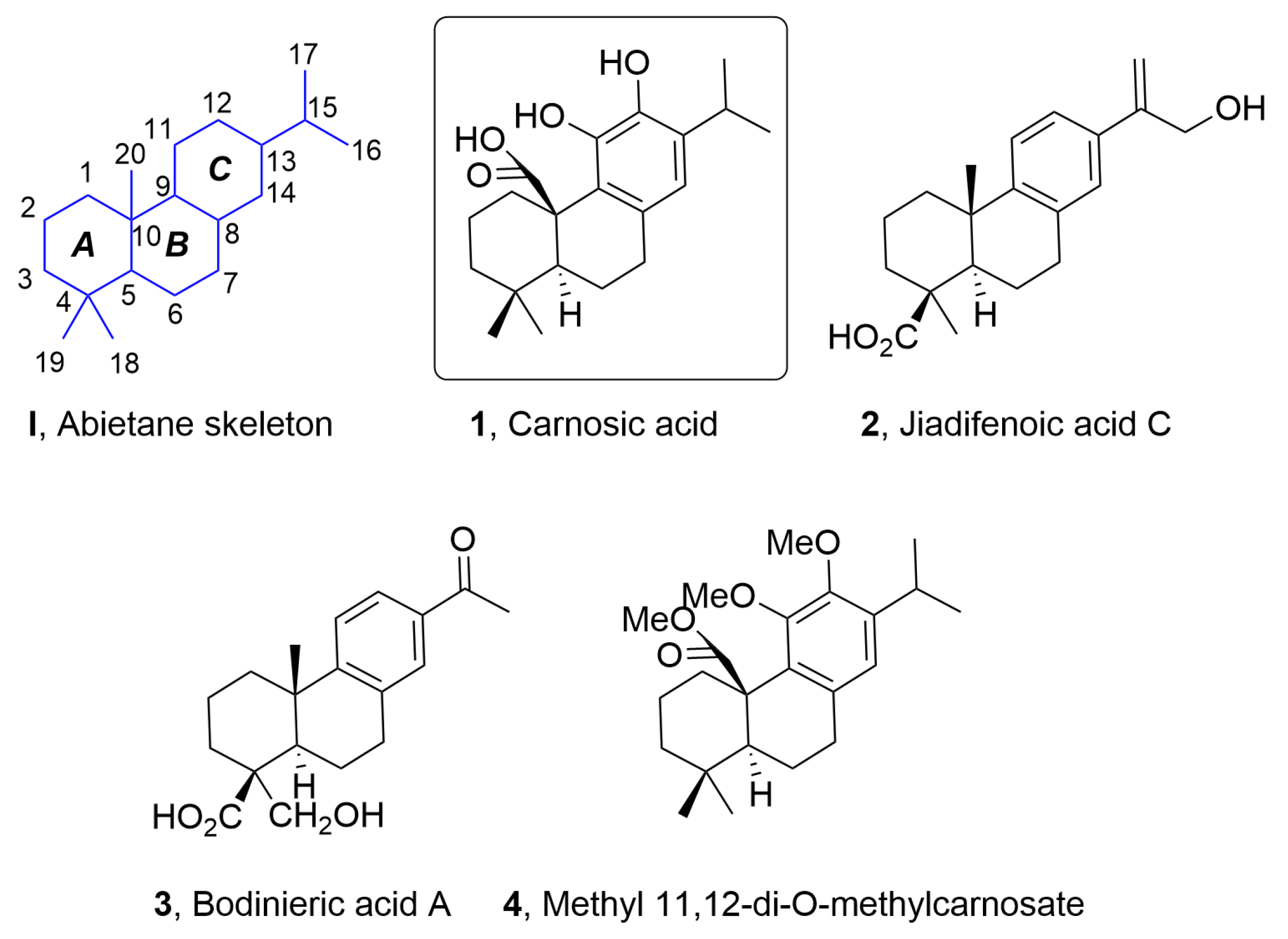
Abietane-type diterpenoids are a family of bioactive natural products occurring in a wide range of plants [1,2], which have shown very interesting biological properties (I, carbon skeleton, Figure 1) [3,4]. Synthetic and medicinal chemists have long been attracted by their structures [5,6], and pharmacological activities of their derivatives [1,4,7]. Our group is devoted for several decades to the total synthesis or semisynthesis of diterpenoids from either marine or plant origin [5,8]. During the last years we are more focused on semisynthesis towards recently isolated bioactive abietanes to confirm the structure and also derivatization of commercially available abietanes towards new therapeutic agents. We became interested in the use of natural carnosic acid (1, Figure 1) [9] in semisynthetic plans due to its known antitumor activities and scarce studies on derivatization [10]. For example, it was envisaged the synthesis of related norabietanes containing an acetyl group at C13 instead of the characteristic isopropyl group. With regard to this, we had experience on functionalization of the typical isopropyl group of abietanes towards the synthesis, for example of jiadifenoic acid C (2) [11], and bodinieric acid A (3) (Figure 1) [12]. However, known dehydrogenation of the isopropyl group failed on methyl carnosate 4 prepared by standard full methylation of carnosic acid (1) [13].
In this communication, we disclose our attempt to introduce an acetyl group in the abietane skeleton of methyl carnosate 4 in a similar manner as it works in ferruginol methyl ether (5) by “ipso” Friedel-Crafts acylation to give nimbosone (Scheme 1) [14]. Nevertheless, undesirable acylation occurred resulting in the introduction of an acetyl group at the only available aromatic position, C14, which in turn, not unexpectedly an organic chemist can also imagine as a product possibility. To our surprise, the obtained 14-acetyl derivative 6 exhibited significantly improved antiproliferative properties in a panel of solid tumor cell lines. As its yield was very low, it was sought an alternative way of preparing it and a three-step synthesis was designed and executed. Interestingly, we also discovered a selective 11-O-demethylation reaction at low temperature which afforded related novel derivatives possessing interesting antiproliferative activities as well.
2. Materials and Methods
2.1. Materials and Equipment
Carnosic acid (98%) was purchased from BLDPharm (Shanghai, China). Acetyl chloride (98%, AcCl), BBr3 (1.0 M) in DCM, MeMgCl (3.0 M) in THF, AlCl3 and pyridinium chlorochromate (98%, PCC) were obtained from Merck Life Science S.L.U. (St. Louis, MO, USA). Cl2CHOCH3 (97%) was purchased from TCI Europe (Zwijndrecht, Belgium). TLC was performed on silica gel 60 F254 plates (Merck Life Science S.L.U., St. Louis, MO, USA) and detected with UV light at 254 nm, visualized by immersion in a 10% sulfuric acid solution and heating with a heat gun. Column chromatography was carried out on silica gel 60 (0.040–0.063 mm, Scharlab S.L., Barcelona, Spain).
Analytical data (instrument): NMR spectra were recorded on Bruker Ascend 400 (9.4T) NMR spectrometer (Billerica, MA, USA). All spectra were recorded in CDCl3 as solvents unless otherwise noted. Cole-Parmer MP-800D melting point apparatus (Vernon Hills, IL, USA), AB Sciex QTOF 6600+ mass spectrometer (Framingham, MA, USA) and JASCO P2000 polarimeter (Tokyo, Japan). Elemental analyses (C, H, N) were performed with a Thermo Scientific™ Flash Smart™ analyzer (Waltham, MA, USA), using sulfanilamide as reference.
2.2. Biology
Cells were maintained in RPMI 1640 supplemented with 5% heat-inactivated fetal calf serum and 2 mM l-glutamine at 37 °C in a humidified incubator with 5% CO2. For assays, exponentially growing cells were trypsinized and re-suspended in antibiotic-containing medium (100 units penicillin G and 0.1 mg of streptomycin per mL) prior to inoculation onto 96-well microtiter plates. Cells were seeded in a volume of 100 μL per well at densities of 2500 (A549, HeLa, MIA PaCa-2 and SW1573) or 5000 (T-47D, WiDr) cells per well.
Tested compounds were dissolved in dimethyl sulfoxide (DMSO) (40 mM initial concentration). Each agent was tested in triplicate at different dilutions ranging from 1 to 100 μM with RPMI 1640 medium. Control cells were exposed to an equivalent concentration of DMSO (0.25% v/v, negative control). The drug treatment was started on day 1 after plating. Drug incubation times were 48 h, after which time cells were precipitated with 25 μL ice-cold trichloroacetic acid (TCA) (50% w/v) and fixed for 60 min at 4 °C. Then the sulforhodamine B (SRB) assay was performed. The optical density (OD) of each well was measured at 530 nm, using BioTek’s PowerWave XS Absorbance Microplate Reader. Values were corrected for background OD from wells only containing medium.
The antiproliferative activity was assessed against a panel of human cancer cell lines using the standard National Cancer Institute (NCI) sulforhodamine B (SRB) assay [15]. The cell lines used in this study were A549 (lung carcinoma), HeLa (cervical adenocarcinoma), MIA PaCa-2 (pancreatic adenocarcinoma), SW1573 (lung carcinoma), T-47D (breast carcinoma), and WiDr (colorectal adenocarcinoma). The human solid tumour cell lines A549 (CCL-185), HeLa (CCL-2), MIA PaCa-2 (CRL-1420), SW1573 (CRL-2170), T-47D (HTB-133), and WiDr (CCL-218) and were acquired from American Type Culture Collection (ATCC, Manassas, VA).
2.3. Chemistry
2.3.1. Synthesis of Methyl 11,12-Di-O-methylcarnosate (4)
To a solution of carnosic acid (1, 2.0 g, 6.1 mmol) in acetone (32.0 mL) at room temperature and under stirring, K2CO3 (3.0 g, 21.8 mmol, 3.5 equiv.) was added in a single portion. Subsequently, Me2SO4 (2.0 mL, 21.1 mmol, 3.3 equiv.) was added dropwise while maintaining stirring. After 72 h, the reaction mixture was filtered, and the resulting solid was washed with acetone (50.0 mL). The filtrate was concentrated under reduced pressure to afford a pale-yellow oil (2.47 g). The crude product was then purified by column chromatography on silica gel (n-hexane/ethyl acetate, 9:1), affording compound 4 (2.32 g, 98.9%) as a pale-yellow oil. All NMR data were in agreement with those reported in the literature [13].
2.3.2. Synthesis of Methyl 12-O-Methylcarnosate (4a)
To a solution of methyl carnosate 4 (160 mg, 0.43 mmol) in anhydrous DCM (5 mL) cooled at –78 °C, BBr3 (1.0 M in DCM, 1.7 mL, 4.0 equiv.) was added dropwise and left to react at –78 °C during 1 h. The reaction mixture was, then, quenched with H2O (5 mL), diluted with ethyl acetate (10 mL), phases separated, and the aqueous layer extracted with ethyl acetate (2 × 10 mL). The combined organic layers were washed with brine (4 mL), dried over Na2SO4 and concentrated under reduced pressure to give an orange oil (164.3 mg). The crude product was purified by column chromatography on silica gel (n-hexane/ethyl acetate, 9:1) to give methyl 12-O-methylcarnosate (4a) as an orange oil (134 mg, 87% yield, 95% purity with 5% impurity as corresponding ester catechol). 1H NMR (400 MHz, CDCl3) δH: 6.52 (s, 1H), 6.09 (s, 1H, OH), 3.73 (s, 3H), 3.62 (s, 3H, CO2Me), 3.54 (dt, J = 13.4, 4.0 Hz, 1H), 3.17 (sept, J = 7.0 Hz, 1H), 2.89-2.77 (m, 2H), 2.32-2.20 (m, 1H), 2.20-2.10 (m, 1H), 1.85-1.79 (m, 1H), 1.59-1.48 (m, 3H), 1.32-1.25 (m, 1H), 1.21-1.19 (m, 7H), 0.97 (s, 3H), 0.78 (s, 3H); 13C NMR (100 MHz, CDCl3) δC: 176.35 (s), 147.71 (s), 142.54 (s), 139.29 (s), 134.35 (s), 125.48 (s), 118.02 (d), 61.65 (q), 54.12 (d), 51.53 (q), 47.87 (s), 41.46 (t), 34.19 (t), 33.90 (s), 32.61 (q), 31.97 (t), 26.45 (d), 23.73 (q), 23.42 (q), 20.05 (q), 20.03 (t), 18.55 (t). All NMR data were in agreement with those reported in the literature except the assignment of geminal protons in C-2 and C-6, and carbons C-8 and C-9 that are interchanged [16].
2.3.3. Synthesis of Methyl 11,12-di-O-methyl-14-acetylcarnosate (6)
To a solution of 4 (954 mg, 2.55 mmol) in anhydrous DCM (10 mL) at 0 °C, acetyl chloride (98%, 1.6 mL, 22.9 mmol, 9.0 equiv.) was added dropwise. Then, under vigorous stirring, anhydrous AlCl3 (2.0 g, 15.3 mmol, 6.0 equiv.) was added in small portions for 5 minutes and left to react for 3 h. The reaction mixture was quenched with 10% aqueous HCl (12 mL) at 0 °C, phases separated, and the aqueous layer was extracted with Et2O (3 × 20 mL). The combined organic layers were washed with saturated aqueous NaHCO3 (12 mL), brine (10 mL), dried over Na2SO4 and concentrated under reduced pressure to afford an orange oil. The crude product was subsequently purified by column chromatography on silica gel (n-hexane/ethyl acetate, 9:1) to give 6 as a yellowish solid (179.3 mg, 17% yield, 56% based on recovered starting material, brsm), and a portion of recovered starting material, compound 4 (666.8 mg). Melting point (m.p.): 150-152 °C; [a]25D= +108.2° (c 0.37, DCM). 1H NMR (400 MHz, CDCl3) δH: 3.76 (s, 3H), 3.65 (s, 3H, CO2Me), 3.58 (s, 3H), 3.34 (dt, J = 13.5, 4.6 Hz, 1H), 2.64 (sept, J = 7.0 Hz, 1H), 2.67-2.54 (m, 2H), 2.45 (s, 3H, COMe), 2.30-2.19 (m, 1H), 2.19-2.09 (m, 1H), 1.79-1.75 (m, 1H), 1.55-1.49 (m, 2H), 1.44 (dd, J = 12.5, 1.4 Hz, 1H), 1.33-1.27 (m, 7H), 1.16-1.08 (m, 1H), 0.93 (s, 3H), 0.75 (s, 3H); 13C NMR (100 MHz, CDCl3) δC: 209.15 (s), 176.33 (s), 152.95 (s), 150.47 (s), 137.50 (s), 135.74 (s), 134.63 (s), 127.07 (s), 59.47 (q), 58.75 (q), 53.32 (d), 51.43 (q), 48.19 (s), 40.77 (t), 35.19 (t), 33.54 (s), 33.05 (q), 32.48 (q), 31.27 (d), 29.06 (t), 22.01 (q), 21.67 (q), 19.98 (t), 19.59 (q), 17.92 (t). HRMS (ESI) m/z 417.2620 [M+H]+, calcd for C25H37O5: 417.2641; Anal. calcd. for C25H36O5: C, 72.1; H, 8.7; Found: C, 71.8; H, 8.7.
2.3.4. Synthesis of Methyl 12-O-Methyl-14-acetyl carnosate (6a)
To a solution of 6 (82.8 mg, 0.20 mmol) in anhydrous DCM (2.5 mL) at –78 °C, BBr3 solution (1.0 M in DCM, 0.80 mL, 0.80 mmol, 4.0 equiv.) was added dropwise and left to react at -78 °C during 2 h. Then, it was quenched with H2O (3 mL), diluted with Et2O (10 mL), phases separated, and the aqueous layer extracted with 5 mL Et2O. The combined organic layers were washed with brine (2 mL), dried over Na2SO4 and concentrated under reduced pressure to give an orange foam (77 mg). The crude product was purified by column chromatography on silica gel (n-hexane/ethyl acetate, 9:1) to give compound 6a as a greenish foam (60.8 mg, 76% yield). Melting point (m.p.): 152-154 °C; [a]20D = +150.5 (c 0.32, DCM), 1H NMR (400 MHz, CDCl3) δH: 6.39 (s, 1H, OH), 3.77 (s, 3H), 3.64 (s, 3H, CO2Me), 3.42 (dt, J = 13.6, 3.5 Hz, 1H), 2.73 (sept, J = 7.0 Hz, 1H), 2.66-2.58 (m, 2H), 2.46 (s, 3H, COMe), 2.30-2.17 (m, 1H), 2.10-1.98 (m, 1H), 1.84-1.78 (m, 1H), 1.61-1.54 (m, 1H), 1.53-1.46 (m, 1H), 1.50 (dd, J = 12.7, 1.6 Hz, 1H), 1.32-1.25 (m, 7H), 1.16 (ddd, J = 13.2, 13.1, 3.9 Hz, 1H), 0.96 (s, 3H), 0.76 (s, 3H); 13C NMR (100 MHz, CDCl3) δC: 209.11 (s), 176.84 (s), 149.22 (s), 145.30 (s), 134.72 (s), 134.26 (s), 128.23(s), 126.50 (s), 61.19 (q), 53.36 (d), 51.83 (q), 48.41 (s), 41.34 (t), 34.39 (t), 33.88 (s), 33.26 (q), 32.46 (q), 30.63 (d), 28.95 (t), 22.32 (q), 21.91 (q), 20.38 (q), 20.00 (t), 18.13 (t). HRMS (ESI) m/z 403.2482 [M+H]+, calcd for C24H35O5: 403.2484; Anal. calcd. for C24H34O5: C, 71.6; H, 8.5; Found: C, 72.1; H, 8.7.
2.3.5. Synthesis of Methyl 11,12-Di-O-methyl-14-formyl carnosate (7)
To a solution of 4 (519 mg, 1.5 mmol) in anhydrous DCM (2 mL) cooled in an ice-salt bath at –5 °C, Cl2CHOCH3 (97%, 0.42 mL, 4.5 mmol, 3.0 equiv.) was added. Then, AlCl3 (635 mg, 4.7 mmol, 3.2 equiv.) was added slowly and in small portions during 5-10 min. It was left to react over 1h 30 minutes. Then, it was quenched with cold aqueous 10% HCl (1.5 mL), diluted with H2O (3 mL) and ethyl acetate (3 mL). Phases separated and the aqueous phase was extracted with 4 mL of ethyl acetate. Then, the combined organic phases were washed with H2O (2 × 5 mL) and brine (5 mL). Next, it was dried over Na2SO4, filtrated and concentrated under reduced pressure to give a yellowish solid. The crude product was subsequently purified by column chromatography on silica gel (n-hexane/ethyl acetate 9:1, adding a little bit of DCM to the crude to increase solubility) to give 7 as a yellowish semisolid (464.2 mg, 76% yield). Melting point (m.p.): 142-144 °C; [a]25D = +179.4 (c 0.3, DCM). 1H NMR (400 MHz, CDCl3) δH: 10.54 (s, 1H, CHO), 3.74 (s, 3H), 3.67 (s, 3H), 3.66 (s, 3H, CO2Me), 3.52 (sept, J = 7.0 Hz, 1H), 3.27 (dt, J = 13.0 Hz, 4.0 Hz, 1H), 2.98-2.95 (m, 2H), 2.34-2.22 (m, 1H), 2.12-2.02 (m, 1H), 1.86-1.80 (m, 1H), 1.60-1.50 (m, 2H), 1.46 (dd, J = 12.6, 1.0 Hz, 1H), 1.35 (d, J = 7.0 Hz, 3H), 1.34 (d, J = 7.0 Hz, 3H), 1.29-1.20 (m, 1H), 1.15-1.08 (m, 1H), 0.96 (s, 3H), 0.76 (s, 3H). 13C NMR (100 MHz, CDCl3) δC: 195.63 (d), 176.44 (s), 155.80 (s), 149.93 (s), 142.18 (s), 136.46 (s), 134.45 (s), 130.55 (s), 59.72 (q), 59.01 (q), 52.93 (d), 51.49 (q), 48.33 (s), 40.48 (t), 35.35 (t), 33.37 (s), 32.42 (q), 30.42 (t), 27.51 (d), 22.50 (q), 22.34 (q), 19.94 (t), 19.60 (q), 17.93 (t). HRMS (ESI) m/z 403.2481 [M+H]+, calcd for C24H35O5: 403.2484; Anal. calcd. for C24H34O5: C, 71.6; H, 8.5; Found: C, 72.2; H, 8.7.
2.3.6. Synthesis of Methyl 12-O-Methyl-14-formyl carnosate (7a)
To a solution of 7 (73 mg, 0.18 mmol) in anhydrous DCM (2.5 mL) cooled at –78 °C, BBr3 (1.0 M in DCM, 0.8 mL, 4.3 equiv.) was added slowly. Then, it was left to react for 1h 30 min. at –78 °C. Then, the reaction mixture was quenched with cold H2O (3 mL) and diluted with ethyl acetate (10 mL). The aqueous phase was extracted with ethyl acetate (5 mL) and the combined organic layers were washed with brine (2 mL), dried over Na2SO4 and concentrated under reduced pressure to give a greenish oil (74.5 mg). The crude product was subsequently purified by column chromatography on silica gel (n-hexane/ethyl acetate, 8:2) to give 7a as greenish semisolid (52.8 mg, 75% yield; 90% purity, 10% impurity as ester catechol). Melting point (m.p.): 135-140 °C. 1H NMR (400 MHz, CDCl3) δH: 10.56 (s, 1H), 6.58 (s, 1H, OH), 3.74 (s, 3H), 3.64 (s, 3H, CO2Me), 3.68-3.60 (m, 1H), 3.40 (dt, J = 13.5, 4.5 Hz, 1H), 3.11-2.99 (m, 2H), 2.27-2.18 (m, 1H), 2.18-2.08 (m, 1H), 1.91-1.84 (m, 1H), 1.61-1.54 (m, 2H), 1.54-1.49 (m, 1H), 1.43 (d, J = 7.5 Hz, 3H), 1.38 (d, J = 7.5 Hz, 3H), 1.31-1.24 (m, 1H), 1.13 (ddd, J = 12.6, 4.6 Hz, 1H), 0.97 (s, 3H), 0.77 (s, 3H). 13C NMR (100 MHz, CDCl3) δC: 193.98 (d), 176.40 (s), 151.84 (s), 143.62 (s), 142.43 (s), 138.39 (s), 128.07 (s), 127.22 (s), 61.91 (q), 52.99 (d), 51.72 (q), 48.24 (s), 40.86 (t), 34.37 (t), 33.56 (s), 32.38 (q), 31.04 (t), 26.56 (d), 23.50 (q), 23.07 (q), 19.92 (t), 19.90 (q), 18.02 (t). HRMS (ESI) m/z 389.2328 [M+H]+, calcd for C23H33O5: 389.2328.
2.3.7. Synthesis of Methyl 11-12-Di-O-methyl-14-(1-hydroxyethyl)carnosate (8)
To a solution of 7 (204.3 mg, 0.5 mmol) in anhydrous THF (4 mL) and cooled to –5 °C, CH3MgCl (3.0 M in THF, 0.24 mL, 1.4 equiv.) was added slowly. Then, it was left to react 1h before adding more CH3MgCl (0.1 mL, 0.6 equiv.). After being stirred for 1h 30 min., the reaction mixture was quenched with cold NH4Cl (2 mL), diluted with ethyl acetate (5 mL), and phases separated. The aqueous phase was extracted with ethyl acetate (5 mL). The combined organic phases were washed with brine (2 mL), dried over Na2SO4 and concentrated under reduced pressure to give a white foam. The crude product was subsequently purified by column chromatography on silica gel (n-hexane/ethyl acetate 8:2) to give product 8 as a yellowish semisolid (105.6 mg, 50% yield, 81% based on recovered starting material) and recovered starting material (78.2 mg). Major diastereomer (66% estimated by 1H NMR, ratio ca. 2:1) 1H NMR (400 MHz, CDCl3) δH: 5.50 (q, 1H), 3.76 (s, 3H), 3.67 (s, 3H), 3.57 (s, 3H), 3.28 (dt, 1H), 3.08-3.03 (m, 1H), 2.78-2.55 (m, 2H), 2.34-2.22 (m, 1H), 2.18- 2.09 (m, 1H), 1.88-1.79 (m, 1H), 1.53 (d, J = 6.8 Hz, 3H), 1,44-1,34 (m, 2H), 1.31 (d, J = 7.0 Hz, 6H), 1.13-1.06 (m, 1H), 0.95 (s, 3H), 0.76 (s, 3H).
2.3.8. Synthesis of Methyl 11-12-Di-O-methyl-14-acetyl carnosate (6) by Oxidation of Methyl 11-12-Di-O-methyl-14-(1-hydroxyethyl)carnosate (8)
To a solution of 8 (92 mg, 0.22 mmol) dissolved in DCM (4.2 mL), PCC (98%, 81.1 mg, 1.7 equiv.) was added in one portion and left to react till no starting material was observed by TLC. Then, it was filtrated using a short pad of silica gel and pure DCM as eluent to give compound 6 as a white semi-solid (79.8 mg, 87% yield). The structure was confirmed by 1H and 13C NMR data in CDCl3 as detailed previously in this work.
3. Results and Discussion
3.1. Synthesis
3.1.1. Preparation and Spectroscopic Characterization of Compound 6
The synthesis of acetyl derivative 6 was carried out by standard Friedel–Crafts acylation of compound 4 (Scheme 1). The conversion reached a maximum of only 17–18% yield during the early stages of the reaction (1–3 h). Although the conversion did not increase at longer reaction times, the amount of recovered starting material, compound 4, progressively decreased owing to its decomposition and the formation of different unidentified by-products. Among them some resulting from demethylation. At shorter reaction times, a significant portion of compound 4 could still be recovered (60-80%).
Extensive experimental studies demonstrate that this reaction does not afford the desired ipso-Friedel–Crafts acylation product, as electrophilic substitution occurs at C14, the only available unsubstituted aromatic position. The methoxy groups act, in general, as ortho/para-directing substituents, increasing the electron density at C14 and making this position more reactive than C13 toward substitution and electrophilic acylation. Additional support for this hypothesis is provided by the Friedel–Crafts acylation of ferruginol methyl ether, which bears only a methoxy substituent at C12. Under identical reaction conditions, acylation occurs through ipso substitution of the isopropyl group rather than electrophilic substitution at C14 (Scheme 1) [14]. This difference indicates that the C11 methoxy group exerts an electronic influence on the C13 meta position and para-related C14 position, resulting into direct acylation at this latter carbon.
It is worth noting that the possibility of an in-situ demethylation of the methoxy groups (C11 and C12 or methyl ester at C20) under the reaction conditions was also investigated. However, no evidence of deprotection was observed at shorter reaction times. Since demethylation with AlCl3 requires the acetyl group to be adjacent to the methoxy substituent, the conversion of compound 6 into the corresponding catechol derivative, compound 6a, requires the use of strong Lewis acids such as BBr3.
Compound 6 exhibited an unusual NMR signal pattern, which appears to be associated with the combined presence of the acetyl substituent at C14 and the methoxy groups. These anomalies were consistently observed in both 1H and 13C NMR spectra recorded in CDCl3. In the 1H NMR spectrum, the characteristic doublet (d) corresponding to each methyl group of the isopropyl moiety appeared broadened and less resolution, due to significant signal broadening and marked decrease in intensity. As a result, this resonance was largely overlapped with other proton signals of ring A, as confirmed by two-dimensional NMR experiments. A similar, although less pronounced, effect was also observed for the resonance of the methyl ester group, which displayed reduced intensity and slight line broadening compared with the other methoxy signals.
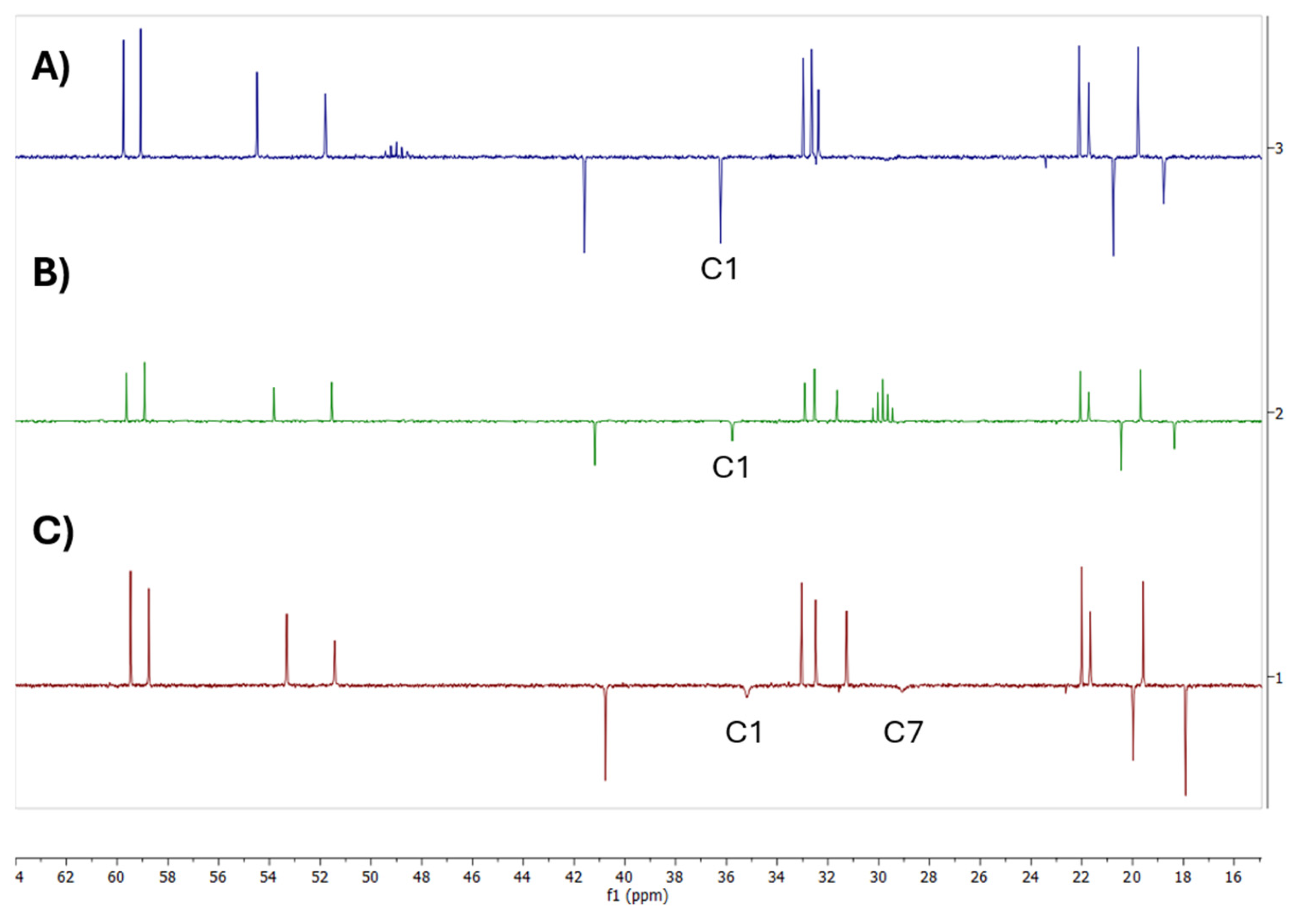
Further anomalies were detected in the 13C DEPT spectrum, where two expected CH2 signals were initially absent on DEPT135. A detailed solvent-dependent study on acetone-d6 and MeOD revealed that these resonances were present but exhibited markedly different intensities depending on the solvent employed (Figure 2). The affected carbons were assigned to C1 (δC = 35.19 ppm) and C7 (δC = 29.06 ppm), whose reduced intensity is likely influenced by the proximity of both the ester and the acetyl functionalities. Apparently, there could be some anisotropy or sterical effect due to the introduced carbonyl group and the proximity of the isopropyl group. In CDCl3, both signals displayed low intensity and broad line shapes, resulting in poor spectral resolution. In acetone-d6 and MeOD, C1 signal showed an improvement in intensity and a slight increase on resolution, while C7 signal exhibited no improvement.
3.1.2. Alternative Synthetic Route to Acetyl Derivative 6
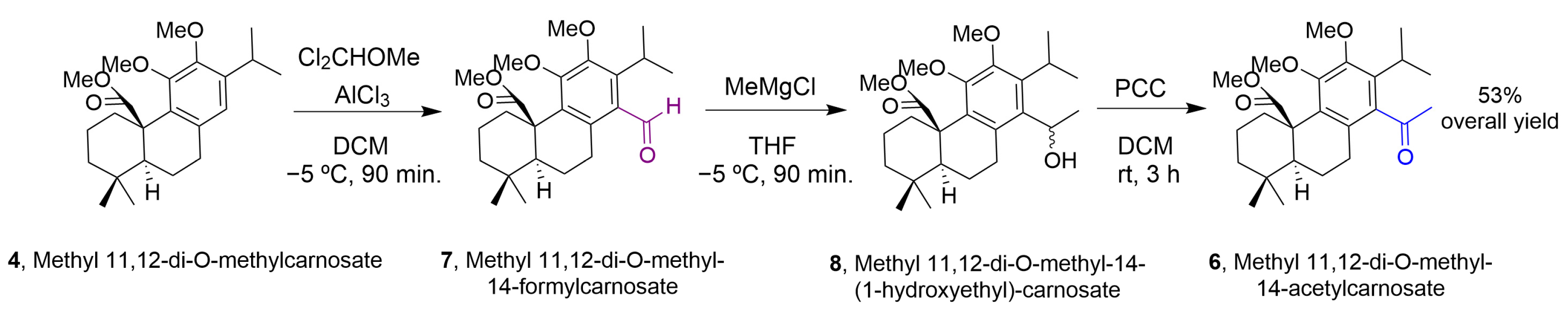
Due to the low yield of the Friedel–Crafts acylation, an alternative strategy was explored to improve the efficiency of C14 functionalization. Instead of direct acylation, this approach relies on the introduction of a new acyl functionality, specifically an aldehyde group at the C14 position using Cl2CHOCH3 and subsequently conversion into the corresponding methyl ketone by Grignard addition and oxidation (Scheme 2).
The C14-formylated product 7 was obtained in 76% yield which was converted into the desired methyl ketone in 53% overall yield from ester 4, representing a substantial improvement over the direct Friedel–Crafts acylation route. This approach may suggest that the electrophilic intermediate generated from Cl2CHOCH3 may be more favorably oriented towards the C14 position on an electrophilic aromatic substitution reaction than the generated with AcCl. The enhanced reactivity is likely associated with both electronic and sterical effects.
3.1.3. Synthesis of O-Demethylated Derivatives from Compounds 6 and 7
To further expand the structural diversity of the synthesized diterpenes and access derivatives with potentially enhanced biological properties, the preparation of deprotected analogues was investigated. In particular, the methoxy and ester protecting groups of compounds 6 and 7 were targeted to obtain the corresponding phenolic derivatives. Initial efforts were directed toward the preparation of the corresponding catechol derivative through complete demethylation of the aromatic methoxy groups. The first assays were performed by carrying out the reaction at 0 °C and the formation of the catechol and mono-methoxy ester derivatives were detected by 1H NMR. However, although the desired catechol derivative was formed under these conditions, it could not be satisfactorily isolated in a pure form.
During the optimization of the demethylation conditions, a selective cleavage of the C11 methoxy group was unexpectedly observed while performing at low temperature and short reaction times (Scheme 3). The observed selectivity is likely related to the low reaction temperature (−78 °C) employed during the demethylation process. The experimental results are consistent with an initial cleavage of the C11 methoxy group at –78 °C, followed by demethylation at C12 and, subsequently, hydrolysis of the methyl ester under more forcing conditions while increasing the temperature reaction to 0 °C. The selective C11 deprotection observed in this work therefore appears to represent the first step of the overall deprotection sequence.
The optimized conditions were subsequently applied to several related substrates bearing the same aromatic substitution pattern (Scheme 3). In all cases, selective deprotection at C11 was observed while the C12 methoxy group remained intact. Although the reaction proceeds with high yield, complete conversion is not achieved. The C11-deprotected compounds (4a,6a,7a) are therefore typically isolated with a purity ≥ 90-95%, being the main impurity the corresponding ester catechol derivative. Owing to its nearly identical Rf value, this impurity could not be readily separated by column chromatography.
3.2. Structural Elucidations
All compounds were analyzed by 1H, 13C, DEPT135, DEPT90, and 2D-NMR data to elucidate its structure (Figure 3, skeleton numbering). In Table 1 are displayed the assignments for 1H NMR data while in Table 2 are the corresponding 13C NMR data assignments for compounds 4a-7a. In Figure 4 and Figure 5, key COSY and HMBC correlations and NOESY interections are depicted.
The NOESY spectra provided key through-space correlations that, together with the COSY and HMBC data, support the proposed structures and stereochemical assignments of the compounds shown in Figure 2.
NOESY analysis compound 6 (Figure 5a): H-1β showed cross-peaks with H-1α, H-2α, and H-2β, whereas H-1α correlated with H-2α. H-2β exhibited NOE interactions with H-2α and H-1α/H-1β, while H-3α correlated with H-3β. In ring B, H-5 showed correlations with H-18, H-6α, H-6β, and H-7, and H-6β displayed additional NOE with H-6α and H-7. H-7 was also spatially correlated with H-5 and H-6α. The methyl ketone group (H-22) exhibited NOESY with H-7, H-15, H-16, and H-17 while H-15 shows correlation with both methyl groups (H-16 and H-17). In turn, H-16 and H-17 each showed correlations with MeO-12 and H-15. Finally, H-18 displayed NOE with H-3α, H-5, H-6α, and H-19, while H-19 correlated with H-2β, H-3β, H-6β, and H-18.
NOESY analysis compound 6a (Figure 5b): H-1β shows correlations with the OH group at C11 and with both protons at C2. H-6β exhibits strong correlations with H-18 and H-19, whereas H-2β and H-3β show correlations only with H-19. In addition, H-6α correlates with H-5, H18, and both protons at C7. Finally, the strong NOE correlation observed between H-19 and the CO2Me group at C10 provides further evidence of their close spatial proximity.
NOESY analysis compound 7 (Figure 5c): In the C1–C3 region, H-1β shows correlations with H-1α, H-2α, and H-2β, while H-2α correlates with H-2β, H-3α, and H-3β; H-2β further correlates with H-19 and H-3β. H-3α shows correlations with H-18 and H-19, whereas H-3β additionally correlates with H-18, H-19, H-5, H-1α, and H-1β. In the central region, H-5 correlates with H-18, H-19, H-6α, H-6β, and the H-7 protons, while H-6α shows correlations with H-18, H-19, H-5, H-6β, and H-7, and H-6β correlates with H-19, H-5, H-6α, and H-7. The correlations observed for H-18 and H-19 further support the spatial arrangement of this region. Within the isopropyl group, H-15 correlates with the 12-MeO group and both H-16 and H-17, while the CO2Me group shows a NOE correlation with C-19, indicating close spatial proximity.
NOESY analysis compound 7a (Figure 5d): Strong correlations among the protons at C1–C3, indicating their close spatial proximity. H-1β shows a NOE correlation with the methoxy group of the ester at C10, which in turn correlates with C-19. H-3α exhibits a correlation with H-18, while the methoxy group at C12 shows NOE correlations with the adjacent isopropyl group. The protons within the isopropyl group (H-15, H-16 and H-17) also display mutual correlations, consistent with their close spatial arrangement.
3.3. Biological Activity
The synthesized compounds were screened in a panel of solid tumor cell lines (A549, HeLa, SW1573, T-47D, WiDr, and MIA PaCa-2) using the SRB assay of the US National Cancer Institute [15] with few modifications in-house [17]. Antiproliferative activity of the compounds was expressed as GI50, which is the concentration of the compound that inhibits 50% of the culture growth (Table 3). Values are mean of three values ± standard deviation.
The compounds exhibited inhibitory activity with GI50 values below 100 μM. Notably, compounds 6 and 7 exhibited a pronounced increase in inhibitory potency relative to the parent compound. Remarkably, when compared with the reference drugs (cisplatin and etoposide), compounds 6 and 7 displayed greater potency against the SW1573, T-47D and WiDr cell lines; meanwhile their activity against A549 and HeLa cell lines were in a similar range. This substantial improvement in activity highlights the favorable effect of the introduction of methyl ketone and an aldehyde group at C14, respectively, which appears to favor the molecular features required for effective target interaction. By contrast, compounds 6a and 7a showed considerably weaker activity than 6 and 7, suggesting that the deprotection of C11 O-methoxy group is not favorable for inhibitory activity. All compounds followed Lipinski’s rules (Table 4).
Supplementary Materials
The following supporting information can be downloaded at Preprints.org, Figure S1-S41: NMR spectra of compounds 4a, 6, 6a, 7, 7a and 8; Figure S42-S45: mass spectra of compounds 6, 6a, 7, 7a.
Author Contributions
Conceptualization, M.A.G.-C.; methodology, M.A.G.-C., W.E.M.-H., J.M.P..; validation, M.A.G.-C. and J.M.P.; formal analysis, M.A.G.-C., N.L.-C., W.E.M.-H, A.G.-B., J.M.P.; investigation, M.A.G.-C., N.L.-C., W.E.M.-H., A.G.-B., and J.M.P.; resources, M.A.G.-C. and J.M.P.; writing—original draft preparation, N.L.-C., M.A.G.-C.; writing—review and editing, M.A.G.-C. and J.M.P.; funding acquisition, M.A.G.-C and J.M.P.. All authors have read and agreed to the published version of the manuscript.
Funding
The authors thank the Spanish Government (Projects PID2021-123059OB-I00, PID2023-146114NB-C21 and CEX2021-001230-S funded by MCIN/AEI /10.13039/501100011033 /FEDER, UE) for financial support. This research was also supported by the regional government “Generalitat Valenciana, Conselleria de Educación, Universidades y Empleo”, grant number CIAICO/2022/220 to M.A.G.-C. W.E.M.-H. also thanks the regional government “Generalitat Valenciana” for a PhD contract (grant number CIACIF/2024/510). A.G.-B. thanks the Asociación Española Contra el Cáncer (AECC) de Santa Cruz de Tenerife for predoctoral grant PRDTF233958GONZ.
Data Availability Statement
The data is available in the article and further details upon request.
Acknowledgments
We acknowledge the support given by the characterization department of the “Instituto de Tecnologia Quimica, ITQ” for providing the NMR, elemental composition and high-resolution mass spectra (through Universitat de Valencia) of the samples.
Conflicts of Interest
The authors declare no conflicts of interest.
References
- Sargazifar, Z.; Ghorbanian Charami, D.; Esmaeilzadeh Kashi, M.; Asili, J.; Shakeri, A. Abietane-Type Diterpenoids: Insights into Structural Diversity and Therapeutic Potential. Chem. Biodivers. 2024, 21, e202400808. [Google Scholar] [CrossRef] [PubMed]
- Rahimi, A.; Emami, S.A.; Akaberi, M. Diterpenes of Salvia (2016–2024): Phytochemistry and Pharmacology. Phytochem Rev. 2025, 24, 4939–5017. [Google Scholar] [CrossRef]
- González, M.A. Aromatic Abietane Diterpenoids: Their Biological Activity and Synthesis. Nat. Prod. Rep. 2015, 32, 684–704. [Google Scholar] [CrossRef] [PubMed]
- Antoniuk, O.; Maranha, A.; Salvador, J.A.R.; Empadinhas, N.; Moreira, V.M. Bi- and Tricyclic Diterpenoids: Landmarks from a Decade (2013–2023) in Search of Leads against Infectious Diseases. Nat. Prod. Rep. 2024, 41, 1858–1894. [Google Scholar] [CrossRef] [PubMed]
- González, M.A. Aromatic Abietane Diterpenoids: Total Syntheses and Synthetic Studies. Tetrahedron 2015, 71, 1883–1908. [Google Scholar] [CrossRef]
- Kang, J.; Quynh Le, T.; Oh, C.H. Recent Advances in Abietane/Icetexane Synthesis. Tetrahedron Lett. 2022, 108, 154133. [Google Scholar] [CrossRef]
- González, M.A. Synthetic Derivatives of Aromatic Abietane Diterpenoids and Their Biological Activities. Eur. J. Med. Chem. 2014, 87, 834–842. [Google Scholar] [CrossRef] [PubMed]
- González, M.A. Total Syntheses and Synthetic Studies of Spongiane Diterpenes. Tetrahedron 2008, 64, 445–467. [Google Scholar] [CrossRef]
- Birtić, S.; Dussort, P.; Pierre, F.-X.; Bily, A.C.; Roller, M. Carnosic Acid. Phytochemistry 2015, 115, 9–19. [Google Scholar] [CrossRef] [PubMed]
- Moura, S.P.S.P.; Moreira, V.M.; Salvador, J.A.R. Carnosic Acid and Its Semisynthetic Derivatives as Promising Anticancer Agents. Int. J. Mol. Sci. 2026, 27, 1149. [Google Scholar] [CrossRef] [PubMed]
- González, M.A.; Zaragozá, R.J. Semisynthesis of the Antiviral Abietane Diterpenoid Jiadifenoic Acid C from Callitrisic Acid (4-Epidehydroabietic Acid) Isolated from Sandarac Resin. J. Nat. Prod. 2014, 77, 2114–2117. [Google Scholar] [CrossRef] [PubMed]
- Zaragozá, R.J.; González-Cardenete, M.A. Synthesis of Bodinieric Acids A and B, Both C-18 and C-19-Functionalized Abietane Diterpenoids: DFT Study of the Key Aldol Reaction. RSC Adv. 2020, 10, 15015–15022. [Google Scholar] [CrossRef] [PubMed]
- Zhou, B.; Li, X.; Feng, H.; Li, Y. Efficient Synthesis of the Key Intermediate Triptophenolide Methyl Ether for the Synthesis of (−)-Triptolide. Tetrahedron 2010, 66, 5396–5401. [Google Scholar] [CrossRef]
- Tada, M.; Kurabe, J.; Yoshida, T.; Ohkanda, T.; Matsumoto, Y. Syntheses and Antibacterial Activities of Diterpene Catechol Derivatives with Abietane, Totarane and Podocarpane Skeletons against Methicillin-Resistant Staphylococcus Aureus and Propionibacterium Acnes. Chem. Pharm. Bull. 2010, 58, 818–824. [Google Scholar] [CrossRef] [PubMed]
- Monks, A.; Scudiero, D.; Skehan, P.; Shoemaker, R.; Paull, K.; Vistica, D.; Hose, C.; Langley, J.; Cronise, P.; Vaigro-Wolff, A.; et al. Feasibility of a High-Flux Anticancer Drug Screen Using a Diverse Panel of Cultured Human Tumor Cell Lines. JNCI J. Natl. Cancer Inst. 1991, 83, 757–766. [Google Scholar] [CrossRef] [PubMed]
- Djarmati, Z.; Jankov, R.M.; Csanádi, J.; Djordjevic, A. The Isolation of Carnosic Acid 12-Methyl Ether from Salvia Officinalis L. and NMR Study of Its Methyl Ester. Collect. Czech. Chem. Commun. 1993, 58, 1919–1924. [Google Scholar] [CrossRef]
- Elshaflu, H.; Todorović, T.R.; Nikolić, M.; Lolić, A.; Višnjevac, A.; Hagenow, S.; Padrón, J.M.; García-Sosa, A.T.; Djordjević, I.S.; Grubišić, S.; et al. Selenazolyl-Hydrazones as Novel Selective MAO Inhibitors With Antiproliferative and Antioxidant Activities: Experimental and In-Silico Studies. Front. Chem. 2018, 6, 247. [Google Scholar] [CrossRef] [PubMed]
- Daina, A.; Michielin, O.; Zoete, V. SwissADME: A Free Web Tool to Evaluate Pharmacokinetics, Drug-Likeness and Medicinal Chemistry Friendliness of Small Molecules. Sci. Rep. 2017, 7, 42717. [Google Scholar] [CrossRef] [PubMed]
Figure 1.
Structures of carnosic acid (1) and other bioactive abietane diterpenoids.
Scheme 1.
Example of “ipso” Friedel-Crafts acylation and result on methyl carnosate 4.
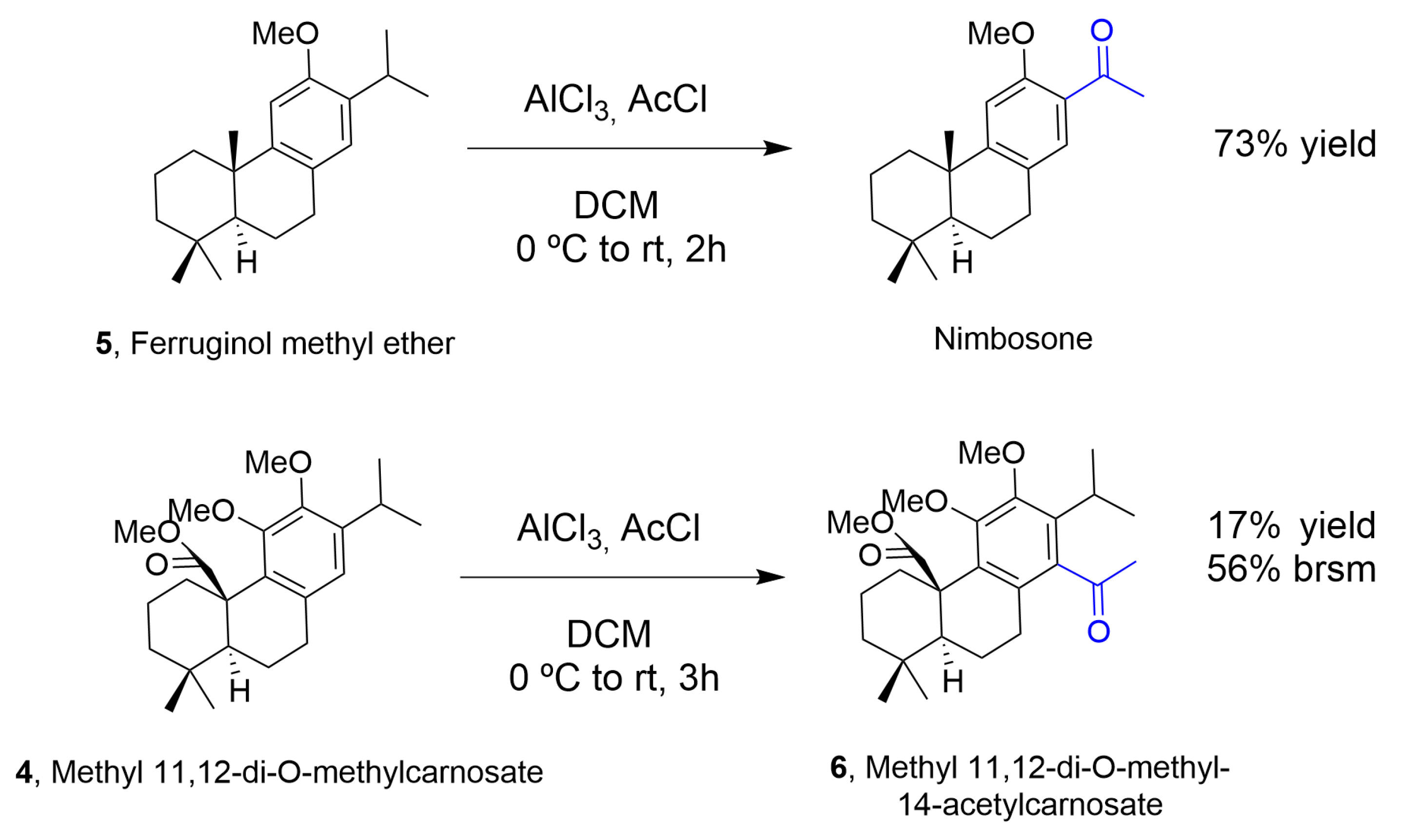
Figure 2.
DEPT135 spectrum for compound 6 in A) MeOD, B) Acetone-d6, C) CDCl3.
Scheme 2.
Synthesis of compound 6 from compound 4 through aldehyde 7.
Scheme 3.
Selective C11 deprotection of compounds 4, 6, and 7.
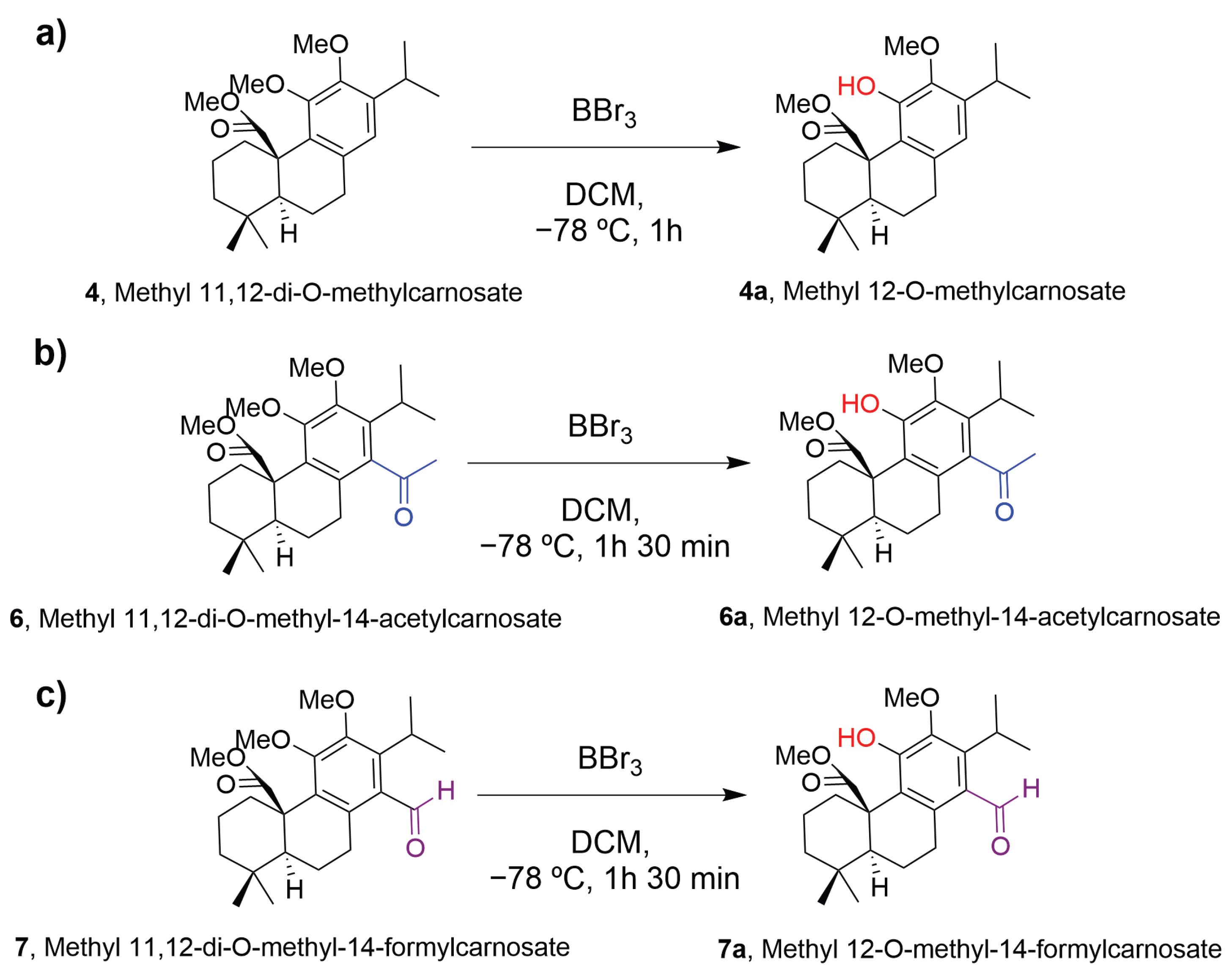
Figure 3.
Numbering of the carbon skeleton for compounds 4-7a.
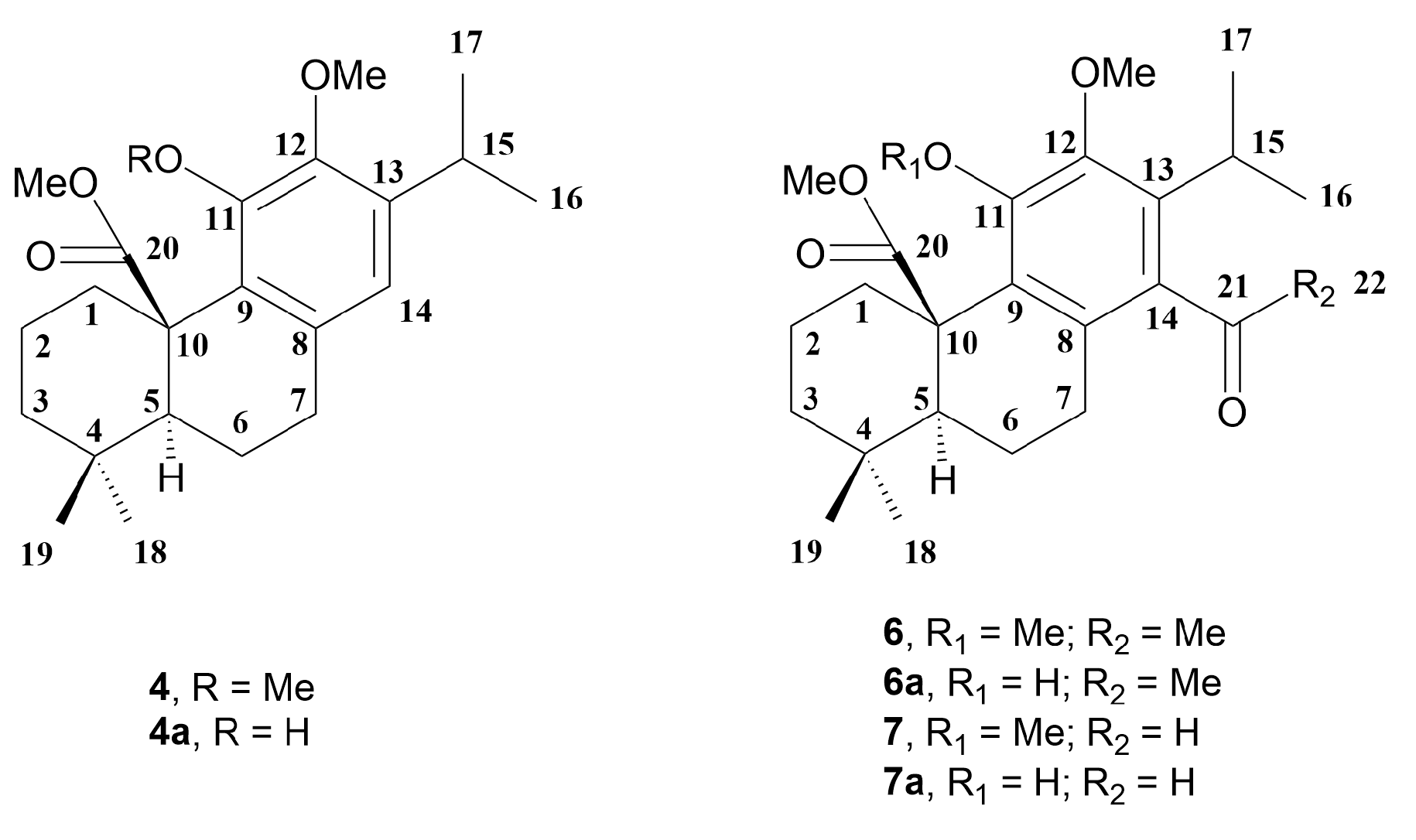
Figure 4.
. Relevant COSY and HMBC correlations for compounds: a) 6, b) 6a, c) 7 and d) 7a.
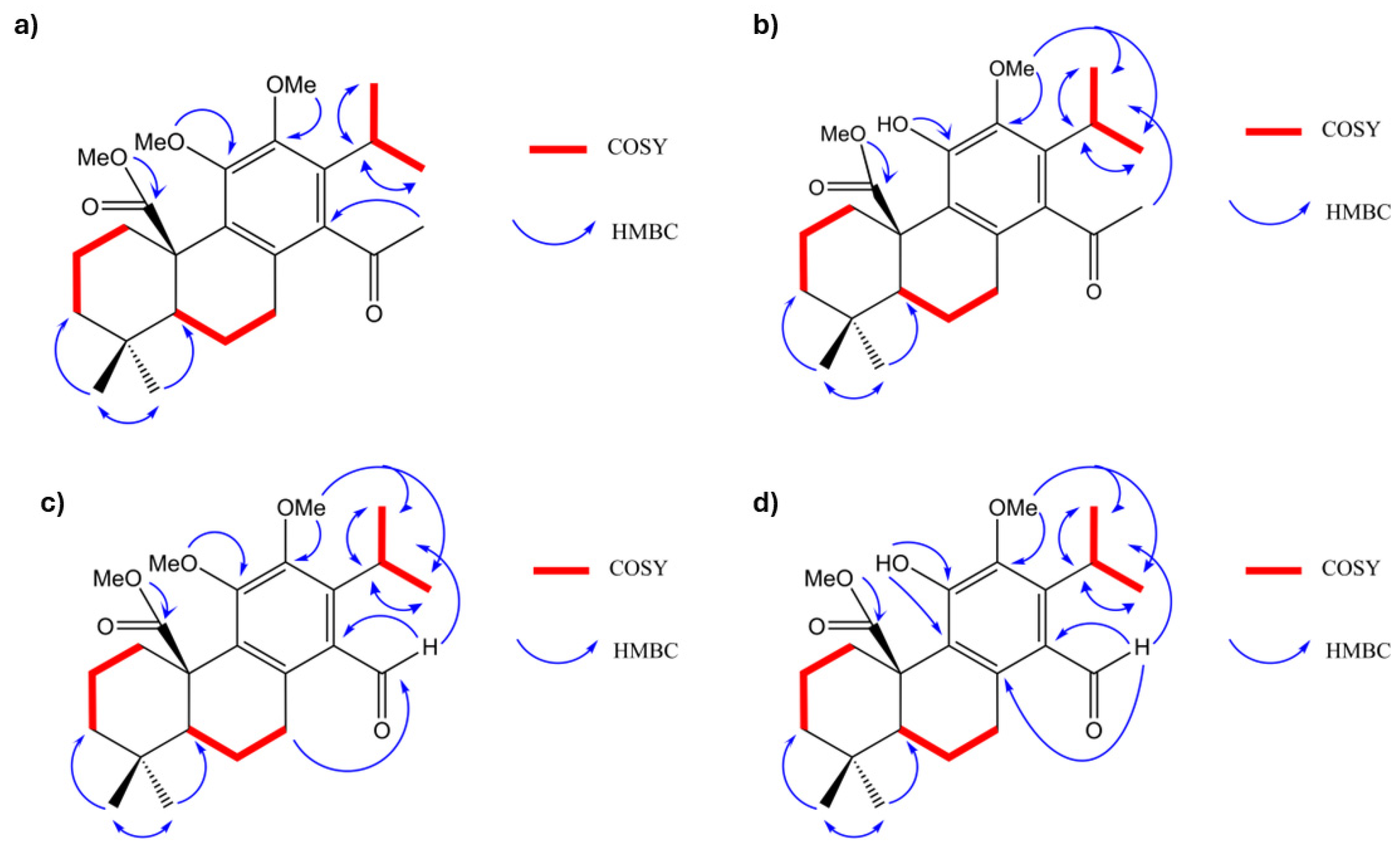
Figure 5.
Relevant NOESY interactions for compounds: a) 6, b) 6a, c) 7 and d) 7a.
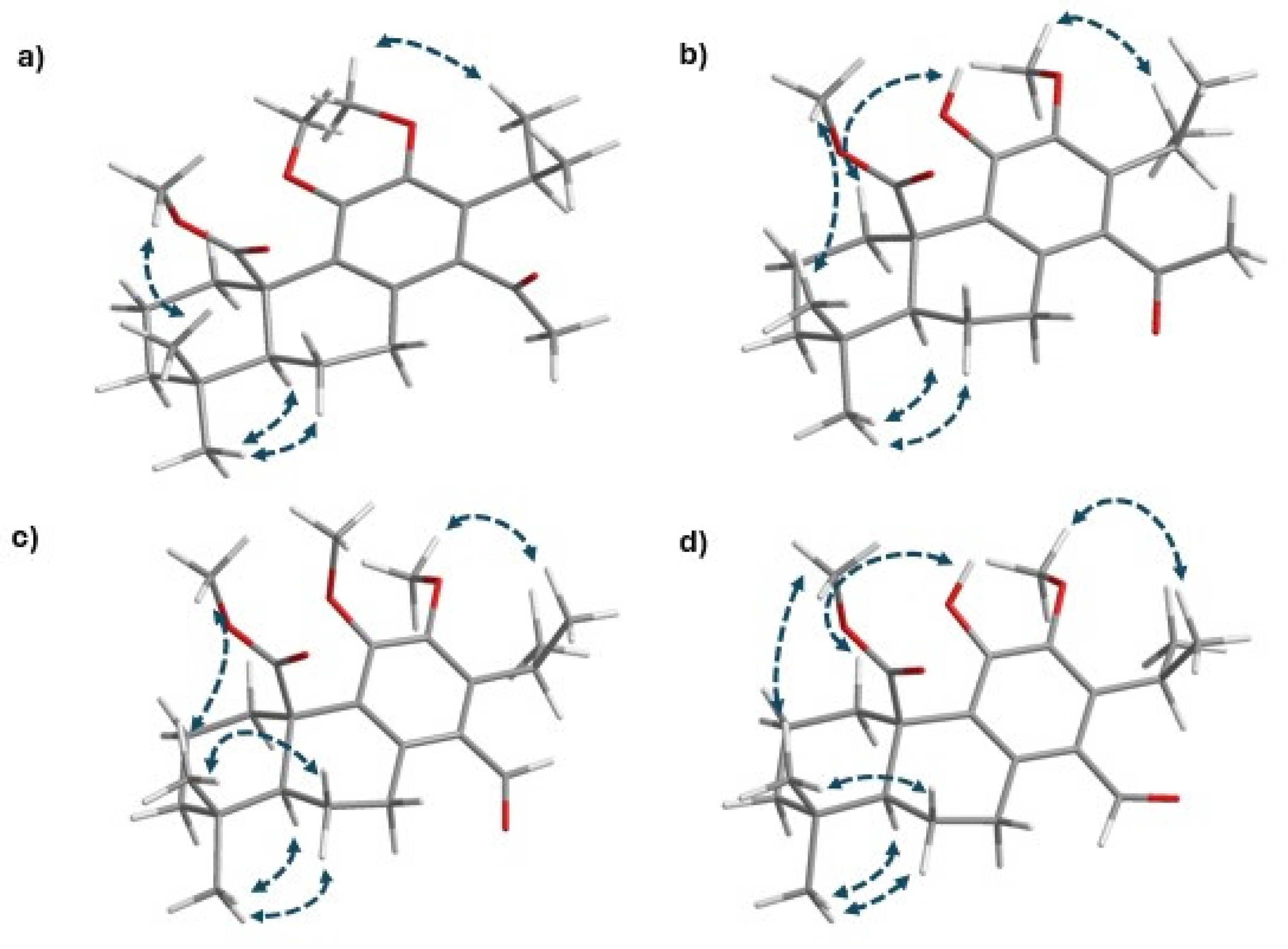

Table 1.
1H NMR chemical shifts (δ, ppm) and multiplicity (400 MHz) in CDCl3 for compounds 4a-7a.
| 4a | 6 | 6a | 7 | 7a | |
|---|---|---|---|---|---|
| H-1α | 1.21-1.19 mc | 1.16-1.08 m | 1.16 ddd (13.2, 13.1, 4.2) | 1.15-1.08 m | 1.17-1.09 m |
| H-1β | 3.54 dt (13.4, 4.0) | 3.34 dt (13.5,4.6) | 3.42 dt (13.6, 3.8) | 3.27 dt (13.0, 4.0) | 3.40 dt (13.5, 4.5) |
| H-2α | 1.59-1.48 ma | 1.55-1.49 m | 1.61-1.54 m | 1.60-1.50 mi | 1.61-1.54 mm |
| H-2β | 2.20-2.10 m | 2.30-2.19 m | 2.10-1.98 m | 2.34-2.22 m | 2.27-2.18 m |
| H-3α | 1.32-1.25 m | 1.33-1.27 m | 1.50 mf | 1.29-1.20 m | 1.31-1.24 m |
| H-3β | 1.59-1.48 ma | 1.55-1.49 m | 1.32-1.25 m | 1.60-1.50 mi | 1.61-1.54 mm |
| H-5 | 1.59-1.48 ma | 1.44 dd (12.5,1.4) | 1.50 dd (12.7, 1.6)f | 1.46 dd (12.6,1.0) | 1.54-1.49 m |
| H-6α | 1.85-1.79 m | 1.79-1.75 m | 1.84-1.78 m | 1.86-1.80 m | 1.91-1.84 m |
| H-6β | 2.32-2.20 m | 2.19-2.09 m | 2.30-2.17 m | 2.12-2.02 m | 2.18-2.08 m |
| H-7α | 2.89-2.77 mb | 2.67-2.54 md | 2.66-2.58 mg | 2.98-2.95 mj | 3.11-2.99 mn |
| H-7β | 2.89-2.77 mb | 2.67-2.54 md | 2.66-2.58 mg | 2.98-2.95 mj | 3.11-2.99 mn |
| H-14 | 6.52 s | - | - | - | - |
| H-15 | 3.17 sept (7.0) | 2.64 sept (7.0) | 2.73 sept (7.0) | 3.52 sept (7.0) | 3.68-3.60 mo |
| H-16 | 1.21-1.19 mc | 1.33-1.27 me | 1.32-1.29 mh | 1.34 d (7.0)k | 1.38 d (7.5)p |
| H-17 | 1.21-1.19 mc | 1.33-1.27 me | 1.32-1.29 mh | 1.35 d (7.0)k | 1.43 d (7.5)p |
| H-18 | 0.97 s | 0.93 s | 0.96 s | 0.96 s | 0.97 s |
| H-19 | 0.78 s | 0.75 s | 0.76 s | 0.76 s | 0.77 s |
| H-21 | - | - | - | 10.54 s | 10.56 s |
| H-22 | - | 2.45 s | 2.46 s | - | - |
| CO2Me | 3.62 s | 3.65 s | 3.64 s | 3.66 sl | 3.64 so |
| 11-OMe | - | 3.58 s | - | 3.67 sl | - |
| 11-OH | 6.09 s | - | 6.39 s | - | 6.58 s |
| 12-OMe | 3.73 s | 3.76 s | 3.77 s | 3.74 s | 3.74 s |
a-p Signals are overlapped.
Table 2.
13C NMR chemical shifts (δ, ppm) (100 MHz) in CDCl3 for compounds 4a-7a.
| Carbon | 4a | 6 | 6a | 7 | 7a |
|---|---|---|---|---|---|
| 1 | 34.19 | 35.19 | 34.39 | 35.35 | 34.37 |
| 2 | 20.03 | 19.98 | 20.00 | 19.94 | 19.92d |
| 3 | 41.46 | 40.77 | 41.34 | 40.48 | 40.86 |
| 4 | 33.90 | 33.54 | 33.88 | 33.37 | 33.56 |
| 5 | 54.12 | 53.32 | 53.36 | 52.93 | 52.99 |
| 6 | 18.55 | 17.92 | 18.13 | 17.93 | 18.02 |
| 7 | 31.97 | 29.06 | 28.95 | 30.42 | 31.04 |
| 8 | 125.48 | 127.07 | 128.23 | 130.55 | 127.22 |
| 9 | 134.35 | 135.74 | 126.50 | 136.46 | 128.07 |
| 10 | 47.87 | 48.19 | 48.41 | 48.33 | 48.24 |
| 11 | 147.71 | 152.95 | 149.22 | 155.80 | 151.84 |
| 12 | 142.54 | 150.47 | 145.30 | 149.93 | 143.62 |
| 13 | 139.29 | 134.63 | 134.26 | 142.18 | 142.43 |
| 14 | 118.02 | 137.50 | 134.72 | 134.45 | 138.39 |
| 15 | 26.45 | 31.27 | 30.63 | 27.51 | 26.56 |
| 16 | 23.73a | 22.01 | 21.91b | 22.50c | 23.50e |
| 17 | 23.42a | 21.67 | 22.32b | 22.34c | 23.07e |
| 18 | 32.61 | 32.48 | 32.46 | 32.42 | 32.38 |
| 19 | 20.05 | 19.59 | 20.38 | 19.60 | 19.90d |
| 20 | 176.35 | 176.33 | 176.84 | 176.44 | 176.40 |
| 21 | - | 209.15 | 209.11 | 195.63 | 193.98 |
| 22 | - | 33.05 | 33.26 | - | - |
| 20-MeO | 51.53 | 51.43 | 51.83 | 51.49 | 51.72 |
| 11-MeO | - | 58.75 | - | 59.01 | - |
| 12-MeO | 61.65 | 59.47 | 61.19 | 59.72 | 61.91 |
a-e Signals may be interchanged.
Table 3.
Antiproliferative activity, GI50 (µM) values determined with SRB assay for compounds 6, 6a, 7 and 7a.
Table 3.
Antiproliferative activity, GI50 (µM) values determined with SRB assay for compounds 6, 6a, 7 and 7a.
| Compound | A549 (lung) |
HeLa (cervix) |
MIA PaCa-2 (pancreas) |
SW1573 (lung) |
T-47D (breast) |
WiDr (colon) |
|---|---|---|---|---|---|---|
| 6 | 3.5 ± 0.4 | 4.0 ± 0.1 | 3.2 ± 0.9 | 1.20 ± 0.45 | 6.9 ± 1.9 | 5.5 ± 0.8 |
| 6a | 12.0 ± 4.0 | 3.3 ± 0.2 | 6.3 ± 2.6 | 4.4 ± 0.4 | 15.0 ± 1.8 | 18.0 ± 0.7 |
| 7 | 3.1 ± 1.2 | 2.2 ± 1.0 | 4.0 ± 0.4 | 4.6 ± 1.6 | 3.0 ± 1.2 | 3.9 ± 1.0 |
| 7a | 21.00 ± 0.05 | 3.8 ± 1.1 | 8.2 ± 3.0 | 10.0 ± 3.2 | 7.3 ± 0.2 | 12.0 ± 0.3 |
| Cisplatin | 4.9 ± 0.2 | 1.9 ± 0.2 | 1.8 ± 0.5 | 2.7 ± 0.4 | 17.0 ± 3.3 | 26.0 ± 4.3 |
| Etoposide | 1.5 ± 0.3 | 3.3 ± 1.6 | - | 15.0 ± 1.5 | 22.0 ± 5.5 | ± 3.1 |
Table 4.
Molecular and Physicochemical Properties Using the SwissADME Online Software [18].
Table 4.
Molecular and Physicochemical Properties Using the SwissADME Online Software [18].
| Compound | MLogP | MW | n-HBA | n-HBD | TPSA | Lipinski’s violation |
|---|---|---|---|---|---|---|
| 6 | 3.41 | 416.55 | 5 | 0 | 61.83 | 0 |
| 6a | 3.20 | 402.52 | 5 | 1 | 72.83 | 0 |
| 7 | 3.20 | 402.52 | 5 | 0 | 61.83 | 0 |
| 7a | 2.99 | 388.50 | 5 | 1 | 72.83 | 0 |
MLogP = Predicted octanol–water partition coefficient (Moriguchi method); MW = Molecular weight (g/mol); n-HBA = Number of hydrogen-bond acceptor groups; n-HBD = Number of hydrogen-bond donor groups; TPSA = Topological polar surface area (Å2).
Disclaimer/Publisher’s Note: The statements, opinions and data contained in all publications are solely those of the individual author(s) and contributor(s) and not of MDPI and/or the editor(s). MDPI and/or the editor(s) disclaim responsibility for any injury to people or property resulting from any ideas, methods, instructions or products referred to in the content. |
© 2026 by the authors. Licensee MDPI, Basel, Switzerland. This article is an open access article distributed under the terms and conditions of the Creative Commons Attribution (CC BY) license.
Copyright: This open access article is published under a Creative Commons CC BY 4.0 license, which permit the free download, distribution, and reuse, provided that the author and preprint are cited in any reuse.