

Submitted:
07 October 2026
Posted:
14 October 2026
You are already at the latest version
Abstract
Bovine Viral Diarrhea (BVD) inflicts economic losses on global dairy production. In Thailand, BVD remains outside national control priorities, shifting the burden of disease management entirely to local biosecurity choices. Using a qualitative approach, this study investigated dairy farmers' perceptions and biosecurity practices within Thailand’s certified Good Agricultural Practice (GAP) sector. Semi-structured, face-to-face in-depth interviews and field observations were conducted with smallholders in western Thailand, and the transcripts were analyzed using thematic analysis. The results revealed a profound "biosecurity paradox" driven by salience bias: while farmers showed universal awareness and strictly enforced emergency protocols for highly visible epidemics like Foot-and-Mouth Disease and Lumpy Skin Disease, they exhibited an acute awareness deficit regarding subclinical pathogens like BVD. Crucially, visual animal selection and structural trust routinely led to introducing persistently infected replacement heifers without screening. Furthermore, unstandardized management of reproductive waste was widespread, with most participants discarding infectious tissues into open fields, occasionally commodifying high-risk biological waste into local human food networks. Rigid top-down GAP rules induced intense regulatory fatigue among financially stressed smallholders. Farmers explicitly rejected conventional extension group workshops due to acute labor constraints, preferring decentralized digital micro-learning (mobile short videos and on-farm posters) and clinical interactions with visiting practitioners. This study provides an empirical blueprint for livestock policy to shift from passive, farmer-dependent reporting to government-led active surveillance to protect national dairy herd health.
Keywords:
awareness
; biosecurity
; livestock policy
; practices
; waste management
1. Introduction
Bovine viral diarrhea (BVD) is a highly contagious and economically significant viral disease of cattle, costing between £0 and £552 per cow per year, with a mean impact of £46.50. Endemically infected herds experience an impact of between £ 6.46 and £87 per cow per year [1]. It leads to substantial economic losses worldwide by decreasing milk production, accelerating premature culling, reducing reproductive performance, and increasing mortality, often by initiating or worsening bovine respiratory disease complexes [2,3,4,5,6,7]. The infection is a major concern for the dairy industry because it affects reproductive performance, including longer calving intervals and delayed age at first service. Persistently infected (PI) animals, born to mothers infected during pregnancy, are a significant source of the virus and can continue to spread it throughout the herd. Identifying and removing PI animals is a key control strategy. Vaccination can be used alongside other control measures to reduce BVD impact. Systematic animal testing is a cornerstone of control programs [4]. Methods include testing individual animals or using bulk tank milk testing to survey an entire herd, which was applied in the BVD eradication scheme in some countries, such as Scotland and Ireland [8].
In Thailand, the primary dairy cattle health issues included Foot-and-Mouth Disease (FMD), mastitis, laminitis, calf diarrhea, and metritis [9]; the BVD virus and related atypical strains have been isolated from cattle populations in the north and northeast since 2001 [10]. Studies showed moderate to high seroprevalence in dairy herds, particularly in the north and northeast [11,12] and the west [13,14]. These studies stated that systemic BVD control strategies, including identification of PI, monitoring and surveillance of infection status, and continued strict biosecurity, should be implemented in Thailand [10,12]. Additionally, the importance of herd biosecurity should be stressed, and the information necessary to achieve a sufficient level of biosecurity should be provided [10]. However, Thailand currently has no official BVD control program regulating cattle movement or a national control program. Like regional neighbors such as Indonesia and other Southeast Asian countries, BVD remains a neglected disease and is not classified as a national control priority [15]. Consequently, management relies entirely on voluntary, farm-level biosecurity practices [15,16].
In Thailand, dairy farm management follows Good Dairy Farming Practice (GDFP), which applies Good Agricultural Practices (GAP) to ensure the production of safe, high-quality milk from healthy animals while also considering animal welfare and social, economic, and environmental sustainability. The GDFP implementation in the context of animal health includes managing the herd to prevent disease (infrastructure, vaccinated animals), holding an effective management program for the herd (keep the records for all medicine used, treated and isolated sick animals), preventing disease on the farm which related biosecurity measures (quarantine, limiting access by people and other animals, and being aware of the risk posed by neighboring farms), and being aware of the risk posed by neighboring farms. The Department of Livestock Development (DLD) of Thailand certifies dairy cattle farms, and these standards are often voluntary, especially for farms that produce for the domestic market. The DLD collaborates with dairy cooperatives and the private sector to encourage compliance with quality and safety standards. Still, participation is often a business decision rather than a strict legal requirement for all farmers. Implementing strict biosecurity measures is vital to prevent introducing the BVD virus into the herd. This includes controlling who and what enters the farm, such as limiting visitors and quarantining new animals before introducing them. Biosecurity can be addressed through individual barriers among farmers and veterinarians and through interpersonal relationships between veterinarians and farmers [16,17].
Because farmers and other actors share responsibility for biosecurity governance, understanding how it is organized and what factors contribute to successful implementation is challenging and requires both qualitative [9,19] and quantitative methods [19,20]. A study among dairy farmers in Ethiopia found that sociodemographic factors, such as education level and lack of training in dairy farm management, were associated with animal health and inadequate biosecurity implementation. Designing and implementing intervention strategies, such as training farmers in basic husbandry practices, is required [20]. Improved knowledge of BVD could be associated with improved animal health and biosecurity [18,19,20].
Qualitative methods provide rich, in-depth insight into human experience, behaviors, and the complexities of social phenomena. They allow researchers to explore the “why” behind behaviors and understand the nuances of complex social issues from the perspective of those experiencing them [21,22,23,24]. Several studies have used qualitative approaches to explore individuals or stakeholder groups, drawing lessons and formulating contextually relevant parameters attuned to the political and socio-cultural context [7,25,26,27,28].
Based on our recent serological surveys of 30 dairy cattle farms in five provinces in western Thailand [14], which showed moderate BVD exposure, individual prevalence was 36.89% (270/732), while herd prevalence was 93.33% (28/30). Significant risk factors of BVD infection were identified as the location of farms (Province), herd size, feeding type, history of abortion, absence of a calving pen (a separate, individual stall for a cow to give birth and recover afterward), inadequate biosecurity, and the existence of pet animals such as dogs and cats on farms. While these quantitative findings mapped risk factors and prevalence rates, they also exposed a critical knowledge gap about the human factors driving these numbers. Because BVD control depends on removing persistently infected animals and maintaining herd biosecurity, farmers make key disease-control decisions on the farm [10,17,29]. Consequently, the striking contrast between widespread herd exposure (93.33%) and the presence of known, preventable risk factors directly prompted this qualitative inquiry.
Currently, little is known about farmers' perceptions and biosecurity practices regarding BVD in this region and throughout Thailand. Therefore, it is essential to explore farmers’ behavior and understand the factors influencing their decisions and actions to implement effective behavior-change interventions for disease prevention and control [28,30,31]. This study aimed to explore farm management and on-farm biosecurity practices and to understand farmers’ perceptions of BVD and the implementation of routine biosecurity measures on dairy farms in western Thailand, using qualitative methods to support the development of policy recommendations and intervention strategies suitable for dairy farmers.
2. Materials and Methods
2.1. Study Design
This study employed a qualitative research design based on semi-structured interviews and direct observation to explore farm management and on-farm biosecurity practices, and to understand farmers' perceptions of BVD and the implementation of routine biosecurity measures on dairy farms. Semi-structured interviews are a commonly used data-collection method in qualitative research and allow for deeper understanding than questionnaires or quantitative methods [22,24,25].
2.2. Ethical Considerations
This study was conducted in accordance with the Declaration of Helsinki and approved by the Kasetsart University Research Ethics Committee (KUREC) (approved number: COE66/009; date of approval: 16 May, 2023).
2.3. Study Area and Target Population
This qualitative study was conducted at dairy farms that participated in a previous cross-sectional seroprevalence study of BVD among 30 dairy herds in five provinces of western Thailand, including Nakhon Pathom. Ratchaburi, Kanchanaburi, Phetchaburi, and Prachuap Khiri Khan [14]. All farmers involved in the previous cross-sectional serological survey were eligible for inclusion. Purposive sampling was used to select target participants: dairy farm owners responsible for managing dairy cows on their farms. The eligible participants were individuals aged 20 to 70 who indicated their willingness, availability, and ability to complete the in-depth interview in Thai. Participants were contacted by phone by the research team to explain the purpose of the study and ask whether they would participate; if they agreed, an interview time was scheduled. As a result, 22 of 30 farmers from five provinces agreed to participate, and the remaining eight either declined or were unavailable after two invitations. Because qualitative interviews are typically conducted with small samples to capture deep, contextual insight into the meanings behind participants' actions, they prioritize information power and data richness over statistical generalizations to the broader population [21,23]. This sampling strategy aligns with the study’s core objective rather than adhering to a rigid numerical rule.
2.4. Data Collection
This study used a mixed-qualitative approach combining semi-structured, in-depth interviews with direct field observation. While the interviews provided participants' self-reported perspectives, direct observations captured real-time behaviors and environmental contexts. To ensure data authenticity and chronology, detailed field notes were compiled in Thai after each observation session. Employing these complementary methods enabled methodological triangulation, enhancing the overall credibility, dependability, and depth of the findings.
Integrating these two methods served as a rigorous validation tool during thematic analysis. By analyzing the interview transcripts alongside the raw field observation notes in Thai, the researcher could cross-examine participants' stated behaviors against empirically observed practices. This dual-lens approach minimized researcher bias, mitigated potential participant social-desirability bias, and ensured that the finalized English themes were deeply grounded in the holistic reality of the field.
Semi-structured, in-depth interviews were conducted face-to-face at the participants’ farm between June and July 2023. This method allows for conversation and flexibility to explore farmers’ perspectives in depth and share them in their own words, minimizing the risks of judgment or observation bias often associated with focus groups [23,24]. Individual farm owners provided permission to visit the farms. One author, with experience conducting in-depth interviews, conducted all interviews in Thai. The interviewer did not know the participants beforehand; a relationship developed during data collection. All research team members were veterinarians with experience in dairy farm research. Before the interview, each participant was informed of the study objectives, their right to answer or decline any question, and their right to withdraw from the study at any time without consequences. Participants then signed the consent form. Each interview lasted between 30 and 45 minutes. To protect participant privacy and maintain confidentiality, all data were recorded and stored anonymously on one of the authors’ password-protected computers.
While recent serological surveillance by Thongtem et al. [14] established a high BVD herd prevalence (93.33%) and identified critical physical risk factors, it did not examine the socio-behavioral drivers behind these on-farm management choices. Therefore, this qualitative inquiry was initiated to bridge this gap by exploring farmers' perceptions and systemic barriers to implementing recommended biosecurity measures. To do so, the semi-structured interview guide was developed by reviewing the literature [28,29]. This guide was used to ensure comprehensive coverage of the required topics, specifically farm management and on-farm biosecurity practices, and farmers’ perceptions of BVD, ultimately supporting the development of tailored policy recommendations and intervention strategies. The questions were predominantly open-ended and consisted of five main topics, including (i) the general characteristics of the farm such as its size, type of farming, resources, and the farmer’s experience, (ii) management strategies including livestock management, feeding, breeding, and overall herd health approach (iii) biosecurity practices on the farm which focus on the implemented measures to prevent the introduction and spread of diseases, such as farm access protocols, cleaning procedures for equipment, and visiting controls, (iv) perceptions of BVD, including farmers’ understanding of BVD, their awareness of the disease, and their attitudes towards biosecurity measures, and (v) how farmers access information relevant of their farm, and how they communicate with other farmers or stakeholders. To ensure the interview guide was comprehensible and appropriate for the target population, a pilot study was conducted with five dairy farmers in a nearby area. Minor changes were made after discussion between the two authors. The interview guide is shown in Table 1.
2.5. Data Processing and Analysis
Data collection relied on in-depth interviews and direct observation, utilizing field notes and audio recordings. All interviews were audio-recorded and transcribed verbatim. To ensure linguistic rigor and maintain cultural validity, the interviewer initially compiled field notes and conducted the first five phases of data analysis entirely in Thai. Translation into English was intentionally delayed until the final phase of report writing. To verify conceptual accuracy, an independent bilingual researcher whose first language is English back-translated the tool. A panel of native speakers from both language backgrounds then reconciled both versions. Two authors (the interviewer and the first author) cross-checked the interview transcripts for accuracy, then identified and extracted relevant participant statements along with their contextual references.
We managed and organized qualitative data in Microsoft Excel and analyzed them using thematic analysis, following the six-phase framework established by Braun and Clarke [22,33,34,35]. Coding was executed in two stages: deductively, using pre-established codes, and inductively, using codes derived directly from the data. One author performed the initial coding and generated candidate themes. The authors then established the final thematic structure through collaborative discussion. Coding and theme generation continued until thematic saturation, defined as the point at which no new themes or conceptual insights emerged from the data.
The six phases of the thematic analysis [33] were executed as follows:
Phase 1: Familiarization with the Data. The interviews were transcribed verbatim in Thai. The primary researcher repeatedly listened to the audio recordings and read the Thai transcripts to immerse deeply in the data.
Phase 2: Generating Initial Codes. Open coding was performed directly on the Thai transcripts. Codes were written in Thai to capture the precise meanings, idioms, and emotional nuances participants expressed.
Phase 3: Searching for Themes. The Thai codes were organized and clustered into broader candidate themes based on shared conceptual patterns.
Phase 4: Reviewing Themes. Candidate themes were reviewed against the coded extracts and the full dataset to ensure they formed a coherent pattern and accurately reflected the source data.
Phase 5: Defining and Naming Themes. The final themes were conceptualized, clearly defined, and named in Thai to maintain structural alignment and cultural validity.
Phase 6: Producing the Report. In the final phase, the finalized themes, sub-themes, and representative data extracts were translated from Thai into English for the final manuscript preparation.
3. Results
A total of 30 dairy farmers were initially screened for eligibility. Of these, 22 participants met the inclusion criteria and were interviewed. The remaining 8 individuals were excluded due to operational closure or scheduling conflicts. Their demographic and farm characteristics are summarized in Table 2. Participants were equally divided between males and females and ranged in age from 33 to 74. Most (90.9%; n=20) had raised dairy cows for more than 10 years. All farms complied with the voluntary Good Agricultural Practices (GAP) for dairy cattle farms and had been certified by the DLD Thailand. Additionally, based on the previous study, all farms had a history of BVD infection, as at least one cow tested positive on the BVD ELISA [15]. Most of the farms (86.4%; n=19) were medium (31.8%; n=7) and large herd size (54.6%; n=12). Saturation emerged at 19 interviews, confirmed by 3 additional interviews to monitor saturation and determine whether new, unrelated insights emerged, indicating that sufficient information power had been achieved to adequately address the research questions. Table 3 presents a comprehensive profile of study participants.
To ensure a systematic and rigorous interpretation of the qualitative data, this study adopted Braun and Clarke’s six-step thematic analysis framework [33]. This established method guided the analysis through sequential data familiarization, initial code generation, searching for broader themes, reviewing and refining themes against the entire dataset, defining and naming final themes, and ultimately producing the report. Through this inductive coding approach, the analysis identified five major themes and associated sub-themes directly from participants’ responses. Figure 1 shows the hierarchical tree diagram of the thematic map, while Table 4 presents a summary matrix of core themes and sub-themes.
3.1. Theme 1: Operational Farm Management Practices and Herd Health Infrastructures
This theme addresses the physical layout, day-to-day husbandry routines, and localized disease-management choices that dictate animal health and welfare.
3.1.1. Baseline Infrastructure vs Scaling Constraints
Because all participating operations held official GAP certification from the DLD, basic physical infrastructure such as age-segregated housing, structural ventilation, and basic drainage systems was already in place. However, because these were primarily small-scale family operations, building designs relied heavily on low-cost techniques and traditional materials. They were frequently built directly adjacent to the farmers’ private residences to maximize space efficiency. The farms used three primary housing configurations: a flexible free-stall system that allowed natural locomotion, a highly controlled tie-stall system to manage individual cows, and a mixed system in which cattle were tethered only during feeding and milking.
"Since all farms were certified for GAP dairy farming, the infrastructure was well installed. However, most farms were small-scale and used low-cost building techniques." (Field observation)
3.1.2. Perimeter Contradictions and Interspecies Contact
While participants demonstrated a conceptual awareness of external biosecurity threats, their physical perimeters revealed stark structural contradictions. Although boundary fencing was structurally installed to contain livestock, front gates and structural entrances were routinely left wide open. This design flaw was historically tied to the shared space between the agricultural facility and the household. Crucially, the community did not perceive interspecies disease transmission between domestic animals and cattle as a significant threat; nearly all participants (21 of 22) co-housed loose dogs, cats, or chickens within the immediate livestock housing areas. Farmers viewed the animals as functional tools rather than biosecurity risks, as shown by their structural assumptions.
“Dogs and cats can stay with dairy cows and guard the farm.” (N03)
“My dog goes inside the cow pen; I think disease might not transfer from cows to dogs or vice versa.” (K11)
3.1.3. Fragmented Veterinary Reliance and Symptom Landscapes
Resource constraints directly limited the integration of permanent veterinary professionals into routine operations. Instead, farmers shouldered full responsibility for clinical diagnostics and medical interventions, relying on personal experience or treating animals reactively before seeking academic or private veterinary support.
“If the cow can eat normally, there is no treatment at all. In the case of mastitis, I will inject medicine into them.” (N10)
“Once the cow is depressed and not eating, I call the veterinarian. He injected
enrofloxacin.” (N15)
“I treated the cow with medicine first. If they did not recover within one day, I would call the veterinarian from the university’s hospital.” (K10)
When surveying historical disease landscapes over the previous 12 months, participants frequently identified mastitis, blood parasites, and lameness. Reaffirming the broader knowledge deficits noted elsewhere, no farmer identified or suspected BVD. Instead, historic epidemic memories were dominated strictly by highly visible, acute outbreaks of FMD and Lumpy Skin Disease (LSD).
3.1.4. High-Risk Biological Waste Disposal Pathways
The most critical biosecurity vulnerability emerged from reproductive health histories and biological waste management. Although nearly all participants (20 of 22) had experienced herd abortions within their operations, they acknowledged an inability to diagnose specific etiologies without formal laboratory support. Despite this diagnostic blind spot, the disposal of high-risk aborted materials was heavily unstandardized and dangerous. A significant majority (16 of 20) engaged in unsafe disposal routines, such as discarding infectious tissues in open fields or using simple water washes (to maintain hygiene) without chemical disinfection. Strikingly, economic rationing and cultural practices even drove the commodification of aborted tissues into local human food streams.
“The pregnant cow aborted with a full-term fetus, so I threw away the aborted materials in the open field, without cleaning the floor. If I buried it, the dog would find and eat it” (PR2)
“The pregnant cow aborted at five months of pregnancy. I threw it away and cleaned the floor with water” (R02)
“When I have an aborted fetus, I bury it, cleaning the floor with water. If the floor seems dirty, I will use ammonium chloride” (N10)
“The abortion was caused by being bumped; I usually bury it or sell the aborted fetus to the local merchant to make a meatball” (P05)
Only a minimal subset (4 of 20) followed recommended biosecurity standards by combining deep burial, chemical lime stabilization, and rigorous disinfectant protocols. This highlights a severe breakdown between nominal GAP compliance and everyday biological risk mitigation.
3.2. Theme 2: Practical Execution of Biosecurity Protocols, Quarantine, and Herd Additions
This theme evaluates the routine application of preventative health measures, livestock procurement strategies, and the management of sick or newly arrived animals.
3.2.1. Performative / Crisis-Only Biosecurity Posture
Although all farms maintained formal GAP certification, field observations revealed that core biosecurity protocols were rarely implemented as daily, preventative routines. Structural vulnerabilities, such as unsecured farm entrances and pervasive perimeter openings, were common, creating pathways for small wild animals, rodents, and vectors to enter the facilities.
Farm entrances routinely lacked functional footbaths. Rather than maintaining continuous biosecurity barriers, participants explicitly rationed disinfection protocols, treating footbaths and boot sprays strictly as temporary measures during acute, visible regional outbreaks. To meet regulatory requirements, they often stored these assets out of sight and set them up only during official GAP audit windows. This crisis-only posture stemmed from a deep-seated fatalism about the efficacy of routine prevention.
“I used the footbath and disinfectant spray during the disease outbreak. At this time, free of disease, I kept it in the storage room. Having a footbath or not does not matter; the disease can spread from elsewhere.” (P02)
3.2.2. Procurement Decisions: Visual Selection and Inter-Farmer Trust
A profound biosecurity vulnerability emerged in how farmers introduced new cattle into their operations. Formal health certifications or diagnostic screenings were entirely absent before purchase. Instead, farmers relied on visual assessments—such as overall body size, physical conformation, and udder condition—supplemented by personal trust and social relationships with sellers. Because external physical health was conflated with sterile diagnostic status, farmers routinely skipped disease screenings, assuming reputable owners managed inherently healthy animals.
“Normally, I buy the cows from a well-known farm, selecting them based on their physical appearance, which will give the best milk yield. No need to screen for disease, because the former owner takes care of them well.” (PR02)
“I bought the cow by looking at the udders; no need to test for any disease. No need to separate it when it arrives at my farm.” (R03)
“I bought the cows from a neighboring farm, and they have already been vaccinated, especially against FMD, and dewormed. No need to quarantine.” (K11)
Even when a farmer expressed baseline suspicion, diagnostic testing was bypassed in favor of blind, prophylactic chemical treatments designed to mask or resolve immediate parasitic risks, operating on verbal guarantees from the vendor.
“The seller said the cow was free of disease. I trust him. Once the cow arrived at my farm, I injected the insecticide and one shot of Imizol® (imidocarb dipropionate), then isolated the new cow for 10 days.” (PR02)
However, this reliance on visual and social clearance ignores the epidemiology of subclinical pathogens—such as BVD, brucellosis, and bovine tuberculosis—which can replicate within highly productive, asymptomatic animals that require blood chemistry or veterinary testing to identify.
3.2.3. Sub-Standard Quarantine Execution and Sick Animal Management
While some participants reported isolating new animals based on historical experience with vector-borne or tick-borne pathogens, the methods used were behaviorally and structurally flawed. The reported isolation windows (3 to 10 days) were too short to account for the incubation periods of major viral and bacterial diseases. Additionally, "isolation" often meant simply tethering the animal at the far edge of a shared barn rather than establishing true spatial or air-flow separation.
“Once the cows arrived at my farm, I injected medicine (Ivermectin), isolated them for 3-7 days before bringing them into the herd” (P04)
“I kept the new cow at the end of the barn, isolated them for 7-8 days before introduction to the main herd” (K13)
“Once the cows arrived at my farm, I gave them an anthelmintic drug and injected one shot of oxytetracycline, which aimed to clear the blood parasite.” (K12)
This inconsistent approach also extended to internal sick-animal management. When cattle became ill, several operations chose not to separate them, prioritizing operational convenience or citing a lack of pen space over disease containment. This practice increases transmission rates across the herd.
“If the cow gets sick, I will separate it from the herd. I'm afraid the disease will spread to others.” (N10)
“I did not isolate the sick animal from the herd; it was quite hard to manage. However, I always cleaned the area where the sick animals were.” (N14)
3.2.4. Record-Keeping Disparities and Hygiene Focus
This lack of clinical tracking also showed up in the farms' administrative habits. Formal medical or treatment logs were entirely absent. Instead, record-keeping was strictly limited to data that directly impacted short-term profits, such as daily milk yields and reproductive dates (e.g., artificial insemination and calvings). While vaccine compliance within the past 12 months was high, it was restricted to state-mandated, highly visible epidemics (FMD and LSD). Finally, while farmers reported regular daily cleaning of cattle pens, observations showed these routines focused on maintaining proper milking hygiene for basic milking convenience rather than meeting the disinfection standards needed to maintain comprehensive herd biosecurity and animal health.
3.3. Theme 3: Perception and Awareness Deficits Regarding BVD
This theme addresses how farmers assess agricultural risk, conceptualize herd health threats, and prioritize different livestock pathologies.
3.3.1. Salience Bias in Disease Prioritization
Participants explicitly reported that their primary operational concerns were centered on stabilizing daily milk yields, managing immediate herd reproductive failures, and navigating macroeconomic pressures—specifically fluctuating milk prices. Within this risk landscape, a significant imbalance emerged regarding disease recognition.
On one hand, participants demonstrated near-universal, vivid awareness of high-impact infectious diseases, specifically FMD and LSD. Because FMD remains highly endemic to this region of Thailand, and because the farming community survived a severe, nationwide LSD epidemic following its introduction in 2021 [36], farmers possessed extensive experiential knowledge. They accurately described the distinct clinical signs of both pathogens, using direct clinical observations to differentiate between them.
“The cows during the milking period got FMD; they had blisters on the tongue and hooves, excess salivation, and lameness. I treated them with medicine. The other cases were the calves that had firm, raised skin nodules, fever, nasal and eye discharge, did not eat, and then died. The veterinarian told me that they had LSD.” (N14)
“FMD: the cow would experience depression, excess salivation, tongue erosion, vesicles at the mouth, and hooves. For LSD, cows will have skin nodules. And for tick fever disease, the cow will have fever, not eat, and be pale.” (PR03)
3.3.2. The BVD Awareness Deficit
In sharp contrast to this high epidemiological literacy, an absolute baseline awareness deficit was observed regarding BVD. None of the interviewed farmers were familiar with the pathogen, and none could spontaneously identify its clinical signs or transmission pathways.
3.3.3. Post-Education Indifference
However, once the interviewer introduced an educational prompt outlining BVD’s symptoms and its long-term negative impacts on reproductive performance and herd milk yields, participants' responses diverged significantly from the urgent alarm typically triggered by FMD or LSD.
While a small subset expressed vague, slight concern about the hidden economic risks, a substantial portion of the cohort showed complete indifference. This emotional and operational detachment was closely tied to the disease's largely invisible, subclinical, and complex nature, which failed to register as an active threat at the local agricultural level.
“I have no idea about BVD. I’ve never heard about it. Once I heard from you, I’m a little worried about BVD because the cows would show various clinical signs, but I don’t feel as much as FMD.” (K13)
“I’ve never heard about BVD, and I’ve never seen any cows suffer from it. I feel nothing.” (K11)
Ultimately, this widespread lack of recognition highlights BVD's inherent diagnostic challenges. The virus manifests across a broad clinical spectrum—ranging from entirely asymptomatic subclinical infections to acute, fatal systemic disease. Because the visible presentation varies heavily based on the animal’s age, virus strain, and individual immune status, BVD remains notoriously difficult for livestock keepers to identify or take seriously without professional veterinary diagnostics and serological testing [15].
3.4. Theme 4: Perception and Attitude Toward GAP Regulations for Dairy Farms
This theme explores the specific intersection between smallholders' structural mentalities and the state's formal quality assurance frameworks. Participants generally maintained a highly supportive, positive attitude toward the foundational ideals of GAP guidelines, explicitly recognizing their long-term importance in improving animal health, calf welfare, overall milk quality, and formal cooperative market access. However, a severe gap emerged between the farmers' abstract support and their immediate, practical operational capabilities.
3.4.1. Subjectivity in Auditing and Enforcement
A prominent sub-theme within this regulatory topic was the perceived subjectivity of the auditing process itself. Rather than viewing the written protocols as inherently rigid or mathematically restrictive, several participants noted that success depended heavily on interpersonal dynamics, local communication styles, and each inspector's interpretation of the rules.
“Following the regulation is not quite complicated; the easy or difficult to be certified, depending on the inspector. We just followed the requirements.” (N12)
“Their requirements are flexible; it is not difficult to follow.” (N10)
This dynamic demonstrates that while farmers view basic hygiene rules as logical, administrative inconsistency creates an unpredictable environment where regulatory certification outcomes feel variable rather than objectively standardized.
3.4.2. Compliance-Driven Industry Exit (Regulatory Fatigue)
Participants noted that complex infrastructure upgrades and logging requirements led to severe regulatory fatigue, particularly for older smallholders lacking dedicated labor support. The financial and bureaucratic pressure is intense enough that several farmers reported they would leave the dairy sector entirely if these rules are strictly enforced.
“GAP certification is quite hard to follow, especially the farm infrastructure, which increases the maintenance cost. Although a GAP-certified farm would get a higher milk price, I’m unsure about its value. (R06)
“It is complicated; I have no time to follow all the regulations, especially recording and keeping many documents. If it is too strict, I will retire, not do the farm; I’m too old and exhausted.” (N14)
This fear of a compliance-driven exit underscores that top-down enforcement of GAP rules, without accompanying structural subsidies or administrative safety nets, risks dismantling smallholder cooperative dairy infrastructure.
3.4.3. The Biosecurity Paradox
The GAP guidelines emphasize biosecurity as a vital barrier against pathogen entry and transmission. The interviewed farmers clearly understood these principles and viewed strict biosecurity as their primary line of defense. Participants proactively managed physical controls by limiting farm traffic, restricting visitor access to milking barns, isolating new stock, and intensifying cleaning protocols during regional outbreaks. Consequently, most respondents were confident that these measures effectively prevented disease introduction and herd-to-herd transmission.
“Biosecurity measures can prevent and reduce disease spread.” (PR03)
Participants widely viewed strict biosecurity protocols as temporary emergency interventions rather than necessary components of routine farm management. This situational application was heavily driven by resource rationing, where a lack of long-term compliance information was compounded by immediate constraints on time and capital.
“We used the foot bath only when there was an outbreak. We could not use it normally due to limited budget and time constraints.” (N12)
Furthermore, this structural rationing was mirrored by fundamental skepticism about the efficacy and purpose of routine biosecurity, leading to operational fatalism. Without clear education on why these daily preventative measures are required, some farmers viewed pathogen introduction as inevitable.
“I don’t know why we have to do biosecurity. For what? Do or don't, disease can spread.” (K01)
Together, these responses showed that even when GAP guidelines exist on paper, smallholders undermine their daily execution when they see them as economically impractical or theoretically futile.
3.5. Theme 5: Communication Channels and Preferred Mechanism for Knowledge Transfer
A critical dimension of improving herd health management involves identifying the precise channels through which smallholders acquire and digest epidemiological data.
3.5.1. Rejection of Conventional Extension Formats
Participants strongly preferred concise, visually engaging, decentralized information streams, reflecting a clear shift away from conventional institutional extension formats. Because of acute time and labor constraints in daily family operations, farmers actively resisted traditional, centralized knowledge-transfer methods like on-site group meetings or formal workshops.
3.5.2. Decentralized Clinical Classrooms
Instead, knowledge acquisition was heavily decentralized and mediated through direct, trusted interactions with visiting animal health experts during routine clinical calls.
“I usually gained knowledge from the veterinarian who visits my farm rather than the group meeting or training. I have no time to participate in the on-site meeting due to a lack of time.” (N15)
While participants identified veterinary practitioners as vital anchors for disease control and herd health management, most smallholdings operated without a permanent on-site veterinarian. This structural reality made strong relational trust with local mobile practitioners especially important.
3.5.3. Asynchronous Digital Micro-Learning
Consequently, to compensate for the lack of formal classroom availability, respondents expressed a strong appetite for independent, self-directed learning materials that could easily blend into their active daily routines. These asynchronous formats allow resource-constrained smallholders to revisit critical instructions at their own pace. The preferred media varied based on direct, practical utility on the farm.
“I prefer a large poster. I can place it on the farm, which is easy to see and read.” (N15)
“I prefer leaflets and brochures; they are easy to hold.” (K01)
“I prefer a short video clip, which is easy to understand. I can view it anytime on my mobile phone.” (K12)
4. Discussion
This qualitative study explored farm management and on-farm security practices, perceptions of BVD, and the implementation of routine biosecurity among 22 dairy farmers in western Thailand. The study identified several key factors and barriers, including infrastructure, individual, and social aspects, that hindered biosecurity implementation.
Dairy farming in this setting was mainly small-scale, traditionally raised family businesses. Dairy housing areas were often combined with owners' households. The co-housing of domestic companion animals (dogs and cats) and auxiliary poultry within production areas highlights how local anthropozoological utilities override standardized biosecurity frameworks [37]. Farmers do not view these non-production animals as biosecurity vectors, but rather as functional tools for property security and pest management. Consequently, formal biosecurity policies fail to achieve true systemic integration because they view the agricultural facility as an isolated corporate node, completely detached from the social, emotional, and physical topology of the rural household. Notably, integrating dairy housing, human living spaces, companion animals, and poultry creates an interface for multi-species disease transmission. In response, modern veterinarians should shift away from lecturing farmers on rigid, unrealistic isolation frameworks. Instead, programs are adopting a One Health approach that views human, animal, and environmental health as interconnected [38]. To transition biosecurity from a "regulatory penalty" to a "community-driven habit", the policy must move away from the corporate-node isolation model [17,38]. Guidelines should treat smallholder production through a lens of multispecies justice and household integration [18,28,38].
Discrepancies between current practices and the recommended standards for good dairy farming were observed. They likely could not fully adhere to all practices outlined in the GDFP guidelines. This is due to various factors, including resource limitations, limited access to technology, and the unique challenges of the agricultural setting. The high cost of implementing specific measures, such as constructing fences or isolation facilities, significantly limited smallholders. Additionally, farm layouts, sometimes shaped by regulations restricting new construction, hindered measures such as proper quarantine or animal isolation. Effective disease-control planning requires collaboration among architects, farmers, and veterinarians to ensure farm infrastructure supports necessary biosecurity practices [18,39], including the ability to isolate sick or newly arrived animals. Therefore, dairy farms must periodically evaluate the technical aspects of their operations in accordance with the GDFP.
The tension between mandated compliance and smallholder vulnerability underscores a critical flaw in Thailand's dairy modernization strategy. While the DLD envisions a universally compliant, standardized dairy sector, the present study showed that pushing top-down requirements onto an aging, financially stressed demographic of smallholders could backfire, causing extensive industry contraction rather than widespread operational growth. As a participant noted, the concrete infrastructure and steep upkeep costs make the long-term economic returns of certification highly questionable, even with promised milk price premiums. This financial strain is worsened by intense administrative exhaustion [40,41]. A participant noted that extensive record-keeping leaves little time for actual herd management, warning that older farmers may quit entirely if enforcement becomes overly punitive. This potential exit directly threatens Thailand’s domestic milk supply and the financial stability of its regional dairy cooperatives. If strict regulation triggers widespread early retirements and smallholder closures, it will shrink the national milk pool and destabilize the rural economy.
This study's findings highlight significant vulnerabilities in current agricultural biosecurity frameworks, characterized primarily by a lack of operational isolation protocols, improper chemical application, and a historical reliance on water-only cleaning methods. These deficiencies closely mirror biosecurity gaps reported among dairy farmers in Ethiopia [20,42,43], where inadequate isolation of diseased livestock and substandard sanitation remain pervasive. In the context of BVD, these primitive cleaning habits increase transmission risk and herd-wide persistence. Biosecurity measures are most effective when implemented routinely, not only during an active outbreak [37]. Relying solely on water for routine cleaning is generally insufficient, as it does not effectively eliminate pathogens. Facilities should use approved disinfectants, detergents, and other cleaning agents to properly sanitize surfaces, equipment, and facilities [37]. Evaluating the distinct roles of cleaning agents and disinfectants helps establish an effective routine sanitation program. To protect people and meet regulatory requirements, facilities must shift from passive cleaning to active, structured sanitization policies. Implementing the following key recommendations will help minimize invisible pathogens (not only BVD virus), prevent cross-contamination, and protect public health across food services, healthcare, and commercial spaces. Additionally, clear structural policies—such as permanently isolating sick or untested replacement animals, using dedicated quarantine equipment, and enforcing mandatory traffic workflows (tending healthy animals before sick animals)—must be codified in standard operating procedures to break the cycle of BVD virus transmission.
Previous studies suggested implementing a systematic BVD control strategy in Thailand, including identifying and eliminating PI, continuing strict biosecurity measures, and monitoring and surveillance of infection status [12,13,14]. The results revealed how subclinical pathogens like BVD can silently maintain endemic stability in the dairy sector, despite official GAP certification. The most glaring biosecurity vulnerability lies in the unstandardized, high-risk disposal of aborted fetuses and embryonic fluids. Because BVD is a primary driver of bovine reproductive failure, aborted tissues are often saturated with immense viral loads. The revelation that 80% of aborted farms (16 of 20) freely discard these materials in open fields or perform simple water rinses represents a catastrophic biosecurity failure. As a participant noted, avoiding burial to prevent domestic dogs from digging up fetuses inadvertently creates an alternate vector; loose domestic animals (reared by 21 of 22 farms) can easily consume, track, and mechanically distribute viral particles across shared household and agricultural perimeters. Even more alarming from a food safety perspective is the direct commodification of aborted tissues into local human food networks, as admitted by a participant (“sell the aborted fetus to the local merchant to make a meatball”). While BVD itself is not zoonotic, this practice highlights an extreme deficit in basic biological hygiene and disease awareness among smallholders.
Furthermore, the results revealed the behavioral and structural mechanisms that allow BVD to flourish unhindered by formal GAP certification. The data illustrated that smallholder biosecurity is fundamentally performative rather than preventative. Storing disinfectant footbaths in closets and only deploying them during active epidemics or to pass official GAP audits creates a rolling vulnerability during standard, everyday operations. This performative approach is compounded by a high-risk procurement model built on visual health assumptions and inter-farmer social trust. Participants explicitly noted that an animal's high milk yield and healthy udder conformation removed any need for disease screening. In the context of BVD epidemiology, this logic is dangerous. Because PI animals are frequently asymptomatic and can look completely healthy while producing milk [15], using physical appearance or a seller's word as a diagnostic filter guarantees the inadvertent introduction of BVD into naive herds. Additionally, the reported “quarantine” behaviors are epidemiologically useless against viral pathogens. Confining a new animal to the “end of the barn” for a mere 3 to 7 days while failing to conduct diagnostic blood screenings provides zero protection against a shedding PI animal. Instead, it merely delays herd exposure by a few days.
Although implementing biosecurity measures was associated with a decrease in the mean annual BVD production losses [15,37,44], the lack of awareness regarding BVD in dairy cattle in this study setting is a significant problem because the disease is often subclinical, meaning it causes ongoing, severe economic losses, including infertility, poor calf health, and reduced production, without dramatic, obvious outbreaks [15]. However, FMD and LSD could serve as excellent models for enhancing on-farm biosecurity practices due to their high contagiousness and severe economic impact, highlighting the critical importance of a multi-faceted and stringent prevention approach.
The vivid descriptions of FMD and LSD provided by participants contrasted with the total ignorance and indifference toward BVD revealed a powerful salience bias governing smallholder risk management. Salience bias occurs when livestock keepers prioritize highly visible, dramatic epidemics that cause striking physical lesions, immediate mortality, or sudden drops in collective milk checks [44]. Because FMD and LSD present unmistakable clinical symptoms, they easily anchor themselves in the community's historical memory. The fact that the participant "felt nothing" even after being educated on the virus demonstrates that exposing smallholders to textbook facts is insufficient to change behavioral habits. If a disease is largely invisible day-to-day, farmers operating on tight economic margins will naturally deprioritize it. For the livestock policy, this means that passive disease reporting systems are structurally incapable of managing BVD. If a farmer does not perceive an invisible disease as a visceral threat on par with FMD, they will never voluntarily request diagnostic tests or pay for vaccines. Therefore, public health policy must look beyond educational campaigns and implement mandatory, state-funded surveillance that bypasses farmers' risk perception entirely [45,49].
This study mentioned strict measures during the outbreak. Some respondents noted that the measures, whether implemented strictly or not, did not alter the course of the disease's spread, reflecting attitudes that viewed biosecurity measures as ineffective or futile during a disease outbreak. These perceptions often stem from the disease's specific characteristics, knowledge gaps, and psychological responses, creating barriers to consistent implementation. To ensure the success of animal disease prevention and control at the farm level, biosecurity measures need to be tailored to each farmer's fundamental attitudes and behaviors [16,46]. Engaging farmers in the discussion process to implement biosecurity measures could help them identify their own solutions and feel greater ownership of the measures.
A lack of awareness and understanding of BVD among farmers could reduce concern and lead to neglect of control measures. Facilitating knowledge exchange among the veterinary, industry, academic, and farmer sectors is vital [1,8,13,14,15,16,17,47]. Veterinarians are crucial to farm health management and disease control, and they foster close relationships with farmers [8,32,48]. None of the farms in this study have a permanent veterinarian. Veterinarians from a veterinary teaching hospital or a private clinic primarily fulfill an "emergency" or "on-call" clinical role, focused on diagnosing and treating existing illnesses and injuries in individual sick animals; however, they often also provide routine preventive health management and consultations. Participants in this study recognized veterinarians as valuable sources of information and advice, and this trust helps them adhere to veterinary recommendations. Therefore, continuing knowledge transfer through veterinary practitioners and suitable media is necessary for sustainable and successful disease control programs [8,48]. Additionally, veterinary practitioners’ recommendations generally acknowledge and reflect their concerns about the welfare implications of BVD virus infection, and they should enhance their understanding of BVD and local BVD prevalence, as well as implement baseline surveillance.
Knowledge about diseases should be shared [8,16,19], and communication should use farmer-friendly media and preferred channels, which are often interpersonal and practical. Veterinarians and herd health professionals should understand and work with individual dairy farmers' beliefs to target appropriate communication and advice strategies for biosecurity recommendations [16,49]. Additionally, veterinarians would advise farmers by guiding the implementation of routine biosecurity measures. The knowledge-transfer preferences articulated in Theme 5 offer a clear, actionable blueprint for addressing these critical BVD awareness gaps and biosecurity fatalism. Historically, the livestock policy has relied on formal group trainings and physical workshop series to disseminate regulatory upgrades. However, our findings show that, because of severe labor and time constraints, these methods fail to reach the most vulnerable producers. Instead, extension policies must leverage the strong relational trust built between farmers and visiting veterinary practitioners. Because farmers use face-to-face clinical encounters as their primary educational channel, local veterinarians must be used as strategic vectors for public health communication. When a veterinarian performs an artificial insemination or treats a downer cow, they represent the ideal vehicle for delivering targeted BVD risk warnings. Additionally, the expressed demand for mobile-friendly digital media (e.g., short video clips) and on-farm visual aids (e.g., large posters) revealed an opportunity to modernize Thai agricultural extension. Rather than deploying lengthy text-heavy manuals regarding GAP compliance, the livestock policy should develop bite-sized, video-based mobile campaigns. For instance, short application video clips showing how a subclinical BVD infection silently drains a cooperative milk tank could quickly reduce local farmer indifference. Replacing time-consuming, centralized workshops with mobile-friendly, asynchronous learning lets the state accommodate smallholders' busy schedules. This approach helps build a flexible, epidemiologically informed agricultural network [50,51].
This study's results were not intended to generalize to all farmers in Thailand. Qualitative data collection allowed a deeper understanding of farmers’ perceptions and how these influence their routine practices [21,22,23,24]. This supports the BVD control interventions that rely on individual and community practices. However, to determine whether these exploratory findings align with Thailand’s broader dairy smallholder population, further research should transition to a large-scale, mixed-methods study. By structuring the quantitative inquiry around the qualitative themes identified in this research, future studies can statistically validate the national prevalence of these behavioral, structural, and institutional dimensions. Suggested further studies include:
Validating asymmetric risk perception: Determine whether salience bias and operational fatalism act as statistically significant drivers of biosecurity failure across the national herd during routine, peacetime operations.
Quantifying untested animal movements: Measure the national volume of untested cattle trade and evaluate how inter-farmer social trust influences the bypassing of diagnostic screening protocols.
Mapping biological waste impact: Establish an empirical, causal link between reported reproductive waste disposal behaviors and objective microbiological pathogen loads within local environments and shared water catchments.
Nonetheless, veterinary practitioners are essential in disease prevention and control, providing information, promoting awareness, and guiding biosecurity practices at the farm level. Therefore, it is necessary to better understand veterinary professionals' experiences and evaluate their knowledge, attitudes, and practices to ensure they are concerned about BVD, since communication between veterinary authorities and farming communities is critical.
Empirical evidence revealed a profound misalignment between nominal regulatory compliance and true microbiological biosecurity. While macro-structural frameworks have established basic physical infrastructure, they fail to regulate the day-to-day microbiological behaviors that allow chronic, subclinical pathogens like BVD to remain endemic. Resolving this division requires national policy to transition toward community-led, One Health governance [38]. By decentralizing biosecurity management through local dairy cooperatives, the livestock policy can reframe these protocols as a shared community responsibility rather than an enforced regulatory burden. This strategy protects animal health and smallholder livelihoods while reducing ecosystem contamination from biological waste runoff.
5. Conclusions
This study demonstrates that improving on-farm biosecurity for BVD extends far beyond technical knowledge; it is deeply intertwined with structural, individual, and social realities. While smallholder farmers generally view government oversight positively, physical infrastructure limitations, economic constraints, and systemic distrust in authorities create critical bottlenecks to compliance. Addressing these complex barriers requires a coordinated One Health approach. Sustainable disease management cannot rely on top-down regulations alone; instead, it demands a collaborative framework that unites farmers, private veterinarians, and government agencies. By translating these findings into targeted educational programs, financial support mechanisms, and participatory policies, stakeholders can co-design biosecurity interventions that are both practical and culturally sustainable for the farming community.
Policy Implications
By analyzing the intersection of farmer perceptions, daily husbandry routines, and national regulations, this research exposes a stark divide between official paper compliance and actual on-farm biosecurity practices. While the livestock policy has established foundational physical infrastructure frameworks across smallholder operations, these macro-level metrics fail to regulate the micro-level behaviors that allow chronic, subclinical pathogens like BVD to remain endemic. The empirical evidence across the five themes reveals a series of interconnected vulnerabilities synthesized into three core conclusions:
The biosecurity paradox and salience bias: A significant asymmetry governs smallholder risk perception and biosecurity execution. Driven by salience bias, dairy farmers maintain near-universal awareness of highly visible epidemics like FMD and LSD. Consequently, they deploy physical biosecurity measures—such as disinfectant footbaths—strictly as temporary emergency tools during active regional crises. During routine operations, however, resource constraints and operational fatalism lead farmers to abandon these practices, creating an entry point for subclinical pathogens. Because health is evaluated entirely through visual selection, physical conformation, and inter-farmer social trust, producers routinely introduce asymptomatic, PI replacement heifers into their herds without diagnostic screening.
High-risk biological waste pathways: The most acute biological threat stems from unstandardized management of reproductive waste. Despite widespread experiences with herd abortions, most participants freely discard highly infectious aborted fetuses and embryonic fluids into open fields or rely on simple water washes without chemical disinfection. These practices are heavily compounded by loose domestic animals on almost all farms, which act as mechanical vectors tracking viral loads across shared boundaries. Most alarmingly, cultural and economic drivers occasionally commodify these high-risk tissues into local human food networks, highlighting a severe breakdown in basic biological hygiene that extends to public health.
Regulatory fatigue and future extension blueprints: Aggressive, top-down enforcement of rigid GAP regulations without administrative safety nets creates intense regulatory fatigue. For an aging, financially stressed smallholder demographic, the steep maintenance costs of physical infrastructure and the heavy burdens of document record-keeping threaten to drive vulnerable producers to quit dairy farming altogether. Forcing farmers to pay out-of-pocket for BVD diagnostics when they already face compliance overwhelm will result in widespread policy failure. However, the data provides a clear blueprint for future success: farmers actively reject traditional classroom workshops in favor of decentralized digital micro-learning (short mobile videos and on-farm visual posters) and direct communication with trusted local veterinary practitioners during routine clinical visits.
To safeguard national dairy genetics, protect regional cooperative milk quality, and manage the economic drain of subclinical pathogens such as BVD, livestock policy must pivot from farmer-dependent passive reporting to government-led active surveillance:
Mandate cooperative-level screening: The livestock policy should bypass individual farmer risk perceptions by mandating routine bulk tank milk testing across a centralized network of regional dairy cooperatives. This leverages existing milk aggregation points to map disease prevalence without placing an operational or financial burden on smallholders.
Overhaul procurement and movement laws: The Animal Epidemics Act, B.E. 2558 must be updated to require BVD-negative diagnostic certification alongside routine FMD protocols for all internal and cross-provincial dairy cattle trade, shutting down the unchecked transit of asymptomatic PI carriers.
Modernize extension via micro-learning: The livestock policy must transition its educational outreach away from text-heavy manuals and town-hall workshops. Extension efforts should deploy bite-sized, video-based mobile campaigns via widely used applications and use mobile veterinary networks as strategic communication vectors, actively dismantling local fatalism by linking daily preventive biosecurity directly to preserving smallholder milk checks.
Author Contributions
Conceptualization, N.Y. and S.T.; methodology, N.Y and S.T.; validation, N.Y., S.T.; formal analysis, N.Y. and S.T.; investigation, N.M. and S.P.; resources, N.M., P.A. and S.P.; data curation, N.Y. and S.T.; writing—original draft preparation, N.Y. and S.T.; writing—review and editing, N.Y., P.A., N.M., S.P. and S.T.; visualization, S.T.; supervision, P.A.; project administration, N.Y.; funding acquisition, N.Y. All authors have read and agreed to the published version of the manuscript.
Funding
Please add: This work was supported by the Office of the Permanent Secretary, Ministry of Higher Education, Science, Research and Innovation, Thailand (Grant No. RGNS63-033)
Institutional Review Board Statement
The study was conducted in accordance with the Declaration of Helsinki and approved by the Institutional Review Board of Kasetsart University Research Ethics Committee (KUREC) (approved number: COE66/009; date of approval: 16 May, 2023).
Informed Consent Statement
Informed consent was obtained from all subjects involved in the study.
Data Availability Statement
The data presented in this study are available on request from the corresponding author. The data is not publicly available due to privacy constraints and the confidentiality agreements signed with participants.
Acknowledgments
The authors gratefully acknowledge all dairy farmers who participated in this study and the veterinary practitioners for their assistance. During preparing this manuscript, the authors used Grammarly, Inc. to review spelling and grammar and improve readability. Gemini (Google) was used to assist in organizing text, drafting sections, and optimizing the manuscript's structure. After using these tools, the authors have reviewed and edited the content as needed and take full responsibility for the publication's content.
Conflicts of Interest
The authors declare no conflicts of interest.
Abbreviations
The following abbreviations are used in this manuscript:
| BVD | Bovine Viral Diarrhea |
| DLD | Department of Livestock Development |
| FMD | Foot-and-Mouth Disease |
| GAP | Good Agricultural Practices |
| LSD | Lumpy Skin Disease |
References
- Yarnall, M.J.; Thrusfield, M.V. Engaging veterinarians and farmers in eradicating bovine viral diarrhoea: a systematic review of economic impact. Vet. Rec. 2017, 181, 347. [Google Scholar] [CrossRef] [PubMed]
- Deng, M.; Chen, N.; Guidarini, C.; Xu, Z.; Zhang, J.; Cai, L.; Yuan, S.; Sun, Y.; Metcalfe, L. Prevalence and genetic diversity of bovine viral diarrhea virus in dairy herds of China. Vet. Microbiol. 2020, 242, 108565. [Google Scholar] [CrossRef] [PubMed]
- González-Bautista, D.D.D.; Bulla-Castañeda, D.M.; Lopez-Buitrago, H.A.; Díaz-Anaya, A.M.; Lancheros-Buitrago, D.J.; García-Corredor, D.J.; Torreglosa, D.J.T.; Ortega, O.O.; Pulido-Medellín, M.O. Seroprevalence of bovine viral diarrhea virus (BVDV) in cattle from Sotaquirá, Colombia. Vet. Anim. Sci. 2021, 14, 100202. [Google Scholar] [CrossRef] [PubMed]
- Rana, E.A.; Hossain, B.; Islam, M.S.; Abraham, S.; Sarker, S.; Gogoi-Tiwari, J.; Uddin, J.M. Bovine viral diarrhoea virus across Asia: A systematic review and meta-analysis of prevalence in cattle population between 2000 and 2025. Vet. Med. Sci. 2026, 12, e71068. [Google Scholar] [CrossRef] [PubMed]
- van Roon, A.M.; Mercat, M.; van Schaik, G.; Nielen, M.; Graham, D.A.; More, S.J.; Guelbenzu-Gonzalo, M.; Fourichon, C.; Madouasse, A.; Santman-Berends, I.M. Quantification of risk factors for bovine viral diarrhea virus in cattle herds: A systematic search and meta-analysis of observational studies. J. Dairy Sci. 2020, 103, 9446–9463. [Google Scholar] [CrossRef] [PubMed]
- Wismandanu, O.; van den Borne, B.H.P.; Fadillah, A.; Poetri, O.N.; Hogeveen, H.; Schukken, Y.H. A cross-sectional study on bovine viral diarrhea virus (BVDV) in bulk milk from smallholder dairy farms in Cianjur, West Java, Indonesia. Prev. Vet. Med. Reg. Stud. Rep. 2025, 1, 100038. [Google Scholar] [CrossRef]
- Zirra-Shallangwa, B.; Gordon, L.G.; Hernandez-Castro, L.E.; Cook, E.A.J.; Bronsvoort, B.M.C.; Kelly, R.F. The epidemiology of bovine viral diarrhea virus in low- and middle-income countries: A systematic review and meta-analysis. Front. Vet. Sci. 2022, 9, 947515. [Google Scholar] [CrossRef]
- Shortall, O. Lessons learned for animal health and governance from bovine viral diarrhea eradication schemes in Scotland and Ireland. Front. Vet. Sci. 2022, 9, 956635. [Google Scholar] [CrossRef]
- Fadillah, R.M. Case study: Evaluation of implementations of good dairy farming practice (GDFP) at SRC animal health dairy farm, Nakhon Ratchasima, Thailand. J. Sci. Agri. Technol. 2022, 3, 19–28. [Google Scholar] [CrossRef]
- Kampa, J.; Stahla, K.; Moreno-Lopez, L.; Chanlun, A.; Aiumlamai, S.; Alenius, S. BVDV and BHV-1 infections in dairy herds in northern and northeastern Thailand. Acta Vet. Scand. 2004, 45, 181–192. [Google Scholar] [CrossRef] [PubMed]
- Kampa, J.; Alenus, U.; Emanuelson, A.; Chanlun, A.; Aiumlamai, S. Bovine herpesvirus type I (BHV-a) and bovine viral diarrhoea virus (BVDV) infections in dairy herds: self clearance and the detection of seroconversions against a new typical pestvirus. Vet. J. 2009, 182, 223–230. [Google Scholar] [CrossRef] [PubMed]
- Nilnont, T.; Aiumlamai, S.; Kanistanont, K.; Inchaisri, C.; Kampa, J. Bovine viral diarrhea virus (BVDV) infection in dairy cattle herds in northeast Thailand. Trop. Anim. Health Prod. 2016, 48, 1201–1208. [Google Scholar] [CrossRef] [PubMed]
- Amonongart, V.; Jala, S.; Yatbantoong, N.; Panneum, S.; Srisomrun, S.; Moungthong, N.; Lertwatcharasarakul, P. Seroprevalence and risk factors of bovine viral diarrhea virus infection of dairy cattle from Kanchanaburi and Nakhon Pathom provinces, Thailand. J. Kaset. Vet. 2020, 30, 11–22. [Google Scholar]
- Thongtem, N.; Lertwatcharasarakul, P.; Yatbantoong, N.; Arunvipas, P. Seroprevalence of bovine viral diarrhea virus and factors associated with the serological status in dairy cattle in western region of Thailand. Indian J. Anim. Res. 2023, 57, 592–598. [Google Scholar] [CrossRef]
- Nugroho, W.; Silitonga, R.J.P.; Reichel, M.P.; Irianingsih, S.H.; Wicaksono, M.S. The epidemiology and control of bovine viral diarrhoea virus in tropical Indonesian cattle. Pathogens 2022, 7, 215. [Google Scholar] [CrossRef] [PubMed]
- Mehmedi, B.; Niemi, J.; Saegerman, C.; de Meneghi, D.; Iatrou, A.M.; Yildiz, R.; Chantziaras, I.; Alleouz, A.; Toppari, I.; Batikas, G.; Viltrop, A.; Niine, T. Tailored biosecurity training for veterinarians and farmers: bridging knowledge and practice gaps. Front. Vet. Sci. 2025, 12, 1643029. [Google Scholar] [CrossRef] [PubMed]
- Moya, S.; Lamont, K.; Brennan, M.L.; Ciavarino, G.; Costa, M.; Allepuz, A.; Tamminen, L.-M.; Correia-Gomes, C.; de Carvalho Ferreira, H.; Dogusan, M.M.; Imperial, T.; de Meneghi, D.; Kjosevski, M.; Chantziaras, I.; Burrell, A. Stakeholders’ perspectives on communicating biosecurity to encourage behavior change in farmers. Front. Vet. Sci. 2025, 12, 1562648. [Google Scholar] [CrossRef] [PubMed]
- Shortall, O.; Mahon, N.; Hardy, C.; Kyle, C. “Nobody here is an individual”: Developing a place-based understanding of biosecurity for managing sheep scab on the Western Isles of Scotland. Prev. Vet. Med. 2024, 233, 106332. [Google Scholar] [CrossRef] [PubMed]
- Lanyon, S.R.; Anderson, M.L.; Reichel, M.P. Associations between farmer demographics, management practices and attitudes towards bovine viral diarrhoea and its control. Am. J. Anim. Vet. Sci. 2017, 12, 210–215. [Google Scholar] [CrossRef]
- Moje, N.; Waktole, H.; Kassahun, R.; Megersa, B.; Chomen, M.T.; Leta, S.; Debela, M.; Amenu, K. Status of animal health biosecurity measures of dairy farms in urban and peri-urban areas of central Ethiopia. Front. Vet. Sci. 2023, 10, 1086702. [Google Scholar] [CrossRef]
- Bannister-Tyrrell, M.; Meiqari, L. Qualitative research in epidemiology: theoretical and methodological perspectives. Ann. Epidemiol. 2020, 49, 27–35. [Google Scholar] [CrossRef] [PubMed]
- Braun, V.; Clarke, V. Reflecting on reflexive thematic analysis. Qual. Res. Sport Exerc. Health 2019, 11, 586–597. [Google Scholar] [CrossRef]
- Lane-Fall, M.B. Why epidemiology is incomplete without qualitative and mixed methods. Am. J. Epidemiol. 2023, 192, 853–855. [Google Scholar] [CrossRef] [PubMed]
- Littlewood, K.; Gardner, D. A brief guide to qualitative research in veterinary science: interviews, focus groups, surveys and reflexive thematic analysis for practitioners and researchers. N. Z. Vet. J. 2026, 74, 339–349. [Google Scholar] [CrossRef] [PubMed]
- Carmichael, J.; Cran, A.; Hrvatin, F.; Matthews, J. “We are stewards and caretakers of the land, not exploiters of resources”: A qualitative study exploring Canadian farmers’ perceptions of environmental sustainability in agriculture. PLoS ONE 2023, 18, e0290114. [Google Scholar] [CrossRef] [PubMed]
- de Jong, E.; van der Velden, I.; Smid, A.-M.C.; Ida, J. A.; Reyher, K.K.; Kelton, D.F.; Barkema, H.W. Dairy farmers’ considerations for antimicrobial treatment of clinical mastitis in British Columbia and Alberta, Canada. Front. Vet. Sci. 2024, 11, 1417958. [Google Scholar] [CrossRef] [PubMed]
- Degeling, C.; Rock, M. Qualitative research for One Health: From methodological principles to impactful applications. Front. Vet. Sci. 2020, 7, 70. [Google Scholar] [CrossRef] [PubMed]
- Sinclair, K.; Curtis, A.; Freeman, P. Biosecurity in multifunctional landscapes: challenges for approaches based on the concept of ‘shared responsibility’. Prev. Vet. Med. 2020, 178, 104682. [Google Scholar] [CrossRef] [PubMed]
- Kampa, S.; Kanistanon, U.; Aiumlamai, S. Reproductive loss due to pestivirus infection in dairy cattle herds in Thailand. Thai J. Vet. Med. 2011, 41, 409–415. [Google Scholar] [CrossRef]
- Biesheuvel, M.M.; Santman-Berends, I.M.; Barkema, H.W.; Ritter, C.; Berezowski, J.; Guelbenzu, M.; Kaler, J. Understanding farmers' behavior and their decision-making process in the context of cattle diseases: A review of theories and approaches. Front. Vet. Sci. 2021, 8, 687699. [Google Scholar] [CrossRef] [PubMed]
- Craighead, L.; Cardwell, J.M.; Prakashbabu, B.C.; Ba, E.; Musallam, I.; Alambe´dji, R.B.; Ayih-akakpo, J.; Guitian, J.; Häsler, B. “Everything in this world has been given to us from cows”, a qualitative study on farmers’ perceptions of keeping dairy cattle in Senegal and implications for disease control and healthcare delivery. PLoS ONE 2021, 16, e0247644. [Google Scholar] [CrossRef]
- Prosser, N.S.; Green, M.J.; Ferguson, E.; Tildesley, M.J.; Hill, E.M.; Keeling, M.J.; Kaler, J. Cattle farmer psychosocial profiles and their association with control strategies for bovine viral diarrhea. J. Dairy Sci. 2021, 105, 3559–35732. [Google Scholar] [CrossRef]
- Braun, V.; Clarke, V. Using thematic analysis in psychology. Qual. Res. Psychol. 2006, 3, 77–101. [Google Scholar] [CrossRef]
- Braun, V.; Clarke, V. One size fits all? What counts as quality practice in (reflexive) thematic analysis? Qual. Res. Psych. 2021, 18, 328–352. [Google Scholar] [CrossRef]
- Braun, V.; Clarke, V. Towards good practice in thematic analysis: Avoiding common problems and be(com)ing a knowing researcher. Int. J. Transgender Health 2023, 24, 1. [Google Scholar] [CrossRef] [PubMed]
- Arjkumpa, O.; Suwannaboon, M.; Boonrawd, M.; Punyawan, I.; Laobannu, P.; Yantaphan, S.; Bungwai, A.; Ponyium, V.; Suwankitwat, N.; Boonpornprasert, P.; Nuansrichay, B.; Kaewkalong, S.; Ounpomma, D.; Charoenlarp, W.; Pamaranon, N.; Prakotcheo, R.; Buameetoop, N.; Punyapornwithaya, V.; Songkasupa, T. First emergence of lumpy skin disease in cattle in Thailand, 2021. Trans. Emerg. Dis. 2021, 68, 3002–3004. [Google Scholar] [CrossRef] [PubMed]
- Ngom, R.V.; Ayissi, G.J.; Akoussa, A.M.; Laconi, A.; Jajere, S.M.; Zangue, H.A.; Piccirillo, A. A systematic review and meta-analysis of the efficacy of biosecurity in disease prevention and control in livestock farms in Africa. Transbound. Emerg. Dis. 2024, 8683715. [Google Scholar] [CrossRef] [PubMed]
- Danasekaran, R. One Health: A holistic approach to tackling global health issues. Indian J. Community Med. 2024, 49, 260–263. [Google Scholar] [CrossRef]
- Bucherer, M.; Holzhausen, J.; Conrath, F.L.; Probst, C. Infrastructure of animal farm: key constructional elements in biosecurity based on experience from Germany. Berl. Munch. Tierarztl. Wochenschr. 2021, 134, 1–12. [Google Scholar] [CrossRef]
- Dechapongpun, W. Empowering Thai dairy farmers: Overcoming challenges and enhancing competency through integrated communication strategies. JBIS 2024, 19, 1–11. Available online: https://so02.tci-thaijo.org/index.php/BECJournal/article/view/270512.
- Verrips-van de Geest, W.; De Boer, I.J.; Van den Pol-van Dasselaar, A.; De Olde, E.M. The perceived lock-ins of dairy farmers during sustainability transition. Animal 2026, 20, 1751–7311. [Google Scholar] [CrossRef] [PubMed]
- Mitiku, B.A.; Gedifew, A.A.; Ayalew, T.S. Smallholder farmer's knowledge and practice towards farm biosecurity measures to prevent infectious diseases in Bahir Dar city, Ethiopia. Vet. Med. Sci. 2025, 11, e70651. [Google Scholar] [CrossRef] [PubMed]
- Harun, M.H.; Shimelis, S.; Andargie, B.; Abdi, M.Y.; Bekere, H.Y. Assessment of biosecurity status in dairy cow farms. Bull. Natl. Res. Cent. 2022, 46, 152. [Google Scholar] [CrossRef]
- Pinior, B.; Garcia, S.; Minviel, J.J.; Raboisson, D. Epidemiological factors and mitigation measures influencing production losses in cattle due to bovine viral diarrhoea virus infection: A meta-analysis. Transbound. Emerg. Dis. 2019, 66, 2426–2439. [Google Scholar] [CrossRef] [PubMed]
- Khorram-Manesh, A.; Dulebenets, M.A.; Goniewicz, K. Implementing public health strategies—The need for educational initiatives: A systematic review. Int. J. Environ. Res. Public Health 2021, 18, 5888. [Google Scholar] [CrossRef] [PubMed]
- Pao, H.; Jackson, E.; Yang, T.; Tsai, J.; Hwang, T.; Sung, W.; Pfeiffer, D. The attitude-behaviour gap in biosecurity: Applying social theories to understand the relationships between commercial chicken farmers' attitudes and behaviours. Front. Vet. Sci. 2023, 10, 1070482. [Google Scholar] [CrossRef] [PubMed]
- Mahon, N.; Clark, B.; Proctor, A.; Holloway, L. Exploring farmers’ understanding of and responses to endemic animal health and welfare issues in the UK. Vet. Rec. 2021, 189, e941. [Google Scholar] [CrossRef] [PubMed]
- McMorrow, C.; Gunn, A.J.; Khalfan, S.; Hernandez-Jover, M.; Brookes, V. Veterinarians’ knowledge, attitudes and practices associated with bovine viral diarrhoea virus control and prevention in south-east Australia. Animals 2020, 10, 1630. [Google Scholar] [CrossRef] [PubMed]
- Grant, N.; Buchanan, H.; Brennan, M.L. Factors within a veterinarian-cattle farmer relationship that may impact on biosecurity being carried out on farms: An exploratory study. Vet. Sci. 2023, 10, 410. [Google Scholar] [CrossRef] [PubMed]
- Mizik, T.; Nagy, J.; Molnár, E.M.; Maro, Z.M. Challenges of employment in the agrifood sector of developing countries—a systematic literature review. Humanit. Soc. Sci. Commun. 2025, 12, 62. [Google Scholar] [CrossRef]
- Carter, H.; Ritter, C.; Morabito, E.; Denis-Robichaud, J.; Roy, J.-P.; LeBlanc, S.J.; Renaud, D.L. Exploring veterinary knowledge extension methods and perceived barriers among Canadian dairy veterinarians and producers: A qualitative focus group study. J. Dairy Sci. 2026, 109, 6351–6363. [Google Scholar] [CrossRef] [PubMed]
Figure 1.
Hierarchical tree diagram of the thematic map. The diagram illustrates the relationship between the core themes and their corresponding sub-themes, mapping out the final thematic map in a top-down structure.
Figure 1.
Hierarchical tree diagram of the thematic map. The diagram illustrates the relationship between the core themes and their corresponding sub-themes, mapping out the final thematic map in a top-down structure.
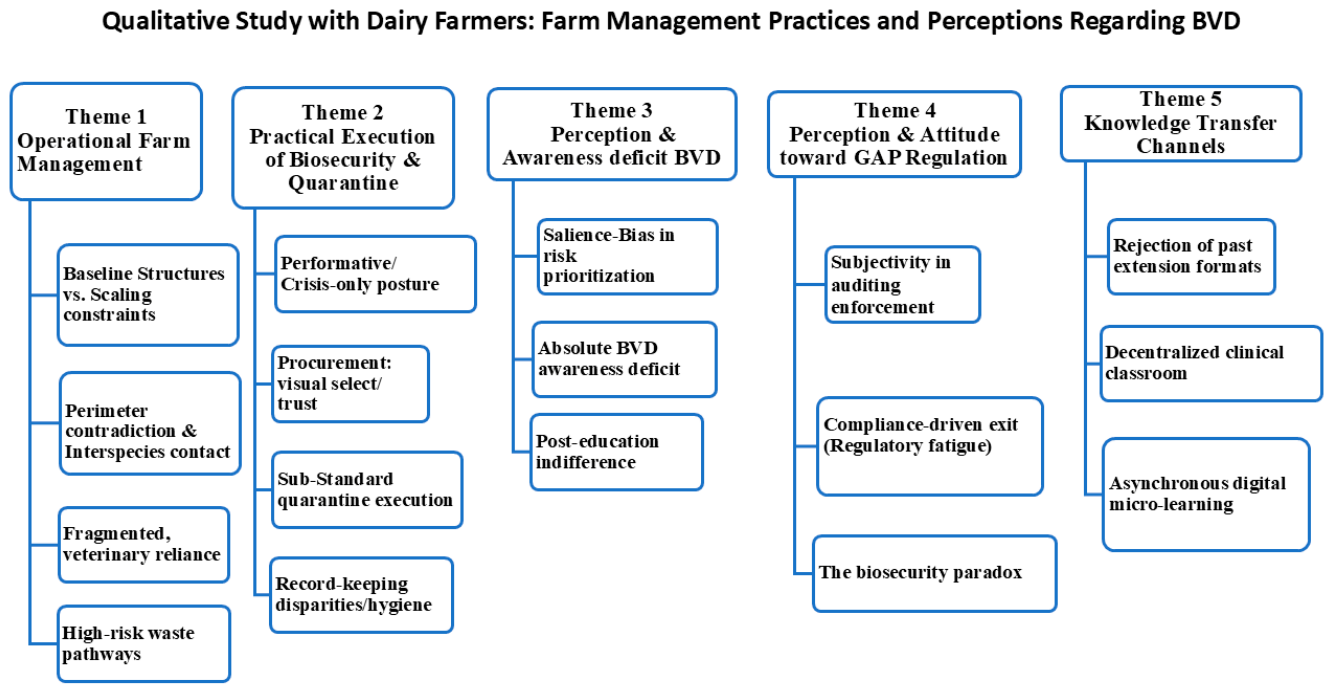

Table 1.
The interview questioning guide.
| Topics | Questions |
|---|---|
| The farm’s background | Could you please tell me about your background? (age/education/experience in dairy farming) How many dairy cows are in each stage of rearing? What is your registration status? (GAP-certified?) |
| Farm management practices |
Please explain your raising system. Grazing and contact with other cattle herds on pasture? Fencing. What did you do to reduce the chance of your cow exposing other animals? Do you have any pets (dog/cat on the farm? Why? Pen of calving (Yes/No), why? History of abortion on the farm (when, how, cause of abortion) History of sick animals? What are the signs/symptoms/diseases? How do you deal with those signs/diseases? Treatment? How/by whom? |
| Biosecurity practices on the farm | Introduction of a new cow/ screening for disease before introduction Purchasing animals from a certified disease-free herd (How, health check?) Quarantine (new introduction/sick animals): How? Where? Restricting access to other animals (How?) Cleaning with disinfectants (Farm hygiene) (How?) Carcass management (How?) Waste management (How?) |
| Perceptions and practices on BVD | Have you ever heard about BVD? From? What is/are the signs of BVD? Have any of your cows suffered from BVD? If “yes”, please specify the signs, the number of cases, and how you treated them. Do you isolate sick animals? Cleaning and Disinfecting, Carcass management How do you feel once your cows get a BVD infection? How virulent are they? What is/are the impact (animal health/economics)? If “no,” do your cows have these signs? Loss of appetite, Weakness, and weight loss, Mouth ulcer, Diarrhea, bloody diarrhea, Nasal and eye discharge, Reduced milk yield, Abortion, Stillbirth, and infertility These are the signs of BVD. What do you think about it? Do you think that your cow has a BVD infection already? How many cows on your farm have these signs? How do you feel when you know the signs of BVD? Do you think it is virulent? Why? In case your cow got BVD, what happens / what matters to your farm? Awareness of BVD (virulent/impact on economic or herd health) |
| Perception related to Biosecurity measures | How do you think about the biosecurity measures on the farm? How do you feel about the GAP standard regulations? Easy/hard to follow? Why? |
| Media and Communication | What is/are your sources of information related to animal health, diseases, biosecurity measures, and other topics? What is the type of media that you prefer? |
Table 2.
Demographic and farm characteristics of the 22 interviewed participants.
| Characteristics | Category | Frequency | Percentage (%) |
| Age | 30-40 years | 5 | 22.7 |
| 41-50 years | 4 | 18.2 | |
| 51-60 years | 10 | 45.5 | |
| >60 years | 3 | 13.6 | |
| Gender | Male | 11 | 50.0 |
| Female | 11 | 50.0 | |
| Education | Primary school | 11 | 50.0 |
| High school | 9 | 40.9 | |
| Bachelor’s degree or higher | 2 | 9.1 | |
| Experience in dairy farming | <10 years | 2 | 9.1 |
| >10 years | 20 | 90.9 | |
| Raising system | Tied stall | 8 | 36.4 |
| Free stall Mixed housing |
5 9 |
22.7 40.9 |
|
| Herd size | Small (< 20 cows) | 3 | 13.6 |
| Medium (20-50 cows) Large (> 50 cows) |
7 12 |
31.8 54.6 |
|
| Farm registration status | Registered GAP | 22 | 100.0 |
| History of positive BVD* | Yes (At least one cow) | 22 | 100.0 |
*From a previous study (Thongtem et al., 2023).
Table 3.
Background profile of the 22 participants.
| Participant | Age (years) |
Gender | Education | Experience (years) | Herd size | History of abortion in farm | Pen of calving | Herd Prevalence of BVD (%) |
|---|---|---|---|---|---|---|---|---|
| K01 | 33 | Female | High school | >10 | 12 | No | No | 0.25 |
| K10 | 59 | Female | High school | >10 | 128 | Yes | Yes | 0.18 |
| K11 | 48 | Female | High school | >10 | 100 | Yes | Yes | 0.16 |
| K12 | 40 | Male | Bachelor’s degree | >10 | 74 | Yes | No | 0.45 |
| K13 | 42 | Male | High school | >10 | 170 | Yes | No | 0.50 |
| N03 | 53 | Female | Primary school | >10 | 48 | Yes | Yes | 0.06 |
| N10 | 52 | Female | Primary school | >10 | 56 | Yes | No | 0.07 |
| N12 | 40 | Female | High school | 3-5 | 110 | Yes | No | 0.92 |
| N14 | 43 | Female | Primary school | >10 | 70 | Yes | No | 0.50 |
| N15 | 48 | Male | Primary school | >10 | 28 | Yes | No | 0.40 |
| R02 | 40 | Male | Primary school | >10 | 15 | Yes | No | 0.28 |
| R03 | 67 | Male | Primary school | >10 | 17 | Yes | No | 0.92 |
| R05 | 54 | Male | High school | >10 | 52 | Yes | No | 0.85 |
| R06 | 74 | Male | Primary school | >10 | 49 | Yes | No | 0.95 |
| R08 | 56 | Female | Primary school | >10 | 23 | Yes | No | 0.11 |
| R09 | 48 | Female | High school | >10 | 43 | Yes | No | 0.20 |
| R10 | 52 | Male | High school | >10 | 38 | Yes | Yes | 0.09 |
| P02 | 60 | Male | Primary school | >10 | 91 | Yes | No | 0.71 |
| P04 | 54 | Male | Primary school | >10 | 51 | No | No | 0.96 |
| P05 | 54 | Female | Primary school | >10 | 15 | Yes | No | 0.97 |
| PR02 | 30 | Male | High school | 5 | 73 | Yes | Yes | 0.5 |
| PR03 | 35 | Female | Bachelor’s degree | >10 | 36 | Yes | No | 0.2 |
Table 4.
Themes and Sub-themes generated from qualitative data.
| Core Theme | Identified Sub-themes | Central Meaning & Key Empirical Focus |
|---|---|---|
|
Theme 1: Operational Farm Management Practices and Herd Health Infrastructures |
|
Evaluates the physical layout, day-to-day husbandry routines, and localized disease-management choices that dictate animal health, detailing vulnerabilities such as loose domestic animals and hazardous abortion waste disposal. |
| ||
| ||
| ||
|
Theme 2: Practical Execution of Biosecurity Protocols, Quarantine, and Herd Additions |
|
Examines the routine application of preventative health measures, exposing a reliance on visual selection, social trust over diagnostic testing, and the performative deployment of biosecurity assets strictly during audits or outbreaks. |
| ||
| ||
| ||
|
Theme 3: Perceptions and Awareness Deficits Regarding |
|
Documents how a profound salience bias toward visible, acute epidemics (FMD and LSD) leads to an absolute baseline awareness deficit and operational indifference toward creeping, subclinical pathogens like BVD. |
| ||
| ||
|
Theme 4: Perception and Attitudes Toward GAP Regulations for Dairy Farms |
|
Outlines the tension between farmers' positive view of GAP goals and the administrative/financial burdens of compliance, which trigger intense regulatory fatigue and exit intentions among older producers. |
| ||
| ||
|
Theme 5: Communication Channels and Preferred Mechanisms for Knowledge Transfer |
|
Establishes the operational blueprint for future interventions by highlighting the rejection of time-consuming workshops in favor of mobile-optimized digital micro-learning and direct trust in visiting clinical veterinarians. |
| ||
| ||
Disclaimer/Publisher’s Note: The statements, opinions and data contained in all publications are solely those of the individual author(s) and contributor(s) and not of MDPI and/or the editor(s). MDPI and/or the editor(s) disclaim responsibility for any injury to people or property resulting from any ideas, methods, instructions or products referred to in the content. |
© 2026 by the authors. Licensee MDPI, Basel, Switzerland. This article is an open access article distributed under the terms and conditions of the Creative Commons Attribution (CC BY) license.
Copyright: This open access article is published under a Creative Commons CC BY 4.0 license, which permit the free download, distribution, and reuse, provided that the author and preprint are cited in any reuse.