

Submitted:
12 October 2026
Posted:
14 October 2026
You are already at the latest version
Abstract
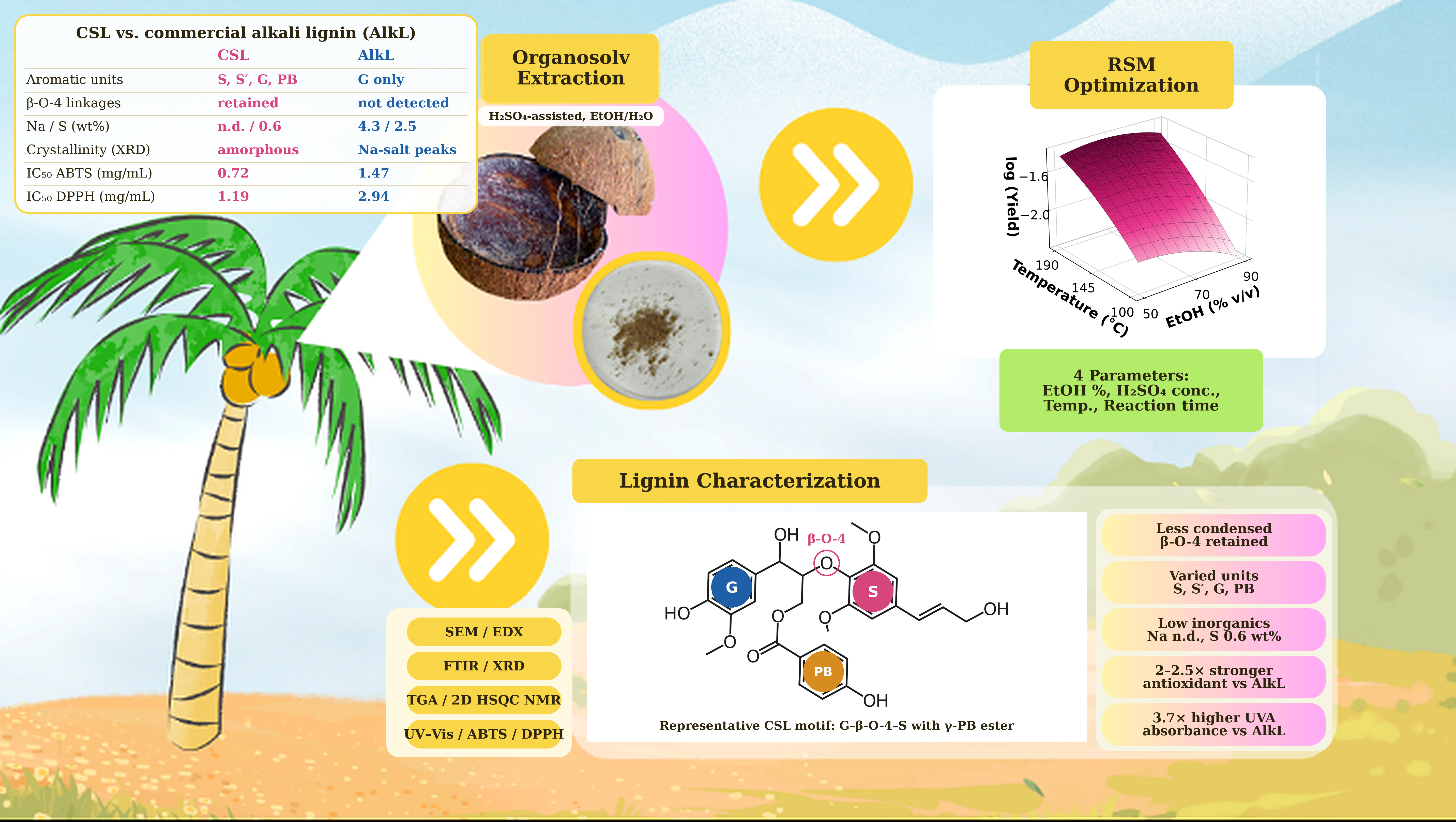
Coconut shell (CS), an abundant by-product of the coconut-processing industry, is a lignin-rich feedstock for renewable aromatic materials. In this study, H2SO4-assisted ethanosolv fractionation of extractive-free CS was optimized using a four-factor Box–Behnken design (ethanol 50–90% v/v, H2SO4 0.2–2.0% w/w, 100–190 °C, 15–90 min). Crude lignin yield (0.2–11.2%) was governed mainly by temperature and time, whereas total phenolic content (TPC; 284.7–827.2 mg GAE g−1) depended on the ethanol and acid concentrations and their interactions with time. Coconut shell lignin obtained at 70% ethanol, 1.1% H2SO4, 190 °C and 90 min (CSL; 11.1% yield) was characterized using commercial alkali lignin (AlkL) as a benchmark. CSL contained 88.0% Klason lignin, 7.8% residual carbohydrate (mainly xylan) and 1.0% ash, and showed a lower sulfur content than AlkL (0.6 vs. 2.5 wt%, EDX) without the crystalline sodium sulfate detected in AlkL. 2D HSQC NMR revealed that CSL is a p-hydroxybenzoate–guaiacyl–syringyl lignin that retains β-O-4′ aryl ether linkages, whereas AlkL is a guaiacyl-type lignin largely depleted of β-O-4′ units. Although its TPC was lower (328.0 vs. 380.1 mg GAE g−1), CSL scavenged ABTS and DPPH radicals about twice as effectively as AlkL (IC50 0.72 and 1.19 vs. 1.47 and 2.94 mg mL−1) and absorbed 4.0- and 3.7-fold more UVB and UVA radiation. H2SO4-assisted ethanosolv fractionation therefore yields a low-sulfur, less-condensed lignin with promising antioxidant and UV-absorbing functionality.
Keywords:
box–Behnken design
; organosolv extraction
; lignin
; coconut shell
; total phenolic content
; antioxi-dant activity
; UV absorption
; sulfuric acida
Copyright: This open access article is published under a Creative Commons CC BY 4.0 license, which permit the free download, distribution, and reuse, provided that the author and preprint are cited in any reuse.