
Submitted:
07 October 2026
Posted:
14 October 2026
You are already at the latest version
Abstract
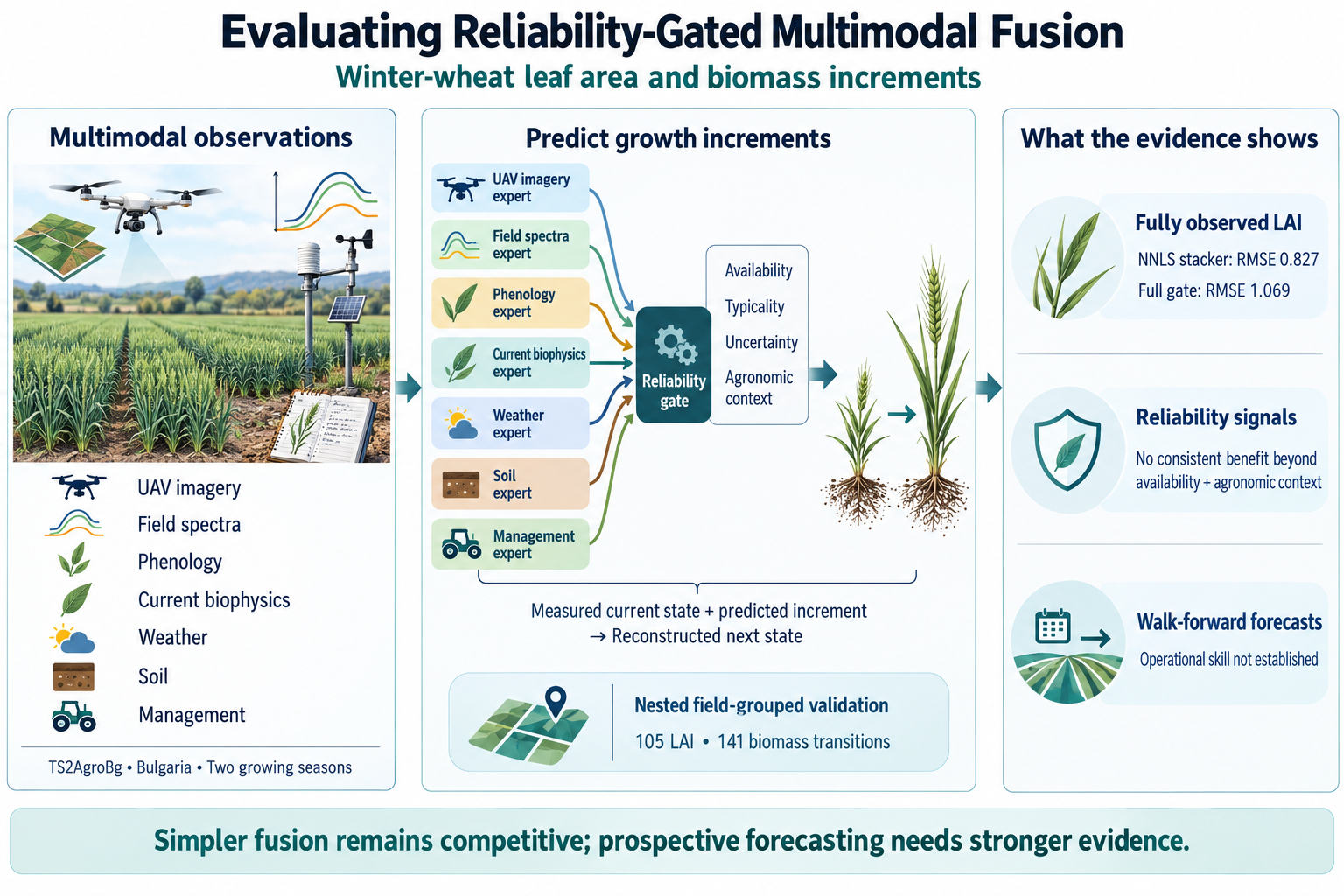
We evaluate whether typicality and uncertainty improve multimodal fusion of winter- wheat leaf area index(LAI)and biomass increments beyond availability-only gating(availability plus agronomic context). Consecutive elementary sampling unit (ESU) visits are kept when their 20m windows overlap (n = 105 LAI, n = 141 biomass); overlap is not a repeated plot. Nested field-grouped cross-validation does not favour the full gate. A nonnegative stacker is more accurate on fully observed ∆LAI (RMSE 0.827 vs 1.069). Availability-only gating has a slightly lower observed RMSE on fully observed biomass increments (101.1 versus 102.4), with no statistically significant difference detected (field Wilcoxon p = 0.23). No consistent field-level benefit of typicality and uncertainty was established. Withholding the current-biophysics expert from the increment predictor measured yt is still used in reconstruction—gives reliability-gated fusion (SARG) the lowest pooled biomass RMSE, but not a paired win versus availability-only (p = 0.42). Concatenated walk-forward does not establish usable next-campaign skill: ridge has a small numerical ∆LAI RMSE gain over the mean-increment baseline (2.190 vs 2.234), and every concatenated R2 remains negative. Reconstruction \(\widehat{y}_{t+1} = y_t + \widehat{\Delta y}\) uses the measured current state.
Keywords:
multimodal data fusion
; dynamic gating
; UAV multispectral imagery
; winter wheat
; growth-increment forecasting
; missing-modality robustness
; nested cross-validation
Copyright: This open access article is published under a Creative Commons CC BY 4.0 license, which permit the free download, distribution, and reuse, provided that the author and preprint are cited in any reuse.