

Submitted:
12 October 2026
Posted:
13 October 2026
You are already at the latest version
Abstract
1. The exceptional navigational ability of bats relies on specialised sensory organs; specifically, the inner ear is optimised to process high-frequency sounds in total darkness. 2. Despite its clear functional importance, inner ear morphology remains an underutilised source of evolutionary insight in Chiroptera, particularly the origins of echolocation and deep-time phylogenetic divergences. 3. Here, we review specialised anatomy of the chiropteran inner ear and contrast bat inner ear ecology with recent insights from echolocating whales 4. We address methodological challenges of studying minute features, demonstrate how non-destructive digital imagery advances overcome traditional barriers, and consider how confounding effects of phylogeny could be addressed in quantitative analyses. 5. We argue that known strong correlations between echolocation strategy and flight space point to excellent opportunities to use chiropteran inner ear morphology to infer the origins and evolution of chiropteran ecology and echolocation behaviour.
Keywords:
Chiroptera
; sensory ecology
; audition
; echolocation
; mammalian inner ear
Introduction
With over 1500 species, bats (Order Chiroptera) constitute approximately 20% of living mammals (Burgin et al., 2018). Their dual adaptations of powered flight and echolocation allowed bats to colonise the night sky, resulting in a near-global distribution (King, 2024, Stevens et al., 2019, Ziegler et al., 2016) and unparalleled dietary diversity, ranging from insects, small vertebrates, fruit, nectar and even blood (Gual-Suárez and Medellín, 2021, Leiser-Miller and Santana, 2020, Potter et al., 2021, Rojas et al., 2011).
In all bats except pteropodids (flying foxes and old-world fruit bats), the high frequency biosonar system of echolocation has largely replaced the visual system for orientation, prey detection and localisation. These transitions coincided with extensive structural modifications, particularly in the inner ears (Davies et al., 2013; Sulser et al., 2022), which receive the ultrasonic signals (a high-frequency sound with a frequency above 20 kHz). Because the great diversity of echolocation types among bats is tightly associated with ecological traits such as diet and environmental surroundings, it is thus also expected that the inner ear of bats reflects a substantial amount of ecological information (Davies et al., 2013; Dickinson et al., 2023) through adaptations to particular echolocation types.
In this article, we review the specialised anatomy of the chiropteran inner ear. We trace the history of the discovery of bat echolocation and provide an overview of the known modifications of the chiropteran inner ear. We then contrast the relatively limited understanding of how bat inner ears reflect ecological traits with recent studies in the echolocating but distantly related odontocetes (whales). Lastly, we argue that the growing affordability and speed of tomography-based 3D digitisation offer an unprecedented opportunity to vastly expand understanding of chiropteran inner-ear morphology, its functional link to hearing ability, and its relationship to bat ecology.
Blinding Bats: The Historical Discovery of Echolocation
Bats' ability to navigate in complete darkness was a longstanding scientific mystery. In 1793, Italian scientist Lazzaro Spallanzani discovered that bats could fly and avoid obstacles with eyes covered or removed (Griffin, 2001, Dijkgraaf, 1960), and Spallanzani’s contemporary, Louis Jurine of Geneva, discovered that bats with their ears plugged became disoriented (Griffin, 2001). Neither researcher could explain how bats used their ears to navigate, and contemporary scientists dismissed the concept (Griffin, 2001). Over a century later, Walter Hahn (1908) replicated these earlier experiments and concluded that “…obstacles are perceived chiefly through sense organs in the inner ear”, but a mechanism eluded him because bats appeared to fly silently.
Hiram Maxim (1912) first suggested that bats might emit sounds to sense objects through reflected echoes, suspecting low-frequency echolocation; soon after, Hamilton Hartridge (1920) proposed that high-frequency sounds were more physically suitable (Griffin, 2001). In 1938, Hartridge’s proposal proved correct when Robert Galambos and Donald Griffin used an ultrasonic detector developed by William Pierce to show that bats were emitting ultrasonic sounds and receiving echoes (Griffin, 2001, Pierce and Griffin, 1938, Griffin and Galambos, 1941, Griffin, 1958). At the same time, Sven Dijkgraaf noted that bats made faint ticking noises and collided with objects when they flew with their mouths covered (Dijkgraaf, 1943, Dijkgraaf, 1946).
The Evolution and Systematic History of Chiroptera
After Galambos, Griffin, and Dijkgraaf’s discoveries established that bats navigate in the dark by sensing returning echoes of high-frequency sound emissions, researchers have identified several inner-ear adaptations for high-frequency hearing (Davies et al., 2013). However, these adaptations evolved in the context of echolocation's unusual evolutionary history, which remained confusing until recently. Until the early 2000s, chiropteran phylogenies divided bats into two suborders based primarily on echolocation: Megachiroptera (or megabats; the singular, non-echolocating family Pteropodidae) and Microchiroptera (or microbats; all echolocating families; Figure 1; Teeling et al., 2005). Megabats typically display greater body mass, larger eyes, simple pinnae lacking a tragus, and feed on plants (Almeida et al., 2025). Conversely, microbats are predominantly insectivores and possess complex pinnae with a tragus (Griffin, 1958; Lawrence and Simmons, 1982). These distinct differences drove early phylogeny mapping (Koopman, 1994) and even prompted suggestions that megabats were more closely related to primates than microbats (Pettigrew, 1989). Genomic analyses revealed that microbats were not a monophyletic clade and established the now broadly accepted subordinal division of Yinpterochiroptera and Yangochiroptera (Teeling et al., 2005; Simmons and Cirranello, 2026). Importantly, Yangochiroptera contains three echolocating superfamilies (Emballonuroidea, Noctilionoidea, and Vespertilionoidea), while Yinpterochiroptera comprises Pteropodidae and the echolocating superfamily Rhinolophoidea (Fig. 1; Teeling et al., 2005). As summarised in Fig. 1, this implies that laryngeal echolocation either evolved once and was subsequently lost in ancestral pteropodids (single origin hypothesis) or evolved convergently in the echolocating lineages (convergent origin hypothesis).
Diversification of species and echolocation across Chiroptera
Most major lineages within crown Chiroptera emerged by the Palaeocene (Santana et al., 2025, Morales et al., 2026). These did not diversify uniformly, so taxonomic diversity is more variable across bat families compared to most other mammalian orders (Jones et al., 2005). Vespertilionidae, Phyllostomidae, Rhinolophidae, Hipposideridae, and Pteropodidae are highly speciose and widely distributed, while most bat families are species-poor (Figure 1; Jones et al., 2005). These contrasting evolutionary trajectories suggest that taxonomic and morphological diversification are heavily influenced by the interplay between echolocation strategies and the various ecological niches they unlock.
Phyllostomids exhibit the greatest dietary range among bats, including insectivory, carnivory, sanguivory, frugivory, nectivory, and omnivory (Monteiro and Nogueira, 2011; Ochoa-Sanz et al., 2025; Riskin and Carter, 2023). This appears to have driven rapid adaptive radiation in skull morphologies (Arbour et al., 2019; Dumont et al., 2012; Giacomini et al., 2022), external sensory structures (nose leaf and pinnae) and craniodental characteristics (Leiser-Miller and Santana, 2020). For instance, the diversification of the predominantly frugivorous Stenodermatinae (New World fruit bats, tent-making bats) tracked that of angiosperms (Monteiro and Nogueira, 2011; Rojas et al., 2011), while the divergence of Desmodontinae coincided with the development of obligate sanguivory (Potter et al., 2021). Despite this high dietary and foraging diversity, many unrelated phyllostomids possess similar echolocation call structures, which seem shaped to navigate acoustically complex environments and secondarily adapted for specific foraging behaviours (Leiser-Miller and Santana, 2021). This possibly allows these bats to exploit a variety of resources and seasonal fluctuations in resource availability. However, nose-leaf morphology varies greatly among these bats and correlates with their foraging strategy (Leiser-Miller and Santana, 2020). Nose-leaves function as an acoustic modifier that shapes and directs vocalisations emitted from the nostrils (Anthwal et al., 2023). Therefore, even structurally similar calls are filtered into distinct acoustic beams that are optimise echolocation for specific foraging environments. Vespertilionidae is the most species-rich chiropteran family, with 545 almost exclusively insectivorous species distributed worldwide (Simmons and Cirranello, 2026). Vespertilionidae diversified much faster than Phyllostomidae and are morphologically highly conservative (Jones et al., 2005; Dool and Puechmaille, 2024). This may reflect limited shifts in niche utilisation, or rapid global radiation that drove swift reproductive isolation and outpaced phenotypic diversification in newly formed lineages (Stevens et al., 2019). However, unlike phyllostomids, vespertilionids exhibit highly diverse call structures (Fullard and Dawson, 1997; Eick et al., 2005) which appeare to have enabled the adoption of varied foraging strategies across various habitats (Siemers and Schnitzler, 2004). Like vespertilionids, the Old-World families Rhinolophidae and Hipposideridae are species-rich (118 and 94 species, respectively; Simmons and Cirranello, 2026) but show relatively low phenotypic variation (Foley et al., 2015). It is thought that the evolution of constant frequency (CF), high-duty cycle echolocation, facilitated their radiation into novel niches (Eick et al., 2005; Odendaal and Jacobs, 2011; Stoffberg et al., 2011). High-duty cycle echolocation exploits the Doppler shift to simultaneously emit calls and process returning echoes. This highly derived echolocation behaviour is specialised to detect and capture fluttering prey in densely vegetated environments. These CF calls are emitted nasally and require intricate nose-leaves to direct acoustic signals. The acoustic demands of high duty cycle echolocation likely imposed an evolutionary constraint that has limited cranial variation in rhinolophids and hipposiderids (Jacobs et al., 2014). Pteropodids (flying foxes or Old-World fruit bats) are behaviourally and morphologically distinct among Chiroptera. They are a highly speciose family widespread throughout the tropics and subtropics of Africa, Asia, and Australasia/Oceania (Ziegler et al., 2016). Pteropodids are the largest known bats, weighing up to 1 kg with wingspans reaching 2 m. These nocturnal frugivores and nectarivores do not echolocate, except for Rousettus, which uses tongue clicks for orientation (Springer et al., 2001). Instead, pteropodids rely heavily on visual and olfactory cues to locate food (Raghuram et al., 2009). Their high taxonomic diversity stems from adaptive radiation in isolated populations that followed their separation from the rest of yinpterochiropterans in the Early Eocene (Almeida et al., 2011).
Chiropteran diversification clearly resulted from an interplay of diverse ecological and environmental factors across widely different temporal and spatial scales. At the core of these spectacular divergences is the unique specialisation of the chiropteran inner ear from the ancestral mammalian condition, which we cover in the next section.
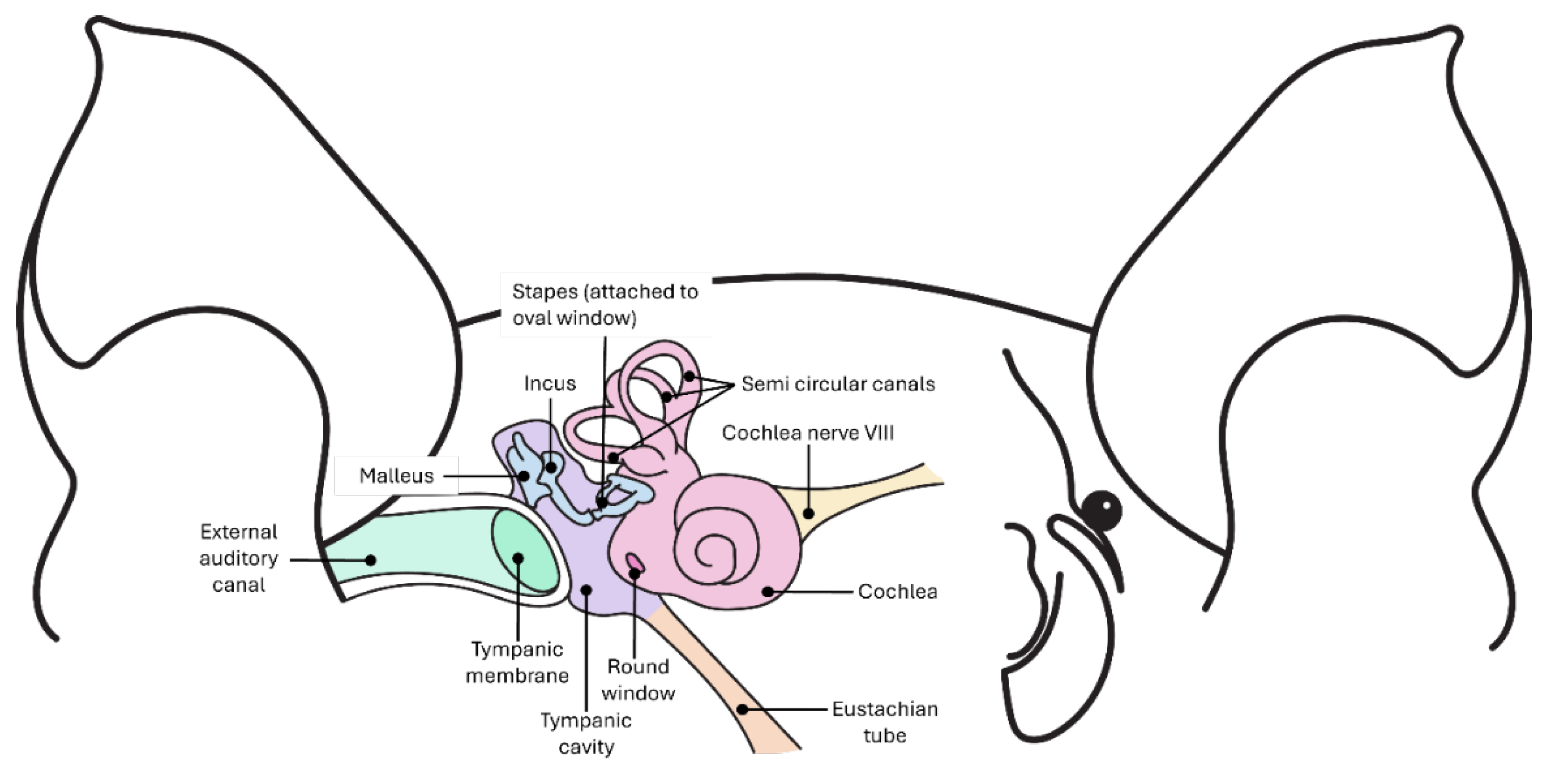
Figure 2.
Diagram of the mammalian peripheral auditory system.
Structure, Function, and Comparative Visualisation of the Mammalian Inner Ear
Compared to non-mammalian vertebrates, mammalian auditory systems permit a broader range of frequency sensitivities (Manley 2017). Most mammals can process frequencies above >10 kHz, but certain lineages, specifically bats and toothed whales (Odontoceti), use biosonar to perceive ‘ultrasonic’ frequencies, spanning 20 kHz to over 200 kHz (Manley, 2017).
The mammalian outer ear (pinna and external auditory canal) funnels sound toward the tympanic membrane. The middle ear is an air-filled cavity positioned laterally to the basicranium and contains the three ear ossicles (incus, malleus, and stapes), which form a chain that transmits sound vibrations from the tympanic membrane to the inner ear via the articulation of the stapes footplate with the fenestra vestibuli (oval window). The bony labyrinth of the inner ear is situated in the petrous bone; it is a fluid-filled structure that includes the cochlea, vestibule, and semicircular canals. While the semicircular canals and vestibule control balance by sensing angular head motion and support movement and stable vision (Rabbitt, 2019), acoustic transduction occurs entirely in the cochlea (Anthwal and Thompson, 2016).
In therian mammals, the cochlea coils around the central modiolus and divides into three ducts: scala vestibuli, scala tympani, and scala media. The organ of Corti sits in the scala media atop the basilar membrane, which is tonotopically organised to perceive high frequencies at the base and low frequencies at the apex (Chittka and Brockmann, 2005). Hair cells within the organ of Corti act as sensory receptors (Manley 2017). Stapedial vibration sends waves through the scalae, displacing the basilar membrane and deflecting stereocilia to convert mechanical force into electrochemical signals. An osseous lamina projects from the modiolus to form a primary spiral lamina—a bony shelf anchoring the basilar membrane along most of the cochlea's length (Manley, 2018).
Adaptations for Ultrasonic Hearing in the Chiropteran Auditory System
The organisation of the chiropteran inner ear, particularly the cochlea, varies widely across the clade (Sulser et al., 2022). For example, laryngeally echolocating bats have more cochlear turns than pteropodids, with an average of 1.75 in pteropodids and 2.5 to 3.5 turns in echolocating lineages (Pye, 1966b, Pye, 1966a, Habersetzer and Storch, 1992). However, cochlear length does not necessarily indicate frequency-sensitivity range, nor is there a simple relationship between cochlear length and the number of turns (Del Rio et al., 2023, West, 1985, Ekdale, 2013, Manley, 2012). Because lower octaves normally require a disproportionately large area of the basilar membrane, the higher low-frequency threshold seen in bats plays a key evolutionary role (Kössl and Vater, 1985; Heffner et al., 2001; Vater et al., 1985; Manley, 2017). This loss of the lower octaves has expanded the area available for high-frequency octaves and could potentially lead to reduced cochlea coiling (Manley, 2017). This effect was used to explain the unusually short cochlea canal observed in the megadermatid Macroderma gigas (Australian ghost bat) compared to other echolocating bats (Davies et al., 2013). Moreover, the cochlea canal in some bats is characterised by an enlarged basal turn rather than a high number of cochlear turns. This is particularly prevalent in bats that use constant-frequency (CF; see below) echolocation because the cochlea needs to accommodate the auditory fovea (Russell et al., 2003, Schuller and Pollak, 1979).
A secondary osseous lamina projecting from the outer wall of the cochlea is prominent in species that use biosonar, including bats and toothed whales (Manley, 2018). This secondary lamina is believed to benefit animals with high-frequency hearing by increasing basilar membrane rigidity (Manley, 2018). The secondary osseous spiral lamina of some mammals corresponds to hearing frequency sensitivities above 10 kHz and is thought to increase basilar membrane rigidity in mammals (Manley, 2018). This explains its prominence in many bats (Bruns et al., 1989, Ramprashad et al., 1979, Küçük and Abe, 1992a), where it can extend between three-quarters to the entire cochlea length (Bruns, 1980, Dannhof and Bruns, 1991). Variation in the presence and extent of the osseous lamina relative to other echolocation-relevant anatomy is likely far more complex, and potentially ecologically informative, than currently understood. For example, Pye (1966b) found a secondary osseous lamina in species of Rhinolophus and Hipposideros but suggested that it was absent in other bat species, even though only two other species – Saccopteryx bilineata and Noctilio leporinus – were investigated. Thus, these early discrepancies highlight the need for broader comparative studies to reveal how subtle anatomical variation aligns with distinct echolocation strategies and ecological niches.
Echolocation, Foraging Mode, and Ecology Shape the Inner ears of Bats
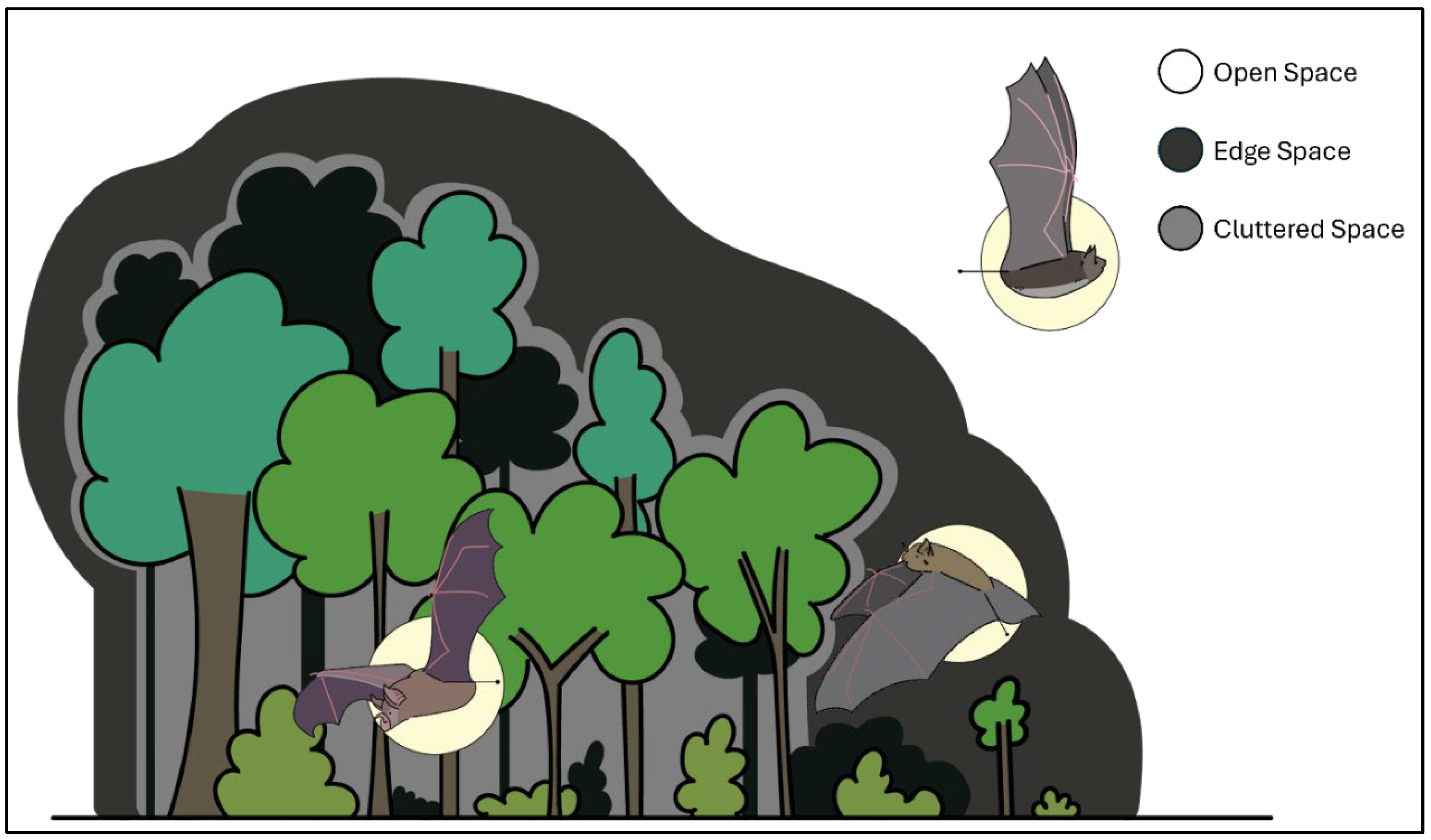
Flight space and foraging modes are strongly linked to echolocation behaviour in bats (Denzinger and Schnitzler, 2013). However, determining how these factors co-vary and relate to morphological adaptations has been difficult as traditional classification schemes face challenges in faithfully capturing the combined dynamics of feeding mode, hunting strategies, and flight space use (such as proposed e.g. by Norberg and Rayner, 1987; McKenzie and Bullen, 2012). Static groupings can overlook behavioural plasticity as such megadermatids shifting foraging strategies across season and prey types (Schmidt et al., 2011; Gual-Suárez and Medellín, 2021). To provide a more adaptable model, Denzinger and Schnitzler (2013) developed the “foraging guild concept”. This comprehensive framework categorises bats by linking flight space use, foraging mode and morphology with specific echolocation adaptations. Under this concept, which we use here, bats fall into three groups based on how they navigate background clutter: open space, edge space and narrow space (Figure 3; Kalko et al., 2008; Denzinger and Schnitzler, 2013). Denzinger and Schnitzler’s (2013) framework is useful for tracing bat adaptations because they align behaviour and echolocation quite well. Open-space foragers typically use shallow frequency-modulated (FM) signals with long pulse intervals and high source levels (intensity of emitted call) to maximise long-range detection in unobstructed areas (Denzinger et al., 2018). Conversely, edge space foragers operating near vegetation, buildings or water surfaces use a variant of FM echolocation. These calls often include an additional acoustic component that either precedes or follows the standard FM sweep (a change in sound pitch/frequency over a short period). Narrow space foragers face the extreme challenge of distinguishing prey echoes from complex background clutter, making “flutter detection”, using long CF signals, advantageous. This allows bats to localise prey by detecting amplitude and frequency modulations in the returning echo of insect wing beats. Flutter detectors emit high duty cycle calls which result in by a temporal overlap of pulse and echo. To manage this overlap, flutter-detecting bats use Doppler shift compensation, a sophisticated vocalisation behaviour of adjusting emission frequency to compensate for Doppler shifts caused by flight speed relative to the target (Neuweiler, 1990). Other narrow space foragers “glean” by snatching stationary food items from surfaces. This strategy, used by both insectivorous and frugivorous species, can be either active, using short, broadband signals at a high frequency, or passive, relying on prey generated acoustic cues (leaf rustling) and even olfaction (Page and Ryan, 2008). Foraging guilds reflect an important mechanism of niche partitioning between differently specialised bat species, which often allows numerous species to share the same flight space and roost sites (Nicholls and Racey, 2006; Novella-Fernandez et al., 2020). A striking example of this behaviour is the coexistence of over 100 different species in certain regions of Brazil (Delgado-Jaramillo et al., 2020). Sustaining such high densities requires fine-scale niche partitioning (MacArthur and Levins, 1967; Schoener, 1974).
Figure 3.
Differential use of flight space by bats.
Ecological Signatures in the Inner Ear of Echolocating Mammals
The above shows that chiropteran inner-ear morphology clearly reflects echolocation behaviours, which in turn are deeply entwined with core ecological traits such as flight space and foraging strategies. These connections make bat inner-ear morphology, particularly cochlear morphology, an ideal source of information where ecologies cannot be directly observed. In addition, understanding how inner ear morphology reflects ecologies and echolocation behaviour has the potential to add crucial new data to existing debates about how echolocation has evolved.
An excellent precedent for relating ecology and inner ear morphology exists for another echolocating mammalian lineage, the toothed whales (Odontocetes). Despite mechanistic differences in echolocation function between air and water, chiropterans and odontocetes exhibit remarkable similarities in cochlea morphologies, call design and acoustic behaviour (Davies et al., 2013, Girdlestone et al., 2020, Park et al., 2019, Ketten et al., 2021). This includes a flattened cochlea with a wider basal turn than in other mammals (Vater and Kössl, 2011; Park et al., 2019), calls in the same frequency range, and call structures adjusted for different echolocation types (Moss et al., 2023; Madsen and Surlykke, 2013). In toothed whales, the cochleae reflect distinct acoustic habitats and frequency sensitivities (Park et al., 2023, Park et al., 2016, Costeur et al., 2018). For instance, cochlea width and length are indicative of habitat preference and modality, providing insights into dive depth limits and habitat boundaries (Gutstein et al., 2014, Park et al., 2023, Park et al., 2016, Viglino et al., 2021, Costeur et al., 2018). Convergent cochlea morphologies are also more pronounced in acoustically complex habitats. This suggests that strong acoustic demands impose evolutionary constraints, producing distinct morphological signatures for specific auditory specialisations (Park et al., 2019). These insights have broader implications for palaeoecological reconstructions of extinct echolocating mammals (Costeur et al., 2018, Madsen and Surlykke, 2013, Park et al., 2016, Park et al., 2019, Racicot, 2022).
Leveraging the digital revolution to expand studies of bat echolocation and ecology
We propose that the clear utility of morphological traits in predicting odontocete echolocation probably also exists in bats, warranting much deeper investigation than has been done. Cochlea morphology has already used to assess hearing sensitivity and echolocation capability in extinct bats (Novacek, 1987, Gunnell et al., 2003, Thewissen et al., 2009, Mennecart et al., 2022, Orliac and O’Leary, 2014, Hand et al., 2023), but detailed ecological and behavioural reconstructions are frequently hindered by the extremely fragile and flattened state of fossil petrosals (Gutstein et al., 2014, Park et al., 2023, Park et al., 2016, Viglino et al., 2021). However, several demonstrated or suspected connections between echolocation behaviour, foraging guild, and inner ear morphology have already been made in some clades. Table 1 summarises these, highlighting strong potential to link cochlear structure, habitat, and foraging behaviour (Dickinson et al., 2023). However, as Table 1 also shows, most of these very promising studies have narrow taxonomic coverage and small sample sizes, which limits the power of inference to other species.
Advances in non-destructive data acquisition through (micro-) Computed Tomography (CT) scanning and access to the resulting 3D data provide an excellent opportunity to explore the minute inner ears of bats at much greater scales than previously possible (Weisbecker et al., 2025). These virtual approaches have already yielded substantial new insights into the origins and evolution of hearing capabilities in extinct mammals, using auditory correlates from extant analogues (Da Cunha et al., 2023, Mennecart et al., 2022, Ruf et al., 2016). This comparative approach has been vital for tracing the transitional evolution of the inner ear (Luo et al., 2010), determining when key innovations, such as cochlea coiling, first arose (Graybeal et al., 1989; Hoffman et al., 2014), and inferring the ancestral hearing capabilities of modern lineages (Peacock et al., 2025; Coleman et al., 2010). Computer aided visualisation tools, such as Synchrotron-based tomography and microCT enable 3D reconstruction of these tiny, often inaccessible regions (for a full review see Cunningham et al., 2014; Racicot 2017). The rise of open-source platforms (i.e., 3D slicer (Fedorov et al ., 2021), ORS Dragonfly (Comet Technologies Canada Inc., 2025)) has made these methodological frameworks and digital reconstruction available to the broader scientific community; and well-established quantitative protocols, such as geometric morphometric analysis (Peacock and Thewissen, 2025), have made it easier than ever to undertake the large-scale comparative analyses required to confidently link auditory anatomy with echolocation and ecological traits in bats.
With these recent advances addressing sample-size issues, the main constraint on linking cochlear morphology to echolocation and foraging behaviour is the strong phylogenetic confounding of these traits across the chiropteran tree. For example, CF echolocation only exists in a monophyletic group (Rhinolophoidea) within the yinpterochiropterans, as well as in a small number of species of the yangochiropteran genus Pteronotus (Fig. 1); differences between CF and FM echolocation therefore need to be interpreted with caution because they could also be purely phylogenetic (Mitchell et al. 2026), and species representing both types may not be co-analysed meaningfully because their inner ears are substantially different. Similarly, foraging modes are often invariant within monophyletic radiations, again meaning it is impossible to determine whether differences reflect phylogenetic signal or functional meaning. Basing interpretations on first principles (e.g., physics) may therefore be the only statistically not very rigorous resort (Mitchell et al. 2024, 2026). However, this issue does not prevent the potential for important insights because many important variables – such as echolocation parameters, or foraging modes across the more variable FM bats – vary widely across species and can therefore be meaningfully analysed.
Conclusions
Bats exhibit remarkable diversity in morphology, ecology, and behaviour, reflected in diverse echolocation strategies associated with flight spaces and foraging strategies. The strong correlation between echolocation strategy and flight space we reviewed here suggests an adaptive complex between inner ear morphology, ecology, and echolocation behaviour ripe for analytical exploitation. Larger-scale, digitally powered studies can exploit this; ideal candidates are dimensions of the auditory fovea, overall cochlea shape and size, the basilar membrane, and a secondary osseous spiral lamina. Many questions can be answered with these data, including which inner ear traits can – or cannot – be used to trace the origin and evolution of echolocation in bats; how petrosa of extinct bats might reflect their echolocation mode or even foraging ecology; and how quickly behavioural modifications might be reflected in inner ear morphology in evolutionary time.
Funding
MCR was supported by an Australian Government Research Training Program (RTP) Scholarship. This research was conducted on the unceded lands of the Kaurna people.
References
- ALMEIDA, F.C.; GIANNINI, N.P.; DESALLE, R.; SIMMONS, N.B. Evolutionary relationships of the Old World fruit bats (Chiroptera, Pteropodidae): another star phylogeny? BMC Evol. Biol. 2011, 11, 1–17. [Google Scholar] [CrossRef]
- ALMEIDA, F.C.; HELGEN, K.M.; SIMMONS, N.B.; GIANNINI, N.P. Evolution and ecology of body size in the world’s largest bats. Proc. R. Soc. B Biol. Sci. 2025, 292. [Google Scholar]
- ÁLVAREZ-CARRETERO, S.; TAMURI, A.U.; BATTINI, M.; NASCIMENTO, F.F.; CARLISLE, E.; ASHER, R.J.; YANG, Z.; DONOGHUE, P.C.; DOS REIS, M. A species-level timeline of mammal evolution integrating phylogenomic data. Nature 2022, 602, 263–267. [Google Scholar] [CrossRef]
- ANTHWAL, N.; THOMPSON, H. The development of the mammalian outer and middle ear. J. Anat. 2016, 228, 217–232. [Google Scholar] [CrossRef]
- Anthwal, N.; Hall, R. P.; De La Rosa Hernandez, F. A.; Koger, M.; Yohe, L. R.; Hedrick, B. P.; Davies, K. T.; Mutumi, G. L.; Roseman, C. C.; Dumont, E. R. Cochlea development shapes bat sensory system evolution. Anat. Rec. 2026, 309, 1061–72. [Google Scholar] [CrossRef]
- ARBOUR, J.H.; CURTIS, A.A.; SANTANA, S.E. Signatures of echolocation and dietary ecology in the adaptive evolution of skull shape in bats. Nat. Commun. 2019, 10, 2036. [Google Scholar] [CrossRef]
- BOONMAN, A.; BUMRUNGSRI, S.; YOVEL, Y. Nonecholocating fruit bats produce biosonar clicks with their wings. Curr. Biol. 2014, 24, 2962–2967. [Google Scholar] [CrossRef]
- BRUNS, V. Peripheral auditory tuning for fine frequency analysis by the CF-FM bat, Rhinolophus ferrumequinum. J. Comp. Physiol. 1976, 106, 77–86. [Google Scholar] [CrossRef]
- BRUNS, V. Basilar membrane and its anchoring system in the cochlea of the greater horseshoe bat. In Anatomy and Embryology; 1980; Volume 161, pp. 29–50. [Google Scholar]
- BRUNS, V.; BURDA, H.; RYAN, M. J. Ear morphology of the frog-eating bat (Trachops cirrhosus, family: Phyllostomidae): apparent specializations for low-frequency hearing. J. Morphol. 1989, 199, 103–118. [Google Scholar] [CrossRef]
- BURGIN, C.J.; COLELLA, J.P.; KAHN, P.L.; UPHAM, N.S. How many species of mammals are there? J. Mammal. 2018, 99, 1–14. [Google Scholar] [CrossRef]
- CHITTKA, L.; BROCKMANN, A. Perception space—the final frontier. PLoS Biol. 2005, 3, e137. [Google Scholar] [CrossRef]
- COLEMAN, M.N.; COLBERT, M.W. Correlations between auditory structures and hearing sensitivity in non-human primates. J. Morphol. 2010, 271, 511–532. [Google Scholar] [CrossRef]
- Comet Technologies Canada Inc. Dragonfly 3D World (Version 2025.1) [Computer software]. 2025. Available online: https://dragonfly.comet.tech/.
- COSTEUR, L.; GROHÉ, C.; AGUIRRE-FERNÁNDEZ, G.; EKDALE, E.; SCHULZ, G.; MÜLLER, B.; MENNECART, B. The bony labyrinth of toothed whales reflects both phylogeny and habitat preferences. Sci. Rep. 2018, 8, 7841. [Google Scholar] [CrossRef]
- DA CUNHA, L.; VIÑOLA-LÓPEZ, L.W.; MACPHEE, R.D.; KERBER, L.; VÉLEZ-JUARBE, J.; ANTOINE, P.O.; BOIVIN, M.; HAUTIER, L.; LEBRUN, R.; MARIVAUX, L.; FABRE, P. H. The inner ear of caviomorph rodents: Phylogenetic implications and application to extinct West Indian taxa. J. Mamm. Evol. 2023, 30, 1155–1176. [Google Scholar] [CrossRef]
- DANNHOF, B. J.; BRUNS, V. The organ of Corti in the bat Hipposideros bicolor. In Hearing Research; 1991; Volume 53, pp. 253–268. [Google Scholar]
- DAVIES, K.T.J.; MARYANTO, I.; ROSSITER, S. J. Evolutionary origins of ultrasonic hearing and laryngeal echolocation in bats inferred from morphological analyses of the inner ear. Front. Zool. 2013, 10, 1–15. [Google Scholar] [CrossRef]
- DEL RIO, J.; TASZUS, R.; NOWOTNY, M.; STOESSEL, A. Variations in cochlea shape reveal different evolutionary adaptations in primates and rodents. Sci. Rep. 2023, 13, 2235. [Google Scholar] [CrossRef]
- DELGADO-JARAMILLO, M.; AGUIAR, L.M.S.; MACHADO, R.B.; BERNARD, E. Assessing the distribution of a species-rich group in a continental-sized megadiverse country: Bats in Brazil. In Diversity and Distributions; 2020; Volume 26, pp. 632–643. [Google Scholar]
- DENZINGER, A.; SCHNITZLER, H.U. Bat guilds, a concept to classify the highly diverse foraging and echolocation behaviors of microchiropteran bats. Front. Physiol. 2013, 4, 164. [Google Scholar] [CrossRef]
- DENZINGER, A.; TSCHAPKA, M.; SCHNITZLER, H.U. The role of echolocation strategies for niche differentiation in bats. Can. J. Zool. 2018, 96, 171–181. [Google Scholar] [CrossRef]
- DICKINSON, E.; TOMBLIN, E.; ROSE, M.; TATE, Z.; GOTTIMUKKULA, M.; GRANATOSKY, M.; SANTANA, S.; HARTSTONE-ROSE, A. Ecomorphological correlates of inner and middle ear anatomy within Pyllostomid bats. Anat. Rec. 2023, 306, 2751–2764. [Google Scholar] [CrossRef]
- DIJKGRAAF, S. Over een merkwaardige functie van den gehoorzin bij vleermuizen. In Verslagen Nederlandsche Akademie van Wetenschappen Afdeeling Naturkunde; 1943; Volume 52, pp. 622–27. [Google Scholar]
- DIJKGRAAF, S. Die sinneswelt der fledermäuse. Experientia 1946, 2, 438–448. [Google Scholar] [CrossRef]
- DIJKGRAAF, S. Spallanzani's unpublished experiments on the sensory basis of object perception in bats. In Isis; 1960; Volume 51, pp. 9–20. [Google Scholar]
- DOOL, S.E.; PUECHMAILLE, S. J. Challenges in the Vespertilionidae phylogeny: resolving Pipistrellus nathusii placement and affirming generic status for Asian pipistrelles. J. Mammal. 2024, 106, 458–468. [Google Scholar] [CrossRef]
- DUMONT, E.R.; DÁVALOS, L.M.; GOLDBERG, A.; SANTANA, S.E.; REX, K.; VOIGT, C.C. Morphological innovation, diversification and invasion of a new adaptive zone. Proc. Biol. Sci. 2012, 279, 1797–805. [Google Scholar] [CrossRef]
- EICK, G.N.; JACOBS, D.S.; MATTHEE, C. A. A nuclear DNA phylogenetic perspective on the evolution of echolocation and historical biogeography of extant bats (Chiroptera). In Molecular Biology and Evolution; 2005; Volume 22, pp. 1869–1886. [Google Scholar]
- EKDALE, E.G. Comparative anatomy of the bony labyrinth (inner ear) of placental mammals. PLoS ONE 2013, 8, e66624. [Google Scholar] [CrossRef]
- FEDOROV, A.; BEICHEL, R.; KALPATHY-CRAMER, J.; FINET, J.; FILLION-ROBIN, J.C.; PUJOL, S.; BAUER, C.; JENNINGS, D.; FENNESSY, F.; SONKA, M.; BUATTI, J.; AYLWARD, S.; MILLER, J.V.; PIEPER, S.; KIKINIS, R. 3D Slicer as an image computing platform for the Quantitative Imaging Network. Magn. Reson Imaging 2012, 30, 1323–41. [Google Scholar] [CrossRef]
- FOLEY, N.M.; THONG, V.D.; SOISOOK, P.; GOODMAN, S.M.; ARMSTRONG, K.N.; JACOBS, D.S.; PUECHMAILLE, S.J.; TEELING, E.C. How and why overcome the impediments to resolution: lessons from rhinolophid and hipposiderid bats. Mol. Biol. Evol. 2015, 32, 313–333. [Google Scholar] [CrossRef]
- FULLARD, J.H.; DAWSON, J.W. The echolocation calls of the spotted bat Euderma maculatum are relatively inaudible to moths. J. Exp. Biol. 1997, 200, 129–137. [Google Scholar] [CrossRef]
- Giacomini, G.; Herrel, A.; Chaverri, G.; Brown, R. P.; Russo, D.; Scaravelli, D.; Meloro, C. Functional correlates of skull shape in Chiroptera: feeding and echolocation adaptations. Integr. Zool. 2022, 17, 430–42. [Google Scholar] [CrossRef]
- GIRDLESTONE, C.D.; NG, J.; KÖSSL, M.; CAPLOT, A.; SHADWICK, R.E.; MORELL, M. Correlating cochlear morphometrics from Parnell’s mustached bat (Pteronotus parnellii) with hearing. J. Assoc. Res. Otolaryngol. 2020, 21, 425–444. [Google Scholar] [CrossRef]
- GRAYBEAL, A.; ROSOWSKI, J.J.; KETTEN; CROMPTON, A.W. Inner-ear structure in Morganucodon, an early Jurassic mammal. Zool. J. Linn. Soc. 1989, 96, 107–117. [Google Scholar] [CrossRef]
- GRIFFIN, D.R. Listening in the dark: The acoustic orientation of bats and men; Yale Univ. Press: New Haven, CT, 1958. [Google Scholar]
- GRIFFIN, D.R. Return to the magic well: echolocation behavior of bats and responses of insect prey. In BioScience; 2001; Volume 51, pp. 555–556. [Google Scholar]
- GRIFFIN; GALAMBOS, R. The sensory basis of obstacle avoidance by flying bats. J. Exp. Zool. 1941. [Google Scholar] [CrossRef]
- GUAL-SUÁREZ, F.; MEDELLÍN, R. A. We eat meat: a review of carnivory in bats. In Mammal review; 2021; Volume 51, pp. 540–558. [Google Scholar]
- GUNNELL, G.F.; JACOBS, B.F.; HERENDEEN, P.S.; HEAD, J.J.; KOWALSKI, E.; MSUYA, C.P.; MIZAMBWA, F.A.; HARRISON, T.; HABERSETZER, J.; STORCH, G. Oldest placental mammal from sub-Saharan Africa: Eocene microbat from Tanzania—evidence for early evolution of sophisticated echolocation. Palaeontol. Electron. 2003, 5, 1–10. [Google Scholar]
- GUTSTEIN, C.S.; FIGUEROA-BRAVO, C.P.; PYENSON, N.D.; YURY-YAÑEZ, R.E.; COZZUOL, M.A.; CANALS, M. High frequency echolocation, ear morphology, and the marine–freshwater transition: A comparative study of extant and extinct toothed whales. Palaeogeogr. Palaeoclimatol. Palaeoecol. 2014, 400, 62–74. [Google Scholar] [CrossRef]
- HABERSETZER, J.; STORCH, G. Cochlea size in extant Chiroptera and middle Eocene microchiropterans from Messel. In Naturwissenschaften; 1992; Volume 79, pp. 462–466. [Google Scholar]
- HAHN, W. L. Some habits and sensory adaptations of cave-inhabiting bats. Biol. Bull. 1908, 15, 135–164. [Google Scholar] [CrossRef]
- HAND, S.J.; MAUGOUST, J.; BECK, R.M.D.; ORLIAC, M.J. A 50-million-year-old, three-dimensionally preserved bat skull supports an early origin for modern echolocation. Curr. Biol. 2023, 33, 4624–4640. [Google Scholar] [CrossRef]
- HAO, X.; LU, Q.; ZHAO, H. A molecular phylogeny for all 21 families within Chiroptera (bats). In Integrative Zoology; 2023; Volume 19, pp. 989–998. [Google Scholar]
- HARTRIDGE, H. The avoidance of objects by bats in their flight. J. Physiol. 1920, 54, 54. [Google Scholar] [CrossRef]
- HEFFNER, R.S.; KOAY, G.; HEFFNER, H. E. Audiograms of five species of rodents: implications for the evolution of hearing and the perception of pitch. In Hearing Research; 2001; Volume 157, pp. 138–152. [Google Scholar]
- HENSON, M.; HENSON, O., JR.; JENKINS, D. The attachment of the spiral ligament to the cochlear wall: anchoring cells and the creation of tension. In Hearing research; 1984; Volume 16, pp. 231–242. [Google Scholar]
- HENSON, M.M. The basilar membrane of the bat, Pteronotus p. parnellii. Am. J. Anat. 1978, 153, 143–157. [Google Scholar] [CrossRef]
- HOFFMANN, S.; O’CONNOR, P.M.; KIRK, E.C.; WIBLE, J.R.; KRAUSE, D.W. Endocranial and inner ear morphology of Vintana sertichi (Mammalia, Gondwanatheria) from the Late Cretaceous of Madagascar. J. Vertebr. Paleontol. 2014, 34(sup1), 110–137. [Google Scholar] [CrossRef]
- HSIAO, C.J.; JEN, P.H.S.; WU, C.H. The cochlear size of bats and rodents derived from MRI images and histology. In Neuroreport; 2015; Volume 26, pp. 478–482. [Google Scholar]
- JACOBS, D.S.; BASTIAN, A.; BAM, L. The influence of feeding on the evolution of sensory signals: a comparative test of an evolutionary trade-off between masticatory and sensory functions of skulls in southern African Horseshoe bats (Rhinolophidae). J. Evol. Biol. 2014, 27, 2829–2840. [Google Scholar] [CrossRef]
- JEPSEN, G.L. Early eocene bat from Wyoming. In Science; 1966; Volume 154, pp. 1333–1339. [Google Scholar]
- JONES, K.E.; BININDA-EMONDS, O.R.; GITTLEMAN, J.L. Bats, clocks, and rocks: diversification patterns in Chiroptera. Evolution 2005, 59, 2243–2255. [Google Scholar] [CrossRef]
- JONES, M.F.; LI, Q.; NI, X.; BEARD, K.C. The earliest Asian bats (Mammalia: Chiroptera) address major gaps in bat evolution. Biol. Lett. 2021, 17. [Google Scholar] [CrossRef]
- KALKO, E.; ESTRADA-VILLEGAS, S.; SCHMIDT, M.; WEGMANN, M.; MEYER, C. Flying high - Assessing the use of the aerosphere by bats. Integr. Comp. Biol. 2008, 48, 60–73. [Google Scholar] [CrossRef]
- KETTEN; SIMMONS, J.A.; RIQUIMAROUX, H.; SIMMONS, A.M. Functional analyses of peripheral auditory system adaptations for echolocation in air vs. water. Front. Ecol. Evol. 2021, 9, 661216. [Google Scholar] [CrossRef]
- KING, C. M. Biogeography and history of the prehuman native mammal fauna of the New Zealand region. Diversity 2024, 16, 45. [Google Scholar] [CrossRef]
- KOOPMAN, K.F. Chiroptera: systematics. In Handbook of zoology; De Gruyter, 1994; pp. 1–217. ISSN 9783110140811. [Google Scholar]
- KÖSSL, M.; VATER, M. The cochlear frequency map of the mustache bat, Pteronotus parnellii. J. Comp. Physiol. A 1985, 157, 687–697. [Google Scholar] [CrossRef]
- KÜÇÜK, B.; ABE, K. Microstructures of the osseous spiral laminae in the bat cochlea: a scanning electron microscopic study. Arch. Histol. Cytol. 1992, 55, 315–319. [Google Scholar] [CrossRef]
- LAWRENCE, B.D.; SIMMONS, J.A. Echolocation in bats: the external ear and perception of the vertical positions of targets. Science 1982, 218, 481–483. [Google Scholar] [CrossRef]
- LEISER-MILLER, L.B.; SANTANA, S.E. Morphological diversity in the sensory system of phyllostomid bats: Implications for acoustic and dietary ecology. In Functional Ecology; 2020; Volume 34, pp. 1416–1427. [Google Scholar]
- LEISER-MILLER, L.B.; SANTANA, S.E. Functional differences in echolocation call design in an adaptive radiation of bats. In Ecology and Evolution; 2021; Volume 11, pp. 16153–16164. [Google Scholar]
- LUO, Z.X.; RUF, I.; SCHULTZ, J.A.; MARTIN, T. Fossil evidence on evolution of inner ear cochlea in Jurassic mammals. Proc. R. Soc. B Biol. Sci. 2011, 278, 28–34. [Google Scholar] [CrossRef]
- MACARTHUR, R.; LEVINS, R. The limiting similarity, convergence, and divergence of coexisting species; The American Naturalist, 1967; Volume 101, pp. 377–385. [Google Scholar]
- MADDISON, W.P.; MADDISON, D. R. Mesquite: a modular system for evolutionary analysis. Version 3.81. 2023. [Google Scholar]
- MADSEN, P.T.; SURLYKKE, A. Functional convergence in bat and toothed whale biosonars. In Physiology; Bethesda, Md., 2013; Volume 28, pp. 276–283. [Google Scholar]
- MANLEY, G. A. Evolutionary paths to mammalian cochleae. J. Assoc. Res. Otolaryngol. 2012, 13, 733–743. [Google Scholar] [CrossRef]
- MANLEY, G.A. Comparative auditory neuroscience: understanding the evolution and function of ears. J. Assoc. Res. Otolaryngol. 2017, 18, 1–24. [Google Scholar] [CrossRef]
- MANLEY, G.A. The foundations of high-frequency hearing in early mammals. J. Mamm. Evol. 2018, 25, 155–163. [Google Scholar] [CrossRef]
- MAXIM, H. The sixth sense of the bat. In Scientific American Supplement; 1912; Volume 74, pp. 148–150. [Google Scholar]
- MCKENZIE, N.L.; BULLEN, R. D. An acoustic survey of zoophagic bats on islands in the Kimberley, Western Australia, including data on the echolocation ecology, organisation and habitat relationships of regional communities; Records of the Western Australian Museum, 2012; Volume 81, pp. 67–108. [Google Scholar]
- MENNECART, B.; DZIOMBER, L.; AIGLSTORFER, M.; BIBI, F.; DEMIGUEL, D.; FUJITA, M.; KUBO, M. O.; LAURENS, F.; MENG, J.; MÉTAIS, G.; MÜLLER, B.; RÍOS, M.; RÖSSNER, G. E.; SÁNCHEZ, I. M.; SCHULZ, G.; WANG, S.; COSTEUR, L. Ruminant inner ear shape records 35 million years of neutral evolution. Nat. Commun. 2022, 13, 7222. [Google Scholar] [CrossRef]
- MITCHELL; SHERRATT, E.; WEISBECKER, V. Facing the facts: adaptive trade-offs along body size ranges determine mammalian craniofacial scaling. In Biological Reviews; 2024; Volume 99, pp. 496–524. [Google Scholar]
- MITCHELL; HALLIWELL, B.; YATES, L.; POTTER, S.; ELDRIDGE, M.D.B.; WEISBECKER, V.; VAN DER GEER, A.A.E. Sizing up phylogenetic testing in geometric morphometrics: a case study of allometry. Contrib. To Zool. 2026, 95, 240–60. [Google Scholar]
- MONTEIRO, L.R.; NOGUEIRA, M.R. Evolutionary patterns and processes in the radiation of phyllostomid bats. BMC Evol. Biol. 2011, 11, 137. [Google Scholar] [CrossRef]
- Morales, A. E.; Liang, Y.; Thomas, W. R.; Leushkin, E. V.; Castellanos, F. X.; Larkin, D. M.; Brown, T.; Fromm, B.; Hand, S. J.; Huang, Z. Reference genomes and fossils revise bat family phylogeny and biogeography. Nature 2026, 1–12. [Google Scholar] [CrossRef]
- MOSS, C.F.; ORTIZ, S.T.; WAHLBERG, M. Adaptive echolocation behavior of bats and toothed whales in dynamic soundscapes. J. Exp. Biol. 2023, 226. [Google Scholar] [CrossRef]
- NEUWEILER, G. Auditory adaptations for prey capture in echolocating bats. In Physiological reviews; 1990; Volume 70, pp. 615–641. [Google Scholar]
- NEUWEILER, G.; BRUNS, V.; SCHULLER, G. Ears adapted for the detection of motion, or how echolocating bats have exploited the capacities of the mammalian auditory system. J. Acoust. Soc. Am. 1980, 68, 741–753. [Google Scholar] [CrossRef]
- NICHOLLS, B.; A. RACEY, P. Habitat selection as a mechanism of resource partitioning in two cryptic bat species Pipistrellus pipistrellus and Pipistrellus pygmaeus. In Ecography; 2006; Volume 29, pp. 697–708. [Google Scholar]
- NOJIRI, T.; WILSON, L. A.; LÓPEZ-AGUIRRE, C.; TU, V. T.; KURATANI, S.; ITO, K.; HIGASHIYAMA, H.; SON, N. T.; FUKUI, D.; SADIER, A. Embryonic evidence uncovers convergent origins of laryngeal echolocation in bats. Curr. Biol. 2021, 31, 1353–1365. [Google Scholar] [CrossRef]
- NORBERG, U. M.; RAYNER, J. M. V. Ecological morphology and flight in bats (Mammalia; Chiroptera): wing adaptations, flight performance, foraging strategy and echolocation. In Philosophical transactions of the Royal Society of London. Series B, Biological sciences; 1987; Volume 316, pp. 335–427. [Google Scholar]
- NOVACEK, M. J. Auditory features and affinities of the Eocene bats Icaronycteris and Palaeochiropteryx (Microchiroptera, incertae sedis). In American Museum of Natural History; 1987; pp. 1–18. [Google Scholar]
- NOVELLA-FERNANDEZ, R.; IBAÑEZ, C.; JUSTE, J.; CLARE, E. L.; DONCASTER, C. P.; RAZGOUR, O. Trophic resource partitioning drives fine-scale coexistence in cryptic bat species. Ecol. Evol. 2020, 10, 14122–14136. [Google Scholar] [CrossRef]
- OCHOA-SANZ, D. M.; ROJAS, D.; HERRERA-ALSINA, L.; HERRERA-PÉREZ, J.; DÁTTILO, W.; YOHE, L. R.; VILLALOBOS, F. One omnivory does not rule them all: the importance of dietary differentiation in the diversification of phyllostomid bats. Evolution 2025, 79, 2516–2529. [Google Scholar] [CrossRef]
- ODENDAAL, L. J.; JACOBS, D. S. Morphological correlates of echolocation frequency in the endemic Cape horseshoe bat, Rhinolophus capensis (Chiroptera: Rhinolophidae). J. Comp. Physiol. A 2011, 197, 435–446. [Google Scholar] [CrossRef]
- ORLIAC, M. J.; O’LEARY, M. A. Comparative anatomy of the petrosal bone of Dichobunoids, early members of Artiodactylamorpha (Mammalia). J. Mamm. Evol. 2014, 21, 299–320. [Google Scholar] [CrossRef]
- PAGE, R.A.; RYAN, M. J. The effect of signal complexity on localization performance in bats that localize frog calls. Anim. Behav. 2008, 76, 761–769. [Google Scholar] [CrossRef]
- PARK, T.; EKDALE, E. G.; RACICOT, R. A.; MARX, F. G. Testing for convergent evolution in baleen whale cochleae. In Convergent Evolution: Animal Form and Function; BELS, V. L., RUSSELL, A. P., Eds.; Springer International Publishing: Cham, 2023. [Google Scholar]
- PARK, T.; FITZGERALD, E. M. G.; EVANS, A. R. Ultrasonic hearing and echolocation in the earliest toothed whales. Biol. Lett. 2016, 12. [Google Scholar] [CrossRef]
- PARK, T.; MENNECART, B.; COSTEUR, L.; GROHÉ, C.; COOPER, N. Convergent evolution in toothed whale cochleae. BMC Evol. Biol. 2019, 19, 195. [Google Scholar] [CrossRef]
- PEACOCK, J.; THEWISSEN, J. G. M. Inner ear volume scaling in mammals with specific reference to semicircular canals in cetacean origins. J. Mamm. Evol. 2025, 32, 45. [Google Scholar] [CrossRef]
- PETTIGREW, J.D.; JAMIESON, B.G.; ROBSON, S.K.; HALL, L. S.; MCANALLY, K.I.; COOPER, H.M. Phylogenetic relations between microbats, megabats and primates (Mammalia: Chiroptera and Primates). Philos. Trans. R. Soc. London. Ser. B Biol. Sci. 1989, 325, 489–559. [Google Scholar] [CrossRef]
- PIERCE, G.W.; GRIFFIN, D.R. Experimental determination of supersonic notes emitted by bats. J. Mammal. 1938, 19, 454–455. [Google Scholar] [CrossRef]
- POTTER, J.H.T.; DAVIES, K.T.J.; YOHE, L.R.; SANCHEZ, M.K.R.; RENGIFO, E.M.; STRUEBIG, M.; WARREN, K.; TSAGKOGEORGA, G.; LIM, B.K.; DOS REIS, M. Dietary diversification and specialization in neotropical bats facilitated by early molecular evolution. Mol. Biol. Evol. 2021, 38, 3864–3883. [Google Scholar] [CrossRef]
- PYE, A. The Megachiroptera and Vespertilionoidea of the Microchiroptera. J. Morphol. 1966a, 119, 101–120. [Google Scholar] [CrossRef]
- PYE, A. The structure of the cochlea in chiroptera. I. Microchiroptera: Emballonuroidea and Rhinolophoidea. J. Morphol. 1966b, 118, 495–510. [Google Scholar] [CrossRef]
- RABBITT, R.D. Semicircular canal biomechanics in health and disease. J. Neurophysiol. 2019, 121, 732–755. [Google Scholar] [CrossRef]
- RACICOT, R. Evolution of whale sensory ecology: frontiers in nondestructive anatomical investigations. In The Anatomical Record; 2022; Volume 305, pp. 736–752. [Google Scholar]
- RAGHURAM, H.; THANGADURAI, C.; GOPUKUMAR, N.; NATHAR, K.; SRIPATHI, K. The role of olfaction and vision in the foraging behaviour of an echolocating megachiropteran fruit bat, Rousettus leschenaulti (Pteropodidae). Mamm. Biol. 2009, 74, 9–14. [Google Scholar] [CrossRef]
- RAMPRASHAD, F.; LANDOLT, J.P.; MONEY, K.E.; CLARK, D.; LAUFER, J. A morphometric study of the cochlea of the little brown bat (Myotis lucifugus). J. Morphol. 1979, 160, 345–358. [Google Scholar] [CrossRef]
- RISKIN, D.K.; CARTER, G.G. The evolution of sanguivory in vampire bats: origins and convergences. Can. J. Zool. 2023, 101, 207–221. [Google Scholar] [CrossRef]
- ROJAS, D.; VALE, Á.; FERRERO, V.; NAVARRO, L. When did plants become important to leaf-nosed bats? Diversification of feeding habits in the family Phyllostomidae. Mol. Ecol. 2011, 20, 2217–2228. [Google Scholar] [CrossRef]
- RUF, I.; VOLPATO, V.; ROSE, K.D.; BILLET, G.; DE MUIZON, C.; LEHMANN, T. Digital reconstruction of the inner ear of Leptictidium auderiense (Leptictida, Mammalia) and North American leptictids reveals new insight into leptictidan locomotor agility. Paläontologische Z. 2016, 90, 153–171. [Google Scholar] [CrossRef]
- RUSSELL, I.J.; DREXL, M.; FOELLER, E.; VATER, M.; KÖSSL, M. The development of a single frequency place in the mammalian cochlea: The cochlear resonance in the mustached bat Pteronotus parnellii. J. Neurosci. 2003, 23, 10971–10981. [Google Scholar] [CrossRef]
- Santana, S. E.; Bernal-Rivera, A.; Chhaya, V.; Guerra, E. B.; Quinche, L. L.; Visconti, F.; Law, C. J. An integrative perspective on bat evolution. Annu. Rev. Ecol. Evol. Syst. 2025, 56, 291–314. [Google Scholar] [CrossRef]
- SCHMIDT, S.; YAPA, W.; GRUNWALD, J.E. Echolocation behaviour of Megaderma lyra during typical orientation situations and while hunting aerial prey: a field study. J. Comp. Physiol. A 2011, 197, 403–412. [Google Scholar] [CrossRef]
- SCHOENER, T.W. Resource Partitioning in ecological communities: research on how similar species divide resources helps reveal the natural regulation of species diversity. In Science; 1974; Volume 185, pp. 27–39. [Google Scholar]
- SCHULLER, G.; POLLAK, G. Disproportionate frequency representation in the inferior colliculus of Doppler-compensating greater horseshoe bats: evidence for an acoustic fovea. J. Comp. Physiol. 1979, 132, 47–54. [Google Scholar] [CrossRef]
- SIEMERS, B.M.; SCHNITZLER, H.U. Echolocation signals reflect niche differentiation in five sympatric congeneric bat species. In Nature; 2004; Volume 429, pp. 657–661. [Google Scholar]
- SIMMONS, N.B.; SEYMOUR, K.L.; HABERSETZER, J.; GUNNELL, G.F. Inferring echolocation in ancient bats. Nature 2010, 466, E8–E8. [Google Scholar] [CrossRef]
- SIMMONS, N.B.; CIRRANELLO, A.L. Bat Species of the World: A taxonomic and geographic database. Version 1.9. Accessed on. 2026. (accessed on 03/24/2026). [Google Scholar]
- SPRINGER; TEELING, E.C.; MADSEN, O.; STANHOPE, M.J.; DE JONG, W.W. Integrated fossil and molecular data reconstruct bat echolocation. Proc. Natl. Acad. Sci. 2001, 98, 6241–6246. [Google Scholar] [CrossRef]
- STEVENS, R.D.; ROWE, R.J.; BADGLEY, C. Gradients of mammalian biodiversity through space and time. J. Mammal. 2019, 100, 1069–1086. [Google Scholar] [CrossRef]
- STOFFBERG, S.; JACOBS, D.S.; MATTHEE, C.A. The divergence of echolocation frequency in horseshoe bats: moth hearing, body size or habitat? J. Mamm. Evol. 2011, 18, 117–129. [Google Scholar] [CrossRef]
- SULSER, R.B.; PATTERSON, B.D.; URBAN, D.J.; NEANDER, A.I.; LUO, Z.X. Evolution of inner ear neuroanatomy of bats and implications for echolocation. Nature 2022, 602, 449–454. [Google Scholar] [CrossRef]
- TEELING, E.C.; SPRINGER; MADSEN, O.; BATES, P.; BRIEN, S.J.; MURPHY, W.J. A molecular phylogeny for bats illuminates biogeography and the fossil record. Science 2005, 307, 580. [Google Scholar] [CrossRef]
- THEWISSEN, J.G.M.; COOPER, L.N.; GEORGE, J.C.; BAJPAI, S. From land to water: the origin of whales, dolphins, and porpoises. Evol. Educ. Outreach 2009, 2, 272–288. [Google Scholar] [CrossRef]
- THIAGAVEL, J.; CECHETTO, C.; SANTANA, S.E.; JAKOBSEN, L.; WARRANT, E.J.; RATCLIFFE, J. M. Auditory opportunity and visual constraint enabled the evolution of echolocation in bats. Nat. Commun. 2018, 9, 98. [Google Scholar] [CrossRef]
- VATER, M.; FENG, A.S.; BETZ, M. An HRP-study of the frequency-place map of the horseshoe bat cochlea: morphological correlates of the sharp tuning to a narrow frequency band. J. Comp. Physiol. A 1985, 157, 671–686. [Google Scholar] [CrossRef]
- VATER, M.; KÖSSL, M. Comparative aspects of cochlear functional organization in mammals. In Hearing research; 2011; Volume 273, pp. 89–99. [Google Scholar]
- VATER, M.; SIEFER, W. The cochlea of Tadarida brasiliensis: specialized functional organization in a generalized bat. Hear. Res. 1995, 91, 178–195. [Google Scholar] [CrossRef]
- VESELKA, N.; MCERLAIN, D.D.; HOLDSWORTH, D.W.; EGER, J.L.; CHHEM, R.K.; MASON, M.J.; BRAIN, K.L.; FAURE, P.A.; FENTON, M.B. A bony connection signals laryngeal echolocation in bats. Nature 2010, 463, 939–942. [Google Scholar] [CrossRef]
- VIGLINO, M.; GAETÁN, M.; BUONO; FORDYCE, R.E.; PARK, T. Hearing from the ocean and into the river: the evolution of the inner ear of Platanistoidea (Cetacea: Odontoceti). Paleobiology 2021, 47, 591–611. [Google Scholar] [CrossRef]
- WEISBECKER, V.; FUSCO, D.; INGLEBY, S.; LAMBRIDES, A. B.; MANNE, T.; MAGUIRE, K.; O'CONNOR, S.; PEACHEY, T. J.; SAMPER CARRO, S. C.; STEMMER, D. Ozboneviz: an Australian precedent in FAIR 3D imagery and extended biodiversity collections. BioScience 2025, 75, 747–756. [Google Scholar] [CrossRef]
- WEST, C.D. The relationship of the spiral turns of the cochlea and the length of the basilar membrane to the range of audible frequencies in ground dwelling mammals. J. Acoust. Soc. Am. 1985, 77, 1091–1101. [Google Scholar] [CrossRef]
- ZIEGLER, A.C.; HOWARTH, F.G.; SIMMONS, N.B. A second endemic land mammal for the Hawaiian Islands: a new genus and species of fossil bat (Chiroptera: Vespertilionidae); American Museum Novitates, 2016; pp. 1–52. [Google Scholar]
Figure 1.
Cladogram depicting family-level relationships of crown Chiroptera based on Morales et al. (2026). The single-origin hypothesis states that echolocation evolved once in the common ancestor of all bats and was subsequently lost in Pteropodidae. In contrast, the independent-origin hypothesis refers to the idea that echolocation evolved twice; once in each of the laryngeal echolocating clades.
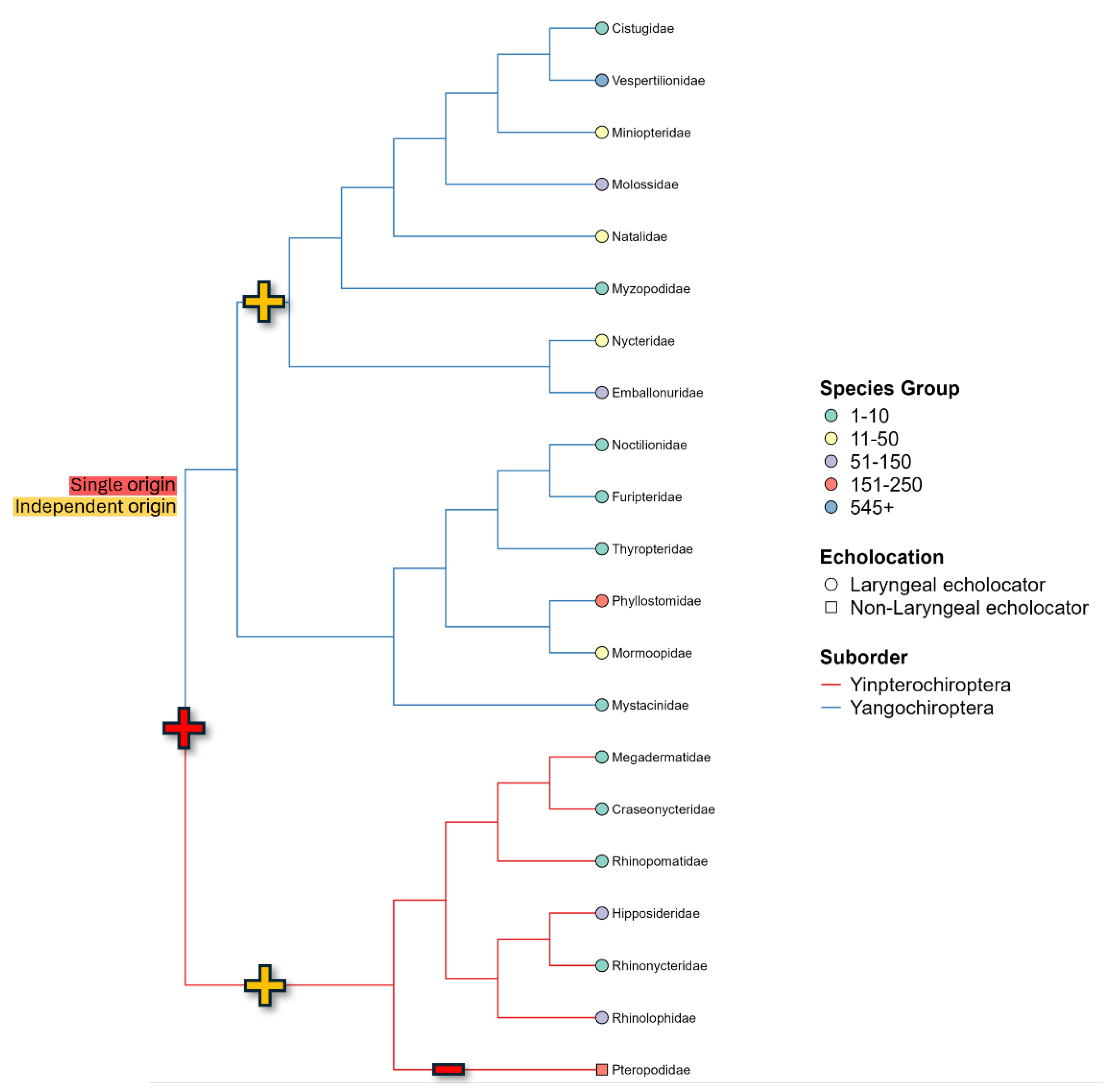

Table 1.
Summary of studies that measure morphological structures and adaptations in the inner ears of bats with associated behavioural and ecological importance.
Table 1.
Summary of studies that measure morphological structures and adaptations in the inner ears of bats with associated behavioural and ecological importance.
| Measured | Source | Ecological and/or behavioural importance |
|---|---|---|
| Auditory fovea | Neuweiler (1990), Neuweiler et al. (1980) |
|
| Basilar membrane | Bruns (1976), Bruns et al. (1989), Davies et al. (2013), Henson (1978), Pye (1966b), Vater and Siefer (1995) |
|
| Basal turn width | Henson et al. (1984) |
|
| Cochlea size | Habersetzer and Storch (1992), Hsiao et al. (2015), Pye (1966a), Bruns et al. (1989) |
|
| Cochlea spirality | Dickinson et al. (2023), Hsiao et al. (2015) |
|
| Secondary osseous spiral laminae | Küçük and Abe (1992b), Pye (1966b) |
|
| Rosenthal’s canal | Sulser et al. (2022) |
|
Disclaimer/Publisher’s Note: The statements, opinions and data contained in all publications are solely those of the individual author(s) and contributor(s) and not of MDPI and/or the editor(s). MDPI and/or the editor(s) disclaim responsibility for any injury to people or property resulting from any ideas, methods, instructions or products referred to in the content. |
© 2026 by the authors. Licensee MDPI, Basel, Switzerland. This article is an open access article distributed under the terms and conditions of the Creative Commons Attribution (CC BY) license (http://creativecommons.org/licenses/by/4.0/).
Copyright: This open access article is published under a Creative Commons CC BY 4.0 license, which permit the free download, distribution, and reuse, provided that the author and preprint are cited in any reuse.