
Submitted:
12 October 2026
Posted:
13 October 2026
You are already at the latest version
Abstract
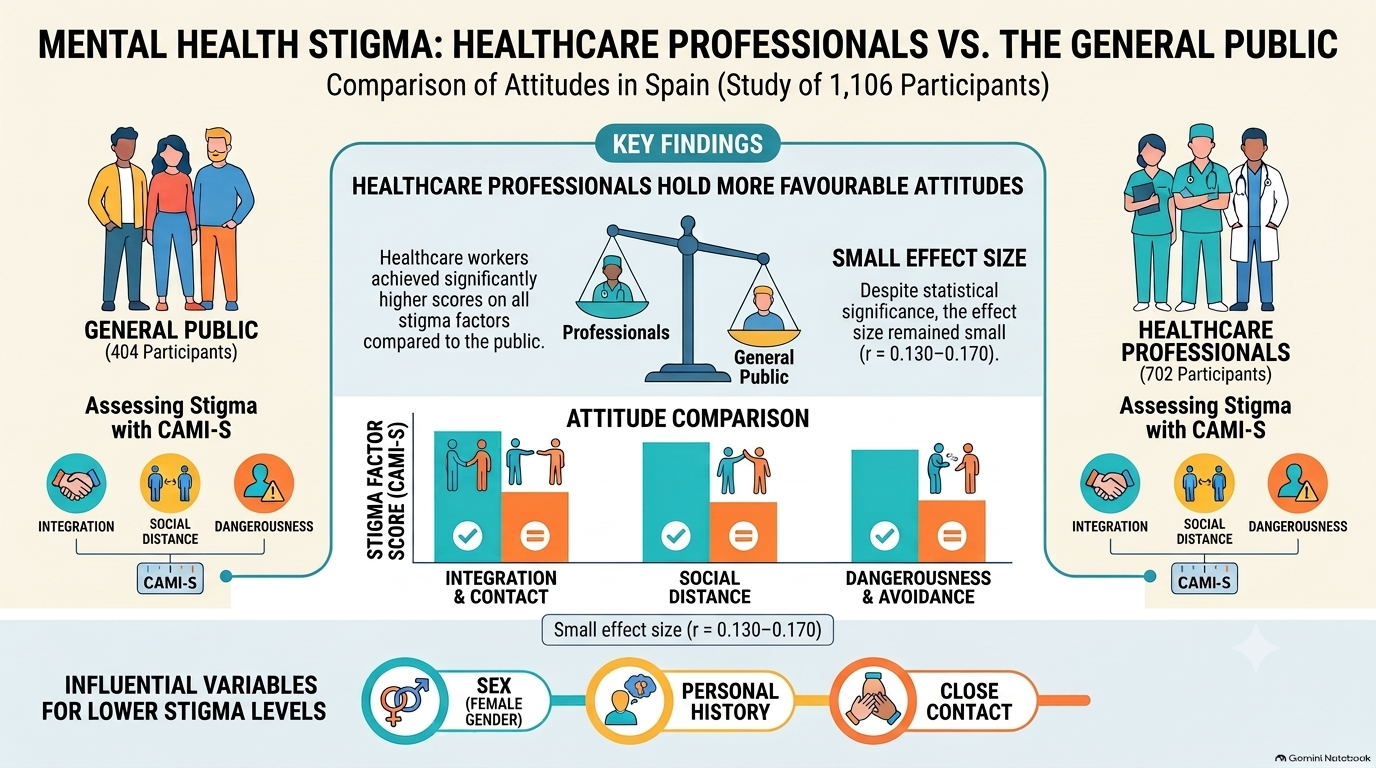
Background/Objectives: Stigma towards people with mental health problems persists in both the general population and healthcare settings, but evidence comparing these groups is limited. The aim of this study is to compare public stigma towards people with mental health problems between the general population and non-specialized healthcare professionals. Methods: An observational, analytical, cross-sectional study was conducted in Spain using two independent samples: 404 participants from the general population and 702 nursing and medical professionals not specialized in mental health. Attitudes were assessed using the Spanish version of the CAMI-S. Differences between groups were analyzed using the Mann–Whitney U test, and effect sizes were calculated using Rosenthal’s r. Multiple linear regres-sion analysis was also performed to identify variables associated with the total CAMI-S score. Results: Healthcare professionals had significantly higher scores than the general population on the total CAMI-S score and on all three factors: integration and contact, social distance, and dangerousness and avoidance (p < 0.001). The effect sizes were small (r = 0.130–0.170). In the multivariate analysis, sex, personal history of mental health problems, close contact with people with mental health problems, and group membership were significantly associ-ated with the total CAMI-S score. The model explained 10.6% of the variance. Conclusion: Non-specialized healthcare professionals showed slightly more favorable attitudes than the general population. These findings highlight the need for continued stigma-reduction strate-gies in both the general population and healthcare settings.
Keywords:
social stigma
; mental health
; health personnel
; attitude of health personnel
; attitude to health mental health problems
Copyright: This open access article is published under a Creative Commons CC BY 4.0 license, which permit the free download, distribution, and reuse, provided that the author and preprint are cited in any reuse.