

Submitted:
12 October 2026
Posted:
13 October 2026
You are already at the latest version
Abstract
Geopolitical tensions are exacerbating the challenges associated with the supply of critical and strategic metals, prompting European and French policymakers to promote the recycling of metals contained in printed circuit boards (PCBs) derived from waste electrical and electronic equipment (WEEE). Few studies have assessed the potential of PCBs in France; however, transforming this potential into a resource requires overcoming several obstacles relating to collection, management, dismantling and recycling. This article aims to estimate the potential stock of end-of-life motherboards from smartphones and laptops in France by 2027. It focuses in particular on five metals: gold, silver, nickel, copper and palladium. The estimate is based on data relating to market placement and product life cycles provided by ADEME (the French Agency for Ecological Transition), data from the Bureau of Geological and Mining Research (Touzé et al., 2024) and data from the scientific literature. An estimate of the economic potential of this deposit was carried out, taking into account the efficiency of metal separation processes. The results indicate a deposit representing several thousand tonnes of PCBs and several million euros in terms of economic recovery potential.
Keywords:
printed circuit boards (PCBs)
; waste electrical and electronic equipment
; metals
; deposit
; recycling
1. Introduction: From Urban Mining to Metal Recovery
The acceleration of the energy transition and digitalisation is driving an increase in global demand for critical and strategic metals [1,2]. This trend is taking place against a backdrop of dwindling mineral resources [3] and geopolitical tensions affecting supply chains [4].
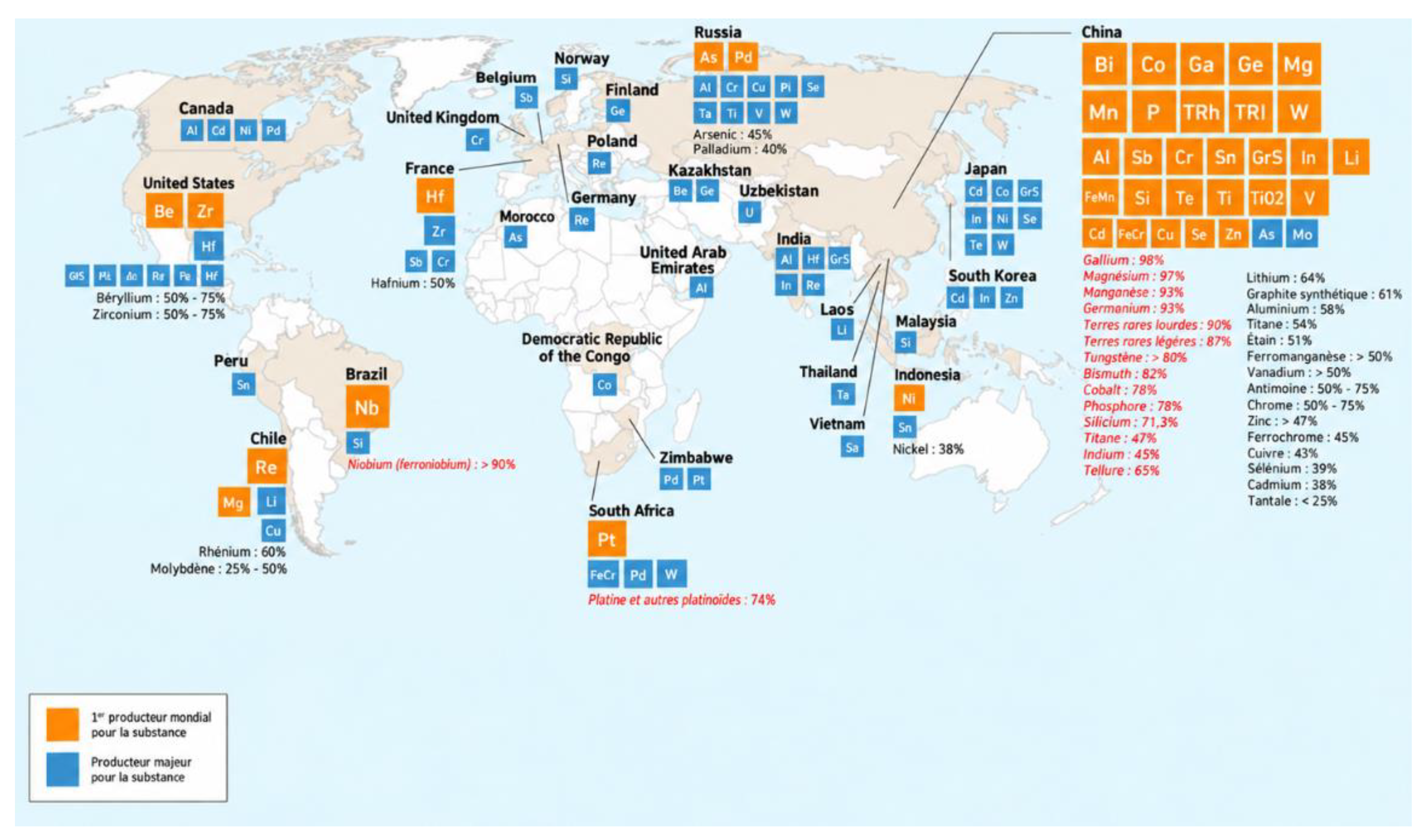
These issues are particularly significant for France and, more broadly, for Europe, which have few mineral resources and limited metal processing capacities (Map 1). They import between 70% and 100% of the metals they consume, depending on the materials in question [5]. This dependency is exacerbated by the geographical concentration of the extraction and refining of certain metals, mainly in China [2,6].
Map 1: Geographical location of refined metal resources
 |
| Source: [5] |
The geographical imbalance in the distribution of resources makes it essential for certain countries to rely on secondary sources of metals, which presents economic, strategic and environmental challenges.
The European Union has therefore adopted the Critical Raw Materials Act (in March 2024), which aims to strengthen Europe’s recycling capacity. In France, the recycling of these metals is one of the key areas of the industrial strategy “Recyclability, recycling and reincorporation of materials”, launched in 2020; this strategy is reflected, in particular, in subsidies for the production and recycling of critical metals (the France 2030 scheme). In Since 2015, the French Geological Survey (BRGM) has been developing criticality criteria to identify metals that are both of significant economic importance and subject to high supply risk (Appendix 1). Strategic metals are those considered indispensable to the functioning of economic or industrial sectors deemed essential, notably defence, energy, space and digital technologies (Appendix 2).
These policies aim to diversify supply sources by developing “secondary deposits”1. They are based on the “urban mining” concept, which regards anthropogenic materials stocks (accumulated in buildings, infrastructure, equipment and products) as potential deposits [7,8]. While conventional mining draws on resources from geogenic deposits, urban mining relies on identifying, characterizing, collecting and recycling of materials already introduced into socio-economic systems, with a view to reintroducing them into production cycles.
Among anthropogenic stocks, Waste Electrical and Electronic Equipment (WEEE) stands out due to its significant volume. Its generation is estimated to be increasing globally by 3 % to 5 % annually [9,10,11]. Their potential economic value is high due to the metals they contain. In 2019, this value generated globally was estimated at 57 billion dollars [12].
In WEEEs, critical and strategic metals are mainly found in Printed Circuit Boards (PCBs), which account for a small proportion of the total mass of WEEE [1,2,13,14]. For example, a tonne of PCBs may contain several hundred grams of gold and palladium, as well as several hundred kilograms of copper [15]. However, the metal composition varies depending on the categories of equipment and the functions of the PCBs [16], necessitating differentiated characterization.
However, the existence of an anthropogenic stock does not automatically translate into a mobilizable secondary resource. Transforming a stock into a resource depends on several factors [17,18] : the quantity of materials placed on the market and their lifespan, the possibilities for dismantling and sorting materials, and the technical performance of recovery processes.
Assessing an urban mining requires distinguishing between the theoretical stock, the available deposit and the fraction of materials that can actually be recovered. This distinction is particularly important for critical and strategic metals, as their presence in WEEE does not guarantee their recycling and recovery within a production cycle.
Literature on PCBs has developed primarily along two lines. A first series of studies focuses on their physicochemical characterization [e.g. 19,20]. The second aims to improve the performance of hydrometallurgical and pyrometallurgical recycling processes [e.g., 21,22]. These studies demonstrate both the metal content of PCBs and the technical feasibility of recovering certain metals in the laboratory.
Box : new project
Recent European research and development programs are
moving beyond an approach based solely on identifying metal stocks to
consider the entire value chain. Focusing on products such as laptops, Wi-Fi
routers and dishwashers, the Horizon Europe CIRCUIT4EU project (2026–2029)
aims to develop solutions linking the characterization of deposits, the
selective dismantling of equipment, the recovery of critical and strategic
metals, and their reintegration into industrial processes.
However, the transition from characterizing PCBs to estimating the urban mining deposit derived from the processing of WEEEs at a national level is poorly documented. Few studies simultaneously provide an estimate of the French stock of PCBs derived from end-of-life WEEE, the quantities of metals they contain, the quantities that are potentially recoverable given recycling yields, and their economic value. In France, this assessment is notably limited by the lack of specific data on the flows of PCBs, which are incorporated into broader WEEE flows or resold to specialist intermediaries.
This article presents an initial estimate of the mass and economic value of the metals contained in PCBs. It provides insights into the reserves of metals contained in PCBs (i) through an estimate of their annual reserves, (ii) quantifying four potentially recoverable critical and strategic metals, and (iii) estimating their economic value.
The analysis focuses on the motherboards of smartphones and of personal and business laptops reaching the end of their life in France in 2027, as they contain a high concentration of metals [1,16]. These motherboards may contain around sixty different chemical elements [21]. In this article, five metals have been selected for their economic or strategic importance to the recycling sector and national sovereignty. These are gold, silver, nickel, copper and palladium. Gold and silver are classified as precious metals because they have high economic value. Nickel is a strategic metal for the energy transition as it is essential for battery production [23]. Copper is experiencing very strong demand, which could rise by between 30 % and 50 % depending on the scenario [23], and 90 % of copper mining resources are expected to be extracted by 2050 [3] ; this leads to it being regarded as a future strategic metal. Finally, palladium is a critical and strategic metal used in particular in the pharmaceutical industry [24]. Four of these metals (gold, silver, copper and palladium) underpin the economic market for card recycling, as smelters value batches of shredded cards based on the mass of these metals [25].
2. Data and Methods for Estimating Recoverable Metals from End-of-Life Electronics
Estimating the metal reserves contained in motherboards and their economic potential is a multi-stage process. After describing the composition of the metals listed on PCBs in the database (2.1), the methods for estimating the reserves of end-of-life PCBs are presented (2.2), along with the quantities of recoverable metals (2.3) and their economic value (2.4).
2.1. Sources of Data for the Characterisation of PCBs
For the two categories of equipment studied, the metal composition of their PCBs was determined using two complementary sources: an experiment conducted by the BRGM and data from the scientific literature.
The metal composition of smartphones is a subject that has been well documented in the scientific literature [1,26,27,28,29]. A comparative analysis makes it possible to determine the average weight and metal content of a smartphone’s motherboard.
Experimental data relating to a sampling campaign by the BRGM of motherboards from personal and business laptops. Based on the characterisation of a batch of 11,200 motherboards from personal laptops and a second batch of 7,500 motherboards from business laptops, the BRGM calculated the average mass of each metal contained in the motherboard [20].
This data was supplemented with information on the market release of computers and mobile phones gathered from ADEME’s databases. Interviews were conducted with waste collection and recycling companies in order to contextualise this data within industrial processes.
On average, a PCB consists of 40 % metal (Table 1).
These metals are unevenly distributed across a circuit board (Figure 1), which is divided into four parts [28].
Source: authors
The substrate (a) is made of fibreglass and epoxy resin. The electronic components (b) contain metals. The solder joints are made of an alloy (c). After 2006, in accordance with the European RoHS Directive, lead and tin were replaced by higher proportions of silver [30]. Finally, the protective layer (d) consists of a nickel plating on the solder joints, followed by a very thin layer of gold and a varnish. It is this fraction that represents the main source of recoverable gold during recycling.
2.2. Methods for Estimating the Stock and the Metals Contained in PCBs
The annual stock of PCBs is estimated by taking into account the number of devices placed on the market in a given year, on the assumption that all devices will become WEEE at the end of their life. The life span includes the period of use, periods of inactivity and reuse in the home prior to disposal.
National data on the placing on the market of smartphones and laptops is available in the ADEME databases [31]. The average lifespan of the various categories of equipment was estimated by combining data from the European Commission, ADEME and consumer surveys. As this data does not distinguish between business and domestic laptops, we assume that their lifespans are identical.
The Table 2 summarises the calculation methods used to assess PCBs waste, the metals it contained and the calculation of its economic value.
Scientific articles and databases do not provide figures for the total mass of metals contained in a PCB, but rather the concentration levels (in kilograms) of each metal per tonne of shredded PCBs. Some studies do not specify whether the PCBs were removed from WEEE prior to shredding.
3. Quantify the French Urban Mining: from PCBs Flows to Economic Potential
The estimate of the potential supply of motherboards stock for 2027 (3.1) is used to assess the quantities of recoverable metals following the application of recycling yields (3.2) and their economic potential (3.3).
3.1. Estimation of the Stock of PCBs
The assumptions regarding the average mass of PCBs are derived from the scientific literature and the BRGM database. The mass fractions of PCBs in equipment were determined on the basis of the literature (Table 3). For example, for smartphones, the mass of the devices ranges from 150 to 300 grams, which results in a mass fraction of the PCBs ranging from a minimum of 7% to a maximum of 14 %.
To estimate the average lifespan of a piece of equipment, it is assumed that a smartphone is kept by its user for 4 years [35] and a personal or business laptop for 6 years [36]. Assuming a lifespan set by category of equipment, equipment placed on the market (Mt,i) in year t is considered to reach the end of its life in year t + Li, where di corresponds to the average lifespan of equipment category i. To estimate the stock of motherboards reaching the end of their life in 2027 (GPCBSmartphone,2027), data on devices placed on the market in 2023 are used for smartphones (Li = 4 years) and those from 2021 for laptops (Li = 6 years). For example, this gives the following for smartphones.
GPCB,Smartphone,2027 = MSmartphone,2023 × fPCB,smartphone
MSmartphone,2023 refers to the total mass of smartphones placed on the market in 2023, and fPCB,smartphone refers to the average mass fraction represented by the motherboard in a smartphone.
The market data provided by ADEME does not allow for a distinction to be made between personal and business laptops. We assume an equal split between the two categories. The stock of PCBs is estimated at between 858.9 and 1,717.8 tonnes for smartphones and between 1,619.4 and 3,238.8 tonnes for each of the laptop categories (Table 4).
3.2. Estimation of Recoverable Metal Stocks
To estimate the mass of recoverable metals for the year 2027, we use the metal concentrations in the PCBs (Table 5). The concentrations are expressed in kilograms of metal per tonne of PCBs (kg/t of PCB). The metal concentration of a single motherboard is given in Appendix 3.
Copper is the predominant metal in all PCBs. Motherboards from business laptops contain the highest amounts of copper (between 255.81 and 382.81 kg/t of PCB), silver (between 0.73 and 122 kg/t) and nickel (between 8.57 and 11.23 kg/t). PCBs in smartphones have significantly lower metal contents.
Based on the estimated reserves of PCBs for 2027, the theoretical metal potential was calculated for each category of equipment by applying the corresponding metal concentrations (Table 6).
The ranges are obtained by combining the minimum and maximum estimates for the PCBs deposit with the minimum and maximum concentrations of each metal.
The quantities actually recoverable are estimated in Table 7 on the basis of the recovery rates for recycling processes reported in the literature. The recovery rates are assumed to be constant regardless of the category of equipment.
The theoretical masses of metals were adjusted using the recovery rates. The results show that, despite the losses inherent in recycling processes, PCBs represent a significant secondary source of critical and strategic metals, particularly copper, for which the recoverable potential is estimated at between 0.37 and 1.12 million kilograms for business laptops in 2027 (Table 8).
3.3. Assessment of Economic Potential
The economic potential of recoverable metals has been estimated on the basis of indicative prices from the London Metal Exchange (LME) and precious metals market prices recorded at the end of May 2026 (Table 9). The prices used highlight significant disparities between metals. Gold has the highest unit value (€85,000/kg). One kilogram of gold is worth approximately twice as much as the second most valuable metal (palladium) and nearly 9,500 times as much as copper.
Source des données : https://www.lme.com/. London Metal Exchange (LME), accessed on 26 May 2026.
The potential economic value of PCBs reaching the end of their life in 2027 is calculated by applying these prices to the estimated recoverable masses for each metal and each category of equipment (Table 10).
Gold accounts for approximately 76 % (minimum) to 81 % (maximum) of the total value of recoverable metals, depending on the scenarios considered. Despite its much lower mass fraction compared with that of copper, silver and nickel, its very high unit price has a considerable impact on the economic value of the PCBs.
Conversely, whilst copper is the most abundant metal by mass, it accounts for between 15 % (minimum scenario) and 6 % (maximum scenario) of the PCBs’s economic value. Palladium also represents a significant source of value despite modest recoverable quantities, whilst the contributions of silver and nickel remain more limited.
Between the minimum economic estimate scenario (Figure 2) and the maximum economic estimate scenario (Figure 3), the value of the metals contained in the PCBs varies considerably.
Smartphones show the widest range of variation between the minimum and maximum scenarios. Estimates for personal and business laptops are more consistent.
4. A High-Value Secondary Resource with Contrasting Material and Economic Profiles
The main results obtained are placed within the context of the existing literature (4.1) before addressing the methodological limitations regarding the estimation of the resource (4.2) and its economic value (4.3).
4.1. PCBs: A Secondary Resource of High Economic Value
Smartphone and laptop motherboards represent a significant secondary source of critical and strategic metals. Estimates indicate that several thousand tonnes of PCBs could reach the end of their life in France in 2027, representing a substantial stock of copper, gold, silver, palladium, and nickel.
Copper is the primary recoverable metal by mass, whereas gold accounts for the majority of the economic value. This difference is due to the vast disparity in prices between the metals. Consequently, despite the relatively small recoverable quantities, gold represents more than ¾ of the total economic value of PCBs.
The results also highlight differences based on equipment categories. Laptops represent the largest source of PCBs by mass, due to the size of their motherboards. However, smartphones contain a higher proportion of metals with high economic and strategic value. For instance, the ratio of gold mass to copper mass ranges from 0.07% to 0.31% for smartphones, compared to 0.04% to 0.08% for laptops. Smartphones thus emerge as a prime target for precious metal recovery.
4.2. The Limitations of the Deposit Estimate
However, the calculation of the potential volume of PCBs and the associated economic estimate rely on assumptions that have limitations. This potential volume is estimated based on the quantities of equipment placed on the national market and their average lifespan. It thus represents a theoretical volume of equipment reaching the end of its life, without implying that all of it is actually captured by collection and recycling systems. Indeed, some equipment may remain in storage in households, businesses, or government agencies, be directed toward reuse, or follow other channels outside of authorized systems [25,48]. The volume actually collected and available for recycling is therefore lower than the estimated theoretical volume.
Furthermore, the data used involve several uncertainties. The mass of the motherboards, their metal content, and recovery yields vary according to equipment categories and generations, as well as the processes and methodologies considered. These variations account for the range observed between the minimum and maximum estimates.
4.3. The Limitations of Economic Assessment
The economic assessment carried out in this study represents a theoretical recovery potential. It does not take into account France’s industrial capacity for collection, dismantling and recycling, nor the technical constraints of industrial processes.
The recovery rates cited are derived mainly from studies carried out in laboratories or on pilot-scale plants. Industrial performance is likely to be lower due to yield losses, or higher for certain metals. Furthermore, not all metals present in a PCB are currently recoverable, as some are present only in trace amounts. Currently in France, industrial processes are optimised to recover precious metals (those of high economic value) at the expense of critical and strategic metals [25].
Finally, the economic estimate is based on metal prices at a specific point in time, even though these prices are highly volatile [49]. Furthermore, it assumes that the price of recycled metals is equivalent to that of metals extracted from geogenic mines. It does not take into account the costs of collection, transport, preparation and refining, nor market fluctuations. The calculated values should therefore be interpreted more as a gross recovery potential than as the actual economic profitability of the sectors.
5. Conclusion
This initial estimate of the potential for recovering metals from PCBs in end-of-life smartphones and laptops in France reveals the existence of an urban mining. Several thousand tons of PCBs could become available each year, representing a significant source of copper, gold, silver, palladium and nickel.
However, the estimates provided represent a theoretical potential and do not take into account all the losses incurred during collection, dismantling and metallurgical processes, nor France’s industrial recycling capacity. Nevertheless, they provide a useful order of magnitude for assessing the potential contribution of PCBs to the national supply of secondary raw materials. This approach needs to be refined using actual data on industrial yields, which are difficult to obtain.
It remains to be seen what potential contribution the urban mining of PCBs will make to the national supply of critical and strategic metals.
6. Patents
This section is not mandatory but may be added if there are patents resulting from the work reported in this manuscript.
Author Contributions
Conceptualization, Berdier, Girault and Maillefert; methodology, Berdier and Girault; validation, Berdier, Girault and Maillefert; formal analysis, Berdier and Girault; investigation, Berdier and Girault; writing—original draft preparation, Berdier and Girault; writing—review and editing, Berdier and Girault; .
Funding
This research was funded by priority research programme and equipment (PEPR) Recyclage (France 2030), project "REVIWEEE".
Informed Consent Statement
Informed consent was obtained from all subjects involved in the study.
Data Availability Statement
Conflicts of Interest
The authors declare no conflicts of interest.
Appendix 1
List of French strategic metals (2023)
| Aluminium | Al | Graphite naturel | Gra | Rhodium (PGM) | Rh |
| Bismuth | Bi | Iridium (PGM) | Ir | Ruthenium (PGM) | Ru |
| Boron | B | Nickel | Ni | Metallic silicon | Si |
| Cobalt | Co | Magnesium | Mg | Tantalum | Ta |
| Copper | Cu | Manganese | Mn | Heavy rare earths | HREEs |
| Tin | Sn | Lithium | Li | Light rare earths | LREEs |
| Gallium | Ga | Palladium | Pd | Metallic titanium | Ti |
| Germanium | Ge | Platinum | Pt | Tungsten | W |
Sources : [3 ;9 ;50]
Appendix 2
List of critical metals in France (2023)
| Antimony | Sb | Germanium | Ge | Rhenium | Re | |
| Silver | Ag | Graphite | Gra | Scandium | Sc | |
| Beryllium | Be | Indium | In | Selenium | Se | |
| Chromium | Cr | Lithium | Li | Tantalum | Ta | |
| Cobalt | Co | Molybdenum | Mo | Tellurium | Te | |
| Copper | Cu | Nickel | Ni | Heavy rare earths | HREEs | |
| Tin | Sn | Niobium | Nb | Light rare earths | LREEs | |
| Gallium | Ga | Platinium group elements | Titanium | Ti | ||
| Tungsten | W | |||||
Sources : [9]
Appendix 3
Minimum and maximum ranges for metal content in motherboards (g/card)
| Smartphones | Personal laptops | Business laptops | |
| Au | 0,004 – 0,030 | 0,017–0,028 | 0,016–0,032 |
| Ag | 0,003 - 0,090 | 0,013–0,075 | 0,117–0,195 |
| Pd | 0,001 – 0,010 | 0,001–0,003 | 0,002–0,003 |
| Cu | 5,57 – 9,58 | 30,88–35,59 | 40,93–61,25 |
| Ni | 0,12 – 0,59 | 0,93–1,20 | 1,37–1,80 |
Sources : [20]
| 1 | Obtained, for example, from the recycling of electrical and electronic waste. |
References
- Duhamel-Achin, I. Dissection d’un téléphone portable et origine des matières premières, L’homme augmenté… par son smartphone ? projet pédagogique. 2021. Available online: https://eduterre.ens-lyon.fr/thematiques/mineraux-et-ressources-minerales/smartphone-et-ressources-naturelles/dissection-dun-telephone-portable (accessed on 30 sptember 2026).
- Ménard, Y. Recyclage des métaux – Limites et opportunité. Eco-conception et électronique, personal communication, 2022.
- Perry, N.; Bauer, T. Flux de matières, criticité des ressources et économie circulaire. Economie circulaire et transition environnementale, communication, webinaire. 2024. Available online: https://reliam.ensam.eu/server/api/core/bitstreams/ee793a87-2f17-4b8c-9d85-1ef361414cdb/content (accessed on 30 sptember 2026).
- Hache, E.; D’Herbemont, V.; Malbec, L.-M. Criticité et géopolitique des matières premières requises par les technologies bas-carbone. Ann. Des. Mines-Responsab. Environ. 2023, 111(3), 69–73. [Google Scholar] [CrossRef]
- Bureau de Recherches Géologiques et Minières (BRGM). Métaux critiques. Concilier éthique et souveraineté ? Géosciences 2022, 26. [Google Scholar]
- Pitron, G. La guerre des métaux rares. La face cachée de la transition énergétique et numérique; Edition Les liens qui libèrent, 2018. [Google Scholar]
- Brunner, P. Urban Mining A Contribution to Reindustrializing the City. J. Ind. Ecol. 2011, 3(15), 339–341. [Google Scholar] [CrossRef]
- Sittu, O.; Williams, I.; Shaw, P. Global E-waste management: Can WEEE make a difference? A review of e-waste trends, legislation, contemporary issues and future challenges. Waste Manag. 2021, 120, 549–563. [Google Scholar] [CrossRef]
- Comité pour les métaux stratégiques (COMES). Recommandation du Comité des Métaux Stratégiques pour le développement de compétences industrielles françaises dans le recyclage des métaux critiques, 2020. 19 06 2026. Available online: https://www.mineralinfo.fr/sites/default/files/documents/2020-12/avis_comes_recyclage_metaux-vfinal-2.pdf.
- Olanrewaju, S.; Williams, I. D.; Shaw, P. J. Global E-waste management: can WEEE make a difference? A review of e-waste trends, legislation, contemporary issues and future challenges. Waste Manag. 2020, vol. 120, 549–563. [Google Scholar] [CrossRef]
- Chesmeh, Z.A.; Bigverdi, Z.; Eqbalpour, M.; Kowsari, E.; Ramakrishna, S.; Gheibi, M. A comprehensive review of used electrical and electronic equipment management with a focus on the circular economy-based policy-making. J. Clean. Prod. 2023, 389. [Google Scholar] [CrossRef]
- Forti, V.; Balde, C.; Kühr, R.; Bel, G. The Global E-waste Monitor 2020: Quantities, flows and the circular economy potential; United Nations Institute for Training and Research (UNITAR), 2020. [Google Scholar]
- Chancerel, P.; Rotter, S. Recycling-oriented characterization of small wasteelectrical and electronic equipment. Waste Manag. 2009, 8(29). [Google Scholar] [CrossRef]
- Vadoudi, K.; Laratte, B.; Lee, S.-J.; Troussier, N. E-waste management and resources recovery in France. Sage J. 2015, 33(10). [Google Scholar] [CrossRef]
- Lacombe, F. Les déchets d’appareils électriques & électroniques. REP « deee »: filière à responsabilité élargie du producteur - déchets d’équipements électriques et électroniques. In Les Notices de l’ORDIF; Institut Paris Région, 2020. [Google Scholar]
- Ganier, A. Smartphone, une mine urbaine, Les défis du CEA, 2021, 244. 18 09 2026. Available online: https://www.cea.fr/presse/Pages/actualites-communiques/ntic/tout-s-explique-materiaux-critiques-smartphones.aspx.
- Lederer, J.; Laner, D.; Fellner, J. A framework for the evaluation of anthropogenic resources: the case study of phosphorus stocks in Austria. J. Clean. Prod. 2014, 84, 368–381. [Google Scholar] [CrossRef]
- Arora, R.; Paterok, K.; Banerjee, A.; Saluja, M.S. Potential and relevance of urban mining in the context of sustainable cities. IIMB Manag. Rev. 2017, 29(3). [Google Scholar] [CrossRef]
- Guo, C.; Wang, H.; Liang, W.; Fu, J.; Yi, X. Liberation characteristic and physical separation of printed circuit board (PCB). Waste Manag. 2011, 31(9–10), 2161–2166. [Google Scholar] [CrossRef]
- Touzé, S.; Hubeau, A.; Ghestem, J.-P.; Moreau, P.; Lafaurie, N.; Noireaux, J. Estimation of the uncertainty of metal content in a batch of waste printed circuit boards from computer motherboards. Waste Manag. 2024, 189, 325–333. [Google Scholar] [CrossRef]
- Martins, T.A.G.; Caldas, M.P.K.; de Moraes, V.T.; Tenório, J.A.S.; Espinosa, D.C.R. Recovering metals from motherboard and memory board waste through sulfuric leaching. J. Environ. Chem. Eng. 2021, 9(6), 106789. [Google Scholar] [CrossRef]
- Charpentier, N. Recyclage de déchets électroniques: tri et réutilisation. PhD thesis (chemistry), Université Paris Saclay, 2024. [Google Scholar]
- Bekaert, F. La vraie complexité de cette transition réside dans le séquencement des décisions. Géosciences 2022, 26, 16–19. [Google Scholar]
- Economidou, M.; Mistry, N.; Wheelhouse, K.M.P.; Lindsay, D.M. Palladium Extraction Following Metal-Catalyzed Reactions: Recent Advances and Applications in the Pharmaceutical Industry. Org. Process Res. Dev. 2023, 27(9), 1585–1615. [Google Scholar] [CrossRef]
- Berdier, C.; Girault, M.; Maillefert, C. Quelle échelle pertinente pour la gestion des métaux critiques et stratégiques contenus dans les cartes électroniques des Déchets d’Equipement Electrique et Electronique (France) ? Conference, Penser et agir pour les transitions en territoire, 62nd ASRDLF Network Conference, Toulouse (France), 24 juny 2026. [Google Scholar]
- Kumar, A.; Kuppusamy, V. K.; Holuszko, M. E.; Janke, T. Improving the Energy Concentration in Waste Printed Circuit Boards Using Gravity Separation. Recycling 2018, 3(2). [Google Scholar] [CrossRef]
- Hubau, A.; Chagnes, A.; Minier, M.; Touzé, S.; Chapron, S.; Guezennec, A.-G. Recycling-oriented methodology to sample and characterize the metal composition of waste Printed Circuit Boards. Waste Manag. 2019, 91, 62–71. [Google Scholar] [CrossRef]
- Thomas, C. Le recyclage des cartes électroniques en France. Responsab. Environ. 2020, 99, 37–40. [Google Scholar] [CrossRef]
- Villemejeanne, B.; Legeai, S.; Cathelineau, M. Le recyclage des cartes électroniques. In Le recyclage, enjeu pour l’économie circulaire; Cathelineau, M., Ed.; ISTE Group: Publisher, 2023; pp. 133–157. [Google Scholar]
- Puttlitz, K. J.; Stalter, K. A. Handbook of Lead-Free Solder Technology for Microelectronic Assemblies; CRC Press, 2004. [Google Scholar]
- ADEME. Overview - waste electrical and electronic equipment. national database. Available online: https://filieres-rep.ademe.fr/filieres-REP/filiere-EEE/tableau-de-bord_old (accessed on 30 september 2026).
- Priya, A.; Hait, S. Comprehensive characterization of printed circuit boards of various end-of-life electrical and electronic equipment for beneficiation investigation. Waste Manag. 2018, 75, 103–123. [Google Scholar] [CrossRef]
- Gómez, M.; Grimes, S.; Qian, Y.; Feng, Y.; Fowler, G. Critical and strategic metals in mobile phones: A detailed characterisation of multigenerational waste mobile phones and the economic drivers for recovery of metal value. J. Clean. Prod. 2023, 419, 138099. [Google Scholar] [CrossRef]
- Oguchi, M.; Murakami, S.; Sakanakura, H.; Kida, A.; Kameya, T. A preliminary categorization of end-of-life electrical and electronic equipment as secondary metal resources. Waste Manag. 2011, 31(9–10), 2150–2160. [Google Scholar] [CrossRef]
- European Commission. Commission Staff Working Document – Impact Assessment Report accompanying the documents Commission Regulation laying down ecodesign requirements for smartphones, mobile phones other than smartphones, cordless phones and slate tablets and Commission Delegated Regulation with regard to energy labelling of smartphones and slate tablets. SWD(2023) 101 final, Brussels, 16 June 2023. [Google Scholar]
- ADEME. Évaluation environnementale et économique de l’allongement de la durée d’usage de biens d’équipements: équipements électriques et électroniques à l’échelle d’un foyer 2020, 27.
- Mehmet, A. K.; Kucuker, M.A.; Kuchta, K. Biomining – Biotechnological Systems for the Extraction and Recovery of Metals from Secondary Sources. Glob. NEST J. 2018, 20(4), 737–742. [Google Scholar] [CrossRef]
- Sahan, M.; Kucuker, M.A.; Demirel, B.; Kuchta, K.; Hursthouse, A. Determination of Metal Content of Waste Mobile Phones and Estimation of Their Recovery Potential in Turkey. Int. J. Environ. Res. Public Health 2019, 16(5), 887. [Google Scholar] [CrossRef]
- Park, H.S.; Kim, Y.J. A novel process of extracting precious metals from waste printed circuit boards: Utilization of gold concentrate as a fluxing material. J. Hazard. Mater. 2019, 365, 659–664. [Google Scholar] [CrossRef]
- Liang, Q.; Wang, J.; Chen, S.; Chen, S.; Hu, L.; Qin, J.; Han, Y.; Zeng, X.; Li, X.; Guo, Q.; Chen, M.; Shu, J. Electrolyte circulation: Metal recovery from waste printed circuit boards of mobile phones by alkaline slurry electrolysis. J. Clean. Prod. 2023, 409. [Google Scholar] [CrossRef]
- Behnamfard, A.; Salarirad, M.M.; Vegliò, F. Process development for recovery of copper and precious metals from waste printed circuit boards with emphasize on palladium and gold leaching and precipitation. Waste Manag. 2013, 33(11), 2354–2363. [Google Scholar] [CrossRef]
- Yazici, E.Y.; Deveci, H. Extraction of metals from waste printed circuit boards (WPCBs) in H2SO4–CuSO4–NaCl solutions. Hydrometallurgy 139, 30–38. [CrossRef]
- Cui, H.; Anderson, C.G. Literature Review of Hydrometallurgical Recycling of Printed Circuit Boards (PCBs). J. Adv. Chem. Eng. 2016, 6, 142. [Google Scholar] [CrossRef]
- Blais, C.; Le Dinh, A.Q.; Loranger, É.; Abdul-Nour, G. Precious Metals Recovery Process from Electronic Boards: Case Study of a Non-Profit Organization (QC, Canada). Sustainability 2024, 16(6). [Google Scholar] [CrossRef]
- Nan, T.; Yang, J.; Aromaa-Stubb, R.; Zhu, Q.; Lundström, M. Process simulation and life cycle assessment of hydrometallurgical recycling routes of waste printed circuit boards. J. Clean. Prod. 2024, 435. [Google Scholar] [CrossRef]
- Aral, S.; Beşe, A.V. Multi-Objective Optimization of the Recovery of Base and Precious Metals from Waste Printed Circuit Boards by Two-Stage Hydrometallurgical Process Using Taguchi-Based Grey Relationship Analysis. J. Sustain. Metall. 2024, 10, 1250–1266. [Google Scholar] [CrossRef]
- Dada, S. R.; Okoye, E.; Dada, O. S. Life Cycle Assessment of Resource Recovery Technologies in Electronic Waste Recycling in the United States. Int. J. Res. 2025, 12(2). [Google Scholar] [CrossRef]
- Echegaray, F.; Hansstein, F.V. Assessing the intention-behavior gap in electronic waste recycling: The case of Brazil. J. Clean. Prod. 2017, 142, 180–190. [Google Scholar] [CrossRef]
- Jégourel, Y. Financialization of the Minerals and Metals Market: Origin, Challenges and Prospects; ISTE Group: Publisher, 2021. [Google Scholar]
- Poinssot, C.; Varin, P. Les ressources minérales, socle du développement des sociétés humaines. Ann. Des. Mines-Réalités Ind. 2025, 4, 5(8). [Google Scholar] [CrossRef]
Figure 1.
Motherboard of a personal laptop.
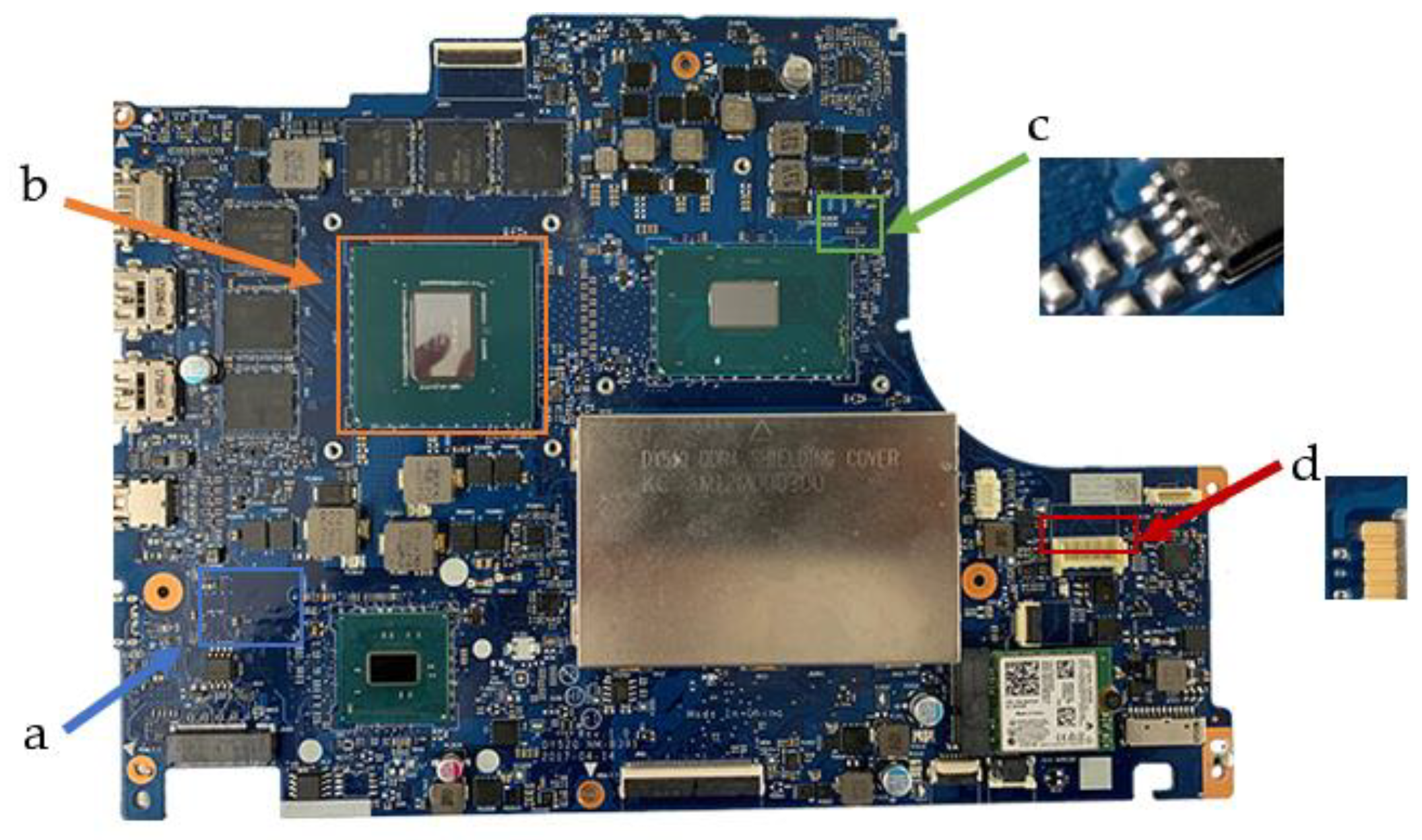
Figure 2.
Scenario for the maximum economic valuation of metals contained in PCBs reaching end-of-life in 2027 (in millions of euros).
Figure 2.
Scenario for the maximum economic valuation of metals contained in PCBs reaching end-of-life in 2027 (in millions of euros).
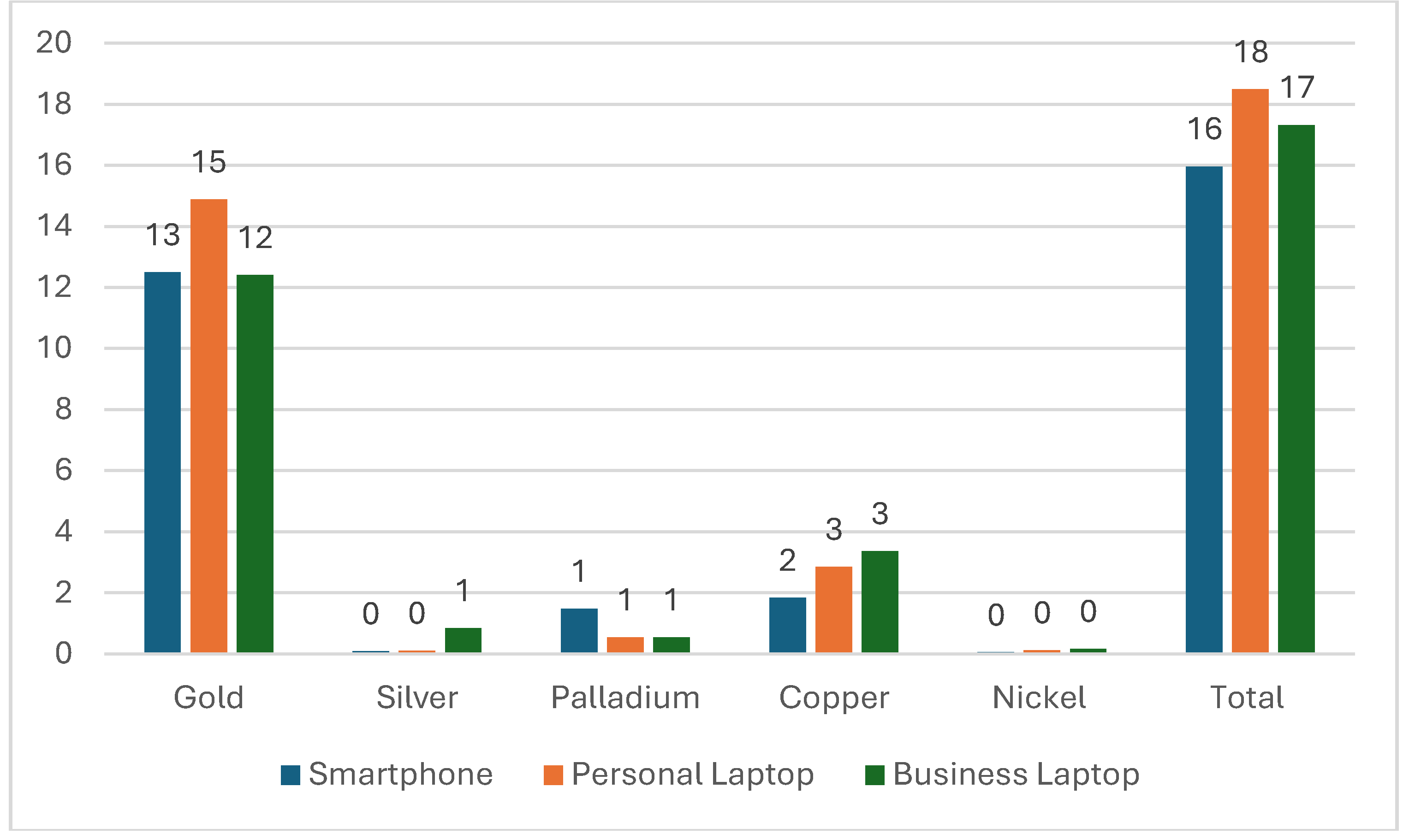
Figure 3.
Scenario for the maximum economic valuation of metals contained in PCBs reaching end-of-life in 2027 (in millions of euros).
Figure 3.
Scenario for the maximum economic valuation of metals contained in PCBs reaching end-of-life in 2027 (in millions of euros).
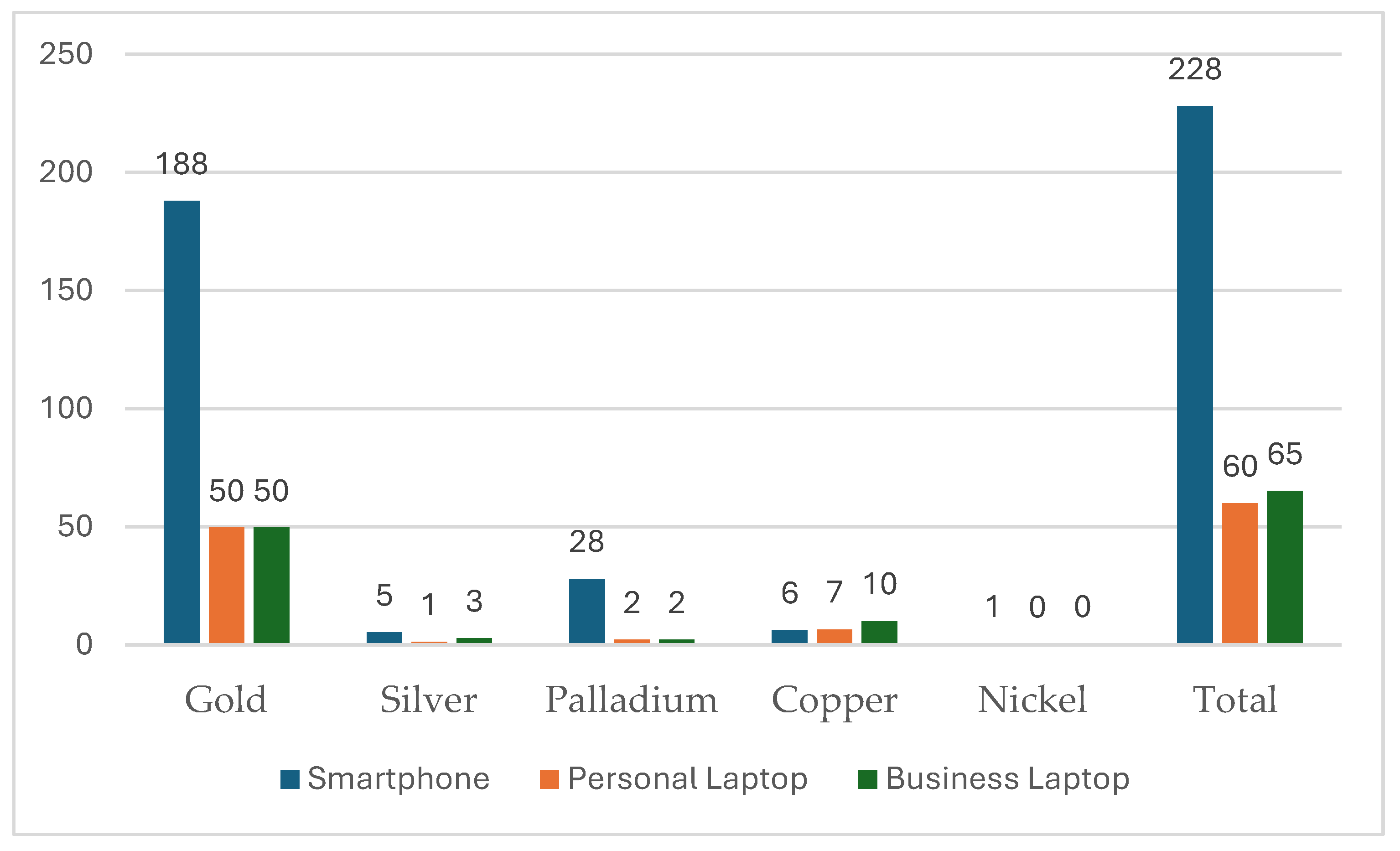

Table 1.
Average composition of a smartphone motherboard.
| Materials | Percentage of total mass |
| Plastic | 30 % |
| Ceramics and glass | 30 % |
| Metals | 40 % |
Table 2.
Summary of methods for estimating recoverable metal reserves and their economic value.
| Estimates | Calculation method | Meaning of index number |
|---|---|---|
| Motherboard stock(GPCB,i,t), Ton |
GPCB,i,t = Mi,t × fPCB,i |
GPCB,i,t : stock of motherboards for each category of equipment i in year t. Mi,t : mass of category i equipment reaching the end of its life in year t. fPCB,i : average mass of a motherboard in category i equipment. |
| Mass of metals contained in motherboards (Mk,i,t), Kilogram |
Mk,i,t= GPCB,i,t× Ck,i |
Mk,i,t : Mass of metal k contained in the stock of motherboards, for equipment category i, in year t. GPCB,i,t : Stock of motherboards for each equipment category i, in year t. Ck,i: Average metal k content of motherboards in category i. |
| Recoverable masses based on process yields (MRECk,i,t), Kilogram |
MRECk,i,t= Mk,i,t × Rk |
MRECk,i,t : Recoverable mass of metal k for equipment of category i. Rk : Recovery rate of metal k. |
| Economic value (Vk,i,t), Millions of euros |
Vk,i,t= MRECk,i,t× Pk |
Vk,i,t : Economic value of recoverable metal k for equipment of category i. MRECk,i,t : Recoverable mass of metal k. Pk : average unit price of metal k. |
Table 3.
Mass fraction of PCBs in equipment.
| Mass of WEEE (grams) Min and Max |
Average mass of PCBs (grams) | Massf raction of PCB (%) Min and Max |
|
| Smartphones |
150 – 300 | 21 | 7 - 14 |
| Source : [32,33] | |||
| Personal laptops |
710 – 1420 | 142 | 10 – 20 |
| Source : [20,34] | |||
| Business laptops | 800 – 1600 | 160 | 10 – 20 |
| Source : [20,34] | |||
Table 4.
Estimated stock of end-of-life of PCBs in 2027 (in tons).
| Smartphones | Personal laptops | Business laptops | |
| Date of market placement | 2023 | 2021 | 2021 |
| Mass of WEEE placed on the market (tons) | 12 270 | 16194 | 16194 |
| Mass fraction of PCB | 0,07- 0,14 | 0,10 - 0,20 | 0,10 - 0,20 |
| Stockpile of end-of-life PCBs in 2027 (tons) | 859 – 1718 | 1619 - 3 239 | 1619 - 3 239 |
Table 5.
Metal concentrations in motherboards (min. and max.) per tonne of PCB (in kilograms of metal per tonne of PCB).
Table 5.
Metal concentrations in motherboards (min. and max.) per tonne of PCB (in kilograms of metal per tonne of PCB).
| Smartphone | Personal laptops | Business laptops | |
| Gold (Au) | 0,19 – 1,43 | 0,12 – 0,20 | 0,10 – 0,20 |
| Silver (Ag) | 0,14 – 4,29 | 0,09 – 0,53 | 0,73 – 1,22 |
| Palladium (Pd) | 0,05 – 0,48 | 0,01 – 0,02 | 0,01 – 0,02 |
| Copper (Cu) | 265,24 – 456,19 | 217,50 – 250,63 | 255,81 – 382,81 |
| Nickel (Ni) | 5,71 – 28,10 | 6,57 – 8,44 | 8,57 – 11, 23 |
| Sources | [33,37,38,39,40] | [20] | [20] |
Table 6.
Minimum and maximum theoretical potential for metals contained in PCBs reaching the end of their life in 2027 (in kilograms).
Table 6.
Minimum and maximum theoretical potential for metals contained in PCBs reaching the end of their life in 2027 (in kilograms).
| Smartphones (min and max) |
Personal laptops (min and max) |
Business laptops (min and max) |
|
| Gold (Au) | 163 – 2456 | 194 – 648 | 162 – 648 |
| Silver (Ag) | 120 – 7369 | 146 – 1717 | 1182 – 3951 |
| Palladium (Pd) | 43 – 825 | 16 – 65 | 16 – 65 |
| Copper (Cu) | 227 638 – 783 643 | 352 220 – 811 820 | 414 259 – 1 239 845 |
| Nickel (Ni) | 4904 – 48 270 | 10 639 – 27 335 | 13 878 – 36 372 |
Table 7.
Metal recovery rates through recycling.
| Metals | Rate of return |
| Gold (Au) | 90 % |
| Silver (Ag) | 85 % |
| Palladium (Pd) | 85 % |
| Copper (Cu) | 90 % |
| Nickel (Ni) | 80 % |
| Sources : [41,42,43,44,45,46,47] | |
Table 8.
Recoverable potential of metals contained in PCBs reaching the end of their life in 2027 (in kilograms).
Table 8.
Recoverable potential of metals contained in PCBs reaching the end of their life in 2027 (in kilograms).
| Smartphones | Personal laptops | Business laptops | |
| Gold (Au) | 147 – 2211 | 175 – 583 | 146 – 583 |
| Silver (Ag) | 102 – 6264 | 124 – 1459 | 1005 – 3359 |
| Palladium (Pd) | 37 – 701 | 14 – 55 | 14 – 55 |
| Copper (Cu) | 205 033 – 705 279 | 316 998 – 730 566 | 372 833 – 1 115 861 |
| Nickel (Ni) | 3 923 – 38 616 | 8512 – 21 868 | 103 – 29 097 |
Table 9.
Indicative metal prices as at 26 May 2026.
| Metals | Price (€/kg) |
| Gold | 85 000 |
| Palladium | 40 000 |
| Silver | 850 |
| Nickel | 14 |
| Copper | 9 |
Table 10.
Potential economic value of recoverable metals contained in end-of-life of PCBs in 2027 (in millions of euros).
Table 10.
Potential economic value of recoverable metals contained in end-of-life of PCBs in 2027 (in millions of euros).
| Smartphones | Personal laptops | Business laptops | |
| Gold (Au) | 12,48 – 187,92 | 14,87 – 49,55 | 12,39 – 49,55 |
| Silver (Ag) | 0,09 – 5,33 | 0,11 – 1,24 | 0,85 – 2,85 |
| Palladium (Pd) | 1,46 – 28,03 | 0,50 – 2,20 | 0,55 – 2,20 |
| Copper (Cu) | 0,05 – 0,54 | 2,85 – 6,58 | 3,36 – 10,04 |
| Nickel (Ni) | 0,05 – 0,54 | 0,12 – 0,31 | 0,16 - 041 |
Disclaimer/Publisher’s Note: The statements, opinions and data contained in all publications are solely those of the individual author(s) and contributor(s) and not of MDPI and/or the editor(s). MDPI and/or the editor(s) disclaim responsibility for any injury to people or property resulting from any ideas, methods, instructions or products referred to in the content. |
© 2026 by the authors. Licensee MDPI, Basel, Switzerland. This article is an open access article distributed under the terms and conditions of the Creative Commons Attribution (CC BY) license (http://creativecommons.org/licenses/by/4.0/).
Copyright: This open access article is published under a Creative Commons CC BY 4.0 license, which permit the free download, distribution, and reuse, provided that the author and preprint are cited in any reuse.