

Submitted:
10 October 2026
Posted:
13 October 2026
You are already at the latest version
Abstract
Postoperative pneumonia synthesis requires compatible outcomes, adjustment sets, and independent populations. This study examines how eligibility and modelling decisions affect the interpretation of perioperative vulnerability. A targeted, non-exhaustive review used 159 references and an inventory of 58 candidate reports. Four hip-fracture cohorts contributed to exploratory meta-analyses using restricted maximum likelihood and modified Hartung–Knapp inference. Nine analyses were checked using two Python implementations; eight leave-one-out analyses and twelve crude-to-adjusted comparisons were examined. Eighteen AI-assisted QUIPS domain judgments covered three cohorts; independent human reconciliation was not completed. The quantitative dataset comprised 6223 patients and 461 pneumonia events. Under permissive eligibility, the adjusted odds ratio for age was 1.47 per decade (95% confidence interval 1.06–2.02). Strict eligibility retained two cohorts, below the protocol-specific pooling threshold. Removing Tian from the unadjusted male-sex analysis changed the pooled odds ratio from 1.33 to 1.02 (0.50–2.07). The implementations agreed within 0.000001. The audit identified discordant matched-sample denominators in Shin. Other complications remained separate outcomes. Numerical reproducibility does not establish absence of bias. The inventory does not establish 57 independent eligible cohorts, and these findings cannot be reported as a completed systematic review.
Keywords:
postoperative pneumonia
; surgery
; prognostic factors
; frailty
; meta-analysis
; pulmonary complications
; bias
; transportability
1. Introduction
Postoperative pneumonia must be distinguished from atelectasis, hypoxaemia, bronchospasm, and non-infectious respiratory failure. Combining these conditions as pulmonary complications may address a broad perioperative question but does not necessarily yield a valid pneumonia-specific estimate. The StEP outcome consensus documented the need for reproducible definitions, while the cross-specialty review by Chughtai and colleagues described the diverse surgical settings in which this infection has been investigated [1,2].
The research gap cannot be described as an absence of reviews. Hip-fracture meta-analyses already exist, and syntheses on oesophagectomy, biomarkers, and cardiac surgery were published in 2026. Without a specific novelty assessment, these precedents preclude describing another compilation of factors as the first or most comprehensive. A defensible contribution requires a more precise question: which associations retain their interpretation when equivalent outcomes, measurement times, and target populations are required [3,4,5,6]?
A prognostic factor may improve risk description without being a modifiable cause. Likewise, a coefficient from a prediction model is not automatically the causal effect of intervening on that factor. Factor synthesis requires the context of each estimate, its adjustment set, and its uncertainty; the availability of an OR must not substitute for defining the scientific question [7].
The source project proposes a systematic review of clinical, sociodemographic, and perioperative factors in hospitalised adults across specialties. However, it contains planned results rather than a final included-study dataset and explicitly states that searching and extraction have not been completed. This article combines a targeted multispecialty clinical review with a verifiable exploratory reanalysis of part of its sentinel evidence. It neither silently replaces the multispecialty population nor presents planned procedures as completed methods [8].
The quantitative objective is to assess the feasibility of pooling age estimates and selected clinical descriptors after hip-fracture surgery, and to examine how interpretation depends on comparability rules. The secondary methodological question is when exclusion of an insufficiently defined estimate requires withholding a quantitative summary, even if an earlier calculation was statistically significant.
2. Materials and Methods
2.1. Design and Relationship to the Source Protocol
Published aggregate data were reanalysed through targeted selection based on availability and verifiability within a sentinel corpus. The seven planned database searches were not completed, two-person independent screening was not performed, and systematic-review identification or exclusion counts were not generated. Accordingly, this is an exploratory meta-analysis and does not claim full PRISMA 2020 compliance. Documentary checking through 8 October 2026 is not the closing date of a systematic search. The editorial revision on 9 October 2026 did not expand the clinical search or the quantitative dataset [8,9].
The numerical component was restricted to older patients undergoing hip-fracture surgery because verifiable estimates and contingency cells were recovered for this setting. Four publications contributed to one or more analyses: Xiang G, Shin, Tian, and Tong. Ji was retained as contrasting evidence because follow-up was 30 days. This selection does not represent all eligible literature and may introduce availability bias. Analyses and scenarios were defined during preparation, after inspecting the sources; they are exploratory, not prospectively prespecified [10,11,12,13,14].
2.2. Outcome, Factors, and Comparability Scenarios
The quantitative synthesis required pneumonia after surgery rather than a composite respiratory-complication outcome. Three temporal categories were recorded: explicitly in-hospital, 30-day follow-up, and insufficiently specified follow-up. They were not treated as equivalent. The main exploratory synthesis excluded Ji. The permissive inclusion of Xiang G, a hospital-based study without an unequivocal follow-up horizon in the consulted report, was disclosed in the tables and interpretation [10,14].
Age, male versus female sex as originally coded, ASA III–IV versus I–II, and general versus non-general anaesthesia were analysed. Sex was not relabelled as gender because the extracted data do not support that inference. Adjusted age ORs formed a separate analytical family. The other three factors were calculated from contingency tables and labelled unadjusted associations. No crude OR was used to complete a meta-analysis of adjusted associations. The analytical rules and the studies retained in each scenario are summarised in Table 1.
2.3. Extraction, Provenance, and Cohort Independence
Documentary extraction was assisted by artificial intelligence and followed by programmed arithmetic checks. DOI, table, estimate, interval, scale, cohort size, events, and decision notes were recorded. Checks confirmed that the four cells of each contrast summed to the study size and that events matched the published total. This is not a second independent human extraction and does not itself establish the accuracy of the original publication.
Independence was examined through hospital, recruitment period, and population rather than author surnames alone. Zhao and Tian originated from the Third Hospital of Hebei Medical University with overlapping periods; both cohorts were not added to the calculations. This precaution addresses plausible overlap, not demonstrated patient-level duplication. Tian and Tong describe different hospitals. Tian was retained because its report was broader and provided a continuous age estimate, without claiming superiority across all bias domains [12,13,15].
2.4. Critical Appraisal, Risk of Bias, and Certainty
The audit followed the six QUIPS domains. Eighteen documentary judgments from a single AI-assisted assessment addressed the age–prognosis association in the published models of Shin, Tian, and Tong. Observed information was separated from the rationale for each judgment. The output is neither an article-level global classification nor human consensus. For Xiang, previous observations were retained and six domains had no new judgment because a complete rereading was not achieved in that assessment. QUIPS was not automatically applied to intervention comparisons [11,12,13,16,17].
No definitive GRADE category was assigned. Certainty concerns a defined body of evidence for each factor and outcome; it is not established by a P value, a low I², or statistical significance of a pooled estimate. Targeted selection and the absence of a completed search prevent a conclusive judgment about the multispecialty question's entire evidence base. Relevant limitations were identified for a subsequent GRADE assessment of prognostic factors [18].
2.5. Standardisation and Statistical Analysis
For adjusted estimates, yᵢ = ln(ORᵢ) and SEᵢ = [ln(Uᵢ) − ln(Lᵢ)]/(2 × 1.959964), where L and U denote the 95% confidence limits. Per-year coefficients were rescaled to a decade by multiplying yᵢ and SEᵢ by 10. Published limits were raised to the corresponding power for presentation. This transformation assumes logit-linearity within the study population; it does not demonstrate a dose–response relationship or support extrapolation to unobserved ages [7].
For crude contrasts, OR = ad/(bc) and SE[ln(OR)] = √(1/a + 1/b + 1/c + 1/d), with a = pneumonia among exposed patients, b = no pneumonia among exposed patients, c = pneumonia in the reference group, and d = no pneumonia in the reference group. All cells were positive, so no continuity correction was added. Patients were counted once within each analysis and were not summed across factors because the same cohorts contributed to multiple outcomes.
Random-effects models were fitted using restricted maximum likelihood (REML). Primary inference used modified Hartung–Knapp, a t distribution with k − 1 degrees of freedom, and variance scale q* = max(1, q). This modification prevents the adjustment from reducing the standard error below its uncorrected counterpart in small, highly concordant sets. Unmodified Hartung–Knapp and Wald intervals were retained as sensitivities, not as ways to select the most significant result [19,20].
The protocol-specific threshold of three studies per synthesis was retained. It is a rule of this investigation, not a universal mathematical minimum. τ² and Q-based I² = max{0, (Q − k + 1)/Q} × 100 were reported. The results file also contains τ²-derived I² to distinguish the formulations. Meta-regression, asymmetry tests, and funnel plots were not performed because sets contained only three or four studies. Prediction intervals were not used to support clinical transportability from such sparse evidence [8,21,22].
Tong's published age interval is not centred on the point estimate on the logarithmic scale. The original point and limits were retained, and the SE was calculated from the interval's full width. A sensitivity analysis used the larger SE derived from the two half-widths. No replacement limits were attributed to the publication. Calculations used Python, NumPy, pandas, and SciPy; figures used Matplotlib. An additional metafor checking script is supplied but was not executed in this environment [13,23].
2.6. Bibliographic Expansion and Distinct Roles of Evidence
Thematic searches and reference tracing through public bibliographic records and publisher platforms expanded the background through 8 October 2026. The initial 150 references supported definitions, specialties, vulnerability, prevention, and methodology; nine subsequently added sources brought the present bibliography to 159. Specific titles or DOIs and available metadata were checked. Consultation varied from bibliographic record or abstract to full text; independent complete reading of all 159 sources is not claimed. The bibliographic matrix records each source's role and checking level.
Prevention trials, earlier reviews, and methodological papers provided context or analytical support rather than additional cohorts. Neither 159 effect estimates nor a PRISMA flow based on 159 references was produced. The meta-analytic component remains four cohorts, with other reports used in separate individual-study analyses. The expansion is not a new systematic search or external validation; it provides broader clinical interpretation and a documented route for continuing the project [7,24,25].
2.7. Reproducibility and Version Control
The earlier programme was executed and compared with a second Python implementation that estimates REML from its score equation and root finding rather than the original scalar optimiser. Nine analyses, ten contingency tables, and eleven adjusted estimates were checked; six non-clinical numerical tests were added. Eight leave-one-out analyses were restricted to initial sets of four studies, retaining at least three after exclusion. Computational comparison does not constitute independent human extraction. During the present editorial revision, the validation programme was rerun without changing clinical input data [19,20].
2.8. Scope Amendment and Unit of Evidence
On 8 October 2026, clinical coverage was expanded to complications other than pneumonia. This was an amendment after some evidence had been inspected, not a retrospectively claimed prespecification. The source protocol excluded non-infectious pulmonary outcomes without separable pneumonia; these were now retained as distinct secondary outcomes. Pneumonia remained primary. HAP/VAP, atelectasis, respiratory failure, sepsis, and mortality were not combined into a single non-specific event. Literal definitions and time windows are recorded in the supplementary outcome dictionary [1,8,26].
A targeted inventory of 57 candidate reports from the earlier bibliography was supplemented with one thoracic-surgery publication, yielding 58 reports. This was not exhaustive screening and does not establish 58 eligible, independent cohorts. Unchecked fields are marked NR or unresolved rather than zero. The requested numerical target is not an eligibility or stopping rule: a completed search must retain all eligible studies, whether fewer or more than 57 [9,24,27].
The bibliographic unit is the report; the population unit is the cohort or episode set; the statistical unit is the estimate for an exposure, outcome, and time window. A multicentre report does not constitute one independent cohort per hospital. Two arms, multiple outcomes, or 7-, 30-, and 90-day follow-up also do not multiply cohorts. Development, validation, and ancillary publications are linked before patients are summed. Alerts for Hebei, Xi'an, Michigan, hepatectomy, and US registries are retained as issues for resolution, not as demonstrated patient duplication [9,12,15,28,29].
2.9. Adjustment Audit and Additional Calculations
Twelve contrasts with published cells and adjusted ORs were examined: the initial six from Tian and Tong, four additional contrasts from Tian, and two from Shin. Crude ORs and intervals were calculated from 2 × 2 tables; adjusted estimates were retained as published. Δlog(OR) is descriptive and does not identify a percentage of confounding removed. No paired test was performed because the covariance was unavailable and identical analytical populations were not fully established. All twelve comparisons are reported in Section 3.8 and the supplementary data [11,12,13,30].
For Tong's in-hospital mortality, a conditional OR and exact confidence interval were calculated from two deaths among 54 patients with pneumonia and 14 deaths among 754 without pneumonia. Total and postoperative length-of-stay mean differences and approximate Welch intervals were calculated from published sample sizes, means, and standard deviations. Original figures were retained in CSV files. These are comparisons between groups defined by subsequent pneumonia, not estimates of deaths or days causally attributable to infection [13].
Six 30-day ORs, intervals, and counts were transcribed from Hung without reconstructing individual data or paired inference from marginal tables. Holm correction was applied to the five published secondary-outcome P values; atelectasis was excluded from that family because it was the study's primary outcome. This post hoc sensitivity uses rounded P values and leaves the original confidence intervals unchanged. It does not control every comparison, time window, or interaction in that publication. The three STRONGER ORs were retained as individual-study results and were not pooled with Hung [27,31,32].
No new patient-level multivariable regressions, propensity scores, mediation analyses, meta-regressions, or multistate models were fitted. Aggregate analyses reproduce operations supported by the sources but cannot reconstruct absent covariates or individual temporal relationships. Section 6.8, Section 6.9, Section 6.10 and Section 6.11 describe the proposed handling of confounding and intermediate variables [7,33,34].
2.10. Documentary Checking, Judgment Criteria, and Change Log
Primary sources and relevant tables or figures in retrieved PDFs were inspected in the source audit. QUIPS judgments addressed the prognostic association of age within published models, not an intervention on age. Low risk for measuring age does not extend to all variables in the study. Analytical rules and sensitivities were developed after sources had been inspected and are not described as prospectively registered decisions [7,11,12,13,16].
Four statuses were distinguished: checked datum, unresolved finding, verified calculation, and unexecuted requirement. Normalising 58 records resolves selected bibliographic ambiguities but does not establish patient independence. Source discrepancies are recorded without conjectural changes to figures or denominators. No PRISMA flow diagram was constructed from the inventory [9,24].
2.11. Scope of Technical Verification
Technical verification requires preserved inputs, reproducible checks, numerical consistency, and explicit non-pooling decisions. It does not complete the multibase search, full study selection, independent human assessments, or certainty assessment of the entire evidence base. Author approvals, registration status, and submission require actual documentation. The present design remains a targeted clinical review with an exploratory meta-analysis [8,9,18].
3. Results
3.1. Quantitative Corpus and Scope
Four retrospective cohorts contributed to the meta-analyses: three from China and one from South Korea (Table 2). Their nominal total was 6223 patients and 461 pneumonia events. The age set without explicit postoperative adjustment comprised 5068 patients and 402 events. Ji's development cohort, with 901 patients and 55 events, was examined separately; its validation cohort was not added as though it supplied an equivalent independent estimate. These counts describe only the analysed corpus, not all eligible studies in a completed review [10,11,12,13,14].
3.2. Age: Exploratory Signal and Loss of Strict Eligibility
The permissive scenario yielded an adjusted OR of 1.47 per decade (95% CI 1.06–2.02), with τ² = 0 and I² = 0% (Figure 1). Following standardisation, individual point estimates were 1.34 for Xiang G, 1.48 for Tian, and 1.50 for Tong. The result describes higher odds, not an equivalent increase in absolute risk. Zero I² does not resolve heterogeneity in selection, definitions, or covariates that may persist despite numerical agreement between three point estimates.
Requiring explicit in-hospital follow-up and excluding adjustment for postoperative variables retained only Tian and Tong. The protocol's three-study threshold therefore precluded a strict pooled estimate. This is the main comparability finding: a calculation was possible under permissive rules but could not be retained as a strictly comparable synthesis. Not poolable does not mean no association; it means that pooling does not meet the adopted rules.
3.3. Unadjusted Clinical and Perioperative Factors
The pooled estimates are summarised in Table 3. Male sex had a pooled crude OR of 1.33 (95% CI 0.59–3.04), with I² = 86.4% (Figure 2). The OR for ASA III–IV versus I–II was 2.98 (0.23–39.29), with I² = 95.9% (Figure 3). General anaesthesia had an OR of 1.41 (0.80–2.48), with I² = 12.4% (Figure 4). All three intervals included one. This imprecision does not establish equivalence or lack of clinical relevance. In particular, the ASA interval is too broad to support a useful clinical interpretation of its pooled point estimate.
Xiang G's ASA contingency cells generated a considerably larger crude association than the other cohorts (Figure 3). Its adjusted model used ASA I as the reference and reported separate coefficients for the other categories; these cannot simply replace the III–IV versus I–II contrast. Disagreement between crude and adjusted contrasts also does not itself quantify confounding bias [10].
3.4. Sensitivity Analyses
The adjusted age sensitivity scenarios are summarised in Table 4. Including Shin, whose model contains early postoperative albumin, yielded an age OR of 1.51 (95% CI 1.21–1.88). Greater precision did not give this estimate greater evidential priority because it combines temporally different adjustment structures. Using the more conservative SE from Tong's asymmetric interval yielded 1.46 (1.05–2.04); this arithmetic choice alone therefore did not explain the main eligibility limitation.
Unmodified Hartung–Knapp yielded an age OR of 1.47 (1.31–1.63), compared with 1.47 (1.06–2.02) after scale modification. The difference illustrates the influence of inference with three concordant estimates. Excluding Xiang G from the crude sex contrast retained three in-hospital studies with an OR of 1.57 (0.45–5.50), leaving considerable uncertainty. None of these sensitivities was interpreted as external confirmation.
3.5. Non-Pooled Associations and Audit Findings
The individual adjusted associations and reasons for non-pooling are presented in Table 5. COPD estimates were not merged with the broader respiratory-disease category. Ji's 30-day follow-up was not combined with index hospitalisation. The corpus contained a non-significant adjusted COPD OR in Xiang G alongside positive respiratory-disease associations elsewhere; retaining only positive results would distort the evidence [10,12,13,14].
The audit identified issues requiring human verification before release: Cox regression in Xiang G's abstract versus logistic regression/ORs in its main text; exclusion of in-hospital deaths in Tian; postoperative albumin adjustment in Shin; and an asymmetric age interval in Tong. Each concerns a different domain and was not collapsed into a global quality score. Preliminary domain assessments and source locations are documented in the supplement and matrices [10,11,12,13].
3.6. Additional Documentary Check
Tong's abstract places recruitment between January 2014 and December 2021, whereas its methods specify January 2018 to December 2021. This discrepancy is recorded without conjecturally choosing either period. It does not by itself change reproduced counts but affects cohort description and assessment of potential overlap. Table 2 labels the period as discordant; an author clarification or editorial correction is needed to resolve it [13].
3.7. Expanded Inventory: Documentary Coverage, Not a Final Cohort Count
The inventory contains 58 reports with identifiers, references, sources, specialties, current roles, checking levels, and independence alerts. The specialty distribution in Table 6 describes candidate reports, not disease frequencies or numbers of meta-analysed cohorts. The pooled dataset remains four cohorts. Individual results from STRONGER and Hung were added without establishing a new, non-duplicated patient total [27,32].
The Michigan alert illustrates why articles cannot simply be counted: Strobel used 16,084 CABG patients from 33 hospitals between the third quarter of 2011 and the second quarter of 2014; Likosky studied 16,182 CABG patients from 33 hospitals in the same state during 2011–2013. This overlap in setting and period precludes assuming independence without linking populations. Conversely, sharing ACS-NSQIP does not itself prove duplication: years, centres, procedures, and eligibility criteria must be compared. These sample sizes were not added to the meta-analytic corpus [28,29].
3.8. Crude and Adjusted Contrasts: Changes Do Not Themselves Identify Confounding
As shown in Table 7, adjustment did not move every association towards the null. Arthroplasty versus osteosynthesis changed from a crude OR of 2.59 to an adjusted OR of 4.39; respiratory disease changed from 4.53 to 4.61. This description does not separate confounding, non-collapsibility, and changes in the analytical population. A small change therefore does not establish absence of confounding, and a large change does not quantify correction. A paired comparison of operative duration was omitted because one table used ≥120 minutes and another >120 minutes; they were not made equivalent for convenience [13,30].
3.9. Separate Complications and Multiplicity Sensitivity
Table 8 reports Hung's six outcomes and the exploratory Holm correction for the five secondary outcomes. Figure 5 displays the separate outcome estimates without pooling them. After defining that family, the nominal cardiovascular P value changed from 0.040 to 0.160 and the pneumothorax P value from 0.008 to 0.040. This operation does not remove confounding, reassess all tests in the source, or retrospectively alter its original conclusions. It demonstrates the dependence of interpretation on an explicit multiplicity plan. Non-significance of other outcomes does not demonstrate equivalence [27,31].
STRONGER reported adjusted ORs of 0.70 (95% CI 0.63–0.77) for the pulmonary composite, 0.53 (0.44–0.62) for pneumonia, and 0.45 (0.37–0.56) for respiratory failure in 45,712 patients. These are correlated individual-study observational results. They were not pooled with Hung: populations, windows, definitions, adjustment strategies, and potential overlapping episodes must first be reconciled. Differences in point estimates or significance between two studies do not constitute a specialty interaction test [27,32].
3.10. Mortality and Length of Stay: Consequences Rather Than Baseline Confounders
The descriptive mortality and length-of-stay estimates are presented in Table 9. The length-of-stay differences are compatible with greater resource use among patients who developed pneumonia, but do not represent causally attributable additional days. Infection occurs during hospitalisation; preceding hospital time affects its opportunity for detection, and death and discharge alter observed follow-up. Tong's published stay coefficients were not combined with these crude differences or interpreted as complete correction of temporal bias [13,34,35].
3.11. Two-Implementation Validation and Leave-One-Out Analysis
The nine analyses agreed within an absolute tolerance of 10⁻⁶ for the compared parameters; the maximum difference was 7.67 × 10⁻⁷ in the source validation. The six non-clinical numerical tests and total-count checks passed. R was not executed. Agreement supports implementation consistency for these data, not completeness of selection or absence of confounding. A rerun for this editorial version is documented in the supplied validation log.
In the crude sex association, omitting Tian yielded an OR of 1.02 (95% CI 0.50–2.07), compared with 1.33 (0.59–3.04) in the full set. Q-based I² fell from approximately 86.4% to 27.3% (Figure 2). In the four-study age scenario that permits postoperative adjustment, removing Tian yielded 1.5357 (1.0017–2.3544); the lower limit is close to one and is not clinical confirmation. Omissions violating the three-study minimum were not performed. All eight outputs are supplied in the leave-one-out data file.
3.12. Expanded Crude-to-Adjusted Audit
The four additional Tian pairs concerned respiratory, cardiac, cerebrovascular, and hepatic disease. Their crude ORs were 4.95, 2.31, 2.23, and 2.58, compared with published adjusted ORs of 3.74, 1.68, 1.58, and 2.61. In Shin, crude ORs for cardiovascular disease and postoperative albumin <3 g/dL were 2.20 and 3.11, compared with adjusted ORs of 2.03 and 2.428. All twelve intervals are now presented in Table 7 and the supplementary matrix. No cohorts are added, and these shifts are not interpreted as quantified bias correction [11,12,30].
3.13. Findings Affecting Decisions to Use Estimates
In Shin's original publication, Figure 1 (p. 1909) shows 380 participants per arm after matching, whereas Table 3 of that publication (p. 1913) uses 223 per arm. Use of the PSM estimate in a new synthesis was withheld pending clarification. This discrepancy does not authorise changing the age coefficient in that publication's Table 1, which was checked separately. A reproducible calculation can therefore coexist with an unreconciled denominator [11].
Tian's exclusion of 17 in-hospital deaths was verified; Tong's discordant recruitment period and asymmetric intervals remain unresolved. These represent different limitations: selection, cohort identification, and estimate reporting. They cannot be reduced to a quality sum. Eighteen documentary domain judgments and their rationales are supplied; they were not produced by two independent reviewers [12,13,16].
3.14. Intervention Comparisons: Residual Imbalance and Calendar Time
The STRONGER audit confirmed comparators from different periods of sugammadex availability and eight of eighty covariates with standardised differences exceeding 0.10 after matching. Perfect balance is not claimed, and additional adjustment is not treated as proof of exchangeability. An outcome derived from discharge diagnoses is not replaced by Hung's 30-day window. Results remain separate, with a thematic audit of calendar-time confounding, selection, and missing information rather than a completed ROBINS-I assessment [27,32,34].
4. Complementary Multispecialty Clinical Synthesis
This section broadens the clinical interpretation without adding studies or participants to the pooled estimates in Section 3. Literature is organised by the question it informs: baseline susceptibility, surgical exposure, respiratory mechanisms, infection detection, or consequences. Miskovic and Lumb's overview and Smetana's preoperative stratification review place pneumonia within a wider pulmonary-complication spectrum, but their outcomes must not all be treated as infectious. This bibliographic expansion is a targeted clinical review rather than a new denominator of included studies [36,37].
4.1. Defining the Outcome: The First Clinical Decision
Pulmonary infection after surgery may be identified through clinical–radiological criteria, cultures, institutional adjudication, or administrative records. These diagnostic pathways are not interchangeable. Hospital-acquired and ventilator-associated pneumonia describe particular care contexts, whereas postoperative establishes a temporal relationship to surgery. Extraction must therefore preserve the diagnosis, confirmation method, and intervals from surgery, admission, and intubation. International HAP/VAP management guidance contextualises these concepts but does not provide a uniform definition for every surgical cohort [1,38].
Stéphan's study of non-ventilator pneumonia after cardiothoracic surgery explicitly examined diagnostic accuracy. Allou and colleagues compared ventilated and non-ventilated patients after cardiac surgery. These studies distinguish identifying pneumonia from describing the support a patient receives. Ventilation started in response to infectious deterioration must not be retrospectively reclassified as an earlier causal exposure [39,40].
Ávila and Fenili, Kodra and colleagues, and Fernandez-Bustamante and colleagues investigated broader pulmonary complications. They inform surveillance and perioperative morbidity but do not justify adding atelectasis, hypoxaemia, or oxygen requirements to pneumonia events. A composite may be valid for its original question yet ineligible for an infection-specific synthesis. This distinction prevents an apparent increase in sample size from producing a less specific answer [41,42,43].
4.2. Age and Functional Reserve Beyond Chronological Thresholds
Bohl and Lv studied pneumonia after hip fracture in older patients using different designs and healthcare systems. Salarbaks also examined length of stay and mortality. These studies support investigating vulnerability in urgent surgery, but age is not a self-sufficient explanation: selection for surgery, baseline function, cognitive impairment, and concurrent diseases may affect interpretation of its coefficient [44,45,46].
Expressing age per decade facilitates interpretation but assumes approximate logit-linearity in the original model. It does not imply that ageing from 60 to 70 has the same clinical meaning as ageing from 85 to 95, or establish a threshold for more intensive care. Han, Lee and Kim, and Gao already synthesised factors after hip fracture. The present contribution is not rediscovering the age association, but identifying which definitions and adjustments permit or prevent summarising it [3,47,48].
Frailty, functional dependence, and age are related but distinct constructs. Kamińska and colleagues' oesophagectomy review situates frailty as a clinically relevant dimension in 2026. It does not support transferring the association's magnitude to hip fracture or replacing a frailty measure with ASA. Instrument, measurement time, and threshold must be recorded before variables are assigned to the same domain [49].
4.3. Nutrition, Inflammation, and Sarcopenia: Related Variables, Different Estimands
Wang's preoperative albumin and Shin's early postoperative albumin represent different clinical times. Low concentrations may reflect nutritional reserve, inflammation, fluid redistribution, or other processes; an association study cannot automatically identify the explanation. Wang and colleagues also examined reported gender, albumin, and perioperative oxygenation together. The original variable terminology is retained without converting every biochemical measurement into a diagnosis of malnutrition [11,50,51].
Sarcopenia adds a measurement problem. Xu and colleagues examined preoperative sarcopenia in oesophageal squamous cell carcinoma; Kamada studied the masseter as a muscle marker. Regional muscle quantity, strength, and physical performance are not equivalent measures. In particular, Kamada followed pneumonia for three months, unlike index hospitalisation. This difference prevents automatic inclusion in an in-hospital summary even when both titles refer to postoperative pneumonia [52,53].
In 2026, Okura and colleagues extended this work to inspiratory weakness and respiratory sarcopenia after oesophagectomy. A more specific hypothesis than low muscle quantity is possible: the ability to inspire, cough, and clear secretions may provide information beyond anatomy. However, an association does not establish that training reverses risk; that question requires intervention evidence [54].
Howroyd and colleagues' biomarker review prevents justifying novelty through an alleged absence of synthesis. A new contribution would distinguish baseline biomarkers, surgical-trauma responses, and early infection signals, and test whether they add useful information to clinical assessment. Combining them all as inflammatory markers could obscure analytical, temporal, and applicability differences [5].
4.4. COPD, Respiratory Function, and Oxygenation
COPD should not be treated as a synonym for any respiratory disease. Kim's abdominal-surgery study included mild-to-moderate COPD, whereas Spadaro examined expiratory flow limitation. A clinical diagnosis, a functional measurement, and a broad respiratory-comorbidity category do not necessarily share a reference population or mechanism. Extraction must document how each condition was identified and whether the patient was clinically stable before surgery [55,56].
In oesophageal surgery, Okamura's spirometric lung age and Wei's pulmonary-function tests describe another dimension of respiratory reserve. In hip fracture, Ji examined admission oxygen partial pressure with 30-day follow-up. These sources enrich physiological interpretation but cannot be pooled as a single binary lung-disease exposure [14,57,58].
Xiang G's non-significant COPD association remains visible alongside positive results from other reports. Excluding it because of its direction would select results. A discrepant contrast may reflect limited precision, definition, selection, or adjustment and requires examination rather than automatic removal. Future synthesis must record every eligible estimate of the predefined exposure and select models by relevance, not P value [7,10].
4.5. Abdominal and Pancreatic Surgery: Complexity Without Automatic Causality
Yang's ACS-NSQIP cohort examined pulmonary complications after major abdominal surgery. Chen studied pneumonia and bacterial spectrum in older patients, while Evaristo-Méndez and Rocha-Calderón examined nosocomial pneumonia in a Latin American abdominal-surgery setting. This diversity is relevant to the original multispecialty question, although one regional study does not represent Colombia or establish transportability to the Caribbean [59,60,61].
After pancreaticoduodenectomy, Nagle and colleagues examined the pneumonia–mortality association. This addresses consequences rather than baseline determinants. Similarly, Studer examined fatal outcomes among surgical patients with aspiration pneumonia. Both are reasonable clinical context; including them in incidence or preoperative-factor synthesis requires a compatible comparator and temporal sequence [62,63].
Urgency, prolonged procedures, and bleeding may coexist with more severe disease. An operative-time association does not establish that arbitrarily shortening surgery prevents infection. Surgical context is central in Xiang B's multispecialty study and Alrefaei's cohort. Time should be analysed as a defined exposure with explicit confounders, without converting care complexity into a measure of individual professional performance [64,65].
4.6. Hepatectomy and Transplantation: Infection, Function, and Care Exposure
Pessaux studied infectious complications after hepatectomy; Nobili and Choudhuri examined pulmonary complications after liver resection. Distinguishing any-site infection from any-mechanism respiratory complications is particularly important here. Neither label should replace a separate pneumonia count. Extent of resection, organ reserve, and surveillance context must also be differentiated across studies [66,67,68].
Sakamoto examined first-postoperative-day sputum monitoring as a pneumonia predictor after hepatectomy. Such an early measurement may inform dynamic prediction, but interpretation depends on whether it precedes infection or detects colonisation or an established process. Siniscalchi investigated ventilator-associated pneumonia after liver transplantation. Immunosuppression and invasive support define a setting that must not be pooled indiscriminately with conventional abdominal surgery [69,70].
4.7. Oesophagectomy and Gastrectomy: Aspiration, Function, and Follow-Up
Harada's review and Huang's study update respiratory-risk evidence in oesophageal cancer surgery. Booka also examined the relationship between postoperative complications and survival. These address related but different questions: who develops pneumonia, who develops any pulmonary complication, and how complications relate to survival. An interpretable meta-analysis must preserve these distinctions rather than grouping outcomes only because the procedure is shared [4,71,72].
Kiuchi and Miki analysed pneumonia after gastric surgery, whereas Ntutumu examined pulmonary complications after laparoscopic gastrectomy. Surgical approach, oncological selection, and event definitions may change observed frequency. Comparing incidence across non-equivalent cohorts does not establish universal protection from laparoscopy; a causal question requires a comparison designed for that intervention and adequate handling of selection [73,74,75].
The aerodigestive pathway makes swallowing and oral health particularly relevant. Soutome and colleagues published a multicentre oral-care cohort and a propensity-score-matched analysis. These distinct reports may share part of their clinical setting and must be linked before pooling. Matching reduces measured imbalances but does not guarantee absence of unmeasured confounding or turn a retrospective study into a randomised trial [76,77].
4.8. Cardiac Surgery: Prediction, Transfusion, and Temporal Sequence
Strobel developed a preoperative pneumonia model after CABG, and Kilic proposed a cardiac-surgery score. Multiple models do not establish interchangeability of their coefficients or readiness for use in another hospital. Vera Urquiza provides an additional clinical setting that must be assessed by selection, definition, and adjustment, not merely a similar outcome name [28,78,79].
Likosky studied red-cell transfusion and pneumonia after CABG. Ailawadi examined pneumonia and care practices in the NIH/CIHR Cardiothoracic Surgical Trials Network. Associations with transfusion or management must be distinguished from claiming that avoiding them prevents infection in every patient: bleeding, severity, and duration may affect both exposure and outcome [29,80].
Dureau's 2026 review and meta-analysis confirms the availability of specialised cardiac evidence synthesis. A multispecialty update should not add its patients to those of the original studies, but examine associations within compatible definitions and time points. Non-ventilated pneumonia, VAP, and reintubation after infection require different analytical categories [6,40].
4.9. Lung Resection and Thoracotomy: Procedure-Specific Interpretation
Simonsen examined pneumonia risk and subsequent survival after lung-cancer surgery; Wang studied nosocomial pneumonia in stage I–IIIa lung cancer. Lugg assessed the long-term impact of postoperative pulmonary complications. These sources are relevant, but Lugg's broader outcome must not be recoded as pneumonia, nor survival consequences as causes of infection [81,82,83].
Baar studied thoracotomy for indications other than primary lung-cancer resection, while Deng synthesised complications after lung-cancer surgery. Thoracic surgery is therefore not inherently homogeneous. Procedure, underlying disease, and expected respiratory support must accompany comparisons. A random-effects model does not correct an excessively broad clinical classification [84,85].
4.10. Arthroplasty, Spine, Head and Neck, and Neurosurgery
Ally examined preoperative pneumonia factors in primary hip and knee arthroplasty. Song used computed tomography to examine early pulmonary complications after knee arthroplasty. Routine imaging may detect findings absent from conventional clinical surveillance. Elective arthroplasty and urgent hip-fracture surgery also cannot be considered equivalent populations merely because they share anatomy [86,87].
Bohl's studies of anterior cervical decompression/fusion and posterior lumbar fusion illustrate the importance of surgical approach. Procedure, baseline function, and comorbidity may differ within the same registry. Before aggregating ACS-NSQIP patients, years, procedure codes, and inclusion criteria must be compared to identify partially overlapping reports [88,89].
In oral and maxillofacial surgery, Li examined patients with tracheotomy, Loeffelbein studied microvascular reconstruction, and Damian examined pulmonary complications after head-and-neck cancer surgery with free flaps. Aerodigestive intervention, reconstruction duration, and support requirements define a setting distinct from orthopaedics. Tracheotomy, aspiration, and pneumonia must remain separate variables; the first may reflect the complexity that prompted its indication [90,91,92].
Desai examined pneumonia after pituitary surgery and Savardekar after clipping ruptured intracranial aneurysms. Pinchuk studied intracranial tumour resection in 2026. These sources broaden clinical coverage but add no weight to the hip-fracture summaries. A reported association between long stay and pneumonia in a neurological cohort requires caution: stay may be a consequence, an opportunity for exposure, or both, rather than a predictor available before surgery [93,94,95].
4.11. ASA and Severity: Clinical Utility Without Causal Equivalence
Hackett documented ASA's usefulness for describing surgical complications and mortality. This does not remove the need for exactly comparable categories. ASA III versus I, an increment per class, and III–IV versus I–II are different contrasts. The broad crude pooled interval in this reanalysis illustrates how a clinically important classification can yield an uninformative average across heterogeneous cohorts [96].
Interpretation should not reduce to deciding which variables are significant. A factor may describe reserve without being an intervention; a modifiable factor may be estimated with substantial bias. Synthesis must separate these dimensions. The source project's conceptual framework organises hypotheses but is not a causal diagram validated by the available results [7,8].
5. Prevention: Distinguishing Intervention Evidence from Prognostic Associations
5.1. Multicomponent Programmes and Preoperative Physiotherapy
Odor and colleagues reviewed perioperative interventions for preventing pulmonary complications. Prevention must be evaluated through concrete strategies with specified comparators and outcomes, not inferred from this reanalysis's ORs for age, ASA, or comorbidity. Effects on composite pulmonary outcomes must also be distinguished from specifically measured pneumonia effects [97].
Kazaure examined long-term outcomes of a surgical-ward prevention programme; Chang studied inpatient pulmonary rehabilitation after hip fracture. These are multicomponent programmes implemented within healthcare systems. Improvements cannot automatically be attributed to one manoeuvre or assumed to recur elsewhere without assessing adherence, population, and usual care [98,99].
Boden's trial evaluated preoperative physiotherapy and respiratory education before upper abdominal surgery. Randomisation offers a more direct basis for assessing an intervention than a prognostic coefficient. Fagevik Olsén studied prophylactic chest physiotherapy, and Silva examined adding breathing exercises to early mobilisation. Comparators matter: adding a component to active care is not equivalent to comparison with no care [100,101,102].
5.2. Inspiratory Training: Population, Dose, and Timing
Hulzebos investigated intensive inspiratory training before CABG in high-risk patients. Dronkers and Kulkarni conducted abdominal-surgery pilot trials. These studies support a specific respiratory-preparation research question, but differences in selection, intensity, and outcomes prevent a universal prescription from their titles or a collection of citations. The target must be specified as inspiratory strength, pulmonary complications, or adjudicated pneumonia [103,104,105].
Van Adrichem compared two preoperative programmes in oesophageal surgery; Brocki studied training added to exercises and mobilisation after lung resection; Reeve investigated physiotherapy after thoracotomy. Preoperative preparation and postoperative rehabilitation are biologically and operationally different exposures, with distinct application and adherence windows. Physiological improvement does not itself establish reduced infection [106,107,108].
5.3. Intraoperative Ventilation: Protective Strategies Are Not Synonymous with High PEEP
Weingarten, Yang, and Severgnini evaluated ventilation strategies in abdominal or lung surgery; Futier studied low-tidal-volume ventilation in abdominal surgery. Their interpretation must preserve tidal volume, pressure, recruitment, and ventilation context rather than use protective as a uniform category. Functional or composite-outcome benefits also cannot be assumed to arise exclusively from preventing pneumonia [109,110,111,112].
PROVHILO compared high and low PEEP during open abdominal surgery; PROBESE studied patients with obesity. These test specific interventions rather than support higher pressures for all patients. PEEP, recruitment manoeuvres, and haemodynamic tolerance must be interpreted within each trial. This article does not add a meta-analysis of these strategies or prescribe individual ventilator settings [113,114].
Serpa Neto's individual-patient-data synthesis examined driving pressure and pulmonary complications. Although based on trial data, an association with an achieved physiological variable is not automatically the effect of assigning an intervention to modify it. Future review must distinguish randomised-treatment effects from observational mediator analyses within the same trials [115].
5.4. Oxygen Therapy, Analgesia, Neuromuscular Blockade, and Devices
OPERA evaluated high-flow nasal oxygen after major abdominal surgery using a hypoxaemia-related primary outcome. Rigg studied epidural anaesthesia and analgesia in major surgery. Both may affect respiratory recovery, but hypoxaemia and analgesic requirements are not pulmonary infection. They inform care context; pneumonia synthesis needs separately reported pneumonia events and the relevant comparator [116,117].
Berg examined residual neuromuscular blockade and pulmonary complications, Brueckmann studied sugammadex and residual blockade, and STRONGER compared sugammadex and neostigmine in a matched cohort. These are distinct questions about persistent blockade, pharmacological reversal, and clinical outcomes. Design differences must remain explicit. Matching remains vulnerable to residual confounding; reducing blockade does not imply that every respiratory difference is attributable to pneumonia [32,118,119].
Monsel's trial compared two endotracheal-tube cuff shapes for early pneumonia after vascular surgery. Its findings should not be absorbed into a generic endorsement of device innovation. Prevention assessment must retain negative results and distinguish mechanical plausibility from demonstrated clinical benefit [120].
5.5. Anaesthetic Technique, Haemodynamics, and Fluids
REGAIN compared spinal and general anaesthesia for hip-fracture surgery using survival and walking recovery outcomes. It does not alone establish pneumonia equivalence. Similarly, this corpus's crude general-anaesthesia OR (Figure 4) cannot recommend a technique or contradict a trial addressing a different primary question. Intervention, population, and outcome must align before conclusions are compared [121].
Pearse evaluated a cardiac-output-guided haemodynamic algorithm, and Brandstrup compared perioperative fluid regimens. These illustrate systemic care's role in surgical outcomes, but restricting fluids, optimising perfusion, and preventing pneumonia are not equivalent concepts. Interpretation must weigh each trial's measured benefits and harms rather than turn an infection-associated factor into a simplified therapeutic instruction [122,123].
5.6. Oral Health and Hospital Prevention
Ehrenzeller and Klompas reviewed daily toothbrushing and hospital-acquired pneumonia, providing evidence on a defined intervention, although the populations are not identical to all surgical specialties. Mechanical brushing must be distinguished from antiseptic application, and an individual component from an oral-care bundle. Soutome's oesophageal cohorts provide specialty-specific context without replacing the evidential implications of each design [76,77,124].
Klompas and colleagues' 2022 update distinguishes ventilator-associated pneumonia, ventilator-associated events, and non-ventilator hospital-acquired pneumonia. This structure informs perioperative continuity but does not justify transferring every recommendation across populations. Synthesis must specify what was studied, in whom, and for which outcome. This reanalysis did not assess chlorhexidine, prophylactic antibiotics, or pneumonia-treatment efficacy and safety [125].
6. Integrated Discussion: From Association to Usable Evidence
6.1. Quantitative Findings and Clinical Meaning
The exploratory age–pneumonia association after hip fracture remained positive in the calculated sensitivities but lost eligibility for strict pooling when explicit in-hospital follow-up was required (Table 4; Figure 1). This does not demonstrate absence of association. It distinguishes arithmetic stability from clinical relevance. An age signal may agree with earlier literature yet remain insufficient for a definitive magnitude or individual-risk estimate [3,47,48].
Crude sex, ASA, and anaesthesia associations do not provide a precise common magnitude (Table 3). ASA's broad interval prevents a firm clinical conclusion from its point estimate (Figure 3), while non-significance for anaesthesia does not establish equivalence (Figure 4). Interpretation must integrate direction, precision, heterogeneity, contrast definition, and design. Classifying factors as risk or no risk solely according to whether an interval crosses one discards essential information [7,126].
6.2. A Five-Domain Comparability Framework
A structured audit is proposed across outcome identity, time horizon, factor definition and scale, adjustment set, and cohort independence. It makes reasons for pooling, stratification, or non-pooling explicit. It is not a validated scale, produces no overall quality score, and does not replace QUIPS. The methodological hypothesis is that documenting these decisions before interpreting a summary reduces the mixing of clinically different questions [7,16].
The first domain separates pneumonia from composite pulmonary complications. The second distinguishes index hospitalisation from 30-day or three-month follow-up. The third retains literal ASA categories and does not substitute COPD for all respiratory disease. The fourth distinguishes postoperative adjustment from information available before surgery. The fifth links hospitals, periods, and registries to prevent duplication. The corpus provides examples of each problem but does not establish that the framework improves external reviewers' performance [1,10,11,12,14,15,53].
Future validation would require a decision manual, publications selected without knowledge of effect direction, independent assessors, and comparison of agreement and analytical consequences. Agreement after discussing the same example would be insufficient. Evaluation should also examine whether the rules selectively exclude older studies, poorly reported populations, or lower-resource regions, and whether any loss of coverage is justified by improved interpretability [16,127].
6.3. Confounding, Mediation, and the Fallacy of Interpreting Every Coefficient
Causal diagrams distinguish common causes, mediators, and selection variables when they encode explicit clinical-process assumptions. Baseline severity may influence transfusion, ventilation, and infection. Adjusting for every available variable does not guarantee less bias; it may block an effect pathway or introduce selection. Causal overadjustment concerns which variables are controlled, not only the number of predictors [128,129].
The “Table 2 fallacy” concerns secondary regression coefficients that do not necessarily share the main estimate's causal interpretation. An age OR from a model designed to study albumin is not automatically the same parameter as age in a model designed for baseline prognosis. Factor-specific extraction must retain the original purpose and all covariates rather than collect context-free coefficients [11,130].
Conditioning on hospital survival, intensive-care admission, or a particular intervention may introduce selection bias if these variables depend on processes related to exposure and outcome. Tian's exclusion of in-hospital deaths warrants assessment but does not alone establish a known bias magnitude. Collider reasoning identifies the relevant question without quantifying bias in the absence of further information [12,131].
Postoperative-factor chronology should include surgical completion, factor measurement, first compatible symptom, pneumonia confirmation, and initiation of support. With longitudinal data, an intervention question could be framed as target-trial emulation, requiring eligibility, strategies, time zero, follow-up, and analysis. No target trial was emulated here. This offers a different research agenda from accumulating retrospective ventilation or stay ORs [35].
6.4. Prediction: Individual Risk Is Not a Meta-Analysis of Coefficients
Arozullah's index and Gupta's calculator were developed for pneumonia; ARISCAT targets broader pulmonary complications. Mazo examined external validation of a pulmonary-complication score. These tools are not interchangeable. Before recommendation, their population, outcome, horizon, and validation status must be established. Adding associated factors from separate publications does not create a new risk calculator [132,133,134,135].
Discrimination describes how a model ranks patients with and without an event; calibration describes agreement between predicted and observed risks. Ranking may remain reasonable while absolute risks are overestimated or underestimated at another hospital. Transportability therefore requires calibration, subgroup performance, and clinical utility, not only an ROC curve. Model-development sample size also cannot be inferred from a review's reference count [136,137].
TRIPOD and PROBAST distinguish prediction-model reporting from assessment of bias and applicability. TRIPOD+AI and PROBAST+AI extend this coverage to regression and machine learning. They do not automatically replace QUIPS for individual prognostic factors, and citing a guideline does not certify compliance. Tool selection must follow the research question [138,139,140,141].
Zhong's 2026 study of machine-learning models in older abdominal-surgery patients illustrates contemporary external validation and calibration assessment. Its outcome is pulmonary complications, not exclusively pneumonia. SHAP variable importance describes contribution within a model, not the effect of intervening on the variable. This distinction permits discussion of computational innovation without falsely presenting the present meta-analysis as an AI validation [140,141,142].
6.5. Uncertainty: Why I² = 0% Does Not Settle Comparability
Random-effects models summarise an effect distribution under assumptions; they do not make clinically incompatible studies equivalent. DerSimonian and Laird and subsequent developments clarify that estimating heterogeneity and choosing an inferential method are separate decisions. REML with modified Hartung–Knapp was retained without switching methods to obtain more favourable intervals [19,20,126,143].
Rücker cautioned against excessive reliance on I², and von Hippel investigated its bias in small meta-analyses. With three cohorts, zero I² establishes neither clinical equality nor absence of meaningful heterogeneity. Prediction intervals may describe variation when the evidence set is adequate and defensible, but do not solve study scarcity. They were therefore not used to justify multispecialty transfer [22,144,145].
Funnel-plot asymmetry guidance was developed mainly for randomised-trial meta-analyses and requires care in prognostic research. Three or four points do not permit an informative assessment of small-study effects. No decorative funnel plot was generated and no low-powered test was interpreted as demonstrating absence of publication bias [146].
Computational reproducibility was checked using two implementations and nine comparisons without executing the R script. This does not itself validate original clinical data. Shin's discordant PSM denominators and the sex estimate's sensitivity to removing Tian (Figure 2) show why numerical and documentary verification are separate tasks [11,12,23].
6.6. Evidence Certainty and Relevance to Colombia
GRADE for prognostic factors concerns the body of evidence by factor, outcome, and population. Huguet's adaptation and Foroutan's guidance address this purpose; general GRADE recommendations require reasoned judgments rather than labels alone. No final category was assigned because selection was targeted and independent assessment incomplete. A significant effect does not imply high certainty, and observational design alone must not trigger a mechanical certainty label [18,147,148].
The quantitative review contains no Colombian cohort and does not estimate absolute risk for the Caribbean. Evaristo-Méndez supplies Latin American context, not Colombian data. Further work should explicitly record residence, access, education, and other reported social dimensions, without interpreting omission as absence of inequality. PROGRESS-Plus structures extraction rather than automatically diagnosing inequity in every cohort [61,127].
For surgical instrumentation, the applicable contribution is better measurement of processes and their temporal relationship to outcomes: procedure complexity, timing, record integrity, and continuity between operating theatre and recovery. This proposal does not attribute reduced pneumonia to an untested professional action. It supports subsequent studies with well-defined exposures and distinguishes shared care responsibility from potentially confounded statistical associations [8,98].
6.7. Strengths, Limitations, and Completion Requirements
The main strength is an explicit correspondence between question, data, contrast, and pooling decision. The bibliography of 159 references broadens clinical and methodological context without increasing the analysed-study count artificially. The dominant limitation remains availability-conditioned, targeted quantitative selection. The amount of missing eligible evidence and its effect on conclusions are unknown. A long bibliography does not correct this uncertainty [7,9].
Further limitations include extraction without independent reconciliation, heterogeneous adjustment, reporting ambiguities, and concentration in China and South Korea. Tong's discordant recruitment periods require clarification; neither was silently selected. Arithmetic sensitivities do not repair design or selection bias. The absence of a strict age meta-analysis is retained rather than concealed by retrospectively relaxing criteria [12,13].
Completing the multispecialty review requires reproducible searches, exports, deduplication, documented selection, independent extraction, domain-based bias assessment, and certainty assessment. PRISMA-P and its explanation guide protocols; PRISMA 2020 and its elaboration guide reporting. They support planning and communication, not certification that methods were executed. Post-inspection amendments must be dated and justified [9,149,150,151].
Search strategies require calibration against sentinel studies, platform-specific adaptation, and review. PRISMA-S and PRESS inform reporting and appraisal, while Bramer addresses database combinations and deduplication. Reproducible records preserve queries, dates, platforms, and exports rather than merely state that PubMed was consulted. The present reference count cannot be reused as a PRISMA identification count [24,25,152,153].
COSMOS-E and MOOSE inform observational-association reviews. Where pooling is not defensible, SWiM's transparency principles may be adapted to describe magnitude, direction, precision, and reasons for non-pooling, acknowledging its original intervention-synthesis scope. The task is to explain each estimate's question and what cannot be summarised, not count studies with P < 0.05 [17,154,155].
6.8. Confounding Structure: Exposure, Time, and Question First
The broad term intervening variable is separated into confounder, mediator, effect modifier, selection variable, and consequence. These are not permanent labels attached to variable names; their roles depend on exposure, outcome, and measurement time. A confounder is considered within a sufficient adjustment set for a causal question, not solely because it correlates with exposure and outcome. Inappropriate conditioning can introduce bias even for a pre-exposure variable [33,128].
Three questions must not automatically share one model. First, prognosis asks which preoperative characteristics are associated with pneumonia. Second, comparisons of potentially modifiable exposures or strategies, such as anaesthesia or reversal agents, require an explicit target effect. Third, consequences of incident pneumonia, including mortality and stay, require its onset time. A useful prediction model need not identify causes; an adjusted OR does not become causal through the number of covariates [7,35,130].
The following causal structures are working assumptions, not mechanisms demonstrated by this reanalysis. For the total effect of anaesthesia, C → anaesthesia and C → pneumonia represent justified pre-decision common causes, alongside a possible anaesthesia → respiratory support → pneumonia pathway. Blocking the intermediate pathway changes the question rather than improving total-effect adjustment. An anaesthesia → ICU ← severity → pneumonia structure illustrates how ICU restriction may open a spurious association [128,129,131].
For smoking, COPD may lie along cumulative exposure → respiratory damage → pneumonia and should not invariably be imposed as a confounder of smoking's total effect. Comorbidities are not causes of chronological age; age is better approached here as a prognostic contrast conditioned on a clinical purpose, not a simple intervention. Baseline albumin is not equivalent to albumin infusion, and postoperative albumin does not automatically measure pre-infection susceptibility [7,33,128,129]. The question-specific adjustment rules and main cautions are summarised in Table 10.
6.9. Confounding by Indication, Selection, and Time-Dependent Exposure
Transfusion and respiratory support require particular caution. Haemoglobin, bleeding, and instability before transfusion may affect treatment and outcome, while earlier transfusion may change subsequent evolution and decisions. When time-varying confounders are affected by earlier exposure, a conventional regression using episode totals may not identify the strategy's effect. Longitudinal weighting or target-trial emulation requires individual sequences, positivity, consistency, and adequate measurement; these cannot be reconstructed from published ORs [29,34,35].
Restricting to patients alive and pneumonia-free at 24 or 48 hours could define a landmark analysis, but changes the population and does not itself remove selection or confounding. Ventilation after pneumonia is a consequence; earlier ventilation may be an exposure, mediator, or severity marker. Surgery, extubation, reintubation, support initiation, and first compatible infection signs must be recorded. Without these times, temporality remains unresolved and the variable is excluded from a baseline causal synthesis even if strongly associated [8,34,35].
For mortality and stay, the proposed framework includes transitions from surgery without pneumonia to pneumonia, discharge, or death, then from pneumonia to discharge or death. Death before pneumonia competes with its observation; discharge also changes follow-up for a strictly hospital outcome. Cumulative-incidence, cause-specific hazard, and multistate analyses address different questions that must be chosen before estimation. Tong's aggregate contrasts (Table 9) do not replace these models [13,26,34,35].
6.10. Adjustment Coverage, Bias Assessment, and Unmeasured Confounding
The supplementary matrix organises covariates, timing, proposed role, and selection method for each estimate, separating regression, matching, weighting, and restriction. It also requires missingness, event counts, model complexity, balance, and common support. No additive score equates more covariates with less bias. An unreported variable is recorded as unavailable information, not evidence that it was measured and appropriately discarded [7,16,33,34].
Hung's tabulated post-matching imbalances were small for recorded factors, but that does not establish exchangeability for unmeasured variables. Restriction to patients without immediate ICU admission needs causal justification because selection occurs after exposure. The source's E-value of 1.50 is retained as its authors' result, neither recalculated nor treated as a causal certificate. Sensitivity to unmeasured confounding requires a specified scale and, for common-outcome ORs, an explicit conversion or approximation [27,156].
QUIPS is retained for prognostic factors. ROBINS-E would address causal exposure questions within its scope, and ROBINS-I non-randomised intervention questions. PROBAST/PROBAST+AI concerns prediction models and does not replace an etiological audit of a coefficient. Judgments concern a result and question, not the journal or design label alone. This work provides documentary observations, not independently reconciled assessments or definitive certainty of the entire evidence base [16,34,139,141,157].
Future sensitivity analyses would prioritise separation or exclusion of ambiguous windows, post-exposure adjustments, high-bias estimates, and unresolved overlapping families. E-values and other quantitative bias analyses may describe the strength of unmeasured confounding required under assumptions, but do not automatically detect or correct selection, diagnostic error, report dependence, or publication bias. No new E-values were calculated for the pooled age association, whose causal estimand was not established [34,156,157].
6.11. Interactions, Dependence, and the Expanded Synthesis Plan
Effect modification should be examined through interaction terms or formal between-stratum comparisons on a specified scale. Significance in one subgroup but not another does not establish a subgroup difference. Meta-regression uses study-level covariates and remains ecological: it does not correct individual confounders omitted by the source studies. Feasibility depends on independent cohorts for each exposure, outcome, and window, not the inventory's 58 rows. Avoiding meta-regression with few studies is prudent; exceeding ten is not a guarantee of adequacy [158].
ORs, RRs, and HRs will remain separate analytical families. Coefficients with different comparators, thresholds, or adjustment purposes will not be pooled. Comparable families may use REML, inference appropriate for small sets, heterogeneity estimates, and defensible prediction intervals. Shared patients, outcomes, or windows require justified selection or dependence modelling; robust standard errors do not make duplicated populations independent. A single any-complication OR will not be generated by summing coexisting categories [7,19,20,126,158].
Study or model selection must not stop at 57 reports or depend on significance. Expansion requires secondary-outcome searches, an amendment log, and reproducible long-format extraction. Acute kidney injury, ARDS, delirium, incident thromboembolism, reintubation, and readmission/ICU admission are included in the outcome dictionary as planned analyses without new estimates in this version. The supplied search text is a proposal, not an executed PRISMA record [9,24,25,26].
Completion requires a reconciled bibliography, linked cohort families, independent eligibility decisions, independent checking of every estimate, question-specific bias and certainty assessments, and agreement between abstract, tables, code, and conclusions. Tong's discrepancies and potential population overlaps require editorial-source clarification or author contact where appropriate. Reporting these limits is essential; no reference or cohort count eliminates uncertainty about unobserved data [7,9,16,18].
7. Conclusions
The exploratory meta-analysis of four hip-fracture cohorts yielded a permissive adjusted age–pneumonia association of OR 1.47 per decade (95% CI 1.06–2.02); the strict temporal scenario could not be pooled under the adopted rule. The expanded inventory documents 58 candidate reports rather than 58 independent included cohorts. It does not establish a new multispecialty quantitative synthesis or justify summing patients across potentially related sources.
Twelve crude-to-adjusted contrasts and eight leave-one-out analyses show how interpretation depends on adjustment and available studies. The crude sex association approaches the null after removing Tian, while age models retain comparability limitations. Multiplicity correction, stay comparisons, and computational checks do not replace causal analysis or reconcile discordant denominators.
This version contributes a reanalysis checked through two implementations, an 18-judgment AI-assisted QUIPS audit, and an explicit findings log, supported by 159 references. Numerical reproducibility is documented, but the completed systematic review requested by the source project is not established because search coverage, global eligibility and independence, human reconciliation, and final evidence certainty remain unresolved. Absence of residual confounding is not claimed.
Author Contributions
Conceptualization, S.X.B.S. and O.D.J.P.L.; methodology, A.D.-P.; formal analysis, A.D.-P.; investigation, A.D.-P., S.X.B.S., O.D.J.P.L., W.A.P. and N.M.B.; data curation, S.X.B.S. and O.D.J.P.L.; validation, A.D.-P., W.A.P. and N.M.B.; writing—original draft preparation, S.X.B.S. and O.D.J.P.L.; writing—review and editing, A.D.-P., W.A.P. and N.M.B.; supervision, A.D.-P. [159]. All five authors participated in the investigation, contributed to the intellectual development of the research, and have reviewed and approved the final version of the manuscript.
Funding
The protocol planned investigator resources and institutional in-kind support. Actual funding, the role of each source, and individual competing-interest declarations were not supplied for the present manuscript. Neither absence of funding nor absence of competing interests is asserted without author confirmation.
Institutional Review Board and Informed Consent Statements
Only published aggregate data were used; no participants, identifiable clinical records, or participant contacts were introduced. No institutional approval or exemption document was supplied. The source protocol planned a written institutional determination; this manuscript does not claim that it has been obtained. No participant consent was collected for this aggregate-data reanalysis.
Data Availability
The package contains the audited inventory, twelve crude-to-adjusted contrasts, eight leave-one-out analyses, two-implementation results, documentary judgments, source locations, and change logs. The earlier reanalysis and 159-reference bibliography retain their checking levels. Programmes do not simulate patients; six numerical test cases only check the algorithm. No public deposit or data DOI is claimed. The accompanying files provide the presently available data and code.
Use of Generative Artificial Intelligence
AI assistance supported documentary comparison, extraction of published data, QUIPS judgments, drafting, English translation, programming, and file checks. The eighteen judgments are a single AI-assisted assessment, not human-reviewer consensus. This process did not obtain author approval. The authors remain responsible for verifying data and decisions and approving any submitted version.
References
- Abbott, T.E.F.; Fowler, A.J.; Pelosi, P.; Gama de Abreu, M.; Møller, A.M.; Canet, J.; et al. A systematic review and consensus definitions for standardised end-points in perioperative medicine: pulmonary complications. Br. J. Anaesth. 2018, 120(5), 1066–1079. [Google Scholar] [CrossRef] [PubMed]
- Chughtai, M.; Gwam, C.U.; Mohamed, N.; Khlopas, A.; Newman, J.M.; Khan, R.; et al. The epidemiology and risk factors for postoperative pneumonia. J. Clin. Med. Res. 2017, 9(6), 466–475. [Google Scholar] [CrossRef] [PubMed]
- Han, S.B.; Kim, S.B.; Shin, K.H. Risk factors for postoperative pneumonia in patients undergoing hip fracture surgery: a systematic review and meta-analysis. BMC Musculoskelet. Disord. 2022, 23, 553. [Google Scholar] [CrossRef] [PubMed]
- Harada, T.; Sato, H.; Okura, K.; Suzuki, M.; Furuya, N.; Tsubaki, K.; et al. Preoperative risk factors for postoperative pneumonia in patients with esophageal cancer: a systematic review and meta-analysis. In Surg Today; 2026. [Google Scholar] [CrossRef] [PubMed]
- Howroyd, F.; Sardeli, A.V.; Gao Smith, F.; Veenith, T.; Duggal, N.A.; Ahmed, Z. Biomarkers associated with post-operative pneumonia: a systematic review and meta-analysis. BMC Pulm. Med. 2026. [Google Scholar] [CrossRef] [PubMed]
- Dureau, P.; Rombi, L.; Ouorou, R.; Hariri, G.; Duceau, B.; Amour, J.; et al. Preoperative and intraoperative risk factors for postoperative pneumonia after cardiac surgery: an ancillary study of the STERNOCAT (Catheter Outcomes With Sternotomy Cardiac Operated) randomized trial and a systematic review with meta-analysis. Crit. Care Med. 2026, 54(5), 1158–1168. [Google Scholar] [CrossRef] [PubMed]
- Riley, R.D.; Moons, K.G.M.; Snell, K.I.E.; Ensor, J.; Hooft, L.; Altman, D.G.; et al. A guide to systematic review and meta-analysis of prognostic factor studies. BMJ 2019, 364, k4597. [Google Scholar] [CrossRef] [PubMed]
- Bandera Soto, S.X.; Portela Leyva, O.J. Factores clínicos, sociodemográficos y perioperatorios asociados con neumonía posoperatoria en pacientes adultos sometidos a cirugía: protocolo de revisión sistemática y metaanálisis [protocolo de grado no publicado]; Universidad Libre Seccional Barranquilla: Barranquilla, 2026. [Google Scholar]
- Page, M.J.; McKenzie, J.E.; Bossuyt, P.M.; Boutron, I.; Hoffmann, T.C.; Mulrow, C.D.; et al. The PRISMA 2020 statement: an updated guideline for reporting systematic reviews. BMJ 2021, 372, n71. [Google Scholar] [CrossRef] [PubMed]
- Xiang, G.; Dong, X.; Xu, T.; Feng, Y.; He, Z.; Ke, C.; et al. A nomogram for prediction of postoperative pneumonia risk in elderly hip fracture patients. Risk Manag Healthc. Policy 2020, 13, 1603–1611. [Google Scholar] [CrossRef] [PubMed]
- Shin, K.H.; Kim, J.J.; Son, S.W.; Hwang, K.S.; Han, S.B. Early postoperative hypoalbuminaemia as a risk factor for postoperative pneumonia following hip fracture surgery. Clin. Interv. Aging 2020, 15, 1907–1915. [Google Scholar] [CrossRef] [PubMed]
- Tian, Y.; Zhu, Y.; Zhang, K.; Tian, M.; Qin, S.; Li, X.; et al. Incidence and risk factors for postoperative pneumonia following surgically treated hip fracture in geriatric patients: a retrospective cohort study. J. Orthop. Surg. Res. 2022, 17, 179. [Google Scholar] [CrossRef] [PubMed]
- Tong, X.; Ci, C.; Chen, J.; Sun, M.; Zhao, H.; Wei, H.; et al. Incidence and risk factors for postoperative nosocomial pneumonia in elderly patients with hip fractures: a single-center study. Front Surg. 2023, 10, 1036344. [Google Scholar] [CrossRef] [PubMed]
- Ji, Y.; Li, X.; Wang, Y.; Cheng, L.; Tian, H.; Li, N.; et al. Partial pressure of oxygen level at admission as a predictor of postoperative pneumonia after hip fracture surgery in a geriatric population: a retrospective cohort study. BMJ Open 2021, 11, e048272. [Google Scholar] [CrossRef] [PubMed]
- Zhao, K.; Zhang, J.; Li, J.; Guo, J.; Meng, H.; Zhu, Y.; et al. In-hospital postoperative pneumonia following geriatric intertrochanteric fracture surgery: incidence and risk factors. Clin. Interv. Aging 2020, 15, 1599–1609. [Google Scholar] [CrossRef] [PubMed]
- Hayden, J.A.; van der Windt, D.A.; Cartwright, J.L.; Côté, P.; Bombardier, C. Assessing bias in studies of prognostic factors. Ann. Intern Med. 2013, 158(4), 280–286. [Google Scholar] [CrossRef] [PubMed]
- Dekkers, O.M.; Vandenbroucke, J.P.; Cevallos, M.; Renehan, A.G.; Altman, D.G.; Egger, M. COSMOS-E: guidance on conducting systematic reviews and meta-analyses of observational studies of etiology. PLoS Med. 2019, 16(2), e1002742. [Google Scholar] [CrossRef] [PubMed]
- Foroutan, F.; Guyatt, G.; Zuk, V.; Vandvik, P.O.; Alba, A.C.; Mustafa, R.; et al. GRADE Guidelines 28: Use of GRADE for the assessment of evidence about prognostic factors: rating certainty in identification of groups of patients with different absolute risks. J. Clin. Epidemiol. 2020, 121, 62–70. [Google Scholar] [CrossRef] [PubMed]
- IntHout, J.; Ioannidis, J.P.A.; Borm, G.F. The Hartung-Knapp-Sidik-Jonkman method for random effects meta-analysis is straightforward and considerably outperforms the standard DerSimonian-Laird method. BMC Med. Res. Methodol. 2014, 14, 25. [Google Scholar] [CrossRef] [PubMed]
- Röver, C.; Knapp, G.; Friede, T. Hartung-Knapp-Sidik-Jonkman approach and its modification for random-effects meta-analysis with few studies. BMC Med. Res. Methodol. 2015, 15, 99. [Google Scholar] [CrossRef] [PubMed]
- Higgins, J.P.T.; Thompson, S.G.; Deeks, J.J.; Altman, D.G. Measuring inconsistency in meta-analyses. BMJ 2003, 327(7414), 557–560. [Google Scholar] [CrossRef] [PubMed]
- IntHout, J.; Ioannidis, J.P.A.; Rovers, M.M.; Goeman, J.J. Plea for routinely presenting prediction intervals in meta-analysis. BMJ Open 2016, 6, e010247. [Google Scholar] [CrossRef] [PubMed]
- Viechtbauer, W. Conducting meta-analyses in R with the metafor package. J. Stat. Softw. 2010, 36(3), 1–48. [Google Scholar] [CrossRef]
- Rethlefsen, M.L.; Kirtley, S.; Waffenschmidt, S.; Ayala, A.P.; Moher, D.; Page, M.J.; Koffel, J.B.; PRISMA-S Group. PRISMA-S: an extension to the PRISMA Statement for Reporting Literature Searches in Systematic Reviews. Syst. Rev. 2021, 10, 39. [Google Scholar] [CrossRef] [PubMed]
- McGowan, J.; Sampson, M.; Salzwedel, D.M.; Cogo, E.; Foerster, V.; Lefebvre, C. PRESS Peer Review of Electronic Search Strategies: 2015 Guideline Statement. J. Clin. Epidemiol. 2016, 75, 40–46. [Google Scholar] [CrossRef] [PubMed]
- Jackson, A.I.R.; Boney, O.; Pearse, R.M.; Kurz, A.; Cooper, D.J.; van Klei, W.A.; et al. Systematic reviews and consensus definitions for the Standardised Endpoints in Perioperative Medicine (StEP) initiative: mortality, morbidity, and organ failure. Br. J. Anaesth. 2023, 130(4), 404–411. [Google Scholar] [CrossRef] [PubMed]
- Hung, K.C.; Weng, H.L.; Wu, J.Y.; Hsu, C.W.; Yang, C.P.; Lai, Y.C.; et al. Sugammadex vs Neostigmine for Reversal of Neuromuscular Blockade and Association with Postoperative Atelectasis After Video-Assisted Thoracoscopic Surgery: A Propensity Score-Matched Cohort Study. Drug Des. Devel Ther. 2026, 20, 593657. [Google Scholar] [CrossRef] [PubMed]
- Strobel, R.J.; Liang, Q.; Zhang, M.; Wu, X.; Rogers, M.A.M.; Theurer, P.F.; et al. A preoperative risk model for postoperative pneumonia after coronary artery bypass grafting. Ann. Thorac. Surg. 2016, 102(4), 1213–1219. [Google Scholar] [CrossRef] [PubMed]
- Likosky, D.S.; Paone, G.; Zhang, M.; Rogers, M.A.M.; Harrington, S.D.; Theurer, P.F.; et al. Red blood cell transfusions impact pneumonia rates after coronary artery bypass grafting. Ann. Thorac. Surg. 2015, 100(3), 794–800. [Google Scholar] [CrossRef] [PubMed]
- Schuster, N.A.; Twisk, J.W.R.; ter Riet, G.; Heymans, M.W.; Rijnhart, J.J.M. Noncollapsibility and its role in quantifying confounding bias in logistic regression. BMC Med. Res. Methodol. 2021, 21, 136. [Google Scholar] [CrossRef] [PubMed]
- Holm, S. A simple sequentially rejective multiple test procedure. Scand. J. Stat. 1979, 6(2), 65–70. [Google Scholar] [CrossRef]
- Kheterpal, S.; Vaughn, M.T.; Dubovoy, T.Z.; Shah, N.J.; Bash, L.D.; Colquhoun, D.A.; et al. Sugammadex versus Neostigmine for Reversal of Neuromuscular Blockade and Postoperative Pulmonary Complications (STRONGER): A Multicenter Matched Cohort Analysis. Anesthesiology 2020, 132(6), 1371–1381. [Google Scholar] [CrossRef] [PubMed]
- VanderWeele, T.J.; Shpitser, I. On the definition of a confounder. Ann. Stat. 2013, 41(1), 196–220. [Google Scholar] [CrossRef] [PubMed]
- Cochrane. Chapter 25: Assessing risk of bias in a non-randomized study. Cochrane Handbook for Systematic Reviews of Interventions. 8 oct 2026. Available online: https://www.cochrane.org/authors/handbooks-and-manuals/handbook/current/chapter-25.
- Hernán, M.A.; Robins, J.M. Using big data to emulate a target trial when a randomized trial is not available. Am. J. Epidemiol. 2016, 183(8), 758–764. [Google Scholar] [CrossRef] [PubMed]
- Miskovic, A.; Lumb, A.B. Postoperative pulmonary complications. Br. J. Anaesth. 2017, 118(3), 317–334. [Google Scholar] [CrossRef] [PubMed]
- Smetana, G.W.; Lawrence, V.A.; Cornell, J.E.; American College of Physicians. Preoperative pulmonary risk stratification for noncardiothoracic surgery: systematic review for the American College of Physicians. Ann. Intern Med. 2006, 144(8), 581–595. [Google Scholar] [CrossRef] [PubMed]
- Torres, A.; Niederman, M.S.; Chastre, J.; Ewig, S.; Fernandez-Vandellos, P.; Hanberger, H.; et al. International ERS/ESICM/ESCMID/ALAT guidelines for the management of hospital-acquired pneumonia and ventilator-associated pneumonia. Eur. Respir. J. 2017, 50(3), 1700582. [Google Scholar] [CrossRef] [PubMed]
- Stéphan, F.; Zarrouki, Y.; Mougeot, C.; Imbert, A.; Kortchinsky, T.; Pilorge, C.; et al. Non-ventilator ICU-acquired pneumonia after cardiothoracic surgery: accuracy of diagnostic tools and outcomes. Respir. Care 2016, 61(3), 324–332. [Google Scholar] [CrossRef] [PubMed]
- Allou, N.; Allyn, J.; Snauwaert, A.; Welsch, C.; Lucet, J.C.; Kortbaoui, R.; et al. Postoperative pneumonia following cardiac surgery in non-ventilated patients versus mechanically ventilated patients: is there any difference? Crit. Care 2015, 19, 116. [Google Scholar] [CrossRef] [PubMed]
- Ávila, A.C.; Fenili, R. Incidence and risk factors for postoperative pulmonary complications in patients undergoing thoracic and abdominal surgeries. Rev. Col. Bras. Cir. 2017, 44(3), 284–292. [Google Scholar] [CrossRef] [PubMed]
- Kodra, N.; Shpata, V.; Ohri, I. Risk factors for postoperative pulmonary complications after abdominal surgery. Open Access Maced. J. Med. Sci. 2016, 4(2), 259–263. [Google Scholar] [CrossRef] [PubMed]
- Fernandez-Bustamante, A.; Frendl, G.; Sprung, J.; Kor, D.J.; Subramaniam, B.; Ruiz, R.M.; et al. Postoperative Pulmonary Complications, Early Mortality, and Hospital Stay Following Noncardiothoracic Surgery: A Multicenter Study by the Perioperative Research Network Investigators. JAMA Surg. 2017, 152(2), 157–166. [Google Scholar] [CrossRef] [PubMed]
- Bohl, D.D.; Sershon, R.A.; Saltzman, B.M.; Darrith, B.; Della Valle, C.J. Incidence, risk factors, and clinical implications of pneumonia after surgery for geriatric hip fracture. J. Arthroplast. 2018, 33(5), 1552–1556.e1. [Google Scholar] [CrossRef] [PubMed]
- Lv, H.; Yin, P.; Long, A.; Gao, Y.; Zhao, Z.; Li, J.; et al. Clinical characteristics and risk factors of postoperative pneumonia after hip fracture surgery: a prospective cohort study. Osteoporos. Int. 2016, 27(10), 3001–3009. [Google Scholar] [CrossRef] [PubMed]
- Salarbaks, A.M.; Lindeboom, R.; Nijmeijer, W. Pneumonia in hospitalized elderly hip fracture patients: the effects on length of hospital-stay, in-hospital and thirty-day mortality and a search for potential predictors. Injury 2020, 51(8), 1846–1850. [Google Scholar] [CrossRef] [PubMed]
- Lee, S.H.; Kim, K.U. Risk factors for postoperative pneumonia in the elderly following hip fracture surgery: a systematic review and meta-analysis. Geriatr. Orthop. Surg. Rehabil. 2022, 13, 21514593221083825. [Google Scholar] [CrossRef] [PubMed]
- Gao, Y.C.; Zhang, Y.W.; Shi, L.; Gao, W.; Li, Y.J.; Chen, H.; et al. What are Risk Factors of Postoperative Pneumonia in Geriatric Individuals after Hip Fracture Surgery: A Systematic Review and Meta-Analysis. Orthop. Surg. 2023, 15(1), 38–52. [Google Scholar] [CrossRef] [PubMed]
- Kamińska, A.; Bonczar, M.; Plutecki, D.; Ostrowski, P.; Koziej, M.; Konturek, A. Postoperative Complications in Patients with Frailty Syndrome Undergoing Esophagectomy—A Systematic Review with Meta-Analysis. J. Clin. Med. 2026, 15(8), 3040. [Google Scholar] [CrossRef] [PubMed]
- Wang, Y.; Li, X.; Ji, Y.; Tian, H.; Liang, X.; Li, N.; et al. Preoperative serum albumin level as a predictor of postoperative pneumonia after femoral neck fracture surgery in a geriatric population. Clin. Interv. Aging 2019, 14, 2007–2016. [Google Scholar] [CrossRef] [PubMed]
- Wang, X.; Dai, L.; Zhang, Y.; Lv, Y. Gender and low albumin and oxygen levels are risk factors for perioperative pneumonia in geriatric hip fracture patients. Clin. Interv. Aging 2020, 15, 419–424. [Google Scholar] [CrossRef] [PubMed]
- Xu, Z.; Wang, Q.; Zhang, Z.; Zhu, Y.; Chen, Y.; Tang, D.; Zhao, J. Association between preoperative diagnosis of sarcopenia and postoperative pneumonia in resectable esophageal squamous cell carcinoma patients: a retrospective cohort study. Front Oncol. 2023, 13, 1144516. [Google Scholar] [CrossRef] [PubMed]
- Kamada, T.; Ohdaira, H.; Ito, E.; Takahashi, J.; Nakashima, K.; Nakaseko, Y.; et al. Association between masseter muscle sarcopenia and postoperative pneumonia in patients with esophageal cancer. Sci. Rep. 2022, 12, 16374. [Google Scholar] [CrossRef] [PubMed]
- Okura, K.; Ikeda, T.; Sato, H.; Katayama, S.; Takahashi, Y.; Nagaki, Y.; et al. Association of Preoperative Inspiratory Muscle Weakness and Respiratory Sarcopenia with Postoperative Pneumonia Following Esophagectomy: A Multicenter Retrospective Cohort Study. Ann. Surg. Oncol. 2026, 33(7), 6296–6305. [Google Scholar] [CrossRef] [PubMed]
- Kim, T.H.; Lee, J.S.; Lee, S.W.; Oh, Y.M. Pulmonary complications after abdominal surgery in patients with mild-to-moderate chronic obstructive pulmonary disease. Int. J. Chron. Obstruct Pulmon Dis. 2016, 11, 2785–2796. [Google Scholar] [CrossRef] [PubMed]
- Spadaro, S.; Caramori, G.; Rizzuto, C.; Mojoli, F.; Zani, G.; Ragazzi, R.; et al. Expiratory flow limitation as a risk factor for pulmonary complications after major abdominal surgery. Anesth. Analg. 2017, 124(2), 524–530. [Google Scholar] [CrossRef] [PubMed]
- Okamura, A.; Watanabe, M.; Mine, S.; Nishida, K.; Kurogochi, T.; Imamura, Y. Spirometric lung age predicts postoperative pneumonia after esophagectomy. World J. Surg. 2016, 40, 2412–2418. [Google Scholar] [CrossRef] [PubMed]
- Wei, R.; Dong, W.; Shen, H.; Ni, Y.; Zhang, T.; Wang, Y.; et al. Predictive effects of lung function test on postoperative pneumonia in squamous esophageal cancer. Sci. Rep. 2016, 6, 23636. [Google Scholar] [CrossRef] [PubMed]
- Yang, C.K.; Teng, A.; Lee, D.Y.; Rose, K. Pulmonary complications after major abdominal surgery: National Surgical Quality Improvement Program analysis. J. Surg. Res. 2015, 198(2), 441–449. [Google Scholar] [CrossRef] [PubMed]
- Chen, P.; A, Y.; Hu, Z.; Cun, D.; Liu, F.; Li, W.; et al. Risk factors and bacterial spectrum for pneumonia after abdominal surgery in elderly Chinese patients. Arch. Gerontol. Geriatr. 2014, 59(1), 186–189. [Google Scholar] [CrossRef] [PubMed]
- Evaristo-Méndez, G.; Rocha-Calderón, C.H. Factores de riesgo para neumonía nosocomial en pacientes con cirugía abdominal. Cir. Cir. 2016, 84(1), 21–27. [Google Scholar] [CrossRef] [PubMed]
- Nagle, R.T.; Leiby, B.E.; Lavu, H.; Rosato, E.L.; Yeo, C.J.; Winter, J.M. Pneumonia is associated with a high risk of mortality after pancreaticoduodenectomy. Surgery 2017, 161(4), 959–967. [Google Scholar] [CrossRef] [PubMed]
- Studer, P.; Raber, G.; Ott, D.; Candinas, D.; Schnüriger, B. Risk factors for fatal outcome in surgical patients with postoperative aspiration pneumonia. Int. J. Surg. 2016, 27, 21–25. [Google Scholar] [CrossRef] [PubMed]
- Xiang, B.; Jiao, S.; Si, Y.; Yao, Y.; Yuan, F.; Chen, R. Risk factors for postoperative pneumonia: a case-control study. Front Public Health 2022, 10, 913897. [Google Scholar] [CrossRef] [PubMed]
- Alrefaei, M.I.; Ahmed, R.A.; Al Thoubaity, F. Incidence of postoperative pneumonia in various surgical subspecialties: a retrospective study. Ann. Med. Surg. (Lond) 2024, 86(9), 5043–5048. [Google Scholar] [CrossRef] [PubMed]
- Pessaux, P.; van den Broek, M.A.; Wu, T.; Olde Damink, S.W.; Piardi, T.; Dejong, C.H.; et al. Identification and validation of risk factors for postoperative infectious complications following hepatectomy. J. Gastrointest. Surg. 2013, 17(11), 1907–1916. [Google Scholar] [CrossRef] [PubMed]
- Nobili, C.; Marzano, E.; Oussoultzoglou, E.; Rosso, E.; Addeo, P.; Bachellier, P.; et al. Multivariate analysis of risk factors for pulmonary complications after hepatic resection. Ann. Surg. 2012, 255(3), 540–550. [Google Scholar] [CrossRef] [PubMed]
- Choudhuri, A.H.; Chandra, S.; Aggarwal, G.; Uppal, R. Predictors of postoperative pulmonary complications after liver resection: results from a tertiary care intensive care unit. Indian J. Crit. Care Med. 2014, 18(6), 358–362. [Google Scholar] [CrossRef] [PubMed]
- Sakamoto, K.; Tamesa, T.; Tokuhisa, Y.; Matsukuma, S.; Tokumitsu, Y.; Maeda, Y.; et al. Perioperative microbiologic monitoring of sputum on postoperative day one as a predictor of pneumonia after hepatectomy. J. Gastrointest. Surg. 2015, 19(9), 1662–1667. [Google Scholar] [CrossRef] [PubMed]
- Siniscalchi, A.; Aurini, L.; Benini, B.; Gamberini, L.; Nava, S.; Viale, P.; et al. Ventilator associated pneumonia following liver transplantation: etiology, risk factors and outcome. World J. Transplant. 2016, 6(2), 389–395. [Google Scholar] [CrossRef] [PubMed]
- Huang, J.; Zhang, W.; Wang, T.; Wang, H.; Zhang, Y.; Zhu, Y.; et al. Incidence and risk factors of postoperative pulmonary complications following esophageal cancer surgery: a single-center retrospective study. J. Thorac. Dis. 2025, 17(9), 6661–6672. [Google Scholar] [CrossRef] [PubMed]
- Booka, E.; Takeuchi, H.; Nishi, T.; Matsuda, S.; Kaburagi, T.; Fukuda, K.; et al. The impact of postoperative complications on survivals after esophagectomy for esophageal cancer. Medicine 2015, 94(33), e1369. [Google Scholar] [CrossRef] [PubMed]
- Kiuchi, J.; Komatsu, S.; Ichikawa, D.; Kosuga, T.; Okamoto, K.; Konishi, H.; et al. Putative risk factors for postoperative pneumonia which affects poor prognosis in patients with gastric cancer. Int. J. Clin. Oncol. 2016, 21(5), 920–926. [Google Scholar] [CrossRef] [PubMed]
- Miki, Y.; Makuuchi, R.; Tokunaga, M.; Tanizawa, Y.; Bando, E.; Kawamura, T.; et al. Risk factors for postoperative pneumonia after gastrectomy for gastric cancer. Surg. Today 2016, 46(5), 552–556. [Google Scholar] [CrossRef] [PubMed]
- Ntutumu, R.; Liu, H.; Zhen, L.; Hu, Y.F.; Mou, T.Y.; Lin, T.; et al. Risk factors for pulmonary complications following laparoscopic gastrectomy: a single-center study. Medicine 2016, 95(32), e4567. [Google Scholar] [CrossRef] [PubMed]
- Soutome, S.; Yanamoto, S.; Funahara, M.; Hasegawa, T.; Komori, T.; Oho, T.; et al. Preventive effect on post-operative pneumonia of oral health care among patients who undergo esophageal resection: a multi-center retrospective study. Surg. Infect. (Larchmt) 2016, 17(4), 479–484. [Google Scholar] [CrossRef] [PubMed]
- Soutome, S.; Yanamoto, S.; Funahara, M.; Hasegawa, T.; Komori, T.; Yamada, S.I.; et al. Effect of perioperative oral care on prevention of postoperative pneumonia associated with esophageal cancer surgery: A multicenter case-control study with propensity score matching analysis. Medicine 2017, 96(33), e7436. [Google Scholar] [CrossRef] [PubMed]
- Kilic, A.; Ohkuma, R.; Grimm, J.C.; Magruder, J.T.; Sussman, M.; Schneider, E.B.; et al. A novel score to estimate the risk of pneumonia after cardiac surgery. J. Thorac. Cardiovasc Surg. 2016, 151(5), 1415–1420. [Google Scholar] [CrossRef] [PubMed]
- Vera Urquiza, R.; Bucio Reta, E.R.; Berríos Bárcenas, E.A.; Choreño Machain, T. Risk factors for the development of postoperative pneumonia after cardiac surgery. Arch. Cardiol. Mex. 2016, 86(3), 203–207. [Google Scholar] [CrossRef] [PubMed]
- Ailawadi, G.; Chang, H.L.; O'Gara, P.T.; O'Sullivan, K.; Woo, Y.J.; DeRose, J.J., Jr.; et al. Pneumonia after cardiac surgery: Experience of the National Institutes of Health/Canadian Institutes of Health Research Cardiothoracic Surgical Trials Network. J. Thorac. Cardiovasc Surg. 2017, 153(6), 1384–1391.e3. [Google Scholar] [CrossRef] [PubMed]
- Simonsen, D.F.; Søgaard, M.; Bozi, I.; Horsburgh, C.R.; Thomsen, R.W. Risk factors for postoperative pneumonia after lung cancer surgery and impact of pneumonia on survival. Respir. Med. 2015, 109(10), 1340–1346. [Google Scholar] [CrossRef] [PubMed]
- Wang, Z.; Cai, X.J.; Shi, L.; Li, F.Y.; Lin, N.M. Risk factors of postoperative nosocomial pneumonia in stage I-IIIa lung cancer patients. Asian Pac. J. Cancer Prev. 2014, 15(7), 3071–3074. [Google Scholar] [CrossRef] [PubMed]
- Lugg, S.T.; Agostini, P.J.; Tikka, T.; Kerr, A.; Adams, K.; Bishay, E.; et al. Long-term impact of developing a postoperative pulmonary complication after lung surgery. Thorax 2016, 71(2), 171–176. [Google Scholar] [CrossRef] [PubMed]
- Baar, W.; Semmelmann, A.; Anselm, F.; Loop, T.; Heinrich, S.; German Thorax Registry Working Group. Risk factors for postoperative pulmonary complications in patients undergoing thoracotomy for indications other than primary lung cancer resection: a multicenter retrospective cohort study. J. Clin. Med. 2025, 14(5), 1565. [Google Scholar] [CrossRef] [PubMed]
- Deng, T.; Song, J.; Tuo, J.; Wang, Y.; Li, J.; Suen, L.K.P.; et al. Incidence and risk factors of pulmonary complications after lung cancer surgery: a systematic review and meta-analysis. Heliyon 2024, 10(12), e32821. [Google Scholar] [CrossRef] [PubMed]
- Ally, S.A.; Foy, M.; Sood, A.; Gonzalez, M. Preoperative risk factors for postoperative pneumonia following primary total hip and knee arthroplasty. J. Orthop. 2021, 27, 17–22. [Google Scholar] [CrossRef] [PubMed]
- Song, K.; Rong, Z.; Yang, X.; Yao, Y.; Shen, Y.; Shi, D.; et al. Early pulmonary complications following total knee arthroplasty under general anesthesia: a prospective cohort study using CT scan. BioMed Res. Int. 2016, 2016, 4062043. [Google Scholar] [CrossRef] [PubMed]
- Bohl, D.D.; Ahn, J.; Rossi, V.J.; Tabaraee, E.; Grauer, J.N.; Singh, K. Incidence and risk factors for pneumonia following anterior cervical decompression and fusion procedures: an ACS-NSQIP study. Spine J. 2016, 16(3), 335–342. [Google Scholar] [CrossRef] [PubMed]
- Bohl, D.D.; Mayo, B.C.; Massel, D.H.; Iantorno, S.E.; Ahn, J.; Basques, B.A.; et al. Incidence and risk factors for pneumonia after posterior lumbar fusion procedures: an ACS-NSQIP study. Spine 2016, 41(12), 1058–1063. [Google Scholar] [CrossRef] [PubMed]
- Li, L.; Yuan, W.; Zhang, S.; Wang, K.; Ruan, H. Analysis of risk factors for pneumonia in 482 patients undergoing oral cancer surgery with tracheotomy. J. Oral Maxillofac. Surg. 2016, 74(2), 415–419. [Google Scholar] [CrossRef] [PubMed]
- Loeffelbein, D.J.; Julinek, A.; Wolff, K.D.; Kochs, E.; Haller, B.; Haseneder, R. Perioperative risk factors for postoperative pulmonary complications after major oral and maxillofacial surgery with microvascular reconstruction: a retrospective analysis of 648 cases. J. Craniomaxillofac Surg. 2016, 44(8), 952–957. [Google Scholar] [CrossRef] [PubMed]
- Damian, D.; Esquenazi, J.; Duvvuri, U.; Johnson, J.T.; Sakai, T. Incidence, outcome, and risk factors for postoperative pulmonary complications in head and neck cancer surgery patients with free flap reconstructions. J. Clin. Anesth. 2016, 28, 12–18. [Google Scholar] [CrossRef] [PubMed]
- Desai, S.V.; Fang, C.H.; Raikundalia, M.D.; Baredes, S.; Liu, J.K.; Eloy, J.A. Impact of postoperative pneumonia following pituitary surgery. Laryngoscope 2015, 125(8), 1792–1797. [Google Scholar] [CrossRef] [PubMed]
- Savardekar, A.; Gyurmey, T.; Agarwal, R.; Podder, S.; Mohindra, S.; Gupta, S.K.; et al. Incidence, risk factors, and outcome of postoperative pneumonia after microsurgical clipping of ruptured intracranial aneurysms. Surg. Neurol. Int. 2013, 4, 24. [Google Scholar] [CrossRef] [PubMed]
- Pinchuk, A.; Tonchev, N.; Schaufler, A.; Dumitru, C.A.; Neyazi, B.; Stein, K.P.; et al. Clinical and Perioperative Determinants of Postoperative Pneumonia After Craniotomy for Tumor Resection. J. Clin. Med. 2026, 15(12), 4437. [Google Scholar] [CrossRef] [PubMed]
- Hackett, N.J.; De Oliveira, G.S., Jr.; Jain, U.K.; Kim, J.Y.S. ASA class is a reliable independent predictor of medical complications and mortality following surgery. Int. J. Surg. 2015, 18, 184–190. [Google Scholar] [CrossRef] [PubMed]
- Odor, P.M.; Bampoe, S.; Gilhooly, D.; Creagh-Brown, B.; Moonesinghe, S.R. Perioperative interventions for prevention of postoperative pulmonary complications: systematic review and meta-analysis. BMJ 2020, 368, m540. [Google Scholar] [CrossRef] [PubMed]
- Kazaure, H.S.; Martin, M.; Yoon, J.K.; Wren, S.M. Long-term results of a postoperative pneumonia prevention program for the inpatient surgical ward. JAMA Surg. 2014, 149(9), 914–918. [Google Scholar] [CrossRef] [PubMed]
- Chang, S.C.; Lai, J.I.; Lu, M.C.; Lin, K.H.; Wang, W.S.; Lo, S.S.; et al. Reduction in the incidence of pneumonia in elderly patients after hip fracture surgery: an inpatient pulmonary rehabilitation program. Medicine 2018, 97(33), e11845. [Google Scholar] [CrossRef] [PubMed]
- Boden, I.; Skinner, E.H.; Browning, L.; Reeve, J.; Anderson, L.; Hill, C.; et al. Preoperative physiotherapy for the prevention of respiratory complications after upper abdominal surgery: pragmatic, double blinded, multicentre randomised controlled trial. BMJ 2018, 360, j5916. [Google Scholar] [CrossRef] [PubMed]
- Fagevik Olsén, M.; Hahn, I.; Nordgren, S.; Lönroth, H.; Lundholm, K. Randomized controlled trial of prophylactic chest physiotherapy in major abdominal surgery. Br. J. Surg. 1997, 84(11), 1535–1538. [Google Scholar] [CrossRef] [PubMed]
- Silva, Y.R.; Li, S.K.; Rickard, M.J.F.X. Does the addition of deep breathing exercises to physiotherapy-directed early mobilisation alter patient outcomes following high-risk open upper abdominal surgery? Cluster-randomised controlled trial. Physiotherapy 2013, 99(3), 187–193. [Google Scholar] [CrossRef] [PubMed]
- Hulzebos, E.H.J.; Helders, P.J.M.; Favié, N.J.; de Bie, R.A.; Brutel de la Riviere, A.; van Meeteren, N.L.U. Preoperative intensive inspiratory muscle training to prevent postoperative pulmonary complications in high-risk patients undergoing CABG surgery: a randomized clinical trial. JAMA 2006, 296(15), 1851–1857. [Google Scholar] [CrossRef] [PubMed]
- Dronkers, J.; Veldman, A.; Hoberg, E.; van der Waal, C.; van Meeteren, N. Prevention of pulmonary complications after upper abdominal surgery by preoperative intensive inspiratory muscle training: a randomized controlled pilot study. Clin. Rehabil. 2008, 22(2), 134–142. [Google Scholar] [CrossRef] [PubMed]
- Kulkarni, S.R.; Fletcher, E.; McConnell, A.K.; Poskitt, K.R.; Whyman, M.R. Pre-operative inspiratory muscle training preserves postoperative inspiratory muscle strength following major abdominal surgery: a randomised pilot study. Ann. R Coll. Surg. Engl. 2010, 92(8), 700–707. [Google Scholar] [CrossRef] [PubMed]
- van Adrichem, E.J.; Meulenbroek, R.L.; Plukker, J.T.M.; Groen, H.; van Weert, E. Comparison of two preoperative inspiratory muscle training programs to prevent pulmonary complications in patients undergoing esophagectomy: a randomized controlled pilot study. Ann. Surg. Oncol. 2014, 21, 2353–2360. [Google Scholar] [CrossRef] [PubMed]
- Brocki, B.C.; Andreasen, J.J.; Langer, D.; Souza, D.S.R.; Westerdahl, E. Postoperative inspiratory muscle training in addition to breathing exercises and early mobilization improves oxygenation in high-risk patients after lung cancer surgery: a randomized controlled trial. Eur. J. Cardiothorac. Surg. 2016, 49(5), 1483–1491. [Google Scholar] [CrossRef] [PubMed]
- Reeve, J.C.; Nicol, K.; Stiller, K.; et al. Does physiotherapy reduce the incidence of postoperative pulmonary complications following pulmonary resection via open thoracotomy? A preliminary randomised single-blind clinical trial. Eur. J. Cardiothorac. Surg. 2010, 37(5), 1158–1166. [Google Scholar] [CrossRef] [PubMed]
- Weingarten, T.N.; Whalen, F.X.; Warner, D.O.; et al. Comparison of two ventilatory strategies in elderly patients undergoing major abdominal surgery. Br. J. Anaesth. 2010, 104(1), 16–22. [Google Scholar] [CrossRef] [PubMed]
- Yang, M.; Ahn, H.J.; Kim, K.; et al. Does a protective ventilation strategy reduce the risk of pulmonary complications after lung cancer surgery? A randomized controlled trial. Chest 2011, 139(3), 530–537. [Google Scholar] [CrossRef] [PubMed]
- Severgnini, P.; Selmo, G.; Lanza, C.; et al. Protective mechanical ventilation during general anesthesia for open abdominal surgery improves postoperative pulmonary function. Anesthesiology 2013, 118(6), 1307–1321. [Google Scholar] [CrossRef] [PubMed]
- Futier, E.; Constantin, J.M.; Paugam-Burtz, C.; et al. A trial of intraoperative low-tidal-volume ventilation in abdominal surgery. N Engl. J. Med. 2013, 369, 428–437. [Google Scholar] [CrossRef] [PubMed]
- Hemmes, S.N.T.; Gama de Abreu, M.; Pelosi, P.; Schultz, M.J.; Network, P.R.O.V.E. High versus low positive end-expiratory pressure during general anaesthesia for open abdominal surgery (PROVHILO trial): a multicentre randomised controlled trial. Lancet 2014, 384, 495–503. [Google Scholar] [CrossRef] [PubMed]
- Writing Committee for the PROBESE Collaborative Group of the PROtective VEntilation Network (PROVEnet) for the Clinical Trial Network of the European Society of Anaesthesiology. Effect of Intraoperative High Positive End-Expiratory Pressure (PEEP) With Recruitment Maneuvers vs Low PEEP on Postoperative Pulmonary Complications in Obese Patients: A Randomized Clinical Trial. JAMA 2019, 321(23), 2292–2305. [Google Scholar] [CrossRef] [PubMed]
- Serpa Neto, A.; Hemmes, S.N.T.; Barbas, C.S.V.; et al. Association between driving pressure and development of postoperative pulmonary complications in patients undergoing mechanical ventilation for general anaesthesia: a meta-analysis of individual patient data. Lancet Respir. Med. 2016, 4(4), 272–280. [Google Scholar] [CrossRef] [PubMed]
- Futier, E.; Paugam-Burtz, C.; Godet, T.; et al. Effect of early postextubation high-flow nasal cannula vs conventional oxygen therapy on hypoxaemia in patients after major abdominal surgery: a French multicentre randomised controlled trial (OPERA). Intensive Care Med. 2016, 42, 1888–1898. [Google Scholar] [CrossRef] [PubMed]
- Rigg, J.R.A.; Jamrozik, K.; Myles, P.S.; et al. Epidural anaesthesia and analgesia and outcome of major surgery: a randomised trial. Lancet 2002, 359, 1276–1282. [Google Scholar] [CrossRef] [PubMed]
- Berg, H.; Roed, J.; Viby-Mogensen, J.; et al. Residual neuromuscular block is a risk factor for postoperative pulmonary complications: a prospective, randomised, and blinded study of postoperative pulmonary complications after atracurium, vecuronium and pancuronium. Acta Anaesthesiol. Scand. 1997, 41(9), 1095–1103. [Google Scholar] [CrossRef] [PubMed]
- Brueckmann, B.; Sasaki, N.; Grobara, P.; et al. Effects of sugammadex on incidence of postoperative residual neuromuscular blockade: a randomized, controlled study. Br. J. Anaesth. 2015, 115(5), 743–751. [Google Scholar] [CrossRef] [PubMed]
- Monsel, A.; Lu, Q.; Le Corre, M.; et al. Tapered-cuff endotracheal tube does not prevent early postoperative pneumonia compared with spherical-cuff endotracheal tube after major vascular surgery: a randomized controlled trial. Anesthesiology 2016, 124(5), 1041–1052. [Google Scholar] [CrossRef] [PubMed]
- Neuman, M.D.; Feng, R.; Carson, J.L.; Gaskins, L.J.; Dillane, D.; Sessler, D.I.; et al. Spinal Anesthesia or General Anesthesia for Hip Surgery in Older Adults. N Engl. J. Med. 2021, 385(22), 2025–2035. [Google Scholar] [CrossRef] [PubMed]
- Pearse, R.M.; Harrison, D.A.; MacDonald, N.; et al. Effect of a perioperative, cardiac output-guided hemodynamic therapy algorithm on outcomes following major gastrointestinal surgery: a randomized clinical trial and systematic review. JAMA 2014, 311(21), 2181–2190. [Google Scholar] [CrossRef] [PubMed]
- Brandstrup, B.; Tønnesen, H.; Beier-Holgersen, R.; et al. Effects of intravenous fluid restriction on postoperative complications: comparison of two perioperative fluid regimens: a randomized assessor-blinded multicenter trial. Ann. Surg. 2003, 238(5), 641–648. [Google Scholar] [CrossRef] [PubMed]
- Ehrenzeller, S.; Klompas, M. Association Between Daily Toothbrushing and Hospital-Acquired Pneumonia: A Systematic Review and Meta-Analysis. JAMA Intern Med. 2024, 184(2), 131–142. [Google Scholar] [CrossRef] [PubMed]
- Klompas, M.; Branson, R.; Cawcutt, K.; Crist, M.; Eichenwald, E.C.; Greene, L.R.; et al. Strategies to prevent ventilator-associated pneumonia, ventilator-associated events, and nonventilator hospital-acquired pneumonia in acute-care hospitals: 2022 Update. Infect. Control Hosp. Epidemiol. 2022, 43(6), 687–713. [Google Scholar] [CrossRef] [PubMed]
- Higgins, J.P.T.; Thompson, S.G.; Spiegelhalter, D.J. A re-evaluation of random-effects meta-analysis. J. R Stat. Soc. Ser. A Stat. Soc. 2009, 172(1), 137–159. [Google Scholar] [CrossRef] [PubMed]
- O'Neill, J.; Tabish, H.; Welch, V.; Petticrew, M.; Pottie, K.; Clarke, M.; et al. Applying an equity lens to interventions: using PROGRESS ensures consideration of socially stratifying factors to illuminate inequities in health. J. Clin. Epidemiol. 2014, 67(1), 56–64. [Google Scholar] [CrossRef] [PubMed]
- Greenland, S.; Pearl, J.; Robins, J.M. Causal diagrams for epidemiologic research. Epidemiology 1999, 10(1), 37–48. [Google Scholar] [CrossRef]
- Schisterman, E.F.; Cole, S.R.; Platt, R.W. Overadjustment bias and unnecessary adjustment in epidemiologic studies. Epidemiology 2009, 20(4), 488–495. [Google Scholar] [CrossRef] [PubMed]
- Westreich, D.; Greenland, S. The Table 2 fallacy: presenting and interpreting confounder and modifier coefficients. Am. J. Epidemiol. 2013, 177(4), 292–298. [Google Scholar] [CrossRef] [PubMed]
- Cole, S.R.; Platt, R.W.; Schisterman, E.F.; Chu, H.; Westreich, D.; Richardson, D.; et al. Illustrating bias due to conditioning on a collider. Int. J. Epidemiol. 2010, 39(2), 417–420. [Google Scholar] [CrossRef] [PubMed]
- Arozullah, A.M.; Khuri, S.F.; Henderson, W.G.; Daley, J. Participants in the National Veterans Affairs Surgical Quality Improvement Program. Development and validation of a multifactorial risk index for predicting postoperative pneumonia after major noncardiac surgery. Ann. Intern Med. 2001, 135(10), 847–857. [Google Scholar] [CrossRef] [PubMed]
- Gupta, H.; Gupta, P.K.; Schuller, D.; Fang, X.; Miller, W.J.; Modrykamien, A.; et al. Development and validation of a risk calculator for predicting postoperative pneumonia. Mayo Clin. Proc. 2013, 88(11), 1241–1249. [Google Scholar] [CrossRef] [PubMed]
- Canet, J.; Gallart, L.; Gomar, C.; Paluzie, G.; Vallès, J.; Castillo, J.; et al. Prediction of postoperative pulmonary complications in a population-based surgical cohort. Anesthesiology 2010, 113(6), 1338–1350. [Google Scholar] [CrossRef] [PubMed]
- Mazo, V.; Sabaté, S.; Canet, J.; Gallart, L.; Gama de Abreu, M.; Belda, J.; et al. Prospective external validation of a predictive score for postoperative pulmonary complications. Anesthesiology 2014, 121(2), 219–231. [Google Scholar] [CrossRef] [PubMed]
- Van Calster, B.; McLernon, D.J.; van Smeden, M.; Wynants, L.; Steyerberg, E.W. Calibration: the Achilles heel of predictive analytics. BMC Med. 2019, 17, 230. [Google Scholar] [CrossRef] [PubMed]
- Riley, R.D.; Ensor, J.; Snell, K.I.E.; Harrell, F.E., Jr.; Martin, G.P.; Reitsma, J.B.; et al. Calculating the sample size required for developing a clinical prediction model. BMJ 2020, 368, m441. [Google Scholar] [CrossRef] [PubMed]
- Collins, G.S.; Reitsma, J.B.; Altman, D.G.; Moons, K.G.M. Transparent reporting of a multivariable prediction model for individual prognosis or diagnosis (TRIPOD): the TRIPOD statement. BMJ 2015, 350, g7594. [Google Scholar] [CrossRef] [PubMed]
- Wolff, R.F.; Moons, K.G.M.; Riley, R.D.; Whiting, P.F.; Westwood, M.; Collins, G.S.; et al. PROBAST: a tool to assess the risk of bias and applicability of prediction model studies. Ann. Intern Med. 2019, 170(1), 51–58. [Google Scholar] [CrossRef] [PubMed]
- Collins, G.S.; Moons, K.G.M.; Dhiman, P.; et al. TRIPOD+AI statement: updated guidance for reporting clinical prediction models that use regression or machine learning methods. BMJ 2024, 385, e078378. [Google Scholar] [CrossRef] [PubMed]
- Moons, K.G.M.; Damen, J.A.A.; Kaul, T.; et al. PROBAST+AI: an updated quality, risk of bias, and applicability assessment tool for prediction models using regression or artificial intelligence methods. BMJ 2025, 388, e082505. [Google Scholar] [CrossRef] [PubMed]
- Zhong, Q.; Huang, G.; Zhou, W.; Zhong, B.; Chen, Y.; Zhou, J.; Li, J. Machine learning-based prediction models for postoperative pulmonary complications in elderly patients undergoing abdominal surgery. Front Surg. 2026, 13, 1780650. [Google Scholar] [CrossRef] [PubMed]
- DerSimonian, R.; Laird, N. Meta-analysis in clinical trials. Control Clin. Trials 1986, 7(3), 177–188. [Google Scholar] [CrossRef] [PubMed]
- Rücker, G.; Schwarzer, G.; Carpenter, J.R.; Schumacher, M. Undue reliance on I2 in assessing heterogeneity may mislead. BMC Med. Res. Methodol. 2008, 8, 79. [Google Scholar] [CrossRef] [PubMed]
- von Hippel, P.T. The heterogeneity statistic I2 can be biased in small meta-analyses. BMC Med. Res. Methodol. 2015, 15, 35. [Google Scholar] [CrossRef] [PubMed]
- Sterne, J.A.C.; Sutton, A.J.; Ioannidis, J.P.A.; Terrin, N.; Jones, D.R.; Lau, J.; et al. Recommendations for examining and interpreting funnel plot asymmetry in meta-analyses of randomised controlled trials. BMJ 2011, 343, d4002. [Google Scholar] [CrossRef] [PubMed]
- Huguet, A.; Hayden, J.A.; Stinson, J.; McGrath, P.J.; Chambers, C.T.; Tougas, M.E.; Wozney, L. Judging the quality of evidence in reviews of prognostic factor research: adapting the GRADE framework. Syst. Rev. 2013, 2, 71. [Google Scholar] [CrossRef] [PubMed]
- Balshem, H.; Helfand, M.; Schünemann, H.J.; et al. GRADE guidelines: 3. Rating the quality of evidence. J. Clin. Epidemiol. 2011, 64(4), 401–406. [Google Scholar] [CrossRef] [PubMed]
- Moher, D.; Shamseer, L.; Clarke, M.; Ghersi, D.; Liberati, A.; Petticrew, M.; et al. Preferred reporting items for systematic review and meta-analysis protocols (PRISMA-P) 2015 statement. Syst. Rev. 2015, 4, 1. [Google Scholar] [CrossRef] [PubMed]
- Shamseer, L.; Moher, D.; Clarke, M.; Ghersi, D.; Liberati, A.; Petticrew, M.; et al. Preferred reporting items for systematic review and meta-analysis protocols (PRISMA-P) 2015: elaboration and explanation. BMJ 2015, 350, g7647. [Google Scholar] [CrossRef] [PubMed]
- Page, M.J.; Moher, D.; Bossuyt, P.M.; Boutron, I.; Hoffmann, T.C.; Mulrow, C.D.; et al. PRISMA 2020 explanation and elaboration: updated guidance and exemplars for reporting systematic reviews. BMJ 2021, 372, n160. [Google Scholar] [CrossRef] [PubMed]
- Bramer, W.M.; Rethlefsen, M.L.; Kleijnen, J.; Franco, O.H. Optimal database combinations for literature searches in systematic reviews: a prospective exploratory study. Syst. Rev. 2017, 6, 245. [Google Scholar] [CrossRef] [PubMed]
- Bramer, W.M.; Giustini, D.; de Jonge, G.B.; Holland, L.; Bekhuis, T. De-duplication of database search results for systematic reviews in EndNote. J. Med. Libr Assoc. 2016, 104(3), 240–243. [Google Scholar] [CrossRef] [PubMed]
- Stroup, D.F.; Berlin, J.A.; Morton, S.C.; Olkin, I.; Williamson, G.D.; Rennie, D.; et al. Meta-analysis of observational studies in epidemiology: a proposal for reporting. JAMA 2000, 283(15), 2008–2012. [Google Scholar] [CrossRef] [PubMed]
- Campbell, M.; McKenzie, J.E.; Sowden, A.; Katikireddi, S.V.; Brennan, S.E.; Ellis, S.; et al. Synthesis without meta-analysis (SWiM) in systematic reviews: reporting guideline. BMJ 2020, 368, l6890. [Google Scholar] [CrossRef] [PubMed]
- VanderWeele, T.J.; Ding, P. Sensitivity analysis in observational research: introducing the E-value. Ann. Intern Med. 2017, 167(4), 268–274. [Google Scholar] [CrossRef] [PubMed]
- Higgins, J.P.T.; Morgan, R.L.; Rooney, A.A.; Taylor, K.W.; Thayer, K.A.; Silva, R.A.; et al. A tool to assess risk of bias in non-randomized follow-up studies of exposure effects (ROBINS-E). Environ. Int. 2024, 186, 108602. [Google Scholar] [CrossRef] [PubMed]
- Deeks, J.J.; Higgins, J.P.T.; Altman, D.G.; McKenzie, J.E.; Veroniki, A.A. Chapter 10: Analysing data and undertaking meta-analyses. In Cochrane Handbook for Systematic Reviews of Interventions. Version 6.5.; Higgins, J.P.T., Thomas, J., Chandler, J., et al., Eds.; Cochrane, 2024; Available online: https://www.cochrane.org/authors/handbooks-and-manuals/handbook/current/chapter-10.
- Brand, A.; Allen, L.; Altman, M.; Hlava, M.; Scott, J. Beyond authorship: attribution, contribution, collaboration, and credit. Learn Publ. 2015, 28(2), 151–155. [Google Scholar] [CrossRef]
Figure 1.
Adjusted age association per decade under permissive eligibility. Individual intervals retain the published limits, rescaled where appropriate; the summary uses REML and modified Hartung–Knapp. Including Xiang G does not resolve its imprecise follow-up horizon. Source: calculations from [10,12,13].
Figure 1.
Adjusted age association per decade under permissive eligibility. Individual intervals retain the published limits, rescaled where appropriate; the summary uses REML and modified Hartung–Knapp. Including Xiang G does not resolve its imprecise follow-up horizon. Source: calculations from [10,12,13].
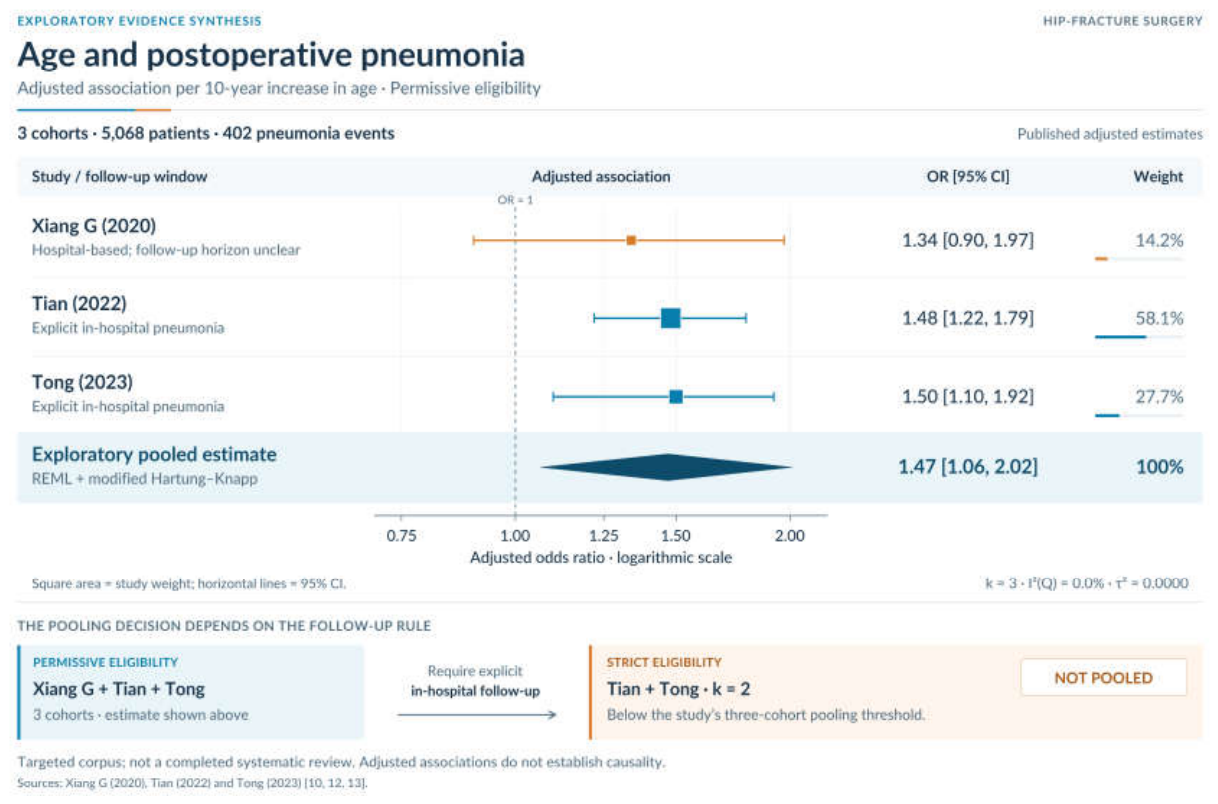
Figure 2.
Male versus female sex across four cohorts, using unadjusted estimates. Heterogeneity prevents describing a universal factor of stable magnitude. Source: calculations from [10,11,12,13].
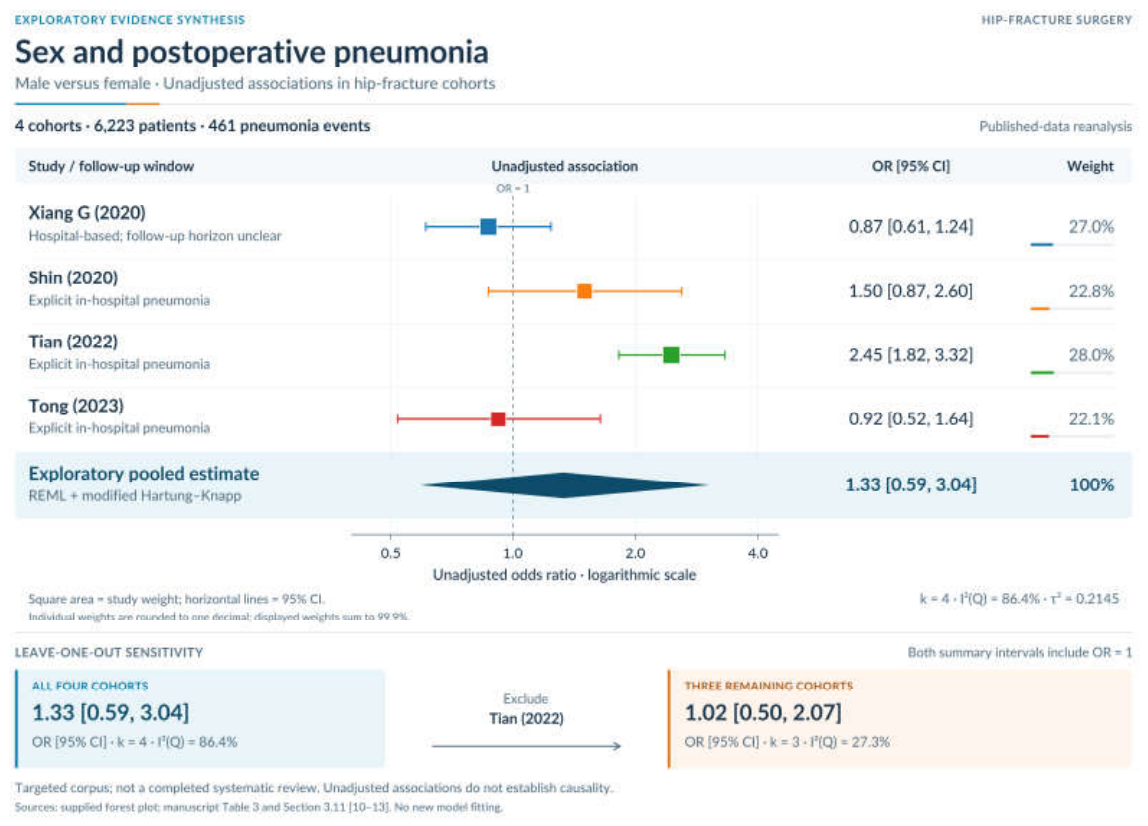
Figure 3.
ASA III–IV versus I–II: unadjusted estimates with substantial between-cohort imprecision. The interval was not narrowed by retrospectively selecting a different inferential method. Source: calculations from [10,12,13].
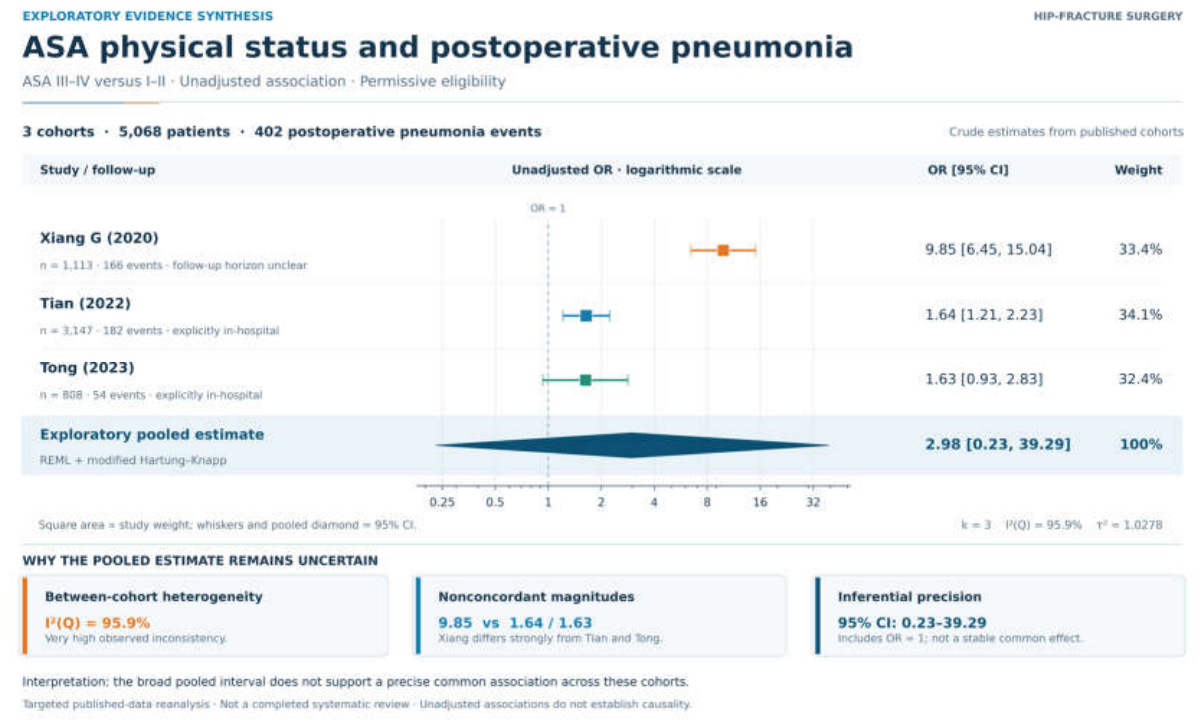
Figure 4.
General versus non-general anaesthesia: an unadjusted observational association, not the causal effect of choosing an anaesthetic technique. Source: calculations from [10,12,13].
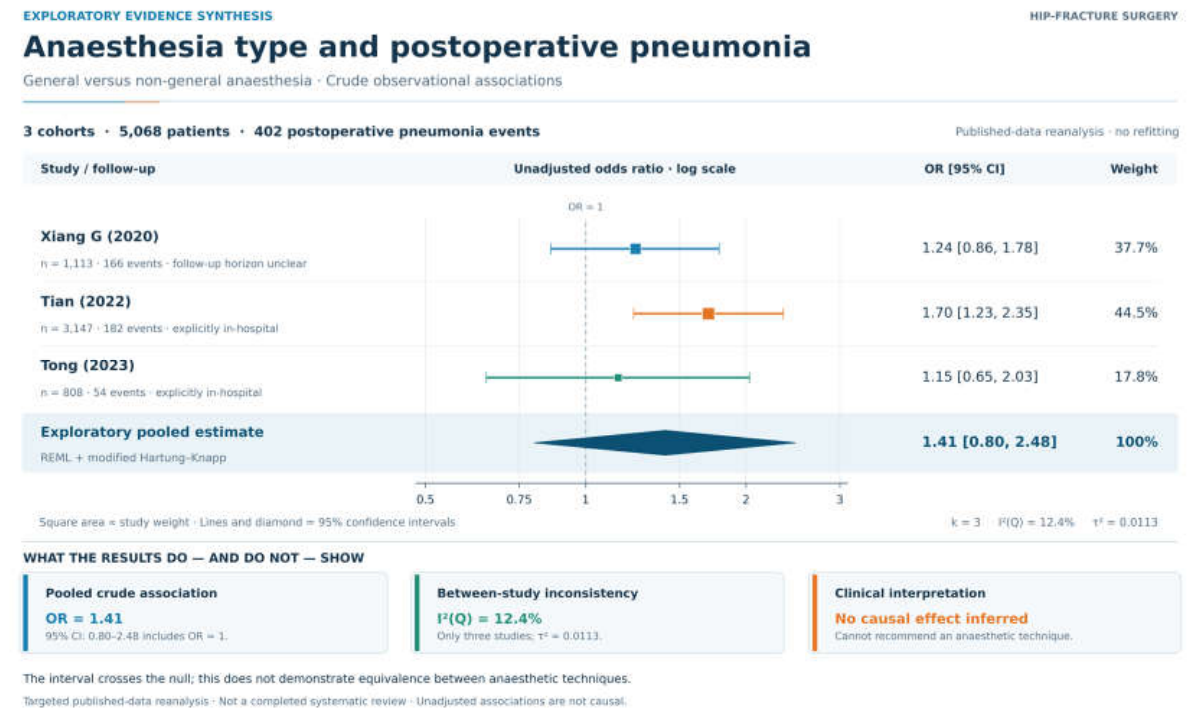
Figure 5.
Six outcomes from one matched cohort; no pooled diamond is presented. Published estimates from [27].
Figure 5.
Six outcomes from one matched cohort; no pooled diamond is presented. Published estimates from [27].
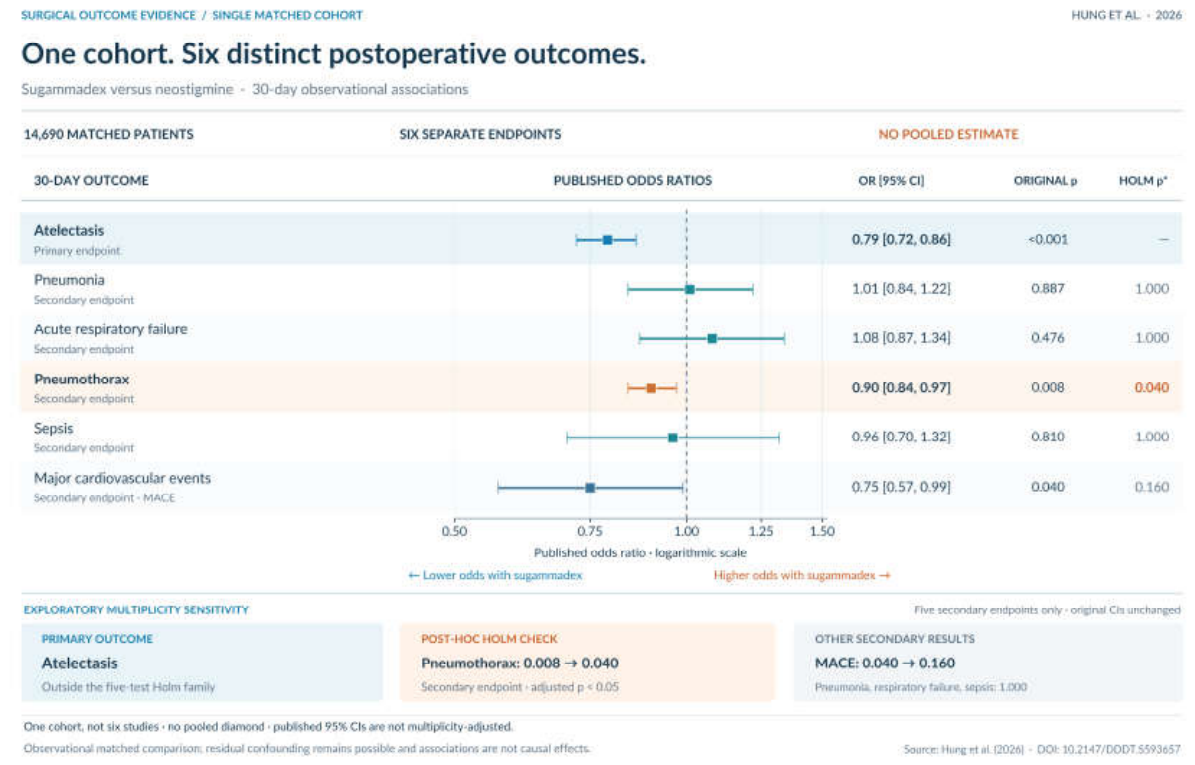

Table 1.
Analytical scenarios defined for this reanalysis.
| Scenario | Rule | Consequence |
| Permissive age | Continuous adjusted OR; no explicit postoperative covariates; an imprecise hospital follow-up window is permitted. | Xiang G, Tian, and Tong; k = 3. |
| Strict age | As above, but an explicitly in-hospital outcome is required. | Tian and Tong; k = 2. No pooling under the protocol rule. |
| Postoperative-adjustment sensitivity | Adds a model adjusting for postoperative albumin. | Includes Shin; not interpreted as baseline-only adjustment. |
| Unadjusted descriptors | Complete cells; equivalent contrasts; factors analysed separately. | Sex: k = 4; ASA and anaesthesia: k = 3. |
| 30-day window | Follow-up differs from index hospitalisation. | Ji is reported separately, not pooled. |
Table 2.
Cohorts contributing to the reanalysis and contrasting evidence.
| Study | Setting / period | N / pneumonia | Window | Analytical role |
| Xiang G, 2020 [10] | Wenzhou, China; 2014–2019 | 1113 / 166 | Hospital-based; imprecise | Permissive age; crude contrasts. |
| Shin, 2020 [11] | Korea University; 2010–2019 | 1155 / 59 | In-hospital | Crude sex; age sensitivity with postoperative adjustment. |
| Tian, 2022 [12] | Hebei, China; 2016–2020 | 3147 / 182 | In-hospital | Age and crude contrasts. |
| Tong, 2023 [13] | Tangshan, China; recruitment period differs between abstract and methods | 808 / 54 | In-hospital | Age and crude contrasts. |
| Ji, 2021 [14] | Xi’an, China; 2018–2019 | 901 / 55 | 30 days | Contrasting time window; not pooled. |
Table 3.
Exploratory estimates: each row represents a separate analytical family.
| Factor / scenario | k | N / events | OR (95% CI) | I²(Q) |
| Adjusted age, permissive | 3 | 5068 / 402 | 1.47 (1.06–2.02) | 0.0% |
| Male sex, crude | 4 | 6223 / 461 | 1.33 (0.59–3.04) | 86.4% |
| ASA III–IV, crude | 3 | 5068 / 402 | 2.98 (0.23–39.29) | 95.9% |
| General anaesthesia, crude | 3 | 5068 / 402 | 1.41 (0.80–2.48) | 12.4% |
| Adjusted age, strict | 2 | 3955 / 236 | Not pooled | Not applicable |
Table 4.
Sensitivity of the adjusted age association.
| Decision | OR per decade (95% CI) | Interpretation |
| REML + modified HK, k = 3 | 1.47 (1.06–2.02) | Main exploratory estimate; permissive eligibility. |
| Add postoperative adjustment, k = 4 | 1.51 (1.21–1.88) | More information but different temporal interpretation. |
| Conservative SE for Tong, k = 3 | 1.46 (1.05–2.04) | Preserves direction; does not correct evidence selection. |
| Unmodified HK, k = 3 | 1.47 (1.31–1.63) | Narrower interval; not selected for significance. |
| Wald, k = 3 | 1.47 (1.27–1.70) | Technical comparator; not main inference. |
| Explicit in-hospital window only, k = 2 | Not pooled | Below the adopted protocol threshold. |
Table 5.
Individual results retained without an additional meta-analysis.
| Factor | Study | Adjusted OR (95% CI) | Reason for non-pooling |
| COPD | Xiang G [10] | 0.76 (0.37–1.58) | Imprecise follow-up; not equivalent to broad respiratory disease. |
| COPD | Ji [14] | 3.65 (1.74–7.65) | 30-day window. |
| Respiratory disease | Tian [12] | 3.74 (2.32–6.04) | Only two broad-domain reports; diagnostic equivalence is not assured. |
| Chronic respiratory disease | Tong [13] | 4.61 (1.70–12.54) | Not recoded as COPD. |
| Male sex | Tian [12] | 2.27 (1.64–3.13) | Not supplemented with crude estimates. |
| General anaesthesia | Tian [12] | 1.61 (1.15–2.27) | Single adjusted estimate in this set. |
Table 6.
Distribution of the 58 candidate reports in the expanded inventory.
| Report specialty | Candidate reports |
| Orthopaedics and spine | 15 |
| Cardiac surgery | 5 |
| Multispecialty | 6 |
| Abdominal, gastric, and pancreatic surgery | 9 |
| Oesophageal surgery | 8 |
| Hepatic surgery and transplantation | 5 |
| Pulmonary and thoracic surgery | 5 |
| Head, neck, and neurosurgery | 5 |
| Documentary total, not final cohorts | 58 |
Source: documentary classification of the earlier bibliography and [27]. The supplementary inventory preserves each record; final design, eligibility, and independence decisions are not established.
Table 7.
Descriptive audit of twelve crude-to-adjusted contrasts within the source publications.
| Publication / factor | Calculated crude OR (95% CI) | Published adjusted OR (95% CI) |
| Tian 2022 / Male sex | 2.45 (1.82–3.32) | 2.27 (1.64–3.13) |
| Tian 2022 / General anaesthesia | 1.70 (1.23–2.35) | 1.61 (1.15–2.27) |
| Tong 2023 / Diabetes | 1.92 (1.06–3.47) | 1.77 (0.91–3.43) |
| Tong 2023 / Chronic respiratory disease | 4.53 (1.86–11.05) | 4.61 (1.70–12.54) |
| Tong 2023 / Preoperative DVT | 2.66 (1.43–4.95) | 3.51 (1.74–10.48) |
| Tong 2023 / Arthroplasty versus osteosynthesis | 2.59 (1.37–4.91) | 4.39 (1.87–10.31) |
| Tian 2022 / Respiratory disease | 4.95 (3.17–7.75) | 3.74 (2.32–6.04) |
| Tian 2022 / Cardiac disease | 2.31 (1.63–3.27) | 1.68 (1.14–2.47) |
| Tian 2022 / Cerebrovascular disease | 2.23 (1.61–3.11) | 1.58 (1.11–2.27) |
| Tian 2022 / Hepatic disease | 2.58 (1.38–4.83) | 2.61 (1.33–5.15) |
| Shin 2020 / Cardiovascular disease | 2.20 (1.23–3.96) | 2.03 (1.12–3.69) |
| Shin 2020 / Albumin <3 g/dL in the first two postoperative days | 3.11 (1.69–5.73) | 2.43 (1.26–4.68) |
Table 8.
Hung's individual 30-day results and exploratory sensitivity for five secondary outcomes.
| Outcome | Published OR (95% CI) | Published P | Holm P* |
| Atelectasis | 0.79 (0.72–0.86) | <0.001 | Outside family |
| Pneumonia | 1.01 (0.84–1.22) | 0.887 | 1.000 |
| Acute respiratory failure | 1.08 (0.87–1.34) | 0.476 | 1.000 |
| Pneumothorax | 0.90 (0.84–0.97) | 0.008 | 0.040 |
| Sepsis | 0.96 (0.70–1.32) | 0.810 | 1.000 |
| MACE | 0.75 (0.57–0.99) | 0.040 | 0.160 |
Table 9.
Additional descriptive calculations from Tong's cohort.
| Outcome | Original data | Calculated estimate | Restriction |
| In-hospital mortality | 2/54 with pneumonia; 14/754 without pneumonia | Conditional OR 2.03 (0.22–9.22) | Exact CI; sparse events; not causal. |
| Total stay (days) | 20.30 ± 10.30 vs. 14.10 ± 6.60 | MD 6.20 (3.35–9.05) days | Approximate Welch CI; unadjusted. |
| Postoperative stay (days) | 13.10 ± 8.90 vs. 8.80 ± 5.00 | MD 4.30 (1.85–6.75) days | Approximate Welch CI; unadjusted. |
Table 10.
Proposed adjustment rules by question; these are not patient-level models fitted in this work.
Table 10.
Proposed adjustment rules by question; these are not patient-level models fitted in this work.
| Question | Relevant earlier information | Main caution |
| Anaesthesia → pneumonia | Clinical/functional status, planned surgery, urgency, contraindications, centre/year. | Do not automatically adjust for subsequent ventilation, ICU admission, or stay. |
| Transfusion → pneumonia | Haemoglobin, bleeding, and instability before transfusion; strategy and threshold. | Total bleeding and subsequent duration may be affected by exposure. |
| Smoking → pneumonia | History and context-specific pre-exposure common causes. | COPD may mediate part of the effect; define total or direct effect. |
| Reversal agent → complications | Block depth, dose, monitoring, surgery, and ventilation before reversal. | Comorbidity balance does not replace missing intraoperative information. |
| Pneumonia → death/stay | Severity before infection and individual event dates. | Future infection must not be treated as a baseline exposure. |
Disclaimer/Publisher’s Note: The statements, opinions and data contained in all publications are solely those of the individual author(s) and contributor(s) and not of MDPI and/or the editor(s). MDPI and/or the editor(s) disclaim responsibility for any injury to people or property resulting from any ideas, methods, instructions or products referred to in the content. |
© 2026 by the authors. Licensee MDPI, Basel, Switzerland. This article is an open access article distributed under the terms and conditions of the Creative Commons Attribution (CC BY) license.
Copyright: This open access article is published under a Creative Commons CC BY 4.0 license, which permit the free download, distribution, and reuse, provided that the author and preprint are cited in any reuse.