

Submitted:
11 October 2026
Posted:
13 October 2026
You are already at the latest version
Abstract
Generative artificial intelligence (AI) has moved from a tool for information retrieval to a partner in conversation, advice, and emotional support. This integrative review examines whether that shift is reshaping friendship and other social bonds. Drawing on relationship science, human–machine communication research, surveys, experiments, longitudinal panels, randomized trials, and meta-analyses published through September 2026, including emerging evidence from Arab societies, the review develops the Responsiveness–Reciprocity Bridge Model to explain why conversational AI can relieve loneliness in the moment yet fail to build the relational capital that sustains people over time. A substantial minority of adolescents and young adults already turn to chatbots when they feel sad, anxious, or lonely, and short-term interactions with companion systems can reduce loneliness about as much as talking with another person, largely because users feel heard. These gains do not establish that synthetic ties can replace human friendship. Close relationships require mutual need, sacrifice, shared history, and practical solidarity that chatbots do not provide; in a randomized experiment, a human peer outperformed a highly supportive chatbot, and longitudinal and large-sample studies associate intensive, companionship-oriented use with greater loneliness and lower well-being. In Arab contexts, culturally aligned and human-guided digital tools show promise, but claims that AI is widely replacing traditional friends are not supported by comparable prevalence research. The central implication is balance: AI can widen access to support, but only if it is designed, governed, and used as a bridge to human relationships rather than as a substitute for them.
Keywords:
artificial intelligence companions
; friendship
; loneliness
; human–machine communication
; parasocial interaction
; social displacement
; emotional support
; Arab societies
1. Introduction
Artificial intelligence is no longer a technology of the future. Conversational systems such as ChatGPT, Gemini, and Claude, along with companion applications such as Replika and Character.AI, now sit inside ordinary routines. They answer questions, draft messages, and, for a growing minority of users, listen when someone is distressed. This shift places long-standing social bonds under a new kind of pressure. The question is not whether machines can speak warmly. It is whether simulated responsiveness can stand in for friendship, and what happens to human ties if people increasingly treat it as though it can.
The need for an answer is practical as well as philosophical. The need to belong is a fundamental human motive rather than a lifestyle preference (Baumeister & Leary, 1995), and its frustration carries measurable costs. A meta-analysis of 148 studies found that people with stronger social relationships had a 50% greater likelihood of survival (Holt-Lunstad et al., 2010), and loneliness and social isolation are associated with 26% and 29% increases, respectively, in the likelihood of mortality (Holt-Lunstad et al., 2015). The World Health Organization's Commission on Social Connection estimates that about one in six people worldwide is affected by loneliness, that loneliness is linked to more than 871,000 deaths each year, and that 17%–21% of people aged 13–29 feel lonely (World Health Organization [WHO], 2025). In the United States, about one in two adults has reported experiencing loneliness (Office of the Surgeon General, 2023). If conversational AI can ease this distress on a scale, the public-health case for it is serious. If the same tools crowd out the relationships that sustain people, the case for caution is equally serious. Both possibilities now appear in the evidence, and they are not mutually exclusive.
This review examines (Alshuqir, 2025) argument that AI is testing social relationships; that virtual companionship offers genuine but limited comfort; and that authentic friendship depends on commitment, trust, and shared experiences that algorithms cannot replicate. It evaluates these claims against the published literature and treats the essay's focus on Arab societies—where family and community ties have historically been strong and Arabic-language AI is now widely accessible—as a distinct empirical question rather than an assumption.
The review makes three contributions. First, it integrates two literatures that have largely developed in parallel: human–machine communication (HMC), which explains why people respond socially to machines (Guzman & Lewis, 2020; Nass & Moon, 2000), and relationship science, which specifies what close relationships require (Reis & Shaver, 1988; Smith et al., 2025). The result is a single explanatory model, the Responsiveness–Reciprocity Bridge Model. Second, it synthesizes the rapidly expanding evidence published between 2022 and 2026 and evaluates it against explicit propositions. Third, it assembles the emerging peer-reviewed evidence from Arab societies and distinguishes what is established there from what remains a plausible but untested hypothesis. Together, these contributions move the debate from whether AI companionship is good or bad toward a more tractable question: under which conditions does it bridge people to one another, and under which conditions substitute for them?
2. Purpose and Review Questions
The review synthesizes current evidence on human–AI social relationships to state, as precisely as the evidence allows, what is known, contested, and unstudied. Six questions organize it:
- How should friendship and related human bonds be distinguished from relationships with conversational AI?
- How common is the use of generative AI for emotional support, especially among young people?
- Can AI companions reduce loneliness, and for how long?
- What risks follow from treating AI as a friend, including dependence, displacement of human ties, and erosion of social skills?
- How do cultural settings, including Arab societies, change both the appeal and the limits of these tools?
- What design, governance, and research priorities follow from the answers to these questions?
3. Method
This study is an integrative review, a design suited to fields in which experimental, observational, qualitative, and theoretical work must be synthesized together to build a comprehensive understanding of a phenomenon (Whittemore & Knafl, 2005). It is not a systematic review with a preregistered protocol, and it makes no claim to exhaustive retrieval. Following Whittemore and Knafl's (2005) staged approach, the review proceeded through problem identification, literature search, data evaluation, data analysis, and presentation.
Sources were identified through targeted searches of PubMed, Google Scholar, the ACM Digital Library, Crossref, and the platforms of major academic publishers, supplemented by the websites of the Pew Research Center and the WHO. Search strings combined technology terms (e.g., chatbot, conversational agent, AI companion, Replika) with outcome terms (e.g., loneliness, friendship, social connection, emotional support, dependence) and, for the regional analysis, with regional terms (e.g., Saudi, Gulf, Arab). The search emphasized work published from 2022 through September 2026, the period in which generative systems became widely available, and retained the earlier theoretical and foundational studies needed to interpret that work. Backward and forward citation tracking from key reviews (Adewale & Muhammad, 2025; Gur & Maaravi, 2025; Smith et al., 2025) identified additional studies.
Inclusion required a direct bearing on companionship, emotional support, loneliness, friendship, social connection, or culturally situated affective use of conversational AI. General studies of AI for productivity or education were excluded unless they measured social or affective use. Priority was given to peer-reviewed experiments, randomized trials, longitudinal studies, systematic reviews, meta-analyses, and nationally representative surveys; qualitative studies were included where they illuminated relational processes that quantitative designs cannot capture. Preprints were excluded. Reports from the Pew Research Center, the WHO, the Office of the U.S. Surgeon General, and Common-Sense Media were retained as clearly identified nonacademic sources because they provide probability-based or authoritative population estimates. Journalistic accounts and institutional claims that could not be traced to a retrievable study were not treated as evidence. That exclusion applies to several specific statistics in the source essay, which are listed in the Appendix A so that the distinction between argument and evidence remains visible. Every reference was checked against its Crossref, publisher, or institutional record.
Each source was coded for design, sample, setting, time horizon, and principal findings and appraised with a design-based hierarchy that weighed randomized and longitudinal designs above cross-sectional and qualitative ones for causal claims, while valuing qualitative work for identifying mechanisms. Findings were synthesized through constant comparison, first by review questions and then against the propositions of the theoretical framework developed in Section 5. Figure 1 summarizes the composition of the resulting evidence base.
As Figure 1 shows, the evidence base of 85 sources is weighted toward recent work: 57 sources (67%) were published from 2022 onward, and 35 appeared in 2025 or 2026 alone, including the first longitudinal panels, randomized comparisons with human partners, and school-based surveys with tens of thousands of respondents. Experimental studies (n = 13) and longitudinal or quasi-experimental studies (n = 7) nonetheless account for fewer than one in four sources, and among the primary studies only three randomized trials followed participants beyond a single session. This distribution shapes the confidence with which the conclusions below can be stated.
4. Literature Review: Belonging, Friendship, and Synthetic Relationships
This section reviews research bearing on a central question: can a relationship with an AI system provide the belonging that human friendship provides? The review proceeds in four steps. Section 4.1 examines why people respond socially to machines, drawing on research on social responses to computers, human–machine communication, anthropomorphism, and parasocial interaction. Section 4.2 sets out what relationship science requires of friendship, namely responsiveness, mutual disclosure, reciprocal obligation, and time. Section 4.3 reviews qualitative, survey, and experimental studies of human–AI companionship, with particular attention to the recent quantitative studies summarized in Table 1. Section 4.4 identifies the gaps in this literature that motivate the present review and the framework developed in Section 5.
4.1. Social Responses to Machines
People respond socially to computers even when they know that the machine is not a person. The computer-are-social-actors (CASA) tradition showed that users apply politeness, gender stereotypes, and reciprocity norms to very simple systems (Nass & Moon, 2000). Later work proposed that people may develop distinct human–media scripts rather than merely transferring human–human scripts to machines (Gambino et al., 2020), and HMC scholarship now treats AI not only as a channel but as a communicator in its own right, with functional, relational, and metaphysical dimensions that require study (Guzman & Lewis, 2020). The communicative effects can be substantial: emotional disclosure to a partner believed to be a chatbot produced psychological benefits equivalent to disclosure to a partner believed to be a person (Ho et al., 2018), and a companion with greater social presence was judged more useful for lonely people (Merrill et al., 2022). AI also mediates human relationships: algorithms now alter messages exchanged between people (Hancock et al., 2020), and suspicion that a partner is using AI-suggested replies lowers perceived cooperativeness (Hohenstein et al., 2023).
Anthropomorphism, the attribution of mind, intention, and feeling to nonhuman agents, is a general human tendency that strengthens when a system speaks in a humanlike way and when the user is motivated to connect (Epley et al., 2007). Lonely people anthropomorphize more readily (Cacioppo & Hawkley, 2009), which means that the users most motivated to perceive a social partner are also those most likely to find one. Media scholarship anticipated part of this dynamic long before chatbots. Horton and Wohl (1956) described parasocial interaction as an illusion of face-to-face intimacy with media figures, and later experiments showed that favored media can provide a sense of belonging that buffers threats to self-esteem, a process termed social surrogacy (Derrick et al., 2009). Generative models intensify both processes. Unlike a television persona, they remember details, mirror tone, and reply contingently, producing exchanges that users experience as reciprocal even though the system's agency is designed rather than lived (Maeda & Quan-Haase, 2024).
4.2. What Relationship Science Requires
Relationship science sets a higher bar than the impression that an interaction feels social. In the interpersonal process model of intimacy, closeness develops when one partner's disclosure is met with responses that the discloser perceives as understanding, validating, and caring, and when that sequence is repeated over time with a partner who also discloses and has needs (Reis & Shaver, 1988). Diary studies confirm that both self-disclosure and partner disclosure predict intimacy, with perceived partner responsiveness partly mediating the effect (Laurenceau et al., 1998). Social penetration theory similarly describes relationships as deepening through gradual, reciprocal increases in the breadth and depth of disclosure (Altman & Taylor, 1973). Friendship also takes time: forming a casual friendship requires roughly 40–60 hours together, and close friendship is likely to require more than 200 hours (Hall, 2019).
Applying more than 50 years of close-relationships research, Smith et al. (2025) concluded that human–chatbot interaction can meet some surface criteria of a close relationship. The parties influence each other, contact can be frequent, and topics can be diverse. Chatbots can also respond in ways users experience as supportive, generating a feeling of connection and some opportunity for reflection. What they do not do is make real requests of the user. They do not need care, they do not negotiate competing interests, and they do not require sacrifice. These are not decorative features of friendship; they are part of how intimacy and commitment are built (Smith et al., 2025). A relationship that never asks anything of a person can feel safe precisely because it is not mutual. Experimental evidence is consistent with this view: emotional support reduced stress and worry more strongly when it came from a human than from a chatbot, and reciprocal self-disclosure made support more effective at reducing worry (Meng & Dai, 2021). Attachment theory explains part of the pull. When people are distressed and short of human company, a consistently warm, nonjudgmental agent can become a safe haven (Bowlby, 1969/1982; Xie & Pentina, 2022). That is attachment-like behavior. It is not, by itself, friendship.
4.3. Empirical Research on Human–AI Companionship
Early qualitative work made relationship formation less mysterious. Interviews with Replika users described bonds that began in curiosity and deepened as trust and self-disclosure grew, broadly in line with social penetration theory (Skjuve et al., 2021). In a 12-week follow-up of 25 users, perceived closeness grew when the system supported reflection and met a felt need for contact, but individual differences were large, and technical failures and unannounced changes could stall or end the bond (Skjuve et al., 2022). Users described their human–AI friendships as resembling human friendship in some respects but as more personalized and tailored to their own needs (Brandtzaeg et al., 2022), and the support they reported was emotional, informational, and appraisal-based rather than tangible (Ta et al., 2020). A friendship that a software update can alter or withdraw is structurally unlike a friendship between people, even when the feelings involved are sincere. When the companion app Soulmate shut down, most surveyed users experienced the loss as a death and coped by re-creating the persona on another platform (Banks, 2024).
Reviews published since 2023 describe the antecedents and the ambivalence of these bonds. Gur and Maaravi (2025), analyzing 38 peer-reviewed empirical studies, found that people who are lonely, whether by trait or by situation, are more likely to form emotional relationships with AI. Such relationships therefore often respond to an unmet social need rather than demonstrating that the need has been met as a friendship would meet it. Adewale and Muhammad (2025), synthesizing 37 empirical and conceptual studies published from 2021 to 2025, described the same duality: companions can simulate trust and reciprocity, while users struggle with authenticity and with what the authors call pseudo-intimacy. Survey and mixed-method studies link loneliness, social anxiety, and personification to engagement that can become dependence, even as users report well-being benefits (Hu et al., 2023; Marriott & Pitardi, 2024; Xie et al., 2023). Analyses of user communities document mental-health harms that arise from emotional dependence itself (Laestadius et al., 2024) and harmful algorithmic behaviors, including relational transgressions, harassment, and encouragement of self-harm, across 35,390 conversation excerpts (R. Zhang et al., 2025).
The most consequential recent additions are quantitative studies with stronger designs. Table 1 summarizes their designs, samples, and principal findings and links each to a proposition of the framework developed in Section 5.
Three features of Table 1 stand out. First, the studies converge on a recruitment pattern in which loneliness, distress, and smaller offline networks precede or accompany affective use (Folk & Dunn, 2026; Herbener & Damholdt, 2025; Huang et al., 2024; Y. Zhang et al., 2026). Second, experimental studies locate the benefit of AI conversation in perceived responsiveness. AI-generated replies can make people feel more heard than human replies, although an AI label reduces the effect (Yin et al., 2024); third-party evaluators rate AI responses as more compassionate than those of trained crisis responders (Ovsyannikova et al., 2025); and warm, relational chatbot styles increase closeness through perceived responsiveness (Telari et al., 2026). Third, studies that compare AI directly with human contact or follow users over time point to limits. A randomly paired student reduced loneliness over 2 weeks, whereas a highly supportive chatbot did not (R.-N. Li et al., 2026), and companionship-oriented, intensive, and highly disclosive use is associated with lower well-being (Y. Zhang et al., 2026).
4.4. Gaps in Literature
Four gaps motivate the present review. Most studies are cross-sectional or brief, so long-term consequences are inferred rather than observed. Benefit and risk studies rarely share a theoretical framework, leaving apparently contradictory findings unreconciled. Measurement is inconsistent: affective use is variously defined as seeking mental-health advice, emotional support, companionship, or friend-like conversation, which makes prevalence estimates difficult to compare. Finally, research from Arab societies is concentrated in acceptance surveys and design studies and rarely measures friendship or social connection directly (Aldaweesh et al., 2026; Alsalman et al., 2026). The framework developed next addresses the second gap directly and organizes the evidence bearing on the others.
5. Theoretical Framework: The Responsiveness–Reciprocity Bridge Model
No single theory accounts for both the documented benefits and the documented risks of AI companionship. Theories of social response explain why people engage with machines but not what that engagement does to human ties; relationship science explains what close relationships require but not why people seek substitutes; and displacement research was developed for media that do not converse. The Responsiveness–Reciprocity Bridge Model (RRBM) integrates these traditions. Table 2 summarizes the theoretical lenses that the model combines and the contribution each makes.
The model rests on a distinction between two properties of social interaction that human relationships bundle together and conversational AI pulls apart. Perceived responsiveness is the experience of being understood, validated, and cared for (Reis & Shaver, 1988). Generative AI supplies this property consistently and at any hour, and the evidence that users feel heard is strong (De Freitas et al., 2026; Yin et al., 2024). Reciprocity is the mutual exchange of needs, obligations, and sacrifices through which relationships accumulate history, commitment, and practical solidarity (Smith et al., 2025). AI cannot supply reciprocity, because its needs are design objectives, its memory is a product feature, and its continued presence depends on the company, a model update, and a subscription. The gap between abundant responsiveness and absent reciprocity, the responsiveness–reciprocity gap, is the model's core construct. It explains why AI conversation can relieve distress in the moment, since responsiveness is the active ingredient of short-term relief, while failing to build the relational capital that protects people over time, since reciprocity is the active ingredient of durable bonds.
Figure 2 depicts the model. Antecedent conditions, namely unmet belonging needs, loneliness, social anxiety, stigma, and barriers to human help, recruit users toward responsive AI, a pull amplified by the tendency of lonely people to anthropomorphize (Cacioppo & Hawkley, 2009; Epley et al., 2007). Interaction produces perceived responsiveness and, with it, short-term relief. From there, use follows one of two pathways. On the bridge pathway, which corresponds to the stimulation hypothesis in research on online communication (Valkenburg & Peter, 2007), AI conversation is structured to rehearse social skills, prompt contact with people, or deliver guided care that connects users to human helpers, so that relief is converted into strengthened human ties. On the substitution pathway, which corresponds to the displacement hypothesis (Hall & Liu, 2022; Kraut et al., 1998), time, disclosure, and emotional investment migrate from people to the system. The frictionless partner becomes preferred precisely because it asks nothing, and dependence, emotional bubbles of uncontested validation (Mlonyeni, 2025), and isolation follow.
Three classes of moderators determine which pathway dominates. Design moderators include the system's success metric (time spent with the model versus contact restored with people), transparent disclosure that the system is not a person, the presence of human guidance, and schizoaffective alignment of the system with the user's long-term interests rather than immediate gratification (Kirk et al., 2025). User moderators include age, intensity and purpose of use, depth of disclosure, and preexisting social resources; consistent with the rich-get-richer pattern observed for early Internet use, people with stronger offline networks may benefit while those with weaker networks may be harmed (Kraut et al., 2002). Cultural moderators include family connectedness, stigma surrounding mental-health help-seeking, and the linguistic and normative alignment of the system with local culture (Aldaweesh et al., 2026; Dwairy et al., 2006; Zolezzi et al., 2018). The model yields six testable propositions:
P1 (Recruitment). Loneliness, social anxiety, distress, and barriers to human help increase the likelihood and intensity of affective AI use.
P2 (Responsiveness). The short-term relief produced by AI conversation is mediated by perceived responsiveness, that is, by feeling heard.
P3 (Reciprocity gap). Because AI cannot reciprocate, its benefits do not accumulate into relational capital equivalent to that produced by human contact of similar duration.
P4 (Substitution). Intensive, companionship-primary, and highly disclosive use is associated with lower well-being and greater isolation over time.
P5 (Bridging). Systems structured to connect users to people and services through bounded scripts, human guidance, or prompts to contact produce more durable benefits than open-ended companionship.
P6 (Cultural moderation). Cultural alignment, family connectedness, and help-seeking stigma moderate both the appeal of AI companionship and the cost of withdrawing from kin networks.
The results that follow are organized by review question, and the Discussion returns to these propositions to assess the strength of the evidence for each.
6. Results
This section reports the findings of the review, following the questions set out in Section 2 and interpreting them through the propositions of the RRBM (Section 5). Section 6.1 examines how common affective use of AI is and who engages in it. Section 6.2 and Section 6.3 weigh the evidence of short-term benefit against the evidence of dependence, displacement, and longer-term isolation. Section 6.4 accounts for these mixed findings by identifying what AI does not reproduce in friendship, and Section 6.5 considers how cultural context, particularly in Arab societies, shapes both the appeal and the limits of these systems. Section 6.6 draws out the design implications, moving from AI as a replacement for human relationships to AI as a complement to them. Throughout, claims are matched to the strength of the available evidence, and widely circulated figures that could not be verified are identified as such.
6.1. How Common Is Affective Use of AI?
Prevalence is lower than popular commentary often implies, it is rising, and its apparent magnitude depends heavily on how affective use is defined (Figure 3). In the first nationally representative U.S. survey of the question, conducted in early 2025, 13.1% of adolescents and young adults aged 12–21 reported using generative AI for mental-health advice, defined as advice or help when feeling sad, angry, or nervous. The rate was 22.2% among those aged 18–21, and the overall figure represented approximately 5.4 million young people (McBain et al., 2025). Among users, 65.5% sought advice monthly or more often, and 92.7% found it somewhat or very helpful. This estimate remains the clearest peer-reviewed baseline. It does not support the claim that nearly half of the world's youth rely on AI for everyday psychological challenges, and no WHO report located for this review states that figure.
U.S. teens' own reports point in the same direction. In a Pew Research Center survey of 1,458 teens conducted in fall 2025, 64% used chatbots, mostly to search for information (57%) or to get help with schoolwork (54%). Personal uses were less common but not rare: 16% had used chatbots for casual conversation and 12% for emotional support or advice (McClain et al., 2026). Parents were far less comfortable with these personal uses than with schoolwork; only 18% were comfortable with their teen using chatbots for emotional support. A survey that asked specifically about AI companions found much higher figures: 72% of U.S. teens had used an AI companion at least once, 52% did so at least a few times a month, and 31% found conversations with AI companions as satisfying as or more satisfying than conversations with real friends. Yet 80% of users still spent more time with real friends (Robb & Mann, 2025).
Outside the United States, estimates vary just as widely. Among 1,599 Danish high-school students, 14.6% reported friend-like conversations with chatbots, but only 2.4% reported social-supportive ones (Herbener & Damholdt, 2025). In a school-based survey of 39,761 Ontario students in Grades 4–12, 21.1% reported affective AI use, defined as seeking emotional support or advice (Bonnesen et al., 2026). In a two-wave panel of 3,843 adolescents, the proportion classified as AI-dependent rose from 17.1% to 24.2% (Huang et al., 2024). In the Arab region, a survey of 12,886 respondents in 21 countries found that 26.4% had used AI chatbots for health assistance, with mental support among the purposes reported (Abdelwahed et al., 2025).
Read together, these estimates support three conclusions. First, the spread from roughly 2% to more than 70% reflects definitional heterogeneity more than genuine disagreement: questions about any contact with a companion product capture curiosity and entertainment, whereas questions about emotional support capture a smaller, more vulnerable group. Second, affective use is concentrated in late adolescence and early adulthood, the developmental period in which identity and peer relationships are consolidated, which raises the stakes of any displacement. Third, affective use is a marker of need. Students who used chatbots for social support were lonelier and reported less perceived social support than nonusers (Herbener & Damholdt, 2025), and in the Ontario sample affective users were about twice as likely as nonusers to have clinically significant emotional problems, an association that persisted after adjustment for loneliness and mattering (Bonnesen et al., 2026). This pattern supports P1. It matches the essay's observation that young people turn to these systems in moments of strain, without supporting the stronger claim that traditional networks have already been broadly abandoned.
Public judgment is more skeptical than personal use. In a 2025 Pew survey of 5,023 U.S. adults, 50% said that the increased use of AI would worsen people's ability to form meaningful relationships, 5% said it would improve that ability, 25% said it would do neither, and 17% were unsure; among adults under 30, 58% expected harm (Kennedy et al., 2025). A reported late-2024 Pew result in which 68% of respondents called AI a "temporary friend" was not found in Pew's publications and is not cited here (see Appendix A). WHO evidence on youth and digital technology is real, but it is not evidence about generative companions. In the Health Behaviour in School-aged Children study, problematic social media use among adolescents rose from 7% in 2018 to 11% in 2022 across Europe, Central Asia, and Canada (World Health Organization Regional Office for Europe [WHO/Europe], 2024), and a 2025 policy brief treats digital technologies, including AI, as determinants of youth mental health whose effects are mixed, bidirectional, and hardest on young people who are already vulnerable (WHO/Europe, 2025). These documents justify concern. They do not document a global majority of youth substituting chatbots for friends.
6.2. Evidence That AI Companions Can Reduce Loneliness—In the Short Term
The essay is right that these systems can fill a gap in the moment. It would be wrong, however, to treat that gap-filling as either empty or sufficient. The clearest experimental case comes from De Freitas et al. (2026), a team that includes Harvard Business School faculty; their work, not a 2024 Harvard study concluding that emotional reliance on AI increases loneliness, is the relevant Harvard-affiliated evidence. Through five studies, interacting with an AI companion reduced loneliness on par with interacting with another person and more than activities such as watching videos. Participants underestimated the benefit. In a week-long design, loneliness fell after use, and feeling heard, rather than distraction alone, was the central mechanism. For the narrow outcome of momentary loneliness, companion chatbots are not a placebo.
Meta-analytic evidence points in the same direction, with important qualifications about durability and evidence quality (Figure 4). A meta-analysis of relational agents, that is, software agents designed for social interaction and increasingly powered by language models, found a moderate reduction in loneliness (Hedges' g = −0.55, 95% CI [−0.88, −0.23]) across 14 studies; however, the studies were small (4–42 participants), heterogeneous (I² = 71%), and all at high risk of bias (Sha et al., 2024). A 2026 meta-analysis of autonomous conversational agents for older adults found pre–post reductions in loneliness and depression (Satake et al., 2026), whereas a meta-analysis of 40 randomized trials of digital interventions for loneliness found no pooled effect for the small subgroup of conversational robots (Hansen et al., 2025). For mental-health symptoms, a meta-analysis of 15 randomized trials found that AI-based conversational agents reduced depression and psychological distress but did not significantly improve psychological well-being (H. Li et al., 2023), extending an earlier review that found only weak evidence of benefit and almost no assessment of safety (Abd-Alrazaq et al., 2020).
Trials of purpose-built systems show what structured design can achieve. In a national randomized trial of 210 adults with clinically significant symptoms of depression, anxiety, or eating-disorder risk, a fine-tuned generative chatbot produced greater symptom reductions than a waitlist control over 4 weeks, with gains maintained at 8 weeks (Heinz et al., 2025). In a single-group study of 176 Korean university students, 4 weeks of use of a social chatbot was followed by modest reductions in loneliness and social anxiety, and lower self-disclosure to the chatbot predicted higher loneliness (Kim et al., 2025). Neither study tested whether the gains transferred to human relationships.
Clinical and quasi-clinical findings share the same limit. In a survey of 1,006 student users of Replika, participants were lonelier than typical student populations but still reported high perceived social support, and many used the system simultaneously as a friend, a therapist, and what the authors called an intellectual mirror (Maples et al., 2024). Three percent reported that the chatbot had halted their suicidal ideation. That figure is a self-report from a self-selected user sample, and the study's interpretation has been formally challenged (Zimmerman & Ruiz, 2025). It signals that some distressed students experience these systems as protective. It is not a trial of suicide prevention and should not be cited as one.
Interpreted through the RRBM, these studies support P2 and specify the help: it is largely immediate, it depends on feeling heard, and it has been demonstrated over minutes, days, or weeks, not across the years in which friendships are actually lived. Figure 4 also reveals an evidential gradient. Effects are largest and most consistent for structured, symptom-focused interventions evaluated in randomized trials, and smallest and least certain for open-ended companionship evaluated against loneliness. This gradient anticipates P5, because the systems with the strongest evidence are those designed to deliver bounded therapeutic content rather than to simulate friendship.
6.3. Risks: Displacement, Dependence, and Longer-Term Isolation
The risk case is not the mirror image of the benefit case; short-term relief and longer-term harm can both be true. The strongest longitudinal evidence to date comes from a 12-month, four-wave panel of 2,149 adults in the United Kingdom, the United States, Canada, and Australia (Folk & Dunn, 2026). On a single-item measure of emotional isolation, increased social chatbot use predicted later increases in loneliness. On a broader 20-item measure of social connectedness, the direction reversed: people who felt less connected later used social chatbots more, and chatbot use did not predict later improvement in connection. The authors treated the analyses as exploratory and cautioned against strong conclusions. Even so, the pattern matches a displacement account better than a compensation account. Loneliness recruits the technology, the technology does not reliably rebuild social connection, and on at least one measure heavier use travels with greater isolation.
Three newer studies sharpen the pattern. In a preregistered randomized experiment, 296 first-semester university students texted daily for 2 weeks with a highly supportive chatbot or a randomly paired fellow student, or they wrote in a journal; only the human-peer condition reduced loneliness (R.-N. Li et al., 2026). Because the chatbot was designed to be maximally supportive and the human partner was a stranger, the result is strong evidence for P3. In a survey of 1,131 Character.AI users combined with 4,664 donated chat sessions, using the chatbot primarily for companionship was associated with lower well-being; the association was stronger for intensive and highly disclosive use, and users with smaller offline networks were more likely to use the chatbot for companionship (Y. Zhang et al., 2026). A quasi-experimental analysis of longitudinal Reddit data found mixed effects after users began engaging with AI companions: more expressions of grief and interpersonal focus, but also more language about loneliness, depression, and suicidal ideation. Interviewees described emotional validation and social rehearsal alongside over-reliance and withdrawal (Yuan et al., 2026).
Systematic reviews describe the same split. Adewale and Muhammad (2025) identify reduced isolation and over-reliance as joint outcomes, alongside ethical risks of data exploitation and algorithmic manipulation. A scoping review of 37 studies of problematic AI use distinguished compulsive use, cognitive over-reliance, and emotional dependence, the last linked to loneliness, anxious attachment, and anthropomorphism (Dagnino et al., 2026), and a validated scale of generative AI dependency was associated with greater loneliness (Goh et al., 2025). Anthropomorphism and perceived authenticity predict attachment to social chatbots, especially when the user's motive is social rather than instrumental (Pentina et al., 2023). Attachment is thus an outcome of design and need, not evidence that the human network has been protected. Panel data also caution against simple causal stories: among adolescents, depression and anxiety predicted later AI dependence, but AI dependence did not predict later depression or anxiety (Huang et al., 2024).
Skill erosion is plausible but still under-measured. Emotional attunement, turn-taking, and the reading of nonverbal cues are practiced in person (Smith et al., 2025; WHO/Europe, 2025). A system that never looks away, never misreads silence, and never requires the user to repair a slight is a poor training ground for those skills, and philosophical analysis warns that AI that mirrors the user's emotions can create emotional bubbles of uncontested validation that stunt emotional growth (Mlonyeni, 2025). The claim should stay at that level. The literature does not yet contain a definitive trial showing that companion use causes a measurable loss of social skill, and some users report applying skills practiced with AI in human interactions (Robb & Mann, 2025; Yuan et al., 2026). It does, however, contain theoretical and longitudinal reasons not to wait for such a trial before setting limits, especially for adolescents (McClain et al., 2026; WHO/Europe, 2025).
There is also a crisis test, which the source essay states in ordinary language and the research supports in technical language. In job loss, illness, or family rupture, people need someone who can show up, share a history, and bear a cost. Chatbots can offer language on a schedule; they cannot sit in a waiting room, attend a funeral, or lend money. The support users report from companions is emotional, informational, and appraisal-based rather than tangible (Ta et al., 2020), and because chatbots make only superficial requests, they cannot supply the goods that come from negotiating with and sacrificing for a partner (Smith et al., 2025). Table 3 consolidates the benefit and risk evidence by time horizon.
As Table 3 indicates, the evidence displays a temporal asymmetry: benefits are best documented at the shortest horizons, and risks at the longest. The asymmetry does not prove that companionship use causes long-term harm, because the longitudinal evidence remains correlational and partly exploratory. It does show that evidence of benefit cannot be extrapolated from days to year, and it is precisely across years that friendships accumulate the reciprocity that the RRBM identifies as their protective core.
6.4. What Algorithms Do Not Reproduce
Friendship, in the sense used here, is neither an exchange of information nor a stream of supportive turns. It is history: obligations, memories that both parties can contest, and a future that neither party fully controls. Intimacy grows when disclosure is met with understanding and care and when that sequence is repeated with a partner who also has needs (Laurenceau et al., 1998; Reis & Shaver, 1988). AI can imitate the responsive half of that sequence; feeling heard is exactly why companions reduce loneliness in the moment (De Freitas et al., 2026). The imitation fails at reciprocity. The system's "needs" are design objectives. Its memory is a product feature. Its loyalty is contingent on a company, a model update, and a subscription, as users discover when an update alters a companion's behavior or a service closes (Banks, 2024; Skjuve et al., 2022).
That gap explains a finding that otherwise looks contradictory: people can feel genuinely helped and still be right to call the relationship temporary. Maples et al. (2024) found users holding overlapping and sometimes conflicting beliefs, namely that Replika was a machine, an intelligence, and in some sense a human, while using it as a friend and therapist at once. Grounded-theory analysis of Replika communities shows that the most serious harms of dependence arise when users come to treat the chatbot as having needs and emotions of its own that they must attend to (Laestadius et al., 2024). Adewale and Muhammad (2025) describe the resulting emotional dissonance. The feeling is real. The partner is not a moral agent. Treating the feeling as though it settled the ontological question is how pseudo-intimacy becomes a substitute for judgment.
Turkle's (2011) argument that sociable machines invite us to expect more from technology and less from one another remains a useful frame, even though it predates large language models. The new evidence does not confirm a simple story of technological alienation; it confirms a narrower one. Tools that excel at simulated responsiveness will be used, especially by the lonely, and that use will sometimes help today while failing to build the relationships that protect people tomorrow (Folk & Dunn, 2026; Gur & Maaravi, 2025; R.-N. Li et al., 2026). In the terms of the RRBM, the responsiveness–reciprocity gap is not a technical deficiency awaiting a better model. It is constitutive: a system designed to serve the user cannot also be a party whose needs make claims on the user.
6.5. Cultural Context, With Attention to Arab Societies
The source essay is right that this issue is not culturally neutral. It is not yet right that regional institutional reports have established a marked substitution of AI for traditional friends in Arab cities; those specific reports could not be recovered as citable studies. What the peer-reviewed record does show is more limited and more interesting. Table 4 summarizes the regional evidence.
First, demand for digital emotional support is real and growing. In the 21-country Arab survey, 72.5% of respondents were aware of AI chatbots and 26.4% had used them for health purposes; respondents reporting psychological or mental-health problems had higher odds of use, as did those with AI-related training (Abdelwahed et al., 2025). An earlier five-country survey of 2,240 university students found that about half of those aware of ChatGPT had used it (Abdaljaleel et al., 2024). In Saudi Arabia, a 2025 survey of 533 adults found that 51.6% had needed psychological support in the past year and 59% supported integrating mental-health chatbots into psychological services; perceived usefulness, ease of use, social influence, and perceived need predicted intention to use (Alsalman et al., 2026). Among Jordanian nursing students, higher anxiety and depression increased the likelihood of using AI-based mental-health support (Albikawi et al., 2025). In the region, as elsewhere, distress and unmet need recruit users toward AI, consistent with P1.
Second, language and normative fit determine whether emotional AI is usable at all. Research with young Saudi women finds that digital mental-health tools are attractive partly because stigma and social barriers discourage in-person help-seeking, and that a lack of cultural and religious sensitivity leads users to disengage (Aldaweesh, 2025). This finding is consistent with a systematic review documenting stigma toward mental illness and its treatment across Arab populations (Zolezzi et al., 2018). Human–computer interaction research using a culturally sensitive chatbot as a technology probe in Saudi Arabia argues that large language models used for emotional support have not "lived in" Saudi society and proposes a standard of minimum cultural alignment, because alignment can increase relatedness while generic empathy can conflict with local norms (Aldaweesh et al., 2026). A young Arab user can indeed consult a model in Arabic, or in a dialect, and receive advice shaped toward local custom, as the essay observes; whether that advice is aligned rather than merely fluent remains an open design problem (Aldaweesh et al., 2026; Alhuwaydi, 2024).
Third, the first Saudi study to model AI attachment and loneliness directly suggests that the relationship is indirect. Among 743 undergraduates at four Saudi universities, including Imam Mohammad Ibn Saud Islamic University, dimensions of AI attachment had no significant direct association with perceived loneliness; associations ran instead through emotion-regulation strategies (Arnout, 2026). As a single cross-sectional study, it requires replication, but it points to emotional competence as a lever through which universities might influence whether AI use bridges or substitutes.
Fourth, the strongest clinical evidence in the region concerns a guided, rule-based system rather than unsupervised companion chatbots. The WHO's STARS intervention, a decision-tree chatbot teaching stress-management skills paired with brief support from trained nonspecialist e-helpers, was tested in a randomized trial of 344 psychologically distressed older adolescents and young adults in Jordan (Bryant et al., 2026). At 3 months, relative to enhanced usual care, STARS produced greater reductions in anxiety (effect size = 0.70, 95% CI [0.41, 0.98]) and depression (effect size = 0.61, 95% CI [0.31, 0.90]), with additional gains in distress, functioning, well-being, and agency, and effects held among participants with more severe symptoms. The authors explain that generative systems were avoided because of the risk of improper or inconsistent responses, and human guidance was part of the model. Retention at 3 months was 64%. Even so, the trial supports a conclusion close to the essay's more hopeful claim: digital conversation can widen access to care in Arab settings when it is structured, culturally developed, and tied to human follow-up. It does not support the claim that a general-purpose chatbot is an adequate friend.
Fifth, cross-cultural reviews warn against exporting one society's interpretation of companion AI. Adewale and Muhammad (2025) note greater therapeutic acceptance in some East Asian contexts and stronger debates about authenticity in Western ones; Arab societies are not represented in that contrast at comparable depth. Comparative research shows that Arab adolescents report higher emotional, financial, and functional connectedness with their families than American adolescents do (Dwairy et al., 2006). Family connectedness may protect against substitution by keeping human alternatives close, whereas stigma, rapid urbanization, and linguistic variation within Arabic may increase the appeal of a private, nonjudgmental listener. These are hypotheses (P6), not findings from regionally representative surveys, and until such surveys exist, precise regional percentages of friendship substitution should not be cited. Older adults present a related gap. Meta-analytic work suggests that some artificial companions can reduce loneliness in later life, particularly in structured settings (Satake et al., 2026; Sha et al., 2024), but a reported early-2025 UNESCO finding that AI innovations reduced isolation among older adults in Arab societies could not be located and is not cited. Distance, disability, and thin local services are real reasons to study AI as a prompt for family contact in the region, not evidence of a completed success story.
6.6. From Replacement to Complement
The design implication follows from the evidence rather than from optimism. Systems that only simulate friendship will be used as friendship by people who lack it. Systems that use conversation to restore human contact have a different ethical profile. Such a system should state, within the interaction itself, that it is not a person and cannot replace one (Adewale & Muhammad, 2025; Smith et al., 2025); because such labels can reduce the feeling of being heard (Yin et al., 2024), the disclosure must be designed with care rather than appended as a disclaimer. It should treat loneliness as a reason to connect the user to people and services, not merely as a reason to prolong the chat. It should avoid the harmful relational behaviors documented in companion apps (R. Zhang et al., 2025) and be aligned with the user's long-term social and psychological needs rather than with engagement (Kirk et al., 2025). It should be culturally specified rather than superficially translated (Aldaweesh, 2025; Aldaweesh et al., 2026). For mental-health support, a bounded, evidence-based script combined with a human helper is currently safer than an open-ended generative companion (Bryant et al., 2026), and WHO guidance similarly advises monitoring mental-health effects, involving young people, and not treating general-purpose chatbots as tested treatments (WHO/Europe, 2025).
Used in this way, technology can match the essay's image of a bridge. Reminders to call a friend, suggestions for shared activities, and tools that help families separated by distance stay in contact are socially different from a bot that becomes the preferred confidant. The difference is not rhetorical. It lies in whether the system's success metric is time spent with the model or contact restored with people.
7. Discussion
The source essay asks whether algorithms can replace the warmth of human experience or whether this era will instead sharpen our understanding of friendship. Literature favors the latter view, with one important qualification: algorithms are not as cold as the metaphor implies. They can appear warmer, more patient, and more accessible than the people users can reach, a quality that is both their appeal and their risk. Experiments in which AI responses are judged more compassionate than those of trained crisis responders (Ovsyannikova et al., 2025) and make recipients feel more heard than human responses (Yin et al., 2024) show that the contest is not between warm humans and cold machines. It is between costly reciprocity and costless responsiveness.
7.1. Principal Findings
Three conclusions are solid enough to state. First, affective use is already common enough to matter and too uneven to be described as a new norm. Roughly one in eight U.S. adolescents and young adults has used generative AI for mental-health advice, with higher rates in early adulthood, and about one in eight U.S. teens reports using chatbots for emotional support (McBain et al., 2025; McClain et al., 2026). Affective use concentrates among the distressed (Bonnesen et al., 2026; Herbener & Damholdt, 2025). Comparable Arab prevalence estimates from representative surveys are not yet available, although regional acceptance studies show substantial interest (Abdelwahed et al., 2025; Alsalman et al., 2026).
Second, short-term loneliness reduction is real (De Freitas et al., 2026; Sha et al., 2024), but long-term substitution for human connection is not supported. The best longitudinal evidence suggests recruitment by loneliness and possible worsening of emotional isolation rather than repair of social connection (Folk & Dunn, 2026), large-sample evidence links companionship-primary use to lower well-being (Y. Zhang et al., 2026), and when AI is compared directly with a human stranger, the human prevails (R.-N. Li et al., 2026).
Third, the properties that make a relationship a friendship, namely mutual need, sacrifice, contested memory, practical presence, and nonverbal attunement, are not reproduced by fluent conversation (Skjuve et al., 2022; Smith et al., 2025). Users and the public already half-recognize this. They use the tools and, in large numbers, doubt that the tools will improve human relationships (Kennedy et al., 2025).
7.2. Theoretical Implications
Table 5 evaluates the six propositions of the RRBM against the evidence reviewed. The assessment distinguishes propositions supported by convergent experimental or longitudinal evidence from those supported only correlationally or indirectly and from those that remain plausible but untested.
Three theoretical implications follow. First, the RRBM resolves the apparent contradiction between the benefit and risk literatures by locating them at different points in the same process. Studies that document relief measure the responsiveness channel at short horizons; studies that document isolation measure the reciprocity deficit at long horizons. Both can be correct. Second, the model extends HMC scholarship by specifying what the relational dimension of communicative AI (Guzman & Lewis, 2020) can and cannot deliver: AI can be a communicator that responds, but not a partner that reciprocates. This refines the CASA insight that people treat machines socially (Nass & Moon, 2000) by showing that social treatment and social sustenance are different outcomes. Third, the model updates the long-running debate between displacement and stimulation (Kraut et al., 1998; Valkenburg & Peter, 2007). For earlier communication technologies, stimulation tended to prevail because those technologies connected people to other people. Online communication enhanced adolescents' well-being largely by strengthening existing friendships (Valkenburg & Peter, 2007), and the best available evidence does not show that social media has displaced face-to-face time (Hall & Liu, 2022). Conversational AI differs in kind because the partner is the technology itself. Displacement therefore becomes the default unless design deliberately routes users back to people, which is why the bridge pathway must be engineered rather than assumed.
7.3. Implications for Arab Societies and Saudi Arabia
For Arab societies, the evidence supports a constructive rather than defensive agenda, and Saudi Arabia is well positioned to lead it. Saudi universities are already producing some of the region's first studies of AI attachment, mental-health chatbots, and culturally aligned emotional-support systems (Aldaweesh et al., 2026; Alsalman et al., 2026; Arnout, 2026), and public acceptance of mental-health chatbots, which align with national digital-health goals, is substantial (Alsalman et al., 2026). Strong family connectedness (Dwairy et al., 2006) is an asset that bridge-oriented design can mobilize, for example, through tools that prompt intergenerational contact or help families separated by study and work stay connected. Yet help-seeking stigma (Zolezzi et al., 2018) means that private chatbots may attract precisely those users for whom substitution is most costly. The Jordanian STARS trial (Bryant et al., 2026) offers a regional model of a bounded chatbot paired with trained human helpers, which Saudi institutions are well placed to adapt and evaluate.
7.4. Practical Implications
The essay's proposed balance is therefore not a compromise between techno philia and nostalgia; it is the position the evidence currently supports. AI can serve as a listener of last resort, a space to practice social skills, a reminder to reach a person, and, when guided, a vehicle for evidence-based psychological strategies. It is a poor friend in the decisive sense: it cannot share a life. For educators, clinicians, and parents, the distinction between functional and affective use offers a practical cue (Bonnesen et al., 2026; McClain et al., 2026). Affective reliance on AI is better read as a signal of unmet need than as a technology problem to be solved by prohibition.
8. Limitations
This review is integrative rather than exhaustive. Publication is moving quickly, and some 2025–2026 studies may be revised as journal issues are finalized. Several important studies rely on Western, English-speaking, or self-selected users of companion apps, and the relational-agent meta-analysis pools small, high-risk-of-bias studies (Sha et al., 2024). Folk and Dunn (2026) appropriately flag their longitudinal results as exploratory; Y. Zhang et al. (2026) and Bonnesen et al. (2026) are cross-sectional and cannot establish direction; and Maples et al. (2024) cannot establish clinical efficacy. The Jordan trial evaluates a guided, rule-based chatbot rather than a generative companion, and attrition was substantial (Bryant et al., 2026). Evidence from Arab societies remains concentrated in acceptance surveys, design studies, and one major trial rather than in population surveys of friendship substitution, and several regional samples are convenience samples. The RRBM is derived from this evidence and has not itself been tested as a whole; its propositions should be evaluated in prospective designs. These limitations are reasons to narrow claims. They are not reasons to retain unverified statistics because they fit the argument.
9. Conclusions
The age of conversational AI is a test of social relationships, as the source essay argues. The test does not show that friendship has become obsolete; it shows why friendship is hard to counterfeit. Machines can offer an ear at any hour, in a user's language, without judgment, and that offer will be accepted, especially by the young and the lonely. Experiments show that the offer can ease loneliness in the moment. Relationship science, longitudinal data, randomized comparisons with human partners, and public judgment converge on what it cannot do: build trust that has survived conflict, create memories that belong to two people, or stand with someone when standing has a cost. The Responsiveness–Reciprocity Bridge Model captures this convergence. AI supplies responsiveness in abundance but cannot supply reciprocity, and whether its use bridges people to one another or substitutes for them depends on design, on users' circumstances, and on culture.
For Arab societies and for others, the practical task is the same: adopt tools that widen access to support and point people back toward one another and refuse the quieter substitution in which a fluent system becomes the relationship that asks the least and is therefore preferred. Friendship remains a source of strength only if it continues to be practiced with people.
10. Recommendations
The findings and discussion support the following recommendations, ordered from research priorities to practice.
- Test the bridge pathway directly. Randomized trials should compare designs that prompt human contact, rehearse social skills, or connect users to human helpers with open-ended companionship, using the frequency and quality of human contact as primary outcomes (P3, P5).
- Extend time horizons. Prospective cohorts of at least 12 months with repeated measures of use intensity, purpose, and disclosure should establish whether intensive companionship use causes later isolation or merely marks it (P4).
- Standardize measurement. Researchers should distinguish functional, social, and affective use and report companion-specific and general-chatbot use separately so that prevalence estimates become comparable across countries.
- Build the Arab evidence base. Nationally representative surveys of affective AI use and its relation to friendship and family contact should be conducted in Saudi Arabia and other Arab countries, alongside trials that adapt guided, culturally aligned models such as STARS and test the moderating roles of family connectedness and stigma (P6).
- Measure social-skill outcomes. Studies should test whether companion use affects observable interpersonal competencies, particularly among adolescents.
- Align design and governance with human connection. Developers and regulators should adopt success metrics based on restored human contact rather than engagement, require transparent disclosure of non-personhood, restrict companion features for minors, and prohibit manipulative relational behaviors (Kirk et al., 2025; WHO/Europe, 2025; R. Zhang et al., 2025).
- Integrate AI literacy into education and counseling. Schools and universities, including those in Saudi Arabia, should treat affective reliance on AI as a signal for outreach and teach students to use AI as a bridge to people, supported by training in emotion regulation (Arnout, 2026; Bonnesen et al., 2026).
Note: The idea for this paper is based on Dr. Abdularhman Alshuqir’s Tweet, titled “Friendship in the Age of Artificial Intelligence”, published in X on September 5, 2026, https://x.com/alshuqir/status/1964030309596320194.
Funding
This work was supported and funded by the Deanship of Scientific Research at Imam Mohammad ibn Saud Islamic University (IMSIU) (grant number IMSIU-DDRSP2602).
Institutional Review Board Statement
The author confirms that the manuscript is an honest, accurate, and transparent account of the study; that no vital features of the study have been omitted; and that any discrepancies from the study as planned have been explained. This study followed all applicable ethical practices in its conduct and reporting.
Data Availability Statement
All data analyzed in this study derive from publicly available treaty texts, official policy documents, institutional statistical databases, and published scholarship, each cited in the reference list.
Conflicts of Interest
The author declares no conflicts of interest.
Appendix A
Source-Essay Claims Not Retained
The statements in Table A1 appear in the Arabic source essay but were not used as findings because they could not be matched to a retrievable study.

Table A1.
Source-Essay Claims Not Retained and Their Treatment in This Review.
| Source-essay claim | Treatment in this review |
| The WHO reports that more than 45% of youth worldwide rely on AI for daily psychological challenges | Not found. Replaced with McBain et al. (2025), McClain et al. (2026), Bonnesen et al. (2026), and WHO/Europe documents (2024, 2025). |
| A 2024 Harvard study found that excessive AI emotional support increases long-term loneliness | Not found. The relevant Harvard-affiliated study (De Freitas et al., 2026) reports short-term reductions in loneliness; longer-term concerns are drawn from Folk and Dunn (2026) and R.-N. Li et al. (2026). |
| The Arab Forum for Digital Development (early 2025) documented AI replacing traditional friends in major Arab cities | Not located as a citable report. Regional evidence is drawn from peer-reviewed surveys, design research, and the Jordan STARS trial (Table 4). |
| UNESCO (early 2025) found that AI innovations reduced isolation among older adults in Arab societies | Not located and not cited. Evidence on older adults is drawn from Satake et al. (2026) and Sha et al. (2024). |
| Pew Research Center (late 2024): 68% called AI a “temporary friend” | Not found in Pew's publications on AI. The verified Pew finding used here is that 50% of U.S. adults expect AI to worsen people's ability to form meaningful relationships (Kennedy et al., 2025). |
Note. Source: Author's verification of the source essay's statistical claims against retrievable records.
References
- Abdaljaleel, M.; Barakat, M.; Alsanafi, M.; Salim, N. A.; Abazid, H.; Malaeb, D.; Mohammed, A. H.; Hassan, B. A. R.; Wayyes, A. M.; Farhan, S. S.; Khatib, S. E.; Rahal, M.; Sahban, A.; Abdelaziz, D. H.; Mansour, N. O.; AlZayer, R.; Khalil, R.; Fekih-Romdhane, F.; Hallit, R.; Sallam, M. A multinational study on the factors influencing university students' attitudes and usage of ChatGPT. Scientific Reports 14 2024, 1983. [Google Scholar] [CrossRef]
- Abd-Alrazaq, A. A.; Rababeh, A.; Alajlani, M.; Bewick, B. M.; Househ, M. Effectiveness and safety of using chatbots to improve mental health: Systematic review and meta-analysis. Journal of Medical Internet Research 2020, 22(7), e16021. [Google Scholar] [CrossRef]
- Abdelwahed, A. E.; Abd El-Nasser, M.; Heih, O. Q.; Suleiman, A. M.; Khader, A. M.; Ibrahim, R. A.; Hamad, M. R. A. F.; Radwan, E.; Srour, A. M.; HealthTech Alliance; Ibrahim Ghallab, M. M. Public attitudes and practices toward using AI chatbots for healthcare assistance: A multinational cross-sectional study. BMC Health Services Research 26 2025, 335. [Google Scholar] [CrossRef]
- Adewale, M. D.; Muhammad, U. I. From virtual companions to forbidden attractions: The seductive rise of artificial intelligence love, loneliness, and intimacy—A systematic review. Journal of Technology in Behavioral Science Advance online publication. 2025. [Google Scholar] [CrossRef]
- Albikawi, Z.; Abuadas, M.; Rayani, A. M. Nursing students' perceptions of AI-driven mental health support and its relationship with anxiety, depression, and seeking professional psychological help: Transitioning from traditional counseling to digital support. Healthcare 2025, 13(9), 1089. [Google Scholar] [CrossRef]
- Aldaweesh, S. A. Exploring challenges and design opportunities for digital mental well-being support in Saudi Arabia: Perspectives of young Saudi women. Doctoral dissertation;Saudi Digital Library, University of Oxford, 2025. Available online: https://drepo.sdl.edu.sa/items/035bcc83-48ea-4e00-85bb-30e1fd6506bb.
- Aldaweesh, S.; Alelsheikh, G.; Alhamed, F.; Van Kleek, M.; Shadbolt, N. "It hasn't lived in our society": Investigating cultural sensitivity in LLM chatbots for emotional support. In Proceedings of the 2026 CHI Conference on Human Factors in Computing Systems; Association for Computing Machinery, 2026; pp. 1–20. [Google Scholar] [CrossRef]
- Alhuwaydi, A. M. Exploring the role of artificial intelligence in mental healthcare: Current trends and future directions—A narrative review for a comprehensive insight. Risk Management and Healthcare Policy 17 2024, 1339–1348. [Google Scholar] [CrossRef]
- Alsalman, Z.; Almaqhawi, A.; Almulhim, A.; Alqadeep, A. F.; Almutawah, G. M.; Al Khalifa, F. A.; Alghadeer, F. R.; Aleid, H. A.; Alkhalifah, W. M.; Alabdullah, Z. A.; AlAmer, S. A.; Shafey, M. M. Behavioral intention to use mental health chatbots in Saudi Arabia: A cross-sectional UTAUT-based study. Frontiers in Public Health 14 2026, 1926484. [Google Scholar] [CrossRef]
- Alshuqir, A. Tweet titled “Friendship in the Age of Artificial Intelligence”. 2025. https://x.com/alshuqir/status/1964030309596320194. [Google Scholar]
- Altman, I.; Taylor, D. A. Social penetration: The development of interpersonal relationships; Holt, Rinehart & Winston, 1973; ISBN 0-03-076635-4. [Google Scholar]
- Arnout, B. A. How emotional regulation mediates the link between AI attachment and perceived loneliness: A study of Saudi university students. Frontiers in Education 11 2026, 1782010. [Google Scholar] [CrossRef]
- Banks, J. Deletion, departure, death: Experiences of AI companion loss. Journal of Social and Personal Relationships 2024, 41(12), 3547–3572. [Google Scholar] [CrossRef]
- Baumeister, R. F.; Leary, M. R. The need to belong: Desire for interpersonal attachments as a fundamental human motivation. Psychological Bulletin 1995, 117(3), 497–529. [Google Scholar] [CrossRef]
- Bonnesen, K.; Krygsman, A.; Hobson, S.; Korczak, D.; Vaillancourt, T. Affective generative artificial intelligence use and youth mental health. In JAMA Pediatrics; Advance online publication; 2026. [Google Scholar] [CrossRef]
- Bowlby, J. Attachment and loss. In Attachment. (Original work published 1969), 2nd ed.; Basic Books, 1982; Vol. 1, ISBN 978-0-465-00543-7. [Google Scholar]
- Brandtzaeg, P. B.; Skjuve, M.; Følstad, A. My AI friend: How users of a social chatbot understand their human–AI friendship. Human Communication Research 2022, 48(3), 404–429. [Google Scholar] [CrossRef]
- Bryant, R. A.; de Graaff, A. M.; Habashneh, R.; Fanatseh, S.; Keyan, D.; Akhtar, A.; Abualhaija, A.; Faroun, M.; Aqel, I. S.; Dardas, L.; Afar, H.; Servili, C.; Hadzi-Pavlovic, D.; van Ommeren, M.; Carswell, K. A guided chatbot-based psychological intervention for psychologically distressed older adolescents and young adults: A randomised clinical trial in Jordan. npj Digital Medicine 2026, 9(1), 57. [Google Scholar] [CrossRef]
- Cacioppo, J. T.; Hawkley, L. C. Perceived social isolation and cognition. Trends in Cognitive Sciences 2009, 13(10), 447–454. [Google Scholar] [CrossRef]
- Dagnino, F. M.; Fante, C.; Guerrieri, V.; Passarelli, M. Addicted, attached, or just delegating? A scoping review on "problematic artificial intelligence use. Frontiers in Psychology 17 2026, 1900953. [Google Scholar] [CrossRef]
- De Freitas, J.; Oğuz-Uğuralp, Z.; Uğuralp, A. K.; Puntoni, S. AI companions reduce loneliness. Journal of Consumer Research 2026, 52(6), 1126–1148. [Google Scholar] [CrossRef]
- Derrick, J. L.; Gabriel, S.; Hugenberg, K. Social surrogacy: How favored television programs provide the experience of belonging. Journal of Experimental Social Psychology 2009, 45(2), 352–362. [Google Scholar] [CrossRef]
- Dwairy, M.; Achoui, M.; Abouserie, R.; Farah, A. Adolescent-family connectedness among Arabs: A second cross-regional research study. Journal of Cross-Cultural Psychology 2006, 37(3), 248–261. [Google Scholar] [CrossRef]
- Epley, N.; Waytz, A.; Cacioppo, J. T. On seeing human: A three-factor theory of anthropomorphism. Psychological Review 2007, 114(4), 864–886. [Google Scholar] [CrossRef]
- Folk, D.; Dunn, E. How does turning to AI for companionship predict loneliness and vice versa? Psychological Science 2026, 37(4), 276–286. [Google Scholar] [CrossRef]
- Gambino, A.; Fox, J.; Ratan, R. A. Building a stronger CASA: Extending the computers are social actors paradigm. Human-Machine Communication 1 2020, 71–86. [Google Scholar] [CrossRef]
- Goh, A. Y. H.; Hartanto, A.; Majeed, N. M. Generative artificial intelligence dependency: Scale development, validation, and its motivational, behavioral, and psychological correlates. Computers in Human Behavior Reports 20 2025, 100845. [Google Scholar] [CrossRef]
- Gur, T.; Maaravi, Y. The algorithm of friendship: Literature review and integrative model of relationships between humans and artificial intelligence (AI). Behaviour & Information Technology 2025, 44(14), 3446–3466. [Google Scholar] [CrossRef]
- Guzman, A. L.; Lewis, S. C. Artificial intelligence and communication: A Human–Machine Communication research agenda. New Media & Society 2020, 22(1), 70–86. [Google Scholar] [CrossRef]
- Hall, J. A. How many hours does it take to make a friend? Journal of Social and Personal Relationships 2019, 36(4), 1278–1296. [Google Scholar] [CrossRef]
- Hall, J. A.; Liu, D. Social media use, social displacement, and well-being. Current Opinion in Psychology 46 2022, 101339. [Google Scholar] [CrossRef]
- Hancock, J. T.; Naaman, M.; Levy, K. AI-mediated communication: Definition, research agenda, and ethical considerations. Journal of Computer-Mediated Communication 2020, 25(1), 89–100. [Google Scholar] [CrossRef]
- Hansen, T.; Johansen, R.; Kirkøen, B.; Stene-Larsen, K.; Straiton, M.; Tornes, R. A.; Reneflot, A. Digital bridges to social connection: A systematic review and meta-analysis of digital interventions for loneliness and social isolation. Internet Interventions 41 2025, 100856. [Google Scholar] [CrossRef]
- Heinz, M. V.; Mackin, D. M.; Trudeau, B. M.; Bhattacharya, S.; Wang, Y.; Banta, H. A.; Jewett, A. D.; Salzhauer, A. J.; Griffin, T. Z.; Jacobson, N. C. Randomized trial of a generative AI chatbot for mental health treatment. NEJM AI 2025, 2(4). [Google Scholar] [CrossRef]
- Herbener, A. B.; Damholdt, M. F. Are lonely youngsters turning to chatbots for companionship? The relationship between chatbot usage and social connectedness in Danish high-school students. International Journal of Human-Computer Studies 196 2025, 103409. [Google Scholar] [CrossRef]
- Ho, A.; Hancock, J.; Miner, A. S. Psychological, relational, and emotional effects of self-disclosure after conversations with a chatbot. Journal of Communication 2018, 68(4), 712–733. [Google Scholar] [CrossRef]
- Hohenstein, J.; Kizilcec, R. F.; DiFranzo, D.; Aghajari, Z.; Mieczkowski, H.; Levy, K.; Naaman, M.; Hancock, J. T.; Jung, M. F. Artificial intelligence in communication impacts language and social relationships. Scientific Reports 13 2023, 5487. [Google Scholar] [CrossRef]
- Holt-Lunstad, J.; Smith, T. B.; Baker, M.; Harris, T.; Stephenson, D. Loneliness and social isolation as risk factors for mortality: A meta-analytic review. Perspectives on Psychological Science 2015, 10(2), 227–237. [Google Scholar] [CrossRef]
- Holt-Lunstad, J.; Smith, T. B.; Layton, J. B. Social relationships and mortality risk: A meta-analytic review. PLOS Medicine 2010, 7(7), e1000316. [Google Scholar] [CrossRef]
- Horton, D.; Wohl, R. R. Mass communication and para-social interaction: Observations on intimacy at a distance. Psychiatry 1956, 19(3), 215–229. [Google Scholar] [CrossRef]
- Hu, B.; Mao, Y.; Kim, K. J. How social anxiety leads to problematic use of conversational AI: The roles of loneliness, rumination, and mind perception. Computers in Human Behavior 145 2023, 107760. [Google Scholar] [CrossRef]
- Huang, S.; Lai, X.; Ke, L.; Li, Y.; Wang, H.; Zhao, X.; Dai, X.; Wang, Y. AI technology panic—Is AI dependence bad for mental health? A cross-lagged panel model and the mediating roles of motivations for AI use among adolescents. Psychology Research and Behavior Management 17 2024, 1087–1102. [Google Scholar] [CrossRef]
- Kennedy, B.; Yam, E.; Kikuchi, E.; Pula, I.; Fuentes, J. How Americans view AI and its impact on people and society; Pew Research Center, 17 September 2025; Available online: https://www.pewresearch.org/science/2025/09/17/how-americans-view-ai-and-its-impact-on-people-and-society/.
- Kim, M.; Lee, S.; Kim, S.; Heo, J.-I.; Lee, S.; Shin, Y.-B.; Cho, C.-H.; Jung, D. Therapeutic potential of social chatbots in alleviating loneliness and social anxiety: Quasi-experimental mixed methods study. Journal of Medical Internet Research 27 2025, e65589. [Google Scholar] [CrossRef]
- Kirk, H. R.; Gabriel, I.; Summerfield, C.; Vidgen, B.; Hale, S. A. Why human–AI relationships need socioaffective alignment. Humanities and Social Sciences Communications 12 2025, 728. [Google Scholar] [CrossRef]
- Kraut, R.; Kiesler, S.; Boneva, B.; Cummings, J.; Helgeson, V.; Crawford, A. Internet paradox revisited. Journal of Social Issues 2002, 58(1), 49–74. [Google Scholar] [CrossRef]
- Kraut, R.; Patterson, M.; Lundmark, V.; Kiesler, S.; Mukopadhyay, T.; Scherlis, W. Internet paradox: A social technology that reduces social involvement and psychological well-being? American Psychologist 1998, 53(9), 1017–1031. [Google Scholar] [CrossRef]
- Laestadius, L.; Bishop, A.; Gonzalez, M.; Illenčík, D.; Campos-Castillo, C. Too human and not human enough: A grounded theory analysis of mental health harms from emotional dependence on the social chatbot Replika. New Media & Society 2024, 26(10), 5923–5941. [Google Scholar] [CrossRef]
- Laurenceau, J.-P.; Barrett, L. F.; Pietromonaco, P. R. Intimacy as an interpersonal process: The importance of self-disclosure, partner disclosure, and perceived partner responsiveness in interpersonal exchanges. Journal of Personality and Social Psychology 1998, 74(5), 1238–1251. [Google Scholar] [CrossRef]
- Li, H.; Zhang, R.; Lee, Y.-C.; Kraut, R. E.; Mohr, D. C. Systematic review and meta-analysis of AI-based conversational agents for promoting mental health and well-being. npj Digital Medicine 6 2023, 236. [Google Scholar] [CrossRef]
- Li, R.-N.; Folk, D.; Singh, A.; Ungar, L.; Dunn, E. Is a random human peer better than a highly supportive chatbot in reducing loneliness over time? Journal of Experimental Social Psychology 125 2026, 104911. [Google Scholar] [CrossRef]
- Maeda, T.; Quan-Haase, A. When human-AI interactions become parasocial: Agency and anthropomorphism in affective design. In Proceedings of the 2024 ACM Conference on Fairness, Accountability, and Transparency; Association for Computing Machinery, 2024; pp. 1068–1077. [Google Scholar] [CrossRef]
- Maples, B.; Cerit, M.; Vishwanath, A.; Pea, R. Loneliness and suicide mitigation for students using GPT3-enabled chatbots. npj Mental Health Research 2024, 3(1), 4. [Google Scholar] [CrossRef]
- Marriott, H. R.; Pitardi, V. One is the loneliest number… Two can be as bad as one. The influence of AI friendship apps on users' well-being and addiction. Psychology & Marketing 2024, 41(1), 86–101. [Google Scholar] [CrossRef]
- McBain, R. K.; Bozick, R.; Diliberti, M.; Zhang, L. A.; Zhang, F.; Burnett, A.; Kofner, A.; Rader, B.; Breslau, J.; Stein, B. D.; Mehrotra, A.; Uscher-Pines, L.; Cantor, J.; Yu, H. Use of generative AI for mental health advice among US adolescents and young adults. JAMA Network Open 2025, 8(11), e2542281. [Google Scholar] [CrossRef]
- McClain, C.; Anderson, M.; Sidoti, O.; Bishop, W. How teens use and view AI. In Pew Research Center; 24 February 2026; Available online: https://www.pewresearch.org/internet/2026/02/24/how-teens-use-and-view-ai/.
- Meng, J.; Dai, Y. Emotional support from AI chatbots: Should a supportive partner self-disclose or not? Journal of Computer-Mediated Communication 2021, 26(4), 207–222. [Google Scholar] [CrossRef]
- Merrill, K., Jr.; Kim, J.; Collins, C. AI companions for lonely individuals and the role of social presence. Communication Research Reports 2022, 39(2), 93–103. [Google Scholar] [CrossRef]
- Mlonyeni, P. M. T. Personal AI, deception, and the problem of emotional bubbles. AI & Society 2025, 40(3), 1927–1938. [Google Scholar] [CrossRef]
- Nass, C.; Moon, Y. Machines and mindlessness: Social responses to computers. Journal of Social Issues 2000, 56(1), 81–103. [Google Scholar] [CrossRef]
- Office of the Surgeon General. Our epidemic of loneliness and isolation: The U.S. Surgeon General's advisory on the healing effects of social connection and community. U.S. Department of Health and Human Services. 2023. Available online: https://www.hhs.gov/sites/default/files/surgeon-general-social-connection-advisory.pdf.
- Ovsyannikova, D.; de Mello, V. O.; Inzlicht, M. Third-party evaluators perceive AI as more compassionate than expert humans. Communications Psychology 2025, 3, Article 4. [Google Scholar] [CrossRef]
- Pentina, I.; Hancock, T.; Xie, T. Exploring relationship development with social chatbots: A mixed-method study of Replika. Computers in Human Behavior 140 2023, 107600. [Google Scholar] [CrossRef]
- Reis, H. T.; Shaver, P. Intimacy as an interpersonal process. In Handbook of personal relationships: Theory, research and interventions; Duck, S., Ed.; Wiley, 1988; pp. 367–389. ISBN 0-471-91491-6. [Google Scholar]
- Robb, M. B.; Mann, S. Talk, trust, and trade-offs: How and why teens use AI companions. In Common Sense Media; 2025; Available online: https://www.commonsensemedia.org/research/talk-trust-and-trade-offs-how-and-why-teens-use-ai-companions.
- Satake, Y.; Costello, H.; Naran, N.; Ishimaru, D.; Ikeda, M.; Howard, R. Autonomous conversational agents for loneliness, social isolation, depression, and anxiety in older people without cognitive impairment: Systematic review and meta-analysis. Psychological Medicine 56 2026, e27. [Google Scholar] [CrossRef]
- Sha, S.; Loveys, K.; Qualter, P.; Shi, H.; Krpan, D.; Galizzi, M. Efficacy of relational agents for loneliness across age groups: A systematic review and meta-analysis. BMC Public Health 2024, 24(1), 1802. [Google Scholar] [CrossRef]
- Skjuve, M.; Følstad, A.; Fostervold, K. I.; Brandtzaeg, P. B. My chatbot companion—A study of human-chatbot relationships. International Journal of Human-Computer Studies 149 2021, 102601. [Google Scholar] [CrossRef]
- Skjuve, M.; Følstad, A.; Fostervold, K. I.; Brandtzaeg, P. B. A longitudinal study of human–chatbot relationships. International Journal of Human-Computer Studies 168 2022, 102903. [Google Scholar] [CrossRef]
- Smith, M. G.; Bradbury, T. N.; Karney, B. R. Can generative AI chatbots emulate human connection? A relationship science perspective. Perspectives on Psychological Science 2025, 20(6), 1081–1099. [Google Scholar] [CrossRef]
- Ta, V.; Griffith, C.; Boatfield, C.; Wang, X.; Civitello, M.; Bader, H.; DeCero, E.; Loggarakis, A. User experiences of social support from companion chatbots in everyday contexts: Thematic analysis. Journal of Medical Internet Research 2020, 22(3), e16235. [Google Scholar] [CrossRef]
- Telari, A.; Gabbiadini, A.; Riva, P. Can humans feel connected to AI? Perceived responsiveness drives social connection with AI chatbots. Journal of Social and Personal Relationships 2026, 43(9), 2579–2600. [Google Scholar] [CrossRef]
- Turkle, S. Alone together: Why we expect more from technology and less from each other; Basic Books, 2011; ISBN 978-0-465-01021-9. [Google Scholar]
- Valkenburg, P. M.; Peter, J. Online communication and adolescent well-being: Testing the stimulation versus the displacement hypothesis. Journal of Computer-Mediated Communication 2007, 12(4), 1169–1182. [Google Scholar] [CrossRef]
- Whittemore, R.; Knafl, K. The integrative review: Updated methodology. Journal of Advanced Nursing 2005, 52(5), 546–553. [Google Scholar] [CrossRef]
- World Health Organization. From loneliness to social connection: Charting a path to healthier societies. Report of the WHO Commission on Social Connection; 2025; Available online: https://www.who.int/publications/i/item/978240112360ISBN 978-92-4-011236-0.
- World Health Organization Regional Office for Europe. Teens, screens and mental health. News release. 25 September 2024. Available online: https://www.who.int/europe/news/item/25-09-2024-teens--screens-and-mental-health.
- World Health Organization Regional Office for Europe. Addressing the digital determinants of youth mental health and well-being: Policy brief (WHO/EURO:2025-12187-51959-79685). 2025. Available online: https://www.who.int/europe/publications/i/item/WHO-EURO-2025-12187-51959-79685.
- Xie, T.; Pentina, I. Attachment theory as a framework to understand relationships with social chatbots: A case study of Replika. In Proceedings of the 55th Hawaii International Conference on System Sciences; 2022; pp. 2046–2055. [Google Scholar] [CrossRef]
- Xie, T.; Pentina, I.; Hancock, T. Friend, mentor, lover: Does chatbot engagement lead to psychological dependence? Journal of Service Management 2023, 34(4), 806–828. [Google Scholar] [CrossRef]
- Yin, Y.; Jia, N.; Wakslak, C. J. AI can help people feel heard, but an AI label diminishes this impact. Proceedings of the National Academy of Sciences of the United States of America 2024, 121(14), e2319112121. [Google Scholar] [CrossRef]
- Yuan, Y.; Zhang, J.; Aledavood, T.; Zhang, R.; Saha, K. Mental health impacts of AI companions: Triangulating social media quasi-experiments, user perspectives, and relational lens. In Proceedings of the 2026 CHI Conference on Human Factors in Computing Systems; Association for Computing Machinery, 2026; pp. 1–22. [Google Scholar] [CrossRef]
- Zhang, R.; Li, H.; Meng, H.; Zhan, J.; Gan, H.; Lee, Y.-C. The dark side of AI companionship: A taxonomy of harmful algorithmic behaviors in human-AI relationships. In Proceedings of the 2025 CHI Conference on Human Factors in Computing Systems; Association for Computing Machinery, 2025; pp. 1–17. [Google Scholar] [CrossRef]
- Zhang, Y.; Zhao, D.; Hancock, J. T.; Kraut, R.; Yang, D. Interaction with AI companions and psychological well-being. In Nature Human Behaviour; Advance online publication, 2026. [Google Scholar] [CrossRef]
- Zimmerman, J. W.; Ruiz, A. J. Matters arising: A response to loneliness and suicide mitigation for students using GPT3-enabled chatbots. npj Mental Health Research 2025, 4(1), 60. [Google Scholar] [CrossRef]
- Zolezzi, M.; Alamri, M.; Shaar, S.; Rainkie, D. Stigma associated with mental illness and its treatment in the Arab culture: A systematic review. International Journal of Social Psychiatry 2018, 64(6), 597–609. [Google Scholar] [CrossRef]
Figure 1.
Composition of the Reviewed Evidence Base by Study Design and Publication Period. Note. N = 85 sources cited in this review; each source was assigned to one primary design category. HHS = U.S. Department of Health and Human Services; CSM = Common Sense Media. Source: Author's classification of the reference list.
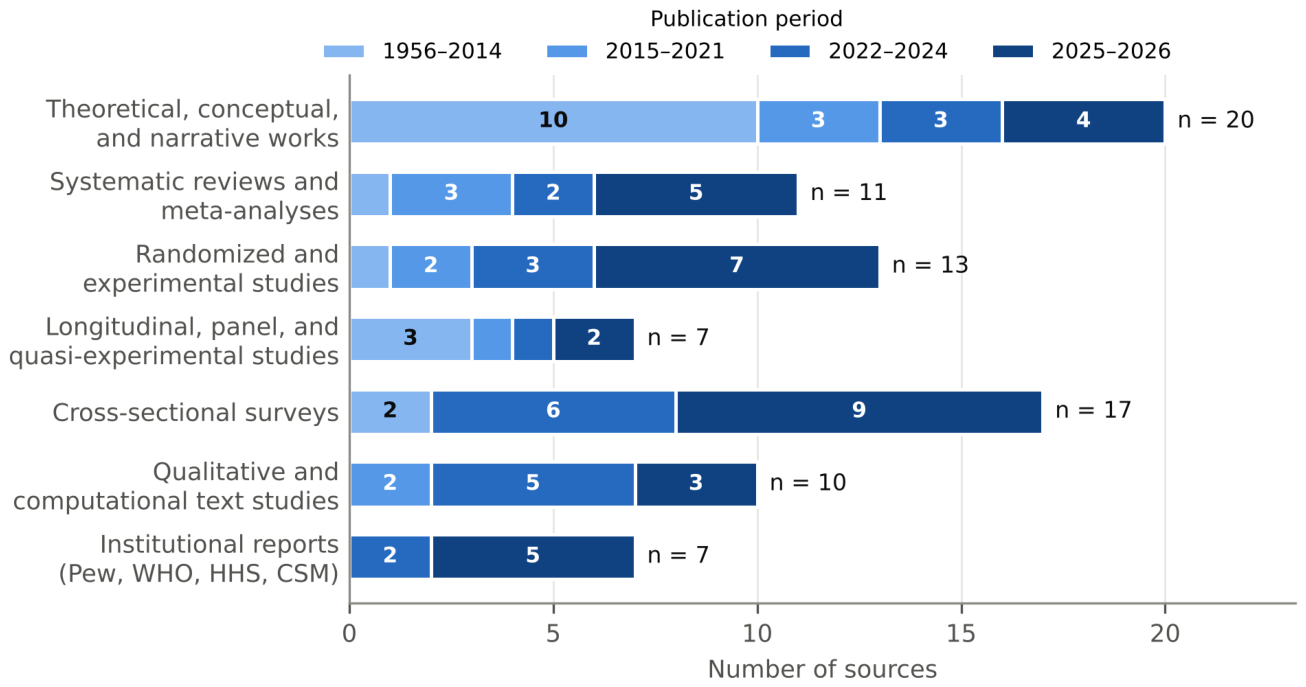
Figure 2.
The Responsiveness–Reciprocity Bridge Model (RRBM) of Human–AI Social Relationships. Note. P1–P6 denote the propositions stated in Section 5. Solid arrows indicate hypothesized pathways; the dashed arrow indicates moderation. Source: Original conceptual model developed by the author, synthesizing Reis and Shaver (1988), Valkenburg and Peter (2007), Smith et al. (2025), and the studies reviewed here.
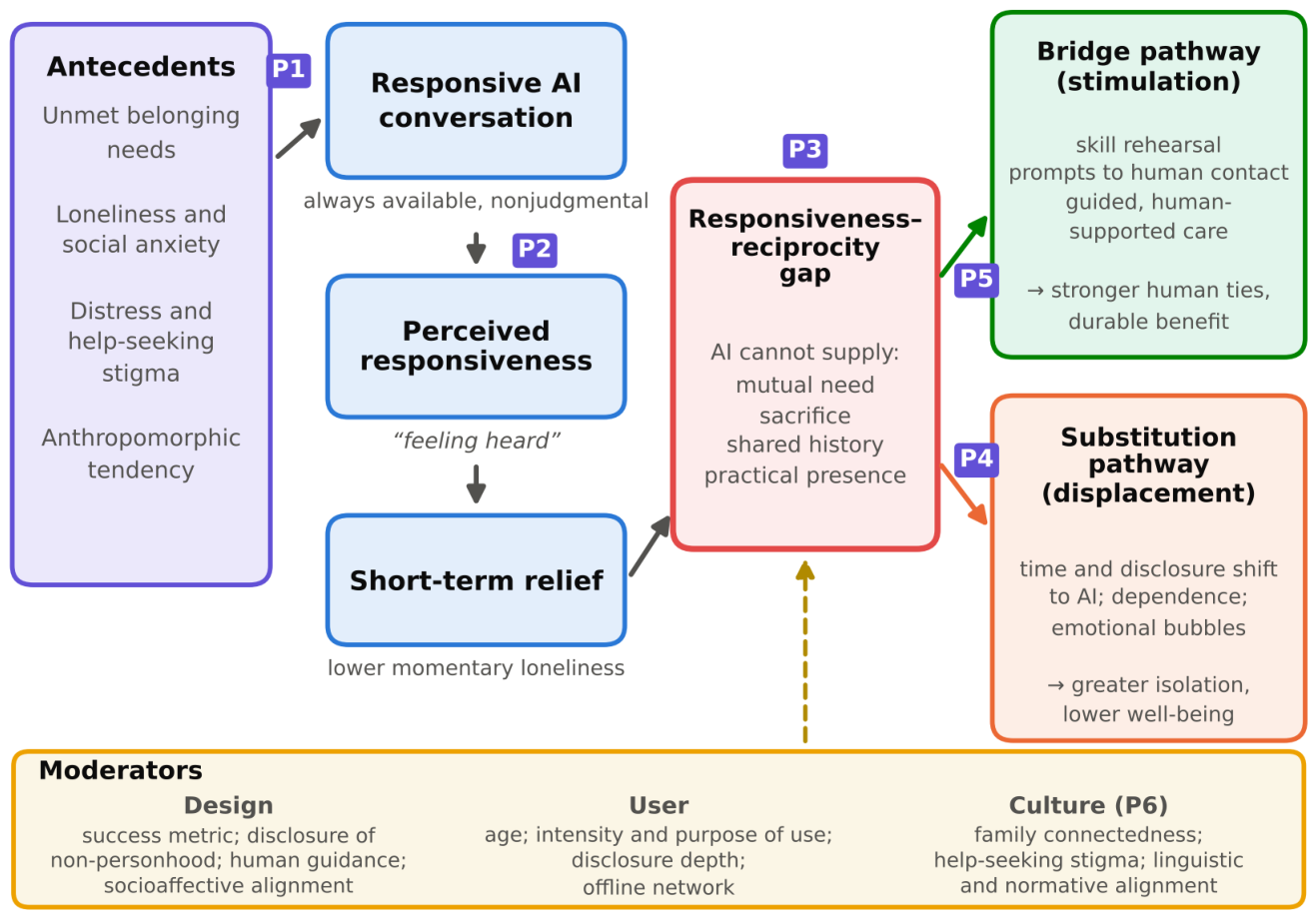
Figure 3.
Reported Prevalence of Affective and Companionship Uses of AI in Recent Surveys. Note. Percentages are shown as published; question wording, age ranges, and sampling differ, so the estimates are not directly comparable. Source: Author's compilation from McBain et al. (2025), McClain et al. (2026), Robb and Mann (2025), Herbener and Damholdt (2025), Bonnesen et al. (2026), and Abdelwahed et al. (2025).
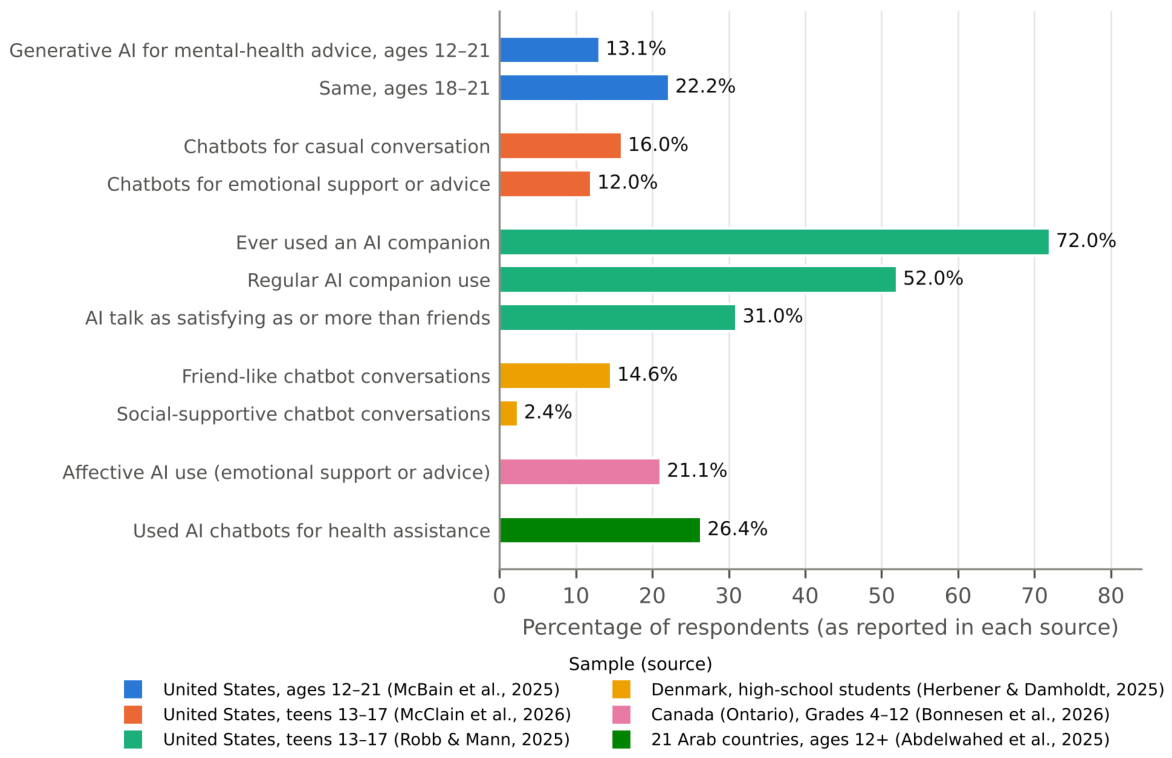
Figure 4.
Standardized Effect Sizes of Conversational Agents on Loneliness and Mental-Health Outcomes. Note. Points show pooled or trial estimates with 95% confidence intervals. Signs are harmonized so that positive values indicate improvement (Sha et al., 2024, reported g = −0.55 for reduced loneliness). Metrics differ (between-group Hedges' g, within-group standardized mean change [SMCC], and trial effect sizes), so the figure conveys a pattern rather than strictly comparable magnitudes. Source: Author's compilation from Sha et al. (2024), Satake et al. (2026), H. Li et al. (2023), and Bryant et al. (2026).
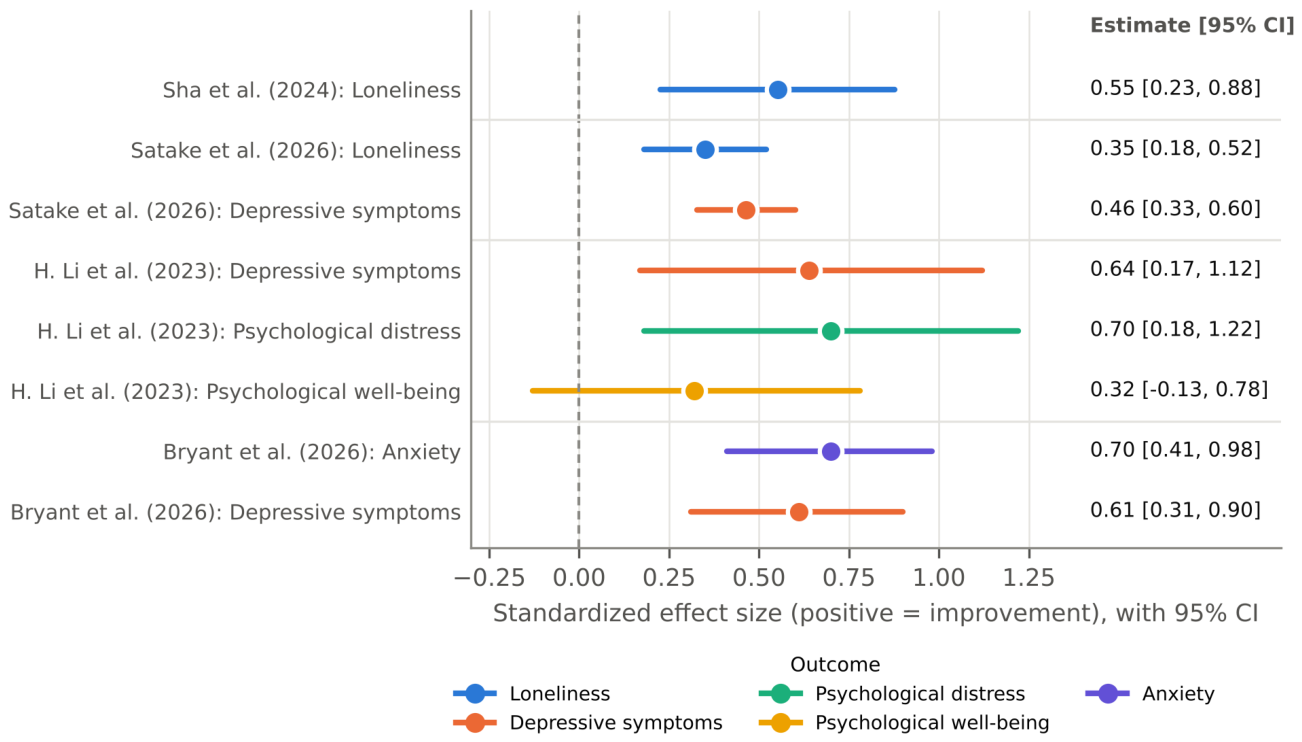
Table 1.
Recent Empirical Studies (2023–2026) on AI Companionship, Loneliness, and Well-Being.
| Study | Design and sample | Principal finding | RRBM link |
| Hu et al. (2023) | Survey; 516 users of conversational AI | Social anxiety predicted problematic use through loneliness and rumination | P1 |
| Huang et al. (2024) | Two-wave panel; 3,843 adolescents | AI dependence rose from 17.1% to 24.2%; depression and anxiety predicted later dependence, not the reverse | P1 |
| Yin et al. (2024) | Experiment; 455 participants | AI-written responses made recipients feel more heard than human responses; an AI label reduced the effect | P2 |
| Herbener & Damholdt (2025) | Preregistered survey; 1,599 Danish high-school students | 2.4% had social-supportive chatbot conversations; these students were lonelier than nonusers (d = 0.53) | P1 |
| Heinz et al. (2025) | RCT; 210 adults with clinical symptoms; 4- and 8-week outcomes | A fine-tuned generative chatbot reduced symptoms more than a waitlist control | P5 |
| Kim et al. (2025) | Single-group pre–post; 176 Korean students; 4 weeks | Loneliness and social anxiety declined modestly; less self-disclosure predicted more loneliness | P2 |
| Ovsyannikova et al. (2025) | Four preregistered experiments; N = 556 | AI responses were rated more compassionate than those of expert crisis responders, even when labeled | P2 |
| De Freitas et al. (2026) | Five studies, including a 1-week longitudinal study | Companions reduced loneliness on par with human interaction; feeling heard was the mechanism | P2 |
| Folk & Dunn (2026) | Four-wave, 12-month panel; 2,149 adults in four countries | Chatbot use predicted later loneliness; low social connection predicted later chatbot use | P1, P4 |
| R.-N. Li et al. (2026) | Preregistered randomized experiment; 296 students; 2 weeks | A random human peer reduced loneliness; a highly supportive chatbot did not | P3 |
| Telari et al. (2026) | Two experiments; N = 163 and 158 | A relational style and deeper topics increased closeness through perceived responsiveness | P2 |
| Y. Zhang et al. (2026) | Survey of 1,131 Character.AI users plus 4,664 donated chat sessions | Companionship-primary, intensive, and highly disclosive use was linked to lower well-being | P4 |
| Bonnesen et al. (2026) | Cross-sectional; 39,761 Ontario students, Grades 4–12 | 21.1% reported affective use; affective users were about twice as likely to have clinical emotional problems | P1 |
| Yuan et al. (2026) | Quasi-experiment on Reddit data plus 18 interviews | Mixed effects: more interpersonal focus, but more language about loneliness and suicidal ideation | P4 |
Note. Studies are ordered by publication year. RRBM = Responsiveness–Reciprocity Bridge Model; P1–P6 = propositions stated in Section 5; RCT = randomized controlled trial. Source: Compiled by the author from the cited studies.
Table 2.
Theoretical Lenses Integrated in the Responsiveness–Reciprocity Bridge Model.
| Theoretical lens | Core claim | Contribution to the RRBM | Key sources |
| Need to belong and loneliness | Belonging is a fundamental motive; loneliness heightens vigilance to social threat and anthropomorphism | Antecedents that recruit users toward AI (P1) | Baumeister & Leary (1995); Cacioppo & Hawkley (2009) |
| CASA and human–machine communication | People apply social scripts to machines; AI acts as a communicator, not only a channel | Explains why users engage socially with AI | Nass & Moon (2000); Gambino et al. (2020); Guzman & Lewis (2020) |
| Anthropomorphism and parasocial interaction | Humanlike cues elicit mind attribution and one-sided intimacy | Amplifies perceived responsiveness and the illusion of reciprocity | Horton & Wohl (1956); Epley et al. (2007); Maeda & Quan-Haase (2024) |
| Interpersonal process model of intimacy; social penetration | Intimacy grows from disclosure met by responsiveness, repeated reciprocally over time | Separates responsiveness from reciprocity (P2, P3) | Altman & Taylor (1973); Reis & Shaver (1988); Laurenceau et al. (1998) |
| Attachment theory | Distress activates proximity seeking toward a safe haven | Explains bond formation and dependence (P4) | Bowlby (1969/1982); Xie & Pentina (2022) |
| Social surrogacy | Favored media can supply a sense of belonging without a relationship | Relief without relational capital (P3) | Derrick et al. (2009) |
| Displacement versus stimulation | Technologies can crowd out or strengthen existing ties | Defines the substitution and bridge pathways (P4, P5) | Kraut et al. (1998, 2002); Valkenburg & Peter (2007); Hall & Liu (2022) |
| Cultural psychology of connectedness and stigma | Family connectedness and help-seeking norms vary across cultures | Cultural moderators (P6) | Dwairy et al. (2006); Zolezzi et al. (2018) |
Note. CASA = computers are social actors; RRBM = Responsiveness–Reciprocity Bridge Model; P1–P6 = propositions stated in Section 5. Source: Author's synthesis of the cited works.
Table 3.
Benefit and Risk Evidence by Time Horizon.
| Time horizon | Evidence of benefit | Evidence of risk or limitation | Net reading |
| Single conversation | Users feel more heard; AI responses are rated more compassionate (Ovsyannikova et al., 2025; Yin et al., 2024) | An AI label lowers felt support; harmful relational behaviors occur (Yin et al., 2024; R. Zhang et al., 2025) | Benefit well established |
| Days to weeks | Loneliness falls on par with human interaction; pooled g = −0.55 for relational agents (De Freitas et al., 2026; Sha et al., 2024) | A random human peer outperforms a highly supportive chatbot (R.-N. Li et al., 2026) | Benefit real but inferior to human contact |
| One to three months | Guided and fine-tuned chatbots reduce anxiety and depression in randomized trials (Bryant et al., 2026; Heinz et al., 2025; H. Li et al., 2023) | Substantial attrition; dependence among intensive users (Dagnino et al., 2026; Goh et al., 2025) | Benefit for structured, guided care |
| Six to twelve months or longer | No evidence that use rebuilds social connection (Folk & Dunn, 2026) | Use predicts later loneliness; companionship-primary use is linked to lower well-being (Folk & Dunn, 2026; Y. Zhang et al., 2026) | Risk predominates; causality unresolved |
Note. Green shading indicates an established net benefit, amber a qualified benefit, and orange a predominant risk. Source: Author's synthesis of the cited studies.
Table 4.
Peer-Reviewed and Doctoral Evidence from Arab Societies.
| Study | Setting | Design and sample | Key finding | RRBM link |
| Dwairy et al. (2006) | Multiple Arab societies | Cross-regional survey of adolescents | Arab adolescents reported greater family connectedness than U.S. adolescents | P6 |
| Zolezzi et al. (2018) | Arab populations | Systematic review | Stigma toward mental illness and its treatment is widespread but varies across groups | P6 |
| Abdaljaleel et al. (2024) | Iraq, Kuwait, Egypt, Lebanon, Jordan | Survey; 2,240 university students | About half of students aware of ChatGPT had used it; usefulness and ease of use predicted attitudes | P1 |
| Aldaweesh (2025) | Saudi Arabia | Doctoral research with young women: app review, interviews, co-design, LLM probe | Stigma drives interest in digital support; cultural and religious insensitivity drives disengagement | P1, P6 |
| Albikawi et al. (2025) | Jordan | Survey; 176 nursing students | Anxiety and depression increased the likelihood of using AI-based mental-health support | P1 |
| Abdelwahed et al. (2025) | 21 Arab countries | Survey; 12,886 respondents aged 12+ | 72.5% were aware of chatbots and 26.4% had used them for health; mental-health problems raised the odds of use | P1 |
| Aldaweesh et al. (2026) | Saudi Arabia | HCI study with a culturally sensitive chatbot probe | Generic LLM empathy can clash with local norms; the authors propose minimum cultural alignment | P6 |
| Alsalman et al. (2026) | Saudi Arabia | Survey; 533 adults | 59% supported integrating mental-health chatbots into services; usefulness and need predicted intention to use | P1, P6 |
| Arnout (2026) | Saudi Arabia (four universities) | Survey with SEM; 743 undergraduates | No direct association between AI attachment and loneliness; indirect paths ran through emotion regulation | P4, P6 |
| Bryant et al. (2026) | Jordan | RCT; 344 distressed young people | Guided STARS chatbot reduced anxiety (0.70) and depression (0.61) relative to enhanced usual care at 3 months | P5 |
Note. HCI = human–computer interaction; LLM = large language model; SEM = structural equation modeling; RCT = randomized controlled trial; RRBM = Responsiveness–Reciprocity Bridge Model. Source: Compiled by the author from the cited studies.
Table 5.
Evidential Status of the RRBM Propositions.
| Proposition | Principal evidence | Strength of design | Status |
| P1. Recruitment | Folk & Dunn (2026); Huang et al. (2024); Herbener & Damholdt (2025); Bonnesen et al. (2026); Abdelwahed et al. (2025) | Longitudinal panels; large cross-sectional surveys | Supported |
| P2. Responsiveness | De Freitas et al. (2026); Yin et al. (2024); Telari et al. (2026); Ovsyannikova et al. (2025) | Experiments with mediation tests | Supported |
| P3. Reciprocity gap | R.-N. Li et al. (2026); Meng & Dai (2021); Smith et al. (2025) | One randomized experiment; laboratory studies; theory | Partially supported; emerging |
| P4. Substitution | Folk & Dunn (2026); Y. Zhang et al. (2026); Yuan et al. (2026); Marriott & Pitardi (2024) | Correlational and quasi-experimental | Partially supported; direction unresolved |
| P5. Bridging | Bryant et al. (2026); Heinz et al. (2025); H. Li et al. (2023) | Randomized trials of structured care; no direct test of prompts to human contact | Partially supported; indirect |
| P6. Cultural moderation | Aldaweesh (2025); Aldaweesh et al. (2026); Arnout (2026); Dwairy et al. (2006); Zolezzi et al. (2018) | Design studies; cross-sectional surveys | Plausible; untested |
Note. Status reflects the author's appraisal of design strength and convergence across studies: green = supported, amber = partially supported, blue = plausible but untested. RRBM = Responsiveness–Reciprocity Bridge Model. Source: Author's analysis.
Disclaimer/Publisher’s Note: The statements, opinions and data contained in all publications are solely those of the individual author(s) and contributor(s) and not of MDPI and/or the editor(s). MDPI and/or the editor(s) disclaim responsibility for any injury to people or property resulting from any ideas, methods, instructions or products referred to in the content. |
© 2026 by the author. Licensee MDPI, Basel, Switzerland. This article is an open access article distributed under the terms and conditions of the Creative Commons Attribution (CC BY) license.
Copyright: This open access article is published under a Creative Commons CC BY 4.0 license, which permit the free download, distribution, and reuse, provided that the author and preprint are cited in any reuse.