
Submitted:
10 October 2026
Posted:
13 October 2026
You are already at the latest version
Abstract
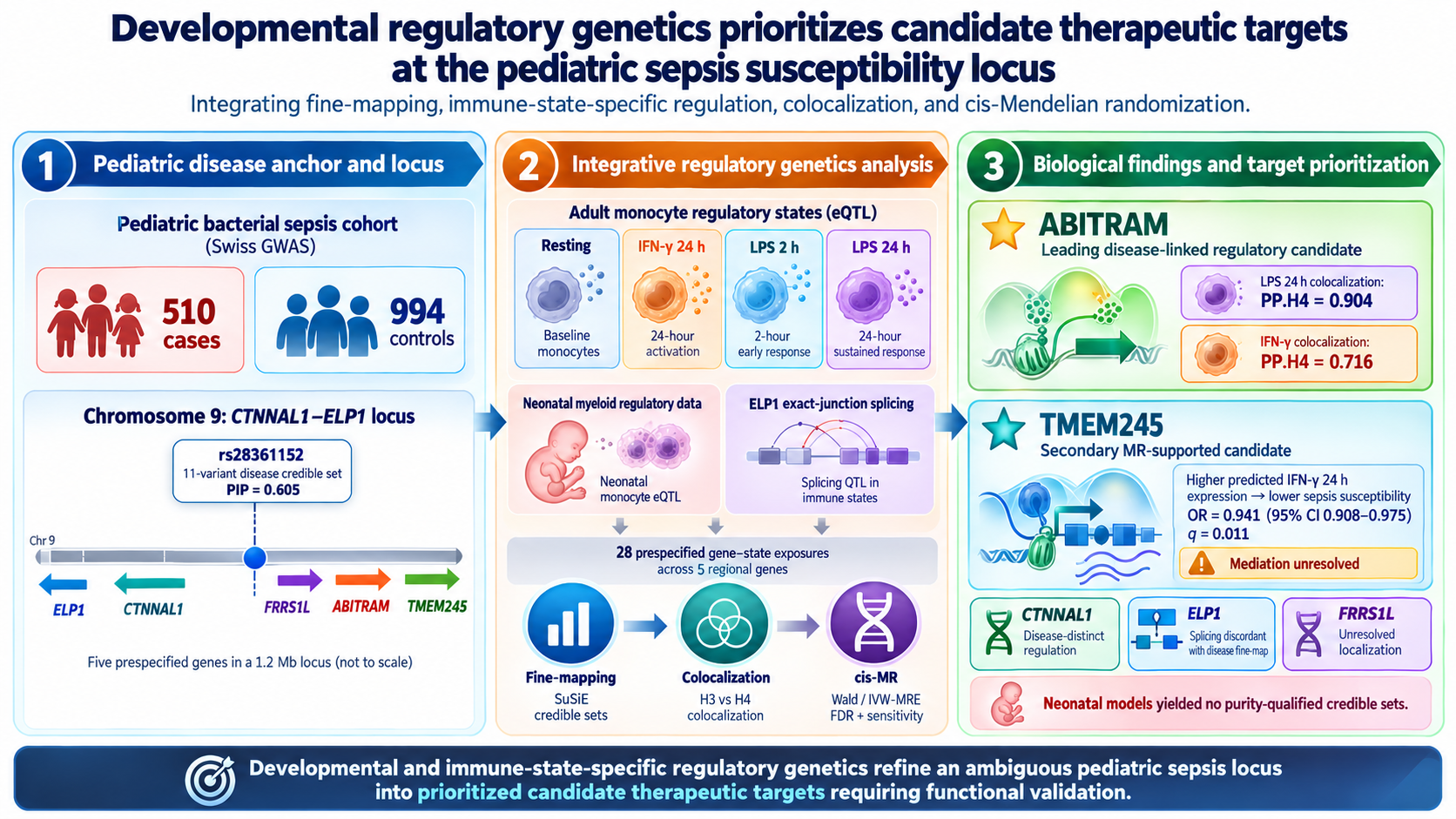
Background: The chromosome 9 CTNNAL1–ELP1 locus is associated with pediatric sepsis susceptibility, but the regulatory gene and developmental context remain unresolved. Methods: We integrated pediatric sepsis fine-mapping (510 cases, 994 controls) with eQTL data from resting and stimulated adult monocytes, neonatal myeloid regulatory data, ELP1 exact-junction splicing, colocalization, and cis-Mendelian randomization using exposure side instruments selected and frozen before outcome extraction. Twenty-eight prespecified gene–state exposures across five regional genes were evaluated. Results: rs28361152 dominated the 11-variant disease credible set (posterior inclusion probability=0.605). ABITRAM showed strong colocalization after 24-hour lipopolysaccharide stimulation (PP.H4=0.904) and supportive sharing after interferon-γ stimulation (PP.H4=0.716), whereas CTNNAL1 regulatory signals were disease-distinct. Higher genetically predicted TMEM245 expression after 24-hour interferon-γ stimulation was associated with lower sepsis susceptibility (odds ratio=0.941, 95% confidence interval 0.908–0.975; P=8.11×10⁻⁴; false-discovery-rate q=0.011). Sensitivity analyses were directionally concordant; however, mediation remained unresolved because colocalization was not evaluable. Neonatal models yielded no purity-qualified credible sets, and rs28361152 was absent from all 11 ELP1 exact-junction credible sets. Conclusion: ABITRAM was the leading disease-linked regulatory candidate, whereas TMEM245 provided secondary Mendelian-randomization support without demonstrated locus mediation. These findings refine the locus into developmentally informed regulatory candidates and therapeutic hypotheses requiring functional validation.
Keywords:
sepsis
; child
; genetic predisposition to disease
; gene expression regulation
; quantitative trait loci
; mendelian randomization analysis
; monocytes
; colocalization
Copyright: This open access article is published under a Creative Commons CC BY 4.0 license, which permit the free download, distribution, and reuse, provided that the author and preprint are cited in any reuse.