
Submitted:
03 October 2026
Posted:
12 October 2026
You are already at the latest version
Abstract
The first industrial robot, the PUMA (Programmable Universal Manipulator Arm) was built by a company called animation in 1961. According to history, 50 years ago robots were viewed as creations designed to exterminate the human race as portrayed in science fictions. To help resolve this assumption, Isaac Asimov compounded the three laws of robotics to protect humans from interactions with robots (Asimov 1984). The laws states that: (1) a robot may not injure a human being or, through inaction, allow a human being to come to harm. (2) a robot must obey the orders given it by human beings except where such orders would conflict with the First Law. (3) a robot must protect its own existence as long as such protection does not conflict with the First or Second Laws. (1). Asimov’s law are considered unscientific by researchers yet it unarguably forms the basis of various machine learning activities used in many manufacturing sectors. Furthermore, the field of robotics has highly evolved by producing a wide variety of objects from autonomous machines to human collaborative robots through the use of artificial intelligence and machine learning. By monitoring the ever increasing research activities in machine learning, it cannot be denied that human robot collaborations is only expected to keep growing. In the logistics industry, collaborative robots are achieving human-like dexterity which allows for increased productivity. This work expands on the foundation of existing scientific research in the ergonomic aspect of human robot communication in warehouses which promotes seamless collaboration of robots and human workers.
Keywords:
collaborative robots
; human robot communication
; warehouse
; logistics
; human robot collaboration
1. Introduction
Collaborative robots are one of the widely deployed technologies in industry 4.0 (2). A Cobot also known as collaborative robots allows humans and robots to coexist in the same space (3) so that work and communication between robots and humans is carried out in an intelligent, easier and safe manner. Compared to the non-collaborative types:
(1) HRC equipment in warehouses are good at performing the most monotonous and injury-prone tasks in an efficient manner resulting in greater consistency, increased automation and productivity.
(2) The use of cobots for warehouse tasks allows operators focus on more complex decision-making and solution-oriented tasks.
(3) The integration of collaborative robots are less expensive and supply chain businesses can achieve higher productivity without additional capital or labor investments resulting in higher profits.
Part of the main goals of collaborative robots in logistics is to optimize the process and minimize errors in material handling and other warehouse operations. Therefore, efficient collaboration calls for a reduction of the interfaces required to exchange information between them and this can be achieved by increasing the perception and cognition capabilities of robots to emulate the ones of humans (4).
Existing research related to robot-human collaboration in supply chain have focused on risk assessment, hazard identification, networking communication, the risk reduction approach for collaborative robots, safety analysis, optimizing antenna positions on human , robots for safe communication, and so on.
This paper starts with the definition and benefits of collaborative robots in warehouses, detailing the main goal of the application of cobots in logistics with a focus on human robot communication systems and the cognitive ergonomics in integrating collaborative robots into warehouse operations.
The remainder parts of this work are organized as follows: Section 2 presents relevant research to this study that focuses on human robot communication tools and the cognitive ergonomics in integrating collaborative robots into warehouse processes. In section 3 uses two case studies to describe the most recently developed cobots in warehouse automations detailing their applications and functionalities with respect to HRC. In section 4 various kinds of AI-based algorithm human-robot interaction activities and how they are implemented in an HRC system is examined. The final conclusions in section 5 is used for describing the future directions.
2. Literature Review
2.1. Synchronous Human Robots Communication Systems
The dynamics of optimum picker-bot collaboration is complex to model analytically due to the complexity in estimating worker travel in the bot scenario (7).Today’s most automated distribution centers rely on vast mazes of conveyor belts, chutes, and carousels. Human operators stand along the conveyors, near inventory shelves, grabbing products and putting them into boxes or totes rolling past them (5). An online monitoring system such as automatic machine learning (ML) tool allows the trust of humans during communications with a robot, eliminates unplanned downtime during task execution and maximizes robot lifetime (3).Introducing new task planning communication systems has the potential of addressing the ergonomic issues in human robot collaboration, allowing HR tasks to be executed in a short time (8). Thus, it is important to identify the specific task-planning requirements. An interactive robot will have to produce plans for its partners and wait for validation from its human partners (9).
For robots to be truly interactive, they must have the ability to navigate the physical world autonomously to assist human operators. A modern symbiotic cognitive environment is equipped with a number of multimodal communication techniques such as displays, tablets and cameras, microphones and speakers, motion and haptic sensors, speech and gesture recognition devices that facilitate the context-dependent presentation, manipulation, and analysis of data (10).
2.2. Cognitive Ergonomics in Integrating Collaborative Robots into Warehouse Processes
Ergonomics aims to make sure that tasks, equipment, information and the environment fit each worker. It is a science concerned with the ‘fit’ between people and their work. It puts people first, taking account of their capabilities and limitations (11). Because operations management is more related to cognitive aspects, this work is more concerned with cognitive ergonomics. Cognitive ergonomics is a sub discipline of ergonomics that addresses problems such as usability of human-computer systems, cognitive aspects of mental load, stress and human errors at work. Cognitive ergonomists are interested in whether the solutions adopted suit the needs and characteristics of user (12). Just a few studies have considered the ergonomic benefits of integrating cobots into task plans for human workers. In order to accomplish logistics tasks effectively the integration of trust-based ergonomic designs leads to a better collaboration of the two elements of the collaborative systems as a result of decrease in perceived task load (13).
In industrialized nations with good living standard, it is becoming increasingly difficult to find labor willing to take over ergonomically hard warehouse jobs. A robust and ergonomic HRC enables optimized responses between workers and robots so that cobots does not add extra weight to users or cause user discomfort (15). The use of cobots in an automated-friendly warehouse is positive because it reduces costs, increases throughput capacity and improves product quality. For these reasons, decision of “what to automate” in order to increase synergies among operators and machines, thus reducing time-losses and increasing productivity becomes crucial (14).
3. The Approach
This section presents the use case scenarios COBOTS in warehouse automations and their functions in HRC by considering communication systems and cognitive ergonomics collaborative robots used for warehouse operations in real use case 1 and 2 respectively. The first part introduces warehouse automations at different levels based on task characteristics. Subsequently, their functions and features in a Human-robot collaborative environment are described.
3.1. Levels of Automation Based on Tasks
A research work defined warehouse robotics as the “deployment of robotics in the warehouse to perform functions such as pick-place, packaging, transportation, and palletizing” (17). Though some robots may look similar, they can have vastly divergent capabilities. Factors such as work volume, lift capacity and repeatability can vary significantly (16) within warehouse activities.
3.1.1. ARMAR-6 Collaborative Humanoid Robot in Pick and Place Task
The ARMAR 6 COBOT is a successful Second Hands project designed to help workers in logistics by acting as a second pair of hands. It is built with machine learning abilities, reasoning abilities, collision-free trajectories for fast grasping, sensorimotor skills, sophisticated manipulations and it uses supervised and unsupervised approaches for 3D reconstruction of human poses which helps the robot to determine human direction and intent enabling workers to focus on the skilled parts of their job whilst the robot takes up the less skilled parts and more arduous tasks.
ARMAR 6 communicates with its human partners by a natural language interface, this breakthrough enhances both usability and adoption of robots in realistic industrial scenarios. The robot has an understanding of the 3d world around it from the images that have been taken from its onboard cameras. It has developed computer vision, with the ability to detect where humans are and to estimate their 3d pose just from images without the need for the humans to wear in markers.
Pick and Place Case Study
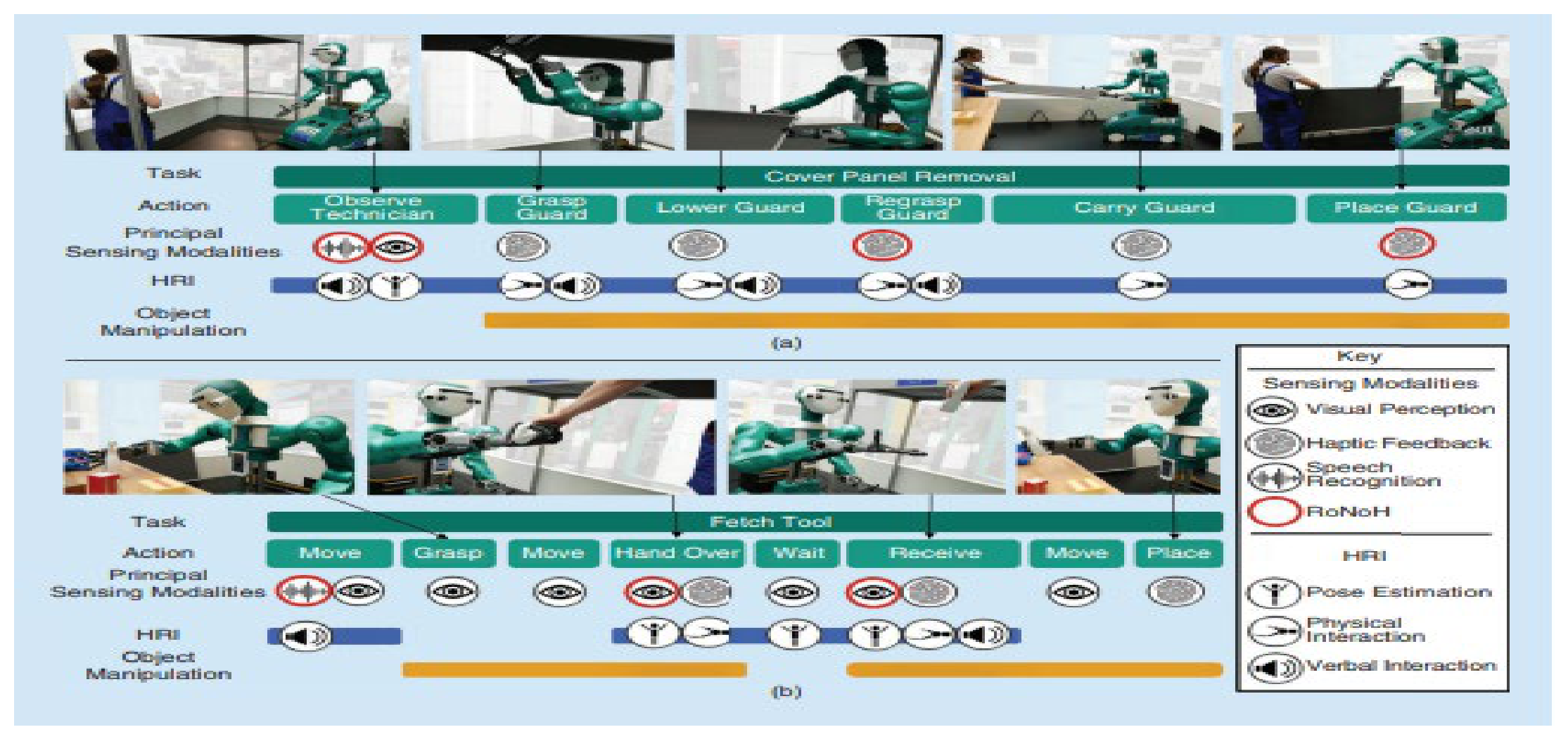
OCADO technologies (18) first used the COBOT in a routine pick and place task of an overhead conveyor system in an automated customer fulfillment center at one of its three warehouses in the UK and demonstrated the task on a YOUTUBE video. The video shows how the robot can grasp and manipulate large objects by following a human’s lead. Based on observation, the robot could deduce that a second agent is missing by interpreting the current scene. That allowed the robot to offer assistance by performing the task of the missing agent.
ARMAR-6 is the sub worker tasked with seamlessly and effectively supporting the expert technician. When the warehouse technician tells the robot to hand over the spray bottle, ARMAR-6 will conclude that the spray bottle is needed and will assist the technician by bringing it and handing it over. The ASMAR-6 robot has the ability to recognize that a human coworker needs help and deliver such assistant proactively. This validates its human intention recognition and physical human robot communication capabilities.
Figure 1.
The warehouse demonstration showing compliant collaborative manipulation and the robot's retrieval of a tool for the technician (source: IEEE Robotics & Automation Magazine, December 2019).
Figure 1.
The warehouse demonstration showing compliant collaborative manipulation and the robot's retrieval of a tool for the technician (source: IEEE Robotics & Automation Magazine, December 2019).
3.1.2. Yaskawa HC20XP Collaborative Palletizing Task
Efficient palletizing and packaging is crucial to the success of any logistics service. Nowadays, there is a shortage in labour in this aspect of warehouse task due to the unergonomic conditions associated to performing such duties. Scholars have pointed out that the best places to implement robotic automation during palletizing is usually at the end because there are more uniform heavy boxes at the end.
Yaskawa HC20XP has a high throughput capacity which allows for larger cases per pick in palletizing operations. Offering four modes of collaborative operation the robot uses Force Limiting (PFL) technology, the HC20XP uses sensors internal to the robot to monitor for external forces, it meets established safety standards, enabling humans to work with or in close placement to robots. It eliminates complexity due to its much longer reach of 1.7metres which gives it the advantage to reach 40x48x80 inches tall pallets without tool extensions eliminating the need for elevators normally required in many collaborative robot applications.
Palletizing Use Case Study
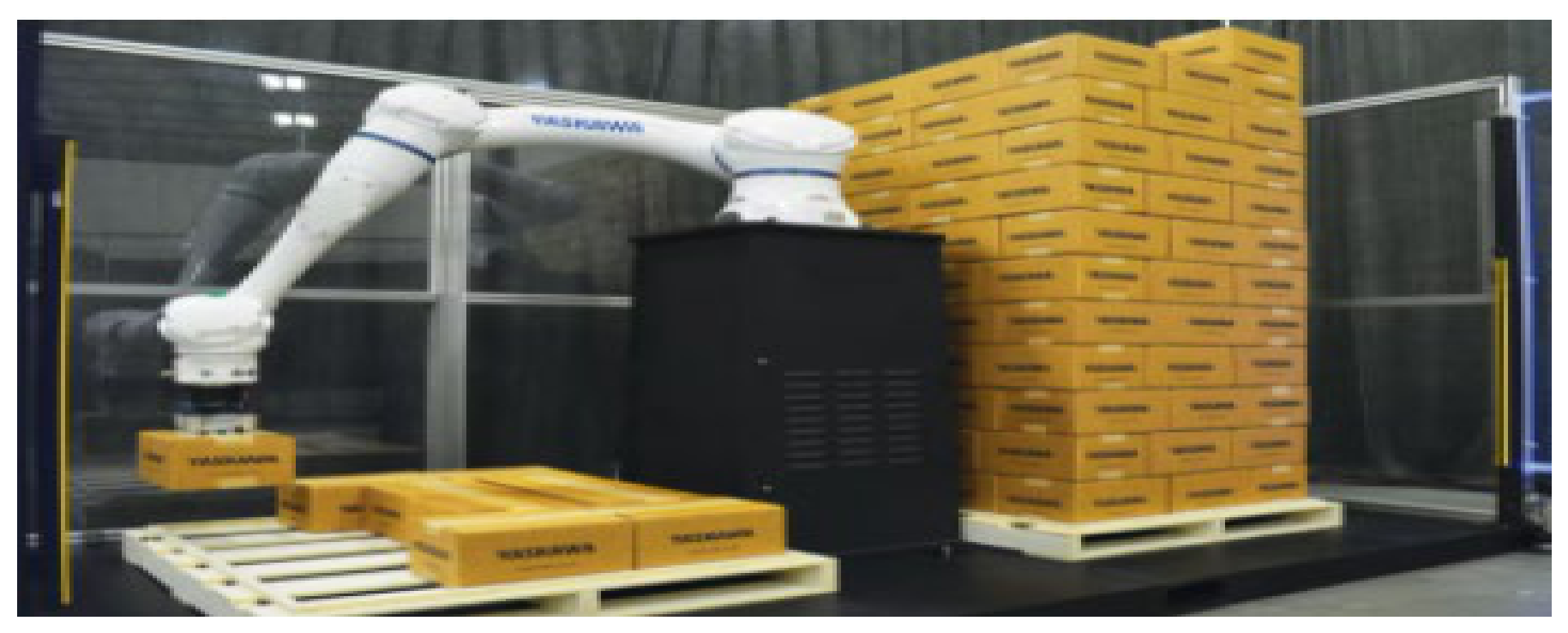
In a demonstration circulated by the producing company, they placed the Yaskawa robot on a 48 inch riser. Two pallets could be seen on the riser and they are standard 40 by 48 inch pallets. The pallet was stack from zero to 80 inches tall without the need for an elevator and that speeds things up and makes it a lot safer.
The robot is equipped with two zone scanners and when the operator walks to the robot's work zone, it slowed down and the green light pops up signifying that the robot is in collaborative mode. As the operator walks back out of this zone the robot shifted into industrial mode and go full speed to maintain productivity. Once the green light is on the operator can interact with the robot and halts its operation by a touch. Then another amber light that comes on and the worker gives all clear signal. Afterwards, he hits a button and the robot was seen to resume operation from where it left off.
Figure 2.
The Motoman HC20XP collaborative robot goes to work in a palletizing application. Image courtesy of Motoman/Yaskawa.
Figure 2.
The Motoman HC20XP collaborative robot goes to work in a palletizing application. Image courtesy of Motoman/Yaskawa.
4. AI-Based Algorithm Human-Robot Interaction Activities and Their Implementations in an HRC System
Technische Universitat Dortmund Innovative Lab Algorithm
Technische Universitat Dortmund innovative lab focuses on designing algorithms to guide human-robot interaction in shared spaces by the help of Vicon’s cutting-edge motion capture and VR solutions. The goal is to develop an artificial intelligent approach that improves the collaboration of drones and robots with people in warehouses.
The algorithm recognizes activities in IMU sensor data. An optical motion capture system trains the algorithm and synchronizes video data from VR cameras with Plug-in Gait to capture and perfectly label manual warehouse tasks. The algorithm’s architecture is then transferred to the IMU sensor data, where it is deployed .The final output helps to improve the ergonomics of warehouse operations and increase production efficiency as well as human-robot interaction.
5. Discussion and Future Directions
There exist many underlying concerns regarding the reliability of collaborating robots with warehouse tasks. Collaborative robots does not eliminate human workers. Instead, collaborative robots work alongside human associates, through effective communication and improved ergonomics and as a result increasing the work efficiency. Two scenarios of warehouse tasks aided by collaborative robots are presented in this paper. An example of machine learning tool and its implementation in human robot collaboration was discussed. Implementing robots on such processes described improves ergonomics and operator’s satisfaction, 2x to 3x increase in productivity, minimizes the likelihood of human error, makes a warehouse more agile and reduces cost-to-serve.
Future works should aim at in-depth algorithm architecture learning to understand more complex aspects of robot-human actions so that more vivid information about simulations of ergonomics can be available for innovations and research purposes.
References
- Asimov, I. The Bicentennial Man. In Philosophy and Science Fiction; Philips, M., Ed.; Prometheus Books: Buffalo, NY, 1984; pp. 183–216. [Google Scholar]
- Williams, B. An introduction to Robotics; Ohio University, USA, 2021. [Google Scholar]
- Aliev, Kurshid; Antonelli, Dario. Proposal of a Monitoring System for Collaborative Robots to Predict Outages and to Assess Reliability Factors Exploiting Machine Learning; Department of Management and Production Engineering, Polytechnic University of Turin: Italy, 2021. [Google Scholar]
- Nikos, D.; Theodoros, T.; Natalia, Z.; George, M.; Sotiris, M. Seamless Human–Robot Collaborative Assembly Using Artificial Intelligence and Wearable Devices; Department of Mechanical Engineering and Aeronautics: University of Patras, Greece, 2021. [Google Scholar]
- Guizzo, E. Three engineers, hundreds of robots, one warehouse. IEEESpectrum 2008, 45(7), 26–34. [Google Scholar] [CrossRef]
- Liau, Y.Y.; Ryu, K. ask Allocation in Human-Robot Collaboration (HRC) Based on Task Characteristics and Agent Capability for Mold Assembly; Department of Industrial Engineering, Pusan National University: Busan, South Korea, 2021. [Google Scholar]
- Meller, Russell D.; Nazzal, Dima; Thomas, Lisa M. Collaborative Bots in Distribution Centers. 15th IMHRC Proceedings, Savannah, Georgia. USA, 2018. [Google Scholar]
- Makris, S.; Tsarouchi, P.; Matthaiakis, A.S.; Athanasatos, A.; Chatzigeorgiou, X.; Stefos, M.; Giavridis, K.; Aivaliotis, S. Dual arm robot in cooperation with humans for flexible assembly. Cirp Ann. 2017. [Google Scholar] [CrossRef]
- Montreuil, Vincent; Clodic, Aurelie; Alami, Rachid. Planning Human Centered Robot Activities. IEEE International Conference on Systems, October 2007. [Google Scholar]
- Wang, L.; Gao, R.; Váncza, J.; Krüger, J.; Wanga, X.V.; Makris, S.; Chryssolouris, G. Symbiotic human-robot collaborative assembly. CIRP Annals Manufacturing Technology.
- Health and Safety Executive, Ergonomics and human factors at work; White Paper, UK, March 2013.
- Mohammed Elmardi, Human Factor and Ergonomics; Mechanical Engineering Department, Nile University: Sudan, July 2019. [CrossRef]
- Cardoso, A.; Colim, A.; Bicho, E.; Braga, A.C.; Menozzi, M.; Arezes, P. Ergonomics and Human Factors as a Requirement to Implement Safer Collaborative Robotic Workstations: A Literature Review. Safety 2021, 7, 71. Available online: https://. [CrossRef]
- Bonini, Marco.; Urru, Augusto; Echelmeyer, Wolfgang. The Quality Interaction Function Deployment for lean Human-Robot Interaction. 2019 24th International Conference on Methods and Models in Automation and Robotics (MMAR), Międzyzdroje, Poland, 26–29 August 2019. ESB Logistic Research Center Reutlingen, Germany, Reutlingen, Germany, July 26, 2020. [Google Scholar]
- Wansoo, K.; Marta, L.; Pietro, B.; Phuong, D.H.; Ugo, P.; Vadim, T.; Luka, P.; Claudio, F.; Lorenzo, N.; Giorgio, M.; et al. Adaptable Workstations for Human–Robot Collaboration. 2019. [Google Scholar] [CrossRef]
- Horst, J.; Marvel, J.; Messina, E. Best Practices for the Integration of Collaborative Robots into Work cells Within Small and Medium-Sized Manufacturing Operations; Intelligent Systems Division Engineering Laboratory National Institute of Standards and Technology: Gaithersburg, Maryland, 2021. [Google Scholar]
- IAM Robotics, Robots In The Warehouse, White Paper. Available online: https://www.mhi.org/media/members/82888/132331767806307849.pdf.
- Ottenhaus, S.; Renninghoff, D.; Grimm, R.; Ferreira, F.; Asfour, T. Visuo-haptic grasping of unknown objects based on gaussian process implicit surfaces and deep learning. Proc. IEEE/RAS Int. Conf. Humanoid Robots (Humanoids), 2019. [Google Scholar]
Disclaimer/Publisher’s Note: The statements, opinions and data contained in all publications are solely those of the individual author(s) and contributor(s) and not of MDPI and/or the editor(s). MDPI and/or the editor(s) disclaim responsibility for any injury to people or property resulting from any ideas, methods, instructions or products referred to in the content. |
© 2026 by the authors. Licensee MDPI, Basel, Switzerland. This article is an open access article distributed under the terms and conditions of the Creative Commons Attribution (CC BY) license (http://creativecommons.org/licenses/by/4.0/).
Copyright: This open access article is published under a Creative Commons CC BY 4.0 license, which permit the free download, distribution, and reuse, provided that the author and preprint are cited in any reuse.