

Submitted:
10 October 2026
Posted:
12 October 2026
You are already at the latest version
Abstract
The development of efficient visible-light-responsive photocatalysts is essential for the sustainable remediation of water contaminated with persistent organic pollutants. In this work, BiAlO₃ perovskite was investigated as a pristine photocatalyst for the first time for the visible-light-driven degradation of Rhodamine B (RhB). The synthesized material exhibited a well-crystallized rhombohedral perovskite structure, while electron microscopy revealed irregularly aggregated particles composed of nanoscale structural features. Surface chemical analysis confirmed the presence of Bi³⁺, Al³⁺, and oxygen species. Optical characterization revealed an optical band gap of approximately 2.7 eV, together with pronounced energy-dependent dielectric, conductivity, and charge-relaxation responses, indicating favorable light–matter and charge-dynamic characteristics. Under visible-light irradiation, BiAlO₃ achieved 87.54% RhB degradation within 90 min, compared with only 9.63% removal by direct photolysis, demonstrating its intrinsic photocatalytic activity. Scavenger experiments revealed that photogenerated holes and hydroxyl radicals make the dominant contributions to RhB degradation, followed by photogenerated electrons and superoxide radicals, with an approximate contribution order of h⁺ > •OH > e⁻ > •O₂⁻. The photocatalyst also retained approximately 75% degradation efficiency after six consecutive cycles, demonstrating good operational stability and reusability. The combination of a relatively narrow band gap, favorable optical and charge-dynamic characteristics, efficient visible-light photocatalytic activity, and satisfactory cycling stability highlights BiAlO₃ as a promising lead-free perovskite photocatalyst for organic pollutant remediation. More broadly, this work establishes the previously unexplored BiAlO₃/RhB photocatalytic system and provides new insight into the relationship between the intrinsic optical and charge-dynamic properties of BiAlO₃ and its photocatalytic performance.
Keywords:
BiAlO3
; photocatalysis
; rhodamine B
; visible-light irradiation
; perovskite oxide
; reactive oxygen species
1. Introduction
The increasing discharge of industrial wastewater containing persistent organic contaminants represents a major environmental challenge because many of these compounds are resistant to conventional biological treatment and can adversely affect aquatic ecosystems and human health [1,2]. Synthetic dyes are particularly important among these pollutants because of their extensive use in textile, printing, paper, pharmaceutical, and related industries. Rhodamine B (RhB), a widely investigated cationic dye, has attracted considerable attention because of its chemical stability, persistence, and potential toxic effects, making its efficient removal from contaminated water an important environmental objective [3,4]. Conventional treatment approaches, including adsorption, coagulation, membrane separation, and biological processes, can reduce pollutant concentrations but may suffer from limitations such as incomplete degradation, generation of secondary waste, or the transfer of contaminants from one phase to another [5,6]. Consequently, advanced oxidation processes, particularly semiconductor-based photocatalysis, have emerged as attractive approaches for the degradation of persistent organic pollutants because they can promote oxidative transformation through highly reactive species generated under light irradiation. Recent studies have continued to demonstrate the potential of photocatalytic processes for RhB removal and have emphasized the importance of developing efficient, stable, and visible-light-responsive photocatalysts [7,8].
Semiconductor photocatalysis is fundamentally based on the generation of electron–hole pairs when the incident photon energy is equal to or greater than the semiconductor band gap. Following photoexcitation, photogenerated electrons and holes can migrate toward the catalyst surface, where they participate in reduction and oxidation reactions with dissolved oxygen, water, hydroxyl groups, and adsorbed organic molecules. These processes can generate highly reactive species, including hydroxyl radicals (•OH) and superoxide radicals (•O2−), while photogenerated holes can also directly contribute to the oxidation of organic pollutants [9]. The efficiency of this process depends strongly on the optical absorption range, band structure, charge-carrier generation and separation, surface characteristics, and interfacial charge-transfer properties of the photocatalyst. A major limitation of many conventional oxide semiconductors is their relatively wide band gaps, which restrict their absorption mainly to the ultraviolet region despite visible light constituting a much larger fraction of the solar spectrum. Accordingly, the development of semiconductor materials capable of harvesting visible light while maintaining suitable charge-transfer and surface redox characteristics has become an important direction in photocatalytic environmental remediation [5,10].
Among the different semiconductor families investigated for photocatalysis, perovskite oxides with the general ABO3 structure have attracted considerable interest because their structural flexibility allows the A- and B-site cations to be varied over a wide range, providing opportunities to tailor their electronic structure, lattice distortion, optical response, and charge-transport characteristics. [5,11,12] In particular, the strong interaction between metal cations and oxygen, structural distortions, defect chemistry, and tunable band structures of perovskite oxides can significantly influence photogenerated charge-carrier dynamics and surface redox reactions. Bi-based perovskites are especially interesting because the electronic states associated with Bi and O can strongly influence their electronic and optical characteristics. Such features have stimulated extensive investigations of Bi-containing perovskites for functional applications involving dielectric, ferroelectric, electronic, and photoactive properties [13,14,15]. The combination of structural flexibility and potentially tunable electronic behavior therefore makes Bi-based perovskite oxides promising candidates for exploring new photocatalytic systems [16,17].
Within this family, BiAlO3 represents a particularly interesting but comparatively less explored Bi-based perovskite. BiAlO3 has been reported to adopt a rhombohedral, non-centrosymmetric perovskite structure, commonly described by the R3c symmetry, and has attracted considerable attention because of its dielectric and ferroelectric characteristics. Experimental investigations have established its rhombohedral crystal structure and temperature-dependent stability, while spectroscopic and theoretical studies have provided evidence of characteristic lattice dynamics and strong interactions involving Bi, Al, and O states [18,19]. Theoretical investigations have further shown that the electronic structure of rhombohedral BiAlO3 is associated with an indirect band gap and that its electronic and vibrational properties are strongly influenced by the distorted perovskite lattice [20,21]. More recent computational studies have continued to examine the structural, electronic, and optical properties of BiAlO3, including its dielectric response, refractive index, absorption characteristics, and related electronic properties [22,23]. These studies establish BiAlO3 as a scientifically interesting functional oxide with a combination of structural, optical, dielectric, and electronic characteristics that could potentially be exploited in light-driven processes.
Recent studies further demonstrate the growing interest in bismuth-containing and perovskite-related materials for photocatalytic dye removal. For example, Kulhary et al. reported a lead-free bismuth-based organic–inorganic hybrid perovskite, [C10H16N]2BiCl5, as a visible-light-active photocatalyst for Rhodamine B and ciprofloxacin degradation, achieving complete RhB removal within 30 min and highlighting the role of its optical properties and enhanced dye adsorption in the photocatalytic process [24]. In another recent study, Kumar reported the photocatalytic behavior of the perovskite-like SrBiO2Cl and BaBiO2Cl phases toward RhB, with degradation efficiencies of 99% and 91%, respectively, under UV irradiation, demonstrating the potential of bismuth-based perovskite-related oxides for organic dye removal [25]. More recently, band-gap-engineered ferroelectric perovskite solid solutions based on KNbO3 and BaFe0.5Nb0.5O3 have also been investigated for visible-light-driven RhB degradation, emphasizing the importance of band-structure engineering and charge-transfer behavior in enhancing photocatalytic performance [26]. These recent developments demonstrate that bismuth-containing and perovskite-based materials constitute an active and rapidly developing research direction for photocatalytic RhB removal. However, most of these recent systems rely on compositional modification, hybrid structures, heterojunction formation, or specific structural engineering strategies, whereas the intrinsic photocatalytic potential of pristine BiAlO3 remains largely unexplored.
Against this background, BiAlO3 represents an intriguing yet insufficiently investigated candidate for photocatalytic applications. Although its rhombohedral perovskite structure and associated optical, dielectric, and electronic characteristics have been previously investigated, its intrinsic ability to promote the visible-light-driven degradation of Rhodamine B has not, to the best of our knowledge, been experimentally established. In particular, no previous study has systematically demonstrated the photocatalytic degradation of RhB using pristine BiAlO3 as the sole photocatalyst. The present work therefore explores BiAlO3 as a previously unreported photocatalyst for RhB degradation and seeks to establish a direct relationship between its intrinsic optical and charge-dynamic properties and its photocatalytic response. The material exhibits an optical band gap of approximately 2.7 eV, enabling photoexcitation under visible-light irradiation, while scavenger experiments provide evidence for the involvement of photogenerated holes, hydroxyl radicals, electrons, and superoxide radicals in the degradation process. BiAlO3 achieves 87.54% RhB degradation after 90 min of visible-light irradiation, together with appreciable photocatalytic stability over repeated cycles. To the best of our knowledge, this represents the first experimental report demonstrating pristine BiAlO3 as a photocatalyst for Rhodamine B degradation, thereby opening a new perspective on the use of BiAlO3 as a lead-free perovskite oxide for visible-light-driven environmental remediation.
2. Experimental
2.1. Materials
Bismuth nitrate pentahydrate [Bi(NO3)3·5H2O] and aluminum sulfate [Al2(SO4)3] were used as the bismuth and aluminum sources, respectively, for the preparation of BiAlO3. Sodium hydroxide (NaOH) was employed as the precipitating agent to establish the alkaline conditions required for the formation of the precursor. Deionized water was used throughout the synthesis for the preparation of the precursor solutions and for washing the precipitated material. For the photocatalytic experiments, Rhodamine B (RhB) was selected as the model organic pollutant. The photocatalytic tests were conducted using aqueous RhB solutions prepared with deionized water. Isopropanol (IPA), ethylenediaminetetraacetic acid (EDTA), potassium dichromate (K2Cr2O7), and p-benzoquinone (BQ) were used as selective scavengers for investigating the contributions of hydroxyl radicals (•OH), photogenerated holes (h+), electrons (e−), and superoxide radicals (•O2−), respectively. All chemicals were of analytical grade and were used as received without further purification.
2.2. Preparation of Bialo3 by Coprecipitation
BiAlO3 powder was prepared by an aqueous co-precipitation route followed by thermal treatment. The synthesis was designed to achieve intimate mixing of the Bi and Al precursors before phase formation. Initially, appropriate stoichiometric quantities of Bi(NO3)3·5H2O and Al2(SO4)3 were dissolved separately in deionized water under constant stirring. After complete dissolution, the two precursor solutions were gradually combined and continuously stirred to obtain a homogeneous solution containing Bi3+ and Al3+ species. Subsequently, NaOH solution was introduced slowly into the mixed solution while vigorous stirring was maintained. The alkaline reagent was added until the pH reached approximately 11, promoting the simultaneous precipitation of the Bi- and Al-containing species and producing a homogeneous hydroxide-based precursor. The resulting suspension was kept under stirring to facilitate precipitation and aging of the solid phase. The precipitate was then collected and repeatedly rinsed with deionized water to eliminate soluble reaction by-products, including nitrate, sulfate, and sodium-containing species. Washing was continued until the washing medium approached neutral pH. The recovered solid was dried at 60 °C for 6 h, yielding a dry precursor suitable for subsequent thermal conversion. The dried precursor was finally subjected to calcination in air at 500 °C for 2 h under a controlled heating program. This treatment promoted the removal of residual volatile species and the transformation of the hydroxide precursor into the crystalline oxide phase through thermal decomposition and subsequent solid-state reactions. The calcination step ultimately resulted in the formation and crystallization of the BiAlO3 perovskite structure, producing the BiAlO3 powder employed in the subsequent structural, optical, and photocatalytic investigations.
2.3. Material Characterizations
The synthesized BiAlO3 powder was systematically characterized to investigate its crystal structure, chemical composition, surface chemical states, morphology, and optical and electronic properties. The crystalline phase and structural characteristics were examined by X-ray diffraction (XRD) using a Bruker D8 Advance diffractometer with Cu Kα radiation. The diffraction patterns were recorded over an appropriate 2θ range, and the experimental data were analyzed to identify the crystalline phase and assess the structural characteristics of the prepared material. Rietveld refinement was further performed to evaluate the agreement between the experimental diffraction profile and the calculated structural model. The vibrational properties of BiAlO3 were investigated by Raman spectroscopy using a 532 nm excitation laser. The Raman spectrum was recorded over the characteristic vibrational region of the material to identify the Raman-active modes associated with the BiAlO3 crystal structure and to provide complementary information on its structural organization. The morphology and microstructural features of the synthesized powder were examined using scanning electron microscopy (SEM) and transmission electron microscopy (TEM). SEM was employed to evaluate the overall particle morphology, surface texture, and degree of agglomeration, whereas TEM was used to obtain further information on the nanoscale structural features and particle organization. The elemental composition was determined by energy-dispersive X-ray spectroscopy (EDX) coupled with electron microscopy. The surface chemical composition and oxidation states of the constituent elements were investigated by X-ray photoelectron spectroscopy (XPS). Survey and high-resolution spectra were recorded for the Bi, Al, and O elements to identify their corresponding chemical states and to examine the surface chemical environment of the synthesized BiAlO3. The optical properties were investigated using UV–visible spectroscopy. The optical absorption data were used to estimate the optical band-gap energy through the Tauc method. The refractive index (n), extinction coefficient (k), dielectric function, optical conductivity, electrical conductivity, relaxation time, and dielectric loss tangent were subsequently evaluated from the optical response to obtain a more comprehensive understanding of the electronic and charge-dynamic behavior of BiAlO3. The combination of these complementary characterization techniques provided information on the structural, morphological, compositional, surface-chemical, optical, dielectric, and charge-transport properties of BiAlO3, allowing these characteristics to be correlated with its photocatalytic performance toward Rhodamine B degradation.
2.4. Photodegradation Process
The photocatalytic performance of the prepared BiAlO3 was assessed using Rhodamine B (RhB) as a representative organic contaminant under visible-light irradiation. For each experiment, 50 mg of BiAlO3 was suspended in 100 mL of an aqueous RhB solution (10 mg L−1). Prior to illumination, the suspension was maintained under continuous magnetic stirring in the absence of light for 30 min to allow the establishment of adsorption–desorption equilibrium between RhB molecules and the photocatalyst surface. After the equilibration period, the suspension was exposed to visible light using a HAMAMATSU L9588 Lightningcure LC8 light source fitted with a cutoff filter allowing wavelengths of λ > 420 nm. The incident light intensity at the reactor surface was approximately 3 mW cm−2. Magnetic stirring was maintained throughout the irradiation period to ensure uniform suspension of the BiAlO3 particles and consistent illumination of the photocatalyst. At selected irradiation times, aliquots were withdrawn from the reaction suspension and separated from the solid photocatalyst before analysis. The temporal evolution of RhB concentration was determined by monitoring its characteristic UV–Vis absorption maximum at approximately 555 nm. A control experiment was simultaneously performed under the same visible-light conditions but without BiAlO3, allowing the contribution of direct photolysis to be distinguished from catalyst-assisted degradation. The photocatalytic reusability of BiAlO3 was also examined through successive degradation cycles. Following each cycle, the solid photocatalyst was separated from the reaction medium, washed thoroughly with deionized water, dried, and subsequently reused under identical experimental conditions. To obtain further insight into the reactive species involved in the photocatalytic process, selective scavenger experiments were conducted while maintaining the same experimental parameters. Isopropanol (IPA), EDTA, K2Cr2O7, and benzoquinone (BQ) were introduced individually as scavengers for hydroxyl radicals (•OH), photogenerated holes (h+), electrons (e−), and superoxide radicals (•O2−), respectively. Changes in the RhB degradation efficiency in the presence of each scavenger were used to assess the relative contribution of these reactive species to the overall photocatalytic degradation process.
3. Results and Discussion
The morphological features of the synthesized BiAlO3 are presented in Figure 1(a,b). The SEM observations reveal a heterogeneous and irregular particle morphology, with the powder consisting predominantly of large, non-uniform aggregates formed by the association of smaller structural units. As shown in Figure 1a, the particles exhibit an irregular geometry and a relatively broad morphological distribution, accompanied by numerous interparticle gaps and voids. A closer observation in Figure 1b further reveals a pronounced surface roughness and the presence of fine structural features distributed over the larger aggregates. The irregular morphology and extensive particle agglomeration can be associated with the solid-state interactions and particle growth occurring during the thermal treatment, which promote contact and coalescence between neighboring particles. At the same time, the rough and non-smooth surface observed in Figure 1b suggests the presence of a structurally heterogeneous external surface, which may provide different types of surface sites for interaction with the aqueous medium and Rhodamine B molecules. In addition, the voids and spaces observed between the aggregated particles in Figure 1a,b may facilitate the penetration and diffusion of the pollutant solution through the catalyst powder, potentially improving the accessibility of surface-active sites during photocatalytic irradiation. Nevertheless, these morphological observations should be interpreted qualitatively, since the presence of visible voids does not by itself demonstrate the existence of a porous structure or provide a quantitative estimation of the specific surface area. The SEM results confirm the formation of a highly heterogeneous BiAlO3 morphology with irregular agglomerated particles and rough surfaces, providing an appropriate morphological basis for investigating its interaction with Rhodamine B during photocatalytic degradation [1,27].
The TEM images shown in Figure 1(c,d) provide further insight into the nanoscale morphology of the synthesized BiAlO3. In agreement with the SEM observations, the TEM images reveal an irregular and heterogeneous morphology, with the particles exhibiting a strong tendency to form aggregates. The observed aggregates are composed of smaller nanoscale structural units with dimensions generally ranging from approximately 13 to 95 nm, as estimated from the measurements indicated in the images. Several individual features with dimensions in the range of approximately 20–50 nm can be clearly distinguished, whereas some larger structural domains approaching 90–95 nm are also observed, indicating a relatively broad particle-size distribution. The irregular shape of the nanoscale units and their aggregation suggest that the thermal treatment promotes interparticle contact and particle growth, resulting in the hierarchical morphology observed at both SEM and TEM scales. Importantly, the nanoscale dimensions observed in Figure 1(c,d) provide a substantially larger population of finely divided structural features compared with the micrometer-scale aggregates observed by SEM, indicating that the apparent large particles are in fact assemblies of smaller nanoscale units. Such hierarchical organization can be beneficial for photocatalytic applications because it may provide a large number of exposed interfaces and accessible surface regions for interaction with Rhodamine B molecules. Furthermore, the intimate contact between neighboring nanoscale domains may influence interparticle charge transport and, consequently, the migration and separation of photogenerated charge carriers under irradiation. Nevertheless, the particle dimensions estimated from TEM should be distinguished from the crystallite size that will be determined from XRD, since individual particles or aggregates may contain one or several crystallites. The TEM observations confirm the nanoscale nature of the BiAlO3 structural features and support the hierarchical morphology inferred from the SEM analysis in Figure 1(a,b) [27,28].
The elemental composition of the synthesized BiAlO3 was investigated by energy-dispersive X-ray spectroscopy (EDX), and the corresponding spectrum is presented in Figure 1e. The spectrum is dominated by characteristic signals assigned to Bi, Al, and O, confirming the presence of the three constituent elements expected for the BiAlO3 composition. The intense Bi-related peaks observed throughout the spectrum are consistent with the high atomic mass and characteristic X-ray emission lines of bismuth, whereas the signals attributed to Al and O further confirm the incorporation of aluminum and oxygen into the synthesized material. No prominent signals corresponding to additional metallic or foreign elements are evident in the spectrum, indicating the absence of detectable extraneous elemental impurities within the analyzed region. The coexistence of Bi, Al, and O signals, together with the morphological observations from SEM and TEM in Figure 1(a–d), provides complementary evidence for the successful formation of the Bi–Al–O-based material. The relatively strong contribution of Bi in the EDX spectrum is expected because the characteristic X-ray emission intensity is strongly influenced by the atomic number and instrumental sensitivity of each element and therefore should not be directly interpreted as evidence of an excess Bi content without quantitative elemental analysis. The EDX results support the successful incorporation of the expected constituent elements in the synthesized BiAlO3 sample and complement the structural and morphological characterization presented above [29,30].
The crystalline structure of the synthesized BiAlO3 was investigated by X-ray diffraction, and the experimental diffraction pattern together with the calculated profile, background contribution, residual curve, and Bragg reflection positions is presented in Figure 2a. The diffraction pattern exhibits a series of well-defined and relatively sharp reflections distributed over the investigated 2θ range, demonstrating the crystalline nature of the synthesized material. The observed reflections can be indexed to the characteristic crystallographic planes of the BiAlO3 phase, including the (012), (110), (006), (202), (024), (116), (122), (214), (300), (208), (220), (310), (218), and (318) planes, as indicated in Figure 2a. The absence of additional pronounced diffraction peaks that could be assigned to secondary crystalline phases suggests the successful formation of a phase-pure BiAlO3 material within the detection limits of the XRD technique. In addition, the relatively high intensity and narrow profile of the principal reflections indicate a well-developed crystalline structure, which is consistent with the nanoscale structural features observed by TEM in Figure 1(c,d). The good correspondence between the experimental and calculated diffraction profiles is further evident throughout the entire angular range, while the relatively low residual signal and the close coincidence between the experimental reflections and the calculated profile indicate a satisfactory agreement between the experimental data and the structural model. The Bragg positions shown in Figure 2a are also consistently aligned with the observed diffraction maxima, providing additional support for the proposed crystal structure. The well-defined crystallinity of BiAlO3 is particularly relevant to its photocatalytic behavior because structural order can influence the electronic structure, defect distribution, and migration of photogenerated charge carriers. However, the photocatalytic implications of the crystalline structure should be considered together with the optical and charge-transfer properties discussed in the subsequent sections. The XRD analysis confirms the formation of highly crystalline BiAlO3 with the expected diffraction characteristics and without evident crystalline secondary phases [31,32].
Raman spectroscopy was employed to further investigate the local structural characteristics and lattice dynamics of the synthesized BiAlO3, and the resulting spectrum is presented in Figure 2b. A total of 13 distinct Raman-active bands can be identified over the investigated spectral range, located at approximately 92, 139, 206, 257, 299, 339, 354, 409, 449, 490, 560, 609, and 653 cm−1. These bands are assigned to the A1 and E phonon modes of the rhombohedral BiAlO3 structure. In particular, the spectrum contains four A1-type modes and nine E-type modes, in excellent agreement with the group-theoretical prediction for the R3c symmetry, for which the Raman-active vibrational representation is Γ = 4A1 + 9E. Previous experimental investigations of BiAlO3 have similarly reported the observation of all 13 Raman-active modes at room temperature, supporting the association of the observed vibrational features with the rhombohedral perovskite structure. The well-resolved low-frequency bands in Figure 2b are particularly sensitive to the vibrations involving the heavier Bi sublattice and the associated Bi–O framework, whereas the modes at higher Raman shifts predominantly reflect lattice vibrations involving the Al–O framework and oxygen displacement within the perovskite lattice. The coexistence of well-defined A1 and E modes over the entire spectral range indicates a relatively ordered local structure and is consistent with the crystalline phase identified by XRD in Figure 2a. Furthermore, the presence of distinct vibrational features extending from the low- to high-frequency regions suggests that the BiAlO3 lattice possesses well-defined long-range and local structural environments rather than a highly disordered oxide network. The Raman results therefore provide independent spectroscopic evidence supporting the formation of the rhombohedral BiAlO3 phase identified by XRD. This structural information is particularly relevant to the subsequent investigation of the optical and photocatalytic properties, since lattice symmetry, metal–oxygen bonding, and phonon dynamics can influence the electronic environment and charge-carrier behavior of semiconductor oxides [33,34].
The surface chemical composition and oxidation states of the synthesized BiAlO3 were investigated by X-ray photoelectron spectroscopy (XPS), and the corresponding survey and high-resolution spectra are presented in Figure 3(a–d). The survey spectrum in Figure 3a displays the characteristic photoelectron signals associated with Bi, Al, and O, together with a weak C 1s contribution, confirming the presence of the principal constituent elements of BiAlO3 at the analyzed surface. The C 1s signal is commonly attributed to adventitious carbon originating from exposure of the sample to the ambient atmosphere and can also be used as a reference for charge correction. The high-resolution Bi 4f spectrum in Figure 3b exhibits the characteristic spin–orbit doublet assigned to Bi 4f7/2 and Bi 4f5/2, located at approximately 159.0 and 162.8 eV, respectively. The separation of approximately 3.8 eV between the two components is consistent with the Bi3+ oxidation state, indicating that bismuth predominantly exists as Bi3+ in the synthesized oxide. This oxidation state is chemically consistent with the expected Bi3+ cation in the BiAlO3 perovskite lattice. The Al 2p spectrum shown in Figure 3c can be resolved into two contributions centered in the typical binding-energy region of oxidized aluminum, confirming the presence of Al in an oxygen-coordinated chemical environment. The dominant Al 2p contribution is located at approximately 73.8 eV, which is consistent with Al3+ in an oxide lattice. The observation of Al3+ together with Bi3+ provides direct surface-chemical evidence for the incorporation of both cations into the Bi–O–Al framework.
Furthermore, the O 1s spectrum in Figure 3d can be deconvoluted into two contributions. The lower-binding-energy component centered at approximately 531.4 eV can be associated primarily with lattice oxygen in the Bi–O/Al–O framework, whereas the higher-binding-energy contribution around 533 eV is reasonably assigned to surface hydroxyl groups, adsorbed oxygen-containing species, or weakly bound surface species. The presence of these surface oxygen-related contributions is particularly relevant to the photocatalytic application of BiAlO3 because surface oxygen-containing groups can participate in adsorption and interfacial reactions during the degradation of organic molecules. Overall, the XPS results presented in Figure 3(a–d) confirm the coexistence of Bi3+, Al3+, and oxygen species at the surface of BiAlO3, in agreement with its expected chemical composition and the crystalline phase identified by XRD. The well-defined chemical states further support the formation of a chemically coherent BiAlO3 oxide framework, providing an important basis for correlating its surface composition with the optical and photocatalytic properties discussed below [35,36,37].
The optical band-gap energy of the synthesized BiAlO3 was estimated using the Tauc approach, and the corresponding plot of (αhν)2 versus photon energy (hν) is presented in Figure 4a. The progressive increase in the absorption coefficient at photon energies above approximately 2.6 eV indicates the onset of strong electronic absorption associated with the fundamental interband transition of BiAlO3. The linear behavior observed in the absorption-edge region supports the consideration of a direct allowed optical transition, for which the Tauc relationship is expressed as (αhν)2 = A(hν − Eg). By extrapolating the linear portion of the absorption edge toward (αhν)2 = 0, an optical band-gap energy of approximately 2.7 eV is obtained. This relatively moderate band-gap value indicates that BiAlO3 can absorb a significant portion of the near-visible region of the electromagnetic spectrum, which is advantageous for its application as a light-driven photocatalyst. In particular, photons with energies equal to or greater than the estimated band gap can promote electrons from the valence band to the conduction band, generating electron–hole pairs that may subsequently participate in surface redox reactions. The determined band gap therefore provides an important basis for understanding the photocatalytic response of BiAlO3 toward Rhodamine B and will be further correlated with its charge-transfer characteristics and degradation performance in the subsequent sections [2,8,34].
The wavelength dependence of the refractive index (n) and extinction coefficient (k) of the synthesized BiAlO3 is presented in Figure 4b. The two optical parameters exhibit pronounced spectral variations, reflecting the wavelength-dependent interaction of the material with incident electromagnetic radiation. In the short-wavelength region, the extinction coefficient k exhibits a strong decrease from its initially high value and reaches a very low level at approximately 500 nm. This behavior is consistent with the strong absorption associated with electronic transitions near the fundamental absorption edge, followed by a rapid reduction in optical losses as the photon energy decreases. In contrast, the refractive index n displays a pronounced maximum in the vicinity of 500 nm, reaching a value of approximately 10, followed by a decrease toward longer wavelengths. Such an anomalous dispersion region, where significant variations in n and k occur simultaneously, is generally associated with strong electronic transitions and enhanced interaction between the electromagnetic field and the material. At longer wavelengths, the refractive index remains relatively high but exhibits additional spectral variations, including a broad increase in the near-infrared region and a maximum of approximately 15.3 around 2000 nm, whereas the extinction coefficient remains comparatively low with only minor fluctuations. The simultaneous low k and relatively elevated n over substantial portions of the longer-wavelength region indicate reduced optical absorption and comparatively lower optical losses in these spectral domains. The pronounced wavelength dependence of both n and k therefore demonstrates that BiAlO3 possesses strongly dispersive optical behavior, with its optical response governed by the electronic and lattice characteristics of the perovskite structure. These results complement the band-gap analysis presented in Figure 4a and provide additional insight into the interaction of BiAlO3 with electromagnetic radiation. In the context of photocatalysis, the optical response in the near-UV/visible region is particularly relevant because it determines the fraction of incident photons that can be absorbed and consequently contribute to photogenerated electron–hole pair formation [4,38].
The real and imaginary parts of the complex dielectric function of the synthesized BiAlO3 are presented as a function of photon energy in Figure 4c. The real part of the dielectric constant, εᵣ, exhibits pronounced dispersion over the investigated energy range, with a relatively high value in the low-energy region followed by a progressive decrease and subsequent spectral variations. As shown in Figure 4c, εᵣ reaches values of approximately 210 at low photon energies, decreases markedly with increasing photon energy, and subsequently develops a broad maximum of about 140 around 1.8 eV before decreasing again toward the higher-energy region. This strong dispersion reflects the frequency-dependent polarization response of BiAlO3 and indicates that different polarization mechanisms contribute to its dielectric behavior depending on the incident photon energy. At higher photon energies, εᵣ decreases to a minimum in the vicinity of the optical absorption region before increasing sharply beyond approximately 3 eV. Such a pronounced variation near the high-energy region is consistent with the onset of strong electronic transitions and the associated modification of the polarization response. In parallel, the imaginary part of the dielectric function, εᵢ, remains relatively high in the low-energy region, decreases substantially with increasing photon energy, and reaches a minimum in the intermediate-energy range before exhibiting a pronounced increase above approximately 2.9 eV. Since εᵢ is directly associated with the dissipative component of the optical response and is related to photon absorption through interband electronic transitions, its sharp increase at higher photon energies indicates enhanced electronic absorption near and above the fundamental optical transition. This behavior is consistent with the absorption-edge region identified from the Tauc analysis in Figure 4a, where the optical transition becomes pronounced at photon energies approaching the BiAlO3 band gap. The simultaneous evolution of εᵣ and εᵢ therefore demonstrates a strongly energy-dependent dielectric response, reflecting the interplay between polarization, electronic transitions, and optical absorption in BiAlO3. These results are particularly relevant to photocatalysis because the dielectric response influences the interaction of the semiconductor with incident radiation and provides information on the electronic polarization processes that accompany photoexcitation. Together with the wavelength-dependent refractive index and extinction coefficient presented in Figure 4b, the dielectric-function analysis provides a more comprehensive description of the optical response of BiAlO3 and establishes a basis for relating its electronic structure to its subsequent photocatalytic activity [39,40].
The energy-dependent optical conductivity and electrical conductivity of the synthesized BiAlO3 are presented in Figure 4d. The two conductivity components exhibit markedly different spectral responses, reflecting the distinct contributions of photon-induced electronic transitions and charge transport processes. The optical conductivity (σopt) remains relatively low in the low- and intermediate-energy regions, with only moderate variations up to approximately 2.5 eV. However, a pronounced increase is observed as the photon energy approaches ~2.9 eV, followed by a steep rise toward higher energies, where σopt reaches its maximum value in the investigated range. This sharp enhancement in optical conductivity is associated with the activation of interband electronic transitions when the photon energy becomes sufficient to promote electrons from occupied valence-band states to empty conduction-band states. The onset of this increase is consistent with the optical absorption edge and band-gap energy determined from the Tauc analysis in Figure 4a, as well as with the pronounced increase in the imaginary dielectric component observed in Figure 4c. In contrast, the electrical conductivity (σelec) exhibits a relatively high response at low photon energies and progressively decreases with increasing energy, reaching a low and relatively stable value in the higher-energy region. This behavior indicates that the low-energy electrical response is associated with the transport of existing charge carriers and their interaction with the alternating electromagnetic field, whereas the contribution from direct photo-induced electronic transitions becomes increasingly important at higher photon energies. The progressive decrease in σelec with increasing photon energy can therefore be associated with the frequency-dependent response of mobile and localized charge carriers within the BiAlO3 structure. The contrasting evolution of σopt and σelec in Figure 4d provides complementary information on the charge-transport characteristics of the material: the former is strongly activated near the fundamental electronic transition, whereas the latter reflects the frequency-dependent carrier-transport response. Importantly, the sharp increase in σopt in the vicinity of the optical band-edge region is consistent with the dielectric and optical results presented in Figure 4a–c, collectively indicating that BiAlO3 undergoes significant electronic excitation at photon energies close to its band gap. These characteristics are relevant to its photocatalytic application because efficient photon absorption and the subsequent generation and transport of photogenerated charge carriers constitute fundamental steps in the photocatalytic degradation of Rhodamine B [41,42].
The variation of the relaxation time (τ) as a function of photon energy for the synthesized BiAlO3 is presented in Figure 5a. The relaxation time exhibits a pronounced energy-dependent behavior, indicating that the response and relaxation of charge carriers within the BiAlO3 lattice are strongly influenced by the excitation energy. As shown in Figure 5a, τ initially exhibits relatively high values in the low-energy region, reaching approximately 1.3 × 10⁻⁹ s, followed by a progressive decrease with increasing photon energy and a minimum approaching zero around 1.15 eV. Subsequently, τ increases gradually up to approximately 1.5 eV, before undergoing a more pronounced increase at higher photon energies, reaching values of approximately 1.3 × 10⁻⁹ s near 1.8 eV. This non-monotonic variation indicates that the charge-carrier relaxation process is governed by different energy-dependent interactions within the BiAlO3 structure. The shorter relaxation times observed in the intermediate-energy region suggest a faster dynamic response of the carriers, whereas the longer relaxation times at lower and higher energies indicate comparatively slower relaxation processes. Such behavior may be associated with the interplay between charge-carrier scattering, localized electronic states, lattice vibrations, and interband electronic transitions. The observed changes in τ are also consistent with the pronounced energy dependence of the dielectric and conductivity responses discussed previously, particularly the variations observed in the real and imaginary components of the dielectric function and in the optical conductivity. Consequently, the relaxation-time analysis provides additional information on the dynamic behavior of charge carriers in BiAlO3 and contributes to establishing a link between its optical response and charge-transport characteristics. These charge-dynamic features are potentially relevant to photocatalysis, where the lifetime and transport of photogenerated carriers can influence their probability of reaching the surface and participating in redox reactions [8,43].
The variation of the dielectric loss tangent (tanδ) as a function of photon energy for the synthesized BiAlO3 is presented in Figure 5b. The dielectric loss remains relatively low over the low- and intermediate-energy region, with only minor fluctuations and a broad, weak maximum around 1.3 eV. This relatively small tanδ response indicates limited energy dissipation in this spectral range and suggests that the polarization processes associated with the material do not result in substantial dielectric losses under these excitation conditions. As the photon energy approaches approximately 2.7 eV, tanδ begins to increase progressively, followed by a pronounced and rapid rise above approximately 2.9 eV. The dielectric loss reaches values close to 1.0 × 10⁻⁵ at the highest investigated photon energies. This sharp increase in tanδ occurs in the same energy region where significant changes in the optical and dielectric parameters were observed, particularly the increase in the imaginary part of the dielectric function and the optical conductivity. The enhanced dielectric loss can therefore be associated with the increasing contribution of electronic transitions and energy dissipation accompanying strong photon absorption near and above the optical absorption edge. The gradual increase followed by the sharp enhancement of tanδ indicates a transition from a relatively low-loss dielectric response toward a regime dominated increasingly by electronic excitation and dissipative processes. The behavior observed in Figure 5b, together with the dielectric-function and conductivity results presented previously, provides further evidence that the optical response of BiAlO3 undergoes a significant modification in the vicinity of its fundamental electronic transition. From the perspective of photocatalysis, the low dielectric-loss region indicates comparatively weak energy dissipation, whereas the pronounced high-energy response reflects strong interaction between the incident radiation and the electronic structure of BiAlO3. These observations contribute to the overall understanding of the optical and charge-dynamic characteristics of the material and will be considered alongside the photocatalytic results to establish structure–property–activity relationships [41,44,45].
The photocatalytic performance of the synthesized BiAlO3 was evaluated through the degradation of Rhodamine B (RhB) under visible-light irradiation, and the corresponding UV–Vis absorption spectra are presented in Figure 6. The spectrum of RhB exhibits a pronounced absorption maximum at approximately 550–555 nm, which is characteristic of the chromophoric structure of the dye. As shown in Figure 6a, direct irradiation of the RhB solution in the absence of BiAlO3 results in only a limited decrease in the characteristic absorption band, corresponding to a photolysis efficiency of approximately 9.63% after 90 min. This limited degradation demonstrates that visible-light irradiation alone is insufficient to substantially decompose RhB under the employed experimental conditions. In contrast, a pronounced decrease in the RhB absorption intensity is observed in the presence of BiAlO3, as shown in Figure 6b. Following the dark equilibration period, the characteristic RhB absorption band progressively decreases with increasing irradiation time, indicating the gradual removal of the dye from the solution during photocatalytic treatment. After 90 min of visible-light irradiation, the BiAlO3 photocatalyst achieves a RhB degradation efficiency of approximately 87.54%, corresponding to a remaining concentration of about 12.46% of the initial value, based on the absorbance ratio. The substantially higher degradation obtained in the presence of BiAlO3 compared with direct photolysis demonstrates that the removal of RhB is predominantly associated with the photocatalytic activity of the semiconductor rather than simple light-induced decomposition. The progressive attenuation of the characteristic RhB absorption band with irradiation time further indicates the consumption of the dye chromophore during the photocatalytic process. The relatively small change observed during the dark period suggests that adsorption contributes to the overall removal but is not the dominant process, whereas the pronounced decrease during illumination highlights the important role of photoinduced reactions at the BiAlO3 surface. Upon visible-light excitation, BiAlO3 absorbs photons with sufficient energy to generate electron–hole pairs, and the resulting charge carriers can migrate toward the catalyst surface and participate in oxidation and reduction reactions leading to the degradation of RhB. The high degradation efficiency obtained after 90 min therefore demonstrates the promising photocatalytic activity of BiAlO3 toward RhB and provides the first direct evidence in this study of its potential as a photocatalytic material for organic pollutant removal [6,46].
To clarify the contribution of the different reactive species to the photocatalytic degradation of Rhodamine B, scavenger experiments were performed using isopropanol (IPA), K2Cr2O7, ethylenediaminetetraacetic acid (EDTA), and benzoquinone (BQ) as selective scavengers for hydroxyl radicals (•OH), photogenerated electrons (e−), holes (h+), and superoxide radicals (•O2−), respectively. The corresponding degradation efficiencies are presented in Figure 7a. In the absence of a scavenger, BiAlO3 achieved a degradation efficiency of approximately 87.5% after 90 min of visible-light irradiation. The addition of IPA markedly decreased the degradation efficiency to 49%, indicating that •OH radicals make an important contribution to RhB degradation. Similarly, the presence of K2Cr2O7 reduced the degradation efficiency to 61.5%, demonstrating that photogenerated electrons are also involved in the photocatalytic process. The most pronounced inhibition was observed in the presence of EDTA, for which the degradation efficiency decreased to only 45%. This substantial decrease indicates that photogenerated holes (h+) play a particularly important role in the degradation of RhB. In contrast, the addition of BQ resulted in a comparatively smaller decrease in degradation efficiency, from 87.5% to 75%, suggesting that •O2− radicals contribute to the process but are less dominant than h+ and •OH. Quantitatively, the addition of EDTA, IPA, K2Cr2O7, and BQ decreased the degradation efficiency by approximately 42.5, 38.5, 26.0, and 12.5 percentage points, respectively. Therefore, the relative influence of the investigated reactive species can be tentatively described as h+ > •OH > e− > •O2− under the employed experimental conditions. These results indicate that the photocatalytic degradation of RhB over BiAlO3 is primarily governed by the direct or indirect oxidation reactions involving photogenerated holes and hydroxyl radicals, while photogenerated electrons and superoxide species provide additional contributions. Accordingly, upon visible-light irradiation, BiAlO3 generates electron–hole pairs, followed by migration of the charge carriers toward the surface. The photogenerated holes can directly oxidize adsorbed RhB molecules and/or surface hydroxyl species to produce highly reactive •OH radicals, whereas the photogenerated electrons can participate in oxygen reduction reactions leading to the formation of •O2−. The scavenger results therefore provide experimental support for the involvement of these reactive species and constitute an important basis for proposing the photocatalytic degradation mechanism of RhB over BiAlO3 [4,47].
The reusability of the BiAlO3 photocatalyst was evaluated through successive photocatalytic degradation cycles of Rhodamine B, and the corresponding degradation efficiencies are presented in Figure 7b. During the first cycle, BiAlO3 exhibited a degradation efficiency of approximately 87.5% after the established irradiation period. Following recovery, washing, drying, and reuse of the catalyst, the photocatalytic efficiency gradually decreased with increasing cycle number. Nevertheless, the material retained a degradation efficiency of approximately 75% after the sixth consecutive cycle, corresponding to a decrease of only about 12.5 percentage points relative to the initial cycle. This moderate decrease demonstrates that BiAlO3 maintains a substantial fraction of its photocatalytic activity during repeated use, indicating satisfactory operational stability under the investigated conditions. The progressive reduction in activity may be associated with several factors, including incomplete recovery of the catalyst after each cycle, partial occupation of surface-active sites by strongly adsorbed reaction intermediates, minor surface modification during irradiation, or a small loss of catalyst during the separation and washing procedures. Despite this gradual decline, the retention of approximately 85.7% of the initial degradation efficiency after six cycles highlights the good reusability of BiAlO3 and supports its potential for repeated application in the photocatalytic treatment of Rhodamine B-containing water. The stability observed over multiple cycles is particularly important because high initial photocatalytic activity alone is insufficient for practical application; maintaining activity after repeated irradiation is also essential for assessing the durability of the catalyst [48,49].
Based on the optical band-gap analysis and the scavenger experiments, a plausible mechanism for Rhodamine B degradation over BiAlO3 is proposed in Figure 8. The Tauc analysis indicates an optical band gap of approximately 2.7 eV, demonstrating that BiAlO3 can be photoexcited under irradiation with photons possessing energies equal to or greater than this value. Upon visible-light excitation, electrons are promoted from the valence band (VB) to the conduction band (CB), generating photogenerated electron–hole pairs. The resulting electrons and holes can migrate toward the BiAlO3 surface, where they participate in redox reactions with adsorbed water, hydroxyl groups, and dissolved oxygen. The scavenger experiments provide important experimental evidence regarding the relative contribution of these reactive species. In particular, the addition of EDTA produced the strongest inhibition of RhB degradation, decreasing the degradation efficiency from 87.5% to 45%, indicating that photogenerated holes (h+) play a dominant role in the degradation process. The strong inhibition observed in the presence of IPA, with the degradation efficiency decreasing to 49%, further demonstrates the important contribution of hydroxyl radicals (•OH), which can be generated through hole-mediated oxidation of surface hydroxyl groups or water. K2Cr2O7 also substantially suppressed the degradation efficiency to 61.5%, confirming that photogenerated electrons participate in the photocatalytic process. In contrast, the addition of BQ resulted in a comparatively smaller decrease to 75%, indicating that superoxide radicals (•O2−) contribute to RhB degradation but are less dominant under the present experimental conditions. Accordingly, the photocatalytic process can be described by the photoexcitation of BiAlO3 followed by the generation and migration of electron–hole pairs, with the photogenerated holes directly oxidizing RhB and/or surface hydroxyl species to produce highly reactive •OH radicals, while the photogenerated electrons can reduce dissolved O2 to form •O2− species. These reactive oxygen species, together with the direct oxidative action of h+, progressively attack the chromophoric structure of RhB and promote its transformation into smaller intermediate species and, ultimately, less complex degradation products. The experimentally observed contribution of the different reactive species follows the approximate order h+ > •OH > e− > •O2−, in agreement with the inhibition effects observed in the scavenger experiments. Thus, the combination of the relatively narrow optical band gap and the experimentally identified reactive species suggests that the photocatalytic activity of BiAlO3 toward RhB originates from its ability to generate photoinduced charge carriers and sustain surface oxidation–reduction reactions under visible-light irradiation.
The photocatalytic performance of the synthesized BiAlO3 was further contextualized by comparison with selected photocatalysts previously reported for Rhodamine B degradation, as summarized in Table 1. BiAlO3 exhibited a degradation efficiency of 87.54% after 90 min of visible-light irradiation, which is higher than the reported values for α-Bi2O3 (65% after 120 min), Bi2O3/WO3 (76.67% after 180 min), Ba-doped β-Bi2O3 (81% after 120 min), Bi2O3/g-C3N4 (45.6% after 60 min), and Bi2O3@Fe-MOF (50.87% after 120 min). These results demonstrate that the pristine BiAlO3 developed in the present work exhibits competitive photocatalytic activity toward RhB, achieving a relatively high degradation efficiency within a comparatively short irradiation period. This performance is particularly noteworthy because BiAlO3 was employed as a single-phase photocatalyst, without the incorporation of a heterojunction, noble-metal cocatalyst, or additional oxidizing agent. The enhanced activity can reasonably be associated with the combined effects of its crystalline perovskite structure, nanoscale morphological features, optical band gap of approximately 2.7 eV, and favorable photoinduced charge dynamics, which collectively facilitate visible-light absorption and the generation of reactive charge carriers. Moreover, the scavenger experiments demonstrated the important contribution of photogenerated holes and hydroxyl radicals to RhB degradation, providing experimental support for the involvement of surface oxidative pathways. Although direct comparison among different studies should be treated cautiously because photocatalytic performance depends strongly on catalyst dosage, initial pollutant concentration, irradiation wavelength and intensity, reaction volume, pH, and reactor configuration, the results summarized in Table 1 nevertheless indicate that BiAlO3 is a promising and comparatively effective perovskite photocatalyst for visible-light-driven RhB degradation.
4. Conclusions
In this study, BiAlO3 perovskite was investigated as a pristine, visible-light-responsive photocatalyst for the degradation of Rhodamine B, providing, to the best of our knowledge, the first experimental demonstration of its application for this purpose. The structural and spectroscopic results confirmed the formation of a well-crystallized BiAlO3 phase with a rhombohedral perovskite structure, while the morphological analysis revealed irregularly aggregated particles composed of nanoscale structural features. The surface chemical analysis further confirmed the presence of Bi3+, Al3+, and oxygen species, supporting the formation of the expected Bi–O–Al oxide framework. The optical and electronic analyses revealed a band-gap energy of approximately 2.7 eV, indicating that BiAlO3 can respond to visible-light irradiation. The wavelength- and photon-energy-dependent refractive index, extinction coefficient, dielectric function, conductivity, relaxation time, and dielectric loss further demonstrated a pronounced energy-dependent optical and charge-dynamic response. These characteristics provide an important basis for understanding the ability of BiAlO3 to interact with visible light and generate photoinduced charge carriers capable of participating in surface redox reactions. The photocatalytic experiments demonstrated that BiAlO3 achieved 87.54% degradation of Rhodamine B after 90 min of visible-light irradiation, whereas only 9.63% removal was obtained by direct photolysis under otherwise comparable conditions. This pronounced difference confirms the intrinsic photocatalytic contribution of BiAlO3 to RhB degradation. Scavenger experiments further indicated that the photocatalytic process involves several reactive species, with the inhibition effects suggesting a relative contribution following the order h+ > •OH > e−; > •O2−. In particular, the strong suppression caused by EDTA and IPA demonstrates the important roles of photogenerated holes and hydroxyl radicals, whereas the effects of K2Cr2O7 and benzoquinone confirm additional contributions from photogenerated electrons and superoxide radicals. BiAlO3 maintained approximately 75% degradation efficiency after six successive photocatalytic cycles, demonstrating satisfactory stability and reusability. Comparison with selected literature photocatalysts also showed that the present pristine BiAlO3 exhibits competitive RhB degradation performance despite the absence of a heterojunction, noble-metal cocatalyst, or additional oxidizing agent. Overall, the combination of its 2.7 eV optical band gap, favorable optical and charge-dynamic characteristics, efficient RhB degradation, contribution of multiple reactive species, and good cycling stability establishes BiAlO3 as a promising lead-free perovskite oxide for visible-light-driven organic pollutant remediation. More broadly, this work demonstrates the previously unexplored photocatalytic potential of BiAlO3 and provides a basis for further optimization of its composition, surface properties, and charge-transfer characteristics for environmental photocatalysis.
Author Contributions
Khaled Derkaoui: Designed the study, supervised the work, and wrote the manuscript.; Khaled O. Sebakhy: Resources and carried out the material characterization; Theodore Azemtsop Manfo: Resources, review and editing; Amal Elfiad: Carried out the synthesis of BiAlO3 and performed the experimental investigations; Khadidja Boukhouidem: Material characterization and analysis; Afaf Brik: contributed to characterization and data treatment; Yamina Mebdoua: Progect adminstration and data analysis; Mustapha El Hariri El Nokab: Participated in material characterization and analysis; Toufik Hadjersi: Resources and carried out the material characterization; Ismail Bencherifa: Supervision, Data interpretation, caractérisation and manuscript revision.
Funding
This research received no specific grant from any funding agency in the public, commercial, or not-for-profit sectors.
Ethics Approval
Not applicable.
Consent to Participate
Not applicable.
Informed Consent Statement
All authors consent to the publication of this manuscript.
Data Availability Statement
The datasets used and/or analyzed during the current study are available from the corresponding author on reasonable request.
Acknowledgments
This work is financially supported by the General Direction of Scientific Research and Technological Development, Algeria (DGRSDT/MESRS).
Conflicts of Interest
The authors declare that they have no competing interests.
References
- Ullah, N.; Sadiq, S.; Khan, S.; Ismail, M.; Sadiq, M. PEG-Modified MnFe2O4 Nanoparticles: Polymer-Assisted Enhancement in Photocatalytic Degradation and Mechanistic Insights. J. Appl. Polym. Sci. 2026, 143, e70208. [Google Scholar] [CrossRef]
- Bencherifa, I.; Derkaoui, K.; Elfiad, A.; Trari, M. B-site engineered high-entropy spinel oxides for efficient visible-light photocatalytic degradation of Rhodamine B. J. Phys. Chem. Solids 2026, 213, 113588. [Google Scholar] [CrossRef]
- He, Z.; Xia, Y.; Wang, F.; Su, J.; Siddique, M.S.; Fu, X.; Chen, G.; Yang, H.; Zhou, W. Promising CdS quantum dots/FeS2 microsphere Z-scheme heterojunction for boosting C-C coupling and hydrogen production. J. Clean. Prod. 2025, 501, 145361. [Google Scholar] [CrossRef]
- Musa, A.A.; Hafeez, H.Y.; Mohammed, J.; Ndikilar, C.E.; Suleiman, A.B. LaFeO3 perovskite: A hotspot into sustainable energy development via photocatalytic water splitting. Inorg. Chem. Commun. 2026, 185, 116020. [Google Scholar] [CrossRef]
- Vivek, P. Design of Tl-doped BiFeO3 photocatalysts for sustainable solar-to-hydrogen energy conversion. Phys. B Condens. Matter 2026, 739, 418960. [Google Scholar] [CrossRef]
- Asokan, J.; Kumar, P.; Arjunan, G.; Shalini, M.G. Photocatalytic Performance of Spinel Ferrites and Their Carbon-Based Composites for Environmental Pollutant Degradation; Springer: Berlin/Heidelberg, Germany, 2025; p. 36. [Google Scholar] [CrossRef]
- Tab, A.; Belabed, C.; Mahieddine, A.; Kaci, M.M.; Derkaoui, K.; Chetoui, A.; Al-Saleem, M.S.M.; Khen, A.; Adnane-Amara, L.; Özacar, M.; et al. 1T/2H-MoS2@Zn-Ni MOF composite: A novel catalyst for efficient hydrogen production and antimicrobial activity. J. Water Process Eng. 2025, 75, 108047. [Google Scholar] [CrossRef]
- Jenila, T.J.; Vinosha, P.A.; Xavier, B.; Dinesh, A.; Patil, R.P.; Gnanasekaran, L.; Ayyar, M.; Slimani, Y.; Almessiere, M.A.; Baykal, A.; et al. Exploring the synergistic photocatalytic performance and optical properties of NiMoO4 decorated Ti3C2Tx (NiMoO4/MXene) nanocomposite via hydrothermal technique. Inorg. Chem. Commun. 2025, 172, 113679. [Google Scholar] [CrossRef]
- Yaqoubi, M.; Salavati-Niasari, M.; Ghanbari, M. S-Scheme CuMn2O4/g-C3N4 heterojunction: Fabrication, characterization, and investigation of photodegradation potential of organic pollutants. Appl. Water Sci. 2025, 15, 1–16. [Google Scholar] [CrossRef]
- Lahmar, H.; Douafer, S.; Laouici, R.; Hamdi, M.; Souici, A.; Trari, M.; Benamira, M. Synthesis and characterization of CuAl2O4 nanoparticles: Application for the removal of Eriochrome Black T under solar light irradiation. Inorg. Chem. Commun. 2024, 163, 112316. [Google Scholar] [CrossRef]
- Sharma, M.; Sajwan, D.; Gouda, A.; Sharma, A.; Krishnan, V. Recent progress in defect-engineered metal oxides for photocatalytic environmental remediation. Photochem. Photobiol. 2024, 100, 830–896. [Google Scholar] [CrossRef]
- Fatima, G.; Firdous, S.; Raza, Q.; Aamir, M.; Alsaikhan, K.; Khezami, L.; El Jery, A.; Alamgir, M.; Jamshaid, M.; Lim, S. High surface area Gd/Mn co-doped LaFeO3 CNT photocatalyst with superior solar amoxicillin degradation and recyclability across wide pH range. Surf. Interfaces 2026, 109165. [Google Scholar] [CrossRef]
- Xia, Y.; He, Z.; He, G.; Chen, L.; Zhang, J.; Su, J.; Siddique, M.S.; Fu, X.; Chen, G.; Zhou, W. Lead-free perovskite Cs3Bi2Br9/FeS2 hollow core-shell Z-scheme heterojunctions toward optimized photothermal-photocatalytic H2 production. Chin. Chem. Lett. 2025, 36, 111521. [Google Scholar] [CrossRef]
- Nadjia, L.; Abdelkader, E.; Ghania, R.; Fadhila, B.; Amina, K.; Abdelghani, B. Synthesis and characterization of BiFeO3 nanoscale particles: Assessment of microstructure, thermo-elastic properties and enhanced LED-light-driven photocatalysis. J. Iran. Chem. Soc. 2026, 23, 325. [Google Scholar] [CrossRef]
- Matharasi, A.; Vinisha, V.; Jobisha, J.; Hannah Priya, G.; Alinda Shaly, A.; Arul Martin Mani, J.; Mary Linet, J. Synthesis and characterization of BaTiO3/BiFeO3 nanocomposite and its application in piezo-photocatalysis. Surf. Interfaces 2026, 87, 108958. [Google Scholar] [CrossRef]
- Naseer, M.; Razzaq, I.; Ali-Zada, A.; Al-Mohaimeed, A.M.; Al-onazi, W.A.; Karim, M.R.; Shah, S.S.A.; Nazir, M.A. Rational Design of MIL-88@BiFeO3 Nanocomposite for Enhanced Photocatalytic Degradation of Organic Dyes. ChemistrySelect 2026, 11, e06207. [Google Scholar] [CrossRef]
- Mazouzi, D.E.; Djani, F.; Soukeur, A.; Bouchal, W.; Manseri, A.; Derkaoui, K.; Martínez-Arias, A.; Ksouri, A.; Sen, F.; Kaci, M.M. Auto-Combustion Designed Bifeo3/Bi2o3 Photocatalyst for Improved Photodegradation of Nitrobenzene Under Visible Light and Sunlight Irradiation. Surf. Interfaces 2024, 44, 103581. [Google Scholar] [CrossRef]
- Mo, C.; Xu, W.; Xi, K.; Zheng, M.; Hou, Y. Robust lead-free capacitor ceramics for harsh electronic service environments with directional phase structure coupled with defect engineering design. Chem. Eng. J. 2025, 522, 167853. [Google Scholar] [CrossRef]
- Gai, X.; Wu, F.; Wang, Y.; He, C. Enhanced electrical properties and good thermal stability in (1-x)Pb(Sb1/2Nb1/2)(Zr0.52Ti0.48)O3-xBiAlO3 piezoceramics. J. Mater. Sci. Mater. Electron. 2025, 36, 1641. [Google Scholar] [CrossRef]
- Hussain, S.; Kumar, A.; Azeem, W.; Makasana, J.; M, R.M.; Chennakesavulu, K.; Pradhan, P.; Aggarwal, T.; Al-harbi, F.F.A.; Oza, A.D.; et al. Study of structural, electronic, elastic, thermodynamic, and optical properties of perovskite BiJO3 (J = Al, Ga, and Sc) materials for solid state photovoltaic applications: A DFT insights. Mater. Res. Bull. 2025, 192, 113607. [Google Scholar] [CrossRef]
- Liu, Q.; Zhang, Y.; Wang, R.; Feng, X.; Zhang, L.; Liu, Y.; Tang, Z.; Guo, F.; Chen, J.; Ye, Y.; et al. Intercalation strategy induced superior energy storage performance in Aurivillius Bi6Ti3FeAlO18 film under low and medium electric fields. J. Mater. 2026, 12, 101113. [Google Scholar] [CrossRef]
- Nie, X.; Man, W.; Jing, R.; Yang, Y.; Shur, V.; Li, Z.; Cheng, H.; Zhang, Q.; Han, A.; Zhang, L.; et al. Tuning electromechanical performance in Bi0.5(Na0.81K0.19)0.5TiO3-LiNbO3 ceramics through BiAlO3 doping at the morphotropic phase boundary. Ceram. Int. 2025, 51, 55714–55724. [Google Scholar] [CrossRef]
- Chauhan, V.; Wu, H.; Ye, Z.-G. Effects of BiAlO3 substitution on the structures and properties of antiferroelectric PbZrO3. J. Mater. Chem. C 2025, 13, 17759–17768. [Google Scholar] [CrossRef]
- Kulhary, D.; Majumder, S.; Naz, E.G.; Singh, Y.; Pachori, S.S.; Bhavsar, S.N.; Bhise, M.R. Bismuth-based organic-inorganic hybrid perovskite [C10H16N]2BiCl5 as a novel visible-light active photocatalyst for the degradation of rhodamine B dye and ciprofloxacin antibiotic. Mater. Sci. Semicond. Process. 2026, 204, 110317. [Google Scholar] [CrossRef]
- Kumar, G. Synthesis and Characterization of Perovskite-Like SrBiO2Cl and BaBiO2Cl for Photocatalytic Degradation of Rhodamine B Dye, Macromol. Symp. 2026, 415, e70315. [Google Scholar] [CrossRef]
- Bhowmik, T.K.; Kumar, R.A.; Dutta, A.; Sinha, T.P. Band-Gap-Engineered Ferroelectric Perovskite xKNbO3–(1 − x)BaFe0.5Nb0.5O3: Structural Phase Transition, Photophysics, DFT-Guided Charge-Transfer Mechanism and Superior Visible-Light Photocatalytic Degradation of Rhodamine B. J. Phys. Chem. C 2026, 130, 12334–12350. [Google Scholar] [CrossRef]
- Subhiksha, V.; Steffy, J.P.; Syed, A.; Elgorban, A.M.; Abid, I.; Wong, L.S.; Khan, S.S. Novel sandwich like interfacial engineering of Cu NPs on CuAl2O4 anchored Bi4O5Br2 nanoflower Z-scheme nano-heterojunction for enhanced photocatalytic degradation of doxycycline and tetracycline. J. Taiwan Inst. Chem. Eng. 2025, 169, 105952. [Google Scholar] [CrossRef]
- Perveen, S.; Bhatti, I.A.; Jamil, S.; Zia, M.A. Natural Sunlight Active Copper-Doped Carbon-Based Nanocomposites to Enhanced Photocatalytic Degradation of Methyl Orange. ChemistrySelect 2026, 11, e04402. [Google Scholar] [CrossRef]
- Nguyen, T.H.; Hoang, N.H.; Van Tran, C.; Nguyen, P.T.M.; Dang, T.D.; Chung, W.J.; Chang, S.W.; Nguyen, D.D.; Kumar, P.S.; La, D.D. Green synthesis of a photocatalyst Ag/TiO2 nanocomposite using Cleistocalyx operculatus leaf extract for degradation of organic dyes. Chemosphere 2022, 306, 135474. [Google Scholar] [CrossRef]
- Khen, A.; Hadjersi, T.; Brihi, N.; Moulai, F.; Fellahi, O.; Naama, S.; Ifires, M.; Manseri, A. Preparation of SiNWs/rGO/CuO Nanocomposites as Effective Photocatalyst for Degradation of Ciprofloxacin Assisted with Peroxymonosulfate. J. Inorg. Organomet. Polym. Mater. 2022, 32, 1078–1091. [Google Scholar] [CrossRef]
- Ge, L.; Han, C.; Xiao, X.; Guo, L. Synthesis and characterization of composite visible light active photocatalysts MoS2-g-C3N4 with enhanced hydrogen evolution activity. Int. J. Hydrogen Energy 2013, 38, 6960–6969. [Google Scholar] [CrossRef]
- Jin, Z.; Hu, R.; Wang, H.; Hu, J.; Ren, T. One-step impregnation method to prepare direct Z-scheme LaCoO3/g-C3N4 heterojunction photocatalysts for phenol degradation under visible light. Appl. Surf. Sci. 2019, 491, 432–442. [Google Scholar] [CrossRef]
- Bencherifa, I.; Seghour, A. A review of Raman spectroscopy applications in nuclear materials and forensic analysis. J. Radioanal. Nucl. Chem. 2025, 334, 7633–7654. [Google Scholar] [CrossRef]
- Rafiezadeh, S.; Irvine, C.; Salih, A.K.; Mousavi, M.; Phillips, M.R.; M.B. Ghasemian, C. Ton-That, Enhanced Luminescence and Photocatalytic Activity in Highly Inverted Spinel ZnGa2O4 Nanoplates. ACS Publ. 2025, 8, 1033–1041. [Google Scholar] [CrossRef]
- Chen, H.H.; Jiang, Z.H.; Li, X.D.; Lei, X.F. Effect of cerium nitrate concentration on morphologies, structure and photocatalytic activities of CeO2 nanoparticles synthesized by microwave interface method. Mater. Lett. 2019, 257, 126666. [Google Scholar] [CrossRef]
- Rajendran, R.; Rojviroon, O.; Arumugam, P.; Ramasamy, G.; Paramasivam, S.; Rojviroon, T. Synergistic effects of activated Carbon-Supported TiO2/ZnO nanocomposites for photocatalytic dye degradation and antibacterial activity. J. Mol. Liq. 2025, 433, 127792. [Google Scholar] [CrossRef]
- Kumar, M.; Rahman, A.; Singh, V.P. An efficient p-n type based (NiO/CeO2) hybrid composite photocatalyst and its performance for cationic dye degradation: Probable degradation pathways, optimization activities, and depth mechanism insights. Next Energy 2025, 7, 100228. [Google Scholar] [CrossRef]
- Albuquerque, W.; Trigueiro, P.; Silva, B.V.; Neves, L.; Almeida, L.C.; Peña-Garcia, R.R. A novel RuO2@ZnO-Alginate-Halloysite composite for the effective degradation of Eosin Yellow dye and Ciprofloxacin drug. Mater. Res. Bull. 2025, 182, 113178. [Google Scholar] [CrossRef]
- Dutta, V.; Sonu; Sudhaik, A.; Kumar, R.; Raizada, P.; Ahamad, T.; Alshehri, S.M.; Thakur, S.; Van Le, Q.; Kaya, S.; et al. Emergence of S-scheme-derived Ag decorated CuBi2O4/CNTs/(BiO)2CO3 photocatalyst with enhanced visible light photocatalytic performance. J. Taiwan Inst. Chem. Eng. 2024, 156, 105319. [Google Scholar] [CrossRef]
- Khalid, N.R.; Hamza, S.M.; Ali, F.; Iqbal, T.; Rafique, M.; Imran, M.; Assiri, M.A. Synthesis and photocatalytic performance of CoMoO4/MoO3 composite for wastewater treatment. Mater. Today Commun. 2023, 35, 105816. [Google Scholar] [CrossRef]
- Petrović, S.; Stanković, M.; Pavlović, S.; Mojović, Z.; Radić, N.; Mojović, M.; Rožić, L. Nickel oxide on mechanochemically synthesized TiO2–CeO2: Photocatalytic and electrochemical activity. React. Kinet. Mech. Catal. 2021, 133, 1097–1110. [Google Scholar] [CrossRef]
- Varshney, A.; Chauhan, S.; Kumar, M.; Raymond Herrera, O.; Sharma, S. BiFeO3 Nanoparticles Doped with Ca–Ho and Having Tunable Magnetism and Band Gap Modulation for Photocatalysis. ACS Appl. Nano Mater. 2026, 9, 1475–1493. [Google Scholar] [CrossRef]
- Shahid, M.; Aljaber, S.; Hjiri, M.; Rafea, M.A.; El-Aassar, M.R.; Shakir, I.; Alanazi, A.K.; Chaudhary, K.; Aadil, M. Hybrid Perovskite-Graphene Systems as a Revolutionary Platform for Visible-Light Photocatalysis and Solar-Driven Organic Pollutant Degradation. J. Inorg. Organomet. Polym. Mater. 2026, 36, 4384–4402. [Google Scholar] [CrossRef]
- Fu, B.; Yang, M.; Cheng, J.; Chen, Z.; Zheng, Y.; Li, Y.; Hu, G.; He, Y.; Hu, C.; Wang, Y. Enhanced ME–Piezo–Photocatalysis in Electrospun Sm-Doped BiFeO3 Nanofibers via Nanoconfined Lattice Distortion. J. Am. Ceram. Soc. 2026, 109, e71137. [Google Scholar] [CrossRef]
- Derkaoui, K.; Hadjersi, T.; Boukhouidem, K.; Djaballah, A.M.; Belabed, C.; Friha, S.; Naama, S.; Kechouane, M.; Trari, M. Optical, dielectric and photoelectrochemical performances of the CeO2/silicon nanowire system: Studying the silicon nanowire length effect on the photodegradation of rhodamine B. React. Kinet. Mech. Catal. 2025, 138, 499–518. [Google Scholar] [CrossRef]
- Cárdenas Cortez, O.A.; Pérez Bueno, J.d.J.; Mexicano, Y.C.; Mendoza López, M.L.; Rodríguez, C.H.; Maldonado Pérez, A.X.; Cruz Alejandre, D.; López, C.M.; García Robles, M.R.; Oza, G.; et al. CoO, Cu, and Ag Nanoparticles on Silicon Nanowires with Photocatalytic Activity for the Degradation of Dyes. Sustain 2022, 14, 13361. [Google Scholar] [CrossRef]
- Ji, J.; Cai, H.; Li, X.; Zuo, C.; Yuan, S.; Feng, Q.; Zhao, J. Multifunctional self-cleaning bactericidal Cu2O/TiO2 coating with durable superhydrophobicity and visible-light photocatalytic activity. Surf. Coat. Technol. 2026, 523, 133220. [Google Scholar] [CrossRef]
- Wang, C.; Ao, Y.; Wang, P.; Hou, J.; Qian, J.; Zhang, S. Preparation, characterization, photocatalytic properties of titania hollow sphere doped with cerium. J. Hazard. Mater. 2010, 178, 517–521. [Google Scholar] [CrossRef]
- Ávalos-Marrón, E.; Diaz-Torres, L.A.; Gómez-Solís, C.; Torres-Castro, A.; Rodríguez-Rojas, R.A.; García-Ramírez, P. Facile sol-gel synthesis of ZnAl2O4 spinel nanoceramics for photocatalytic applications: H2 production and MB dye degradation. J. Sol-Gel Sci. Technol. 2025, 113, 109–122. [Google Scholar] [CrossRef]
- Janardhana, D.; Jayaramu, S.N.; Coetsee, E.; Motaung, D.E.; Swart, H.C. Nanosheet g-C3N4 decorated α-Bi2O3:Eu3+ needles for efficient photocatalytic degradation of rhodamine B dye. Mater. Sci. Semicond. Process. 2024, 184, 108789. [Google Scholar] [CrossRef]
- Adhikari, S.P.; Dean, H.; Hood, Z.D.; Peng, R.; More, K.L.; Ivanov, I.; Wu, Z.; Lachgar, A. Visible-light-driven Bi2O3/WO3 composites with enhanced photocatalytic activity. RSC Adv. 2015, 5, 91094–91102. [Google Scholar] [CrossRef]
- Kalpana, S.; Senthilkumar, N.; Jeyachitra, R.; Senthil, T.S. Synthesis of barium-doped β-Bi2O3 photocatalyst with enhanced degradation of methylene blue and rhodamine-B dyes under UV–Vis light irradiation. Mater. Sci. Eng. B 2024, 306, 117483. [Google Scholar] [CrossRef]
- Sharma, A.; Tahir, M.; Ahamad, T.; Kumar, N.; Sharma, S.; Kumari, M.; Majeed Khan, M.A.; Takhur, S.; Raizada, P. Improved charge transfer and enhanced visible light photocatalytic activity of Bi2O3@Fe-MOF for degradation of Rhodamine B and Triclopyr. J. King Saud Univ.–Sci. 2023, 35, 102922. [Google Scholar] [CrossRef]
Figure 1.
SEM, TEM, and EDX characterization of the synthesized BiAlO3: (a,b) SEM images, (c,d) TEM images, and (e) EDX spectrum.
Figure 1.
SEM, TEM, and EDX characterization of the synthesized BiAlO3: (a,b) SEM images, (c,d) TEM images, and (e) EDX spectrum.
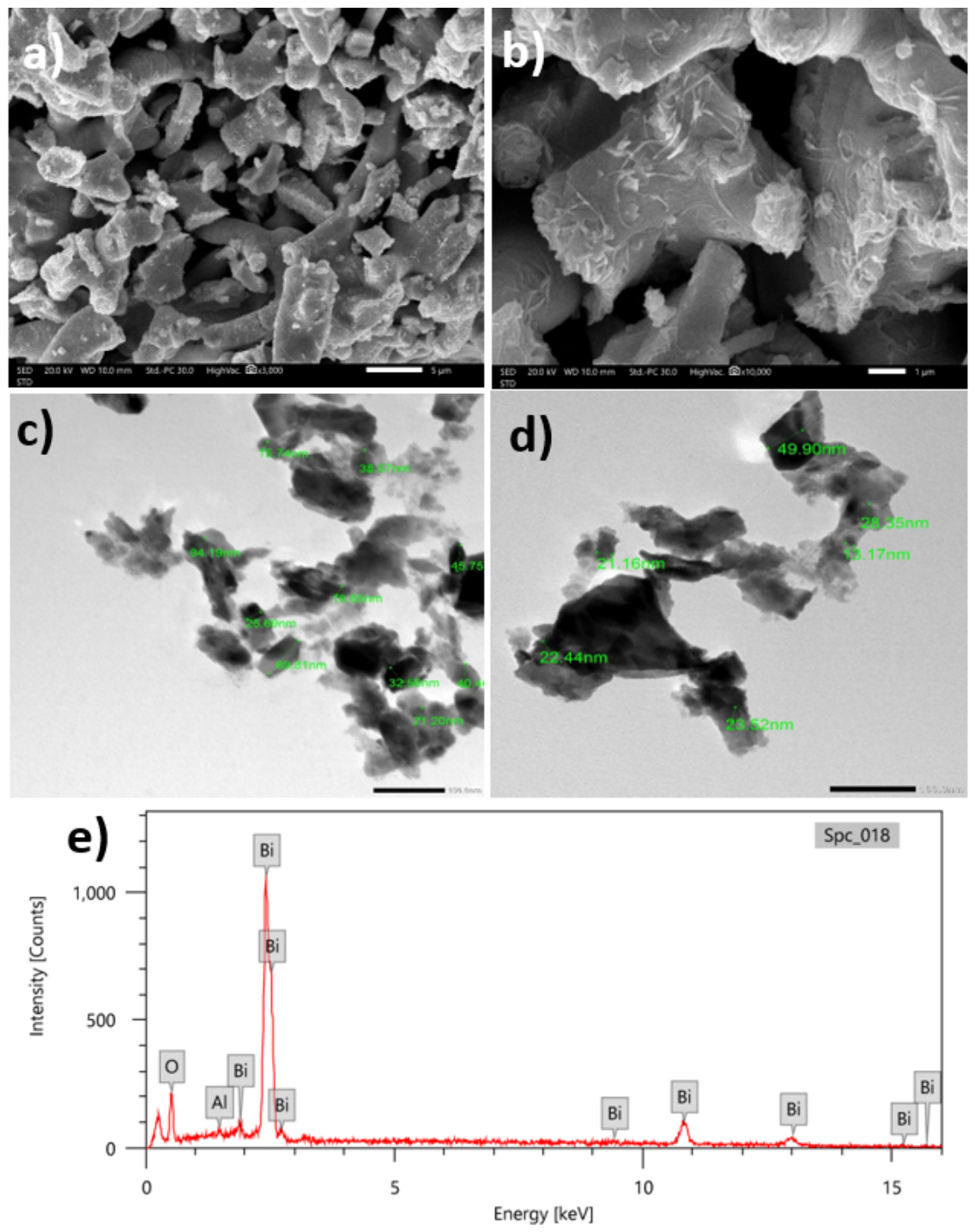
Figure 2.
Structural characterization of the synthesized BiAlO3: (a) X-ray diffraction pattern and Rietveld refinement, and (b) Raman spectrum.
Figure 2.
Structural characterization of the synthesized BiAlO3: (a) X-ray diffraction pattern and Rietveld refinement, and (b) Raman spectrum.
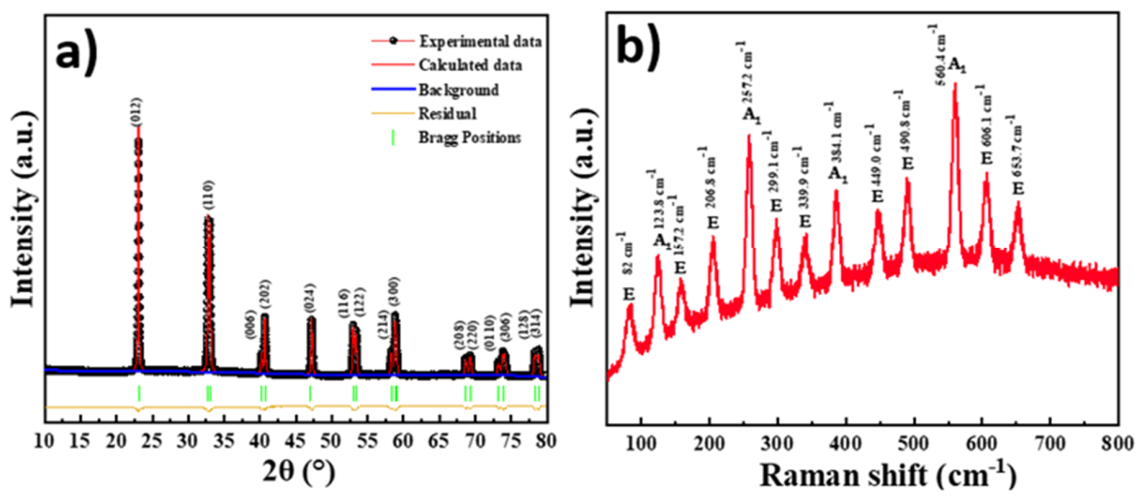
Figure 3.
XPS characterization of the synthesized BiAlO3: (a) survey spectrum, (b) high-resolution Bi 4f spectrum, (c) Al 2p spectrum, and (d) O 1s spectrum.
Figure 3.
XPS characterization of the synthesized BiAlO3: (a) survey spectrum, (b) high-resolution Bi 4f spectrum, (c) Al 2p spectrum, and (d) O 1s spectrum.
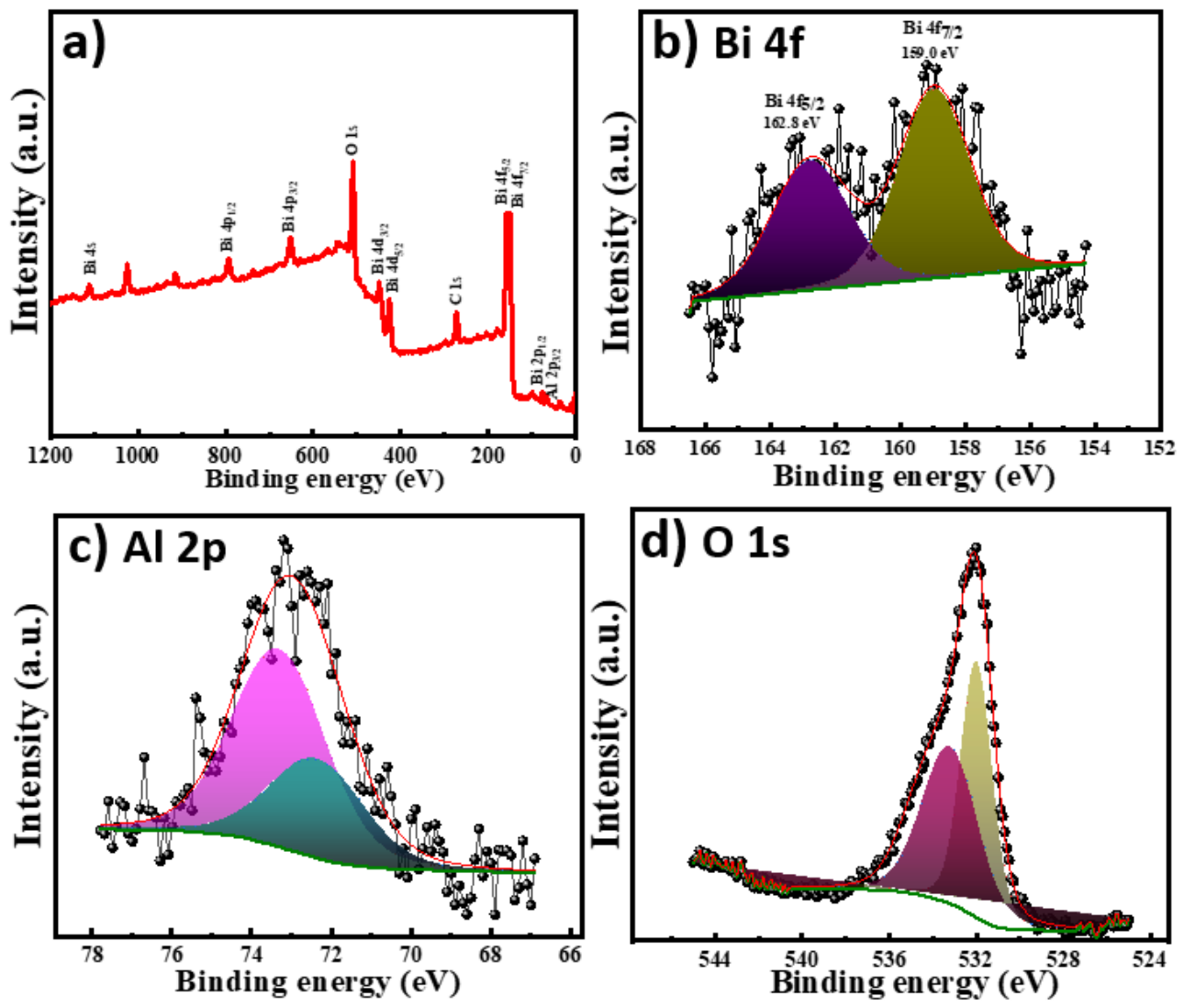
Figure 4.
Optical and electronic properties of the synthesized BiAlO3: (a) Tauc plot, (b) refractive index and extinction coefficient, (c) real and imaginary parts of the dielectric function, and (d) optical and electrical conductivity as a function of photon energy.
Figure 4.
Optical and electronic properties of the synthesized BiAlO3: (a) Tauc plot, (b) refractive index and extinction coefficient, (c) real and imaginary parts of the dielectric function, and (d) optical and electrical conductivity as a function of photon energy.
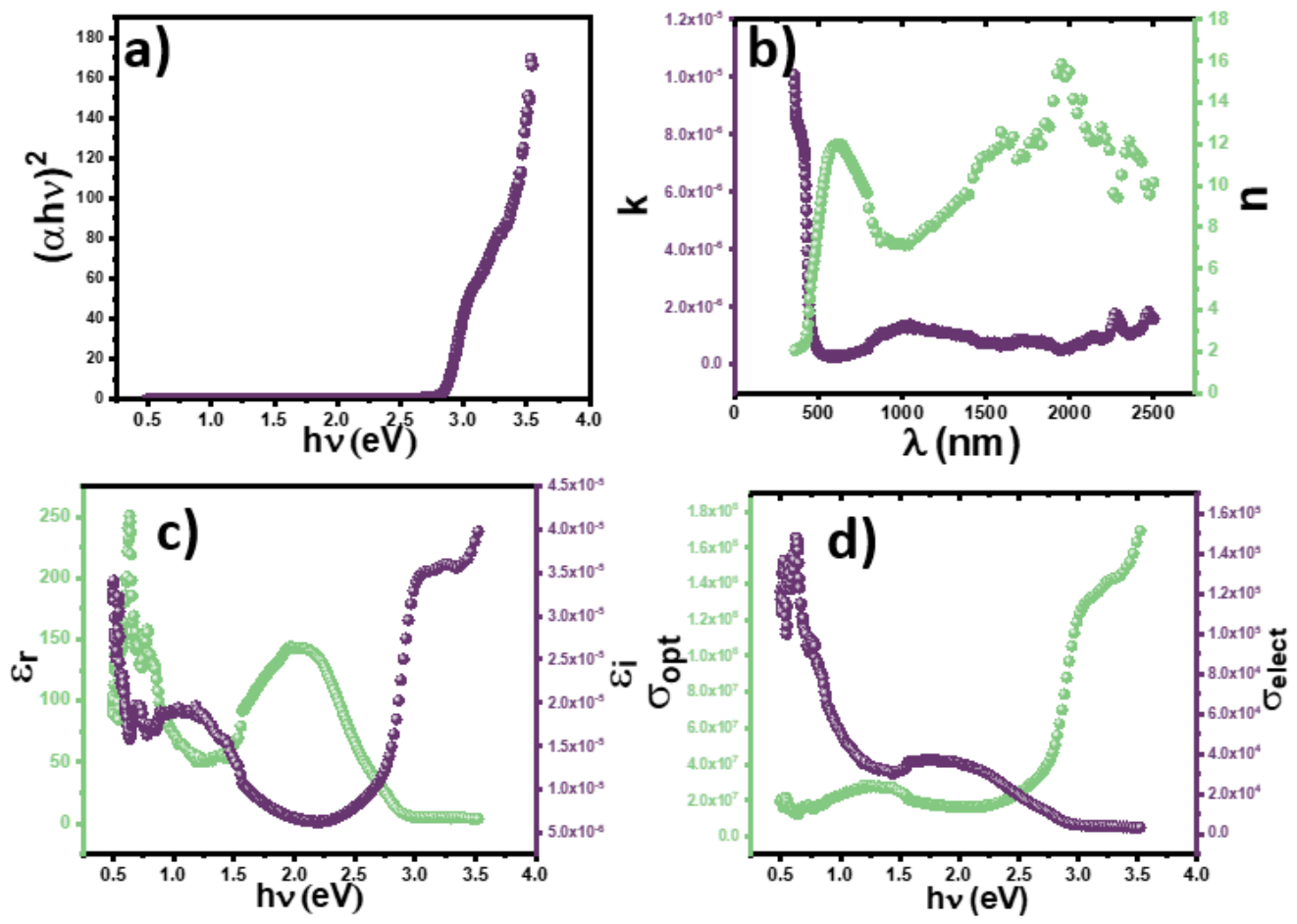
Figure 5.
Charge-dynamic and dielectric properties of the synthesized BiAlO3: (a) relaxation time (τ) and (b) dielectric loss tangent (tanδ) as a function of photon energy.
Figure 5.
Charge-dynamic and dielectric properties of the synthesized BiAlO3: (a) relaxation time (τ) and (b) dielectric loss tangent (tanδ) as a function of photon energy.
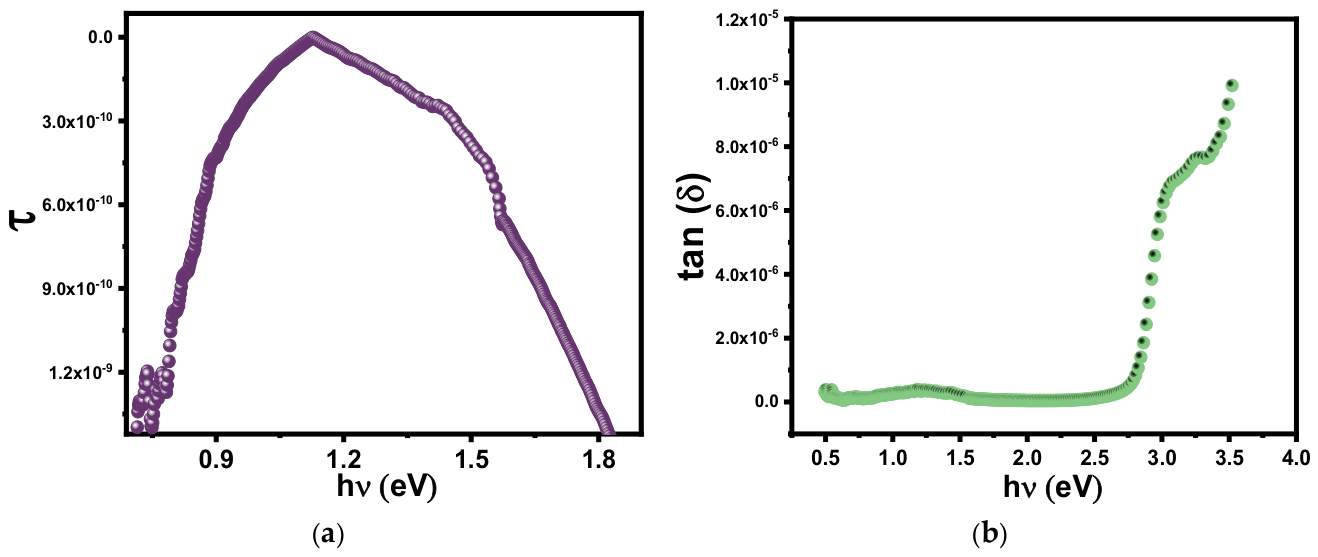
Figure 6.
UV–Vis absorption spectra showing the degradation of Rhodamine B under visible-light irradiation: (a) direct photolysis of RhB and (b) photocatalytic degradation in the presence of BiAlO3.
Figure 6.
UV–Vis absorption spectra showing the degradation of Rhodamine B under visible-light irradiation: (a) direct photolysis of RhB and (b) photocatalytic degradation in the presence of BiAlO3.
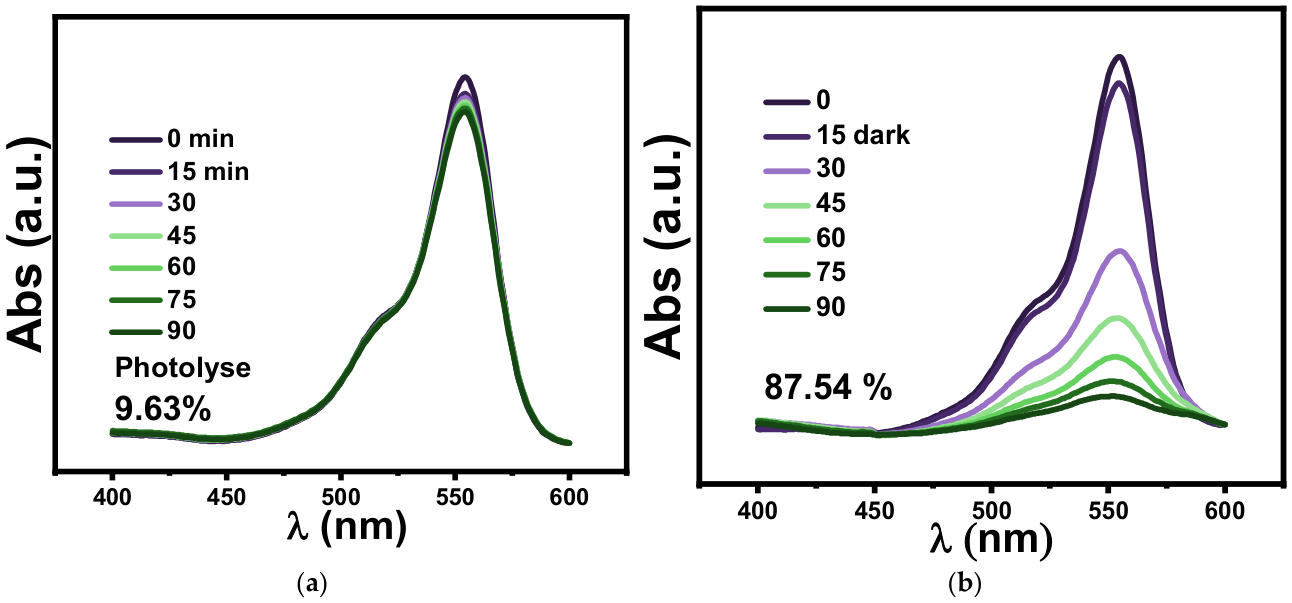
Figure 7.
Photocatalytic performance and reusability of the synthesized BiAlO3 for Rhodamine B degradation under visible-light irradiation: (a) effect of selective scavengers on the degradation efficiency and identification of the principal reactive species involved in the photocatalytic process, and (b) photocatalytic degradation efficiency of BiAlO3 over six consecutive reuse cycles.
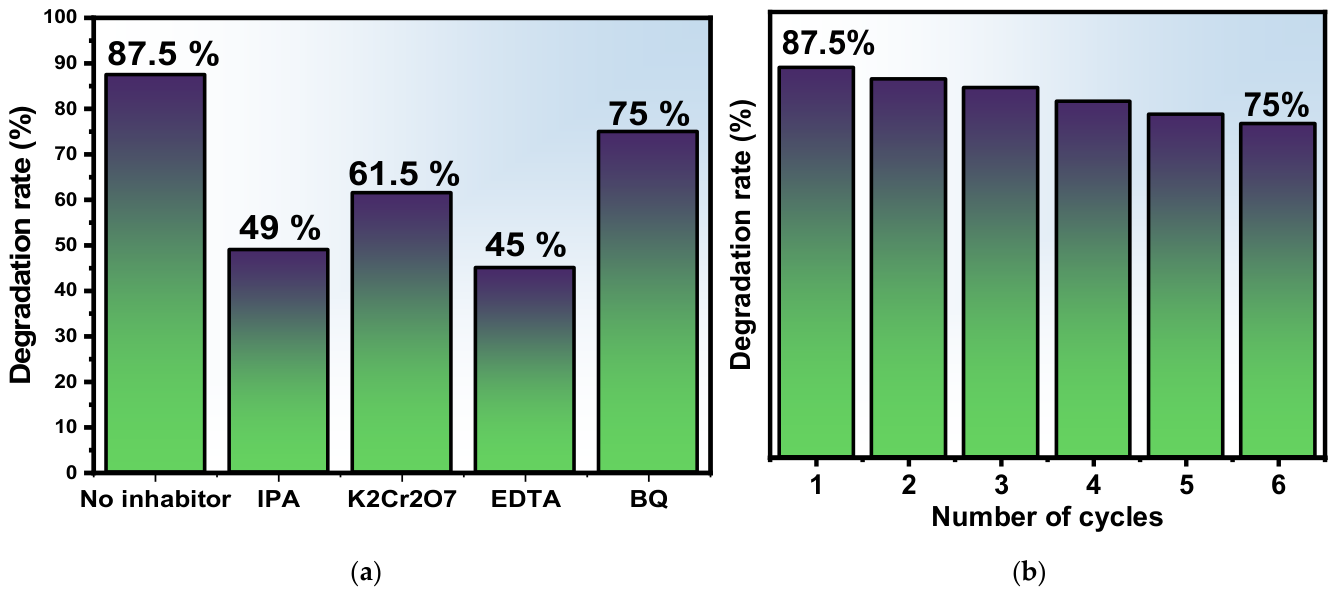
Figure 8.
Proposed photocatalytic mechanism for Rhodamine B degradation over BiAlO3 under visible-light irradiation.
Figure 8.
Proposed photocatalytic mechanism for Rhodamine B degradation over BiAlO3 under visible-light irradiation.
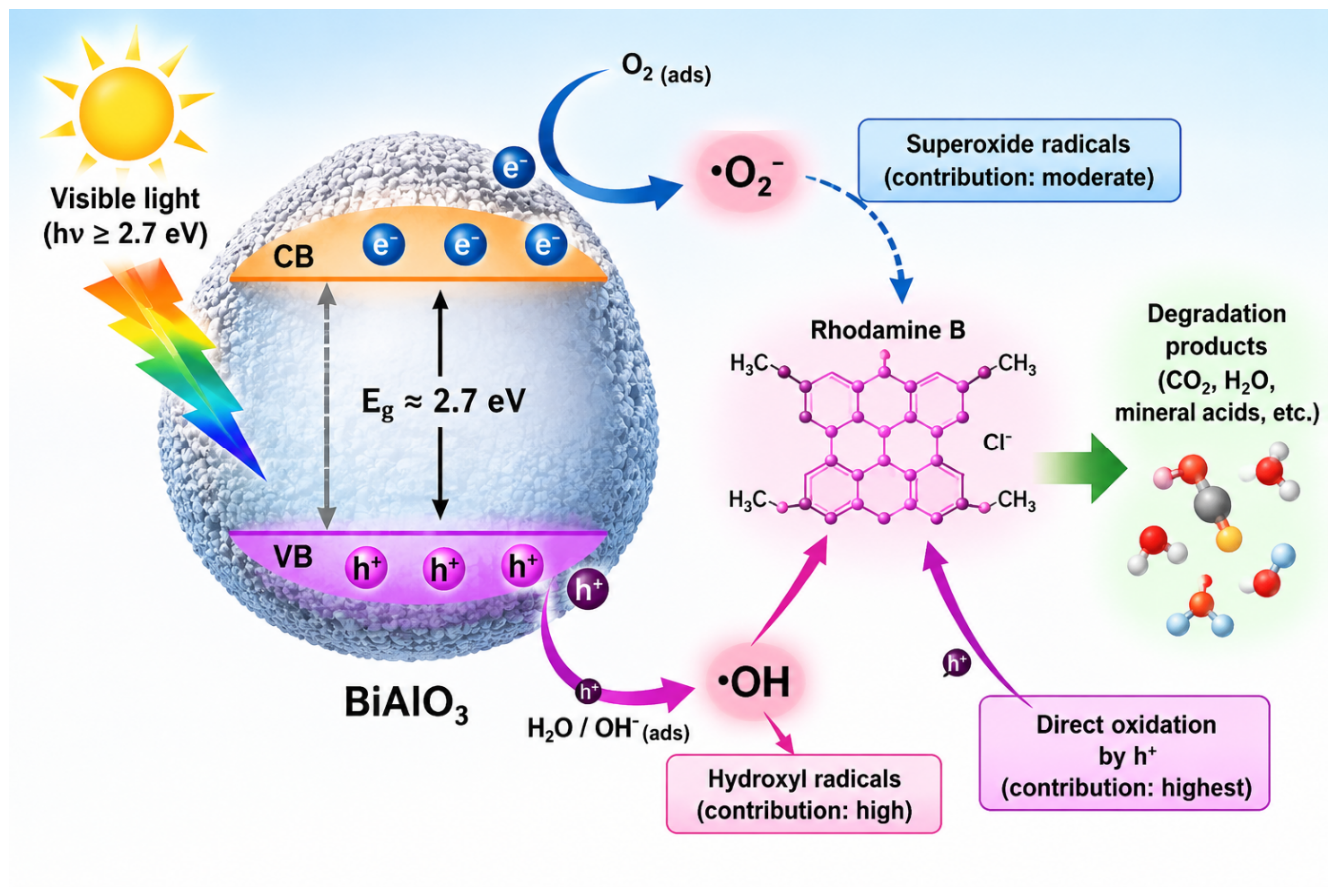

Table 1.
Comparison of BiAlO3 photocatalytic performance with selected reported photocatalysts for Rhodamine B degradation.
Table 1.
Comparison of BiAlO3 photocatalytic performance with selected reported photocatalysts for Rhodamine B degradation.
| Photocatalyst | Light Source | RhB Concentration | Irradiation Time | Degradation Efficiency (%) | Ref. |
| BiAlO3 (this work) | Visible light, λ > 420 nm | 10 mg L−1 | 90 min | 87.54 | This work |
| α-Bi2O3 | Visible light, λ > 420 nm | 10 mg L−1 | 120 min | 65.0 | [50] |
| Bi2O3/WO3 | Visible light, λ ≥ 420 nm | 10 mg L−1 | 180 min | 76.67 | [51] |
| Ba-doped β-Bi2O3 | UV–Vis light | 20 mg L−1 | 120 min | 81.0 | [52] |
| Bi2O3/g-C3N4 | Visible light, λ > 400 nm | 1 × 10⁻⁵ mol L−1 | 60 min | 45.6 | [50] |
| Bi2O3@Fe-MOF | Visible light | — | 120 min | 50.87 | [53] |
Disclaimer/Publisher’s Note: The statements, opinions and data contained in all publications are solely those of the individual author(s) and contributor(s) and not of MDPI and/or the editor(s). MDPI and/or the editor(s) disclaim responsibility for any injury to people or property resulting from any ideas, methods, instructions or products referred to in the content. |
© 2026 by the authors. Licensee MDPI, Basel, Switzerland. This article is an open access article distributed under the terms and conditions of the Creative Commons Attribution (CC BY) license.
Copyright: This open access article is published under a Creative Commons CC BY 4.0 license, which permit the free download, distribution, and reuse, provided that the author and preprint are cited in any reuse.