

Submitted:
09 October 2026
Posted:
12 October 2026
You are already at the latest version
Abstract
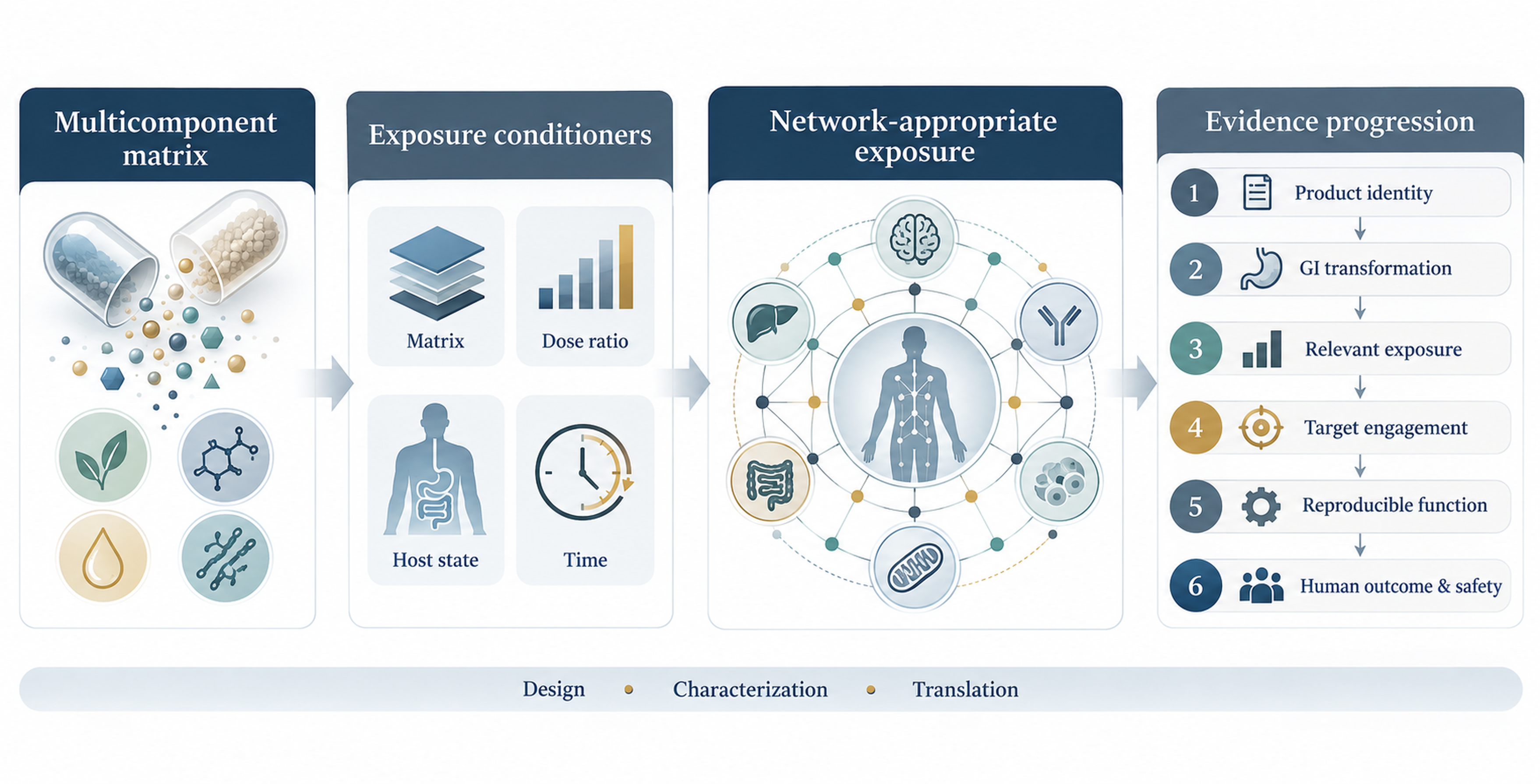
Multicomponent dietary supplements are commonly compared by ingredient count and labeled milligrams, whereas finished-product performance is determined by molecular identity, free con-centration, tissue delivery, and biological response. This critical integrative review introduces net-work-appropriate exposure as a design principle linking four decisions: what to provide, how much to provide, how to deliver it, and what to prioritize or omit. The framework treats the formulation matrix, dose ratio, host state, and time as joint determinants of effective exposure. Literature was organized across gastrointestinal transformation, mineral and nutrient competition, tolerable upper intake levels, precision nutrition, mixture interactions, analytical compatibility and assay develop-ment, and four connected functional domains: the barrier-microbiota-immune interface, redox and extracellular-matrix homeostasis, mitochondrial bioenergetics, and membrane-cofactor signaling. Six cumulative evidence stages organize progression from product identity through gastrointestinal transformation, plausible local or systemic exposure, target engagement, reproducible phenotype, and human outcomes with safety. A rational dose window integrates target-relevant exposure with saturation, competition, tolerability, interaction, clearance, and established intake limits, while ana-lytical validity is embedded across every stage. Together, these elements define a testable product-level architecture for the design, evaluation, and translation of multicomponent dietary supple-ments.
Keywords:
multicomponent dietary supplements
; network-appropriate exposure
; rational dose window
; bioaccessibility
; formulation matrix
; analytical interference
; precision nutrition
; translational framework
1. Introduction
Dietary supplements are commonly formulated as combinations of vitamins, minerals, amino acids, plant-derived compounds, lipids, fibers, microbial products, and specialized delivery excipients. Their scientific evaluation often remains ingredient-centered: evidence for each component is summarized separately and the formulation is then described as if those effects could be added together. Ingredient-level evidence provides the biological rationale for formulation, while finished-product behavior emerges at the system level. Regulatory category, label compliance, product identity, effective exposure, biological activity, and safety represent complementary layers of evaluation for the final combination [1,2].
The finished matrix changes the problem. Food structure and macronutrient context influence disintegration, solubilization, digestion, micellarization, transport, and microbial transformation. Fibers can bind or retain bioactive compounds, lipids can facilitate or delay their transfer, and protein or colloidal interfaces can alter apparent availability [3,4,5]. Polyphenols illustrate this gap particularly well: extensive molecular activity has been reported in cell-free and cellular systems, yet parent-compound exposure in humans is often low, metabolism is extensive, and biological effects may depend more on conjugates or microbial products than on the compound initially placed in the formulation [6,7,8].
Multicomponent products introduce an additional layer of interaction complexity. Components can influence dissolution, transport, metabolism, binding, pH, osmolarity, viscosity, redox conditions, and stability. Competition among zinc, iron, copper, and manganese at the intestinal mucus layer illustrates how the effective exposure of one component depends on its surrounding matrix [9]. Combination effects are ratio- and context-dependent and may be additive, subadditive, or supra-additive across different exposure ranges [10,11]. Product-level interpretation therefore integrates ingredient identity with ratio, matrix, exposure, and endpoint.
This review proposes network-appropriate exposure as a mechanism-oriented framework for the design and evaluation of multicomponent dietary supplements. The design unit is the reproducible relationship among a physiological objective, network nodes, component families, dose ratios, molecular environment, delivery form, timing, and host state. Four decisions make this relationship operational: what to provide, how much to provide, how to provide it, and what to prioritize or omit. The framework organizes formulation hypotheses into four interacting functional domains and six cumulative evidence stages spanning composition, gastrointestinal transformation, exposure, target engagement, reproducible phenotype, and human outcome. Analytical validity is embedded across the entire architecture.
Network-appropriate exposure is defined here as the concentration-time profile of chemically identified species that reaches a prespecified biological node within a dose range associated with reproducible target engagement and tolerability. The framework integrates four exposure conditioners—matrix, dose ratio, host state, and time—with six cumulative evidence stages and deliberate component selection. Together, these elements convert ingredient selection, dose design, delivery, and prioritization into a unified product-level translational architecture. The same architecture applies to single- and multi-ingredient strategies, distinguishes formulation strength from labeled milligrams, defines a rational exposure window, and connects laboratory, clinical, regulatory, and manufacturing decisions within a common development framework.
2. Review Methodology
This article presents a critical integrative review and conceptual framework informed by a structured literature search conducted in PubMed/MEDLINE through 23 September 2026. Search blocks covered multicomponent nutraceutical systems; food-matrix effects; gastrointestinal digestion and bioaccessibility; barrier, microbiota, and immune interactions; redox regulation and extracellular matrix; mitochondrial bioenergetics; membrane and micronutrient signaling; chrononutrition; mixture interactions; delivery systems; analytical interference; cell-based assay qualification; precision nutrition; biomarkers; product quality; and regulatory translation.
The searches yielded 372 unique PubMed records after deduplication. Eligibility screening and targeted reference tracking produced the 109-source evidence base synthesized in this manuscript; all included sources were published between 2020 and 2026. Complete search blocks, eligibility rules, and the structured search strategy are provided in Supplementary Tables S1 and S2.
Priority was given to systematic reviews, consensus methods, position statements, translational reviews, interlaboratory studies, and mechanistic work that clarified an evidence boundary. Publications from 2020 through 2026 were prioritized for the final evidence base. Reference lists of selected reviews and consensus documents were examined to identify additional methodological sources through targeted reference tracking. English-language peer-reviewed articles and authoritative methodological guidance were eligible. Studies were excluded when they offered only computational prediction without experimental or clinical context, or when their relevance depended on an unverified commercial claim.
Evidence was synthesized according to six levels of inference: composition and quality, bioaccessibility, systemic exposure, target engagement, cellular or tissue phenotype, and human outcome. Methodological appraisal focused on the validity and product-level applicability of each inference incorporated into the framework. Consistent with its integrative design, the review used structured qualitative evidence synthesis to connect mechanistic, analytical, translational, and clinical evidence across the proposed framework. Ingredient-specific examples were mapped to the design principle they illustrate.

Table 1.
Search and synthesis strategy.
| Evidence block | Representative search concepts | Purpose in the framework | Priority evidence |
|---|---|---|---|
| System architecture | multicomponent, nutraceutical, dietary supplement, mixture | Define how finished-product behavior emerges from multicomponent interactions | Critical reviews and formulation studies |
| Transformation | food matrix, INFOGEST, digestion, bioaccessibility, microbiota metabolism | Map the product between ingestion and local or systemic exposure | Consensus methods and digestion reviews |
| Mechanistic domains | barrier, microbiota, immunity, redox, ECM, mitochondria, membrane, cofactors | Identify testable physiological nodes and intermediate endpoints | Mechanistic reviews and human-context evidence |
| Temporal design | chrononutrition, meal timing, nutrient timing, circadian | Define evidence-based criteria for AM/PM, meal-timing, and nutrient-timing strategies | Systematic reviews, consensus, position statements |
| Interactions | synergy, antagonism, Bliss, Loewe, HSA, ZIP | Define model-based interaction analysis and experimental design criteria | Methodological and mixture studies |
| Assay validity | assay interference, live-cell imaging, viability, replication | Characterize matrix–assay interactions and analytical performance | Fit-for-purpose and interlaboratory studies |
| Clinical translation | precision nutrition, biomarkers, exposure, responder | Connect mechanism with population, exposure, outcome, and safety | Clinical reviews and biomarker guidance |
| Dose and host context | dose-response, upper intake level, competition, intolerance, renal or hepatic function | Define a useful exposure window and population-specific adaptation criteria | Recent guidance, clinical nutrition and interaction studies |
| Quality and regulation | identity, stability, standardization, safety, claims | Align product control and public language with evidence | Regulatory and quality reviews |
3. Multicomponent Formulations as Biological and Physicochemical Systems
3.1. From Ingredient-Level Evidence to System-Level Behavior
Ingredient lists define nominal inputs, whereas system-level behavior emerges from the sequence linking manufacture, storage, digestion, microbial transformation, absorption, distribution, and elimination. These processes determine the molecular species and concentrations reaching intestinal, systemic, and tissue compartments. Product-level interpretation therefore connects labeled composition with molecular fate and site-specific exposure.
Mechanistic relevance is strongest when experimental concentrations correspond to plausible exposure at the proposed site of action. Poorly absorbed parent molecules may remain highly relevant when the intended action is luminal or microbiota-mediated, whereas systemically targeted mechanisms depend on the circulating or tissue-accessible species generated after digestion and metabolism [5,8,12].
Composition also changes the exposure of neighboring components. Lipids may improve the micellarization of lipophilic compounds; fibers can delay release or carry compounds to the colon; proteins and minerals can form complexes; and pH-dependent solubility can change during digestion. The same matrix may increase stability during storage yet reduce release during digestion, or improve dispersion in water while altering intestinal transfer. These formulation-specific effects are characterized most directly at the finished-product level through measurements of release, stability, and intestinal transfer [3,4,13].
3.2. Identity and Quality Are Mechanistic Variables
Mechanistic interpretation begins with a stable and traceable test article. Botanical identity, chemical form, salt or ester form, excipient composition, particle-size distribution, water activity, oxidation state, microbial specification, contaminant profile, and storage history can all influence experimental outcomes. Lot-to-lot variation is particularly consequential when a formulation includes natural extracts or fermentation-derived materials. Standardization by a single marker compound may be insufficient when the hypothesized activity depends on several fractions or on the matrix itself.
Product quality is therefore part of the causal model. Stability over time preserves intervention identity, while precise chemical-form specification captures biologically relevant differences. Folate and 5-methyltetrahydrofolate, for example, represent related but distinct entities, and creatine literature illustrates the value of matching evidence to the characterized form [2,14]. Identity testing, release specifications, stability-indicating methods, and retained samples provide the foundation for mechanistic and clinical reproducibility.
3.3. Digestion Transforms the Intervention
For an orally administered system, the gastrointestinal tract is an experimental reactor rather than a passive conduit. Ionic strength, enzymes, bile salts, gastric emptying, intestinal transit, and food co-ingestion can transform the matrix before it reaches absorptive or microbial compartments. The internationally harmonized INFOGEST static digestion method provides a reproducible starting point for simulating these conditions, while subsequent refinements extend its application across diverse food and supplement matrices [15,16,17].
Digestion duration, lipid load, and delivery-particle characteristics influence recovery and bioaccessibility [3,18,19]. A high-information workflow characterizes the intact product, the digested matrix, the bioaccessible fraction, and, where relevant, an absorbed or basolateral fraction generated through an epithelial model [20,21,22].
3.4. Bioaccessibility Within the Exposure Continuum
Bioaccessibility describes the fraction released from the matrix and available for intestinal uptake. Bioavailability extends this characterization through absorption, metabolism, distribution, and delivery of relevant molecular species to biological compartments. Together, these measures define an exposure continuum from matrix release through systemic or local availability, target engagement, and functional response.
Delivery technologies provide additional control over dispersibility, stability, release, and exposure. Liposomes, nano- and microcarriers [23,24,25], spray-dried particles [26], and electrospun systems can improve formulation performance. Particle size, polydispersity, biological interfaces, and protein adsorption contribute to delivery behavior [27,28,29]. Direct comparison of finished formulations using characterized analytical methods and relevant exposure measurements quantifies the contribution of the delivery system. Contemporary absorption frameworks likewise connect food and formulation context with measurable absorption [30].
3.5. From Labeled Dose to Effective Exposure: Defining a Rational Window
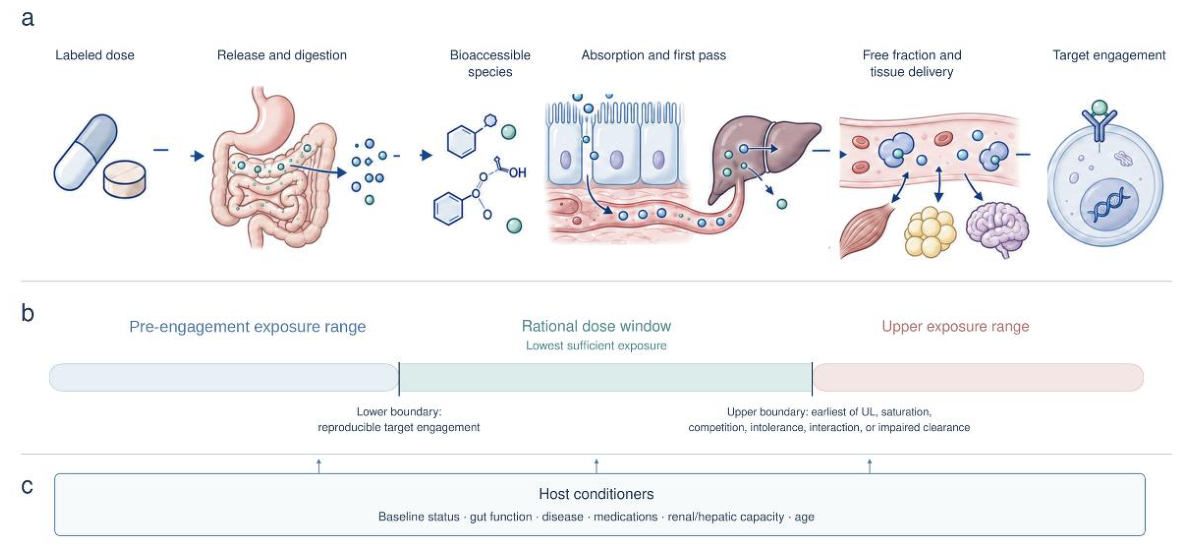
Labeled dose is the mass placed in the dosage form; effective exposure is the concentration-time profile of the relevant molecular species at the proposed site of action. Between them lie release, digestion, complexation, micellarization, absorption, first-pass metabolism, protein binding, distribution, cellular transport, and elimination. The relationship may be non-linear and host-conditioned. A nominally high dose can produce little additional target exposure when release or transport is saturated, while increasing intestinal osmotic load, competition, or unabsorbed substrate.
A rational dose window has two boundaries. Its lower boundary is the smallest finished-product exposure with a plausible and reproducible effect on a prespecified node or function. Its upper boundary is the earliest relevant constraint among plateauing benefit, saturation, nutrient-nutrient competition, gastrointestinal intolerance, drug interaction, tissue accumulation, impaired renal or hepatic clearance [31,32], or an applicable tolerable upper intake level [33,34]. Recent clinical-nutrition guidance reinforces that baseline status, disease state, route, duration, and total intake from diet and supplements influence this boundary [31,32].
The rational dose window prioritizes target-relevant exposure, tolerability, and compatibility among components rather than maximizing labeled milligrams. Once exposure approaches a plateau, additional input can be redirected toward another limiting node or omitted to preserve adherence and interaction margin. Folate–vitamin B12 relationships illustrate the value of biochemical context in dose design [35], while medication use in older adults highlights the importance of integrating supplement exposure with the existing therapeutic system [36].
Four design decisions follow. What to provide is determined by the physiological objective and modifiable network node. How much to provide is determined by dose-response, cumulative intake, chemical form, and the effective exposure window. How to provide it is determined by the molecular environment, dosage form, co-ingestion, timing, and adherence. What to prioritize or omit is determined by incremental function, compatibility, exposure contribution, tolerability, and population fit. These decisions are specified at the formulation level and updated when the formulation, population, or regimen changes.
Table 2.
Four decisions in rational multicomponent supplement design.
| Decision | Central question | Design requirements | Design objective |
|---|---|---|---|
| What to provide | Which network node or physiological limitation is both relevant and nutritionally modifiable? | Define intended population, baseline status, primary node, ingredient family and measurable target-engagement endpoint | Network-aligned component selection with a defined responder and endpoint |
| How much to provide | What is the lowest exposure range likely to engage the target without avoidable burden? | Use dose-response data, chemical form, cumulative diet-plus-supplement intake, applicable upper limits, saturation, competition and uncertainty factors | Exposure-calibrated dosing within a rational window |
| How to provide it | Which matrix, dosage form, meal context and schedule preserve delivery and tolerability? | Specify release, digestion, bioaccessibility, co-ingestion, split dosing, timing, adherence and finished-product exposure | Matrix- and context-aware delivery with measured exposure |
| What to prioritize or omit | Which components, ratios, or contexts contribute the greatest incremental value to the finished architecture? | Compare incremental function, compatibility, medication context, tolerability, organ function, stability, and exposure contribution | Selective inclusion based on incremental function and compatibility |
4. An Evidence-Progression Framework for Translation
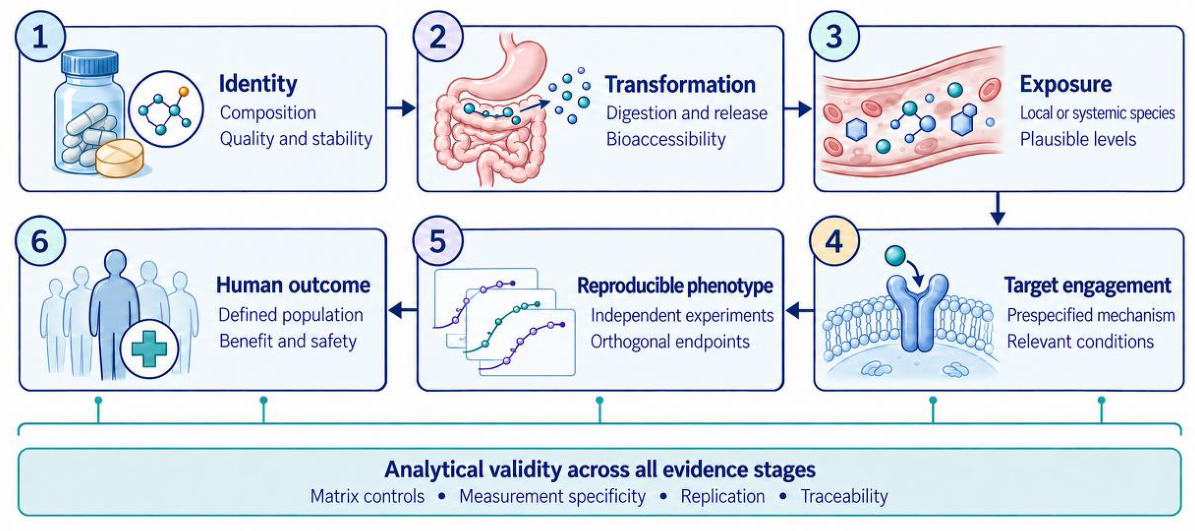
The framework organizes product development as six cumulative evidence stages. Composition defines product identity; gastrointestinal transformation characterizes release and bioaccessibility; exposure studies establish site-relevant availability; target-engagement studies connect exposure to mechanism; replicated phenotypes establish functional activity; and controlled human studies characterize population-specific outcomes and safety. Each stage adds a distinct layer of information to the finished formulation. Supplementary Table S3 translates these stages into a reporting framework for formulation development and manuscript preparation.
Figure 1.
Evidence progression for a multicomponent dietary supplement. Six cumulative evidence stages connect product identity with human outcomes, while analytical validity, replication, and traceability apply throughout.
Figure 1.
Evidence progression for a multicomponent dietary supplement. Six cumulative evidence stages connect product identity with human outcomes, while analytical validity, replication, and traceability apply throughout.
4.1. Stage 1 Identity and Compositional Control
The first stage establishes reproducible intervention identity through ingredient identity, chemical form, quantitative composition or justified specification ranges, manufacturing parameters, critical excipients, contaminant limits, stability, and lot traceability. For proprietary systems, public disclosure can remain at an appropriate compositional-family level while controlled master formulas, auditable release testing, and traceable specifications preserve reproducibility and safety assessment.
4.2. Stage 2 Gastrointestinal Transformation and Bioaccessibility
The second stage asks what the oral product becomes during digestion. Relevant measures include disintegration, dissolution, particle and droplet behavior, phase separation, chemical stability, recovery of marker compounds, micellarization, and microbial accessibility. Standardized simulated digestion can identify whether the formulation protects, releases, or sequesters its intended components. When colonic action is proposed, fermentation models and measurement of microbial metabolites are more relevant than plasma exposure to the parent compound.
4.3. Stage 3 Plausible Local or Systemic Exposure
The third stage characterizes whether the molecular species used in mechanistic experiments reach the proposed site of action at biologically relevant concentrations and durations. Exposure mapping includes parent compounds, conjugates, degradation products, microbiota-derived metabolites, protein binding, and matrix interactions because nominal and free concentrations can differ substantially in cell culture and in vivo [29]. The resulting exposure model reports the tested dose range, rational window, and host variables affecting intestinal function, metabolism, distribution, and elimination. Finished-product pharmacokinetics or biomarkers provide the corresponding organism-level exposure information when formulation-dependent delivery is part of the hypothesis.
4.4. Stage 4 Target Engagement and Mechanistic Coherence
The fourth stage characterizes whether the intervention engages the proposed molecular or physiological node under exposure-relevant conditions. Target engagement is defined most clearly through orthogonal methods and concordance with the proposed mechanism. For complex systems, combining pathway-specific readouts with measures of cellular state and analytical controls distinguishes mechanism-specific responses from broader stress or measurement effects. Model selection is aligned with the intended biological interface: controlled cellular systems support mechanistic assay development, while complementary physiological models extend interpretation toward the intended population. Cell-free antioxidant assays contribute compositional information, and cellular redox measurements extend this information to intracellular regulation [37].
4.5. Stage 5 Reproducible Phenotype
The fifth stage connects target engagement with reproducible functional response. Depending on the hypothesis, this may involve barrier integrity, cytokine response, mitochondrial respiration, substrate oxidation, muscle performance, recovery, or another predefined phenotype. Independent biological replication, a credible model, exposure-response analysis, suitable controls, and orthogonal endpoints together define functional reproducibility, while technical replicates characterize within-run precision.
4.6. Stage 6 Human Outcome and Safety
The final stage characterizes meaningful outcomes and safety in the intended population. Baseline nutritional status, diet, medication use, age, sex, microbiome, genotype, and disease state define responder heterogeneity and support biologically informed population selection. Clinical evidence for curcumin and resveratrol illustrates how formulation, exposure, dose, and population characteristics shape human outcomes [38,39,40].
Stage 6 integrates total exposure, applicable upper intake levels, medication context, gastrointestinal tolerability, and renal or hepatic capacity where relevant. Botanical-supplement safety literature further illustrates the value of identity verification, adverse-event surveillance, medication review, and predefined monitoring criteria [33,36,41].
Table 3.
Evidence stages for multicomponent dietary supplement evaluation.
| Stage | Central question | Minimum evidence | Evidence-aligned interpretation |
|---|---|---|---|
| 1 Identity | Is the finished intervention reproducibly defined? | Master formula, specifications, lot release, stability and traceability | Establishes composition and quality attributes |
| 2 Transformation | What does the oral matrix become during digestion? | Disintegration, recovery, stability, bioaccessibility and relevant microbial transformation | Establishes release and bioaccessibility under the tested conditions |
| 3 Exposure | Do relevant species reach the proposed site within a rational window? | Local exposure model, finished-product pharmacokinetics, dose-response, free concentration and host-conditioned exposure | Establishes local or systemic exposure within defined conditions |
| 4 Target engagement | Does the formulation change the proposed node? | Exposure-relevant conditions, prespecified target and orthogonal confirmation | Establishes target engagement and mechanistic coherence |
| 5 Phenotype | Does engagement produce a reproducible function? | Independent biological replication, credible model, controls and functional endpoint | Establishes reproducible preclinical function in the stated model |
| 6 Human outcome | Does the finished product benefit the intended population safely? | Controlled study, adherence, safety, cumulative intake, organ function, medication review and responder analysis | Establishes outcome and safety within the tested population, formulation, regimen, and duration |
5. Four Interacting Mechanistic Domains
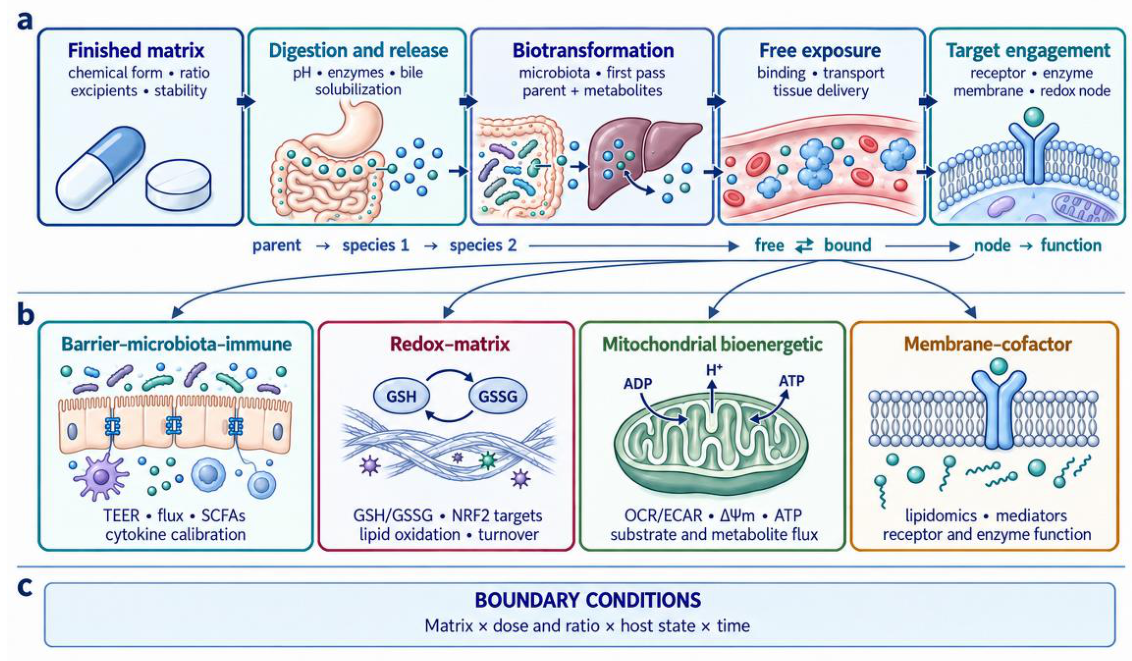
The four domains function as connected organizational units that convert a formulation concept into measurable biological hypotheses. Each domain defines a physiological interface, nutritional inputs, intermediate endpoints, and product-level evaluation criteria. The network is conditioned by matrix, dose, host state, and time, explaining why identical nominal compositions can generate different effective exposures. Nutrients and metabolites are therefore mapped across interacting nodes instead of being assigned to a single pathway.
These domains were selected because together they capture the principal interfaces through which an orally administered multicomponent system is transformed into measurable biological action: intestinal processing and immune communication; redox and matrix regulation; cellular energy handling; and membrane-dependent signaling. Their convergence through metabolites, cofactors, redox couples, lipids, and host-derived signals provides a tractable bridge from composition to phenotype.
Figure 2.
Molecular fate and network-node architecture. Chemical form, matrix, gastrointestinal transformation, microbial and first-pass metabolism, protein binding, transport, and tissue delivery determine which species engage a biological node. The four domains organize prespecified measurable hypotheses and connect molecular fate with product-level translation.
5.1. Barrier Microbiota and Immune Interface
The intestinal barrier integrates epithelial cells, mucus, antimicrobial factors, immune populations, vascular and lymphatic transport, and the microbiota. Diet influences each component directly and indirectly. Barrier function is dynamic and is characterized through complementary structural, permeability, microbial, and immune measures [42,43,44].
Fermentable fibers and prebiotic substrates can change microbial community function and short-chain fatty-acid production. Acetate, propionate, and butyrate participate in epithelial metabolism and mucosal immune regulation, but their effects depend on dose, location, host context, and microbial ecology [45,46,47]. Prebiotics, probiotics, synbiotics, and postbiotics represent distinct intervention categories with strain-, substrate-, product-, and context-specific effects [48,49,50].
Polyphenols add a bidirectional layer. Microbial metabolism generates smaller phenolic products and, for some precursors, distinct metabolites such as urolithins. In return, polyphenols and their metabolites can alter microbial function. Interindividual variation in microbial conversion means that equal intake can generate distinct exposure profiles [7,51,52]. A formulation designed around this domain integrates substrate fate, taxonomic change, microbial function, and host-relevant outputs.
Mechanistic studies are most informative when barrier structure, microbial function, and immune regulation are measured as distinct but connected processes. Transepithelial electrical resistance, paracellular flux, tight-junction localization, mucus properties, microbial metabolites, and immune mediators provide complementary views of this interface. Human translation is strengthened by convergence among intestinal, metabolic, and inflammatory measures. Immune effects are best framed in terms of calibrated activation, tolerance, resolution, and tissue-specific control [53,54,55].
5.2. Redox and Extracellular Matrix Homeostasis
Redox biology is often simplified into a contest between oxidants and antioxidants. In reality, reactive species participate in signaling, host defense, adaptation, and damage. Cellular redox state is governed by compartmentalized production, enzymatic defenses, NADPH availability, thiol systems, and repair. Chemical radical-scavenging assays characterize one layer of redox activity, while intracellular redox signaling is defined through cellular and tissue-level measurements.
The NRF2-KEAP1 network links electrophile and oxidative sensing to detoxification, glutathione metabolism, intermediary metabolism, and stress adaptation [56,57]. Phytochemicals can influence this network, including through epigenetic mechanisms, but activation is dose-, tissue-, and context-dependent [58]. Persistent changes in stress-response markers are interpreted alongside dose, tissue context, and functional endpoints to distinguish adaptive signaling, pharmacological engagement, and cellular stress.
NADH/NAD+ and NADPH/NADP+ couples connect redox state to metabolism and biosynthesis [59,60]. These systems interact with glutathione, mitochondrial function, inflammatory signaling, and extracellular redox conditions. The extracellular matrix is not merely structural: redox-sensitive proteases, cross-linking, inflammation, and cellular mechanotransduction influence remodeling [61,62]. Nutritional interventions aimed at redox and matrix resilience are characterized through complementary measurements of chemical antioxidant capacity, cellular redox regulation, tissue remodeling, and functional outcome.
5.3. Mitochondrial and Bioenergetic Capacity
Mitochondrial function integrates substrate oxidation, electron transport, redox balance, and ATP production [63]. Creatine illustrates a relatively well-defined energetic mechanism. The creatine-phosphocreatine system buffers and transports high-energy phosphate [64,65], but outcomes depend on tissue, baseline status, dose, training stimulus, and duration [64,65]. Carnitine supports mitochondrial fatty-acid transport, while coenzyme Q10 participates in electron transfer and redox processes; supplementation effects depend on exposure and the physiological limitation being addressed [66,67]. Spermidine- and NAD-related pathways illustrate broader links among nutrient sensing, autophagy, mitochondrial adaptation, and aging. Their human translation is evaluated by connecting mechanistic findings with finished-product exposure and controlled clinical outcomes [60,68].
Bioenergetic assessment integrates oxygen consumption, extracellular acidification, substrate oxidation, mitochondrial membrane potential, redox ratios, metabolite flux, ATP, and functional outputs. Together, these measurements distinguish energetic adaptation, coupling state, cellular stress, and changes in cell number. Exposure-relevant concentrations and independent experiments provide the corresponding reproducibility context.
5.4. Membrane Lipid and Cofactor Signaling
Membranes organize receptors, transporters, enzymes, and signaling complexes. Lipid composition affects membrane order, curvature, vesicle trafficking, immune-cell activation, and the generation of lipid mediators. Phosphoinositides and cholesterol-rich domains illustrate how relatively small changes in lipid organization can influence signaling without requiring a change in total protein abundance [69,70,71]. Lipid metabolism is also tightly coupled to T-cell activation and function [72].
Omega-3 fatty acids provide a familiar example of the distinction between intake and mechanism. Their biological effects encompass membrane incorporation, altered eicosanoid substrate availability, and specialized pro-resolving mediators [73]. Mechanistic characterization integrates incorporation or relevant metabolites, exposure duration, and background diet.
Micronutrients add another layer because many act as enzyme cofactors, redox partners, or transcriptional regulators. Vitamin C, vitamin D, vitamin E, folate, zinc, selenium, and other micronutrients can influence immune and metabolic functions, but effects often depend on baseline status and follow non-linear dose-response relationships [31,32,54]. Correcting deficiency and supplementing an already replete population are different interventions. Multicomponent products integrate cumulative exposure, chemical form, competition, and upper intake limits across the complete formulation [9,33].
5.5. Cross-Domain Effects
The domains converge through shared metabolites and signaling states. Microbial products can affect hepatic and immune metabolism; redox state regulates barrier and mitochondrial function; membrane composition changes receptor signaling; and mitochondrial metabolites influence epigenetic regulation. The gut-liver axis provides one example of this integration [74], while foodomics, network pharmacology, and multi-omics offer tools to map multi-layer responses [75,76].
Cross-domain structure is operationalized through a limited and hierarchically ordered set of linked hypotheses. A barrier-focused intervention, for example, can define permeability as its primary endpoint, microbial metabolites and inflammatory signaling as secondary endpoints, and a systemic metabolomic signature as an exploratory endpoint. This hierarchy connects network-level ambition with prespecified biological interpretation.
Table 4.
Mechanistic domains and representative evaluation measures.
| Domain | Core processes | Representative measures | Key interpretation criterion |
|---|---|---|---|
| Barrier microbiota and immunity | Permeability, mucus, microbial metabolism, SCFAs, mucosal immune regulation | Transepithelial resistance, paracellular flux, tight-junction localization, microbial metabolites, cytokine panels | Interpret taxonomic change together with functional barrier and immune measures |
| Redox and extracellular matrix | NRF2-KEAP1, NADPH and thiols, oxidative signaling, protease activity, matrix remodeling | GSH and GSSG, redox ratios, NRF2 targets, lipid oxidation, matrix turnover markers | Connect chemical antioxidant capacity with intracellular redox and tissue-level measures |
| Mitochondrial and bioenergetic | Substrate oxidation, electron transfer, ATP buffering, stress adaptation | Respiration, glycolytic flux, membrane potential, metabolite flux, ATP and functional output | Interpret energetic readouts with cell number, coupling, and functional context |
| Membrane lipid and cofactors | Membrane composition, lipid mediators, receptor organization, enzyme cofactor sufficiency | Lipidomics, mediator profiles, membrane incorporation, nutrient-status biomarkers, enzyme-linked endpoints | Interpret responses relative to baseline nutrient status, background diet, and chemical form |
6. Temporal Organization and AM/PM Design Principles
Human metabolism is temporally organized. Circadian clocks influence glucose handling, lipid metabolism, hormone secretion, gastrointestinal function, sleep, and immune responses. Meal timing and fasting intervals can therefore change the physiological context in which a nutrient is delivered [77,78,79]. This temporal organization establishes timing as a product-level design variable whose value is determined through comparative exposure, tolerability, adherence, and functional data.
A mechanistically grounded temporal design begins with a defined rationale for timing. The reason may be pharmacokinetic, such as avoiding competition for absorption; physiological, such as aligning a substrate with feeding or exercise; behavioral, such as improving adherence; or tolerability-related, such as separating components that cause gastrointestinal symptoms. Each rationale predicts a different measurement. Plasma concentration-time profiles address pharmacokinetics, while sleep, glucose, exercise, or recovery endpoints address physiological timing.
Human chrononutrition studies establish that timing can influence cardiometabolic physiology, while the magnitude and direction of the effect depend on protocol, total intake, and baseline state [80,81,82]. Supplement timing can therefore be formulated as a product-specific hypothesis informed by, but distinct from, meal-timing evidence. Sports-nutrition research further shows that total daily intake, training status, baseline stores, and timing can contribute with different weights depending on the nutrient [83,84,85]. For multicomponent systems, temporal separation provides a practical design variable for managing competition, functional emphasis, tolerability, and adherence. Comparative AM/PM development holds total daily dose constant and evaluates exposure, adherence, tolerability, and the intended functional endpoint across combined and separated schedules.
7. Interactions in Multicomponent Systems
7.1. Additivity, Synergy, and Antagonism
Synergy is a model-based property of a defined combination, ratio, exposure range, endpoint, and biological context. Reference models such as Loewe additivity, Bliss independence, highest-single-agent comparison, and zero-interaction potency encode different expectations and can therefore provide complementary views of interaction [11,86,87]. Comparison with untreated control or an individual component remains descriptively informative, while formal synergy classification is anchored to the prespecified reference model [88].
Natural-product and dietary combinations can show synergistic or antagonistic antioxidant behavior depending on concentration and assay conditions [10]. The same principle applies more broadly. A component may improve another component's solubility while competing for transport; preserve stability during storage while slowing release; or enhance one pathway while opposing another. Interaction is therefore defined for a specific combination, ratio, exposure range, endpoint, and biological context.
7.2. Experimental Design for Interaction Analysis
Interaction analysis is strongest when individual concentration-response curves and combination matrices are evaluated with exposure-equivalent controls and a prespecified reference model. Orthogonal endpoints strengthen interpretation when matrix effects are plausible, and independent experiments establish reproducibility. For high-component formulations, staged designs make the problem tractable by defining functional modules, exploring ratio space, applying response-surface or mixture models, and advancing the most informative architectures through progressively higher evidence stages.
7.3. Context Dependence as a System Property
Context dependence is an informative property of multicomponent systems. Media composition, serum proteins, pH, oxygen tension, substrate availability, cell density, microbiome, disease state, and baseline nutrient status can shift response magnitude or direction. Protein binding modifies free exposure in vitro [29], while changes in nutrient and serum conditions alter both cell physiology and matrix behavior. Predefined comparisons across relevant environments therefore map the exposure and population contexts in which a formulation produces its most coherent and reproducible response.
Figure 3.
Experimental logic for multicomponent interaction analysis. Synergy or antagonism is defined relative to a prespecified reference model at stated doses, ratios, endpoints, and contexts, and is interpreted through independent replication and orthogonal confirmation.
Figure 3.
Experimental logic for multicomponent interaction analysis. Synergy or antagonism is defined relative to a prespecified reference model at stated doses, ratios, endpoints, and contexts, and is interpreted through independent replication and orthogonal confirmation.
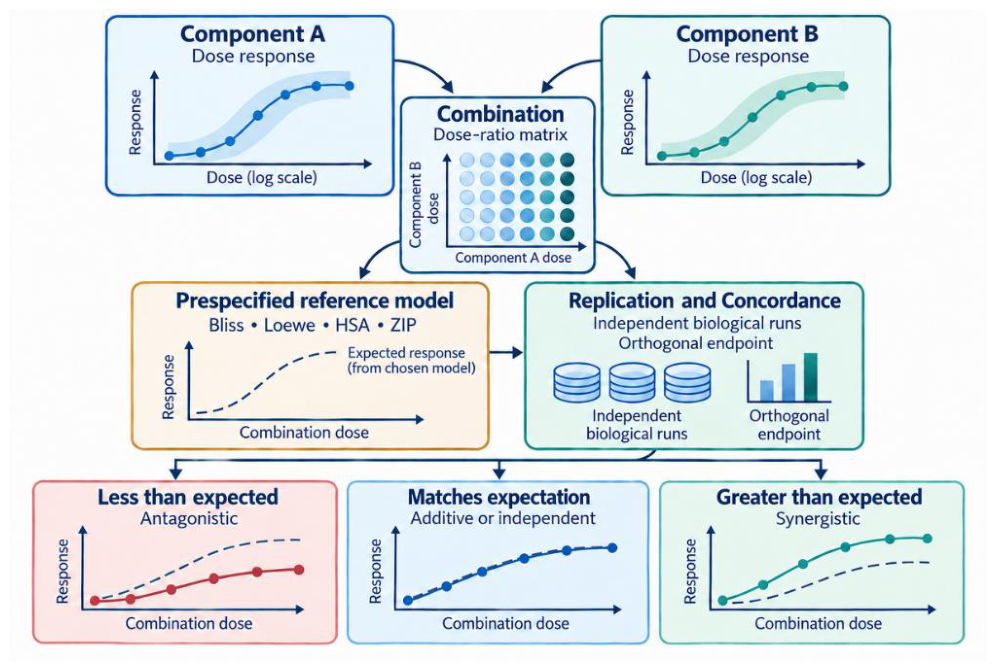
Table 5.
Interaction concepts and experimental design criteria.
| Interaction statement | Meaning | Minimum experimental design | Preferred interpretation |
|---|---|---|---|
| Additive or independent | The combination matches the response expected under a prespecified reference model | Individual concentration-response curves, combination matrix, matched exposure and model selected in advance | Report the relationship to the prespecified reference expectation |
| Synergistic | The combination exceeds the model-specific expected response at defined doses and ratios | Dose-ratio matrix, model agreement or justified model choice, independent replication and orthogonal confirmation | Classify within the defined dose-ratio model and reproduce the finding |
| Antagonistic | The combination is lower than the model-specific expectation | Same requirements as synergy, with assessment of physicochemical and biological causes | Characterize physicochemical and biological contributors to the lower-than-expected response |
| Context dependent | The interaction changes with medium, meals, timing, biological state or population | Predefined contextual comparison with total dose and key covariates controlled | Report the predefined environmental or host condition governing the interaction |
8. Formulation and Delivery as Part of the Mechanism
Delivery is often discussed after ingredient selection, but it can determine the biological intervention. Particle size, surface charge, lipid composition, encapsulation efficiency, release kinetics, oxygen permeability, moisture protection, and reconstitution conditions influence stability and exposure. Nanotechnology-based approaches, liposomes, and other carrier systems can improve the delivery of poorly soluble compounds, with formulation effects quantified against a suitable non-encapsulated comparator [23,24,27].
Enhanced bioavailability is beneficial when the resulting exposure remains within a verified target-engagement and safety window. Increased exposure can alter tissue distribution, interactions, and tolerability, while carrier materials can acquire a protein corona in biological fluids and thereby modify cellular recognition and dosimetry [28]. Delivery claims therefore specify the measured gain—recovery after digestion, micellarization, plasma exposure, or target-tissue availability—and connect that gain with functional and safety endpoints.
Powdered multicomponent systems introduce practical formulation variables that directly influence mechanistic consistency. Particle size and density affect blend uniformity; hygroscopicity affects flow and stability; redox-active ingredients can influence neighboring components; and flavor or solubility shape adherence. Uniformity across dosage units and realistic use conditions therefore becomes part of the biological design. Reconstitution volume, water temperature, time to consumption, and food co-ingestion are specified as controlled use variables. Delivery characterization integrates quality, transformation, exposure, and function: stability-indicating assays define product integrity; digestion and dissolution studies define release; pharmacokinetic or biomarker studies define organism-level exposure; and functional studies define physiological response. Together, these layers form a continuous translational chain.
9. Experimental Characterization of Complex Nutraceutical Matrices
9.1. Analytical Compatibility as the Basis for Biological Interpretation
Assay signals are interpreted through a structured control framework. Matrix-only wells characterize optical or chemical background [89,90,91]; matrix-plus-probe wells characterize direct reporter interactions [92,93]; no-cell controls characterize precipitation and segmentation behavior; vehicle controls separate carrier effects; and positive/negative controls define assay responsiveness. Dilution linearity and spike recovery quantify signal suppression or enhancement. Automated microscopy benefits from the same compatibility framework because image-derived confluence, object count, fluorescence intensity, and morphology depend on focus, illumination, segmentation, thresholds, and field selection. Computational imaging increases information density when paired with well-characterized analysis pipelines [94,95]. Quantitative nuclear imaging and label-free kinetic monitoring provide complementary strategies for distinguishing changes in cell number or growth trajectory from morphology-dependent confluence effects [96,97].
9.2. Fit-for-Purpose Assay Development
Assay development is matched to the intended scientific question. Screening assays emphasize repeatability, dynamic range, controls, and decision rules; potency assays add specificity, precision, accuracy, range, and linkage to biological activity; mechanistic assays further integrate exposure plausibility and orthogonal confirmation [98,99]. A sequential workflow first establishes matrix compatibility and time-zero signal stability, then maps an interpretable concentration-response range, fixes acquisition and analysis parameters prospectively, and evaluates reproducibility across independent experiments. This sequence creates a progressively stronger basis for formulation comparison, mechanistic interpretation, and interaction analysis.
9.3. Kinetic Fingerprints and Environmental Dependence
Time-resolved acquisition preserves the structure of a biological response. Onset, slope, inflection, persistence, area under the trajectory, and terminal response together define a kinetic fingerprint, while early-transient and sustained trajectories can be separated analytically [94,100]. Kinetic profiles are interpreted alongside matrix, reporter, settling, fluorescence, and focus controls [94,100]. Segmentation behavior is evaluated through complementary quantitative and label-free imaging approaches [95,96,97]. A delayed, dose-ordered trajectory that reproduces across experiments and converges with an orthogonal endpoint provides a high-information biological signal [95,96,97]. The culture or assay environment is part of the exposure; serum content, protein binding, nutrients, pH, osmolality, substrate availability, digestion reagents, and cell state can alter both free fraction and response. Directional changes across environments define boundary conditions and identify the environmental context in which the formulation produces a reproducible response. Supplementary Table S10 and Figure S2 provide the corresponding interpretation map.
9.4. Replication, Model Identity, and Orthogonal Endpoints
Technical wells characterize within-plate precision, while biological replication characterizes reproducibility across independently prepared cultures or samples. Quantitative bioimaging guidance therefore emphasizes experimental-unit definition, sampling strategy, quality control, and transparent analysis [101]. Model identity is integrated into the same framework through authentication, contamination monitoring, passage history, and complete culture-condition reporting [102]. Model selection is matched to the biological interface under study; immortalized and tumor-derived lines are particularly useful for controlled assay development, while broader tissue relevance is established through complementary model systems.
Orthogonal endpoints integrate distinct measurement principles. Nuclear count, metabolic activity, membrane integrity, apoptosis markers, and cell-cycle analysis provide complementary views of cell viability and fate. Specific cell-death mechanisms are assigned through convergence among these independent readouts [103,104].
9.5. Digestion-Aware Cellular Testing
Direct exposure of cultured cells to an undigested oral product is useful for analytical stress testing and formulation comparison. Physiologic relevance is increased by coupling this step with standardized gastrointestinal transformation, defined bioaccessible fractions, compatibility testing, and exposure-relevant concentrations. Epithelial absorption models can further separate luminal from potentially systemic fractions [21,22]. Digestion blanks and matched processing controls characterize the contribution of salts, enzymes, bile components, pH adjustment, and dilution. When microbial transformation is central, colonic fermentation or metabolite-focused testing extends the same framework to microbiota-derived exposure.
9.6. Omics and Network Measurements
Transcriptomics, proteomics, metabolomics, and microbiome analysis can capture coordinated responses that extend beyond single endpoints and are particularly useful for testing multi-domain architectures [75,76]. Interpretability is maximized by anchoring omics to prespecified hypotheses, adequate sample size, multiplicity control, and independent replication. Pathway enrichment and correlation networks then function as discovery and stratification layers that refine targeted causal testing. The strongest architecture combines a prespecified functional endpoint with targeted mechanistic measures and omics-based systems context.
Figure 4.
Matrix-aware laboratory characterization with kinetic phenotyping. Matrix, reporter, no-cell, and vehicle controls precede dose-time mapping. Time-resolved trajectories, independent biological experiments, and orthogonal endpoints establish analytical specificity, kinetic structure, reproducibility, and contextual interpretation.
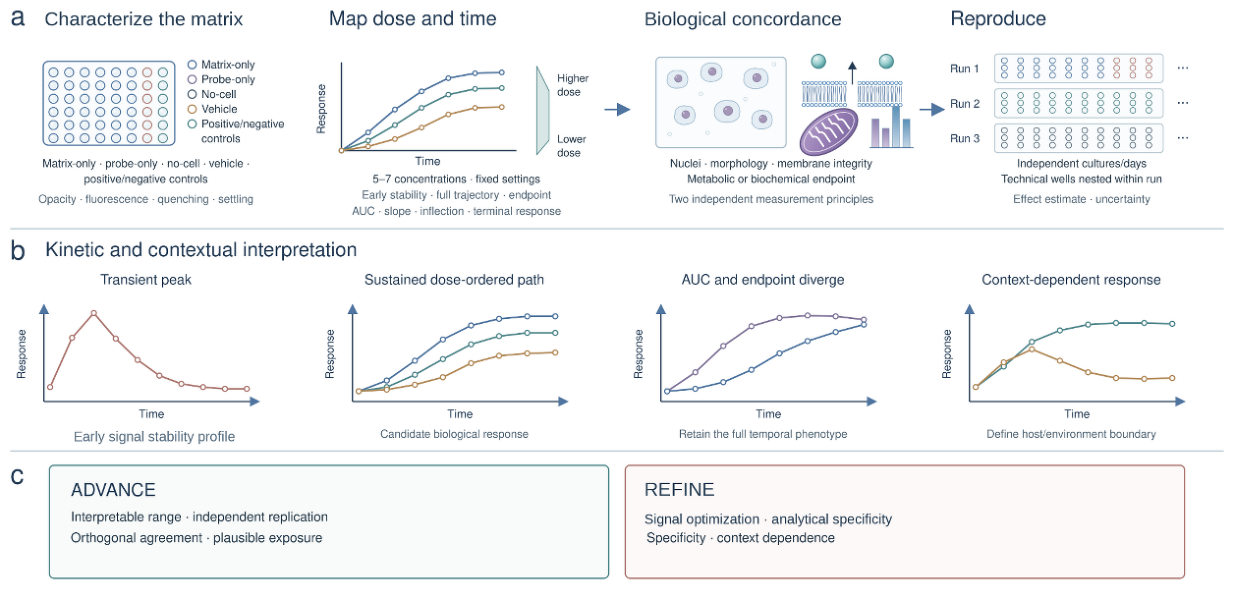
Table 6.
Staged experimental development program for a complex oral matrix.
| Stage | Core work | Advance criterion | Optimization action |
|---|---|---|---|
| Product control | Identity, uniformity, contaminants, stability and use conditions | Lot meets a fit-for-purpose specification | Re-establish comparability across units, preparation, and storage |
| Analytical compatibility | Matrix blanks, spike recovery, dilution linearity, no-cell and reporter controls, and time-zero stability | Signal remains specific and interpretable across the intended range | Optimize matrix-reporter conditions or analytical platform |
| Oral transformation | Standardized digestion, recovery, bioaccessibility and microbial fate where relevant | Relevant species and plausible exposure range are defined | Refine formulation or exposure hypothesis around the species generated |
| Mechanistic testing | At least 5 to 7 concentrations, justified ratios, independent experiments, target engagement and orthogonal endpoints | Prespecified mechanism, exposure window and phenotype reproduce | Expand dose range, replication, or endpoint depth to strengthen reproducibility |
| Exposure confirmation | Finished-product pharmacokinetics or validated local or systemic biomarker | Target species reaches the relevant compartment | Optimize formulation, regimen, or biomarker strategy |
| Human evaluation | Tolerability, adherence, predefined clinical or functional outcome and safety monitoring | Benefit-risk is acceptable in the intended population | Optimize adherence, regimen, population selection, or endpoint alignment |
10. Clinical Translation and Precision Nutrition
10.1. Defining the Population and Expected Responder
Nutrition responses are heterogeneous because people differ in baseline status, diet, genetics, microbiome, disease burden, medications, sleep, activity, and adherence. Precision nutrition seeks to explain and use this heterogeneity rather than average it away [105,106]. For a multicomponent supplement, the intended responder is defined biologically. Examples include people with low baseline intake, a measured deficiency, high inflammatory burden, impaired barrier function, or a defined performance demand.
Baseline characterization separates deficiency correction from supplementation of replete participants. Prespecified biomarker-based stratification preserves subgroup-specific response patterns across biologically distinct populations.
10.2. Biomarkers and Exposure
Biomarker interpretation assigns each measurement to a defined role: intake, exposure, target engagement, or response. Plasma metabolites establish ingestion and systemic exposure, while convergent functional and physiological markers characterize downstream response. Current precision-nutrition work reinforces the use of validated biomarkers and explicit links between measurement and inference [107,108].
Finished-product pharmacokinetics are especially important when the formulation is designed to improve delivery or when components may alter each other's exposure. A small early-phase study can measure parent compounds, metabolites, safety, tolerability, and candidate target-engagement markers before a larger efficacy trial. This sequence confirms biologically relevant exposure before progression to larger outcome studies and improves development efficiency.
10.3. Trial Design for Multicomponent Products
The primary clinical question should match the development stage. Early trials can establish tolerability, adherence, exposure, and biomarker responsiveness. Later trials are structured around a prespecified primary endpoint, an appropriate control, justified duration, and adequate statistical power. If the product is intended as an adjunct to standard care, concomitant treatment is maintained stable and documented.
Factorial designs can estimate the contribution of major modules, but they become unwieldy as component count rises. Adaptive or sequential strategies may be more practical: first compare the full system with control, then evaluate critical modules or ratios when the full system shows a reproducible signal. Dismantling studies can clarify whether complexity adds value, while avoiding the assumption that every component is necessary.
Adherence deserves direct measurement because multidosing and reconstitution can reduce real-world exposure. Packaging counts, electronic monitoring, intake diaries, and exposure biomarkers provide complementary information. Adherence data are interpreted alongside intention-to-treat and per-protocol analyses to determine how faithfully the study achieved the intended exposure and how the regimen is likely to perform in practice.
10.4. Safety and Interaction Surveillance
Safety assessment integrates cumulative micronutrient intake, medication interactions, allergy profile, and renal or hepatic function where relevant. Observation duration is matched to intended use, with longer follow-up for chronic regimens than for exercise-associated or short-recovery applications. Pregnant individuals, older adults, patients with organ impairment, and people receiving anticoagulants or immunomodulatory treatment benefit from population-specific eligibility criteria, monitoring, or dedicated evaluation [31,36].
Post-market surveillance is important because uncommon events and use outside trial conditions may emerge only after broader exposure. Lot traceability and retained samples help investigate signals. Transparent reporting of formulation, lot, adherence, concomitant products, and temporal association supports meaningful causality assessment.
10.5. Host-Conditioned Absorptive, Metabolic, and Eliminative Capacity
Host physiology modulates the exposure generated by a given formulation and schedule. Achlorhydria, malabsorption, inflammatory bowel disease, bariatric surgery, altered bile delivery, dysbiosis, renal impairment, hepatic dysfunction, polypharmacy, and age-related physiological change can modify release, uptake, transformation, distribution, or elimination. These conditions may move either boundary of the rational dose window: the lower boundary can rise when absorption is impaired, while the upper boundary can fall when clearance or tolerance is reduced.
Host-conditioned exposure is implemented through protocol-defined adaptation and monitoring. Protocols prespecify clinically relevant host variables, identify how each variable modifies the mechanistic chain, and select among formulation adjustment, regimen adjustment, additional monitoring, or dedicated population-specific evaluation. Component selection is similarly bidirectional: inclusion and omission are both active design decisions. Components are prioritized when they add distinct, exposure-plausible function and de-emphasized when they add redundancy, competition, tolerability burden, or disproportionate monitoring complexity. Reporting these decisions makes formulation logic reproducible and keeps the architecture focused on incremental biological value.
Figure 5.
From labeled dose to host-conditioned effective exposure. Release, digestion, absorption, binding, tissue delivery, and target engagement transform nominal input into biologically relevant exposure. The rational dose window integrates reproducible target engagement with saturation behavior, component interactions, tolerability, clearance capacity, and applicable upper intake levels.
11. Regulatory Translation and Evidence-Aligned Scientific Communication
Regulatory status varies by jurisdiction, while product evaluation consistently separates ingredient permissibility, manufacturing quality, labeling, and evidence for finished-product benefit [1]. This layered view allows regulatory efficiency and scientific rigor to operate together.
Scientific statements are aligned with the highest evidence stage reached by the exact product. Compositional analysis characterizes what the product contains; digestion studies characterize release and bioaccessibility; target-engagement studies characterize mechanism; and controlled human studies characterize population-specific outcomes. Population, dose, formulation, comparator, and duration define the scope of each conclusion.
Mechanistic language is strongest when terms such as supports, optimizes, balances, detoxifies, or boosts are linked to a measurable function and a defined evidence stage. This approach clearly distinguishes correction of deficiency, restoration of function, and enhancement beyond baseline physiology.
Proprietary protection and scientific reproducibility coexist when the publication identifies the test article consistently, describes relevant compositional families and quality controls, and provides sufficient information to judge exposure and reproduce the reported procedures. Manufacturing trade secrets can remain confidential while every public claim remains anchored to reproducible public evidence.
Table 7.
Evidence-aligned scientific communication across evidence stages.
| Evidence available | Evidence-aligned wording | Scope of interpretation |
|---|---|---|
| Composition and quality only | Contains specified components and meets defined release criteria | Product composition and release quality |
| Digestion or bioaccessibility study | Releases or retains specified compounds under the tested digestion conditions | Bioaccessibility under the tested digestion conditions |
| Exposure study | Increases measured exposure to specified species under the tested conditions | Measured exposure to specified species |
| Cellular target engagement | Modulates the measured pathway in the stated model and exposure range | Mechanistic modulation in the stated model and exposure range |
| Replicated functional model | Produces a reproducible preclinical functional response in the stated model | Reproducible preclinical function in the stated model |
| Controlled human trial | Produces the prespecified outcome in the tested population and regimen | Outcome in the tested population, formulation, dose, and duration |
12. Translational Roadmap for Mechanism-Oriented Nutraceutical Systems
The framework establishes eight operational standards for the development of multicomponent dietary supplements.
First, finished-product identity is the starting point of every study. Master formula, lot release, stability, preparation, and actual exposure form a continuous traceability chain. Ingredient identity becomes scientifically informative within this product-level chain.
Second, oral products are evaluated after physiologically relevant transformation. Standardized digestion, bioaccessible-fraction testing, microbial metabolism, and finished-product pharmacokinetics connect nominal dose with effective exposure.
Third, combination logic is defined through modular formulation hypotheses, dose-ratio matrices, and prespecified interaction models. Additive, synergistic, antagonistic, and context-dependent patterns all contribute actionable design information.
Fourth, analytical compatibility is embedded at the start of biological testing. Controls for optical, fluorescent, chemical, temporal, and segmentation behavior, together with concentration-response data, independent replication, and orthogonal endpoints, establish a high-confidence mechanistic platform.
Fifth, temporal organization is evaluated as an intervention variable. Morning-evening separation, meal timing, and exercise timing are compared with simpler schedules while total dose remains constant.
Sixth, clinical development defines the responder, verifies exposure, and aligns biomarkers with mechanism. Precision nutrition narrows the hypothesis, identifies likely responders, and converts host states affecting absorption, metabolism, tolerance, or clearance into prespecified adaptation, monitoring, and population-specific evaluation strategies [105,109].
Seventh, dose development defines a rational window, integrates total intake with applicable upper limits, tests component ratios, characterizes exposure plateaus and tolerability, and documents deliberate component selection. Dose de-escalation and component-removal studies complement escalation studies by defining the most efficient formulation architecture.
Finally, data packages preserve full-response patterns, boundary conditions, and formulation-context relationships as part of the product-development record. This cumulative knowledge accelerates iteration, strengthens interpretation of subsequent findings, and improves reproducibility across the nutraceutical evidence base.
Supplementary Table S5 consolidates the minimum reporting items for finished multicomponent products across analytical, preclinical, and clinical stages.
13. Conclusions
Multicomponent dietary supplements are evaluated as finished physicochemical and biological systems. Isolated-ingredient evidence supplies formulation rationale; finished-product evidence establishes how the matrix is digested, absorbed, distributed, measured, and experienced by a defined population. Formulation quality is therefore determined by characterized exposure and reproducible function rather than by ingredient count or labeled milligrams.
The evidence-progression framework presented here links six levels: identity, gastrointestinal transformation, site-relevant exposure, target engagement, reproducible phenotype, and human outcome with safety. Analytical validity crosses every level. The four mechanistic domains provide a practical way to organize hypotheses, while matrix, dose, host state, and time determine whether the proposed nodes experience an appropriate exposure. A rational dose window integrates a lower boundary of plausible engagement with an upper boundary defined by saturation, competition, tolerability, interaction, clearance capacity, and applicable intake limits.
This approach changes the central development question. Instead of asking only whether each ingredient has a favorable mechanism somewhere in the literature, investigators ask what to provide, how much to provide, how to provide it, what to prioritize or omit, and how coherently the finished formulation progresses across each evidence stage under conditions relevant to intended use. This shift connects mechanistic ambition with reproducibility, tolerability, translational efficiency, and clinical relevance.
Supplementary Materials
The following supporting information can be downloaded at the website of this paper post-ed on Preprints.org.
Author Contributions
Conceptualization, R.G.-S.; methodology, R.G.-S., F.G.-C. and N.M.-G.; literature investigation and evidence curation, R.G.-S., F.G.-C., P.H.-L., N.M.-G., A.L., J.I., F.K., I.M. and R.G.-P.; resources, R.G.-P. and A.T.; writing—original draft preparation, R.G.-S.; writing—review and editing, R.G.-S., F.G.-C., P.H.-L., N.M.-G., A.L., J.I., F.K., I.M., R.G.-P. and A.T.; visualization, R.G.-S., P.H.-L. and A.T.; supervision, R.G.-S.; project administration, R.G.-S., R.G.-P. and A.T.; funding acquisition, R.G.-S. All authors have read and agreed to the published version of the manuscript.
Funding
No external funding was received for the preparation of this review. The Article Processing Charge was funded by Biogenica Foundation.
Institutional Review Board Statement
Not applicable. This review synthesizes previously published literature and publicly available regulatory and methodological guidance.
Informed Consent Statement
Not applicable.
Data Availability Statement
No original experimental or clinical datasets were generated for this review. The literature-search strategy and supporting methodological materials are provided in the article and Supplementary Materials.
Acknowledgments
AI-assisted tools were used for editorial support during manuscript preparation. All content was critically reviewed and approved by the authors, who take full responsibility for the integrity and content of this publication.
Conflicts of Interest
Some authors are affiliated with OGRD Alliance LLC or collaborating entities engaged in nutraceutical research, formulation science, and translational development. Biogenica Foundation funded the Article Processing Charge. The funder had no role in literature selection, evidence synthesis, interpretation, manuscript preparation, or the decision to submit the work for publication.
Abbreviations
| Abbreviation | Definition |
| ADP | adenosine diphosphate |
| AM | morning administration period |
| ATP | adenosine triphosphate |
| AUC | area under the curve |
| ECAR | extracellular acidification rate |
| ECM | extracellular matrix |
| GSH | reduced glutathione |
| GSSG | oxidized glutathione |
| HSA | highest single agent |
| INFOGEST | internationally harmonized framework for standardized in vitro gastrointestinal digestion |
| KEAP1 | Kelch-like ECH-associated protein 1 |
| NAD+/NADH | oxidized/reduced nicotinamide adenine dinucleotide redox couple |
| NADP+/NADPH | oxidized/reduced nicotinamide adenine dinucleotide phosphate redox couple |
| NRF2 | nuclear factor erythroid 2-related factor 2 |
| OCR | oxygen consumption rate |
| PM | evening administration period |
| SCFA | short-chain fatty acid |
| TEER | transepithelial electrical resistance |
| UL | tolerable upper intake level |
| ZIP | zero interaction potency |
| ΔΨm | mitochondrial membrane potential |
References
- Coates, P.M.; Bailey, R.L.; Blumberg, J.B.; El-Sohemy, A.; Floyd, E.; Goldenberg, J.Z.; Gould Shunney, A.; Holscher, H.D.; Nkrumah-Elie, Y.; Rai, D.; et al. The Evolution of Science and Regulation of Dietary Supplements: Past, Present, and Future. J. Nutr. 2024, 154, 2335–2345. [Google Scholar] [CrossRef] [PubMed]
- Kreider, R.B.; Jäger, R.; Purpura, M. Bioavailability, Efficacy, Safety, and Regulatory Status of Creatine and Related Compounds: A Critical Review. Nutrients 2022, 14, 1035. [Google Scholar] [CrossRef] [PubMed]
- Capuano, E.; Janssen, A.E.M. Food Matrix and Macronutrient Digestion. Annu. Rev. Food Sci. Technol. 2021, 12, 193–212. [Google Scholar] [CrossRef] [PubMed]
- Núñez-Gómez, V.; González-Barrio, R.; Periago, M.J. Interaction between Dietary Fibre and Bioactive Compounds in Plant By-Products: Impact on Bioaccessibility and Bioavailability. Antioxidants 2023, 12, 976. [Google Scholar] [CrossRef] [PubMed]
- Williamson, G. Bioavailability of Food Polyphenols: Current State of Knowledge. Annu. Rev. Food Sci. Technol. 2025, 16, 315–332. [Google Scholar] [CrossRef] [PubMed]
- Di Lorenzo, C.; Colombo, F.; Biella, S.; Stockley, C.; Restani, P. Polyphenols and Human Health: The Role of Bioavailability. Nutrients 2021, 13, 273. [Google Scholar] [CrossRef] [PubMed]
- Luca, S.V.; Macovei, I.; Bujor, A.; Miron, A.; Skalicka-Woźniak, K.; Aprotosoaie, A.C.; Trifan, A. Bioactivity of dietary polyphenols: The role of metabolites. Crit. Rev. Food Sci. Nutr. 2020, 60, 626–659. [Google Scholar] [CrossRef] [PubMed]
- El-Saadony, M.T.; Yang, T.; Saad, A.M.; Alkafaas, S.S.; Elkafas, S.S.; Eldeeb, G.S.; Mohammed, D.M.; Salem, H.M.; Korma, S.A.; Loutfy, S.A.; et al. Polyphenols: Chemistry, bioavailability, bioactivity, nutritional aspects and human health benefits: A review. Int. J. Biol. Macromol. 2024, 277, 134223. [Google Scholar] [CrossRef] [PubMed]
- Einhorn, V.; Haase, H.; Maares, M. Interaction and competition for intestinal absorption by zinc, iron, copper, and manganese at the intestinal mucus layer. J. Trace Elem. Med. Biol. 2024, 84, 127459. [Google Scholar] [CrossRef] [PubMed]
- Sadowska-Bartosz, I.; Bartosz, G. Interactions Between Antioxidants: How Useful Are In Vitro Studies for Understanding the Action of Antioxidants in Complex Systems? Int. J. Mol. Sci. 2026, 27, 7491. [Google Scholar] [CrossRef] [PubMed]
- Ianevski, A.; Giri, A.K.; Aittokallio, T. SynergyFinder 3.0: An interactive analysis and consensus interpretation of multi-drug synergies across multiple samples. Nucleic Acids Res. 2022, 50, W739–W743. [Google Scholar] [CrossRef] [PubMed]
- Oracz, J.; Nebesny, E.; Zyzelewicz, D.; Budryn, G.; Luzak, B. Bioavailability and metabolism of selected cocoa bioactive compounds: A comprehensive review. Crit. Rev. Food Sci. Nutr. 2020, 60, 1947–1985. [Google Scholar] [CrossRef] [PubMed]
- Anghel, A.-M.; Enachi, E.; Cristea, A.-G.; Bălănescu, F.; Cioancă, O.; Hăncianu, M.; Robu, S. Tomato-Derived Lycopene: From Phytochemistry and Extraction Technologies to Bioavailability and Nutraceutical Applications. Molecules 2026, 31, 2243. [Google Scholar] [CrossRef] [PubMed]
- Schön, C.; Micka, A.; Menzel, D.; Wilhelm, M.; Obeid, R. Pharmacokinetics of (6S)-5-Methyltetrahydrofolate dicholine salt compared to folic acid: a randomized double-blind single dose cross-over study. Food Nutr. Res. 2025, 69, 12633. [Google Scholar] [CrossRef] [PubMed]
- Mendes, M.B.; Rodrigues, G.G.G.; Sad, M.E.L.d.S.; dos Santos, G.F.P.; da Costa, J.d.C. Methodological Modifications of the INFOGEST 2.0 Protocol in Plant-Based Food Studies: A Systematic Review. J. Food Sci. 2026, 91, e71356. [Google Scholar] [CrossRef] [PubMed]
- Egger, L.; Blanco-Doval, A.; Sousa, R.; Brügger, C.; Binz, E.; Brodkorb, A.; Dupont, D.; Recio, I.; Portmann, R. INFOGEST Quant: standardized in vitro determination of digestibility and DIAAS of dietary proteins based on the INFOGEST static digestion model. Nat. Protoc. 2026, 21, 1869–1895. [Google Scholar] [CrossRef] [PubMed]
- Zhou, H.; Tan, Y.; McClements, D.J. Applications of the INFOGEST In Vitro Digestion Model to Foods: A Review. Annu. Rev. Food Sci. Technol. 2023, 14, 135–156. [Google Scholar] [CrossRef] [PubMed]
- Wang, J.; Aalaei, K.; Skibsted, L.H.; Ahrné, L.M. Calcium bioaccessibility increased during gastrointestinal digestion of α-lactalbumin and β-lactoglobulin. Food Res. Int. 2023, 164, 112415. [Google Scholar] [CrossRef] [PubMed]
- Vital, N.; Gramacho, A.C.; Silva, M.; Cardoso, M.; Alvito, P.; Kranendonk, M.; Silva, M.J.; Louro, H. Challenges of the Application of In Vitro Digestion for Nanomaterials Safety Assessment. Foods 2024, 13, 1690. [Google Scholar] [CrossRef] [PubMed]
- Xavier, A.A.O.; Mercadante, A.Z. A guide for the evaluation of in vitro bioaccessibility of carotenoids. Methods Enzymol. 2022, 674, 297–327. [Google Scholar] [CrossRef] [PubMed]
- Kondrashina, A.; Arranz, E.; Cilla, A.; Faria, M.A.; Santos-Hernández, M.; Miralles, B.; Hashemi, N.; Rasmussen, M.K.; Young, J.F.; Barberá, R.; et al. Coupling in vitro food digestion with in vitro epithelial absorption; recommendations for biocompatibility. Crit. Rev. Food Sci. Nutr. 2024, 64, 9618–9636. [Google Scholar] [CrossRef] [PubMed]
- Ośko, J.; Nasierowska, K.; Grembecka, M. Application of in vitro digestion models in the evaluation of dietary supplements. Foods 2024, 13, 2135. [Google Scholar] [CrossRef] [PubMed]
- Singh, A.R.; Desu, P.K.; Nakkala, R.K.; Kondi, V.; Devi, S.; Alam, M.S.; Hamid, H.; Athawale, R.B.; Kesharwani, P. Nanotechnology-based approaches applied to nutraceuticals. Drug Deliv. Transl. Res. 2022, 12, 485–499. [Google Scholar] [CrossRef] [PubMed]
- Rudzińska, M.; Grygier, A.; Knight, G.; Kmiecik, D. Liposomes as Carriers of Bioactive Compounds in Human Nutrition. Foods 2024, 13, 1814. [Google Scholar] [CrossRef] [PubMed]
- Ahmad, R.; Srivastava, S.; Ghosh, S.; Khare, S.K. Phytochemical delivery through nanocarriers: a review. Colloids Surf. B Biointerfaces 2021, 197, 111389. [Google Scholar] [CrossRef] [PubMed]
- Coelho, S.C.; Estevinho, B.N.; Rocha, F. Recent Advances in Water-Soluble Vitamins Delivery Systems Prepared by Mechanical Processes (Electrospinning and Spray-Drying Techniques) for Food and Nutraceuticals Applications—A Review. Foods 2022, 11, 1271. [Google Scholar] [CrossRef] [PubMed]
- Lüdtke, F.L.; Silva, T.J.; da Silva, M.G.; Hashimoto, J.C.; Ribeiro, A.P.B. Lipid Nanoparticles: Formulation, Production Methods and Characterization Protocols. Foods 2025, 14, 973. [Google Scholar] [CrossRef] [PubMed]
- Önal Acet, B.; Gül, D.; Stauber, R.H.; Odabaşı, M.; Acet, Ö. A Review for Uncovering the "Protein-Nanoparticle Alliance": Implications of the Protein Corona for Biomedical Applications. Nanomaterials 2024, 14, 823. [Google Scholar] [CrossRef] [PubMed]
- Kolli, A.R. Deriving protein binding-corrected chemical concentrations for in vitro testing. Clin. Transl. Sci. 2023, 16, 2123–2129. [Google Scholar] [CrossRef] [PubMed]
- Weaver, C.M.; Armah, S.; Bruno, R.S.; Fletcher, A.; Glahn, R.; Herter-Aeberli, I.; Karosas, T.; Loechl, C.U.; Lopez-Teros, V.; McBurney, M.I.; et al. Perspective: Framework for Developing Prediction Equations for Estimating the Absorption and Bioavailability of Nutrients from Foods. Adv. Nutr. 2025, 16, 100481. [Google Scholar] [CrossRef] [PubMed]
- Lepp, H.-L.; Amrein, K.; Dizdar, O.S.; Casaer, M.P.; Gundogan, K.; de Man, A.M.E.; Rezzi, S.; van Zanten, A.R.H.; Shenkin, A.; Berger, M.M.; et al. LLL 44 - Module 3: Micronutrients in chronic disease. Clin. Nutr. ESPEN 2024, 62, 285–295. [Google Scholar] [CrossRef] [PubMed]
- Amrein, K.; de Man, A.M.E.; Dizdar, O.S.; Gundogan, K.; Casaer, M.P.; Lepp, H.-L.; Rezzi, S.; van Zanten, A.R.H.; Shenkin, A.; Berger, M.M.; et al. LLL 44 - 2 - Micronutrients in clinical nutrition: Vitamins. Clin. Nutr. ESPEN 2024, 61, 427–436. [Google Scholar] [CrossRef] [PubMed]
- EFSA Panel on Nutrition; Novel Foods and Food Allergens. Guidance for establishing and applying tolerable upper intake levels for vitamins and essential minerals. EFSA J. 2024, 22, e9052. [Google Scholar] [CrossRef] [PubMed]
- EFSA Panel on Nutrition; Novel Foods and Food Allergens. Scientific opinion on the tolerable upper intake level for vitamin B6. EFSA J. 2023, 21, e08006. [Google Scholar] [CrossRef] [PubMed]
- Miller, J.W.; Smith, A.; Troen, A.M.; Mason, J.B.; Jacques, P.F.; Selhub, J. Excess Folic Acid and Vitamin B12 Deficiency: Clinical Implications? Food Nutr. Bull. 2024, 45, S67–S72. [Google Scholar] [CrossRef] [PubMed]
- Jaqua, E.E.; Gonzalez, J.; Bahjri, K.; Erickson, S.; Garcia, C.; Santhavachart, M.; Nguyen, V.; Labib, W.; Abdrabou, R. Analyzing Potential Interactions Between Complementary and Alternative Therapies, Over-the-Counter, and Prescription Medications in the Older Population. Perm. J. 2024, 28, 70–77. [Google Scholar] [CrossRef] [PubMed]
- Shahidi, F.; Samarasinghe, A. How to assess antioxidant activity? Advances, limitations, and applications of in vitro, in vivo, and ex vivo approaches. Food Prod. Process. Nutr. 2025, 7, 50. [Google Scholar] [CrossRef] [PubMed]
- Panknin, T.M.; Howe, C.L.; Hauer, M.; Bucchireddigari, B.; Rossi, A.M.; Funk, J.L. Curcumin Supplementation and Human Disease: A Scoping Review of Clinical Trials. Int. J. Mol. Sci. 2023, 24, 4476. [Google Scholar] [CrossRef] [PubMed]
- Sun, J.-N.; Yang, R.; Fang, L.; Li, Y.-J.; Xing, W.-Y.; Sun, M.-L.; Wu, L.; Wu, Q.-J.; Gong, T.-T. Effects of resveratrol supplementation on multiple health outcomes: an umbrella review of systematic reviews and meta-analyses of randomized controlled trials. Nutr. J. 2026, 25, 63. [Google Scholar] [CrossRef] [PubMed]
- Liu, S.; Liu, J.; He, L.; Liu, L.; Cheng, B.; Zhou, F.; Cao, D.; He, Y. A Comprehensive Review on the Benefits and Problems of Curcumin with Respect to Human Health. Molecules 2022, 27, 4400. [Google Scholar] [CrossRef] [PubMed]
- Philips, C.A.; Valsan, A.; Theruvath, A.H.; Ravindran, R.; Oommen, T.T.; Rajesh, S.; Bishnu, S.; Augustine, P.; Liver Research Club India. Ashwagandha-induced liver injury—A case series from India and literature review. Hepatol. Commun. 2023, 7, e0270. [Google Scholar] [CrossRef] [PubMed]
- Martel, J.; Chang, S.H.; Ko, Y.F.; Hwang, T.L.; Young, J.D.; Ojcius, D.M. Gut barrier disruption and chronic disease. Trends Endocrinol. Metab. 2022, 33, 247–265. [Google Scholar] [CrossRef] [PubMed]
- Dmytriv, T.R.; Storey, K.B.; Lushchak, V.I. Intestinal barrier permeability: the influence of gut microbiota, nutrition, and exercise. Front. Physiol. 2024, 15, 1380713. [Google Scholar] [CrossRef] [PubMed]
- Matar, A.; Damianos, J.A.; Jencks, K.J.; Camilleri, M. Intestinal Barrier Impairment, Preservation, and Repair: An Update. Nutrients 2024, 16, 3494. [Google Scholar] [CrossRef] [PubMed]
- Tan, J.K.; Macia, L.; Mackay, C.R. Dietary fiber and SCFAs in the regulation of mucosal immunity. J. Allergy Clin. Immunol. 2023, 151, 361–370. [Google Scholar] [CrossRef] [PubMed]
- Ghosh, S.; Whitley, C.S.; Haribabu, B.; Jala, V.R. Regulation of Intestinal Barrier Function by Microbial Metabolites. Cell. Mol. Gastroenterol. Hepatol. 2021, 11, 1463–1482. [Google Scholar] [CrossRef] [PubMed]
- Guan, X.; Li, W.; Meng, H. A double-edged sword: Role of butyrate in the oral cavity and the gut. Mol. Oral Microbiol. 2021, 36, 121–131. [Google Scholar] [CrossRef] [PubMed]
- Yoo, S.; Jung, S.C.; Kwak, K.; Kim, J.S. The Role of Prebiotics in Modulating Gut Microbiota: Implications for Human Health. Int. J. Mol. Sci. 2024, 25, 4834. [Google Scholar] [CrossRef] [PubMed]
- Smolinska, S.; Popescu, F.D.; Zemelka-Wiacek, M. A Review of the Influence of Prebiotics, Probiotics, Synbiotics, and Postbiotics on the Human Gut Microbiome and Intestinal Integrity. J. Clin. Med. 2025, 14, 3673. [Google Scholar] [CrossRef] [PubMed]
- Li, H.Y.; Zhou, D.D.; Gan, R.Y.; Huang, S.Y.; Zhao, C.N.; Shang, A.; Xu, X.Y.; Li, H.B. Effects and Mechanisms of Probiotics, Prebiotics, Synbiotics, and Postbiotics on Metabolic Diseases Targeting Gut Microbiota: A Narrative Review. Nutrients 2021, 13, 3211. [Google Scholar] [CrossRef] [PubMed]
- Cheng, H.; Zhang, D.; Wu, J.; Liu, J.; Zhou, Y.; Tan, Y.; Feng, W.; Peng, C. Interactions between gut microbiota and polyphenols: A mechanistic and metabolomic review. Phytomedicine 2023, 119, 154979. [Google Scholar] [CrossRef] [PubMed]
- García-Villalba, R.; Giménez-Bastida, J.A.; Cortés-Martín, A.; Ávila-Gálvez, M.Á.; Tomás-Barberán, F.A.; Selma, M.V.; Espín, J.C.; González-Sarrías, A. Urolithins: a Comprehensive Update on their Metabolism, Bioactivity, and Associated Gut Microbiota. Mol. Nutr. Food Res. 2022, 66, e2101019. [Google Scholar] [CrossRef] [PubMed]
- Eggersdorfer, M.; Berger, M.M.; Calder, P.C.; Gombart, A.F.; Ho, E.; Laviano, A.; Meydani, S.N. Perspective: Role of Micronutrients and Omega-3 Long-Chain Polyunsaturated Fatty Acids for Immune Outcomes of Relevance to Infections in Older Adults—A Narrative Review and Call for Action. Adv. Nutr. 2022, 13, 1415–1430. [Google Scholar] [CrossRef] [PubMed]
- Gombart, A.F.; Pierre, A.; Maggini, S. A Review of Micronutrients and the Immune System-Working in Harmony to Reduce the Risk of Infection. Nutrients 2020, 12, 236. [Google Scholar] [CrossRef] [PubMed]
- Munteanu, C.; Schwartz, B. The relationship between nutrition and the immune system. Front. Nutr. 2022, 9, 1082500. [Google Scholar] [CrossRef] [PubMed]
- Luchkova, A.; Mata, A.; Cadenas, S. Nrf2 as a regulator of energy metabolism and mitochondrial function. FEBS Lett. 2024, 598, 2092–2105. [Google Scholar] [CrossRef] [PubMed]
- Murakami, S.; Kusano, Y.; Okazaki, K.; Akaike, T.; Motohashi, H. NRF2 signalling in cytoprotection and metabolism. Br. J. Pharmacol. 2026, 183, 101–114. [Google Scholar] [CrossRef] [PubMed]
- Bhattacharjee, S.; Dashwood, R.H. Epigenetic Regulation of NRF2/KEAP1 by Phytochemicals. Antioxidants 2020, 9, 865. [Google Scholar] [CrossRef] [PubMed]
- Koju, N.; Qin, Z.H.; Sheng, R. Reduced nicotinamide adenine dinucleotide phosphate in redox balance and diseases: A friend or foe? Acta Pharmacol. Sin. 2022, 43, 1889–1904. [Google Scholar] [CrossRef] [PubMed]
- Zapata-Pérez, R.; Wanders, R.J.A.; van Karnebeek, C.D.M.; Houtkooper, R.H. NAD+ homeostasis in human health and disease. EMBO Mol. Med. 2021, 13, e13943. [Google Scholar] [CrossRef] [PubMed]
- Liu, G.; Li, B.; Qin, S.; Nice, E.C.; Yang, J.; Yang, L.; Huang, C. Redox signaling-mediated tumor extracellular matrix remodeling: pleiotropic regulatory mechanisms. Cell. Oncol. 2024, 47, 429–445. [Google Scholar] [CrossRef] [PubMed]
- Cai, Z.; Gong, Z.; Li, Z.; Li, L.; Kong, W. Vascular Extracellular Matrix Remodeling and Hypertension. Antioxid. Redox Signal. 2021, 34, 765–783. [Google Scholar] [CrossRef] [PubMed]
- Zong, Y.; Li, H.; Liao, P.; Chen, L.; Pan, Y.; Zheng, Y.; Zhang, C.; Liu, D.; Zheng, M.; Gao, J. Mitochondrial dysfunction: mechanisms and advances in therapy. Signal Transduct. Target. Ther. 2024, 9, 124. [Google Scholar] [CrossRef] [PubMed]
- Bonilla, D.A.; Kreider, R.B.; Stout, J.R.; Forero, D.A.; Kerksick, C.M.; Roberts, M.D.; Rawson, E.S. Metabolic Basis of Creatine in Health and Disease: A Bioinformatics-Assisted Review. Nutrients 2021, 13, 1238. [Google Scholar] [CrossRef] [PubMed]
- Kreider, R.B.; Stout, J.R. Creatine in Health and Disease. Nutrients 2021, 13, 447. [Google Scholar] [CrossRef] [PubMed]
- Xiang, F.; Zhang, Z.; Xie, J.; Xiong, S.; Yang, C.; Liao, D.; Xia, B.; Lin, L. Comprehensive review of the expanding roles of the carnitine pool in metabolic physiology: beyond fatty acid oxidation. J. Transl. Med. 2025, 23, 324. [Google Scholar] [CrossRef] [PubMed]
- Mantle, D.; Hargreaves, I.P. Coenzyme Q10 and Autoimmune Disorders: An Overview. Int. J. Mol. Sci. 2024, 25, 4576. [Google Scholar] [CrossRef] [PubMed]
- Schwarz, C.; Benson, G.S.; Horn, N.; Wurdack, K.; Grittner, U.; Schilling, R.; Märschenz, S.; Köbe, T.; Hofer, S.J.; Magnes, C.; et al. Effects of Spermidine Supplementation on Cognition and Biomarkers in Older Adults With Subjective Cognitive Decline: A Randomized Clinical Trial. JAMA Netw. Open 2022, 5, e2213875. [Google Scholar] [PubMed]
- Virk, R.; Cook, K.; Cavazos, A.; Wassall, S.R.; Gowdy, K.M.; Shaikh, S.R. How Membrane Phospholipids Containing Long-Chain Polyunsaturated Fatty Acids and Their Oxidation Products Orchestrate Lipid Raft Dynamics to Control Inflammation. J. Nutr. 2024, 154, 2862–2870. [Google Scholar] [CrossRef] [PubMed]
- Davies, E.M.; Mitchell, C.A.; Stenmark, H.A. Phosphoinositides in New Spaces. Cold Spring Harb. Perspect. Biol. 2023, 15, a041406. [Google Scholar] [CrossRef] [PubMed]
- Gutiérrez-Sandoval, R.; Gutiérrez-Castro, F.; Muñoz-Godoy, N.; Rivadeneira, I.; Lagos, A.; Iturra, J.; Krakowiak, F.; Peña-Vargas, C.; Vidal, M.; Toledo, A. Structural Determinants and Repair of Membrane Microdomains in Dendritic Cell-Mediated Antitumor Immunity: An Integrative Mechanistic Synthesis. Int. J. Mol. Sci. 2026, 27, 2305. [Google Scholar] [CrossRef] [PubMed]
- Lim, S.A.; Su, W.; Chapman, N.M.; Chi, H. Lipid metabolism in T cell signaling and function. Nat. Chem. Biol. 2022, 18, 470–481. [Google Scholar] [CrossRef] [PubMed]
- Al-Shaer, A.E.; Buddenbaum, N.; Shaikh, S.R. Polyunsaturated fatty acids, specialized pro-resolving mediators, and targeting inflammation resolution in the age of precision nutrition. Biochim. Biophys. Acta Mol. Cell Biol. Lipids 2021, 1866, 158936. [Google Scholar] [CrossRef] [PubMed]
- Albillos, A.; de Gottardi, A.; Rescigno, M. The gut-liver axis in liver disease: Pathophysiological basis for therapy. J. Hepatol. 2020, 72, 558–577. [Google Scholar] [CrossRef] [PubMed]
- Yuan, H.; Zhou, J.; Li, H.; Kang, S.; Park, S. A systems biology approach to memory health: Integrating network pharmacology, gut microbiota, and multi-omics for health functional foods. Int. J. Mol. Sci. 2025, 26, 6698. [Google Scholar] [CrossRef] [PubMed]
- Keijer, J.; Escoté, X.; Galmés, S.; Palou-March, A.; Serra, F.; Aldubayan, M.A.; Pigsborg, K.; Magkos, F.; Baker, E.J.; Calder, P.C.; et al. Omics biomarkers and an approach for their practical implementation to delineate health status for personalized nutrition strategies. Crit. Rev. Food Sci. Nutr. 2024, 64, 8279–8307. [Google Scholar] [CrossRef] [PubMed]
- Reytor-González, C.; Simancas-Racines, D.; Román-Galeano, N.M.; Annunziata, G.; Galasso, M.; Zambrano-Villacres, R.; Verde, L.; Muscogiuri, G.; Frias-Toral, E.; Barrea, L. Chrononutrition and Energy Balance: How Meal Timing and Circadian Rhythms Shape Weight Regulation and Metabolic Health. Nutrients 2025, 17, 2135. [Google Scholar] [CrossRef] [PubMed]
- Franzago, M.; Alessandrelli, E.; Notarangelo, S.; Stuppia, L.; Vitacolonna, E. Chrono-Nutrition: Circadian Rhythm and Personalized Nutrition. Int. J. Mol. Sci. 2023, 24, 2571. [Google Scholar] [CrossRef] [PubMed]
- Adafer, R.; Messaadi, W.; Meddahi, M.; Patey, A.; Haderbache, A.; Bayen, S.; Messaadi, N. Food Timing, Circadian Rhythm and Chrononutrition: A Systematic Review of Time-Restricted Eating's Effects on Human Health. Nutrients 2020, 12, 3770. [Google Scholar] [CrossRef] [PubMed]
- Ezpeleta, M.; Cienfuegos, S.; Lin, S.; Pavlou, V.; Gabel, K.; Tussing-Humphreys, L.; Varady, K.A. Time-restricted eating: Watching the clock to treat obesity. Cell Metab. 2024, 36, 301–314. [Google Scholar] [CrossRef] [PubMed]
- Varady, K.A.; Cienfuegos, S.; Ezpeleta, M.; Gabel, K. Cardiometabolic Benefits of Intermittent Fasting. Annu. Rev. Nutr. 2021, 41, 333–361. [Google Scholar] [CrossRef] [PubMed]
- Koppold, D.A.; Breinlinger, C.; Hanslian, E.; Kessler, C.; Cramer, H.; Khokhar, A.R.; Peterson, C.M.; Tinsley, G.; Vernieri, C.; Bloomer, R.J.; et al. International consensus on fasting terminology. Cell Metab. 2024, 36, 1779–1794.e4. [Google Scholar] [CrossRef] [PubMed]
- Bird, S.P.; Nienhuis, M.; Biagioli, B.; De Pauw, K.; Meeusen, R. Supplementation Strategies for Strength and Power Athletes: Carbohydrate, Protein, and Amino Acid Ingestion. Nutrients 2024, 16, 1886. [Google Scholar] [CrossRef] [PubMed]
- Smith, H.A.; Betts, J.A. Nutrient timing and metabolic regulation. J. Physiol. 2022, 600, 1299–1312. [Google Scholar] [CrossRef] [PubMed]
- Ribeiro, F.; Longobardi, I.; Perim, P.; Duarte, B.; Ferreira, P.; Gualano, B.; Roschel, H.; Saunders, B. Timing of Creatine Supplementation around Exercise: A Real Concern? Nutrients 2021, 13, 2844. [Google Scholar] [CrossRef] [PubMed]
- Wooten, D.J.; Meyer, C.T.; Lubbock, A.L.R.; Quaranta, V.; Lopez, C.F. MuSyC is a consensus framework that unifies multi-drug synergy metrics for combinatorial drug discovery. Nat. Commun. 2021, 12, 4607. [Google Scholar] [CrossRef] [PubMed]
- Duarte, D.; Vale, N. Evaluation of synergism in drug combinations and reference models for future orientations in oncology. Curr. Res. Pharmacol. Drug Discov. 2022, 3, 100110. [Google Scholar] [CrossRef] [PubMed]
- Twarog, N.R.; Connelly, M.; Shelat, A.A. A critical evaluation of methods to interpret drug combinations. Sci. Rep. 2020, 10, 5144. [Google Scholar] [CrossRef] [PubMed]
- Tapia-Rojas, S.; García-Paitán, M.; Rosario-Chavarri, J.D.; Santiani, A.; Alvarez-Vega, S.; Amiel-Pérez, J.; Mayanga-Herrera, A. Medicinal plant extracts interfere in gastric cancer stem cells fluorescence-based assays. Saudi J. Biol. Sci. 2024, 31, 104000. [Google Scholar] [CrossRef] [PubMed]
- Martin, L.; Lopez, K.; Fritz, S.; Easterling, C.P.; Krawchuck, J.A.; Poerwoprajitno, A.R.; Xu, W. Determination of the optical interference of iron oxide nanoparticles in fluorometric cytotoxicity assays. Heliyon 2024, 10, e25378. [Google Scholar] [CrossRef] [PubMed]
- El Yamani, N.; Rundén-Pran, E.; Varet, J.; Beus, M.; Dusinska, M.; Fessard, V.; Moschini, E.; Serchi, T.; Cimpan, M.R.; Lynch, I.; et al. Hazard assessment of nanomaterials using in vitro toxicity assays: Guidance on potential assay interferences and mitigating actions to avoid biased results. Nano Today 2024, 55, 102215. [Google Scholar] [CrossRef]
- Tan, L.; Hirte, S.; Palmacci, V.; Stork, C.; Kirchmair, J. Tackling assay interference associated with small molecules. Nat. Rev. Chem. 2024, 8, 319–339. [Google Scholar] [CrossRef] [PubMed]
- Dahlin, J.L.; Auld, D.S.; Rothenaigner, I.; Haney, S.; Sexton, J.Z.; Nissink, J.W.M.; Walsh, J.; Lee, J.A.; Strelow, J.M.; Willard, F.S.; et al. Nuisance compounds in cellular assays. Cell Chem. Biol. 2021, 28, 356–370. [Google Scholar] [CrossRef] [PubMed]
- Shroff, H.; Testa, I.; Jug, F.; Manley, S. Live-cell imaging powered by computation. Nat. Rev. Mol. Cell Biol. 2024, 25, 443–463. [Google Scholar] [CrossRef] [PubMed]
- Szulczewski, J.M.; Yesilkoy, F.; Ulland, T.K.; Bartels, R.; Millis, B.A.; Boppart, S.A.; Eliceiri, K.W. To label or not: The need for validation in label-free imaging. J. Biomed. Opt. 2024, 29, S22717. [Google Scholar] [CrossRef] [PubMed]
- Mikheeva, A.M.; Bogomolov, M.A.; Gasca, V.A.; Sementsov, M.V.; Spirin, P.V.; Prassolov, V.S.; Lebedev, T.D. Improving the power of drug toxicity measurements by quantitative nuclei imaging. Cell Death Discov. 2024, 10, 181. [Google Scholar] [CrossRef] [PubMed]
- Gutiérrez-Sandoval, R.; Gutiérrez-Castro, F.; Muñoz-Godoy, N.; Rivadeneira, I.; Sobarzo, A.; Iturra, J.; Muñoz, I.; Peña-Vargas, C.; Vidal, M.; Krakowiak, F. Real-Time Functional Stratification of Tumor Cell Lines Using a Non-Cytotoxic Phospholipoproteomic Platform: A Label-Free Ex Vivo Model. Biology 2025, 14, 953. [Google Scholar] [CrossRef] [PubMed]
- Pierce, L.; Anderson, H.; Sarkar, S.; Bauer, S.R.; Sarkar, S. Experimental and computational approach to establish fit-for-purpose cell viability assays. Regen. Med. 2024, 19, 27–45. [Google Scholar] [CrossRef] [PubMed]
- Eder, K.M.; Marzi, A.; Wågbø, A.M.; Vermeulen, J.P.; de la Fonteyne-Blankestijn, L.J.J.; Rösslein, M.; Ossig, R.; Klinkenberg, G.; Vandebriel, R.J.; Schnekenburger, J. Standardization of an in vitro assay matrix to assess cytotoxicity of organic nanocarriers: A pilot interlaboratory comparison. Drug Deliv. Transl. Res. 2022, 12, 2187–2206. [Google Scholar] [CrossRef] [PubMed]
- Gutiérrez-Sandoval, R.; Gutiérrez-Castro, F.; Muñoz-Godoy, N.; Rivadeneira, I.; Lagos, A.; Iturra, J.; Krakowiak, F.; Muñoz, I.; Toledo, A. Proteomic Stability and Ex Vivo Compatibility of a Processed Phospholipoproteic Secretome-Derived Formulation. Pharmaceutics 2026, 18, 847. [Google Scholar] [CrossRef] [PubMed]
- Senft, R.A.; Diaz-Rohrer, B.; Colarusso, P.; Swift, L.; Jamali, N.; Jambor, H.; Pengo, T.; Brideau, C.; Montero Llopis, P.; Uhlmann, V.; et al. A biologist's guide to planning and performing quantitative bioimaging experiments. PLoS Biol. 2023, 21, e3002167. [Google Scholar] [CrossRef] [PubMed]
- Souren, N.Y.; Fusenig, N.E.; Heck, S.; Dirks, W.G.; Capes-Davis, A.; Bianchini, F.; Plass, C. Cell line authentication: A necessity for reproducible biomedical research. EMBO J. 2022, 41, e111307. [Google Scholar] [CrossRef] [PubMed]
- Özkaya, A.B.; Geyik, C. From viability to cell death: Claims with insufficient evidence in high-impact cell culture studies. PLoS ONE 2022, 17, e0250754. [Google Scholar] [CrossRef] [PubMed]
- Kari, S.; Subramanian, K.; Altomonte, I.A.; Murugesan, A.; Yli-Harja, O.; Kandhavelu, M. Programmed cell death detection methods: A systematic review and a categorical comparison. Apoptosis 2022, 27, 482–508. [Google Scholar] [CrossRef] [PubMed]
- Zeisel, S.H. Precision (Personalized) Nutrition: Understanding Metabolic Heterogeneity. Annu. Rev. Food Sci. Technol. 2020, 11, 71–92. [Google Scholar] [CrossRef] [PubMed]
- Demetrowitsch, T.J.; Schlicht, K.; Knappe, C.; Zimmermann, J.; Jensen-Kroll, J.; Pisarevskaja, A.; Brix, F.; Brandes, J.; Geisler, C.; Marinos, G.; et al. Precision Nutrition in Chronic Inflammation. Front. Immunol. 2020, 11, 587895. [Google Scholar] [CrossRef] [PubMed]
- Cuparencu, C.; Bulmuş-Tüccar, T.; Stanstrup, J.; La Barbera, G.; Roager, H.M.; Dragsted, L.O. Towards nutrition with precision: unlocking biomarkers as dietary assessment tools. Nat. Metab. 2024, 6, 1438–1453. [Google Scholar] [CrossRef] [PubMed]
- Brennan, L.; Hu, F.B.; Sun, Q. Metabolomics Meets Nutritional Epidemiology: Harnessing the Potential in Metabolomics Data. Metabolites 2021, 11, 709. [Google Scholar] [CrossRef] [PubMed]
- Berger, M.M.; Shenkin, A.; Dizdar, O.S.; Amrein, K.; Augsburger, M.; Biesalski, H.-K.; Bischoff, S.C.; Casaer, M.P.; Gundogan, K.; Lepp, H.-L.; et al. ESPEN practical short micronutrient guideline. Clin. Nutr. 2024, 43, 825–857. [Google Scholar] [CrossRef] [PubMed]
Disclaimer/Publisher’s Note: The statements, opinions and data contained in all publications are solely those of the individual author(s) and contributor(s) and not of MDPI and/or the editor(s). MDPI and/or the editor(s) disclaim responsibility for any injury to people or property resulting from any ideas, methods, instructions or products referred to in the content. |
© 2026 by the authors. Licensee MDPI, Basel, Switzerland. This article is an open access article distributed under the terms and conditions of the Creative Commons Attribution (CC BY) license (http://creativecommons.org/licenses/by/4.0/).
Copyright: This open access article is published under a Creative Commons CC BY 4.0 license, which permit the free download, distribution, and reuse, provided that the author and preprint are cited in any reuse.