
Submitted:
11 October 2026
Posted:
12 October 2026
You are already at the latest version
Abstract
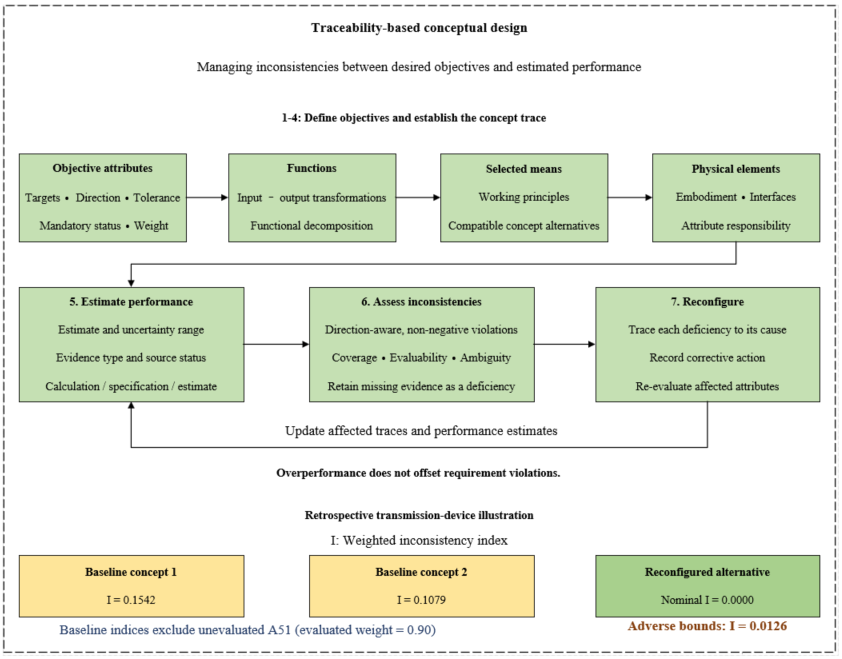
This paper presents a traceability-based framework for managing inconsistencies between desired objectives and estimated performance during conceptual design. A seven-step procedure links measurable objective attributes to functions, selected means, physical elements, and performance evidence. Direction-aware, non-negative violation scores prevent compensating overperformance from masking unmet requirements, while coverage, evaluability, and ambiguity criteria identify deficiencies in the assessment record. A retrospective transmission-device case illustrates two baseline concepts and a reconfigured alternative. Under the declared inputs, their weighted inconsistency indices are 0.1542, 0.1079, and 0.0000, respectively. The baseline indices exclude the unevaluated mandatory attribute A51 and use an evaluated-weight denominator of 0.90. The reconfigured alternative has three E3-class calculations, four E4-class specifications, and one E5-class estimate; these classifications do not establish source completeness or physical verification. Simultaneous adverse bounds for A51 and A71 yield an index of 0.0126, so nominal conformance is not robust over the declared ranges. Missing source records, configuration discrepancies, and the absence of prototype tests limit the findings to a methodological illustration. The contribution is an integrated procedure for documenting deficiencies and corrective actions; comparative effectiveness remains to be established.
Keywords:
conceptual design
; design traceability
; inconsistency management
; functional decomposition
; deviation analysis
; concept reconfiguration
; requirements traceability
; evidence classification
Copyright: This open access article is published under a Creative Commons CC BY 4.0 license, which permit the free download, distribution, and reuse, provided that the author and preprint are cited in any reuse.