
Submitted:
11 October 2026
Posted:
12 October 2026
You are already at the latest version
Abstract
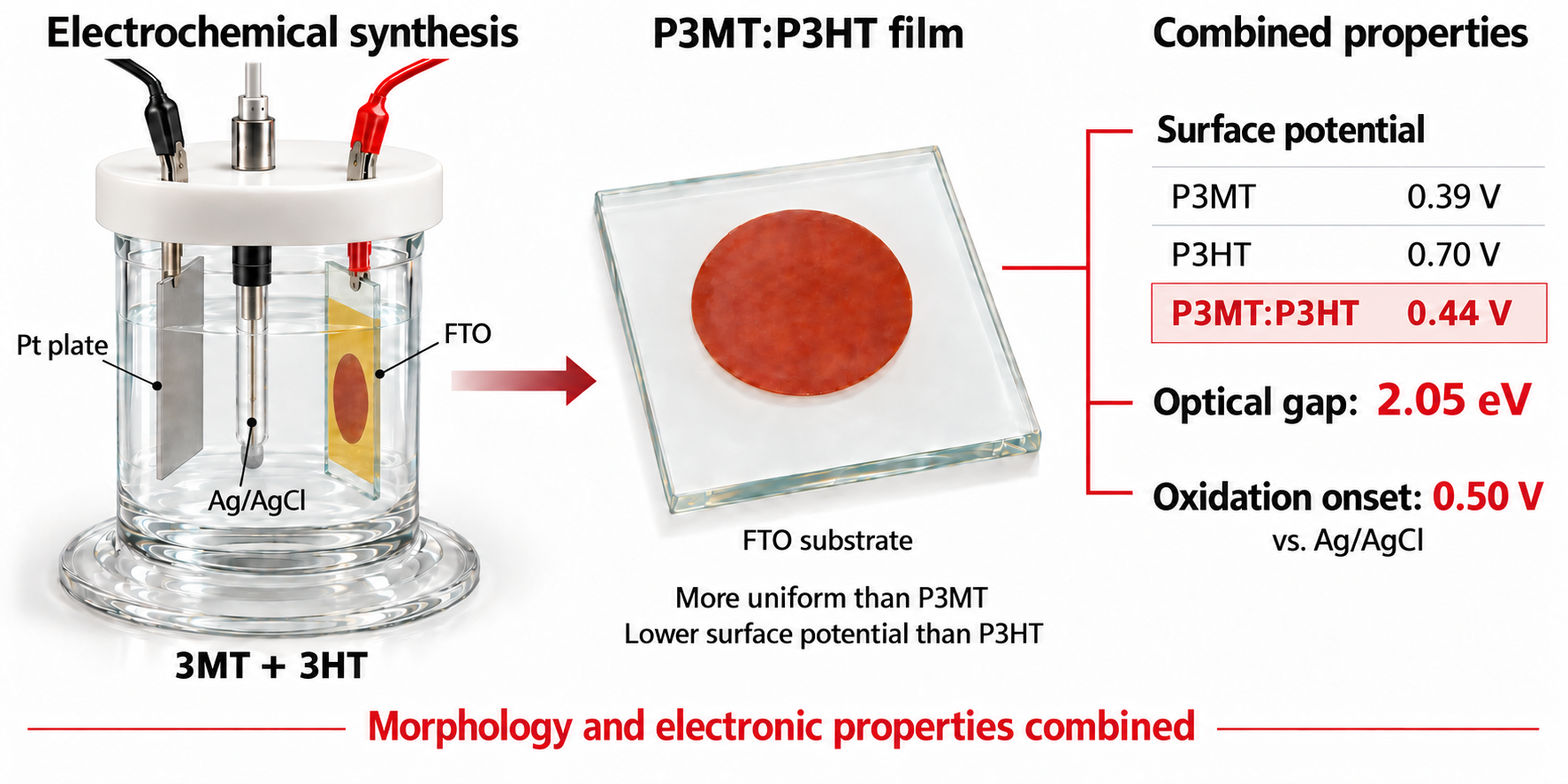
Combining thiophene derivatives offers a route to improve film morphology while retaining electronic properties relevant to optoelectronic applications. This work investigates electrochemically synthesized poly(3-methylthiophene-co-3-hexylthiophene) (P3MT:P3HT) films in comparison with poly(3-methylthiophene) (P3MT) and poly(3-hexylthiophene) (P3HT) prepared under the same deposition conditions. Films were deposited on fluorine-doped tin oxide (FTO) by galvanostatic electropolymerization with charge control and characterized using electron and atomic force microscopy, Kelvin probe force microscopy, optical spectroscopy, and cyclic voltammetry. The copolymer exhibited a more homogeneous surface than P3MT and an intermediate thickness of 410 ± 45 nm. Its average surface potential was 0.44 V, close to P3MT (0.39 V) and lower than P3HT (0.70 V). An oxidation onset of 0.50 V versus Ag/AgCl and an optical gap of 2.05 eV provided estimated HOMO and LUMO energies of -4.93 and -2.88 eV, respectively. Photoluminescence analysis revealed changes in the relative emission contributions, while the separation between absorption and excitation maxima decreased from 30 nm for P3MT to 11 nm for the copolymer. These results demonstrate that electrochemical copolymerization improves film uniformity while preserving surface potential and oxidation characteristics close to P3MT, combining complementary morphological, optical, and electronic properties for optoelectronic applications.
Keywords:
poly(3-hexylthiophene)
; poly(3-methylthiophene)
; electrochemical synthesis
; copolymer
; optoelectronic properties
Copyright: This open access article is published under a Creative Commons CC BY 4.0 license, which permit the free download, distribution, and reuse, provided that the author and preprint are cited in any reuse.