

Submitted:
12 October 2026
Posted:
12 October 2026
You are already at the latest version
Abstract
Destination choice is a critical decision for solo travellers, as it influences their travel experiences and overall satisfaction. Despite the rapid growth of solo travel, limited empirical research has examined how psychological and motivational factors translate into destination choices. This study investigates the determinants of destination selection among solo travellers by integrating the Theory of Reasoned Action and Push-Pull Theory, with travel intention as a mediator between push factors (self-discovery and subjective norm), pull factors (destination facilitation), and destination selection behaviour. Data were collected through an online survey of solo travellers, yielding 239 usable responses. Partial Least Squares Structural Equation Modelling (PLS-SEM) and bootstrapping were employed to test the hypothesised relationships. The findings reveal that travel intention is the strongest determinant of destination selection, followed by destination facilitation and perceived behavioural control. Travel intention significantly mediates the effects of self-discovery and subjective norm on destination selection. However, destination facilitation directly influences destination selection rather than indirectly through travel intention. The study extends Push-Pull Theory and the Theory of Reasoned Action to solo travel and provides practical insights for destination marketers, hoteliers, and tourism operators. Future research should consider longitudinal designs, cross-cultural comparisons, and generational differences among solo travellers.
Keywords:
subjective norm
; self-discovery
; destination facilitation
; perceived behavioural control
; intention
; destination selection
1. Introduction
In single travel, destination selection is a crucial decision since it determines the entire travel experience as well as the traveller’s safety, overall well-being, and pleasure (Otegui-Carles et al., 2022). Because solo travellers are exclusively liable for all destination-related decisions, unlike group travellers, their decision-making process is inherently more complicated and psychologically relevant (Matotek & Slavuj Borčić, 2025). According to Goh et al. (2024) and Agrawal et al. (2025), the increasing popularity of solo travel around the world, from Gen Z explorers and elderly people to women seeking empowerment, has made destination selection a top concern for tourism businesses everywhere. Global trends currently indicate a broadening of solo traveller motivations and populations. According to Sharma et al. (2025), Gen Z travellers are increasingly opting for destinations based on nature and exhibiting pro-sustainable tourism habits, with destination image playing a crucial role in their decision-making. Female solo travellers show unique preferences that are influenced by their desire for empowerment, cultural sensitivity, and safety considerations (Agrawal et al., 2025; Pitanatri et al., 2025). Senior single tourists seek places that support healthy aging by offering accessible infrastructure and wellness facilities (Goh et al., 2024). Social media forums have emerged as key information sources, fundamentally altering decision-making through digital platforms (Danklang & Leelasantitham, 2026; Závodná & Musil, 2025). Nevertheless, risk perception remains a major obstacle, especially for Asian tourists, whose destination choices are strongly influenced by word-of-mouth and cultural factors (Meliana & Yudhistira, 2025; Xess & Dandotiya, 2026). Although much research has examined solo travel, we still don't fully understand the psychological factors that influence destination choice. Empirical research on the selection behaviors that result from destination attributes remains limited, and most current research focuses on motivations or post-travel experiences (Otegui-Carles et al., 2022). Across demographic groups, theory still inadequately supports the relationship between intrinsic motivations and extrinsic destination qualities. Moreover, little attention has been given to the role of intention in linking motivational factors to destination selection (Slavuj Borčić & Matotek, 2025). The main difficulty solo tourists face is balancing their internal desires with the qualities of their destination. Meliana and Yudhistira (2025) and Xess and Dandotiya (2026) explain that balancing the need for self-discovery and freedom with practical concerns such as safety, infrastructure, and social acceptance is made harder by contradictory information sources and perceived risks. As a result, decision paralysis often reduces traveler enjoyment and limits segment growth. This study has significant ramifications for a variety of stakeholders. Understanding selection criteria helps policymakers develop targeted tourism policies and make infrastructure investments. Insights help the tourism sector develop sustainable destination management and marketing strategies. Knowing determinants allows operators to create customized packages and marketing initiatives. This study clarifies the decision-making process for lone travellers, enabling them to make more educated destination selections that are tailored to their unique needs and risk assessments. This study aims to assess the direct and indirect relationship between subjective norm, self-discovery, destination facilitation, and perceived behavioural control and destination selection, with intention as a mediator, among solo travellers in Klang Valley, Malaysia.
2. Literature Review
2.1. Underpinning Theories
This research aims to clarify the determinants of destination choice among solo travellers by integrating two contrasting theoretical frameworks, the Theory of Reasoned Action (TRA) and the Push-Pull Theory. The theoretical framework for comprehending the driving factors behind travel behaviour is provided by the Push-Pull Theory (Crompton, 1979; Dann, 1977). Push factors, according to this hypothesis, are intrinsic socio-psychological incentives that motivate the urge to travel, whereas pull factors are extrinsic destination-specific features that draw visitors to certain places (Dann, 1977). In this study, self-discovery is an intra-personal push factor that expresses the desire for personal growth, autonomy, and introspection. According to Uysal et al. (2012), social influence serves as a socio-environmental push mechanism, where family and friends' approval or disapproval either reinforces or restricts solo travel motivation. Destination facilitation acts as a pull factor, encompassing the perceived safety, infrastructure, accessibility, and tourist-friendly amenities that draw lone tourists to certain destinations. Although Push-Pull Theory does explain the content of travel motivation, it does not completely account for the decision-making process by which intentions become real behaviour. This vacuum is filled by the Theory of Reasoned Action (Ajzen & Fishbein, 1980), which states that intention is the proximate psychological process that links motivational antecedents and behavioural results (Fishbein & Ajzen, 1975) and serves as the immediate precursor to behaviour. The TRA states that a person's attitude toward a behaviour and their subjective norms, the perceived social pressure to engage or not engage in the behaviour (Ajzen & Fishbein, 1980), influence their intention to perform that behaviour. The mediating variable in this research is the desire to travel alone, which converts the inspirational factors of self-discovery, social influence, and destination facilitation into actual destination choice behaviour. This framework posits that push and pull factors affect destination choice in a sequential manner by developing solo-travel intentions.
2.2. Relationship Between Self-Discovery, Intention, & Destination Selection
Self-discovery refers to the process through which individuals gain insight into their identity, capabilities, preferences, values, and direction. Solo travel can create conditions for self-discovery because the traveller faces unfamiliar environments, makes independent decisions, negotiates uncertainty, and reflects without the constant influence of familiar companions. Yang (2021) found that anticipated self-discovery is an important inspiration for potential solo travellers, and Bianchi (2022) showed that self-development contributes to explaining continued solo travel intention. This motivational logic also aligns with evidence that self-actualization is a significant driver of solo holiday attitudes (Yang et al., 2022). A destination may be selected partly because it is perceived to offer an appropriate setting for reflection, challenge, learning, cultural immersion, or autonomy. Destinations associated with meaningful experiences, novelty, manageable challenge, and personal independence may therefore be more attractive to travellers seeking self-discovery. At the same time, self-discovery should strengthen the intention to travel solo because the expected personal benefits increase the perceived value of undertaking the behaviour. Intention may subsequently translate this motive into destination selection. Based on this logic, we propose the following hypotheses.
- H1: Self-discovery has a positive effect on destination selection among solo travellers.
- H2: Self-discovery has a positive effect on intention to travel solo among solo travellers.
- H3: Intention to travel solo mediates the relationship between self-discovery and destination selection among solo travellers.
2.3. Relationship Between Destination Facilitation, Intention, & Destination Selection
Destination facilitation is defined in this study as the perceived presence of external conditions that make solo travel workable. These conditions include reliable transport, ease of navigation, accessible and appropriately priced accommodation, accurate information, digital connectivity, visitor support, safety infrastructure, and transparent service systems. The construct is particularly relevant because solo travellers cannot distribute planning and problem-solving responsibilities across a familiar group. They may therefore place greater weight on destinations that reduce uncertainty and provide visible support without undermining autonomy. The literature supports the importance of enabling conditions, even when it uses different labels. Yang (2021) identifies safety and cost as major inhibitors of solo travel. Karagoz et al. (2021) show that destination-specific and social-psychological risks can weaken solo female travel intention. Kim et al.(2021) demonstrate that structural and awareness constraints influence destination image among independent travellers. In digital travel planning, facilitating conditions, perceived ease of use, information access, and seld-efficacy contribute to intention (Chen et al., 2023). Collectively, these findings indicate that destinations perceived as accessible, informative, safe and manageable are more likely to be selected and to strengthen solo travel intention. Destination facilitation may also exert an indirect effect. When travellers believe that a destination will support independent mobility and reduce foreseeable problems, they are more likely to form a strong intention to undertake the trip. That intention then increases the likelihood of choosing the destination. The following hypotheses are therefore advanced.
- H4: Destination facilitation has a positive effect on destination selection among solo travellers.
- H5: Destination facilitation has a positive effect on intention to travel solo among solo travellers.
- H6: Intention to travel solo mediates the relationship between destination facilitation and destination selection among solo travellers.
2.4.. Relationship Between Subjective Norm, Intention, & Destination Selection
Subjective norm refers to perceived social pressure from important others to perform or avoid a behaviour. Solo travel can be socially sensitive because family members, partners, friends and peers may express concern about safety, loneliness, cultural appropriateness or responsibility. Social approval can reassure travellers, provide practical support and normalise traveling alone, while disapproval can create doubt or prevent the traveller from acting. Family influence is likely to be especially relevant for first-time solo travellers and in collectivist settings where travel decisions are embedded in close social relationships. Evidence on subjective norm is mixed. Wang et al. (2021) and Chen et al. (2023) report significant relationships between subjective norm and travel-related intention, whereas Bianchi (2022) found subjective norm was not a significant predictor of continued solo travel intention. This inconsistency may indicate that social influence is strongest before the first solo trip, in particular cultures, or when travellers evaluate higher-risk destinations. It may also operate directly on destination selection; significant others may approve solo travel generally but encourage the traveller to choose destinations perceived as safer, closer, more familiar, or better supported. Because subjective norm can shape both willingness to travel alone and the acceptability of specific destination alternatives, direct and mediated relationships are proposed.
- H7: Subjective norm has a positive effect on destination selection among solo travelers.
- H8: Subjective norm has a positive effect on intention to travel solo among solo travelers.
- H9: Intention to travel solo mediates the relationship between subjective norm and destination selection among solo travellers.
2.5. Relationship Between Perceived Behavioural Control, Intention, & Destination Selection
Perceived behavioural control reflects the traveller’s belief that solo travel is within their capability and control. Relevant control resources include financial capacity, time, health, travel skills, language ability, digital literacy, confidence, prior experience, access to transport, and the ability to respond to risk or unexpected events. In solo travel, these perceptions are central because the individual expects to manage the trip without routine assistance from a familiar companion. The theory of Planned Behavior predicts that greater perceived control strengthens intention and may also influence behaviour directly when perceived control accurately reflects actual control (Ajzen, 1991). Tourism research supports this relationship. Lam and Hsu (2004), Wang et al. (2021) and Chen et al. (2023) report positive associations between perceived behavioural control and travel-related intentions. Yang et al. (2022) identify perceived behavioural control as a prominent predictor of solo travel intention. These results suggest that travellers who feel capable of managing a solo trip are more likely to intend to travel and to commit to a destination. Perceived behavioural control may influence destination selection directly because travellers compare destination demands with their personal resources. A destination that appears financially, physically, culturally, or logistically beyond the traveller’s capability may be rejected even when it is attractive. Intention is nevertheless expected to transmit part of this effect because control beliefs strengthen commitment before selections. The following hypotheses are proposed.
- H10: Perceived behavioural control has a positive effect on destination selection among solo travelers.
- H11: Perceived behavioural control has a positive effect on intention to travel solo among solo travellers.
- H12: Intention has a positive effect on destination selection among solo travellers.
- H13: Intention to travel solo mediates the relationship between perceived behavioural control and destination selection among solo travellers.
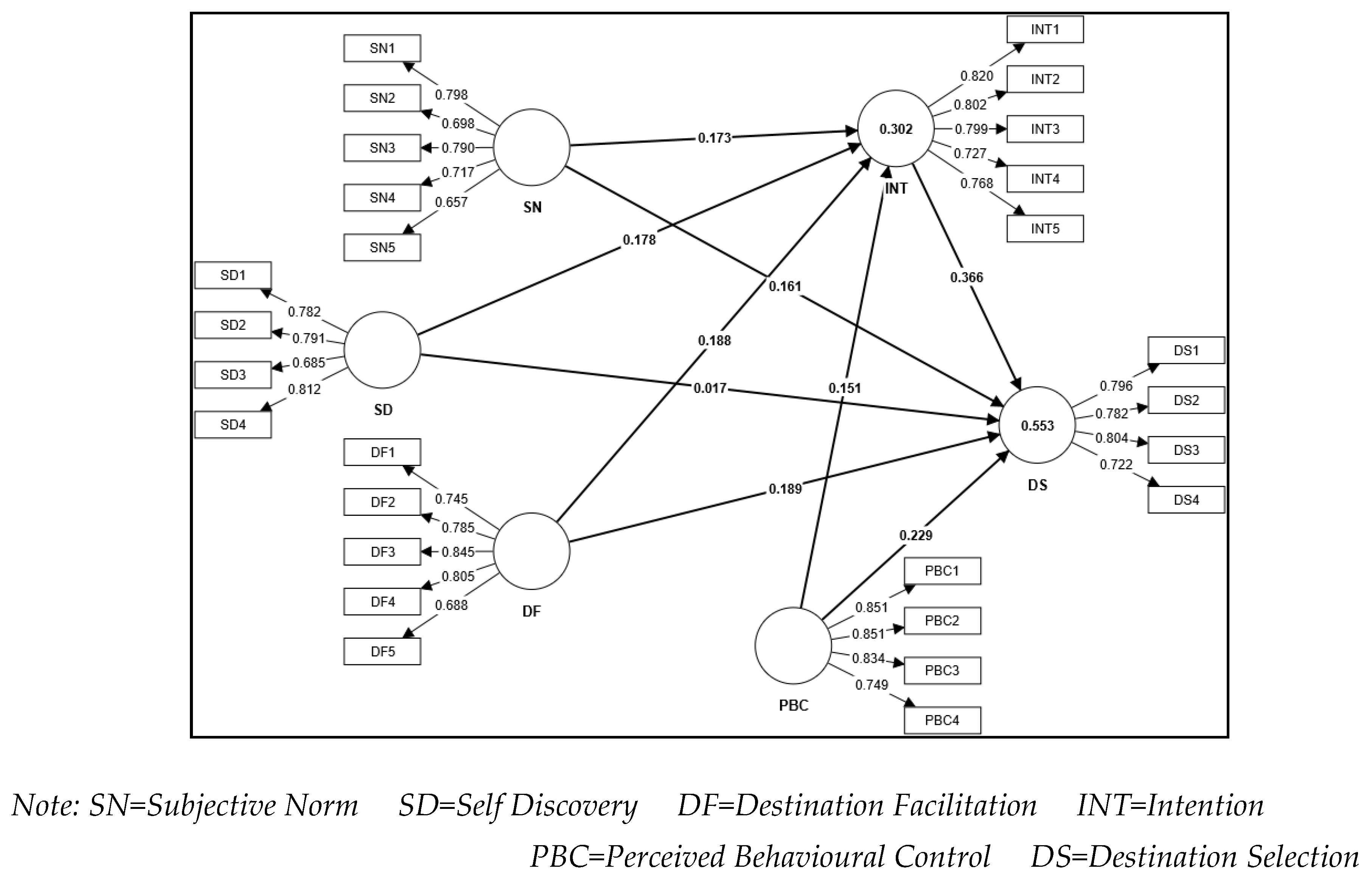
Figure 1.
Research Model.
3. Methodology
3.1. Sampling & Data Collection
In accordance with the hypothetical model and hypotheses depicted in Fig. 1, this study utilized a quantitative cross-sectional survey design to analyse the structural correlations among the aforementioned constructs. Considering that a cross-sectional approach was employed, the projected routes should be viewed as theory-consistent correlations rather than indisputable causal effects. The design is effective at explaining behavioural processes. The following subsections present a logical and chronological discussion of questionnaire design, population and sample, data gathering approaches, data analysis methodologies, and validity tests. Malaysian travellers made up the intended audience. The poll was done online using email invitations and social networking platforms like Facebook and WhatsApp to get the greatest possible geographical coverage and response rate. Questionnaires were sent to particular people using non-probability snowball sampling due to the absence of a comprehensive list of the population. All participants gave their agreement to participate in the research before doing so. Respondents rated the questionnaire items on a five-point Likert scale (1 = strongly disagree to 5 = strongly agree). Out of 440 surveys sent, 357 were received for the Structural Equation Modelling (SEM) analysis, giving an acceptable response rate of 81.13 percent. Of these, only 239 were deemed complete and ready for analysis. Partial least squares structural equation modelling (PLS-SEM) using SmartPLS 4.2 (Ringle et al., 2024) was used to analyse the data.
3.2. Measures
The measurement items were created using empirical data and well-established conceptual definitions from prior research on maladaptive artificial intelligence and its origins. The original research featured 27 measured variables, including self-discovery (SD) (five questions, derived from Bianchi (2016)), destination facilitation (DF) (four items, derived from Della Corte et al. (2025)), subjective norm (SN) (five items, derived from Ajzen (1991)), perceived behavioural control (PBC) (four items, derived from Ajzen (1991)), intention to travel solo (INT) as a mediator (five items, derived from Bianchi (2016)), and destination selection (DS) (four items, derived from Woodside & Lyonski (1989)). According to the conceptual framework, all latent variables (SD, DF, SN, PBC, INT, DS) were treated as reflective constructs, with indicators functioning as observable manifestations of their core dimensions.

Table 1.
Measurement Items.
| Self-Discovery | 1. I travel solo to better understand myself and my capabilities. |
|
| 2. Traveling alone allows me to discover new aspects of my personality. | Bianchi (2016) | |
| 3. I seek overseas destinations that offer opportunities for personal growth. |
||
| 4. Solo travel helps me gain a sense of independence and self-reliance. |
||
| Destination Facilitation | 5. I select destinations that are known to be safe for solo travellers. | |
| 6. The availability of clear English/international signage is crucial for my choice. |
Della Corte et al. (2025) | |
| 7. I prefer destinations where public transport is easy to navigate alone. |
||
| 8. The presence of well-reviewed, safe accommodation options influence my selection. |
||
| 9. I look for destinations with reliable mobile connectivity and digital navigation tools. | ||
| Subjective Norm | 10. Most people who are important to me think I should travel solo overseas. |
|
| 11. I am influenced by solo travel influencers/bloggers when picking a destination. |
Ajzen (1991) | |
| 12. People whose opinions I value would approve of my choice to travel alone. |
||
| 13. Seeing others in my social circle travel solo encourages me to do the same. | ||
| 14. Social media communities for solo travellers play a big role in my final selection. |
||
| Perceived Behavioural Control | 15. I am confident in my ability to manage an overseas trip by myself. | |
| 16. Deciding where to go solo is entirely under my own control. | Ajzen (1991) | |
| 17. I have the necessary resources (time, money, skills) to travel solo overseas. |
||
| 18. I feel capable of handling any unexpected problems while traveling alone. | ||
| Intention to Travel Solo | 19. I plan to take a solo holiday overseas in the near future. | |
| 20. I will make an effort to travel alone for my next international trip. | Bianchi (2016) | |
| 21. I am determined to experience a foreign destination as a solo traveller. |
||
| 22. The thought of traveling solo overseas is very appealing to me. | ||
| 23. I intend to prioritize solo travel over group travel for my next vacation. | ||
| Destination Selection | 24. I have already made a final decision on which overseas destination to visit. |
|
| 25. Among all available alternatives, my chosen destination is my first choice. |
Woodside & Lysonski (1989) | |
| 26. I am certain about my selection of this specific overseas destination. |
||
| 27. I do not plan to consider other destinations besides the one I have selected. |
4. Data Analysis
Respondents’ Profiles
The demographic profile of the 239 lone traveller respondents shows a sample that is diverse but clearly positioned. Solo travel is popular among both genders, with males making up 52.7% (n=126) and females 47.3% (n=113), indicating a slight male dominance in the gender distribution. Most respondents were middle-aged, with 45.6% (n=109) in the 41–50 years age group, followed by 41.8% (n=100) in the 31–40 years group. Only 4.6% (n=11) of respondents were under 30, and 4.2% (n=10) and 3.8% (n=9) were aged 51–60 years and above 60 years, respectively. This suggests that solo travel is mainly an activity for established adults in their thirties and forties, possibly indicating greater financial stability and life experience. In terms of educational attainment, the sample was highly educated, with undergraduates making up the majority at 55.2% (n=132), followed by postgraduates at 30.5% (n=73), while only 14.2% (n=34) were high school graduates. This suggests that solo travellers tend to have higher educational qualifications, which may be linked to increased travel awareness and disposable income. More than half of respondents (51.0%, n=122) earned less than RM4,850, making them low-income earners. Middle-income earners (RM4,851–RM10,970) made up 34.3% (n=82), and high-income earners above RM10,971 made up just 14.6% (n=35). Even though many respondents had lower incomes, 68.6% (n=164) reported having previously travelled alone, while 31.4% (n=75) had never done so, which is fascinating. This suggests solo travel is not just for the wealthy, as many tourists show ingenuity in funding their journeys regardless of income level.
Common Method Bias
To assess the presence of common method bias (CMB), this study employed the full collinearity variance inflation factor (VIF) approach recommended by Kock & Lynn (2012) and Kock (2015). According to this method, if all VIFs resulting from a full collinearity test are equal to or lower than 3.3, the model is considered free of common method bias (Kock, 2015). Table 2 presents the full collinearity VIF values for all latent variables in the model. The VIF values for Destination Selection (DS), Self-Discovery (SD), Destination Facilitation (DF), Subjective Norm (SN), Perceived Behavioural Control (PBC), and Intention (INT) were 2.143, 1.492, 2.292, 1.673, 1.323, and 1.436, respectively. All VIF values were well below the recommended threshold of 3.3, with the highest value recorded at 2.292 and the lowest at 1.323. These results indicate that common method bias does not pose a serious threat to the validity of the findings, as none of the variables exceeded the acceptable limit. Consequently, the data collected in this study are deemed suitable for further statistical analysis without substantial distortion from method-induced variance (Kock & Lynn, 2012).
Measurement Model
This research evaluated the psychometric qualities of the measurement model by assessing convergent validity and construct reliability in accordance with Hair et al.'s (2019) suggestions. Composite Reliability (CR) and Cronbach's Alpha (CA) were utilized to evaluate construct reliability, with 0.70 or higher considered to be an acceptable threshold (Hair et al., 2019). According to Table 3, all constructs surpassed these thresholds, with CA values falling between 0.768 (Self-Discovery) and 0.843 (Intention to Travel Solo) and CR values ranging from 0.852 (Self-Discovery) to 0.893 (Perceived Behavioural Control). This showed that all constructs had acceptable internal consistency and composite reliability. Convergent validity was confirmed by examining both item loadings and Average Variance Extracted (AVE). The AVE values for each construct, which ranged from 0.539 (Subjective Norm) to 0.676 (Perceived Behavioural Control), were higher than the recommended threshold of 0.50 (Hair et al., 2019), demonstrating that each construct accounts for more than half of the variance in its respective indicators. Furthermore, all individual item loadings exceeded 0.60, ranging from 0.657 (SN5) to 0.851 (PBC1 and PBC2), indicating that each indicator loaded significantly on its target construct. The lowest AVE for Subjective Norm was 0.539, but it remained above the benchmark, while Destination Facilitation had the highest AVE at 0.601 and a CR of 0.882. All constructs satisfied the three requirements of CA > 0.70, CR > 0.70, AVE > 0.50, and all item loadings were greater than 0.60, confirming that the measurement model shows sufficient convergent validity. These results collectively support the suitability of the measurement tool for subsequent structural analysis (Hair et al., 2019).
Heterotrait-Monotrait (HTMT) Ratios
As advised by Henseler et al. (2015), this study used the Heterotrait-Monotrait (HTMT) ratio of correlations to evaluate discriminant validity. Every construct pair had acceptable discriminant validity based on the conservative threshold of HTMT < 0.85 (Table 4). Between Destination Facilitation and Self-Discovery, the highest HTMT value was recorded at 0.815 (CI: 0.710–0.904), followed by Subjective Norm and Destination Facilitation at 0.779 (CI: 0.683–0.865). With 0.437 (CI: 0.280–0.581) being the lowest, all other pairs fell below 0.70. Even with the upper bound of the confidence interval for Self-Discovery and Destination Facilitation slightly above 0.85 (0.904), the total HTMT values remained below the allowable threshold, establishing discriminant validity (Henseler et al., 2015).
Hypothesis Testing
To assess the structural model and determine the path coefficients (β) and R², this study used PLS-SEM (Hair et al., 2017). We assessed statistical significance using 5,000 bootstrapped samples. Table 5 presents the hypothesis-testing results, including t-statistics, β, and p-values. We tested hypotheses using t > 1.96 and p < 0.05. The findings clarify the relationships between variables and show a mix of supported and unsupported pathways. The structural model evaluation shown in Table 5 gives empirical evidence for the assumed correlations, with hypotheses evaluated using beta coefficients, t-statistics, and p-values at a significance level of p < 0.05 and t > 1.96. Table 5 presents the hypothesis-testing results, which indicate a mix of significant and non-significant relationships between the constructs. H1, which states that Destination Choice is directly influenced by Self-Discovery, was rejected (β=0.017, t=0.266, p=0.790), showing that self-discovery goals do not directly affect destination selection. However, H2 was accepted, showing that Self-Discovery positively affects Intention to Travel Solo (β=0.178, t=2.304, p=0.021), and H3 was supported, indicating that Intention mediates the relationship between Self-Discovery and Destination Selection (β=0.065, t=2.076, p=0.038). Furthermore, H4 and H5 were both accepted, showing that Destination Facilitation significantly and directly influences Destination Selection (β=0.189, t=2.288, p=0.022) and Intention (β=0.188, t=2.064, p=0.039). Nonetheless, since the indirect effect of Intention on Destination Selection through Destination Facilitation was not statistically significant (β=0.069, t=1.882, p=0.060), which was just over the acceptable threshold, H6 was rejected. H7 was accepted for Subjective Norm (β=0.161, t=2.271, p=0.023), H8 was accepted (β=0.173, t=2.306, p=0.021), and importantly, H9 was accepted (β=0.063, t=2.293, p=0.022), indicating that Intention completely mediates the Subjective Norm-Destination Selection pathway. Focusing on Perceived Behavioral Control, H10 received strong support (β=0.229, t=4.408, p<0.001), validating the direct prediction of Destination Selection by PBC, and H11 confirmed PBC's impact on Intention (β=0.151, t=2.290, p=0.022). Intention was the strongest predictor because its direct impact on Destination Selection (H12) was highly significant (β=0.366, t=6.735, p<0.001). Lastly, H13 validated Intention's mediating influence on the PBC-Destination Selection connection (β=0.055, t=2.171, p=0.030). All hypotheses, except H1 (SD→DS) and H6 (DF→INT→DS), were supported, and H12 had the greatest impact on all direct relationships.
Effect Sizes & R-Squared
According to Cohen's (1992) guidelines, f² values of 0.02, 0.15, and 0.35 represent small, medium, and large effect sizes, respectively. Representing a medium effect, intention had the greatest impact on Destination Selection (f²=0.210). Perceived Behavioral Control showed modest effects on both Destination Selection (f²=0.088) and Intention (f²=0.025). Objective Norm, Self-Discovery, and Destination Facilitation all had little to modest effects (f²<0.035). The R² values showed that the model accounts for 55.3% of the variation in Destination Choice and 30.2% of the variation in Intention, indicating considerable explanatory power for the dependent variable.
Table 6.
Effect Sizes (f2) & R2.
| DS | INT | |
| DF | 0.034 | 0.022 |
| INT | 0.210 | |
| PBC | 0.088 | 0.025 |
| SD | 0.002 | 0.025 |
| SN | 0.031 | 0.023 |
| R2 | 0.553 | 0.302 |
PLSpredicts
Using the PLSpredict approach suggested by Shmueli et al. (2016, 2019), this study evaluated the out-of-sample predictive power of the model. The Q²predict values for all indicators were positive, varying from 0.119 (INT3) to 0.358 (DS1), indicating the model's predictive importance for all endogenous structures, as shown in Table 7. Additionally, the negative PLS-LM differences, which ranged from -0.011 to -0.036, showed that PLS-RMSE values were consistently lower than the LM-RMSE benchmarks for all nine indicators. All PLS-RMSE values were higher than the Linear Model predictions, with Destination Selection indicators showing the greatest improvements. These findings demonstrate that the PLS-SEM model outperforms the naive linear model benchmark in terms of predictive performance, validating the model's strong predictive ability (Shmueli et al., 2019).
Importance-Performance Map Analysis
Following Hair et al. (2018) and Ringle and Sarstedt (2016), the Importance-Performance Map Analysis (IPMA) was conducted to identify constructs that are important but perform poorly for Destination Selection. According to Table 8, Intention had the highest importance (0.366) but only middling performance (61.601), suggesting a crucial area for management to focus on. The highest performance (66.698) among all structures and moderate significance (0.285) were demonstrated by Perceived Behavioural Control, indicating that the impact is currently performing sufficiently. Another priority area was Destination Facilitation, which showed remarkable performance (62.419) but also significant importance (0.257). However, Subjective Norm had low importance (0.225) and modest performance (63.755), while Self-Discovery had the lowest importance (0.082) and moderate performance (64.874). The lowest-performing and most important construct, Intention, may be improved by concentrating on marketing messages that strengthen solo travellers’ resolve and desire. These communications include specific promotional campaigns that promote peer testimonials and solo-friendly experiences. Furthermore, to turn the value of Destination Facilitation into actual destination selection, Destination Facilitation performance must be improved through investments in infrastructure, safety upgrades, and digital accessibility. These focused enhancements would maximize the influence on decision-making outcomes.
Discussion & Conclusion
Discussion
For tourism stakeholders looking to improve destination selection among lone travellers, the empirical data provides insightful information. Underlining the crucial need for tourism operators to strengthen solo travellers' commitment through targeted marketing campaigns featuring authentic testimonials, dedicated solo itineraries, and flexible booking options that reduce uncertainty, Intention to Travel Solo was found to be the greatest predictor of Destination Selection (β=0.366). Social media platforms offer excellent venues for highlighting solitary experiences and fostering a sense of community among aspiring lone travellers. The second most significant direct influence on Destination Selection (β=0.229) was exhibited by Perceived Behavioral Control, indicating that boosting travellers' confidence is crucial. Pre-travel guides, cultural orientation materials, and 24/7 support hotlines are just a few of the resources tourist operators should provide. Flexible cancellation policies and beginner-friendly packages with planned itineraries would further reduce perceived restrictions. With a β of 0.189, Destination Facilitation showed a clear direct impact on Destination Selection, indicating that destination characteristics strongly influence decisions. Accessible tourist information centers, clear signage, and dependable public transit are just a few infrastructure improvements stakeholders should support. Strengthening facilitation perception would involve improving digital connectivity and promoting destination safety through clear security measures. Subjective Norm showed significant direct effects on both Destination Selection (β=0.161) and Intention (β=0.173), underscoring the value of social validation. To promote lone travel, destination marketers should utilize user-generated content initiatives and social media influencer collaborations. Social approval would be enhanced by encouraging positive word-of-mouth through referral programs. Self-Discovery did not directly predict Destination Choice (rejected, β=0.017), but it significantly influenced Intention (β=0.178), supporting mediation via Intention (accepted, β=0.065). Similarly, Destination Facilitation's indirect effect through Intention was not supported (β=0.069, rejected), suggesting that destination characteristics primarily influence selection through direct channels. Since there are numerous competing elements that simultaneously impact judgments and diminish indirect consequences, these nonsignificant findings may be due to decision-making intricacy. The confirmed mediation pathways for Self-Discovery and Subjective Norm highlight the value of reinforcing intention as the primary mechanism for translating motivational and social factors into real destination selection behaviour.
Theoretical Implications
By integrating the Theory of Reasoned Action (Ajzen & Fishbein, 1980) and the Push-Pull Theory (Dann, 1977; Crompton, 1979), this research offers a number of important theoretical contributions to the corpus of knowledge already in existence on how single travellers choose their destinations. First, the findings empirically confirm the applicability of Push-Pull Theory in the context of solo travel, validating that self-discovery and destination facilitation are important push and pull factors, respectively, in shaping solo travel intention, and thus extending Dann's (1977) conceptualization to a contemporary traveler segment. Second, by showing intention's mediating role in translating motivational forces into destination selection, the study advances theoretical understanding. This supports the Theory of Reasoned Action's claim that intention directly precedes behavior (Ajzen & Fishbein, 1980). The considerable indirect impacts through desire on subjective norm and self-discovery show that the motivation-intention-behaviour sequence works well in solitary travel situations. Third, the finding that destination facilitation directly affects destination selection, rather than indirectly through intention, offers a novel theoretical insight: pull factors may operate through twin channels, influencing decision behaviour without involving intentional processes. This calls into question the TRA's long-held assumption that all antecedents function solely through intention. Ultimately, the established function of perceived behavioural control broadens the theoretical framework by showing that ability limitations have an independent impact on destination choice, implying that future research ought to include both motivational and capability channels when examining traveller decision-making.
Practical Implications
For tourism sector stakeholders who want to attract and serve lone travellers well, the findings of this research provide a number of practical consequences. Since intention was the strongest predictor of destination choice, destination marketing organizations should prioritize campaigns that first boost solitary travel intention. This may be done by using focused digital marketing methods like real solo traveller endorsements, user-generated material, and influencer alliances that normalize and promote solo travel experiences. To address the demand for intention formation and social validation, hotels and accommodation providers should create solo-friendly packages that include flexible booking options, single-supplement waivers, and social spaces that encourage solo guests to mingle. Travel firms and tour operators should invest in developing thorough pre-travel resources that increase perceived behavioural control, such as comprehensive safety guides, cultural orientation materials, and 24/7 customer service. To help beginner solo travellers gradually increase their confidence, packages with structured itineraries and local guide services would be useful. To improve destination facilitation, destination management authorities should focus on infrastructure improvements such as reliable public transportation, easy access to tourist information centres, improved digital connectivity, and clear multilingual signage. The perception of facilitation might be further enhanced by supporting destination safety through visible security measures and emergency response systems. Last but not least, promoting positive word-of-mouth through online review sites and referral programs would increase social acceptance by leveraging subjective norms as a factor in destination choice. Taken together, these tactics address the primary determinants identified in this research.
Limitation of the Study
This research recognizes several constraints that should be considered when interpreting the findings, despite its significant accomplishments. First, this study's cross-sectional design collects data at a single point in time, which limits its ability to determine causal links between variables, since travel decision-making is a dynamic process that unfolds over time. Second, the sample was primarily composed of middle-aged participants, which could limit the applicability of the findings to younger solo travellers, such as Gen Z, whose incentives and tastes are influenced by digital technology. Third, the study focused solely on motivational factors, overlooking external constraints such as health concerns, time availability, or financial limits that may strongly influence actual destination choice. Fourth, social desirability bias may have skewed respondents' responses, especially on socially sensitive topics. Finally, the study was conducted in only one cultural setting, which limited its cross-cultural utility. Future studies should use cross-cultural comparisons and longitudinal designs to address these limitations.
Suggestions for Future Study
There are several opportunities for future research based on the findings and limitations of this study. Because the decision-making process for solo travel changes over time from the first thought to the final destination selection, future research should first use longitudinal or experimental designs to determine the causal relationships between the constructs. Additionally, comparative cross-cultural studies should examine how cultural variables shape the link between motivational factors and destination choice across national contexts. Third, future research should integrate more factors, including perceived risk, destination image, and digital influence, to expand the theoretical framework and increase explanatory power, as social media platforms progressively influence solo travel choices. Fourth, researchers should explore generational disparities by studying younger travellers, such as Gen Z and millennials, who are the fastest-growing independent travel groups and have specific incentives influenced by technology and environmental worries. Finally, qualitative approaches like in-depth interviews or ethnography might provide more insight into the complex decision-making processes of solo travellers, which quantitative surveys may not fully capture.
Conclusion
By combining the Theory of Reasoned Action and the Push-Pull Theory, this research examined the factors influencing solo travellers’ choice of destination. An analysis of 239 people found that intention to travel alone is the most important factor in choosing a destination, followed by perceived behavioural control and destination facilitation. Through indirect channels facilitated by intention, self-discovery and subjective norm had considerable impacts. In the context of single travel, the results theoretically confirm both underlying theories, expanding their theoretical range to a contemporary traveller segment. The insignificant findings for certain direct relationships highlight the complexity of solo travel decision-making. In practice, tourism stakeholders should focus on increasing solo travel intention by using targeted marketing, boosting perceived behavioural control through pre-travel resources, and enhancing destination facilitation by investing in infrastructure. By strategically addressing these determinants, the tourism industry can better attract the rapidly growing solo travel market and contribute theoretically and practically to the field.
References
- Agrawal, C.; Gaur, P.; Duggal, T. Solo traveling: An emerging case of women's empowerment. In Thriving concepts in women’s and gender studies; Shrivastava, R., Ashraf, G. Y., Mishra, G., Dani, T. S., Eds.; Apple Academic Press, 2025; pp. 397–413. [Google Scholar] [CrossRef]
- Ajzen, I. The theory of planned behavior. Organ. Behav. Hum. Decis. Process. 1991, 50(2), 179–211. [Google Scholar] [CrossRef]
- Ajzen, I.; Fishbein, M. Understanding attitudes and predicting social behavior; Prentice-Hall, 1980. [Google Scholar]
- Bianchi, C. Solo holiday travellers: Motivators and drivers of satisfaction and dissatisfaction. Int. J. Tour. Res. 2016, 18(2), 197–208. [Google Scholar] [CrossRef]
- Bianchi, C. Antecedents of tourists’ solo travel intentions. Tour. Rev. 2022, 77(3), 780–795. [Google Scholar] [CrossRef]
- Chen, S.-C.; Jong, D.; Hsu, C.-S.; Lin, C.-H. Understanding extended theory of planned behavior to access backpackers’ intention in self-service travel websites. J. Hosp. Tour. Res. 2023, 47(1), 106–132. [Google Scholar] [CrossRef]
- Cohen, S.; Wills, T. A. Stress, social support, and the buffering hypothesis. Psychol. Bull. 1985, 98(2), 310–357. [Google Scholar] [CrossRef]
- Crompton, J. L. Motivations for pleasure vacation. Ann. Tour. Res. 1979, 6(4), 408–424. [Google Scholar] [CrossRef]
- Danklang, U.; Leelasantitham, A. The tourist life cycle in millennial solo travel: The roles of bias and narrative information in Thailand and Asia. Sustainability 2026, 18(5), 2265. [Google Scholar] [CrossRef]
- Dann, G. M. S. Anomie, ego-enhancement and tourism. Ann. Tour. Res. 1977, 4(4), 184–194. [Google Scholar] [CrossRef]
- Della Corte, V.; Cascella, C.; Di Taranto, E.; Luongo, S. Unlocking the secrets of destination competitiveness: A new tool to measure tourist satisfaction at the destination level. Manag. Decis. Advance online publication. 2025. [Google Scholar] [CrossRef]
- Fishbein, M.; Ajzen, I. Belief, attitude, intention, and behavior: An introduction to theory and research; Addison-Wesley, 1975. [Google Scholar]
- Goh, E.; Tham, A.; Lai, M. Y. Exploring senior solo travel through a tri-factor healthy ageing framework. Tour. Manag. Perspect. 54 2024, 101314. [Google Scholar] [CrossRef]
- Hair, J. F.; Black, W. C.; Babin, B. J.; Anderson, R. E. Multivariate data analysis, 8th ed.; Cengage Learning, 2019. [Google Scholar]
- Hair, J. F.; Hult, G. T. M.; Ringle, C. M.; Sarstedt, M. A primer on partial least squares structural equation modeling (PLS-SEM), 2nd ed.; SAGE, 2017. [Google Scholar]
- Hair, J. F.; Sarstedt, M.; Ringle, C. M.; Gudergan, S. P. Advanced issues in partial least squares structural equation modeling; SAGE, 2018. [Google Scholar]
- Henseler, J.; Ringle, C. M.; Sarstedt, M. A new criterion for assessing discriminant validity in variance-based structural equation modeling. J. Acad. Mark. Sci. 2015, 43(1), 115–135. [Google Scholar] [CrossRef]
- Karagöz, D.; Işık, C.; Dogru, T.; Zhang, L. Solo female travel risks, anxiety and travel intentions: Examining the moderating role of online psychological-social support. Curr. Issues Tour. 2021, 24(11), 1595–1612. [Google Scholar] [CrossRef]
- Kim, S.-E.; Kim, H. (L.; Yang, S.-B. Why not this destination? The effects of travel constraints of independent travelers on destination image formation. Int. J. Tour. Res. 2021, 23(6), 1073–1085. [Google Scholar] [CrossRef]
- Kock, N. Common method bias in PLS-SEM: A full collinearity assessment approach. Int. J. E-Collab. 2015, 11(4), 1–10. [Google Scholar] [CrossRef]
- Kock, N.; Lynn, G. S. Lateral collinearity and misleading results in variance-based SEM: An illustration and recommendations. J. Assoc. Inf. Syst. 2012, 13(7), 546–580. [Google Scholar] [CrossRef]
- Lam, T.; Hsu, C. H. C. Theory of planned behavior: Potential travelers from China. J. Hosp. Tour. Res. 2004, 28(4), 463–482. [Google Scholar] [CrossRef]
- Matotek, L.; Slavuj Borčić, L. Solo female travel—Experiences and spatial practices of female travellers. Geoadria 2025, 30(2), 1–29. [Google Scholar] [CrossRef]
- Meliana, M.; Yudhistira, P. G. A. From fear to adventure: How trust, risk, and behaviour control influence Gen Z’s solo travel intention. J. Manaj. Teor. Dan Terap. 2025, 18(1), 78–96. [Google Scholar] [CrossRef]
- Otegui-Carles, A.; Araújo-Vila, N.; Fraiz-Brea, J. A. Solo travel research and its gender perspective: A critical bibliometric review. Tour. Hosp. 2022, 3(3), 733–751. [Google Scholar] [CrossRef]
- Pitanatri, P. D. S.; Adnyani, N. W. G.; Kartini, L. P.; Valeri, M. Travel motivations, preferences, and characteristics of women solo travelers in Bali. J. Appl. Sci. Travel Hosp. 2025, 8(1), 63–78. [Google Scholar] [CrossRef]
- Ringle, C. M.; Sarstedt, M. Gain more insight from your PLS-SEM results: The importance-performance map analysis. Ind. Manag. Data Syst. 2016, 116(9), 1865–1886. [Google Scholar] [CrossRef]
- Ringle, C. M.; Wende, S.; Becker, J.-M. SmartPLS 4 [Computer software]. SmartPLS. 2024. Available online: https://www.smartpls.com.
- Sharma, M.; Rawat, N.; Joshi, S.; Misra, A. Assessing the role of destination and nature-based destination image in Gen Z solo travellers’ pro-sustainable tourism behaviour: The moderating role of social media influencers trust. Qual. Quant. 2025, 59(6), 5469–5489. [Google Scholar] [CrossRef]
- Shmueli, G.; Ray, S.; Velasquez Estrada, J. M.; Chatla, S. B. The elephant in the room: Predictive performance of PLS models. J. Bus. Res. 2016, 69(10), 4552–4564. [Google Scholar] [CrossRef]
- Shmueli, G.; Sarstedt, M.; Hair, J. F.; Cheah, J.-H.; Ting, H.; Vaithilingam, S.; Ringle, C. M. Predictive model assessment in PLS-SEM: Guidelines for using PLSpredict. Eur. J. Mark. 2019, 53(11), 2322–2347. [Google Scholar] [CrossRef]
- Wang, L.; Wong, P. P. W.; Zhang, Q. Travellers’ destination choice among university students in China amid COVID-19: Extending the theory of planned behaviour. Tour. Rev. 2021, 76(4), 749–763. [Google Scholar] [CrossRef]
- Woodside, A. G.; Lysonski, S. A general model of traveler destination choice. J. Travel Res. 1989, 27(4), 8–14. [Google Scholar] [CrossRef]
- Xess, A.; Dandotiya, R. Cultural dimensions and solo travel intentions: Examining the role of perceived risk and word-of-mouth among Indian travellers. Int. J. Tour. Archaeol. Hosp. 2026, 6(2), 146–162. [Google Scholar] [CrossRef]
- Yang, E. C. L. What motivates and hinders people from travelling alone? A study of solo and non-solo travellers. Curr. Issues Tour. 2021, 24(17), 2458–2471. [Google Scholar] [CrossRef]
- Yang, E. C. L.; Liang, A. R.-D.; Lin, J. H. A market segmentation study of solo travel intentions and constraints. J. Hosp. Tour. Res. 2025, 49(1), 132–145. [Google Scholar] [CrossRef]
- Yang, E. C. L.; Nimri, R.; Lai, M. Y. Uncovering the critical drivers of solo holiday attitudes and intentions. Tour. Manag. Perspect. 41 2022, 100913. [Google Scholar] [CrossRef]
- Yang, E. C. L.; Yang, M. J. H.; Khoo-Lattimore, C. The meanings of solo travel for Asian women. Tour. Rev. 2019, 74(5), 1047–1057. [Google Scholar] [CrossRef]
- Závodná, L. S.; Musil, M. Solo travellers in social media: TripAdvisor forum analysis. DETUROPE Cent. Eur. J. Reg. Dev. Tour. 2025, 17(2), 17–33. [Google Scholar] [CrossRef]
Table 2.
Common Method Bias.
| DS | SD | DF | SN | PBC | INT | |
| DS | 2.143 | 2.080 | 2.089 | 1.973 | 1.776 | |
| SD | 1.834 | 1.492 | 1.805 | 1.834 | 1.801 | |
| DF | 2.292 | 1.922 | 2.090 | 2.349 | 2.355 | |
| SN | 1.843 | 1.861 | 1.673 | 1.854 | 1.884 | |
| PBC | 1.323 | 1.437 | 1.429 | 1.409 | 1.436 | |
| INT | 1.413 | 1.675 | 1.700 | 1.699 | 1.704 |
Table 3.
Construct Reliability and Validity & Item Loadings.
| Constructs | Items | DF | CA | CR | AVE |
| Destination Facilitation | DF1 | 0.745 | 0.834 | 0.882 | 0.601 |
| DF2 | 0.785 | ||||
| DF3 | 0.845 | ||||
| DF4 | 0.805 | ||||
| DF5 | 0.688 | ||||
| Destination Selection | DS1 | 0.796 | 0.781 | 0.858 | 0.603 |
| DS2 | 0.782 | ||||
| DS3 | 0.804 | ||||
| DS4 | 0.722 | ||||
| Intention to Travel Solo | INT1 | 0.820 | 0.843 | 0.888 | 0.614 |
| INT2 | 0.802 | ||||
| INT3 | 0.799 | ||||
| INT4 | 0.727 | ||||
| INT5 | 0.768 | ||||
| Perceived Behavioural Control | PBC1 | 0.851 | 0.840 | 0.893 | 0.676 |
| PBC2 | 0.851 | ||||
| PBC3 | 0.834 | ||||
| PBC4 | 0.749 | ||||
| Self-Discovery | SD1 | 0.782 | 0.768 | 0.852 | 0.592 |
| SD2 | 0.791 | ||||
| SD3 | 0.685 | ||||
| SD4 | 0.812 | ||||
| Subjective Norm | SN1 | 0.798 | 0.786 | 0.853 | 0.539 |
| SN2 | 0.698 | ||||
| SN3 | 0.790 | ||||
| SN4 | 0.717 | ||||
| SN5 | 0.657 |
Notes: CA=Cronbach Alpha CR=Composite Reliability AVE=Average Variance Extracted
Table 4.
Heterotrait-Monotrait (HTMT) Ratio – Confidence Interval.
| HTMT | 2.50% | 97.50% | |
| DS <-> DF | 0.693 | 0.574 | 0.801 |
| INT <-> DF | 0.557 | 0.411 | 0.682 |
| INT <-> DS | 0.754 | 0.648 | 0.849 |
| PBC <-> DF | 0.497 | 0.347 | 0.634 |
| PBC <-> DS | 0.633 | 0.523 | 0.732 |
| PBC <-> INT | 0.437 | 0.280 | 0.581 |
| SD <-> DF | 0.815 | 0.710 | 0.904 |
| SD <-> DS | 0.585 | 0.432 | 0.732 |
| SD <-> INT | 0.541 | 0.385 | 0.677 |
| SD <-> PBC | 0.412 | 0.247 | 0.572 |
| SN <-> DF | 0.779 | 0.683 | 0.865 |
| SN <-> DS | 0.682 | 0.551 | 0.796 |
| SN <-> INT | 0.539 | 0.404 | 0.660 |
| SN <-> PBC | 0.527 | 0.398 | 0.651 |
| SN <-> SD | 0.660 | 0.554 | 0.761 |
Table 5.
Hypothesis Testing Results.
| Hypotheses | Beta | T statistics | P values | 2.50% | 97.50% | Decision |
| H1: SD -> DS | 0.017 | 0.266 | 0.790 | -0.101 | 0.145 | Rejected |
| H2: SD -> INT | 0.178 | 2.304 | 0.021 | 0.025 | 0.323 | Accepted |
| H3: SD -> INT -> DS | 0.065 | 2.076 | 0.038 | 0.010 | 0.133 | Accepted |
| H4: DF -> DS | 0.189 | 2.288 | 0.022 | 0.024 | 0.345 | Accepted |
| H5: DF -> INT | 0.188 | 2.064 | 0.039 | 0.003 | 0.357 | Accepted |
| H6: DF -> INT -> DS | 0.069 | 1.882 | 0.060 | -0.001 | 0.147 | Rejected |
| H7: SN -> DS | 0.161 | 2.271 | 0.023 | 0.018 | 0.297 | Accepted |
| H8: SN -> INT | 0.173 | 2.306 | 0.021 | 0.030 | 0.318 | Accepted |
| H9: SN -> INT -> DS | 0.063 | 2.293 | 0.022 | 0.014 | 0.123 | Accepted |
| H10: PBC -> DS | 0.229 | 4.408 | 0.000 | 0.122 | 0.329 | Accepted |
| H11: PBC -> INT | 0.151 | 2.290 | 0.022 | 0.021 | 0.281 | Accepted |
| H12: INT -> DS | 0.366 | 6.735 | 0.000 | 0.255 | 0.470 | Accepted |
| H13: PBC -> INT -> DS | 0.055 | 2.171 | 0.030 | 0.011 | 0.111 | Accepted |
Note: Significant at p<0.05, t>1.96
Table 7.
PLSpredicts.
| Q²predict | PLS-RMSE | LM-RMSE | PLS-LM | |
| DS1 | 0.358 | 0.578 | 0.595 | -0.017 |
| DS2 | 0.239 | 0.617 | 0.636 | -0.019 |
| DS3 | 0.245 | 0.654 | 0.665 | -0.011 |
| DS4 | 0.162 | 0.721 | 0.747 | -0.026 |
| INT1 | 0.225 | 0.603 | 0.617 | -0.014 |
| INT2 | 0.159 | 0.625 | 0.653 | -0.028 |
| INT3 | 0.119 | 0.684 | 0.706 | -0.022 |
| INT4 | 0.134 | 0.706 | 0.742 | -0.036 |
| INT5 | 0.165 | 0.613 | 0.641 | -0.028 |
Table 8.
Importance-Performance Map Analysis (IPMA).
| Importance | Performance | |
| DF | 0.257 | 62.419 |
| INT | 0.366 | 61.601 |
| PBC | 0.285 | 66.698 |
| SD | 0.082 | 64.874 |
| SN | 0.225 | 63.755 |
Disclaimer/Publisher’s Note: The statements, opinions and data contained in all publications are solely those of the individual author(s) and contributor(s) and not of MDPI and/or the editor(s). MDPI and/or the editor(s) disclaim responsibility for any injury to people or property resulting from any ideas, methods, instructions or products referred to in the content. |
© 2026 by the authors. Licensee MDPI, Basel, Switzerland. This article is an open access article distributed under the terms and conditions of the Creative Commons Attribution (CC BY) license.
Copyright: This open access article is published under a Creative Commons CC BY 4.0 license, which permit the free download, distribution, and reuse, provided that the author and preprint are cited in any reuse.