

Submitted:
11 October 2026
Posted:
12 October 2026
You are already at the latest version
Abstract
Social participation is associated with health in later life, but the relational processes giving it personal significance require explanation. Relational Recognition Theory (RRT) distinguishes group recognition, the perceived confirmation of membership, from individualized recognition, the perceived confirmation of personal value. Perceived contribution expresses this experienced value rather than independently verified productive output. The theory proposes that membership provides opportunities for expression and acknowledgment, connecting participation to health and well-being. Cross-sectional survey data from 985 adults aged 60 years and older in two Beijing communities were analyzed using measurement-model comparisons and structural equation modeling. Group-related items referred to groups or associations; interviews contextualized participants' organizational experiences. The two-dimensional recognition model fit better than a single-dimensional model. The standardized sequential indirect effect was .162, with a bias-corrected 95% confidence interval of [.112, .218]. It remained positive after education and income adjustment and across four health outcomes. Community comparisons identified differences in some pathways. The findings provide initial individual-level evidence consistent with RRT. The theory explains how accepted membership can support experienced personal value as roles and capacities change, informing recognition-oriented social work without making productive performance a condition of being valued.
Keywords:
relational recognition theory
; social participation
; group recognition
; individualized recognition
; health and well-being
; recognition ecology
1. Introduction
Social participation has long been studied in the sociology of aging and health sociology. Research has linked social and productive activities to survival in later life and traced connections between social integration, psychosocial processes, and health (Berkman et al., 2000; Glass et al., 1999). These findings leave an important relational question: what happens within participation that makes it meaningful to the participant? Activity type and frequency describe what people do and how often they do it. They tell us less about whether participants have a recognized place or whether their experience and judgment matter to others.
Two older adults may attend the same activity equally often yet occupy different social positions. One may simply be counted among those present and follow arrangements made by others. The other may be consulted, undertake a role suited to their capacities, and influence shared affairs. Participation may therefore have different health implications depending on whether participants are taken seriously as people with judgment, experience, and value.
This question is particularly salient in later life. Retirees with relatively secure living conditions may nevertheless lose opportunities to have their experience sought out or their actions needed by others. People requiring assistance may have their daily lives arranged for them while losing opportunities to express their preferences. The healthy aging framework emphasizes interactions between capacities and environments (World Health Organization, 2015). Economic security, capacities for action, and social position need to be considered separately to understand why better living conditions do not automatically create opportunities to express personal value. RRT approaches this separation through the older person’s experience of significance: greater material provision or activity output does not by itself establish that the person feels valued. The issue is how participation is experienced, not how much it produces.
Social support and social capital already encompass value and membership. Cobb (1976) addresses being cared for, being valued, and belonging to a network, while Portes (1998) examines both the resources and exclusion associated with membership. A recognition perspective asks more specifically how membership connects to the experience of being valued as a particular person. The same assistance may respect a recipient’s judgment or entirely replace their decisions. The resources provided and the recipient’s standing as an agent are thus connected but distinguishable concerns.
Changes in physical functioning make this question more pressing. Successful aging emphasizes functional maintenance and continued engagement, while disability perspectives caution that treating these as a single standard can further marginalize people with functional limitations (Minkler & Fadem, 2002; Rowe & Kahn, 1997). Valued participation is also shaped by social and organizational conditions (Jones-Cobb & Turner, 2025). When an earlier intensity of activity can no longer be sustained, can roles and responses be adjusted so that a person’s experience and actions continue to matter?
This article proposes Relational Recognition Theory (RRT), defining relational recognition as an individual’s perceived confirmation, through interaction, of membership and personal value. Group recognition concerns the confirmation of one’s position as a member; individualized recognition concerns the confirmation of one’s value as a particular person. Perceived contribution is one expression of this value experience, not a requirement to demonstrate productive achievement. RRT proposes that recognized membership provides a relational foundation for people to express themselves and experience their presence, experience, or judgment as meaningful to others. The central question is how participation becomes a relationship in which the individual has both a place and a sense of personal significance.
Survey data from 985 older adults in two Beijing communities examine four propositions concerning participation, dual recognition, their sequential association with health, and contextual variation. Interviews clarify the forms of collective participation and experiences of role adjustment. The core contribution remains the distinction and connection between membership and personal value; community comparisons examine conditions of this relationship rather than define the theory by two residential settings.
2. Relational Recognition Theory
2.1. Social Participation and the Normative Basis of Recognition
RRT understands social participation as a relational arena in which individuals enter shared social life, acquire a position within relationships, and experience their value. Participants encounter invitations, arrangements, trust, evaluation, and responses as well as social contact. These interactions give activities relational significance. Through them, people may experience themselves as accepted members, passive recipients of arrangements, or particular persons whose presence and judgment matter in shared life.
Participation, perceived contribution, and recognition have different analytical referents. Participation describes engagement in interaction and shared affairs. Perceived contribution concerns the individual’s sense that their presence, experience, action, or judgment has meaning for others or shared life. It is not an externally calculated amount of labor, service, or economic output. Recognition concerns the perceived confirmation of membership and personal value. Frequent participation can coexist with little opportunity to speak, and substantial effort can be taken for granted. Conversely, a person may experience a meaningful contribution through listening, sharing a memory, or expressing a preference without producing a measurable result. Perceived contribution is a manifestation of experienced personal value, not an additional construct alongside value in the model.
Recognition has both a social source and a subjective form. Invitations, listening, trust, and feedback provide its relational basis, while individuals interpret these responses in light of their circumstances. Value in RRT concerns a person’s experienced social significance. The individual’s sense of being meaningful is the phenomenon to be explained; it does not require validation against an external productivity threshold. This experiential focus neither makes recognition a purely private belief nor treats compliments as direct measures of it. A response matters through the meaning it has for the recipient. Pleasant contact need not give someone a voice, whereas a disagreement may preserve the experience of being valued when their views receive serious consideration.
Honneth (1995) distinguishes respect for persons as equals from social esteem for their particular characteristics, capacities, and contributions. This distinction provides RRT’s normative basis. Retirement, illness, and dependence on care do not diminish a person’s entitlement to respect, to express preferences, or to participate in relevant decisions. Relationships can sustain or damage the experience of personal value, but basic dignity does not depend on approval or the scale of a contribution. Group and individualized recognition apply this concern with social standing and esteem to the everyday relationships formed through participation.
‘Adaptive contribution’ refers to sustaining the experience of having something meaningful to offer as physical capacities, roles, and opportunities change. Sharing experience, caring about others, expressing preferences, or undertaking a chosen responsibility may provide occasions for that experience. Adaptation concerns forms of participation and the relationships through which they become meaningful; it is not simply the assignment of smaller productive tasks. Its aim is continuity of perceived value, not maintenance of an output quota. Equal entitlement to recognition means that opportunities should not be discounted in advance because of age or dependence. Rest, declining an activity, and accepting assistance remain choices deserving respect, and neither dignity nor membership has to be earned by making a contribution.
2.2. Two Dimensions of Recognition: Membership and Personal Value
Group recognition (GR) refers to the experience that one’s position as a member is confirmed in group relationships. Acceptance, belonging, and a legitimate place from which to participate and express needs are manifestations of this experience. In this article, a participation group is a set of people whose recurring interaction is organized around shared activities or affairs and whose membership is recognizable to participants. It may be a formal association, a volunteer team, an interest or learning group, or a continuing self-organized activity circle. Group recognition concerns the individual’s standing in such relationships, not recognition of an entire social category.
Activity content and organizational form are distinct. Volunteering or learning describes what people do; a team, association, or self-organized circle describes how their relationships are organized. A residential community is a setting that may contain several such groups, not automatically a single group. Recurring membership can coexist with exclusion, disagreement, or weak recognition. The existence of a group therefore does not imply that its members experience either form of recognition.
Bollen and Hoyle (1990) distinguish belonging and morale within perceived cohesion, providing a reference point for understanding membership experiences. RRT focuses more specifically on how a person’s position as a member is confirmed through interaction. Someone may be on an attendance list yet remain merely informed of decisions and assigned tasks. Continued invitations, concern when they are absent, and responses to their expressed needs may instead establish a stable place. Access to resources and relational security may express the practical substance of membership, but resource availability alone does not establish how the person is treated.
Individualized recognition (IR) refers to the experience that one’s personal value is confirmed in relationships. Feeling that one’s presence matters, that one’s experience is appreciated, or that one’s views are taken seriously can express this confirmation. Feeling thanked or needed, including a sense of contribution, is one manifestation of it. Allen et al.’s (2015) research on daily variability in perceived usefulness among older adults offers a reference point. RRT examines how opportunities and responses make personal significance apparent to the individual. Neither verified productive performance nor an externally rated social benefit is a prerequisite for this experience. Recognition can occur while receiving care or expressing a choice, as well as while helping others. Contribution is therefore interpreted through the person’s experience of value, rather than used as a test of whether that person deserves to be valued.
These terms operate at different explanatory levels rather than successive stages. Personal value is the broader experience of significance as a particular person. Perceived usefulness emphasizes feeling needed, while perceived contribution emphasizes feeling that one’s presence or involvement has meaning for others. They may overlap as manifestations of experienced personal value; neither is a separate mediator in the present model. Individualized recognition denotes the experience of this value being confirmed in relationships. Adaptive contribution concerns sustaining such experience as capacities and participation change, not an additional recognition dimension or a stage beyond individualized recognition.
Group recognition concerns having an accepted place from which to participate and speak. Individualized recognition concerns whether particular actions and views are understood and valued. A person may belong without feeling valued, or be admired for a skill while still feeling like an outsider. Both forms of recognition may be present, but neither guarantees the other. Explaining their connection therefore requires an account of what membership enables within a relationship.
The distinction also yields different expectations for participation. Someone who is welcomed but never consulted faces a different problem from someone whose expertise is sought but whose continued membership is uncertain. Stabilizing membership addresses the latter situation more directly. Inviting an established member into shared decisions addresses the former and may deepen individualized recognition without increasing attendance. These contrasts separate access to an accepted position from the opportunities for expression and response available within it. They also indicate why a general measure of positive evaluation can conceal consequential differences between participants’ experiences.
Related theories provide important foundations. Mattering research links feeling valued with adding value and situates these experiences within relationships and social fairness. Work-group inclusion research addresses the joint satisfaction of belongingness and uniqueness needs and their organizational conditions (Prilleltensky, 2020; Shore et al., 2011). Relational Regulation Theory concerns the regulation of affect, thought, and action through ordinary conversations and shared activities (Lakey & Orehek, 2011). RRT focuses further on how membership opens opportunities for personal value to be expressed and responded to, locating this process within later-life role change and health.
The subjective nature of value is not itself a claim of theoretical novelty: perceived usefulness and mattering already address subjective significance. RRT’s further proposition concerns the relational connection between two experiences that can diverge. Recognized membership can provide continuing access to interactions in which the particular person feels consequential, even when participation produces no additional output. The explanatory emphasis is on how a social position becomes personally meaningful, not on relabeling a positive self-evaluation or enlarging the list of productive activities.
Self-efficacy and individualized recognition concern different objects of evaluation. Self-efficacy involves judgments about one’s capacity to perform actions and also has social sources (Bandura, 1977). Individualized recognition concerns the social value experienced through relationships. A retiree may be confident in their capacity to address a community issue but feel unrecognized because they are never consulted. A person with limited capacities may nevertheless feel valued when their views are carefully considered. Table 1 distinguishes these existing explanations from the additional relational questions posed by RRT.
2.3. The Sequential Mechanism from Membership to Personal Value
In sustained community participation, group recognition can provide a relational foundation for individualized recognition. Three processes explain this connection: continuing membership makes repeated involvement possible, relational security enables expression, and familiarity provides a context in which others can appreciate a person’s actions. Together, these processes make personal value more likely to enter shared consideration.
Membership gives people continuing access to shared affairs. Experience and capacities often become apparent gradually, through repeated cooperation and everyday expression. A stable place allows others to become familiar with what a person knows, can do, and cares about. For older adults who have left employment organizations, this creates opportunities to use prior experience in new relationships. It can also make newly developed interests and capacities visible to others.
Trust and relational security affect whether people use those opportunities. Participants who fear exclusion may remain silent despite having relevant experience or a different view. A secure position can make it easier to try a role, request help, or disagree. Edmondson’s (1999) study of psychological safety and learning behavior in work teams offers a reference for understanding these interpersonal risks. Applied here, this reasoning suggests that security enables expression and gives others something particular to recognize. Feeling safe in a group and having one’s contribution taken seriously are connected, but distinguishable, experiences.
Continuing interaction also supplies a shared context in which people interpret their significance to one another. Familiarity can make a quiet presence, an expression of concern, or a personal account meaningful beyond its observable result. Others may respond to a person’s experience or wishes, and the person may understand that response as confirmation that they matter. This process is not an assessment of whether a contribution is large enough to count. The same modest action can carry different meanings in different relationships, while extensive effort may leave someone feeling interchangeable. RRT locates the transition to individualized recognition in this experienced meaning, rather than in a conversion of measurable output into external praise.
Membership creates opportunities for personal value to be seen and acknowledged. Whether these opportunities yield individualized recognition depends on their organization. A stable group may reward conformity while offering little scope for differentiated expression. Group recognition has its own significance for security and can also support individualized recognition where differences are accommodated. People may likewise be valued for a contribution before entering a group. The model therefore retains paths such as SP→IR and treats the proposed sequence as a focal mechanism rather than a universal temporal rule.
The sequence specifies a connection that treating membership and personal value only as parallel correlates leaves unexplained. Access without opportunities to express oneself may leave a participant peripheral; an assigned role without a personally meaningful response may leave activity disconnected from felt value. The proposed mechanism is conditional: continuing membership provides repeated contact, opportunities to express preferences and experience, and responses addressed to the particular person. These relational conditions can support personal-value recognition. These are relational arrangements, not compulsory stages through which every participant must pass. Accordingly, the theory predicts that changing how members are heard and responded to can alter individualized recognition without increasing attendance or productive output. Conversely, increased activity may leave value experience unchanged when the person’s relational position remains the same. These are implications of the proposed mechanism, not additional effects established by the present survey.
2.4. Recognition and Health: Positive Self-Relations and Social Engagement
RRT locates the health significance of recognition in positive self-relations as a social agent. Honneth’s (1995) account of self-confidence, self-respect, and self-esteem emphasizes the connection between how people understand themselves and how others treat them. Applied to later-life role change, this suggests that confirmation of membership and personal value can support a continuing understanding of oneself as an agent in shared social life.
Group recognition provides stability in one’s relational position. Feeling able to interact, express difficulties, and maintain contact with others makes that position more intelligible and continuous. Individualized recognition gives particular significance to experience and judgment, supporting self-respect, willingness to act, and engagement in life. When these forms of recognition are connected, participation offers more than temporary contact: it provides a position from which the individual can continue to engage and express themselves. This account is consistent with the psychosocial processes emphasized in social integration research (Berkman et al., 2000).
Experienced personal value is analytically distinct from feeling happy or being healthy. It answers a relational question about one’s significance, whereas the outcomes concern functioning, psychological symptoms, and evaluations of health and life. A person may feel valued while living with illness, just as good physical functioning need not imply a recognized place. RRT proposes an association between these domains through self-relations and engagement; it does not define recognition by a favorable health outcome.
The theoretical links of recognition to psychological states and subjective well-being are relatively direct. Links to physical functioning and daily living capacities may additionally involve continued activity, self-care, and the use of support. RRT therefore examines both overall health and well-being and its specific dimensions, retaining direct recognition associations, sequential links, and other participation pathways. Its focus is how social position and experiences of value acquire health significance. An exactly zero residual direct effect is not a condition of the theory.
At the level of everyday experience, the proposed connection is between being able to act and having reasons to remain engaged. A person may know how to perform an activity yet see little reason to continue when their presence or judgment seems inconsequential. Recognition supplies relational reasons for engagement: someone expects their presence, their perspective contributes to a decision, or their account helps another person understand a difficulty. RRT proposes that these experiences can sustain continuity and purpose when occupational roles or physical capacities change. In this account, dependence on assistance and agency can coexist. Receiving help while retaining choices and a valued voice can preserve an active relationship with one’s life, rather than making the health significance of participation conditional on physical independence.
2.5. Recognition Ecology: The Social Distribution of Opportunities and Responses
Recognition is experienced individually, but relationships and organizational arrangements shape its conditions. ‘Recognition ecology’ refers to the social context of membership, role-taking, expression of value, and responses. ‘Recognition opportunity structure’ denotes more specific entry requirements, role options, and feedback arrangements. These concepts specify conditions of the core mechanism and are not added as mediating variables.
Opportunity distribution concerns, first, who can sustain participation. Activity schedules, information channels, and invitations may affect access for people in different physical and family circumstances. Second, it concerns whether roles accommodate different capacities, tasks can be adjusted, and those receiving help still have a place from which to speak and contribute. Third, evaluation and feedback affect which actions become visible and whose opinions receive serious consideration. Recognition ecology makes these arrangements part of the sociological explanation.
Differences in recognition consequently cannot be attributed entirely to whether individuals are active, confident, or sociable. Standards emphasizing speed, specialized skills, or fixed attendance may favor some participants while leaving the everyday contributions of those with limited capacities unseen. Formal organizations can provide clear responsibilities and resources, while informal interaction can foster familiarity and understanding. Both may also create barriers or fix people in established identities. RRT examines actual opportunities and responses without presuming the general superiority of either organizational form.
Recognition ecology shapes how participation establishes membership, how membership connects to personal value, and how recognition relates to health. RRT therefore expects the same relational logic to be realized differently across contexts, without every link necessarily becoming stronger at the same time. Community comparisons examine this heterogeneity to clarify the conditions under which dual recognition and its sequential mechanism operate.
2.6. Propositions and Hypothesized Model
P1. Recognition-arena proposition. Through sustained interaction, shared affairs, and opportunities for expression, social participation provides a relational arena for older adults to experience group and individualized recognition. Empirically, SP is expected to be positively associated with both GR and IR.
P2. Dual-dimensional sequence proposition. Group and individualized recognition are related but distinguishable experiences. The former provides a foundation for the latter through membership, safety in expression, and shared understanding. The empirical analysis examines both the two-dimensional measurement structure and the positive GR→IR path after accounting for SP.
P3. Recognition-mediation proposition. Group recognition, individualized recognition, and their sequential connection constitute important pathways linking social participation to health and well-being. The focal test concerns the SP→GR→IR→HWB sequential indirect association, retaining the two shorter indirect pathways and the residual direct path.
P4. Recognition-ecology proposition. Community social backgrounds and ways of life shape conditions for membership, role-taking, and responses through patterns of interaction and the organization of participation. The strengths of the pathways linking participation, dual recognition, and health and well-being are therefore expected to differ between communities. The empirical analysis tests the joint equality of the core paths and identifies particular differences.
Figure 1 brings the four propositions together. The central sequence connects participation, recognized membership, recognition of personal value, and health and well-being. The model also retains the two shorter indirect pathways and the residual direct path. Community comparisons examine contextual variation in this structure.
3. Data and Methods
3.1. Study Settings and Participants
The study draws on a Beijing survey of older adults’ social participation. The original project combined a questionnaire survey with qualitative interviews. The questionnaire covered experiences of group relationships and social roles, including perceived usefulness; this article develops and examines a recognition-based explanation using the resulting data. The survey was conducted in June–July 2023 among community residents aged 60 years and older. Both communities originated in work-unit residential settings. Community L mainly comprises older low-rise housing, with frequent neighborly interaction and informal mutual assistance. Community F mainly comprises high-rise housing, with higher educational and income levels and more organized activities. These descriptions are based on the survey and field records.
Residential buildings served as sampling clusters. A random starting building was selected using existing building numbers, followed by selection at a fixed interval, yielding 11 buildings. Among 1,196 eligible residents, 1,005 questionnaires were returned. After excluding 20 questionnaires with missing age information, the analytical sample comprised 985 participants: 491 in Community L and 494 in Community F. The remaining analytical variables had no missing values. Trained interviewers administered the questionnaire face to face. Supplementary Section S0 describes building selection and sample formation.
The study received institutional ethical approval, and participants provided informed consent. Graduate students on the research team interviewed participants drawn from the questionnaire sample. Accounts of Party-branch-organized activities and self-organized dance groups illustrate different organizational forms within the same residential setting. They also show that participants did not always use ‘association’ for all their collective activities. The interviews inform interpretation of membership, role adjustment, and personal value; anonymized excerpts and their limits are presented in Supplementary Section S7.
3.2. Measures and Covariates
The core measures comprise 52 five-category items. SP is a first-order reflective latent variable measured by seven items covering physical activity, helping others, recreation, club or association activities, volunteering, care, and learning. Higher scores indicate more frequent participation. The club/association item concerns recurring activities of an organized collective, not group activity in general. Photography clubs and continuing interest classes illustrate this organizational form. Such activities may also involve learning or recreation; the items describe overlapping aspects of participation rather than mutually exclusive categories. They do not identify membership in a particular named organization. GR and IR separately assess membership-related and personal-value experiences; the distinctions between activity content, organizational form, and response referent guide their interpretation.
GR and IR are second-order constructs. GR includes group identity and belonging (six items), norm compliance and capital acquisition (eight), and psychological safety and sense of control (seven). IR includes perceived relational contribution (four), autonomous value maintenance (two), and agentic self-expression (three). This operationalization includes direct experiences of being thanked and needed, together with group influences, aspirations for autonomy, and expressive actions. Item wording, instructions, coding, and loadings are provided in Supplementary Table S1A–S1D. Perceived relational contribution is assessed through respondents’ reports of being appreciated, missed, an emotional support, or needed. It is not a record of hours worked, income generated, or services delivered. These items approach experienced value through relational self-reports; they do not impose an objective productivity criterion. The broader IR construct also retains the autonomy and expressive domains specified above.
The GR block asked about feelings experienced ‘in the process of joining groups or associations’ and included references to leaders, fellow members, shared goals, and rules. Elsewhere, the questionnaire asked which types of association participants had joined: volunteering, cultural or recreational, fitness, learning, visits or travel, mutual assistance, and neighborly interaction, plus other types. This identifies the survey’s organizational vocabulary; it did not select a unique named group for the preceding answers. The IR block referred more broadly to social-role experiences during participation, including being thanked or needed by ‘people around you.’ The analysis is consequently at the individual level and does not assume that all GR and IR responses describe the same group. Original instructions and the type question are reproduced in Supplementary Table S1E.
HWB is a second-order latent variable comprising basic mobility function (BMF), instrumental activities of daily living (retaining the analysis code IDA), psychological health (analysis code PDS), and subjective health and happiness (SHH). It includes 15 items, with higher scores indicating better states on each dimension. Negative psychological symptoms are coded from 1 (‘every day’) to 5 (‘never’), so higher scores indicate fewer symptoms. Dimension-specific analyses examine whether the overall finding extends across health content.
The main model includes age and gender as predictors of SP and HWB and allows the two covariates to covary. Additional socioeconomic status (SES) adjustment includes education and personal income as predictors of all four core constructs, with all pairwise covariances among the four covariates freely estimated. Coding and adjustment details appear in Supplementary Sections S1 and S4.
3.3. Analytical Strategy
Models were estimated by maximum likelihood in IBM SPSS Amos. The analysis examined whether GR and IR required separate measurement, whether their proposed sequence linked participation to health, and whether these relationships varied across communities or outcome specifications.
For P2, a confirmatory factor analysis (CFA) allowed the four core constructs to correlate. Factor loadings, composite reliability (CR), average variance extracted (AVE), and construct correlations were examined (Fornell & Larcker, 1981). A model distinguishing GR and IR was compared with one combining them into a single recognition factor, using the same items and first-order domains. This comparison assessed whether the proposed distinction improved representation of the observed relationships. Overall fit was considered using the comparative fit index (CFI), Tucker–Lewis index (TLI), root mean square error of approximation (RMSEA), and standardized root mean square residual (SRMR), alongside other indices (Hu & Bentler, 1999).
For P1–P3, the six core paths in Figure 1 were estimated simultaneously. Indirect associations were decomposed into pathways through GR, through IR, and sequentially through GR and IR, retaining the residual SP→HWB path. Products of the relevant coefficients gave the point estimates. Bias-corrected 95% confidence intervals from 5,000 bootstrap resamples assessed uncertainty in each complete indirect pathway, whose sampling distribution need not be symmetric (Preacher & Hayes, 2008; Taylor et al., 2008). Supplementary Section S2 defines the estimands and standardization conventions.
For P4, first- and second-order loading comparability is examined (Chen, 2007), followed by a comparison of a model with freely estimated core paths and a model imposing joint equality on all six paths. Each path is then constrained individually to locate differences. The age and gender paths and all other parameter settings are retained consistently across these comparisons. Equality tests concern unstandardized coefficients, while β coefficients describe the group-specific patterns. Model specifications and estimates appear in Supplementary Table S3A–S3G.
Additional models included education and income to assess sensitivity to SES adjustment. Models replacing overall HWB with each health dimension examined whether the sequence extended across outcome content (Supplementary Sections S4 and S5). Because all indicators came from the same questionnaire, an all-item single-factor model was compared with the theoretical multidimensional model as a diagnostic of shared-source measurement (Podsakoff et al., 2003). This assessed the adequacy of a general-factor representation, while the remaining scope for method effects is considered in the limitations and Supplementary Section S6.
ChatGPT (OpenAI) assisted with manuscript drafting, English translation, reference checking, estimand expressions, and figure-rendering code. The authors reviewed the material and retained responsibility for the theory and analysis. Statistical models and bootstrap estimates were obtained in Amos; the figures display those estimates without re-estimation.
4. Results
4.1. Participant Characteristics
Communities L and F included 491 and 494 participants, with mean ages of 78.2 and 74.2 years, respectively, t(983) = 7.76, p < .001. The proportions with junior-college education or above were 15.3% and 52.4%, and those with monthly incomes of at least CNY 8,000 were 13.8% and 30.0% (Table 2). These differences in age and socioeconomic composition, together with the residential and interaction patterns described above, provide two contrasting settings in which to examine P4.
4.2. Measurement Structure
CR ranged from .840 to .954 and AVE from .512 to .875. GR and IR correlated at .712, but the model separating them fit better than the single-dimensional model. CFI increased from .901 to .913 and RMSEA decreased from .063 to .059 (Table 3). The findings support a distinction between membership-related and personal-value experiences, providing a basis for P2 and the subsequent examination of the proposed sequence.
4.3. Structural Associations
The full model yielded χ2(1358) = 5870.840, CFI = .909, TLI = .904, RMSEA = .058, 90% CI [.057, .060], and SRMR = .066. The SP→GR and SP→IR coefficients were .577 and .236, respectively, both p < .001. After accounting for SP, GR→IR was .576, p < .001. These findings support the expectations in P1 and P2 that participation relates to both recognition dimensions and that membership relates to personal-value recognition.
GR→HWB and IR→HWB were .123 (p = .007) and .489 (p < .001). The residual SP→HWB coefficient rounded to .000 at three decimal places (p = .991). Figure 2 presents the six structural paths, and Table 4 evaluates the complete indirect pathways. Full structural and covariate estimates appear in Supplementary Section S2.
4.4. Indirect Effects
All three specific indirect effects had bias-corrected 95% confidence intervals that excluded zero (Table 4). The sequential indirect effect was .162 [.112, .218]. The shorter indirect effects through GR and IR were .071 [.021, .127] and .116 [.070, .167]. These intervals provide evidence for the complete indirect associations, beyond the positive estimates of the individual component paths.
The sequential pathway had the largest point estimate of the three specific indirect effects. The total indirect effect was .349 [.271, .418]. The residual direct-effect interval included zero, indicating that, in the current overall-HWB model, the estimated participation–health association was largely carried by the recognition pathways, consistent with P3.
4.5. Community Differences
Under identical measurement constraints, the test imposing joint equality on the six core paths was significant, Δχ2(6) = 107.609, p < .001, supporting P4’s expectation of contextual differences. CFI was .8850 in the structural-free model and .8830 in the joint-equality model, indicating a small change in approximate fit. The clearest individual differences concerned SP→GR and GR→IR, with Δχ2(1) values of 18.502 and 46.550, both p < .001. Both remained significant against a .05/6 reference threshold for the six comparisons.
SP→GR and GR→IR were .616 and .723 in Community L, compared with .467 and .279 in Community F. The between-community GR→HWB difference reached nominal, unadjusted significance (p = .027). Differences in IR→HWB and the remaining two paths did not reach .05. The common RRT framework therefore exhibited differences in the strength of some pathways rather than a difference in every relationship. Joint and individual comparisons and group-specific free estimates appear in Supplementary Section S3.
4.6. Robustness and Common-Method Diagnostics
After education and income adjustment, the sequential indirect effect was .154, 95% CI [.106, .206], with similar core path estimates. The sequence remained positive, with intervals excluding zero, when BMF, IDA, psychological health, and SHH were modeled separately. The main pattern was therefore not confined to overall HWB or a single happiness indicator. Other pathway combinations varied across outcomes (Supplementary Sections S4 and S5).
The all-item single-factor model yielded CFI = .544 and RMSEA = .133, substantially poorer than the theoretical multidimensional model. One general factor was insufficient to represent the measurement structure, although method effects were not thereby eliminated. An exploratory latent method-factor model produced an inadmissible solution and was not treated as supporting evidence (Supplementary Section S6).
5. Discussion
5.1. Membership and Personal Value as a Relational Sequence
The findings support a distinction between group recognition and individualized recognition and a positive sequential association with health and well-being. This association persisted after SES adjustment and across four health outcomes. Activity content alone does not specify how participants are positioned: a recurring group provides a setting in which membership, expression, and responses can be examined separately. The evidence links individuals’ group-related experiences with their wider experience of personal value; it is consistent with, rather than a direct observation of, the proposed relational process.
Group relationships and experiences of personal value offer different points of entry into this process. Goals, norms, cooperation, and security describe the relational setting of collective participation; feeling needed or able to make a meaningful contribution expresses aspects of personal-value experience. RRT explains their connection through the opportunities that membership opens for expression and response. The GR→IR relationship is thus a proposition about how social positions support experiences of value. Its explanatory content lies in the relational conditions that allow this connection to develop, including occasions to speak, suitable roles, and others’ attention to particular actions. In this account, perceived contribution indicates that the individual experiences such a position as meaningful. It is not evidence that participation has generated an objectively greater contribution. The theory explains how feeling valued becomes possible within membership relationships, rather than ranking participants by what they give to others.
The measurement and structural findings are consistent with this account. The two recognition dimensions were correlated, yet combining them reduced model fit. Keeping them separate made it possible to examine the connection between membership-related experience and personal value, and to estimate the sequential indirect association with health. Its persistence across adjustment and outcome specifications gives the proposed connection a broader empirical basis than a single composite outcome would provide. The data identify an association requiring explanation; the theory supplies an account of the social processes through which it could arise.
Social support, mattering, and group inclusion already address care, belonging, being valued, and their social conditions. RRT builds on these accounts by connecting membership, recognition of particular value, and health in later life. Brown et al. (2003) found that providing certain forms of support was associated with lower subsequent mortality among older participants. A recognition perspective further asks how giving and receiving support maintain a person’s standing as an agent. Its health explanation does not require a capacity to give: people needing care may also experience value through expression, choice, and genuine responses.
5.2. Later-Life Change and Continuity of Experienced Value
Later life requires attention to economic security, occupational exit, and the organization of participation together. A stable pension does not automatically preserve opportunities to have one’s experience used and views sought. Nor should needing assistance entail losing standing to participate. RRT asks how relationships continue to confirm membership and value when material security, physical capacities, and roles change at different rates.
Material provision and recognition can occur together while addressing different aspects of participation. Transport, accessible premises, and financial security make attendance possible. The allocation of roles and treatment of preferences shape what attendance means. Where material provision is relatively secure, the difference between having resources and feeling personally significant may become especially visible. Recognition also matters under scarcity, because assistance can preserve the recipient’s judgment or displace it. The historical question concerns changing relationships among economic security, social roles, and available forms of participation; it does not require assuming that recognition is a newly emerging need. For RRT, better resources do not remove the question of personal value, and a value experience does not need to be supplemented by greater earnings or productive achievement before it counts as recognition.
In the interviews, one respondent described transferring organizational affiliation into the community after retirement and using prior experience to assist others and receive acknowledgment. Another described telling stories about dance after becoming unable to continue performing (Supplementary Section S7, excerpts I1–I3). These accounts illustrate the lived forms of role adjustment. Continuity theory emphasizes adaptation grounded in prior experience (Atchley, 1989). RRT further examines how that experience acquires a place and receives a response within new relationships.
As an implication of this account, adaptive contribution concerns how participation and relational responses can sustain felt significance as capacities change. Functional maintenance, visible output, and basic respect remain distinguishable concerns (Minkler & Fadem, 2002; Rowe & Kahn, 1997). The relevant question is whether older adults can experience their presence, preferences, or actions as meaningful in relationships, not whether adjusted tasks reproduce an earlier level of productivity. A different way of being involved may sustain perceived value without compensating for lost output. Suitable roles are one route to this experience, while receiving care, sharing an account, or having a choice respected may offer others.
The participant’s interpretation is central to evaluating this experience. Researchers or practitioners need not establish that an action delivers sufficient external benefit before taking a person’s sense of contribution seriously. Equally, an activity judged useful by an organization may not be experienced as recognition by its participants. This makes the older adult’s own account indispensable while leaving the relational conditions of that account open to examination. A wider range of legitimate ways of participating can support continuity of value; it should not create a new obligation to remain useful. For those requiring continuing care, the right to be heard and treated respectfully precedes any evaluation of contribution. Felt value can be supported within that standing without requiring a return for the care received.
5.3. Recognition Across Health Dimensions
Positive sequential indirect associations across all four outcomes extend the scope of the observed pattern beyond an overall index or happiness alone to self-reported functioning and subjective experiences. For SHH, the shorter indirect association through GR was nonsignificant while the full sequence was positive, further demonstrating the usefulness of distinguishing the recognition dimensions and their connection. Negative residual direct associations coexisted with positive indirect and total effects for psychological health and SHH, showing that the other pathways were not uniformly positive.
Relational security, perceived value, and continued engagement offer plausible connections to psychological health. Daily functioning may also involve sustained activity, self-care, and the use of support. The results are compatible with a shared recognition pathway operating alongside outcome-specific processes, although those additional processes were not measured directly. The negative residual direct coefficients for psychological health and SHH describe associations conditional on the recognition variables. They should not be interpreted as effects of a separately observed form of participation lacking recognition.
5.4. Community Context
Community comparisons contextualize the core mechanism without treating all residents as members of one participation group. The stronger SP→GR and GR→IR associations in Community L may reflect opportunities afforded by familiarity and sustained shared life. Its residual GR→HWB association was close to zero while GR→IR and IR→HWB were positive, making the distinction between membership and personal value important to interpretation. In Community F, recognition–health coefficients were numerically larger, but evidence of those between-community differences was not consistent. The joint path test supports contextual heterogeneity, not the superiority of one organizational form.
RRT’s potential scope rests on recurring membership relationships, opportunities for expression, and responses to particular persons, rather than on an organization being called a club, a team, or an association. The interview accounts show that formal and self-organized activities coexist and can be described differently by participants (Supplementary Table S7B). This supports examining relational conditions across organizational forms, but does not establish identical mechanisms in all of them. The present community comparison identifies variation within two settings; explaining it through particular rules, leadership arrangements, or role opportunities remains a theoretical interpretation rather than a separately estimated causal result.
5.5. Implications for Social Work
RRT identifies intervention needs among both people with little social contact and those who participate without a stable role or a sense of being valued. For the former, access to relationships remains important. For the latter, increasing the number of activities alone may leave the relevant problem untouched. Attention turns to how participants are positioned within existing relationships, what they can contribute or influence, and how others respond.
Group recognition directs attention to sustained membership, opportunities to speak, and relational security. Individualized recognition directs attention to adaptive roles and concrete responses. Practice need not divide these into nonoverlapping stages, but membership should continually create room for personal value to be expressed. Implementation can build on local relationships and organizational conditions.
An intervention informed by RRT would connect continuing membership, voluntary involvement, and personally meaningful responses. Entry should establish a recognizable place. Shared activities should accommodate participants’ capacities and preferences, with roles available rather than compulsory. Responses should help participants experience that their presence, actions, or judgments matter to others. A role without acceptance may feel exposed, whereas acceptance without personal attention may remain impersonal. The aim is not to allocate work and then certify that it was productive, but to organize relationships in which value can be experienced. The sequence provides an organizing rationale, rather than two separate targets for raising questionnaire scores.
Shared goals or issues can organize opportunities for recognition. For example, an older residents’ discussion group may address everyday concerns over time, with members choosing whether to record, liaise, share experience, comment, or simply take part in discussion. The organization provides genuine responses to what residents express. The theoretical significance lies in whether residents experience themselves as people whose lives and judgments matter, rather than in the number of suggestions adopted or tasks completed. Perceived contribution can arise from this involvement without a measurable productive result. Care and professional support remain important, with their provision preserving choice, agency, and the possibility of declining a role.
Professional support can help participants negotiate tasks, make overlooked contributions visible, and obtain organizational responses. Intervention research can then test whether changing these arrangements improves recognition and health. The survey identifies candidate processes for such work; it does not establish intervention effectiveness.
Attendance records whether an intervention reaches participants. Membership experiences, voluntary involvement, and responses as understood by participants indicate the relational processes it seeks to change. Evaluation should therefore ask whether older adults feel they have a place and personal significance, including a sense of contribution where relevant. Staff assessments of usefulness or activity output cannot substitute for these accounts. Health outcomes remain a separate empirical question: feeling valued is the recognition experience of interest, not proof that an intervention has improved health. These connected but distinguishable aims guide the development of relational recognition intervention theory.
5.6. Limitations
The cross-sectional evidence cannot establish temporal ordering (Maxwell & Cole, 2007). The questionnaire assessed group relationships and social-role experiences; some indicators concern benefits, autonomy aspirations, or expressive behavior rather than recognition itself. No unique named group was recorded as the reference for the recognition responses, and IR items extend beyond group members to people around the respondent. The study therefore cannot isolate a within-group transition or determine how respondents combined multiple affiliations. More direct measures with aligned relationship referents would distinguish recognition within a group from its connections to wider social life.
All outcomes and recognition indicators were self-reported. The poor fit of an all-item single-factor model does not exclude common-method effects (Podsakoff et al., 2003). Within-building dependence was not separately adjusted, and the relatively low CFI and TLI values of the multigroup models warrant caution in interpreting specific contextual differences. Longitudinal data and independent interventions would allow a closer examination of membership, responses to personal value, and subsequent health change.
6. Conclusion
This study develops and initially examines Relational Recognition Theory. Group recognition confirms a place in shared social life, while individualized recognition confirms the significance of the particular person. The two-dimensional structure and positive sequential indirect association receive empirical support. The sequence persists after SES adjustment and across health outcomes, while community comparisons identify contextual differences in some pathways.
RRT’s contribution is to distinguish the confirmation of membership from the confirmation of personal value and to explain how the former can provide a relational foundation for the latter. Perceived contribution is understood as an older adult’s experience of significance, not as productive output awaiting external verification. The theory’s proposed scope concerns continuing participation relationships in which people can express themselves and experience responses as personally meaningful, rather than any particular organizational label. It connects the health significance of participation to continuity of experienced value under changing capacities and offers a basis for social work organized around sustained membership, voluntary roles, and responsive relationships, without requiring older adults to keep proving their productive usefulness.
Supplementary Materials
The following supporting information can be downloaded at the website of this paper posted on Preprints.org, Supplementary Sections S0–S7 provide sampling details, item wording and coding, model estimates, sensitivity analyses, and interview excerpts. Table S1E and S7B document group referents and organizational forms. Figure S1 reproduces the complete original Amos model.
Author Contributions
Shengai Lin: Conceptualization, Investigation, Methodology, Writing—original draft, Writing—review and editing. Bin Ai: Conceptualization, Funding acquisition, Project administration, Supervision, Writing—review and editing.
Funding
This research was supported by the National Social Science Foundation of China under the project “Research on the Mechanisms of Social Participation Affecting Health among Older Adults” (Grant No. 22BRK005). The funder had no role in study design, data collection, analysis, interpretation, manuscript preparation, or the decision to submit.
Institutional Review Board Statement
The study was approved by the Biological and Medical Ethics Committee of Minzu University of China (approval no. ECMUC2023015CO; 10 March 2023).
Informed Consent Statement
Informed consent was obtained from the participants. Interview excerpts are presented anonymously.
Data Availability Statement
The individual-level survey data and interview records are not publicly available because of participant privacy and confidentiality. Requests for access will be considered by the corresponding author in accordance with informed consent and institutional requirements.
Acknowledgments
We thank the community staff, survey and interview participants, and graduate students who assisted with data collection. The authors used ChatGPT (OpenAI) for writing, translation, reference checking, and code assistance as described in Section 3.3. They reviewed and revised the material and take full responsibility for the article.
Conflicts of Interest
The authors declare no conflict of interest.
References
- Allen, P. M., Mejía, S. T., & Hooker, K. (2015). Personality, self-perceptions, and daily variability in perceived usefulness among older adults. Psychology and Aging, 30(3), 534–543. [CrossRef]
- Atchley, R. C. (1989). A continuity theory of normal aging. The Gerontologist, 29(2), 183–190. [CrossRef]
- Bandura, A. (1977). Self-efficacy: Toward a unifying theory of behavioral change. Psychological Review, 84(2), 191–215. [CrossRef]
- Berkman, L. F., Glass, T., Brissette, I., & Seeman, T. E. (2000). From social integration to health: Durkheim in the new millennium. Social Science & Medicine, 51(6), 843–857. [CrossRef]
- Bollen, K. A., & Hoyle, R. H. (1990). Perceived cohesion: A conceptual and empirical examination. Social Forces, 69(2), 479–504. [CrossRef]
- Brown, S. L., Nesse, R. M., Vinokur, A. D., & Smith, D. M. (2003). Providing social support may be more beneficial than receiving it: Results from a prospective study of mortality. Psychological Science, 14(4), 320–327. [CrossRef]
- Chen, F. F. (2007). Sensitivity of goodness of fit indexes to lack of measurement invariance. Structural Equation Modeling: A Multidisciplinary Journal, 14(3), 464–504. [CrossRef]
- Cobb, S. (1976). Presidential address—1976. Social support as a moderator of life stress. Psychosomatic Medicine, 38(5), 300–314. [CrossRef]
- Edmondson, A. (1999). Psychological safety and learning behavior in work teams. Administrative Science Quarterly, 44(2), 350–383. [CrossRef]
- Fornell, C., & Larcker, D. F. (1981). Evaluating structural equation models with unobservable variables and measurement error. Journal of Marketing Research, 18(1), 39–50. [CrossRef]
- Glass, T. A., Mendes de Leon, C. F., Marottoli, R. A., & Berkman, L. F. (1999). Population based study of social and productive activities as predictors of survival among elderly Americans. BMJ, 319(7208), 478–483. [CrossRef]
- Honneth, A. (1995). The struggle for recognition: The moral grammar of social conflicts (J. Anderson, Trans.). Polity Press.
- Hu, L.-t., & Bentler, P. M. (1999). Cutoff criteria for fit indexes in covariance structure analysis: Conventional criteria versus new alternatives. Structural Equation Modeling: A Multidisciplinary Journal, 6(1), 1–55. [CrossRef]
- Jones-Cobb, B., & Turner, N. (2025). Examining valued social participation of disabled older adults through the frameworks of critical gerontology and critical disability studies. The Gerontologist, 65(4), Article gnaf030. [CrossRef]
- Lakey, B., & Orehek, E. (2011). Relational regulation theory: A new approach to explain the link between perceived social support and mental health. Psychological Review, 118(3), 482–495. [CrossRef]
- Maxwell, S. E., & Cole, D. A. (2007). Bias in cross-sectional analyses of longitudinal mediation. Psychological Methods, 12(1), 23–44. [CrossRef]
- Minkler, M., & Fadem, P. (2002). “Successful aging”: A disability perspective. Journal of Disability Policy Studies, 12(4), 229–235. [CrossRef]
- Podsakoff, P. M., MacKenzie, S. B., Lee, J.-Y., & Podsakoff, N. P. (2003). Common method biases in behavioral research: A critical review of the literature and recommended remedies. Journal of Applied Psychology, 88(5), 879–903. [CrossRef]
- Portes, A. (1998). Social capital: Its origins and applications in modern sociology. Annual Review of Sociology, 24, 1–24. [CrossRef]
- Preacher, K. J., & Hayes, A. F. (2008). Asymptotic and resampling strategies for assessing and comparing indirect effects in multiple mediator models. Behavior Research Methods, 40(3), 879–891. [CrossRef]
- Prilleltensky, I. (2020). Mattering at the intersection of psychology, philosophy, and politics. American Journal of Community Psychology, 65(1–2), 16–34. [CrossRef]
- Rowe, J. W., & Kahn, R. L. (1997). Successful aging. The Gerontologist, 37(4), 433–440. [CrossRef]
- Shore, L. M., Randel, A. E., Chung, B. G., Dean, M. A., Ehrhart, K. H., & Singh, G. (2011). Inclusion and diversity in work groups: A review and model for future research. Journal of Management, 37(4), 1262–1289. [CrossRef]
- Taylor, A. B., MacKinnon, D. P., & Tein, J.-Y. (2008). Tests of the three-path mediated effect. Organizational Research Methods, 11(2), 241–269. [CrossRef]
- World Health Organization. (2015). World report on ageing and health. World Health Organization. ISBN: 9789241565042.
Figure 1.
Theoretical propositions and hypothesized paths in RRT. Note. Thick arrows indicate the focal sequence, thin arrows the other theoretical paths, and the dashed arrow the freely estimated residual direct path. Width does not indicate effect size. P4 is assessed by community comparisons. Measurement and age/gender paths are omitted. Figure preparation is described in Section 3.3.
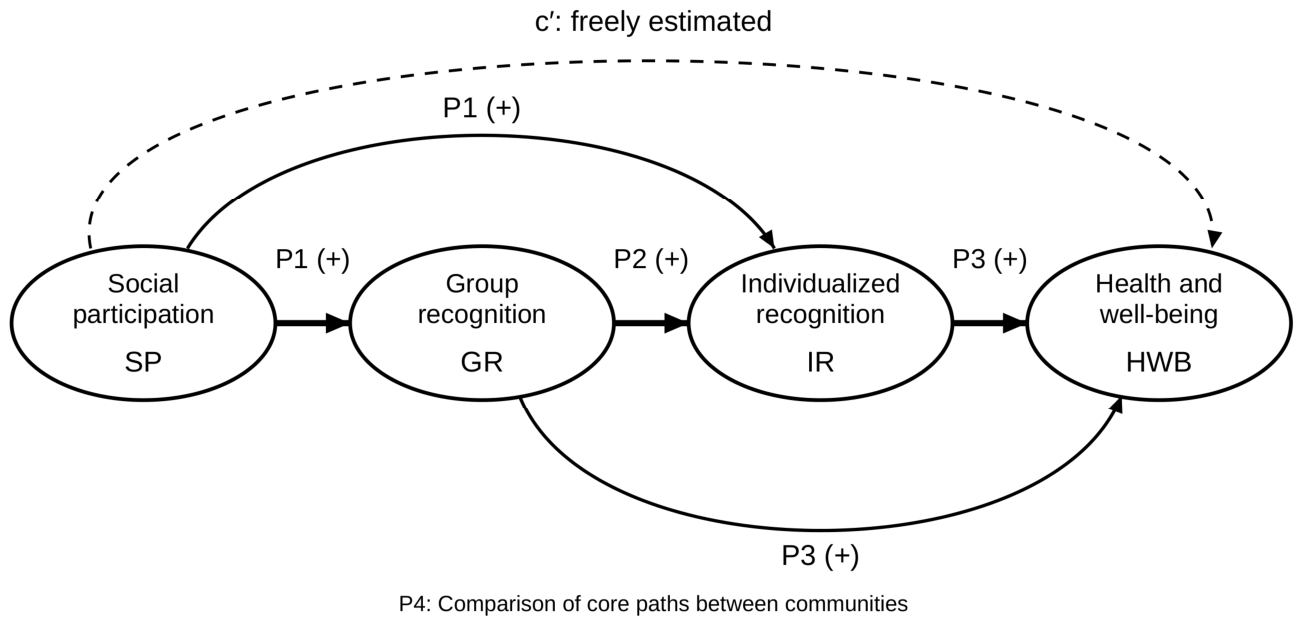
Figure 2.
Core structural estimates from the full RRT model. Note. Standardized coefficients from the full-sample model. ** p < .01, *** p < .001; n.s., not significant. Significance refers to conventional ML tests. The value .000 is rounded, not fixed. SP is first-order and the other constructs are second-order. The complete model appears in Supplementary Figure S1. Python rendering of the reported Amos estimates is described in Section 3.3.
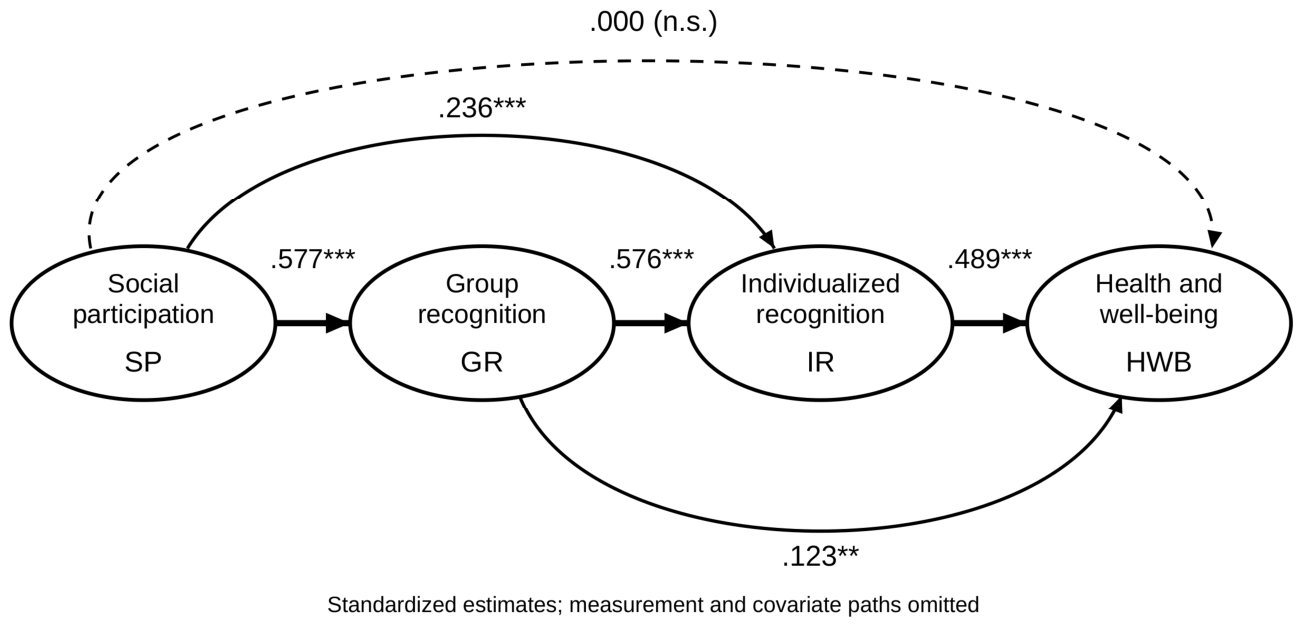

Table 1.
RRT in relation to adjacent theories and concepts.
| Theory / concept | Existing explanatory focus | Further relational question posed by RRT |
| Social support / social capital | Assistance, care, evaluation, membership, and relational resources (Cobb, 1976; Portes, 1998) | How do the ways support and resources are provided affirm or weaken participants’ standing as agents? |
| Belonging / perceived cohesion | Subjective experiences of belonging and group morale (Bollen & Hoyle, 1990) | How does accepted membership open opportunities for expression, role-taking, and responses? |
| Perceived usefulness / mattering | Daily usefulness, feeling valued and adding value, and their social conditions (Allen et al., 2015; Prilleltensky, 2020) | How does personal value develop within membership relationships, and why can belonging and feeling valued diverge? |
| Work-group inclusion | Joint satisfaction of belongingness and uniqueness needs and its organizational conditions (Shore et al., 2011) | Is there a conditional process connecting membership to personal value and, in turn, to health in later life? |
| Self-efficacy | Judgments about the capacity to perform actions (Bandura, 1977) | When do capability and being valued diverge, and how can recognition continue as capacities change? |
| Relational Regulation Theory | Regulation of affect, thought, and action through everyday interaction (Lakey & Orehek, 2011) | What membership position and particular social significance are also affirmed through interaction? |
| Relational Recognition Theory | Relational confirmation of membership and personal value | Proposes a sequence from membership to personal-value recognition, with recognition ecology specifying the organization and distribution of opportunities. |
Note. The comparison concerns explanatory objects and process propositions. Relational Regulation Theory and Relational Recognition Theory share the acronym RRT. Throughout this article, RRT refers to Relational Recognition Theory.
Table 2.
Participant characteristics by community.
| Variable | Category |
Community L (n = 491) |
Community F (n = 494) |
Overall (N = 985) |
Group comparison |
| Age (years) | Mean (SD) | 78.2 (7.9) | 74.2 (8.1) | 76.2 (8.3) | t(983) = 7.76 p < .001 |
| Gender | Male | 205 (41.8) | 240 (48.6) | 445 (45.2) | χ2(1) = 4.64 p = .031 |
| Female | 286 (58.2) | 254 (51.4) | 540 (54.8) | ||
| Education | Primary or less | 27 (5.5) | 31 (6.3) | 58 (5.9) | χ2(4) = 172.90 p < .001 |
| Junior secondary | 207 (42.2) | 76 (15.4) | 283 (28.7) | ||
| Senior secondary / technical secondary | 182 (37.1) | 128 (25.9) | 310 (31.5) | ||
| Junior college | 45 (9.2) | 133 (26.9) | 178 (18.1) | ||
| Bachelor’s or higher | 30 (6.1) | 126 (25.5) | 156 (15.8) | ||
| Monthly income (CNY) | Below 4,000 | 43 (8.8) | 40 (8.1) | 83 (8.4) | χ2(4) = 46.81 p < .001 |
| 4,000–5,999 | 232 (47.3) | 158 (32.0) | 390 (39.6) | ||
| 6,000–7,999 | 148 (30.1) | 148 (30.0) | 296 (30.1) | ||
| 8,000–9,999 | 49 (10.0) | 87 (17.6) | 136 (13.8) | ||
| 10,000 or more | 19 (3.9) | 61 (12.3) | 80 (8.1) |
Note. Values are n (%) except for age. Continuous age is used in the structural models. Overall age mean and SD are pooled from group summaries and rounded. Group differences are assessed using a t test for age and chi-square tests for categorical variables. Structural path comparisons appear in Supplementary Section S3.
Table 3.
Measurement validity and comparison of recognition structures.
| A. Composite reliability, average variance extracted, and construct correlations. | |||||||||||||
| Construct | CR | AVE | SP | GR | IR | HWB | |||||||
| SP | .878 | .512 | .715 | ||||||||||
| GR | .954 | .875 | .574 | .935 | |||||||||
| IR | .840 | .641 | .559 | .712 | .801 | ||||||||
| HWB | .882 | .652 | .404 | .531 | .696 | .807 | |||||||
| Note. Diagonal entries are square roots of AVE. CR and AVE for SP use item loadings. Those for GR, IR, and HWB use second-order loadings of their first-order domains. | |||||||||||||
| B. Two-dimensional and single-dimensional recognition models. | |||||||||||||
| Recognition structure | χ2 | df | χ2/df | CFI | TLI |
RMSEA 90% CI |
AIC | ||||||
| Separate GR and IR | 5520.244 | 1258 | 4.388 | .913 | .908 | .059 [.057, .060] |
5760.244 | ||||||
| Combined Recognition | 6112.955 | 1261 | 4.848 | .901 | .896 | .063 [.061, .064] |
6346.955 | ||||||
| Note. Both models use the same 52 observed indicators, retaining the six first-order recognition domains and the measurement structures of SP and HWB. This comparison addresses the distinction between the recognition dimensions and does not establish their temporal order. | |||||||||||||
Table 4.
Decomposition of the association between participation and health and well-being.
| Effect / pathway | Standardized effect | Bias-corrected 95% CI | Bootstrap p |
| SP→GR→HWB | .071 | [.021, .127] | .008 |
| SP→IR→HWB | .116 | [.070, .167] | .001 |
| SP→GR→IR→HWB | .162 | [.112, .218] | .001 |
| Total indirect effect | .349 | [.271, .418] | .001 |
| Residual direct effect | .000 | [−.066, .070] | .944 |
| Total effect | .349 | [.303, .395] | <.001 |
Note. Point estimates combine the relevant path coefficients. Five thousand bootstrap resamples provide bias-corrected 95% confidence intervals. Bootstrap p values differ from the conventional ML tests in Figure 2. The ordering of specific indirect effects is based on point estimates, not tests of differences between them.
Disclaimer/Publisher’s Note: The statements, opinions and data contained in all publications are solely those of the individual author(s) and contributor(s) and not of MDPI and/or the editor(s). MDPI and/or the editor(s) disclaim responsibility for any injury to people or property resulting from any ideas, methods, instructions or products referred to in the content. |
© 2026 by the authors. Licensee MDPI, Basel, Switzerland. This article is an open access article distributed under the terms and conditions of the Creative Commons Attribution (CC BY) license (http://creativecommons.org/licenses/by/4.0/).
Copyright: This open access article is published under a Creative Commons CC BY 4.0 license, which permit the free download, distribution, and reuse, provided that the author and preprint are cited in any reuse.