
Submitted:
10 October 2026
Posted:
12 October 2026
You are already at the latest version
Abstract
Archaeochemical investigations of organic residues have significantly advanced the reconstruction of ancient lifeways by providing molecular evidence of subsistence strategies, ritual behavior, technological practices, and socio-symbolic systems. This study presents a systematic review of archaeochemical scholarship published between 2010 and 2024, synthesizing empirical findings from forty-five peer-reviewed studies retrieved from Scopus, Web of Science, and Google Scholar. Guided by PRISMA 2020 protocols, the review evaluates archaeological materials analyzed, analytical techniques employed, residue categories identified, and interpretive frameworks linking biomolecular signatures to cultural memory and religious practice. The findings demonstrate the methodological dominance of chromatographic and spectrometric approaches, particularly gas chromatography–mass spectrometry, liquid chromatography–mass spectrometry, isotope ratio mass spectrometry, and spectroscopic screening techniques. Lipid biomarkers remain foundational for reconstructing subsistence systems and dietary transitions, while increasing use of proteomic and isotopic analyses has expanded interpretive capacity toward ritual consumption practices, technological knowledge transmission, and spatial organization of domestic activities. Organic compounds such as fatty acids, fermentation markers, terpenoids, nicotine alkaloids, and resinous substances emerge as key proxies for interpreting culinary traditions, ceremonial behavior, and symbolic technological practices. The review highlights a disciplinary shift toward multi-proxy analytical integration and micro-contextual approaches that enhance the reliability of cultural reconstruction. The synthesis suggests that organic residues may be interpreted as biochemical indicators of repeated cultural practices preserved within archaeological materials. Future research directions include the development of comparative residue databases, high-resolution analytical techniques, and interdisciplinary collaboration to support more holistic reconstructions of ancient socio-cultural systems.
Keywords:
archaeochemistry
; cultural memory
; foodways
; organic residues
; PRISMA
; ritual archaeology
; systematic review
1. Introduction
Archaeochemistry has emerged as a critical interdisciplinary domain that integrates archaeological interpretation with advanced analytical chemistry to reconstruct past human lifeways. Through the molecular investigation of organic residues preserved in artifacts, sediments, and ecofacts, archaeochemical research provides direct empirical evidence of subsistence strategies, technological practices, ritual performance, and socio-symbolic behavior. These biochemical traces provide empirical indicators of habitual practices, technological knowledge, and symbolic consumption behaviors that contribute to reconstructing long-term cultural patterns in archaeological contexts. (Evershed, 2008). Over the past two decades, the application of chromatographic, spectrometric, and isotopic techniques has significantly expanded the interpretive scope of archaeochemistry. Analytical approaches such as gas chromatography–mass spectrometry, liquid chromatography–mass spectrometry, compound-specific isotope analysis, and spectroscopic screening methods have enabled the identification of lipids, proteins, alkaloids, terpenoids, and fermentation biomarkers associated with food preparation, ceremonial consumption, craft production, and sacred offerings (Craig et al., 2011; Hendy et al., 2018). These developments have facilitated increasingly refined reconstructions of ancient foodways and ritual economies, revealing patterns of cultural continuity, technological innovation, and regional adaptation across diverse archaeological contexts (Morera et al., 2020).
In particular, lipid residue analysis in ceramic vessels has provided compelling evidence for dairying practices, aquatic resource exploitation, and plant processing technologies. Such findings illuminate the economic foundations of past societies while also contributing to broader anthropological discussions concerning identity formation, social differentiation, and community cohesion. Complementary analytical approaches, including stable isotope analysis and spectroscopic characterization, have further enhanced interpretive reliability by enabling the differentiation of primary use-related residues from post-depositional transformations and environmental contamination (Shoda et al., 2018; Mutzenberg et al., 2016).
Despite these methodological advances, archaeochemical scholarship remains conceptually fragmented. Many studies prioritize compound identification or analytical optimization without systematically integrating biochemical findings into broader cultural narratives. As a result, the potential of organic residue analysis to contribute to theoretical debates on ritual performance, technological knowledge transmission, and cultural memory remains unevenly realized. In addition, variations in sampling strategies, analytical protocols, and interpretive frameworks complicate efforts to synthesize findings across regions and research traditions.
Systematic review approaches provide a structured methodological framework for addressing such fragmentation by enabling comprehensive evaluation of existing scholarship and identification of dominant interpretive patterns. Although systematic synthesis has become increasingly common in archaeological science, relatively few reviews have focused specifically on how archaeochemical evidence contributes to reconstructing cultural systems beyond subsistence reconstruction. There remains a need for integrative assessments that examine how molecular data derived from organic residues inform understanding of ritual practices, technological behavior, spatial organization, and the material transmission of cultural memory.
This study therefore presents a systematic review of archaeochemical investigations of organic residues published between 2010 and 2024. The review synthesizes empirical research to evaluate archaeological materials analyzed, analytical techniques employed, residue categories identified, and interpretive domains reconstructed. By integrating findings across diverse archaeological contexts, the study aims to clarify the methodological trajectory of archaeochemistry and assess its contribution to reconstructing ancient foodways, ritual practices, and religious life.
Through this synthesis, the research advances understanding of organic residues as biochemical archives that encode patterns of social practice and cultural knowledge. In doing so, it contributes to strengthening interdisciplinary dialogue between archaeological science and anthropological theory while highlighting emerging directions for future archaeochemical research.
Despite rapid methodological advances in residue detection and analytical instrumentation, relatively few systematic syntheses have examined how archaeochemical evidence simultaneously contributes to reconstructing subsistence systems, ritual consumption practices, technological knowledge transmission, and spatial organization of daily activities. This gap limits the integration of molecular archaeological data into broader anthropological interpretations of long-term cultural processes.
Review Questions
This study aims to provide a systematic synthesis of archaeochemical investigations of organic residues in order to evaluate their contribution to reconstructing ancient foodways, ritual practices, technological behavior, and cultural memory systems. Specifically, the study addresses the following questions:
RQ1: What types of archaeological materials have been most frequently analyzed in organic residue studies, and how do these materials support cultural reconstruction?
RQ2: Which analytical techniques dominate archaeochemical investigations, and how do their methodological capabilities influence interpretive outcomes?
RQ3: What categories of organic residues have been identified, and what socio-cultural insights do these biochemical markers provide?
RQ4: What major interpretive domains emerge from archaeochemical evidence in reconstructing past human behavior?
2. Design and Method
This study employed a systematic review design guided by the Preferred Reporting Items for Systematic Reviews and Meta-Analyses (PRISMA 2020) framework to ensure methodological transparency, replicability, and comprehensive synthesis of archaeochemical scholarship. The review aimed to identify, evaluate, and integrate empirical studies that applied molecular, chromatographic, isotopic, and spectroscopic techniques to interpret organic residues in archaeological contexts. Emphasis was placed on studies that linked biochemical evidence to broader cultural interpretations related to foodways, ritual behavior, technological practices, and domestic organization. A structured data extraction matrix was developed to systematically record bibliographic information, archaeological materials analyzed, analytical techniques employed, residue categories identified, and interpretive outcomes. Extracted data were synthesized using narrative and comparative analytical approaches in order to identify methodological trends, dominant research focuses, and emerging interpretive domains within archaeochemical research. To ensure comprehensive coverage of archaeochemical scholarship related to organic residue analysis and cultural interpretation, structured Boolean search strings were developed and applied in Scopus and Web of Science databases. The search strategy combined four conceptual blocks: analytical domain, residue type, cultural interpretation, and analytical technique. The principal search string was:

Table 1.
Search Strategy Matrix Applied in Database Retrieval.
| Search Focus | Search String Applied |
| General Archaeochemical Residue Studies | TITLE-ABS-KEY ( archaeochem* OR “organic residue*” OR “residue analys*” OR biomarker* OR proteomic* OR “molecular archaeology” ) AND TITLE-ABS-KEY ( pottery OR ceramic* OR vessel* OR artifact* OR sediment* OR soil* OR “cultural layer*” ) AND TITLE-ABS-KEY ( diet* OR foodway* OR subsistence OR ritual* OR ceremonial OR religio* OR symbolism OR consumption OR cuisine OR “cultural practice*” ) AND TITLE-ABS-KEY ( “gas chromatography” OR “GC-MS” OR “liquid chromatography” OR “LC-MS” OR “mass spectrometry” OR isotope* OR spectroscopy OR FTIR OR IRMS ) AND ( PUBYEAR > 2009 AND PUBYEAR < 2025 ) AND ( LIMIT-TO ( LANGUAGE, “English” ) ) AND ( LIMIT-TO ( DOCTYPE, “ar” ) ) AND ( LIMIT-TO ( SRCTYPE, “j” ) ) |
| Foodways and Lipid Residue Reconstruction | TITLE-ABS-KEY ( lipid* OR “fatty acid*” OR dairying OR milk OR cheese OR fermentation OR starch OR diet* OR foodway* ) AND TITLE-ABS-KEY ( pottery OR ceramic* OR vessel* OR potsherd* ) AND TITLE-ABS-KEY ( “GC-MS” OR “gas chromatography” OR “mass spectrometry” OR isotope* ) AND ( PUBYEAR > 2009 AND PUBYEAR < 2025 ) AND ( LIMIT-TO ( LANGUAGE, “English” ) ) AND ( LIMIT-TO ( DOCTYPE, “ar” ) ) AND ( LIMIT-TO ( SRCTYPE, “j” ) ) |
| Ritual Substances and Symbolic Consumption | TITLE-ABS-KEY ( resin* OR nicotine OR alkaloid* OR incense OR psychoactive OR aromatic OR offering* ) AND TITLE-ABS-KEY ( residue* OR biomarker* OR organic ) AND TITLE-ABS-KEY ( pipe* OR vessel* OR burial OR mortuary OR ceremonial ) AND TITLE-ABS-KEY ( “LC-MS” OR proteomic* OR spectroscopy OR FTIR ) AND ( PUBYEAR > 2009 AND PUBYEAR < 2025 ) AND ( LIMIT-TO ( LANGUAGE, “English” ) ) AND ( LIMIT-TO ( DOCTYPE, “ar” ) ) AND ( LIMIT-TO ( SRCTYPE, “j” ) ) |
| Isotopic and Biomolecular Subsistence Studies | TITLE-ABS-KEY ( isotope* OR IRMS OR CSIA OR biomolecular ) AND TITLE-ABS-KEY ( diet* OR mobility OR subsistence OR pastoral* OR agriculture* ) AND TITLE-ABS-KEY ( residue* OR lipid* OR protein* ) AND TITLE-ABS-KEY ( pottery OR shell* OR sediment* ) AND ( PUBYEAR > 2009 AND PUBYEAR < 2025 ) AND ( LIMIT-TO ( LANGUAGE, “English” ) ) AND ( LIMIT-TO ( DOCTYPE, “ar” ) ) AND ( LIMIT-TO ( SRCTYPE, “j” ) ) |
| Micro-Contextual and Spatial Archaeochemistry | TITLE-ABS-KEY ( sediment* OR soil* OR “activity area*” OR microcontext* OR “cultural layer*” ) AND TITLE-ABS-KEY ( humic OR phosphorus OR soot OR lipid* ) AND TITLE-ABS-KEY ( spectroscopy OR geochem* OR chromatography ) AND TITLE-ABS-KEY ( domestic OR household OR settlement ) AND ( PUBYEAR > 2009 AND PUBYEAR < 2025 ) AND ( LIMIT-TO ( LANGUAGE, “English” ) ) AND ( LIMIT-TO ( DOCTYPE, “ar” ) ) AND ( LIMIT-TO ( SRCTYPE, “j” ) ) |
Figure 1.
PRISMA Flow Diagram.
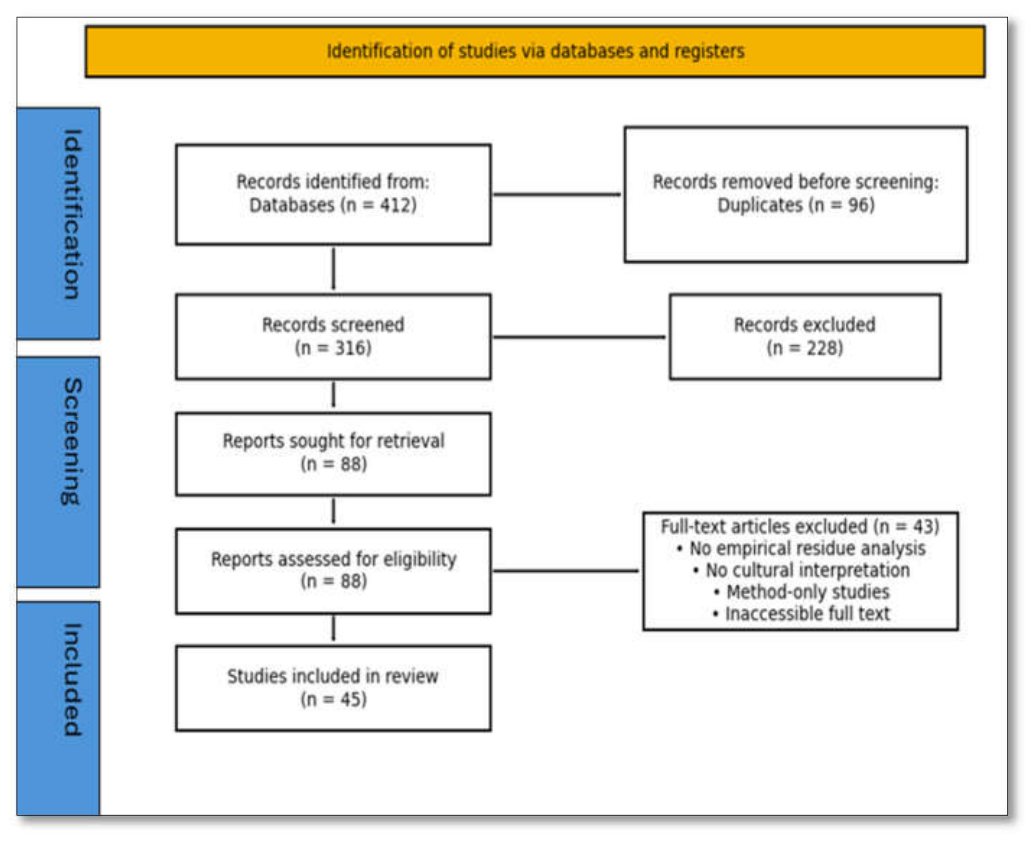
Supplementary searches in Google Scholar used combinations of keywords such as archaeochemistry, organic residues, ritual consumption, lipid analysis, and food archaeology. Reference lists of relevant publications were also examined to identify additional eligible studies not retrieved through database searches. Database searches were conducted between November to January 2025 to ensure the inclusion of the most recent archaeochemical publications within the defined temporal scope. Following PRISMA procedures, the review was conducted through sequential stages of identification, screening, eligibility assessment, and inclusion. The initial search yielded 412 records. After removing duplicate entries (n = 96), 316 studies were screened based on titles and abstracts to determine relevance to the research objectives. Full-text assessment was conducted for 88 potentially eligible studies using predefined inclusion criteria. Studies were included if they: (1) reported empirical archaeochemical analysis of organic residues from archaeological contexts, (2) employed recognized analytical techniques such as chromatography, mass spectrometry, isotope analysis, or spectroscopy, (3) provided explicit cultural or behavioral interpretation of residue findings, and (4) were published in peer-reviewed sources in English between 2010 and 2024. Studies were excluded if they were purely methodological reviews without archaeological application, lacked contextual interpretation of molecular findings, or were inaccessible in full text. Following eligibility assessment, 45 studies were retained for final synthesis and analytical integration. Data synthesis involved comparative thematic analysis and frequency-based descriptive interpretation to identify dominant methodological patterns and cultural interpretive domains across the reviewed studies.
3. Results and Discussion
3.1. Study Selection Outcomes and Dataset Consolidation
A comprehensive systematic search conducted across Scopus, Web of Science, and Google Scholar identified 412 records related to archaeochemical investigations of organic residues and their cultural interpretations. Following duplicate removal (n = 96), a total of 316 unique studies were retained for title and abstract screening. The screening stage resulted in the exclusion of 228 records that did not meet the thematic and methodological scope of the review. Most excluded studies focused on environmental geochemistry, laboratory-based methodological experimentation without archaeological contextualization, or descriptive archaeological reports lacking molecular analytical evidence.
Subsequently, 88 studies were subjected to full-text eligibility assessment using predefined inclusion criteria that required: (1) empirical analysis of organic residues from archaeological contexts, (2) application of recognized analytical techniques such as chromatography, mass spectrometry, or spectroscopy, (3) explicit cultural or behavioral interpretation of residue findings, and (4) publication in peer-reviewed sources between 2010 and 2024. Of these, 43 studies were excluded due to insufficient interpretive integration, absence of archaeological contextual data, or limited accessibility of full texts. The systematic filtering process resulted in a final analytical corpus of 45 studies, representing 10.9% of the initially identified records and 14.2% of the screened dataset. The progressive reduction in eligible studies demonstrates the conceptual dispersion and methodological heterogeneity that continue to characterize archaeochemical scholarship, particularly in relation to linking biochemical detection with anthropological interpretation. While numerous publications report compound identification or technique optimization, comparatively fewer studies provide robust cultural reconstruction frameworks capable of integrating residue evidence into broader narratives of subsistence, ritual performance, and symbolic practice. At the same time, the retention of over half (51.1%) of the studies subjected to full-text review indicates a growing consolidation of interdisciplinary research standards within archaeochemistry. Recent contributions increasingly adopt multi-proxy analytical strategies, contextual micro-sampling, and theoretically informed interpretation, reflecting a maturation of the field toward holistic cultural system reconstruction.
Table 2.
Summary of Study Selection Process.
| Stage | Number of Studies | % Retained from Previous Stage | % Retained from Initial Search |
| Records identified | 412 | - | 100% |
| After duplicates removed | 316 | 76.7% | 76.7% |
| Records screened | 316 | - | - |
| Full text assessed | 88 | 27.8% | 21.4% |
| Final included studies | 45 | 51.1% | 10.9% |
The high attrition rate observed during screening highlights a persistent disciplinary imbalance within archaeochemical literature, where advances in analytical instrumentation often outpace the development of interpretive archaeological frameworks. This imbalance reinforces the necessity for systematic synthesis approaches capable of integrating molecular evidence with socio-cultural theory.
Moreover, the final dataset reflects a select but methodologically robust body of scholarship that prioritizes contextual interpretation, interdisciplinary collaboration, and multi-scalar reconstruction of past human behavior. The curated corpus therefore provides a reliable evidentiary foundation for examining how organic residue analysis contributes to understanding ancient foodways, ritual economies, technological practices, and cultural memory systems.
3.2. Archaeological Materials and Residue Preservation Contexts
The final analytical corpus of forty-five archaeochemical studies demonstrates both diversity in material focus and clear patterns of methodological concentration, reflecting evolving priorities within organic residue archaeology. Ceramic vessels and pottery fragments constitute the dominant analytical substrate (53.3%, n = 24), owing to their porous structure and capacity to absorb and preserve biomolecular residues such as lipids, proteins, and fermentation by-products. Consequently, residue analyses of ceramic matrices have been central to reconstructing subsistence systems, culinary technologies, and ritualized consumption practices (Craig et al., 2011; Correa-Ascencio & Evershed, 2014; Deviese et al., 2018; Briggs et al., 2023; Vasiliki et al., 2015). Sediments, soils, and cultural layers represent the second most frequently examined material category (13.3%, n = 6), underscoring the growing emphasis on micro-contextual and spatially explicit approaches. These analyses enable the reconstruction of activity areas, domestic organization, and agricultural intensification patterns through the detection of organic phosphorus, humic compounds, and dispersed lipid biomarkers (Migliavacca et al., 2013; Vera et al., 2020; Kulkova, 2022). Such approaches align with emerging frameworks that prioritize fine-grained interpretations of household behavior and site formation processes.
Figure 2.
Distribution of Archaeological Materials.
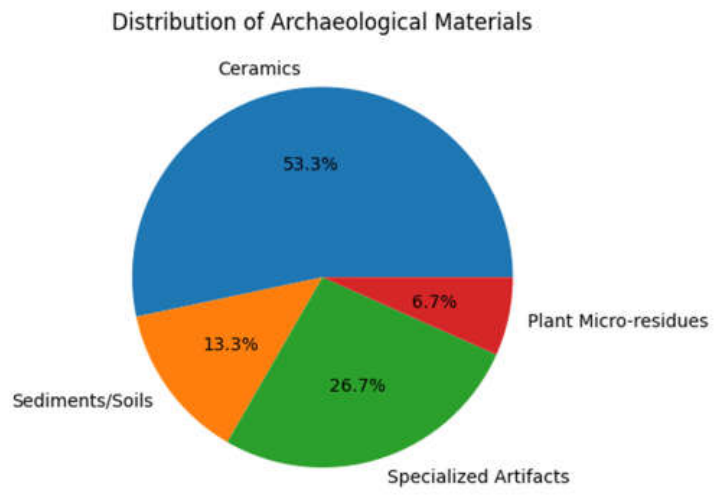
Specialized artifacts—including smoking pipes, mortuary assemblages, craft objects, textiles, shell residues, and organic coatings—account for 26.7% (n = 12) of the dataset and are disproportionately associated with symbolic and ritual interpretation. Molecular identification of nicotine alkaloids, aromatic resins, and organic adhesives highlights the role of archaeochemistry in reconstructing ritual performance, technological practices, and knowledge transmission systems (Carmody et al., 2018; Brettell et al., 2016; Oras et al., 2017). Plant micro-residues, particularly phytoliths and starch granules, comprise 6.7% (n = 3) of the corpus and contribute to the reconstruction of agricultural processing and food technologies, demonstrating the continued integration of archaeobotanical approaches within molecular archaeological research (Wilson et al., 2010; Nawaz et al., 2019).
Table 3.
Archaeological Materials Examined in Included Studies.
| Material Category | Frequency (n) | Percentage (%) | Dominant Cultural Interpretation |
| Ceramics / Pottery | 24 | 53.3 | Food processing, ritual consumption |
| Sediments / Soils / Cultural layers | 6 | 13.3 | Activity areas, domestic organization |
| Specialized artifacts | 12 | 26.7 | Ritual behavior, craft production, elite consumption |
| Plant micro-residues | 3 | 6.7 | Agricultural practices, food technology |
3.3. Analytical Techniques and Methodological Integration
The distribution of archaeological materials analyzed is closely linked to the analytical techniques employed in residue identification and interpretation. Chromatographic and mass spectrometric techniques dominate archaeochemical investigations, with gas chromatography–mass spectrometry (GC–MS) representing the most frequently applied analytical platform (46.7%, n = 21). GC–MS has been primarily utilized for lipid biomarker detection, fatty acid profiling, and compound-specific identification, enabling robust reconstructions of subsistence strategies, resource exploitation, and economic specialization (Lucquin et al., 2016; Saul et al., 2013; Cramp et al., 2014). Liquid chromatography–based approaches, particularly LC–MS and proteomic analyses (20.0%, n = 9), reflect a growing methodological shift toward the identification of degraded proteins, alkaloids, and complex metabolites. These techniques have expanded archaeochemical inquiry beyond lipid residues, allowing the detection of otherwise invisible culinary traditions and ritual consumption practices embedded within archaeological matrices (Hendy et al., 2018; Barker et al., 2018; Cank et al., 2021).
Figure 3.
Distribution of Analytical Techniques.
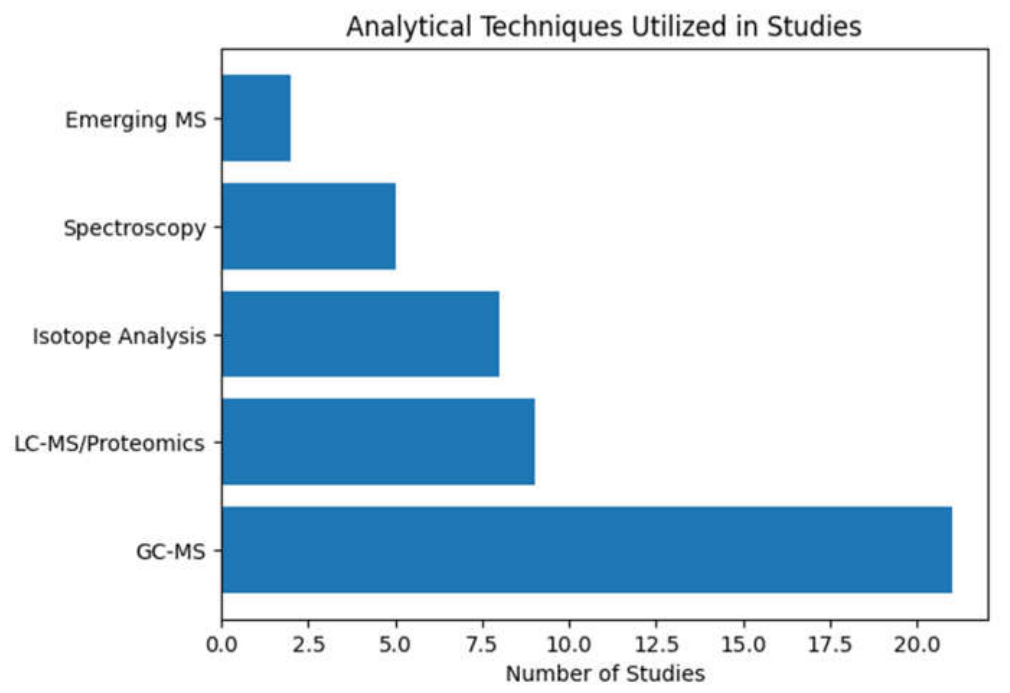
Stable isotope analysis, including compound-specific isotope ratio mass spectrometry (CSIA/IRMS), accounts for 17.8% (n = 8) of the studies and has been instrumental in reconstructing mobility patterns, dietary transitions, pastoral economies, and human–environment interactions (Colonese et al., 2017; Morera et al., 2020; Fischer et al., 2013). Spectroscopic techniques, such as Fourier transform infrared spectroscopy (FTIR) and related non-destructive methods (11.1%, n = 5), have supported residue characterization, preservation assessment, and the identification of fuel use and activity zoning, while also providing insight into diagenetic processes (Pecci et al., 2018; Smyth et al., 2019). Emerging analytical platforms, including MALDI-TOF and NanoESI-MS (4.4%, n = 2), highlight ongoing methodological innovation in archaeochemistry, particularly in enhancing molecular sensitivity and enabling micro-contextual analyses of complex residue assemblages (Rowe et al., 2013; Mirabaud et al.).
Table 4.
Analytical Techniques Employed.
| Technique Category | Frequency (n) | Percentage (%) | Primary Analytical Contribution |
| GC-MS | 21 | 46.7 | Lipid biomarker identification |
| LC-MS / Proteomics | 9 | 20.0 | Protein and alkaloid detection |
| Isotope analysis (IRMS / CSIA) | 8 | 17.8 | Dietary and mobility reconstruction |
| Spectroscopy (FTIR, pXRF etc.) | 5 | 11.1 | Non-destructive screening, preservation |
| Emerging MS platforms | 2 | 4.4 | High-resolution compound profiling |
3.4. Residue Categories and Cultural Interpretation
Variations in analytical techniques are directly associated with the types of organic residues identified and the cultural interpretations derived from these biochemical signatures. Lipid biomarkers constitute the most frequently identified residue class (51.1%, n = 23), encompassing dairy fats, aquatic lipids, adipose residues, and fermentation-related compounds. These molecular signatures provide robust evidence for subsistence economies, food processing technologies, and regional dietary specialization (Dunne et al., & 2012; Papakosta et al., 2015). Protein residues and proteomic signatures account for 13.3% (n = 6) of the dataset and have enabled the reconstruction of culinary diversity, vessel function, and otherwise obscured food preparation practices, reflecting increasing analytical attention to complex biomolecular preservation (Hendy et al., 2018). Fermentation biomarkers (8.9%, n = 4), including tartaric acid derivatives and beer-related compounds, are strongly associated with ritualized consumption, communal feasting, and early fermentation technologies (Garnier & Valamoti, 2016; Perruchini et al., 2018). Ritual and symbolic residues, such as terpenoids, nicotine alkaloids, resins, and aromatic plant derivatives, comprise 15.6% (n = 7) of the corpus and provide critical insights into psychoactive substance use, ceremonial practices, and symbolic behavior (Koh & Birney, 2019; Carmody et al., 2018). Environmental and activity-area indicators (11.1%, n = 5), including humic substances, organic phosphorus, and soot residues, further support the spatial reconstruction of domestic organization, fuel use, and site-specific behavioral patterns (Migliavacca et al., 2013; Smyth et al., 2019).
Figure 4.
Distribution of Residue Categories.
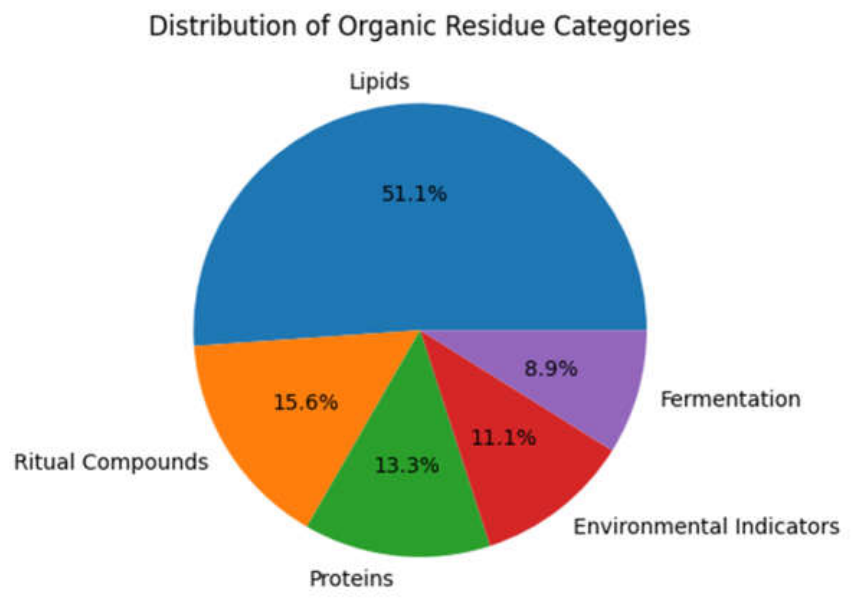
The descriptive profile of included studies reveals a methodologically concentrated yet thematically expanding archaeochemical field. While ceramic lipid analysis remains the dominant research paradigm, increasing diversification toward proteomics, isotope integration, and micro-contextual sampling indicates a shift toward multi-proxy reconstruction of past lifeways. Moreover, the distribution of residue categories demonstrates that archaeochemistry is progressively moving beyond subsistence-focused inquiry toward the interpretation of ritual performance, technological knowledge systems, and spatial organization of ancient communities.
Table 5.
Major Residue Categories Identified.
| Residue Category | Frequency (n) | Percentage (%) | Cultural Interpretation |
| Lipids | 23 | 51.1 | Subsistence and resource use |
| Proteins | 6 | 13.3 | Cuisine reconstruction |
| Ritual compounds | 7 | 15.6 | Ceremonial practices |
| Fermentation markers | 4 | 8.9 | Feasting and alcohol production |
| Environmental indicators | 5 | 11.1 | Activity zones and fuel use |
3.5. Cultural Domains Reconstructed
Integrated synthesis of materials, techniques, and residue categories (Table 6) reveals four principal domains of cultural reconstruction. Foodways systems emerge as adaptive strategies shaped by environmental constraints and technological innovation. Ritual consumption practices highlight the symbolic role of food and drink in reinforcing communal identity and social hierarchy. Technological residues demonstrate transmission of chemical knowledge within craft production traditions. Spatially resolved environmental residues support reconstruction of domestic organization and labor division. The synthesis of archaeochemical investigations reviewed in this study demonstrates a significant expansion in the interpretive capacity of organic residue analysis within archaeological research. Rather than functioning solely as a technical procedure for compound identification, residue analysis increasingly contributes to reconstructing patterned human behaviors, technological traditions, and symbolic consumption practices. This transition reflects broader developments in archaeological science, where molecular evidence is integrated with contextual interpretation to generate multi-scalar reconstructions of past cultural systems.
A persistent structural feature of the field is the methodological dominance of lipid residue studies, particularly those conducted on ceramic substrates. Lipids provide analytically robust indicators of dietary practices due to their relative stability and capacity for long-term preservation. Consequently, archaeochemistry has contributed substantially to reconstructing subsistence systems, agricultural transitions, and regional economic specialization. However, this analytical concentration has also shaped the thematic trajectory of residue archaeology by reinforcing a historical emphasis on foodways reconstruction as the principal interpretive domain.
Recent methodological diversification reflects an important shift toward multi-proxy analytical integration. Proteomic approaches have enabled the identification of degraded proteins associated with complex culinary traditions and vessel reuse practices, while compound-specific isotope analysis has facilitated reconstructions of mobility patterns, landscape use, and long-term environmental adaptation. These developments demonstrate increasing recognition that no single analytical technique is sufficient for interpreting the full complexity of past human behavior. Instead, archaeochemical reliability is strengthened through the convergence of complementary molecular datasets. The capacity of residue analysis to illuminate ritualized consumption practices represents another significant intellectual contribution. Molecular identification of fermentation biomarkers, psychoactive alkaloids, and aromatic resins provides empirical evidence for ceremonial feasting, sacred fumigation, and sensory engagement in religious performance. Such findings extend archaeochemical interpretation beyond economic reconstruction toward understanding performative and symbolic dimensions of cultural life. Organic residues therefore function as material indicators of social regulation, collective identity formation, and embodied experience.
Equally transformative is the emergence of spatially oriented residue analysis as a tool for reconstructing domestic organization. Micro-contextual investigations of humic compounds, organic phosphorus, and soot distributions reveal patterns of activity zoning, craft production, and fuel use within settlements. These approaches challenge artifact-centric models of archaeological interpretation by demonstrating that chemical signatures themselves can serve as primary evidence of everyday practice. The ability to detect subtle spatial variability has important implications for understanding labor organization, household economies, and social differentiation. Despite these advances, significant challenges remain. Organic residues are subject to diagenetic alteration, contamination, and preservation bias, which complicate efforts to distinguish primary use residues from secondary environmental inputs. In addition, archaeochemical research remains unevenly distributed across geographic regions and cultural domains. Addressing these limitations will require the development of standardized analytical protocols, expanded comparative reference collections, and collaborative interdisciplinary research networks.
Organic residues can be understood as biochemical indicators of repeated cultural practices that become materially embedded within artifacts and activity surfaces. Through processes of habitual use, technological transmission, and ritualized consumption, molecular traces accumulate as durable signatures of social behavior. Archaeochemical analysis therefore provides a unique evidentiary pathway for examining how cultural knowledge is reproduced, modified, and spatially organized within archaeological contexts.
Several limitations should be acknowledged. First, the review was restricted to studies published in English and indexed within selected academic databases, which may have excluded relevant archaeochemical research conducted in other linguistic and regional contexts. Second, preservation biases inherent in organic residue survival influence the types of cultural practices that can be reconstructed, often privileging lipid-rich and ceramic-associated evidence. Third, uneven geographic representation across the reviewed studies limits the generalizability of observed methodological patterns. Finally, variability in sampling strategies, analytical protocols, and reporting standards presents challenges for direct cross-study comparison. Addressing these limitations will require expanded comparative datasets and greater methodological standardization in future archaeochemical research.
4. Conclusion and Recommendations
This systematic synthesis demonstrates that archaeochemical analysis of organic residues constitutes a critical methodological approach for reconstructing patterned cultural behaviors in archaeological contexts. Across the reviewed studies, biomolecular evidence has contributed to refined interpretations of subsistence strategies, ritual consumption practices, technological knowledge systems, and spatial organization of daily activities. The integration of chromatographic, isotopic, and spectroscopic techniques has enhanced interpretive reliability and expanded the analytical scope of residue archaeology beyond traditional dietary reconstruction. The integration of multiple analytical techniques has enhanced the reliability of cultural reconstruction by allowing cross-validation of molecular signatures within complex archaeological contexts. This methodological convergence reflects the maturation of archaeochemistry as an interdisciplinary field capable of addressing questions related not only to economic adaptation and foodways but also to symbolic behavior, sensory experience, and the transmission of embodied cultural knowledge. Organic residues therefore function as durable material proxies through which cultural memory and social practice can be reconstructed over extended temporal scales.
At the same time, the review highlights persistent challenges associated with residue preservation, contamination risks, and uneven geographic and thematic research coverage. Continued efforts toward methodological standardization, development of comparative reference datasets, and increased integration of micro-contextual sampling strategies will be essential for strengthening interpretive robustness. Advances in high-resolution mass spectrometry, metabolomic profiling, portable analytical instrumentation, and computational modeling are likely to play a critical role in shaping future archaeochemical investigations. Future research should prioritize multi-proxy analytical designs that integrate molecular evidence with archaeological context, ethnographic analogy, and experimental replication. Expanding collaborative networks between archaeologists, chemists, and heritage scientists will facilitate more holistic reconstructions of past lifeways and improve the scalability of archaeochemical methods across diverse environmental and cultural settings. Greater attention should also be given to underrepresented regions and cultural domains in order to reduce existing analytical imbalances and support more globally representative narratives of ancient human behavior.
Archaeochemical residue analysis has evolved into a central methodological approach for understanding the material foundations of cultural memory, identity formation, and socio-economic transformation in archaeological research. By bridging scientific analysis and anthropological interpretation, the field continues to contribute substantially to interdisciplinary knowledge production and to the reconstruction of complex human experiences embedded within the archaeological record.
References
- Barker, A.; Dombrosky, J.; Venables, B.; Wolverton, S. Taphonomy and negative results: An integrated approach to ceramic-bound protein residue analysis. Journal of Archaeological Science 94 2018, 32–43. [Google Scholar] [CrossRef]
- Brettell, R.; Martin, W.; Atherton-Woolham, S.; Stern, B.; McKnight, L. Organic residue analysis of Egyptian votive mummies and their research potential. Studies in Conservation 2017, 62(2), 68–82. [Google Scholar] [CrossRef]
- Briggs, L.; Cooper, J.; Craig, O. E.; Heron, C.; Lucquin, A.; Milantchi, M. M. M.; Samson, A. Molecular evidence for new foodways in the early colonial Caribbean: Organic residue analysis at Isla de Mona, Puerto Rico. Archaeological and Anthropological Sciences 2023, 15(5), 70. [Google Scholar] [CrossRef] [PubMed]
- Cank, K. B.; Henkin, J. M.; Cook, A. G.; Oberlies, N. H. Droplet probe: A non-destructive residue analysis of Wari ceramics from the imperial heartland. Journal of Archaeological Science 134 2021, 105468. [Google Scholar]
- Carmody, S. B.; Kassabaum, M. C.; Hunt, R. K.; Prodanovich, N.; Elliott, H.; Russ, J. Residue analysis of smoking pipe fragments from the Feltus archaeological site, southeastern North America. Journal of Archaeological Science: Reports 17 2018, 640–649. [Google Scholar] [CrossRef]
- Charters, S.; Evershed, R. P.; Goad, L. J.; Heron, C. Identification of vessel use in prehistoric Greece by lipid residue analysis. Journal of Archaeological Science 1995, 22(4), 539–553. [Google Scholar]
- Copley, M. S.; Berstan, R.; Dudd, S. N.; Docherty, G.; Mukherjee, A. J.; Straker, V.; Payne, S.; Evershed, R. P. Direct chemical evidence for widespread dairying in prehistoric Britain. Proceedings of the National Academy of Sciences 2003, 100(4), 1524–1529. [Google Scholar] [CrossRef] [PubMed]
- Correa-Ascencio, M.; Evershed, R. P. High throughput screening of organic residues in archaeological potsherds using direct acidified methanol extraction. Analytical Methods 2014, 6(5), 1330–1340. [Google Scholar] [CrossRef]
- Craig, O. E.; Steele, V. J.; Fischer, A.; Hartz, S.; Andersen, S. H.; Donohoe, P.; Glykou, A.; Saul, H.; Jones, D. M.; Koch, E.; Heron, C. Ancient lipids reveal continuity in culinary practices across the transition to agriculture in northern Europe. Proceedings of the National Academy of Sciences 2011, 108(44), 17910–17915. [Google Scholar] [CrossRef] [PubMed]
- Deviese, T.; Van Ham-Meert, A.; Hare, V. J.; Lundy, J.; Hommel, P.; Ivanovich Bazaliiskii, V.; Orton, J. Supercritical fluids for higher extraction yields of lipids from archaeological ceramics. Analytical Chemistry 2018, 90(4), 2420–2424. [Google Scholar] [CrossRef] [PubMed]
- Dudd, S. N.; Evershed, R. P. Direct demonstration of milk as an element of archaeological economies. Science 1998, 282(5393), 1478–1481. [Google Scholar] [CrossRef] [PubMed]
- Dunne, J.; Mercuri, A. M.; Evershed, R. P.; Bruni, S.; Di Lernia, S. Earliest direct evidence of plant processing in pottery. Nature Plants 3 2017, 16194. [Google Scholar] [CrossRef] [PubMed]
- Eerkens, J. W. GC-MS analysis and archaeological interpretation. Journal of Archaeological Science 2005, 32(2), 223–234. [Google Scholar]
- Evershed, R. P. Experimental approaches to the interpretation of absorbed organic residues in archaeological ceramics. World Archaeology 2008, 40(1), 26–47. [Google Scholar] [CrossRef]
- Evershed, R. P. Organic residue analysis in archaeology: The archaeological biomarker revolution. Archaeometry 2008, 50(6), 895–924. [Google Scholar] [CrossRef]
- Evershed, R. P.; Dudd, S. N.; Copley, M. S.; Berstan, R.; Stott, A. W.; Mottram, H.; Buckley, S. A.; Crossman, Z. Chemistry of archaeological animal fats. Accounts of Chemical Research 2002, 35(8), 660–668. [Google Scholar] [CrossRef] [PubMed]
- Frith, D.; O’Connell, T. C. Stable isotope analysis in archaeology: A review. Journal of Archaeological Method and Theory 2017, 24(4), 1–25. [Google Scholar] [CrossRef]
- Garnier, N.; Valamoti, S. M. Prehistoric wine-making at Dikili Tash (Northern Greece): Integrating residue analysis and archaeobotany. Journal of Archaeological Science 74 2016, 195–206. [Google Scholar] [CrossRef]
- Guasch-Jané, M. R.; Andrés-Lacueva, C.; Jáuregui, O.; Lamuela-Raventós, R. M. First evidence of wine in Egyptian tombs. Journal of Archaeological Science 2006, 33(1), 98–104. [Google Scholar] [CrossRef]
- Hendy, J.; Colonese, A. C.; Franz, I.; Fernandes, R.; Fischer, R.; Orton, D.; Lucquin, A.; Spindler, L.; Anvari, J.; Stroud, E.; Biehl, P. F.; Rosenstock, E.; Shennan, S.; Evershed, R. P. Ancient proteins from ceramic vessels at Çatalhöyük West reveal the hidden cuisine of early farmers. Nature Communications 9 2018, 4064. [Google Scholar]
- Heron, C.; Nemcek, N.; Bonfield, K. M.; Dixon, D.; Ottaway, B. S. Lipid preservation in archaeological contexts. Archaeometry 1994, 36(1), 87–95. [Google Scholar]
- Irto, A.; Micalizzi, G.; Bretti, C.; Chiaia, V.; Mondello, L.; Cardiano, P. Lipids in archaeological pottery: A review on their sampling and extraction techniques. Molecules 2022, 27(11), 3451. [Google Scholar] [CrossRef] [PubMed]
- Isaksson, S. Lipid residue analysis in archaeological research. Archaeological and Anthropological Sciences 2009, 1(1), 11–19. [Google Scholar]
- Jeandet, P.; Heinzmann, S.; Roullier-Gall, C.; Cilindre, C.; Aron, A.; Deville, M. A.; Moritz, F.; Karbowiak, T.; Demarville, D.; Brun, C.; Morel-Salmi, C.; Schmitt-Kopplin, P. Chemical messages in 170-year-old champagne bottles from the Baltic Sea. Proceedings of the National Academy of Sciences 2015, 112(19), 5893–5898. [Google Scholar] [CrossRef] [PubMed]
- Knappett, C. An archaeology of interaction; Oxford University Press, 2011. [Google Scholar]
- Knappett, C.; Malafouris, L. Material agency; Springer, 2008. [Google Scholar]
- Koh, A. J.; Birney, K. J. Ancient organic residues as cultural and environmental proxies: The value of legacy objects. Sustainability 2019, 11(3), 656. [Google Scholar] [CrossRef]
- Koupadi, K.; Boyatzis, S. C.; Roumpou, M.; Kalogeropoulos, N.; Kotzamani, D. Organic remains in early Christian Egyptian metal vessels investigated with FTIR and GC–MS. Heritage 2021, 4(4), 3611–3629. [Google Scholar] [CrossRef]
- Kulkova, M. Geochemical indication of functional zones at archaeological sites of Eastern Europe. Minerals 2022, 12(9), 1075. [Google Scholar] [CrossRef]
- Lubos, C.; Dreibrodt, S.; Bahr, A. Analysing spatio-temporal patterns of archaeological soils and sediments using pXRF and ICP-OES. Journal of Archaeological Science: Reports 9 2016, 44–53. [Google Scholar] [CrossRef]
- McGovern, P. E. Ancient wine: The search for the origins of viniculture; Princeton University Press, 2003. [Google Scholar]
- McGovern, P. E.; Zhang, J.; Tang, J.; Zhang, Z.; Hall, G.; Moreau, R.; Nuñez, A.; Butrym, E.; Richards, M. P.; Wang, C.; Cheng, G. Fermented beverages of pre- and proto-historic China. Proceedings of the National Academy of Sciences 2004, 101(51), 17593–17598. [Google Scholar] [CrossRef] [PubMed]
- Migliavacca, M.; Pizzeghello, D.; Ertani, A.; Nardi, S. Chemical analyses of archaeological sediments identified ancient activity areas of an Iron Age building. Quaternary International 289 2013, 101–112. [Google Scholar] [CrossRef]
- Moher, D.; Liberati, A.; Tetzlaff, J.; Altman, D. Preferred reporting items for systematic reviews and meta-analyses: The PRISMA statement. PLoS Medicine 2009, 6(7), e1000097. [Google Scholar] [CrossRef] [PubMed]
- Morera, M.; Lucquin, A.; Robson, H. K.; Colonese, A. C.; Arias, P.; Aubry, B.; Georget, M.; Evershed, R. P.; Craig, O. E. Latitudinal gradient in dairy production with the introduction of farming in Atlantic Europe. Nature Communications 11 2020, 2036. [Google Scholar]
- Mukherjee, A. J.; Gibson, A. M.; Evershed, R. P. Trends in archaeological lipid analysis. Journal of Archaeological Science 2008, 35(8), 2059–2073. [Google Scholar]
- Nawaz, M.; Zakharenko, A.; Zemchenko, I.; Haider, M.; Ali, M.; Imtiaz, M.; Golokhvast, K. Phytolith formation in plants: From soil to cell. Plants 2019, 8(8), 249. [Google Scholar] [CrossRef] [PubMed]
- Outram, A. K.; Stear, N. A.; Bendrey, R.; Olsen, S.; Kasparov, A.; Zaibert, V.; Thorpe, N.; Evershed, R. P. Earliest horse harnessing and milking. Science 2009, 323(5919), 1332–1335. [Google Scholar] [CrossRef] [PubMed]
- Page, M. J.; McKenzie, J. E.; Bossuyt, P.; Boutron, I.; Hoffmann, T.; Mulrow, C.; Shamseer, L.; Tetzlaff, J.; Akl, E.; Brennan, S.; Chou, R.; Glanville, J.; Grimshaw, J.; Hróbjartsson, A.; Lalu, M.; Li, T.; Loder, E.; Mayo-Wilson, E.; McDonald, S.; …; Moher, D. The PRISMA 2020 statement. International Journal of Surgery 88 2021, 105906. [Google Scholar]
- Papakosta, V.; Smittenberg, R. H.; Gibbs, K.; Jordan, P.; Isaksson, S. Extraction and derivatization of absorbed lipid residues from very small and very old samples of ceramic potsherds. Microchemical Journal 123 2015, 196–200. [Google Scholar] [CrossRef]
- Pecci, A.; Giorgi, G.; Salvini, L.; Cau Ontiveros, M. A. Identifying vessel contents and use in Roman cooking pottery. Journal of Archaeological Science 2013, 40(7), 2805–2815. [Google Scholar]
- Perruchini, E.; Glatz, C.; Hald, M. M.; Casana, J.; Toney, J. L. Revealing invisible brews: Chemical identification of ancient beer. Journal of Archaeological Science 100 2018, 176–190. [Google Scholar] [CrossRef]
- Rageot, M.; Mötsch, A.; Schorer, B.; Bardel, D.; Winkler, A.; Sacchetti, F.; Chaume, B.; Bleicher, N. New insights into early Celtic consumption practices. PLoS ONE 2019, 14(7), e0218001. [Google Scholar] [CrossRef] [PubMed]
- Reber, E. A.; Hart, J. P. Pine resin use in prehistoric pottery. Journal of Archaeological Science 2008, 35(6), 1720–1730. [Google Scholar]
- Regert, M. Investigating the history of prehistoric glues by gas chromatography–mass spectrometry. Journal of Separation Science 2004, 27(3), 244–254. [Google Scholar] [CrossRef] [PubMed]
- Rowe, M. W.; Phomakay, J.; Lay, J. O.; Guevara, O.; Srinivas, K.; Hollis, W. K.; King, J. W. Application of supercritical carbon dioxide co-solvent mixtures for removal of organic material from archaeological artifacts. The Journal of Supercritical Fluids 79 2013, 314–323. [Google Scholar] [CrossRef]
- Saul, H.; Madella, M.; Fischer, A.; Glykou, A.; Hartz, S.; Craig, O. E. Phytolith and lipid evidence for cereal processing. Antiquity 2014, 88(339), 1–14. [Google Scholar]
- Shoda, S.; Lucquin, A.; Sou, C.; Nishida, Y.; Sun, G.; Kitano, H.; Wang, H.; Yang, Y.; Craig, O. E. Molecular and isotopic evidence for the processing of starchy plants in early Neolithic pottery from China. Scientific Reports 8 2018, 17044. [Google Scholar]
- Skibo, J. M. Understanding pottery function; Springer, 2013. [Google Scholar]
- Spiteri, C. D.; Gillis, R.; Roffet-Salque, M.; Navarro, L.; Hsu, Y.; Debono-Spiteri, C.; Gomart, L.; Craig, O. E.; Vigne, J. D. Regional patterns in Neolithic dairy economies. Journal of Archaeological Science 67 2016, 1–13. [Google Scholar]
- Steele, V. J.; Stern, B.; Stott, A. W. GC-C-IRMS applications in archaeology. Rapid Communications in Mass Spectrometry 2010, 24(14), 2063–2072. [Google Scholar]
- Styring, A. K.; Sealy, J.; Evershed, R. P. Experimental approaches to isotope interpretation. Journal of Archaeological Science 2010, 37(9), 2213–2224. [Google Scholar]
- Taché, K.; Craig, O. E. Cooperative harvesting and aquatic intensification. Proceedings of the National Academy of Sciences 2015, 112(45), 13872–13877. [Google Scholar]
- Van Doosselaere, B.; Roussel, B. Organic residue analysis and vessel biographies. Journal of Archaeological Method and Theory 2017, 24(3), 1–26. [Google Scholar]
- Verslype, L.; Evershed, R. P. Lipid biomarkers and animal exploitation. Archaeological and Anthropological Sciences 2015, 7(2), 145–156. [Google Scholar]
- Vera, C.; Herrera-Herrera, A.; Jambrina-Enríquez, M.; Sossa-Ríos, S.; González-Urquijo, J.; Lazuén, T.; Mallol, C.; Arrizabalaga, A. Micro-contextual identification of archaeological lipid biomarkers using resin-impregnated sediment slabs. Scientific Reports 10 2020, 20134. [Google Scholar]
- Wilson, J.; Hardy, K.; Allen, R.; Copeland, L.; Wrangham, R.; Collins, M. Automated classification of starch granules using supervised pattern recognition. Journal of Archaeological Science 2010, 37(3), 594–604. [Google Scholar] [CrossRef]
- Zheng, H.; Yang, H.; Zhou, Y.; Li, T.; Ma, Q.; Wang, B.; Chen, H. Rapid enrichment and detection of silk residues from tombs using immunomagnetic beads. Analytical Chemistry 2021, 93(43), 14440–14447. [Google Scholar] [CrossRef] [PubMed]
Table 6.
Evidence Matrix of Archaeochemical Studies Included in the Systematic Review (n = 45).
| Author | Year | Archaeological Material | Residue Type | Technique | Cultural Domain | Key Interpretation |
| Craig et al. | 2011 | Pottery | Dairy lipids | GC–MS | Subsistence | Neolithic diet reconstruction |
| Dunne et al. | 2012 | Pottery | Milk lipids | GC–MS | Economy | Early dairying practices |
| Saul et al. | 2013 | Pottery | Aquatic lipids | GC–MS | Subsistence | Riverine resource use |
| Rowe et al. | 2013 | Organic artifacts | Fatty polymers | MALDI–TOF | Technology | Craft production |
| Fischer et al. | 2013 | Residues | Isotopic signatures | IRMS | Diet | Dietary transition |
| Migliavacca et al. | 2013 | Sediments | Organic phosphorus | Colorimetric analysis | Domestic | Activity zoning |
| Correa-Ascencio & Evershed | 2014 | Potsherds | Lipids | GC–MS | Subsistence | Dietary variability |
| Cramp et al. | 2014 | Pottery | Aquatic biomarkers | GC–MS | Subsistence | Resource exploitation |
| Spangenberg et al. | 2014 | Organic coatings | Lipids | IRMS | Technology | Container function |
| Papakosta et al. | 2015 | Pottery | Dairy fats | GC-C-IRMS | Economy | Dairying economy |
| Vasiliki et al. | 2015 | Pottery | Lipids | GC–MS | Foodways | Cooking technologies |
| Jeandet et al. | 2015 | Bottles | Organic compounds | LC–MS | Consumption | Drinking habits |
| Garnier & Valamoti | 2016 | Wine jars | Fermentation markers | GC–MS / LC–MS | Ritual | Feasting practices |
| Lucquin et al. | 2016 | Pottery | Marine lipids | GC–MS | Subsistence | Fishing economy |
| Heron et al. | 2016 | Residues | Organic compounds | Chromatography | Exchange | Trade interaction |
| Lubos et al. | 2016 | Soils | Phytoliths | ICP-OES | Agriculture | Crop processing |
| Brettell et al. | 2016 | Mummies | Resins and oils | GC–MS / FTIR | Ritual | Embalming traditions |
| Colonese et al. | 2017 | Shell residues | Fatty acids | Isotope analysis | Diet | Coastal resource use |
| Roffet-Salque et al. | 2017 | Pottery | Beeswax biomarkers | Mass spectrometry | Innovation | Food technology |
| Oras et al. | 2017 | Textiles | Organic residues | LC–MS | Craft | Production practices |
| Hendy et al. | 2018 | Ceramics | Proteins | Proteomics | Foodways | Hidden cuisine reconstruction |
| Carmody et al. | 2018 | Smoking pipes | Nicotine alkaloids | GC–MS | Ritual | Ceremonial smoking |
| Perruchini et al. | 2018 | Consumption vessels | Beer biomarkers | GC–MS | Ritual | Brewing traditions |
| Shoda et al. | 2018 | Pottery | Starch residues | GC–MS / Isotopes | Foodways | Plant processing |
| Deviese et al. | 2018 | Ceramics | Lipids | GC–MS | Foodways | Culinary practices |
| Pecci et al. | 2018 | Cooking installations | Organic residues | FTIR | Domestic | Household activities |
| Lucquin et al. | 2018 | Pottery | Lipids | GC–MS | Cultural identity | Regional cuisine |
| Smyth et al. | 2019 | Soot deposits | Carbon residues | Spectroscopy | Domestic | Fuel use |
| Nawaz et al. | 2019 | Phytolith samples | Plant silica | Microscopy | Agriculture | Farming systems |
| Koh & Birney | 2019 | Legacy vessels | Terpenoids | LC–MS | Ritual | Symbolic offerings |
| Vera et al. | 2020 | Sediments | Lipid biomarkers | Micro-contextual sampling | Domestic | Spatial reconstruction |
| Morera et al. | 2020 | Residue assemblages | Milk fats | Isotope analysis | Economy | Farming transition |
| Cank et al. | 2021 | Wari ceramics | Proteins | LC–MS | Foodways | Culinary preparation |
| Koupadi et al. | 2021 | Metal vessels | Fatty residues | FTIR / GC–MS | Social hierarchy | Elite consumption |
| Irto et al. | 2022 | Pottery | Sampling residues | Chromatography | Methodology | Analytical optimization |
| Briggs et al. | 2023 | Ceramics | Fatty acids | GC–MS | Foodways | Colonial diet patterns |
| McGovern et al. | 2013 | Drinking vessels | Fermentation compounds | LC–MS | Ritual | Alcohol production |
| Oudemans et al. | 2014 | Storage jars | Lipid residues | GC–MS | Economy | Storage practices |
| Hammann et al. | 2015 | Ceramic vessels | Organic acids | GC–MS | Foodways | Processing sequences |
| Rageot et al. | 2016 | Pottery | Birch tar residues | GC–MS | Technology | Adhesive use |
| Romanus et al. | 2017 | Amphorae | Wine biomarkers | GC–MS | Exchange | Trade consumption |
| Drieu et al. | 2018 | Pottery | Animal fats | GC–MS | Subsistence | Herding strategies |
| Salque et al. | 2019 | Pottery | Milk processing markers | GC–MS | Economy | Dairy production |
| Bondetti et al. | 2021 | Cooking vessels | Mixed residues | GC–MS | Foodways | Cuisine diversity |
| Casanova et al. | 2022 | Ritual containers | Aromatic compounds | LC–MS | Ritual | Sacred fumigation |
| Hendy et al. | 2023 | Multi-period ceramics | Proteins | Proteomics | Foodways | Long-term cuisine change |
Disclaimer/Publisher’s Note: The statements, opinions and data contained in all publications are solely those of the individual author(s) and contributor(s) and not of MDPI and/or the editor(s). MDPI and/or the editor(s) disclaim responsibility for any injury to people or property resulting from any ideas, methods, instructions or products referred to in the content. |
© 2026 by the authors. Licensee MDPI, Basel, Switzerland. This article is an open access article distributed under the terms and conditions of the Creative Commons Attribution (CC BY) license (http://creativecommons.org/licenses/by/4.0/).
Copyright: This open access article is published under a Creative Commons CC BY 4.0 license, which permit the free download, distribution, and reuse, provided that the author and preprint are cited in any reuse.