

Submitted:
09 October 2026
Posted:
12 October 2026
You are already at the latest version
Abstract
Background: Portable topical hemostats are needed across a spectrum that extends from superficial household cuts to compressible traumatic bleeding in austere environments. A patented polyethylene oxide formulation comprising liquid PEO-400, solid PEO-1500 and PEO-4000, and aqueous zinc and copper salts can be cast as a cylindrical stick. Existing records describe wound contraction, scab formation, antimicrobial activity, and lower semi-quantitative wound bleeding, but do not establish time to hemostasis or efficacy in severe hemorrhage. Methods: We performed a translational design analysis of the patent record and two prior publications, reconciled claims against the available endpoints, and converted the evidence into two target product profiles: a same-user multi-use household stick for minor external wounds and a single-casualty field applicator for repeated application during one care episode. Product architecture, failure modes, performance gates, and a staged verification programme were defined using current trauma guidance, device-risk principles, and benchmark hemostatic models. Results: The source formulation is compatible with twist-up or push-up dispensing and rapidly forms a hydrophilic film, but its hemostatic mechanism remains a testable hypothesis based on fluid sequestration, surface pressure, and barrier formation. Prior rat data showed differences between PEO-metal treatment (n=7) and untreated controls (n=11) on days 4, 5, and 7 and reported bleeding scores of + versus ++, respectively; these outcomes support continued development but cannot be interpreted as validated hemorrhage control. The principal reuse hazards are cross-contamination, dose variability, tip deformation, water uptake, and transfer of debris into the wound. A controlled advance mechanism, sacrificial tip removal, tamper-evident cap, and explicit single-user or single-casualty labelling are therefore essential. Conclusions: A solid PEO balm is a plausible delivery platform for minor superficial bleeding and subsequent wound protection. Claims for moderate, severe, junctional, or arterial bleeding require blood-contact testing and standardized large-animal hemorrhage studies against gauze-based comparators. The proposed validation pathway prevents premature field claims while preserving a practical route to a compact first-aid product.
Keywords:
hemostasis
; wound healing
; polyethylene oxide
; solid balm
; stick applicator
; first aid
; field medicine
; zinc
; copper
; reusable medical device
1. Introduction
External bleeding is not a single product problem. Minor cuts and abrasions usually require cleansing, direct pressure, and protection, whereas life-threatening extremity or junctional hemorrhage requires immediate compression, wound packing, a hemostatic dressing, and, when indicated, a tourniquet. Current Tactical Combat Casualty Care guidance positions approved hemostatic gauze as an adjunct to direct pressure for compressible hemorrhage that is not amenable to a limb tourniquet; it does not support substitution of an unvalidated topical balm for those interventions [4,5]. A rational product-development programme must therefore define the intended bleeding severity before assigning a field-use claim.
Solid topical dosage forms offer a practical interface between wound dressings and semisolid ointments. A twist-up or push-up applicator can protect the bulk formulation, meter the exposed surface, limit hand contact, and remain usable when tubes are difficult to manipulate. Polyethylene oxides of different molecular masses can be blended to tune melting range, penetrability, spreading, and resistance to deformation. Earlier work on polyethylene glycol ointment bases showed that the ratio of liquid and solid grades strongly controls drop point, congealing range, and spreadability [9]. These properties are especially relevant when a product must remain dimensionally stable during transport yet deposit a thin layer under low manual force.
Russian patent RU 2791374 C1 describes a hydrophilic wound-healing composition based on PEO-400, PEO-1500, and PEO-4000 with an aqueous combination of zinc and copper sulfates, followed by casting and rapid cooling in cylindrical moulds [1]. The source record reports antimicrobial, sorption, wound-healing, and hemostatic properties and contains preliminary rat data. Two related publications discuss the wound-dressing landscape and planimetric assessment of wound repair [2,3]. However, none reports a prospectively defined hemostasis endpoint such as time to stable hemostasis, post-treatment blood loss, rebleeding under resuscitation, or survival. This evidentiary gap is critical because standardized severe-bleeding models use precisely these endpoints [6,12,13,14,15].
The present work treats product architecture as a scientific variable rather than packaging afterthought. The objective was to convert the existing formulation and wound-repair observations into a falsifiable development model for two use contexts: (i) immediate management of superficial, low-flow bleeding in a household first-aid kit and (ii) adjunctive use in a field dressing kit after life-threatening bleeding has been addressed by established methods. We further examined whether and under what restrictions the applicator can be described as reusable. The output is an original target product profile, risk-control strategy, and staged validation framework; it is not a claim of established clinical hemostatic efficacy.
2. Materials and Methods
2.1. Evidence Corpus and Source Reconciliation
The analysis used six source files supplied as a single project corpus: the granted patent and its pre-grant description, the patent application form, two complete 2023 journal issues containing the authors’ prior articles, and a publication acceptance certificate. The granted patent was treated as the controlling source for claim scope and inventor identity. The journal articles were treated as prior publication, not as new data. Quantitative statements were retained only when the sample size, comparison, time point, or endpoint could be recovered. Patent assertions without an associated method or numeric endpoint were classified as hypotheses requiring verification.

Table 1.
Reconciled evidence and permissible interpretation.
| Source element | Recovered evidence | Permissible use in this study | Restriction |
| Granted patent RU 2791374 C1 | PEO grade ranges, aqueous Zn/Cu component, 50-60 °C melt mixing, moulding, rapid cooling at 5 °C, cylindrical stick option. | Defines formulation and manufacturing design space. | A patent claim is not clinical validation. |
| Patent animal data | PEO-metal group n=7 versus untreated control n=11; Mann-Whitney differences reported on days 4, 5, and 7; bleeding scored + versus ++. | Preliminary signal supporting further testing. | No calibrated bleeding scale, time to hemostasis, blood loss, allocation method, or blinded assessment. |
| Patent microbiology | Agar diffusion against E. coli M17 and S. aureus P295 with ampicillin comparator; narrative observations at 24 and 72 h. | Supports antimicrobial testing as a development objective. | No complete zone diameters, replicate-level data, log reduction, or preservative-effect study. |
| 2023 wound-product review | Market and material overview, including polymeric wound coverings and compact reusable formats. | Establishes prior conceptual context. | Not evidence of product-specific performance. |
| 2023 planimetry paper | Animal and literature-based analysis of wound-area trajectories and methodological variability. | Informs wound-repair endpoints and interpretation. | Does not validate rapid hemostasis. |
| Current trauma and device sources | Compression, packing, approved hemostatic dressings, device risks, biocompatibility and shelf-life controls. | Defines external benchmarks and safety gates. | Does not confer equivalence on the PEO stick. |
2.2. Formulation Design Space
The patented composition contains 27-32% PEO-400, 1-15% PEO-4000, 1-20% aqueous metal-salt phase, and PEO-1500 to 100% by mass [1]. One disclosed example used 30 parts PEO-400, 55 parts PEO-1500, 5 parts PEO-4000, and 10 parts aqueous zinc/copper solution. Preparation comprised melting the solid PEO fractions at 50-60 °C, mixing to homogeneity with PEO-400 and the aqueous phase, filling a cylindrical mould, and rapidly cooling at 5 °C. No new batch was manufactured for the present analysis; the composition was used to define critical material attributes and testable ranges.
The design hypothesis was that the low-molecular-mass fraction provides wetting and transfer, PEO-1500 provides the main solid matrix, and PEO-4000 increases structural integrity and film persistence. The aqueous metal phase introduces ionic species with potential antimicrobial and repair-related activity, but also increases risks related to water activity, salt crystallization, dose nonuniformity, irritation, and concentration-dependent cytotoxicity. Copper and zinc participate in tissue repair biology, yet their topical effects depend on chemical form, release rate, local concentration, and wound environment [10,11,16]. Accordingly, metal content was treated as a release-controlled formulation factor rather than as a presumed efficacy enhancer.
2.3. Target Product Profile Construction
Two target product profiles were generated by separating user, wound severity, reuse horizon, application method, and failure consequence. The household profile prioritizes minor superficial wounds and same-user reuse over the labelled in-use period. The field profile prioritizes gloved operation, environmental robustness, and repeated dosing to one casualty during one episode, followed by disposal. Neither profile includes uncontrolled arterial, deep junctional, thoracic, abdominal, or internal bleeding without completion of dedicated validation.
Table 2.
Target product profiles for a solid wound balm applicator.
| Attribute | Household first-aid stick | Field dressing applicator |
| Intended user | Layperson or trained caregiver. | Trained first responder or medic; gloved use. |
| Initial claim boundary | Temporary control of minor external bleeding from superficial cuts and abrasions, followed by wound protection. | Adjunctive coverage of superficial or low-flow external wounds after standard hemorrhage control; no replacement for packing, compression, or tourniquet. |
| Reuse definition | Same user only, across minor-wound episodes, within a validated in-use period. | One casualty and one care episode; repeated applications permitted, then discard. |
| Dose delivery | Twist-up advance with hard stop; thin visible film deposited without placing the housing in contact with the wound. | Push-up or ratcheting advance operable with gloves; controlled exposed length and one-handed cap. |
| Tip control | Advance-and-trim sacrificial layer after direct wound contact; cap remains isolated from contaminated tip. | Break-off or shave-off tip segment between wound sites; discarded with contaminated dressings. |
| Environmental target | Stable at typical indoor storage and short transport excursions. | Package and formulation verified after thermal cycling, vibration, drop, dust, water splash, and freeze-thaw challenge. |
| Primary performance endpoint | Time to cessation of low-flow capillary bleeding with standardized direct pressure. | Successful stable hemostasis only in the validated wound class; rebleeding after movement/transport challenge. |
| Key comparators | Direct pressure plus standard adhesive dressing; plain PEO stick. | Standard gauze and an approved hemostatic gauze appropriate to the model. |
| Exclusions | Deep punctures, bites, visibly contaminated wounds requiring medical care, heavy or pulsatile bleeding, known hypersensitivity. | Arterial or junctional hemorrhage until large-animal evidence exists; internal use; contact with major vessels, nerves, or organs. |
2.4. Failure-Mode Analysis
Failure modes were identified at the interface of formulation, dispenser, wound, environment, and user. Severity was prioritized over nominal convenience. Cross-user contamination and delayed use of definitive hemorrhage control were classified as unacceptable hazards. Risk controls were therefore embedded in the product definition rather than deferred to general instructions for use.
Table 3.
Principal failure modes and design controls.
| Failure mode | Potential consequence | Primary control | Verification |
| Tip contamination during reuse | Transfer of organisms or debris to a later wound. | Same-user restriction; sacrificial tip removal; cap geometry that does not touch exposed product. | In-use microbial challenge with repeated simulated applications and worst-case storage. |
| Use on multiple casualties | Cross-infection in field care. | Single-casualty labelling, distinctive break seal, disposal after episode. | Human-factors study under time pressure and low light. |
| Stick softening or fracture | Dose loss, fragments in wound, applicator failure. | Defined rheological window; limited exposed length; thermal and drop-qualified housing. | Penetration, bend/fracture, dose-mass, drop, vibration, and temperature cycling tests. |
| Water uptake or salt migration | Surface liquefaction, crystallization, nonuniform metal dose. | High-barrier primary pack, desiccant if justified, water-activity specification. | Mass gain, Karl Fischer water, microscopy, assay and content-uniformity mapping. |
| Insufficient wet adhesion under flow | Washout and continued bleeding. | Tune transfer force and film cohesion; require compression-compatible use. | Dynamic whole-blood flow model and ex vivo vessel or tissue model. |
| Overstatement of field indication | Delay in tourniquet, packing, or evacuation. | Severity-specific label and contraindications; training aligned with trauma guidance. | Use-error analysis and simulated casualty scenarios. |
| Metal-ion overexposure | Irritation, cytotoxicity, delayed repair or systemic exposure. | Release specification based on toxicological assessment, not nominal formulation alone. | Extractables/leachables, ion release, cytotoxicity, irritation/sensitization and systemic exposure assessment. |
2.5. Proposed Verification and Validation Endpoints
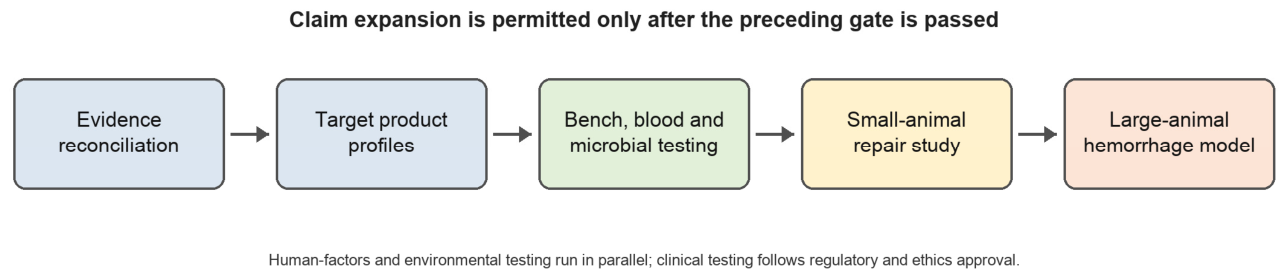
The validation pathway was designed as sequential gates. Advancement requires predefined acceptance criteria and appropriate controls. Early tests separate matrix effects from zinc/copper effects; later models test clinically relevant bleeding and operational handling. Biological evaluation should follow a risk-management framework based on intended tissue contact and exposure duration [8]. FDA’s proposed controls for topical hemostatic dressings similarly emphasize material characterization, performance testing, biocompatibility, shelf-life validation, and labelling [7].
Table 4.
Staged development programme and decision gates.
| Stage | Core tests | Primary endpoints | Go criterion |
| 1 Material and dispenser | Identity, molecular-mass distribution, water content/activity, ion content and release, rheology, drop/congealing range, dose per stroke, film thickness, particulate shedding, thermal cycling. | Batch uniformity; dimensional stability; reproducible deposited mass; no unacceptable fracture or liquefaction. | Specifications met across at least three engineering batches and post-ageing samples. |
| 2 Blood-contact performance | Whole-blood clotting index, thromboelastography, platelet/erythrocyte interaction, dynamic flow washout, clot adhesion, hemolysis. | Clot initiation/strength, retained mass under flow, adhesion, hemolysis. | Predefined improvement versus plain PEO without unacceptable hemolysis or assay interference. |
| 3 Microbiology and biocompatibility | Bioburden/sterility strategy, preservative or antimicrobial effectiveness as applicable, simulated-use contamination, cytotoxicity, irritation, sensitization, chemical characterization. | Log change by specified organisms, recoverable bioburden, cell viability, local reaction, metal exposure. | Risk-based acceptance under the intended contact category and reuse period. |
| 4 Minor-wound proof of concept | Randomized, blinded animal or validated ex vivo superficial-incision model; plain PEO, active stick, standard dressing comparators. | Time to hemostasis, blood loss, rebleeding, local tissue response, epithelialization. | Prospectively powered superiority or non-inferiority for the claimed minor-wound endpoint. |
| 5 Severe-bleeding claim expansion | Standardized swine femoral-artery or other indication-matched model with resuscitation and movement challenge [6,12,13,14,15]. | Stable hemostasis, post-treatment blood loss, survival, rebleeding, pressure required, retrieval and histology. | Performance at least comparable to the selected approved hemostatic dressing with acceptable safety. |
| 6 Human factors and clinical | Gloved operation, low light, stress, one-handed use, label comprehension; ethics- and regulator-approved clinical study for the final indication. | Critical task success, use errors, time to correct application, clinical time to hemostasis and adverse events. | No unresolved critical use error; clinical benefit-risk supports the exact label. |
2.6. Statistical Framework for Future Efficacy Studies
For minor-wound studies, the primary endpoint should be time to hemostasis, defined prospectively as absence of visible bleeding for a fixed observation period after a standardized application and pressure protocol. Interval-censored or time-to-event methods are preferable when assessment occurs at fixed intervals. Blood loss should be quantified gravimetrically with correction for applied fluid. Rebleeding after movement or a standardized challenge should be a key secondary endpoint. Allocation concealment, blinded outcome assessment, predefined rescue treatment, and reporting of all failures are required. For large-animal models, survival, post-treatment blood loss, time to stable hemostasis, resuscitation volume, hemodynamics, and histology should be reported, following the logic of standardized combat-hemostat models [6,12,13,14,15].
Sample size must be based on the selected primary endpoint and a clinically meaningful effect, not on the prior n=7 versus n=11 wound-healing comparison. Repeated wound sites within one animal require hierarchical or mixed-effects analysis; treating each site as an independent animal would inflate precision. Multiplicity should be controlled for secondary time points. Missing data caused by rescue intervention or death must be handled as informative outcomes rather than silently excluded.
3. Results
3.1. Evidence Boundary and Preliminary Signal
The source corpus supports three conclusions. First, the PEO blend can be produced as a dense, plastic, elastic-viscous cylinder and transferred as a thin film. Second, the patented formulation has preliminary wound-repair and antimicrobial signals that justify controlled testing. Third, the record does not support an efficacy claim for rapid traumatic hemorrhage control. The patent reports a semi-quantitative bleeding score of ++ in untreated controls and + in both the PEO-metal formulation and Levomekol comparator. It also reports Mann-Whitney differences between PEO-metal treatment (n=7) and control (n=11) on days 4, 5, and 7. These observations concern the course of full-thickness wounds and cannot be converted into time to hemostasis or blood-loss reduction.
The source records also differ in experimental details: the patent description includes female Wistar rats and 1 cm2 wounds in one experiment, whereas the later planimetry publication describes male Wistar rats and 2 × 2 cm wounds in a separate analysis [1,3]. We therefore did not pool these datasets. This reconciliation prevents artificial precision and makes clear that any new efficacy study must preserve animal-level identifiers, randomization, raw wound-area values, bleeding observations, and protocol deviations.
3.2. Product Architecture
The selected architecture is a replaceable or integral cylindrical cartridge within a twist-up or ratcheting housing. Only a short segment is exposed. The applicator deposits material onto the wound margin and surface while the housing remains outside the wound. Direct pressure is then applied with sterile gauze according to the validated protocol. The cap uses an internal clearance zone so that the contaminated tip cannot touch the cap wall. A trimming collar or dedicated single-use blade removes a defined sacrificial layer after contact. The mechanism must prevent retraction of contaminated material into the clean barrel.
For household use, the device can be reused by the same person only if simulated-use testing demonstrates acceptable microbial control and chemical/physical stability across the labelled in-use period. For field use, “multi-use” is narrowed to multiple applications on one casualty during one care episode. This distinction preserves the practical value requested for a compact kit while preventing cross-casualty transmission. A field unit should be discarded whenever the housing is grossly contaminated, the tip contacts soil or foreign material, the stick fractures, or the tamper barrier is compromised.
3.3. Mechanistic Model
Three mechanisms are plausible and experimentally separable. The first is physical concentration: a hydrophilic PEO matrix can absorb or redistribute water at the wound interface, potentially increasing local concentration of cells and coagulation proteins. The second is barrier formation: the transferred layer may reduce low-pressure surface flow and support direct compression. The third is post-hemostatic wound conditioning through moisture management and controlled release of zinc and copper. None should be assumed to produce rapid coagulation. In fact, hydrophilic PEG-based materials can dissolve or wash out under substantial flow unless coupled to a tissue-reactive or mechanically retained structure [17]. This is why dynamic washout and clot-adhesion testing precede any field-hemorrhage study.
The metal salts are more plausibly linked to antimicrobial and repair-related effects than to immediate hemostasis. Zinc and copper participate in enzyme systems, inflammation, angiogenesis, and epithelial repair, but beneficial and toxic concentrations can overlap depending on speciation and release [10,11,16]. The active comparison must therefore include plain PEO, PEO plus zinc, PEO plus copper, and the combined formulation when feasible. This factorial structure distinguishes matrix mechanics from ion-mediated effects and reduces the risk of attributing a physical barrier effect to the metals.
3.4. Claim Ladder
The evidence supports a staged claim ladder. The first defensible target is convenient topical application and film formation. The second, after bench and minor-wound studies, is temporary control of minor external bleeding. The third is support of wound protection or repair, contingent on biocompatibility and controlled in vivo evidence. Claims for moderate-to-severe external bleeding, junctional injury, arterial injury, or battlefield hemorrhage are last-stage claims that require indication-matched large-animal data and operational testing. Failure at any gate returns the product to the preceding claim level rather than encouraging reinterpretation of wound-closure data as hemostasis.
Figure 1.
Evidence-gated pathway for development of the solid PEO balm applicator.
3.5. Field-Use Decision Model
The field-use decision model begins with bleeding severity. Pulsatile bleeding, rapid pooling, shock, traumatic amputation, or a wound requiring deep packing triggers established hemorrhage-control actions and evacuation; the balm is not used as a substitute. After life-threatening bleeding is controlled, a validated solid applicator could have value for superficial secondary wounds, donor or abrasion-like surfaces within its label, or protection of wound margins. For isolated minor cuts in austere settings, the same applicator could be used as the primary topical product together with direct pressure and an appropriate dressing. The device must remain removable or irrigable so that definitive care is not impeded.
4. Discussion
4.1. Why a Solid Balm Format Is Worth Testing
A stick applicator can solve genuine use problems: rapid access, controlled exposure of product, operation without squeezing a tube, and compact carriage. Compared with powders, it may reduce airborne loss and uncontrolled dispersal. Compared with a jar, it limits finger contact. Compared with a pre-impregnated dressing, it allows coverage of irregular superficial areas. These benefits are meaningful only if the formulation transfers reliably across the temperature range of use and does not leave large fragments in the wound. The dispenser and formulation must therefore be developed as one system.
The proposed product is also materially different from approved combat gauze. Gauze can be packed into a wound and retained under high compression; kaolin- or chitosan-based dressings have extensive preclinical and operational evidence [4,5,6,13]. A PEO stick deposits a surface layer and, in its current form, lacks a load-bearing scaffold. This difference limits extrapolation from the combat-hemostat literature but helps define engineering options. If future work targets deeper compressible wounds, the balm may be better used to coat or load a gauze substrate rather than as a free-standing stick.
4.2. Reusability is a Controlled Claim, Not an Intrinsic Property
The fact that a cylinder is consumed layer by layer does not by itself make repeated wound contact microbiologically safe. Blood, exudate, skin organisms, soil, and fibres can remain at or below the visible surface, enter the cap, or be drawn into the barrel. Antimicrobial activity against two laboratory strains is not equivalent to preservation during repeated use, and a narrative absence of secondary growth in an agar zone does not establish a validated microbial barrier. Reusability therefore requires a defined user population, exposure count, interval, storage condition, cleaning or trimming step, and pass/fail criterion. Without those data, the safest field configuration is single casualty and single episode.
A household same-user claim may ultimately be feasible, but direct sharing should remain prohibited. The validation study should challenge the tip with relevant Gram-positive and Gram-negative bacteria, yeast, and mould; reproduce blood and protein soil; simulate cap replacement and storage; and quantify organisms recovered from the next dispensed dose. The test must include aged product because water activity, surface cracking, and metal-ion distribution may change during storage.
4.3. Safety and Regulatory Implications
Regulatory classification will depend on jurisdiction, intended use, and whether the principal mode of action is physical or pharmacological. A claim based on physical barrier formation and moisture absorption may follow a device pathway, while claims based on antimicrobial or pharmacological action of copper and zinc may alter classification. The formulation should not be positioned first and classified later. The development team should define the principal mode of action, contact duration, wound depth, sterility status, and reuse model before pivotal testing.
Biological safety must account for the complete finished product, not only the historical use of PEG or essentiality of trace metals. Chemical characterization should include residuals, degradation products, packaging migrants, and the released zinc/copper dose under simulated wound conditions. Cytotoxicity, irritation, sensitization, hemocompatibility, and any additional endpoints should be selected through a risk-based assessment consistent with ISO 10993-1 [8]. If a sterile claim is pursued, sterilization compatibility, package integrity, dose uniformity after sterilization, and shelf-life performance become critical.
4.4. Interpretation of the Preliminary Animal Evidence
The prior observations are useful for hypothesis generation. Earlier scab formation, less exudation, and lower semi-quantitative bleeding may reflect improved surface management. Nevertheless, planimetric wound closure is a later repair outcome and is influenced by contraction, epithelialization, scab management, infection, and imaging method. It cannot stand in for immediate hemostasis. The small groups, incomplete randomization and blinding information, and absence of raw hemostasis data further limit inference. The appropriate scientific response is not to discard the formulation, but to use the signal to design a study in which bleeding is the primary endpoint.
4.5. Limitations
This study is a translational design analysis, not a new animal or clinical efficacy experiment. It relies partly on patent-level data, for which reporting standards differ from peer-reviewed experimental reports. Raw planimetry values, individual bleeding observations, formulation batch records, rheology, metal-release profiles, and complete microbiology measurements were not available in the supplied corpus. The proposed target product profiles and acceptance gates are therefore development outputs that require prospective verification. The analysis also does not establish long-term stability, sterilization compatibility, safe reuse, or effectiveness in anticoagulated subjects.
5. Conclusions
The PEO-400/1500/4000 zinc-copper composition described in RU 2791374 C1 is a plausible platform for a compact solid balm applicator. Its strongest near-term indication is temporary management of minor superficial bleeding together with direct pressure and subsequent wound protection. A reusable household presentation should be restricted to one user and supported by simulated-use microbial evidence; a field presentation should be restricted to one casualty and one care episode. The current evidence does not justify claims for severe, junctional, or arterial hemorrhage and does not support replacement of approved hemostatic gauze, wound packing, pressure dressings, or tourniquets. The staged programme defined here provides a direct route from formulation characterization to minor-wound proof of concept and, only if successful, to standardized large-animal hemorrhage testing and clinical evaluation.
Declarations
Ethics statement
No new human or animal experiment was conducted for this translational design analysis. The prior animal work is cited as previously reported and must not be interpreted as a new study. The formulation and animal work forming the preliminary evidence base were conducted at Kursk State Medical University.
Use of artificial intelligence
During preparation of this manuscript, the authors used OpenAI ChatGPT and Codex to support English-language drafting, organization, and editorial revision. The authors reviewed and edited the resulting text and take responsibility for the content of the manuscript.
Data availability
All numerical evidence evaluated in this article is contained in the cited patent and prior publications. The proposed validation framework generates no new experimental dataset..
Acknowledgments
The authors acknowledge Alexey Vladimirovich Barchukov, Anna Vladimirovna Stupitskaya, and Konstantin Alexandrovich Mikhailov for contributions documented in the patent record and prior publications.
Competing interests
Ilyan Chankhovich Kan, Elena Vyacheslavovna Budko, and Leonid Mikhailovich Yampolsky are named inventors on RU 2791374 C1. The patent proprietor is SINAPS LLC. This relationship should be considered when interpreting the development proposal.
References
- Kan, I.C.; Budko, E.V.; Yampolsky, L.M.; Barchukov, A.V.; Stupitskaya, A.V. Wound-healing ointment and method for its production. Russian Federation Patent RU 2791374 C1. Published 7 March 2023.
- Budko, E.V.; Barchukov, A.V.; Yampolsky, L.M.; Kan, I.C. Wound healing drugs: scientific achievements and the market. International Journal of Medicine and Psychology. 2023;6(2):68-75.
- Budko, E.V.; Barchukov, A.V.; Kan, I.C.; Mikhailov, K.A.; Yampolsky, L.M. Development of planimetric analysis of wound healing results. International Journal of Medicine and Psychology. 2023;6(5):88-95.
- Deaton TG, Drew B, Montgomery HR, Butler FK Jr. Tactical Combat Casualty Care Guidelines: 25 January 2024. Journal of Special Operations Medicine. 2024;24(1):100-108. [CrossRef]
- Bennett, B.L.; Littlejohn, L.F.; Kheirabadi, B.S.; et al. Management of external hemorrhage in Tactical Combat Casualty Care: chitosan-based hemostatic gauze dressings. Journal of Special Operations Medicine. 2014;14(3):40-57. PMID:25344707.
- Kheirabadi, B.S.; Arnaud, F.; McCarron, R.; et al. Development of a standard swine hemorrhage model for efficacy assessment of topical hemostatic agents. Journal of Trauma. 2011;71(1 Suppl):S139-S146. [CrossRef]
- US Food and Drug Administration. General and Plastic Surgery Devices Panel: Topical Hemostatic Wound Dressings - classification and proposed special controls. 26-27 October 2022. https://www.fda.gov/media/162540/download.
- International Organization for Standardization. ISO 10993-1:2025. Biological evaluation of medical devices - Part 1: Requirements and general principles for the evaluation of biological safety within a risk management process. Geneva: ISO; 2025.
- Hadi, I.A.; Ugriné, H.E.; Farouk, A.M.; Shayoub, M. Formulation of polyethylene glycol ointment bases suitable for tropical and subtropical climates. I. Acta Pharmaceutica Hungarica. 1989;59(3):137-142. PMID:2763848.
- Kluger, N.; Lain, E.; Frasson, N.; Doat, G.; Stennevin, A.; Bianchi, P. The multifaceted properties of copper and zinc in skin healing. Dermatology and Therapy. 2026;16(1):143-154. [CrossRef]
- Agren, M.S. Studies on zinc in wound healing. Acta Dermato-Venereologica Supplementum. 1990;154:1-36. PMID:2275309.
- Ran, Y.; Hadad, E.; Daher, S.; et al. QuikClot Combat Gauze use for hemorrhage control in military trauma: January 2009 Israel Defense Force experience in the Gaza Strip - a preliminary report of 14 cases. Prehospital and Disaster Medicine. 2010;25(6):584-588. [CrossRef]
- Littlejohn, L.F.; Devlin, J.J.; Kircher, S.S.; Lueken, R.; Melia, M.R.; Johnson, A.S. Comparison of Celox-A, ChitoFlex, WoundStat, and combat gauze hemostatic agents versus standard gauze dressing in control of hemorrhage in a swine model of penetrating trauma. Academic Emergency Medicine. 2011;18(4):340-350. [CrossRef]
- Kheirabadi, B.S.; Scherer, M.R.; Estep, J.S.; Dubick, M.A.; Holcomb, J.B. Determination of efficacy of new hemostatic dressings in a model of extremity arterial hemorrhage in swine. Journal of Trauma. 2009;67(3):450-459. [CrossRef]
- Kunio, N.R.; Riha, G.M.; Watson, K.M.; Differding, J.A.; Schreiber, M.A.; Waters, J.M. Chitosan based advanced hemostatic dressing is associated with decreased blood loss in a swine uncontrolled hemorrhage model. American Journal of Surgery. 2013;205(5):505-510. [CrossRef]
- Lansdown, A.B.G.; Sampson, B.; Rowe, A. Sequential changes in trace metal, metallothionein and calmodulin concentrations in healing skin wounds. Journal of Anatomy. 1999;195(Pt 3):375-386. [CrossRef]
- Boerman, M.A.; Roozen, E.; Sánchez-Fernández, M.J.; et al. Next generation hemostatic materials based on NHS-ester functionalized poly(2-oxazoline)s. Biomacromolecules. 2017;18(8):2529-2538. [CrossRef]
- King, D.R.; Cohn, S.M.; Proctor, K.G.; Miami Clinical Trials Group. Modified rapid deployment hemostat bandage terminates bleeding in coagulopathic patients with severe visceral injuries. Journal of Trauma. 2004;57(4):756-759. [CrossRef]
- Hickman, D.A.; Pawlowski, C.L.; Sekhon, U.D.S.; Marks, J.; Gupta, A.S. Biomaterials and advanced technologies for hemostatic management of bleeding. Advanced Materials. 2018;30(4):1700859. [CrossRef]
- Boateng, J.S.; Matthews, K.H.; Stevens, H.N.E.; Eccleston, G.M. Wound healing dressings and drug delivery systems: a review. Journal of Pharmaceutical Sciences. 2008;97(8):2892-2923. [CrossRef]
Disclaimer/Publisher’s Note: The statements, opinions and data contained in all publications are solely those of the individual author(s) and contributor(s) and not of MDPI and/or the editor(s). MDPI and/or the editor(s) disclaim responsibility for any injury to people or property resulting from any ideas, methods, instructions or products referred to in the content. |
© 2026 by the authors. Licensee MDPI, Basel, Switzerland. This article is an open access article distributed under the terms and conditions of the Creative Commons Attribution (CC BY) license (http://creativecommons.org/licenses/by/4.0/).
Copyright: This open access article is published under a Creative Commons CC BY 4.0 license, which permit the free download, distribution, and reuse, provided that the author and preprint are cited in any reuse.