

Submitted:
10 October 2026
Posted:
12 October 2026
You are already at the latest version
Abstract
Background. Animals meet the same sensory classes under different physiological and social conditions and select different actions. How experience changes the mapping from stimulus to behavioral program, without adding any act to the motor repertoire, is a central question for mechanistic neuroendocrinology. Proposal. We separate three operations. Open denotes the physiological state in which a neural substrate is writable; write denotes durable, activity-dependent modification of that substrate; and read denotes recovery of the modified architecture into a competition among behavioral programs for common effectors. We propose that local inhibitory configuration, comprising GABAa receptor subunit composition and neurosteroid tone, contributes to that competition by determining how a broadly distributed permissive signal is transformed at each node. Evidence and predictions. Prairie voles (Microtus ochrogaster) supply a tractable mammalian case, since reproductive maturation, pair bonding, selective aggression, parental care and partner loss repeatedly remap social stimuli onto different outputs, each with an accessible neuroendocrine handle. The critical mechanistic requirement is non-proportional receiver function: when all channels respond proportionally to a common field, that field alters overall gain while leaving unchanged which program wins. Conclusions. The framework yields discriminating physiological tests linking life-history transitions, local receiver properties and behavioral selection, and it remains agnostic about whether any single molecular signal is universal across taxa.
Keywords:
prairie vole
; neurosteroids
; GABAa receptor
; pair bonding
; behavioral selection
1. Introduction: the Same Stimulus, a Different Action
An animal has one set of effectors. Sherrington’s final-common-path principle makes the consequence explicit: allied and antagonistic influences converge on motor output, so coordinated acts that require the same effectors cannot be completed simultaneously (Sherrington 1906). Behavior is therefore a scheduling problem as well as a motivational one. A prairie vole (Microtus ochrogaster, Wagner, 1842) at its burrow entrance, with a partner nearby, pups in the nest and an unfamiliar conspecific approaching, may have several complete programs available but can execute only one at a time.
The problem is clearest when experience changes what the same stimulus releases. Before pair bonding, an unfamiliar conspecific elicits investigation and, in receptive animals, mating; after bonding, the same stimulus class can elicit attack and rejection of alternative mates. The repertoire has not acquired a new act; the mapping from stimulus to program has been rewritten. Comparable re-specifications accompany reproductive release from the natal group, formation of a selective bond, the onset of parental care and adaptation to partner loss in prairie voles, with analogous transitions across mammals (Kenkel et al. 2021; McGraw and Young 2010).
For neuroethology, the important distinction is between identifying the sensory and motivational variables that make an action possible and explaining how one complete behavioral program gains control when several are concurrently available. The latter is an arbitration problem. It becomes especially informative when life-history experience changes the action selected by an otherwise familiar class of stimulus. Rather than treating such transitions only as changes in generalized motivation, we ask what properties an arbitration mechanism must have, what physiological variables could implement it, and how those variables could themselves be modified by experience.
The argument has three parts. First, candidate behavioral programs should be defined operationally by mutually exclusive execution and separable gating. Second, distributed neural circuits require a mechanism by which the same systemic state can be read differently at different nodes. Third, experience-dependent transitions can be organized as a recursive OPEN-WRITE-READ cycle (Figure 1) in which execution affects subsequent permissive state, experience modifies neural substrate while it is writable, and the modified architecture is later read competitively rather than retrieved as a fixed lookup. One division of labor runs through all three. The cellular evidence for receiver properties — GABAa receptor subunit composition, neurosteroid action and its sign — comes largely from mice and rats and serves here as proof of concept, whereas the behavioral remapping is native to voles. The Limitations section returns to what would be required to join them.
2. Behavioral Arbitration Requires Execution-Defined Units
The requirements should follow from the arbitration problem rather than from a preferred taxonomy. Stating them first also makes clear what evidence would count against a proposed unit set.
A scheduling problem exists only when co-execution is impossible. Candidate units must therefore be mutually exclusive at the effector level: two programs that require the same effectors cannot run to completion at once. Arbitration is also substantive only if competitors have distinct enabling conditions. The units must therefore be separately gated and independently perturbable, such that an intervention can shift one without necessarily shifting the others. The corresponding empirical tests are developed below.
Affect-defined categories do not satisfy the first requirement by design, and this is a property of affect rather than a defect of affective theories. Affects can co-occur and combine (Panksepp 1998); execution cannot. An animal cannot complete mounting and flight simultaneously. Near-ties are therefore informative. Voles show conflicting postures, alternating approach and withdrawal, and displacement behaviors such as digging or nose-grooming when neither competing program is completed (Clarke 1956). On an execution account, this is a scheduling failure with a quantitative prediction: displacement should peak when competing readiness values are most closely matched.
The second requirement — independent gating — is increasingly accessible experimentally. In prairie voles, deletion of either the oxytocin receptor or vasopressin 1a receptor markedly reduces same-sex stranger aggression while sparing partner preference and social investigation after one to three weeks of cohabitation (Hasunuma et al. 2026). In wild-type animals, stranger aggression is also uncorrelated with time spent near the partner (Hasunuma et al. 2026). Thus, two outputs associated with the bonded state can vary independently, satisfying an important prerequisite for treating them as distinct arbitration channels.
This operational view complements, rather than replaces, affective and motivational classifications. Conserved emotional systems have been defined by stimulation-evoked behavioral, autonomic and affective responses and by reinforcement properties (Panksepp 1998; Panksepp and Watt 2011). Those findings support the existence of inherited behavioral architectures. Arbitration asks a different question: when more than one architecture is available, which one obtains the final common path? The unit of analyzis therefore need not coincide with an affective category, and candidate units should be retained or rejected according to execution and dissociation tests rather than terminology.
3. Distributed Circuits Require Receiver-Dependent Selection
If behavioral programs were individuated by anatomical territory, the problem would be simpler. They are not. In mouse ventrolateral ventromedial hypothalamus, neurons involved in attack are intermingled with neurons active during mating (Lin et al. 2011), and Esr1+ neurons in the same region can scale between mounting and attack as activation intensity changes (Lee et al. 2014). In medial preoptic area, galanin neurons govern parenting through projection-defined populations (Wu et al. 2014; Kohl et al. 2018). These systems converge downstream on shared periaqueductal output (Falkner et al. 2020). Mating, attack and care therefore occupy interdigitated circuitry; a program is better defined by a distributed configuration than by a single anatomical address.
The social behavior network provides a natural substrate for this view. Newman, Goodson and colleagues described reciprocally connected, steroid-sensitive nodes — including preoptic area, ventromedial hypothalamus, bed nucleus of the stria terminalis, medial amygdala, lateral septum, anterior hypothalamus and periaqueductal gray, with accumbens and ventral tegmental area added subsequently — in which social behaviors correspond to activity patterns across the network rather than to dedicated regions (Newman 1999; Goodson 2005; O’Connell and Hofmann 2011). What this framework does not by itself specify is how one distributed pattern gains priority when several are available. Receptor composition and local modulator tone can be measured at each of these nodes, allowing a network account of social behavior to be linked to a mechanism of arbitration.
Inhibition is a plausible point of selection within such shared circuitry. Sherrington’s final-common-path account already assigned inhibition a selective role: allied influences are admitted and antagonists excluded through graded control of common output rather than simple suppression (Sherrington 1906).
Comparative receptor anatomy illustrates how identical signals can acquire different effects through different receiver maps. Across Microtus species, oxytocin and vasopressin receptor distributions track social organization (Insel and Shapiro 1992; Insel et al. 1994), whereas benzodiazepine binding shows little corresponding variation. The vasopressin 1a receptor protein is 99% conserved between prairie and montane voles and has similar binding kinetics; what differs is its distribution (Young et al. 1999; Lim et al. 2004). In transgenic mice, expression of the prairie vole receptor gene produces a prairie-vole-like receptor distribution and an affiliative response to vasopressin absent in wild-type littermates (Young et al. 1999). Thus, changing where a signal is read can change what the signal does without changing the ligand. Peptide receptor maps can therefore be treated as part of the architecture that assigns broadcast signals to particular nodes (Wang et al. 1998).
4. Inhibitory Configuration as a Candidate Selecting Variable
Three levels should be kept apart in what follows. The computational requirement is that receiver functions — written g(k) for channel k — differ non-proportionally across channels; any mechanism with that property would serve. The candidate physiological implementation proposed here is local inhibitory configuration: the composition of inhibitory receptors at the nodes of each channel, together with the modulator tone those receptors see. The illustrative molecular mechanism is neurosteroid-sensitive GABAa signaling, which is the best-instrumented instance rather than the definition of one. Evidence against the molecular exemplar would leave the computational requirement untouched; evidence against the requirement would sink the account.
The pharmacology of that exemplar is well established. Neurosteroids including allopregnanolone modulate GABAa receptors at conserved transmembrane sites (Belelli and Lambert 2005; Hosie et al. 2006), and at physiological concentrations they act on δ-subunit-containing extrasynaptic receptors that mediate tonic inhibition (Stell et al. 2003; Wohlfarth et al. 2002). Tonic inhibition depends on ambient transmitter, local receptor composition and circulating or locally synthesized steroid, and it regulates the excitability of whole populations (Farrant and Nusser 2005). A change in neurosteroid tone can therefore act as a broadly distributed permissive signal whose consequences depend on receiver configuration at each node.
One signal, many receivers. The physiological variable is the local neurosteroid milieu together with the receptor configuration it meets, so channel specificity sits in the receiver function rather than in a program-specific signal.
Receiver disagreement is essential. If every channel transformed the field proportionally, the field would cancel from between-channel comparisons: it could raise or lower overall readiness while leaving the winner unchanged, and the account would collapse into a theory of arousal. Physiological precedent fits the alternative, since postpartum changes in oxytocin and allopregnanolone accompany increased caregiving alongside reduced mating and competitive behavior (Brunton and Russell 2008), implying that one shared state change moves different systems unequally.
Critical prediction. Non-proportional receiver functions are the central mechanistic requirement of this account, and proportionality falsifies it. The decisive experiment is specified below: manipulate the same inhibitory machinery at nucleus accumbens and at anterior hypothalamus, then ask whether bond formation and stranger-directed aggression move independently.
The sign depends on the receiver. At α4β2δ receptors allopregnanolone can reduce outward current, so in hippocampal CA1 at puberty it lowers tonic inhibition of pyramidal cells — the reverse of its effect before puberty and in adulthood — through an identified α4 intracellular-loop residue and accelerated desensitization (Shen et al. 2007; Smith et al. 2007). More generally, what a chloride conductance does depends on its reversal potential relative to rest, which chloride transporter balance sets (Rivera et al. 1999; Ben-Ari 2002). Sign as well as magnitude is therefore partly a property of the receiving tissue.
Receiver heterogeneity exists within and across nodes. In dentate molecular layer, δ subunits in interneurons colocalize with α1 while principal cells pair δ with α4, so composition differs by cell class within one tissue (Glykys et al. 2007; Wei et al. 2003). Across regions, δ-containing receptors are confined to interneurons in CA3 but carried by both classes in CA1 and dentate gyrus (Glykys et al. 2008). One steroid signal can therefore meet different receptor populations over short distances.
Compensation makes concentration alone insufficient. Receiver composition is itself dynamic (Maguire et al. 2005; Maguire and Mody 2008). Across late pregnancy, as brain allopregnanolone rises markedly, surface δ expression on parvalbumin interneurons falls by roughly two-thirds and returns toward baseline after parturition; elevation and downregulation offset one another in vivo, and the functional consequence appears only on acute steroid withdrawal in vitro (Ferando and Mody 2013). Transitions therefore need not track field amplitude, and differential compensation across receivers supplies one route to the required non-proportionality.
Other modulators remain integral to the competition. Addressed monoaminergic signals bias individual channels strongly: accumbal D1 and D2 receptors act in opposition during bond formation (Aragona et al. 2006), and serotonergic activation in anterior hypothalamus shifts behavior from aggression toward affiliation (Gobrogge et al. 2017). Peptides act through receptor distributions that determine which nodes read a signal. Addressed inputs of both kinds bias particular competitors. The receiver function is likewise not a neurosteroid parameter alone, since what a node makes of a broadcast signal also depends on its fast synaptic weights, AMPA- and NMDA-receptor complement included, and on its intrinsic excitability, both of which experience modifies (Zhang and Linden 2003). Tonic inhibitory conductance enters that composite in a specific way: it acts divisively on the input–output relation, scaling the gain with which fast excitation becomes firing rather than subtracting a fixed amount (Mitchell and Silver 2003; Farrant and Nusser 2005). This is why a shared inhibitory variable can re-rank channels at all. A subtractive change would displace every channel equally, whereas a multiplicative one interacts with the synaptic weight and excitability each channel already carries, and those differ because experience wrote them differently.
That arithmetic has a concrete circuit form. Glutamatergic prefrontal input to nucleus accumbens drives affiliative behavior in prairie voles through a pathway whose efficacy rises as a bond forms (Amadei et al. 2017), and striatal fast-spiking interneurons set the gamma regime in which that input is integrated (Berke 2009), with tonic conductance helping to establish the excitability entrainment depends on (Gunn et al. 2015). A tonic conductance at those cells scales the slope relating excitatory drive to firing, so an identical prefrontal volley under an identical dopaminergic bias yields different output as ambient neurosteroid tone changes. The permissive state operates on the addressed inputs rather than alongside them.
Nor is the argument limited to one chemical family. Sterol-derived signaling contributes to gating across timescales, from rapid membrane effects to slower enzymatic, circuit and structural change (Rahman and Zorumski 2026).
Two constraints keep this from becoming a sedation account. Allopregnanolone shows non-monotonic dose–response relations, with low and high doses producing different behavioral effects (Fish et al. 2001; Miczek et al. 2003), so the operative variable is configuration rather than sedation. And separability does not require independent generation: NMDA receptor activation promotes local neurosteroid synthesis (Tokuda et al. 2011), yet finasteride, TSPO ligands and subunit manipulations move the field without equivalently moving the drive (Frye 2001; Gunn et al. 2015).
5. Prairie Voles as a Model of Repeated Behavioral Remapping
Prairie voles are particularly useful because their life history contains repeated, experimentally accessible remappings between social stimuli and behavioral outputs (Kenkel et al. 2021; Getz et al. 1993) (Figure 2). The cases below identify transitions at which the proposed gating architecture can be tested (Table 1). Figure 2 names the five channels by executed function — mating and courtship, affiliation and attachment, stranger-directed aggression, parental care, and threat response and coping — each defined by the acts it produces.
The natal hold. Females remain reproductively suppressed in the natal group and lack a spontaneous oestrous cycle; chemosignals from an unfamiliar male induce oestrus over one to two days (Carter et al. 1987; Carter et al. 1995). In the present framework, this is a context-dependent gate: reproductive execution remains unavailable until an external condition changes, despite preserved underlying capacity.
Installing the bond. Cohabitation with mating establishes selective partner preference within hours, and extended cohabitation can do so without mating (Williams et al. 1992). Histone deacetylase inhibition facilitates preference formation after non-mating cohabitation and increases acetylation at oxytocin and vasopressin receptor promoters in nucleus accumbens (Wang et al. 2013), providing evidence that social experience can modify a durable molecular substrate. The installation is not reducible to one route or one peptide receptor: same-sex peer preferences form without mating (Beery et al. 2018), and receptor-null animals from independent lines can still form partner preferences (Hasunuma et al. 2026; Berendzen et al. 2023; Horie et al. 2019). A faster addressed mechanism operates at the same node. During cohabitation, a 5-Hz prefrontal signal modulates accumbal gamma; the coupling predicts huddling latency, and optogenetic stimulation during non-mating cohabitation biases later preference (Amadei et al. 2017). These observations are compatible with layered control in which a distributed state sets permissiveness while anatomically addressed pathways carry channel-specific information.
The inversion. Bond formation also changes the response to unfamiliar conspecifics. In anterior hypothalamus, vasopressin and corticotropin-releasing hormone signaling favor stranger-directed aggression, whereas serotonergic activation shifts behavior toward affiliation; vasopressin infusion can even elicit aggression toward the partner (Gobrogge et al. 2017; Gobrogge et al. 2009). These findings distinguish two timescales. Acute hypothalamic signaling can bias arbitration among already available programs within an encounter, whereas the slower bond-dependent transition changes which program the stranger stimulus preferentially releases.
Parenthood. Prairie voles provide an informative partial-open state because many virgin females spontaneously care for novel pups (McGraw and Young 2010; Olazábal and Young 2006). Comparative data show that montane voles, which typically ignore pups as virgins, increase oxytocin receptor binding in lateral amygdala within 24 hours of parturition, whereas prairie voles show no comparable change (Insel and Shapiro 1992). In parallel, GABAa δ and γ2 subunits change across pregnancy and postpartum; δ-subunit disruption impairs normal maternal behavior, and a δ-preferring agonist can restore it (Maguire and Mody 2008). Supraoptic oxytocin neurons also lose allopregnanolone sensitivity around parturition through a peptide-dependent change in receptor state (Koksma et al. 2003). These observations link reproductive transition to changes in how relevant nodes read modulatory signals, although the causal chain proposed here remains to be tested directly in voles.
Separation. Partner loss engages a stress-coping reconfiguration rather than simply erasing the bond: corticotropin-releasing factor signaling promotes passive coping (Bosch et al. 2009), partner preference can persist while accumbal transcriptional signatures of pairing erode (Sadino et al. 2023), and paired animals buffer one another’s stress responses (Smith and Wang 2014). Work in pregnancy also shows that neurosteroid effects need not be mediated exclusively through GABAa receptors. In the nucleus tractus solitarii, locally synthesized allopregnanolone recruits an opioid mechanism that suppresses noradrenaline release in paraventricular nucleus; naloxone and finasteride reverse different steps of this effect (Brunton et al. 2009), while the paraventricular nucleus lacks δ-subunit expression (Pirker et al. 2000). The broader point is that the receiver tissue can determine not only magnitude and sign but also transduction pathway.
6. OPEN-WRITE-READ: A Recursive Architecture
Three operations that are often conflated in discussions of experience-modified innate behavior should be separated.
OPEN is gated writability: whether a substrate can currently be modified. WRITE is durable, experience-dependent modification of that substrate at a rate set by permissive state and activity. READ is recovery of the stored architecture and its entry into the competition that determines execution. These operations form a cycle rather than a linear sequence because execution feeds back on the conditions for subsequent opening and writing (Figure 1a).
These operations can be stated compactly. Execution readiness of a channel is written conjunctively as R = Φ(A · D · C), with execution when R ≥ θ, where A is the neural architecture available for the act, D the activating drive, C the context including the releasing stimulus, Φ the permissive state and θ the commitment threshold (Rahman et al. 2025). Terms are normalized to the unit interval and every term carries a channel index k. Writing takes the same form one layer down, W = ΦN · (AN · DN · CN), with plasticity-capable architecture, activity-dependent intracellular activation, the available molecular targets and writability in the corresponding roles (Rahman 2026). The product is chosen as the simplest operator that enforces a strict gate: R(k) falls to zero whenever any single constituent does, so an animal holding both the architecture and the drive remains below threshold while the releasing context is absent. An additive form instead permits compensation, letting a large drive substitute for a missing context, whereas this account treats each domain as indispensable; a logistic function of a weighted sum supplies a threshold while inheriting that same substitutability below saturation. The commitment is to conjunctive dependence with a threshold, and the product is the simplest member of a broader class of nonlinear gating functions carrying that property.
Keeping ΦN distinct from Φ separates writability from immediate performance, and the two can take opposite values in the same animal. A domestic chick on day 4 sees, orients and approaches normally, putting the execution term near its ceiling, yet training at that age installs no durable preference unless the window is pharmacologically reopened (Yamaguchi et al. 2012; Aoki et al. 2018).
One feedback is that execution can generate or terminate a permissive state. In chicks, imprinting training drives a rapid deiodinase-dependent rise in brain triiodothyronine that contributes to imprintability, and exogenous hormone can reopen the window after closure (Yamaguchi et al. 2012). In mice, predominantly GABAergic preoptic neurons remain active after male ejaculation and suppress subsequent receptivity (Ishii et al. 2025). In both cases, the permissive state is not merely an upstream condition on behavior; it is partly shaped by the behavior that preceded it.
A second feedback is that what is written changes what will later be read. Durable modifications may reside in receptor composition, chloride handling, local modulator metabolism or phosphorylation states that alter receptor efficacy. In prairie voles, bonding experience is associated with histone acetylation at oxytocin and vasopressin receptor promoters in nucleus accumbens (Wang et al. 2013); because receptor expression determines which nodes respond to a broadcast signal, such changes can edit the future reading map. In supraoptic neurons, peptide signaling alters neurosteroid sensitivity (Koksma et al. 2003), providing an example in which the target of writing is itself a gate.
READ is the step at which arbitration becomes explicit. Recovering a stored architecture does not determine behavior when several programs are concurrently available; the recovered states must still compete for common effectors (Figure 1b). Treating READ as a lookup obscures this competition and shifts explanatory weight onto drive alone. Treating it as competition gives the permissive field a specific role: not to determine what is stored, but to alter which available program crosses threshold under current conditions.
Evidence from imprinting shows that OPEN and WRITE can be dissociated. GABAergic agents reopen the chick’s sensitive period when administered immediately before training on day 4, but not when given on day 1 with training delayed to day 4; by contrast, a day-1 thyroid hormone pulse induces a state that persists (Yamaguchi et al. 2012; Aoki et al. 2018). Opening can also be reached through partially distinct molecular routes: mTORC1 is required for visual and auditory imprinting, whereas thyroid hormone engages it in the visual but not auditory pathway (Batista et al. 2018), and eIF2α-dependent translational control is required for auditory but not visual learning (Batista et al. 2016). Thus, permissiveness is best treated as a latent functional state with multiple molecular implementations rather than as a single ligand.
The recursive logic is not restricted to one species or sensory modality. Deiodinase-controlled local thyroid hormone availability in hypothalamic tanycytes is a conserved vertebrate mechanism for setting permissive state, although upstream sensing differs between birds and mammals (Dardente et al. 2014). The responsiveness of this machinery can itself be developmentally gated: photoperiod alters hypothalamic deiodinase expression in juvenile but not adult Brandt’s voles (Wang et al. 2025). A gate can therefore be subject to a higher-order gate.
7. Comparative Implications
The framework is deliberately broader than prairie vole social behavior. Sensitive-period biology provides a complementary test case because opening, encoding and later expression can be experimentally separated. In domestic chicks, imprinting training drives a deiodinase-dependent increase in brain triiodothyronine, and exogenous thyroid hormone can restore imprintability after the sensitive period has closed (Yamaguchi et al. 2012). GABAergic manipulations can also reopen imprinting under specific timing conditions (Aoki et al. 2018). These observations support the distinction between a substrate becoming writable and the experience that is subsequently written into it.
Across vertebrates, local thyroid-hormone availability, steroid-sensitive inhibition and peptide-receptor distributions illustrate a common physiological principle: systemic or broadly distributed signals need not have uniform consequences when receiver configuration differs among tissues. The particular signal may vary across taxa and life-history transitions. The general comparative prediction is therefore not that neurosteroids provide a universal switch, but that behavioral re-specification should be accompanied by measurable changes in the transfer functions through which relevant neural nodes read permissive state.
8. Discriminating Experiments
The model makes a stringent prediction: receiver functions must be non-proportional across channels. Manipulating receptor or steroid-synthesis machinery at different nodes should therefore produce dissociable behavioral effects. Additional tests concern transition-locked regional steroid profiles and the predicted dissociation between acquisition and expression (Winslow et al. 1993).
The proportionality test. Manipulate the δ subunit and 5α-reductase separately in nucleus accumbens and anterior hypothalamus. Lentiviral CRISPRa/i permits bidirectional control of Oxtr and Drd2 in adult vole accumbens (Loth et al. 2025), AAV-CRISPR editing of Oxtr is established in prairie voles (Boender et al. 2023), and anterior hypothalamus can be targeted with site-specific pharmacology (Gobrogge et al. 2009). The critical prediction is a double dissociation: accumbal manipulation should alter preference formation while sparing stranger aggression, whereas hypothalamic manipulation should alter stranger aggression while sparing preference. Correlated, same-signed effects from both sites would argue that the putative field acts as common gain rather than as a selector.
Three controls separate selection from nonspecific effect. Open-field distance and velocity establish that altered aggression survives independently of locomotor change; elevated plus-maze and novel-object approach, scored in the same animals, distinguish a channel-specific shift from a generalized change in anxiety-like behavior; and a partner-presentation control, in which the familiar partner replaces the stranger after the same manipulation, confirms that the effect tracks the releasing stimulus rather than the testing procedure. Re-ranking is supported when a manipulation moves one channel while these measures hold steady.
Combined-subthreshold perturbation. Apply two perturbations that are individually ineffective but predicted to converge on permissive gating. In chick imprinting, a GABAa antagonist and a GABAb agonist at doses that were individually inert (Steel’s test, n.s.) together reopened the closed window (p < 0.001) (Aoki et al. 2018). That experiment tested receptor-subtype synergy rather than the present model, so it is precedent for the design, not confirmation of the mechanism. An analogous experiment targeting the steroid arm in prairie voles would provide a direct test.
Transition-locked steroid profiles. Quantify allopregnanolone, tetrahydrodeoxycorticosterone, pregnenolone and progesterone by mass spectrometry in nucleus accumbens, medial preoptic area, anterior hypothalamus and basolateral amygdala across major life-history stages, in both sexes, with regions analyzed separately and reproductive experience recorded. Regionally differentiated trajectories would support a local field model; flat or globally covarying profiles would favor a whole-animal state account.
Acquisition versus expression. Inhibit 5α-reductase during bond acquisition and compare the effect with the same manipulation after preference is established, using doses that spare mating and locomotion. The framework predicts a larger effect on acquisition than expression. Prairie voles provide a precedent for this logic on a different pathway: a vasopressin antagonist blocks the transition to aggression without reducing aggression once established (Winslow et al. 1993).
Co-registration. In the same brains and at the same nodes, combine receptor autoradiography, subunit-resolved mapping, neurosteroidogenic-enzyme expression and steroid quantification across the bond-dependent inversion. This is the most direct way to test whether the anatomical map that reads peptide signals is also the map at which steroid tone gains behavioral leverage.
Structural writability. A physical substrate for OPEN would make writability measurable, and the extracellular matrix is the leading candidate. Perineuronal nets are hyaluronan scaffolds carrying lecticans and are turned over continuously rather than laid down once (Fawcett et al. 2019); enzymatic degradation of them restores ocular dominance plasticity in adult cortex (Pizzorusso et al. 2002; Sorg et al. 2016). Proteolysis of that scaffold tracks writability specifically: extracellular protease activity is required for the ocular dominance shift (Mataga et al. 2002), and matrix metalloproteinase-9 is required for late-phase potentiation and durable memory rather than for immediate transmission (Nagy et al. 2006). In prairie voles, Wisteria floribunda agglutinin labeling now maps sexually dimorphic net density across the social brain, though only in sexually naive animals (Castro et al. 2026). Quantifying net integrity with matrix metalloproteinase and ADAMTS activity at accumbens, medial preoptic area and anterior hypothalamus across cohabitation, parturition and partner loss would test whether integrity falls at a node before the channel it serves is remapped. Perineuronal nets act here as a structural constraint on writability: they set whether a node can be rewritten at all, while the ranking among channels remains the work of the receiver functions.
9. Limitations
Two limitations are central. First, the mechanistic bridge is currently cross-species. Circuit intermingling (Lin et al. 2011; Lee et al. 2014), receptor cell-class composition (Glykys et al. 2007), neurosteroid sign reversal (Shen et al. 2007) and the isolation–steroid–aggression chain (Pinna et al. 2003; Serra et al. 2000) are established mainly in mice and rats, whereas prairie voles provide the life-history transitions, channel dissociations and chromatin-level evidence for durable installation. No experiment yet connects these elements end to end, and similar behavioral outcomes do not establish conserved mechanisms. Second, no direct marker of writability — such as perineuronal-net turnover, extracellular-matrix proteolysis or a metaplastic set point — has been measured across these transitions in voles; perineuronal net distribution has now been mapped in the vole social brain, but only in sexually naive animals (Castro et al. 2026; Rahman and Zorumski 2026; Sorg et al. 2016). These gaps define the most informative tests of the proposal. Each element has a corresponding vole experiment above: co-registration would establish whether the receptor composition documented in rodents holds at vole nodes, the accumbens-versus-hypothalamus double dissociation would test whether those receivers behave non-proportionally in this species, and transition-locked profiling would show whether sign reversal has a vole counterpart at the moments channels are remapped. The account becomes a vole account when those measurements exist.
A further limitation is taxonomic breadth. The current formulation is anchored in a mammalian social-behavior system and draws mechanistic support from rodents and sensitive-period work in birds. Demonstrating comparative generality will require identifying homologous functional operations—not necessarily homologous molecules—in systems with different effectors, sensory ecologies and life histories. That is an empirical program rather than an assumption of the framework.
10. Conclusions
Behavioral selection is a physiological problem whenever several complete actions are available but shared effectors permit only one to control execution. Experience makes the problem revealing because the same stimulus class can come to release a different action without a new motor repertoire. The OPEN-WRITE-READ framework separates three operations that are often conflated: whether a substrate is currently modifiable, what experience durably changes while it is writable, and how the resulting architecture later enters competition for control. Prairie voles make this tractable because one species traverses several such transitions. The framework reduces to a single testable claim: experience changes future behavioral selection by altering how relevant nodes read permissive state, and the critical test is whether receiver functions differ enough to re-rank competing programs.
Author Contributions
Tahir Rahman: Conceptualization; Investigation; Methodology; Visualization; Writing – original draft; Writing – review and editing.
Funding
This research received no specific grant from any funding agency in the public, commercial or not-for-profit sectors.
Institutional Review Board Statement
Not applicable. This article reviews previously published studies and reports no new experiments involving human participants or animals. verification, reference checking and copy-editing. No text, data or figures were incorporated without author review, every citation was checked against the primary source, and the author takes full responsibility for the content of this article.
Data Availability Statement
Data sharing is not applicable to this article, as no new data were created or analyzed.
Acknowledgments
The author used Claude (Anthropic) to assist with literature.
Conflicts of Interest
The author declares no conflict of interest.
References
- Amadei, E.A.; et al. Dynamic corticostriatal activity biases social bonding in monogamous female prairie voles. Nature 2017, 546, 297–301. [Google Scholar] [CrossRef]
- Aoki, N.; et al. GABAa and GABAb receptors in filial imprinting linked with opening and closing of the sensitive period in domestic chicks (Gallus gallus domesticus). Front Physiol. 2018, 9, 1837. [Google Scholar] [CrossRef]
- Aragona, B.J.; et al. Nucleus accumbens dopamine differentially mediates the formation and maintenance of monogamous pair bonds. Nat. Neurosci. 2006, 9, 133–139. [Google Scholar] [CrossRef]
- Batista, G.; Johnson, J.L.; Dominguez, E.; Costa-Mattioli, M.; Pena, J.L. Translational control of auditory imprinting and structural plasticity by eIF2α. eLife 2016, 5, e17197. [Google Scholar] [CrossRef]
- Batista, G.; Johnson, J.L.; Dominguez, E.; Costa-Mattioli, M.; Pena, J.L. Regulation of filial imprinting and structural plasticity by mTORC1 in newborn chickens. Sci. Rep. 2018, 8, 8044. [Google Scholar] [CrossRef]
- Beery, A.K.; Christensen, J.D.; Lee, N.S.; Blandino, K.L. Specificity in sociality: mice and prairie voles exhibit different patterns of peer affiliation. Front Behav. Neurosci. 2018, 12, 50. [Google Scholar] [CrossRef]
- Belelli, D.; Lambert, J.J. Neurosteroids: endogenous regulators of the GABAa receptor. Nat. Rev. Neurosci. 2005, 6, 565–575. [Google Scholar] [CrossRef]
- Ben-Ari, Y. Excitatory actions of GABA during development: the nature of the nurture. Nat. Rev. Neurosci. 2002, 3, 728–739. [Google Scholar] [CrossRef]
- Berendzen, K.M.; et al. Oxytocin receptor is not required for social attachment in prairie voles. Neuron 2023, 111, 787–796. [Google Scholar] [CrossRef]
- Berke, J.D. Fast oscillations in cortical–striatal networks switch frequency following rewarding events and stimulant drugs. Eur. J. Neurosci. 2009, 30, 848–859. [Google Scholar] [CrossRef]
- Boender, A.J.; et al. An AAV-CRISPR/Cas9 strategy for gene editing across divergent rodent species: targeting neural oxytocin receptors as a proof of concept. Sci. Adv. 2023, 9, eadf4950. [Google Scholar] [CrossRef]
- Bosch, O.J.; Nair, H.P.; Ahern, T.H.; Neumann, I.D.; Young, L.J. The CRF system mediates increased passive stress-coping behavior following the loss of a bonded partner in a monogamous rodent. Neuropsychopharmacology 2009, 34, 1406–1415. [Google Scholar] [CrossRef]
- Brunton, P.J.; Russell, J.A. The expectant brain: adapting for motherhood. Nat. Rev. Neurosci. 2008, 9, 11–25. [Google Scholar] [CrossRef]
- Brunton, P.J.; et al. Central opioid inhibition of neuroendocrine stress responses in pregnancy in the rat is induced by the neurosteroid allopregnanolone. J. Neurosci. 2009, 29, 6449–6460. [Google Scholar] [CrossRef]
- Carter, C.S.; Witt, D.M.; Schneider, J.; Harris, Z.L.; Volkening, D. Male stimuli are necessary for female sexual behavior and uterine growth in prairie voles (Microtus ochrogaster). Horm. Behav. 1987, 21, 74–82. [Google Scholar] [CrossRef]
- Carter, C.S.; DeVries, A.C.; Getz, L.L. Physiological substrates of mammalian monogamy: the prairie vole model. Neurosci. Biobehav Rev. 1995, 19, 303–314. [Google Scholar] [CrossRef]
- Castro, A.E.; Uriarte, N.; Zangrando, D.; Camacho, F.J.; Paredes, R.G.; Portillo, W.; Nogueira, J. Sexually dimorphic organization of extracellular matrix and perineuronal nets in the prairie vole (Microtus ochrogaster) social brain. Brain Struct. Funct. 2026, 231, 122. [Google Scholar] [CrossRef]
- Clarke, J.R. The aggressive behaviour of the vole. Behaviour 1956, 9, 1–23. [Google Scholar] [CrossRef]
- Dardente, H.; Hazlerigg, D.G.; Ebling, F.J.P. Thyroid hormone and seasonal rhythmicity. Front Endocrinol. 2014, 5, 19. [Google Scholar] [CrossRef]
- Falkner, A.L.; et al. Hierarchical representations of aggression in a hypothalamic–midbrain circuit. Neuron 2020, 106, 637–648. [Google Scholar] [CrossRef]
- Farrant, M.; Nusser, Z. Variations on an inhibitory theme: phasic and tonic activation of GABAa receptors. Nat. Rev. Neurosci. 2005, 6, 215–229. [Google Scholar] [CrossRef]
- Fawcett, J.W.; Oohashi, T.; Pizzorusso, T. The roles of perineuronal nets and the perinodal extracellular matrix in neuronal function. Nat. Rev. Neurosci. 2019, 20, 451–465. [Google Scholar] [CrossRef]
- Ferando, I.; Mody, I. Altered gamma oscillations during pregnancy through loss of δ subunit-containing GABAa receptors on parvalbumin interneurons. Front Neural Circuits 2013, 7, 144. [Google Scholar] [CrossRef]
- Fish, E.W.; Faccidomo, S.; DeBold, J.F.; Miczek, K.A. Alcohol, allopregnanolone and aggression in mice. Psychopharmacology 2001, 153, 473–483. [Google Scholar] [CrossRef]
- Frye, C.A. The role of neurosteroids and non-genomic effects of progestins and androgens in mediating sexual receptivity of rodents. Brain Res. Rev. 2001, 37, 201–222. [Google Scholar] [CrossRef]
- Getz, L.L.; McGuire, B.; Pizzuto, T.; Hofmann, J.E.; Frase, B. Social organization of the prairie vole, Microtus ochrogaster. J. Mammal. 1993, 74, 44–58. [Google Scholar] [CrossRef]
- Glykys, J.; Peng, Z.; Chandra, D.; Homanics, G.E.; Houser, C.R.; Mody, I. A new naturally occurring GABAa receptor subunit partnership with high sensitivity to ethanol. Nat. Neurosci. 2007, 10, 40–48. [Google Scholar] [CrossRef]
- Glykys, J.; Mann, E.O.; Mody, I. Which GABAa receptor subunits are necessary for tonic inhibition in the hippocampus? J. Neurosci. 2008, 28, 1421–1426. [Google Scholar] [CrossRef]
- Gobrogge, K.L.; Liu, Y.; Young, L.J.; Wang, Z. Anterior hypothalamic vasopressin regulates pair-bonding and drug-induced aggression in a monogamous rodent. Proc. Natl. Acad. Sci. USA 2009, 106, 19144–19149. [Google Scholar] [CrossRef]
- Gobrogge, K.L.; Jia, X.; Liu, Y.; Wang, Z. Neurochemical mediation of affiliation and aggression associated with pair-bonding. Biol. Psychiatry 2017, 81, 231–242. [Google Scholar] [CrossRef]
- Goodson, J.L. The vertebrate social behavior network: evolutionary themes and variations. Horm. Behav. 2005, 48, 11–22. [Google Scholar] [CrossRef]
- Gunn, B.G.; et al. GABAa receptor-acting neurosteroids: a role in the development and regulation of the stress response. Front Neuroendocrinol. 2015, 36, 28–48. [Google Scholar] [CrossRef]
- Hasunuma, K.; Horie, K.; Yoshida, M.; Nishimori, K.; Onaka, T.; Sato, N. Oxytocin receptor or vasopressin 1a receptor knockout suppresses same-sex conspecific aggression without affecting partner preference in male prairie voles (Microtus ochrogaster). Horm. Behav. 2026, 184, 105968. [Google Scholar] [CrossRef]
- Horie, K.; et al. Oxytocin receptor knockout prairie voles generated by CRISPR/Cas9 editing show reduced preference for social novelty and exaggerated repetitive behaviors. Horm. Behav. 2019, 111, 60–69. [Google Scholar] [CrossRef]
- Hosie, A.M.; Wilkins, M.E.; da Silva, H.M.A.; Smart, T.G. Endogenous neurosteroids regulate GABAa receptors through two discrete transmembrane sites. Nature 2006, 444, 486–489. [Google Scholar] [CrossRef]
- Insel, T.R.; Shapiro, L.E. Oxytocin receptor distribution reflects social organization in monogamous and polygamous voles. Proc. Natl. Acad. Sci. USA 1992, 89, 5981–5985. [Google Scholar] [CrossRef]
- Insel, T.R.; Wang, Z.X.; Ferris, C.F. Patterns of brain vasopressin receptor distribution associated with social organization in microtine rodents. J. Neurosci. 1994, 14, 5381–5392. [Google Scholar] [CrossRef]
- Ishii, K.K.; et al. Post-ejaculatory inhibition of female sexual drive via heterogeneous neuronal ensembles in the medial preoptic area. eLife 2025, 12, RP91765. [Google Scholar] [CrossRef]
- Kenkel, W.M.; Gustison, M.L.; Beery, A.K. A neuroscientist’s guide to the vole. Curr. Protoc. 2021, 1, e175. [Google Scholar] [CrossRef]
- Kohl, J.; et al. Functional circuit architecture underlying parental behaviour. Nature 2018, 556, 326–331. [Google Scholar] [CrossRef]
- Koksma, J.J.; et al. Oxytocin regulates neurosteroid modulation of GABAa receptors in supraoptic nucleus around parturition. J. Neurosci. 2003, 23, 788–797. [Google Scholar] [CrossRef]
- Lee, H.; et al. Scalable control of mounting and attack by Esr1+ neurons in the ventrolateral ventromedial hypothalamus. Nature 2014, 509, 627–632. [Google Scholar] [CrossRef]
- Lim, M.M.; Hammock, E.A.D.; Young, L.J. The role of vasopressin in the genetic and neural regulation of monogamy. J. Neuroendocrinol. 2004, 16, 325–332. [Google Scholar] [CrossRef]
- Lin, D.; et al. Functional identification of an aggression locus in the mouse hypothalamus. Nature 2011, 470, 221–226. [Google Scholar] [CrossRef]
- Loth, M.K.; Mesch, K.T.; Herrera-Garcia, C.; Brusman, L.E.; Donaldson, Z.R. Lentiviral CRISPRa/i in the adult prairie vole brain: modulating neuronal gene expression without DNA cleavage. Front Genome Ed. 2025, 7, 1602983. [Google Scholar] [CrossRef]
- Maguire, J.L.; Mody, I. GABAa-R plasticity during pregnancy: relevance to postpartum depression. Neuron 2008, 59, 207–213. [Google Scholar] [CrossRef]
- Maguire, J.L.; Stell, B.M.; Rafizadeh, M.; Mody, I. Ovarian cycle-linked changes in GABAa receptors mediating tonic inhibition alter seizure susceptibility and anxiety. Nat. Neurosci. 2005, 8, 797–804. [Google Scholar] [CrossRef]
- Mataga, N.; Nagai, N.; Hensch, T.K. Permissive proteolytic activity for visual cortical plasticity. Proc. Natl. Acad. Sci. USA 2002, 99, 7717–7721. [Google Scholar] [CrossRef]
- McGraw, L.A.; Young, L.J. The prairie vole: an emerging model organism for understanding the social brain. Trends Neurosci. 2010, 33, 103–109. [Google Scholar] [CrossRef]
- Miczek, K.A.; Fish, E.W.; De Bold, J.F. Neurosteroids, GABAa receptors, and escalated aggressive behavior. Horm. Behav. 2003, 44, 242–257. [Google Scholar] [CrossRef]
- Mitchell, S.J.; Silver, R.A. Shunting inhibition modulates neuronal gain during synaptic excitation. Neuron 2003, 38, 433–445. [Google Scholar] [CrossRef]
- Nagy, V.; et al. Matrix metalloproteinase-9 is required for hippocampal late-phase long-term potentiation and memory. J. Neurosci. 2006, 26, 1923–1934. [Google Scholar] [CrossRef]
- Newman, S.W. The medial extended amygdala in male reproductive behavior: a node in the mammalian social behavior network. Ann. N Y Acad. Sci. 1999, 877, 242–257. [Google Scholar] [CrossRef]
- O’Connell, L.A.; Hofmann, H.A. The vertebrate mesolimbic reward system and social behavior network: a comparative synthesis. J. Comp. Neurol. 2011, 519, 3599–3639. [Google Scholar] [CrossRef]
- Olazábal, D.E.; Young, L.J. Oxytocin receptors in the nucleus accumbens facilitate ’spontaneous’ maternal behavior in adult female prairie voles. Neuroscience 2006, 141, 559–568. [Google Scholar] [CrossRef]
- Panksepp, J. (1998) Affective Neuroscience: The Foundations of Human and Animal Emotions. Oxford University Press, Oxford.
- Panksepp, J.; Watt, D. What is basic about basic emotions? Lasting lessons from affective neuroscience. Emot. Rev. 2011, 3, 387–396. [Google Scholar] [CrossRef]
- Pinna, G.; Dong, E.; Matsumoto, K.; Costa, E.; Guidotti, A. In socially isolated mice, the reversal of brain allopregnanolone down-regulation mediates the anti-aggressive action of fluoxetine. Proc. Natl. Acad. Sci. USA 2003, 100, 2035–2040. [Google Scholar] [CrossRef]
- Pirker, S.; Schwarzer, C.; Wieselthaler, A.; Sieghart, W.; Sperk, G. GABAa receptors: immunocytochemical distribution of 13 subunits in the adult rat brain. Neuroscience 2000, 101, 815–850. [Google Scholar] [CrossRef]
- Pizzorusso, T.; Medini, P.; Berardi, N.; Chierzi, S.; Fawcett, J.W.; Maffei, L. Reactivation of ocular dominance plasticity in the adult visual cortex. Science 2002, 298, 1248–1251. [Google Scholar] [CrossRef]
- Rahman, T. How transient experience produces durable commitment: a recursive execution–encoding architecture for filial imprinting. Horm. Behav. 2026, 185, 105999. [Google Scholar] [CrossRef]
- Rahman, T.; Zorumski, C.F. ARCH × Φ: sterols and the evolution of gated biological execution. BioSystems 2026, 265, 105812. [Google Scholar] [CrossRef]
- Rahman, T.; Zorumski, C.F.; Meloy, J.R. The ARCH model: a neuroevolutionary framework for behavioral execution. Front Psychiatry 2025, 16, 1669530. [Google Scholar] [CrossRef]
- Rivera, C.; et al. The K+/Cl− co-transporter KCC2 renders GABA hyperpolarizing during neuronal maturation. Nature 1999, 397, 251–255. [Google Scholar] [CrossRef]
- Sadino, J.M.; et al. Prolonged partner separation erodes nucleus accumbens transcriptional signatures of pair bonding in male prairie voles. eLife 2023, 12, e80517. [Google Scholar] [CrossRef]
- Serra, M.; et al. Social isolation-induced decreases in both the abundance of neuroactive steroids and GABAa receptor function in rat brain. J. Neurochem 2000, 75, 732–740. [Google Scholar] [CrossRef]
- Shen, H.; et al. Reversal of neurosteroid effects at α4β2δ GABAa receptors triggers anxiety at puberty. Nat. Neurosci. 2007, 10, 469–477. [Google Scholar] [CrossRef]
- Sherrington, C.S. The Integrative Action of the Nervous System; Charles Scribner’s Sons: New York, 1906. [Google Scholar]
- Smith, A.S.; Wang, Z. Hypothalamic oxytocin mediates social buffering of the stress response. Biol. Psychiatry 2014, 76, 281–288. [Google Scholar] [CrossRef]
- Smith, S.S.; Shen, H.; Gong, Q.H.; Zhou, X. Neurosteroid regulation of GABAa receptors: focus on the α4 and δ subunits. Pharmacol. Ther. 2007, 116, 58–76. [Google Scholar] [CrossRef]
- Sorg, B.A.; et al. Casting a wide net: role of perineuronal nets in neural plasticity. J. Neurosci. 2016, 36, 11459–11468. [Google Scholar] [CrossRef]
- Stell, B.M.; Brickley, S.G.; Tang, C.Y.; Farrant, M.; Mody, I. Neuroactive steroids reduce neuronal excitability by selectively enhancing tonic inhibition mediated by δ subunit-containing GABAa receptors. Proc. Natl. Acad. Sci. USA 2003, 100, 14439–14444. [Google Scholar] [CrossRef]
- Tokuda, K.; et al. Ethanol enhances neurosteroidogenesis in hippocampal pyramidal neurons by paradoxical NMDA receptor activation. J. Neurosci. 2011, 31, 9905–9909. [Google Scholar] [CrossRef]
- Wang, H.; Duclot, F.; Liu, Y.; Wang, Z.; Kabbaj, M. Histone deacetylase inhibitors facilitate partner preference formation in female prairie voles. Nat. Neurosci. 2013, 16, 919–924. [Google Scholar] [CrossRef]
- Wang, L.; Li, Z.; Song, Y.; Li, N.; Liu, X.H.; Wang, D. Divergent photoperiodic responses in hypothalamic Dio3 expression and gonadal activity between offspring and paternal Brandt’s voles. Animals 2025, 15, 469. [Google Scholar] [CrossRef]
- Wang, Z.; Young, L.J.; De Vries, G.J.; Insel, T.R. Voles and vasopressin: a review of molecular, cellular, and behavioral studies of pair bonding and paternal behaviors. Prog. Brain Res. 1998, 119, 483–499. [Google Scholar] [CrossRef]
- Wei, W.; Zhang, N.; Peng, Z.; Houser, C.R.; Mody, I. Perisynaptic localization of δ subunit-containing GABAa receptors and their activation by GABA spillover in the mouse dentate gyrus. J. Neurosci. 2003, 23, 10650–10661. [Google Scholar] [CrossRef]
- Williams, J.R.; Catania, K.C.; Carter, C.S. Development of partner preferences in female prairie voles (Microtus ochrogaster): the role of social and sexual experience. Horm. Behav. 1992, 26, 339–349. [Google Scholar] [CrossRef]
- Winslow, J.T.; Hastings, N.; Carter, C.S.; Harbaugh, C.R.; Insel, T.R. A role for central vasopressin in pair bonding in monogamous prairie voles. Nature 1993, 365, 545–548. [Google Scholar] [CrossRef]
- Wohlfarth, K.M.; Bianchi, M.T.; Macdonald, R.L. Enhanced neurosteroid potentiation of ternary GABAa receptors containing the δ subunit. J. Neurosci. 2002, 22, 1541–1549. [Google Scholar] [CrossRef]
- Wu, Z.; Autry, A.E.; Bergan, J.F.; Watabe-Uchida, M.; Dulac, C.G. Galanin neurons in the medial preoptic area govern parental behaviour. Nature 2014, 509, 325–330. [Google Scholar] [CrossRef]
- Yamaguchi, S.; et al. Thyroid hormone determines the start of the sensitive period of imprinting and primes later learning. Nat. Commun. 2012, 3, 1081. [Google Scholar] [CrossRef]
- Young, L.J.; Nilsen, R.; Waymire, K.G.; MacGregor, G.R.; Insel, T.R. Increased affiliative response to vasopressin in mice expressing the V1a receptor from a monogamous vole. Nature 1999, 400, 766–768. [Google Scholar] [CrossRef]
- Zhang, W.; Linden, D.J. The other side of the engram: experience-driven changes in neuronal intrinsic excitability. Nat. Rev. Neurosci. 2003, 4, 885–900. [Google Scholar] [CrossRef]
Figure 1.
The OPEN-WRITE-READ cycle. (a) The cycle. OPEN denotes gated writability; WRITE denotes durable modification of substrate S as a joint function of permissive state and activity; READ recovers architecture from S and enters it into competition governing execution. Execution feeds back by helping generate a subsequent permissive state and by supplying activity while the window is open. (b) The competition schematic: a common field reaches several channels through receiver functions g(k). Re-ranking requires non-proportional receiver functions; proportionality reduces the field to common gain. Symbols: R, execution readiness, with execution when R ≥ θ; Φ, the permissive state at execution; A, the neural architecture available to be recruited for the act; D, activating drive; C, context, including the releasing stimulus; θ, the commitment threshold of the channel. The subscript N marks the encoding layer, where W is writing rate, ΦN is writability, AN is plasticity-capable cellular architecture, DN is activity-dependent intracellular activation and CN is the set of molecular and synaptic targets available for modification. ΦN and Φ are distinct: an animal may retain the machinery for execution after the capacity for durable modification has closed. S denotes the persistent substrate, g(k) the receiver function of channel k, and NS neurosteroid tone.
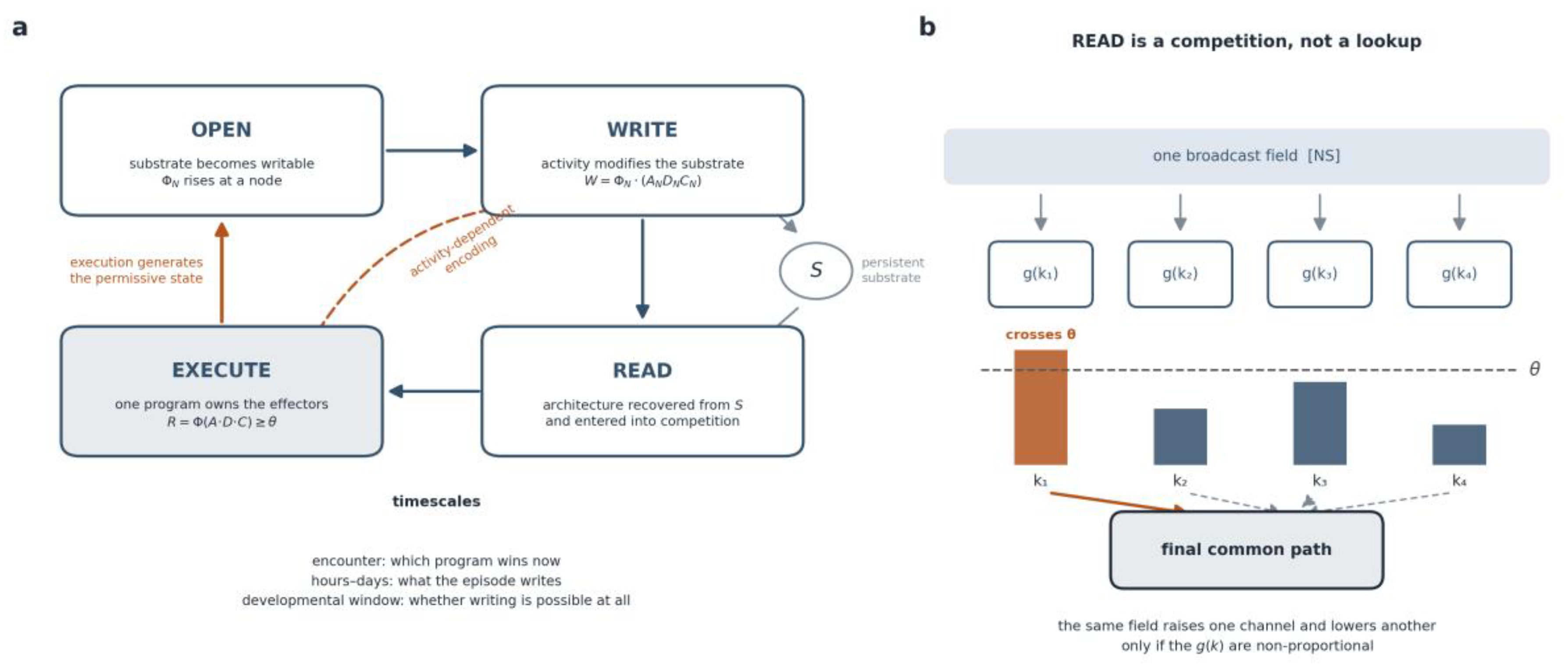
Figure 2.
Repeated gate re-specification across the prairie vole life history. Rows show schematic normalized readiness for five behavioral channels across six life-history stages under stage-typical releasers; each row plots R(k)/θ(k), the execution readiness of channel k scaled by its own threshold, so the dashed line at unity marks the point of execution. Values are illustrative, not fitted. Channels are named by executed function: mating and courtship; affiliation and attachment; stranger-directed aggression; parental care; and threat response and coping. The figure is a hypothesis map identifying transitions at which receiver configuration, permissive state and behavioral competition can be measured rather than asserting that one molecular mechanism has already been demonstrated across all stages.
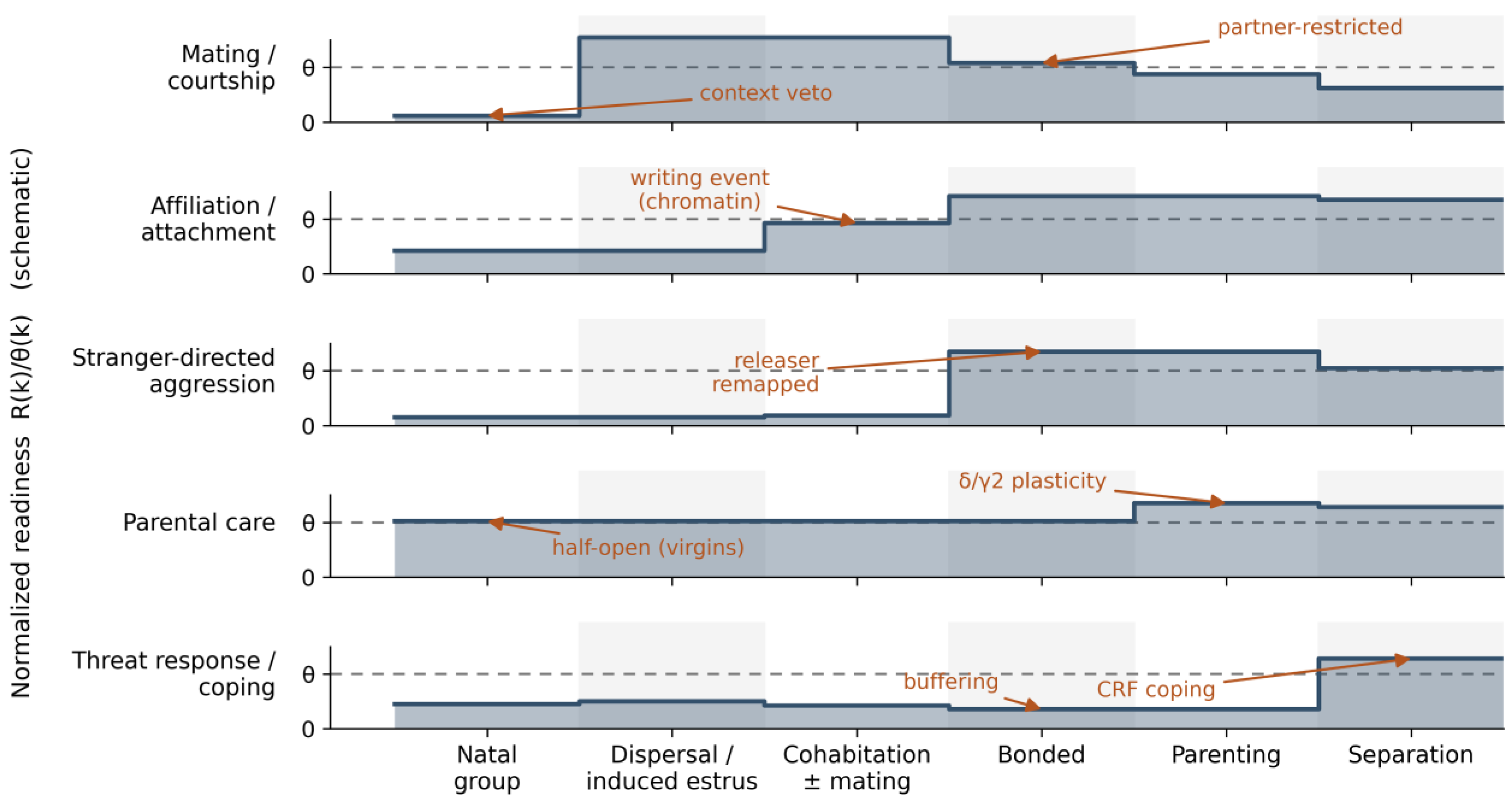

Table 1.
Operational summary of the prairie vole transitions.
| Transition | Behavioral remapping | Candidate physiological handle | Key test |
| Natal group → reproductive release | Male chemosignals open reproductive responsiveness in females | Neuroendocrine permissive state | Separate transient opening from durable writing |
| Cohabitation → selective bond | Social partner acquires preferential control over affiliative output | Accumbal receptor/chromatin state and corticostriatal drive | Manipulate acquisition versus later expression |
| Bonded state → stranger aggression | Unfamiliar conspecific is remapped from investigation/affiliation toward attack | Anterior hypothalamic peptide/monoamine balance | Dissociate aggression from partner preference |
| Pregnancy/parturition → care | Care channel is strengthened and mating/competitive outputs are reweighted | GABAa subunit plasticity, oxytocin-neurosteroid interactions | Measure receiver changes across reproductive state |
| Partner loss → coping reconfiguration | Stress-coping output changes without immediate erasure of the bond | CRF, oxytocin and local neurosteroid mechanisms | Track persistence of attachment separately from coping state |
Disclaimer/Publisher’s Note: The statements, opinions and data contained in all publications are solely those of the individual author(s) and contributor(s) and not of MDPI and/or the editor(s). MDPI and/or the editor(s) disclaim responsibility for any injury to people or property resulting from any ideas, methods, instructions or products referred to in the content. |
© 2026 by the authors. Licensee MDPI, Basel, Switzerland. This article is an open access article distributed under the terms and conditions of the Creative Commons Attribution (CC BY) license (http://creativecommons.org/licenses/by/4.0/).
Copyright: This open access article is published under a Creative Commons CC BY 4.0 license, which permit the free download, distribution, and reuse, provided that the author and preprint are cited in any reuse.