
Submitted:
09 October 2026
Posted:
12 October 2026
You are already at the latest version
Abstract
We derive the necessary and sufficient conditions for the solvability of a system of dual quaternion matrix equations (AX, XC, EXF) = (B, D, G) as well as their general solution expressions by means of the Moore-Penrose inverse and rank equalities. Then, the main conclusions of this paper are verified via a numerical example, and the applications of such equation systems to image encryption and decryption are investigated.
Keywords:
dual quaternion
; moore-penrose inverse
; rank
; general solution
1. Introduction
In 1843, the Irish mathematician Hamilton first proposed the concept of quaternions [1], viewing them as elements of a four-dimensional real vector space used to represent rotations in three-dimensional space. Once quaternions were proposed, they attracted the attention and research of many scholars. Up to now, quaternion matrix algebra has been applied in multiple fields such as quantum physics [2], signal processing [3], and color image processing [4]. In 1873, Clifford [5] proposed the concepts of dual numbers and dual quaternions. Dual quaternions have been widely applied in fields such as robotics [6,7,8,9], 3D motion modeling [10,11,12], and computer graphics [13,14]. Currently, dual quaternions have become the foundation for engineering problems like secure control [15] and multi-agent formation control [16,17], attracting considerable research attention from many scholars.
In 2024, Chen et al. [18] studied the dual quaternion matrix equation , while Hong et al. [19] studied the subspace constrained least squares solutions of unit dual quaternion equations and . Chen et al. [20] presented an improved power method for eigenvalue computation of Hermitian dual quaternion matrices. Zhu et al. [21] studied the equation least-norm solution over the dual quaterion algebra. Wang and Gao [22,23] provided two review articles that traced the research trajectory of Sylvester-type equations, summarized various solution methods and applications, and identified existing research gaps and future directions. Zhu [24] investigated the solvability of the n-quaternion matrix equation . For a class of equation systems (, ) = (B, D), Xie et al. [25] conducted research under the dual quaternion algebra, and Yang et al. [26] carried out related studies under the dual split quaternion tensor algebra. Subsequently, Wang et al. [27] summarized the solution problems of this type of equation system in various algebraic structures such as the real number field, complex number field, and rings. Based on this, this paper extends the equations (, ) = (B, D) to the following equations
To our knowledge, there is limited information on using the matrix Moore-Penrose inverse and rank as tools to provide exact solutions for this type of dual quaternion matrix equation system. To enrich the theory and application of the matrix equation system (1), this paper studies the solutions of equation system (1) in the dual quaternion algebra.
The structure of this article is arranged as follows, Section 2 provides the definitions of dual quaternions and dual quaternion matrices, and presents some basic lemmas. Section 3 formally presents the main theorems of the dual quaternion equation system (1), and simultaneously offers a corollary for judging the existence of a unique solution to the equation. Section 4 verifies the effectiveness of the main results through numerical examples. Section 5 explores its application in the encryption and decryption of color images.
2. Preliminaries
In this section, we mainly present the definitions of dual quaternions and dual quaternion matrices, and introduce some related properties and lemmas that are applied in the proof process. Furthermore, we propose several lemmas to prove the equivalent conditions for the solvability of equations (1).
We first present the mathematical notations and definitions of several sets. The set of quaternions is denoted by
where is the real field and satisfy
The set of dual quaternions is denoted by
where , and are refered as the real part and the dual part of q respectively. Let , indicate the set of all quaternion matrices and dual quaternion matrices respectively. For a given quaternion matrices A, symbols , , and stand respectively for the rank of A, the conjugate transpose of A, and the Moore-Penrose inverse of A.
2.1. Dual Quaternions and Dual Quaternion Matrix
Let , , dual quaternion addition and multiplication are defined as
For a dual quaternion matrix , it can be written as , where and are quaternion matrices in , denoted respectively as the real part and dual part of A. For , , if , , then . The addition and multiplication of dual quaternion matrices can be expressed as
2.2. Moore-Penrose Inverse
Definition 1.
Let and , where I represents the identity matrix. Denote 0 as the zero matrix with appropriate sizes. and have the following properties:
2.3. Basic Lemmas
Lemma 1.
[30] Let A, B, and C be quaternion matrices of appropriate sizes over . The following properties of the quaternion matrix equation are equalities:
(1) Equation is consistent.
(2) .
In such a case, the general solution is given by
where U, V are any matrices over with appropriate sizes.
For the dual quaternion matrix equations (, ) = (B, D), the following lemma provides the necessary and sufficient conditions for it to be solvable.
Lemma 2.
[25] Let , , , and be given. Set
, , ,
,
, , ,
, , ,
, , ,
.
Then the following properties of the dual quaternion matrix equations are equalities:
(1) equation is consistent.
(2)
(3) The equations in (2) hold, together with the fulfillment of the rank equality conditions, where
In such circumstances, the general solution of the equations (, ) = (B, D) can be expressed as , where
and are arbitrary matrices with appropriate sizes.
Lemma 3.
[18] Suppose that , , , , and , then we have the following rank equality:
(1)
(2)
(3)
(4)
(5)
(6)
3. The Solution of (1)
Based on the Lemmas established above, we present the main results of this article concerning the dual quaternion matrix equations (1). We first establish the necessary and sufficient conditions for the solvability of the dual quaternion matrix equations (1), and subsequently derives its general solution under these conditions.
Theorem 1.
Let , , , , , , be given. Set
, , ,
,
, , ,
, , ,
, , , ,
,
, , , ,
, , , ,
, , , ,
, , , ,
, ,
, ,
, ,
, , .
Then the following statements are equivalent:
(1) The system of dual quaternion matrix equations (1) is consistent.
(2)
(3)
In this case, the general solution to (1) can be expressed as follows:
where are arbitrary matrices over with appropriate sizes.
Proof.
Assume that dual quaternion matrix equations (1) is consistent. Let the solution of equation (1) expressed as
According to the definitions of operations on dual quaternion matrices, a given dual quaternion matrix equation with specific coefficients can be regarded as equivalent to a particular quaternion matrix equation. Substituting (19) into (1), the problem of solving the dual quaternion matrix equations (1) can be transformed into the problem of solving the following quaternion matrix equations (20):
In light of Lemma 2, the system of equation (21) is consistent if and only if
In this case, the general of (21) can be writted as
where are any matrices over with adequate sizes. By substituting and U from equation (24) into equation (22) we obtain
By simplification, we can obtain
.
Thus we get (6). Under the circumstances, the general solution of (25) can be expressed as
where are any matrices over with appropriate sizes. Notice that , , and can be expressed as
where
We substitute , into , , and respectively, gets
Then equation (23) is equivalent to
By Lemma 1, in equation (27) is solvable if and only if
we conclude that (28) is consistent if and only if
In this case, the general solution of (27) can be expressed as
where are arbitrary matrices over with appropriate sizes. So far, we have demonstrated the equivalence of (1) and (2), and derived the general solution of (20) in the form given by (18). Next, we prove that (2)⇔(3).
(2)⇔(3): By Lemma 2, we have the conclusion of (8-11). Next, we will respectively present the equivalent rank equalities (12-17) corresponding to when the quaternion matrix equation system (20) has a solution and when equalities (6) and (7) hold.
First, we present the derivation of equality (6) and equivalent rank equalities (12) and (13). Take , as a particular solution of system of equations (21), according to Lemma 3, we have
Thus we get (12) and (13). Then we give the derivation of (7) and equivalent rank equalities (14), (15), (16), and (17) as follows. Take , as a particular solution of system of equations (21-22), we have
We have now established the equivalence of the rank conditions in () and (), which directly implies (2) ⇔ (3). This, together with the previously verified implications (1) ⇔ (2), completes the proof of Theorem 1. □
4. Numerical Example
In the previous section, we derive the necessary and sufficient conditions for the solvability of equations (1) and present its general solution form. In this section, a numerical example is adopted to verify the accuracy and error bound of the numerical solution of the system of equations. We use the notation to denote all elements from the i-th to the j-th column of matrix A. All the symbols and matrices involved in the following example are consistent with Theorem 1.
Example 1.
Given dual quaternion matrices and as:
To verify the correctness of the equivalent conditions (2) and the rank equality conditions (3) in Theorem 1, we conducted numerical experiments based on the MATLAB 2023a. The results of the equivalent conditions (2) are as follows:
and the results of the rank equality conditions (3) are as follows:
From the results, it can be seen that both the equivalent condition (2) and the rank equality condition (3) given by the theorem 1 are satisfied. According to the conclusion of the theorem, it can be determined that the system of equation is solvable. Meanwhile, after numerical calculations with MATLAB 2023a, it is obtained that the numerical solution of the system is , where
We use the Frobenius norm to represent the error. The error results are as follows:
This indicates that when the error of the solution is relatively small, Theorem 1 is effective in deriving the general solution of the dual quaternion matrix equations (1).
5. Applications
In this section, we elaborate on the fundamental principles, constructive algorithms, and specific examples related to the practical application of the dual quaternion matrix equations (1) in color image encryption and decryption. To intuitively verify the effectiveness and feasibility of the proposed method, the corresponding experimental results and performance comparisons are graphically and numerically illustrated in Figure 3 and Table 3.
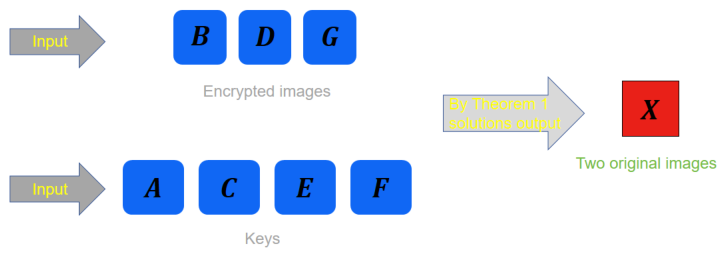
Since image pixels correspond one-to-one to matrix elements, a color image can be represented by a quaternion matrix. For a dual quaternion matrix equation, its real part and dual part can represent two color images respectively, which provides a feasible approach for image encryption and decryption using dual quaternion matrix equations. The encryption and decryption processes are illustrated in Figure 1 and Figure 2, respectively.
The encryption process takes two original images and encrypts them using the dual quaternion matrices keys , and F to generate the encrypted images , and G. The encryption matrices are public, while the keys are known only to the recipient.
The decryption process requires both the encryption matrices and the keys, which can be derived from Theorem 1 in this paper. The encryption and decryption processes are described by Algorithm 1 and Algorithm 2, respectively. Figure 3 displays the results of image encryption and decryption.
| Algorithm 1: Encryption process |
| 1.Input: Two original color images and keys. |
| 2. represent two color images respectively. |
| 3.Keys are . |
| 4.Encrypt using the encryption model in Figure 1. |
| 5.Six encrypted color images denote . |
| 6.Output: Encrypted color images. |
| Algorithm 2: Decryption process |
| 1.Input: Encrypted matrices and keys. |
| 2. represent encrypted images . |
| 3.Keys are . |
| 4.By applying Theorem 1, two original images can be derived. |
| 5.Output: Two decrypted color images. |
Figure 3 presents the complete results of image encryption and decryption, the first row shows two original color images, the second row shows the corresponding ciphertext images generated by encryption using the key matrix, and the third row shows the decrypted images recovered based on the correct key.
Figure 3.
Original, encrypted and decrypted version for two images
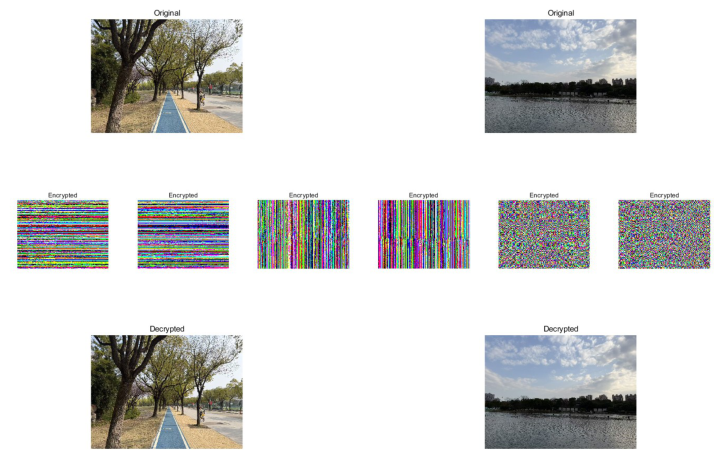
To verify the quality of the above encryption and decryption method, we use PSNR (Peak Signal-to-Noise Ratio), SSIM (Structural Similarity Index Measure), and FSIM (Feature Similarity Index Measure) to measure the performance. As shown in Table 1, the SSIM and FSIM values of the two images are both 1, and the PSNR values are above 50, indicating that the encryption and decryption method have strong feasibility.

Table 1.
Comparison results
| Name | SSIM | FSIM | PSNR |
|---|---|---|---|
| Image 1 | 1 | 1 | 197.7337 |
| Image 2 | 1 | 1 | 164.2762 |
6. Conclusion
In this paper, by utilizing rank theory and Moore-Penrose inverse theory of dual quaternion matrix equation system, we derived solvability conditions and general solutions of system (1). Furthermore, we provide a numerical example using MATLAB 2023a to demonstrate the accuracy of the solutions, and a application in image encryption and decryption. We will extend to study the solutions of such system in the split quaternion algebra and commutative quaternion algebra.
References
- Hamilton, W.R. Lectures on Quaternions; Hodges and Smith: Dublin, Ireland, 1853. [Google Scholar]
- Adler, S.L. Quaternionic Quantum Mechanics and Quantum Fields; Oxford University Press: Cary, NC, USA, 1995. [Google Scholar]
- Cyrus, J.; Clive, C.T.; Danilo, P.M. A class of quaternion valued affine projection algorithms. Signal Process. 2013, 93, 1712–1723. [Google Scholar] [CrossRef]
- Miao, J.; Kou, K.I. Color image recovery using low-rank quaternion matrix completion algorithm. IEEE Trans. Image Process. 2021, 31, 190–201. [Google Scholar] [CrossRef]
- Clifford, W.K. Preliminary sketch of bi-quaternions. Proc. Lond. Math. Soc. 1873, 4, 381–395. [Google Scholar]
- Daniilidis, K. Hand-eye calibration using dual quaternions. Int. J. Robot. Res. 1999, 18, 286–298. [Google Scholar] [CrossRef]
- Diprasetya, M.R.; Pöppelbaum, J.; Schwung, A. KineNN: Kinematic neural network for inverse model policy based on homogeneous transformation matrix and dual quaternion. Robot. Comput.-Integr. Manuf. 2025, 94, 102945. [Google Scholar] [CrossRef]
- Li, A.; Wang, L.; Wu, D. Simultaneous robot-world and hand-eye calibration using dual-quaternions and Kronecker product. Int. J. Phys. Sci. 2010, 5, 1530–1536. [Google Scholar] [CrossRef]
- Wang, X.; Yu, C.; Lin, Z. A dual quaternion solution to attitude and position control for rigid body coordination. IEEE Trans. Robot. 2012, 28, 1162–1170. [Google Scholar] [CrossRef]
- Cheng, J.T.; Kim, J.; Jiang, Z.Y.; et al. Dual quaternion-based graphical SLAM. Robot. Auton. Syst. 2016, 77, 15–24. [Google Scholar] [CrossRef]
- Li, X.; Lu, Q.; Huang, Z.; Li, K. Robust torque-computed control for a robot manipulator with unit dual quaternion. IEEE Trans. Ind. Electron. 2025, 72, 10728–10738. [Google Scholar] [CrossRef]
- Wang, X.; Zhu, H. On the comparisons of unit dual quaternion and homogeneous transformation matrix. Adv. Appl. Clifford Algebr. 2014, 24, 213–229. [Google Scholar] [CrossRef]
- Han, X.; Wu, J.; Yan, L.; Lotfi, S.; Shu, H.Z. Color image recovery via quaternion matrix completion. In Proceedings of the 2013 6th International Congress on Image and Signal Processing (CISP), Hangzhou, China, 16–18 December 2013; IEEE: Piscataway, NJ, USA, 2013; pp. 358–362. [Google Scholar] [CrossRef]
- Kenwright, B. A beginners guide to dual-quaternions: What they are, how they work, and how to use them for 3D character hierarchies. 20th International Conference in Central Europe on Computer Graphics, Visualization and Computer Vision (WSCG 2012), Plzen, Czech Republic, 25–28 June 2012; pp. 1–10. [Google Scholar]
- Sun, K.; Zheng, Q.; Jin, R. Secure control for spacecraft relative dual-quaternion systems with denial-of-service attacks. IEEE Trans. Aerosp. Electron. Syst. 2025, 61, 15555–15566. [Google Scholar] [CrossRef]
- Qi, L.Q.; Wang, X.K.; Luo, Z.Y. Dual quaternion matrices in multi-agent formation control. Commun. Math. Sci. 2023, 21, 1865–1874. [Google Scholar] [CrossRef]
- Qi, L.Q.; Cui, C.F. Eigenvalues of dual Hermitian matrices with application in formation control. SIAM J. Matrix Anal. Appl. 2024, 45, 2135–2154. [Google Scholar] [CrossRef]
- Chen, Y.; Wang, Q.W.; Xie, L.M. Dual quaternion matrix equation AXB=C with applications. Symmetry 2024, 16, 287. [Google Scholar] [CrossRef]
- Zhu, H.; Ng, M.K. The subspace constrained least squares solution of unit dual quaternion vector equations and its application to hand-eye calibration. J. Sci. Comput. 2025, 103, 49. [Google Scholar] [CrossRef]
- Chen, Y.; Zhang, L. Improved power methods for computing eigenvalues of dual quaternion Hermitian matrices. Comput. Appl. Math. 2026, 45, 130. [Google Scholar] [CrossRef]
- Zhu, L.J.; Wang, Q.W.; Kou, Z.L. The least-norm solution to a matrix equation over the dual quaternion algebra. Symmetry 2025, 17, 267. [Google Scholar] [CrossRef]
- Wang, Q.W.; Gao, J.L. A Comprehensive Review on the Generalized Sylvester Equation AX-YB=C. Symmetry 2025, 17, 1686. [Google Scholar] [CrossRef]
- Wang, Q.W.; Gao, J.L. A Review on Solving Sylvester-Type Equations. Symmetry 2026, 18, 984. [Google Scholar] [CrossRef]
- Zhu, X. Higher quaternion matrix equations with applications. Comput. Appl. Math. 2026, 45, 68. [Google Scholar] [CrossRef]
- Xie, L.M.; Wang, Q.W. Some novel results on a classical system of matrix equations over the dual quaternion algebra. Filomat 2025, 39, 1477–1490. [Google Scholar] [CrossRef]
- Yang, L.Q.; Wang, Q.W.; Kou, Z.L. A system of tensor equations over the dual split quaternion algebra with an application. Mathematics 2024, 12, 3571. [Google Scholar] [CrossRef]
- Wang, Q.W.; Gao, Z.H.; Gao, J.L. A comprehensive review on solving the system of equations AX=C and XB=D. Symmetry 2025, 17, 625. [Google Scholar] [CrossRef]
- Moore, E.H. On the reciprocal of the general algebraic matrix. Bull. Am. Math. Soc. 1920, 26, 394–395. [Google Scholar] [CrossRef]
- Penrose, R. A generalized inverse for matrices. Math. Proc. Camb. Philos. Soc. 1955, 51, 406–413. [Google Scholar] [CrossRef]
- He, Z.H.; Wang, Q.W. The general solutions to some systems of matrix equations. Linear Multilinear Algebra 2015, 63, 2017–2032. [Google Scholar] [CrossRef]
Figure 1.
Encryption model
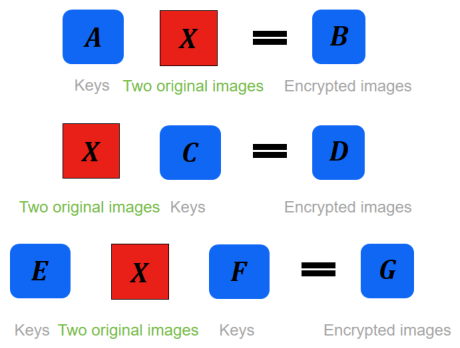
Figure 2.
Decryption model
Disclaimer/Publisher’s Note: The statements, opinions and data contained in all publications are solely those of the individual author(s) and contributor(s) and not of MDPI and/or the editor(s). MDPI and/or the editor(s) disclaim responsibility for any injury to people or property resulting from any ideas, methods, instructions or products referred to in the content. |
© 2026 by the authors. Licensee MDPI, Basel, Switzerland. This article is an open access article distributed under the terms and conditions of the Creative Commons Attribution (CC BY) license (http://creativecommons.org/licenses/by/4.0/).
Copyright: This open access article is published under a Creative Commons CC BY 4.0 license, which permit the free download, distribution, and reuse, provided that the author and preprint are cited in any reuse.