

Submitted:
09 October 2026
Posted:
10 October 2026
You are already at the latest version
Abstract
5G Advanced and 6G V2X Environments require intelligence that is real-time, resource-light and robust across high-density vehicle mobility, non-stationary channels and hard ware constrained edge nodes. Existing AI-driven resource man agement approaches — including CNNs, LSTMs, GNNs, Deep Reinforcement Learning, Transformers, and Federated Learning — have limitations, such as high computational overhead, large data requirements, poor generalization under topology churn, and catastrophic forgetting under continuous retraining. These limitations render them ill-suited for deployment, especially at the level of radio units. To address this issue, this paper proposes NeuroChaos-V2X, a chaos-inspired edge intelligence framework that integrates vehicle mobility, wireless channel, and edge computing states into a unified multi-domain state vector. A Neu roChaos Feature Transformation module, employing GLS and Logistic-map neurons, converts raw network measurements into chaos-derived descriptors — firing time, firing rate, energy, and entropy — without requiring deep architectures or large training datasets. These features drive a unified NeuroChaos Decision Engine supporting edge server selection, task offloading, resource prioritization, and handover management simultaneously. The framework’s low-sample learning capability, CPU-only footprint, and sensitivity to small state perturbations make it inherently suited to resource-constrained V2X edge tiers. This position paper establishes the conceptual foundation and motivates experimental validation against GNN, DRL, and Transformer baselines in future 6G-V2X simulation environments.
Keywords:
Neurochaos Learning
; chaotic neural networks
; edge intelligence
; Vehicle-to-Everything (V2X)
; 6G networks
; Mobile Edge Computing (MEC)
1. Introduction
Cellular Vehicle-to-Everything (C-V2X) communication (a glossary of acronyms used in this paper is presented in Table 1) has evolved progressively across 3GPP releases — from LTE-V2X and NR-V2X, where resource allocation mechanisms play a central role in performance [1] — toward the anticipated 6G V2X paradigm.
In addition, requirements such as Advanced Driver-Assistance Systems, autonomous driving, and unmanned vehicles have raised the need for dynamic resource allocation in V2X communications [2,3]. However, existing resource allocation approaches suffer from high computational overload and latency, especially when traffic loads are high [4].
To address these limitations, decentralized deep reinforcement learning (DRL)-based approaches have been developed so that each V2V transmitter functions as an independent agent making decisions from local observations [5]. Recent work integrates GNNs with DRL to exploit spatial relational structure where communication links are modeled as nodes in a dynamic graph, with GraphSAGE being employed to learn adaptive representations under changing network topologies [6].
Despite these advancements existing resource allocation methods for 5G/6G vehicular networks continue to face several fundamental limitations (summarized in Table 2) which includes:
- Resource Allocation gets highly complicated due to dynamic topological changes, Diversified QoS requirements and spectrum scarcity [3].
- High vehicular density causes high computational complexity and latency in decision making in heterogeneous environments [4].
- The Advent of AI in Cellular Communications spanning across Resource Allocation, Beamforming and Traffic Management in diversified 6G Environments also undergoes challenges in Computational complexity and Data privacy [7].
- Traditional GNN’s cannot dynamically adapt to rapid fluctuations in node count and adjacency structure inherent to highly mobile V2X topologies [8].
- Scalability ceiling faced by DRL in dense V2X environments which demands high system overhead, making resource allocation practically infeasible at scale [8].
To overcome these limitations, we introduce NeuroChaos-V2X: An Edge Intelligence Framework for Resource Orchestration in 6G Vehicular Networks. NeuroChaos-V2X simultaneously models the vehicle mobility dynamics, wireless channel dynamics, and edge-computing dynamics using a unified representation, referred to as a multi-domain state vector. GLS and logistic-map neurons then extract compact NeuroChaos features [9,10], from raw network measurements (e.g., Received Signal Strength Indicators, CPU utilization, latency requirements) and learning directly from NeuroChaos features instead of raw network measurements, NeuroChaos-V2X alleviates the scalability/generalization limitations of DL-, RL-, and GNN-based solutions. Specifically, NeuroChaos-V2X exploits the Neurochaos features to power a decision engine that determines edge server selection, task offloading decisions, resource prioritization, and handover decisions jointly within a unified optimization framework.
Section 2 presents a comprehensive review of existing AI-Driven Resource Allocation and Edge Intelligence techniques in dynamic 5G/6G V2X Scenarios. Section 3 examines the existing research gaps and establishes the specific objectives of proposed work. Section 4 outlines the foundation of NeuroChaos Learning. Section 5 outlines the structure of proposed NeuroChaos V2X Framework. Section 6 formulates the research questions and hypotheses guiding the proposed framework. Section 7 summarizes what was observed from literature review and explains how the Proposed NeuroChaos V2X Framework addresses those objectives.
2. Literature Review
Edge AI powered vehicle intelligence driven by ML and DL, represents a significant advancement over 5G V2X by enabling proactive traffic management and enhancing reliability and accuracy in latency-sensitive applications [11]. From an architectural standpoint this has resulted in a transition from Cloud-based AI processing to vertically distributed computation across the UE-edge-cloud continuum, with collaborative, multi-tier execution bringing AI inference closer to the end users [12].
The prevailing deployment strategy in the literature is hierarchical, multi-tier resource architecture spanning local, regional and cloud layers. Tasks are dynamically scheduled across their tiers according to urgency, computational complexity, and resource availability, with latency-critical control functions executed at the vehicle or RSU and compute-intensive analytics offloaded to edge or cloud nodes [13]. Edge nodes co-located with RSUs or base stations act as intermediary layers, reducing vehicle-to-service latency for safety-critical decisions such as collision avoidance [14].
This tiered placement reinforces the case for lightweight, low-footprint learning paradigms that can execute directly at UE or RSU tiers without depending on cloud round-trips. However, current edge-AI treatments of V2X remain fragmented: existing surveys typically examine edge intelligence from narrow, domain-specific angles rather than offering a unified cross-tier framework [7]. This is where we need a deployment model - such as Neurochaos Learning framework that uses low-sample learning, chaos-inspired feature extraction, and low-compute inference for edge devices [10] — that explicitly maps lightweight AI variants to each layer of the computing continuum based on their resource and retraining constraints [15].
3. Research Gaps and Objectives
Current resource allocation methods for 6G-V2X — predominantly DL, RL, GNN, and Transformer-based — exhibit limitations that map directly onto the five operational challenges above, rather than resolving them. Taken together, these limitations show that the dominant DL/RL/GNN/Transformer paradigm is not merely computationally heavy — it is structurally mismatched to the four defining conditions of 6G-V2X: density and topology that outpace retraining cycles, channel statistics that violate stationarity assumptions, edge hardware that cannot sustain its computational footprint, and rare-event data distributions it cannot generalize from. This mismatch motivates the case for a lightweight, low-data, retraining-resilient paradigm — the gap this paper positions Neurochaos Learning (NL) to address.
4. Why NeuroChaos Learning?
This section justifies NL as the computational substrate for edge intelligence in the proposed architecture.
Biological Motivation: The human brain achieves robust, low-power, real-time inference using neurons that are chaotic, noisy, and heterogeneous in their firing — properties that classical ANNs deliberately suppress through smooth, deterministic activation functions. NL inverts this design choice. NL uses a Chaotic 1D Map, Which is a discrete function that generates unpredictable behavior from a simple non linear equation.
where:
- indicates the current iteration state,
- indicates state obtained after subsequent iteration,
- characterizes the nonlinear state-update function
Several properties of NeuroChaos that are worth considering are as below.
- Low-Sample Learning- As the name says, useful discriminatory features exist from very few labeled datasets rather than training on large datasets as in case of deep learning [22].
- Noise Tolerance - As neurons already behave chaotically, small perturbations are partially absorbed by the natural sensitivity and variability of the trajectory, hence NeuroChaos neurons are expected to be more robust to noisy wireless environments than conventional AI models [9].
- Nonlinear Pattern Discovery - The chaotic map is itself a nonlinear dynamical system, so NL captures nonlinear structures in a single transformation step, without stacking many layers as DL requires. This property aligns with three V2X edge tasks: mobility dynamics (non-linear trajectory/velocity changes), channel variations (multipath, Doppler effects), and resource demand fluctuations (bursty, non-stationary traffic) [9].
5. NeuroChaos-V2X Framework Architecture
The proposed NeuroChaos-V2X Framework introduces a biologically inspired chaotic-neural decision mechanism for resource orchestration in next-generation 6G-V2X networks. The framework integrates information from three heterogeneous domains:
- Vehicle Layer – captures mobility and traffic dynamics such as speed, location, acceleration, and vehicle density.
- Communication Layer – monitors wireless channel quality indicators including SINR, CQI, RSSI, and packet loss.
- Edge Layer – observes computing-resource availability at edge nodes through CPU utilization, queue length, latency, and memory usage.
This collected information from the three domains is Integrated and fed as input to the NeuroChaos Feature Transformation Module in Figure 1.
Let the integrated V2X state be:
This means the overall V2X state vector is formed by combining: : Vehicle features; : communication features; and : edge computing features.
where
For example, if : has 4 metrics such as (Speed, Location, Acceleration and Vehicle Density), has 4 metrics such as (SINR, CQI, RSSI, packet loss) and has 4 metrics such as (CPU, Queue length, Latency, Memory), then
dim() = dim() = dim() = 4
dim(X) = dim() + dim() + dim () = 12 = n
With 12 input features Equation 4 becomes
Each component is normalized to [0,1] before it enters the chaotic Neuron. Now we assign one NeuroChaos neuron to each of the input features ,i-1,..n. The NeuroChaos neuron transforms the input using chaotic logistic dynamics as shown in Equation 5:
where:
= NeuroChaos state, r = chaos control parameter, = input coupling factor, – chaotic state of the i-th neuron at iteration t, – scalar coupling weight for feature i (so , not a scalar), is the i-th (normalized, scalar) component of X.
Each neuron is iterated for t =0,......T (until firing conditions are met) producing a trajectory used to compute the neuron’s four descriptors.
The resulting NeuroChaos feature representation is:
where FT, FR, E, and H denote firing time, firing rate, chaotic- energy, and entropy respectively.
With Chaos based Feature Extraction Equation 7 becomes
where is a NeuroChaos feature-extraction operator that derives four representative descriptors — Firing Time (FT), Firing Rate (FR), Energy (E), and Entropy (H) — from each neuron’s chaotic trajectory. These features capture the neuron’s response timing, activity, intensity, and complexity, providing a compact representation for subsequent V2X decisions.
Let us define a minimum Firing time explicitly
Hence the final representation is:
where is the shared feature representation
These derived NeuroChaos descriptors are subsequently supplied to NeuroChaos Decision Engine for decision making. The decision engine converts the extracted NeuroChaos feature vector into task-specific V2X decisions for resource orchestration. For each task, it evaluates the available action candidates by computing their corresponding scores from the NeuroChaos feature representation, and the highest-scoring action is selected as the final decision.
where
where:
- = shared NeuroChaos feature vector
- = weights belonging to task k
- = action space for task k
Formulating decision engine as:
where is the task-specific score vector.
Then, server selection becomes:
Offloading becomes:
Resource prioritization becomes:
Handover becomes:
After processing the shared NeuroChaos feature vector, the NeuroChaos Decision Engine generates task-specific decisions for server selection, task offloading, resource prioritization, and handover management. These decisions are then executed according to the current network, mobility, and edge-computing conditions to enable adaptive V2X resource orchestration. Based on real-time network, mobility, and edge-computing conditions, the framework generates intelligent decisions regarding: edge server selection, task offloading, resource prioritization, mobility and handover management.
Three properties of chaos-transformed features map onto V2X constraints:
- Low-sample requirement → fits cold-start scenarios where a vehicle or RSU has just joined the network and has no historical data.
- CPU-only, low-compute footprint → fits RSU/edge-tier hardware that cannot run heavy DNN inference within handover-relevant latency budgets.
- Sensitivity to small perturbations → fits the fact that V2X decisions (handover, offloading) are triggered by small, fast-changing differences in channel/load state, which chaotic features may amplify into more separable decision boundaries than raw values would.
6. Research Questions
The proposed Neuro-Chaos V2X Framework makes four key contributions. These contributions collectively address the structural mismatch between existing AI-Driven resource allocation paradigms and the operational demand for resource-constrained V2X edge tiers. Key contributions of this study include:
- Formulating a single cross-layer state Vector X that captures vehicle mobility, wireless channel conditions and edge-computing resource availability
- Incorporating GLS and Logistic-map chaotic neurons into a dedicated feature transformation module that converts raw V2X network measurement into four chaos derived descriptors producing discriminative features for resource allocation
- Developing a single Decision Engine that simultaneously handles edge server Selection, task offloading, resource prioritization and handover management
- Establishing a systematic mapping of five core 5G/6G V2X operational Challenges such as Dynamic Topology Churn, Fluctuating Wireless Channels, Edge Resource Constraints, Data Scarcity and Continuous Environmental evolution to the structural limitations of DL, RL, GNN and Transformer approaches.
- Demonstrating through evidence that these paradigms are fundamentally ill-suited for deployment at UE and RSU edge tiers.
6.1. Key Research Questions
RQ1:- Feature Transformation Effectiveness
To What Extent do Neuro-Chaos-derived descriptors enhance the representations of integrated V2X States for accurate and efficient resource allocation compared to raw network measurements?
RQ2:- Low Sample Adaptability
Can Neuro-Chaos Learning Adapt to Changing V2X network Conditions such as rapid topology changes, fluctuating SINR/CQI and busty edge-resource demand without requiring continuous retraining or large training datasets?
RQ3:- Unified Multi-Domain Decision Can integrating vehicle communication and edge-computing states into a unified Neuro-Chaos representation improve resource orchestration, edge server selection, task offloading, resource prioritization and handover management in dynamic 5G/6G environments?
RQ4:- Computational Feasibility at Edge Tiers
Can Neuro-Chaos Learning provide resource allocation decisions compared to GNN, DRL and Transformer based methods while requiring less computation, making it suitable for deployment on resource-constrained UE and RSU Tiers?
6.2. Hypotheses
H1: Implementing Neuro-Chaos Learning will reduce computational complexity while maintaining efficient resource allocation in 5G/6G networks.
H2: Incorporating Neuro-Chaos-based feature transformation to improve resource allocation decisions by capturing dynamic network conditions effectively.
H3: Integrating a Neuro-Chaos-based representation of vehicles, communication and edge-computing states that enhances edge server selection, task-offloading, resource prioritization and handover management.
7. Conclusions
This position paper presented NeuroChaos-V2X, a NeuroChaos-inspired edge intelligence framework for resource allocation in future 6G vehicular networks. The paper first analyzed the limitations of existing AI-driven resource management approaches, including CNNs, LSTMs, GNNs, DRL, Transformers, and Federated Learning, highlighting challenges related to dynamic topology adaptation, non-stationary wireless environments, computational complexity, retraining overhead, and data scarcity. These limitations become increasingly significant in 6G-V2X environments characterized by ultra-dense mobility, heterogeneous Quality-of-Service requirements, and resource-constrained edge infrastructure.
To address these limitations, this position paper proposed a unified NeuroChaos-V2X architecture that integrates vehicle mobility information, communication-state indicators, and edge-computing resource metrics into a common cross-layer state representation. The NeuroChaos module transforms raw network and system measurements into a compact set of chaotic features, which capture the state of the V2X system and help in resource allocation, using lower computational overhead than conventional DL-based approaches.
In future work, we will implement our architecture and evaluate it on realistic V2X resource allocation scenarios, with emphasis on addressing the aforementioned research questions and while doing so, verifying the aforementioned hypotheses as well.
References
- Rajalakshmi, P.; et al. Towards 6G V2X sidelink: survey of resource allocation—mathematical formulations, challenges, and proposed solutions. IEEE Open J. Veh. Technol. 2024, 5, 344–383. [Google Scholar] [CrossRef]
- Gonzalez-Martín, M.; Sepulcre, M.; Molina-Masegosa, R.; Gozalvez, J. Analytical models of the performance of C-V2X mode 4 vehicular communications. IEEE Trans. Veh. Technol. 2018, 68, 1155–1166. [Google Scholar] [CrossRef]
- Tahi, T.Z. Resource allocation in C-V2X: A review. arXiv 2024, arXiv:2401.15756. [Google Scholar]
- Ye, H.; Li, G.Y.; Juang, B.H.F. Deep reinforcement learning based resource allocation for V2V communications. IEEE Trans. Veh. Technol. 2019, 68, 3163–3173. [Google Scholar] [CrossRef]
- Ji, M.; Wu, Q.; Fan, P.; Cheng, N.; Chen, W.; Wang, J.; Letaief, K.B. Graph neural networks and deep reinforcement learning-based resource allocation for V2X communications. IEEE Internet Things J. 2024, 12, 3613–3628. [Google Scholar] [CrossRef]
- Liu, Q.; Ma, Y. Communication resource allocation method in vehicular networks based on federated multi-agent deep reinforcement learning. Sci. Rep. 2025, 15, 30866. [Google Scholar] [CrossRef]
- Qi, W.; Li, Q.; Song, Q.; Guo, L.; Jamalipour, A. Extensive edge intelligence for future vehicular networks in 6G. IEEE Wirel. Commun. 2021, 28, 128–135. [Google Scholar] [CrossRef]
- Yu, S.; Lee, J.W. Deep reinforcement learning based resource allocation for D2D communications underlay cellular networks. Sensors 2022, 22, 9459. [Google Scholar] [CrossRef]
- Balakrishnan, H.N.; Kathpalia, A.; Saha, S.; Nagaraj, N. Chaosnet: A chaos based artificial neural network architecture for classification. Chaos An. Interdiscip. J. Nonlinear Sci. 2019, 29. [Google Scholar] [CrossRef]
- Harikrishnan, N.; Nagaraj, N. Neurochaos inspired hybrid machine learning architecture for classification. In Proceedings of the 2020 International Conference on Signal Processing and Communications (SPCOM); IEEE, 2020; pp. 1–5. [Google Scholar]
- Nguyen, V.L.; Hwang, R.H.; Lin, P.C.; Vyas, A.; Nguyen, V.T. Toward the age of intelligent vehicular networks for connected and autonomous vehicles in 6G. IEEE Netw. 2022, 37, 44–51. [Google Scholar] [CrossRef]
- Rodriguez-Conde, I.; Campos, C.; Fdez-Riverola, F. Horizontally distributed inference of deep neural networks for AI-enabled IoT. Sensors 2023, 23, 1911. [Google Scholar] [CrossRef]
- Uddin, A.; Sakr, A.H.; Zhang, N. Intelligent offloading in vehicular edge computing: A comprehensive review of deep reinforcement learning approaches and architectures. arXiv 2025, arXiv:2502.06963. [Google Scholar]
- Ye, Y.; Gao, S.; Zheng, X.; Yang, L. Sequential Task Assignment and Resource Allocation in V2X-Enabled Mobile Edge Computing. IEEE Open Journal of Vehicular Technology, 2026. [Google Scholar]
- Honna, P.; Patravali, A.; Nagaraj, N.; Narendra, N.C. Linked Data Classification using Neurochaos Learning. arXiv 2026, arXiv:2602.16204. [Google Scholar]
- Igl, M.; Farquhar, G.; Luketina, J.; Boehmer, W.; Whiteson, S. Transient non-stationarity and generalisation in deep reinforcement learning. arXiv 2020, arXiv:2006.05826. [Google Scholar]
- Liu, Y.; Jiang, Z.; Zhang, S.; Xu, S. Deep reinforcement learning-based beam tracking for low-latency services in vehicular networks. In Proceedings of the ICC 2020-2020 IEEE International Conference on Communications (ICC); IEEE, 2020; pp. 1–7. [Google Scholar]
- Singh, J.; Fallahzadeh, E.; Adams, B.; Hassan, A.E. On the impact of black-box deployment strategies for edge AI on latency and model performance. Empir. Softw. Eng. 2026, 31, 126. [Google Scholar] [CrossRef]
- Bargagna, F.; De Santi, L.A.; Martini, N.; Genovesi, D.; Favilli, B.; Vergaro, G.; Emdin, M.; Giorgetti, A.; Positano, V.; Santarelli, M.F. Bayesian convolutional neural networks in medical imaging classification: a promising solution for deep learning limits in data scarcity scenarios. J. Digit. Imaging 2023, 36, 2567–2577. [Google Scholar] [CrossRef]
- Ao, S.I.; Fayek, H. Continual deep learning for time series modeling. Sensors 2023, 23, 7167. [Google Scholar] [CrossRef]
- De Lange, M.; Aljundi, R.; Masana, M.; Parisot, S.; Jia, X.; Leonardis, A.; Slabaugh, G.; Tuytelaars, T. A continual learning survey: Defying forgetting in classification tasks. IEEE Trans. Pattern Anal. Mach. Intell. 2021, 44, 3366–3385. [Google Scholar] [CrossRef]
- Pant, K.K.; Nagaraj, N.; et al. Advancing Forest Fires Classification using Neurochaos Learning. arXiv 2025, arXiv:2510.26383. [Google Scholar]
Figure 1.
NeuroChaos-V2X Framework Architecture
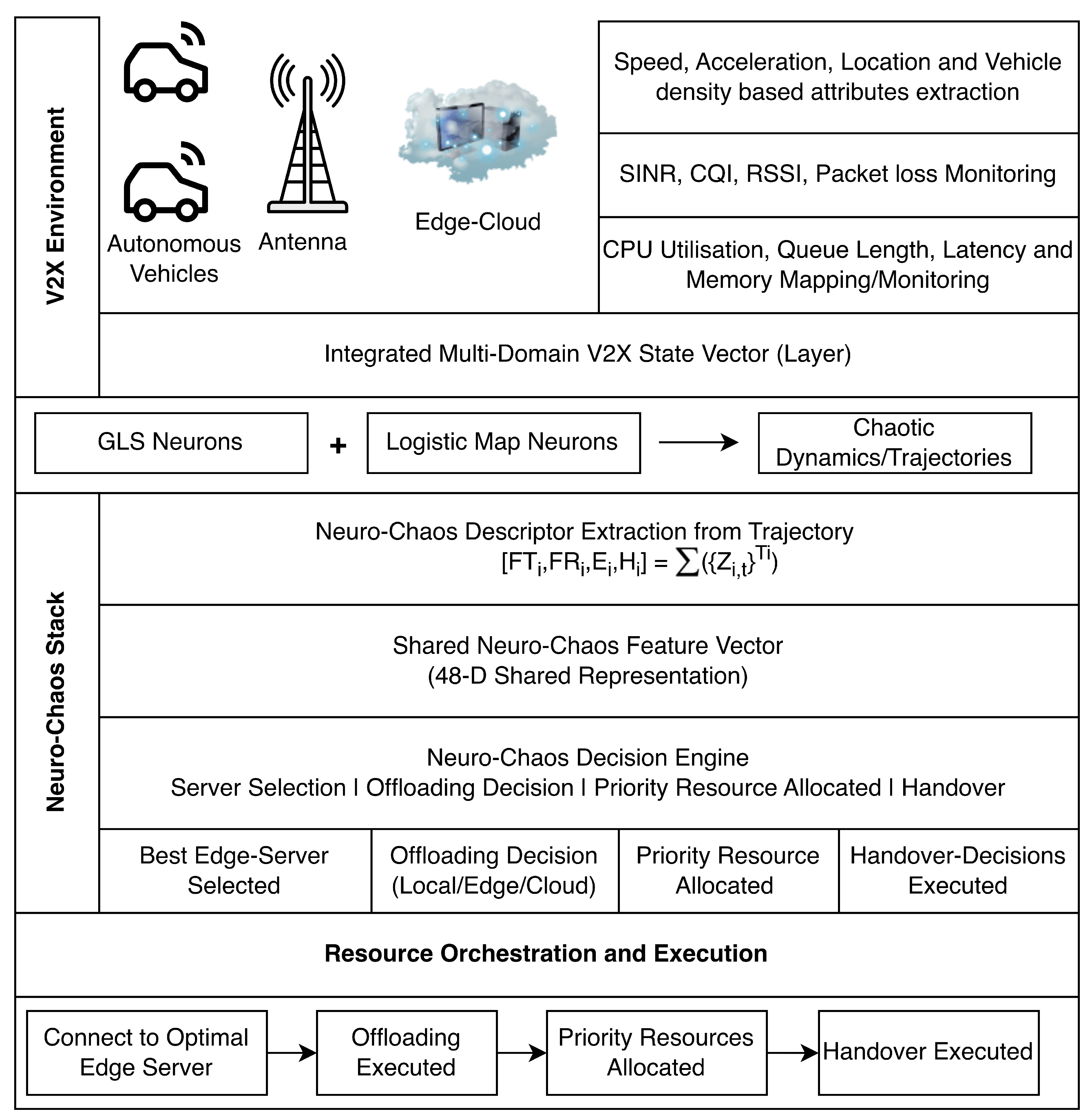

Table 1.
Glossary of Acronyms
| Acronym | Description |
|---|---|
| CQI | Channel Quality Indicator |
| DL | Deep Learning |
| DNN | Deep Neural Network |
| DRL | Deep Reinforcement Learning |
| FL | Federated Learning |
| GLS | Generalized Lüroth Series |
| GNN | Graph Neural Network |
| LSTM | Long Short-Term Memory |
| MEC | Multi-access Edge Computing |
| RL | Reinforcement Learning |
| RSU | Roadside Unit |
| SINR | Signal-to-Interference-plus-Noise Ratio |
| V2V | Vehicle-to-Vehicle |
| V2X | Vehicle-to-Everything |
Table 2.
Mapping of 6G-V2X Operational Challenges to Structural Limitations of Existing AI Approaches
Table 2.
Mapping of 6G-V2X Operational Challenges to Structural Limitations of Existing AI Approaches
| Operational Challenge | Structural Limitation of Existing AI Approaches | Refs. |
|---|---|---|
| Dynamic vehicle density and topology churn | Requires continuous graph updates, frequent retraining, and exhibits limited generalization under rapidly changing vehicular topology. | [4,5,6,8] |
| Fluctuating wireless channels (SINR/CQI) | Performance degrades in highly non-stationary wireless environments because learned policies assume relatively stable channel statistics. | [4,7,16,17] |
| Edge resource constraints (CPU, memory and energy) | Deep models incur high computation, memory usage and energy consumption, making deployment difficult on resource-constrained UE and RSU platforms. | [7,12,13,18] |
| Limited data availability for rare events | Requires large labeled datasets and exhibits poor generalization when training samples are scarce or safety-critical events occur infrequently. | [1,3,19] |
| Continuous environmental evolution | Repeated retraining introduces catastrophic forgetting and stability–plasticity trade-offs, reducing performance on previously learned scenarios. | [7,20,21] |
Disclaimer/Publisher’s Note: The statements, opinions and data contained in all publications are solely those of the individual author(s) and contributor(s) and not of MDPI and/or the editor(s). MDPI and/or the editor(s) disclaim responsibility for any injury to people or property resulting from any ideas, methods, instructions or products referred to in the content. |
© 2026 by the authors. Licensee MDPI, Basel, Switzerland. This article is an open access article distributed under the terms and conditions of the Creative Commons Attribution (CC BY) license (http://creativecommons.org/licenses/by/4.0/).
Copyright: This open access article is published under a Creative Commons CC BY 4.0 license, which permit the free download, distribution, and reuse, provided that the author and preprint are cited in any reuse.