

Submitted:
09 October 2026
Posted:
10 October 2026
You are already at the latest version
Abstract
Malaria is a public health problem in Senegal, with heterogeneous transmission and little known about transmission drivers at the Senegalese border. This study aimed to determine bionomics of major vectors and malaria transmission in the Senegambian border. The study was conducted from July 2023 to March 2024 in Nemataba and Ndrame Ndimb (near the border), and in Medina Dianguette and Paoskoto (farther). Adult mosquitoes were collected using human landing catches and pyrethrum spray catches. Laboratory analyses were performed by Enzyme-Linked Immunosorbent Assay and Polymerase Chain Reaction techniques. Anopheles gambiae s.l. human biting rates (HBRs) were 1.05 bites/person/night (b/p/n) in Nemataba and 6.55 b/p/n in Ndrame Ndimb, while they were 14.73 b/p/n in Medina Dianguette and 1.47 b/p/n in Paoskoto. Anopheles funestus HBR was 2.88 b/p/n in Paoskoto and 0.37 b/p/n in Ndrame Ndimb. Human blood index for An. gambiae s.l. were 77.08% in Medina Dianguette, 66.67% in Nemataba, 2.42% in Ndrame Ndimb and 0 in Paoskoto, while for An. funestus they were 5.93% in Ndrame Ndimb and 3.65% in Paoskoto. Malaria transmission was detected in Medina Dianguette and Paoskoto, with 0.078 and 0.209 ib/p/n, respectively. This study highlights the diverse bionomic characteristics of major malaria vectors along the Senegambian border.
Keywords:
bionomics
; major vector
; malaria transmission
; senegambian border
1. Introduction
Malaria remains one of the leading causes of hospitalization and death, making it one of the deadliest parasitic diseases. In Senegal, malaria is therefore a key priority of the national malaria control programme [1]. Consequently, several efforts have been made in term of vector control throughout interventions such as long-lasting insecticidal nets (LLINs) and indoor residual spraying (IRS), the two main tools most use in the context of the country. In terms of disease prevention, these tools have made a significant contribution to disease control through their widespread deployment in targeted areas [2]. These current core malaria vector interventions, both of which primarily target Anopheles vectors that feed and rest indoors [3]. In addition, insecticide-based IRS and LLINs have selected for interventions-based evolutionary adaptations that enable the vectors to be refractory to the interventions hence insecticide resistance acquired or to escape from these insecticide-based interventions. The main adaptations observed relate to insecticide resistance, as well as shifts in biting and resting behaviours [4,5].
These adaptations or, more importantly, shifts in vector behaviours mean that we are increasingly seeing vectors biting and resting outdoors or in outdoor shelters [6,7]. This situation poses a real problem for health control programmes, as the tools at their disposal do not enable them to reach these targeted vectors. These vectors are therefore, responsible for the risk of malaria transmission to outside or, more importantly, for residual transmission [8]. In Senegal, malaria is transmitted largely by species such as An. gambiae, An. arabiensis, An. coluzzii and An. funestus [7,9]. Species such as An. pharoensis, An. nili and An. melas also play a minor role in transmission at local level [8,10].
Entomological surveillance and field observations instead suggest heterogeneous environmental conditions; therefore, distribution of these species varies considerably from the north to the south of the country. Species of the An. gambiae complex are found throughout the country. Both An. gambiae and An. coluzzii have been reported in the country, with a predominance An. coluzzii in the north and An. gambiae in the south and the center. In most cases, An. arabiensis coexists with An. coluzzii in the north and with An. gambiae in the south, these species are sympatric almost everywhere across the country, with relative abundances varying according to eco-climatic zones [11]. As for An. melas, a species dependent on brackish water, it is mainly found in littoral and coastal areas and in mangrove ecosystems. Its range extends from north to south and inland into all areas where salt water is present, particularly along certain watercourses [12]. Anopheles funestus has a more restricted distribution compared with the major species of An. gambiae complex. The presence of An. funestus in the Lower Senegal River Valley, north-west of the Lower Ferlo Valley, in the Lake Guiers area, appears to be linked to environmental changes resulting from hydro-agricultural development and crop irrigation. In areas where it coexists with An. gambiae s.l. species, the late emergence of An. funestus and the availability of its breeding sites during the dry season enable it to ensure the persistence of malaria transmission [10].
The proliferation of these species in breeding sites is influenced by rainfall. The peak of malaria transmission is clearly concentrated in the period from September to November, coinciding with the end of the rainy season, a very hot and humid period [13]. During this period, transmission is primarily carried out by An. gambiae, An. coluzzii and An. arabiensis, whilst during the dry season, An. funestus takes over. In areas where market gardening and irrigated farming are common, it is possible that, outside the rainy seasons, vector population densities may be high, particularly for An. gambiae at the start of the flooding period and An. funestus as vegetation establishes itself, which may contribute to prolonged malaria transmission during the dry season [14,15].
The specific composition of these vectors in the southern region, particularly in the Senegambian region, varies, especially depending on the season. Furthermore, the transmission drivers are not well understood, and are associated with high malaria incidence rates in the Senegambian region. In view of this situation, and to tackle these vectors in the Senegambian region, the National Malaria Control Programmes (NMCPs) of Senegal and The Gambia have drawn up a memorandum of understanding for mass distribution of LLINs at the border [2].
In this context, the study aimed to determine bionomic characteristics of major vector species and malaria transmission in Senegambian cross border, with goal of gaining a better understanding of the entomological factors involved in malaria transmission alongside the Senegambian border. This study formed part of a broader operational entomological assessment conducted at four sentinel sites along the Senegambian border, combining vector bionomic characterization with human behavioural observations to better understand determinants of residual malaria transmission.
2. Materials and Methods
2.1. Study Areas
2.2. Mosquito Sampling and Laboratory Processing
Host-seeking and indoor resting mosquitoes were sampled bimonthly from July 2023 to March 2024 using human landing catches (HLCs) and pyrethrum spray catches (PSCs), respectively. For HLC activities, three households were randomly selected as capture points where one room was used at each point. Capture sessions took place in two consecutive nights, between 8 p.m. and 6 a.m., simultaneously involving two capture operators one placed inside the room and the other outside. At each capture point, two capture operators worked in pairs between 8 p.m. and 1 a.m., before replaced by another pair working during the second half of the night, i.e. from 1 a.m. to 6 a.m. In order to minimize biases linked to the differential attractiveness of the operators, the latter were rotated by alternating pairs between the time slots (8 p.m./1 a.m. and 1 a.m./6 a.m.) and the capture points. A supervisor was appointed to ensure that collection activities were correctly conducted, by monitoring work instructions and offering coffee to the capture operators to keep them from dozing off. Collected mosquitoes were counted and identified using conventional keys [17]. A subset of host seeking females (486 An. gambiae s.l. and 148 An. funestus) was dissected to determine the physiological age [18].
Indoor resting females were collected using PSC in ten randomly selected rooms in each study site, from 7 a.m. to 9 a.m. The technique consisted of laying white sheets on the floor of selected rooms, then spraying inside with overactivated solution of pyrethroids (by adding piperonyl butoxide), after first taking out food and blocking all exits that could serve as an escape for mosquitoes. Ten minutes after spraying, the sheets were carefully removed and Anopheles mosquitoes were collected using flexible forceps and then placed into numbered Petri dishes. Collected Anopheles mosquitoes were identified and classified according to the repletion state (unfed, fed, half-gravid and gravid). All the sampled anopheline specimens were individually stored in numbered Eppendorf tubes containing desiccant and kept for subsequent laboratory processing.
At the Laboratory of Vector and Parasite Ecology (LEVP), University of Cheikh Anta Diop (UCAD), Dakar, Senegal, a subsample of 52.46% (n = 724) An. gambiae s.l. and 46.75% (n = 381) An. funestus specimens were separately dissected. Head-thoraces, fed female abdomens and legs or wings, were used to determine Plasmodium infection rates, feeding host and species identification, respectively. Blood meal origin of indoor resting females was determined by Enzyme-Linked Immunosorbent Assay (ELISA) method [19]. The infectivity of host-seeking females was detected using another ELISA technique that targeted circumsporozoïtique antigen (ELISA-CSP) as described by Wirtz et al. [20]. Genomic deoxyribonucleic acid (DNA) was extracted from individual mosquitoes using the protocol of Collins et al. [21]. The sibling species of An. gambiae complex were identified using polymerase chain reaction (PCR) as described by Wilkins et al. [22]. Also, An. funestus group was identified using PCR described by Koekemoer et al. [23].
2.3. Data Analysis
Human biting rates were calculated by dividing the number of Anopheles females caught on human via HLC by the number of mosquito collectors who operated per night. Indoor resting densities were obtained by dividing the number of females collected inside dwellings by the number of rooms sprayed. Infection rates were obtained by dividing the number of infected female (ELISA-CSP positive) by the number of tested females. Parity rates were calculated by dividing the number of parous females by the total dissected. Entomological inoculation rates (EIR) were expressed as the product of infection rates and human biting rates. Human blood index was obtained as the ratio between the number of blood meals taken from humans and the total number of blood meals identified. Data were entered into an Excel database. The Wilcoxon rank-sum test was used to compare mean human biting rates between sites and indoors vs. outdoors, and mean indoor resting densities between sites. The average number of parous females were also compared between sites using Fisher’s exact test. All statistical analysis and graphs were performed using ggplot2, dplyr, tidyr and ggrepel packages under R software (version 4.5.1). The significance level was set at 5%.
3. Results
3.1. Diversity and Distribution of the Anopheline fauna
A total of 2,301 Anopheles female mosquitoes were collected during the entire study period, all collection methods combined, including 38.46% (n = 885) in Medina Dianguette, 30.86% (n = 710) in Ndrame Ndimb, 26.16% (n = 602) in Paoskoto and 4.52% (n = 104) in Nemataba. The collected samples consisted of 860 (97.18%) An. gambiae s.l. and 25 (2.82%) An. rufipes in Medina Dianguette against 63 (60.58%) An. gambiae s.l., 34 (32.69%) An. rufipes and 7 (6.73%) An. nili in Nemataba. While, in Ndrame Ndimb, the collected samples consisted of 369 (51.97%) An. gambiae s.l., 319 (44.93%) An. funestus, 18 (2.54%) An. rufipes, 2 (0.28%) An. pharoensis, 1 (0.14%) An. wellcomei and 1 (0.14%) An. ziemanni against 496 (82.39%) An. funestus, 88 (14.62%) An. gambiae s.l., 16 (2.66%) An. wellcomei and 2 (0.33%) An. rufipes in Paoskoto. The most more important specific diversity was observed in Ndrame Ndimb and the lowest specific diversity was recorded Medina Dianguette (Figure 2). As An. gambiae s.l. was predominant in Medina Dianguette, Nemataba and Ndrame Ndimb (with a good proportion of An. funestus), and An. funestus was predominant in Paoskoto, sub-sequent comparisons were made among these species.
3.2. Relative Abundance of An. gambiae s.l. and An. funestus
Out of 1,380 An. gambiae s.l. collected, 62.32% (n = 860) were collected from Medina Dianguette, with 88.14% (n = 758) by HLCs and 11.86% (n = 102) by PSCs, against 4.56% (n = 63) collected from Nemataba, with 80.95% (n = 51) by HLCs and 19.05% (n = 12) by PSCs. While, the 26.74% (n = 369) An. gambiae s.l. were collected from Ndrame Ndimb, with 8.13% (n = 30) by HLCs and 91.87% (n = 339) by PSCs, against 6.38% (n = 88) An. gambiae s.l. collected from Paoskoto, with 14.77% (n = 13) by HLCs and 85.23% (n = 75) by PSCs. This analysis shows that, in Medina Dianguette and Nemataba, more An. gambiae s.l. females were captured in the HLCs than in the PSCs collections, conversely, in Ndrame Ndimb and Paoskoto, more An. gambiae s.l. females were found in the PSCs than in the HLCs collections.
Out of 815 An. funestus collected, 60.86% (n = 496) were collected from Paoskoto, with 34.88% (n = 173) by HLCs and 65.12% (n = 323) by PSCs, against 39.14% (n = 319) collected from Ndrame Ndimb, with 6.90% (n = 22) by HLCs and 93.10% (n = 297) by PSCs. Both in Ndrame Ndimb and Paoskoto, more An. funestus females were found in the PSCs than in the HLCs collections.
In Nemataba, An. gambiae s.l. populations collected by HLCs, were mostly abundant in September with 73.33% indoors and 91.67% outdoors, however, they were most abundant in July with 80.54% indoors and 72.16% outdoors in Medina Dianguette. While, An. gambiae s.l. populations collected by HLCs were most abundant in July with 80% indoors and 75% outdoors in Ndrame Ndimb, and in Paoskoto in outdoors (50%) and in September for indoors population (60%). In Paoskoto, An. funestus collected by HLCs were most abundant in January with 30.43% indoors and 38.27% outdoors while, in Ndrame Ndimb, the most abundance were recorded indoors (40%) in January and outdoors in September and January with 42.86% (Table 1).
For indoor resting females, the relative abundance of An. gambiae s.l. was higher in September with 41.67% and 39.22% in Nemataba and Medina Dianguette, respectively. Conversely, the most abundance of An. gambiae s.l. were recorded in July with 73.75% and 64% in Ndrame Ndimb and Paoskoto, respectively. While, An. funestus was most abundant in September (32.20%) and January (61.28%) in Paoskoto and Ndrame Ndimb, respectively (Table 1).
3.3. Molecular Identification of An. gambiae Sibling Species and An. funestus Group
A sub-sample of 479 An. gambiae s.l. specimens were successfully identified by PCR in Medina Dianguette (n = 224), Ndrame Ndimb (n = 182), Nemataba (n = 27) and Paoskoto (n = 46). Molecular analysis revealed the presence of An. gambiae (50.90%, n = 114), An. coluzzii (41.96%, n = 94), An. arabiensis (4.91%, n = 11) and An. gambiae/An. coluzzii hybrids (2.23%, n = 5) in Medina Dianguette, whereas An. arabiensis (40.74%, n = 11), An. coluzzii (33.33%, n = 9) and An. gambiae (25.92%, n = 7) in Nemataba. While in Ndrame Ndimb, An. arabiensis (79.12%, n = 144), An. gambiae (17.58%, n = 32), An. coluzzii (2.20%, n = 4), and An. gambiae/An. coluzzii hybrids (1.10%, n = 2) were observed against An. arabiensis (95.65%, n = 44) and An. gambiae (4.35%, n = 2) in Paoskoto. Anopheles arabiensis was the most common species in both Ndrame Ndimb and Paoskoto, whereas An. gambiae and An. coluzzii were predominant in Medina Dianguette and a slight predominance of An. arabiensis was noted over An. gambiae and An. coluzzii in Nemataba (Figure 3). Molecular analysis performed on 248 An. funestus specimens in Ndrame Ndimb (n = 110) and Paoskoto (n = 138), revealed the exclusive presence of An. funestus s.s.
3.4. Human Biting Rates of An. gambiae s.l. and An. funestus
A total of 60 person-nights were used, during 10 capture sessions, in each site. The mean human biting rates (HBRs) of An. gambiae s.l. were higher, in Medina Dianguette (14.73 bites per person per night (b/p/n)) than in Nemataba (1.05 b/p/n), and in Ndrame Ndimb (6.55 b/p/n) than in Paoskoto (1.47 b/p/n). However, Wilcoxon tests did not reveal any significant differences between the sites (p-value = 0.059 and p-value = 0.249, respectively). There was no significant difference between indoors (13.53, 0.5, 0.33 and 0.17 b/p/n) and outdoors (11.73, 1.2, 0.67 and 0.27 b/p/n) HBRs in Medina Dianguette (w = 13, p-value = 1), Nemataba (w = 13.5, p-value = 0.91), Ndrame Ndimb (w = 6, p-value = 0.18) and Paoskoto (w = 10, p-value = 0.65), respectively. However, mostly peak HBRs were recorded in July with (54.5, 8 b/p/n) indoors and (42.33, 15 b/p/n) outdoors in Medina Dianguette and Ndrame Ndimb, respectively. While, the HBRs peaked in September with 2 b/p/n indoors and 6.5 b/p/n outdoors in Nemataba, and in indoors (3 b/p/n) in Paoskoto, whereas, HBRs peaked in July with 4 b/p/n outdoors in Paoskoto (Figure 4).
The mean human biting rates of An. funestus were higher in Paoskoto (2.88 b/p/n) than in Ndrame Ndimb (0.37 b/p/n), and the difference was statistically significant (w = 0, p-value = 0.012). There was no significant difference between indoors (0.5 and 3.07 b/p/n) and outdoors (0.23 and 2.7 b/p/n) HBRs in Ndrame Ndimb (w = 17, p-value = 0.39) and Paoskoto (w = 15.5, p-value = 0.6), respectively. However, mostly peak HBRs were recorded in January with 4.67 b/p/n indoors and 5.17 b/p/n outdoors in Paoskoto, and in Ndrame Ndimb, HBRs peaked indoors (1 b/p/n) in September and outdoors (0.5 b/p/n) in January (Figure 4).
3.5. Nocturnal Activity of An. gambiae s.l. and An. funestus
Hourly biting profiles of these species showed heterogeneous variations between sites. In Medina Dianguette, HBRs showed that An. gambiae s.l. was more aggressive during the second half of the night and the highest peaks appeared outdoors between 2 a.m. to 3 a.m. and indoors 3 a.m. to 4 a.m. While in Nemataba, An. gambiae s.l. showed earlier peak indoors and outdoors between 9 p.m. to 10 p.m., an activity more intense outdoors with two peaks between 11 p.m. to 12 a.m. and 2 a.m. to 3 a.m., and peaks indoors from 1 a.m. to 3 a.m. In Ndrame Ndimb, An. gambiae s.l. biting pressure was higher outdoors where the highest peaks appeared between 10 p.m. to 11 p.m. and 12 a.m. to 1 a.m. and four similar peaks were noted indoors (8 p.m./9 p.m., 10 p.m./11 p.m., 2 a.m./3 a.m. and 5 a.m./6 a.m.). Anopheles funestus showed a first peak indoors between 11p.m. to 12 a.m., and the highest peaks appeared indoors and outdoors between 3 a.m. to 4 a.m. Conversely, in Paoskoto, An. gambiae s.l. biting pressure was lower and the peaks were appeared indoors between 1 a.m. to 2 a.m. and outdoors between 2 a.m. to 3 a.m. However, An. funestus biting pressure showed earlier peaks indoors and outdoors between 8 p.m. to 9 p.m. The highest peaks appeared in the second half of the night indoors between 2 a.m. 3 a.m. and 4 a.m. to 5 a.m., and outdoors between 1 a.m. 2 a.m. and 3 a.m. to 4 a.m. (Figure 5).
3.6. Physiological State of An. gambiae s.l. and An. funestus
The abdominal statuses of 620 An. funestus and 528 An. gambiae s.l. resting females were determined. Among the 620 An. funestus females, 53.53% and 48.61% of them collected in Ndrame Ndimb and Paoskoto, respectively, had recently fed. Of the 528 An. gambiae s.l., 53.92%, 48.08%, 41.67% and 41.33% of them collected in Medina Dianguette, Ndrame Ndimb, Nemataba and Paoskoto, respectively, had recently fed (Table 2).
3.7. Indoor Resting Densities of An. gambiae s.l. and An. funestus
The mean indoor resting density (IRD) of An. gambiae s.l. was significantly (w = 25, p-value = 7.9e-3) lower in Nemataba [0.24 females per room (f/r)] than in Medina Dianguette (2.04 f/r). Conversely, there was no significant difference (w = 19, p-value = 0.209) in IRDs between Paoskoto (1.5 f/r) and Ndrame Ndimb (6.78 f/r). While, there was no significant difference (w = 8.5, p-value = 0.463) in IDRs of An. funestus between Ndrame Ndimb (5.94 f/r) and Paoskoto (6.46 f/r).
The highest IRDs of An. gambiae s.l. were recorded in July in Ndrame Ndimb (25 f/r) and Paoskoto (4.8 f/r), and in September in Medina Dianguette and Nemataba, with 4 f/r and 0.5 f/r, respectively. The highest IRDs of An. funestus were observed in September in Paoskoto and in January in Ndrame Ndimb, with 10.4 f/r and 18.2 f/r, respectively (Figure 6).
3.8. Trophic Preferences and Human Blood Index
The blood meals of 238 An. gambiae s.l. and 233 An. funestus females were tested, including 159 An. gambiae s.l. and 113 An. funestus from Ndrame Ndimb, 120 An. funestus and 27 An. gambiae s.l. from Paoskoto, 49 An. gambiae s.l. from Medina Dianguette and 3 An. gambiae s.l. from Nemataba. Out of the 159 An. gambiae s.l. tested in Ndrame Ndimb, 165 blood meals were successfully identified, with a human blood index (HBI) of 2.42%. Similarly, in Paoskoto, of the 27 An. gambiae s.l. tested, 38 blood meals were successfully identified, and none of them was taken on human giving a null HBI. Blood meals identified alone on equine hosts were 84.85% and 50% in Ndrame Ndimb and Paoskoto, respectively. Conversely, out of the 49 An. gambiae s.l. tested in Medina Dianguette, 48 blood meals were successfully identified, with a HBI of 77.08% while in Nemataba, the 3 blood meals of An. gambiae s.l. tested, were successfully identified, with a HBI of 66.67% (Table 3).
Among the 113 An. funestus tested in Ndrame Ndimb, 118 blood meals were successfully identified, with a HBI of 5.93%. Meanwhile, of the 120 An. funestus tested in Paoskoto, 137 blood meals were successfully identified, with a HBI of 3.65%. Blood meals identified alone on equine hosts were 49.15% and 47.44% in Ndrame Ndimb and Paoskoto, respectively. Globally, equines were the first host of choice for An. gambiae s.l. and An. funestus populations in Ndrame Ndimb and Paoskoto whereas, in Medina Dianguette and Nemataba, humans were the first host of choice for An. gambiae s.l.
3.9. Pariry Rates of An. gambiae s.l. and An. funestus
The mean parity rates of An. gambiae s.l. were 44.96% and 60% in Medina Dianguette and Nemataba, respectively. Although, the parity rate was higher in Nemataba than Medina Dianguette, the difference was not statistically significant (OR = 1.63, CI95% [0.80 – 3.46], p-value = 0.19). There was no significant difference (OR = 1.49, IC95% [0.30 – 9.89], p-value = 0.73) in mean parity rates of An. gambiae s.l. between Ndrame Ndimb (33.33%) and Paoskoto (25%).
Similarly, no significant difference (OR = 0.93, IC95% [0.36 – 2.47], p-value = 1) in mean parity rates of An. funestus was noted between Ndrame Ndimb (56%) and Paoskoto (57.72%) (Table 4).
3.10. Infection Rates (IRs) and Malaria Transmission
A total of 226 An. gambiae s.l. females were tested by ELISA-CSP, including 188, 16, 15 and 7 from Medina Dianguette, Nemataba, Ndrame Ndimb and Paoskoto, respectively. Amongst the An. gambiae s.l. tested, one was found to be infected in Medina Dianguette and in Paoskoto within 0.53% and 14.28% IRs, respectively. No female was found infected in Ndrame Ndimb and Nemataba. The entomological inoculation rates were 0.078 infected bites per person per night (ib/p/n) and 0.209 ib/p/n in Medina Dianguette and Paoskoto, respectively. The transmission was not detected in Nemataba and Ndrame Ndimb during the study period.
Amongst the 98 An. funestus tested by ELISA-CSP, including 15 in Ndrame Ndimb and 83 in Paoskoto, none of them was found to be infected, indicated that An. funestus was not involved in malaria transmission during the study period.

Table 5.
Infection rates of An. gambiae s.l. and An. funestus in Ndrame Ndimb, Paoskoto, Nemataba and Medina Dianguette.
Table 5.
Infection rates of An. gambiae s.l. and An. funestus in Ndrame Ndimb, Paoskoto, Nemataba and Medina Dianguette.
| Sites | An. funestus | An. gambiae s.l. | ||||
| Tested | Positive | IR (%) | Tested | Positive | IR (%) | |
| Medina Dianguette | - | - | - | 188 | 1 | 0.53 |
| Ndrame Ndimb | 15 | 0 | 0 | 15 | 0 | 0 |
| Nemataba | - | - | - | 16 | 0 | 0 |
| Paoskoto | 83 | 0 | 0 | 7 | 1 | 14.28 |
| Total | 98 | 0 | 0 | 226 | 2 | 0.88 |
IR = infection rate.
4. Discussion
The investigation carried out alongside the Senegambian border into bionomic characteristics of major vector species and malaria transmission has shown that An. arabiensis was the most common species in both Ndrame Ndimb and Paoskoto. Whereas, An. gambiae and An. coluzzii were predominant in Medina Dianguette, and a slight predominance of An. arabiensis was noted over An. gambiae and An. coluzzii in Nemataba. The predominance of An. arabiensis in Ndrame Ndimb and Paoskoto is consistent with the ecological conditions of this area, as these two sites are located in central Senegal, a slightly drier area. As An. arabiensis is highly tolerant of dry and arid environments, several studies have demonstrated its predominance in the center of the country [15,24,25,26]. Its predominance in Nemataba might be explained by the timing of the study collection, the majority of which was carried out during the dry season, which might reflect seasonal shifts in species composition [10,16]. Anopheles gambiae and An. coluzzii are typically more abundant in humid area, Medina Dianguette is located in south part of the country characterize by bioclimatic conditions favorable to the development of larval and the survival of adult populations in the humid savannah and forest ecosystems [17,27]. In An. funestus group, An. funestus s.s. was exclusive present in Ndrame Ndimb and Paoskoto. This finding corroborates several studies showing the exclusive present of An. funestus s.s. in Senegal [15,28,29,30].
Relative abundance of An. gambiae s.l. species was the highest during the rainy season (July and September), this high abundance might be explained by the presence of rainwater, which provide suitable breeding sites leading to the proliferation of mosquitoes [7,17]. While for An. funestus, the most abundance were recorded in September and January. The persistent high abundance of An. funestus during the dry season might be due to the permanent nature of these breeding sites [14,17]. Changes to the environment brought about by hydro-agricultural developments and crop irrigation mean that Ndrame Ndimb and Paoskoto are increasingly characterized by a specific ecological profile typical of An. funestus. Irrigation is also known as a factor that increasing Anopheles breeding sites [31]. This discrepancy between species highlights the variable capacity of Anopheles adaptations across ecological contexts.
The high peaks of HBRs of An. gambiae s.l. were recorded in July in Medina Dianguette and Ndrame Ndimb, both indoors and outdoors. While, HBRs peaked in September indoors and outdoors in Nemataba, and in Paoskoto, HBRs peaked indoors in September and outdoors in July. The higher density of An. gambiae s.l. following the rainy season is consistent with findings from other studies that link rainfall with the proliferation of breeding sites for these species [7,32,33]. However, mostly peak HBRs of An. funestus were recorded in January indoors and outdoors in Paoskoto, and in Ndrame Ndimb, HBRs peaked indoors in September and outdoors in January, this finding was consistent with previous study in central Senegal [28]. Both in An. gambiae s.l. and An. funestus, there was no significance difference in HBRs between indoors and outdoors, which showed that these species bite, as well as indoors and outdoors. Anopheles gambiae s.l. was more aggressive during the second half of the night in Medina Dianguette and in Paoskoto while, in Nemataba and Ndrame Ndimb, An. gambiae s.l. showed earlier peaks in the first time of the night and others peaks in the second half of the night. Despite a few peaks in the early evening in Nemataba and Ndrame Ndimb, An. gambiae s.l. remains active during the second half of the night, consistent with his known nocturnal biting behaviour [7,34,35]. These peaks in the early evening, can be explained by the human host’s availability during this period given that they are still active [10], supported by Vajda et al. [36]. Anopheles funestus was more aggressive during the second half of the night both in Paoskoto and Ndrame Ndimb, consistent with previous study in the area [28]. Conversely, others studies showed that An. funestus bites during the day [15] and even more aggressive in broad daylight [30]. Evidence of nocturnal activity is particularly relevant for the evaluation and implementation of malaria control strategies based on human exposure patterns.
Anopheles gambiae s.l. were highly anthropophilic in Medina Dianguette and Nemataba, consistent with previous studies conducted in the south part of the country [7,10,27,37]. This high HBI demonstrates the affinity that the vector has with humans, despite the use of mosquito nets. While, the lower HBIs were noted in Ndrame Ndimb and Paoskoto, can be explained by the fact that in this area, An. arabiensis was the most common species within the An. gambiae complex, exhibits behavioural flexibility in relation to animals. Also, An. funestus exhibits a low level of anthropophilic, similar findings were reported by Gueye et al. [26], Faye et al. [28] in the same area. Globally in Ndrame Ndimb and Paoskoto, the widespread use of LLINs may explain these low HBIs in An. gambiae s.l. and An. funestus, meaning that, following the availability and accessibility of human host, they may resort to feed on alternative hosts [38,39]. It is also worth noting that in Ndrame Ndimb and Paoskoto, there are many horses and other domestic animals. Previous studies carried out in the central region of the country have reported HBIs for An. gambiae s.l. and An. funestus of over 70%, notably by Konaté et al. [39] in Dielmo. Otherwise, the low HBIs observed in Ndrame Ndimb and Paoskoto coincided with predominance of An. arabiensis and substantial equine feeding, suggesting that host availability and vector host preference may contribute to reduced human feeding. The concurrent human behavioural observations reported in the companion analysis [36] provide additional context for interpreting the extent to which reduced human-vector contact may also reflect LLIN protection.
In Medina Dianguette, Ndrame Ndimb and Paoskoto, An. gambiae s.l. consisted mainly of young females. The predominance of nulliparous females in several sites may be consistent with recent adult emergence following seasonal increases in vector abundance, although other factors, including differential mortality associated with vector-control interventions, may also contribute. While in Nemataba, An. gambiae s.l. consisted mainly of older females, this finding corroborates previous studies conducted in Senegal where An. gambiae s.l. showed high parity rates [8,14,25,35]. Therefore, An. funestus consisted mainly of older females both in Ndrame Ndimb and Paoskoto, previous study in Dielmo reported high parity rate [30]. Conversely, these observations contrast with those of Dia et al. [14], of Faye et al. [28] in the north and center of the country, which show a relatively young population of An. funestus.
Only one An. gambiae s.l. specimen in Medina Dianguette and in Paoskoto were found infected by Plasmodium. Similarly, low infection rates were recorded by Sy et al. [8] in central Senegal. These infection rates observed, were low compared to those obtained from these areas within An. gambiae s.l. by Konaté et al. [35]. A study carried out in the southern part of the country, in contrast to the low infection rate in Medina Dianguette, showed that the species An. arabiensis, An. gambiae and An. coluzzii were infected by Plasmodium, with high infection rates in different villages [40]. No female An. gambiae s.l. were found to be infected by Plasmodium in Ndrame Ndimb and Nemataba. This absence of malaria transmission may be explained by the fact that the An. gambiae s.l. population in Ndrame Ndimb consists mainly of young females, and although the An. gambiae s.l. population in Nemataba has reached the critical epidemiological age, no malaria transmission was detected. Anopheles funestus population was not involved in malaria transmission during the study period. In contrast, previous studies conducted in central Senegal have showed that An. funestus was involved in malaria transmission [15,28,30]. Overall, the use of vector control strategies may explain this lack of transmission in Ndrame Ndimb and Paoskoto. Additionally, the opportunistic feeding behaviour of An. gambiae s.l. and An. funestus, with a lower HBIs in Ndrame Ndimb and Paoskoto, may further influence the infection rate and malaria transmission [41].
The study sites were located solely in Senegal, having sites on both the Senegalese and Gambian sides, and along the entire border, would enable a better characterization of the bionomics of major malaria vectors. Given the short duration of the study, monthly longitudinal monitoring throughout the year would help to better determine variations in abundance, as well as the biting and resting behaviours of the vectors. Laboratory analyses, with greater financial resources, would enable all samples to be processed in order to maximize the chance to detect infected females. The concurrent human behavioural analysis [36] provides an important complementarity perspective by integrating vector biting patterns with human location, activity, sleeping patterns and LLIN use to identify when and where human exposure occurs despite existing vector-control interventions. The use of additional collection methods, such as window traps, Prokopack aspirator in outdoor shelters would have been beneficial to better characterize the resting behaviour of vector populations. Importantly, the vector bionomic patterns described here should be interpreted alongside the human behaviour observations collected concurrently at the same sites. While, the present analysis characterizes species composition, biting and resting behaviours, host feeding and physiological characteristics, the companion analysis integrates these entomological data with hourly observations of human location, activity, sleeping and LLIN use to quantify the extent to which vector activity overlaps with human exposure and to identify gaps in protection. This complementary approach demonstrates how species and behaviour-specific vector characteristics translate into heterogeneous human exposure across sites.
5. Conclusions
This study provides preliminary information about vector bionomic characteristics in the Senegambian cross border. Specific composition showed that An. arabiensis were more prevalent in central of the country and in the south, An. gambiae and An. coluzzii were predominant in Medina Dianguette while in Nemataba, there was a slight predominance of An. arabiensis over An. gambiae and An. coluzzii. Anopheles funestus was only caught in Ndrame Ndimb and Paoskoto. Both An. gambiae s.l. and An. funestus bite, as well as indoors and outdoors, An. gambiae s.l. was more aggressive from July to September while, An. funestues was more aggressive from September to January. Anopheles gambiae s.l. was consisted mainly of young females in Medina Dianguette, Ndrame Ndimb and Paoskoto, While in Nemataba, it consisted mainly of older females. Also, An. funestus was consisted mainly of older females both in Ndrame Ndimb and Paoskoto, Equines were the first host of choice for An. gambiae s.l. and An. funestus populations in Ndrame Ndimb and Paoskoto whereas, in Medina Dianguette and Nemataba, humans were the first host of choice for An. gambiae s.l. Plasmodium infection was detected in An. gambiae s.l. from Medina Dianguette and Paoskoto, although sample sizes were limited. These findings provide basic data on vector bionomic in the Senegambian cross border, which can allow malaria control programmes to plan interventions for better decision-making.
Author Contributions
Conceptualization, E.H.A.N., M.D., E.A.V., N.F.L., S.D., M.C., L.K., and S.A.T.; methodology, M.D., N.S.D., E.G.T., E.A.V. and E.H.A.N.; software, M.D.; validation, E.A.V., and E.H.A.N.; formal analysis, M.D. and E.A.V.; investigation, M.D., N.S.D., E.G.T.; resources, E.H.A.N., E.A.V., N.F.L., S.D., M.C., and S.A.T.; data curation, M.D. and E.A.V.; writing—original draft preparation, M.D.; writing—review and editing, M.D., N.S.D., E.G.T., A.S., N.A.N., M.B.F., O.C., M.F.T., G.B., Y.C., C.L., F.B.S., L.I.A., M.M., M.G., I.Y.S., A.W., O.F., O.S., N.M.T., M.S., F.S.N., D.K., and T.T.; visualization, M.D.; supervision, L.K., O.F., A.N., S.M.D., N.F.L., S.D., and M.C.; project administration, E.H.A.N., N.F.L., S.D., M.C., and S.A.T.; funding acquisition, E.H.A.N., and S.A.T. All authors have read and agreed to the published version of the manuscript.
Funding
This research was funded by Bill and Melinda Gates, grant number INV-003212.
Institutional Review Board Statement
The study was conducted in accordance with the Declaration of Helsinki, and approved by the WCG-IRB (Study Number: 1351269) and Senegal national ethics committee (N°000092/MSAS/CNERS/SP, dated 16 February 2023).
Informed Consent Statement
Informed consent was obtained from all subjects involved in the study. The study protocol was carefully explained to the chief and inhabitants of each village investigated to obtain their informed oral consent. Informed oral consent was also obtained from the heads of each household and the human participants in which collections were undertaken.
Data Availability Statement
The data sets generated and/or analyzed during the current study are available from the corresponding author on reasonable request.
Acknowledgments
We are grateful to the study site populations, LEVP team and health authorities for assistance in field surveys. We thank also NMCP Senegal for their support and assistance in this work, Ethical and security authorities for their authorization and support.
Conflicts of Interest
The authors declare no conflicts of interest.
Abbreviations
The following abbreviations are used in this manuscript:
| An. | Anopheles |
| b/p/n | Bites per person per night |
| CSP | Circumsporozoïtique surface protein |
| DNA | Deoxyribonucleic acid |
| EIR | Entomological inoculation rate |
| ELISA | Enzyme-Linked Immunosorbent Assay |
| f/r | Female per room |
| HBI | Human blood index |
| HBR | human biting rate |
| HLC | Human Landing Catches |
| ib/p/n | infected bites per person per night |
| IR | Infection rate |
| IRD | Indoor resting density |
| IRS | Indoor residual spraying |
| LEVP | Laboratory of Vector and Parasite Ecology |
| LLINs | Long-lasting insecticidal nets |
| n | number collected |
| NMCP | National Malaria Control Programme |
| PCR | Polymerase chain reaction |
| PSC | Pyrethrum Spray Catches |
| s.l. | sensu lato |
| s.s. | sensu stricto |
| UCAD | University of Cheikh Anta Diop |
References
- NMCP. Annual Epidemiological Newsletter 2023 on Malaria in Senegal. Dakar Minist. Health Soc. Action 2024, 1–67. [Google Scholar]
- NMCP. Final report on the national mass distribution campaign for insecticide-treated mosquito nets (MDC/ITN), edition 2025. Minist. Health Hyg. Public 2025, 1–99. [Google Scholar]
- Chaccour, C.J.; Alonso, S.; Zulliger, R.; Wagman, J.; Saifodine, A.; Candrinho, B.; Macete, E.; Brew, J.; Fornadel, C.; Kassim, H.; et al. Combination of indoor residual spraying with long-lasting insecticide-treated nets for malaria control in Zambezia, Mozambique: a cluster randomized trial and cost-effectiveness study protocol. BMJ glob. Health 2018, 3, e000610. [Google Scholar] [CrossRef]
- Hamid-Adiamoh, M.; Amambua-Ngwa, A.; Nwakanma, D.; D’Alessandro, U.; Awandare, G.A.; Afrane, Y.A. Insecticide resistance in indoor and outdoor resting Anopheles gambiae in northern Ghana. Malar. J. 2020, 19, 1–12. [Google Scholar] [CrossRef]
- Coleman, S.; Dadzie, S.K.; Seyoum, A.; Yihdego, Y.; Mumba, P.; Dengela, D.; Ricks, P.; George, K.; Fornadel, C.; Szumlas, D.; et al. A reduction in malaria transmission intensity in Northern Ghana after 7 years of indoor residual spraying. Malar. J. 2017, 16, 324. [Google Scholar] [CrossRef]
- Killeen, G.F. Characterizing, controlling and eliminating residual malaria transmission. Malar. J. 2014, 13, 1–22. [Google Scholar] [CrossRef]
- Diop, M.; Coulibaly, Y.; Thiaw, O.; Dia, A.K.; Coulibaly, Y.I.; Sangaré, M.; Ndoye, N.A.; Diallo, M.; Tall, M. F.; Faye, M.B.; et al. Bionomics of Anopheles gambiae complex (Diptera: Culicidae) and malaria transmission pattern in a pre-elimination area in South-Western Senegal. Malar. J. 2025, 24, 215. [Google Scholar] [CrossRef]
- Sy, O.; Niang, E.H.A.; Ndiaye, M.; Konaté, L.; Diallo, A.; Ba, E.C.C.; Tairou, F.; Diouf, E.; Cissé, B.; Gaye, O.; et al. Entomological impact of indoor residual spraying with pirimiphos-methyl: a pilot study in an area of low malaria transmission in Senegal. Malar. J. 2018, 17, 64. [Google Scholar] [CrossRef]
- Niang, E.H.A.; Konaté, L.; Diallo, M.; Faye, O.; Dia, I. Reproductive isolation among sympatric molecular forms of An. gambiae from inland areas of south-eastern Senegal. PLoS ONE 2014, 9, e104622. [Google Scholar] [CrossRef]
- Faye, O.; Konaté, L.; Diop, A. Entomological profile of malaria in Senegal. Dakar Minist. Health Med. Prev. 2011, 1–39. [Google Scholar]
- Niang, E.H.A.; Konaté, L.; Diallo, M.; Faye, O.; Dia, I. Patterns of insecticide resistance and knock down resistance (kdr) in malaria vectors An. arabiensis, An. coluzzii and An. gambiae from sympatric areas in Senegal. Parasites Vectors 2016, 9, 71. [Google Scholar] [CrossRef]
- Diop, A.; Molez, J.F.; Konaté, L.; Fontenille, D.; Gaye, O.; Diouf, M.; Diagne, M.; Faye, O. Role of Anopheles melas Theobald (1903) on malaria transmission in a mangrove swamp in Saloum (Senegal). Parasite 2002, 9, 239–246. [Google Scholar] [CrossRef]
- Talla, C.; Diarra, M.; Diouf, I.; Thiam, M.S.; Gaye, A.; Barry, M.A.; Igumbor, E.; Merle, C.S.; Audu, R.; Loucoubar, C. Impact of climatic factors on malaria in Senegal based on the surveillance system between 2015 and 2022. Front. Trop. Dis. 2025, 6, 1631996. [Google Scholar] [CrossRef]
- Dia, I.; Konaté, L.; Samb, B.; Sarr, J.B.; Diop, A.; Rogerie, F.; Faye, M.; Riveau, G.; Remoue, F.; Diallo, M.; et al. Bionomics of malaria vectors and relationship with malaria transmission and epidemiology in three physiographic zones in the Senegal River Basin. Acta Trop. 2008, 105, 145–153. [Google Scholar] [CrossRef]
- Doucouré, S.; Thiaw, O.; Wotodjo, A.N.; Bouganali, C.; Diagne, N.; Parola, P.; Sokhna, C. Anopheles arabiensis and Anopheles funestus biting patterns in Dielmo, an area of low-level exposure to malaria vectors. Malar. J. 2020, 19, 230. [Google Scholar] [CrossRef]
- Diop, M.; Diagne, N.S.; Vajda, E.; Tine, E.G.; Sy, A.; Faye, M.B.; Lo, C.; Coulibaly, Y.; Ndoye, N.A.; Tall, M.F.; et al. Distribution of kdr-west and kdr-east resistance alleles in Anopheles gambiae s.l. across contrasting transmission settings in central and southern Senegal. Malar. J. 2026. [Google Scholar] [CrossRef]
- Diagne, N.; Fontenille, D.; Konaté, L.; Faye, O.; Lamizana, M.T.; Legros, F.; Molez, J.F.; Trape, J.F. The Anopheline of Senegal: an annotated and illustrated list. Bull. Soc. Path. Exot. 1994, 87, 267–277. [Google Scholar]
- Detinova, T.S. Determination of the physiological age of female Anopheles from the changes of the tracheal system of the ovaries. Med. Parazitol. 1945, 14, 45–49. [Google Scholar]
- Beier, J.C.; Perkins, P.V.; Wirtz, R.A.; Koros, J.; Diggs, D.; Gargan, T.P.; Koech, D.K. Bloodmeal identification by direct enzyme-linked immunosorbent assay (ELISA), tested on Anopheles (Diptera: Culicidae) in Kenya. J. Med. Entomol. 1988, 25, 9–16. [Google Scholar] [CrossRef]
- Wirtz, R.A.; Zavala, F.; Charoenvit, Y.; Campbell, G.H.; Burkot, T.R.; Schneider, I.; Esser, K.M.; Beaudoin, R.L.; Andre, R.G. Comparative testing of monoclonal antibodies against Plasmodium falciparum sporozoites for ELISA development. Bull. World Health Organ. 1987, 65, 39–45. [Google Scholar]
- Collins, F.H.; Mendez, M.A.; Rasmussen, M.O.; Mehaffey, P.C.; Besansky, N.J.; Finnerty, V. A ribosomal RNA gene probe differentiates member species of the Anopheles gambiae complex. Am. J. Trop. Med. Hyg. 1987, 37, 37–41. [Google Scholar] [CrossRef]
- Wilkins, E.E.; Howell, P.I.; Benedict, M.Q. IMP PCR primers detect single nucleotide polymorphisms for Anopheles gambiae species identification, Mopti and Savanna rDNA types, and resistance to dieldrin in Anopheles arabiensis. Malar. J. 2006, 5, 125. [Google Scholar] [CrossRef]
- Koekemoer, L.L.; Kamau, L.; Hunt, R.H.; Coetzee, M. A cocktail polymerase chain reaction assay to identify members of the Anopheles funestus (Diptera: Culicidae) group. Am. J. Trop. Med. Hyg. 2002, 66, 804–811. [Google Scholar] [CrossRef]
- Thiaw, O.; Doucouré, S.; Sougoufara, S.; Bouganali, C.; Konaté, L.; Diagne, N.; Faye, O.; Sokhna, C. Investigating insecticide resistance and knock-down resistance (kdr) mutation in Dielmo, Senegal, an area under long lasting insecticidal-treated nets universal coverage for 10 years. Malar. J. 2018, 17, 123. [Google Scholar] [CrossRef]
- Sy, O.; Sarr, P.C.; Assogba, B.S.; Nourdine, M.A.; Ndiaye, A.; Konaté, L.; Faye, O.; Donnelly, M.J.; Gaye, O.; Weetman, D.; Niang, E.A. Residual malaria transmission and the role of Anopheles arabiensis and Anopheles melas in central Senegal. J. Med. Entomol. 2023, 60, 546–553. [Google Scholar] [CrossRef]
- Gueye, A.; Ngom, E.H.M.; Diagne, A.; Ndoye, B.B.; Dione, M.L.; Sambe, B.S.; Sokhna, C.; Diallo, M.; Niang, M.; Dia, I. Host feeding preferences of malaria vectors in an area of low malaria transmission. Sci. Rep. 2023, 13, 16410. [Google Scholar] [CrossRef]
- Faye, O.; Gaye, O.; Fontenille, D.; Sy, N.; Konaté, L.; Hébrard, G.; Herve, J.P.; Trouillet, J.; Diallo, S.; Mouchet, J. Comparison of malaria transmission in two epidemiological facies in Senegal: The Sahelian coastal zone and the southern Sudanian zone. Dakar Med. 1995, 40, 201–207. [Google Scholar]
- Faye, M.B.; Dia, A.K.; Diouf, A.F.; Silamé, B.; Coulibaly, Y.; Diop, M.; Diédhiou, S.M.; Thiaw, O.; Konaté, L.; Niang, E.H.A.; et al. Role of Anopheles funestus in sustaining residual malaria transmission in central Senegal. Malar. J. 2026. [Google Scholar] [CrossRef]
- Samb, B.; Konaté, L.; Irving, H.; Riveron, J.M.; Dia, I.; Faye, O.; Wondji, C.S. Investigating molecular basis of lambda-cyhalothrin resistance in an Anopheles funestus population from Senegal. Parasites Vectors 2016, 9, 449. [Google Scholar] [CrossRef]
- Sougoufara, S.; Diédhiou, S.M.; Doucouré, S.; Diagne, N.; Sembène, P.M.; Harry, M.; Trape, J.F.; Sokhna, C.; Ndiath, M.O. Biting by Anopheles funestus in broad daylight after use of long-lasting insecticidal nets: a new challenge to malaria elimination. Malar. J. 2014, 13, 125. [Google Scholar] [CrossRef]
- Faye, O.; Konaté, L.; Mouchet, J.; Fontenille, D.; Sy, N.; Hebrard, G.; Herve, J.P. Indoor resting by outdoor biting females of Anopheles gambiae complex (Diptera: Culicidae) in the Sahel of northern Senegal. J. Med. Entomol. 1997, 34, 285–289. [Google Scholar] [CrossRef]
- Correia, A.; Moreira, A.; Leite, C. Malaria in Cape Verde: the path towards eliminating the disease. An. Inst. Hig. Med. Trop. 2024, 23, 6–19. [Google Scholar] [CrossRef]
- De Pina, A.J.; Moreira, A.L.; Correia, A.J.; Furtado, U.D.; Seck, I.; Faye, O. National Strategy for Malaria Elimination in Cape Verde in 2020 Horizon. Ann. Malar. Res. 2019, 1, 1002. [Google Scholar]
- Robert, V.; Dieng, H.; Lochouarn, L.; Traoré, S.F.; Trape, J.F.; Simondon, F.; Fontenille, D. Malaria transmission in the Niakhar area, Senegal. Trop. Med. Int. Health 1998, 3, 667–677. [Google Scholar]
- Konaté, L.; Diagne, N.; Brahimi, K.; Faye, O.; Legros, F.; Rogier, C.; Petrarca, V.; Trape, J.F. Vector biology and transmission of Plasmodium falciparum, P. malariae and P. ovale in a West African savannah village (Dielmo, Senegal). Parasite 1994, 1, 325–333. [Google Scholar]
- Vajda, E.A.; Diop, M.; Diagne, N.S.; Tine, E.G.; Sy, A.; Ndoye, N.A.; Faye, M.B.; Ciss, O.; Tall, M.T.; Bodian, G.; et al. Characterizing human-Anopheles exposure to inform targeted malaria vector control in the Senegambian border region. Malar. J. with Editor (submitted). 2026. [Google Scholar]
- Diop, M.; Coulibaly, Y.; Lo, C.; Dia, A.K.; Ndoye, N.A.; Tine, E.G.; Diagne, N.S.; Coulibaly, Y.I.; Sangaré, M.; Thiaw, O.; et al. Feeding and resting behaviours of natural Anopheles gambiae s.l. populations in an area of low malaria transmission in south-western Senegal: A comparative study between mainland and island settings. Parasites Vectors 2026, 19, 78. [Google Scholar] [CrossRef]
- Ntonifor, N.H.; Veyufambom, S. Assessing the effective use of mosquito nets in the prevention of malaria in some parts of Mezam division, North west Region Cameroon. Malar. J. 2016, 15, 1–8. [Google Scholar] [CrossRef]
- Konaté, L.; Faye, O.; Gaye, O.; Sy, N.; Diop, A.; Diouf, M.; Trape, J.F.; Molez, J.F. Zoophagy and alternative hosts of malaria vectors in Senegal. Parasite 1999, 6, 259–267. [Google Scholar] [CrossRef]
- Niang, E.H.A.; Konaté, L.; Faye, O.; Diallo, M.; Dia, I. Vector bionomics and malaria transmission in an area of sympatry of An. arabiensis, An. coluzzii and An. gambiae. Acta trop. 2019, 189, 129–136. [Google Scholar] [CrossRef]
- Gonçalves, A.A.L.M.; Dias, A.H.C.; Monteiro, D.D.S.; Varela, I.B.F.; da Veiga Leal, S. Blood meal survey reveals insights into mosquito-borne diseases on the island of Santiago, Cape Verde. Front. Trop. Dis. 2023, 4, 1070172. [Google Scholar] [CrossRef]
Figure 1.
Location of the study sites.
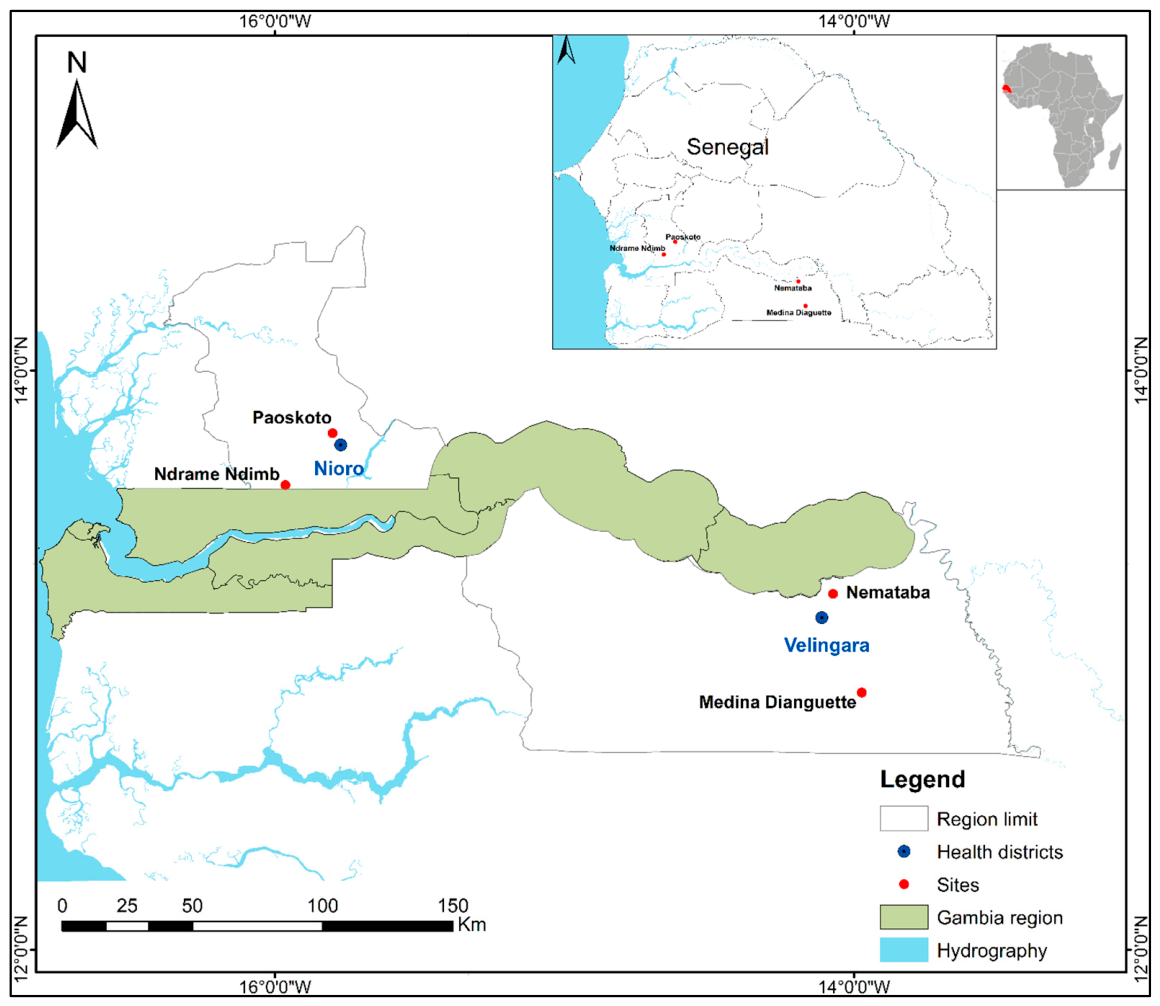
Figure 2.
Diversity of collected Anopheles mosquitoes from July 2023 to March 2024: A Nemataba. B Ndrame Ndimb. C Medina Dianguette. D Paoskoto.
Figure 2.
Diversity of collected Anopheles mosquitoes from July 2023 to March 2024: A Nemataba. B Ndrame Ndimb. C Medina Dianguette. D Paoskoto.
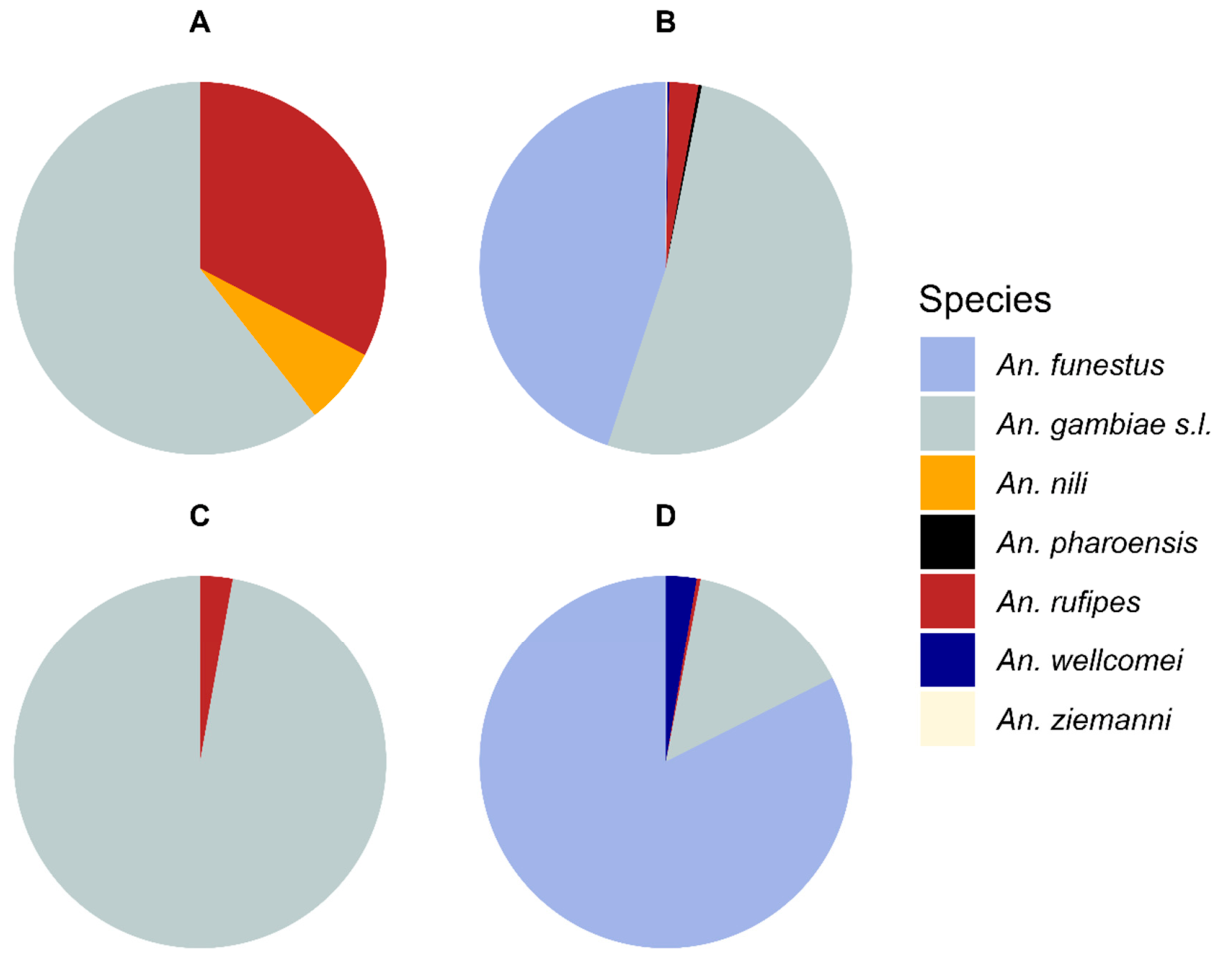
Figure 3.
Specific composition of An. gambiae sibling species from July 2023 to March 2024: A Nemataba. B Ndrame Ndimb. C Medina Dianguette. D Paoskoto.
Figure 3.
Specific composition of An. gambiae sibling species from July 2023 to March 2024: A Nemataba. B Ndrame Ndimb. C Medina Dianguette. D Paoskoto.
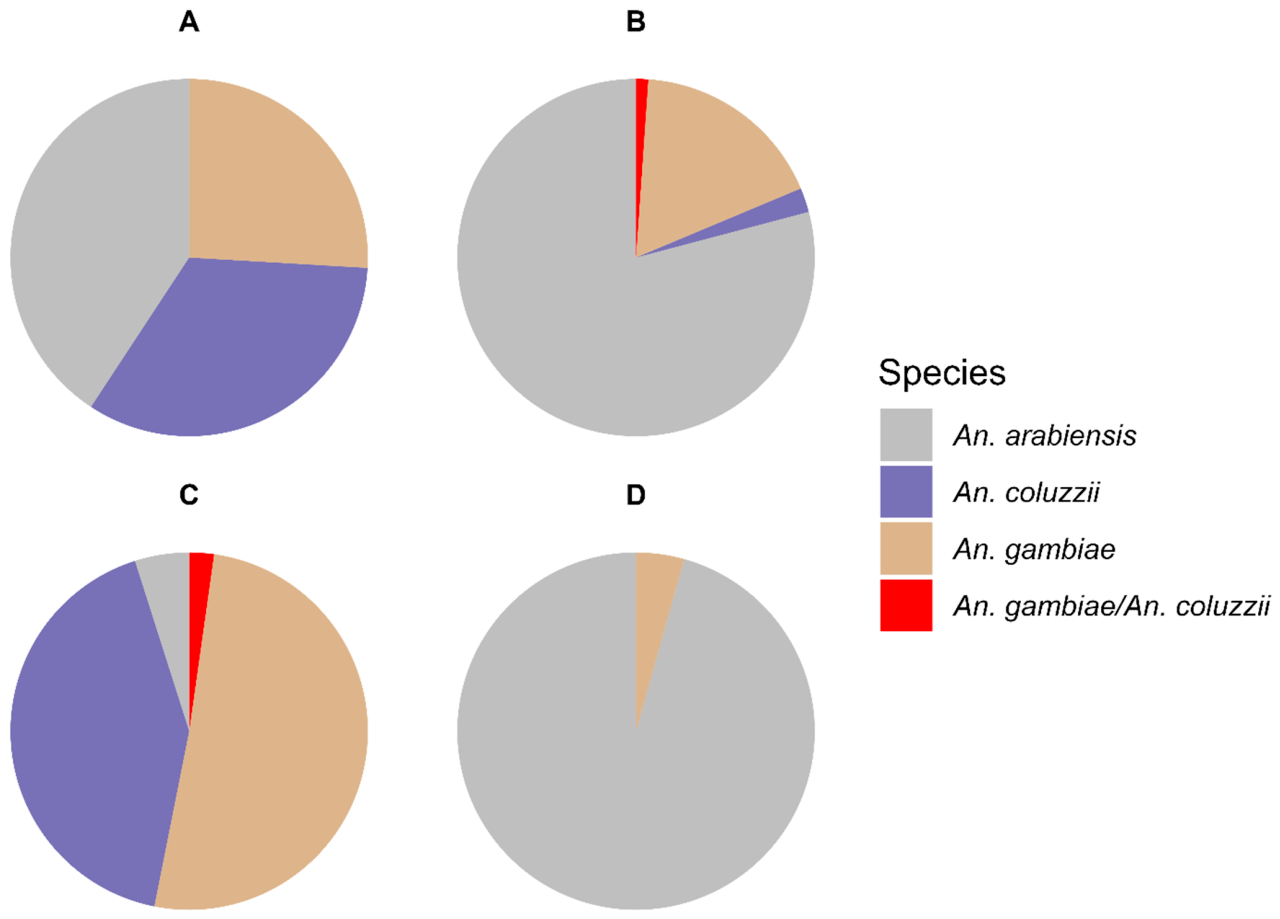
Figure 4.
Variation of human biting rates of An. gambiae s.l. and An. funestus from July 2023 to March 2024 in Medina Dianguette, Ndrame Ndimb, Nemataba and Paoskoto.
Figure 4.
Variation of human biting rates of An. gambiae s.l. and An. funestus from July 2023 to March 2024 in Medina Dianguette, Ndrame Ndimb, Nemataba and Paoskoto.
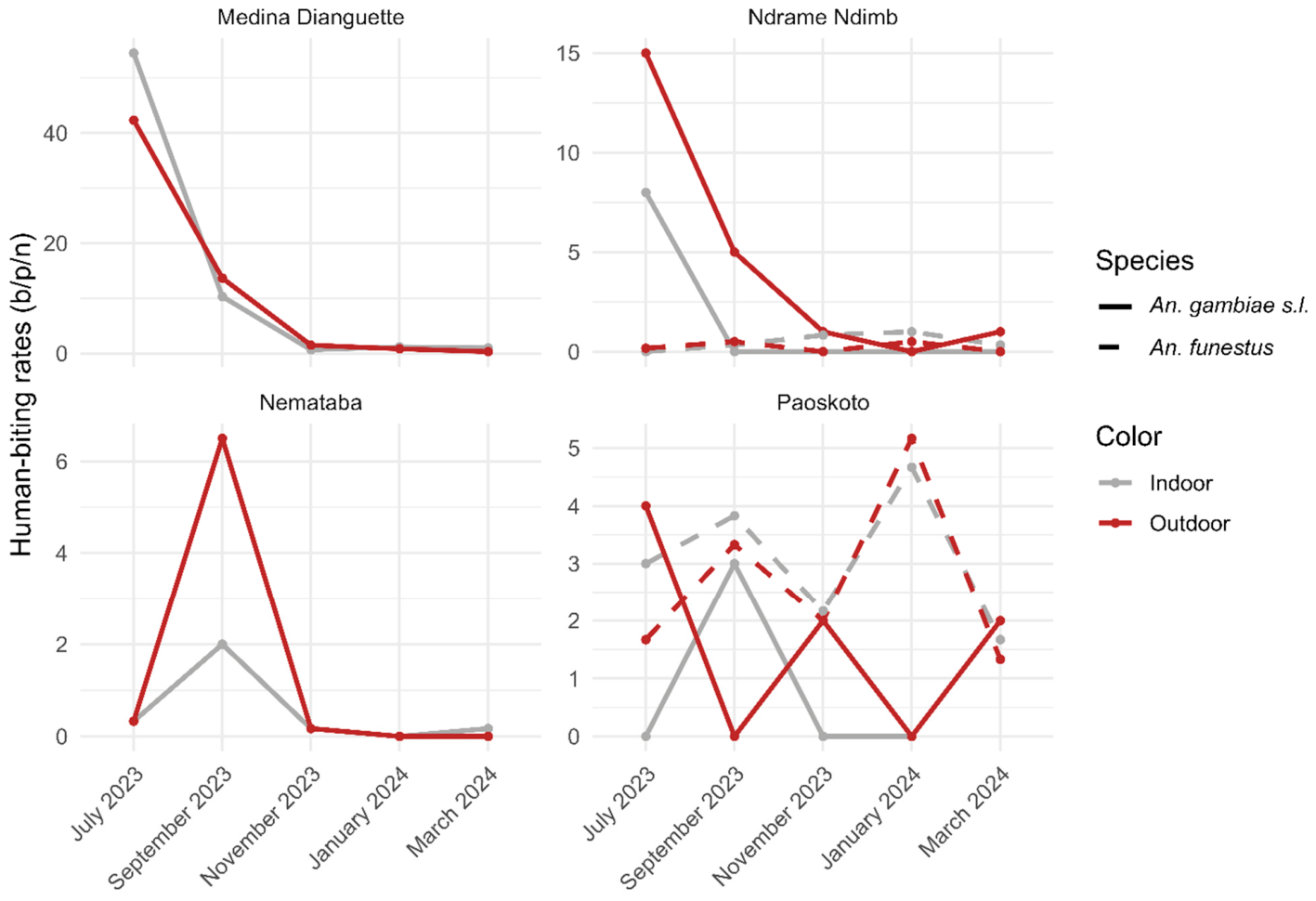
Figure 5.
Variation in indoors and outdoors nocturnal activity of An. gambiae s.l. and An. funestus.
Figure 5.
Variation in indoors and outdoors nocturnal activity of An. gambiae s.l. and An. funestus.
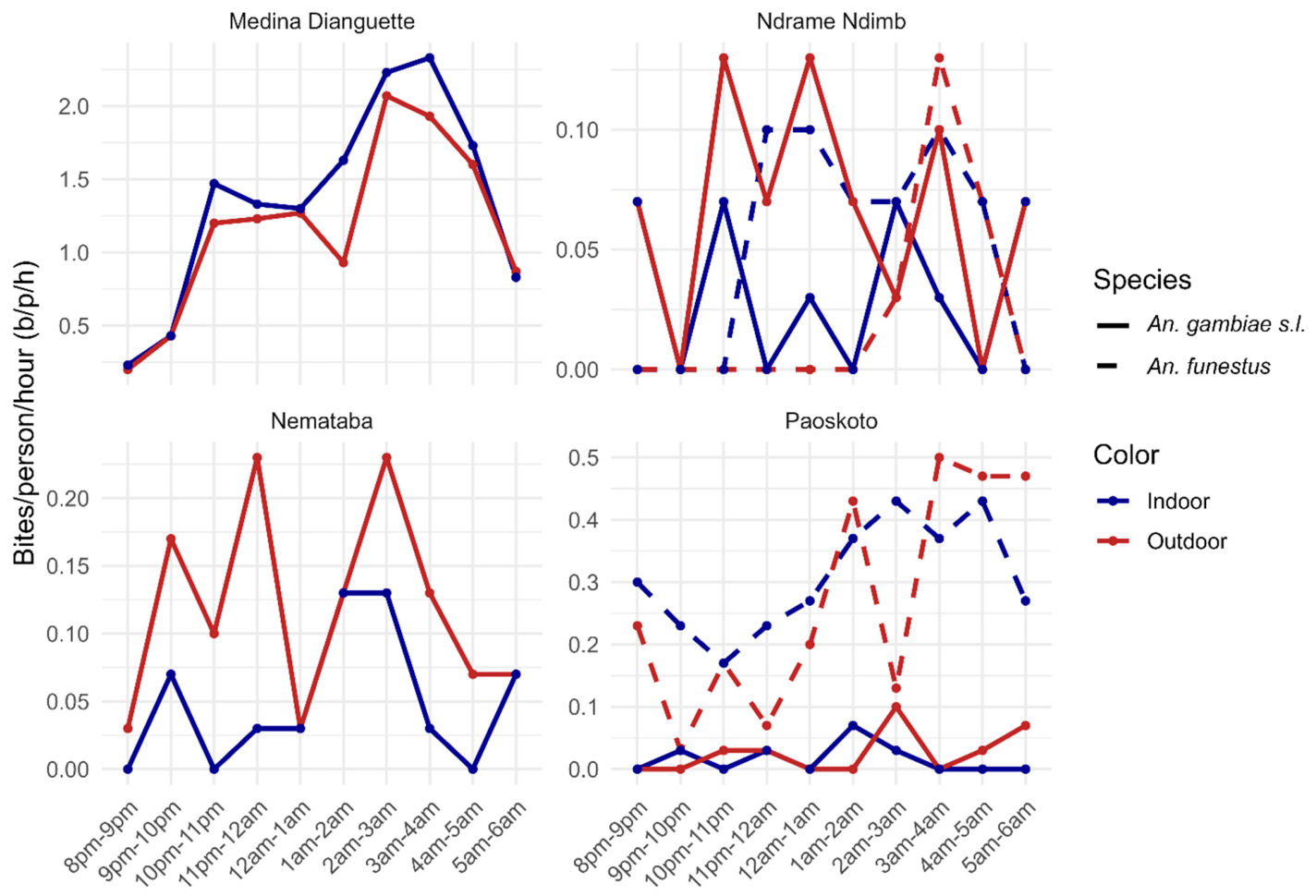
Figure 6.
Indoor resting density variations of An. gambiae s.l. and An. funestus populations in Medina Dianguette, Ndrame Ndimb, Nemataba and Paoskoto from July 2023 to March 2024.
Figure 6.
Indoor resting density variations of An. gambiae s.l. and An. funestus populations in Medina Dianguette, Ndrame Ndimb, Nemataba and Paoskoto from July 2023 to March 2024.
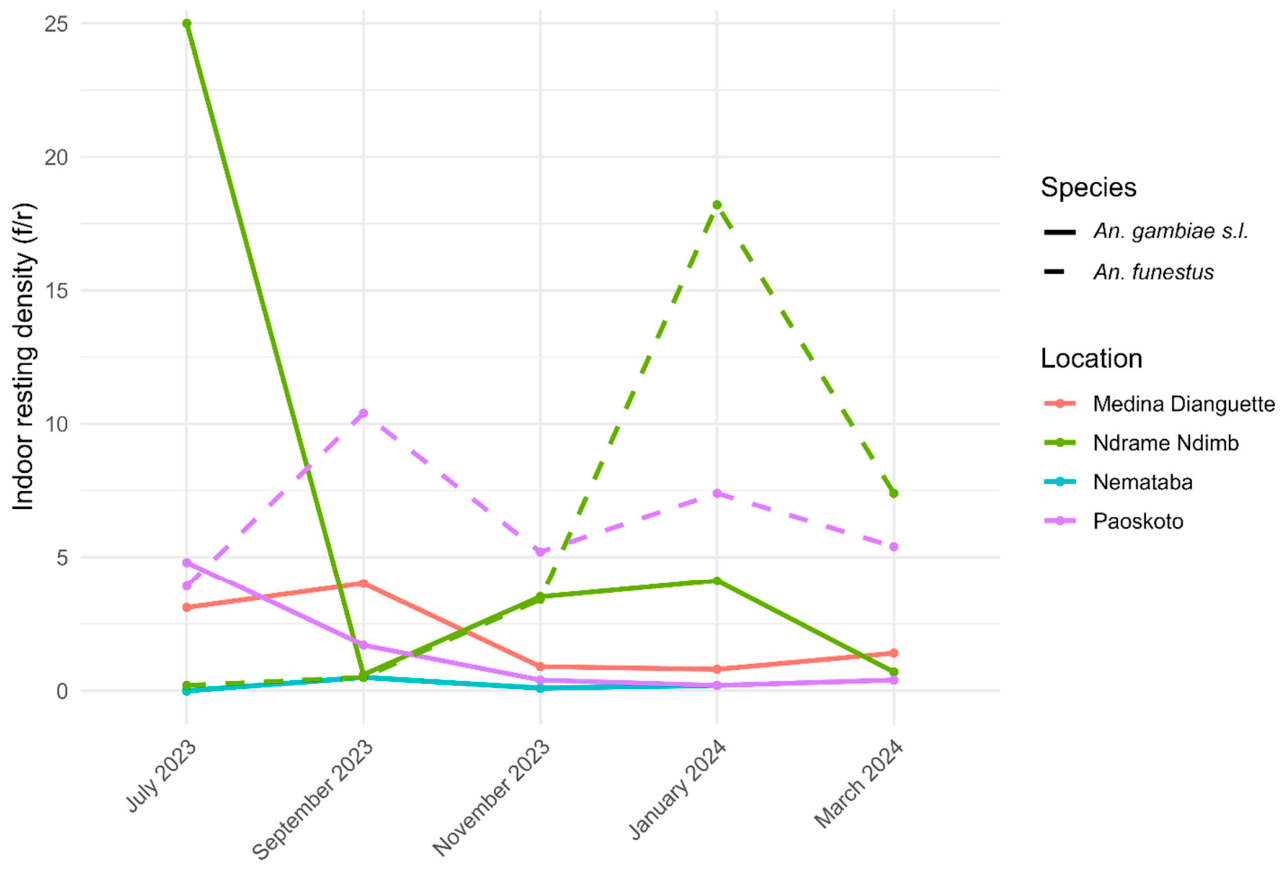
Table 1.
Variation of relative abundance of An. gambiae s.l. and An. funestus from July 2023 to March 2024 in Nemataba, Ndrame Ndimb, Medina Dianguette and Paoskoto.
Table 1.
Variation of relative abundance of An. gambiae s.l. and An. funestus from July 2023 to March 2024 in Nemataba, Ndrame Ndimb, Medina Dianguette and Paoskoto.
| Nemataba | Ndrame Ndimb | Medina Dianguette | Paoskoto | |||||||||||||||||||||
| In-HLC | Out-HLC | PSC | In-HLC | Out-HLC | PSC | In-HLC | Out-HLC | PSC | In-HLC | Out-HLC | PSC | |||||||||||||
| n | % | n | % | n | % | n | % | n | % | n | % | n | % | n | % | n | % | n | % | n | % | n | % | |
| An. gambiae s.l. | ||||||||||||||||||||||||
| July 23 | 2 | 13.33 | 2 | 5.55 | 0 | 0 | 8 | 80 | 15 | 75 | 250 | 73.75 | 327 | 80.54 | 254 | 72.16 | 31 | 30.39 | 0 | 0 | 4 | 50 | 48 | 64 |
| September 23 | 11 | 73.33 | 33 | 91.67 | 5 | 41.67 | 0 | 0 | 5 | 25 | 6 | 1.77 | 62 | 15.27 | 82 | 23.29 | 40 | 39.22 | 3 | 60 | 0 | 0 | 17 | 22.67 |
| November 23 | 1 | 6.67 | 1 | 2.78 | 1 | 8.33 | 1 | 10 | 0 | 0 | 35 | 10.32 | 4 | 0.99 | 9 | 2.56 | 9 | 8.82 | 0 | 0 | 2 | 25 | 4 | 5.33 |
| January 24 | 0 | 0 | 0 | 0 | 2 | 16.67 | 0 | 0 | 0 | 0 | 41 | 12.09 | 7 | 1.72 | 5 | 1.42 | 8 | 7.84 | 0 | 0 | 0 | 0 | 2 | 2.67 |
| March 24 | 1 | 6.67 | 0 | 0 | 4 | 33.33 | 1 | 10 | 0 | 0 | 7 | 2.07 | 6 | 1.48 | 2 | 0.57 | 14 | 13.73 | 2 | 40 | 2 | 25 | 4 | 5.33 |
| Total | 15 | 100 | 36 | 100 | 12 | 100 | 10 | 100 | 20 | 100 | 339 | 100 | 406 | 100 | 352 | 100 | 102 | 100 | 5 | 100 | 8 | 100 | 75 | 100 |
| An. funestus | ||||||||||||||||||||||||
| July 23 | 0 | 0 | 0 | 0 | 0 | 0 | 0 | 0 | 1 | 14.28 | 2 | 0.67 | 0 | 0 | 0 | 0 | 0 | 0 | 18 | 19.57 | 10 | 12.35 | 39 | 12.07 |
| September 23 | 0 | 0 | 0 | 0 | 0 | 0 | 2 | 13.33 | 3 | 42.86 | 5 | 1.68 | 0 | 0 | 0 | 0 | 0 | 0 | 23 | 25 | 20 | 24.69 | 104 | 32.20 |
| November 23 | 0 | 0 | 0 | 0 | 0 | 0 | 5 | 33.34 | 0 | 0 | 34 | 11.45 | 0 | 0 | 0 | 0 | 0 | 0 | 13 | 14.13 | 12 | 14.81 | 52 | 16.1 |
| January 24 | 0 | 0 | 0 | 0 | 0 | 0 | 6 | 40 | 3 | 42.86 | 182 | 61.28 | 0 | 0 | 0 | 0 | 0 | 0 | 28 | 30.43 | 31 | 38.27 | 74 | 22.91 |
| March 24 | 0 | 0 | 0 | 0 | 0 | 0 | 2 | 13.33 | 0 | 0 | 74 | 24.92 | 0 | 0 | 0 | 0 | 0 | 0 | 10 | 10.87 | 8 | 9.88 | 54 | 16.72 |
| Total | 0 | 0 | 0 | 0 | 0 | 0 | 15 | 100 | 7 | 100 | 297 | 100 | 0 | 0 | 0 | 0 | 0 | 0 | 92 | 100 | 81 | 100 | 323 | 100 |
n = number collected; % = percentage; In-HLC = indoor human landing catches; Out-HLC = outdoor human landing catches; PSC = pyrethrum spray catches.
Table 2.
Physiological state of An. gambiae s.l. and An. funestus resting females.
| Species | Sites | Unfed | Fed | Gravid | Half-gravid |
Grand total |
||||
| n | % | n | % | n | % | n | % | |||
| An. funestus | Ndrame Ndimb | 25 | 8.42 | 159 | 53.53 | 58 | 19.53 | 55 | 18.52 | 297 |
| Paoskoto | 47 | 14.55 | 157 | 48.61 | 86 | 26.62 | 33 | 10.22 | 323 | |
| Total | 72 | 11.61 | 316 | 50.97 | 144 | 23.23 | 88 | 14.19 | 620 | |
| An. gambiae s.l. | Medina Dianguette | 3 | 2.94 | 55 | 53.92 | 29 | 28.43 | 15 | 14.71 | 102 |
| Ndrame Ndimb | 25 | 7.38 | 163 | 48.08 | 94 | 27.73 | 57 | 16.81 | 339 | |
| Nemataba | 0 | 0 | 5 | 41.67 | 2 | 16.66 | 5 | 41.67 | 12 | |
| Paoskoto | 6 | 8 | 31 | 41.33 | 30 | 40 | 8 | 10.67 | 75 | |
| Total | 34 | 6.44 | 254 | 48.11 | 155 | 29.36 | 85 | 16.09 | 528 | |
| Grand total | 106 | 9.23 | 570 | 49.65 | 299 | 26.05 | 173 | 15.07 | 1,148 | |
n = number collected.
Table 3.
Blood meal origin of An. gambiae s.l. and An. funestus females.
| Species | T | I | N | Vertebrate hosts | Mixted | HBI (%) | ||||||||||||
| H | B | S | C | E | HB | HE | BS | BE | SE | SC | HSE | BSE | ||||||
| An. funestus | ||||||||||||||||||
| Ndrame Ndimb | 113 | 118 | 12 | 5 | 13 | 14 | 1 | 53 | 1 | 0 | 9 | 0 | 3 | 0 | 1 | 1 | 5.93 | |
| Paoskoto | 120 | 137 | 5 | 4 | 22 | 8 | 0 | 60 | 0 | 1 | 15 | 2 | 1 | 1 | 0 | 1 | 3.65 | |
| Total | 233 | 255 | 17 | 9 | 35 | 22 | 1 | 113 | 1 | 1 | 24 | 2 | 4 | 1 | 1 | 2 | 4.71 | |
| An. gambiae s.l. | ||||||||||||||||||
| Ndrame Ndimb | 159 | 165 | 7 | 2 | 4 | 5 | 0 | 128 | 0 | 2 | 1 | 0 | 10 | 0 | 0 | 0 | 2.42 | |
| Nemataba | 3 | 3 | 0 | 2 | 0 | 0 | 0 | 1 | 0 | 0 | 0 | 0 | 0 | 0 | 0 | 0 | 66.67 | |
| Medina Dianguette | 49 | 48 | 2 | 37 | 4 | 2 | 0 | 3 | 0 | 0 | 1 | 0 | 0 | 0 | 0 | 0 | 77.08 | |
| Paoskoto | 27 | 38 | 1 | 0 | 2 | 0 | 0 | 14 | 0 | 0 | 5 | 1 | 2 | 0 | 0 | 2 | 0 | |
| Total | 238 | 254 | 10 | 41 | 10 | 7 | 0 | 146 | 0 | 2 | 7 | 1 | 12 | 0 | 0 | 2 | 16.93 | |
T = tested; I = identified; N = negative; H = human; B = bovine; S = sheep; C = chicken; E = equine; HBI = human blood index.
Table 4.
Variation of parity rates of An. gambiae s.l. and An. funestus in Ndrame Ndimb, Paoskoto, Nemataba and Medina Dianguette from July 2023 to March 2024.
Table 4.
Variation of parity rates of An. gambiae s.l. and An. funestus in Ndrame Ndimb, Paoskoto, Nemataba and Medina Dianguette from July 2023 to March 2024.
| Months | An. funestus | An. gambiae s.l. | ||||||||||||||||
| Ndrame Ndimb | Paoskoto | Medina Dianguette | Ndrame Ndimb | Nemataba | Paoskoto | |||||||||||||
| NP | P | PR (%) | NP | P | PR (%) | NP | P | PR (%) | NP | P | PR (%) | NP | P | PR (%) | NP | P | PR (%) | |
| July 2023 | 1 | 0 | 0 | 9 | 16 | 64 | 176 | 117 | 39.93 | 27 | 10 | 27.03 | 1 | 0 | 0 | 6 | 1 | 14.28 |
| September 2023 | 0 | 3 | 100 | 16 | 19 | 54.28 | 41 | 58 | 58.58 | 0 | 3 | 100 | 8 | 15 | 65.22 | 0 | 2 | 100 |
| November 2023 | 2 | 4 | 66.67 | 5 | 10 | 66.67 | 6 | 2 | 25 | 1 | 1 | 50 | 1 | 0 | 0 | 1 | 0 | 0 |
| January 2024 | 8 | 6 | 42.86 | 17 | 20 | 54.05 | 0 | 3 | 100 | 0 | 0 | 0 | 0 | 0 | 0 | 0 | 0 | 0 |
| March 2024 | 0 | 1 | 100 | 5 | 6 | 54.54 | 1 | 3 | 75 | 0 | 0 | 0 | 0 | 0 | 0 | 2 | 0 | 0 |
| Total | 11 | 14 | 56 | 52 | 71 | 57.72 | 224 | 183 | 44.96 | 28 | 14 | 33.33 | 10 | 15 | 60 | 9 | 3 | 25 |
NP = nulliparous; P = parous; PR = parity rate.
Disclaimer/Publisher’s Note: The statements, opinions and data contained in all publications are solely those of the individual author(s) and contributor(s) and not of MDPI and/or the editor(s). MDPI and/or the editor(s) disclaim responsibility for any injury to people or property resulting from any ideas, methods, instructions or products referred to in the content. |
© 2026 by the authors. Licensee MDPI, Basel, Switzerland. This article is an open access article distributed under the terms and conditions of the Creative Commons Attribution (CC BY) license.
Copyright: This open access article is published under a Creative Commons CC BY 4.0 license, which permit the free download, distribution, and reuse, provided that the author and preprint are cited in any reuse.