

Submitted:
09 October 2026
Posted:
10 October 2026
You are already at the latest version
Abstract
Colon histology computer-aided diagnosis (CAD) papers often lead with pooled grading accuracy. That number mixes easy majority-class hits with minority-class misses and treats a Grade 1↔Grade 2 swap as interchangeable with calling poorly differentiated cancer well differentiated. This preprint recomputes stratified five-fold support-vector grading on 560 public colorectal cancer patches with frozen ResNet50 embeddings (Grade 1 n=251, Grade 2 n=210, Grade 3 n=99). Cross-validated accuracy is 73.6% ± 2.9% and macro-F1 is 0.705, but Grade 3 recall is only 0.475. Of 148 residual mistakes, 119 (80.4%) are adjacent-grade swaps; 29 (19.6%) jump from Grade 3 to Grade 1. A published soft-voting ensemble confusion matrix shows the same structure: 86.0% of errors remain adjacent. We treat that adjacent share as the checkable claim—not a new leaderboard—and argue that Grade 3 recall and adjacent versus non-adjacent error counts should be reported before pooled accuracy is read as a deployment summary. Embedding protocol and ensemble confusion-matrix anchors follow a published two-stage colon pipeline; no new patients were enrolled.
Keywords:
colon cancer
; histological grading
; adjacent-grade error
; Grade-3 recall
; LC25000
; computational pathology
; error costs
1. Introduction
Histological grade for colorectal adenocarcinoma is not a balanced three-way quiz. Well-, moderately, and poorly differentiated tumors sit on a morphological continuum, Grade 3 is usually the minority class on curated patch sets, and missing poorly differentiated disease is not clinically interchangeable with confusing Grade 1 and Grade 2 [1,2,3]. Yet grading CAD abstracts still often lead with a single accuracy or macro-F1 number that pools those events.
Public patch corpora such as LC25000 made binary colon detection easy to reproduce [4]. Fine-grained grading is harder: class imbalance, adjacent morphology, and frozen-embedding limits all show up once the task leaves the binary table [5,6]. Reporting guidance for early AI decision support already asks authors to name the error that matters and the intended use [7,8]. The gap this paper fills is narrower. It takes a fixed public embedding bank for 560 graded colon patches, recomputes stratified five-fold classification, and writes down how many mistakes are neighbors versus Grade 3→Grade 1 jumps.
No new slides were scanned here. The contribution is a checkable error anatomy: adjacent-grade share, Grade 3 recall, and a short argument that those two statistics should travel with pooled accuracy. A published two-stage colon pipeline supplies the embedding protocol and an ensemble confusion-matrix anchor [9]; the calculations below concern the grading stage only.
2. Materials and Methods
We use 560 colorectal adenocarcinoma patches with pathologist-assigned grades stored with 2,048-dimensional ResNet50 (ImageNet) penultimate activations [4,10]. Class counts are Grade 1 (44.8%), Grade 2 (37.5%), and Grade 3 (17.7%). Filenames in the embedding table correspond to 20× tiles; multi-magnification stratification is out of scope for this reanalysis. Binary detection results on the larger LC25000-derived colon set are not recomputed here; prior work already shows near-ceiling detection on that corpus [9,11,12].
Features were standardized inside each training fold. An RBF-kernel support vector machine (SVM) was trained under stratified five-fold cross-validation (shuffle seed 42). Metrics are accuracy, macro-F1, and per-grade precision, recall, and F1. Out-of-fold predictions supply one confusion matrix for adjacent-error accounting. Adjacent errors are defined as on the ordered labels ; non-adjacent errors are Grade 1↔Grade 3 swaps. As an external published reference—not re-trained here—we also decompose the soft-voting ensemble confusion matrix reported for the same 560-patch grading task [9]. That matrix is used only to test whether adjacent dominance is an SVM-only artifact.
We treat Grade 3 recall and adjacent-error share as primary reporting statistics. Pooled accuracy remains in the tables because readers expect it; it is not treated as a release summary. An illustrative relative-cost scale (adjacent G1↔G2 , adjacent G2↔G3 , non-adjacent G3→G1 ) is used only in discussion to make asymmetry concrete. Those weights are author-chosen discussion devices, not surveyed clinical utilities [3,8].
3. Results
3.1. Per-Grade Recall Under Cross-Validation
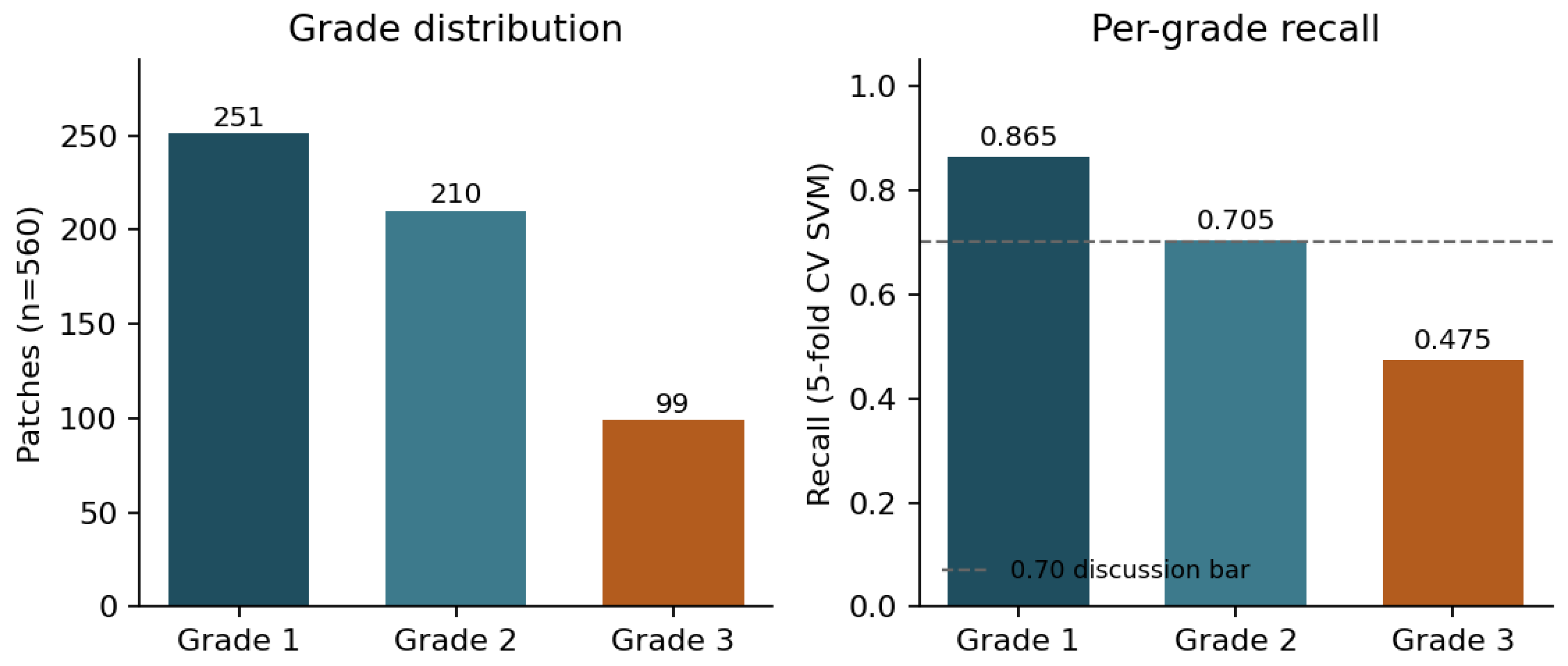
Five-fold CV accuracy is with macro-F1 . Per-grade recall is 0.865 (Grade 1), 0.705 (Grade 2), and 0.475 (Grade 3). Grade 3 precision is high (0.887) because the model rarely predicts Grade 3; when it does, it is often correct, but it misses more than half of true Grade 3 patches (52 of 99). Figure 1 shows the class imbalance next to those recalls. Table 1 records the full per-grade profile.

Table 1.
Per-grade SVM performance under stratified five-fold cross-validation on 560 public embeddings.
Table 1.
Per-grade SVM performance under stratified five-fold cross-validation on 560 public embeddings.
| Grade | Support | Precision | Recall | F1 |
|---|---|---|---|---|
| Grade 1 | 251 | 0.719 | 0.865 | 0.785 |
| Grade 2 | 210 | 0.722 | 0.705 | 0.713 |
| Grade 3 | 99 | 0.887 | 0.475 | 0.618 |
| Macro avg | 560 | 0.776 | 0.682 | 0.705 |
Figure 1.
Grade distribution on the 560-patch set (left) and per-grade recall under five-fold CV SVM (right). The dashed line marks an arbitrary 0.70 discussion bar for Grade 3 recall.
Figure 1.
Grade distribution on the 560-patch set (left) and per-grade recall under five-fold CV SVM (right). The dashed line marks an arbitrary 0.70 discussion bar for Grade 3 recall.
3.2. Adjacent-Grade Dominance
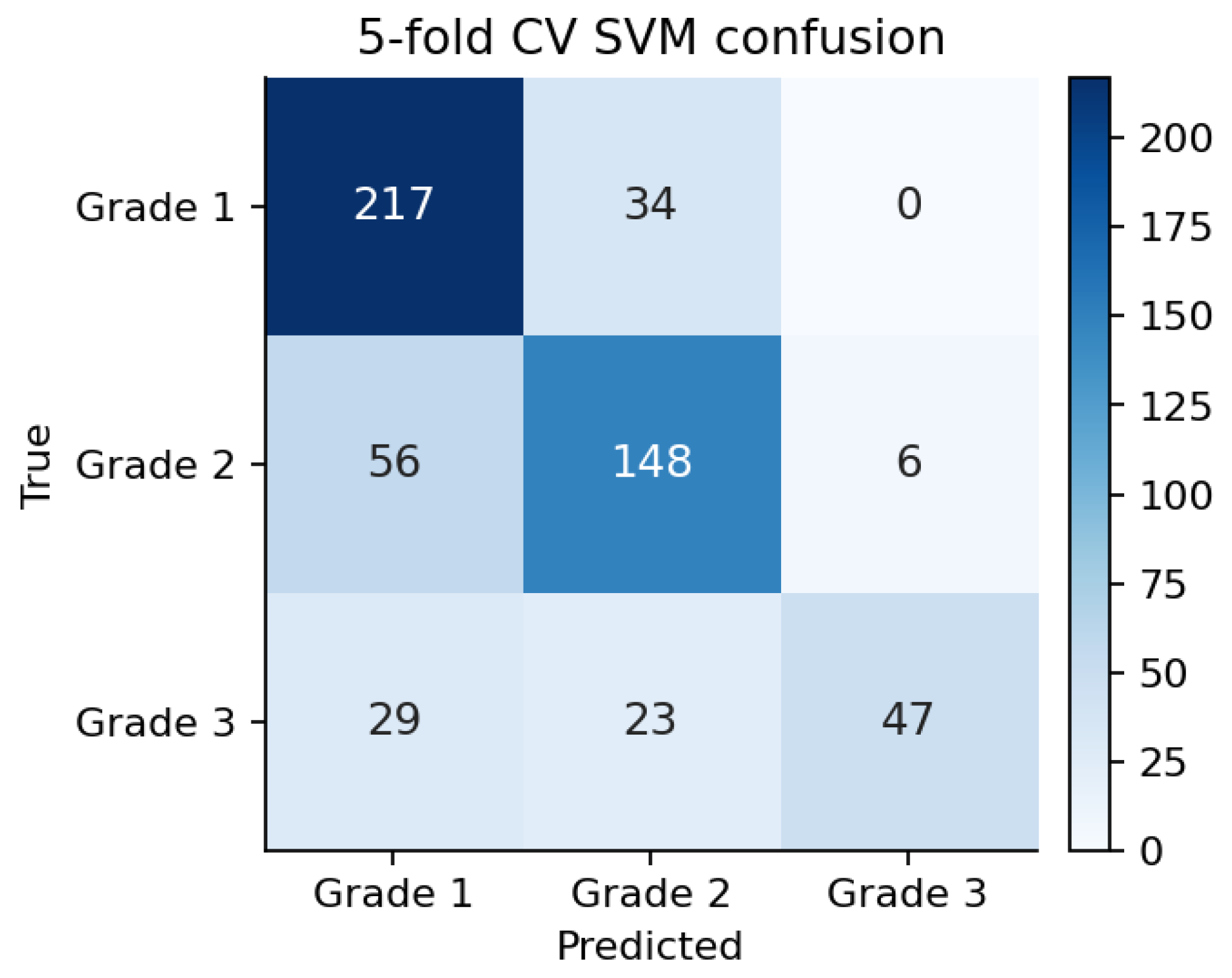
The out-of-fold confusion matrix is shown in Figure 2 and Table 2. Of 148 errors, 119 () are adjacent-grade swaps and 29 () are non-adjacent Grade 3→Grade 1 calls. No Grade 1 patch was predicted as Grade 3 in the CV predictions. Most Grade 3 misses land on Grade 1 (29) or Grade 2 (23).
Table 2.
Out-of-fold SVM confusion counts (rows: true grade; columns: predicted).
| True \ Pred | G1 | G2 | G3 |
|---|---|---|---|
| G1 | 217 | 34 | 0 |
| G2 | 56 | 148 | 6 |
| G3 | 29 | 23 | 47 |
Figure 2.
Five-fold CV SVM confusion matrix on 560 graded colon patches.
The published ensemble confusion matrix for the same patch set shows 107 total errors, of which 92 () are adjacent and 15 () are non-adjacent [9]. Figure 3 compares those shares. Soft voting improves Grade 3 recall in the source report, but it does not erase adjacent-grade structure: residual mistakes remain mostly neighbors on the differentiation spectrum [1,2].
3.3. What Pooled Accuracy Hides
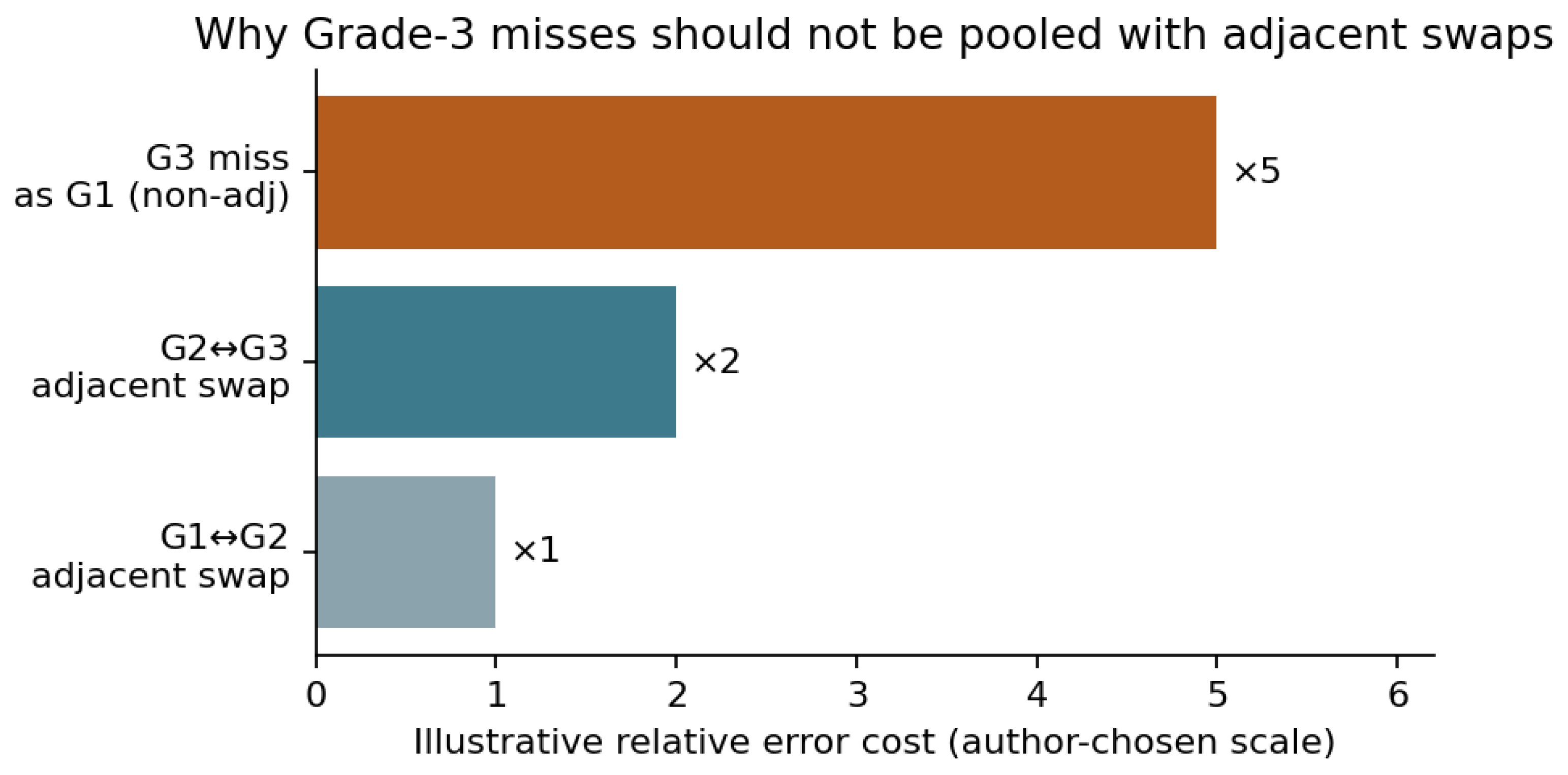
A 73.6% accuracy headline is compatible with Grade 3 recall below 0.50. Macro-F1 (0.705) softens the minority miss but still does not separate adjacent swaps from Grade 3→Grade 1 jumps. Under the illustrative cost scale in Figure 4, the 29 non-adjacent CV misses receive five times the weight of a G1↔G2 swap; those 29 events alone outweigh dozens of adjacent mistakes if the weighted sum is the decision statistic. Committees need not adopt these particular weights, but they should choose some Grade 3-aware accounting rather than treating every off-diagonal cell as equal [3,8].
4. Discussion
Adjacent-grade dominance is expected under a continuous differentiation spectrum, and it is still useful to quantify. An 80–86% adjacent share means most residual CAD mistakes look like disagreements pathologists already negotiate along the Grade 2 boundary, while the non-adjacent remainder is the sharper safety signal [1,13]. Reporting only pooled accuracy hides both facts: how often the model is “almost right,” and how often it is wrong in the costly direction.
The Grade 3 recall of 0.475 under CV SVM fails any reasonably strict minority gate near 0.70. That failure is not rescued by Grade 3 precision of 0.887. A model that rarely predicts Grade 3 can look precise while still missing poorly differentiated tiles. Binary colon detectors on LC25000-style data can approach ceiling performance [11,12]; grading does not inherit that ease. Foundation-model embeddings and weakly supervised whole-slide methods may change the absolute numbers [14,15], but they do not remove the need to publish minority recall and adjacency structure.
Limits are straightforward. The 560 patches are public research tiles, not a multi-site whole-slide cohort; all graded embeddings used here are 20×; the SVM and fold seed are specific; and the cost weights in Figure 4 are illustrative. The ensemble matrix is cited from a published source and was not re-fit in this notebook [9]. Replication should keep the adjacent/non-adjacent split visible even if a stronger backbone raises Grade 3 recall.
5. Conclusions
On these public embeddings, colon grading errors are mostly neighbors: of CV SVM mistakes and of published ensemble mistakes are adjacent-grade swaps, while Grade 3 recall under cross-validation is only 0.475. Pooled accuracy of 73.6% does not communicate either fact. Before a colon grading CAD number is treated as operational, report Grade 3 recall and the adjacent versus non-adjacent error split alongside accuracy.
Author Contributions
Conceptualization, J.C., S.B. and S.M.; methodology, J.C.; formal analysis, J.C.; investigation, J.C., S.B. and S.M.; writing—original draft preparation, J.C.; writing—review and editing, J.C., S.B. and S.M.; visualization, J.C.; supervision, J.C. All authors have read and agreed to the published version of the manuscript.
Funding
This research received no external funding.
Institutional Review Board Statement
Not applicable.
Informed Consent Statement
Not applicable.
Data Availability Statement
This study reanalyzes public histopathology embeddings derived from LC25000-linked research releases and published ensemble confusion-matrix anchors. No new primary data were generated.
Acknowledgments
The authors thank colleagues who commented on earlier drafts of this manuscript.
Conflicts of Interest
The authors declare no conflicts of interest.
Abbreviations
The following abbreviations are used in this manuscript:
| CAD | computer-aided diagnosis |
| CV | cross-validation |
| F1 | harmonic mean of precision and recall |
| LC25000 | Lung and Colon Histopathological Image Dataset |
| SVM | support vector machine |
References
- WHO Classification of Tumours Editorial Board. Digestive System Tumours, 5th ed.; International Agency for Research on Cancer: Lyon, France, 2019.
- Kather, J.N.; Weis, C.-A.; Bianconi, F.; Melchers, S.M.; Schad, L.R.; Gaiser, T.; Marx, A.; Zöllner, F.G. Multi-class texture analysis in colorectal cancer histology. Sci. Rep. 2016, 6, 27988. [CrossRef]
- Saito, T.; Rehmsmeier, M. The precision-recall plot is more informative than the ROC plot when evaluating binary classifiers on imbalanced datasets. PLoS ONE 2015, 10, e0118432. [CrossRef]
- Borkowski, A.A.; Bui, M.M.; Thomas, L.B.; Wilson, C.P.; DeLand, L.A.; Mastorides, S.M. Lung and colon cancer histopathological image dataset (LC25000). arXiv 2019, arXiv:1912.12142.
- Litjens, G.; et al. A survey on deep learning in medical image analysis. Med. Image Anal. 2017, 42, 60–88. [CrossRef]
- Esteva, A.; Kuprel, B.; Novoa, R.A.; Ko, J.; Swetter, S.M.; Blau, H.M.; Thrun, S. Dermatologist-level classification of skin cancer with deep neural networks. Nature 2017, 542, 115–118. [CrossRef]
- Collins, G.S.; Reitsma, J.B.; Altman, D.G.; Moons, K.G.M. Transparent reporting of a multivariable prediction model for individual prognosis or diagnosis (TRIPOD): The TRIPOD statement. BMC Med. 2015, 13, 1. [CrossRef]
- Vasey, B.; et al. Reporting guideline for the early-stage clinical evaluation of decision support systems driven by artificial intelligence: DECIDE-AI. Nat. Med. 2022, 28, 924–933. [CrossRef]
- Dahal, S.; Bhattarai, B. Two-stage deep learning pipeline for colon cancer detection and histological grading using transfer learning and ensemble methods. In Proceedings of the International Conference on Advanced Research in Computing (ICARC), Belihuloya, Sri Lanka, 2026; pp. 1–6. [CrossRef]
- He, K.; Zhang, X.; Ren, S.; Sun, J. Deep residual learning for image recognition. In Proceedings of the IEEE Conference on Computer Vision and Pattern Recognition (CVPR), Las Vegas, NV, USA, 27–30 June 2016; pp. 770–778. [CrossRef]
- Mangal, S.; Chaurasia, A.; Khajanchi, A. Convolution neural networks for diagnosing colon and lung cancer histopathological images. arXiv 2020, arXiv:2009.03878.
- Hasan, R.; K.R.; V.K.R.S. CoC-ResNet—classification of colorectal cancer on histopathologic images using residual networks. Multimed. Tools Appl. 2024, 83, 56965–56989. [CrossRef]
- Kather, J.N.; et al. Predicting survival from colorectal cancer histology slides using deep learning: A retrospective multicenter study. PLoS Med. 2019, 16, e1002730. [CrossRef]
- Chen, R.J.; et al. Towards a general-purpose foundation model for computational pathology. Nat. Med. 2024, 30, 850–862. [CrossRef]
- Lu, M.Y.; Williamson, D.F.K.; Chen, T.Y.; Chen, R.J.; Barbieri, M.; Mahmood, F. Data-efficient and weakly supervised computational pathology on whole-slide images. Nat. Biomed. Eng. 2021, 5, 555–570. [CrossRef]
Figure 3.
Share of residual grading errors that are adjacent-grade versus non-adjacent (G1↔G3) for the CV SVM recomputed here and for the published ensemble confusion matrix.
Figure 3.
Share of residual grading errors that are adjacent-grade versus non-adjacent (G1↔G3) for the CV SVM recomputed here and for the published ensemble confusion matrix.
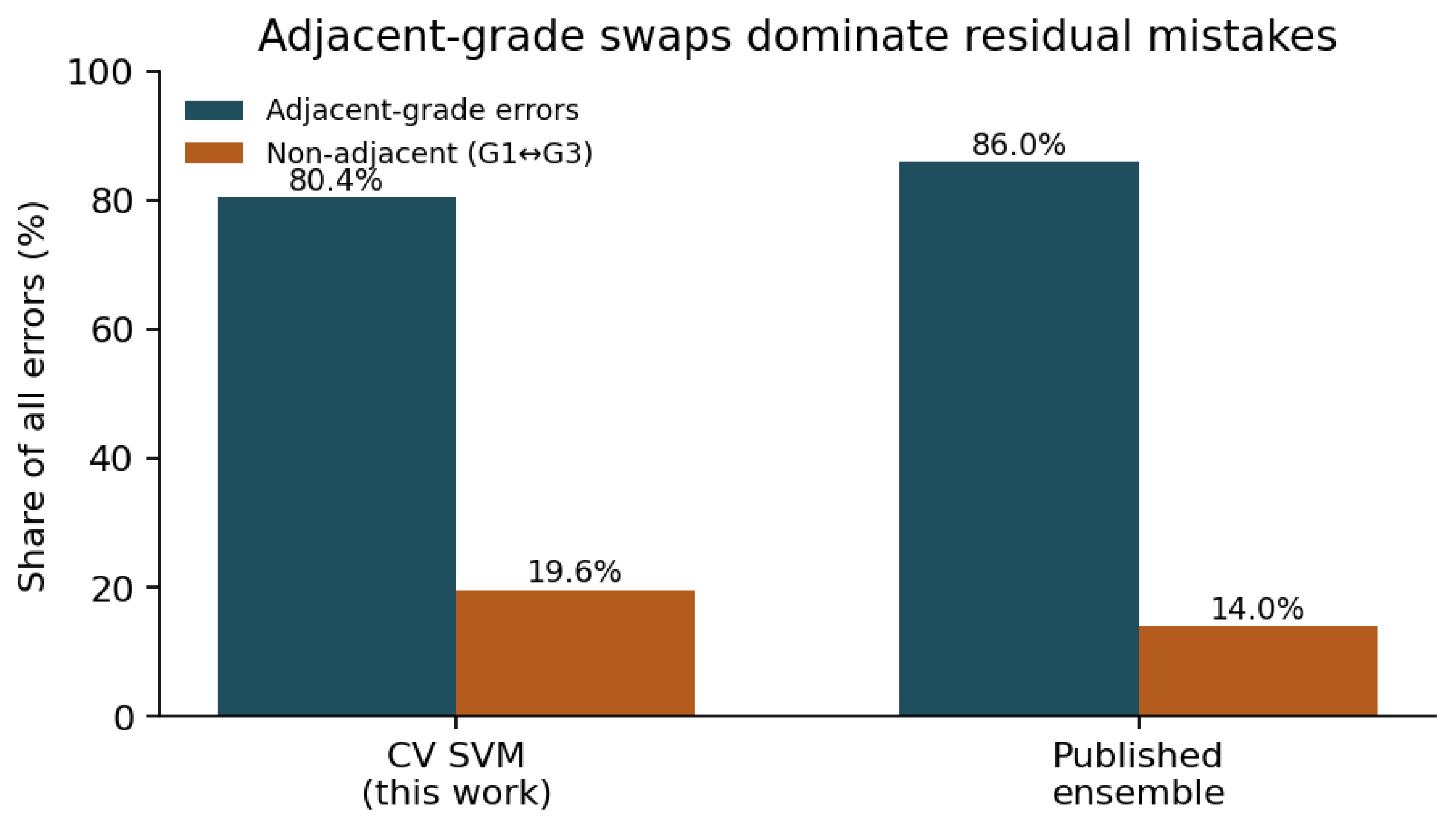
Figure 4.
Illustrative relative costs used only for discussion: adjacent G1↔G2 (), adjacent G2↔G3 (), and non-adjacent G3→G1 (). Not a surveyed utility elicitation.
Figure 4.
Illustrative relative costs used only for discussion: adjacent G1↔G2 (), adjacent G2↔G3 (), and non-adjacent G3→G1 (). Not a surveyed utility elicitation.
Disclaimer/Publisher’s Note: The statements, opinions and data contained in all publications are solely those of the individual author(s) and contributor(s) and not of MDPI and/or the editor(s). MDPI and/or the editor(s) disclaim responsibility for any injury to people or property resulting from any ideas, methods, instructions or products referred to in the content. |
© 2026 by the authors. Licensee MDPI, Basel, Switzerland. This article is an open access article distributed under the terms and conditions of the Creative Commons Attribution (CC BY) license (http://creativecommons.org/licenses/by/4.0/).
Copyright: This open access article is published under a Creative Commons CC BY 4.0 license, which permit the free download, distribution, and reuse, provided that the author and preprint are cited in any reuse.