

Submitted:
07 October 2026
Posted:
10 October 2026
You are already at the latest version
Abstract
This study examines whether coastal and maritime heritage can diversify tourism experiences and support a more balanced spatial distribution of visitors in Porto, Portugal. It investigates the determinants of tourists’ intentions to visit coastal experiences and their effects on satisfaction and loyalty, considering the mediating role of visit intentions and moderating effects of age and income. A quantitative survey was conducted with tourists in Porto, Portugal, and 432 responses were collected. The findings show that coastal and maritime tourism motivation and interest most strongly influenced visit intentions and loyalty, while accessibility and information availability had the strongest effect on satisfaction, highlighting the importance of adequate access and information to engage with alternative experiences. Visit intentions also positively affected satisfaction and loyalty, with significant indirect effects supporting its mediating role, whereas age and income did not significantly moderate the relationships. The findings suggest that developing attractive coastal and maritime experiences, supported by adequate accessibility and information, can diversify Porto’s tourism offer and contribute to a more balanced distribution of visitors, reducing concentration in the historic centre while strengthening destination satisfaction and loyalty.
Keywords:
coastal and maritime tourism
; coastal and maritime heritage
; heritage city
; Porto
; destination development
; destination management
1. Introduction
Tourism is a main driver of economic, social, and cultural development in historic cities, where heritage is central to destination identity and attractiveness. It can generate economic benefits, support urban regeneration, and contribute to the conservation and valorisation of cultural heritage. However, increasing visitor numbers and their concentration in historic areas can also place considerable pressure on heritage resources, historical landscapes, local communities, and urban infrastructure [1]. In highly visited destinations, these concerns are increasingly associated with perceptions that tourism activity may be approaching or exceeding the capacity of urban areas to accommodate visitors without compromising local life and the visitor experience [2]. Such pressure calls for strategic tourism management that balances tourism’s role in territorial development with the preservation of local social and economic vitality and the historical and cultural significance of heritage.
The city of Porto, Portugal, illustrates the close relationship between heritage, tourism development and urban economic activity. The Historic Centre of Oporto, Luiz I Bridge and Monastery of Serra do Pilar was inscribed on the UNESCO World Heritage List in 1996, recognizing its Outstanding Universal Value and its significance as a historic urban landscape shaped by centuries of cultural, commercial and maritime connections. Since then, Porto has strengthened its position as an international tourism destination, supported by its historic and cultural heritage, distinctive urban landscape and diverse tourism offer. This growing international visibility is also reflected in its recognition through the World Travel Awards, including Europe’s Leading City Break Destination in 2023 and Europe’s Leading Seaside Metropolitan Destination in 2024, as well as World’s Leading Seaside Metropolitan Destination in 2024 (3).
Nowadays, Porto municipality addresses these issues through a strategic vision that focuses on achieving balanced solutions for municipal requirements. The tourism industry brings economic benefits to the region, yet it creates problems for residents due to high tourist traffic leading to excessive visitor numbers which create overtourism conditions. The authors define overtourism not merely as high visitor numbers but as the resulting congestion, price escalation, and transformation of local commerce into tourist-focused enterprises, which diminish cultural authenticity [4].
The situation in Porto exhibits similarities to historical patterns observed in European cities, which experience excessive pressure in their central areas and require strategies that balance exploration needs with their negative consequences [5]. Residents of Porto already report their concerns about peak-season traffic problems and infrastructure limitations and short-term rental activities that drive up housing costs [5,6]. This is particularly relevant given the strong spatial concentration of tourism activity in Porto’s historic core, with a municipal study estimating that the Historic Centre and Baixa account for approximately 71% of tourism supply and 79% of tourism demand [7].
In Porto, the challenge is not simply the absolute volume of visitors, but the concentration of tourism activity within a relatively limited historic urban area, where visitor pressure intersects with residential functions, heritage conservation and local economic activity [8]. In fact, the overdependence on historic districts risks their potential for future destruction, indicating the need to find other forms of tourism development. Recent research on urban tourism suggests that alternative local experiences can function as soft interventions for dispersing visitors away from central places [9].
The “Visão de Futuro para a Sustentabilidade do Destino Porto” seeks a balanced development model that integrates tourism with resident quality of life, establishing the city as an authentic and sophisticated international destination [7].
In this context, the coastal and maritime heritage of the destination represents a particularly relevant territorial dimension, offering opportunities to diversify tourism experiences while integrating cultural, natural, and leisure resources.
Coastal and maritime tourism has gained growing popularity, providing experiences that integrate cultural, natural, and leisure activities [10]. The International Coastal and Marine Tourism Society describes this type of tourism as encompassing a variety of leisure activities associated with the marine world, such as cruises, boating, and water sports [11]. Coastal destinations are therefore not defined only by their beaches or marine activities. They can also encompass maritime landscapes, historic ports and settlements, fortifications, fishing traditions, gastronomy and other forms of tangible and intangible cultural heritage. In this broader perspective, coastal tourism can bring together natural, cultural and recreational resources within integrated visitor experiences [12].
This approach is especially relevant to Porto, where previous research has identified the need to extend tourism activity beyond the city centre and develop tourism products in less-visited areas [5]. Such areas also encompass established residential communities whose presence, everyday practices, and local identities contribute to the cultural character and authenticity of these neighbourhoods. Therefore, tourism diversification should not simply seek to redistribute visitors spatially but should be carefully managed to support local communities and preserve the social and cultural fabric of residential areas while enabling the sustainable valorisation of their heritage and tourism resources [6].
Yet, Porto’s maritime resources are still not maximally developed from the perspective of promotion and infrastructure, even though they are of great historical and cultural value. The territory extending from the Atlantic Ocean to the Douro estuary encompasses a rich cultural landscape reflecting Portugal’s long-standing maritime traditions, including exploration, fishing, navigation and trade. Mobilising these heritage resources for tourism can diversify visitor flows and experiences, extend tourism to less concentrated areas, and strengthen the territorial integration cultural and maritime identity [12].
The research goal of this study is to analyze the perspectives of tourists’ on maritime and coastal heritage as an alternative tourist offer in Porto, in order to diversify the city’s tourism products and reduce pressure on its historic center, particularly to examine the determinants of tourists’ intentions to purchase and visit coastal experiences in Porto and their effects on satisfaction and loyalty, considering the mediating role of intentions and the moderating role of age and income, as a basis for diversifying tourism away from the historic centre.
2. Hypothesis and Literature Review
Tourism has become a major driver of economic, social, and cultural development in
historic cities, particularly in UNESCO World Heritage cities, where heritage is central to destination identity and attractiveness. It can generate economic benefits, support urban regeneration, and contribute to the conservation and valorisation of cultural heritage. However, increasing visitor numbers and their concentration in historic areas can also place considerable pressure on heritage resources, historical landscapes, local communities, and urban infrastructure [1,13].
The continued increase in visitor numbers over recent decades in historical cities has transformed the social, economic, and spatial dynamics of many cities, giving rise to contrasting perspectives on tourism development [14,15,16]. In highly visited destinations, these concerns are increasingly associated with perceptions that tourism activity may be approaching or exceeding the capacity of urban areas to accommodate visitors without compromising local life and the visitor experience [2]. This pressure highlights the need to manage tourism strategically, recognising its importance for territorial development while ensuring that tourism growth supports local social and economic vitality and safeguards the historical and cultural significance of heritage. Consequently, the sustainable management of UNESCO World Heritage cities requires an integrated approach that reconciles heritage conservation with tourism development and addresses the spatial and temporal concentration of visitors through more effective visitor-flow management and the distribution of tourism activity across different areas [17].
This requires moving beyond a narrow focus on heritage and city pressures towards an integrated approach in which tourism development, visitor experience, local communities, and heritage protection are considered simultaneously. In particular, when tourism becomes spatially and temporally concentrated, management strategies need to address where, when, and how visitors use heritage areas, rather than focusing exclusively on the total number of tourists [18]. This includes monitoring tourism flows, identifying areas of excessive pressure, managing visitor density, and encouraging the distribution of tourism activity towards less concentrated areas. In this sense, thoughtful and adaptive planning is essential for managing tourism growth in ways that support the long-term sustainability and resilience of destinations [19]. Rather than being a linear process, tourism development requires continuous monitoring, evaluation, and adjustment as destinations respond to changing visitor demand, environmental pressures, infrastructure constraints, and the interests of different stakeholders [20]. At the same time, tourism planners and decision-makers operate within complex institutional, spatial, economic, and governance contexts, which can constrain their ability to implement sustainable development strategies effectively.
Tourism pressure is not determined exclusively by the overall number of visitors, but also by their spatial and temporal concentration within destinations. Consequently, contemporary visitor management increasingly moves beyond simply increasing capacity towards strategies that influence where, when and how visitors move through urban and heritage environments. Spatial and temporal redistribution can help relieve pressure on highly visited sites by encouraging alternative itineraries, broadening the visitor offer, promoting lesser-known areas and attractions, and shifting visitation towards less sensitive locations and periods. Nevertheless, the effective redistribution of tourists requires the active involvement of local authorities in developing substantial alternative attractions and amenities, as isolated soft interventions are unlikely to significantly alter tourists’ preference for traditional, centrally located experiences [9].
In World Heritage cities, however, visitor redistribution is more complex than simply shifting tourists from crowded sites to less visited ones. The relocation of visitor flows must be compatible with the vulnerability, significance and carrying capacity of different heritage assets, while also considering the everyday life of local communities and the distribution of tourism benefits. UNESCO increasingly emphasises integrated approaches to urban heritage management that connect heritage conservation with tourism, urban development, stakeholder participation and local community interests [21].
This is particularly important because heritage value extends beyond individual monuments to encompass the wider historic urban landscape and its social, cultural and community dimensions. UNESCO’s Historic Urban Landscape approach therefore promotes the integration of heritage management into broader urban planning and development processes, while recent visitor-management guidance stresses the need to consider spatial and temporal pressures, carrying-capacity ranges and impacts on local quality of life [21]. Accordingly, the objective should not be to disperse tourists indiscriminately, but to develop context-sensitive visitor-flow strategies that reduce pressure on vulnerable heritage assets while integrating visitor redistribution with conservation, interpretation, and stakeholder perspectives [22].
This requires combining spatial and temporal redistribution with visitor monitoring, interpretation, diversified itineraries, community engagement and, where necessary, access management. Such an approach shifts the focus from simply managing visitor numbers towards managing the relationship between visitor intensity, heritage vulnerability and community needs and capacity. By integrating visitor-flow management with conservation objectives, the quality of the visitor experience and the interests of local communities, destinations can develop more balanced and resilient approaches to World Heritage tourism [23].
Coastal and maritime tourism has gained growing popularity, providing experiences that integrate cultural, natural, and leisure activities [10]. The International Coastal and Marine Tourism Society describes this type of tourism as encompassing a variety of leisure activities associated with the marine world, such as cruises, boating, and water sports [11]. Coastal destinations are therefore not defined only by their beaches or marine activities. They can also encompass maritime landscapes, historic ports and settlements, fortifications, fishing traditions, gastronomy and other forms of tangible and intangible cultural heritage. In this broader perspective, coastal tourism can bring together natural, cultural and recreational resources within integrated visitor experiences [12]. From another perspective, as authors emphasize, coastal and maritime cultural heritage encompasses tangible and intangible resources associated with human activities and interactions in coastal and marine environments (24). Its significance is shaped not only by the physical characteristics of heritage assets but also by the meanings, identities, and cultural practices attributed to them by different communities.
This multidimensional character makes coastal and maritime tourism particularly relevant for fostering meaningful connections between natural environments, maritime heritage, and local communities. Maritime heritage has intrinsic cultural and social value that extends beyond its potential contribution to tourism and economic development. From this perspective, it should not be regarded exclusively as a resource for tourism consumption, but also as an important component of cultural identity and place attachment, reflecting the historical and continuing interactions between communities and coastal environments [25].
Drawing on the literature on coastal and marine tourism motivations, overtourism and destination information, this study examines how four determinants influence coastal experience purchase and visit intentions and post-experience outcomes, and whether age and income moderate these relationships. The following hypotheses are proposed (Figure 1):
H1.
The determinants a) maritime and coastal tourism motivation and interest, b) perceived accessibility and information availability, c) perceived pressure in the historic centre, and d) historic centre appreciation positively affect the coastal experience purchase and visit intentions.
H2.
The determinants a) maritime and coastal tourism motivation and interest, b) perceived accessibility and information availability, c) perceived pressure in the historic centre, and d) historic centre appreciation positively affect post-experience tourism outcomes, i) satisfaction and ii) loyalty.
H3.
The coastal experience purchase and visit intentions positively affects post-experience tourism outcomes, satisfaction, and loyalty.
H4.
The determinants a) maritime and coastal tourism motivation and interest, b) perceived accessibility and information availability, c) perceived pressure in the historic centre, and d) historic centre appreciation positively affect post-experience tourism outcomes, satisfaction, and loyalty, when this relationship is mediated by the coastal experience purchase and visit intentions
H5.
The relationship between the coastal experience purchase and visit intentions and post-experience tourism outcomes, i) satisfaction, and ii) loyalty is stronger when tourists are older.
H6.
The relationship between the coastal experience purchase and visit intentions and post-experience tourism outcomes, i) satisfaction, and ii) loyalty is more intense when tourists have higher income.
3. Materials and Methods
3.1. Porto and the Atlantic Quarter
Porto is located in the north-west of Portugal and one of the country’s oldest cities, is renowned for its historical, cultural, and architectural heritage. Porto lies at the core of the Porto Metropolitan Area (PMA), a grouping of 16 municipalities. Porto is surrounded by Matosinhos, Maia, Gondomar and, across the Douro, Vila Nova de Gaia. It is the main urban centre of the region, with an estimated 273,476 residents at the end of 2025 (26). Although it covers just 41.4 km², it is one of Portugal’s most important municipalities in economic and social terms. It is divided into seven parishes: four single parishes (Bonfim, Campanhã, Paranhos and Ramalde) and three unions of parishes (Aldoar, Foz do Douro and Nevogilde; Cedofeita, Santo Ildefonso, Sé, Miragaia, São Nicolau and Vitória; and Lordelo do Ouro and Massarelos) (27).
The city is classified as a UNESCO World Heritage Site and is distinguished by its combination of modernity and tradition. Despite its relatively small geographical area, Porto stands out as one of the leading tourist destinations in the Porto Metropolitan Area (PMA) and Northern Portugal. The promotion of tourism in Porto city and other Northern regions of Portugal is based on various tourism products, such as nature, heritage, culture, climate, and port wine (6). Over the past decade, Porto has experienced substantial growth in tourist arrivals, with particularly strong pressure in the historic city centre. In this context, the Municipality of Porto developed a strategy to disperse tourism flows, which divides the city into eight tourism “quarters” (27). Its rationale is to address emerging overtourism in the city centre. The Historic Centre and Downtown Porto concentrated 71% of tourism supply, measured by the number of tourist establishments, and 79% of tourism demand in 2022, measured by foreign ATM transactions, which the report reads as signs of excessive tourism pressure in these areas. The Atlantic Quarter (Quarteirão Atlântico) corresponds to the quarter designated in that strategy as “Foz—Matosinhos Sul”, which extends into the neighbouring municipality of Matosinhos and is classified as a “consolidating” quarter. It encompasses Porto’s western waterfront, extending from the point where the Douro River meets the Atlantic Ocean to the southern part of the neighbouring municipality of Matosinhos. It represents the Atlantic-facing side of Porto, connecting the river and the ocean while bringing together the natural and geological characteristics of the coastline, distinctive culinary and retail activities, and a rich array of intangible cultural traditions. Its identity is strongly rooted in the area’s maritime heritage, reflected in the chain of coastal fortifications extending from the Castle of São João da Foz to the Fort of São Francisco Xavier. The quarter also encompasses the transition towards Matosinhos, an area historically associated with fishing and renowned for its strong gastronomic traditions, which form an integral part of the character and identity of the Atlantic Quarter (27)
3.2. Tourism supply and demand in Porto and the Atlantic Quarter
Over the past decade, Porto has experienced substantial tourism growth, accompanied by an expansion of tourism infrastructure and accommodation capacity. This rapid development has been particularly evident in central areas, contributing to increasing tourism intensity and reshaping the city’s spatial and economic dynamics. Table 1 presents the evolution of tourism supply in the Porto Metropolitan Area (PMA), Matosinhos and Porto between 2021 and 2025. Porto showed the strongest expansion, with the number of establishments rising from 302 to 498 and bed-places from 20,674 to 32,653, average annual growth rates of 13.3% and 12.1%. By 2025, the city concentrated 62.6% of establishments and 61.6% of bed-places in the PMA. Matosinhos grew more moderately (5.9% for establishments and 5.0% for bed-places), and its share of PMA capacity fell from 7.6% to 6.2%. Its number of hotels remained almost unchanged (17 to 16).
Table 2 shows how tourism demand evolved in the Porto Metropolitan Area (PMA), Matosinhos and Porto between 2021 and 2025. Porto grew the most, with guests and overnight stays rising at average annual rates of 35.1% and 37.0%. By 2025 the city accounted for 60.9% of guests and 66.3% of overnight stays in the PMA, which confirms it as the region’s main tourism hub. Porto also had the longest average length of stay, at 2.17 nights. Matosinhos grew more slowly (12.2% and 16.5%), and its share of guests in the PMA fell steadily, from 12.5% to 7.3%.
Figure 2 shows tourism intensity, measured as guests in tourist accommodation per inhabitant, in Portugal, the Porto Metropolitan Area (PMA), Porto and Matosinhos between 2021 and 2025. Porto stands out: intensity rose from 3.9 guests per inhabitant in 2021 to a peak of 11.8 in 2024, then fell slightly to 11.1 in 2025, about four times the national value (2.8). The PMA (2.7) closely followed the national trend, which suggests that tourism demand in the metropolitan area is concentrated mainly in the city of Porto. Matosinhos recorded the lowest intensity, stabilising at around 2.0 guests per inhabitant from 2022 onwards. This indicates relatively low tourism pressure and scope for further development, possibly by capturing part of the demand spilling over from Porto.
The secondary data reveal a spatial concentration of tourism activity in Porto, with the city accounting for more than 60% of the PMA’s accommodation establishments and guests and approximately two-thirds of overnight stays by 2025. The sharp increase in tourism intensity, reaching 11.1 guests per inhabitant, contrasts with the substantially lower level recorded in Matosinhos, indicating an uneven distribution of tourism pressure across the metropolitan area. This concentration may intensify pressures on Porto’s urban fabric, particularly in areas already characterised by high visitor density and a strong presence of tourism-related activities. In 2025, Porto concentrated 273,476 residents in just 41,4 km², more than twice the population density of neighbouring Matosinhos, which had 181,930 residents in a larger area of 62,42 km² (26). This concentration of residents within a small territory, combined with Porto’s strong tourism growth, raises questions about the city’s capacity to balance residential life and tourism flows.
The comparatively lower intensity observed in Matosinhos suggests that its tourism potential remains underexploited. A more spatially balanced approach could strengthen the integration of Porto and Matosinhos as a complementary coastal-urban destination. The municipal strategies have already identified these resources as important components of the municipality’s tourism development. Consequently, extending tourism flows towards Matosinhos, particularly through the Atlantic Quarter, could help redistribute visitor pressure while creating opportunities for local economic development.
3.3. Survey Process and Data Collection
The sample for this study was collected from tourists visiting the historical city centre of Porto between January and July 2025. Data was gathered using a structured questionnaire, which was made available to respondents in both printed and online formats. Printed questionnaires were distributed directly to tourists in the historical city centre, while a QR code was also provided, allowing respondents to access and complete the same questionnaire electronically via Google Forms. This dual approach facilitated data collection among tourists with different preferences for completing the survey.
A non-probabilistic convenience sampling approach based on voluntary participation was adopted. Participation was restricted to individuals who met the eligibility criterion specified in the questionnaire, namely, being a tourist visiting the city of Porto. In total, 432 valid responses were obtained. The questionnaire was anonymous, participation was voluntary, and respondents were informed about the purpose of the study before completing the survey. Prior to the main data collection, a pre-test was conducted with 10 participants to assess the clarity and comprehensibility of the questions, as well as the average time required to complete the questionnaire. Based on the feedback received, the questionnaire was reviewed and finalized for the main survey.
The questionnaire consisted of three sections. The first section gathered information on trip characteristics (e.g., number of nights spent in Porto, duration of stay, and number of visits to the city). Section II focused on perceptions of maritime and coastal heritage, access and information availability, perceived pressure in the historic centre and coastal experience, comprising 22 items adapted from the studies of the authors (5;28;29).
Responses were measured on a five-point Likert scale, ranging from 1 = “Strongly Disagree” to 5 = “Strongly Agree.” Section III collected socio-demographic data about the respondents through seven questions.
3.4. Data Analysis
Data analysis was conducted in four main stages. First, descriptive statistics were generated for the participants’ socio-demographic characteristics and study variables using SPSS (v.25). Second, an exploratory factor analysis (EFA) with varimax rotation and a confirmatory factor analysis (CFA) were performed to identify and validate the latent variables. Third, the structural model was estimated using Partial Least Squares (PLS-SEM) with SmartPLS (v.4). The choice of PLS is justified by the non-normal distribution of the data (as shown by kurtosis and skewness) and its suitability for optimizing relationships between indicators and latent constructs (30). Measurement validity and reliability were assessed following the authors (31): Cronbach’s alpha (α > 0.70), composite reliability (CR > 0.70), average variance extracted (AVE > 0.50), and discriminant validity with HTMT (Heterotrait-Monotrait) criterion. Model fit and explanatory power were evaluated using R² and Q², and collinearity was checked with VIF values (< 5.0). Finally, relationships in the research model were tested through PLS bootstrapping.
4. Results
4.1. Descriptive Analysis
The sample consists of 432 participants. Of these, 54.9% are female and 45.1% are male. The average age of respondents is 34.19 years, ranging from 16 to 75 years. In terms of education, 75.2% hold a higher education degree, while 22.9% have completed secondary or intermediate-level education. Regarding professional status, 25.1% are students, 56.6% are employees, 14.1% are self-employed, and 4.2% are retired. As for net monthly income, 15.3% earn less than €1,000 per month, 20.8% earn between €1,000 and €2,000, 17.6% between €2,000 and €3,000, and 17.1% report earnings above €3,000 per month. A total of 21.8% of respondents preferred not to disclose their income. Table 3 shows the statistical description of the latent variables and indicators included in the model.
4.2. Factor Analysis
The 20 initially collected items were divided into seven factors. None of the items were removed, and the three factors present an accumulated variance of 51.75%, none explaining more than 50% of the variance. The 20 items have commonalities greater than 0.70, enough to proceed with the rotation of the factor matrix. All items have high confirmatory factor loads (0.70), and, as such, the reflective nature of the items in the model is confirmed, therefore, no item needs to be deleted. EFA (Exploratory Factor Analysis) and CFA (Confirmatory Factor Analysis) results are presented in appendix.
4.3. Measures of Reliability and Validity
Table 4 presents the measures used to assess the reliability, convergent validity and discriminant validity of the latent variables included in the measurement model. The results reveal both high reliability indices (Cα > 0.70 and CR > 0.70) and the existence of convergent (AVE > 0.50) and discriminant validity by HTMT criterion (< 0.90). The model exhibits good model fit according to the reference values of Hair et al. (2021): GFI = 0.947 (reference value > 0.90); CFI = 0.963 (reference value > 0.90); IFI = 0.932 (reference value > 0.90); RMSEA = 0.074 (reference value < 0.08). Potential multicollinearity was assessed by calculating the variance inflation factor (VIF) for each variable. The largest VIF is relative to the variable Access_4 (1.481), which indicates that there is no evidence of severe multicollinearity between the variables in its model, as it falls within acceptable standards, according to the authors (31).
The R-Square (R2) was also calculated to evaluate the significance and relevance of path coefficients. According to Cohen (2013) criterion, the dependent variables present a “substantial effect” (> 0.26) (Table 4). The predictive relevance of the estimated model was evaluated using the Stone-Geisser measure (Q2). As the Q2 values obtained for the dependent variables are greater than zero, the model presents predictive relevance (Table 5).
4.4. Structural Model Testing
Table 6 shows the results of the bootstrap analysis of the research model.
The determinants of coastal tourism motivation and interest, , pressure on historic center and city center appreciation positively affect tourists’ coastal experience purchase and visit intentions (β = 0.526, β = 0.121, and β = 0.101, respectively). However, accessibility and information availability about coastal tourism did not reach statistical significance in influencing tourists’ coastal experience purchase and visit intentions. Therefore, hypotheses H1a, H1c, and H1d are confirmed, while H1b is rejected. Coastal tourism motivation and interest is the determinant with the strongest positive effect on tourists’ willingness to engage and purchase in Coastal and Maritime Tourism.
The determinants of motivation and interest, accessibility and information araciality, pressure on historic center and historical center appreciation positively affect post-experience tourism satisfaction (β = 0.023, β = 0.317, β = 0.088, and β = 0.108, respectively). However, the effects of motivation and interest and pressure on historic center are not statistically significant. Thus, hypotheses H2bi and H2di are confirmed, while hypotheses H2ai and H2ci are rejected. Accessibility and information availability is the determinant with the strongest positive effect on tourists’ satisfaction.
The determinants of interest, accessibility, city challenges, and pressure on historic centers also positively affect post-experience tourism loyalty (β = 0.351, β = 0.116, β = 0.027, and β = 0.110, respectively). However, the effect of pressure on historical centre is not statistically significant. Therefore, hypotheses H2aii, H2bii, and H2dii are confirmed, while H2cii is rejected. Interest and motivation in coastal tourism is the determinant with the strongest positive effect on post-experience tourism loyalty.
The coastal experience purchase and visit intentions positively affects post-experience tourism outcomes, namely satisfaction (β = 0.189) and loyalty (β = 0.212). Thus, hypotheses H3i and H3ii are confirmed, with the effect being slightly stronger for loyalty.
The determinants of motivation and interest in coastal tourism, accessibility and information availability, perceived pressure on historic centers and historical city appreciation have positive indirect effects on post-experience tourism outcomes through willingness to engage in Coastal and Maritime Tourism. Specifically, costal tourism interest and motivation has significant indirect effects on both satisfaction (β = 0.116) and loyalty (β = 0.272). Accessibility and availability does not have significant indirect effects on either satisfaction (β = 0.016) or loyalty (β = 0.036). Perceived pressure on historical centre has significant indirect effects on satisfaction (β = 0.026) and loyalty (β = 0.062). Finally, historic center appreciation has a significant indirect effect on loyalty (β = 0.052), but its indirect effect on satisfaction is not statistically significant (β = 0.022). Therefore, hypotheses H4ai, H4aii, H4ci, H4cii, and H4dii are confirmed, whereas H4bi, H4bii, and H4di are rejected.
Finally, the relationships between post-experience tourism outcomes and he coastal experience purchase and visit intentions. are not moderated by age or income, as none of the interaction effects reaches statistical significance. Therefore, hypotheses H5a, H5b, H6a, and H6b are rejected.
5. Discussion and Results
The findings show that the determinants of Coastal and Maritime Tourism do not affect the coastal experience purchase and visit intentions, satisfaction, and loyalty in the same way. Coastal and maritime tourism interest and motivation emerged as the strongest predictor of the coastal experience purchase and visit intentions (β = 0.526).
Perceived accessibility and information availability, however, was not significant. This result is consistent with the broader literature emphasising that tourism diversification requires attractive alternative experiences rather than simply redirecting visitors to less-congested areas (5;9). The importance of interest and motivation in coastal and maritime tourism may also reflect the multidimensional nature of coastal and maritime tourism, which combines natural, cultural and recreational resources (11;12).
For satisfaction, accessibility and information availability about coastal tourism was the strongest determinant (β = 0.317), whereas interest and motivation in coastal tourism and perceived pressure on city centre were not significant. This suggests that, once tourists engage with an alternative tourism experience, the conditions under which that experience is accessed become particularly relevant. This finding is consistent with the emphasis placed by the authors (17) and (18) on visitor-flow management and appropriate conditions for experiencing tourism destinations. It is also relevant to Porto, where the development of coastal and maritime tourism requires adequate infrastructure and promotion (12).
Interest and motivation in coastal and maritime tourism also showed the strongest direct effect on loyalty (β = 0.351), followed by accessibility and information availability and historic centre appreciation. This supports the importance of developing distinctive coastal and maritime experiences that integrate cultural, natural and maritime resources (24;25).
The mediation results further indicate that the coastal experience purchase and visit intentions.acts as an important mechanism linking destination-related perceptions to post-experience outcomes. Significant indirect effects were found for interest and motivation in coastal tourism and pressure on city centre on both satisfaction and loyalty, and for historic centre appreciation on loyalty. These findings reinforce the argument that alternative tourism experiences can contribute to visitor redistribution and diversification beyond traditional tourism areas (5;9).
Finally, age and income did not significantly moderate the relationships examined. This suggests that the observed relationships are not substantially dependent on these demographic characteristics. Overall, the findings support the development of Coastal and Maritime Tourism in Porto as part of a broader diversification strategy, but indicate that successful diversification depends not only on reducing pressure on the historic centre but also on creating attractive experiences and ensuring adequate accessibility.
6. Conclusions
This study examined the potential of coastal and maritime tourism to diversify tourism in Porto, a UNESCO World Heritage city facing challenges associated with the spatial concentration of tourism in its historic centre. The findings indicate that tourists’ motivation and interest are key to generating intentions to purchase and visit coastal and maritime experiences, whereas accessibility and information become more important in shaping satisfaction with those experiences (32). Visit intentions also contribute positively to satisfaction and loyalty, with their mediating effects showing how interest in alternative experiences can translate into positive post-experience outcomes. For Porto decision-makers, these findings highlight the importance of developing distinctive coastal and maritime experiences while strengthening their accessibility, information, and visibility as complementary tourism offers. This approach could support a more balanced spatial distribution of visitors beyond the historic centre and reinforces the conclusions of the Porto tourism study (27), which identifies spatial concentration as a key challenge and emphasizes the need to diversify tourism experiences and distribute visitor flows across the city.
The absence of significant moderating effects of age and income indicates that, within the scope of this study, the relationships identified are broadly consistent across tourist demographic groups. These findings support the development of coastal and maritime experiences as potentially inclusive alternatives rather than strategies targeted exclusively at specific age or income segments. Nevertheless, future research should examine more closely the relationship between tourists’ demographic and motivational profiles and the specific coastal and maritime attractions they value, allowing the identification of potential visitor segments and the development of experiences more closely aligned with different patterns of demand (33).
The study therefore suggests that developing new attractions and experiences in historic cities should be understood as part of an integrated visitor-management strategy rather than simply as a means of increasing tourism supply. The objective should be to create a diversified network of meaningful experiences across the destination that can broaden visitor flows, reduce pressure on highly concentrated areas, and generate benefits for local communities while maintaining the heritage values of the World Heritage property. This approach is consistent with UNESCO’s emphasis on spreading visitors spatially and temporally, diversifying tourism products and experiences, strengthening community benefits, and ensuring that tourism management contributes to the protection and presentation of Outstanding Universal Value (23).
This perspective aligns closely with the present findings, as both emphasize that visitor redistribution requires not only attractive alternative experiences but also effective accessibility and timely information to encourage visitors to explore less-concentrated areas. From a UNESCO perspective, such diversification forms part of responsible visitor management that can help reduce pressure on sensitive heritage areas; in the Porto context, it highlights the potential of coastal and maritime tourism to function not simply as a new attraction, but as an integrated component of destination management that broadens visitor experiences beyond the historic centre while supporting satisfaction and the protection of World Heritage values.
For Porto, future destination planning could therefore focus on strengthening the Atlantic Quarter as a complementary tourism area through the integrated development of maritime heritage, coastal landscapes, fortifications, gastronomy, fishing heritage and recreational activities. These resources should be connected through thematic itineraries, improved interpretation, digital information, public transport and pedestrian/cycling connections, rather than developed as isolated attractions. Local communities and businesses should be involved in the design and management of these experiences so that tourism diversification also contributes to local economic and social value. UNESCO similarly recommends locally driven tourism management and economic diversification around World Heritage properties. This perspective is particularly relevant to Porto, where coastal and maritime tourism can be positioned not simply as a beach-oriented alternative, but as a diversified portfolio of heritage, cultural, natural and maritime experiences. As suggested by the Salinas study, strengthening the visibility and distinctiveness of these different attributes may help broaden the destination image beyond a single dominant tourism product (28). In Porto, this diversification may be particularly relevant for extending the visitor experience beyond the historic centre and supporting a more spatially balanced tourism offer.
Future research should extend the present analysis in three directions. First, longitudinal studies could examine whether the development of coastal experiences and the implementation of tourism-development policies in the Atlantic Quarter actually change visitor flows between Porto’s historic centre and the coastal area over time. Such research could establish baseline conditions before or during policy implementation and subsequently monitor changes in visitor volumes, spatial distribution, length of stay, activity patterns, and residents’ perceptions. This would allow assessment of whether the Municipality’s strategy of tourism diversification and spatial decentralisation is effectively redistributing tourism activity, rather than simply generating additional demand in the Atlantic Quarter. Second, spatial and temporal visitor data could be combined with residents’ perceptions and heritage-vulnerability indicators to identify areas where redistribution would be appropriate and areas where additional tourism pressure should be avoided. This is particularly important when tourism diversification extends into predominantly residential areas, where the capacity of local communities and infrastructure to accommodate additional tourism activity should be assessed before promoting increased visitor flows. Such an approach would help identify areas where redistribution may be appropriate, while avoiding the transfer of tourism pressure from established hotspots to residential neighbourhoods with limited capacity to accommodate additional tourism. Third, future research could evaluate specific coastal and maritime tourism products and test whether improved accessibility, interpretation, and digital promotion translate into actual visitation, longer stays, and greater local economic benefits. Such research should also examine how local communities and heritage sites and monuments in the Atlantic Quarter could participate in and benefit from tourism development, including opportunities for local businesses, employment, entrepreneurship, and the valorisation of local cultural and maritime resources. It should further assess whether increased visitor flows can contribute to the visibility, interpretation, conservation, and sustainable management of local monuments, ensuring that tourism development generates benefits for both communities and heritage.
Overall, the findings support a shift from a concentration-based tourism model towards a more integrated territorial approach in which the historic centre remains a fundamental component of Porto’s identity, while new attractions and experiences expand the geographical, cultural and experiential scope of the destination. The challenge for Porto, therefore, is not simply to attract visitors to new places, but to build a balanced destination in which tourism, heritage conservation, local life and economic development can coexist over the long term. Porto’s Atlantic Quarter should be developed as an integrated micro-destination connecting coastal heritage, maritime culture, nature, gastronomy, and leisure experiences. Its development should be supported by continuous monitoring of visitor flows, residents’ perceptions, local capacity, and heritage vulnerability, combined with improved accessibility, interpretation, and digital communication. Local communities, businesses, and heritage institutions should be actively involved so that tourism generates local economic benefits and contributes to the visibility, conservation, and sustainable management of local heritage assets.
Author Contributions
For research articles with several authors, a short paragraph specifying their individual contributions must be provided. The following statements should be used “Conceptualization, I.F. and M.R.; methodology, S.G. and M.R; software, S.G.; validation, S.G., M.R. and I.F.; formal analysis, S.G., M.R and I.F; investigation, M.R and I.F.; resources, M.R. and I.F; data curation, S.G.; writing—original draft preparation, M.R. and I.F; writing—review and editing, M.R. and I.F; visualization, M.R. and S.F; supervision, I.F.; project administration, M.R.; funding acquisition, I.F. and M.R. All authors have read and agreed to the published version of the manuscript.
Funding
This research received no external funding.
Data Availability Statement
Datasets are restricted and not publicly available for data protection reasons.
Acknowledgments
During the preparation of this manuscript, the authors used ChatGPT to support translation and to improve the clarity of expression, and Claude to assist with the wording of the interpretation of results and the formatting of the reference list. The authors have reviewed and edited the output and take full responsibility for the content of this publication. The Master’s students of the Tourism and Hospitality programme at University Portucalense are gratefully acknowledged for their support in collecting the data.
Conflicts of Interest
The authors declare no conflicts of interest.
Appendix A.
EFA (Exploratory Factor Analysis) and CFA (Confirmatory Factor Analysis).
| Factor 1 | Factor 2 | Factor 3 | Factor 4 | Factor 5 | Factor 6 | Factor 7 | Communality | Confirmatory factor loads | |
| Motivation and Interest | |||||||||
| Item _1 | 0.794 | 0.786 | 0.739 | ||||||
| Item_2 | 0.708 | 0.782 | 0.704 | ||||||
| Item_3 | 0.749 | 0.793 | 0.729 | ||||||
| Item_4 | 0.755 | 0.845 | 0.713 | ||||||
| Item_5 | 0.743 | 0.714 | 0.715 | ||||||
| Accessibility and Information Availability | |||||||||
| Item_1 | 0.741 | 0.779 | 0.768 | ||||||
| Item _2 | 0.886 | 0.821 | 0.526 | ||||||
| Item _3 | 0.700 | 0.752 | 0.700 | ||||||
| Item _4 | 0.731 | 0.723 | 0.788 | ||||||
| Pressure in the center | |||||||||
| Item _1 | 0.724 | 0.743 | 0.773 | ||||||
| Item _2 | 0.713 | 0.745 | 0.718 | ||||||
| Item _3 | 0.826 | 0.837 | 0.723 | ||||||
| Item _4 | 0.817 | 0.770 | 0.787 | ||||||
| City appreciation | |||||||||
| Item _1 | 0.752 | 0.802 | 0.812 | ||||||
| Item _2 | 0.886 | 0.878 | 0.795 | ||||||
| Item _3 | 0.863 | 0.861 | 0.786 | ||||||
| Coastal Visit Intentions | |||||||||
| Item _1 | 0.637 | 0.786 | 0.838 | ||||||
| Item _2 | 0.753 | 0.748 | 0.846 | ||||||
| Loyalty | 0.783 | 0.730 | 1.000 | ||||||
| Satisfaction | 0.887 | 0.857 | 1.000 |
References
- Romero-Ojeda, J.-M.; Sánchez-Montañés, B.; Lorusso, F.M. ‘TourGIStized’: A tool for assessing the physical impacts of overtourism on heritage areas. Its application to Seville. J. Cult. Herit. 2025, 72, 91–103. [Google Scholar] [CrossRef]
- Oliveira, S.L.M.; Silva, F. Capacidade de carga no planeamento e gestão dos destinos: O caso dos recursos turísticos naturais na Ilha do Pico. Tour. Hosp. Int. J. 2023, 21. [Google Scholar] [CrossRef]
- Câmara Municipal do Porto. Porto wins ‘Oscar’ for best European city by the sea. 2024. Available online: https://porto.pt/en/news/porto-wins-oscar-for-best-european-city-by-the-sea.
- Dodds, R.; Butler, R. The phenomena of overtourism: A review. Int. J. Tour. Cities 2019, 5, 519–528. [Google Scholar] [CrossRef]
- Gusman, I.; Chamusca, P.; Fernandes, J.; Pinto, J. Culture and tourism in Porto City Centre: Conflicts and (im)possible solutions. Sustainability 2019, 11, 5701. [Google Scholar] [CrossRef]
- Freitas, I.V.; Sousa, C.; Ramazanova, M.; Albuquerque, H. Feeling a historic city: Porto landscape through the eyes of residents and visitors. Int. J. Tour. Cities 2022, 8, 529–xxx. [Google Scholar] [CrossRef]
- Câmara Municipal do Porto. Quarteirões Turísticos: Estratégia de Base para a Dispersão dos Fluxos Turísticos do Destino Porto e a Criação de Quarteirões no Concelho do Porto—Relatório Global; Câmara Municipal do Porto: Porto, Portugal, 2024; Available online: [URL]; (accessed on 22 September 2026). [Google Scholar]
- Stevic, I.; Rodrigues, V.; Breda, Z.; Veríssimo, M.; Ferreira da Silva, A.M.; Costa, C.M.M. Residents’ perceptions of negative tourism impacts and mitigation strategies: The case of Porto. Int. J. Tour. Cities 2024, 10, 1488–1506. [Google Scholar] [CrossRef]
- Zuckerman Farkash, M.; Birenboim, A.; Fleischer, A.; Ben-Nun Bloom, P. Can local tours disperse tourists from city centres? Curr. Issues Tour. 2024, 27, 511–516. [Google Scholar] [CrossRef]
- Yu, L.; Wang, Y.; Katsumata, S.; Zhao, H.; Wang, Y.; Jiang, X. Ocean and coastal tourism: National or regional culture on culinary selection of inbound tourists. Ocean Coast. Manag. 2024, 249, 106981. [Google Scholar] [CrossRef]
- Dimitrovski, D.; Lemmetyinen, A.; Nieminen, L.; Pohjola, T. Understanding coastal and marine tourism sustainability: A multi-stakeholder analysis. J. Destin. Mark. Manag. 2021, 19, 100554. [Google Scholar] [CrossRef]
- Ferreira da Silva, M.; Vegas Macias, J.; Taylor, S.; Ferguson, L.; Sousa, L.P.; Lamers, M.; Flannery, W.; Martins, F.; Costa, C.; Pita, C. Tourism and coastal & maritime cultural heritage: A dual relation. J. Tour. Cult. Change 2022, 20, 806–826. [Google Scholar] [CrossRef]
- Sánchez-Montañés Macías, B.; Romero-Ojeda, J.-M.; Castilla Roldán, M.V. The impact of overtourism on architecture and urban space in historic cities: An understudied phenomenon. J. Tour. Anal. 2023, 30, 89–121. [Google Scholar] [CrossRef]
- Bang, D.; Jang, S.C. Reframing carrying capacity: A visitor-oriented approach. Ann. Tour. Res. 2025, 115, 104022. [Google Scholar] [CrossRef]
- Wassler, P.; Herrero-Crespo, Á.; Rialp-Criado, J. Understanding overtourism: What do Barcelona residents really think? Tour. Manag. Perspect. 2026, 63, 101495. [Google Scholar] [CrossRef]
- García-Hernández, M.; de la Calle-Vaquero, M.; Chamorro-Martínez, V. Can overtourism at heritage attractions really be sustainably managed? Lights and shadows of the experience at the site of the Alhambra and Generalife (Spain). Heritage 2023, 6, 6494–6509. [Google Scholar] [CrossRef]
- Liberatore, G.; Biagioni, P.; Ciappei, C.; Francini, C. Dealing with uncertainty, from overtourism to overcapacity: A decision support model for art cities: The case of UNESCO WHCC of Florence. Curr. Issues Tour. 2023, 26, 1067–1081. [Google Scholar] [CrossRef]
- Stojcic, N.; Pavlic, I.; Puh, B.; Svilokos, T. Reinventing carrying capacity for living heritage sites. Tour. Plan. Dev. 2026, in press. [Google Scholar] [CrossRef]
- Glyptou, K. Operationalising tourism sustainability at the destination level: A systems thinking approach along the SDGs. Tour. Plan. Dev. 2024, 21, 95–121. [Google Scholar] [CrossRef]
- Pereira, L.N.; Muhs, C.; Andraz, J.; Nunes, R.; Lança, M.; Silva, J.A. An assessment model of the Algarve as a sustainable tourism destination: A conceptual framework. Tour. Plan. Dev. 2025, 22, 367–386. [Google Scholar] [CrossRef]
- UNESCO. Urban Heritage for Resilience: Consolidated Results of the Implementation of the 2011 Recommendation on the Historic Urban Landscape—3rd Member States Consultation; UNESCO: Paris, France, 2023. [Google Scholar]
- Silviyani, A. Behind many visages: The Waluku Cultivating Civilization Tour as part of the visitor flow management program in the Borobudur District. Gadjah Mada J. Tour. Stud. 2024, 6. [Google Scholar] [CrossRef]
- UNESCO World Heritage Centre. Guide 8: Managing Visitor Behaviour; UNESCO World Heritage Centre: Paris, France, 2024. [Google Scholar]
- Ounanian, K.; van Tatenhove, J.P.M.; Hansen, C.J.; Delaney, A.E.; Bohnstedt, H.; Azzopardi, E.; Flannery, W.; Toonen, H.; Kenter, J.O.; Ferguson, L.; Kraan, M.; Vegas Macias, J.; Lamers, M.; Pita, C.; Ferreira da Silva, A.M.; Albuquerque, H.; Alves, F.L.; Mylona, D.; Frangoudes, K. Conceptualizing coastal and maritime cultural heritage through communities of meaning and participation. Ocean Coast. Manag. 2021, 212, 105806. [Google Scholar] [CrossRef]
- Delaney, A.E.; Frangoudes, K. Coastal and maritime cultural heritage: From the European Union to East Asia and Latin America. Marit. Stud. 2024, 23, 26. [Google Scholar] [CrossRef]
- PORDATA. O Seu Município em Números. Available online: https://www.pordata.pt/municipios (accessed on [Day Month Year]).
- Câmara Municipal do Porto. Estratégia de Base para a Dispersão dos Fluxos Turísticos do Destino Porto e a Criação de Quarteirões no Concelho do Porto—Sumário Executivo; Câmara Municipal do Porto: Porto, Portugal, 2024; Available online: https://www.cm-porto.pt/destaque/quarteiroes-turisticos (accessed on [Day Month Year]).
- Carvache-Franco, W.; Carvache-Franco, M.; Carvache-Franco, O.; Hernández-Lara, A.B. Motivation and segmentation of the demand for coastal and marine destinations. Tour. Manag. Perspect. 2020, 34, 100661. [Google Scholar] [CrossRef]
- Zhuge, Y.; Jiao, Y.; Tong, H.; Yu, J.J. Predicting marine tourism intention through information processing: An ability-motivation-opportunity framework. Front. Mar. Sci. 2025, 12, 1629706. [Google Scholar] [CrossRef]
- Ringle, C.M.; Sarstedt, M.; Mitchell, R.; Gudergan, S.P. Partial least squares structural equation modeling in HRM research. Int. J. Hum. Resour. Manag. 2020, 31, 1617–1643. [Google Scholar] [CrossRef]
- Hair, J.F., Jr.; Hult, G.T.M.; Ringle, C.M.; Sarstedt, M.; Danks, N.P.; Ray, S. Partial Least Squares Structural Equation Modeling (PLS-SEM) Using R: A Workbook; Springer: Cham, Switzerland, 2021. [Google Scholar] [CrossRef]
- Hu, T.; Chen, H. Destination experiencescape for coastal tourism: A social network analysis exploration. J. Outdoor Recreat. Tour. 2024, 46, 100747. [Google Scholar] [CrossRef]
- Pafi, M.; Flannery, W.; Murtagh, B. Coastal tourism, market segmentation and contested landscapes. Mar. Policy 2020, 121, 104189. [Google Scholar] [CrossRef]
Figure 1.
shows the research model and the formulated hypotheses.
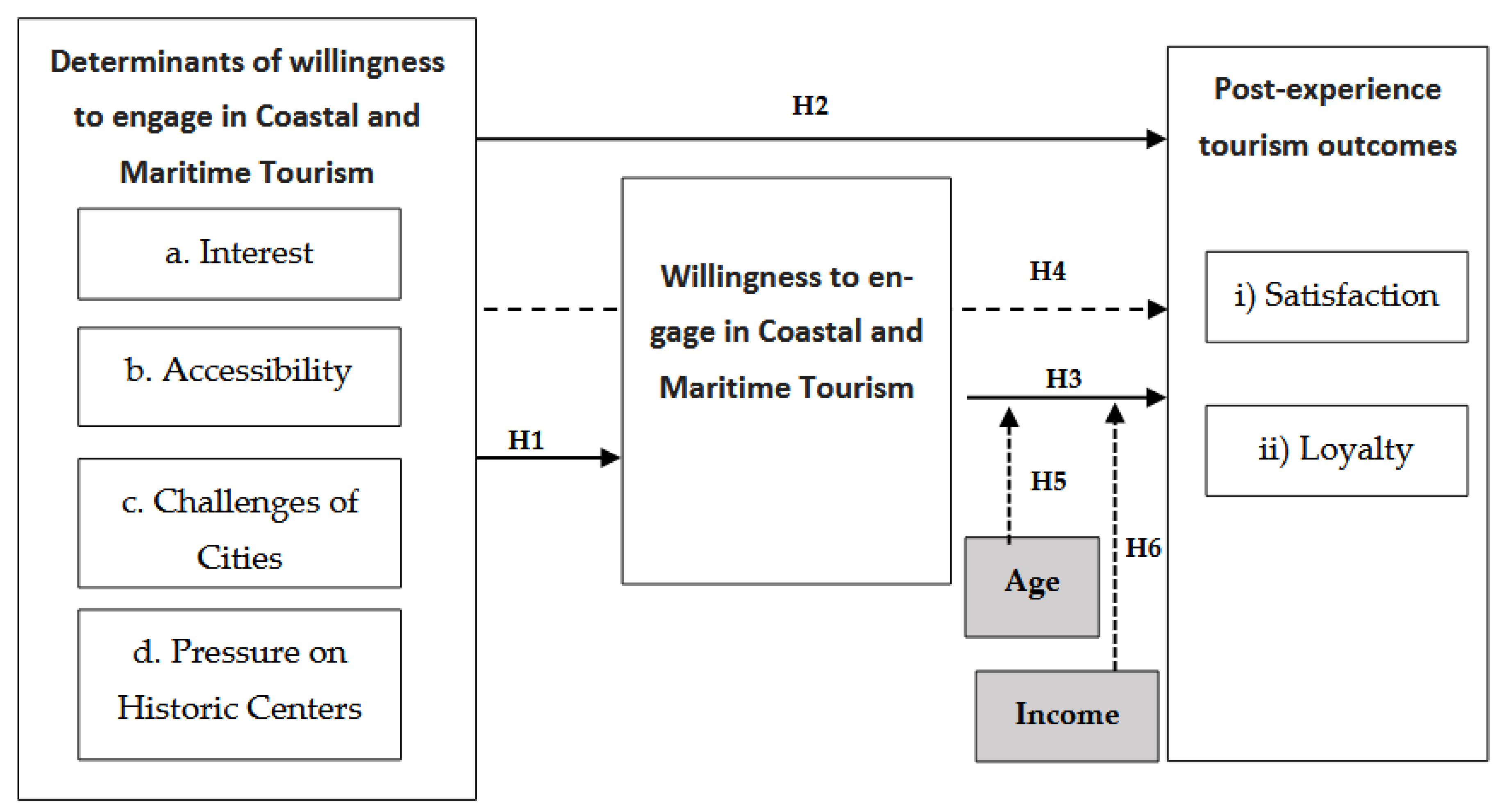
Figure 2.
Tourism intensity (guests in tourist accommodation per inhabitant). Source: INE (2026).
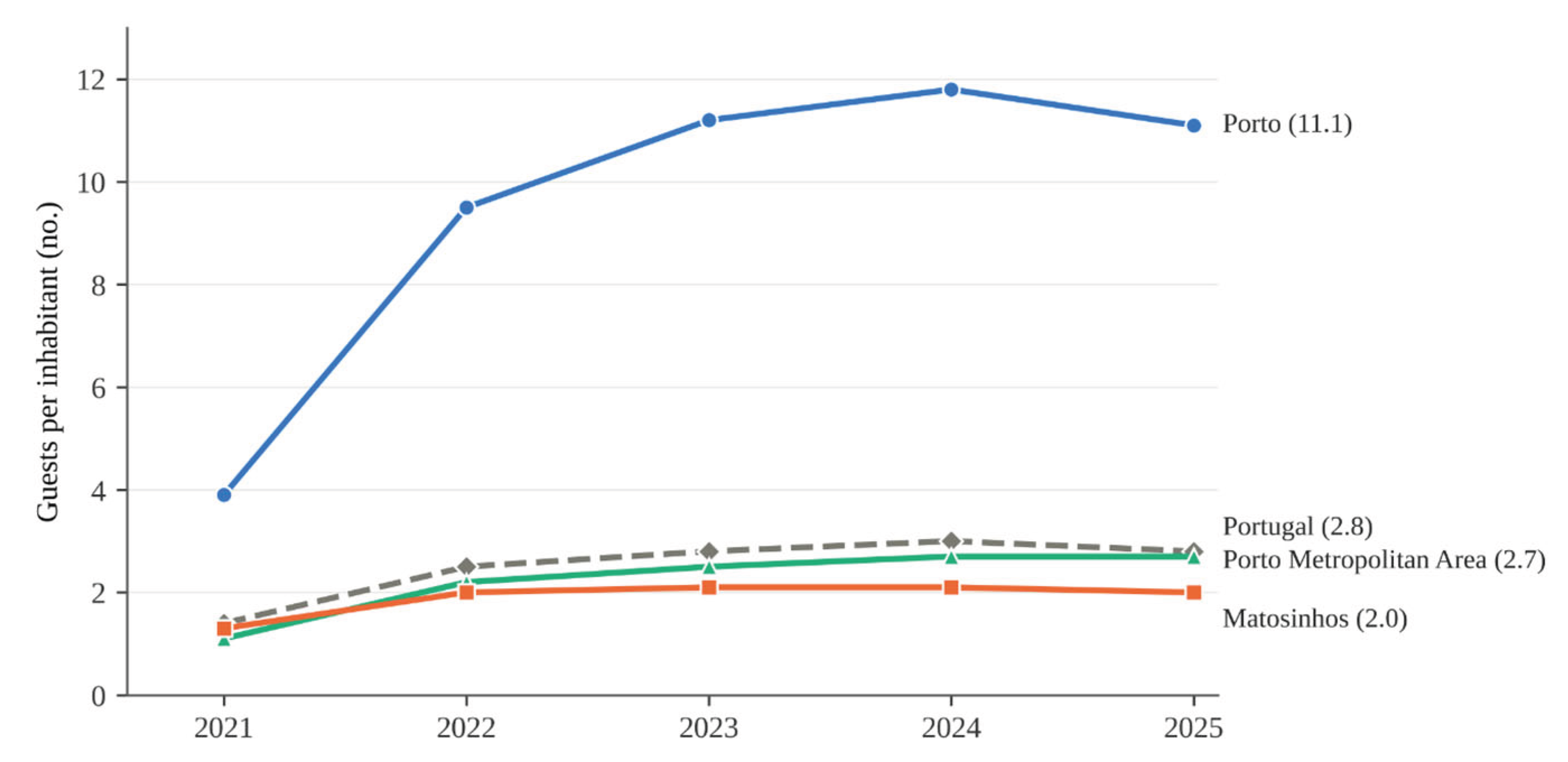

Table 1.
Tourism supply.
| Indicators / Years | 2021 | 2022 | 2023 | 2024 | 2025 | AAG |
|---|---|---|---|---|---|---|
| Number of accommodation establishments | ||||||
| Porto Metropolitan Area (PMA) | 521 | 638 | 713 | 776 | 795 | 11,1% |
| Matosinhos | 35 | 35 | 41 | 42 | 44 | 5,9% |
| Porto | 302 | 389 | 443 | 488 | 498 | 13,3% |
| % Matosinhos (share of PMA) | 6,7% | 5,5% | 5,8% | 5,4% | 5,5% | |
| % Porto (share of PMA) | 58,0% | 61,0% | 62,1% | 62,9% | 62,6% | |
| Number of rooms | ||||||
| Porto Metropolitan Area (PMA) | 16 346 | 19 552 | 21 463 | 22 901 | 24 379 | 10,5% |
| Matosinhos | 1 316 | 1 415 | 1 469 | 1 515 | 1 550 | 4,2% |
| Porto | 9 428 | 11 694 | 13 199 | 13 954 | 15 027 | 12,4% |
| % Matosinhos (share of PMA) | 8,1% | 7,2% | 6,8% | 6,6% | 6,4% | |
| % Porto (share of PMA) | 57,7% | 59,8% | 61,5% | 60,9% | 61,6% | |
| Accommodation capacity (bed places) | ||||||
| Porto Metropolitan Area (PMA) | 35 552 | 42 866 | 46 531 | 50 148 | 52 966 | 10,5% |
| Matosinhos | 2 718 | 3 037 | 3 162 | 3 359 | 3 306 | 5,0% |
| Porto | 20 674 | 25 936 | 28 656 | 30 616 | 32 653 | 12,1% |
| % Matosinhos (share of PMA) | 7,6% | 7,1% | 6,8% | 6,7% | 6,2% | |
| % Porto (share of PMA) | 58,2% | 60,5% | 61,6% | 61,1% | 61,6% | |
Source: INE (2026).
Table 2.
Tourism demand in the Porto Metropolitan Area, Matosinhos and Porto, 2021–2025.
| Indicators / Years | 2021 | 2022 | 2023 | 2024 | 2025 | Annual average growth |
|---|---|---|---|---|---|---|
| Number of guests | ||||||
| Porto Metropolitan Area (PMA) | 1 846 265 | 3 810 790 | 4 507 707 | 4 834 582 | 4 999 650 | 28,3% |
| Matosinhos | 230 322 | 345 253 | 375 546 | 383 714 | 364 894 | 12,2% |
| Porto | 913 883 | 2 267 125 | 2 757 813 | 2 965 862 | 3 046 116 | 35,1% |
| % Matosinhos (share of PMA) | 12,5% | 9,1% | 8,3% | 7,9% | 7,3% | |
| % for Porto (share of PMA) | 49,5% | 59,5% | 61,2% | 61,3% | 60,9% | |
| Number of overnight stays | ||||||
| Porto Metropolitan Area (AMP) | 3 352 303 | 7 470 106 | 8 898 492 | 9 514 850 | 9 973 516 | 31,3% |
| Matosinhos | 329 188 | 548 747 | 596 363 | 628 805 | 605 382 | 16,5% |
| Porto | 1 874 637 | 4 819 168 | 5 869 506 | 6 279 499 | 6 611 174 | 37,0% |
| % Matosinhos (share of AMP) | 9,8% | 7,3% | 6,7% | 6,6% | 6,1% | |
| % Porto (share of AMP) | 55,9% | 64,5% | 66,0% | 66,0% | 66,3% | |
| Average length of stay, nights | ||||||
| Porto Metropolitan Area (AMP) | 1,82 | 1,96 | 1,97 | 1,97 | 1,99 | 2,4% |
| Matosinhos | 1,43 | 1,59 | 1,59 | 1,64 | 1,66 | 3,8% |
| Porto | 2,05 | 2,13 | 2,13 | 2,12 | 2,17 | 1,4% |
INE (2026).
Table 3.
Statistical description of variables.
| Constructs | Mean | SD |
|---|---|---|
| Maritime and Coastal Tourism Motivation and Interest | 3,65 | 1,050 |
| 1. I find appealing the idea of coastal and maritime heritage in Porto and its coastal areas | 3,83 | 1,004 |
| 2. I want to explore Porto’s maritime history (museums, historic ships, fishing villages) | 3,69 | 1,007 |
| 3. I want to practice activities such as boat tours, kayaking, surfing, recreation and leisure activities in coastal area | 3,62 | 1,161 |
| 4. Interacting with local communities would improve maritime heritage experience | 3,78 | 0,966 |
| 5. Variety of tools and applications using AI would facilitate and enhance my maritime and coastal tourism experience | 3,35 | 1,101 |
| Perceived Accessibility and Information Availability | 3,49 | 0,990 |
| 1. Information about maritime and coastal heritage and tourism activities in Porto is available | 3,46 | 0,972 |
| 2. Maritime and coastal tourism is underpromoted in Porto | 3,52 | 1,020 |
| 3. It is easy to access coastal and maritime sites in Porto using public transportation (bus, metro) | 3,55 | 1,033 |
| 4. Information about how to access maritime and coastal sites in Porto is available | 3,42 | 0,927 |
| Perceived pressure in the historical center | 3,33 | 1,040 |
| 1. City centre is overcrowded and it’s difficult to access attractions due to overcrowding | 3,23 | 1,097 |
| 2. Traffic congestion is worsened in the city centre | 3,43 | 1,049 |
| 3. There is an increasing number of commercialized shops and stores instead of traditional ones | 3,64 | 0,986 |
| 4. I feel loss of cultural identity due to expanding businesses in the centre | 3,00 | 1,035 |
| Historcial centre appreciation | 3,79 | 1,010 |
| 1. During a visit I learned about historical and cultural heritage in Porto | 3,85 | 0,94 |
| 2. I enjoyed visiting centre and did not look for other experiences around | 3,59 | 1,096 |
| 3. The historical monuments are well preserved | 3,93 | 0,988 |
| 4. Coastal Experience Purchase and Visit Intentions | 3,54 | 1,020 |
| 5. I am willing to spend extra money on coastal or maritime experiences (guided coastal tours, visiting maritime museums, participating in water-based activities etc.) | 3,36 | 1,100 |
| 6. I would visit Porto’s coastal areas if I had more information about the activities available there. | 3,72 | 0,935 |
| Loyalty/I will return to Porto to experience more of its maritime and coastal heritage and related tourism activities | 3,83 | 1,025 |
| Satisfaction/I am satisfied with the variety of maritime and coastal activities available in Porto | 3,58 | 0,952 |
On average, the items that generated the highest levels of agreement were those related to loyalty (M = 3.83) and pressures in historic centers (M = 3.79). The items with the lowest average levels of agreement were those related to accessibility (M = 3.49).
Table 4.
Measures of convergence, reliability and validity of latent variables.
| Cα | CR | AVE | Motiv. and interest |
Access& availab. | Pressure | H.centre appreciat. | Visit intentions | Loyalty | Satisfaction | |
|---|---|---|---|---|---|---|---|---|---|---|
| Coastal motivate. and interest | 0.711 | 0.813 | 0.569 | |||||||
| Accessibility and availability | 0.649 | 0.793 | 0.594 | 0.824 | ||||||
| Pressure in the center | 0.701 | 0.816 | 0.527 | 0.427 | 0.447 | |||||
| Historical center appreciation | 0.653 | 0.810 | 0.588 | 0.622 | 0.747 | 0.426 | ||||
| Coastal visit intentions | 0.590 | 0.830 | 0.709 | 0.596 | 0.727 | 0.508 | 0.621 | |||
| Loyalty | - | - | - | 0.700 | 0.562 | 0.254 | 0.476 | 0.688 | ||
| Satisfaction | - | - | - | 0.473 | 0.602 | 0.332 | 0.469 | 0.559 | 0.413 |
| Dependent Variables | R2 | Q2 |
|---|---|---|
| Loyalty | 0.288 | 0.266 |
| Satisfaction | 0.311 | 0.288 |
| Coastal Experience Purchase and Visit Intentions | 0.449 | 0.307 |
Table 6.
Bootstrap analysis of the research model.
| Path (β) | t Value (Bootstrap) | P-value | 2.5%* | 97.5%* | Hypothesis | |
|---|---|---|---|---|---|---|
| Support | ||||||
| H1a) Coastal Motivation and interest → Coastal Visit Intentions | 0.526 | 11.654 | 0.000 | 0.435 | 0.625 | Yes |
| H1b) Accessibility and information availab. → Coastal Visit Intentions | 0.074 | 1.410 | 0.159 | -0.031 | 0.178 | No |
| H1c) Pressure in the centre → Coastal Visit Intentions | 0.121 | 2.634 | 0.009 | 0.035 | 0.208 | Yes |
| H1d) Historical centre appreciation → Coastal Visit Intentions | 0.101 | 2.836 | 0.036 | 0.007 | 0.194 | Yes |
| H2ai) Coastal Motivation and interest → Satisfaction | 0.023 | 0.357 | 0.721 | -0.095 | 0.153 | No |
| H2aii) Coastal Motivation and interest → Loyalty | 0.351 | 5.941 | 0.000 | 0.244 | 0.464 | Yes |
| H2bi) Accessibility and information availab. → Satisfaction | 0.317 | 5.674 | 0.000 | 0.218 | 0.428 | Yes |
| H2bii) Accessibility and information availab. → Loyalty | 0.116 | 2.347 | 0.019 | 0.025 | 0.211 | Yes |
| H2ci) Pressure in the centre → Satisfaction | 0.088 | 1.859 | 0.064 | -0.007 | 0.184 | No |
| H2cii) Pressure in the centre → Loyalty | 0.027 | 0.668 | 0.504 | 0.005 | 0.106 | No |
| H2di) Historical centre appreciation → Satisfaction | 0.108 | 2.184 | 0.029 | 0.017 | 0.210 | Yes |
| H2dii) Historical centre appreciation → Loyalty | 0.110 | 2.282 | 0.023 | 0.012 | 0.196 | Yes |
| H3i) Coastal Visit Intentions → Satisfaction | 0.189 | 2.775 | 0.006 | 0.048 | 0.306 | Yes |
| H3ii) Coastal Visit Intentions → Loyalty | 0.212 | 3.443 | 0.001 | 0.085 | 0.323 | Yes |
| H4ai) Coastal Motivation and interest → Visit Intentions → Satisfaction | 0.116 | 3.645 | 0.000 | 0.053 | 0.177 | Yes |
| H4aii) Coastal Motivation and interest → Visit Intentions → Loyalty | 0.272 | 7.101 | 0.000 | 0.194 | 0.342 | Yes |
| H4bi) Accessibility and infor. availab. → Visit Intentions → Satisfaction | 0.016 | 1.349 | 0.178 | -0.005 | 0.036 | No |
| H4bii) Accessibility and infor. availab. → Visit Intentions → Loyalty | 0.036 | 1.415 | 0.158 | -0.015 | 0.085 | No |
| H4ci) Pressure in the centre → Engagement → Satisfaction | 0.026 | 2.246 | 0.025 | 0.007 | 0.052 | Yes |
| H4cii) Pressure in the centre → Coastal Visit Intentions → Loyalty | 0.062 | 2.789 | 0.005 | 0.024 | 0.106 | Yes |
| H4di) His.cent. appreciation → Coastal Visit Intentions → Satisfaction | 0.022 | 1.815 | 0.070 | 0.001 | 0.050 | No |
| H4dii) His.cent. appreciation → Coastal Visit Intentions → Loyalty | 0.052 | 2.090 | 0.037 | 0.004 | 0.100 | Yes |
| H5a) Satisfaction x Age → Coastal Visit Intentions | 0.057 | 1.459 | 0.145 | -0.024 | 0.135 | No |
| H5b) Loyalty x Age → Coastal Visit Intentions | 0.055 | 1.483 | 0.139 | -0.015 | 0.125 | No |
| H6a) Satisfaction x Income → Coastal Visit Intentions | 0.005 | 0.116 | 0.908 | -0.078 | 0.088 | No |
| H6b) Loyalty x Income → Coastal Visit Intentions | -0.054 | 1.256 | 0.210 | -0.140 | 0.033 | No |
Note: * Confidence interval.
Disclaimer/Publisher’s Note: The statements, opinions and data contained in all publications are solely those of the individual author(s) and contributor(s) and not of MDPI and/or the editor(s). MDPI and/or the editor(s) disclaim responsibility for any injury to people or property resulting from any ideas, methods, instructions or products referred to in the content. |
© 2026 by the authors. Licensee MDPI, Basel, Switzerland. This article is an open access article distributed under the terms and conditions of the Creative Commons Attribution (CC BY) license (http://creativecommons.org/licenses/by/4.0/).
Copyright: This open access article is published under a Creative Commons CC BY 4.0 license, which permit the free download, distribution, and reuse, provided that the author and preprint are cited in any reuse.