

Submitted:
09 October 2026
Posted:
10 October 2026
You are already at the latest version
Abstract
Background/Objectives. Fatigue is defined as an overwhelming sense of tiredness, weakness, or ex-haustion, which can be physical, psychological, or a combination of both. Evidence suggests that fa-tigue is more prevalent among patients with inflammatory bowel disease (IBD) than in the general population. The aim of this study was to assess the prevalence of fatigue among Swedish IBD pa-tients. Another aim was to increase knowledge about factors that may contribute to fatigue, and strat-egies for managing fatigue. Methods. Swedish IBD patients were asked to complete the IBD Fatigue Scale. Analyses involved both a quantitative and a qualitative approach. Results. A total of 675 pa-tients participated in the study. Patients with active disease, continuous symptoms, extraintestinal manifestations, and impaired wellbeing had higher scores of fatigue. Four categories relating to fa-tigue were identified: (1) fatigue difficult to define and attribute, (2) fatigue arising from interacting bodily and psychosocial burdens, (3) managing a limited and fluctuating supply of energy, and (4) restoring energy through activity, support and recovery. Participants frequently described fatigue as arising from an interaction between disease activity, comorbid conditions, psychological distress, sleep problems, pain, and everyday life demands. Conclusions. Although fatigue was more severe among participants with active disease, continuous symptoms and impaired wellbeing, the free-text responses demonstrated that patients frequently perceived comorbidities, disturbed sleep, pain, psy-chological distress and demanding life circumstances as additional contributors. Management in-volved balancing rest and activity, planning limited energy, and drawing on supportive relationships and restorative environments. These findings support a holistic and person-centred approach in which fatigue is assessed beyond intestinal disease activity.
Keywords:
IBD
; fatigue
; Crohn’s Disease
; ulcerative colitis
1. Introduction
Inflammatory bowel disease (IBD), comprising Crohn’s disease (CD), ulcerative colitis (UC), and IBD-unclassified (IBD-U), is a chronic, immune-mediated disorder characterised by relapsing and remitting intestinal inflammation [1,2] that can result in substantial symptom burden, impaired quality of life, and disability [3]. In addition to gastrointestinal symptoms, many patients report fatigue, a burdensome symptom that may persist even during clinical remission [4,5].
Fatigue is a multidimensional symptom encompassing physical, cognitive, and emotional aspects [6]. It encompasses a sensation of exhaustion or diminished energy levels disproportionate to the degree of physical exertion, thereby impeding daily activities. Unlike ordinary tiredness, fatigue may persist despite periods of rest. It has been characterised as an enduring and overpowering sensation of weariness, debility, or depletion [6]. However, fatigue still lacks standardised definitions, widely accepted diagnostic criteria, and assessment tools. This deficiency has hindered endeavours to elucidate the aetiology of fatigue and has posed challenges in the development of efficacious treatments.
Fatigue is more prevalent among patients with IBD compared to the general population and fatigue in IBD is associated with reduced health-related quality of life (HRQOL) [7,8,9]. Fatigue affects multiple domains of functioning, including physical activity, cognitive performance, emotional wellbeing and social participation [10,11]. Several studies have reported that fatigue is more common among women with IBD than among men, although the mechanisms underlying this difference remain unclear [4,12,13]. Fatigue in IBD is a common and multifactorial symptom and appears to affect women and men differently [14]. Similar sex-related differences in fatigue have also been reported in population-based studies of the general population [15]. Also, sleep disturbances, psychological distress, anaemia, micronutrient deficiencies and ongoing inflammation have all been associated with fatigue in patients with IBD [4,5,12].
A recent systematic review and meta-analysis estimated the overall prevalence of fatigue in IBD at approximately 47%, with prevalence ranging from 53% to 76% during active disease and from 15% to 54% during remission [4]. In a cross-cultural study from eight countries, fatigue was ranked fourth in major patient concerns related to IBD, higher on the list than pain and bowel control [16]. The study also found a geographic trend within the European countries along a north-south gradient, with the highest scores in Italy and Portugal, the most southerly countries, and the lowest scores in Sweden, the most northerly country. Such differences might be attributable to differences in educational level, cultural differences, and national prosperity and health expenditures, in addition to the biology of the disease [16].
Although fatigue is recognised as one of the most burdensome symptoms of IBD, its attribution remains clinically and conceptually challenging. Fatigue may persist despite apparent disease remission, [4,5] suggesting that intestinal inflammation alone does not fully explain its occurrence or severity. Previous studies have mainly quantified fatigue and examined associations with disease activity, psychological distress, sleep disturbance, nutritional deficiencies, and sociodemographic factors [4,5,16]. However, less is known about how patients themselves distinguish IBD-related fatigue from tiredness associated with comorbidities, medication, pain, sleep disruption, and the demands of everyday life. Furthermore, population-based studies combining disease-specific fatigue assessment with patients’ own accounts of perceived contributing factors and self-management strategies remain limited. A better understanding of these perceptions is needed to support differentiated assessment and holistic, person-centred management of fatigue in IBD.
The aim of this study was to investigate the severity and impact of fatigue in a Swedish IBD population and to explore patients' perceptions of factors contributing to fatigue and the strategies they use to manage fatigue in everyday life.
2. Materials and Methods
2.1. Study Population and Study Design
This cross-sectional study employed both a quantitative and a qualitative approach, and included patients with UC, CD and IBD-U recruited from two tertiary referral hospitals in different regions of Sweden. Eligible patients received written information about the study by email. After providing written informed consent, participants were invited to complete a questionnaire covering demographic and clinical characteristics as well as experiences of fatigue.
Inclusion criteria were age ≥18 years, a confirmed diagnosis of UC, CD or IBD-U, ability to complete a questionnaire, and sufficient proficiency in Swedish. Patients were eligible regardless of disease activity and could therefore be either in clinical remission or experiencing active disease.
2.1.1. Questionnaires
Participants completed a questionnaire comprising three sections: demographic and clinical characteristics, self-reported disease activity, and fatigue-related questions.
Demographic and clinical information included diagnosis, age, sex, educational level, civil status, employment status, and current medical treatment. Disease activity was assessed using a self-reported question in which participants indicated whether they perceived themselves to be experiencing a relapse or to be in remission at the time of questionnaire completion.
The IBD Fatigue Scale (IBD-F) is a disease-specific instrument developed to assess fatigue in patients with IBD [10]. The questionnaire has been translated, culturally adapted, and psychometrically validated for use in Swedish patients with IBD [17]. The IBD-F comprises three sections. Section I assesses the presence and severity of fatigue and consists of five items, yielding a total score ranging from 0 to 20, with higher scores indicating more severe fatigue. Section II evaluates the impact of fatigue on daily life and contains 30 items. Possible scores range from 0 to 120, where higher scores indicate a greater impact of fatigue on daily functioning. Section III consists of open-ended questions that allow participants to comment on their fatigue experiences and describe issues they consider important in relation to fatigue [10].
2.1.2. Data Collection
A total of 2208 patients were eligible and were asked to participate in the study; 760 (34%) gave informed consent and received the questionnaire digitally and of those, 675 (88%) participated in the study. All data was pseudonymised and no patient could be identified.
2.2. Statistical Methods
2.2.1. Quantitative Analysis
Descriptive statistics were used for the background data, prevalence of fatigue, and impact on daily life. Groups were compared using an independent t-test or one-way ANOVA, where applicable. A p-value of less than 0.05 was considered statistically significant. The analyses were conducted in SPSS version 30.0.0.0.
2.2.2. Qualitative Analysis
The free-text responses in Section III of the IBD-F were analysed using an inductive qualitative content process with a primarily descriptive orientation. The unit of analysis comprised participants’ responses to the three open-ended questions concerning perceived causes of fatigue, additional factors contributing to fatigue, and strategies used to manage fatigue.
All responses were read repeatedly to obtain an overall understanding of the material. Meaning units relevant to the study aim were identified and assigned concise codes. Responses containing more than one meaning were assigned multiple codes. Codes were then compared for similarities and differences and grouped into subcategories and broader categories. Particular attention was paid to how participants attributed fatigue to IBD, to factors outside IBD, or to an interaction between several factors.
Responses indicating that the participant did not experience fatigue, did not know the cause, or considered the question not applicable were retained and coded separately, as these responses provided information about uncertainty regarding the concept and attribution of fatigue. The analysis was performed manually in Microsoft Excel for Microsoft 365. Both researchers participated in the analysis. Coding differences were discussed and resolved through consensus. Frequencies were subsequently calculated to describe how commonly the categories occurred, but the qualitative interpretation was based on the content and meaning of the responses rather than frequency alone.
3. Results
Of the 675 participating patients, 53% were women, 60% had CD and 37% had UC. Mean age was 51 years and mean number of years with IBD was 20. Most of the participants were living with a partner (70%) and most were currently working (86%). The majority, 80%, reported being in remission, 14% had continuous problems, and 6% had active disease. Sixty percent reported extraintestinal manifestations (EIM) and 18% had deteriorated wellbeing. Most of the participants had on-going medical treatment with 5-aminosalicylic acid, thiopurine, advanced therapies or corticosteroids. See Table 1.
3.1. Quantitative Findings
Participants reported a mean value of 7.1 for IBD-F section I, and a mean value of 26.1 for IBD-F section II (Table 2).
Those reporting the worst wellbeing also reported the most severe fatigue and the greatest impact on daily life (Table 3).
Participants with continuous IBD symptoms and those with EIM treated with corticosteroids or advanced therapies experienced higher levels of fatigue. Patients living without a partner reported higher levels of fatigue compared to those with a partner, and students or unemployed patients also reported higher levels of fatigue compared to those working. Women reported higher levels of fatigue compared to men. There were no differences between diagnoses.
3.2. Qualitative Findings
3.2.1. Fatigue as a Multifactorial and Difficult-to-Attribute Experience
The free-text responses demonstrated that fatigue was rarely perceived as having a single identifiable cause. Although some participants directly attributed fatigue to active IBD, gastrointestinal symptoms, previous surgery, or repeated disease flares, most described fatigue as arising from a complex interaction between disease-related and non-disease-related factors. Four categories were identified: (1) fatigue as difficult to define and attribute, (2) fatigue arising from interacting bodily and psychosocial burdens, (3) managing a limited and fluctuating supply of energy, and (4) restoring energy through activity, support and recovery (Figure 1).
3.2.2. Fatigue as Difficult to Define and Attribute
Many participants expressed uncertainty regarding whether they experienced fatigue at all or whether their symptoms represented ordinary tiredness associated with ageing, work, parenthood or other life circumstances. Several explicitly stated that they found it difficult to distinguish fatigue related to IBD from fatigue caused by other health conditions, psychological stress, or sleep disturbances.
Participants frequently described uncertainty regarding causality and referred to fatigue as the result of multiple interacting factors rather than a single underlying cause. Several described fatigue as a ‘chicken-and-egg’ phenomenon where they could not determine whether poor sleep, stress, psychological distress, IBD symptoms or fatigue itself represented the primary problem.
3.2.3. Fatigue Arising from Interacting Bodily and Psychosocial Burdens
Participants commonly described factors other than active intestinal inflammation as contributors to fatigue. These included comorbid conditions such as thyroid disease, diabetes, rheumatic disease, chronic pain disorders, cardiovascular disease, neurological disorders, cancer, and post-COVID symptoms. Psychological distress, anxiety, depression, previous exhaustion syndromes, and ongoing life crises were also described as contributors.
Sleep disturbance emerged as a prominent theme. Participants attributed fatigue to nocturnal bowel movements, pain, insomnia, sleep apnoea, small children, caregiving responsibilities, and chronic sleep deprivation. Nutritional deficiencies, particularly iron and vitamin deficiencies, and concerns regarding nutrient absorption, were also frequently described as explanations for fatigue.
Work-related strain, demanding family responsibilities, caregiving obligations, financial concerns, and an overall busy lifestyle were commonly perceived as contributing factors. For several participants, fatigue was experienced as the cumulative effect of balancing chronic illness with everyday demands.
Factors perceived as external to IBD were often indirectly connected to the disease. Participants described how frequent toilet visits, pain, dietary restrictions, fear of symptoms, need for advance planning, and concerns about access to toilets generated substantial psychological and physical burdens even when overt disease activity was limited.
3.2.4. Managing a Limited and Fluctuating Supply of Energy
Participants described fatigue management primarily as an ongoing balancing act between activity and recovery. Rest, daytime naps, reduced activity levels, and planned recovery periods were frequently used strategies. Many described the need to carefully prioritise activities and conserve energy. Acceptance emerged as an important strategy. Several participants described learning to recognise personal limits, adapt expectations, and plan activities around available energy levels. Some reported reducing working hours, working from home, or declining social engagements to maintain functioning in other areas of life.
3.2.5. Restoring Energy Through Activity, Support and Restorative Environments
Exercise was the most common active management strategy. Walking, physical activity, yoga, outdoor recreation, and structured exercise were frequently perceived as improving both energy and wellbeing. However, participants also described a paradoxical relationship whereby fatigue reduced their ability to exercise, resulting in a perceived vicious cycle of inactivity and worsening fatigue.
Additional strategies included attention to diet, hydration, nutritional supplements, and establishing regular routines. Family members, partners and friends were often described as important sources of practical and emotional support. Nature, quiet environments, meditation, mindfulness, relaxation, and activities that distracted attention from symptoms were also perceived as beneficial.
Several participants expressed that fatigue had received limited attention within healthcare and that they had not previously been informed that fatigue could be related to IBD (Figure 1).
4. Discussion
The principal finding of this study was that fatigue among Swedish patients with IBD was perceived as a multifactorial and context-dependent experience rather than a symptom attributable solely to intestinal inflammation. While quantitative findings demonstrated higher fatigue scores among patients with active disease, continuous symptoms, extraintestinal manifestations, and impaired wellbeing, the qualitative findings revealed a considerably more complex picture. Participants frequently described fatigue as arising from an interaction between disease activity, comorbid conditions, psychological distress, sleep problems, pain, and everyday life demands.
According to Varbobitis, a cut-off value of >7.5 in IBD-F should be regarded as prevalence of significant fatigue [11]. In our study, the mean score for the total population was 7.1, which should mean moderate levels of fatigue in the Swedish IBD population.
Women had more severe fatigue than men, which corresponds with earlier studies [11,13,18]. Also, the IBD-F scores are comparable between the Swedish and the Danish populations concerning female and male sex – Swedish 8.1/5.8 and Danish 7.2/6.6 [13]. Our study found a clear difference between those in remission and those in active disease, where the latter had significantly higher scores for both fatigue and impact of fatigue, corresponding with other findings [11,18]. No difference could be found between diagnoses, which a Norwegian study also demonstrated [18]. However, this is not in agreement with several other studies that have shown that patients with CD experience more fatigue compared to those with UC [11,19,20,21].
Patients with poor wellbeing also had more severe fatigue. Whether fatigue leads to impaired wellbeing or vice versa is difficult to say. Radford et al. demonstrated that IBD patients who felt they had no control over their IBD symptoms experienced higher levels of fatigue than those who felt in control [7]. Several studies have also found a strong correlation between HRQOL and fatigue, where patients with fatigue had poorer HRQOL [8,11,19,22]. Villoria et al. found that patients with fatigue had higher scores for depressions, anxiety, and sleep disorders [19]. Participants in our study also stated that stress, anxiety and depression were important factors contributing to fatigue.
Participants with lower levels of education, or who were unemployed or studying, have more severe fatigue. However, the number of these patients was low and no conclusion should be drawn. Patients living alone had more fatigue compared to those living with a partner. Participants stated that relationships and family were important for managing fatigue.
EIM produced more severe fatigue and impact on daily life, which most probably also affects wellbeing. This corresponds with findings in other studies; Varbobitis et al. found an association between fatigue and arthralgias/arthritis [11] and Villoria et al. an association regarding joint disorders [19]. In our study, the type of EIM was not examined – participants were only asked to state whether they had EIM or not. However, other diseases were reported as contributing to fatigue, and these could include EIM.
Lack of exercise was reported as cause of fatigue and the ability to exercise was stated as factor for managing fatigue. Qiao et al. found that physical activity had a significant negative effect on fatigue, meaning that greater physical activity was associated with lower levels of fatigue [9]. No fewer than 75% of the patients (both in remission and active disease) considered fatigue as the main reason for limiting their physical activity, and patients who were more physically active experienced lower levels of fatigue [9]. A systematic review found that physical activity may reduce fatigue, but the evidence was uncertain [23]. It could, however, be assumed that physical activity can improve HRQOL and wellbeing, and this could reduce levels of fatigue. The patients also stated that contemplation was one important factor for managing fatigue; this too can be considered to improve HRQOL and wellbeing.
In our study, participants described malnutrition and vitamin-mineral deficiencies as factors contributing to fatigue. This corresponds with Ramezani et al., who found that supplements, vitamins B1, B6, B12, and magnesium, were associated with significant improvements in fatigue [24].
The qualitative findings also suggest that fatigue should be understood within a broader biopsychosocial framework. Factors such as poor sleep, pain, anxiety, and reduced physical activity were frequently described by participants as causes of fatigue. Importantly, these factors cannot necessarily be separated from IBD itself. Nocturnal bowel symptoms, fear of incontinence, dietary restrictions, and the need for constant planning may contribute to sleep disruption, psychological strain, and reduced participation in daily activities, thereby perpetuating fatigue even in the absence of overt disease activity.
Strengths and Limitations
A major strength of this study is the large population-based sample and the combination of quantitative fatigue assessment and qualitative free-text responses. The qualitative component provided important contextual information that would not have been captured using standardised scales alone.
Several limitations should be acknowledged. The qualitative data consisted of brief written responses and therefore lacked the depth obtainable through qualitative interviews. Participants were explicitly asked about causes of fatigue other than IBD, which may have encouraged greater focus on non-IBD-related explanations. Consequently, the results should not be interpreted as indicating that IBD was unimportant, but rather that patients perceived multiple interacting contributors to fatigue. Finally, reported causes of fatigue represent subjective perceptions and were not clinically verified.
5. Conclusions
Participants with IBD experienced fatigue as a multifactorial and difficult-to-attribute symptom shaped by the interaction of disease-related, biomedical, psychological, and everyday life factors. Although fatigue was more severe among participants with active disease, continuous symptoms, and impaired wellbeing, the free-text responses demonstrated that patients frequently perceived comorbidities, disturbed sleep, pain, psychological distress, and demanding life circumstances as additional contributors. Management involved balancing rest and activity, planning limited energy, and drawing on supportive relationships and restorative environments. These findings support a holistic and person-centred approach in which fatigue is assessed beyond intestinal disease activity, with management strategies tailored to the individual patient’s health and life context.
Author Contributions
Both authors have contributed equal concerning conceptualization, methodology, analyses, draft preparation and writing the manuscript.
Funding
This research received no external funding.
Institutional Review Board Statement
The study was approved by the Swedish Medical Research Ethics Committee 2023-04562-01 and was carried out in accordance with the Declaration of Helsinki.
Informed Consent Statement
Informed consent was obtained from all subjects involved in the study.
Data Availability Statement
The original contributions presented in this study are included in the article/supplementary material. Further inquiries can be directed to the corresponding author(s).
Conflicts of Interest
The authors declare no conflicts of interest.
Abbreviations
The following abbreviations are used in this manuscript:
| IBD | Inflammatory bowel disease |
| UC | Ulcerative colitis |
| CD | Crohn’s Disease |
| IBD-U | IBD-unclassified |
| IBD-F | IBD-Fatigue Scale |
| EIM | Extraintestinal manifestations |
| HRQOL | Health-related quality of life |
References
- Le Berre, C.; Honap, S.; Peyrin-Biroulet, L. Ulcerative colitis. Lancet 2023, 402(10401), 571–84. [Google Scholar] [PubMed]
- Torres, J.; Mehandru, S.; Colombel, J.-F.; Peyrin-Biroulet, L. Crohn’s disease. The Lancet 2017, 389(10080), 1741–55. [Google Scholar] [CrossRef] [PubMed]
- Thakor, A.; Yogakanthi, S.; Noor, N.M.; Parkes, M. Rapid diagnosis and treatment of inflammatory bowel diseases. J. Crohn’s Colitis 2026, 20 (Supplement_2), ii3–ii10. [Google Scholar] [CrossRef] [PubMed]
- D’Silva, A.; Fox, D.E.; Nasser, Y.; Vallance, J.K.; Quinn, R.R.; Ronksley, P.E.; et al. Prevalence and Risk Factors for Fatigue in Adults With Inflammatory Bowel Disease: A Systematic Review With Meta-Analysis. Clin. Gastroenterol. Hepatol. 2022, 20(5), 995–1009.e7. [Google Scholar] [CrossRef] [PubMed]
- Danso, Y.; Hart, A.L.; Alexander, J.L.; Moulton, C.D. Fatigue in inflammatory bowel disease: a practical guide for gastroenterology clinicians. Frontline Gastroenterol. 2025, flgastro–2024–103035. [Google Scholar] [CrossRef]
- Dittner, A.J.; Wessely, S.C.; Brown, R.G. The assessment of fatigue: a practical guide for clinicians and researchers. J. Psychosom. Res. 2004, 56(2), 157–70. [Google Scholar] [PubMed]
- Radford, S.J.; McGing, J.; Czuber-Dochan, W.; Moran, G. Systematic review: the impact of inflammatory bowel disease-related fatigue on health-related quality of life. Frontline Gastroenterol. 2021, 12(1), 11–21. [Google Scholar] [CrossRef] [PubMed]
- Stroie, T.; Preda, C.; Meianu, C.; Istratescu, D.; Manuc, M.; Croitoru, A.; et al. Fatigue Is Associated with Anxiety and Lower Health-Related Quality of Life in Patients with Inflammatory Bowel Disease in Remission. Medicina 2023, 59(3). [Google Scholar] [CrossRef] [PubMed]
- Qiao, R.; Zhou, Y.; Ding, T.; Jiang, X. Fatigue, Physical Activity, and Quality of Life in Patients with Inflammatory Bowel Disease: A Cross-Sectional Study. Int. J. Gen. Med. 2024, 17, 49–58. [Google Scholar] [CrossRef] [PubMed]
- Czuber-Dochan, W.; Norton, C.; Bassett, P.; Berliner, S.; Bredin, F.; Darvell, M.; et al. Development and psychometric testing of inflammatory bowel disease fatigue (IBD-F) patient self-assessment scale. J. Crohns Colitis 2014, 8(11), 1398–406. [Google Scholar] [CrossRef] [PubMed]
- Varbobitis, I.; Kokkotis, G.; Gizis, M.; Perlepe, N.; Laoudi, E.; Bletsa, M.; et al. The IBD-F Patient Self-Assessment Scale Accurately Depicts the Level of Fatigue and Predicts a Negative Effect on the Quality of Life of Patients With IBD in Clinical Remission. Inflamm. Bowel Dis. 2021, 27(6), 826–35. [Google Scholar] [CrossRef] [PubMed]
- Amiot, A.; Chaibi, S.; Bouhnik, Y.; Serrero, M.; Filippi, J.; Roblin, X.; et al. Prevalence and Determinants of Fatigue in Patients with IBD: A Cross-Sectional Survey from the GETAID. J. Crohn’s Colitis 2023, 17(9), 1418–25. [Google Scholar] [CrossRef] [PubMed]
- Bager, P.; Vestergaard, C.; Juul, T.; Dahlerup, J.F. Population-based normative data for the inflammatory bowel disease fatigue scale - IBD-F. Scand. J. Gastroenterol. 2018, 53(10–11), 1274–9. [Google Scholar] [CrossRef] [PubMed]
- Bager, P.; Befrits, R.; Wikman, O.; Lindgren, S.; Moum, B.; Hjortswang, H.; et al. Fatigue in out-patients with inflammatory bowel disease is common and multifactorial. Aliment. Pharmacol. Ther. 2012, 35(1), 133–41. [Google Scholar] [CrossRef] [PubMed]
- Watt, T.; Groenvold, M.; Bjorner, J.B.; Noerholm, V.; Rasmussen, N.A.; Bech, P. Fatigue in the Danish general population. Influence of sociodemographic factors and disease. J. Epidemiol. Community Health 2000, 54(11), 827–33. [Google Scholar] [CrossRef] [PubMed]
- Levenstein, S.; Li, Z.; Almer, S.; Barbosa, A.; Marquis, P.; Moser, G.; et al. Cross-cultural variation in disease-related concerns among patients with inflammatory bowel disease. Am. J. Gastroenterol. 2001, 96(6), 1822–30. [Google Scholar] [CrossRef] [PubMed]
- Czuber-Dochan, W.; Norton, C.; Andonova, A.; Pencova, M.; Cluzeau, V.; Chalabreysee, M.; Barkan, R.; Goren, I.; Shpoker, I.; Radice, S.; Schiavoni, E.; Occhieri, A.; Napolitano, D.; Turchini, L.; Zega, M.; Jelsness-Jørgensen, L.P.; Giner-Agudo, A.; Barastegui, R.; Fernández-Fernández, C.; Gallego, M.; Murciano, F.; Navarro, E.; Rivera, A.; Vara-Hernández, A.; Pihl Lesnovska, K.; Jäghult, S. Inflammatory Bowel Disease Fatigue (IBD-F) scale translation, validation and cultural acceptability: an international cross-sectional multi-centre study. J. Crohn’s Colitis 2026. In Manuscript. [Google Scholar]
- Huppertz-Hauss, G.; Hoivik, M.L.; Jelsness-Jorgensen, L.P.; Opheim, R.; Henriksen, M.; Hoie, O.; et al. Fatigue in a population-based cohort of patients with inflammatory bowel disease 20 years after diagnosis: The IBSEN study. Scand. J. Gastroenterol. 2017, 52(3), 351–8. [Google Scholar] [CrossRef] [PubMed]
- Villoria, A.; Garcia, V.; Dosal, A.; Moreno, L.; Montserrat, A.; Figuerola, A.; et al. Fatigue in out-patients with inflammatory bowel disease: Prevalence and predictive factors. PLoS ONE 2017, 12(7), e0181435. [Google Scholar] [CrossRef] [PubMed]
- Hart, A.; Miller, L.; Buttner, F.C.; Hamborg, T.; Saxena, S.; Pollok, R.C.G.; et al. Fatigue, pain and faecal incontinence in adult inflammatory bowel disease patients and the unmet need: a national cross-sectional survey. BMC Gastroenterol. 2024, 24(1), 481. [Google Scholar] [CrossRef] [PubMed]
- Lage, A.C.; Oliveira, C.C.; Batalha, A.; Araujo, A.F.; Czuber-Dochan, W.; Chebli, J.M.F.; et al. The Inflammatory Bowel Disease-Fatigue Patient Self-Assessment Scale: Translation, Cross-Cultural Adaptation and Psychometric Properties of the Brazilian Version (Ibd-F Brazil). Arq. Gastroenterol. 2020, 57(1), 50–63. [Google Scholar] [CrossRef] [PubMed]
- Gong, S.S.; Fan, Y.H.; Lv, B.; Zhang, M.Q.; Xu, Y.; Zhao, J. Fatigue in patients with inflammatory bowel disease in Eastern China. World J. Gastroenterol. 2021, 27(11), 1076–89. [Google Scholar] [CrossRef] [PubMed]
- Farrell, D.; Artom, M.; Czuber-Dochan, W.; Jelsness-Jorgensen, L.P.; Norton, C.; Savage, E. Interventions for fatigue in inflammatory bowel disease. Cochrane Database Syst. Rev. 2020, 4(4), CD012005. [Google Scholar] [CrossRef] [PubMed]
- Ramezani, E.; Bager, P.; Torabinasab, K.; Daryani, N.E.; Looha, M.A.; Masoumvand, M.; et al. Effects of B vitamins and magnesium on fatigue, disease activity and quality of life in inflammatory bowel disease. Sci. Rep. 2026, 16(1). [Google Scholar] [CrossRef] [PubMed]
Figure 1.
Energy balanced model of fatigue in IBD.
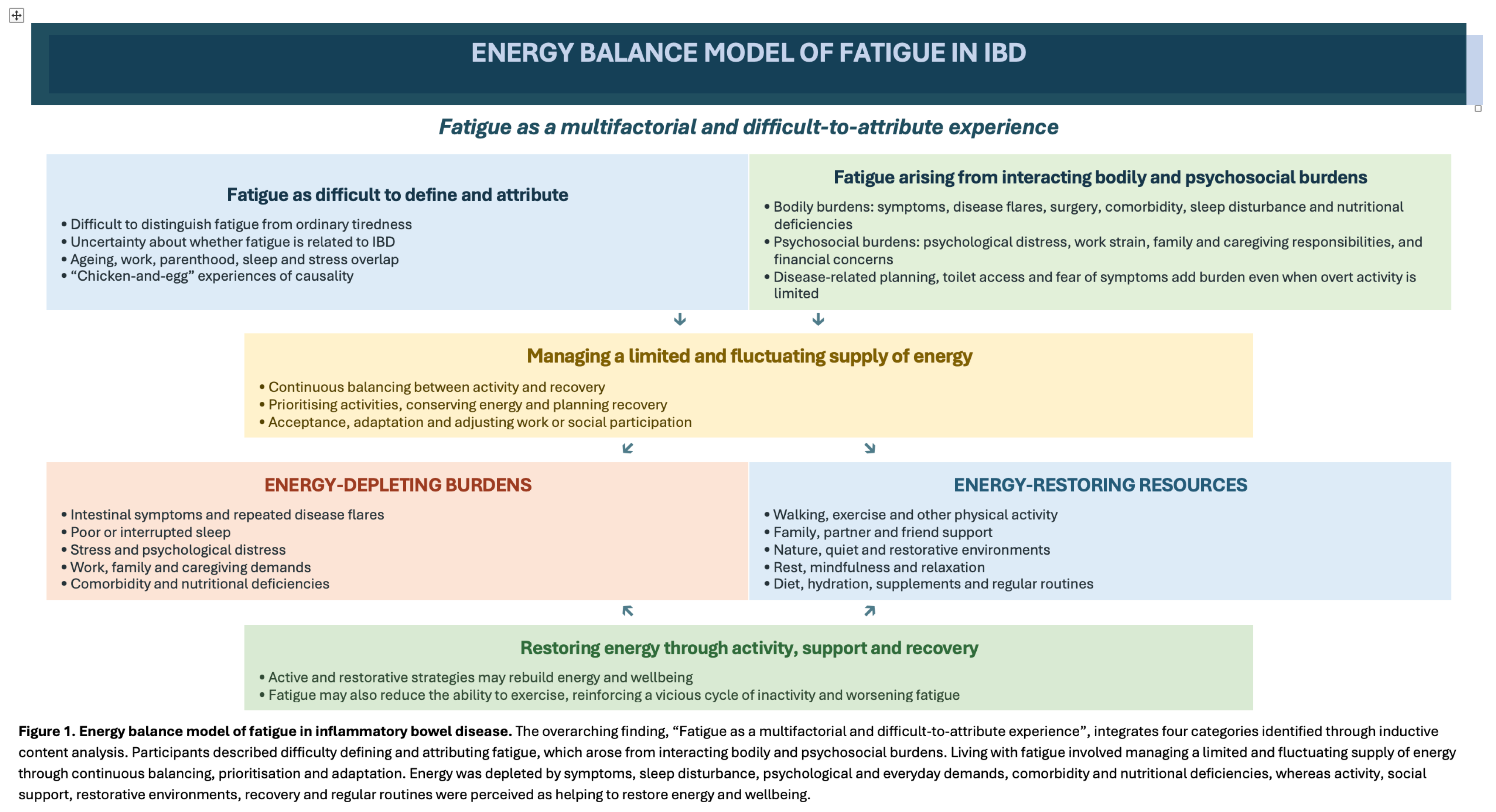

Table 1.
Background data, all participants. N=675.
| N | % | |
|---|---|---|
| Sex Women Men |
357 316 |
53 47 |
| Diagnosis CD UC IBDU |
407 248 20 |
60 37 3 |
| Educational level Elementary school Upper secondary school Vocational school College University Postgraduate |
21 205 77 132 228 12 |
3 30 11 20 34 2 |
| Relationship status Married/Living with partner Single |
471 203 |
70 30 |
| Work status Working Student Unemployed |
243 87 20 |
86 3 11 |
| Treatment None 5-ASA Thiopurine Biologics Kortisone |
166 211 82 190 13 |
25 32 12 29 2 |
| Disease status Relapse Remission Continuous symptoms |
41 536 91 |
6 80 14 |
| Wellbeing Very good Pretty good Bad Very bad Terrible |
97 477 80 20 2 |
14 71 12 3 3 |
| Extraintestinal manifestations No Yes |
270 402 |
40 60 |
Table 2.
IBD-Fatigue Scale, Section I+II, all participants, N=675.
| All participants | Mean | SD |
|---|---|---|
| IBD-F, section I (range 0-20) | 7.1 | 5.14 |
| IBD-F, Section II (0-120) | 26.1 | 26.03 |
Table 3.
IBD-Fatigue scale I+II, comparisons between groups. All participants, N=675.
| Mean | SD | P-value | |
|---|---|---|---|
| IBD-F, Section I, sex Women/Men |
8.1/5.8 | 5.22/4.78 | <0.001 |
| IBD-F, Section II, sex Women/Men |
31.0/20.6 | 27.27/23.43 | <0.001 |
| IBD-F, Section I, diagnosis UC/CD/IBDU |
7.0/7.1/7.0 | 5.20/5.11/4.43 | 0.934 |
| IBD-F, Section II, diagnosis UC/CD/IBDU |
24.8/28.2/23.9 | 25.29/27.37/23.45 | 0.253 |
| IBD-F, Section I, relationship status Married, living with partner/Single |
6.7/8.0 | 4.91/5.55 | 0.002 |
| IBD-F, Section II, relationship status Married, living with partner/Single |
24.8/29.3 | 25.34/27.49 | 0.042 |
| IBD-F, Section I, work status Working/Student/Unemployed |
6.9/9.9/8.9 | 5.04/4.99/5.60 | <0.001 |
| IBD-F, Section II, work status Working/Student/Unemployed |
25.2/49.0/37.2 | 25.17/27.67/30.18 | <0.001 |
| IBD-F, Section I, educational level Elementary school/Upper secondary school/Vocational school/College/University/Postgraduate |
7.2/7.9/9.0/ 5.8/6.5/4.4 |
5.95/5.15/5.47/4.66/ 4.87/5.37/5.13 |
<0.001 |
| IBD-F, Section II, educational level Elementary school/Upper secondary school/Vocational school/College/University/Postgraduate |
28.3/28.0/37.6/ 21.4/23.7/19.4 |
26.09/26.92/30.95/ 23.29/23.53/29.90 |
<0.001 |
| IBD-F, Section I, treatment None/5ASA/Thiopurine/Biologics/Kortisone |
6.9/6.4/6.7/8.1/8.1 | 5.36/4.96/4.98/ 4.90/4.89 |
0.008 |
| IBD-F, Section II, treatment None/5ASA/Thiopurine/Biologics/Kortisone |
25.4/20.9/27.3/ 32.1/33.8 |
26.96/23.32/26.30/ 26.35/34.00 |
<0.001 |
| IBD-F, Section I, extraintestinal manifestations Yes/No |
8.5/5.1 | 5.03/4.60 | <0.001 |
| IBD-F, Section II, extraintestinal manifestations Yes/No |
32.9/16.4 | 27.40/20.24 | <0.001 |
| IBD-F, Section I, disease status Relapse/Remission/Continuous symptoms |
8.6/6.3/10.8 | 4.73/4.96/4.75 | <0.001 |
| IBD-F, Section II, disease status Relapse/Remission/Continuous symptoms |
35.1/22.5/44.5 | 32.31/23.37/29.76 | <0.001 |
| IBD-F, Section I, wellbeing Very good/Pretty good/Bad/Very bad/Terrible |
2.0/6.8/12.4/ 14.9/12.5 |
2.97/4.37/4.12/ 4.89/0.71 |
<0.001 |
| IBD-F, Section II, wellbeing Very good/Pretty good/Bad/Very bad/Terrible |
5.1/22.9/56.9/ 77.6/79.0 |
10.06/20.11/25.91/ 29.70/57.98 |
<0.001 |
Disclaimer/Publisher’s Note: The statements, opinions and data contained in all publications are solely those of the individual author(s) and contributor(s) and not of MDPI and/or the editor(s). MDPI and/or the editor(s) disclaim responsibility for any injury to people or property resulting from any ideas, methods, instructions or products referred to in the content. |
© 2026 by the authors. Licensee MDPI, Basel, Switzerland. This article is an open access article distributed under the terms and conditions of the Creative Commons Attribution (CC BY) license.
Copyright: This open access article is published under a Creative Commons CC BY 4.0 license, which permit the free download, distribution, and reuse, provided that the author and preprint are cited in any reuse.