
Submitted:
08 October 2026
Posted:
10 October 2026
You are already at the latest version
Abstract
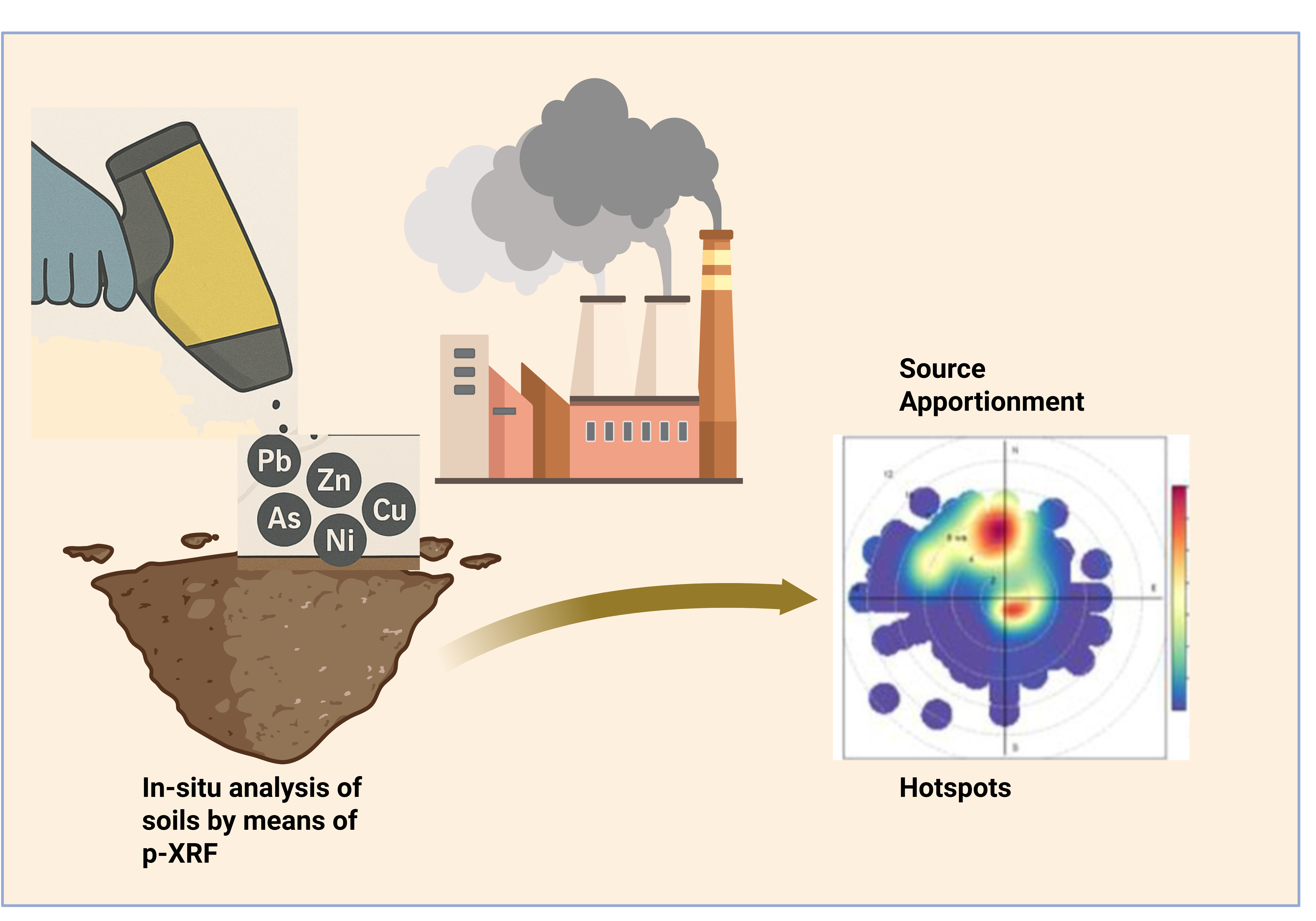
We quantified potentially toxic elements in surface soils from Taranto (Apulia, Italy) along an industrial-to-urban gradient (0-15 km) from a large integrated steel plant. Industrial emissions have been associated with increased cancer incidence, respiratory and neurodevelopmental impacts. We performed 3,446 georeferenced in situ measurements using portable X-ray fluorescence (p-XRF) spectroscopy in five residential districts (Tamburi, Statte, Paolo VI, Taranto centre, and Talsano) at incremental distance from the point source. Concentrations of arsenic (As), copper (Cu), iron (Fe), lead (Pb), manganese (Mn), mercury (Hg), nickel (Ni) rubidium (Rb), strontium (Sr), selenium (Se) and zinc (Zn) differed significantly across districts. Fe, Hg, Mn, Ni, Pb, Se, and Zn showed a clear distance-related decrease from the plant perimeter to more distal residential locations. Exceedances of Italian residential soil limits (D.Lgs. 152/2006) were frequent for As, Cu, Ni, Pb, Se, and Zn and Hg exceeded the 1 mg/kg residential limit in all measurements. Spatial patterns were consistent with atmospheric transport and deposition of industrial particulates, with additional contributions from traffic and other local sources. These findings document widespread multi-element soil contamination in Taranto and support sustained environmental monitoring and targeted remediation, prioritizing neighborhoods closest to the industrial area and incorporating community engagement.
Keywords:
steel plant
; metals
; p-XRF
; soil analysis
; environment monitoring
; source apportionment
Copyright: This open access article is published under a Creative Commons CC BY 4.0 license, which permit the free download, distribution, and reuse, provided that the author and preprint are cited in any reuse.