

Submitted:
08 October 2026
Posted:
10 October 2026
You are already at the latest version
Abstract
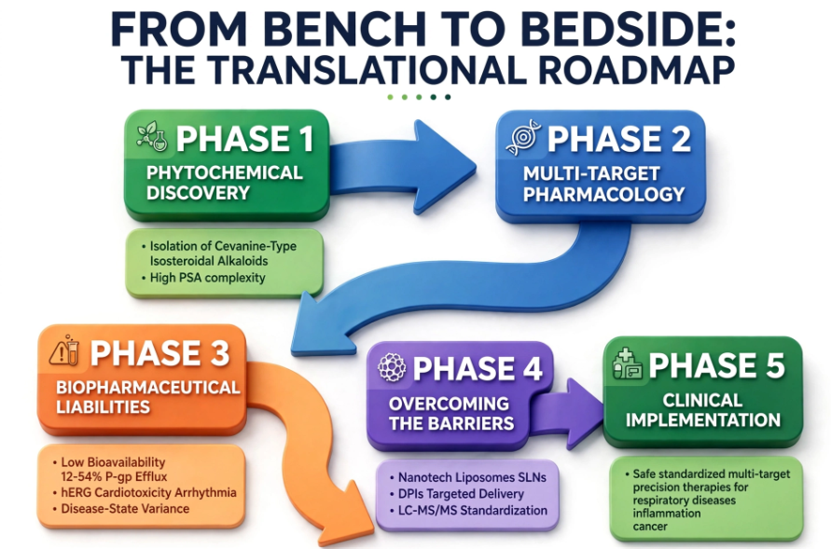
Fritillaria thunbergii Miq. (Zhe Beimu) is traditionally used to clear heat, resolve phlegm, relieve cough, and disperse nodules. Its steroidal and isosteroidal alkaloids, particularly peimine, peiminine, peimisine, and sipeimine, exhibit antitussive, anti-inflammatory, anti-fibrotic, analgesic, anticancer, and metabolic activities. However, the transition from traditional multi-component preparations to clinically deployable alkaloid products remains constrained by uncertain exposure–efficacy relationships, variable disposition, and formulation-dependent safety. This review integrates evidence on the phytochemical classification, molecular pharmacology, absorption, distribution, metabolism, excretion, and toxicology of Fritillaria thunbergii alkaloids. Particular attention is given to exposure–efficacy margins, pathological changes in gastrointestinal and pulmonary disposition, hERG-mediated cardiac risk, and the contrast between isolated-monomer and standardized botanical-product development. Nanocarriers, pulmonary delivery, combination therapy, bioactivity-guided quality control, and FDA/NMPA development pathways are evaluated within a bench-to-bedside framework. The evidence supports multi-target actions involving TGF-β/Smad, NF-κB/MAPK, PI3K/Akt/mTOR, muscarinic and nicotinic receptors, voltage-gated ion channels, and P-glycoprotein. Translation is nevertheless limited by low and variable oral bioavailability, intestinal P-glycoprotein efflux, first-pass metabolism, and a mismatch between many micromolar in vitro effects and achievable systemic exposure. Inflammatory states may increase tissue penetration and systemic exposure, further narrowing the therapeutic window. hERG blockade by major alkaloids is the principal safety concern, whereas matrix interactions may partly attenuate this liability. The most credible development strategy prioritizes physiologically feasible targets, localized pulmonary delivery, exposure-controlled nanocarriers, rigorous toxicokinetic and cardiac monitoring, and product-specific standardization. Clinical advancement will require indication-specific exposure thresholds, disease-state pharmacokinetic modelling, GLP-compliant safety studies, and early-phase trials with intensive electrocardiographic surveillance. Targeted inhalation may offer the clearest route for respiratory indications by increasing local lung exposure while limiting systemic cardiotoxicity. Development should also explicitly compare a single-new-chemical-entity strategy with a standardized botanical-drug pathway capable of preserving beneficial matrix effects. Together, these priorities provide an actionable roadmap for translating Fritillaria thunbergii alkaloids into reproducible and clinically testable therapies.
Keywords:
Fritillaria thunbergii
; steroidal and isosteroidal alkaloids
; clinical translation
; pharmacokinetic barriers
; nanotechnology-based drug delivery
; bioactivity-guided standardization
Copyright: This open access article is published under a Creative Commons CC BY 4.0 license, which permit the free download, distribution, and reuse, provided that the author and preprint are cited in any reuse.