
Submitted:
08 October 2026
Posted:
10 October 2026
You are already at the latest version
Abstract
This study examines the role of disaster collective memory in promoting preparedness behavior using fuzzy-set Qualitative Comparative Analysis (fsQCA). By analyzing earthquake cases in Mashiki (Kumamoto, Japan) and Palu (Central Sulawesi, Indonesia), along with each national-scope samples, this research evaluates configurations of five core conditions: collective memory, threat appraisal, coping appraisal, social norms, and trust. The analysis compares two distinct groups of causal recipes—one omitting collective memory and the other including it—to determine their paths to successful preparedness. The findings reveal that incorporating collective memory generates a perfect causal recipe, with Japan acting as the typical case. Concurrently, the model captures an efficacy-preparedness paradox within the Palu context. Methodologically, these results demonstrate that examining non-linear interactions between determinants provides significantly deeper insights than treating them as isolated factors in linear frameworks. This study highlights the necessity of designing highly contextualized disaster risk reduction strategies, emphasizing that a disaster case must be analyzed as a whole entity shaped by individual and social factors inherent to the affected region.
Keywords:
disaster collective memory
; preparedness behavior
; fsQCA
; Mashiki
; Palu
1. Introduction
In an era of accelerating climate volatility and unpredictable natural hazards, fostering proactive disaster preparedness became unavoidable in modern disaster management. In some countries with high risk of natural hazards such as Japan and Taiwan, it is already in their agenda to nurture. However, their experience with proactive preparedness cannot be simply implemented in other countries. Proactive disaster preparedness involves communities and individuals as the main actor that have their own complex psychological and social mechanism in protecting themselves. Previous studies tried to formulate perfect pattern of factors promoting preparedness behavior. Protection Motivation Theory (PMT) is one of the established theories in explaining preparedness behavior, involving threat appraisal and coping appraisal as the main contributor, where each is considered the most important factors in preparedness behavior [1,2].
However, while PMT variables are essential, individualistic psychological lens often overlooks social and institutional dynamics that govern local communities. To address this, our previous research expanded standard PMT boundaries across South Korea, Taiwan, Indonesia, and Malaysia by integrating individual threat and coping appraisals with community-level factors which are ‘trust’ derived from Community Engagement Theory (CET) [3,4] and ‘social norms’ rooted in the Theory of Planned Behavior (TPB) [5]. Utilizing Structural Equation Modeling (SEM), that four-country study proved that our survey measurements were reliable, but it showed that these psychological and social factors had a very weak straight-line effect as mediators [6]. To investigate if these relationships look different right where a disaster happens, we then tested this same model using SEM in localized, high-risk disaster contexts compared to their national baselines: Mashiki (N=178) alongside Japan (N=400), and Palu (N=108) alongside Indonesia (N=400). Interestingly, this localized analysis showed a similarly conflicting pattern where independent, linear paths failed to capture strong mediation. This proves that looking at variables one by one cannot fully explain how these factors work under different levels of regional risk.
This common problem shows a major gap in how we study disaster preparedness. Traditional linear models like SEM, assume that variables work in straight line and compete against each other to explain an outcome. But in real life, especially in contexts like Japan, Indonesia, Mashiki, and Palu, individual feelings, social pressures, and trust do not work alone. In real life many factors interact and produce particular outcome, like a recipe. We can say, different groups of people can get same level of preparedness, through different combination of factors. Because linear models hold variables constant, they hide these real-world interactions. They also fail to see that the reasons why someone prepares can be completely different from the reasons why someone does nothing. So we need to stop looking at variables as isolated factors and start looking at how they combine in different local contexts to truly understand what drives communities to protect themselves.
To solve this problem, our current study applies different method called fuzzy-set Qualitative Comparative Analysis (fsQCA). Instead of looking at variables one by one, fsQCA allows us to look at them as a combined recipe to see how different factors work together to drive disaster preparedness. This approach is perfect for comparing our specific case groups: the national-level baselines of Japan and Indonesia, and the localized disaster epicenters of Mashiki and Palu. Specifically, this paper compares two distinct configurational models, which are baseline model containing our four main psychological and social variables, and an expanded model that introduces disaster collective memory. By comparing these two models across our cases, we can see exactly how adding collective memory changes the recipe for preparedness. This allows us to find out if including memory creates more accurate path to high preparedness when moving from a broad national context to a high-risk local city.
This study provides important theoretical and practical contributions to disaster risk reduction. Theoretically, by comparing recipes with and without disaster collective memory, this paper goes beyond standard individual psychology models. It shows how the shared history of a community can help explain the actions people take to protect themselves in cultures and different levels of risk. Practically, our findings from this study can help organizations that deal with disasters and local governments create effective programs to build resilience. Of using the same approach, for every situation the people involved can use these specific setups to make plans that match both the general guidelines of a country and the special needs of high-risk cities.
2. Literature Review and Framework Development
This chapter reviews the theories behind human protective behavior by integrating individual psychology, social norms, and institutional trust. This chapter also will introduce disaster collective memory and outline four case studies to justify why a configurational approach is necessary to analyze these factors as a combined recipe.
2.1. Individual Appraisals and Disaster Preparedness (PMT)
Protection Motivation Theory (PMT) explains that individual’s adoption of protective measures consists of two cognitive pathways: threat appraisal and coping appraisal. Threat appraisal is the mental process of assessing possible threats, specifically comparing the severity level of the threats with our vulnerability to their damaging effects [7]. However, the higher threat appraisal does not guarantee active preparedness behavior [8] Instead, taking action depends on coping appraisal: a person’s belief in their own ability to protect themselves and the effectiveness of safety measures [7,9], and become necessary step to start real preparedness behavior. However, PMT has limitation which treat a person in cognitive isolation by focusing only on individual thoughts and ignoring the community factors.
2.2. The Social and Institutional Context of Preparedness (CET & TPB)
In extended behavioral frameworks, social norms act as a psychological bridge which translates collective expectations into protective action and drives household-level disaster mitigation intentions [7] as well as institutional-level climate adaptation behaviors [10]. While within the Community Engagement Theory (CET) framework, trust acts as bridge that transforms community participation and empowerment into sustained preparedness behavior. Trust can reduce risk anxiety and validate the credibility of safety information [3]. These show that developing this systemic, community-level trust prevents people to become passive and rely only on their authorities and encourage them to do mitigation actions [4].
Integrating Community Engagement Theory (CET) and the Theory of Planned Behavior (TPB) with Protection Motivation Theory (PMT) means combining individual cognitive appraisals and personal intentions, making it has broader correlations and including social aspects. This combined framework provides a more holistic view of disaster preparedness. It can show how an individual’s psychological drive in facing threats is activated and maintained through institutional trust, social norms, and collective community empowerment [3,11].
2.3. The Critical Link: Disaster Collective Memory
Disaster collective memory acts as a form of group learning which based on past experiences which provides communities to preserve disaster lessons and narratives across generations [12]. Traditional disaster models usually treat past experience as a minor background factor or mere information rather than dynamic behavioral driver [13]. Treating experience linearly makes this framework fail to capture how collective memory actually acts as foundation of social and cultural tool that changes threat perceptions and community response strategies [12]. To address this gap, our study compares two models: a standard structural model and an expanded version that views memory as an active, culturally embedded system [14]. This direct comparison proves that shared stories and intergenerational memory practices consistently drive protective action and showing that collective memory’s influence on household preparedness is a constant factor across different cultures [12,14].
2.4. The Configurational Approach
Traditional lineal statistics (e.g., Structural Equation Modeling) approach measures each factor separately to see its individual effect on an outcome. In disaster research, this usually means looking at threat appraisal, coping appraisal, institutional trust, or social norms as independent and parallel tracks. However, human and community protective behaviors under threat are complex and rarely follow a simple linear path [15,16]. When empirical models show weak linear paths, it does not mean these underlying factors are irrelevant, but shows that single factor is not strong enough to drive complex preparedness behavior on its own. While traditional linear statistics cannot show that management and social conditions are heavily interdependent, and one factor’s impact relies entirely on whether other conditions are present or absent [15,17,18].
To better see how individuals and communities view risk, this study uses configurational approach using Fuzzy-Set Qualitative Comparative Analysis (fsQCA). Standard methods treat mental and social factors as separate competitors. Instead, this new framework views these factors as ingredients in a “recipe”. This framework analyzes causal relationships from a holistic perspective based on three principles [17]:
- Equifinality: People can reach the exact same goal through different paths. No single factor is mandatory. Multiple combinations of conditions can lead to high preparedness.
- Conjunctural causation: A single factor does not work alone. Its actual effect depends entirely on the other conditions paired with it.
- Causal asymmetry: The conditions that cause high preparedness are not just the reverse of those that cause low preparedness. Both outcomes come from different combinations of factors.
3. Research Context and Case Studies
This chapter provides empirical and geographical contexts of the study, to understand how macro-level national policies and micro-level local disaster memories shape community resilience.
3.1. Introduction to the Comparative Case Approach
To understand the non-linear configurations that influence disaster preparedness, this research utilizes a nested case design approach. The design considers two national-scope samples at the macro-level and two localized disaster epicenters. This approach allows us to analyze the interactions between broader institutional settings and more localized collective memories in terms of protective behavior. In particular, the national environment of Japan and Indonesia act as macro-baselines, while the areas of Mashiki Town and Palu City serve as disaster epicenters. By comparing these socio-cultural environments, we can comprehend whether certain “recipes” for preparedness are universally applicable or highly context-dependent.
3.2. Macro-Level Baseline: Institutional and National Context
The national contexts of Japan and Indonesia provide contrasting institutional and cultural environments for disaster policy, which will be explained in separated chapters below.
3.2.1. Japan Baseline
3.2.2. Indonesia Baseline
Meanwhile, Indonesia’s disaster management operates within highly decentralized and geographically fragmented framework that shift responsibilities from the central government to regional disaster management agencies (BPBD) across the country [21,22]. Due to local budget limitation and unequal infrastructure development across municipalities, local governments frequently face major limitations in their formal disaster-management capabilities [23]. This impacted on relying heavily on informal social capital, mutual community networks, and localized resilience models, such as gotong royong (communal mutual aid), to bridge structural service gaps during localized hazard events [22,23].
3.3. Localized Epicenters: The Micro-Context of Disaster
While national contexts show average policy trends, risk mechanisms happen differently at the localized city level, where abstract threats turned into real lived experience. This chapter will explain each of the situations of Mashiki and Palu to depict the real circumstances of the disaster-prone areas.
3.3.1. Mashiki Town, Kumamoto
The Physical Event
2016 Kumamoto Earthquake was known with its earthquake sequence with double shock happened between 28 hours, with the second one as the mainshock. Asano and Iwata (2021) [24] found that the second, larger rupture sent an extreme, high-velocity ground motion pulse directly into downtown Mashiki. This characteristic made it very destructive and catastrophic.
- Structural damage in Mashiki was heavily concentrated, where 90% of the collapsed or severely damaged buildings were located within a narrow 100-meter corridor of the surface fault rupture [25].
- While modern Japanese building codes are very advanced, earthquakes that rip the ground open will still tear straight through a building’s base. This showed that structural engineering alone cannot protect properties built directly over active fault lines [25].
- Sun et al. (2021) stated that older, traditional wooden houses which highly concentrated in downtown Mashiki built before major building code updates, and suffered disproportionate, systemic collapse during the second shock [26].
- Based on satellite radar data, Mashiki suffered far worse, longer-lasting damage and slower recovery compared to neighboring Kumamoto City [27].
Infrastructural and Spatial Memory
Historically, Japan remembered disasters by building stone monuments or saving damaged ruins, which vital for keeping local memories alive and protecting people from future risks [29]. However, maintaining this physical memory can also backfire. While these sites teach important safety lessons, they can also block local space, limit community access, and cause emotional and financial stress for survivors living nearby [30,31].
This tension makes people-focused disaster educational programs very important. However, disaster memory can fade fast even in heavily impacted areas. Hamatsu and Takeuchi (2026) stated that disaster education in local schools in Mashiki remains weak and depends on personal choice of individual teachers due to frequent teacher changes and a lack of official lesson plans [32].
To combat this fading memory, researchers emphasize combining physical monuments and archived materials with active, oral storytelling [33]. Mashiki built community hubs to drive the recovery process forward [34], where small, highly accessible, and evenly distributed community spaces are far more effective at preserving social bonds and keeping local history alive [35].
Socio-Cultural Aspect
Besides physical damages, the earthquake also damaged the town’s community life. The collapses of wooden residence in Mashiki caused massive displacement and economic disparity. Younger, higher-income households who possessed the resources to rebuild or relocate avoid temporary housing, while older and less-wealthy residents were highly dependent on public housing assistance [36].
Besides that, the displacements also causing psychological damages, such as isolation especially in single elderly [37] where older survivors who lost touch with their friends and community networks experienced a sharp decline in physical activity and exercise habits [38]. This also impacted on women’s mental health, which was deeply tied to active community participation and neighborhood networks, while men’s distress was more closely linked to disruptions in broader structural changes, such as adjustments to local school districts [39]. In response to this, traditional neighborhood associations formed and acted as a powerful protective shield against depression [40].
In practice, Kumamoto recovery also relied heavily on self-organized community action, showing that local cohesion is the most important aspect in the community when disaster strikes.
3.3.2. Palu City, Central Sulawesi
The Physical Event
Disaster happened in Palu, Central Sulawesi was sequence of disasters. After an earthquake strike, a localized tsunami within Palu Bay and catastrophic soil liquefaction in urban neighborhoods followed [41]. Early reports stated that the tsunami only on underwater landslides, but in geodetic and satellite data later, it showed that the main cause was co-seismic movement which is the shifting of the ground under the bay [42]. And simultaneously the strong vertical shaking triggered liquefaction in loose, water-saturated sandy soils [43,44]. In Balaroa, Petobo, and Jono Oge, the ground turned to liquid, and huge mudflows buried over a thousand buildings and permanently reshaped the landscape [43,45].
This disaster exposed major problems in regional disaster management: struggles in incorporating systemic, cascading risk models into actual policy [46] and lack of active collective memory about tsunami, which impacted on low-risk perception and critical communication failures during the crucial early minutes of the 2018 event [47]. The epicenter of the earthquake and the affected areas are shown in Figure 2.
As shown in the Figure 2, Palu City was not the exact epicenter of the earthquake, but this administrative city is chosen for our sample due to its dense population and the impact to the residents.
Spatial Erasure vs. Spatial Memory
Disaster recovery in Palu required different process than Mashiki: spatial erasure. Due to the high risk of future liquefaction, local authorities enforced Governor Regulation No. 10/2019, making the heavily impacted areas as uninhabitable “Red Zones” and legally cancelling land ownership rights in these areas [48,49] and planning to turn it into green spaces, water catchment areas, and public memorial parks [50]. However, implementing these zones has created social and emotional problems:
- Families choosing to stay close to their original land for social networks and economic stability purpose, but it forces them face their physical and emotional trauma of the disaster site [51].
- In areas like Petobo, survivors built new homes near historic landmarks, such as the community Buvu Bionga water well, and using their own cultural traditions to rebuild their community [53].
This spatial disruption has affected the city’s social dynamics. Rapid post-disaster urbanization has widened social gaps, strained traditional family structures, and weakened community solidarity [54]. Despite legal, physical, and social struggles, survivors stay strong through shared culture. Community support, faith, and family connections play a key role in helping young people and their caregivers heal emotionally [55,56]. These human rights challenges show that sustainable long-term recovery needs fair treatment and safe housing rights [57,58].
Cultural Memory and Local Knowledge
2018 disaster showed disconnection between modern urban development and historical local wisdom. Centuries ago, the indigenous ToKaili people developed customary spatial planning system called Pengataa [59]. In this system, communities grouped land by safety levels and stayed away from areas at risk of Nalodo (the local Kaili word for earthquakes, tsunamis, and soil liquefaction happening all at once) [59]. This historical memory was built directly into local place names as natural warnings about past hazards [60]:
- Early 20th-century studies confirm this liquefaction areas were once river basins, which is reflected in the name Puse Ntasi, meaning “center of the sea” [61].
The ToKaili people passed down these lessons through Kayori (oral poetry) and Tutura (oral histories), which warned that “this land has broken once, and will break again” [62,63]. They also performed ceremonies like Nora’a Keke to live safely and peacefully with their dangerous environment [64].
However, as Palu modernized, people forgot or ignored this local knowledge [65]. Rapid city growth ignored traditional land rules, and official 2012 hazard maps were never used for city planning or public education [65,66]. Today, while general disaster knowledge is high, actual household preparedness stays moderate [66].
3.4. Linking Context to Behavioral Theory
The four case studies (Japan, Indonesia, Mashiki, and Palu) show that preparedness is not a uniform response to risks. Instead, it is a local process shaped by how people think and interact. In these high-risk areas, household preparedness is different from national-level for two reasons:
- Amplified Threat and Coping Appraisals: In Mashiki and Palu, disaster risk is shared memory of past events. This intense local memory changes how people view danger and their own ability to deal with it, making them much more active than the rest of the country [5,67]. Direct experience with past hazards acts as a strong trigger that raises people’s fear of danger, while also reshaping self-efficacy and response costs [7,68].
- Localized Trust and Social Norm Feedback Loops: In local communities, people trust their government based on the visible, daily progress of local recovery rather than a general belief in national leaders [28]. Social norms are also local. They are strengthened by close friends and neighbors who went through the same traumatic experience together [41]. Because of this, local peer expectations and trust in local leaders create a clear cycle of behavior that national data simply cannot show [28,41].
This approach fits this study best, because it allows us to find the exact combination of factors that leads to preparedness in these high-risk areas. It shows whether local memory and social trust drive action, whether in Japan’s structured system or Indonesia’s community-led framework.
4. Methods
4.1. Methodological Framework and Rationale
This study uses Fuzzy-Set Qualitative Comparative Analysis (fsQCA) to study protective behavior, because people and communities do not react to disasters in simple or straight lines. Standard methods like Structural Equation Modeling (SEM) look at each factor separately and assume every factor acts on its own path. However, a single factor often matters only when combined with specific other conditions. While weak linear connections cannot show these combinations.
This study uses a set-based framework to look at how factors combine in different ways. We compare two distinct models to see the true role of collective memory. The first model includes disaster collective memory (DCM x TA x DSN x CA x Tr → Pr). The second model leaves memory out (TA x DSN x CA x Tr → Pr). This setup lets us see how five main conditions (Disaster Collective Memory, Threat Appraisal, Social Norms, Coping Appraisal, and Trust) work together to produce Preparedness Behavior.
4.2. Case Selection and Sampling Stratification
Following the nested case design from Chapter 3, this study does not pool all data together. Instead, it divides the sample into separate layers. This allows us see how national baselines interact with local disaster experiences.
4.2.1. Macro-Level National Baselines: Japan and Indonesia
We collected 400 online questionnaires (each) from residents across Japan and Indonesia as national-scope samples to account for the broad administrative systems in each country.
4.2.2. Localized High-Exposure Epicenters: Mashiki and Palu
We gathered primary field data from two ground-zero municipal locations to capture how threats become real, lived experiences:
- Mashiki Town, Japan (N = 178): 500 questionnaires distributed through postal service to residents chosen randomly by the municipality office.
- Palu City, Indonesia (N = 108): 500 questionnaires distributed through postal service to residents using addresses provided by the Palu City Regional Disaster Management Agency (BPBD Kota Palu).
4.3. Variable Operationalization and Calibration
Before running the analysis, raw survey data calibrated into fuzzy sets from 0 (complete non-membership) to 1 (complete membership).
4.3.1. Operationalization of Conditions
We track five causal conditions alongside our main outcome. These conditions combine individual psychological factors, institutional trust, and local memory. Table 1 defines the scope of each condition.
4.3.2. Calibration Strategy
We use three standard qualitative anchors based on data from Mashiki and Palu:
- Full Membership (0.95): Cases above this value are completely inside the set.
- Full Non-Membership (0.05): Cases below this value are completely outside the set.
- Crossover Point (0.50): The point of maximum ambiguity, where a case is neither in nor out.
Subsequent chapters detail the mathematical rules used for survey scales.
4.4. Analytical Protocol and Truth Table Construction
The fsQCA estimation uses a two-step truth table algorithm:
- Analysis of Necessary Conditions: Each condition was tested individually. A condition is necessary for high preparedness () if its consistency score exceeds 0.90.
- Analysis of Sufficient Conditions: The truth table was constructed with 2k rows (where k is the number of conditions). And rows with minimum case count and a raw consistency score above 0.80 was kept.
Then, the minimized solutions were generated (complex, parsimonious, and intermediate) to compare resilience paths across regions.
5. Results
5.1. Calibration of Fuzzy Sets
As explained in previous chapter, all raw variables were calibrated into fuzzy sets between 0 and 1. Following standard fsQCA rules, we set three main anchors based on sample metrics: full membership at 0.95, the crossover point at 0.50, and full non-membership at 0.05. This calibration for each construct can be seen in Table 2.
5.2. Truth Table Construction and Case Association
After calibration, truth table was built to map how cases fall across the possible logical combinations. With four causal conditions (TA, DSN, CA, Tr), there are 24 = 16 possible configurations. Since macro-level research compares a small number of contexts, the minimum case count cutoff of 1 was set. Strict consistency score of 1.00 was used to find combinations which lead to high Preparedness Behavior ().
Table 3 shows the populated rows of the truth table. Out of the 16 potential configurations, only 3 actually appeared across our 4 cases. This happened because cases cluster around qualitative crossover points.
- Row 1 (1 0 1 1) is occupied by the Japan. It has raw consistency of 1.000, making it a highly reliable path to high preparedness.
- Row 3 (0 1 0 0) is occupied by Mashiki. It shows a post-disaster setting with high local social norms, but low threat and coping appraisals.
- Row 2 (0 0 0 0) Indonesia serves as the main anchor here. Palu clusters in this row too because its calibrated Trust (Tr) score sits right at the 0.50 cutoff. In fsQCA, cases on the crossover point do not form a new row, but join the nearest similar baseline row.
As shown in Table 3, only Row 1 (Japan) passes the consistency threshold for high preparedness behavior. Rows 2 and 3 show low consistencies (0.524 and 0.327) which means low level of preparedness here.
5.3. Boolean Minimization and Causal Solutions
To find the final causal paths to high Preparedness Behavior (Pr), Quine-McCluskey algorithm was used and generated three solution types: complex, parsimonious, and intermediate. The Intermediate Solution was used as our main framework for interpretation. While Parsimonious solutions were only used to separate “core” conditions from “contributing” conditions, because it can use ungrounded assumptions.
We used a nested modeling setup to test the impact of cultural context:
- Run 1: The baseline model using standard Protection Motivation Theory (PMT) variables and institutional Trust.
- Run 2: The expanded model, adding Disaster Collective Memory (DCM) as a key social condition.
Table 4 shows both results.
Analysis of the Baseline vs. Expanded Configurations
As shown in Table 4, Run 1 (the baseline model) produces a single causal recipe: high threat appraisal, high coping appraisal, and high trust (TA x CA x Tr). This path achieves a strong solution coverage of 0.710, explaining roughly 71% of high preparedness behavior across the dataset. Its solution consistency is at 0.909. While above the standard 0.90 threshold, this score shows that purely cognitive and institutional variables leave small empirical gaps.
In Run 2, we added Disaster Collective Memory (DCM) and it significantly improves model fit. The expanded intermediate solution produces the path:
DCM x TA x CA x Tr → Pr
While maintaining the exact same solution coverage (0.710), solution consistency climbs to a perfect 1.000000. This shift highlights causal asymmetry and contextual necessity: active disaster memory serves as a crucial stabilizing anchor. Without the historical framing from DCM, psychological indicators (TA, CA) show less situational certainty.
Social Norms (DSN) dropped out of both successful models. This indicates that when individual risk appraisals are strong and backed by institutional trust, peer pressure becomes redundant.
At the case level, Japan acts as the ideal typical case, with near-perfect membership score (0.95, 0.95) in both the recipe and the preparedness outcome. In contrast, Palu highlights why single variables fail in isolation. In the parsimonious model, Palu shows high individual Coping Appraisal (0.86), but has extremely low preparedness (0.05). This gap makes the parsimonious consistency become invalid 0.589, which shows that coping capacity alone cannot drive preparedness without collective memory and institutional trust.
6. Discussion
Our results show that collective memory is what turns individual and institutional perceptions into actual preparedness behavior (Pr). This section explains why standard behavioral models under-predict preparedness and how the causal recipe varies across contexts.
6.1. Theoretical Integration: Merging Psychological Preparedness Theories with Disaster Collective Memory
Most research on the drivers of preparedness uses individual psychological models [69,70,71]. Built on threat appraisal (risk perception) and coping appraisal (response efficacy), these models support education programs that translate personal risk and cost perceptions into adaptive action [72,73]. But our findings suggest that these appraisals rarely operate on their own. They work through the social context around them. We get the results indicating disaster collective memory is what structural activator.
The baseline model has consistency of 0.909, while model with disaster collective memory shows improvement and become 1.000. The change we see here means something. We know that conventional behavioral models were missing important condition. Qian et al. (2026) also have similar conclusion. The research showed that symbolic and narrative memory pathways shape behavioral intentions [74]. Preparedness culture cannot be imposed from above. But it grows from community’s values, daily routines, and implicit collective memories [75,76,77]. Conventional theories explain behavior through individual cognitive appraisal, and influenced by personal experience or expert risk communication [74,75,76,77]. But they cannot explain why informed people still fail to act. A collective memory approach fills that gap because it treats preparedness as community stewardship. It also gives meaning to disaster threats in social framework.
This results also aligned with research that stated that preparedness is not linear path, or outcome from isolated variables. Instead treat it as outcome from complex system and cannot be explained by simple net-effects regressions [76,78]. Effective preparedness resembles a simultaneous recipe in which risk perception, efficacy, institutional trust, and historical memory intersect [69,75]. Linear models overlook these combinations. High risk perception alone, for instance, predicts little without a temporal and social context [78], and strong response efficacy stays dormant unless institutional trust activates it [69]. These psychological variables are always filtered through daily routines, cultural practices, and place identities [75,76,79]. Predicting real human behavior needs multi-level frameworks with connections between each factor as parts of community’s historical and social fabric [78,79].
6.2. Cross-Contextual Case Evaluation: Fulfilling the Causal Recipe
6.2.1. The Macro-Level Benchmark (Japan)
Japan is the macro-level benchmark, with typical case profile of (0.95, 0.95). The result fits Japan’s long history of disaster management which has mature institutions and active memory infrastructures. These conditions create environment where high risk perception can convert quickly into preparedness. This becomes possible when top-down policy empowers communities and encourage shared community narratives and supporting grassroots networks from above [80,81]. Awareness can be manifested not by constant education, but through memories such as memorials and monuments that act as external cognitive networks that keep past lessons visible [82]. Intergenerational rituals and public commemoration are considered informal institution which has role in preserving continuity and enabling fast communication and action [83,84]. When formal systems and collective memory structures align, preparedness becomes shared, self-reinforcing habit which can protect people when the disaster happens.
6.2.2. The Efficacy-Action Gap (Palu, Indonesia)
The Palu case reveals a paradox where people have high efficacy (CA = 0.86) but also have very low preparedness (Pr = 0.05). People who are capable and aware but still fail to prepare became a pattern known as the perception-action gap [85]. This can happen because individual efficacy does not work in a vacuum. In the condition where there is no institutional trust (e.g., past trauma, rumor, and skepticism toward authorities) people do not take action even when they know how to respond [86]. Here trust become conversion agent. And government through planning have to address this distrust. Not by coercion but local partnerships [87]. But this also depends on collective memory. Without shared history, risk communication will not be smooth, and physical memorials only work when oral tradition keeps them alive [33].
6.2.3. Localized Trajectories (Mashiki, Japan and Macro-Indonesia)
Mashiki and macro-level Indonesia show two extremes of system failure. Each show how specific conditions can make the people fail to do preparedness action.
Mashiki (0,1,0,0) has high institutional trust and strong social norms. But it also has low-risk perception and disaster fatigue. Long experience with drills and cohesive community resulted in high compliance, but years of inconsequential alerts also create cry-wolf syndrome [88,89]. Because residents trust local government and their disaster infrastructure, they become complacent. They become too calm because think that public measures will protect them [90]. This condition creates false security and makes them focus on daily routines instead of emergency preparedness. These action such as food stockpiles and mobility plans for the elderly become forgotten [91,92].
While macro-level Indonesia (0,0,0,0) shows the opposite failure. It shows low risk appraisal, low social norms, low efficacy, and low institutional trust simultaneously. This is not a local issue but structural one in national disaster governance. It is said lacks unified framework for turning hazard knowledge into daily practice [46,93]. Top-down policies treat at-risk residents as afterthought only. It also leaves communities and local authorities without proper coordination or reliable guidance [94,95]. The condition failed the pathways into preparedness identified in literature; they are trust in messengers, self-efficacy, and access to clear information [96]. Mashiki fails because institutional dependence removes personal urgency. While Indonesia fails because weak framework prevents any foundation from forming in the first place [97].
6.3. The Redundancy of Social Norms (DSN) in High-Resilience Systems
In fsQCA, a condition can become a “don’t care” in the minimized solution. It means that the presence or absence makes no difference to the outcome. We see from the result that social norms were absent from every successful intermediate solution. That means redundancy, interpreted that in highly resilient systems, social norms do not have influence in people behavior. If a system has strong structural and cognitive foundations (e.g., digital risk infrastructure, sound policies, high civic capacity, etc.) informal social pressure becomes unnecessary anymore [98]. The successful paths ignore social norms entirely. Social norms became redundant form in systems that function well without conformity.
The redundancy reflects a behavioral shift from externally coerced compliance to internalized habit:
External coercion → peer conformity → temporary compliance → [disaster collective memory + trust] → internalized habit → automatic routines → high-resilience preparedness
In low-resilience systems, preparedness relies on external mechanisms. For example, people act because of perceived pressure, community monitoring, and the wish to conform [99]. But in high-resilience systems, two factors replace that pressure. Collective memory turns media-driven warnings into practical knowledge incorporated into local culture and lived experience [100]. Trust (Tr) lowers public uncertainty about safety rules. We can see that citizens who trust the system do not skeptical towards public goals [99]. Collective memory and trust create people who intuitively see themselves as active parts of crisis management [85]. Preparedness becomes spatial custom and routines and not act as performance anymore [101]. When behavior is fully integrated into daily life, peer pressure is unnecessary.
6.4. Policy Implications for International Disaster Risk Reduction (DRR)
6.4.1. Shifting from Cognitive to Cultural Interventions
Traditional risk reduction policies usually use protection motivation models, like predicting preparedness by modifying perceived threat and self-efficacy. Top-down risk communication often fails because it treats communities without its human aspects. While in real life communities are group of people with its own culture and custom. International DRR should fund “memory infrastructure” at the community level, not just informational handouts. It means customization is important for each community. Cultural memory practices demonstrably build preparedness behavior. So, governments can support local narrative systems, such as Japan’s kataribe. It is storytellers who preserve first-hand accounts of past disasters [102]. Storytelling is not mere cultural resource; but also learning mechanism that spreads safety practices from person to person [102]. Preserving ruins, remembrance trails, and oral archives turns abstract warnings into active learning spaces.
6.4.2. Building Institutional Trust as an Infrastructure
Standard models treat early warning systems as purely technical devices. Technology will be useless if we do not trust the system behind it. Empirical studies show that institutional trust is one of the strongest determinants for preparedness behavior, while systematic distrust create apathetic people and governance traps [103]. International frameworks should treat trust as important infrastructure, not as sociopolitical side issue. When top-down warnings fail to reach remote communities, the problem is usually a last-mile failure of trust, not technology problem. We can see the example of Mentawai Islands. There, relational authorities, tuddukat wooden drums, and ecological knowledge passed across generations mobilize people faster than official channels [104]. If we combine official procedures with decentralized relational networks, we can make people follow macro-level warning system.
6.4.3. Targeting the Context: Highly Structured vs. Reconstructive Environments
A uniform global policy fails because it ignores local institutional baselines. So, we should differentiate strategies between environments in Table 5:
In structured settings like Japan, policies should prevent institutional exhaustion. Structural mitigation like seawalls and early warning sensors work best when synchronized with local values, identity, and daily experience. Because the more they engage the human side, the more they encourage actual preparedness.
But in Palu, or in reconstructive areas, the governments should focus on policies which rebuild institutions first. Planners cannot assume civic compliance or safe infrastructure. They should stabilize livelihoods, resolve land disputes, and earn trust before technical measures can succeed.
7. Conclusions
This study shows that disaster collective memory strengthens preparedness when individual cognition and social context work together. Using fuzzy-set Qualitative Comparative Analysis (fsQCA), we could see these links as interactions among several conditions. Not like SEM which is testing linear, symmetrical effects. SEM would only tell us whether collective memory or trust has a net positive effect across the whole sample. fsQCA showed how the two work together.
The case results make the same point from a different angle. Even preparedness that looks like an individual choice is shaped by the social environment around it. Japan and Indonesia both suffer earthquakes, but residents in each country perceive risk and act on experience very differently, due to different local context. In Japan (with Mashiki as the local case, where nearly everything is institutionalized), strong social norms and institutions lead people to rely passively on the system. In Indonesia (specifically Palu), weak institutions force resilience to grow organically from social interaction and collective history. The study found different paths to preparedness in each place.
7.1. Theoretical Implications
The study shifts disaster preparedness research from treating factors as independent and isolated, become combination and context-based approach. Methodologically the shift from SEM to fsQCA can show details that SEM cannot see.
First, SEM assumes unifinality which suggest one best path to an outcome. While fsQCA showed equifinality. This means several equally effective recipes can produce high preparedness, and Mashiki and Palu reached it through different combinations. Then SEM assumes causal symmetry. When a factor produces an outcome, its absence will also produce the absence of the outcome. Different with fsQCA which showed causal asymmetry. The conditions for being prepared are not the mirror image of the conditions for being unprepared. The result shows high institutional trust is a core part of preparedness in Japan’s structured environment. But in Palu, low trust does not automatically prevent preparedness when collective memory and communal interaction are strong. Using these multiple, non-linear paths of fsQCA, it provides human behavior pattern under threat which is far better than linear regression models.
This also extends Protection Motivation Theory (PMT). Cognitive appraisals are not purely psychological calculations, but shaped by social context. By placing PMT and related theories inside that context, also put disaster collective memory as connecting condition, this framework can explain why same hazard can impact on very different behavior under different institutional conditions.
7.2. Policy and Practical Implications
Based on our findings, we offer three practical recommendations for governments, NGOs, and disaster agencies.
- Invest in memory infrastructure: Electronic warnings and information pamphlets are not enough to make people take action. Governments should fund local memory projects, preserve physical ruins, and create memory trails. With these, disaster awareness can become part of local culture.
- Build trust: The most advanced early warning system is useless if people do not trust the agency behind it. Trust is also part of the safety infrastructure. To overcome the “last mile” problem, official warning systems should link up with traditional warning systems so communities trust the message.
- Match the strategy to the environment: One global framework will never work for every case. In highly structured environments like Japan, the task is to humanize existing structures, integrating seawalls with local culture and aesthetics. The more human, the more connected the people to preparedness. In reconstructive environments such as Palu, the task is survival fundamentals, from stabilize livelihoods, settle land conflicts, and rebuild trust. It is important before high-tech warning systems.
7.3. Limitations and Directions for Future Research
This study has two main limitations for future research:
- This study only captures a part of moving target, which is collective memory and preparedness at a single point in time. In reality, collective memory is organic and naturally changes over time. This limitation can be followed-up with same studies in the same communities but with longer period (5 to 10 years). This would allow researchers to see exactly when disaster memory starts to decay, helping governments know precisely when to intervene and refresh community awareness.
- The causal recipe only focused on particular conditions (cultural and psychological conditions). This makes other (presumably) influential factors (e.g., socioeconomic factors) were not examined. In future research, these excluded factors can be added to see how community’s financial realities interact with its cultural memory and impacting preparedness behavior.
Institutional Review Board Statement
Ethical review and approval were waived for this study in accordance with the institutional guidelines of Kumamoto University and the national Ethical Guidelines for Medical and Biological Research Involving Human Subjects (MEXT/MHLW/METI, Japan), as the research involved solely voluntary, non-invasive, anonymous survey questionnaires administered to adult respondents with no collection of personally identifiable information.
Informed Consent Statement
Informed consent was obtained from all subjects involved in the study.
Data Availability Statement
The data supporting the findings of this study are available from the corresponding author upon reasonable request. The dataset is not currently publicly archived because the underlying survey files require further verification, cleaning, and documentation to ensure that the shared dataset corresponds to the final analyses reported in this article and excludes preliminary or superseded trial-and-error files.
Acknowledgments
This work was supported by JST SPRING, Grant Number JPMJSP2127.
Appendix A. Questionnaire

Part 1.
Circle/check “Yes” or “No” for the questions below.
| Question | Yes | No |
|---|---|---|
| Have you ever been taught or told how to avoid natural disasters based on past disaster events by family or friends? | ||
| Have you ever been taught or told how to recognize natural disasters based on past disaster events by family or friends? | ||
| Are there any local practices, customs, or habits in your area based on past natural disaster events? | ||
| Have you ever received information regarding the history of disasters in your area through media such as television or radio? | ||
| Have you ever received information regarding the history of disasters in your area through the internet? | ||
| Have you ever visited a disaster site (museum, memorial monument, or other) in your area and learned about the associated disaster risk? | ||
| Have you ever received education/lessons regarding disaster risk in your area? | ||
| Have you ever heard stories about natural disasters from family or friends who have experienced a disaster? |
Part 2.
Regarding the following statements related to earthquakes, choose the answer that best matches your opinion, from “Strongly agree” to “Strongly disagree”.
Part 2.
Regarding the following statements related to earthquakes, choose the answer that best matches your opinion, from “Strongly agree” to “Strongly disagree”.
| Statement | Strongly agree | Agree | Unsure | Disagree | Strongly disagree |
|---|---|---|---|---|---|
| Thinking about earthquakes makes me afraid and anxious about the possibility of them happening again. | |||||
| If an earthquake occurs, I am concerned about its impact not only on me, but also on my family. | |||||
| If an earthquake occurs, I am concerned about the potential damage to my house/property. | |||||
| Earthquakes can happen at any time. | |||||
| An earthquake event could harm me and my family. | |||||
| An earthquake event could cause damage to my house/property. | |||||
| An earthquake event can be life-threatening. |
Part 3.
Regarding the following statements, choose the answer that best matches your opinion, from “Strongly agree” to “Strongly disagree”.
Part 3.
Regarding the following statements, choose the answer that best matches your opinion, from “Strongly agree” to “Strongly disagree”.
| Statement | Strongly agree | Agree | Unsure | Disagree | Strongly disagree |
|---|---|---|---|---|---|
| I think most residents will follow the disaster prevention measures established by the government. | |||||
| I think most residents will go to designated evacuation sites if an earthquake occurs. | |||||
| I think most residents will take safety measures to cope with earthquake risks. | |||||
| I think most residents understand the earthquake risk in their area. | |||||
| I think most residents stay up to date with earthquake-related information. | |||||
| I think most residents would know what to do when an earthquake occurs. |
| Statement | Strongly agree | Agree | Unsure | Disagree | Strongly disagree |
| I think people around me want me to follow the disaster prevention measures established by the government. | |||||
| I think people around me want me to go to designated evacuation sites if an earthquake occurs. | |||||
| I think people around me want me to take measures to protect myself from earthquake risks. | |||||
| I think people around me want me to understand the earthquake risk in my area. | |||||
| I think people around me want me to stay up to date with the latest earthquake information. | |||||
| I think people around me want me to know what to do if an earthquake occurs. |
Part 4.
Regarding the following statements about the effectiveness of earthquake preparedness, choose the answer that best matches your opinion, from “Strongly agree” to “Strongly disagree”.
Part 4.
Regarding the following statements about the effectiveness of earthquake preparedness, choose the answer that best matches your opinion, from “Strongly agree” to “Strongly disagree”.
| Statement | Strongly agree | Agree | Unsure | Disagree | Strongly disagree |
|---|---|---|---|---|---|
| Retrofitting the house and securing indoor furniture are effective in saving my life during an earthquake. | |||||
| Retrofitting the house and securing indoor furniture are effective in protecting my assets during an earthquake. | |||||
| Preparedness such as stockpiling/having supplies can help make life better after a disaster. | |||||
| Checking evacuation sites and evacuation routes in advance is useful during an earthquake evacuation. | |||||
| Disaster prevention information and knowledge are useful when a disaster occurs. | |||||
| Disaster prevention drills are useful in the event of an earthquake. | |||||
| Confirming how to contact my family in advance will be useful during an earthquake. | |||||
| Earthquake insurance is useful in rebuilding my life after an earthquake. | |||||
| The information I have helps me take safety measures against earthquakes. | |||||
| The information I have helps me protect my house/property from earthquakes. | |||||
| The information I have helps me prepare supplies for an earthquake. |
Part 5.
Regarding the following statements about trust in organizations, choose the answer that best matches your opinion, from “Strongly agree” to “Strongly disagree”.
Part 5.
Regarding the following statements about trust in organizations, choose the answer that best matches your opinion, from “Strongly agree” to “Strongly disagree”.
| Statement | Strongly agree | Agree | Unsure | Disagree | Strongly disagree |
|---|---|---|---|---|---|
| I trust the earthquake prediction information provided by the government. | |||||
| I can rely on the government in the event of an earthquake. | |||||
| Government disaster prevention measures can protect my life and property. | |||||
| I can rely on neighborhood associations or voluntary disaster prevention organizations when an earthquake occurs. | |||||
| I can rely on my neighbors in the event of an earthquake. | |||||
| The nearest evacuation site is a safe place in the event of an earthquake. | |||||
| I trust the media regarding earthquake warning reports. | |||||
| I trust relevant agencies regarding earthquake assessments and recommendations. |
Part 6.
Circle/check the preparations you have made to face the threat of an earthquake disaster.
| Preparation made | |||
|---|---|---|---|
| Emergency bag | Sandals or shoes beside the bed | ||
| Water and/or food supplies | Portable gas stove and/or solid fuel | ||
| Arranging furniture/household items to facilitate evacuation | Confirming evacuation locations and/or evacuation routes | ||
| Securing furniture to prevent toppling during an earthquake | Confirming contact methods and/or meeting places with family members | ||
| Taking measures to prevent glass from shattering | Discussing cooperation with neighbors (in case an earthquake occurs) | ||
| Flashlight | Checking hazard maps | ||
| Fire extinguisher | Creating hazard maps | ||
| Earthquake circuit breaker (earthquake sensor device) | Earthquake insurance | ||
Part 7. Answer the following questions by circling or filling in the provided spaces.
- Write your gender and age. Gender: [ Male · Female ] | Age: [ _____ years old ]
- Write the area where you live. [ ______________________ ]
- How long have you lived in your current home? [ _________ years ]
- How many people live in your house (including yourself)? [ _________ people ]
- Are there any family members who have difficulty evacuating on their own (e.g., infants, pregnant women, persons with disabilities, elderly with mobility constraints, etc.)? (Multiple answers allowed)
- a.
- None
- a.
- Myself
- a.
- Infant
- a.
- Pregnant woman
- a.
- Person with a disability
- a.
- Person with weak/lame legs
- a.
- Other
- 6.
- Have you ever experienced an earthquake up to this point? ( Yes · No )
If you answered “No”, skip directly to Part 8.
- 7.
- If you answered “Yes” to the question above, when did you experience the earthquake? (Multiple answers allowed)
- a.
- Within 5 years
- a.
- Within 10 years
- a.
- Within 20 years
- a.
- Within 30 years
- a.
- Within 40 years
- a.
- Within 50 years
- a.
- More than 50 years ago
Part 8.
Select “Yes” or “No” for the following questions regarding your experience with earthquakes.
Part 8.
Select “Yes” or “No” for the following questions regarding your experience with earthquakes.
| Question | Yes | No |
|---|---|---|
| Have you ever evacuated to a safer place or left your residence during an earthquake? | ||
| Have you or your family members ever suffered injuries or loss of life as a result of an earthquake? | ||
| Have your relatives or acquaintances ever suffered injuries or loss of life as a result of an earthquake? | ||
| Have you or your family members ever experienced physical damage or loss of house/property as a result of an earthquake? | ||
| Have your relatives or acquaintances ever experienced physical damage or loss of house/property as a result of an earthquake? | ||
| Have you or your family members ever experienced financial loss, such as business damage or loss of income, as a result of an earthquake? | ||
| Have your relatives or acquaintances ever experienced financial loss, such as business damage or loss of income, as a result of an earthquake? |
Part 9.
Have you ever experienced psychological impact or emotional distress due to an earthquake?
Please answer on a scale from 0 to 10, where 0 means “no impact at all” and 10 means “very severe impact”.
[No impact at all] ( 0 1 2 3 4 5 6 7 8 9 10 ) [Very severe impact]
Part 10.
Overall, how severe was the impact of the earthquake(s) you experienced?
Please answer on a scale from 0 to 10, where 0 means “not serious at all” and 10 means “very serious”.
[Not serious at all] ( 0 1 2 3 4 5 6 7 8 9 10 ) [Very serious]
References
- Mol, J.M.; Botzen, W.J.W.; Blasch, J.E. After the virtual flood: Risk perceptions and flood preparedness after virtual reality risk communication. Judgm. Decis. Mak. 2022, 17, 189–214. [Google Scholar] [CrossRef]
- Šuriņa, S.; Martinsone, K.; Perepjolkina, V.; Kolesnikova, J.; Vainik, U.; Ruža, A.; Vrublevska, J.; Smirnova, D.; Fountoulakis, K.N.; Rancans, E. Factors Related to COVID-19 Preventive Behaviors: A Structural Equation Model. Front. Psychol. 2021, 12, 676521. [Google Scholar] [CrossRef] [PubMed]
- Paton, D.; et al. Australasian Journal of Disaster and Trauma Studies The development and use of Community Engagement Theory to inform readiness interventions for natural hazard events. Australas. J. Disaster Trauma Stud. 2024, vol. 28(no. 1). [Google Scholar]
- Becker, J.S.; Vinnell, L.J.; Doyle, E.E.H.; McBride, S.K.; Paton, D.; Johnston, D.M. A decade of shaking in the Garden City: the dynamics of preparedness, perceptions, and beliefs in Canterbury, New Zealand, and implications for earthquake information. Front. Commun. 2024, 9, 1410333. [Google Scholar] [CrossRef]
- Gumasing, M.J.J.; Sobrevilla, M.D.M. Determining Factors Affecting the Protective Behavior of Filipinos in Urban Areas for Natural Calamities Using an Integration of Protection Motivation Theory, Theory of Planned Behavior, and Ergonomic Appraisal: A Sustainable Disaster Preparedness Approach. Sustainability 2023, 15, 6427. [Google Scholar] [CrossRef]
- Mutiara, A.; Kakimoto, R. Disaster Collective Memory Practice’s Impact on Preparedness Behavior: Case Study of South Korea, Taiwan, Indonesia, and Malaysia. Int. J. Adv. Sci. Eng. Inf. Technol. 2026, 16, 496–507. [Google Scholar] [CrossRef]
- Kurata, Y.B.; Ong, A.K.S.; Ang, R.Y.B.; Angeles, J.K.F.; Bornilla, B.D.C.; Fabia, J.L.P. Factors Affecting Flood Disaster Preparedness and Mitigation in Flood-Prone Areas in the Philippines: An Integration of Protection Motivation Theory and Theory of Planned Behavior. Sustainability 2023, 15, 6657. [Google Scholar] [CrossRef]
- Liu, W.; Zhang, Z.; Song, Z.; Shi, J. Unveiling the Nexus Between Farmer Households’ Subjective Flood Risk Cognition and Disaster Preparedness in Southwest China. Sustainability 2025, 17, 7956. [Google Scholar] [CrossRef]
- Ngxongo, N.A.; Fitchett, J.M. Perception of risks and threats among tourism operators: a protection motivation theory perspective on climate change resilience and adaptive strategies in eThekwini, South Africa. South Afr. Geogr. J. 2026, 108. [Google Scholar] [CrossRef]
- Jacob, J.; Valois, P.; Tessier, M. Using the Theory of Planned Behavior to Predict the Adoption of Heat and Flood Adaptation Behaviors by Municipal Authorities in the Province of Quebec, Canada. Sustainability 2021, 13, 2420. [Google Scholar] [CrossRef]
- Najafi, M.; Ardalan, A.; Akbarisari, A.; Noorbala, A.A.; Elmi, H. Salient Public Beliefs Underlying Disaster Preparedness Behaviors: A Theory-Based Qualitative Study. Prehospital Disaster Med. 2017, 32, 124–133. [Google Scholar] [CrossRef] [PubMed]
- Sandoval-Díaz, J.; Navarrete-Valladares, C.; Suazo-Muñoz, C.; Martínez-Labrín, S. Collective memories and previous experiences of older people in the face of disaster risk processes: lessons learned, implication, and social support. Front. Clim. 2023, 5, 1272219. [Google Scholar] [CrossRef]
- Kato, T. Sharing experience by residents of past disaster sites: Effects of time from disasters and types of experience. Int. J. Disaster Risk Reduct. 2021, 61. [Google Scholar] [CrossRef]
- Fitriani, D.N.; Bajari, A.; Suminar, J.R.; Aristi, N. Reconstructing Society Through Memory: Smong, Cultural Trauma, and Community Resilience in Post-Disaster Simeulue, Indonesia. Societies 2026, 16, 23. [Google Scholar] [CrossRef]
- Mombeuil, C.; Michel, J.F.; Louis, C.P. Beyond Linear Models: A Hybrid SEM-fsQCA Approach to Understanding Consumer Intentions for Organic Rice. Businesses 2026, 6, 13. [Google Scholar] [CrossRef]
- Pappas, I.O.; Woodside, A.G. Fuzzy-set Qualitative Comparative Analysis (fsQCA): Guidelines for research practice in Information Systems and marketing. Int. J. Inf. Manag. 2021, 58. [Google Scholar] [CrossRef]
- Li, Z.; Zhao, Y.; Duan, T.; Dai, J. Configurational patterns for COVID-19 related social media rumor refutation effectiveness enhancement based on machine learning and fsQCA. Inf. Process. Manag. 2023, 60, 103303. [Google Scholar] [CrossRef] [PubMed]
- Hossain, M.A.; Sabani, A.; Lokuge, S.; Boo, Y.L.; Kaisar, S.; Menon, P. A Configurational Approach to CSP Selection and Rejection. J. Comput. Inf. Syst. 2024, 1–16. [Google Scholar] [CrossRef]
- Pastrana-Huguet, J.; Casado-Claro, M.-F.; Gavari-Starkie, E. Japan’s Culture of Prevention: How Bosai Culture Combines Cultural Heritage with State-of-the-Art Disaster Risk Management Systems. Sustainability 2022, 14, 13742. [Google Scholar] [CrossRef]
- Matharage, S.S.; Ishiwatari, M.; Aldrich, D.P. Empowering Communities: A Bottom-Up Approach to Disaster Risk Reduction. IDRiM J. 2025, 15, 207–234. [Google Scholar] [CrossRef]
- Center for Excellence in Disaster Management & Humanitarian Assistance (CFE-DM), INDONESIA Disaster Management Reference Handbook Disaster Management Reference Handbook Series. 2025. Available online: https://www.cfe-dmha.org.
- Djalante, R.; Garschagen, M.; Thomalla, F.; Shaw, R. Introduction: Disaster Risk Reduction in Indonesia: Progress, Challenges, and Issues; Springer Nature, 2017; pp. 1–17. [Google Scholar] [CrossRef]
- Putra, D.I.; Matsuyuki, M.; Affair, R.O.I.J.M.M.U.N.M.O.H. The Disaster-Management Capabilities of Local Governments: A Case Study in Indonesia. J. Disaster Res. 2020, 15, 471–480. [Google Scholar] [CrossRef]
- Asano, K.; Iwata, T. Revisiting the Source Rupture Process of the Mainshock of the 2016 Kumamoto Earthquake and Implications for the Generation of Near-Fault Ground Motions and Forward-Directivity Pulse. Bull. Seism. Soc. Am. 2021, 111, 2426–2440. [Google Scholar] [CrossRef]
- Suzuki, Y.; Watanabe, M.; Nakata, T.; Tanaka, K.; Fujiwara, H.; Monma, N.; Nakamura, H.; Naito, S.; Iwaki, A.; Senna, S. Concentration of structural damage along surface fault ruptures during the 2016 Kumamoto earthquake. J. Disaster Sci. Manag. 2026, 2. [Google Scholar] [CrossRef]
- Sun, J.; Nagashima, F.; Kawase, H.; Matsushima, S. Baoyintu Simulation of building damage distribution in downtown Mashiki, Kumamoto, Japan caused by the 2016 Kumamoto earthquake based on site-specific ground motions and nonlinear structural analyses. Bull. Earthq. Eng. 2021, 19, 3491–3521. [Google Scholar] [CrossRef]
- Nonaka, T.; Asaka, T.; Iwashita, K. Analysis of the recovery activity after the Kumamoto Earthquake using ALOS-2/PALSAR-2. 2021 7th Asia-Pacific Conference on Synthetic Aperture Radar (APSAR); LOCATION OF CONFERENCE, IndonesiaDATE OF CONFERENCE; pp. 1–4.
- Takeda, K.; Inaba, K. The damage and reconstruction of the Kumamoto earthquake: an analysis on the impact of changes in expenditures with multi-regional input–output table for Kumamoto Prefecture. J. Econ. Struct. 2022, 11, 1–35. [Google Scholar] [CrossRef] [PubMed]
- Garnier, E.; Lahournat, F. Japanese stone monuments and disaster memory – perspectives for DRR. Disaster Prev. Manag. Int. J. 2022, 31, 1–12. [Google Scholar] [CrossRef]
- Gerster, J.; Shibayama, A. School memorials as sites of memory and the dynamics of remembrance after the Great East Japan Earthquake. Soc. Sci. Jpn. J. 2025, vol. 28(no. 2). [Google Scholar] [CrossRef]
- Nishisaka, R.; Yazawa, Y.; Furuya, K. Residents’ perceptions of disaster heritage in post-disaster communities: Implications for utilization policy and the risk of community burden. Int. J. Disaster Risk Reduct. 2026, 143. [Google Scholar] [CrossRef]
- Hamatsu, T.; Takeuchi, Y. Current Situation and Problems of Pass on Related to the Kumamoto Earthquake in 2016: The Case of Elementary and Junior High School Teachers in Mashiki Town. J. Disaster Res. 2026, 21, 71–86. [Google Scholar] [CrossRef]
- Pisa, P.F. Understanding memory transmission in disaster risk reduction practices: A case study from Japan. Int. J. Disaster Risk Reduct. 2023, 100. [Google Scholar] [CrossRef]
- Nakanishi, H. Disaster Resilience and Sustainability; Taylor & Francis: London, United Kingdom; ISBN, 2022. [Google Scholar]
- Ghezelloo, Y.; Hokugo, A.; Tsukihashi, O. Production of gathering spaces in post-disaster recovery scenarios: case studies from the Great East Japan Earthquake and Tsunami-2011. City Territ. Arch. 2023, 10, 1–16. [Google Scholar] [CrossRef]
- Watanabe, H.; Maruyama, T. Residential preference transitions of disaster victims: A case using three-wave panel data in Mashiki following the 2016 Kumamoto earthquake in Japan. Int. J. Disaster Risk Reduct. 2021, 54. [Google Scholar] [CrossRef]
- Ueyama, K.; Kondo, T.; Watanabe, H.; Maruyama, T.; Meno, F. Characteristics and Challenges of Housing Recovery Process of victims in Mashiki Town in the 2016 Kumamoto Earthquake after Residence in Government-Leased Private Rental Interim Housing. J. City Plan. Inst. Jpn. 2021, 56, 944–951. [Google Scholar] [CrossRef]
- Kanamori, Y.; Ide-Okochi, A.; Samiso, T. Factors Related to Physical Activity among Older Adults Who Relocated to a New Community after the Kumamoto Earthquake: A Study from the Viewpoint of Social Capital. Int. J. Environ. Res. Public Heal. 2023, 20, 3995. [Google Scholar] [CrossRef] [PubMed]
- Ide-Okochi, A.; He, M.; Kanamori, Y.; Samiso, T.; Takamoto, K.; Murayama, H. Gender Differences in the Association between Psychological Distress and Sociability among Older Adult Survivors: Cross-Sectional Survey Four Years after the 2016 Kumamoto Earthquake in Japan. Tohoku J. Exp. Med. 2024, 262, 2024.J003–155. [Google Scholar] [CrossRef] [PubMed]
- Matsuoka, Y.; Haseda, M.; Kanamori, M.; Sato, K.; Amemiya, A.; Ojima, T.; Takagi, D.; Hanazato, M.; Kondo, N. Does disaster-related relocation impact mental health via changes in group participation among older adults? Causal mediation analysis of a pre-post disaster study of the 2016 Kumamoto earthquake. BMC Public Heal. 2023, 23, 1–12. [Google Scholar] [CrossRef] [PubMed]
- Cilia, M.G.; Mooney, W.D.; Nugroho, C. Field Insights and Analysis of the 2018 Mw 7.5 Palu, Indonesia Earthquake, Tsunami and Landslides. Pure Appl. Geophys. 2021, 178, 4891–4920. [Google Scholar] [CrossRef]
- Simons, W.; Broerse, T.; Shen, L.; Kleptsova, O.; Nijholt, N.; Hooper, A.; Pietrzak, J.; Morishita, Y.; Naeije, M.; Lhermitte, S.; et al. A Tsunami Generated by a Strike-Slip Event: Constraints From GPS and SAR Data on the 2018 Palu Earthquake. J. Geophys. Res. Solid Earth 2022, 127. [Google Scholar] [CrossRef]
- Tohari; Muttaqien, I.; Syifa, R. W. Understanding of flow liquefaction phenomena in Palu City from shear wave velocity profiles. E3S Web Conf. 2022, vol. 340, 01011. [Google Scholar] [CrossRef]
- Lindung, Z.M.; Weeradetch, T.; Suched, L.; Kyohei, U.; Tetsuo, T. Ground motion, liquefaction and hazard analysis at the Palu site during the 2018 Indonesian great earthquake (Mw 7.5). China Geol. 2026, 9, 152–174. [Google Scholar] [CrossRef]
- Montgomery, J.; Wartman, J.; Reed, A.N.; Gallant, A.P.; Hutabarat, D.; Mason, H.B. Field reconnaissance data from GEER investigation of the 2018 MW 7.5 Palu-Donggala earthquake. Data Brief. 2021, 34, 106742. [Google Scholar] [CrossRef] [PubMed]
- Triyanti, A.; Surtiari, G.A.K.; Lassa, J.; Rafliana, I.; Hanifa, N.R.; Muhidin, M.I.; Djalante, R. Governing systemic and cascading disaster risk in Indonesia: where do we stand and future outlook. Disaster Prev. Manag. Int. J. 2022, 32, 27–48. [Google Scholar] [CrossRef]
- Rafliana, I.; Jalayer, F.; Cerase, A.; Cugliari, L.; Baiguera, M.; Salmanidou, D.; Necmioğlu, Ö.; Ayerbe, I.A.; Lorito, S.; Fraser, S.; et al. Tsunami risk communication and management: Contemporary gaps and challenges. Int. J. Disaster Risk Reduct. 2022, 70. [Google Scholar] [CrossRef]
- Akbar, A.; Bakri, M. Dynamics of Post-Disaster Reconstruction in the Balaroa and Petobo Liquefaction Areas. Eur. Mod. Stud. J. 2024, 8, 212–228. [Google Scholar] [CrossRef]
- Meiske, M.; Riza, M.; Nur, S. S. Status Hukum Hak Milik atas Tanah yang Ditetapkan sebagai Zona Merah: Studi Kasus Kota Palu. Amanna Gappa 2021, vol. 29(no. 1), 26–35. [Google Scholar]
- Akbar, A.; Arsyad, M.; Mardin, R.; Takwin, S. Resiliensi Ekologi dalam Pengelolaan Zona Merah Pasca Bencana Likuefaksi Balaroa. RUANG J. Arsit. 2026, 20, 1–14. [Google Scholar] [CrossRef]
- Najib, A.M.R.; Setiawan, B. Studi Komparatif Keterikatan Tempat (Place Attachment) pada Komunitas Relokasi dan In-Situ Pascabencana Likuifaksi di Sulawesi Tengah. J. PeWeKa Tadulako 2025, 4, 142–156. [Google Scholar] [CrossRef]
- Swantoro, A.; Karjoko, L.; Handayani, I.G.A.K.R.; Hutabarat, S.M.P.; Fransiska, A. The Evaluating Relocation Policy Impact on the Sustainable Development Goals (SDGs): A Case Study of Liquefaction Victims in Petobo Village, Central Sulawesi. J. Lifestyle SDGs Rev. 2025, 5, e6671–e6671. [Google Scholar] [CrossRef]
- Arief, I. Post-2018 Disaster Behavioral Adaptation and the Role of Buvu Bionga in Petobo Settlement, Palu City, Indonesia. Herança 2026, 9, 82–97. [Google Scholar] [CrossRef] [PubMed]
- Abu, A.; Hasriani, H.; Alhabsyi, F. Urbanization and Changes in Social Structure Post-Disaster in Palu City. ENTITA J. Pendidik. Ilmu Pengetah. Sos. Dan Ilmu-Ilmu Sos. 2024, 6, 195—204–195—204. [Google Scholar] [CrossRef]
- Lomeli-Rodriguez, M.; Parrott, E.; Bernardino, A.; Rahman, A.; Direzkia, Y.; Joffe, H. Psychological Resilience Following Disasters: A Study of Adolescents and Their Caregivers. J. Loss Trauma 2024, 30, 483–514. [Google Scholar] [CrossRef]
- Parrott, E.; Bernardino, A.; Lomeli-Rodriguez, M.; Burgess, R.; Rahman, A.; Direzkia, Y.; Joffe, H. Community Resilience after Disasters: Exploring Teacher, Caregiver and Student Conceptualisations in Indonesia. Sustainability 2023, 16, 73. [Google Scholar] [CrossRef]
- Tjitrawati, A.T.; Romadhona, M.K.; Moechthar, O.; Kinasih, S.E. The Palu Disaster and Indonesia’s Obligation to Ensure the Right of Adequate Housing and Land Rights: Mission Accomplished? Walter de Gruyter GmbH, 2024; pp. 311–351. [Google Scholar] [CrossRef] [PubMed]
- Tjitrawati, A.T.; Romadhona, M.K. Re-assessing Human Rights Issues in Palu Disaster Management. J. Southeast Asian Hum. Rights 2025, 9, 81–121. [Google Scholar] [CrossRef]
- Sirajuddin, Z.; Fitriaty, P.; Shen, Z. Pengataa, ToKaili Customary Spatial Planning: A record of tropical settlements in Central Sulawesi, Indonesia. For. Soc. 2022, 6, 547–569. [Google Scholar] [CrossRef]
- Syamsuddin, S.; Putra, R.A.; Wulansari, A. An Ethnosemantic Study of Palu Toponym and Its Association with Natural Hazards. J. Engl. Lang. Teach. Linguist. 2023, 8, 57–68. [Google Scholar] [CrossRef]
- Jefrianto. “Belajar Dari Balaroa: Menegaskan Komitmen Mitigasi Bencana Berbasis Kearifan Lokal,” WeSpeakUp. Available online: https://wespeakup.org (accessed on Jul. 14 2026).
- Suntoro, A.; Wahyuni, T.; Ismeti; Utomo, N.A. Toponym and Kayori: Potential Benefits of Local Wisdom to Kaili in Disaster Mitigation Strategies in Central Sulawesi, Indonesia; Springer Nature, 2023; pp. 321–342. [Google Scholar] [CrossRef]
- Heri. “Toponimi hingga Tradisi Lisan: Jejak Bencana dalam Ingatan Kolektif Sulawesi Tengah,” rindang.ID. Available online: https://rindang.id/2026/04/29/toponimi-hingga-tradisi-lisan-jejak-bencana-dalam-ingatan-kolektif-sulawesi-tengah/ (accessed on Jul. 14 2026).
- Yunidar, Y.; Lembah, G.; Yotolembah, A.N.I.G.; Ulinsa, U.; Aryuni, M.; Samad, M.A. NORA’A KEKE ORAL TRADITION: KAILI TRIBE DISASTER CONTROL RITUALS IN PALU VALLEY (TRADISI LISAN NORA’A KEKE: RITUAL PENGENDALIAN BENCANA SUKU KAILI DI LEMBAH PALU). Gramatika STKIP PGRI Sumat. Barat 2022, 8, 253–266. [Google Scholar] [CrossRef]
- Bernarda, R. P. Mitigasi Berbasis Pengetahuan Lokal yang Terlupakan: Studi Kasus Tragedi Lembah Palu 28 September 2018. Bachelor’s thesis, Universitas Gadjah Mada, Yogyakarta, 2020. Available online: https://etd.repository.ugm.ac.id/penelitian/detail/192313 (accessed on Jul. 14 2026).
- A Sekartaji, D.; Mei, E.T.W. The effect of disaster knowledge on community preparedness in dealing with liquefaction disaster in Palu City, Central Sulawesi; CONFERENCE NAME, LOCATION OF CONFERENCE, COUNTRYDATE OF CONFERENCE; p. 012069.
- Banerjee, S.; Shaw, R. Abstracting the gap between awareness and action: the Hazard Literacy Framework (HLF) for disaster risk reduction in the Global South. J. Hazard Lit. 2025, 1. [Google Scholar] [CrossRef]
- Onggo, B.S.; Sadeli, A.H.; Perdana, T.; Hermiatin, F.R. Factors affecting the intention of disaster survivors to comply to disaster response procedure and to prepare for future disasters. J. Risk Res. 2026, 29, 356–375. [Google Scholar] [CrossRef]
- Ni, M.; Xia, L.; Wang, X.; Wei, Y.; Han, X.; Liu, Y.; Pan, S. Psychological influences and implications for household disaster preparedness: a systematic review. Front. Public Health 2025, 13, 1457406. [Google Scholar] [CrossRef] [PubMed]
- Yin, X.; Yu, Y.; Kang, Y.; Hu, D.; Wu, Y. A cross-sectional study on household disaster preparedness in China and analysis of its influencing factors. BMC Public Health 2025, 25, 1–17. [Google Scholar] [CrossRef] [PubMed]
- Santana, F.N.; Gonzalez, D.J.; Wong-Parodi, G. Psychological factors and social processes influencing wildfire smoke protective behavior: Insights from a case study in Northern California. Clim. Risk Manag. 2021, 34. [Google Scholar] [CrossRef]
- Guo, L.; Fang, M.; Liu, L.; Chong, H.; Zeng, W.; Hu, X. The development of disaster preparedness education for public: a scoping review. BMC Public Health 2025, 25, 1–14. [Google Scholar] [CrossRef] [PubMed]
- Heidenreich, A.; Thieken, A.H. Individual heat adaptation: Analyzing risk communication, warnings, heat risk perception, and protective behavior in three German cities. Risk Anal. 2024, 44, 1788–1808. [Google Scholar] [CrossRef] [PubMed]
- Qian, Y.; Peng, X.; Jung, E. The role of cultural memory and place attachment in designing cultural heritage tourism. Sci. Rep. 2026, 16, 14321. [Google Scholar] [CrossRef] [PubMed]
- Starosta, D. Raised Under Bad Stars: Negotiating a Culture of Disaster Preparedness. Int. J. Disaster Risk Manag. 2023, 5, 1–16. [Google Scholar] [CrossRef]
- Appleby-Arnold, S.; Brockdorff, N.; Callus, C. Developing a “culture of disaster preparedness”: The citizens’ view. Int. J. Disaster Risk Reduct. 2021, 56. [Google Scholar] [CrossRef]
- Erll, A. The hidden power of implicit collective memory. Mem. Mind Media 2022, 1, e14. [Google Scholar] [CrossRef]
- Köhler, L.; Han, S. The driving effect of experience: How perceived frequency of floods and feeling of loss of control are linked to household-level adaptation. Int. J. Disaster Risk Reduct. 2024, 112. [Google Scholar] [CrossRef]
- Dobre, D.; Armaș, I.; Albulescu, A.-C. Examining the Risk Perception-Disaster Preparedness Behavior Nexus in the Seismic Context of Bucharest. Int. J. Disaster Risk Sci. 2025, 16, 724–741. [Google Scholar] [CrossRef]
- Liu, M.; Zhang, C.; Li, Z.; Abdulai, A.; Yang, J. Building Rural Resilience Through a Neo-Endogenous Approach in China: Unraveling the Metamorphosis of Jianta Village. Agriculture 2025, 15, 2251. [Google Scholar] [CrossRef]
- Menegatto, M.; Edelstein, M.R.; DeVasto, D.; Zamperini, A. PFAS Contamination and the Impacts of Environmental Turbulence: The Role of Collective Memory and Narrative Epidemiology in Invisible Disaster. Int. J. Environ. Res. Public Health 2026, 23, 448. [Google Scholar] [CrossRef] [PubMed]
- Bietti, L.M. Memorials: Collective memory, distributed cognition and urban environment. 2024, 1, 5–15. [Google Scholar] [CrossRef]
- Hariani, R.R.; Badaruddin, B.; Bengkel, B.; Irmayani, T. Strengthening disaster mitigation of mount Sinabung through the integration of local wisdom and social resilience: a participatory study in Karo Regency. J. Proj. Manag. 2026, 11, 169–180. [Google Scholar] [CrossRef]
- Derviş, L. Faith, Deportation and Collective Memory: Islam as a Cultural Anchor Among the Ahiska Turks Diaspora. Religions 2026, 17, 63. [Google Scholar] [CrossRef]
- Birka, I.; Kļaviņš, D. Individual Threat Perception and Limits of Household Preparedness in Helsinki, Riga and German Cities. In Ahead Print; 2026. [Google Scholar] [CrossRef]
- McLean, K.E. Ebola lessons: Did prior epidemic experience protect against the spread of COVID-19 in Sierra Leone? Med. Anthr. Q. 2024, 38, 164–178. [Google Scholar] [CrossRef] [PubMed]
- Bollyky, T.; Petersen, M.B. A practical agenda for incorporating trust into pandemic preparedness and response. Bull. World Heal. Organ. 2024, 102, 440–447. [Google Scholar] [CrossRef] [PubMed]
- Sawada, Y.; Kanai, R.; Kotani, H. Impact of cry wolf effects on social preparedness and the efficiency of flood early warning systems. Hydrol. Earth Syst. Sci. 2022, 26, 4265–4278. [Google Scholar] [CrossRef]
- Shimamoto, K.; Ibuka, Y. Socioeconomic disparities in risk perceptions and precautionary actions against COVID-19 among the working age population aged 18–59 in Japan: a cross-sectional study. BMJ Public Heal. 2024, 2, e000181. [Google Scholar] [CrossRef] [PubMed]
- Wang, T.; Lu, Y.; Liu, T.; Zhang, Y.; Yan, X.; Liu, Y. The determinants affecting the intention of urban residents to prepare for flood risk in China. Nat. Hazards Earth Syst. Sci. 2022, 22, 2185–2199. [Google Scholar] [CrossRef]
- Han, S.; Keeni, M.; Fuyuki, K. The relationship between disaster resilience and household food security in a disaster-prone area in Kumamoto prefecture, Japan. Nat. Hazards 2024, 120, 10119–10140. [Google Scholar] [CrossRef]
- Petraroli, I.; Nagahama, A.; Baars, R.C.; Terumoto, K. Ready for the worst: awaiting disaster in ageing rural Japan. Disasters 2025, 49, e12680. [Google Scholar] [CrossRef] [PubMed]
- Arifin, S.; Wicaksono, S.S.; Sumarto, S.; Martitah, M.; Sulistianingsih, D. Disaster resilient village-based approach to disaster risk reduction policy in Indonesia: A regulatory analysis. Jamba-J. Disaster Risk Stud. 2021, 13, 9. [Google Scholar] [CrossRef] [PubMed]
- Andreastuti, S.D.; Paripurno, E.T.; Subandriyo, S.; Syahbana, D.K.; Prayoga, A.S. Volcano disaster risk management during crisis: implementation of risk communication in Indonesia. J. Appl. Volcanol. 2023, 12, 1–20. [Google Scholar] [CrossRef]
- Dewi, P.; Supriyono, B.; Setyowati, E.; Sujarwoto, S. LEX LOCALIS-JOURNAL OF LOCAL SELF-GOVERNMENT COLLABORATIVE GOVERNANCE OF DISASTER MANAGEMENT TOWARD LOCAL RESILIENCE: THE CASE OF RESEARCH ON LUMAJANG REGENCY, INDONESIA. 2025. [Google Scholar] [CrossRef]
- Wei, J.; Ren, H. From perception to action in public health emergencies: a three-gate integrated framework linking risk perception, information engagement, and protective responses. Front. Public Health 2026, 14. [Google Scholar] [CrossRef] [PubMed]
- Hargono, A.; Artanti, K.D.; Astutik, E.; Widodo, P.P.; Trisnawati, A.N.; Wardani, D.K.; Lioni, E. Relationship between disaster awareness and disaster preparedness: online survey of the community in Indonesia. J. Public Heal. Afr. 2023, 14, 2376. [Google Scholar] [CrossRef] [PubMed]
- Li, L.; Li, Z.; Ding, H.; Gao, M. How can digitalization be used to develop community resilience in public health emergencies?: A qualitative comparative analysis from China. PLoS ONE 2024, 19, e0315713. [Google Scholar] [CrossRef] [PubMed]
- Su, Y.; Zhu, Y. The effect of social trust on rural residents’ willingness to participate in waste management: evidence from Guangxi, China. Front. Environ. Sci. 2026, 14, 1809214. [Google Scholar] [CrossRef]
- Caputo, A.; Mutalipassi, S.; Prospero, C. Lived experience and discursive change online: perception of environmental risk in the Pisano Foundries crisis (Italy). Environ. Sociol. 2026, 1–20. [Google Scholar] [CrossRef]
- Kuligowski, E.D.; Morrison, R.; Gwynne, S.; Atas, G.; Lovreglio, R.; Roohafza, F. A theoretical framework explaining evacuation travel behaviour in bushfires: A qualitative study of destination and mode choices. Fire Saf. J. 2026, 162. [Google Scholar] [CrossRef]
- Matsunaga, H.; Yamada, S.; Kashiwazaki, Y.; Orita, M.; Takamura, N. What characteristics define individuals who serve as kataribe (storytellers) in conveying lessons derived from the unprecedented disaster, including the Fukushima Daiichi Nuclear Power Plant accident? Front. Commun. 2025, 10, 1627318. [Google Scholar] [CrossRef]
- Cabiles-Bacalla, R.; Martinez-Alba, M.A. Disaster Preparedness Among Households in a High-Risk Philippine City: A Descriptive-Causal Analysis. Asia Pac. J. Educ. Technol. Psychol. Soc. Sci. 2025, 1, 16–35. [Google Scholar] [CrossRef]
- Hidayat, M.; Assegaf, A.H.; Rubiyanto. Traditional communication as a missing lens in disaster studies: a perspective from the Mentawai Islands. Front. Commun. 2026, 11, 1749790. [Google Scholar] [CrossRef]
Figure 1.
2016 Kumamoto Earthquake affected areas.
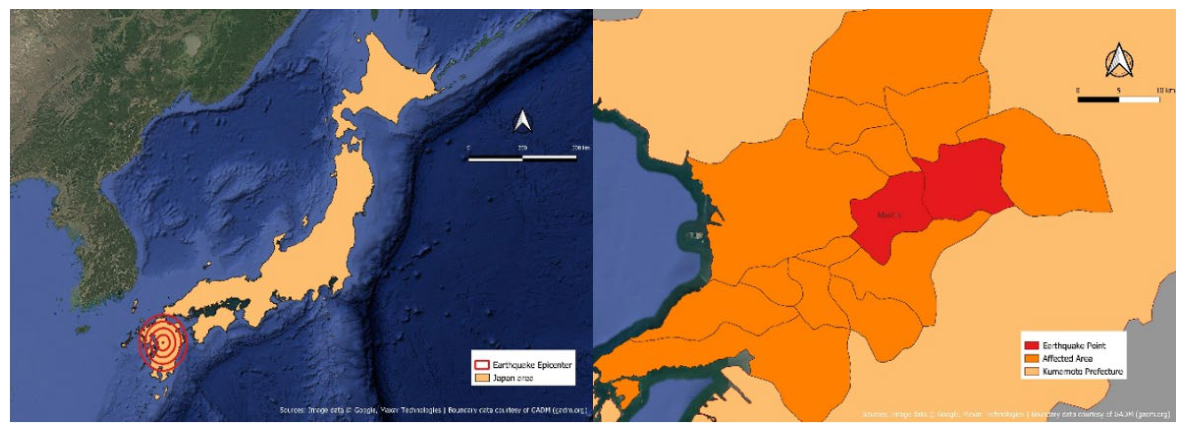
Figure 2.
2018 Central Sulawesi Earthquake affected areas.
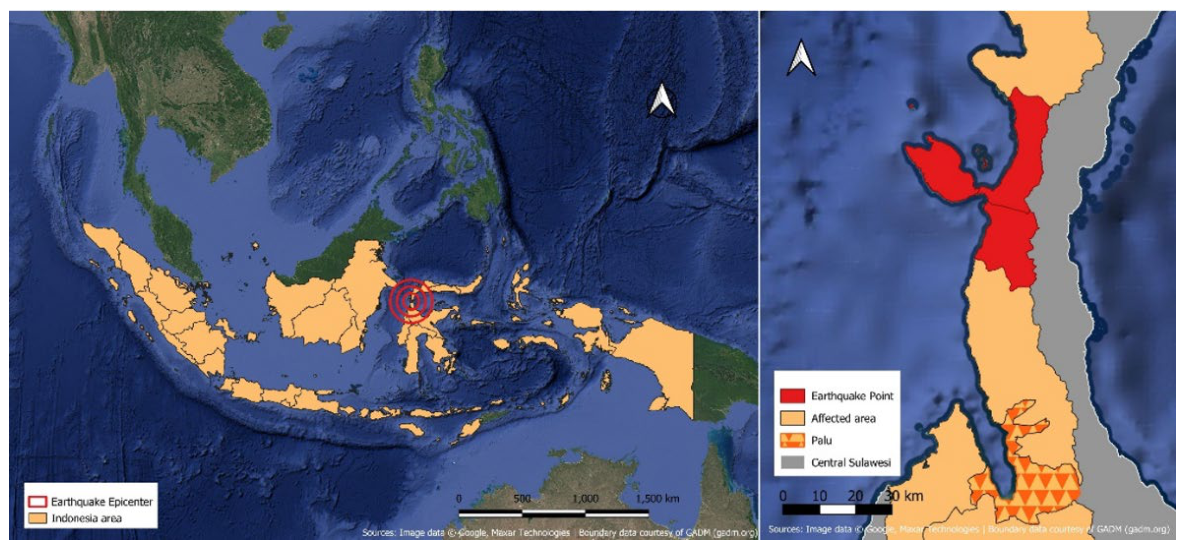
Table 1.
Conceptualization of causal and outcome conditions.
| Condition Code | Condition Type | Conceptual Definition |
|---|---|---|
| Pr | Outcome | Actual behavior of individual in protecting themselves from future threats. |
| DCM | Causal | Shared information and socio-cultural repository (in many forms) of past disaster to avoid forgetfulness. |
| TA | Causal | Individual’s mental process in evaluating threats and their vulnerability. |
| DSN | Causal | Social norms apply in community, consist of descriptive norms and subjective norms in relation to disaster preparedness. |
| CA | Causal | Individual’s assessment of their own capacity and response measure to protect them from threats. |
| Tr | Causal | People’s level of trust towards their governments and disaster related parties. |
Table 2.
Calibration threshold for fuzzy-set QCA variables.
| Variable Name | Code | Full Membership (0.95) | Cross-Over Point (0.50) | Full non-membership (0.05) |
|---|---|---|---|---|
| Disaster collective memory perception | DCM | 4.07 | 3.10 | 2.45 |
| Threat appraisal | TA | 2.06 | 1.63 | 1.43 |
| Social norms | DSN | 3.29 | 2.75 | 1.86 |
| Coping appraisal | CA | 2.03 | 1.75 | 1.50 |
| Trust | Tr | 2.67 | 2.27 | 1.99 |
| Preparedness behavior | Pr | 4.16 | 3.46 | 3.04 |
Table 3.
Empirical truth table rows and contextual configurations.
| TA | DSN | CA | Tr | Number of Cases | Raw Consistency | Associated Cases |
|---|---|---|---|---|---|---|
| 1 | 0 | 1 | 1 | 1 | 1.000000 | Japan |
| 0 | 0 | 0 | 0 | 1 | 0.523810 | Indonesia (+ Palu) |
| 0 | 1 | 0 | 0 | 1 | 0.326531 | Mashiki |
Table 4.
fsQCA causal configurations for high preparedness behavior (Pr).
| Causal Conditions | Run 1: Baseline Model (without Collective Memory) | Run 2: Expanded Socio-Cultural Model (with Collective Memory) |
|---|---|---|
| Disaster collective memory perception (DCM) | ● | |
| Threat appraisal (TA) | ● | ● |
| Coping appraisal (CA) | ● | ● |
| Trust (Tr) | ● | ● |
| Social norms (DSN) | space | space |
| Solution pathway | TA x CA x Tr → Pr | DCM x TA x CA x Tr → Pr |
| Empirical case fit (>0.5) | Japan (0.95, 0.95) | Japan (0.95, 0.95) |
| Raw coverage | 0.709677 | 0.709677 |
| Unique coverage | 0.709677 | 0.709677 |
| Solution consistency | 0.909091 | 1.000000 |
| Overall solution coverage | 0.709677 | 0.709677 |
1 Note: ●: the presence of a condition. Blank spaces: the condition was minimized out of the configuration and is indifferent to the pathway.
Table 5.
Differentiation in disaster policy implementation.
| Attribute | Highly Structured Environments (e.g., Japan) | Reconstructive Environments (e.g., Palu, Indonesia) |
|---|---|---|
| Baseline State | Strong regulatory compliance, deep historical risk archives, mature multi-layered structural mitigation | Post-disaster disruption, fragmented governance, low civic trust, physical and social displacement |
| Policy Mandate | Optimize and humanize: balance structural mitigation with local values, identity, and ecological access to prevent institutional fatigue | Fundamentally reconstruct: rebuild institutional trust, secure housing and economic protections, establish rapid risk financing |
| Primary Mechanism | Socio-technical optimization and community-driven design | Targeted community-based risk communication, land-use planning, and social safety nets |
Disclaimer/Publisher’s Note: The statements, opinions and data contained in all publications are solely those of the individual author(s) and contributor(s) and not of MDPI and/or the editor(s). MDPI and/or the editor(s) disclaim responsibility for any injury to people or property resulting from any ideas, methods, instructions or products referred to in the content. |
© 2026 by the authors. Licensee MDPI, Basel, Switzerland. This article is an open access article distributed under the terms and conditions of the Creative Commons Attribution (CC BY) license (http://creativecommons.org/licenses/by/4.0/).
Copyright: This open access article is published under a Creative Commons CC BY 4.0 license, which permit the free download, distribution, and reuse, provided that the author and preprint are cited in any reuse.