

Submitted:
07 October 2026
Posted:
09 October 2026
You are already at the latest version
Abstract
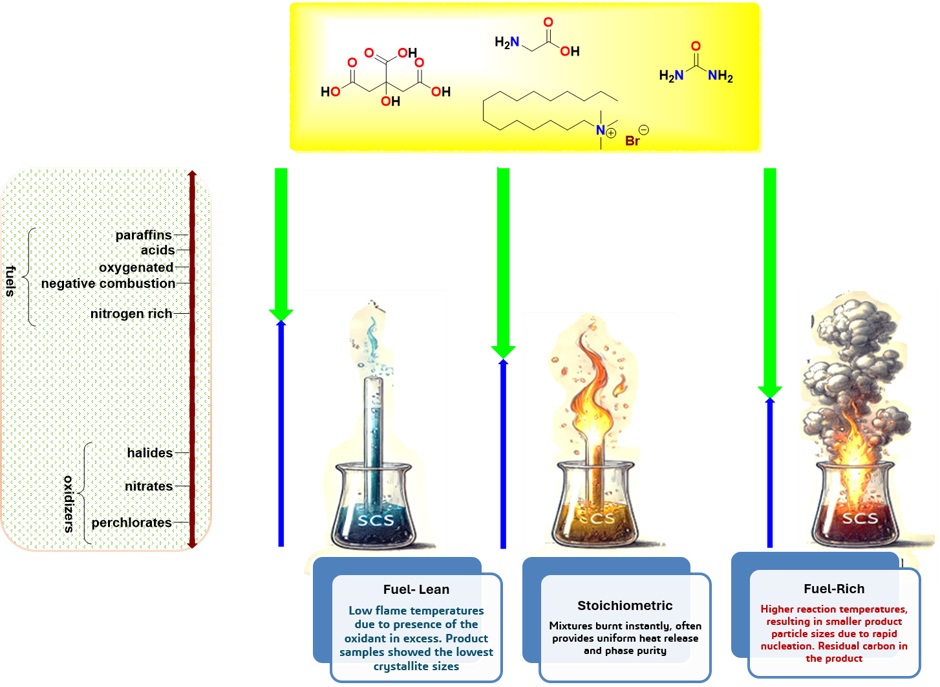
Solution Combustion Synthesis (SCS) continues to emerge as a green synthesis method for the preparation of advanced inorganic nanomaterials with tailored physicochemical properties. This review discusses the basic concepts of fuel–oxidizer ratios in solution combustion synthesis and explores in detail the effects of different types of fuel-oxidizer mixtures, oxidizer nature, fuel type, experimental conditions, and targeted material properties on the optimization of combustible mixtures. Furthermore, highlights on the impact of varying fuel–oxidizer ratios on powder properties and their performance in different applications such as biosensing, catalysis, photocatalysis, and electrochemical energy storage were analyzed. Findings demonstrate that careful modulation of the combustible mixture enables structured tuning of nanomaterial properties for specific technological applications. However, despite the significant progress achieved in solution combustion synthesis, challenges still exist with controlling the combustion reaction, carbonaceous impurities, scalability, and morphology regulation. Hence, the review suggest that future perspectives should focus on the integration of advanced thermodynamic modelling, real-time in situ characterization techniques, and the development of novel fuels and oxidants to achieve improved combustion precision and reproducibility. These advancements are expected to enhance the scalability and industrial applicability of SCS while enabling the design of next-generation functional nanomaterials with superior performance and sustainability.
Keywords:
solution combustion synthesis
; combustion temperature
; fuel-oxidizer ratio
; nanomaterials
; powder properties
Copyright: This open access article is published under a Creative Commons CC BY 4.0 license, which permit the free download, distribution, and reuse, provided that the author and preprint are cited in any reuse.