
Submitted:
07 October 2026
Posted:
09 October 2026
You are already at the latest version
Abstract
Cells often behave differently after a brief stimulus has ended. This is called cellular memory, but persistence alone does not show it. The same phenotype can come from leftover agent or signal, selection of cells that were already different, a shift in the mix of cell states, genetic change, or a state held by the exposed cells. This Review compares how four fields use the word (trained immunity, stem-cell inflammatory memory, yeast transcriptional memory and cancer drug tolerance). It lists seven explanations and the test that separates each. It then proposes a framework for judging what a study can claim: four ordered gates and four claim labels (U, P, M, H). The labels are operational categories, not grades of truth or of study quality. A test not done counts as untested, not as negative. The framework is a proposal, not a validated standard. A planned audit, set out in the Supplement, would test it against failure conditions stated in advance.
Keywords:
cellular memory
; transient exposure
; drug-tolerant persisters
; selection
; epigenetic memory
; evidence framework
1. Introduction
When an exposure ends, the cells that met it are often changed. Innate immune cells activated once respond differently to later triggers [1,2]. Skin stem cells that lived through inflammation heal wounds faster long after it has cleared [3]. Yeast that switched a gene on can switch it on again faster, for several divisions [4,5]. Tumour cells that survive a drug can regrow after it is withdrawn, and often regain sensitivity [6]. These cases are called cellular memory: a lasting change in state or response after a brief stimulus [7]. But the word covers very different claims: brief priming, lasting molecular marks, altered recall, persistence during treatment, and inheritance through division.
Three questions are often run together. Who is present after the exposure? Why are they present? Do those same cells now respond differently to a later challenge? A population can stay rich in tolerant cells while no identified cell remembers anything. A cell can respond differently without ever dividing. Passing a state on through division is a further step.
| What this Review adds |
| Persistence is not sufficient to establish cellular memory. This Review proposes a gated framework that separates persistence, cell or lineage attribution, exposure-dependent contribution, recall and mitotic propagation. It asks not only what a study observes, but what that evidence allows it to claim. |
| Unlike reviews that mainly summarise mechanisms or findings, the framework gives a fixed structure for seeing where a cellular-memory claim is supported, where it stays unresolved, and where the evidence should stop. It is a falsifiable proposal, not a validated standard. The contribution is not a new mechanism or observation, but an explicit evidentiary architecture that stops persistence, lineage, origin, recall, propagation and mechanism from being treated as interchangeable. |
Reviews of drug-tolerant persisters map definitions, models and mechanisms [10,15,16,44]. A recent review grades evidence on persistence after withdrawal, maintenance across divisions and response to rechallenge, as different strengths of support, not required criteria [22]. Tools for parts of the problem exist: lineage tracing and barcoding [18,25], fluctuation tests [19,20], models of heritability and switching [21,26,27], and criteria for trained immunity and bacterial persistence [1,23,24] (Table S1). What is missing is one ordered rule for what each kind of evidence lets a study claim. This Review proposes one (Figure 1). Each element is known. The contribution is the combination, and we do not claim that it beats the tools above. Whether it is useful is a question for the test in Section 7.
The Review makes three moves. It compares how four fields use the word (Section 2). It lists seven explanations for a persistent phenotype and the test that separates each (Section 3). It proposes four gates and four claim labels (Section 4 and Section 5), and reads published work through them (Section 6). It offers no universal definition of cellular memory. “Memory” is a working name, M is an operational label, and nothing here has been validated.
2. One word, Four Fields
Each research tradition that uses the word “memory” has its own standard of proof. Table 1 sets four side by side. The comparison is by design, not by merit. No study is scored here, and a study in any field can earn a higher or lower label than its field’s usual design suggests.
Each field lends the framework a piece of its logic. Bacterial persistence is defined by what is observed [24], which is the logic behind P. Trained immunity is defined by altered response to later triggers [1,2] and kept apart from tolerance and priming [23]. That is the logic behind M and the note on direction. Yeast work shows that a long-lasting signal can mimic a state [4,5,29] and that inheritance may last only a few divisions, which is why Gate 4 states a number. Cancer biology brings the problem of selection and the tools to test it: barcoding [25] and fluctuation tests [19,20]. The framework joins these pieces and replaces none of them.
Three points follow. First, each field proves most strongly the part it needs: immunology tests recall, cancer biology tests persistence, yeast work tests propagation. The other parts are often taken for granted. Second, the unit of evidence differs. A change seen in bulk cells is a population effect. The same change seen in followed cells is a claim about those cells. Third, origin is handled differently. In isogenic cells, selection of a pre-existing state is a weak rival. In heterogeneous tumours it is a leading one [8,9]. The same word therefore names different claims. That is the case for a shared, ordered statement of what was shown.
3. Seven Reasons a Phenotype Can Outlast Its Cause
Between a persistent phenotype and a memory claim stand at least seven explanations (Table 2). They sit at different levels. The first two ask whether the exposure really ended. The third and fourth describe the population, not the cell. The last three say what keeps a state going or how far it travels. Read as one flat list, they send a memory claim against the wrong comparison. Variation that exists before treatment and states that treatment induces can both be real, and often coexist [8,9,10,11,12,13].
Drug-tolerant persister cells show why the list matters. A 2010 study described a small, reversibly drug-tolerant subpopulation linked to a chromatin state [6]. That supports reversible tolerance. Alone, it cannot separate pre-existing variation, induced change and memory of the drug. In melanoma, rare cells express resistance markers before treatment, and the drug then pushes some into a stable resistant state [8]. In lung cancer, resistant cells can pre-exist and can also arise from tolerant cells [9]. Barcoding linked cycling and non-cycling persisters to different lineages [14]. Reviews list cell-to-cell variation, induced transitions, clonal dynamics and the microenvironment as all contributing [10,15,16]. Regrowth or regained sensitivity after withdrawal shows reversibility within the interval tested. It does not show same-cell memory, induction by the exposure or propagation. Some studies now describe memory formed by treatment [17], and a recent review asks what such claims need [22]. What differs between studies is the evidence offered to separate memory from the other explanations.
4. What Counts as Evidence
Persistence is an observation; memory is an exposure-attribution claim.
The step from the first to the second is where errors enter, because one observation fits many explanations. A claim deserves trust in proportion to how hard it was to fail [28,45]. A check counts only if it could have gone against the claim. Each gate below is built that way.
Three kinds of statement are kept apart. An observation is what a measurement showed. An inference is what follows if the design is sound. An assumption is what we took for granted, such as full delivery of the exposure or the absence of a hidden subpopulation. A label is only as strong as its weakest assumption, so assumptions are named, not buried. Six rules follow.
- A label describes a report, not cells. M says that named rivals were tested for and not found, within what the design could detect. New data can overturn it.
- A pass is relative to the design: system, interval, assay and detection limit. Rivals that were not measured can never be excluded, so the label is silent about them.
- Silence is not a result. A test not reported (NR), not done (ND) or not assessable (NC) is never coded 0. Done and failed is 0. Partly met is 1. Met is 2.
- Two failures differ. A rival shown to explain the result counts against the claim. A rival not excluded only leaves the claim open.
- “Memory” names a pattern of evidence, not one natural kind.
Three things are recorded on separate axes: the label (U, P, M or H), the origin of the state (pre-existing, induced, mixed or unresolved) and the carrier, the proposed maintenance mechanism (C0 to C2). None changes another.
The framework is conservative by design. M needs several tests to pass together, so a true memory phenotype can sit at P because one test is missing. We accept more missed positives in return for fewer unsupported claims. The size of that trade is unknown. The framework is held to the standard it sets: Section 7 states which results would make us change or drop it.
5. A Gated Framework
Four ordered gates test persistence (Gate 1), attribution to exposed cells (2A), exposure contribution beyond detectable selection (2B), recall (Gate 3) and mitotic propagation (Gate 4). Each applies to a population for which the previous gate is settled (Figure 1). The label is a conjunction, so the order does not change it. The order fixes the exit shown and the reporting path, and it blocks reclassification after the fact. Persistence comes first, because without it nothing remains to explain. Attribution comes before origin, because it fixes the unit (cell, clone or lineage) in which origin is judged. Propagation comes last, because it applies to a state already shown.
5.1. Terms

Table 3.
Key terms.
| Term | Working definition |
| Persistent phenotype | A reproducible difference from matched unexposed controls, measured at a stated time after the exposure ended, once leftover agent and relay signals have been cleared or shown too weak to explain it. |
| Exposed cells | Cells shown to have received the exposure, or a defined lineage shown to contain exposed descendants. A barcode alone does not show exposure. |
| Same-cell, clone-level and lineage-level persistence | The difference is seen in identified cells followed over time, in a recovered clone, or in a barcoded or otherwise defined lineage. Not every descendant need keep it. None of these shows cell autonomy. |
| Selection alone | Differential survival or growth of a pre-existing state, with no exposure-dependent change of state in the tracked cells or lineage under the design’s counterfactual. |
| Recall | A history-dependent change in the size, speed, threshold or quality of the response to a defined second challenge, against time-matched, exposure-naive controls. A weaker, delayed or different response counts. The challenge must be separated in time from the first exposure. Its direction is recorded and does not change the label, so trained-immunity-like and tolerance-like responses stay visible but apart [23]. |
| Mitotic propagation | The altered phenotype itself, not only a marker or barcode, persists in daughter cells that arose after the exposed cell divided, through a stated number of divisions. It does not imply germline inheritance, absence of DNA change or any carrier. |
| Cell autonomy | A state kept without outside relay. It needs separate evidence and is not required for M. |
5.2. Labels
The word “memory” in M is deliberately operational. It names the evidence category defined by the gates. It does not claim that the underlying state is a distinct natural kind. M is an operational label for an exposure-attributed, persistent change in later response, against the alternatives the study could detect.
Table 4.
Labels. Colours match Figure 1. Labels are claim-status categories of different specificity, not grades of importance. U is a status, not a claim about biology.
Table 4.
Labels. Colours match Figure 1. Labels are claim-status categories of different specificity, not grades of importance. U is a status, not a claim about biology.
| Label | Name | Minimum condition | What it licenses | What it does not establish |
| U | Persistence not established in the report (a status, not a biological conclusion) | Gate 1 not established. Sub-status: not reported or not done (NR, ND); not assessable (NC); tested, criterion not met (0 or 1) | Only that this report does not show persistence | Whether anything persists after the exposure and relay signals ended |
| P | Persistent phenotype | Gate 1 = 2 | A reproducible difference remained after the exposure and relay signals ended | Cell autonomy, which cells carry it, origin, recall, propagation |
| M | Exposure-attributed memory claim (working label) | Gates 1, 2A, 2B and 3 all = 2 | Exposed cells or their defined descendants show an altered response to a later challenge that is attributable to the exposure, within the alternatives the design could detect | Propagation; the carrier |
| H | Memory with mitotic propagation | M plus Gate 4 = 2 | The same, and the altered state persisted through the stated divisions in the lineages followed | Any particular mechanism of inheritance |
P is not a weak M. H is not a higher grade than M. It is a narrower claim that adds propagation, and it holds for the lineages followed. U does not mean that nothing persists. It often means the study was not built to answer Gate 1, for example because it measured response during treatment. Recall seen only in bulk cells stays at P as “population-level recall”. For non-dividing cells H does not apply. The study-level label summarises the study’s primary claim. It does not say that every model in the paper meets the same label.
M is narrow on purpose. It is a claim about exposed cells, so it needs cell-level attribution (2A) and evidence that the exposure contributed (2B). A pre-existing susceptibility does not exclude M when the exposure demonstrably changes, stabilises or reprograms the state. A pre-existing state that only survives or expands stays at P. M needs neither cell autonomy nor propagation: trained immunity is defined by altered response to later triggers [1,2]. All of this is a scope choice. It does not say that trained immunity, or any other field’s memory, is not memory in the wider sense.
5.3. Gates
Table 5 gives each gate in brief. The full rules, codes and coding criteria are in the Supplement (Part B).
An example of mixed origin. A clone with high baseline expression of a marker is more likely to switch state (predisposition). After exposure the marker rises in that clone but not in its unexposed sister culture. This is mixed origin, and 2B = 2. A drug-naive resistant clone that simply outgrows the rest is selection alone, and 2B is 0 or 1. A baseline marker or a surviving clone cannot settle the question, because each shows presence, not contribution. Tracking the same cells before and after exposure is not enough unless unexposed cells are tracked too, because cells change state with no exposure.
5.4. The Carrier Is Noted, Not Required
What keeps a state going does not gate a label. “Carrier” means a proposed maintenance mechanism, not a transport vehicle. It is noted on three levels: C0, not examined; C1, named on correlative evidence; C2, perturbation-consistent support, meaning that perturbing the proposed carrier changes the persistent phenotype in a direction and size set in advance, with non-specific effects such as cell death or slowed growth accounted for. C2 is consistent with a causal role. It is not proof of mechanism, because a perturbation can be toxic or act on many things at once. Models show that feedback among chromatin modifications can let a state outlast its stimulus [34]. That shows a mechanism is possible, not that a given phenotype uses it. Trained immunity has been linked to epigenetic programming [35] and to mTOR- and HIF-1α-dependent glycolysis [36]. These are candidate links, not C2 evidence. In yeast, a histone mark can be copied through replication [37], which shows what a C2 claim can look like.
A carrier can also be genetic. A genetic carrier shown at C2 adds the suffix -g to M or H (M-g, H-g). The suffix is an annotation of the carrier. It is not a higher grade, not a claim of non-genetic memory, and not evidence that the exposure caused the genetic change. Such a case should also be called genetic adaptation or acquired resistance.
Table 6.
From observation to warranted statement.
| Observation | Unwarranted inference | Warranted statement |
| Cells survived the drug | The cells remembered the drug | The cells showed drug tolerance under this regimen |
| A population stays tolerant after washout | The state is stable in each cell | A population-level phenotype persists |
| The same lineage remains after exposure | The exposure induced memory | Lineage persistence is shown; origin is unresolved |
| Cells respond faster to a second stimulus | Epigenetic memory is proven | Altered recall is shown; the carrier is unexamined |
| The state appears in daughter cells | Epigenetic inheritance is proven | Mitotic propagation is shown; the carrier is unresolved |
| A genetic change persists after exposure | Non-genetic memory is proven | A persistent genetic change is shown; labelled -g if the gates are met |
| Regrowth and regained sensitivity after withdrawal | No memory exists | The state is reversible within the interval tested |
6. Reading Published Work Through the Framework
None of the studies below has been scored. The readings are illustrations of what the gates ask, not verdicts.
Trained immunity. Studies that use bulk cells and ex vivo re-stimulation, with no link to defined cells or lineages, stay at P as “population-level recall”, even though recall defines the field [1,2]. This reflects what such designs show about cell history, not the importance of the finding. Sensitivity analysis SA3 shows how many would qualify if 2A were only a note. 2A stays a requirement because M is a claim about exposed cells, and a claim about cells needs evidence about cells.
Inflammatory memory in skin stem cells. Naik and colleagues exposed mouse skin to acute inflammation and found that epithelial stem cells later healed wounds faster, with reported dependence on AIM2 and IL-1 signalling [3]. The study has the elements of exposure, persistence, altered response and mechanistic perturbation. It was not designed around the gates, so it is a candidate anchor for the test in Section 7.
Adaptation to cancer therapy. In melanoma cells, a low dose of therapy led to resistance to a high dose, which the authors took to show that resistance was not purely selective [17]. Because treatment never stopped, such a design bears on selection (the question of 2B) but cannot show persistence after removal (Gate 1). One study can thus speak to several gates and complete none of them. The framework makes visible which gates each experiment addresses, without judging the study.
Heritable states and origin. In colorectal cancer models, “cellular memory” names a heritable epigenetic configuration from which several programs can run [42]. That is a claim about maintenance, and the framework would still ask whether the exposure created it. The same drug can select a pre-existing resistant subpopulation in one cell line and cause switching in another [27], so origin is coded per model. Where a heritable pre-treatment state is read as memory [43], the framework records a predisposition. It assigns M only if the exposure is shown to contribute under Gate 2B. This does not say that the paper is wrong.
What each field would gain. The gates ask for different things in different places. In immunology they ask for cell-level evidence behind a well-established recall result. In cancer biology they ask for recall tests where persistence is well documented. In heterogeneous tissues they ask for a clearer account of origin. In yeast they ask for exposure of every cell. Each field gains most from the part it now takes for granted.
7. How the Framework Would Be Tested
A framework that has never met real papers is untested. The Supplement (Part C) sets out a pilot audit of cancer drug-tolerance studies. It has not been done. No result is reported, and this Review claims no empirical validation. The audit asks whether two coders reach the same label, whether the gates separate studies that differ in evidence, and whether the labels sort a literature usefully. Its main outcome is the gap between the authors’ wording and the label their evidence supports: “memory” with a label below M, or “heritable” memory with a label below H. It tests the framework, not memory and not the field. It is not a systematic review, and it cannot say how common memory is. Figure 1 shows what the audit would code.
Two failure conditions are fixed in advance. The thresholds are pilot rules, not validated cut-offs. Meeting either triggers a prespecified review and possible revision. The framework is dropped for this use only if, after one documented revision, reliability stays poor, contrasting held-out anchors still cannot be told apart, or transfer fails. None of this would mean that any biology is wrong.
- Reliability failure. Cohen’s kappa [39] for the study-level label is below 0.60, together with low raw agreement or disagreement that stays unresolved after calibration. The 0.60 value is an arbitrary pilot rule. Kappa alone does not trigger failure, because it depends on how common each category is, so Gwet’s AC1 [40] is reported beside it.
- Discrimination failure. Before coding, at least two pairs of held-out studies are named that differ by an observable design feature (for example rechallenge done or not done, lineage-resolved tracking or none), not by the label we expect. The condition is met if both members of a pair receive the same label and the same origin and propagation notes after blinded coding. This is the more informative test. Two coders can apply a poor rule alike, so reliability is not validity.
Three further checks are not failure conditions. An anchor-concordance check asks whether the rubric is applied as intended to held-out studies whose authors explicitly claim memory. It tests implementation, not validity, because the reference classifications come from the framework’s own criteria. A transfer test applies the same rubric to trained immunity, yeast and stem-cell memory. If substantial parts cannot be coded there, the scope of the framework will be narrowed. Two descriptive diagnostics, on the concentration of labels and on the strictness of Gate 1, are given in the Supplement.
Limits. The audit covers one literature and measures reporting, not biology. A missing item measures the completeness of a report, not the quality of the study or the absence of the state. The rubric was written by the first coder, and a blinded second coder reduces this but cannot remove it. Only English-language, peer-reviewed papers are covered, and the search depends on terminology. Reversibility after withdrawal is compatible with memory of limited duration. The framework may be too strict or too complex for some literatures, and it treats the microenvironment only through Gate 1. Sensitivity analyses SA2, SA3 and SA9 show how results change when its strictest requirements are relaxed.
8. Outlook and Open Questions
The framework is a proposal. These questions decide whether it becomes a research programme or stays a way of sorting papers.
- Does M predict anything beyond classification? If not, the framework stays a taxonomy, though it could still serve as a reporting structure. If M also predicts behaviour on rechallenge, at relapse or under treatment, it becomes a tool for biology. The audit cannot answer this. It needs prospective experiments.
- Can memory exist without a measurable carrier? A study can reach M with the carrier at C0 or C1. That may point to states that current assays cannot see, or to claims that are not yet supported.
- How stable is M? Hours, days, weeks and divisions are different time scales. Can they be told apart without making duration a universal threshold? A long duration does not establish memory, and a short one does not exclude it.
- Can M turn into H? Some exposure-attributed states pass through division and others do not. What decides this is unknown. It matters most in cancer, where a state that divides can seed relapse.
- How do memory and genetic change interact? Many tolerant states may start non-genetic and later be fixed by mutation. Are the two exclusive, sequential or mixed?
- Does the framework travel? Trained immunity, yeast and stem-cell memory are test cases (Section 7). If the gates cannot be coded there, the framework is local to cancer drug tolerance.
Two steps would help at once. Designs that meet 2A, 2B and 3 together, such as barcoding before exposure with a matched unexposed counterfactual and a preset rechallenge, would show whether M is reachable in practice. And authors can state, in their own papers, which gates their design addresses. That alone would make claims easier to compare. A U label means that a report does not establish persistence, not that persistence is absent. Failing to reach M means that a requirement set in advance was not met in that study, not that the phenomenon does not exist.
9. Conclusion
What is new. This Review offers three things. First, a side-by-side reading of four fields that use one word for different claims (Table 1), and seven explanations that can each produce the same persistent phenotype, each with the test that separates it (Table 2). Second, an ordered rule. A claim moves on only when the evidence for each step is shown: persistence, attribution to the exposed cells, exposure contribution beyond detectable selection, recall and propagation. Persistence alone never earns a memory label, and a test not done is never scored as failed. Third, a fixed list of results that would make us change or drop the framework.
What follows. Authors can state what their design shows and name the step it leaves open. Reviewers and editors get a short list of questions to put to any memory claim. Readers can compare claims across fields. Experimenters are pointed to designs that are rarely run together: barcoding before exposure, a matched unexposed counterfactual and a preset rechallenge.
Perspective. This is a proposal until it is tested. If it passes the audit and the transfer test, it could become a shared reporting standard. If M predicts later behaviour, it becomes a tool for biology and not only for sorting papers (Section 8). If it fails, the failure conditions say how. The fields would keep their own definitions, and the gates would remain a checklist of what a persistence claim needs.
Persistence is an observation; memory is an exposure-attribution claim.
Supplementary Materials
The following supporting information can be downloaded at the website of this paper posted on Preprints.org.
Author Contributions
Said Ganihodjaev is the sole author. He conceived the study, developed the framework and the audit protocol, and wrote and revised the manuscript.
Funding
This work received no specific grant or funding from any public, commercial or not-for-profit body.
Institutional Review Board Statement
Not applicable. The work involved no human participants, animals or personal data.
Data Availability Statement
The audit protocol, coding manual and anchor list will be deposited in a public repository, with a dated version, at the audit freeze and before screening begins.
Conflicts of Interest
The author declares no competing interests.
References
- Netea, M.G.; Domínguez-Andrés, J.; Barreiro, L.B.; et al. Defining trained immunity and its role in health and disease. Nat. Rev. Immunol. 2020, 20, 375–388. [Google Scholar] [CrossRef]
- Netea, M.G.; Joosten, L.A.B.; Latz, E.; et al. Trained immunity: a program of innate immune memory in health and disease. Science 2016, 352, aaf1098. [Google Scholar] [CrossRef]
- Naik, S.; Larsen, S.B.; Gomez, N.C.; et al. Inflammatory memory sensitizes skin epithelial stem cells to tissue damage. Nature 2017, 550, 475–480. [Google Scholar] [CrossRef]
- Ge, T.; Brickner, J.H. Inheritance of epigenetic transcriptional memory. Curr. Opin. Genet Dev. 2024, 85, 102174. [Google Scholar] [CrossRef]
- Sump, B.; Brickner, J.H. Establishment and inheritance of epigenetic transcriptional memory. Front Mol. Biosci. 2022, 9, 977653. [Google Scholar] [CrossRef]
- Sharma, S.V.; Lee, D.Y.; Li, B.; et al. A chromatin-mediated reversible drug-tolerant state in cancer cell subpopulations. Cell 2010, 141(1), 69–80. [Google Scholar] [CrossRef]
- Burrill, D.R.; Silver, P.A. Making cellular memories. Cell 2010, 140(1), 13–18. [Google Scholar] [CrossRef]
- Shaffer, S.M.; Dunagin, M.C.; Torborg, S.R.; et al. Rare cell variability and drug-induced reprogramming as a mode of cancer drug resistance. Nature 2017, 546, 431–435. [Google Scholar] [CrossRef]
- Hata, A.N.; Niederst, M.J.; Archibald, H.L.; et al. Tumor cells can follow distinct evolutionary paths to become resistant to epidermal growth factor receptor inhibition. Nat. Med. 2016, 22(3), 262–269. [Google Scholar] [CrossRef]
- Russo, M.; Chen, M.; Mariella, E.; et al. Cancer drug-tolerant persister cells: from biological questions to clinical opportunities. Nat. Rev. Cancer 2024, 24(10), 694–717. [Google Scholar] [CrossRef]
- Brock, A.; Chang, H.; Huang, S. Non-genetic heterogeneity—a mutation-independent driving force for the somatic evolution of tumours. Nat. Rev. Genet. 2009, 10, 336–342. [Google Scholar] [CrossRef]
- Goyal, Y.; Busch, G.T.; Pillai, M.; et al. Diverse clonal fates emerge upon drug treatment of homogeneous cancer cells. Nature 2023, 620, 651–659. [Google Scholar] [CrossRef]
- McGranahan, N.; Swanton, C. Clonal heterogeneity and tumor evolution: past, present, and the future. Cell 2017, 168(4), 613–628. [Google Scholar] [CrossRef]
- Oren, Y.; Tsabar, M.; Cuoco, M.S.; et al. Cycling cancer persister cells arise from lineages with distinct programs. Nature 2021, 596, 576–582. [Google Scholar] [CrossRef]
- Marine, J.C.; Dawson, S.J.; Dawson, M.A. Non-genetic mechanisms of therapeutic resistance in cancer. Nat. Rev. Cancer 2020, 20, 743–756. [Google Scholar] [CrossRef]
- Pisco, A.O.; Huang, S. Non-genetic cancer cell plasticity and therapy-induced stemness in tumour relapse: ‘What does not kill me strengthens me’. Br. J. Cancer 2015, 112, 1725–1732. [Google Scholar] [CrossRef]
- Li, J.; Ravindran, P.T.; O’Farrell, A.; et al. AP-1 mediates cellular adaptation and memory formation. Nat. Commun. 2026, 17, 4265. [Google Scholar] [CrossRef]
- Wagner, D.E.; Klein, A.M. Lineage tracing meets single-cell omics: opportunities and challenges. Nat. Rev. Genet. 2020, 21(7), 410–427. [Google Scholar] [CrossRef]
- Luria, S.E.; Delbrück, M. Mutations of bacteria from virus sensitivity to virus resistance. Genetics 1943, 28(6), 491–511. [Google Scholar] [CrossRef]
- Russo, M.; Pompei, S.; Sogari, A.; et al. A modified fluctuation-test framework characterizes the population dynamics and mutation rate of colorectal cancer persister cells. Nat. Genet. 2022, 54, 976–984. [Google Scholar] [CrossRef]
- Sun, H.; Kumari, N.; Melzer, M.E.; Backman, V.; Goyal, Y. Navigating nongenetic plasticity in cancer drug resistance. Annu Rev. Cancer Biol. 2025, 9, 245–266. [Google Scholar] [CrossRef]
- Shi, C.; Jiang, R.; Yan, J. Cellular memory after cancer therapy: persistence after drug withdrawal, maintenance across cell divisions, and responses to rechallenge. Front Pharmacol. 2026, 17, 1966584. [Google Scholar] [CrossRef]
- Divangahi, M.; Aaby, P.; Khader, S.A.; et al. Trained immunity, tolerance, priming and differentiation: distinct immunological processes. Nat. Immunol. 2021, 22, 2–6. [Google Scholar] [CrossRef]
- Balaban, N.Q.; Helaine, S.; Lewis, K.; et al. Definitions and guidelines for research on antibiotic persistence. Nat. Rev. Microbiol. 2019, 17, 441–448. [Google Scholar] [CrossRef]
- Bhang, H.C.; Ruddy, D.A.; Krishnamurthy Radhakrishna, V.; et al. Studying clonal dynamics in response to cancer therapy using high-complexity barcoding. Nat. Med. 2015, 21(5), 440–448. [Google Scholar] [CrossRef]
- Schiffman, J.S.; D’Avino, A.R.; Prieto, T.; et al. Defining heritability, plasticity, and transition dynamics of cellular phenotypes in somatic evolution. Nat. Genet. 2024, 56(10), 2174–2184. [Google Scholar] [CrossRef]
- Whiting, F.J.H.; Mossner, M.; Gabbutt, C.; et al. Quantitative measurement of phenotype dynamics during cancer drug resistance evolution using genetic barcoding. Nat. Commun. 2025, 16, 5282. [Google Scholar] [CrossRef]
- Platt, J.R. Strong inference. Science 1964, 146(3642), 347–353. [Google Scholar] [CrossRef]
- Rando, O.J.; Verstrepen, K.J. Timescales of genetic and epigenetic inheritance. Cell 2007, 128(4), 655–668. [Google Scholar] [CrossRef]
- Straussman, R.; Morikawa, T.; Shee, K.; et al. Tumour micro-environment elicits innate resistance to RAF inhibitors through HGF secretion. Nature 2012, 487, 500–504. [Google Scholar] [CrossRef]
- Wilson, T.R.; Fridlyand, J.; Yan, Y.; et al. Widespread potential for growth-factor-driven resistance to anticancer kinase inhibitors. Nature 2012, 487, 505–509. [Google Scholar] [CrossRef]
- Shaffer, S.M.; Emert, B.L.; Reyes Hueros, R.A.; et al. Memory sequencing reveals heritable single-cell gene expression programs associated with distinct cellular behaviors. Cell 2020, 182(4), 947–959. [Google Scholar] [CrossRef]
- Fennell, K.A.; Vassiliadis, D.; Lam, E.Y.N.; et al. Non-genetic determinants of malignant clonal fitness at single-cell resolution. Nature 2022, 601, 125–131. [Google Scholar] [CrossRef]
- Bruno, S.; Williams, R.J.; Del Vecchio, D. Epigenetic cell memory: the gene’s inner chromatin modification circuit. PLoS Comput Biol. 2022, 18(4), e1009961. [Google Scholar] [CrossRef]
- Saeed, S.; Quintin, J.; Kerstens, H.H.D.; et al. Epigenetic programming of monocyte-to-macrophage differentiation and trained innate immunity. Science 2014, 345, 1251086. [Google Scholar] [CrossRef]
- Cheng, S.C.; Quintin, J.; Cramer, R.A.; et al. mTOR- and HIF-1α-mediated aerobic glycolysis as a metabolic basis for trained immunity. Science 2014, 345, 1250684. [Google Scholar] [CrossRef]
- Brickner, J.H. Inheritance of epigenetic transcriptional memory through read-write replication of a histone modification. Ann. N Y Acad. Sci. 2023, 1526(1), 50–58. [Google Scholar] [CrossRef]
- Nosek, B.A.; Ebersole, C.R.; DeHaven, A.C.; Mellor, D.T. The preregistration revolution. Proc. Natl. Acad. Sci. USA 2018, 115(11), 2600–2606. [Google Scholar] [CrossRef]
- Cohen, J. A coefficient of agreement for nominal scales. Educ. Psychol. Meas. 1960, 20, 37–46. [Google Scholar] [CrossRef]
- Gwet, K.L. Computing inter-rater reliability and its variance in the presence of high agreement. Br. J. Math. Stat. Psychol. 2008, 61(1), 29–48. [Google Scholar] [CrossRef]
- Cohen, J. Weighted kappa: nominal scale agreement with provision for scaled disagreement or partial credit. Psychol. Bull. 1968, 70(4), 213–220. [Google Scholar] [CrossRef]
- Oliveira, E.A.; Milite, S.; Fernandez-Mateos, J.; et al. Epigenetic heritability of cell plasticity drives cancer drug resistance through a one-to-many genotype-to-phenotype paradigm. Cancer Res. 2025, 85(15), 2921–2938. [Google Scholar] [CrossRef]
- Emert, B.L.; Cote, C.J.; Torre, E.A.; et al. Variability within rare cell states enables multiple paths toward drug resistance. Nat. Biotechnol. 2021, 39(7), 865–876. [Google Scholar] [CrossRef]
- Aguilar-Cazares, D.; Lopez-Gonzalez, J.S.; Perez-Medina, M.; Galicia-Velasco, M. Drug-tolerant persister cells in cancer: a scoping review of definitions, models, and molecular mechanisms. Front Oncol. 2026, 16, 1771061. [Google Scholar] [CrossRef]
- Mayo, D.G. Statistical inference as severe testing: how to get beyond the statistics wars; Cambridge University Press: Cambridge, 2018. [Google Scholar]
Figure 1.
Gates, exits and labels. Boxes on the right show where a claim stops. A stop means the next label is not earned, not that memory was disproved. Gate 2 is one gate with two parts, and the exit shows which part is missing. The label is the most specific one for which all required gates equal 2; parts coded NA are left out of that rule. Labels are claim-status categories of different specificity, not grades of quality. M is a working label (Table 4). Grey marks U, yellow P, light green M, dark green H, and purple the maintenance mechanism, which never gates a label. Gate 4 does not apply to non-dividing cells. The figure is original and has not been published elsewhere.
Figure 1.
Gates, exits and labels. Boxes on the right show where a claim stops. A stop means the next label is not earned, not that memory was disproved. Gate 2 is one gate with two parts, and the exit shows which part is missing. The label is the most specific one for which all required gates equal 2; parts coded NA are left out of that rule. Labels are claim-status categories of different specificity, not grades of quality. M is a working label (Table 4). Grey marks U, yellow P, light green M, dark green H, and purple the maintenance mechanism, which never gates a label. Gate 4 does not apply to non-dividing cells. The figure is original and has not been published elsewhere.
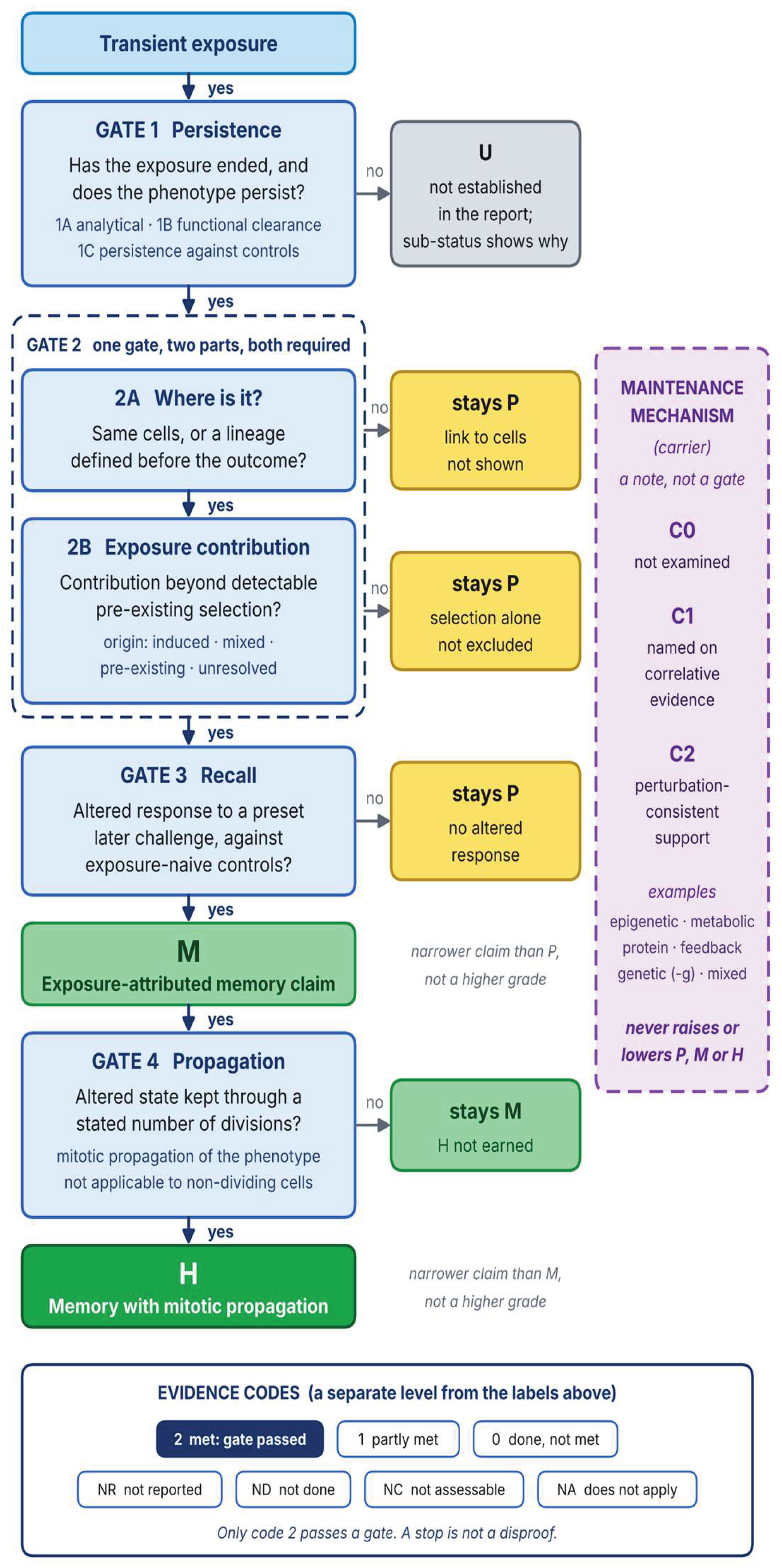
Table 1.
What each field usually shows, and what often stays open. The last column is a hedged reading under the framework; no study has been coded.
Table 1.
What each field usually shows, and what often stays open. The last column is a hedged reading under the framework; no study has been coded.
| Field | What is usually shown | What often stays open | What the usual design may support |
| Trained immunity [1,2,23] | Altered response to a later stimulus, often in bulk cells ex vivo, with epigenetic and metabolic marks [35,36] | Link to identified cells or lineages; clearance of the first stimulus; origin | P with population-level recall; potentially M where cells or lineages are followed |
| Inflammatory memory in stem cells [3] | Earlier inflammation, later faster repair, and a perturbed mechanism | Whether the same exposed cells were followed; origin; propagation | Potentially M if 2A and 2B are met |
| Yeast transcriptional memory [4,5,37] | Faster reactivation and inheritance over a few divisions, with a histone mark | Fading signal versus state; lineage-resolved evidence; exposure of every cell | Potentially M or H if the gates are met |
| Cancer drug-tolerant persisters [6,8,9,10,12,14] | Persistence, regrowth and tolerance after treatment; lineage barcoding in some studies | Selection versus induction versus memory; clearance; recall is rarely tested | Depends on design |
Table 2.
Seven explanations for a persistent phenotype, and the test that separates each.
| Explanation | What it predicts | Test that separates it | Gate |
| 1. Leftover agent | Phenotype fades as drug leaves cells and medium; reappears if the residual level is added back | Measure drug in cells and medium; add back at the residual level to naive cells | 1A, 1B |
| 2. Continued signalling (autocrine, paracrine, niche) | Phenotype follows the medium or the neighbours, not the cell [30,31] | Conditioned-medium transfer with a fresh-medium control; blockade; co-culture separation | 1B |
| 3. Selection of a pre-existing subpopulation | The same lineages win with or without the exposure | Barcode before exposure; compare unexposed sister cultures | 2B |
| 4. Shift in the mix of cell states | The population changes, but no tracked cell does | Follow the same cells or lineages; count growth and loss | 2A |
| 5. Genetic change | Phenotype tracks a mutation or copy-number change | Sequence persisters and controls; record as carrier (-g) | Carrier |
| 6. Stable state in the same cells (memory) | Exposed cells respond differently to a later challenge | Preset rechallenge against exposure-naive controls | 3 |
| 7. State passed through division | Daughter cells keep the altered phenotype | Lineage-resolved tracking through a stated number of divisions | 4 |
Table 5.
The gates in brief.
| Gate | Question | What satisfies it | A stop means |
| 1 | Is what remains of the exposure too weak to explain the phenotype, and does the phenotype persist? | Leftover agent and relay signalling shown too weak, by analytical (1A) and functional (1B) tests that fit the exposure. The difference persists against matched unexposed controls, in independent biological units, at a stated time after removal (1C). | Persistence not established (U). Continued signalling is supported if the phenotype is lost under blockade or moves with the medium. |
| 2A | Can the phenotype be linked to exposed cells, or to a lineage that contains them? | Longitudinal link to identified exposed cells, or to a lineage whose ancestry was fixed independently of the outcome (for example a barcode applied before exposure). A barcode shows presence, not exposure. | A shift in the mix of states may explain it (stays P). |
| 2B | Does the design support an exposure contribution beyond detectable selection? | A controlled design with a counterfactual: paired tracking with matched unexposed cells, a split population with exposed and unexposed sister cultures, or lineage-specific perturbation. A pass does not show that selection did not contribute. It shows that the tested selection model does not fully account for the exposure-associated change. | Selection alone is not excluded (stays P). |
| 3 | Do the tracked cells respond differently to a defined later challenge? | Preset challenge, dose, interval and measure; exposure-naive controls; an effect that meets a criterion set before analysis or an external standard. A p-value alone never gives 2. Confounders (cell number, viability, growth, stress resistance) are controlled. | No altered response (stays P). |
| 4 | Is the altered state kept through a stated number of divisions? | Lineage-resolved persistence of the phenotype itself, checked in the intervening generations and not only at the end of a clone’s expansion. The number of lineages and the fraction that keep it are reported. The claim reaches no further than the divisions and lineages followed. | The state is lost within the divisions followed (stays M). |
Disclaimer/Publisher’s Note: The statements, opinions and data contained in all publications are solely those of the individual author(s) and contributor(s) and not of MDPI and/or the editor(s). MDPI and/or the editor(s) disclaim responsibility for any injury to people or property resulting from any ideas, methods, instructions or products referred to in the content. |
© 2026 by the author. Licensee MDPI, Basel, Switzerland. This article is an open access article distributed under the terms and conditions of the Creative Commons Attribution (CC BY) license.
Copyright: This open access article is published under a Creative Commons CC BY 4.0 license, which permit the free download, distribution, and reuse, provided that the author and preprint are cited in any reuse.