

Submitted:
07 October 2026
Posted:
09 October 2026
You are already at the latest version
Abstract
Mono-substituted 1-n-alkyladamantanes provide a homologous cage–chain platform for resolving chain-length effects relevant to advanced aerospace fuels. Adamantane (Ada) and its 1-methyl- to 1-pentyl-substituted homologues were examined using density functional theory, molecular descriptors, occupied-valence orbital analysis, and 13C NMR calculations. From Ada to peAda, the electronic spatial extent increases from 1137.99 to 5136.94 a.u. (over 4-fold); the A rotational constant decreases by approximately 10%, and the B and C constants by approximately 85%, marking the transition from a compact spherical-top cage to elongated, near-prolate asymmetric homologues. Dipole moments remain low (0.00–0.18 D). The adjacent-homologue electronic-energy increment approaches a constant contribution per added CH2 unit, with the prAda–peAda values spanning 0.203 kcal mol−1; this unbalanced increment does not measure relative stability. Across the series, the HOMO binding-energy descriptor changes by 0.174 eV and the occupied-valence count increases from 28 to 43. Calculated 13C NMR shifts identify Cα, C1′, and adjacent cage CH2 sites as the principal cage–chain interface. eAda shows the largest additional local perturbation; from prAda onward, cage-carbon shifts vary little while successive methylene units generate increasingly differentiated side-chain resonances. Agreement with experiment is stronger for spectral pattern and signal ordering than for uncorrected absolute shifts. These descriptors support screening of chain-length effects without directly predicting fuel performance.
Keywords:
high-energy-density fuels
; sustainable aviation fuel (SAF)
; alkyl adamantanes
; diamondoid hydrocarbons
; Cage-chain interplay
; 13C NMR
; density functional theory (DFT)
1. Introduction
High-energy-density (HED) hydrocarbons remain important molecular platforms for advanced aviation and aerospace fuels because they can combine high volumetric energy density, compact molecular architecture, and favourable combustion characteristics (Xie, Shi et al. 2021, Wang and Vasilyev 2027). Among these candidates, strained and cage-like hydrocarbons are particularly attractive because their dense carbon frameworks can provide energy-density advantages while maintaining hydrocarbon compatibility with conventional fuel systems (Kabo, Kazarina et al. 2022, Liu, Pan et al. 2022). However, practical fuel design requires more than high intrinsic energy content: candidate molecules must also exhibit suitable liquid-phase behaviour, oxidative and thermal robustness, manageable volatility, and molecular features that can be screened before synthesis or large-scale testing (Liu, Pan et al. 2022).
The rigid tricyclic adamantane moiety and its 1-alkyl-substituted derivatives provide a useful family for developing such design rules (Kabo, Kazarina et al. 2022, Roy, Titov et al. 2023, Song, Zhang et al. 2024). The parent adamantane cage offers a highly symmetric diamondoid framework (Dane, Montgomery et al. 2025), while bridgehead alkyl substitution provides a controlled way to tune molecular size, anisotropy, packing efficiency, volatility, and spectroscopic response without disrupting the rigid saturated cage (Liu, Pan et al. 2022, Song, Zhang et al. 2024). The fuel relevance of this architecture was demonstrated by Harvey et al., who synthesised and characterised alkyl diamondoid fuels including 1-pentyladamantane, 2-butyladamantane, 2-propyladamantane, and 2-ethyladamantane; these molecules combined densities near or above conventional jet fuel with high volumetric net heats of combustion and unusually high derived cetane numbers for multicyclic hydrocarbons (Harvey, Harrison et al. 2016, Xie, Shi et al. 2021). In particular, 1-pentyladamantane exhibited a density of 0.915 g mL−1, a volumetric net heat of combustion (NHOC) of 39.0 MJ L−1, and a derived cetane number of 48.5, demonstrating that a normal alkyl chain attached to the adamantane scaffold can partially reconcile high density with diesel-relevant ignition quality (Harvey, Harrison et al. 2016, Xie, Shi et al. 2021).
This study examines the homologous 1-n-alkyladamantane series rather than adamantanes bearing multiple methyl substituents at different bridgehead positions, which were considered previously (Wang and Vasilyev 2027). Some methyladamantanes are solid at room temperature and are therefore less suitable as neat liquid fuels (Wang and Vasilyev 2027). This focus is motivated by experimental fuel-performance data. Xie et al. synthesised 1-ethyladamantane and 1-n-propyladamantane to retain high density while improving low-temperature behaviour and maintaining adequate oxidation stability (Xie, Shi et al. 2021). Longer butyl and pentyl homologues were examined by Harvey et al., who reported a favourable property balance for 1-pentyladamantane: a density of 915 kg m−3, a volumetric net heat of combustion of 39.0 MJ L−1, together with 1H and 13C NMR spectra and viscosity measurements (Harvey, Harrison et al. 2016). These results define a cage–chain trade-off in which short substituents favour density but may provide insufficient improvement in liquid-phase behaviour, whereas longer chains can improve fluidity and ignition quality while reducing density and potentially increasing viscosity (Harvey, Harrison et al. 2016).
The major objective of this study is to develop a descriptor-to-design framework for the homologous 1-alkyladamantane series (n = 0–5). Specifically, we determine how systematic extension of the normal alkyl substituent at the C1 bridgehead changes structural robustness, molecular anisotropy, occupied-valence orbital distributions, and 13C NMR chemical-shift patterns. Side-chain length is a fundamental fuel-design variable because it governs the balance between cage-derived density and volumetric energy, and chain-dependent packing, phase behaviour, viscosity, and ignition quality. The analysis does not replace experimental fuel testing; instead, it establishes molecular-level descriptors for rationalising these property trade-offs and prioritising alkyladamantane candidates before synthesis and measurement. By integrating the experimental 1-pentyladamantane benchmark with the present homologous trends, this work defines the cage–chain balance required to advance high-energy-density hydrocarbon fuel design (Harvey, Harrison et al. 2016).
2. Computational Methods and Details
The molecular systems considered in this work comprise adamantane and the homologous 1-n-alkyladamantane series, collectively denoted AlkylAda (n = 0–5): adamantane (Ada), 1-methyladamantane (mAda), 1-ethyladamantane (eAda), 1-propyladamantane (prAda), 1-butyladamantane (bAda), and 1-pentyladamantane (peAda). To describe substitution-induced changes within the cage, the carbon atoms are classified according to their local bonding environments. In each substituted homologue, Cα denotes the quaternary cage carbon at the C1 substitution site that is directly bonded to the normal alkyl chain. The three remaining bridgehead cage carbons retain CH environments, whereas the six secondary cage carbons are CH2 sites. As indicated in Figure 1, adamantane (Ada) itself contains four symmetry-equivalent cage CH bridgeheads (C1(Cα), C3, C5 and C7) and six symmetry-equivalent cage CH2 carbons (C2, C4, C6, C8, C9, and C10). Upon alkyl substitution at C1 (Cα), the three remaining bridgehead carbons (C3, C5 and C7) retain nearly equivalent environments, while the six secondary cage carbons separate into two distinct sets: the upper carbons (C2, C8, C9) and the lower carbons (C4, C6, C10). This classification provides a consistent basis for analysing how alkyl-chain extension perturbs the Cα, cage CH, and cage CH2 environments, particularly their calculated 13C NMR chemical shifts, while the substitution position remains fixed across the series.
Gas-phase geometries of Ada and the AlkylAda series were optimised at the B3LYP/6-311++G(2df,2p) level. Frequency calculations were performed at the same level to verify that the optimised structures corresponded to stationary minima. Occupied-valence orbital-energy distributions were obtained from the HF/6-311++G(2df,2p) orbital energies on B3LYP geometries, with carbon 1s core orbitals excluded. For solvent-dependent structural and spectroscopic analyses, the gas-phase structures were re-optimised in chloroform using the polarisable continuum model (PCM) at the B3LYP/aug-cc-pVTZ level. The corresponding 13C NMR shielding constants were calculated using the gauge-including atomic orbital (GIAO) method at the same PCM(chloroform)-B3LYP/aug-cc-pVTZ level. The reference tetramethylsilane (TMS) carbon shielding is 182.5 ppm. The computational methodology is consistent with that previously established for methyl-substituted adamantanes (Wang and Vasilyev 2027). All calculations were performed using Gaussian 16 (Frisch 2016) on the OzSTAR supercomputing facility at Swinburne University of Technology, Melbourne, Australia.
3. Results and Discussion
3.1. Molecular-Property Trends Across the 1-Alkyladamantane Series
Table 1 summarises how progressive extension of the normal C1-alkyl substituent modifies molecular polarity, electronic spatial extent, rotational constants, and total electronic energy. The dipole moments remain small and non-monotonic across the series (0.00–0.18 D), indicating that chain growth does not systematically polarise the saturated cage–chain framework. By contrast, the electronic spatial extent <R2> increases monotonically from 1137.99 a.u. for Ada to 5136.94 a.u. for peAda, corresponding to a more than fourfold increase as the electron distribution expands with each added CH2 unit.
The rotational constants reveal the accompanying rise in molecular anisotropy. For Ada, the B3LYP/6-311++G(2df,2p) values obtained here (A = 1.6846 GHz; B = C = 1.6845 GHz) are consistent with spherical-top symmetry and agree to within 1% with the previously reported B3LYP/6-31G(d,p) value of A = B = C = B0 = 1.6747 GHz (Pirali, Boudon et al. 2012). Across the series, A decreases by only ~10% (to 1.5082 GHz), whereas B and C drop by ~85% (to 0.2602 and 0.2575 GHz, respectively). These changes mark a continuous transition from the compact, nearly spherical adamantane cage to an elongated, near-prolate top as the alkyl chain lengthens.
As expected for a homologous series containing one additional CH2 unit at each step, Etotal becomes progressively more negative from −390.858390 Eh for Ada to −587.476261 Eh for peAda. The adjacent-homologue increments correspond to −24,670.720, −24,675.614, −24,677.619, −24,677.808, and −24,677.821 kcal mol−1 for mAda through peAda, respectively. As reported in Figure 2, the increment in total electronic energy becomes more negative by 7.102 kcal mol−1 from mAda to peAda, with most of this change occurring over the first two chain-extension steps. From prAda to peAda, the values span only 0.203 kcal mol−1, demonstrating convergence toward an approximately constant electronic-energy contribution per added CH2 unit at the present level of theory. Because adjacent homologues differ in stoichiometry, however, these increments are not balanced reaction energies and should not be interpreted as strain energies or direct measures of relative thermodynamic stability.
The near-constant ΔE values from prAda to peAda are an internal consistency feature of the homologous series rather than a measure of relative stability, because successive homologues differ in stoichiometry and the increments are not balanced reaction energies. Their convergence indicates that the electronic-energy contribution of each additional CH2 unit approaches an apparent plateau over the chain-length range examined; further extension should therefore change this specific increment only slightly. This plateau cannot, however, be extrapolated directly to fuel performance. High-density polycyclic hydrocarbons can exhibit appreciable sooting propensity because their relatively low H/C ratios and compact carbon-rich frameworks favour soot-precursor formation during incomplete combustion (Pethe, Livingston et al. 1998). Within the present series, extension of the saturated normal alkyl chain increases the molecular H/C ratio from 1.60 for Ada to 1.73 for peAda and may therefore moderate, rather than exacerbate, this compositional contribution to soot formation (Pethe, Livingston et al. 1998), which is not described by the present study. Moreover, <R2> and the rotational constants continue to vary substantially, while density, viscosity, volatility, freezing behaviour, heat of combustion, ignition quality, and emissions may remain chain-length dependent. Thus, the observed plateau supports diminishing sensitivity only of the adjacent-homologue electronic-energy increment; experimental combustion and particulate-emission measurements are required before any conclusion can be drawn regarding the effect of side-chain length on soot formation.
3.2. Valence-Orbital Shifts as Substitution Descriptors
Adamantane (C10H16) contains 76 electrons, of which 56 occupy 28 doubly occupied valence molecular orbitals after exclusion of the ten carbon 1s core orbitals. At the Td equilibrium geometry, these orbitals transform as the a1, a2, e, t1, and t2 irreducible representations; the e and t representations are doubly and triply degenerate, respectively. The occupied valence-shell configuration is therefore expressed as follows (Crandall, Stahl et al. 2024):
...(5a1)2(5t2)6(1t1)6(6t2)6(3e)4(2t1)6(7t2)6
This configuration accounts for all 56 valence electrons, with the triply degenerate 3t2 level forming the highest occupied molecular orbitals (HOMO) manifold of Ada. C1-alkyl substitution lowers the molecular symmetry to C1, removes the symmetry-enforced degeneracy, and converts the parent frontier manifold into non-degenerate orbitals whose energies can respond independently to the substituent.
Figure 3 shows a monotonic decrease in the HOMO energy, −εHOMO, from 10.904 eV for Ada to 10.730 eV for peAda, equivalent to a 0.174 eV increase in the HOMO energy across the series. The change is small relative to the pronounced chain-length dependence of the molecular spatial extent and rotational constants reported in Table 1. The HOMO isosurfaces displayed for Ada–prAda remain concentrated mainly on the adamantane cage, with limited amplitude on the alkyl substituent. Within the range visualised, substitution therefore perturbs the energy and symmetry of the frontier occupied orbital without changing its predominantly cage-centred character. Because Figure 3 does not display HOMO isosurfaces for bAda and peAda, the same spatial assignment cannot be confirmed directly for those homologues from this figure.
The combined energy and isosurface data indicate that normal-chain extension is a weak perturbation of the frontier occupied level compared with its effects on molecular size and rotational anisotropy. The interpretation is limited to the calculated HF/6-311++G(2df,2p) orbital energies and the HOMO isosurfaces presented in Figure 3; no ionisation-potential result is inferred.
Figure 4 compares the occupied-valence orbital-energy distributions across the Ada–peAda series using the positive orbital binding-energy descriptors, −εi/eV, derived from the HF occupied eigenvalues (Koopmans 1934). Each added CH2 unit contributes three doubly occupied valence orbitals, increasing the count from 28 in Ada to 31, 34, 37, 40, and 43 in mAda, eAda, prAda, bAda, and peAda, respectively. The Ada–prAda distributions are shown, and the complete validated orbital-energy data are provided in Table S7.
Figure 4 reveals a systematic evolution from a symmetry-quantised valence spectrum in Ada to an increasingly quasi-continuous distribution in the AlkylAda homologues. In Td-symmetric Ada, the occupied orbitals form a1, a2, e, t1, and t2 manifolds. The twofold and threefold degeneracies of the e and t levels place several orbitals at identical energies, so the ordered −εi values form conspicuous plateaus separated by energy gaps, giving the staircase-like profile in Figure 3 (black curve). C1-alkyl substitution lowers the symmetry to C1, removes these degeneracies, and allows the components of each parent Ada manifold to shift independently according to their amplitude at the substituted bridgehead and their interaction with the Ccage–Calkyl σ framework. The discrete Ada plateaus therefore split into clusters of closely spaced levels in mAda (Wang and Vasilyev 2027) and become progressively less sharply defined from eAda to the longer-chain homologues.
The smoothing is reinforced by the addition of three doubly occupied σ orbitals for every CH2 increment, which raises the occupied-valence count from 28 in Ada to 43 in peAda. These additional C–C and C–H σ combinations populate energy intervals between the split cage-derived levels and increase the local density of states; as the chain lengthens, near-degenerate cage and chain orbitals can also mix and reorder when they have compatible spatial character. The spectrum therefore does not undergo a uniform shift with substitution. Its principal Ada-like energy envelopes remain discernible, while symmetry breaking and the increasing alkyl σ contribution progressively fill the intervening gaps. The gradual loss of the staircase pattern marks the transition from a compact, highly symmetric cage to a lower-symmetry cage–chain system with a denser occupied-valence manifold. Chain extension consequently produces a modest change in the frontier occupied level but a much larger increase in the complexity of the full occupied-valence distribution. Assignment of individual levels as predominantly cage- or chain-centred requires inspection of orbital coefficients or Dyson orbitals (Morini, Hajgató et al. 2010), because orbital energies alone do not uniquely resolve strongly mixed states.
3.3. 13C NMR Signatures of Cage–Substituent Coupling: Chain-Length Effects
The calculated spectra reproduce the principal experimental signal patterns and chemical-shift ordering across Ada–peAda (Table 3). Ada contains two symmetry-equivalent cage-carbon environments: four tertiary bridgehead CH carbons calculated at 33.6 ppm and six secondary CH2 carbons at 40.5 ppm. The corresponding experimental resonances occur at 28.5 and 37.8 ppm (Pehk, Lippmaa et al. 1971). The 6.9 ppm calculated separation reflects the different local bonding of the two carbon classes within the Td-symmetric cage. Figure 6 shows how C1 substitution removes this equivalence and increases the number of distinct cage and side-chain resonances.
Methyl substitution converts one bridgehead CH carbon into the quaternary Cα site at 34.2 ppm and leaves the three remaining bridgehead CH carbons at 33.8 ppm. The six cage CH2 carbons split into calculated environments at 39.3 and 46.6 ppm, and the methyl C1′ carbon appears at 31.0 ppm. The calculated spectrum therefore expands from two environments in Ada to five in mAda. Experiment shows the same increase, from two Ada resonances to five mAda resonances at 29.1, 30.0, 31.7, 37.2, and 44.9 ppm (Xie, Liu et al. 2020). The experimental mAda peaks are not assigned carbon by carbon, so agreement is assessed from the number, ordering, and spacing of the signals rather than from one-to-one numerical errors. The calculated pattern supports symmetry reduction at the substituted bridgehead (Wang and Vasilyev 2027).
Extension from mAda to eAda changes the side-chain spectrum more strongly than the cage spectrum (Table 3 and Figure 6). The cage CH shifts remain near 34 ppm, whereas Cα moves from 34.2 to 37.3 ppm. The two cage CH2 shifts change from 39.3 and 46.6 ppm to 39.5 and 48.7 ppm, increasing their separation from 7.3 to 9.2 ppm. C1′ changes from a methyl carbon at 31.0 ppm in mAda to the cage-bound methylene at 40.3 ppm in eAda, placing it within the cage-carbon region. The new terminal C2′ methyl signal occurs at 6.4 ppm, close to the experimental value of 6.95 ppm (Xie, Shi et al. 2021). These coordinated changes identify the Cα–C1′ junction and nearby cage CH2 sites as the most responsive region. Attribution of the 6.4 ppm C2′ shift to a specific conformational or shielding contribution requires conformationally averaged calculations and shielding-tensor analysis.
The eAda-to-prAda extension leaves the cage-carbon pattern nearly unchanged. Cage CH shifts remain within 33.7–34.2 ppm, Cα changes from 37.3 to 37.2 ppm, and the cage CH2 shifts change from 39.5/48.7 to 39.2/49.2 ppm. The principal change occurs in the substituent: C1′ moves from 40.3 to 50.6 ppm, while the added C2′ methylene and terminal C3′ methyl appear at 18.3 and 14.8 ppm, respectively. The terminal C3′ value agrees with the experimental high-field signals at 15.20 and 15.69 ppm, and the calculated C1′ value lies above the most downfield experimental resonance at 47.45 ppm (Xie, Shi et al. 2021). The prAda results establish a chain-like C3′ < C2′ < C1′ ordering alongside a cage spectrum that differs little from eAda.
Insertion of another methylene to form bAda changes the cage shifts by no more than 0.5 ppm relative to prAda: Cα remains at 37.2 ppm, cage CH occurs at 34.2 and 33.8 ppm, and cage CH2 occurs at 48.8 and 39.7 ppm. C1′ also remains in the downfield cage region at 48.8 ppm. The chain interior changes more substantially: prAda C2′ and terminal C3′ at 18.3 and 14.8 ppm become bAda internal methylenes at 28.3 and 27.4 ppm, while the new terminal C4′ signal appears at 14.8 ppm. The assigned experimental bAda shifts confirm the calculated order C4′ < C3′ ≈ C2′ < C1′, with calculated values of 14.8, 27.4, 28.3, and 48.8 ppm compared with 14.6, 24.0, 25.0, and 45.5 ppm, respectively (Matsuoka, Ogiwara et al. 2006). The non-terminal chain carbons are overestimated by 3.3–3.4 ppm, whereas terminal C4′ differs by 0.2 ppm.
PeAda retains the bAda cage pattern, with cage CH at 34.3 and 33.8 ppm and cage CH2 at 48.8 and 39.7 ppm; the verified Cα value is 36.1 ppm. C1′ at 48.9 ppm is nearly coincident with the downfield cage CH2 resonance, while C3′ at 37.3 ppm lies 1.2 ppm downfield of Cα. The remaining side-chain shifts are 26.7 ppm (C2′), 27.7 ppm (C4′), and 14.7 ppm (C5′). The terminal C5′ value agrees with the experimental 14.4 ppm resonance (Harvey, Harrison et al. 2016). The comparatively downfield calculated C3′ shift is specific to the optimised conformer and should not be assigned a unique mechanism without conformational averaging.
The NMR trends locate the dominant cage–chain response at the substituted bridgehead and the side-chain carbons. Methyl substitution removes the equivalence of the Ada cage sites; extension to eAda changes Cα, C1′, and the split cage CH2 environments most strongly. From prAda onward, the cage shifts vary little, whereas additional methylene units generate new chain resonances. In peAda, near-coincident cage and chain shifts produce spectral congestion without indicating equivalent bonding environments. The series therefore evolves from symmetry-controlled cage resonances to a conserved cage pattern accompanied by an increasingly differentiated alkyl-chain spectrum.
Normal-chain extension progressively differentiates the side-chain carbons while only modestly changing the cage shifts. In bAda, C1′ overlaps the downfield cage CH2 resonance at 48.8 ppm; in peAda, C1′ at 48.9 ppm is nearly coincident with cage CH2 at 48.8 ppm, while C3′ at 37.3 ppm lies close to Cα at 36.1 ppm. Multi-methyl substitution behaves differently: methyl groups added at symmetry-related bridgeheads perturb the cage Cα, CH, and CH2 environments while retaining equivalent or near-equivalent methyl environments (Figure 7) (Wang and Vasilyev 2027). This distinction favours mono-n-alkyladamantanes as the broader design space for future HED fuels. Chain length provides a continuous variable for balancing the density contribution of the adamantane cage against liquid-phase handling and ignition-related properties of the alkyl segment, as demonstrated experimentally for 1-pentyladamantane. Multiple methyl substitution can modify the cage electronic and spectroscopic environments, but the retained equivalence of the methyl groups offers less scope for tuning chain-dependent properties and may preserve packing tendencies associated with compact, highly substituted cages. These results support prioritising 1-alkyladamantane homologues for experimental screening, while treating multi-methyl derivatives as a complementary class rather than the primary route to liquid HED-fuel candidates.
The compact spectra of the multi-methyl series reflect retention of symmetry-related cage and methyl environments; in 1,3,5,7-tetraMeAda, all four bridgeheads are Cα sites and no cage CH environment remains.
4. Conclusions
Systematic extension of the C1 normal alkyl substituent from Ada to peAda increases molecular size and anisotropy while leaving polarity essentially unchanged. The electronic spatial extent increases more than fourfold, from 1137.99 to 5136.94 a.u., whereas dipole moments remain within 0.00–0.18 D. Concomitantly, the A rotational constant decreases by approximately 10% and the B and C constants by approximately 85%, reflecting a progressive transition from a compact spherical-top cage to elongated, near-prolate homologues. The adjacent-homologue electronic-energy increment converges towards a near-constant contribution per added CH2 unit, with the prAda–peAda values spanning only 0.203 kcal mol−1; because these increments are not balanced reaction energies, they should not be interpreted as measures of strain or relative stability. By comparison, the HOMO binding-energy descriptor varies by only 0.174 eV across the series, whereas the occupied-valence count rises from 28 to 43 and symmetry lowering transforms the degenerate plateaus of Ada into an increasingly dense orbital distribution.
The calculated 13C NMR shifts locate the principal cage–chain interface at Cα, C1′, and the adjacent cage CH2 sites. The largest additional local perturbation occurs in eAda; from prAda onward, the cage shifts remain largely conserved, whereas successive methylene units generate distinct side-chain resonances. Agreement with experiment is stronger for spectral patterns and signal ordering than for uncorrected absolute shifts. Collectively, these descriptors constitute a molecular-level screening framework rather than a direct predictor of fuel performance. The experimental density (915 kg m−3), volumetric net heat of combustion (39.0 MJ L−1), and derived cetane number (48.5) reported for 1-pentyladamantane confirm the practical relevance of the series (Harvey, Harrison et al. 2016). Rational candidate selection will nevertheless require direct measurement of key fuel properties and emissions, complemented by conformationally averaged NMR calculations for the longer-chain homologues.
Supplementary Materials
The following supporting information can be downloaded at the website of this paper posted on Preprints.org.
Funding
Small financial support from CSIRO Energy for “Study of Sustainable and High-Energy Density Aviation Fuels.”.
Acknowledgments
The authors thank supercomputing facilities provided by Swinburne University of Technology Supercomputing Facilities (OzSTAR and Ngarrgu Tindebeek (which means “Knowledge of the Void” in the Moondani Toombadool language)).
Declaration of Competing Interest
The authors declare that they have no known competing financial interests or personal relationships that could have appeared to influence the work reported in this paper.
Declaration of AI-Assisted Technologies in the Manuscript Preparation Process
The authors used Copilot to assist with language editing, improvement of readability, and refinement of manuscript structure. All AI-generated suggestions were critically reviewed, revised, and verified by the authors. The authors take full responsibility for the content, accuracy, and conclusions of the manuscript.
References
- Baranov, N. I.; Bagrii, E. I.; Safir, R. E.; Cherednichenko, A. G.; Bozhenko, K. V.; Maksimov, A. L. Quantum-Chemical Study of Formation of Alkyl- and Alkenyladamantanes by Ionic Alkylation with Olefins. Kinetics and Catalysis 2024, 65(2), 93–100. [Google Scholar] [CrossRef]
- Crandall, P.; Stahl, S.; Merli, A.; Förstel, M.; Dopfer, O. Photoelectron Spectra of Functionalized Adamantanes. Physical Chemistry Chemical Physics 2024, 26(37), 24607–24623. [Google Scholar] [CrossRef]
- Dane, C.; Montgomery, A. P.; Kassiou, M. The adamantane scaffold: Beyond a lipophilic moiety. European Journal of Medicinal Chemistry 2025, 291, 117592. [Google Scholar] [CrossRef]
- Frisch, M. J.; Trucks, G. W.; Schlegel, H. B.; Scuseria, G. E.; Robb, M. A.; Cheeseman, J. R.; Scalmani, G.; Barone, V.; Petersson, G. A.; Fox, D. J. Gaussian 16, Revision A.03. Wallingford, CT; Gaussian, Inc, 2016. [Google Scholar]
- Kabo, G. Y.; Kazarina, Z. A.; Stepurko, E.; Blokhin, A. Energy Density of Adamantane-Containing Hydrocarbons in Condensed Phases. Petroleum Chemistry 2022, 62(5), 499–505. [Google Scholar] [CrossRef]
- Koopmans, T. Über die Zuordnung von Wellenfunktionen und Eigenwerten zu den einzelnen Elektronen eines Atoms. Physica 1934, 1, 104–113. [Google Scholar] [CrossRef]
- Liu, Q.; Pan, L.; Jia, T.; Zhang, X.; Zou, J.-J. Alkyl-adamantane as high-density endothermic fuel: Synthesis and thermal cracking performance. Fuel 2022, 324, 124688. [Google Scholar] [CrossRef]
- Morini, F.; Hajgató, B.; Deleuze, M. S. Electron Momentum Spectroscopy of Norbornadiene at the Benchmark ADC(3) Level. The Journal of Physical Chemistry A 2010, 114(34), 9374–9387. [Google Scholar] [CrossRef]
- Pehk, T.; Lippmaa, E.; Sevostjanova, V.; Krayuschkin, M.; Tarasova, A. 13C NMR spectra of adamantane derivatives. Organic Magnetic Resonance 1971, 3(6), 783–790. [Google Scholar] [CrossRef]
- Pethe, S.; Livingston, T.; Segal, C.; Williams, K. R.; Powell, D. H. Physico-chemical properties and combustion characteristics of new high-energy-density caged hydrocarbon compounds. Combustion science and technology 1998, 132(1-6), 17–35. [Google Scholar] [CrossRef]
- Pirali, O.; Boudon, V.; Oomens, J.; Vervloet, M. Rotationally resolved infrared spectroscopy of adamantane. The Journal of Chemical Physics 2012, 136(2). [Google Scholar] [CrossRef]
- Roy, B.; Titov, E.; Saalfrank, P. Computational Study of the Adamantane Cation: Simulations of Spectroscopy, Fragmentation Dynamics, and Internal Conversion. Theoretical Chemistry Accounts 2023, 142(8), 71. [Google Scholar] [CrossRef]
- Silva, P. H. A.; Perlin, A. L.; de Oliveira, C. J. F.; Oliveira, R. R.; Esteves, P. M. The Adamantaneland Revisited. The Journal of Physical Chemistry A 2025, 129(45), 10443–10451. [Google Scholar] [CrossRef]
- Song, L.; Zhang, T.-C.; Zhang, Y.; Chen, B.-C.; Ye, J.; Hou, F.-C.; Sun, J.; Zhou, S.-Q. Thermal Decomposition Behaviors of Adamantane and 1-Methyladamantane in Oxygen Atmosphere: ReaxFF Molecular Dynamics Simulation. Fuel 2024, 375, 132603. [Google Scholar] [CrossRef]
- Wang, F.; Vasilyev, V. Implications for Advanced HED Fuel Design: Electronic and Spectroscopic Signatures of Methyl–Substituted Adamantanes. Fuel 2027, 429, 140699. [Google Scholar] [CrossRef]
- Xie, J.; Liu, Y.; Jia, T.; Pan, L.; Fang, Y.; Shi, C.; Nie, G.; Zhang, X.; Zou, J.-J. Regioselective synthesis of methyl-substituted adamantanes for promoting oxidation stability of high-density fuels. Energy & Fuels 2020, 34(4), 4516–4524. [Google Scholar] [CrossRef]
- Xie, J.; Shi, C.; Zhao, Y.; Pan, L.; Zhang, X.; Zou, J.-J. Synthesis and comprehensive fuel properties of mono-substituted alkyl adamantanes for advanced aerospace propulsion. Fuel Processing Technology 2021, 218, 106842. [Google Scholar] [CrossRef]
Figure 1.
Structures and atom numbering of adamantane (Ada) and its C1-n-alkyl homologues: 1-methyl-(mAda), 1-ethyl-(eAda), 1-propyl-(prAda), 1-butyl-(bAda), and 1-pentyladamantane (peAda). The side chain carbons are labelled as C1’, C2’, …, C5’.
Figure 1.
Structures and atom numbering of adamantane (Ada) and its C1-n-alkyl homologues: 1-methyl-(mAda), 1-ethyl-(eAda), 1-propyl-(prAda), 1-butyl-(bAda), and 1-pentyladamantane (peAda). The side chain carbons are labelled as C1’, C2’, …, C5’.
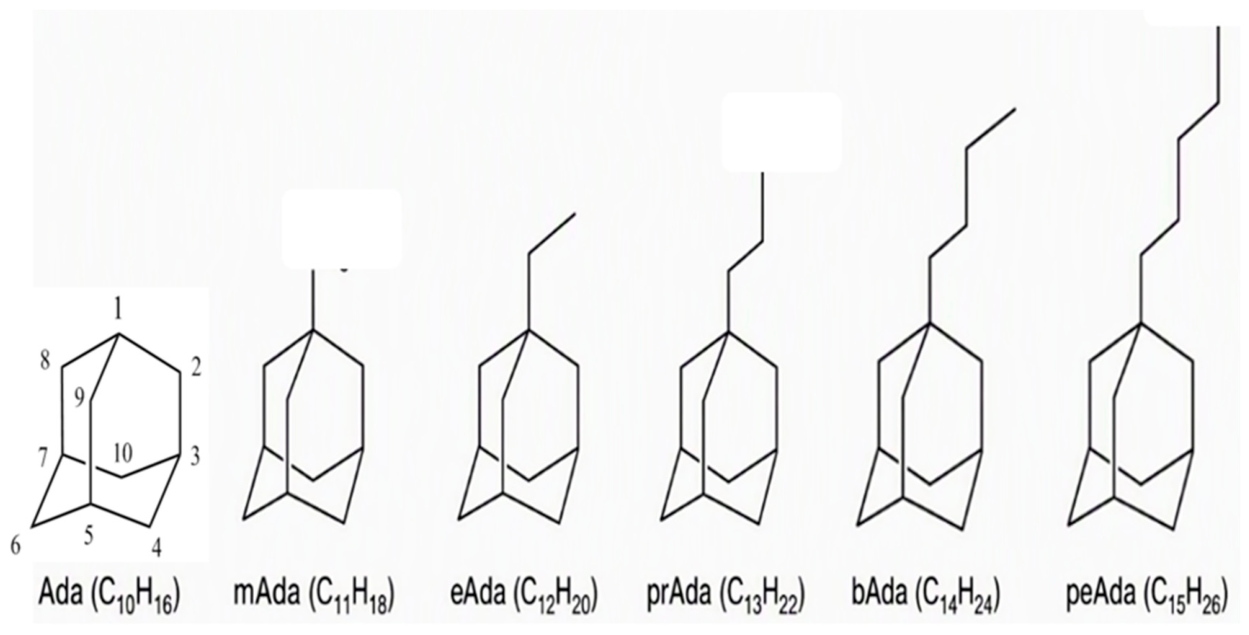
Figure 2.
Adjacent-homologue electronic-energy increments, ΔE = E(n) − E(n−1), for mAda–peAda (left axis, kcal mol−1) and electronic spatial extent, <R2>, for Ada–peAda (right axis, a.u.). The expanded ΔE axis highlights convergence of the incremental CH2 contribution toward approximately −24,677.82 kcal mol−1, whereas <R2> increases monotonically with chain length.
Figure 2.
Adjacent-homologue electronic-energy increments, ΔE = E(n) − E(n−1), for mAda–peAda (left axis, kcal mol−1) and electronic spatial extent, <R2>, for Ada–peAda (right axis, a.u.). The expanded ΔE axis highlights convergence of the incremental CH2 contribution toward approximately −24,677.82 kcal mol−1, whereas <R2> increases monotonically with chain length.
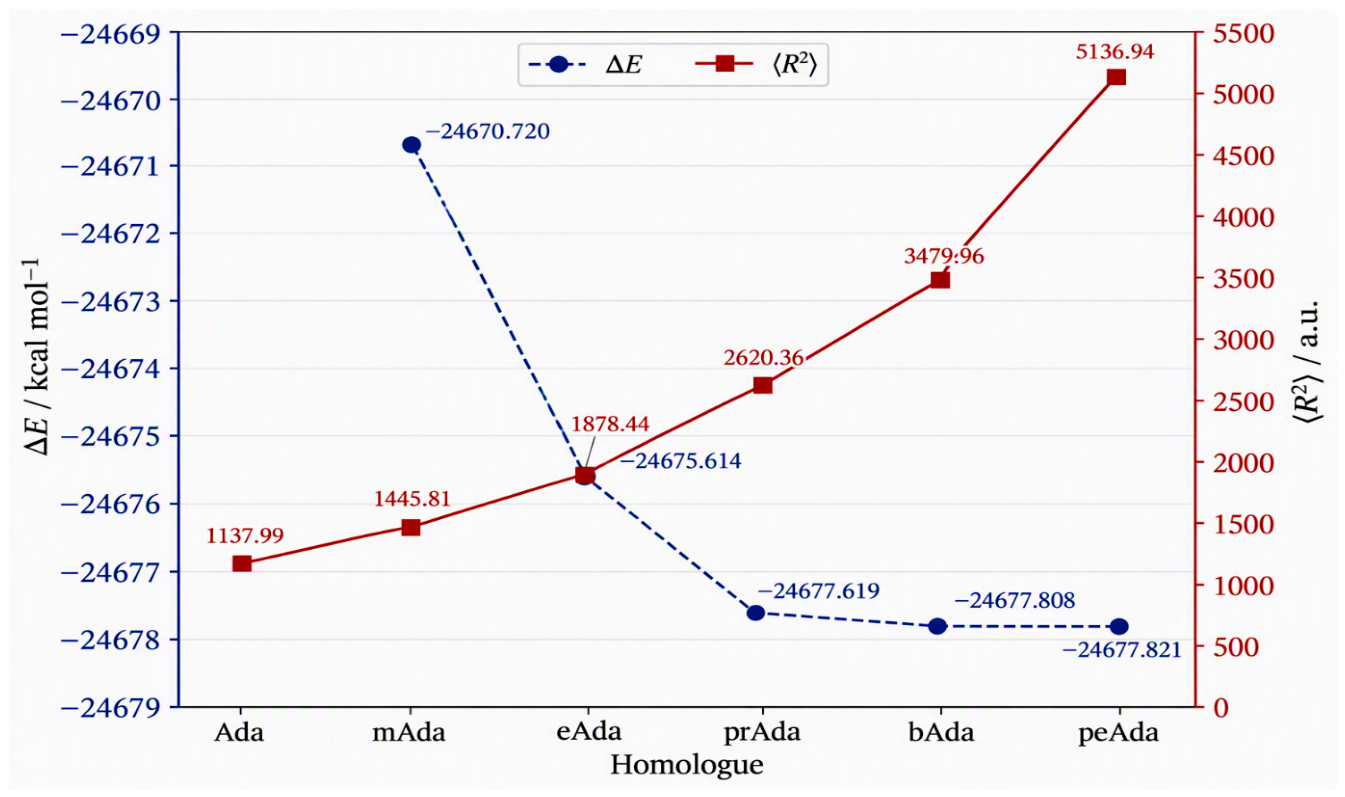
Figure 3.
HOMO correlation diagram for Ada and the 1-n-alkyladamantane series (mAda–peAda). Horizontal bars show −εHOMO values obtained from HF/6-311++G(2df,2p) orbital energies; the dashed line is included as a visual guide. Ada’s triply degenerate 3t2 HOMO is represented by a single thick bar. HOMO isosurfaces are displayed for Ada–prAda to illustrate the qualitative spatial distribution of the frontier orbital. The corresponding LUMOs of the series are provided on the top for comparison purposes.
Figure 3.
HOMO correlation diagram for Ada and the 1-n-alkyladamantane series (mAda–peAda). Horizontal bars show −εHOMO values obtained from HF/6-311++G(2df,2p) orbital energies; the dashed line is included as a visual guide. Ada’s triply degenerate 3t2 HOMO is represented by a single thick bar. HOMO isosurfaces are displayed for Ada–prAda to illustrate the qualitative spatial distribution of the frontier orbital. The corresponding LUMOs of the series are provided on the top for comparison purposes.
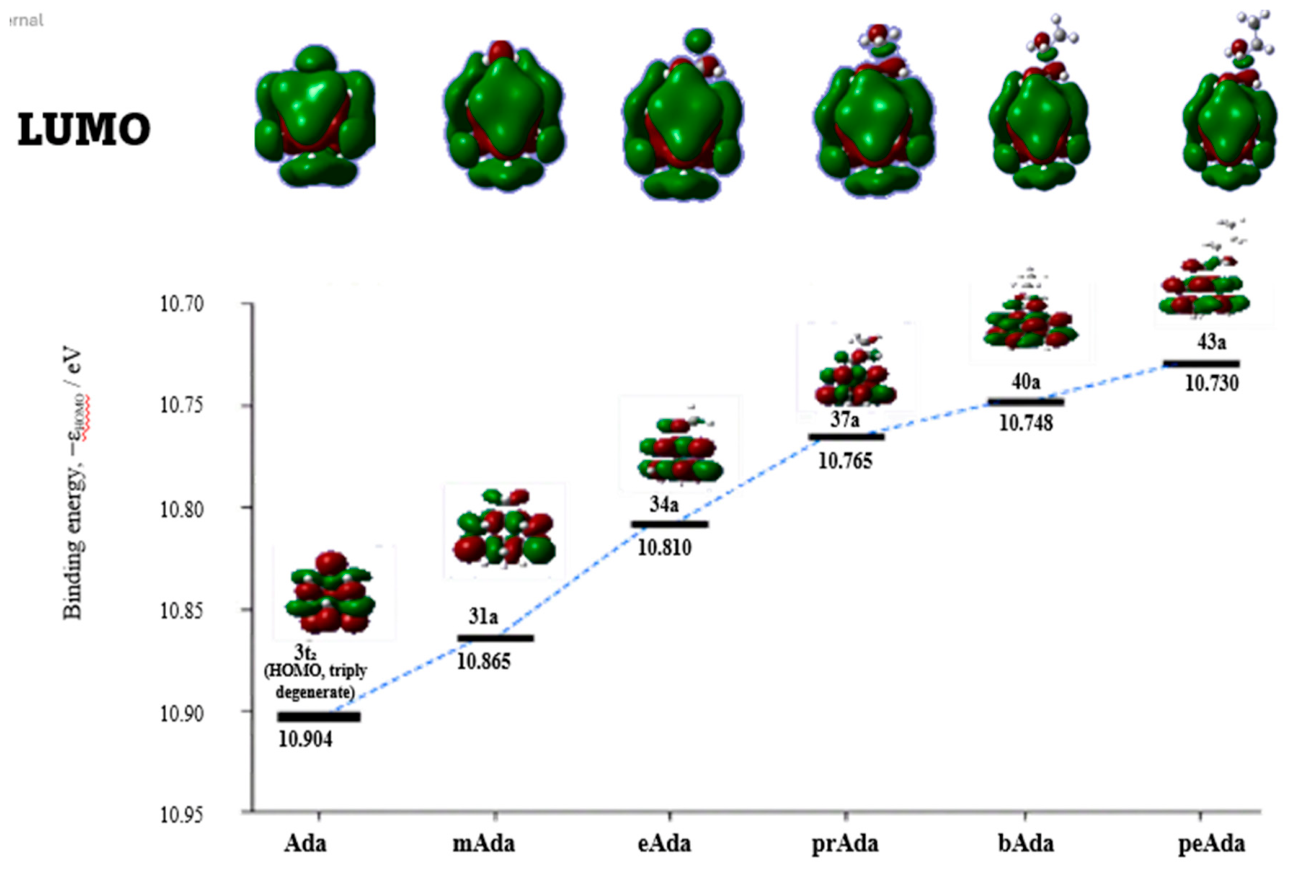
Figure 4.
Occupied-valence orbital-energy distributions for the Ada–peAda series. Positive orbital binding-energy descriptors, −εi/eV, were obtained from HF/6-311++G(2df,2p) occupied eigenvalues. Each point represents one doubly occupied valence molecular orbital, with carbon 1s core orbitals excluded.
Figure 4.
Occupied-valence orbital-energy distributions for the Ada–peAda series. Positive orbital binding-energy descriptors, −εi/eV, were obtained from HF/6-311++G(2df,2p) occupied eigenvalues. Each point represents one doubly occupied valence molecular orbital, with carbon 1s core orbitals excluded.
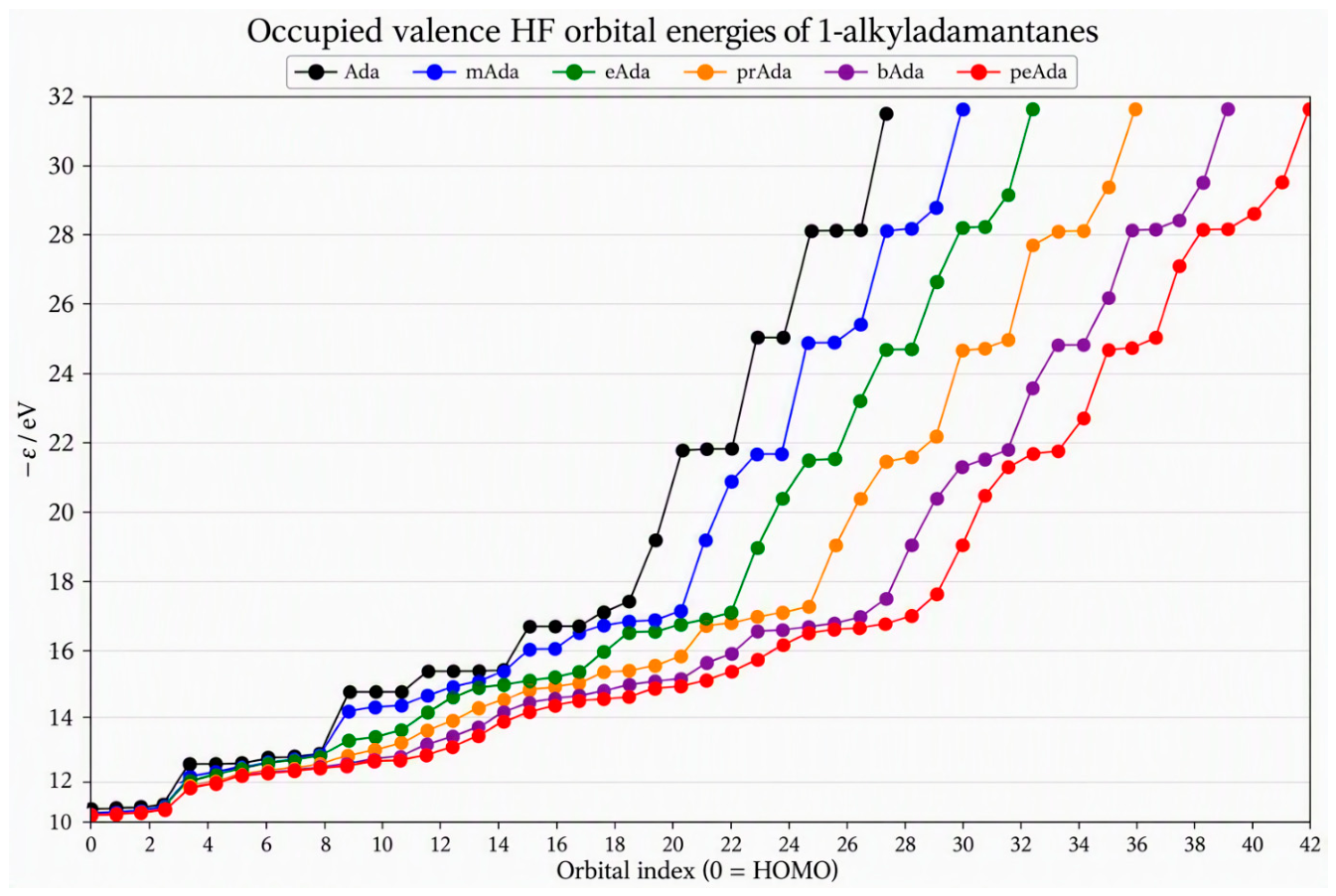
Figure 6.
Calculated 13C NMR stick spectra of Ada and the homologous 1-n-alkyladamantanes mAda–peAda at the PCM(chloroform)-GIAO-B3LYP/aug-cc-pVTZ level. Chemical shifts were obtained from δ(13C) = 182.5 − σiso. Cage Cα, cage CH, cage CH2, and side-chain C1′–C5′ sites are shown in blue, orange, green, and black, respectively.
Figure 6.
Calculated 13C NMR stick spectra of Ada and the homologous 1-n-alkyladamantanes mAda–peAda at the PCM(chloroform)-GIAO-B3LYP/aug-cc-pVTZ level. Chemical shifts were obtained from δ(13C) = 182.5 − σiso. Cage Cα, cage CH, cage CH2, and side-chain C1′–C5′ sites are shown in blue, orange, green, and black, respectively.
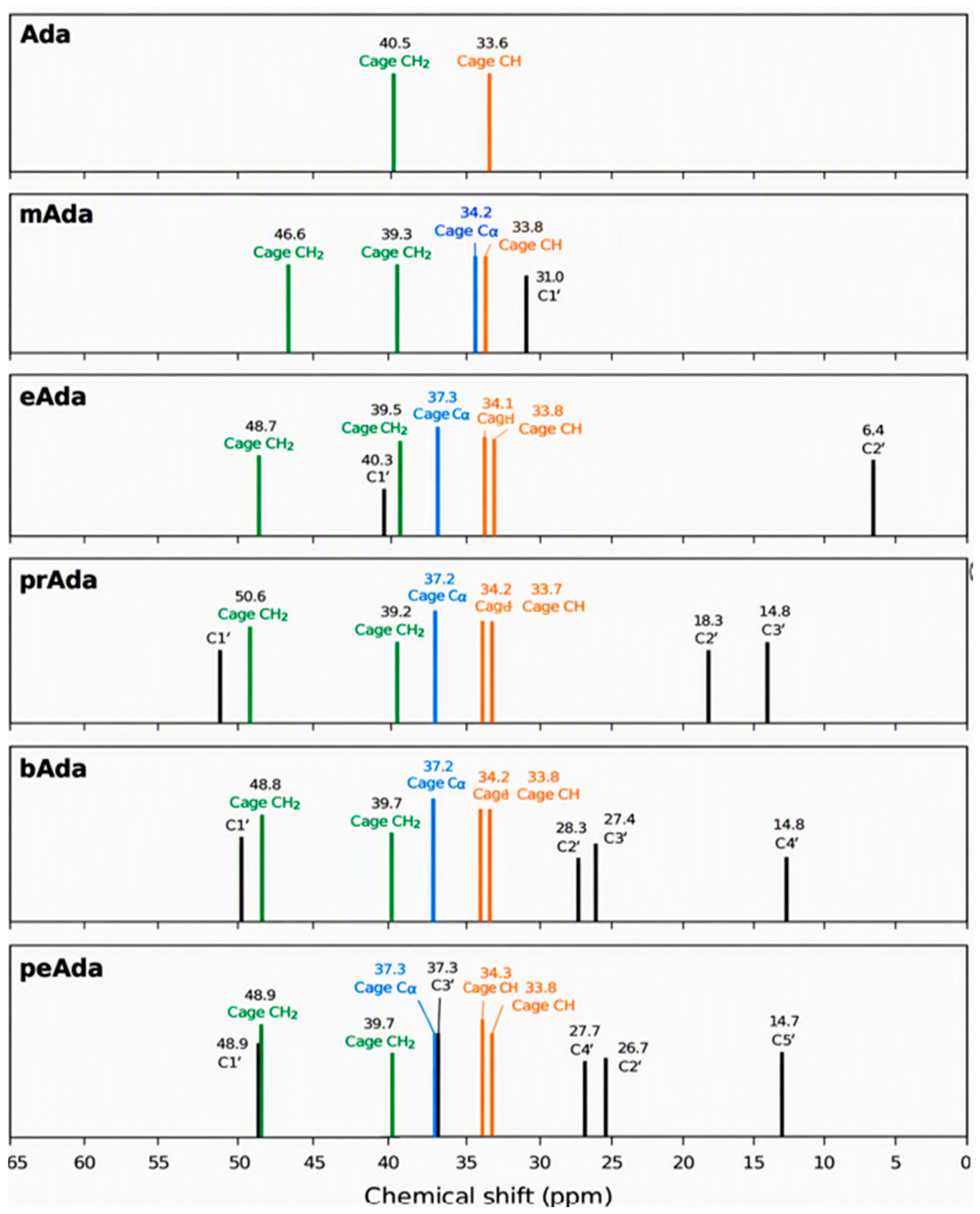
Figure 7.
Calculated 13C NMR stick spectra of Ada, 1-mAda, 1,3-diMeAda, 1,3,5-triMeAda, and 1,3,5,7-tetraMeAda at the PCM(chloroform)-GIAO-B3LYP/aug-cc-pVTZ level, using δ(13C) = 182.5 − σiso. Cage Cα, cage CH, cage CH2, and methyl C′ resonances are shown in blue, orange, green, and black, respectively.
Figure 7.
Calculated 13C NMR stick spectra of Ada, 1-mAda, 1,3-diMeAda, 1,3,5-triMeAda, and 1,3,5,7-tetraMeAda at the PCM(chloroform)-GIAO-B3LYP/aug-cc-pVTZ level, using δ(13C) = 182.5 − σiso. Cage Cα, cage CH, cage CH2, and methyl C′ resonances are shown in blue, orange, green, and black, respectively.
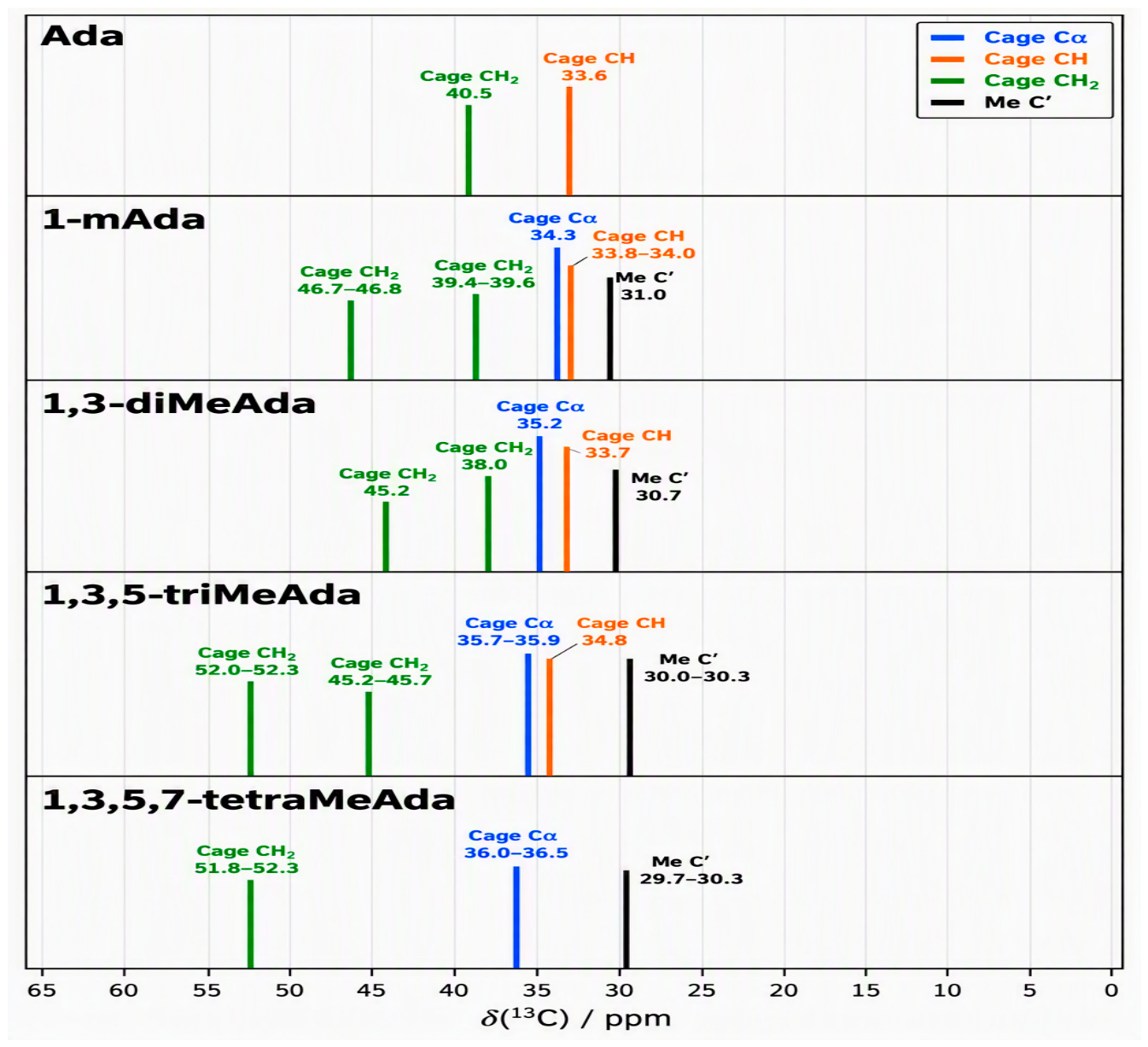

Table 1.
Molecular descriptors for adamantane and the homologous 1-alkyladamantane series relative to the preceding homologue.*.
Table 1.
Molecular descriptors for adamantane and the homologous 1-alkyladamantane series relative to the preceding homologue.*.
| Mol | μ / D | <R2> / a.u. | A# / GHz | B# / GHz | C# / GHz | Etotal / Eh | ΔE* / Eh |
|---|---|---|---|---|---|---|---|
| Ada | 0.00 | 1137.99 | 1.6846 | 1.6845 | 1.6845 | −390.858390 | — |
| mAda | 0.17 | 1445.81 | 1.6725 | 1.1664 | 1.1663 | −430.173683 | −39.315293 |
| eAda | 0.10 | 1878.44 | 1.6004 | 0.8165 | 0.8033 | −469.496775 | −39.323092 |
| prAda | 0.18 | 2620.36 | 1.5862 | 0.5358 | 0.5303 | −508.823062 | −39.326287 |
| bAda | 0.09 | 3479.96 | 1.5193 | 0.3715 | 0.3659 | −548.149651 | −39.326589 |
| peAda | 0.18 | 5136.94 | 1.5082 | 0.2602 | 0.2575 | −587.476261 | −39.326610 |
*ΔE values were calculated as E(n) − E(n−1), where n denotes the number of carbon atoms in the normal alkyl substituent; therefore, each value represents the addition of one CH2 unit relative to the preceding homologue. All total energies and ΔE values for Ada–peAda were obtained from gas-phase B3LYP/6-311++G(2df,2p) calculations. Optimised coordinates are provided in Table S1–S6 of the Supplementary Information. #Rotational constant of Ada is given by A=B=C=B0=1.6747 GHz using B3LYP/6-31G(d,p)(Pirali, Boudon et al. 2012).
Table 3.
Calculated and experimental 13C NMR chemical shifts of Ada, mAda, eAda, prAda, bAda, and peAda (ppm).
Table 3.
Calculated and experimental 13C NMR chemical shifts of Ada, mAda, eAda, prAda, bAda, and peAda (ppm).
| Molecule | Cα (C1) | Cage CH | Cage CH2 | C1′ | C2′ | C3′ | C4′ | C5′ | Expt |
|---|---|---|---|---|---|---|---|---|---|
| Ada | — | 33.6 | 40.5 40.5 |
— | — | — | — | — | 28.5, 37.8(Pehk, Lippmaa et al. 1971) |
| mAda | 34.2 | 33.8 | 46.6 39.3 |
31.0 | — | — | — | — | 29.1, 30.0, 31.7, 37.2, 44.9 (Xie, Liu et al. 2020) |
| eAda | 37.3 | 34.1 33.8 |
48.7 39.5 |
40.3 | 6.4 | — | — | — | 6.95, 28.86, 32.26, 36.79, 37.43, 42.09(Xie, Shi et al. 2021) |
| prAda | 37.2 | 34.2 33.7 |
49.2 39.2 |
50.6 | 18.3 | 14.8 | — | — | 15.20, 15.69, 28.90, 32.40, 37.42, 42.65, 47.45(Xie, Shi et al. 2021) |
| bAda | 37.2 | 34.2 33.8 |
48.8 39.7 |
48.8 | 28.3 | 27.4 | 14.8 | — | 14.6 (C4′, a), 24.0 (C3′, b), 25.0 (C2′, c), 30.1 (C1, C3, C7), 33.4 (C5), 38.5 (C2, C8, C10), 43.6 (C4, C6, C9), 45.5 (C1′, d) (Matsuoka, Ogiwara et al. 2006; Figure 2A, CDCl3) |
| peAda | 36.1 | 34.3 33.8 |
48.8 39.7 |
48.9 | 26.7 | 37.3 | 27.7 | 14.7 | 14.4, 22.3, 23.0, 29.1, 32.5, 33.2, 37.6, 42.8, 45.0 (Harvey, Harrison et al. 2016) |
*All assignments are based on DFT calculations using δ(13C) = 182.5 − σiso, with 182.5 ppm as the TMS reference shielding. In the substituted homologues, Cα denotes the quaternary C1 bridgehead bonded to the alkyl substituent and is distinguished from the remaining cage CH bridgeheads. Side-chain carbons are numbered outwards from the cage: C1′ is directly bonded to Cα, subsequent C′ labels denote successive chain carbons, and the highest-numbered C′ site is the terminal CH3 group.
Disclaimer/Publisher’s Note: The statements, opinions and data contained in all publications are solely those of the individual author(s) and contributor(s) and not of MDPI and/or the editor(s). MDPI and/or the editor(s) disclaim responsibility for any injury to people or property resulting from any ideas, methods, instructions or products referred to in the content. |
© 2026 by the authors. Licensee MDPI, Basel, Switzerland. This article is an open access article distributed under the terms and conditions of the Creative Commons Attribution (CC BY) license (http://creativecommons.org/licenses/by/4.0/).
Copyright: This open access article is published under a Creative Commons CC BY 4.0 license, which permit the free download, distribution, and reuse, provided that the author and preprint are cited in any reuse.