
Submitted:
08 October 2026
Posted:
09 October 2026
You are already at the latest version
Abstract
Spatial regeneration and the cultural and creative industries (CCIs) are paired in policies for China’s traditional villages, yet seldom examined together. This correlational literature review analyzes the full texts of 35 peer-reviewed case studies published in 2017–2026. The corpus was assembled purposively; a later check of two bibliographic databases flagged at least 238 further potentially eligible records, so the 35 papers cover only part of the literature. Each paper was coded for regeneration strategies, CCI categories, village type, governance mode, outcomes, and conflicts, and the analysis combines keyword co-occurrence, φ coefficients, and a qualitative classification of outcomes. Five of six regeneration strategies are reported in more than two-thirds of the papers. Cultural tourism is reported in every paper, followed by performing arts, crafts, and museums, whereas architecture, design, film, and digital content appear in eight papers. No strategy–category association remains significant after correction for multiple comparisons. Of 140 outcome judgments, 47.1% are realized positive, 35.7% mixed, and 10.0% realized negative; negative results concentrate in the social dimension. The sample is too small to test differences by region, village type, or governance mode. In these papers, the link between spatial regeneration and cultural activity is documented almost exclusively through tourism.
Keywords:
traditional villages
; spatial regeneration
; cultural and creative industries
; culture–tourism integration
; correlational literature review
1. Introduction
Spatial regeneration has become a central concern in the conservation of China’s traditional villages. Since the List of Chinese Traditional Villages was launched in 2012, 8155 villages have been inscribed on the national list in six batches. Inscription brings conservation responsibilities and earmarked funding, but it also brings pressure: in villages with aging populations and large numbers of vacant houses, historic buildings need uses that can be sustained. Safeguarding cultural heritage is itself a target of the 2030 Agenda for Sustainable Development (Target 11.4) [1]. In this paper, spatial regeneration is understood in its architectural and spatial sense, namely keeping the historic built environment in continued use through repair, functional conversion, and the reshaping of surrounding spaces. International research treats built heritage as a resource for sustainable development rather than a burden [2] and regards adaptive reuse as the principal means of extending the life of buildings while retaining their cultural significance [3,4]. In the context of traditional villages, scholars have drawn on the production of space [5], landscape genes [6], and design practice to explain how space is reshaped. These studies answer the question of how space is altered, but they less often ask which industries occupy the space afterwards and who receives the benefits.
What connects spatial regeneration to industry is the recurrent policy vocabulary of the “cultural and creative industries” (CCIs) and “culture–tourism integration”. The most widely used definition of the CCIs comes from the UK Department for Culture, Media and Sport (DCMS): industries that have their origin in individual creativity, skill, and talent and that have the potential to create wealth and jobs through the generation and exploitation of intellectual property [7]. For statistical purposes, they are grouped into nine categories: advertising and marketing; architecture; crafts; design; film, television, radio, and photography; information technology, software, and computer services; publishing; museums, galleries, and libraries; and music, performing, and visual arts [8]. In rural areas, the creative economy is seen as a response to agricultural decline, although it is small in scale and dependent on incoming talent [9]; the concept of creative tourism, in turn, emphasizes visitors’ participatory learning and making and seeks to move beyond sightseeing [10]. Traditional villages are both historic built environments and places where intangible cultural heritage survives, and they are therefore expected to link space and industry. Critical research, however, points to the costs of this linkage: the commercial development of heritage gradually erodes the rural idyll that attracts visitors [11]; who defines authenticity is itself contested [12,13]; and outcomes differ with the distribution of power and benefits among communities, governments, and external capital [14,15].
The two bodies of literature, on space and on industry, nevertheless rarely speak to each other. Existing reviews either treat rural tourism as the sole driver [16] or construct heritage-led regeneration frameworks without distinguishing specific industrial categories [17]; bibliometric reviews map the evolution of research hotspots [18,19] but do not check the content of individual cases. Research on culture-led regeneration has long observed that the contribution of culture to regeneration tends to be stated more strongly than the evidence supports [20]. To establish what the “integration of spatial regeneration and the CCIs” actually refers to in traditional villages, the industrial side cannot be treated as a general label. It has to be placed in the same framework as the spatial side and identified case by case: which spatial interventions were implemented, which businesses moved in, how the two correspond, and with what results.
To this end, this paper reviews peer-reviewed case studies of Chinese traditional villages, following the design of the correlational literature review by Tua and Imoto [21]. The term is used here in their sense: a body of literature is coded into categories, and the review then examines how the categories co-occur with one another and with the reported outcomes; it is not a statistical meta-analysis of effect sizes. Two research questions are addressed: (1) Which linkages connect spatial regeneration strategies with CCI categories? (2) How do the type of traditional village, its region, and its governance arrangements mediate between spatial regeneration and the CCIs? Three expectations were formulated. First, case studies that address spatial regeneration and cultural industries together are increasing, and later studies document more strategies and categories. Second, the actual content of what the literature calls the “cultural and creative industries” is predominantly cultural tourism, with limited presence of creative categories in the DCMS sense [20]. Third, combinations of strategies and categories, and their outcomes, differ with village type and governance arrangements [14].
The review proceeds in four steps: (1) an examination of research hotspots and the status of scholarship; (2) the identification of regeneration strategies and CCI categories paper by paper, and their classification by village type and governance mode; (3) an analysis of the spatial distribution of the case sites and the composition of respondents, of the correlation between strategies and categories, and of the association between each category and the reported outcomes; and (4) a discussion of the present state of the linkage between spatial regeneration and the CCIs and of directions for future research.
2. Materials and Methods
2.1. Data Collection
Literature search, screening, and paper selection. The literature was located by the author through Google Scholar using Chinese and English search terms that combined four concept groups: traditional villages; spatial regeneration; the cultural and creative industries and culture–tourism integration; and China (Table 1). Papers were retained for full-text reading if they met all of the following conditions: (a) the paper is a peer-reviewed journal article; (b) it studies one or more specific traditional villages in China; (c) it addresses regeneration at the level of buildings or public space; (d) it addresses cultural, creative, or tourism activities; and (e) the full text could be obtained. Thirty-eight papers were read in full. On full-text reading, three of them did not meet condition (c) or (d) and were excluded: one proposes a digital tourism scenario that has not yet been implemented [22]; one studies a Hakka walled-house village where repair and tourism development had not started at the time of the fieldwork [23]; and one examines the community-based repair of a temple as cultural space, with no industrial component [24]. The analysis therefore covers 35 papers [6,25,26,27,28,29,30,31,32,33,34,35,36,37,38,39,40,41,42,43,44,45,46,47,48,49,50,51,52,53,54,55,56,57,58], 20 in Chinese and 15 in English, published in 15 journals (Table 2, Figure 1). The three excluded papers are listed in Table A1 (Appendix A), and the results obtained when they are included are reported as a sensitivity analysis in Section 3.4.
No exhaustive database search was conducted, and the search was not designed as a systematic review: no screening log (search dates, numbers of records retrieved and excluded) is reported, and inclusion was conditional on full-text availability. The 35 papers should therefore be read as a purposively assembled body of literature, not as a census of the field; the coverage check reported below indicates how much they leave out. Two features of the design bear directly on the findings. First, the search terms include “culture–tourism integration” and “cultural tourism”, and condition (d) admits papers that address tourism activities, so the prevalence of tourism in the corpus is partly built in. Second, a category was recorded only when a paper reports it (Section 2.2.2), so the frequencies given below describe what the case-study literature documents, not what exists in the villages. Both points are taken up in the limitations of the study.
Coverage check. Because the corpus was not assembled by a reproducible search, its coverage was examined afterwards with a documented database search carried out on 7 October 2026 (Table A2). Two searches of titles and abstracts were run in OpenAlex for journal articles published from 2012 onwards: a narrower string that combines village terms, creative-industry or tourism terms, and China (755 records), and a broader string that relaxes the village terms and adds regeneration and spatial terms (3324 records, which include the 755). A three-block search of titles, keywords, and abstracts in the China National Knowledge Infrastructure (CNKI) returned 769 journal records. Twenty-six of the 35 papers have records in OpenAlex; the narrower string retrieves 11 of them and the broader string 22, including 14 of the 15 English-language papers, and at least five of the 20 Chinese-language papers are among the CNKI records. After the removal of nine duplicates and six records in other languages, the 740 records of the narrower OpenAlex search were screened on title and abstract against conditions (a)–(d) in two independent runs of a GenAI model, which agreed on 94.7% of the records (Cohen’s = 0.89). Both runs excluded 490 records. Of the 250 records that at least one run judged eligible or possibly eligible, 12 are among the 38 papers read in full, and 238 had not been identified before; both runs judged 45 of these 238 records probably eligible, and the others were uncertain on the basis of the abstract. Among the 52 records that both runs judged probably eligible, seven belong to the corpus. None of the 238 records was assessed in full text, the screening was not verified by a human reviewer, and the remaining 2569 OpenAlex records and the CNKI records were not screened. The check therefore gives a lower bound on what the corpus omits and not a count of eligible studies. It shows that the 35 papers are only a part, and on this evidence a minority, of the literature that may meet the inclusion conditions.
2.2. Data Analysis and Assessment
2.2.1. Organizational Tabulation and Visualization
Qualitative text information and quantifiable data were both entered into spreadsheets and then arranged into cross-tabulations as required for the bar charts, donut charts, heat map, and Sankey diagram. Tabulation and plotting were carried out in Python 3 (pandas, Matplotlib).
2.2.2. Foundational Concepts and Text Information Analysis
To keep the concepts consistent, regeneration strategies were divided into six categories on the basis of the literature on heritage-led regeneration and adaptive reuse [3,4,17]. CCI categories follow the nine DCMS groups [8], with cultural tourism listed separately, giving 10 categories. Governance modes were classified into seven types: government-led, market-led, artist- or expert-led, community-led, multi-actor co-governance, comparative study, and not stated (Table A3). When each paper was read, every category was turned into a question to be checked against the full text: did this case implement this strategy? Is this type of business present? A category was recorded as present only if the paper reports that it had actually occurred in the case village; authors’ recommendations and planning proposals were not counted. A category that a paper does not mention is recorded as not reported, which is not evidence that it is absent from the village. Governance mode was judged by the actual pattern of decision-making and resource control described in the paper, not by the label the paper itself uses. Two further classification variables were recorded: village type (ethnic minority villages, urban and peri-urban villages, other traditional villages, and cross-type comparisons) and the listing status stated in the paper.
Generative artificial intelligence (GenAI) was used in data extraction. The structured coding of the full texts was produced with the assistance of a GenAI model (Claude, Anthropic) following the codebook, and the section of the paper on which each code rests was recorded. Twelve papers were then drawn at random and recoded in a separate run that had no access to the first-round results: governance mode agreed in all cases, and Cohen’s for regeneration strategies, CCI categories, outcomes, and conflicts was 0.80, 0.89, 0.83, and 0.95, respectively. This is the agreement between two runs of the same model and cannot substitute for agreement between researchers. The author subsequently checked the coding of all papers against the original texts, including the classification of village type.
2.2.3. Spatial Distribution Analysis of the Case Sites
The case site of each paper was assigned to a provincial-level administrative unit, with cross-provincial studies counted once for each province, and the results were aggregated into eastern, central, and western regions. On this basis, the numbers of strategies and categories reported were compared across regions, and the respondents of each study were compiled: the numbers of interviewees and questionnaires, and the identity of the respondents (villagers and residents; government officials and village cadres; operators and enterprises; tourists; newcomers; experts and cultural elites). No map was drawn; a provincial bar chart is used instead.
2.2.4. Bibliometric and Keyword Analysis
The author keywords of the 35 papers were extracted. To place the two languages in a single network, English keywords were rendered into Chinese and synonyms were merged (Table A4); the labels shown in the figures and tables are English translations. Two keywords appearing in the same paper were counted as one co-occurrence, and a keyword co-occurrence network was constructed with all keywords included and no minimum threshold of occurrences. Clusters were detected with the Louvain algorithm, and the modularity Q is reported. Because no threshold is applied and the corpus is small, the keywords of a single paper form a fully connected group; the clusters are therefore reported together with the number of papers on which they rest and are treated as descriptive. The keywords were also sorted into a spatial side and an industrial side (the two lists are given in the note to Table A4). The calculations were carried out with NetworkX in Python; because the number of papers is small and the Chinese-language papers have no index records in the Web of Science, VOSviewer and CiteSpace were not used.
2.2.5. Correlational Analyses of Regeneration Strategies and CCI Categories
Two quantitative methods were used. First, the coefficient (the Pearson correlation between two binary variables) was calculated for each strategy–category pair in which both items vary across papers, with p values from Fisher’s exact test adjusted for multiple comparisons by the Holm method. Second, the Pearson correlation between publication year and the number of strategies and categories reported per paper was calculated; cumulative counts, which Tua and Imoto [21] correlate with year, are not used, because a cumulative series is correlated with time by construction. A Sankey diagram shows the correspondence among village type, governance mode, regeneration strategies, and CCI categories, with link width representing the number of papers in which two items co-occur. For comparisons between regions, village types, and governance modes, proportions are reported with Wilson 95% confidence intervals (CIs); given the group sizes (three to 19 papers), no inferential claims are made about differences between groups.
For the qualitative analysis, the outcomes that each paper reports in four dimensions (economic; social and community; cultural and authenticity; environmental) were classified by their type of correlation with the integration of regeneration and the CCIs according to the criteria in Table 3, with positive and negative results treated equally. Four types of conflict reported as having occurred were also recorded: gentrification, over-commercialization, loss of authenticity, and homogenization.
Two sensitivity analyses were carried out. The first adds the three excluded papers. The second addresses the fact that several villages are studied by more than one paper, so that the papers are not independent observations: papers that share a case village were merged into a single unit, with strategies, categories, and conflicts taken as the union across the papers and an outcome dimension coded as mixed if any of the papers codes it as mixed or if the papers give both positive and negative codes.
3. Results
3.1. General Patterns and Overview of Foundational Concepts
The 35 papers date from 2017 to 2026 (Figure 2). Two were published in 2017; none appeared in 2018–2020; papers have been published every year since 2021, and 29 date from 2022 or later. The gap in 2018–2020 reflects the non-exhaustive search and not an absence of research: the coverage check flagged 23 potentially eligible records from these three years, and the growth of the field as a whole is documented in earlier reviews [17,18]. Twenty papers are in Chinese and 15 in English; 29 study a single village, five compare two or three villages, and one studies 12 villages within one district. By journal (Table 2), the four MDPI journals account for 12 papers and the Journal of Natural Resources for six, four of which were published in 2026; the remaining 17 are spread over 10 journals. The modest size of the corpus is also what made it feasible to check every full text.
The 35 papers were first classified by village type and governance mode (Figure 3). In terms of village type, 10 papers (28.6%) study ethnic minority villages, including Dong, Yao, Tujia, Bai, and Zhuang villages; four (11.4%) study urban and peri-urban villages in Guangzhou; two are cross-type comparisons; and the remaining 19 (54.3%) study other traditional villages, located in Anhui, Hunan, Jiangxi, Shaanxi, Shanxi, and other provinces. In terms of governance mode, judged by the actual arrangements described in the papers, 19 cases (54.3%) are government-led, seven (20.0%) are under multi-actor co-governance, three are community-led, two are market-led, two are comparative studies, one is artist- or expert-led, and one does not state the mode. Twenty-seven papers state that the case village is inscribed on the List of Chinese Traditional Villages or designated a Famous Historical and Cultural Village of China, while eight do not state a national listing.
3.2. Bibliometric Analysis and Keyword Characteristics
The 35 papers contain 184 keywords, or 119 after synonyms are merged, forming 382 co-occurrence links with a total link strength of 414 (Figure 4). Node size represents the number of papers in which a keyword occurs, links represent co-occurrence in the same paper, and colors represent clusters. The Louvain algorithm divides the network into 11 clusters with a modularity Q of 0.59 (Table 4). This value should not be over-interpreted: with no occurrence threshold, the keywords of each paper form a fully connected group, and four of the 11 clusters consist of the keywords of a single paper, one of which is not connected to the rest of the network. Only the first six clusters draw on four or more papers.
The most frequent keyword is “traditional villages” (22 papers), followed by “rural tourism” (10), “rural revitalization” (6), and “production of space” (5); “culture–tourism integration”, “art intervention”, “development path”, “development models”, “heritage conservation”, “China”, and “cultural landscape” each occur in three papers. Sorting the keywords into the two sides reveals a clear asymmetry. On the spatial side there are 30 keywords, appearing in 22 papers, such as production of space, spatial governance, spatial transformation, cultural space, holistic restoration, function renewal, and architectural conservation. On the industrial side there are 13 keywords, appearing in 19 papers; 17 of these papers use tourism-related keywords (rural tourism, culture–tourism integration, heritage tourism, creative tourism, and the like), only four use art- or creativity-related keywords, and two use digital ones. No paper lists “cultural and creative industries” or its Chinese abbreviation as a keyword.
The publication years in Table 4 show which themes are long-standing and which are recent. The clusters centered on “traditional villages”, “rural tourism”, “heritage conservation”, and “cultural landscape” span 2017 to 2025 or 2026. The “production of space” cluster (2022–2024) and the “development path–culture–tourism integration–common prosperity” cluster (2021–2026) are more recent, the latter reflecting the alignment of Chinese-language research with the policy agendas of rural revitalization and common prosperity. The five smallest clusters all date from 2025–2026 and concern architectural conservation and urban-to-rural migration, digital platforms and rural tourism consumption, public space and user satisfaction, cultural space and digital empowerment, and the reactivation of ancestral halls. Each of these rests on one or two papers, and whether they will grow into stable lines of research remains to be seen.
3.3. Spatial Distribution of the Study Locations
The cases in the 35 papers are distributed across 14 provincial-level units (Figure 5a). Hunan has the most (10 case attributions), followed by Anhui (five), Guangdong (four), and Jiangxi (three). By region, 18 papers concern central China, eight eastern China and eight western China, and one is a cross-regional comparison. There are no cases in the northeast; Shaanxi is the only province in the northwest; and regions rich in ethnic minority villages, such as Tibet, Qinghai, and Xinjiang, are absent altogether. The concentration of cases is related to the repeated study of a small number of villages: Zhangguying Village and Xixinan Village are each studied in three papers, and Goulan Yao Village, Huangdu Village, Huangpu Village, Laoche Village, and Yuanjia Village in two, so that the 35 papers cover 33 distinct case sites (counting the 12 villages of the Suzhou study as one). The concentration in central China stems largely from a single research team in Hunan: eight of the 35 papers are co-authored by Bohua Li or Yindi Dou. Because papers on the same village are not independent observations, the main results are re-examined in Section 3.4 with such papers merged.
The numbers of strategies and categories reported vary by region (Figure 5b). Papers on central China report on average 4.06 regeneration strategies and 3.33 CCI categories, those on western China 4.00 and 2.75, and those on eastern China 3.50 and 3.38. Five of the eight western papers study ethnic minority villages. With eight papers each on eastern and western China, these differences are descriptive only.
This section also compiles the respondents of the studies (Figure 6). Of the 35 papers, 30 report the numbers of interviewees or questionnaires, which total 2234 respondents, comprising 955 interviews and 1279 questionnaires; five papers report no sample size at all. For 67.5% of these respondents the papers do not state the composition. The respondents whose identity is stated are villagers and residents (17.1% of the total), tourists (5.9%), operators and enterprises (4.5%), newcomers such as lifestyle migrants, artists, and tenants (2.5%), government officials and village cadres (2.2%), and experts and cultural elites (0.2%). In terms of coverage, of the 27 papers that specify whom they surveyed, 23 surveyed villagers, 21 surveyed officials or village cadres, 16 surveyed tourists, 15 surveyed operators, only nine surveyed newcomers, and six surveyed experts, heritage bearers, or cultural elites.
These figures have two implications. First, villagers are the group most often surveyed, but the identity of about two-thirds of the respondents is not reported and interview quotations are often absent, so it is difficult to judge how far villagers’ views enter the conclusions of the papers. Second, incoming operators, artists, and migrants are the actual carriers of creative businesses in many cases, yet they are among the least surveyed groups. Four of the five papers that report gentrification surveyed newcomers or operators; studies that did not survey this group may well fail to observe problems of the same kind.
3.4. Quantitative and Qualitative Correlational Analyses of Regeneration Strategies and CCI Categories
Reporting of strategies and categories. Five of the six regeneration strategies are each reported in more than two-thirds of the 35 papers (Figure 7a): landscape and public space regeneration in 28 papers (80.0%; 95% CI 64.1–90.0%), adaptive reuse and events and festivals in 27 each (77.1%; 61.0–87.9%), and conservation repair and additions and insertions in 24 each (68.6%; 52.0–81.4%). Digital activation is reported in seven papers (20.0%; 10.0–35.9%). The CCI categories are reported far more unevenly (Figure 7b). Cultural tourism is reported in all 35 papers, performing and visual arts in 26 (74.3%; 57.9–85.8%), crafts in 22 (62.9%; 46.3–76.8%), and museums and galleries in 18 (51.4%; 35.6–67.0%), whereas architecture is reported in five papers, film, television, and photography in three, design in two, and information technology (IT) and software in two. These last four categories, referred to below as the creative categories, appear in eight papers in total (22.9%; 12.1–39.0%), and advertising and publishing are not reported in any paper. A paper reports on average 3.91 of the six strategies (standard deviation, SD, 1.15) and 3.23 of the 10 categories (SD 1.17), and 22 papers report four or more strategies. The two means are not compared with each other: the two classifications differ in the number and the granularity of their categories, and the DCMS classification was devised for national industry statistics and not for businesses at the scale of a village.
Because the search terms and the inclusion criteria favor tourism (Section 2.1), an internal check was made. Sixteen of the 35 papers contain no tourism-related term in their title or keywords. All 16 nevertheless report cultural tourism businesses in the case village, four of them report creative categories, and they report on average 3.12 CCI categories, against 3.32 in the 19 papers that are framed in terms of tourism. The universal reporting of tourism is thus not confined to papers that present themselves as tourism research, although this check cannot show what a search without tourism terms would have retrieved.
Table 5 gives the mean numbers reported by region, village type, and governance mode. Papers on ethnic minority villages report the most regeneration strategies (4.40), and the four papers on urban and peri-urban villages each report four CCI categories. Government-led cases report more strategies (4.21) than cases under co-governance (3.57) or community-led cases (3.00), while the numbers of CCI categories are almost identical across the three modes (3.00–3.29). With groups of three to 19 papers and standard deviations of about one category, these differences are small relative to the variation within groups; they are reported descriptively and are not tested.
Quantitative correlation between strategies and categories. Of the 60 strategy–category pairs, 42 can be calculated, because cultural tourism is reported in every paper and advertising and publishing in none (Figure 8). Only three pairs have an absolute value above 0.4, and 31 of the 42 (74%) have an absolute value below 0.2. The largest coefficients are those between digital activation and design and between digital activation and IT and software ( = 0.49 in both cases; unadjusted p = 0.035), but each rests on only two papers. Events and festivals and performing and visual arts have a coefficient of 0.46 (unadjusted p = 0.015): of the 27 papers that report an events and festivals strategy, 23 also report performing and visual arts businesses. Conservation repair and crafts are negatively associated ( = −0.39; unadjusted p = 0.027). After Holm adjustment for the 42 comparisons, none of these associations is significant (smallest adjusted p = 0.64). For adaptive reuse and for additions and insertions, the largest absolute coefficient with any CCI category is 0.17, and for landscape and public space regeneration it is 0.24. The data therefore provide no statistical evidence that particular spatial strategies go together with particular CCI categories. This is an absence of evidence and should not be read as evidence of independence: with 35 papers only strong associations can be detected, and most strategies and the four common categories are reported in so many papers that little variation is left to correlate.
The number of strategies and categories reported per paper is not correlated with publication year (Pearson r = −0.04, p = 0.84): papers published in 2021 report 7.5 on average, and those published in 2026 report 6.5. Later studies in this corpus thus do not document more strategies or business types than earlier ones.
The Sankey diagram (Figure 9) displays the co-occurrences descriptively. Regeneration in every type of village is predominantly government-led, and the governance modes distribute their flows across the six regeneration strategies in similar proportions. From the regeneration strategies, the great majority of the flows converge on four categories, namely cultural tourism, performing and visual arts, crafts, and museums and galleries, while only a few thin links reach architecture, film, design, and digital content. Link width counts the papers in which two items are reported together and does not imply that a strategy produced a category.
Qualitative assessment of outcome correlations. The types of outcome correlation were assigned according to the criteria in Table 3. The 35 papers yield 140 judgments across the four dimensions (Figure 10): 47.1% are realized positive, 35.7% mixed, 10.0% realized negative, 3.6% not addressed, 2.9% potential positive, and 0.7% potential negative. Mixed and realized negative judgments together make up 45.7%; that is, nearly half of the judgments involve negative results that have already occurred. The distribution reported by Tua and Imoto [21] is dominated by realized and potential positive correlations, but the two distributions are not directly comparable, because the mixed type was added in this study.
The four dimensions show different patterns. Economic outcomes are predominantly realized positive (24 papers, 68.6%); the supporting evidence consists mostly of visitor numbers, tourism revenue, and the number of guesthouses, and the data are largely supplied by governments, scenic-area management bodies, or operating companies. The social dimension is where negative results are most concentrated: 20 papers are mixed and five are realized negative, against 10 that are purely positive, and the recurring issues are the unequal distribution of benefits and the marginal position of villagers in decision-making. Cultural and authenticity outcomes are divided: 16 papers are realized positive, 15 mixed, and four realized negative. For environmental outcomes, 16 papers are realized positive, 10 mixed, and three realized negative. Twenty papers (57.1%; 95% CI 40.9–72.0%) report at least one type of conflict that has already occurred: loss of authenticity in 13, over-commercialization in nine, homogenization in eight, and gentrification in five.
The outcome judgments were also tabulated by strategy and by category. For every strategy and category reported in 18 or more papers, realized positive judgments account for 47–56% and mixed judgments for 31–39%. This similarity is largely a consequence of the structure of the data: most cases adopt several strategies and host several categories at once, so the same judgments are counted under many of them, and outcomes cannot be attributed to any single strategy or category. The one visible difference concerns architecture. In the five papers in which design firms or architects have moved into the village, realized positive judgments account for only 35% and mixed and realized negative judgments together for 65%. Three of these five papers, however, study the same village (Xixinan), so this pattern rests on three villages and cannot be generalized.
Comparisons between groups are inconclusive. Cultural and authenticity outcomes are mixed or realized negative in 9 of 19 government-led cases (47%; 95% CI 27–68%) and in 4 of 7 cases under co-governance (57%; 25–84%), and in 6 of 10 papers on ethnic minority villages (60%; 31–83%) and 10 of 19 papers on other traditional villages (53%; 32–73%). The intervals overlap almost completely and are so wide that even differences of 20 or 30 percentage points between groups could not be detected. That no difference is observed should therefore not be read as evidence that governance mode or village type makes no difference; the corpus does not allow this question to be answered.
Sensitivity analyses. Table 6 compares the main results with the two sensitivity analyses. Adding the three excluded papers changes the figures only slightly. Merging the papers that share a case village reduces the 35 papers to 26 units (six groups of two to four papers and 20 single papers). The order of the CCI categories is unchanged, and creative categories appear in six of the 26 units (23.1%). The outcome distribution is less stable: the share of mixed judgments rises from 35.7% to 50.0%, and that of realized positive judgments falls from 47.1% to 38.5%. Part of this shift follows from the merging rule itself, under which diverging judgments on the same village are coded as mixed; it also shows that a purely positive judgment can depend on which paper about a village is read. The coefficient between events and festivals and performing and visual arts lies between 0.46 and 0.54 in the three analyses.
4. Discussion
The first result concerns what the industrial side consists of. Three groups of core terms run through the larger clusters of the keyword co-occurrence network: traditional villages; rural tourism and rural revitalization; and the production of space (Figure 4, Table 4). They correspond, respectively, to the object of research, the industrial and policy context, and the explanatory framework. Among the papers that use industry-related keywords, 17 of 19 use tourism-related ones, and the paper-by-paper check of the full texts shows that cultural tourism is reported in all 35 papers. This result has to be read against the search design: tourism terms were among the search terms and the inclusion criteria admitted tourism activities, so a high share of tourism was to be expected. Two observations suggest that it is not only an artifact. All 16 papers that are not framed in terms of tourism also report tourism businesses in the case village. In addition, the search included terms for the creative industries, art intervention, and crafts, yet the creative categories appear in only eight papers and no paper lists the “cultural and creative industries” as a keyword. The coverage check points in the same direction without settling the matter: its narrower string admits records that match creative-industry terms without any tourism term (208 of the 755 records), but only 43 of the 238 additional records flagged as potentially eligible, and four of the 45 judged probably eligible by both runs, contain no tourism term in the title or abstract. Within this corpus, the linkage between spatial regeneration and cultural activity is thus described, and practiced, as “culture and tourism”, which is consistent with the earlier observation that the contribution of culture to regeneration is stated more strongly than it is evidenced [20]. Whether the same holds for the wider literature can only be established by a systematic review that assesses these records in full text.
Of the three expectations, the second is supported within the limits of the corpus, the first is not supported in the part that could be examined, and the third could not be assessed. On the first, whether case studies that address space and industry together are increasing cannot be established from a non-exhaustive search; earlier reviews document the growth of the field [17,18]. The part that can be examined here, the number of strategies and categories reported per paper, shows no increase over time, and newer themes such as digital empowerment, urban-to-rural migration, and platform-based consumption are each confined to one or two papers. On the third, the groups defined by region, village type, and governance mode contain between three and 19 papers, the confidence intervals of the group proportions overlap almost completely, and the classification of governance mode relies on the papers’ own descriptions. The finding that governance arrangements shape the outcomes of community participation [14] is therefore neither confirmed nor contradicted here.
Two descriptive patterns may nevertheless be worth examining in future work. Papers on ethnic minority villages report the most regeneration strategies; all 10 report events and festivals and nine report performing arts businesses, which suggests that ethnic culture enters the industry mainly through festivals and staged performance. The four papers on urban and peri-urban villages in Guangzhou all report the same four categories (cultural tourism, performing and visual arts, crafts, and museums and galleries), and three of them report gentrification or over-commercialization following the arrival of artists and rising rents [43,44,52]. One possible reading is that the emergence of art-related businesses depends more on a village’s proximity to urban consumer markets and to creative practitioners than on the amount of regeneration work carried out. With four papers on four villages in a single city, this is a hypothesis and not a finding.
The outcome judgments call for caution about the effects of “integration”. Nearly half of the judgments (45.7%) involve negative results that have already occurred, and the share is 55.8% when papers on the same village are merged. These judgments are concentrated in the social dimension, where 25 of the 35 papers are mixed or realized negative, and, to a lesser extent, in the cultural dimension (19 papers): the unequal distribution of benefits, the marginalization of villagers in decision-making, and the alteration of rituals and village appearance to cater to tourists [30,39,57,58]. This is consistent with the creative destruction model of heritage commodification [11]. In terms of the dimensions of sustainability, the literature documents economic gains more consistently than social ones, and the economic data come largely from governments and operators. It should also be noted that different papers on the same village can arrive at opposite judgments: for Goulan Yao Village, Zhangguying Village, Huangpu Village, and Laoche Village, two papers on each village give one realized positive and one realized negative judgment in the same dimension. The outcome codes therefore record how the literature frames outcomes, which depends in part on each study’s topic and perspective; they are not measurements of the effects of regeneration.
4.1. Prominent Strategies and Categories
Among the regeneration strategies, five (landscape and public space regeneration, events and festivals, adaptive reuse, conservation repair, and additions and insertions) are each reported in more than two-thirds of the papers, and 22 papers report four or more strategies. In the cases they usually occur as a package: historic buildings are repaired; some of them are converted into guesthouses, exhibition halls, and shops; a visitor center and a car park are built; lanes and watercourses are upgraded; and festivals and scheduled performances are staged to draw visitors. Digital activation is the only strategy that is not widely reported, and what has been implemented consists mostly of online platforms for scenic areas, short-video promotion, and e-commerce.
Among the CCI categories, cultural tourism, performing and visual arts, crafts, and museums and galleries are the most frequently reported, and in the cases they depend on one another: performances, craft sales, and village history museums all cater to tourists. The categories that, in the DCMS definition, create value through intellectual property, namely design, film and television, IT and software, advertising, and publishing, are reported only occasionally. A few cases go further: design firms and architects have moved into Xixinan Village [34,46,50]; the transformation of Shuanglang was driven by artists who built their own houses there [41]; brocade design, study tours, and e-commerce have emerged in Laoche Village [32]; and digital content production is the subject of the study of Diaoyuan Village [25]. These cases are where research on the industrial side could usefully concentrate. The papers on Xixinan and Shuanglang, the two villages with the largest reported influx of creative newcomers, also report gentrification, the infilling of the lake for construction, and changes in the livelihoods of the original residents. On this limited evidence, the emergence of creative categories cannot be assumed to bring better social outcomes.
4.2. Limitations of the Study
The conclusions of this review are bounded by the following limitations. First, the corpus is not an exhaustive or reproducible sample. The literature was located through Google Scholar alone, whose ranking mechanism is opaque and whose results cannot be fully reproduced [59]; no screening log was kept; and inclusion was conditional on full-text availability. The coverage check indicates the scale of what is missing: in the narrower OpenAlex search alone, 238 records that are not in the corpus were flagged as potentially eligible, 45 of them by both screening runs, and the broader OpenAlex search and the CNKI search were not screened at all. The 35 papers thus cover only part of the eligible literature, the frequencies reported here may not hold in that literature, and statements about the growth or the overall composition of the field cannot be derived from this review, which should not be read as a systematic review. The coverage check itself has limits: it relied on GenAI screening of titles and abstracts, without human verification or full-text assessment, and Web of Science and Scopus were not searched. Second, the prevalence of tourism is partly built into the design, because the search terms include “culture–tourism integration” and “cultural tourism” and the inclusion criteria admit tourism activities; the low frequencies of the creative categories, in turn, may partly reflect the fact that studies of rural creative industries that do not address spatial regeneration were not sought. Third, the codes record what the papers report. A category that is not reported is not necessarily absent from the village, and the frequencies describe the literature and not the villages. Fourth, only peer-reviewed journal articles were included; theses, books, and planning documents were not, so a large body of local practice is left out. Fifth, the literature is concentrated in a small number of well-known villages, in Hunan Province, and in one research team, and northwestern and northeastern China are almost blank; papers on the same village are not independent observations, which the merged analysis addresses only in part. Sixth, the coding was produced with the assistance of a GenAI model and verified by a single author; agreement was measured only between two runs of the same model, and no independent second human coder was involved, so inter-coder reliability in the usual sense is not established. Seventh, with 35 papers and subgroups of three to 19, the statistical power is low: only strong associations could be detected, and differences between regions, village types, and governance modes cannot be tested. Eighth, the included studies are mostly qualitative single-village cases whose outcomes are the qualitative judgments of their authors, and the keyword analysis rests on author-supplied keywords, whose conventions differ between Chinese and English papers and whose merging involves judgment.
5. Conclusions
This review examined how 35 peer-reviewed case studies of Chinese traditional villages document spatial regeneration and the cultural and creative industries together. Its conclusions apply to this body of literature, which the coverage check shows to be only part of the eligible literature, and remain to be tested against a systematically assembled corpus.
First, in the literature reviewed, the link between spatial regeneration and cultural activity is documented almost exclusively through cultural tourism, on which performance, crafts, and museums depend. The creative categories of the DCMS classification are reported in eight of the 35 papers, and the term “cultural and creative industries” does not appear as a keyword in any of them. This pattern is partly shaped by the search design, but it also holds in the papers that are not framed in terms of tourism.
Second, regeneration strategies are reported as a package: five of the six strategies appear in more than two-thirds of the papers. No association between a particular strategy and a particular CCI category remains significant after correction for multiple comparisons, and the number of strategies and categories reported per paper has not increased with publication year.
Third, the corpus is too small and too concentrated in a few villages, one province, and one research team to determine whether village type, region, or governance mode mediates between spatial regeneration and the CCIs. The descriptive differences reported here are hypotheses for future research.
Finally, nearly half of the outcome judgments involve negative results that have already occurred, most heavily in the social dimension; economic outcomes are mostly positive but rest largely on data from governments and operators; and different papers on the same village can reach opposite judgments. Traditional villages do link space to cultural activity in these cases, but what “integration” means in the literature reviewed is narrower than policy language implies.
Four recommendations are made for future research. First, a systematic review should be undertaken with a documented search of several databases, such as the Web of Science, Scopus, and CNKI, using creative-industry terms that do not presuppose tourism, a screening log, and at least two independent human coders; the records identified in the coverage check (Table A2) offer a starting point. Second, the focus of research should shift to the industrial side, especially to creative activities that do not depend on visiting tourists and to the incoming operators, designers, and artists who carry them out, a group that has so far rarely been surveyed. Third, outcomes should be recorded with verifiable indicators and stated data sources, and the divergent conclusions of earlier research on the same village should be addressed directly. Fourth, surveys in villages should follow the principle of informed consent and report the composition of respondents, so that villagers’ views are visible in the research.
Funding
This research received no external funding.
Institutional Review Board Statement
Not applicable.
Informed Consent Statement
Not applicable.
Data Availability Statement
The 38 papers read in full and their coding are listed in Table A1. The search records and the screening log of the coverage check, the coding evidence, the keyword-merging table, and the analysis scripts are available from the author on reasonable request.
Acknowledgments
During the preparation of this study, the authors used Claude to complete the full-text structured coding checks and database recording. The author has reviewed and edited the output and assumes full responsibility for the content of this publication.
Conflicts of Interest
The author declares no conflicts of interest.
Abbreviations
The following abbreviations are used in this manuscript:
| CCIs | Cultural and creative industries |
| CI | Confidence interval |
| CNKI | China National Knowledge Infrastructure |
| DCMS | Department for Culture, Media and Sport (United Kingdom) |
| GenAI | Generative artificial intelligence |
| IT | Information technology |
| SD | Standard deviation |
| SEM | Structural equation modeling |
| TV | Television |
Appendix A

Table A1.
The 38 papers read in full and their coding.
| Paper | Case village(s) | Type | Gov. | Econ. | Soc. | Cult. | Env. | Conflicts | Strategies and categories |
|---|---|---|---|---|---|---|---|---|---|
| Yang and Jia (2021) [40] | Luotian, Shuinan, Jingtai | OT | Gov | RP | RP | RP | RP | None | D1,2,4,6; C3,8,9,10 |
| Zhuang et al. (2022) [43] | Xiaozhou, Fenghe | UP | Comp | RP | MX | MX | MX | X1 | D1,3,4,6; C3,8,9,10 |
| Zeng et al. (2022) [41] | Shuanglang | EM | Art | RP | MX | MX | MX | X2, X3, X4 | D1,2,3,4,6; C2,3,9,10 |
| Dou et al. (2022) [27] | Zhangguying | OT | Gov | RP | RP | RP | RP | None | D1,2,3,4,6; C3,8,9,10 |
| Lu et al. (2022) [34] | Xixinan | OT | Mkt | RP | MX | MX | RP | X1 | D1,2,3,4,6; C2,9,10 |
| Chen et al. (2022) [26] | Maihuayu | OT | Gov | RP | MX | RP | RP | None | D1,3,4,5,6; C3,10 |
| Lu and Liu (2023) [33] | Hanxin | OT | Comm | RN | MX | MX | – | None | D3,6; C3,9,10 |
| Li et al. (2023) [6] | Huangdu | EM | Gov | RP | RP | RP | RP | None | D1,2,3,4,6; C9,10 |
| Li et al. (2023) [29] | Zhangguying | OT | Gov | MX | RN | RN | RN | X2, X3, X4 | D1,2,3; C9,10 |
| Yang et al. (2023) [39] | Huangdu | EM | Gov | RP | MX | MX | – | X2, X3, X4 | D3,4,6; C9,10 |
| Yang et al. (2023) [38] | Banliang | OT | Comm | MX | MX | MX | MX | None | D1,2,4,6; C8,9,10 |
| Wang and Xu (2023) [37] | Chengkan | OT | Gov | MX | MX | MX | MX | X3, X4 | D1,2,3,4,5,6; C3,4,8,10 |
| Zhou et al. (2024) [42] | 12 villages in Wuzhong District, Suzhou | OT | Co-gov | RP | RP | RP | RP | None | D1,2,4; C8,10 |
| Tang and Li (2024) [36] | Huangpu | UP | Gov | RP | RP | RP | RP | None | D1,2,3,4,6; C3,8,9,10 |
| Liu et al. (2025) [22] * | Zhangguying | OT | NS | PP | – | PP | – | None | D5,6; C3,8,9,10 |
| Ma and Xie (2025) [35] | Chashan | EM | Co-gov | RP | RP | RP | RP | None | D1,2,3,4,5,6; C8,9,10 |
| Long et al. (2025) [32] | Laoche | EM | Gov | RP | RP | RP | – | None | D1,2,3,4,5,6; C3,4,5,6,8,9,10 |
| Liu et al. (2026) [31] | Liugou | OT | Co-gov | RP | MX | RP | MX | X4 | D1,2,4,6; C3,9,10 |
| Xu (2026) [24] * | L (anonymized) | OT | Co-gov | – | RP | RP | – | None | D2,4; C none |
| Li et al. (2026) [30] | Goulan Yao | EM | Gov | – | RN | RN | RN | X2, X3, X4 | D1,2,4,6; C8,9,10 |
| Bai et al. (2026) [25] | Diaoyuan | OT | Co-gov | RP | MX | MX | PP | X3 | D1,5; C3,5,6,10 |
| Dou et al. (2026) [28] | Goulan Yao | EM | Co-gov | RP | MX | MX | RP | X3 | D1,2,4,6; C3,8,9,10 |
| Chen and Tao (2017) [44] | Zhucun | UP | Gov | RP | MX | MX | RP | X2, X3 | D3,4,6; C3,8,9,10 |
| Gao and Wu (2017) [45] | Yuanjia | OT | Comm | RP | RP | RP | MX | None | D1,3,4; C3,8,10 |
| Chen and Kong (2021) [46] | Xixinan | OT | Gov | MX | MX | RP | RP | X1 | D1,2,3,4; C2,3,9,10 |
| Qin and Leung (2021) [47] | Nalu | EM | Gov | RP | RP | RP | RP | None | D1,2,3,4,6; C3,8,9,10 |
| Rautio (2021) [48] | Meili (pseudonym) | EM | Gov | RN | RN | RN | MX | X3 | D2,4,6; C2,10 |
| Chen and Li (2022) [49] | Zhangguying, Laoche | CT | Gov | MX | RN | RP | – | None | D5,6; C3,8,9,10 |
| Lu et al. (2022) [50] | Xixinan | OT | Gov | RP | MX | RP | MX | X1 | D1,2,3,4,6; C2,5,9,10 |
| Tang et al. (2022) [23] * | Zhoutian | OT | Gov | RN | RN | RN | PN | None | D none; C10 |
| Yang (2023) [51] | Anzhen | OT | Gov | PP | RN | MX | RP | X2 | D2,3,4,6; C10 |
| Gu et al. (2025) [52] | Huangpu | UP | Co-gov | RP | MX | MX | RN | X2 | D1,2,6; C3,8,9,10 |
| Jin and Gong (2025) [53] | Shishe, Chenjiapu, Kenggen | OT | Mkt | PP | MX | MX | PN | X3 | D1,3; C3,8,9,10 |
| Li and Zhang (2025) [54] | Machang (Tengchong) | OT | NS | PP | RP | RP | RP | None | D2,4,6; C9,10 |
| Wang and Lu (2025) [55] | Shibadong, Yuanjia | CT | Comp | RP | MX | RP | RP | None | D3,4,5,6; C3,8,9,10 |
| Wang et al. (2025) [56] | Dali | EM | Co-gov | RP | MX | MX | RP | X2, X3 | D1,3,6; C3,9,10 |
| Li et al. (2026) [57] | Lijiashan | OT | Gov | RP | MX | MX | MX | X3, X4 | D1,2,3,4; C10 |
| Zhou et al. (2026) [58] | Qiaonan | OT | Gov | RP | MX | RN | MX | X1, X2, X3, X4 | D1,2,3,4; C3,10 |
Note: “Village” is omitted from the village names. Type: EM = ethnic minority village; UP = urban or peri-urban village; OT = other traditional village; CT = cross-type comparison. Governance mode (Gov.): Gov = government-led; Co-gov = multi-actor co-governance; Comm = community-led; Mkt = market-led; Art = artist- or expert-led; Comp = comparative study; NS = not stated. Outcomes (economic; social and community; cultural and authenticity; environmental): RP = realized positive; PP = potential positive; MX = mixed; PN = potential negative; RN = realized negative; – = not addressed. Conflicts and the codes for strategies (D) and categories (C) are defined in Table A3. The three papers marked with an asterisk (*) were excluded from the main analysis after full-text reading (Section 2.1) and enter only the sensitivity analysis. Coding was produced with the assistance of generative artificial intelligence (GenAI) and checked by the author.
Table A2.
Database searches of the coverage check (7 October 2026).
| Database | Fields and limits | Search string | Records |
|---|---|---|---|
| OpenAlex, narrower string | Titles and abstracts; type: article; published 1 January 2012 to 7 October 2026 | (“traditional village” OR “traditional villages” OR “ancient village” OR “ancient villages” OR “historic village” OR “historic villages” OR “historical village” OR “historical villages” OR “heritage village” OR “heritage villages” OR “ethnic village” OR “ethnic villages” OR “ethnic minority village” OR “ethnic minority villages” OR “traditional settlement” OR “traditional settlements” OR “historical and cultural village” OR “historical and cultural villages”) AND (“creative industry” OR “creative industries” OR “cultural industry” OR “cultural industries” OR “cultural and creative” OR “creative economy” OR “art intervention” OR “art-led” OR “artistic intervention” OR artist OR artists OR craft OR crafts OR handicraft OR handicrafts OR “creative tourism” OR “creative class” OR design OR tourism OR tourist OR tourists OR “culture-tourism”) AND (China OR Chinese OR Hunan OR Anhui OR Guangdong OR Jiangxi OR Yunnan OR Guangxi OR Guizhou OR Shaanxi OR Shanxi OR Zhejiang OR Jiangsu OR Fujian OR Sichuan OR Chongqing OR Hebei OR Henan OR Hubei OR Shandong OR Beijing OR Hainan OR Tibet OR Xinjiang OR Qinghai OR Gansu OR Ningxia OR “Inner Mongolia” OR Liaoning OR Jilin OR Heilongjiang OR Tianjin OR Shanghai OR Huizhou) | 755 |
| OpenAlex, broader string | As above | (((village OR villages) AND (traditional OR ancient OR historic OR historical OR heritage OR ethnic OR vernacular)) OR “traditional settlement” OR “traditional settlements”) AND (regeneration OR revitalization OR revitalisation OR revitalizing OR revitalising OR revitalize OR renewal OR “adaptive reuse” OR reuse OR “spatial restructuring” OR “spatial reconstruction” OR “spatial transformation” OR “production of space” OR “spatial production” OR “space production” OR activation OR “creative industry” OR “creative industries” OR “cultural industry” OR “cultural industries” OR “cultural and creative” OR “creative economy” OR “art intervention” OR “art-led” OR “artistic intervention” OR artist OR artists OR craft OR crafts OR handicraft OR handicrafts OR “creative tourism” OR “creative class” OR design OR tourism OR tourist OR tourists OR “culture-tourism” OR festival OR “intangible cultural heritage” OR digital OR gentrification OR commodification OR “cultural landscape” OR “cultural space”) AND (China OR Chinese OR Hunan OR Anhui OR Guangdong OR Jiangxi OR Yunnan OR Guangxi OR Guizhou OR Shaanxi OR Shanxi OR Zhejiang OR Jiangsu OR Fujian OR Sichuan OR Chongqing OR Hebei OR Henan OR Hubei OR Shandong OR Beijing OR Hainan OR Tibet OR Xinjiang OR Qinghai OR Gansu OR Ningxia OR “Inner Mongolia” OR Liaoning OR Jilin OR Heilongjiang OR Tianjin OR Shanghai OR Huizhou OR Guangzhou OR Suzhou OR Huangshan OR Dong OR Miao OR Yao OR Tujia OR Bai OR Hakka OR Huizhou) | 3324 |
| CNKI (overseas platform), professional search | Title, keywords, and abstract (TKA); academic journals; no date limit; cross-language and synonym expansion switched off | TKA=(`’ + `’ + `’ + `’ + `’ + `’) AND TKA=(`’ + `’ + `’ + `’ + `’ + `’) AND TKA=(`’ + `’ + `’ + `’ + `’ + `’ + `’ + `’) | 769 |
Note: OpenAlex applies stemming and does not support wildcards, so word variants are listed. The 755 records of the narrower OpenAlex string are contained in the 3324 records of the broader string. Of the CNKI records, 757 date from 2012 or later. In the CNKI string, spaces are added around the plus signs for legibility. Only the records of the narrower OpenAlex string were screened.
Table A3.
Coding framework.
| Dimension | Categories |
|---|---|
| Regeneration strategies | D1 adaptive reuse (functional conversion); D2 conservation repair; D3 additions and insertions; D4 landscape and public space regeneration; D5 digital activation; D6 events and festivals |
| CCI categories | C1 advertising and marketing; C2 architecture (as an industry, e.g., design studios or resident architects); C3 crafts; C4 design (product, graphic, and fashion); C5 film, TV, radio, and photography; C6 IT, software, and digital content; C7 publishing; C8 museums, galleries, and libraries; C9 music, performing, and visual arts (C1–C9 are the nine groups of the UK Department for Culture, Media and Sport, DCMS); C10 cultural tourism (including guesthouses and scenic areas) |
| Governance mode | Government-led; market-led; artist- or expert-led; community-led; multi-actor co-governance; comparative study (papers that explicitly compare cases under different governance modes); not stated. The mode is judged by the actual pattern of decision-making and resource control described in the paper |
| Village type | Ethnic minority villages; urban and peri-urban villages; other traditional villages; cross-type comparisons |
| Outcome dimensions | O1 economic; O2 social and community; O3 cultural and authenticity; O4 environmental (criteria in Table 3) |
| Conflicts | X1 gentrification; X2 over-commercialization; X3 loss of authenticity; X4 homogenization (recorded only when reported as having occurred) |
Table A4.
Rules for merging synonymous keywords.
| Merged keyword | Original keywords merged |
|---|---|
| traditional villages | 传统村落 (traditional village); 古村落 (ancient village); 传统聚落 (traditional settlement); traditional village(s); traditional Chinese village; heritage villages; traditional settlement |
| rural tourism | 乡村旅游 (rural tourism); 旅游发展 (tourism development); 旅游驱动 (tourism-driven); 旅游乡建 (tourism-based rural construction); rural tourism; tourism development; integrated rural tourism |
| culture–tourism integration | 文旅融合 (culture–tourism integration); 农文旅融合 (agriculture–culture–tourism integration) |
| production of space | 空间生产 (production of space); 文旅空间生产 (production of cultural tourism space) |
| landscape genes | 景观基因 (landscape genes); 文化景观基因 (cultural landscape genes) |
| art intervention | 艺术介入 (art intervention); 艺术介入乡村 (art intervention in rural areas); art intervention |
| heritage conservation | heritage protection; preservation; rural heritage conservation |
| cultural landscape | cultural landscape; changes in cultural landscape; cultural landscape preservation |
| endogenous development | 新内生发展 (neo-endogenous development); endogenous |
| development path; development models | 路径 (path); 提升路径 (improvement path); 模式 (model); development models |
| poverty alleviation | 脱贫攻坚 (poverty alleviation campaign); poverty alleviation |
Note: Chinese keywords are given in their original form; the merged keywords are English renderings of the Chinese labels used in the analysis. Keywords assigned to the spatial side: production of space; cultural landscape; architectural conservation; landscape genes; spatial governance; spatial transformation; ancestral temples; architecture; building scale; cultural space; form; function renewal; functional suitability; holistic restoration; human settlements; landscape; landscape restoration; mediatized place; migrant buildings; pattern language; planning; production–living–ecological space; public space; renewal and activation; restructuring; rural function evolution; spatial revitalization; traditional architectural features; transformation and activation; urban renewal. Keywords assigned to the industrial side: rural tourism; art intervention; culture–tourism integration; commodification of place; consumption patterns; creative tourism; digital empowerment; digital platforms; government-led tourism; heritage tourism; rural tourism consumption; sustainable tourism; tourism resilience. All other keywords were assigned to neither side.
References
- United Nations. Transforming Our World: The 2030 Agenda for Sustainable Development; A/RES/70/1; United Nations: New York, NY, USA, 2015. [Google Scholar]
- Tweed, C.; Sutherland, M. Built cultural heritage and sustainable urban development. Landsc. Urban Plan. 2007, 83, 62–69. [Google Scholar] [CrossRef]
- Bullen, P.A.; Love, P.E.D. Adaptive reuse of heritage buildings. Struct. Surv. 2011, 29, 411–421. [Google Scholar] [CrossRef]
- Plevoets, B.; Van Cleempoel, K. Adaptive Reuse of the Built Heritage: Concepts and Cases of an Emerging Discipline; Routledge: London, UK, 2019. [Google Scholar]
- Lefebvre, H. The Production of Space; Blackwell: Oxford, UK, 1991. [Google Scholar]
- Li, B.; Zhang, H.; Dou, Y.; Liu, P. Landscape restoration and shaping of culture: Spatial production and symbol construction of traditional villages: Taking Huangdu Dong Cultural Village in Tongdao Dong Autonomous County, Hunan Province as an example. Prog. Geogr. 2023, 42, 1609–1622. (In Chinese) [Google Scholar] [CrossRef]
- Department for Culture; Media and Sport (DCMS). Creative Industries Mapping Document 2001; DCMS: London, UK, 2001. [Google Scholar]
- Department for Culture; Media and Sport (DCMS). Creative Industries Economic Estimates Methodology; DCMS: London, UK, 2016. [Google Scholar]
- Bell, D.; Jayne, M. The creative countryside: Policy and practice in the UK rural cultural economy. J. Rural Stud. 2010, 26, 209–218. [Google Scholar] [CrossRef]
- Richards, G. Creativity and tourism: The state of the art. Ann. Tour. Res. 2011, 38, 1225–1253. [Google Scholar]
- Mitchell, C.J.A. Entrepreneurialism, commodification and creative destruction: A model of post-modern community development. J. Rural Stud. 1998, 14, 273–286. [Google Scholar] [CrossRef]
- Wang, N. Rethinking authenticity in tourism experience. Ann. Tour. Res. 1999, 26, 349–370. [Google Scholar] [CrossRef]
- Zhu, Y. Cultural effects of authenticity: Contested heritage practices in China. Int. J. Herit. Stud. 2015, 21, 594–608. [Google Scholar] [CrossRef]
- Ying, T.; Zhou, Y. Community, governments and external capitals in China’s rural cultural tourism: A comparative study of two adjacent villages. Tour. Manag. 2007, 28, 96–107. [Google Scholar] [CrossRef]
- Oakes, T. Heritage as improvement: Cultural display and contested governance in rural China. Mod. China 2013, 39, 380–407. [Google Scholar] [CrossRef]
- Yanan, L.; Ismail, M.A.; Aminuddin, A. How has rural tourism influenced the sustainable development of traditional villages? A systematic literature review. Heliyon 2024, 10, e25627. [Google Scholar] [CrossRef]
- Yang, Y.; Hakimi, H.A.; Azmi, N.F.; Li, K.; Duan, B. A framework for heritage-led regeneration in Chinese traditional villages: Systematic literature review and experts’ interview. Heritage 2025, 8, 219. [Google Scholar] [CrossRef]
- Xia, J.; Gu, X.; Fu, T.; Ren, Y.; Sun, Y. Trends and future directions in research on the protection of traditional village cultural heritage in urban renewal. Buildings 2024, 14, 1362. [Google Scholar] [CrossRef]
- Bai, J.; Johar, S.B.; Mohammad, N.B.; Xia, J. Traditional village protection and sustainable development: Knowledge graph construction and hotspot evolution. Sustain. Futur. 2026, 11, 101577. [Google Scholar] [CrossRef]
- Evans, G. Measure for measure: Evaluating the evidence of culture’s contribution to regeneration. Urban Stud. 2005, 42, 959–983. [Google Scholar] [CrossRef]
- Tua, K.J.; Imoto, T. Philippine heritage bridging cultural ecosystem service and nature’s contribution to people in cultural landscapes: A correlational literature review. J. Cult. Herit. Manag. Sustain. Dev. 2026, 16, 561–593. [Google Scholar] [CrossRef]
- Liu, C.; Huangfu, Z.; Li, G. Construction of digital tourism scenarios for traditional villages: A case study of Zhangguying Village. Resour. Sci. 2025, 47, 1976–1991. (In Chinese) [Google Scholar] [CrossRef]
- Tang, B.; Zeng, Z.; Xi, Z. Research on the symbiosis model of the core interest subjects of Chinese ancient village tourism sites in the context of rural revitalization. Sustainability 2022, 14, 12001. [Google Scholar] [CrossRef]
- Xu, Y. The path and mechanism of pluralistic co-governance of cultural space in traditional villages: A case study of the conservation and regeneration of L Village in the Lower Weihe River Basin. J. Nat. Resour. 2026, 41, 3163–3178. (In Chinese) [Google Scholar] [CrossRef]
- Bai, D.; Yu, X.; You, Q. The transformation and revitalization mechanisms of traditional village cultural spaces through digital empowerment: A case study of Diaoyuan Village in Ji’an. J. Nat. Resour. 2026, 41, 1084–1100. (In Chinese) [Google Scholar] [CrossRef]
- Chen, X.; Huang, Y.; Wang, X. Process, characteristics and mechanism of spatial transformation in traditional villages from the perspective of spatial production: A case study of Maihuayucun Village in Huangshan City. Trop. Geogr. 2022, 42, 78–86. (In Chinese) [Google Scholar] [CrossRef]
- Dou, Y.; Ye, W.; Li, B. Features, models and logic of function renewal of “living-production-ecological” space in tourism-driven traditional villages: A case study of Zhang Guying Village, Hunan Province. Trop. Geogr. 2022, 42, 136–147. (In Chinese) [Google Scholar] [CrossRef]
- Dou, Y.; Wei, H.; Zeng, J.; Zhu, Y.; Wu, Y.; Li, B. The embedded path of cultural-tourism integration in traditional villages for common prosperity: Based on the perspective of resource integration and value co-creation. J. Nat. Resour. 2026, 41, 2347–2362. (In Chinese) [Google Scholar] [CrossRef]
- Li, B.; Chen, X.; Dou, Y.; Liu, P. Space governance of the traditional settlement based on the perspective of actor-network: Taking Zhangguying Village as case study. Sci. Geogr. Sin. 2023, 43, 1154–1166. (In Chinese) [Google Scholar] [CrossRef]
- Li, B.; Huang, C.; Wei, H.; Liu, Z.; Dou, Y. Theoretical framework and practical pathways for integrated spatial restoration of traditional villages: A case study of Goulan Yao Village. J. Nat. Resour. 2026, 41, 1101–1120. (In Chinese) [Google Scholar] [CrossRef]
- Liu, M.; Wang, P.; Fan, L. The formation and mechanisms of rural tourism consumption space through the lens of assemblage theory: A case study of Liugou Village. J. Nat. Resour. 2026, 41, 1154–1172. (In Chinese) [Google Scholar] [CrossRef]
- Long, X.; Li, B.; Yang, F.; Dou, Y. Theoretical cognition and evolutionary path of neo-endogenous development in traditional villages. Resour. Sci. 2025, 47, 1992–2004. (In Chinese) [Google Scholar] [CrossRef]
- Lu, J.; Liu, A. A symbiosis model for the development of intangible cultural heritage in traditional villages: Take Hanxin Village in Jiangxi Province as an example. Resour. Sci. 2023, 45, 1396–1409. (In Chinese) [Google Scholar] [CrossRef]
- Lu, L.; Chen, H.; Fu, L. Process and mechanism of function evolution of traditional villages under the background of tourism development: A case study of Xixinan Village, Huangshan City. Sci. Geogr. Sin. 2022, 42, 874–884. (In Chinese) [Google Scholar] [CrossRef]
- Ma, X.; Xie, X. Pathway and mechanism for improving the livelihood of ethnic minorities through cultural and tourism integration: A case study of Chashan Village in Fuchuan Yao Autonomous County. Econ. Geogr. 2025, 45, 202–212. (In Chinese) [Google Scholar] [CrossRef]
- Tang, X.; Li, S. Study on the production of urban isolated cultural tourism space from isolation to integration: A case of Huangpu Village. Hum. Geogr. 2024, 39, 162–169. (In Chinese) [Google Scholar] [CrossRef]
- Wang, N.; Xu, J. Driven by modernity, the tourism spatial production of traditional villages: Take Chengkan Village, Anhui Province as an example. J. Yunnan Agric. Univ. (Soc. Sci.) 2023, 17, 96–103. (In Chinese) [Google Scholar] [CrossRef]
- Yang, F.; Dou, Y.; Yi, Y.; Liu, X.; Li, B.; Liu, P. The mechanism and path of common prosperity of tourism-driven traditional villages from the perspective of catalysis: Taking Banliang Village in Hunan Province as an example. J. Nat. Resour. 2023, 38, 357–374. (In Chinese) [Google Scholar] [CrossRef]
- Yang, L.; Hu, Y.; Wu, X.; Hu, J. Cultural landscape gene production process and mechanism of Dong traditional village: A case study of Huangdu Village. J. Nat. Resour. 2023, 38, 1164–1177. (In Chinese) [Google Scholar] [CrossRef]
- Yang, Y.; Jia, D. The realization path of ancient villages revitalization promoted by the integration of agriculture, culture and tourism. J. Yunnan Agric. Univ. (Soc. Sci.) 2021, 15, 19–24. (In Chinese) [Google Scholar] [CrossRef]
- Zeng, L.; Lv, G.; An, N. Research on the reproduction of rural landscape under the background of art intervention. Hum. Geogr. 2022, 37, 53–64. (In Chinese) [Google Scholar] [CrossRef]
- Zhou, M.; Wang, Y.; Li, G. From autonomy to co-governance: Logical evolution of traditional villages’ governance in Suzhou from the perspective of institutional change. Hum. Geogr. 2024, 39, 72–82. (In Chinese) [Google Scholar] [CrossRef]
- Zhuang, N.; Yang, R.; Lu, J.; Weng, S. Art intervention in rural areas: Comparative analysis of multi-level benefits of two typical modes in rural development transformation. Trop. Geogr. 2022, 42, 396–408. (In Chinese) [Google Scholar] [CrossRef]
- Chen, H.; Tao, W. The revival and restructuring of a traditional folk festival: Cultural landscape and memory in Guangzhou, South China. Sustainability 2017, 9, 1767. [Google Scholar] [CrossRef]
- Gao, J.; Wu, B. Revitalizing traditional villages through rural tourism: A case study of Yuanjia Village, Shaanxi Province, China. Tour. Manag. 2017, 63, 223–233. [Google Scholar] [CrossRef]
- Chen, P.; Kong, X. Tourism-led commodification of place and rural transformation development: A case study of Xixinan Village, Huangshan, China. Land 2021, 10, 694. [Google Scholar] [CrossRef]
- Qin, R.J.; Leung, H.H. Becoming a traditional village: Heritage protection and livelihood transformation of a Chinese village. Sustainability 2021, 13, 2331. [Google Scholar] [CrossRef]
- Rautio, S. Material compromises in the planning of a “traditional village” in Southwest China. Soc. Anal. 2021, 65, 67–87. [Google Scholar] [CrossRef]
- Chen, X.; Li, B. Rethinking cultural creativity and tourism resilience in the post-pandemic era in Chinese traditional villages. Sustainability 2022, 14, 12371. [Google Scholar] [CrossRef]
- Lu, S.; Rao, X.; Duan, P. The rural gentrification and its impacts in traditional villages: A case study of Xixinan Village, in China. Sustainability 2022, 14, 10077. [Google Scholar] [CrossRef]
- Yang, Q. Research on the changes in cultural landscape of tourist-type traditional Chinese villages from the perspective of cultural memory: Taking Anzhen Village in Chongqing as an example. Land 2023, 12, 816. [Google Scholar] [CrossRef]
- Gu, Z.; Li, H.; Huang, J.; Qi, L. Reconfiguring community relational dynamics through revitalizing rural ancestral temples: Insights from Whampoa Village in Guangzhou, China. Buildings 2025, 15, 575. [Google Scholar] [CrossRef]
- Jin, Z.; Gong, K. Urban-to-rural migration as an influential factor for vernacular village revitalization: A building-scale assessment of migrants’ spatial–lifestyle interventions on traditional values in Zhejiang, China. Buildings 2025, 15, 3113. [Google Scholar] [CrossRef]
- Li, P.; Zhang, W. Intervention and co-creation: Art-led transformation of spatial practices and cultural values in rural public spaces. Land 2025, 14, 1353. [Google Scholar] [CrossRef]
- Wang, H.; Lu, X. A comparative study on the promoting effects of different tourism development models on rural revitalization: Case studies from two typical villages in China. Sustainability 2025, 17, 714. [Google Scholar] [CrossRef]
- Wang, Y.; Sulaiman, M.K.A.M.; Harun, N.Z. Reframing place identity for traditional village conservation: A theoretical model with evidence from Dali Dong Village. Heritage 2025, 8, 427. [Google Scholar] [CrossRef]
- Li, P.; Sho, K.; Chien, P.M.; Zhao, S. Exploring the spatial impact of China’s government-led tourism development model on vernacular architecture in a traditional village. J. Rural Stud. 2026, 126, 104318. [Google Scholar] [CrossRef]
- Zhou, Y.; Xiao, L.; Mokhtar, N.A.; Mat Sulaiman, M.K.A. Revitalising heritage villages in Asia: Multi-dimensional approaches to cultural landscape preservation—A case study of Qiaonan Village, China. Sustainability 2026, 18, 4970. [Google Scholar] [CrossRef]
- Gusenbauer, M.; Haddaway, N.R. Which academic search systems are suitable for systematic reviews or meta-analyses? Evaluating retrieval qualities of Google Scholar, PubMed, and 26 other resources. Res. Synth. Methods 2020, 11, 181–217. [Google Scholar] [CrossRef]
Figure 1.
Review and data-processing method. The design follows Tua and Imoto [21]. CCIs: cultural and creative industries.
Figure 1.
Review and data-processing method. The design follows Tua and Imoto [21]. CCIs: cultural and creative industries.
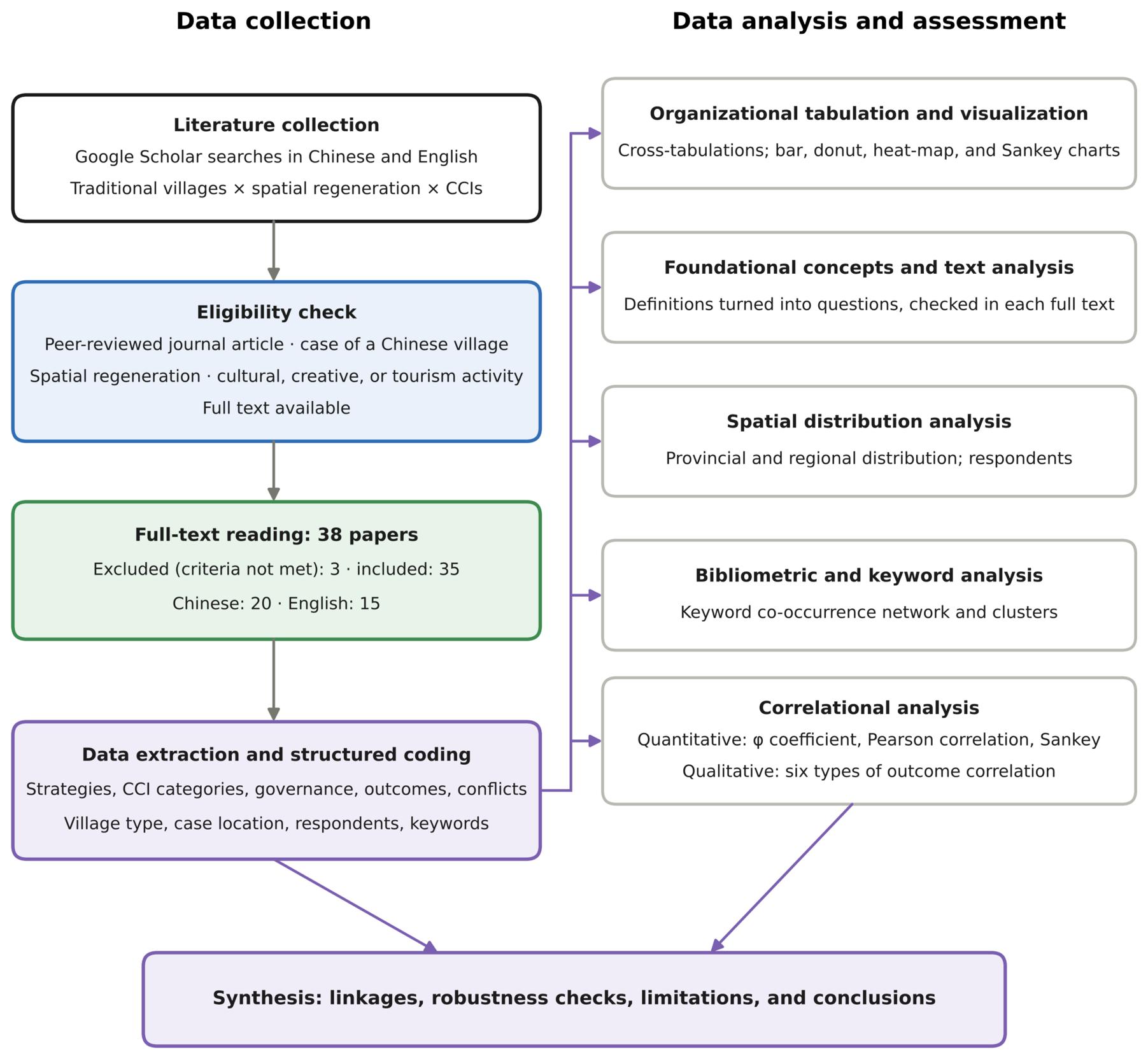
Figure 2.
Annual and cumulative numbers of the 35 papers.
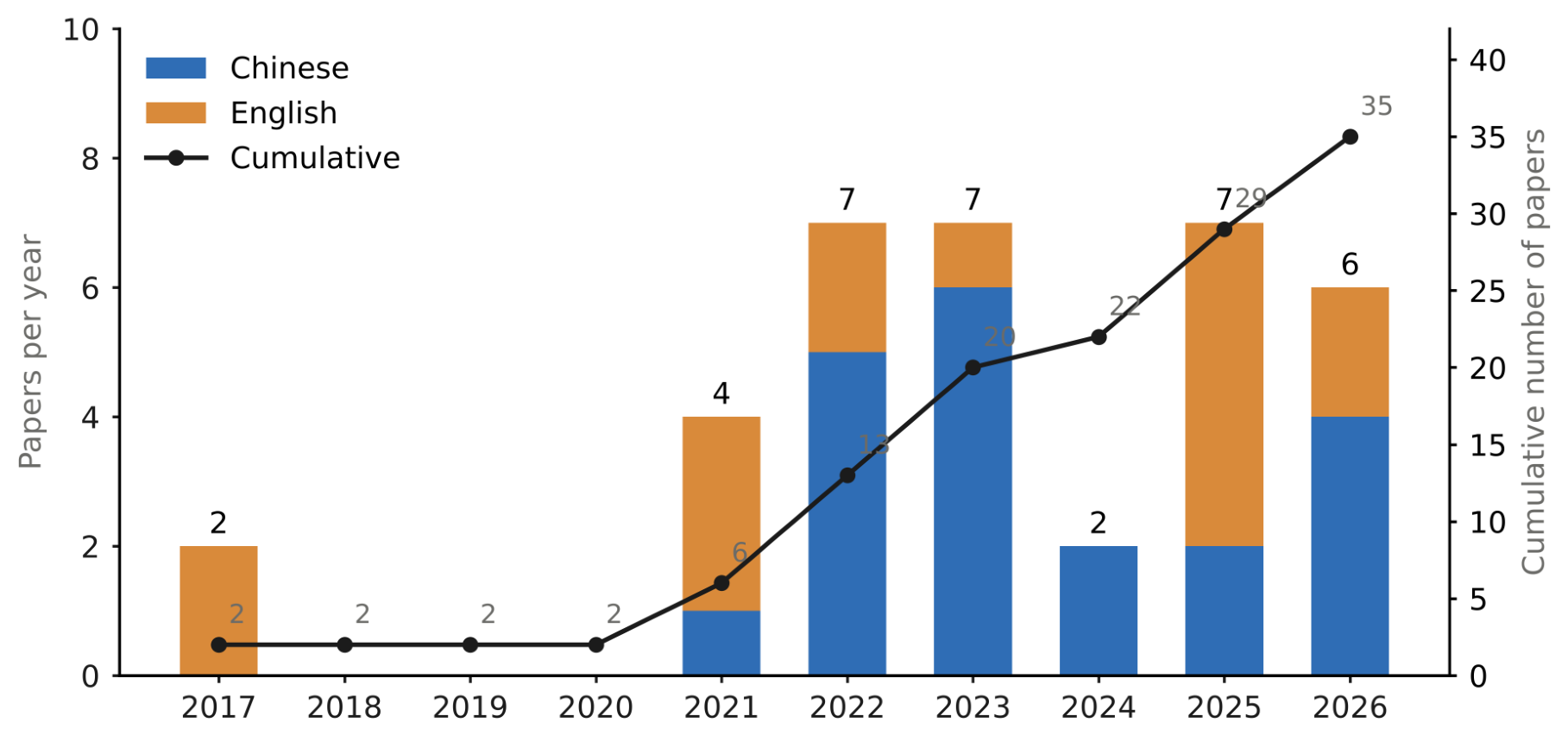
Figure 3.
Classification of the 35 papers. (a) Village type. (b) Governance mode.
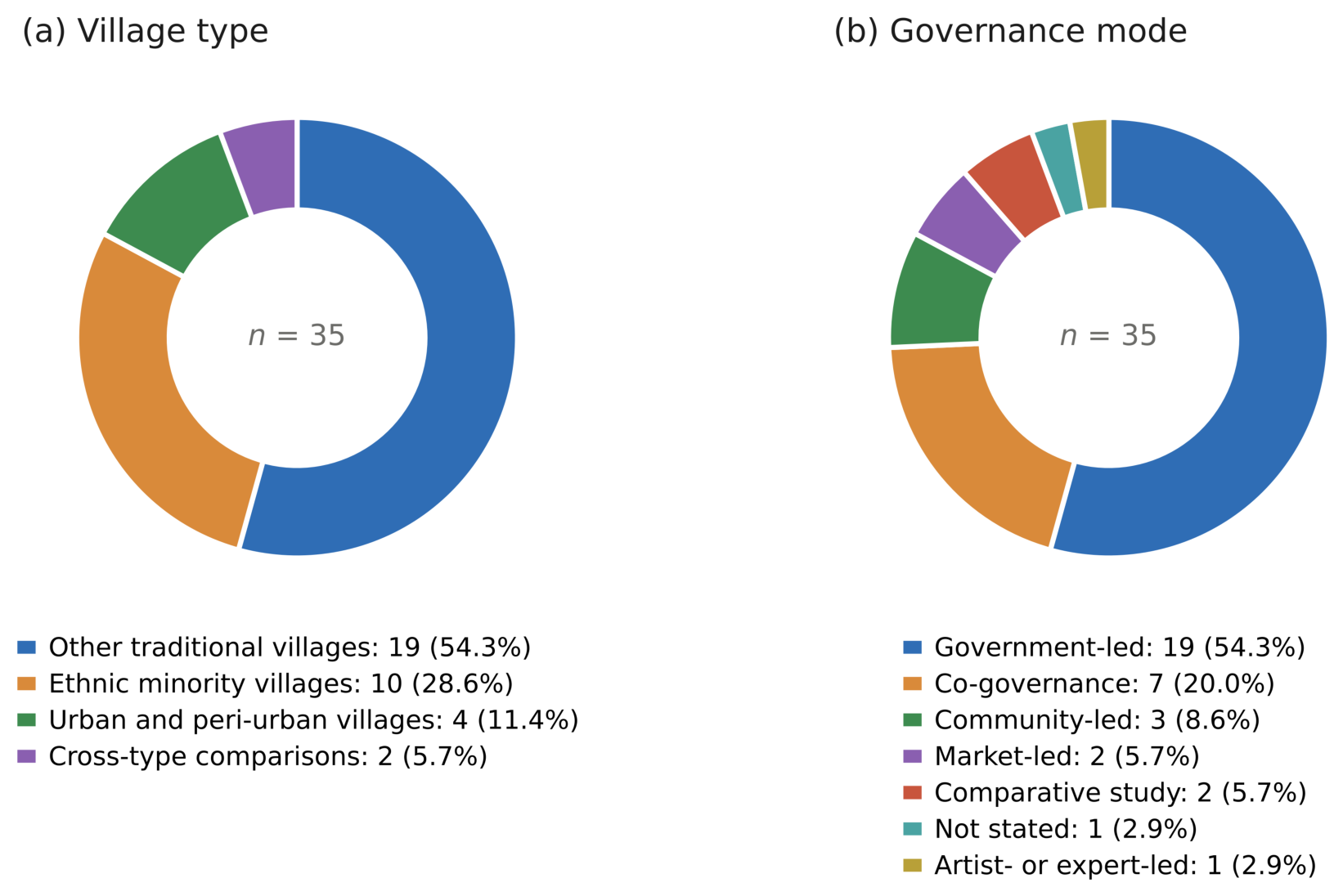
Figure 4.
Keyword co-occurrence network of the 35 papers. All keywords are included; node size indicates the number of papers and color indicates the cluster. Labels are shown only for keywords occurring in two or more papers and for the leading keyword of each cluster.
Figure 4.
Keyword co-occurrence network of the 35 papers. All keywords are included; node size indicates the number of papers and color indicates the cluster. Labels are shown only for keywords occurring in two or more papers and for the leading keyword of each cluster.
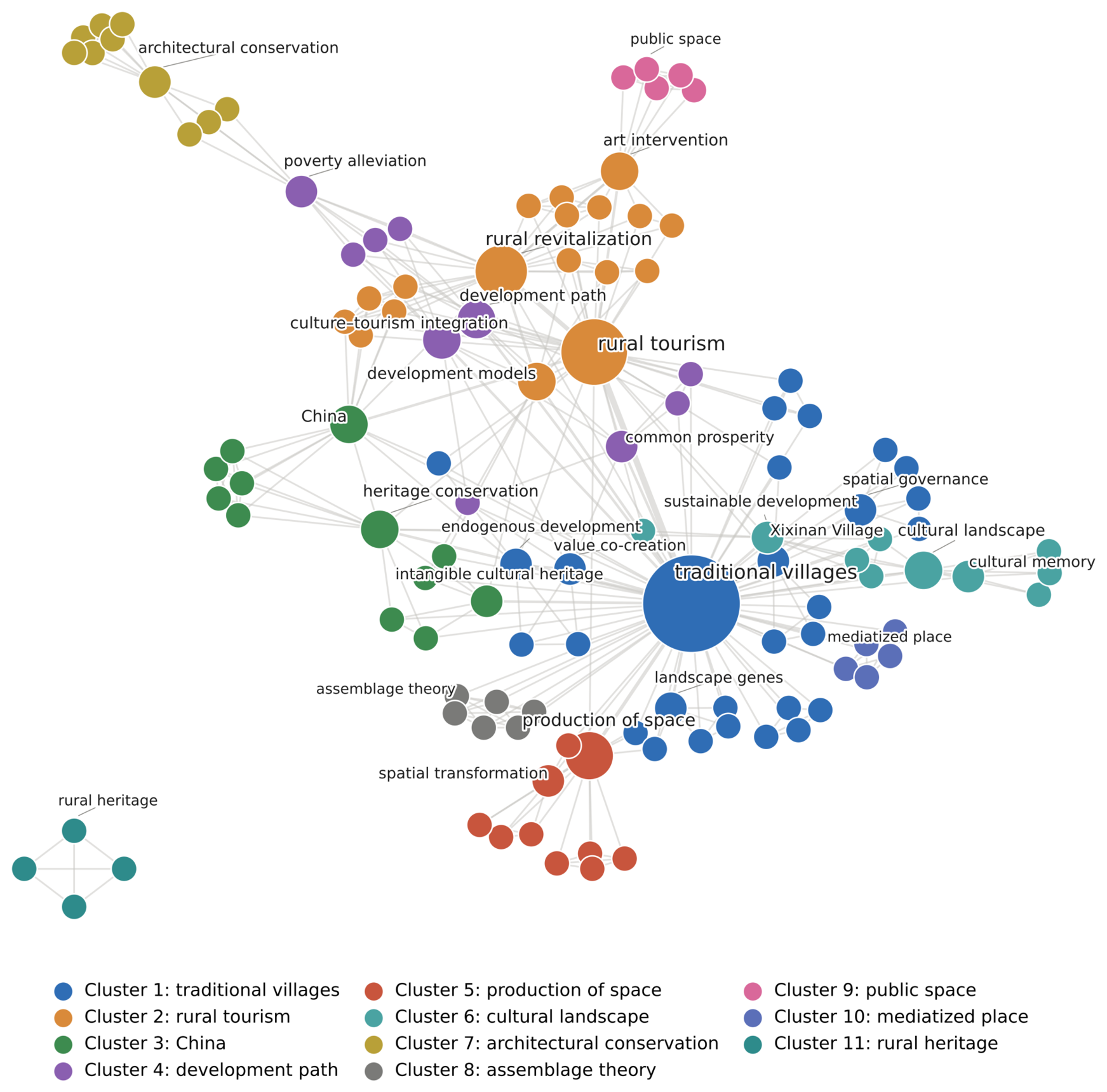
Figure 5.
Spatial distribution of the case sites. (a) Number of case attributions by province. (b) Mean number of regeneration strategies and CCI categories reported per paper, by region.
Figure 5.
Spatial distribution of the case sites. (a) Number of case attributions by province. (b) Mean number of regeneration strategies and CCI categories reported per paper, by region.
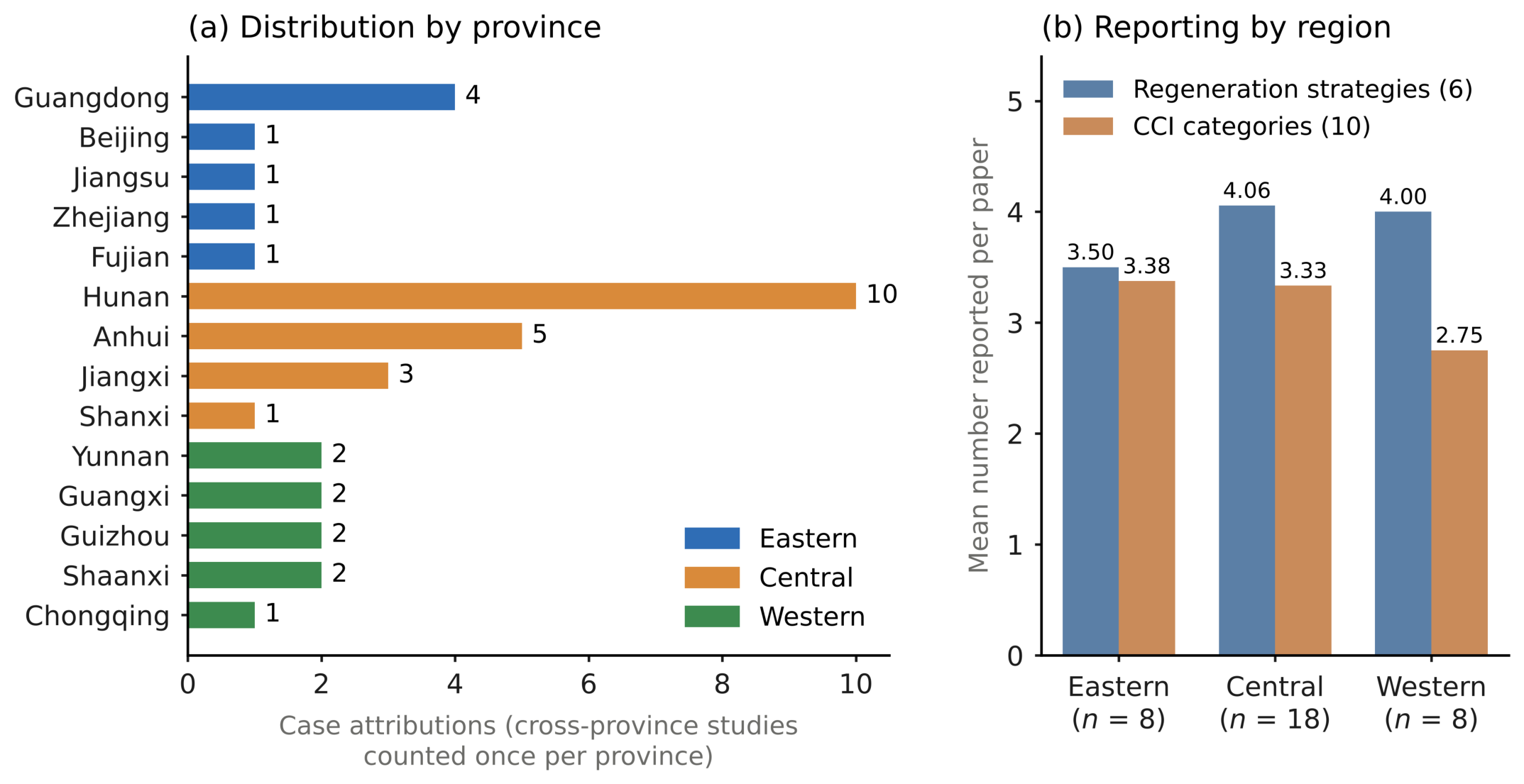
Figure 6.
Composition of respondents. (a) Respondent identity (n = 2234). (b) Number of papers that surveyed each group, based on the 27 papers that specify their respondents.
Figure 6.
Composition of respondents. (a) Respondent identity (n = 2234). (b) Number of papers that surveyed each group, based on the 27 papers that specify their respondents.
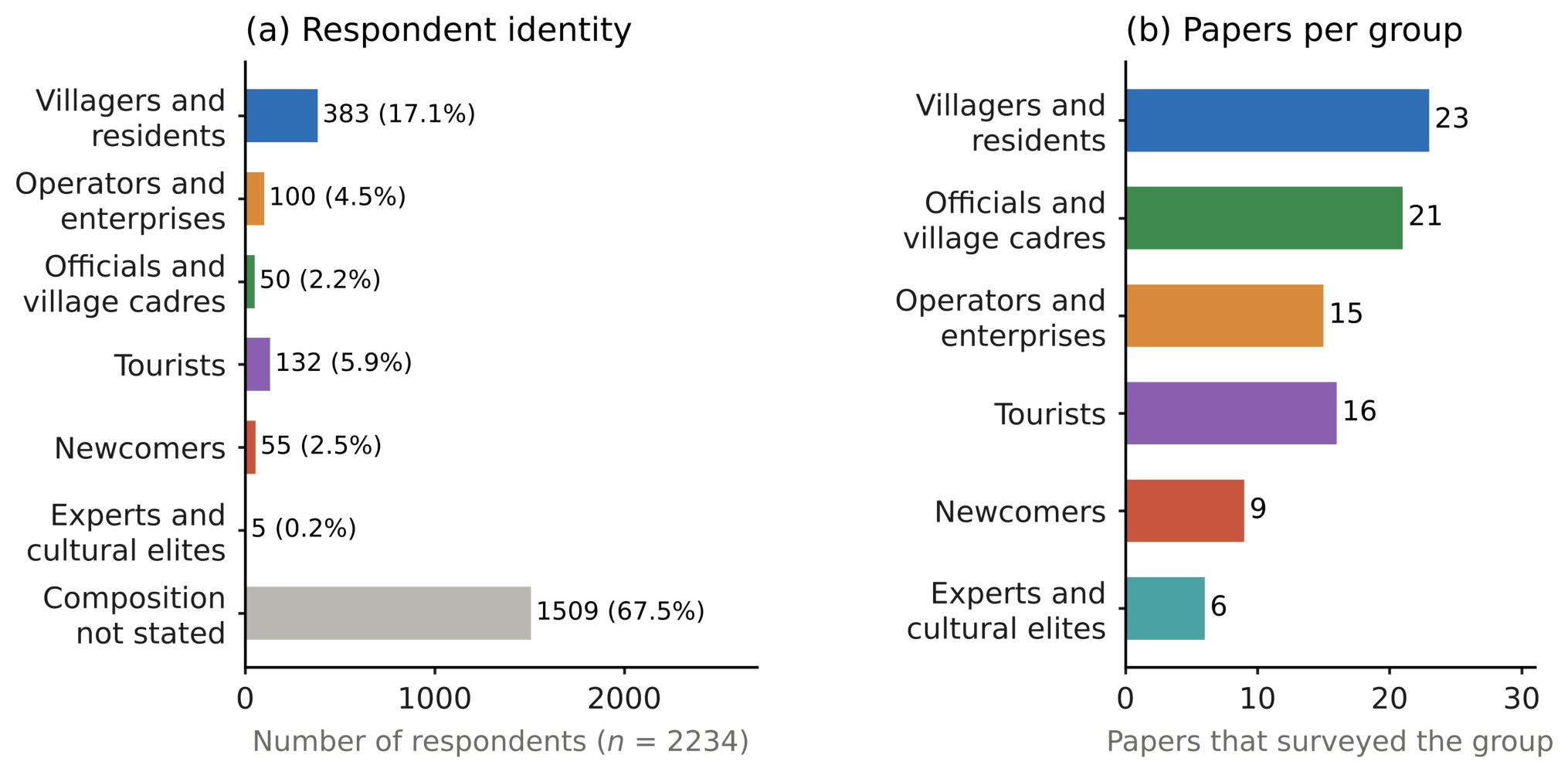
Figure 7.
Reporting of regeneration strategies and CCI categories in the 35 papers. (a) Regeneration strategies. (b) CCI categories. Bars show the percentage of papers that report each item, and the horizontal lines are Wilson 95% confidence intervals. IT: information technology; TV: television.
Figure 7.
Reporting of regeneration strategies and CCI categories in the 35 papers. (a) Regeneration strategies. (b) CCI categories. Bars show the percentage of papers that report each item, and the horizontal lines are Wilson 95% confidence intervals. IT: information technology; TV: television.
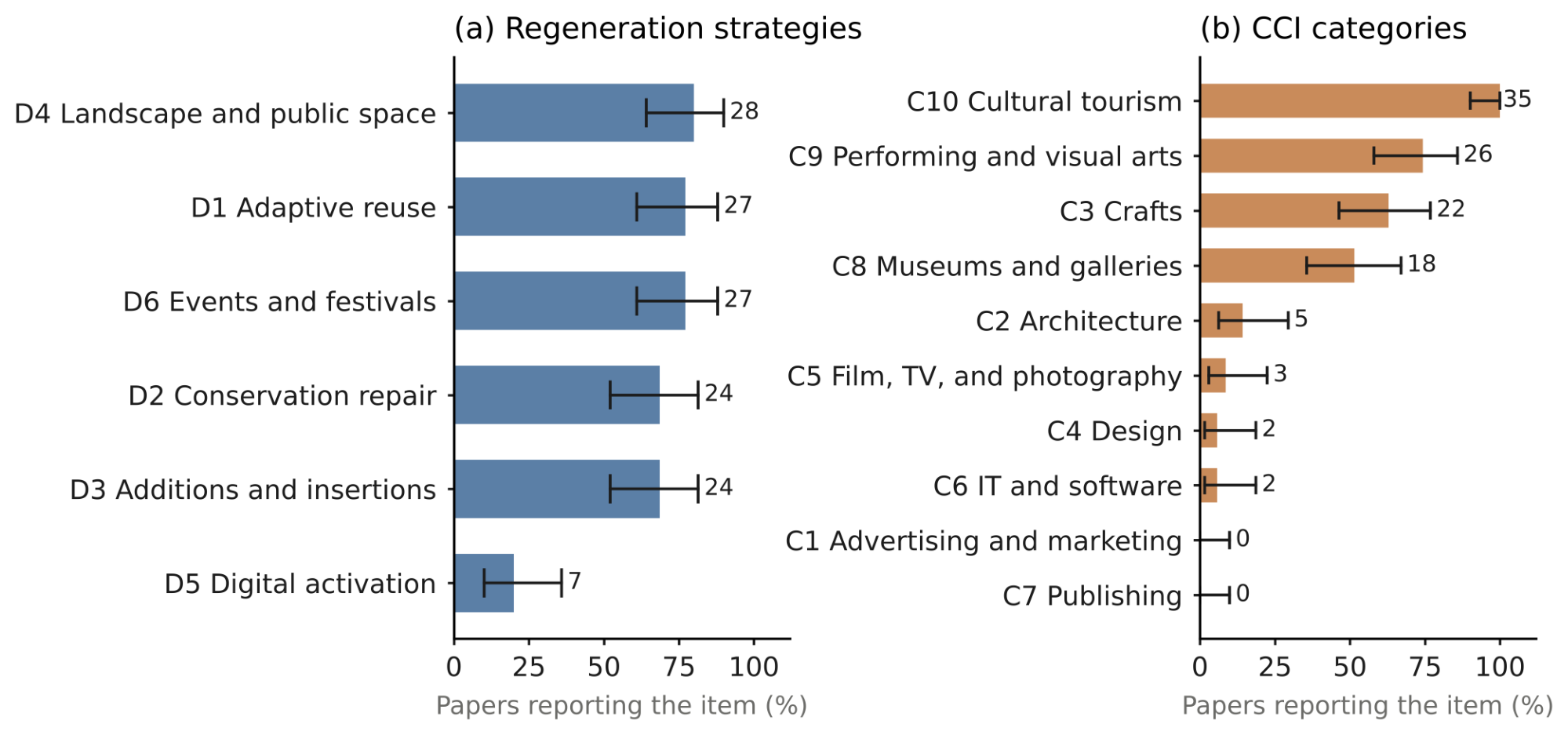
Figure 8.
coefficients between regeneration strategies and CCI categories (n = 35). Cultural tourism is reported in all papers and advertising and publishing in none; these three categories are excluded from the calculation.
Figure 8.
coefficients between regeneration strategies and CCI categories (n = 35). Cultural tourism is reported in all papers and advertising and publishing in none; these three categories are excluded from the calculation.
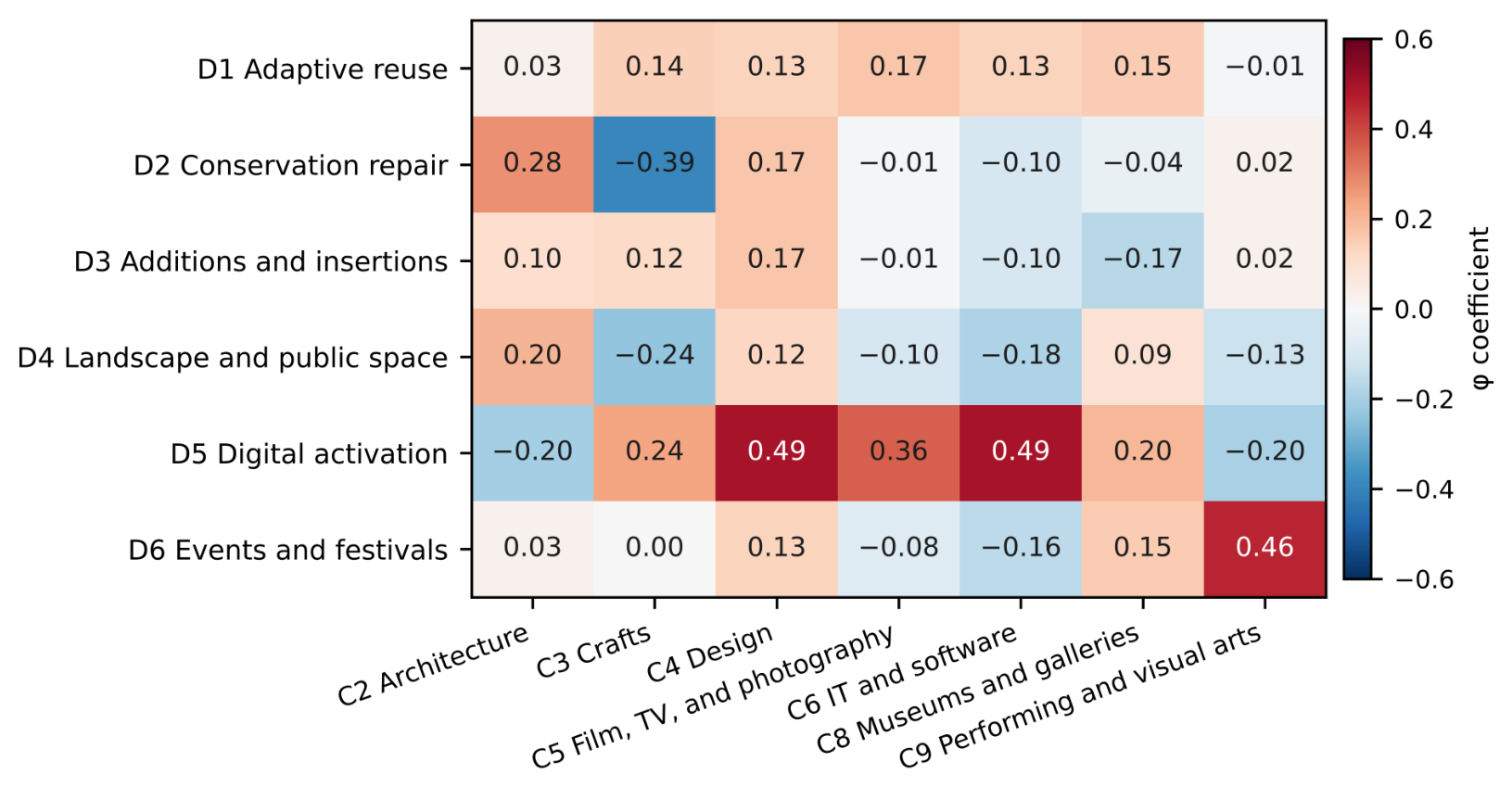
Figure 9.
Co-occurrence of village type, governance mode, regeneration strategies, and CCI categories (n = 35). Link width is allocated according to the number of papers in which two nodes co-occur, and link color follows the left-hand node.
Figure 9.
Co-occurrence of village type, governance mode, regeneration strategies, and CCI categories (n = 35). Link width is allocated according to the number of papers in which two nodes co-occur, and link color follows the left-hand node.
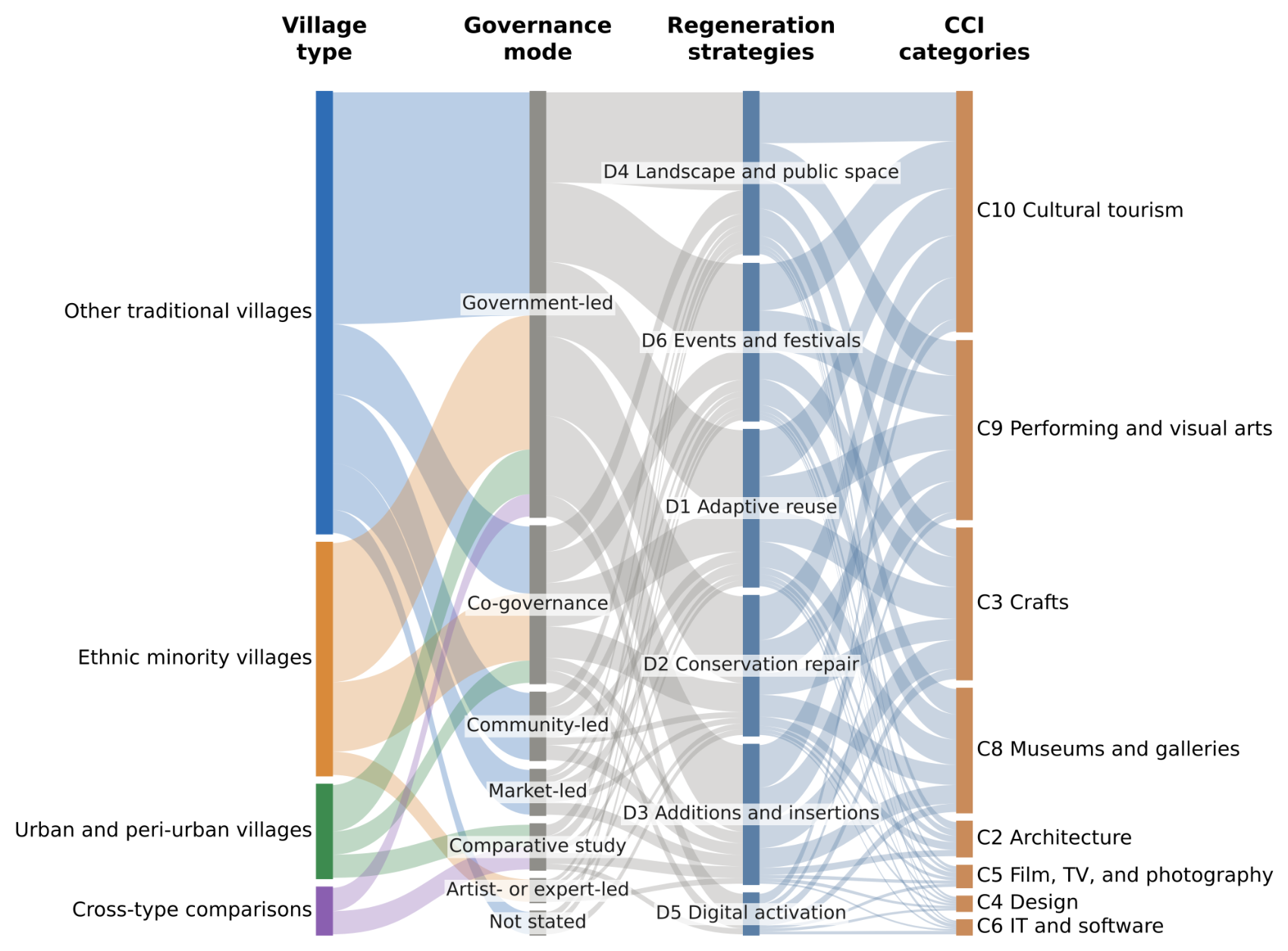
Figure 10.
Distribution of the types of outcome correlation by outcome dimension (n = 35).
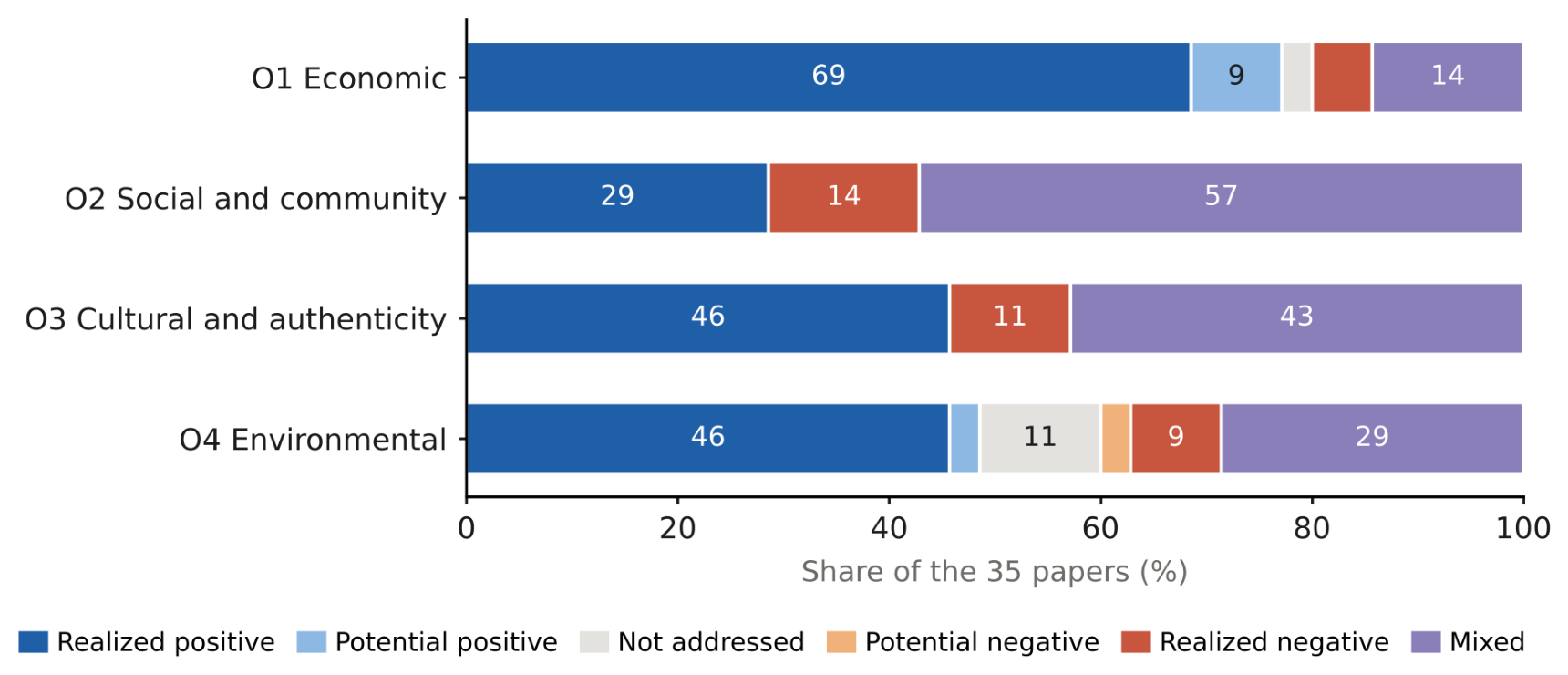
Table 1.
Search concept groups and parameters.
| Concept group | Chinese search terms | English search terms | Remarks |
|---|---|---|---|
| Traditional villages | 传统村落;古村落;历史文化名村;少数民族特色村寨 | traditional village; ancient village; historic village; heritage village | Covers the different lists and designations |
| Spatial regeneration | 再生;更新;有机更新;活化;空间重构 | regeneration; revitalization; renewal; adaptive reuse; spatial restructuring | Covers interventions in buildings and public space |
| Cultural and creative industries | 文创;文化创意产业;文化产业;文旅融合;艺术乡建;手工艺 | creative industry; cultural industry; cultural tourism; creative tourism; art intervention; craft | The terms include “culture–tourism integration”, which raises the share of tourism-related literature |
| Geography | 中国 | China; Chinese | Chinese cases only |
Table 2.
Distribution of the 35 papers by journal and year.
| Year | MDPI journals | Elsevier journals | Soc. Anal. | J. Nat. Resour. | Resour. Sci. | Trop. Geogr. | Hum. Geogr. | Other Chinese journals | Total |
|---|---|---|---|---|---|---|---|---|---|
| 2026 | 1 | 1 | 0 | 4 | 0 | 0 | 0 | 0 | 6 |
| 2025 | 5 | 0 | 0 | 0 | 1 | 0 | 0 | 1 | 7 |
| 2024 | 0 | 0 | 0 | 0 | 0 | 0 | 2 | 0 | 2 |
| 2023 | 1 | 0 | 0 | 2 | 1 | 0 | 0 | 3 | 7 |
| 2022 | 2 | 0 | 0 | 0 | 0 | 3 | 1 | 1 | 7 |
| 2021 | 2 | 0 | 1 | 0 | 0 | 0 | 0 | 1 | 4 |
| 2020 | 0 | 0 | 0 | 0 | 0 | 0 | 0 | 0 | 0 |
| 2019 | 0 | 0 | 0 | 0 | 0 | 0 | 0 | 0 | 0 |
| 2018 | 0 | 0 | 0 | 0 | 0 | 0 | 0 | 0 | 0 |
| 2017 | 1 | 1 | 0 | 0 | 0 | 0 | 0 | 0 | 2 |
| Total | 12 | 2 | 1 | 6 | 2 | 3 | 3 | 6 | 35 |
Note: The MDPI journals are Sustainability (6 papers), Land (3), Buildings (2), and Heritage (1); the Elsevier journals are Tourism Management and Journal of Rural Studies; the other Chinese journals are Scientia Geographica Sinica (2), Journal of Yunnan Agricultural University (Social Science) (2), Progress in Geography (1), and Economic Geography (1). The corpus contains no papers published in 2018–2020.
Table 3.
Criteria for assigning the type of outcome correlation.
| Type of correlation | Criterion |
|---|---|
| Realized positive | The paper reports positive results that have already occurred, supported by data or field evidence |
| Potential positive | The authors infer, expect, or recommend that positive results may arise but do not report that they have occurred |
| Not addressed | The paper does not address the dimension |
| Potential negative | The authors point to risks or possible negative results but do not report that they have occurred |
| Realized negative | The paper reports negative results that have already occurred, with no corresponding positive results |
| Mixed | Positive and negative results that have already occurred are both reported in the same dimension |
Source: The first five types follow Tua and Imoto [21]; “mixed” was added in this study because a single paper often reports both gains and losses in the same dimension.
Table 4.
Clusters of the keyword co-occurrence network and their representative keywords.
| Cluster | Representative keywords | Keywords | Papers | Publication years of the papers |
|---|---|---|---|---|
| 1 | traditional villages; endogenous development; landscape genes; value co-creation; Xixinan Village; spatial governance | 29 | 22 | 2017–2026 |
| 2 | rural tourism; rural revitalization; art intervention; development models; commodification of place; state entrepreneurialism | 18 | 14 | 2017–2025 |
| 3 | China; heritage conservation; intangible cultural heritage; architecture; cultural heritage; materiality | 12 | 6 | 2017–2025 |
| 4 | development path; culture–tourism integration; poverty alleviation; common prosperity; livelihood and well-being; mechanism | 10 | 5 | 2021–2026 |
| 5 | production of space; spatial transformation; urban island; symbol construction; landscape restoration; urban renewal | 10 | 5 | 2022–2024 |
| 6 | cultural landscape; sustainable development; cultural memory; heritage tourism; community participation; governance models | 10 | 4 | 2017–2026 |
| 7 | architectural conservation; urban-to-rural migration; migrant buildings; building scale; traditional rural lifestyles; traditional architectural features | 10 | 2 | 2025–2026 |
| 8 | assemblage theory; rural tourism consumption; consumption patterns; digital platforms; renewal and activation; Liugou Village | 6 | 1 | 2026 |
| 9 | public space; functional suitability; user satisfaction; SEM; cultural significance | 5 | 1 | 2025 |
| 10 | mediatized place; cultural space; digital empowerment; transformation and activation; Diaoyuan Village | 5 | 1 | 2026 |
| 11 | rural heritage; ancestral temples; spatial revitalization; community resilience | 4 | 1 | 2025 |
Note: The co-occurrence analysis includes all keywords; the rules for merging synonyms are given in Table A4. Clusters were detected with the Louvain algorithm (modularity Q = 0.59). Within a cluster, keywords are ordered by the number of papers in which they occur and then by weighted degree. “Papers” is the number of papers that contribute at least one keyword to the cluster. SEM: structural equation modeling.
Table 5.
Mean numbers of regeneration strategies and CCI categories reported per paper, by sub-variable.
Table 5.
Mean numbers of regeneration strategies and CCI categories reported per paper, by sub-variable.
| Variable | Sub-variable | Papers | Regeneration strategies reported, mean (SD) | CCI categories reported, mean (SD) |
|---|---|---|---|---|
| Region | Eastern China | 8 | 3.50 (0.93) | 3.38 (0.92) |
| Central China | 18 | 4.06 (1.26) | 3.33 (1.33) | |
| Western China | 8 | 4.00 (1.20) | 2.75 (1.04) | |
| Village type | Ethnic minority villages | 10 | 4.40 (1.17) | 3.40 (1.51) |
| Other traditional villages | 19 | 3.79 (1.13) | 2.89 (1.05) | |
| Urban and peri-urban villages | 4 | 3.75 (0.96) | 4.00 (0.00) | |
| Governance mode | Government-led | 19 | 4.21 (1.08) | 3.16 (1.46) |
| Co-governance | 7 | 3.57 (1.27) | 3.29 (0.76) | |
| Community-led | 3 | 3.00 (1.00) | 3.00 (0.00) | |
| All papers | 35 | 3.91 (1.15) | 3.23 (1.17) |
Note: Regeneration strategies are counted over six categories (D1–D6) and CCI categories over 10 (C1–C10). Cross-regional and cross-type comparisons and governance modes with fewer than three papers are not listed. SD: standard deviation.
Table 6.
Main results and sensitivity analyses.
| Indicator | Main analysis (35 papers) | Including the three excluded papers (38 papers) | Papers sharing a case village merged (26 units) |
|---|---|---|---|
| Mean number of regeneration strategies reported | 3.91 | 3.71 | 4.08 |
| Mean number of CCI categories reported | 3.23 | 3.11 | 3.27 |
| Digital activation | 7 (20.0%) | 8 (21.1%) | 6 (23.1%) |
| Cultural tourism | 35 (100%) | 37 (97.4%) | 26 (100%) |
| Performing and visual arts | 26 (74.3%) | 27 (71.1%) | 18 (69.2%) |
| Crafts | 22 (62.9%) | 23 (60.5%) | 18 (69.2%) |
| Museums and galleries | 18 (51.4%) | 19 (50.0%) | 13 (50.0%) |
| At least one creative category | 8 (22.9%) | 8 (21.1%) | 6 (23.1%) |
| Outcome judgments: realized positive | 47.1% | 44.7% | 38.5% |
| Outcome judgments: mixed | 35.7% | 32.9% | 50.0% |
| Outcome judgments: realized negative | 10.0% | 11.2% | 5.8% |
| At least one conflict reported | 20 (57.1%) | 20 (52.6%) | 17 (65.4%) |
| , events and festivals × performing and visual arts | 0.46 | 0.54 | 0.52 |
Note: Percentages of outcome judgments are calculated over four dimensions per paper or unit. The creative categories are architecture; design; film, TV, and photography; and IT and software. In the merged analysis, strategies, categories, and conflicts are the union across the papers of a unit, and an outcome dimension is coded as mixed if any paper codes it as mixed or if the papers give both positive and negative codes.
Disclaimer/Publisher’s Note: The statements, opinions and data contained in all publications are solely those of the individual author(s) and contributor(s) and not of MDPI and/or the editor(s). MDPI and/or the editor(s) disclaim responsibility for any injury to people or property resulting from any ideas, methods, instructions or products referred to in the content. |
© 2026 by the authors. Licensee MDPI, Basel, Switzerland. This article is an open access article distributed under the terms and conditions of the Creative Commons Attribution (CC BY) license (http://creativecommons.org/licenses/by/4.0/).
Copyright: This open access article is published under a Creative Commons CC BY 4.0 license, which permit the free download, distribution, and reuse, provided that the author and preprint are cited in any reuse.