
Submitted:
05 October 2026
Posted:
09 October 2026
You are already at the latest version
Abstract
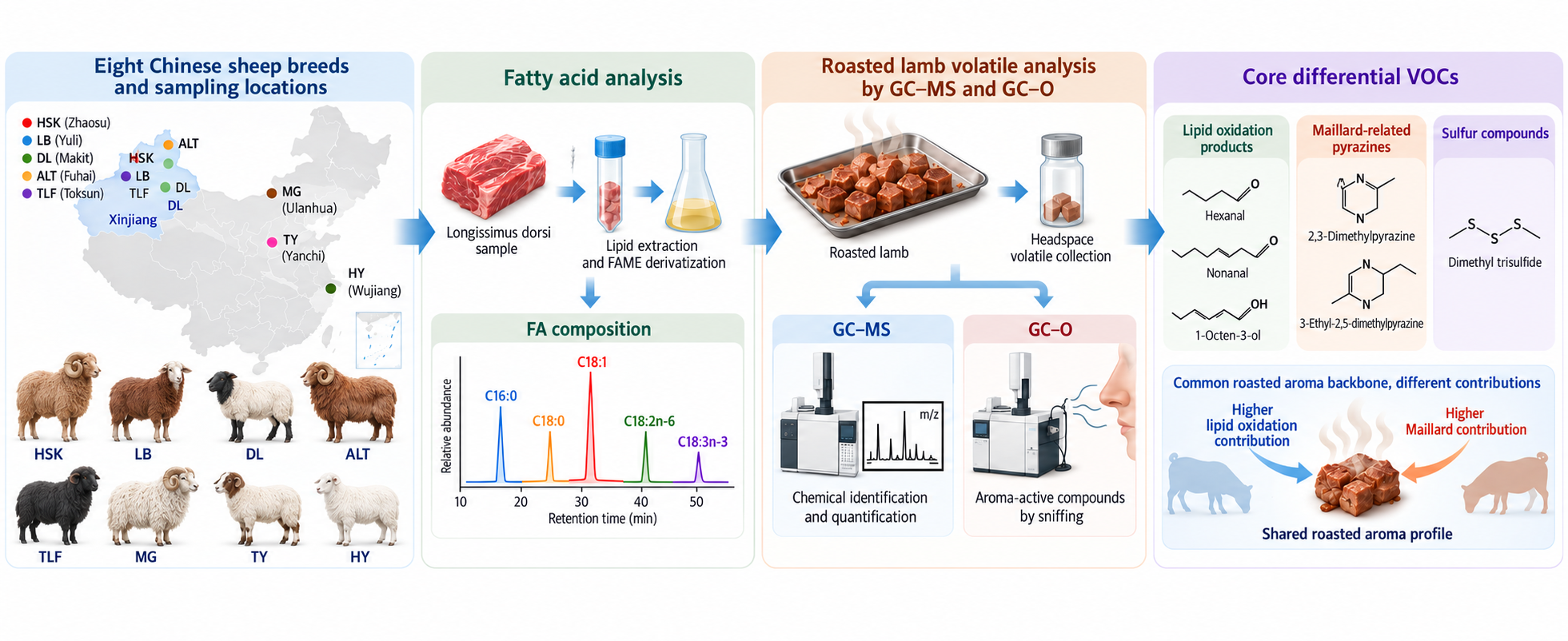
Breed-associated differences in roasted lamb flavour are often described from volatile profiles alone, whereas the links among lipid precursors, volatile abundance and olfactory activity remain less clear. Here, fatty acid profiling, headspace solid-phase microextraction–gas chromatography–mass spectrometry (HS-SPME–GC–MS) and gas chromatography–olfactometry–mass spectrometry (GC–O–MS) were combined to compare eight Chinese sheep breeds under standardized roasting conditions. Major unsaturated fatty acids, particularly C18:1, C18:2n-6, C18:3n-3 and C20:4n-6, differed markedly among breeds. Aldehydes and pyrazines dominated the roasted volatilome, but their relative contributions varied. GC–O–MS revealed a shared roasted/nutty aroma backbone, with 2,3-dimethylpyrazine detected across all breeds, whereas lipid-derived odorants including hexanal, nonanal, octanal, (E)-2-octenal and 1-octen-3-ol showed greater breed-associated variation. Some breeds exhibited pyrazine-dominant profiles, whereas others showed greater contributions from lipid-derived aldehydes and alcohols. Unsaturated fatty acids were more closely associated with lipid-derived volatiles than with pyrazines. These findings indicate that breed-associated differences in roasted lamb aroma are characterised mainly by shifts in the relative contribution of lipid oxidation products and Maillard-derived odorants against a shared aroma-active background.
Keywords:
lamb
; roasting
; fatty acids
; volatile compounds
; GC–O
Copyright: This open access article is published under a Creative Commons CC BY 4.0 license, which permit the free download, distribution, and reuse, provided that the author and preprint are cited in any reuse.