

Submitted:
02 October 2026
Posted:
09 October 2026
You are already at the latest version
Abstract
Jurisdictional REDD+ is widely promoted as a mechanism to align forest conservation, and climate mitigation, through standardized readiness frameworks and multilevel governance, yet a persistent dilemma remains: how can politically divergent subnational states converge on the same international climate finance outcomes? This study addresses that question by comparing two contrasting Brazilian Amazon states that both secured funding under the REDD+ Early Movers (REM) program. Methodologically, the research employs comparative process tracing, drawing on 287 documents and 74 semi-structured interviews, and applies Van Evera's evidence tests to assess the strength of causal explanations for program approval. The results reveal five necessary conditions for REM financing, formal compliance with REDD+ Readiness requirements was neither necessary nor sufficient for success; instead, informal arrangements, historical political trajectories, paradiplomatic networks, and multilevel coalitions among social actors played a decisive role. These findings lead to the conclusion that jurisdictional REDD+ operates less as a hierarchical implementation of institutional models and more as a polycentric governance process emerging from dynamic interactions across governance scales. By reconstructing the causal mechanisms that link international climate finance to subnational forest politics, this study advances theoretical debates on climate finance while offering practical insights for policy design in heterogeneous political contexts.
Keywords:
polycentric governance
; forest economy
; REDD+
; Brazilian Amazon
1. Introduction
The need to mitigate climate change, expressed in the goal of keeping the global average temperature increase below 2°C, has driven the creation of various mechanisms for reducing, removing and offsetting greenhouse gas (GHG) emissions. In Brazil, deforestation and burning, the main sources of these emissions, combined with the extensive coverage of native forest, place the country at the center of discussions and implementation of Reducing Emissions from Deforestation and Forest Degradation (REDD+) projects, as one of the main Payment for Ecosystem Services (PES) mechanisms for valuing standing forests in the Brazilian Amazon [1].
Jurisdictional REDD+ has become one of the central strategies in global climate governance for reducing emissions from tropical deforestation. Since the consolidation of REDD+ under the United Nations Framework Convention on Climate Change (UNFCCC), international organizations, donor governments, and development agencies have promoted subnational jurisdictional programs as key mechanisms for aligning forest conservation, climate mitigation, and sustainable development [2,3]. These initiatives are generally expected to emerge through standardized readiness frameworks involving credible Forest Reference Emission Levels (FRELs), Monitoring, Reporting and Verification (MRV) systems, safeguards information systems, and institutional coordination across governance levels. Under this perspective, jurisdictional REDD+ is frequently understood as the outcome of nested multilevel governance arrangements in which subnational actors implement internationally defined institutional architectures.
Yet the emergence of jurisdictional REDD+ programs raises a deeper theoretical dilemma. If successful jurisdictional programs depend primarily on standardized institutional readiness and hierarchical coordination across governance levels, how can politically and institutionally divergent states converge toward the same outcome of international REDD+ financing? This puzzle becomes particularly evident in the Brazilian Amazon, where the states of Acre and Mato Grosso, despite radically different political economies, governance trajectories, and environmental narratives [4] both succeeded in establishing jurisdictional REDD+ programs financed through the REDD+ Early Movers (REM) program.
At first glance, these cases should not converge. Acre became internationally recognized for its socio-environmental governance model rooted in the historical struggles of rubber tappers, Indigenous peoples, and the Alliance of Forest Peoples, later institutionalized through the political agenda of Florestania and the State System of Incentives for Environmental Services (SISA) [5,6]. Forest conservation in Acre was historically embedded within broader political claims involving territorial rights, social justice, and forest-based livelihoods. Mato Grosso, by contrast, historically represented one of the main frontiers of agribusiness expansion and accumulated deforestation in the Brazilian Amazon. The state became associated with commodity-oriented development, land concentration, and political coalitions aligned with large-scale agriculture [4,7]. Despite these contrasting trajectories, both states secured international REDD+ financing through REM, while other Amazonian states with declining deforestation rates did not.
Existing literature offers only partial explanations for this convergence. Research on climate governance has traditionally emphasized the role of multilateral agreements such as the Kyoto Protocol and the Paris Agreement in coordinating climate action through hierarchical and nested governance structures [1]. Within this perspective, global rules and national policies are expected to cascade downward into subnational implementation arenas. However, this approach has been increasingly challenged by scholarships on polycentric governance. Ostrom [8,9] argues that climate governance cannot be reduced to centralized top-down coordination because climate action emerges from interactions among multiple autonomous but interconnected decision-making centers. Subsequent studies have expanded this perspective by highlighting the role of cities, subnational governments, NGOs, and transnational coalitions in shaping climate governance beyond formal interstate arrangements [8,9,10].
In parallel, REDD+ scholarship has developed a substantial body of literature on readiness frameworks, results-based finance, and safeguards. Studies on REDD+ Readiness emphasize the importance of institutional preparation, technical capacity, and governance safeguards for program implementation [2,3]. Other contributions focus on payments for environmental services and results-based finance mechanisms as incentives for reducing deforestation [11,12]. Additional research highlights the importance of social safeguards and participation of Indigenous peoples and local communities in REDD+ governance [13,14,15]. More recently, scholarship on subnational climate governance has examined paradiplomacy and transnational coalitions such as the Governors’ Climate and Forests Task Force (GCF-TF) as important drivers of climate action beyond the nation-state [16].
Brazilian scholarship has also produced important contributions regarding forest governance and REDD+. Studies on the Action Plan for the Prevention and Control of Deforestation in the Legal Amazon (PPCDAm) demonstrate the importance of federal anti-deforestation policies and monitoring systems in reducing Amazonian deforestation [7,17]. Other works examine the institutionalization of REDD+ through Brazil’s National REDD+ Strategy (ENREDD+) and the National REDD+ Commission (CONAREDD+) [18,19]. Research on Acre’s SISA and Mato Grosso’s jurisdictional initiatives has further explored the design and implementation of state-level forest governance systems [1,20]. Additionally, studies on Amazonian social movements and paradiplomacy have demonstrated how state-level politics and transnational alliances shape environmental governance in the region [5,16].
Despite these advances, important gaps remain. First, these bodies of literature are rarely connected analytically. Research on REDD+ readiness often treats governance complexity as a secondary issue, focusing primarily on technical and institutional compliance. Conversely, polycentric governance scholarship tends to remain at a conceptual level, offering limited empirical operationalization of causal mechanisms in concrete climate governance processes. Second, existing studies seldom explain how interactions across international, national, and subnational scales produce jurisdictional REDD+ programs in politically heterogeneous contexts. Finally, much of the literature on Brazilian state-level REDD+ initiatives remains descriptive, focusing on institutional arrangements rather than reconstructing the historical and political mechanisms linking social movements, paradiplomacy, donor agendas, and subnational climate finance.
This article addresses these gaps by examining the formation and financing of jurisdictional REDD+ programs in Acre and Mato Grosso through comparative process tracing. Drawing on 287 documents, 74 semi-structured interviews, and participant observation conducted between 2022 and 2025, the study reconstructs the causal processes that enabled both states to access REM financing despite their contrasting governance trajectories. The analysis combines process tracing with Van Evera’s [21] evidence tests to evaluate competing explanations and identify the conditions that were necessary for program approval [21].
The findings demonstrate that formal compliance with REDD+ Readiness frameworks was neither necessary nor sufficient to explain jurisdictional REDD+ financing. Instead, program formation depended on polycentric interactions among international donors, federal institutions, state governments, NGOs, social movements, and transnational coalitions. The study identifies five necessary conditions for REM financing: (1) significant reductions in deforestation associated with credible FRELs; (2) reliable MRV systems; (3) a favorable international political environment for subnational climate initiatives; (4) political commitment to maintaining REDD+ outcomes; and (5) commitment to socio-environmental safeguards. However, these conditions operated through historically contingent and politically negotiated processes rather than through linear institutional implementation.
The article contributes to literature in three ways. Theoretically, it advances debates on climate governance by demonstrating that jurisdictional REDD+ is better understood through a polycentric rather than nested governance framework. Empirically, it explains how divergent political and institutional trajectories converged toward similar climate finance outcomes in the Brazilian Amazon. Methodologically, it demonstrates the value of combining process tracing and Bayesian evidence tests to investigate complex causality in climate governance across multiple scales.
By analyzing Acre and Mato Grosso as contrasting yet convergent cases, the article argues that jurisdictional REDD+ does not emerge from the simple diffusion of standardized institutional models. Instead, it emerges from historically constructed interactions among multiple governance arenas capable of transforming heterogeneous political contexts into internationally legitimate climate governance arrangements.
2. Materials and Methods
P Process tracing (PTing) is a technique, not a methodology linked to a specific theoretical-epistemological framework. It is possible to begin the analysis in three different ways: (a) testing existing theories; (b) proposing new theories by proposing a causal mechanism model that explains a proven association; (c) proposing an explanation for an exceptional or interesting case [22,23]. This article focuses on path (c).
The temporal reconstruction of the causal mechanism involves extensive historical research. Inevitably, “temporality” is an indispensable tool for applying the technique. Once this analysis is complete, we have a description of a causal process as a specific and ordered sequence of events. Grzymala-Busse [24] defines the temporality of causal process analysis in four important elements: duration, time, acceleration, and timing.
The definition of the duration of the case delimits the time lapse of the causal mechanism (beginning and end of the analysis). Within this lapse, it is crucial to define the units of change to be privileged, which Grzymala-Busse [24] defines as "time." The temporal order of these units is relevant, as it identifies what came "before" and "after." It is therefore necessary to understand when changes are most accelerated until they reach the timing—the moment of acceleration and the point of no return of the effect under investigation [24]. Therefore, in addition to establishing the timeline of the causal process of a specific effect, these divisions seek to define units of change, points of acceleration of change, and points of no return.
Not all the evidence collected leads to a causal mechanism that contributes to confirming or questioning the explanatory hypotheses of interest. It is necessary to select the changes (time) that will compose the timeline (duration) of the causal process. The juxtaposition of rival explanations brought by the case study, the counterfactual argument, and the theory strengthen the choice of variables necessary and/or sufficient to explain the case [25].
Evidence tests help the researcher choose which variables should compose the causal mechanism by comparing the possibilities of these mechanisms with the probabilities of occurrence. Stephen Van Evera [21] introduced four ideal types of evidence tests, which are compatible with Bayesian analysis and assist in the robust choice for the composition of the causal mechanism, namely: straws-in-the-wind, hoop test, smoking-gun, and doubly-decisive [21].
Another key element of evidence testing is counterfactual cases. Ricks and Liu [25] consider counterfactuals to be “heuristic devices” that allow us to compare, while controlling for all other variables, the empirical evidence of the case studied with other events or cases, selecting the best hypotheses and strengthening the causal mechanism. The counterfactual case can be chosen by the principle of maximum difference or maximum similarity [26,27]. Maximum difference (least-similar systems design) is a qualitative research strategy in which the researcher purposely selects cases that have very distinct independent variables (e.g., historical contexts, divergent political, geographical, or social profiles) but that present similar results [27].
Finally, it is important to note that PTing does not merely describe a temporal trajectory of events, but rather proposes the development of causal mechanisms, often through the creation of causal configurations between different variables, which result in evidence that fits the “hoop test” and distances itself from “straws-in-the-wind” [25].
2.1. Data Collection
The development of PTing to identify causal configurations around the institutional arrangements identified in the REM/AC must consider the interaction between the different decision-making arenas responsible for creating the rules, as well as the programme's capacity to adapt through mechanisms of social participation and decision-making by local actors.
This article is the result of three years of field research (Feb. 2022 to Mar. 2025), during which two of the authors lived in the municipality of Cruzeiro do Sul, Acre, and actively participated in local and state discussions on REDD+ mechanisms, both jurisdictional and private.
The multi-method analysis [28] comprises: 1) action research process [29], 2) documentary and content analysis (287) [30], 3) unstructured interviews (68), 4) semi-structured interviews (6). Careful analysis of REM reports, regulations, legislation, meeting minutes and interviews, described in detail at development of PTing to identify causal configurations around the institutional arrangements identified in the REM/AC must consider the interaction between the different decision-making arenas responsible for creating the rules, as well as the programme's capacity to adapt through mechanisms of social participation and decision-making by local actors.
This article is the result of three years of field research (Feb. 2022 to Mar. 2025), during which two of the authors lived in the municipality of Cruzeiro do Sul, Acre, and actively participated in local and state discussions on REDD+ mechanisms, both jurisdictional and private.
The multi-method analysis (Hesse-Biber & Johnson, 2015) comprises: 1) action research process (Toledo & Giatti, 2014), 2) documentary and content analysis (287) (Bardin, 2011), 3) unstructured interviews (68), 4) semi-structured interviews (6). Careful analysis of REM reports, regulations, legislation, meeting minutes and interviews, described in detail at Table 1 .
Documentary analysis and interviews were used to construct a timeline for each decision-making level (international, national and state – AC and MT) used for the historical reconstruction of the case and its counterfactual. Only those facts listed as relevant to the case were included in the analysis in this article.
3. Results
In this section, we will analyze the important international and national historical facts that led to the REDD+/AC and REDD+/MT receiving funding from the REM program. This article does not provide a detailed reconstruction of the historical process; the historical data has been published and is available for download. In this section, we will focus only on describing the historical moments relevant to the construction of the cases (Figure 1) and understanding the necessary independent variables identified in the causal configuration.
The historical event that marks the beginning of the analysis for both cases was related to changes in the social, political, and economic environment of the state. In the case of REDD+/AC, we adopted the end of the rubber subsidy as the milestone marking the end of the so-called “time of the rubber tapper” [33], and for REDD+/MT, we adopted the PPCDam (Action Plan for the Prevention and Control of Deforestation in the Legal Amazon), which altered the dynamics of land use and occupation in the state. In both cases, the reduction of deforestation and the creation of reliable MRV mechanisms was the gateway to the REDD+ program, which culminated in the signing of the contract between the states and KfW, a milestone for the start of the REM.
3.1. International Environment
The international environment played a significant role in both cases. Of particular note is the creation of the Coalition for Rainforest Nations (CfRN) in 2003, in response to the lack of financial incentives for forest protection not provided for in climate agreements, which culminated in the creation of the RED (Reducing Emissions from Deforestation) mechanism in 2005 (COP11/2005). The failure of the multilateral mechanism and mistrust of global climate agreements triggered paradiplomacy [16] by subnational states that disagreed with the position of their central governments and were interested in engaging in climate solutions. It was only in Bali (COP13/2007) that the idea of REDD was consolidated as a proposal by CfRN countries to establish a new climate agreement, giving priority to forests [1].
In Copenhagen (COP15/2009), REDD+ was consolidated, and in Cancún (COP16/2010), guidelines (Cancún Agreement) were created for the establishment of jurisdictional programs called REDD+ Readiness (R-Package). R-Package defines key positions for the creation of subnational programs, as explained by Minang et al. [3].
The R-Package encourages the creation of the Governors' Climate and Forests Task Force (GCF). Through it, the governor of California calls on nine other governors from Brazil, Indonesia and the United States to advance strategies to combat climate change, including the government of Acre [35]. In 2008, this small coalition signed a historic Memorandum of Understanding (MoU) on climate and forest cooperation, and the GCF was born. This effort initially focused on the voluntary market and the certification of states by private certification via Verra.
The political environment favorable to investments in the climate agenda led to the creation of the Amazon Fund as a REDD+ “pay-for-results” fund to reduce deforestation and forest degradation in the country as a whole. At the time, the Amazon Fund competed with the states of the Legal Amazon in raising funds via REDD+, as it accounted for the efforts of these states to reduce emissions from deforestation and forest degradation. For this reason, the Amazonian states participating in the GCF were interested in creating their own jurisdictional REDD+ projects [36].
On the other hand, the European strategy, catalyzed by Germany, focused on the creation of the REM program in 2012, following the approval of the R-Package. With REM, the aim is to explore the possibility of creating a REDD+ program at the subnational level, based on P/R and donations, with the support of Norway and the United Kingdom [37].
3.2. Case Reconstruction – REDD+/AC
With the fall in rubber prices, rubber plantation owners abandoned rubber production and the plantations. The rubber tappers who remained in the settlements, now free from the "barrack system" ("regime of captivity in the bosses' barracks"), began to call themselves "autonomous rubber tappers," migrating from the center of the forest to the riverbanks and establishing new settlements [33,34].
In 1967, the creation of the "Operation Amazon" program marked the military government's effort to occupy the Amazon. Under the slogans "integrate so as not to surrender" and "land without men for men without land," the initiative aimed to boost the colonization of Amazonian territories by facilitating the migration of populations from the south and southeast, the so-called "paulistas," to "uninhabited" areas of the forest. As a result, between 1970 and 1975, many rubber-tapping families were expelled from their homes and migrated to the outskirts of cities, sometimes without receiving compensation for their improvements [5].
In 1975, Wilson Pinheiro, president of the Rural Workers' Union (STR) of Brasiléia, encouraged by CONTAG and the meetings promoted by the Basic Ecclesial Communities [33], identified the need to allocate land to the rubber tappers who had been expelled from the rubber plantations. The following year, the Empates were created as a social mobilization tactic to guarantee the right to land ownership, way of life and maintenance of the forest. With the assassination of Wilson in 1980, Francisco Alves Mendes Filho, Chico Mendes, president of STR Xapuri, took over the leadership of the movement to reclaim the rubber tappers' territories [5].
At the same time, indigenous populations were subjected to "attraction fronts," supported by the Indian Protection Service (SPI - 1910 to 1966), for the contact and "pacification" of indigenous and isolated peoples. The creation of the National Indian Foundation (FUNAI) in 1967 changed national policy towards indigenous peoples, maintaining the concept of indigenous guardianship under the Indian Statute (Law No. 6,001/1973), but with a policy of demarcating Indigenous Lands (TI) [38].
In 1983, the Indigenous Assemblies began in Rio Branco/AC, with the support of the Indigenous Missionary Council (CIMI) and other institutions and social movements, connecting indigenous leaders from Acre and southern Amazonas [38]. In 1985, the First National Meeting of Rubber Tappers took place in Brasiléia, bringing together indigenous peoples, organized by Ailton Krenak and Biraci Brasil (Nixiwaká Yawanana), representatives of UNI, and the rubber tappers' movement led by Chico Mendes.
At this meeting, the National Council of Rubber Tappers (CNS) was created, along with the concept of Extractive Reserves (RESEX) as a catalyst for the rubber tappers' territorial strategy, combining indigenous inspiration for territory, measurement based on placement and roads, and the environmentalist discourse of forest conservation [5,39]. According to Allegretti [5], the Alliance of Forest Peoples also emerged from this meeting.
In 1992, ratification of the Pilot Program for the Protection of Tropical Forests in Brazil (PPG7) initiated funding for the regularization of Indigenous Territories in Acre through the Integrated Project for the Protection of Indigenous Populations and Lands in the Legal Amazon (PPTAL), conducted by FUNAI. By 2001, Acre already had 28 identified Indigenous Territories in the process of regularization, 12 of which were funded by PPTAL. In addition to the demarcated lands, the state's indigenous peoples were undergoing a process of consolidation of the movement through the creation of representative associations and organizations.
The assassination of Chico Mendes in 1988 intensified pressure for the creation of RESEX in Acre. In 1990, the Alto Juruá RESEX was created, the first in the state, followed by the Chico Mendes RESEX in the same year [40].
This entire historical context of the strengthening of indigenous and rubber tapper social movements throughout the 1970s and 1990s, along with the growing importance of environmental issues at the international level, culminated in the election of Jorge Viana (Workers' Party - PT) in 1999, with broad support from social movements and NGOs.
Under the concept of Florestania, a neologism combining forest and citizenship, the government seeks to create the legal, political, and economic foundations for a forest-based economy, incorporating into its administration the same leaders who fought for years to elect the government they felt represented them [6].
The government was the first to create its Economic Ecological Zoning (ZEE), supported by PPG7 [41], the Chico Mendes Law (No. 1,277), for the subsidy of natural rubber production; the incorporation of indigenous education and the need for differentiated study for indigenous peoples, which culminated in the recognition of "Indigenous Agroforestry Agents" (AAFI) as a professional category in the state of Acre [38].
The transition to the Binho Marques administration (2007-2010) slowed down the internationalization of the state's economy, shifting its efforts towards raising funds for the implementation of socio-environmental projects and policies [16]. Binho advanced the discussion of PSA mechanisms as a proposal to increase state revenue. With the creation of the GCF and the signing of the MoU in 2009.
In 2010, the State System of Incentives for Environmental Services (SISA - State Law No. 2,308/2010) was created, establishing the Incentive Program for Carbon Environmental Services, or ISA carbono, which allows the state to raise funds through the REDD+ mechanism.
Acre was innovative in the process of creating SISA, being the first state in the Legal Amazon to have a specific law for payments for environmental services. Even before the creation of the National REDD+ Strategy (ENREDD+), the National REDD+ Council (CONAREDD+) and InfoHub Brasil (MMA Ordinance No. 370) in 2015 [42–45]. ISA Carbon emerged even before the Cancun Agreement, which established the R-Package [3]. And the P/R methodology for jurisdictional REDD+ was only recognized within the UNFCCC in the Warsaw Framework (COP19/2013) [46].
The REM program appears as an alternative to the government. According to interviews conducted with technicians from KfW [47] and GIZ [48], the German government's rapprochement with the state of Acre had already existed since the PPG7 project (1992). The German government also monitored Brazil's progress, particularly in the state of Acre, in reducing deforestation, creating SISA and the governance system via CEVA and CTI, including funding to support the law [46].
3.3. Reconstruction of the Counterfactual Case of Maximum Difference – REDD+/MT
Unlike Acre, described as "an exception, a small island, but not reflective of the reality in the rest of the Amazon" [47], the creation of the REDD+/MT was a challenge, as it is the third largest state in Brazil, covering three different biomes (e.g. Pantanal, Cerrado, Amazon), and home to a wide spectrum of agribusinesses that, in some cases, support narratives and practices of climate denialism [36].
In 2005, when the PPCDam and Operation Curupira were launched, both of which were command and control actions to combat deforestation, pressure to combat deforestation increased in the state. Governor Blairo Maggi (2003-2010), the state's largest soybean farmer, won the "Golden Chainsaw" award promoted by the NGO Greenpeace [49]. In the same year, the government created the State Secretariat for the Environment (SEMA/MT) (Complementary Law – LC No. 214/2005), marking a transformation in the state's environmental management [50]. Added to this movement was the mobilization for the creation of the "Soy Moratorium" [51].
In 2013, the GCF pushed MT forward in the REDD+ climate agenda negotiations, which created, with Ordinary Law No. 9,878/2013, the State REDD+ System of Mato Grosso (SISREDD+/MT), the State Forum on Climate Change (FEMC), the State REDD+ Fund, the Management Council and the Scientific Panel [52].
In the same year, LC No. 255/2013 approved and created the administrative units for collegiate decision-making: the State Council for the Environment and the State Council for the Management of the State REDD+ System. Associated with senior management, the Office of the Deputy Secretary for Climate Change was created, with strategic support from the Sectoral Ombudsman for the Environment [53]. The state's NGOs hold the 1st Mato Grosso Seminar on Sustainable Municipalities, and the following year, in 2014, the state government creates the Mato Grosso Program for Sustainable Municipalities (PMS) [54].
The PMS did not take off as a state strategy for decentralizing the environmental agenda in the state. In 2015, the "Produce, Conserve and Integrate Strategy" or "PCI" was launched by the government at COP21. Institutionalized by State Decree No. 468/2016, the PCI established the "State PCI Committee" [55], composed of seven members of the state government and 14 guests from regional, national and international NGOs, companies and regulatory agencies [55].
The PCI appears as a "narrative tool" that was important in strengthening the state's commitment to the REDD+/MT and its financing via REM. The PCI demonstrated to REM the government's political will to maintain the results of deforestation reduction and the necessary "political environment" [48] necessary, acting as a unifying and mediating platform for the state's different interest groups, as a "multisectoral coalition that shares the same vision" [56].
By 2016, MT had already reduced deforestation by more than 90% between 2004 and 2014 (below 2,000 km2) [36]; it had 185 protected areas, including 79 indigenous territories, corresponding to 22% of the state's area, and 106 conservation units, covering 6% of the total area of the state of Mato Grosso [57]. In addition, there was already a legal framework in place for SISREDD+, FEMC and the State Environment Council, with increased multisectoral participation.
The PCI showed the state's commitment to maintaining long-term deforestation reduction results. In line with this, the participation of SEMA/MT technicians in GCF meetings increased their interest in seeking investments for the climate and environmental agenda, since "although MT has a strong economy, the state is not rich, it does not have much money" [47]. Although the REM program’s funding was not significant in relation to the state's GDP, it was relevant when compared to the size of the funding allocated to SEMA [58]. The support of GIZ and NGOs was essential in helping the state meet the criteria and lay the foundations for the REM trial [47].
After all these preparatory phases, the REM/MT contract was signed in 2017 at COP23 in Bonn, Germany [47], with €44 million in funding for Phase I (2018-2023) allocated by the German and British governments. The funds are released in accordance with the state's performance in combating deforestation year on year, which must keep deforestation below the limit of 1,788 km²/year.
4. Discussion
This This article addressed a central dilemma in the literature on climate governance and jurisdictional REDD+: if the emergence of subnational REDD+ programs depends primarily on standardized institutional readiness and nested governance arrangements, as dominant frameworks suggest, how can politically and institutionally divergent states converge toward the same outcome of international REDD+ financing? The comparison between Acre and Mato Grosso demonstrates that existing explanations centered on formal compliance with REDD+ Readiness requirements are insufficient to explain the formation and financing of jurisdictional REDD+ programs in the Brazilian Amazon.
The empirical findings challenge the assumption that jurisdictional REDD+ emerges through linear implementation of internationally standardized institutional architectures. Although the literature on R-Package emphasizes formal requirements such as REDD+ strategies, MRV systems, safeguards information systems, and FRELs [2,3], the evidence gathered through process tracing indicates that formal compliance alone guaranteed nor explained program approval under REM. Instead, the trajectories observed in REDD+/AC and REDD+/MT Grosso reveal that jurisdictional REDD+ emerged through historically contingent and politically negotiated processes involving interactions across multiple governance arenas.
The comparison is particularly revealing because the two states represent contrasting political economies and institutional trajectories. Acre consolidated a socio-environmental governance model strongly influenced by the rubber tapper movement, Indigenous organizations, and the political agenda of Florestania [5,6]. Mato Grosso, by contrast, historically embodied an agribusiness-oriented development model associated with high deforestation rates and resistance to environmental regulation. Under dominant theoretical expectations, Acre would appear substantially more likely to obtain international REDD+ financing than Mato Grosso. Yet both states converged toward the same outcome: the implementation and financing of jurisdictional REDD+ programs through REM.
This paradox exposes important limitations in nested governance approaches. The nested perspective assumes relatively coherent vertical coordination between international, national, and subnational governance levels, where subnational implementation depends on alignment with nationally and internationally defined institutional requirements [9]. However, the evidence from Acre and Mato Grosso demonstrates that REDD+ governance evolved through fragmented and negotiated interactions among multiple decision-making centers rather than through hierarchical institutional embedding.
The findings instead support a polycentric interpretation of climate governance [8,10,59]. In both cases, the creation of jurisdictional REDD+ programs depended on dynamic interactions among international organizations, transnational coalitions, federal institutions, state governments, NGOs, Indigenous organizations, and local social movements. These actors did not operate within a stable hierarchical chain of authority. Rather, they formed overlapping and partially autonomous governance arenas capable of cooperation, competition, and mutual adjustment over time.
The process tracing analysis identified five conditions that were consistently necessary for REM financing in both cases: (1) sustained reduction of deforestation with credible FRELs; (2) reliable MRV systems; (3) a favorable international environment for subnational climate initiatives; (4) a political environment oriented toward maintaining REDD+ outcomes; and (5) commitment to socio-environmental safeguards and participation mechanisms. Importantly, however, these conditions did not operate independently or mechanically. Their explanatory power emerged through interaction effects and temporal sequencing across multiple governance scales.
The reduction of deforestation and the establishment of credible FRELs constituted foundational conditions for program legitimacy. Neither Acre nor Mato Grosso would likely have accessed REM financing without demonstrable reductions in deforestation and robust historical emissions data. In this sense, federal investments in monitoring systems such as PRODES and broader anti-deforestation policies under PPCDAm played a decisive enabling role. Yet these variables alone were insufficient, since other Amazonian states also achieved significant reductions in deforestation without obtaining jurisdictional REDD+ financing.
Similarly, robust MRV systems proved necessary but not sufficient. Monitoring capacity enabled both states to demonstrate performance and permanence, thereby satisfying core donor expectations regarding environmental integrity. However, the existence of MRV systems did not automatically translate into financing eligibility. Their effectiveness depended on broader political and institutional configurations capable of mobilizing international trust and maintaining long-term governance commitments.
One of the article’s central findings concerns the decisive role of the international political environment. Bayesian evidence tests demonstrated strong support for the hypothesis that a favorable international environment significantly increased the probability of program approval. The emergence of transnational subnational coalitions such as the Governors’ Climate and Forests Task Force (GCF-TF), the growing international demand for jurisdictional approaches, and the creation of REM by the German government collectively generated political and financial opportunities for subnational actors. These transnational arenas partially bypassed national institutional bottlenecks and expanded the strategic autonomy of state governments within climate governance negotiations.
This dynamic was particularly evident in Acre, where paradiplomatic practices enabled the state government to establish direct relations with international actors, climate coalitions, and financing institutions. The state’s international insertion preceded the formalization of REDD+ under the Warsaw Framework and contributed to positioning Acre as a pioneer in jurisdictional climate governance. However, the findings also show that paradiplomacy alone cannot explain program emergence. Mato Grosso lacked Acre’s historical socio-environmental identity and institutional trajectory, yet successfully mobilized alternative coalitions around the Produce, Conserve and Include (PCI) strategy, supported by NGOs, international cooperation agencies, and agribusiness actors.
These findings reinforce the importance of informal institutional arrangements in jurisdictional REDD+ formation. Existing REDD+ literature often privileges formal institutional design and legal architecture, yet the evidence indicates that informal coalitions, historical political legacies, and negotiated governance arrangements were frequently more influential than formal institutional compliance. In Acre, the legacy of the Alliance of Forest Peoples, Indigenous mobilization, and social movement participation generated legitimacy and governance capacity that extended beyond formal state institutions. In Mato Grosso, broad coalitions involving NGOs, consultants, international cooperation agencies, and segments of agribusiness compensated for institutional limitations within the state bureaucracy.
The role of socio-environmental safeguards further illustrates this point. Neither Acre nor Mato Grosso possessed fully operational safeguards information systems at the time of REM approval, contrary to what would be expected under strict REDD+ Readiness assumptions. Nevertheless, both states signaled commitment to safeguards through participatory processes and consultation mechanisms involving Indigenous peoples and traditional communities. This suggests that donors prioritize political signaling and governance credibility over strict procedural compliance.
Perhaps the most significant finding concerns the limited explanatory role of technical state capacity. Contrary to dominant assumptions in the literature on environmental governance and climate finance, the technical capacity of state bureaucracies did not emerge as a decisive variable. Bayesian tests substantially weakened this hypothesis, particularly in the case of Mato Grosso, where external consultants, NGOs, and international cooperation agencies compensated for institutional weaknesses within the state administration. These finding challenges conventional state-capacity explanations and suggests that climate governance outcomes may depend more on networked governance arrangements than on bureaucratic consolidation alone.
The findings therefore suggest that jurisdictional REDD+ should not be understood as the diffusion of standardized institutional models across subnational jurisdictions. Rather, these programs emerge through context-dependent political processes shaped by historical trajectories, coalition-building dynamics, and interactions among multiple governance arenas. The same institutional outcome (i.e. REM financing) was achieved through substantially different political and institutional pathways.
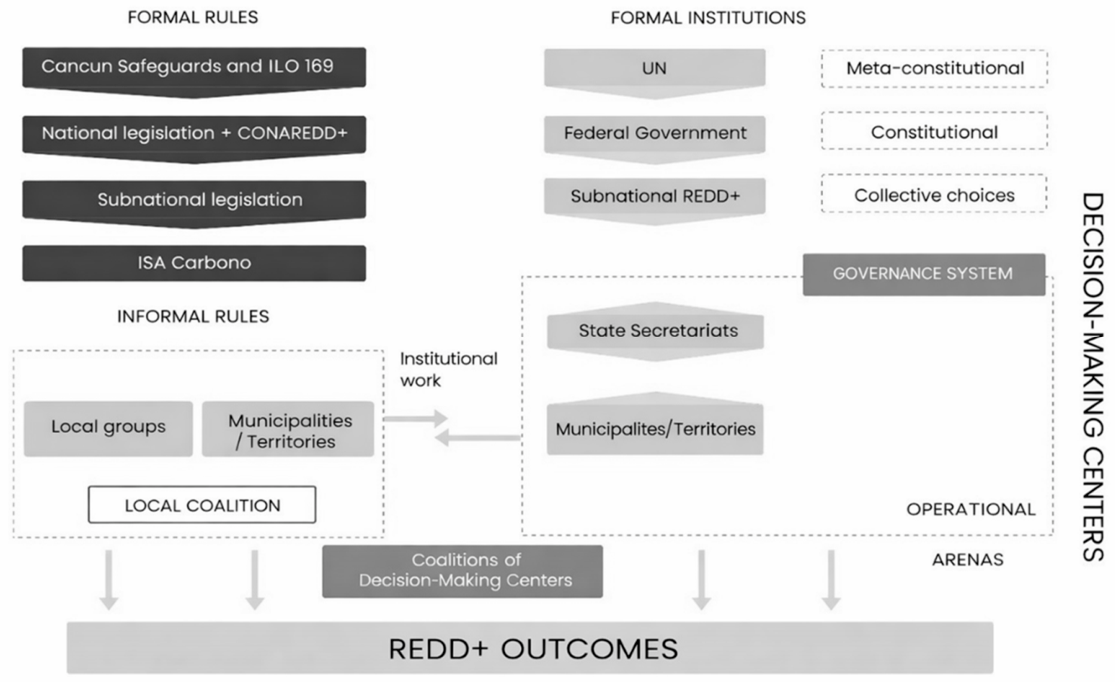
Figure 2.
Polycentric governance framework responsible for the construction of REDD+/AC.
From a theoretical perspective, the article advances the literature by operationalizing polycentric governance empirically through process tracing. While previous studies have emphasized the normative or conceptual relevance of polycentricity, few have reconstructed the causal mechanisms linking international climate governance, national anti-deforestation policies, subnational coalitions, and local participation processes. By tracing these interactions longitudinally, the article demonstrates that polycentric governance is not merely an abstract institutional configuration but a concrete causal process through which climate policies are negotiated, adapted, and implemented.
The framework presented in Figure 3 organizes how different decision-making centers were structured and interacted in the institutional construction of REDD+/AC. It identifies the meta-constitutional, constitutional, collective-choice, and operational arenas revealed by the process tracing analysis, as well as the types of institutions created within each center. The arrows represent the intensity of influence that each center exerts over the others.
5. Conclusions
This article examined the formation of jurisdictional REDD+ programs in Acre and Mato Grosso to address a central dilemma in climate governance literature: if successful REDD+ initiatives are expected to emerge through standardized readiness requirements and nested governance arrangements, how can politically divergent states converge toward the same outcome of international climate finance?
The comparative analysis demonstrates that formal compliance with REDD+ Readiness requirements was neither necessary nor sufficient to explain access to REM financing. Instead, jurisdictional REDD+ emerged through historically contingent and politically negotiated interactions among actors operating across international, national, and subnational arenas. While both states followed distinct political trajectories, they converged through different combinations of enabling conditions and governance arrangements.
The study identified five necessary conditions for REM financing: significant reductions in deforestation associated with credible FRELs, reliable MRV systems, a favorable international political environment, political commitment to maintaining REDD+ outcomes, and commitment to socio-environmental safeguards. However, these conditions did not operate as isolated institutional requirements. Their effects depended on interactions among political coalitions, historical trajectories, and governance networks across scales.
The findings therefore support a polycentric interpretation of climate governance and challenge assumptions that jurisdictional REDD+ can be explained primarily through nested institutional arrangements or technical readiness frameworks. Informal coalitions, paradiplomatic strategies, and the participation of NGOs, Indigenous organizations, and social movements frequently played a more decisive role than formal institutional design or state technical capacity.
More broadly, the article suggests that climate governance outcomes cannot be understood as simple products of institutional replication. Similar outcomes may emerge from fundamentally different political pathways. Understanding how these pathways are constructed is essential not only for explaining the emergence of jurisdictional REDD+ but also for designing climate finance strategies capable of operating effectively in politically heterogeneous contexts.
Supplementary Materials
The following supporting information can be downloaded at the website of this paper posted on Preprints.org.
Author Contributions
Conceptualization, K.S.-D. and P.S.; methodology, K.S.-D. and C.B.-R.; software, N/A; validation, K.S.-D., C.B.-R. and A.I.; formal analysis, K.S.-D.; investigation, K.S.-D., C.B.-R. and L.S.; resources, P.S. and A.I.; data curation, C.B.-R. and L.S.; writing—original draft preparation, K.S.-D.; writing—review and editing, K.S.-D., C.B.-R., A.I., P.S. and L.S.; visualization, K.S.-D. and L.S.; supervision, P.S. and A.I.; project administration, K.S.-D.; funding acquisition, P.S. and A.I. All authors have read and agreed to the published version of the manuscript.
Funding
This research was funded by CAPES and Instituto Fronteiras.
Data Availability Statement
The process tracing database supporting the reported results is openly available in Zenodo at https://doi.org/10.5281/zenodo.18500064. Interview transcripts and sensitive documentary materials are not publicly available due to privacy, legal, and ethical restrictions related to the protection of research participants and the confidentiality agreements established during fieldwork. All other data analyzed in this study are included in the article and its Supplementary Materials.
Conflicts of Interest
The authors declare no conflicts of interest.
Abbreviations
The following abbreviations are used in this manuscript:
| CONAREDD+ | National REDD+ Commission |
| ENREDD+ | National REDD+ Strategy |
| FRELs | Forest Reference Emission Levels |
| MRV | Monitoring, Reporting and Verification |
| PES | Payment for Ecosystem Services |
| PPCDAm | Action Plan for the Prevention and Control of Deforestation in the Legal Amazon |
| PTing | Process Tracing |
| REDD+ | Reducing Emissions from Deforestation and Forest Degradation |
| REM | REDD+ Early Movers |
| UNFCCC | United Nations Framework Convention on Climate Change |
References
- Sessin-Dilascio, K.; Borges-Rossi, C.; Sinisgalli, P. Uncovering REDD Plus in Brazil. Sustainability 2024, 16, 5409. [Google Scholar] [CrossRef]
- Angelsen, A.; Martius, C.; De Sy, V.; Duchelle, A. Transforming REDD+: Lessons and New Directions; CIFOR: Bogor, Indonesia, 2018. [Google Scholar]
- Minang, P.A.; Van-Noordwijk, M.; Duguma, L.A.; Alemagi, D.; Do, T.H.; Bernard, F.; et al. REDD+ Readiness Progress across Countries: Time for Reconsideration. Clim. Policy 2014, 14, 685–708. [Google Scholar] [CrossRef]
- Lopes, G.; de Castro, F. State-Level Politics in Forest Governance: The Role of the Narrative-Policy Nexus in the Brazilian Amazon. Environ. Policy Gov. 2026, 476–490. [Google Scholar] [CrossRef]
- Allegretti, M. A construção social de políticas públicas. Chico Mendes e o movimento dos seringueiros. Desenvolv. Meio Ambiente 2008, 1–21. [Google Scholar]
- Ferreira-Castelo, C.E. Um olhar sobre o desenvolvimento acreano: a “florestania” e outras histórias. Rev. NERA 2020, 23(51). [Google Scholar] [CrossRef]
- Bizzo, E.; Michener, G. Forest Governance without Transparency? Evaluating State Efforts to Reduce Deforestation in the Brazilian Amazon. Environ. Policy Gov. 2017, 27, 560–574. [Google Scholar] [CrossRef]
- Ostrom, E. Polycentric Systems for Coping with Collective Action and Global Environmental Change. Glob. Environ. Change 2010, 20, 550–557. [Google Scholar] [CrossRef]
- Ostrom, E. Nested Externalities and Polycentric Institutions: Must We Wait for Global Solutions to Climate Change before Taking Actions at Other Scales? Econ. Theory 2012, 49, 353–369. [Google Scholar] [CrossRef]
- Nagendra, H.; Ostrom, E. Polycentric Governance of Multifunctional Forested Landscapes. Int. J. Commons 2012, 6, 104–133. [Google Scholar] [CrossRef]
- Börner, J.; Baylis, K.; Corbera, E.; Ezzine-de-Blas, D.; Honey-Rosés, J.; Persson, U.M.; Wunder, S. The Effectiveness of Payments for Environmental Services. World Dev. 2017, 96, 359–374. [Google Scholar] [CrossRef]
- Wunder, S.; Brouwer, R.; Engel, S.; Ezzine-de-Blas, D.; Muradian, R.; Pascual, U.; Pinto, R. From Principles to Practice in Paying for Nature’s Services. Nat. Sustain. 2018, 1, 145–150. [Google Scholar] [CrossRef]
- Larson, A.M.; Brockhaus, M.; Sunderlin, W.D.; Duchelle, A.; Babon, A.; Dokken, T.; et al. Land Tenure and REDD Plus: The Good, the Bad and the Ugly. Glob. Environ. Change 2013, 23, 678–689. [Google Scholar] [CrossRef]
- Lawlor, K.; Madeira, E.M.; Blockhus, J.; Ganz, D.J. Community Participation and Benefits in REDD+: A Review of Initial Outcomes and Lessons. Forests 2013, 4, 296–318. [Google Scholar] [CrossRef]
- Sills, E.O.; de Sassi, C.; Jagger, P.; Lawlor, K.; Miteva, D.A.; Pattanayak, S.K.; Sunderlin, W.D. Building the Evidence Base for REDD+: Study Design and Methods for Evaluating the Impacts of Conservation Interventions on Local Well-Being. Glob. Environ. Change 2017, 43, 148–160. [Google Scholar] [CrossRef] [PubMed]
- Filho, F.G. A Paradiplomacia Subnacional no Brasil: Uma Análise da Política de Atuação Internacional dos Governos Estaduais Fronteiriços da Amazônia. Thesis, Universidade de Brasília, Brasília, Brazil, 2011. Available online: https://repositorio.unb.br/jspui/handle/10482/9379.
- Nepstad, D.; Soares-Filho, B.; Merry, F.; Lima, A.; Moutinho, P.; Carter, J.; et al. The End of Deforestation in the Brazilian Amazon. Science 2009, 326, 1350–1351. [Google Scholar] [CrossRef] [PubMed]
- Correa, J.; Van der Hoff, R.; Rajão, R. Amazon Fund 10 Years Later: Lessons from the World’s Largest REDD+ Program. Forests 2019, 10, 272. [Google Scholar] [CrossRef]
- May, P.; Millikan, B.; Gebara, M. The Context of REDD+ in Brazil: Drivers, Agents and Institutions; CIFOR: Bogor, Indonesia, 2011. [Google Scholar]
- Conceição, H.R.; Börner, J. Understanding Adoption and Design of Incentive-Based Forest Conservation Policies: A Case Study of the SISA Program in Acre, Brazil. In Ecological Economic and Socio Ecological Strategies for Forest Conservation; Springer: Cham, Switzerland, 2020; pp. 241–258. [Google Scholar]
- Van Evera, S. Guide to Methods for Students of Political Science; Cornell University Press: Ithaca, NY, USA, 1997. [Google Scholar]
- Beach, D.; Pedersen, R.B. Causal Case Study Methods: Foundations and Guidelines for Comparing, Matching, and Tracing; University of Michigan Press: Ann Arbor, MI, USA, 2016. [Google Scholar]
- Trampusch, C.; Palier, B. Between X and Y: How Process Tracing Contributes to Opening the Black Box of Causality. New Political Econ. 2016, 21, 437–454. [Google Scholar] [CrossRef]
- Grzymala-Busse, A. Time Will Tell? Temporality and the Analysis of Causal Mechanisms and Processes. Comp. Political Stud. 2011, 44, 1267–1297. [Google Scholar] [CrossRef]
- Ricks, J.I.; Liu, A.H. Process-Tracing Research Designs: A Practical Guide. PS Political Sci. Politics 2018, 51, 842–846. [Google Scholar] [CrossRef]
- Fearon, J. Counterfactuals and Hypothesis Testing in Political Science. World Politics 1991, 43, 169–195. Available online: https://www.cambridge.org/core/journals/world-politics/article/counterfactuals-and-hypothesis-testing-in-political-science/1DE902D41097CEF599E73F84A47BBE4F. [CrossRef]
- Waldner, D. What Makes Process Tracing Good? Causal Mechanisms, Causal Inference, and the Completeness Standard in Comparative Politics. In Process Tracing: From Metaphor to Analytic Tool; Bennett, A., Checkel, J., Eds.; Cambridge University Press: Cambridge, UK, 2015; pp. 126–152. [Google Scholar]
- Hesse-Biber, S.; Johnson, R. The Oxford Handbook of Multimethod and Mixed Methods Research Inquiry; Guilford Publications: New York, NY, USA, 2015. [Google Scholar]
- Toledo, R.F.; Giatti, L.L. Challenges to Participation in Action Research. Health Promot. Int. 2014, 30, 162–173. [Google Scholar] [CrossRef] [PubMed]
- Bardin, L. Análise de Conteúdo; Edições 70: São Paulo, Brazil, 2011. [Google Scholar]
Figure 1.
Summary of the PTing case of the jurisdictional REDD+ programme in Acre and Mato Grosso.
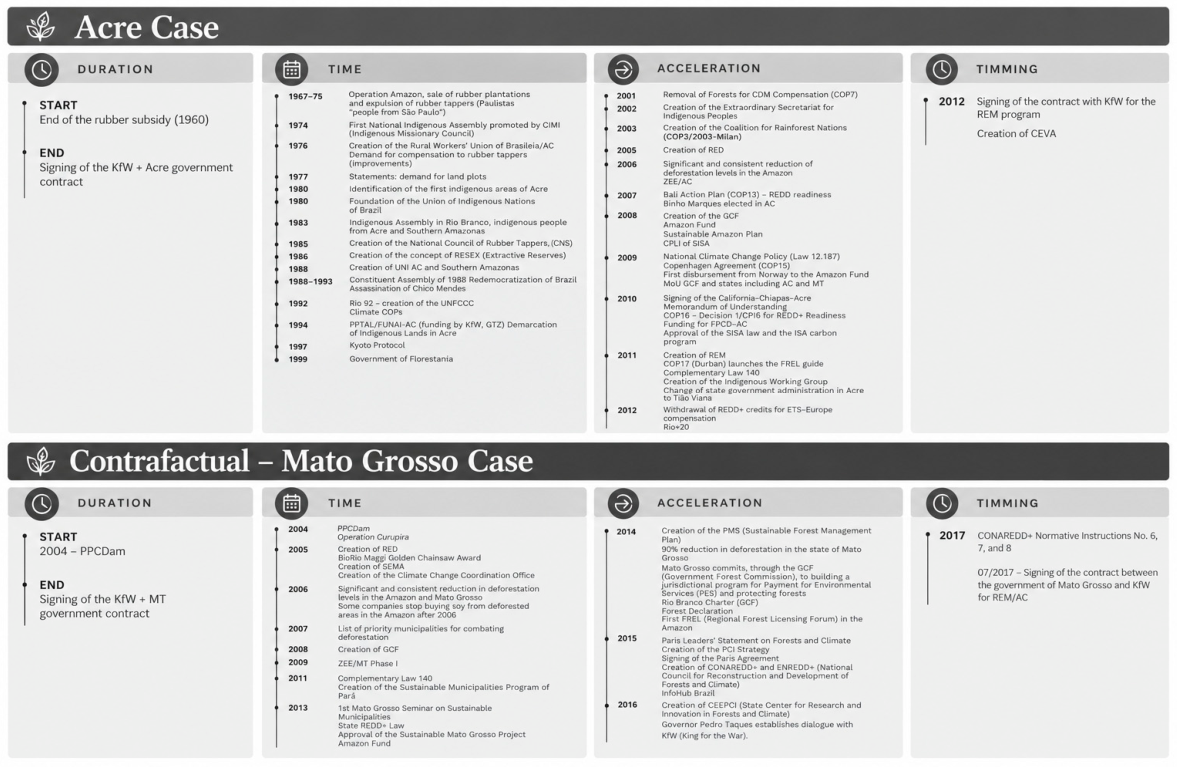

Table 1.
Description of data collected during the action research conducted in the state of Acre, 2022–2025.
Table 1.
Description of data collected during the action research conducted in the state of Acre, 2022–2025.
| Period | Collection technique | Quantitative |
|---|---|---|
| Feb. 2022 – Mar. 2025 | Application of unstructured and semi-structured questionnaires using snowball sampling (Parker et al., 2019) | 34 international, national, state and local stakeholders involved in jurisdictional REDD+ projects in the states of Acre and Mato Grosso: 7 NGOs, 15 governments, 12 social movements. Total of 68. |
| July 2024 – February 2025 | Qualitative analysis of meeting minutes (Sessin-Dilascio et al., 2023) | Analysis of all REM/Acre documents, minutes of meetings of the REDD+/AC participatory governance body (58 CEVA, 54 CTI, 5 CTM), CONAREDD+ (72). Total of 189. |
| Oct/2024 | Semi-structured questionnaire for local governments (Cruzeiro do Sul-AC) | 6 interviews conducted in Cruzeiro do Sul-AC with IBAMA, ICMBio, SEMEIA, MPAC, IMAC, Acre State Public Defender's Office |
| Dec/2024 | Participatory workshops on the REDD+ jurisdictional programme in Acre | 4 participatory workshops with local stakeholders: indigenous peoples (2), leaders of the Riozinho da Liberdade, Alto Juruá and Alto Tarauacá RESEX (2). |
| Nov 2024-Mar 2025 | Documentary analysis (Sessin-Dilascio; Rossi; Sinisgalli, 2023)of reports on jurisdictional REDD+ programmes: GCF, CONAREED+, Amazon Fund, REM/MT, REM/AC, international reports on investments, newspaper publications (Papo de Índio), press releases (ABIOVE, Greenpeace, etc. | 95 reports, regulations, laws, and news articles related to REDD+ at the international, national, state, and local levels. |
Disclaimer/Publisher’s Note: The statements, opinions and data contained in all publications are solely those of the individual author(s) and contributor(s) and not of MDPI and/or the editor(s). MDPI and/or the editor(s) disclaim responsibility for any injury to people or property resulting from any ideas, methods, instructions or products referred to in the content. |
© 2026 by the authors. Licensee MDPI, Basel, Switzerland. This article is an open access article distributed under the terms and conditions of the Creative Commons Attribution (CC BY) license.
Copyright: This open access article is published under a Creative Commons CC BY 4.0 license, which permit the free download, distribution, and reuse, provided that the author and preprint are cited in any reuse.