

Submitted:
06 October 2026
Posted:
09 October 2026
You are already at the latest version
Abstract
Nondestructive evaluation (NDE) is moving from manually interpreted indications toward connected measurement systems in which sensing, imaging, automated processing, artificial intelligence (AI), and engineering decisions are coupled through a digital thread. This transition increases information availability but also introduces additional points at which measurement meaning, uncertainty, or traceability can be lost. This critical integrative review reframes NDE 4.0 as a metrological-assurance problem and proposes a six-layer architecture spanning the physical measurand, instrument, signal, information, inference, and decision layers. The architecture is combined with an uncertainty map for hybrid physical-digital inspection, a minimum digital evidence record, and a qualification V-model linking intended use to verification, representative validation, bounded autonomy, and post-deployment surveillance. A worked ultrasonic-sizing example illustrates how classical measurement contributions and model-inference uncertainty can be combined without treating AI confidence as a substitute for measurement uncertainty. The synthesis distinguishes metrological traceability from digital provenance, probability of detection from classification metrics, and probabilistic calibration from measurement uncertainty. Cross-sector analysis of aerospace, nuclear, rail, civil infrastructure, and additive manufacturing shows that increasing autonomy raises both information value and evidential burden. The central conclusion is that, for measurement-based engineering decisions, especially in higher-consequence applications, the defensibility of an NDE 4.0 system depends on an adequately traceable, uncertainty-aware, intended-use validation, and auditable sensor-to-decision chain.
Keywords:
artificial intelligence
; digital thread
; instrumentation
; measurement uncertainty
; metrological traceability
; NDE 4.0
; probability of detection
; qualification
; uncertainty quantification
1. Introduction
Industrial NDE has historically relied on comparatively transparent evidence chains: a physical interaction generates an instrument response, the response is compared with a reference or procedural threshold, and a qualified person makes an engineering disposition. Contemporary NDE can instead acquire encoded ultrasonic datasets, computed-tomography projections, thermal sequences, acoustic-emission streams, or robotic images; transform them through multiple processing stages; combine them with historical information; and generate an algorithmic recommendation. The resulting information can be richer, but the causal path from physical condition to reported result is also longer and more difficult to audit.
This change is fundamentally a measurement-science problem. A high-performing classifier is not, by itself, a measurement system, and a digital twin is not automatically an authoritative representation of asset condition. The reported result depends on the definition of the measurand, calibration and stability of the acquisition chain, sampling and processing choices, data provenance, model validity, uncertainty, and the decision rule applied to the output. Measurement-science literature has similarly emphasized that AI-related error contributions and uncertainty must be evaluated within the complete measurement system rather than inferred from predictive accuracy alone [1,31,32,33].
Existing NDE 4.0 literature has established the importance of interoperability, digital twins, data sovereignty, automation, and human factors [2,3,4,5,6,7]. Method-specific studies have also documented rapid progress in AI-assisted ultrasonics, terahertz inspection, microwave and millimetre-wave NDE, railway monitoring, and AIoT systems [9,10,11,12,13,14]. These streams are necessary but incomplete for qualification: metrology addresses traceability and measurement uncertainty; POD/MAPOD addresses detection reliability; trustworthy-AI frameworks address model risk and governance; and digital-twin frameworks address lifecycle information. Taken individually, these established frameworks address different segments of the modern inspection chain rather than a single linked path from physical measurand through digital inference to engineering disposition. The integration gap addressed here is therefore not the absence of assurance methods, but the absence of an NDE-specific architecture that connects their evidence requirements and hand-offs end to end.
This paper addresses that integration gap through four contributions. First, it recasts NDE 4.0 as a sensor-to-decision measurement-evidence chain. Second, it develops a six-layer metrological-assurance architecture and uncertainty taxonomy for hybrid physical-digital inspection. Third, it defines a minimum digital evidence record and a qualification V-model that links intended use, representative validation, safe deferral, change control, and surveillance. Fourth, it proposes a risk-proportional transition roadmap that can be adapted across industrial sectors. The paper is a critical integrative review and conceptual synthesis; it does not claim experimental validation or consensus-standard status for the proposed framework.
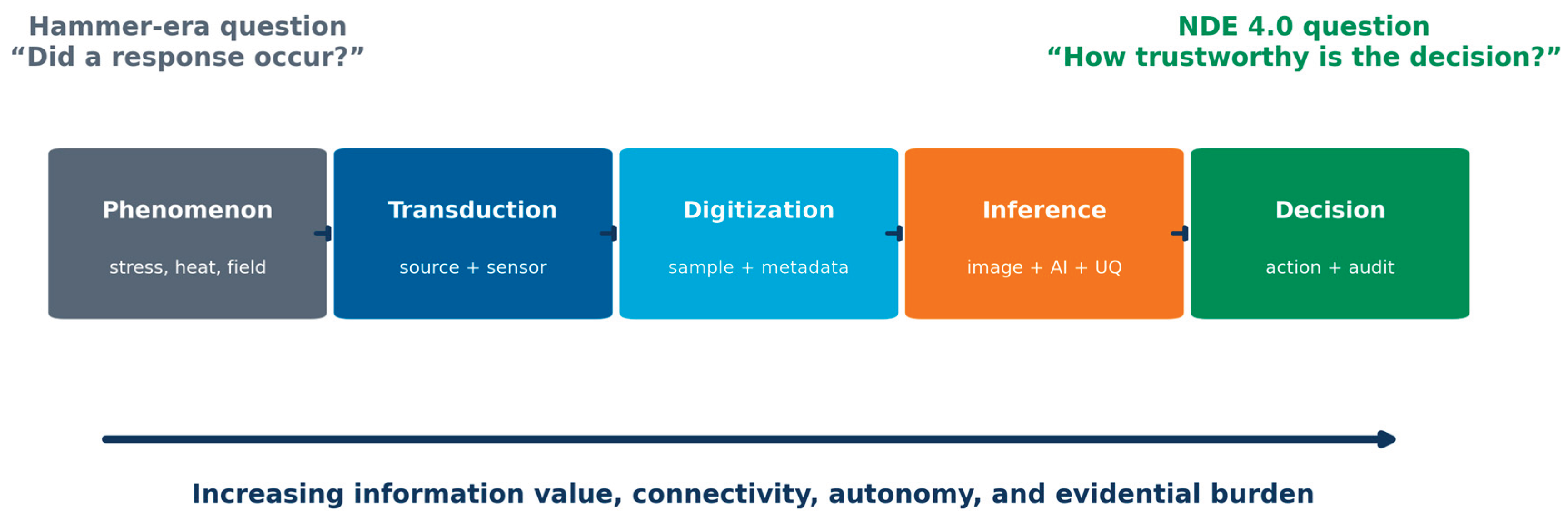
Figure 1.
Evolution from direct indication to a connected sensor-to-decision evidence chain. The transition increases both information content and the burden of demonstrating trustworthiness.
Figure 1.
Evolution from direct indication to a connected sensor-to-decision evidence chain. The transition increases both information content and the burden of demonstrating trustworthiness.
2. Review Design, Scope, and Analytical Method
This study uses a critical integrative review design rather than a systematic meta-analysis. The evidence base is intentionally heterogeneous: normative metrology documents, NDE reliability methods, instrumentation studies, AI validation research, digital-thread architectures, cybersecurity guidance, and governance standards cannot be combined through a single effect-size model. The review therefore asks a different question: which assurance requirements recur across these evidence streams when the complete NDE sensor-to-decision chain is treated as a measurement system? Six evidence streams were retained: measurement terminology and uncertainty; NDE reliability and POD; digital metrology and calibration; AI-assisted measurement; interoperability and digital twins; and governance, cybersecurity, and human factors. Sources were retained when they defined a measurement concept, supplied a validation method, reported a relevant NDE measurement system, or established an operational or governance requirement. Vendor claims and market forecasts were excluded from technical conclusions.
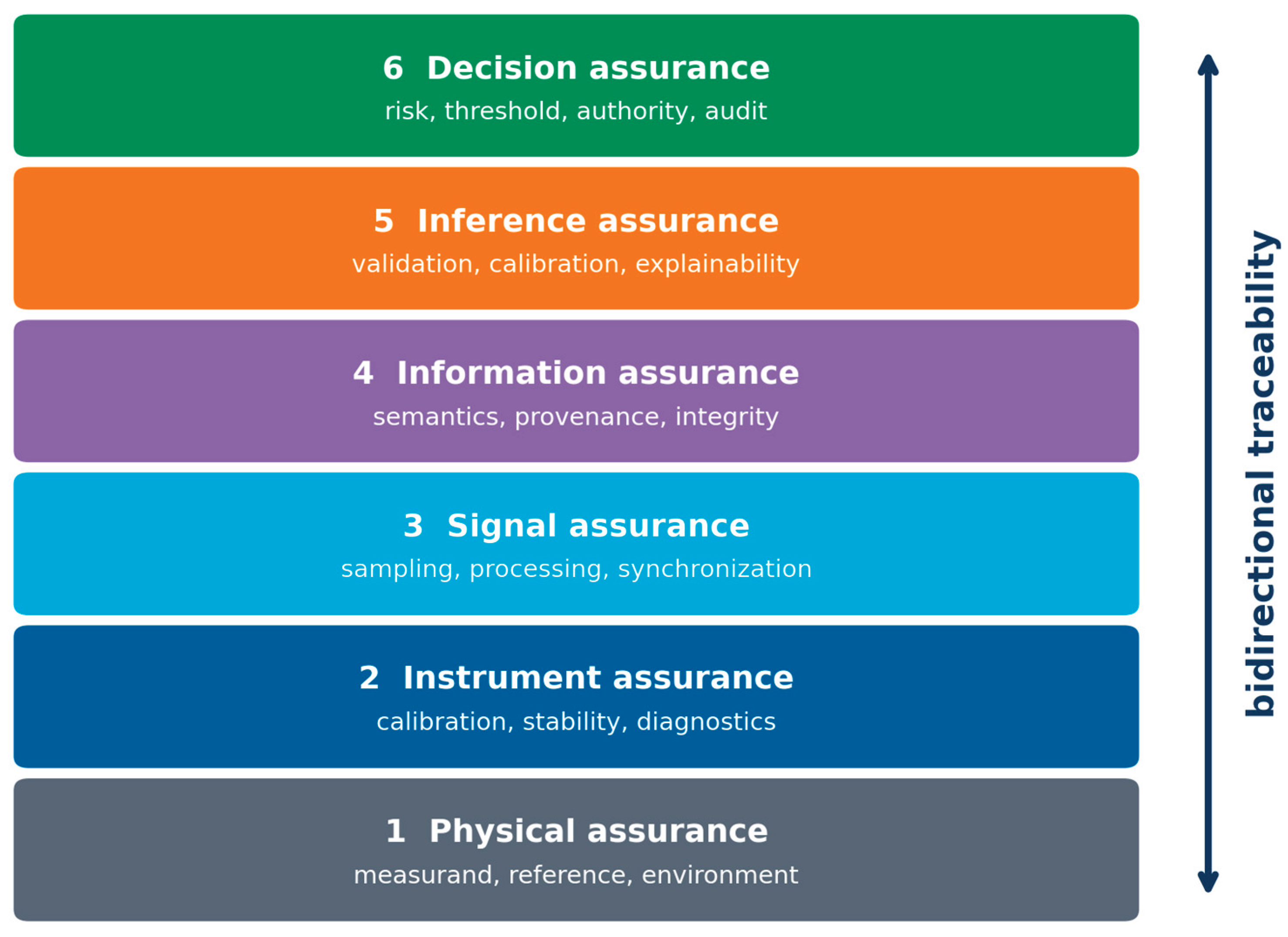
The synthesis proceeded in three stages. First, recurring assurance requirements were extracted from the six evidence streams. Second, requirements with the same function were consolidated into the six layers shown in Figure 2. Third, the framework was stress-tested conceptually against aerospace, nuclear energy, rail, civil infrastructure, and additive manufacturing, which differ in materials, flaw morphology, access, consequence, regulation, and inspection frequency. Technology readiness was not inferred from publication volume or isolated accuracy values. Maturity was judged by the availability of a defined measurand, reference standards, representative validation, uncertainty treatment, interoperability, decision governance, and field surveillance. Because this is an integrative review, the taxonomy, qualification ladder, and roadmap are analytical outputs requiring future empirical validation; no claim of exhaustive systematic-review coverage is made.
Figure 2.
Six-layer measurement-assurance stack for connected and AI-enabled NDE. Assurance must be maintained vertically rather than evaluated only at the classifier output.
Figure 2.
Six-layer measurement-assurance stack for connected and AI-enabled NDE. Assurance must be maintained vertically rather than evaluated only at the classifier output.
Review transparency note. The framework is intended as a conceptual synthesis of authoritative metrology/standards sources and representative peer-reviewed NDE and AI literature, not as a PRISMA-style systematic review. Accordingly, conclusions are framed as proposed assurance requirements and research hypotheses rather than prevalence estimates or consensus statements. Source identification was targeted to the six evidence streams defined above, using standards and metrology documents together with peer-reviewed literature that directly informed measurement, reliability, digital-thread, AI-validation, interoperability, cybersecurity, or governance requirements. Because the objective was integrative synthesis rather than exhaustive evidence counting, no claim is made that the search captures every database, publication, or time period relevant to NDE 4.0.

Table 1.
Evidence streams used to construct the framework.
| Evidence stream | Principal question | Representative foundations | Role in the synthesis |
|---|---|---|---|
| Metrology | What quantity is estimated, and with what traceability and uncertainty? | VIM, GUM, ISO/IEC 17025 [15,16,17] | Physical, instrument, and uncertainty layers |
| NDE reliability | How does the complete inspection system perform under representative conditions? | Berens, MIL-HDBK-1823A, MAPOD [8,18,19,20] | Detection reliability and qualification |
| Digital metrology | How are calibration and units represented in machine-actionable form? | DCC and Digital SI literature [21,22,23] | Digital evidence and provenance |
| AI-assisted measurement | How are model error, uncertainty, and dataset shift separated from sensor performance? | I&M guidance and UQ literature [1,24,25,26,27,28,29,30,31,32,33] | Inference assurance and safe deferral |
| Interoperability and twins | How is measurement meaning preserved across systems and lifecycle models? | DICONDE and digital-twin literature [5,34,35,36] | Information assurance and lifecycle use |
| Governance and human factors | Who has decision authority, and how are changes and failures controlled? | NIST AI RMF, ISO/IEC AI standards, IEC 62443 [37,38,39,40] | Decision assurance and surveillance |
3. NDE 4.0 as an Evolution of Measurement Evidence
3.1. From Indication to Quantified Measurand
Traditional NDT frequently produces an indication that is compared with a procedural threshold. Modern NDE attempts to estimate size, location, morphology, material state, or degradation rate. The shift is not merely from analog to digital. It is a shift in what is asserted. “A response exceeded 50% full-screen height” is an instrument response; “a 2.4-mm-high crack is present” is an estimate of a physical quantity; “the component has 18 months of remaining useful life” is a model-based prediction. Each statement moves farther from direct observation and requires additional assumptions, calibration, and uncertainty characterization.
Let the acquired signal be represented by
where is the measurand or condition of interest, represents instrument and inspection parameters, represents environmental and coupling conditions, is the forward measurement process, and is residual noise. A digital inference system estimates through an inverse mapping , where includes learned parameters and prior information. Errors may consequently arise from the physical measurement, the inverse model, or mismatch between training and operational domains. Treating only sensor calibration while ignoring and yields an incomplete uncertainty statement. For example, in encoded ultrasonic crack sizing, a calibrated time base and reference block may control instrument-related error, while probe skew, coupling, and surface condition perturb the acquired signal; reconstruction settings can shift the apparent flaw response; and a learned sizing model can add residual bias or dispersion if the field flaw population differs from the validation data. The final reported crack height therefore inherits uncertainty from both the physical acquisition and the digital inference chain.
x = H(q,θ,e) + ε,
3.2. Relationship to Existing Assurance Frameworks
The proposed architecture is deliberately complementary to, rather than a replacement for, established assurance frameworks. VIM and GUM define measurement concepts, traceability, and uncertainty [15,16]; POD/MAPOD methods characterize NDE system reliability [8,18,19,20]; digital calibration and digital-twin approaches support machine-actionable information and lifecycle integration [21,22,23,35,36]; and AI risk-management frameworks address model and organizational risk [37,38,39]. The unresolved integration problem is that these frameworks govern different portions of the same modern inspection chain. Table 2 identifies the boundary addressed by the present synthesis.
What is new in the six-layer framework is the explicit treatment of the interfaces between assurance domains. Rather than evaluating metrology, NDE reliability, data provenance, AI validation, and decision governance as parallel checklists, The framework proposes that assurance evidence be preserved and re-evaluated, where necessary, as information passes from the physical measurand to the final disposition. This interface-focused structure is the principal conceptual contribution: it identifies where a result can lose meaning, traceability, or validity even when the individual subsystem satisfies its own local requirement.
Table 2.
Relationship of established assurance frameworks to the proposed NDE 4.0 architecture.
| Framework | Primary assurance objective | Strength for NDE 4.0 | Boundary not covered alone |
|---|---|---|---|
| VIM / GUM | Measurement concepts, traceability and uncertainty | Rigorous metrological language and uncertainty principles | Does not by itself qualify learned inference, dataset shift or decision authority |
| POD / MAPOD | Inspection reliability as a function of flaw size/condition | System-level detection capability and confidence bounds | Does not by itself govern AI lifecycle, provenance or adaptive updates |
| Digital calibration / digital metrology | Machine-actionable calibration and measurement information | Improves traceability, interoperability and automation | Calibration metadata alone cannot validate the downstream inference model |
| Digital-twin frameworks | Lifecycle data integration and state representation | Connects inspection evidence to asset context | A digital representation does not establish measurement validity |
| Trustworthy-AI / AI risk frameworks | Model risk, robustness and organizational governance | Provides lifecycle and governance controls | Often use-case agnostic and not tied to physical measurands or NDE reliability |
| Proposed architecture | End-to-end sensor-to-decision assurance | Creates a single NDE-specific assurance chain that explicitly links measurand definition, instrument and signal control, digital provenance, AI validation, uncertainty, and decision authority across their interfaces. | Conceptual integration framework; it does not replace application-specific codes, POD studies, metrological evaluation, AI validation, or empirical qualification evidence. |
3.3. Five Changes in the Evidential Contract
Table 3 shows that digital capability changes the contract between the inspection system and the user. A high-resolution image is not necessarily a better measurement if its scale, reconstruction assumptions, or processing history are unknown. Likewise, a model output between zero and one is not necessarily a calibrated probability [27]. The key transition is from storing data to preserving defensible measurement evidence.
Table 3.
Five changes in the NDE evidential contract.
| Transition | Earlier evidential focus | NDE 4.0 evidential requirement | Failure if omitted |
|---|---|---|---|
| Observation to estimation | Visible or audible indication | Measurand definition, estimator bias, resolution, uncertainty | Instrument response is mistaken for physical truth |
| Single channel to fused data | One modality and one calibration | Registration, synchronization, correlation, fusion uncertainty | More data create false confidence |
| Local record to digital thread | Paper or isolated file | Persistent identity, provenance, units, configuration, integrity | Result cannot be reproduced or compared |
| Rule to learned inference | Fixed threshold | Training scope, calibration, drift, explainability, version control | Model silently fails outside its domain |
| Inspector to shared autonomy | Named human decision maker | Explicit authority, escalation, override, accountability | Responsibility becomes ambiguous |
4. The Measurement-Assurance Stack
The proposed stack decomposes NDE 4.0 assurance into six coupled layers (Figure 2). The layers are not a software architecture; they are measurement-accountability boundaries. For applications requiring formal qualification, each layer should be supported by explicit acceptance evidence, and the relationships among evidence items should be traceable across material interfaces. A failure at a lower layer can invalidate apparently strong performance at a higher layer: for example, For safety-relevant or measurement-based inspection claims, high dataset-level classification accuracy is not sufficient evidence to overcome an incorrectly defined measurand, unstable acquisition, biased reference truth, or an unqualified decision threshold.
4.1. Physical Assurance
Physical assurance begins with the measurand and the population to which the result will apply. Crack height, wall thickness, attenuation, thermal diffusivity, porosity fraction, corrosion area, and damage class are different measurement problems even when acquired with the same instrument. Component geometry, material state, surface condition, access, temperature, stress, and expected flaw population bound the problem. Reference artefacts and simulations are most informative for qualification when their relevant physical attributes adequately represent, or their limitations are explicitly related to, the intended population. For complex flaws, a reference notch may establish sensitivity without representing scattering from a service-induced crack.
4.2. Instrument Assurance
Instrument assurance includes calibration, standardization, linearity, bandwidth, timing, encoder accuracy, probe or detector health, source stability, and environmental compensation. The acceptance evidence should demonstrate both traceability and fitness for the intended inspection range. Smart instruments can report self-diagnostics, but self-reporting does not eliminate external verification. Digital calibration certificates can make calibration information machine actionable, provided the certificate preserves the quantity, value, uncertainty, method, date, responsible laboratory, and traceability information required for the result [21,22,23]. Recent DCC implementations reinforce the practical feasibility of machine-interpretable calibration records, while also showing that schema harmonization and software quality remain active implementation issues [51,52]. In a UT or PAUT workflow, for example, a DCC could allow the inspection software to verify the current calibration status and associated uncertainty of relevant equipment or reference artefacts before acquisition, while linking those records to the inspection dataset for later audit; the inspection-specific sensitivity or standardization checks would still remain governed by the applicable procedure and code.
4.3. Signal Assurance
Signal assurance covers sampling, filtering, gain, reconstruction, interpolation, compression, synchronization, registration, and signal-to-noise behaviour. Because these transformations can alter detectability and sizing bias, their configuration is part of the measurement model rather than merely a software implementation detail. A processing pipeline can change detectability and sizing bias even when the raw transducer response is stable. Where technically, commercially, and regulatorily practicable, raw or minimally processed data should be retained in proportion to the intended use. Transformations that materially affect the reported measurement or decision should be documented and version controlled. For multi-sensor fusion used to support quantitative interpretation or disposition, temporal and spatial registration uncertainty should be evaluated and, where material, reported or otherwise incorporated into the evidence record. Where complete raw-data retention is constrained by acquisition rate, onboard memory, network bandwidth, proprietary equipment, or long-term storage burden, the retained record should at minimum preserve the least-processed data needed to reproduce the reported result, together with the processing configuration, software version, and any irreversible compression or reduction step.
4.4. Information Assurance
At the information layer, values acquire context: units, coordinates, specimen identity, inspection plan, procedure revision, calibration state, operator or robotic platform, environmental conditions, and access permissions. Information assurance therefore asks whether another competent system or reviewer could recover the same measurement meaning, not merely open the same file. DICONDE provides an important basis for consistent NDE imaging and communication, but syntactic compatibility alone does not guarantee semantic equivalence [2,34]. A field labeled “amplitude,” for example, remains ambiguous without definition, units or scale, processing state, and reference. Information assurance also includes authenticity, cybersecurity, retention, and data sovereignty.
4.5. Inference Assurance
Inference assurance may include validation against representative cases, uncertainty calibration, robustness testing for nuisance variables, sensitivity to preprocessing, version control, and—where technically justified—validated input-quality, drift, or OOD monitoring. identifying inputs that differ materially from the population represented during qualification - sensitivity to preprocessing, and version control. Explainability is useful when it reveals failure mechanisms or supports review, but A visually plausible saliency map does not, by itself, constitute evidence of performance validation, robustness, or causal relevance. Physics-informed models may improve data efficiency and plausibility; they still require verification of the encoded physics, boundary conditions, and residual model discrepancy.
4.6. Decision Assurance
The decision layer translates measurements into accept, reject, monitor, rescan, or repair actions. The required evidence is therefore consequence-dependent: an operating point suitable for screening may be unacceptable for final disposition. Its validity depends on consequence, prevalence, costs of false calls, code requirements, and human authority. A threshold chosen to maximize F1 score may be inappropriate when a missed crack has a far higher consequence than a false call. For decisions with meaningful safety, reliability, or economic consequence, decision assurance should address risk-appropriate thresholds, escalation paths, and retention of evidence available to the final decision maker. For a crack-screening application on a fracture-critical component, for example, a false negative can carry a substantially greater safety consequence than a false positive; a conservative operating point may therefore intentionally accept more false calls and route marginal cases to qualified review or secondary inspection rather than optimize a balanced classification score.
Integrated PAUT example. Consider encoded phased-array ultrasonic inspection used to size a weld crack and support disposition. At the physical layer, the measurand is defined as crack height within a specified weld geometry and flaw population. Instrument assurance establishes the status of the PAUT unit, probe, wedge, encoder, time base, sensitivity, and relevant reference artefacts. Signal assurance fixes the focal laws, sampling, gain, filtering, reconstruction, scan coverage, and synchronization needed to preserve the response used for sizing. Information assurance binds the encoded data to component identity, coordinates, procedure revision, calibration state, environmental conditions, and processing history. Inference assurance then evaluates the sizing algorithm or AI model against representative independent flaws, including bias, dispersion, uncertainty, nuisance variables, and OOD conditions. Finally, decision assurance applies the qualified acceptance rule, required confidence or POD evidence, and an escalation path for marginal or out-of-domain cases. The example shows that for the intended PAUT sizing-and-disposition claim, the credibility of the final disposition depends on sufficiently controlled interfaces across the six layers. Strong inference performance alone does not establish adequacy where acquisition, provenance, or decision-governance controls are deficient.
5. Uncertainty in Hybrid Physical-Digital NDE
5.1. Why Classical Sensor Uncertainty Is Not Enough
The Guide to the Expression of Uncertainty in Measurement (GUM) remains the foundation for combining uncertainty components when a measurement model and input distributions can be specified [16]. The wider GUM suite also provides Monte Carlo propagation and guidance for developing measurement models [41,50]. AI-enabled NDE complicates that model because the inverse relationship may be high-dimensional, data-dependent, and nonstationary. System complexity does not remove the need to characterize limitations; rather, it motivates separating and documenting aleatory variability, model uncertainty, reference-truth uncertainty, and distribution shift to the extent supported by the intended use and available evidence. In practical NDE terms, aleatory variability includes repeat-to-repeat effects such as coupling or noise; epistemic/model uncertainty reflects limited knowledge, finite training data, or model-form error; reference-truth uncertainty arises when the nominal flaw size or class is itself imperfectly known; and distribution shift occurs when deployed materials, geometries, instruments, environments, or flaw populations differ from those used for qualification.
For an estimated scalar measurand , let z contain the uncertain acquisition, environmental, processing, reference, and model inputs. If the end-to-end model is locally differentiable, a first-order approximation can be written as
where Jz is the sensitivity Jacobian, Σz is the covariance matrix of the inputs, and udisc represents residual model discrepancy. This expression is only a local approximation; it is not proposed as a universal uncertainty budget for AI. For strongly nonlinear pipelines, Monte Carlo propagation or other distributional methods are more appropriate [41]. Because domain shift is not generally reducible to a stationary variance term, it should be addressed through appropriate evidence, which may include external validation, stress testing, operational monitoring, and post-deployment surveillance where applicable. In classification tasks a scalar expanded uncertainty may not be meaningful; reliability diagrams, prediction sets, class-conditional error bounds, or scenario-conditioned POD curves may be more appropriate [1,28,32].
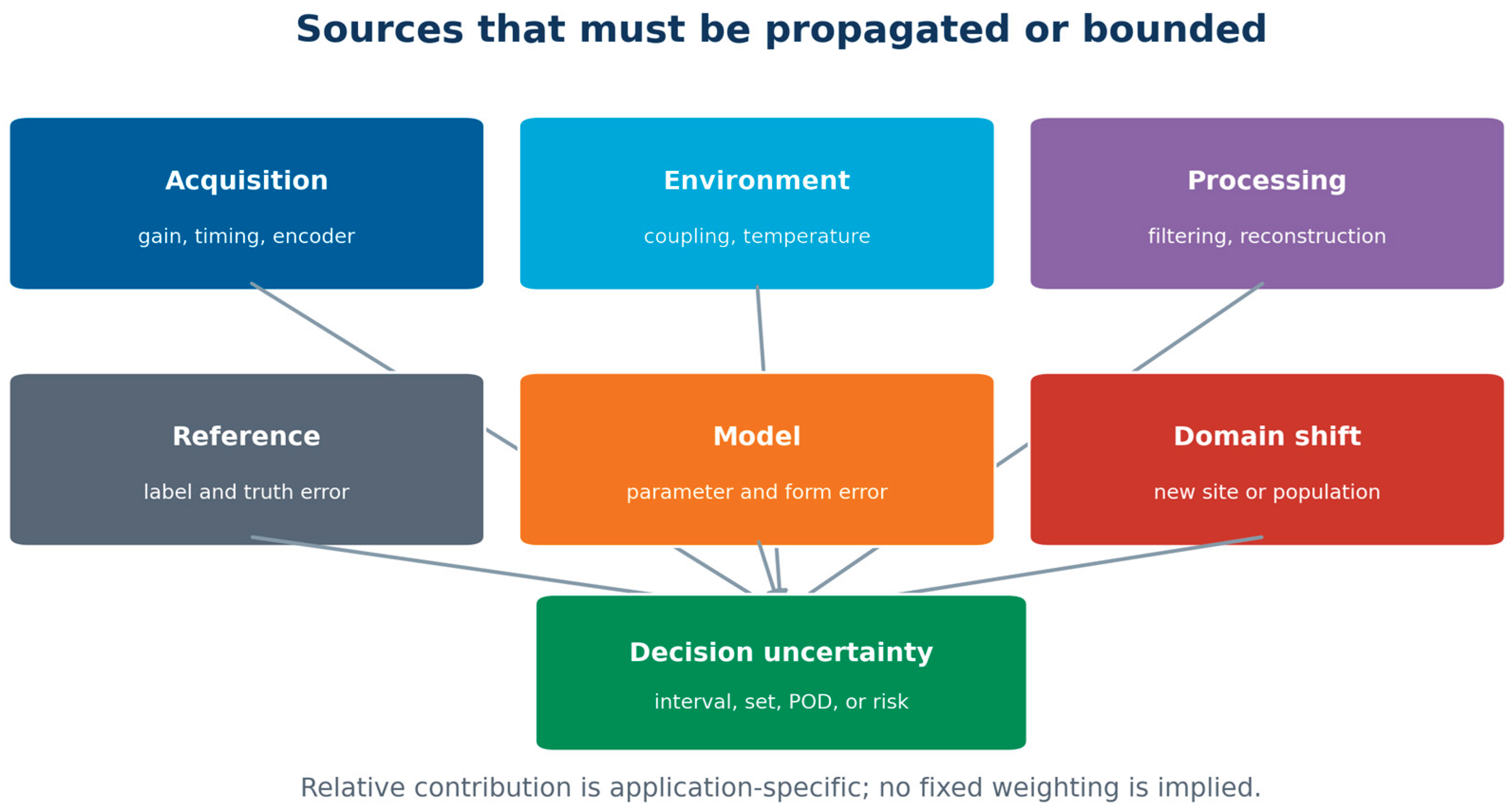
Figure 3.
Conceptual map of uncertainty sources in hybrid NDE. Relative contributions are application-specific; the figure assigns no numerical weighting.
Figure 3.
Conceptual map of uncertainty sources in hybrid NDE. Relative contributions are application-specific; the figure assigns no numerical weighting.
5.2. Illustrative Uncertainty Budget for AI-Assisted Ultrasonic Sizing
Consider an AI-assisted ultrasonic system that reports crack height from an encoded scan. For illustration, suppose the reported size depends on reference-block calibration, probe/encoder positioning, coupling and surface variability, reconstruction settings, and model inference. These contributions should not be interpreted as universally independent or normally distributed; the example is intentionally simplified to show how an AI contribution can enter an uncertainty budget without replacing the physical measurement model.
Table 4.
Illustrative standard-uncertainty contributions for AI-assisted ultrasonic crack sizing.
| Contribution | Illustrative mechanism | Standard uncertainty (mm) |
|---|---|---|
| Reference/calibration | Reference dimension and material-velocity realization | 0.10 |
| Probe/encoder positioning | Scan-position and angular variation | 0.15 |
| Coupling/surface condition | Transfer and local SNR variation | 0.20 |
| Signal processing | Filtering/reconstruction parameter sensitivity | 0.12 |
| AI inference | Residual prediction dispersion within the validated domain | 0.25 |
If, solely for this illustrative case, the five contributions are treated as independent standard uncertainties, the root-sum-of-squares combined standard uncertainty is u_c = sqrt(0.10^2 + 0.15^2 + 0.20^2 + 0.12^2 + 0.25^2) = 0.39 mm. A nominal expanded uncertainty with k = 2 would therefore be approximately 0.78 mm. The calculation is not a validated industrial uncertainty budget: correlations, nonlinearity, model-form discrepancy and domain shift would require application-specific treatment, potentially using Monte Carlo or distributional methods [41]. The point is methodological: model inference becomes an additional contributor to the reported measurement result; it does not substitute for metrological uncertainty. The 0.25 mm AI-inference term is a hypothetical standard uncertainty used only to make the numerical example explicit; in an actual qualification it should be estimated from independent validation residuals, repeated measurements, or another justified uncertainty model within the claimed operating domain. The independence assumption is also illustrative. For example, poorer coupling or lower signal-to-noise ratio can simultaneously alter the physical measurement and degrade model inference, creating covariance that should be represented in the full covariance matrix or propagated by simulation rather than ignored.
Table 5.
Uncertainty sources in a hybrid NDE system.
| Uncertainty source | Typical mechanism | Observable diagnostic | Control or quantification |
|---|---|---|---|
| Acquisition chain | Gain drift, bandwidth, timing, encoder error | Reference response, stability trend, repeat scan | Calibration, check standards, control charts |
| Coupling/environment | Lift-off, temperature, surface, alignment | SNR, coupling map, environmental log | Compensation, rejection rules, representative tests |
| Processing | Filter, interpolation, reconstruction parameters | Pipeline sensitivity, image residual | Locked/versioned pipeline, ablation study |
| Reference/label | Flaw truth error, ambiguous class, destructive sizing error | Inter-rater agreement, truth uncertainty | Consensus labels, metrology-grade truth data |
| Model | Finite data, parameter uncertainty, misspecification | Calibration error, ensemble spread, residual pattern | Uncertainty-aware model, external validation |
| Domain shift | New alloy, geometry, instrument, site, prevalence | Drift score, OOD rate, performance decay | Domain qualification, monitoring, revalidation |
| Human/decision | Automation bias, threshold choice, inconsistent override | Override pattern, response time, disagreement | Training, authority matrix, risk-based threshold |
5.3. Detection Reliability and Model Metrics
POD estimates the probability that a defined inspection system detects a target condition as a function of flaw size or another relevant variable. It characterizes the complete system—equipment, procedure, specimen population, operator or algorithm, and decision rule—under stated conditions [8,18,19,20]. Classification accuracy instead summarizes agreement over a sampled dataset and changes with class prevalence. Precision, recall, AUC, and F1 score are useful dataset-level metrics; however, none alone demonstrates system-level detection capability for a safety-relevant NDE claim [31,32]. A practical distinction is that a classifier can achieve high overall accuracy on a dataset dominated by large, easily detected reflectors or nondefective cases while still performing poorly on small flaws near the inspection threshold. POD instead asks how detection probability changes with flaw size or another physically relevant variable under stated inspection conditions, making it directly informative about the lower end of the required detection capability.
For AI-NDE studies seeking to support operational or qualification claims, the following reporting elements are generally advisable: specimen- or component-level separation, class prevalence, uncertainty intervals, performance stratification, false-call behavior, and independent or cross-site evaluation where feasible. When model-assisted POD is used to support a qualification claim, the credibility of the simulation and treatment of model discrepancy should be justified rather than presumed [20,42]. For sizing tasks, bias, dispersion, coverage of reported intervals, and performance across the claimed operating envelope should be reported in addition to detection metrics.
5.4. Decision Risk and Abstention
Where decision costs, prevalence, and constraints can be meaningfully specified, threshold selection may be guided by expected-loss analysis rather than by an abstract performance score alone:
R(τ) = CFNP(FN|τ) + CFPP(FP|τ) + CDP(defer|τ).
A deferral or escalation option can be an important control in shared-autonomy designs, particularly where input quality, domain validity, or predictive uncertainty is insufficient. Where the operating concept allows deferral, the system should define an escalation pathway for inadequate signal quality, validated-domain violations, or uncertainty above a predetermined limit. Such triggers should be validated for the anticipated failure modes. When coupled with predefined thresholds, authority assignments, and fallback procedures, uncertainty information can inform operational actions such as human review, reacquisition, or alternate inspection. In practice, C_FN, C_FP, and C_D are not universal constants. They should be derived from the application-specific consequence analysis, applicable code or regulatory constraints, downstream repair or reinspection burden, production impact, and safety or service risk. In high-consequence inspection, the false-negative cost may dominate; in high-throughput screening, excessive false calls and deferrals may also carry material operational cost.
6. Digital Traceability and the NDE Evidence Record
Consistent with VIM terminology, metrological traceability is a property of a measurement result and refers to its documented relation to a reference through an unbroken chain of calibrations, each contributing to measurement uncertainty [15,16,43]. Digital provenance is related but distinct: provenance records how data and algorithms were created or transformed, whereas metrological traceability connects a measurement result to a reference. For AI-enabled NDE systems used to support traceable measurement results or engineering dispositions, both metrological traceability and digital provenance are generally needed. A thickness or crack-size estimate generated by a learned model cannot be reproduced from a calibration certificate alone if the preprocessing, model version, reference velocity, sampling configuration, or uncertainty method is missing.
6.1. Minimum Digital Evidence Record
Status of the proposed fields. Table 6 is a proposed minimum evidence structure for this framework, not a normative replacement for code- or sector-specific records. The evidence classes are intended to be present whenever they materially affect reconstruction or audit of the result, but individual fields are conditional on method and intended use. For example, model identifier and OOD status apply when learned inference is used, while robot pose applies only to encoded or robotic acquisition. Applicable codes, procedures, customer requirements, and regulatory controls remain authoritative and may require additional records.
Table 6.
Minimum digital NDE evidence record.
| Evidence class | Minimum retained content | Purpose |
|---|---|---|
| Identity | Asset/component, region, coordinate frame, timestamp | Prevents orphaned or misregistered results |
| Acquisition | Instrument, probe/source/detector, firmware, sampling, scan plan | Reconstructs how the signal was obtained |
| Calibration | Reference artefact, method, values, uncertainty, due status | Supports traceability and fitness for purpose |
| Environment | Temperature, surface/coupling, access, robot pose/encoder state | Defines operational conditions and nuisance variables |
| Processing | Ordered transformations, parameters, software versions, checksums | Makes derived images and features reproducible |
| Model | Identifier, weights version, training-domain statement, validation status | Binds an inference to the qualified model |
| Uncertainty | Quality indicators, interval/set, OOD or drift status | Communicates limitations with the result |
| Decision | Threshold/rule, human or automated authority, override, action | Preserves accountability and audit history |
For interoperable or auditable deployments, the evidence record should preferably be machine readable and protected by appropriate integrity controls. The linkage to asset configuration should follow the organization’s configuration-management and cybersecurity requirements. Hashes can demonstrate that files are unchanged, but cryptographic integrity does not establish measurement validity. Distributed-ledger mechanisms may provide integrity or provenance functions in selected architectures; they do not, by themselves, establish sensor validity, representative training data, or a valid uncertainty model [21,22].
6.2. Semantic Interoperability
Interoperability exists at several levels. Transport interoperability moves bytes; syntactic interoperability allows a receiving system to parse a structure; semantic interoperability preserves meaning; and pragmatic interoperability enables consistent action. In NDE 4.0 implementations, achieving file exchange or syntactic compatibility does not by itself demonstrate that measurement meaning and downstream decision semantics are preserved across systems. A portable evidence record therefore benefits from controlled vocabularies for method, measurand, indication, coordinate frame, units, processing state, confidence, and decision status. Where cross-vendor exchange is within the intended use, interoperability should be evaluated through representative round-trip tests that assess preservation of units, orientation, processing state, coordinate conventions, and decision-relevant meaning.
7. Qualification of AI-Enabled NDE Measurement Systems
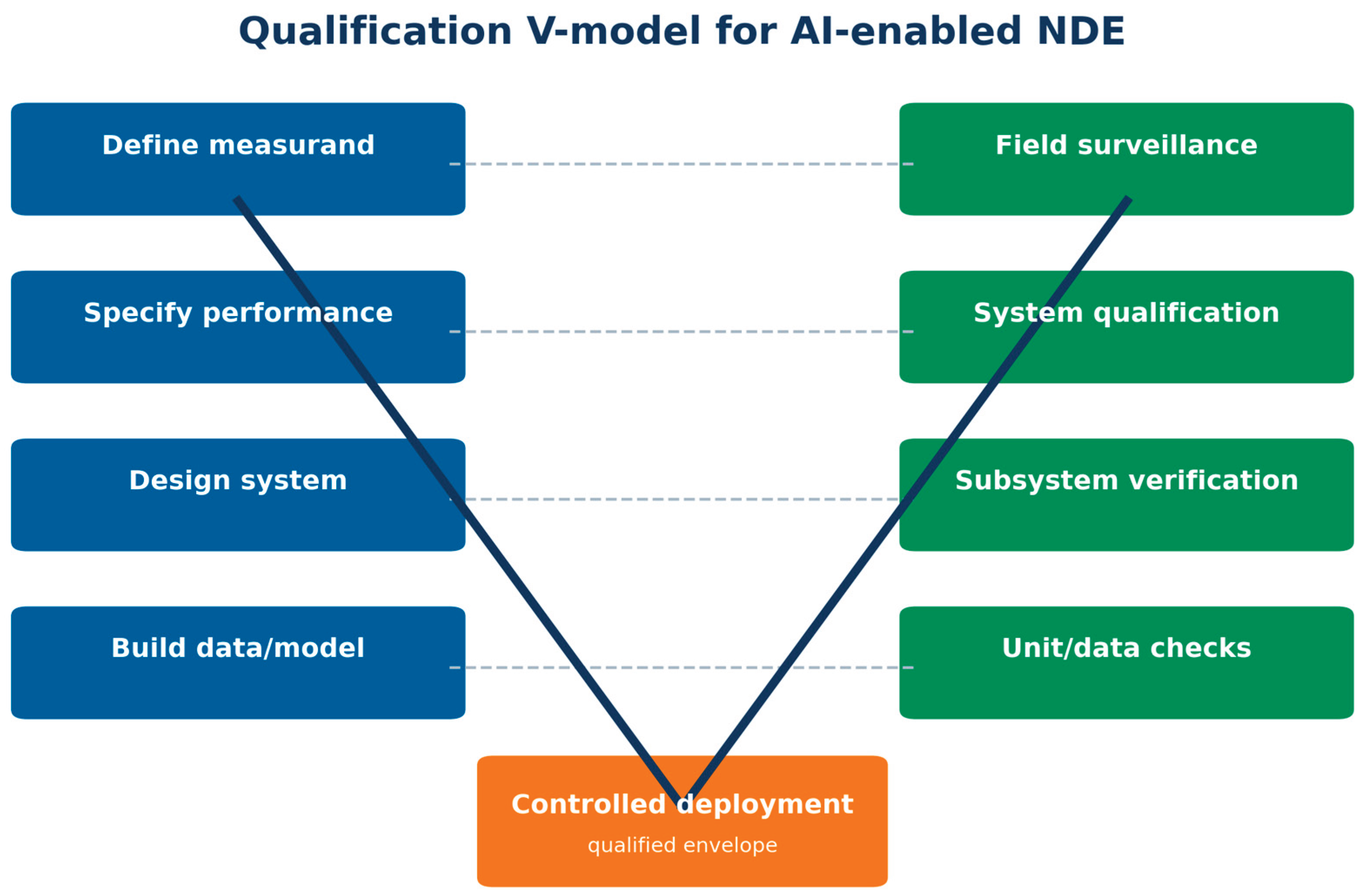
For systems intended to influence inspection or disposition decisions, qualification should begin with the intended use and assess the complete inspection system—not the AI model in isolation—to the extent that system elements affect the claimed performance. The V-model in Figure 4 couples each requirement or development activity with corresponding verification, representative validation, operational qualification, and surveillance evidence. This avoids a common failure mode in which a model is trained first and the intended measurand, deployment envelope, and decision authority are defined later.
Figure 4.
Qualification V-model. Left-side requirements and design choices are paired with right-side verification, validation, qualification, and surveillance evidence.
Figure 4.
Qualification V-model. Left-side requirements and design choices are paired with right-side verification, validation, qualification, and surveillance evidence.
7.1. Requirement Definition
The top-level requirement should identify, as applicable, the measurand or target condition, population, operating environment, required performance, allowable false-call burden, latency, and decision authority. “Detect weld defects with AI” is not testable. For a detection or disposition use case, a sufficiently testable requirement would ordinarily state the defect types and size range, geometry and material bounds, acquisition systems, lower confidence requirement on POD, allowable false calls per unit length or component, and conditions requiring abstention.
7.2. Data Design and Partitioning
Random image-level splitting can place near-duplicate patches from the same specimen in training and test sets, producing optimistic performance. The problem is statistical dependence: patches from one component can share the same acquisition settings, material texture, geometry, background artefacts, or even overlapping signal content. A model may therefore recognize specimen-specific signatures that reappear in the test set rather than demonstrate generalization to a genuinely new component. Data partitioning should occur at a level that minimizes leakage and reflects the intended deployment generalization claim—for example, component, lot, site, instrument, or time period. Reference truth should include its own uncertainty and acquisition method. Negative examples should adequately represent the expected operational background, including relevant geometry, surface condition, benign reflectors, repairs, and acquisition artefacts. Published ultrasonic benchmarking illustrates the importance of controlled model comparison and explicit dataset design [44]. Where synthetic data materially contribute to training or qualification evidence, transfer to withheld real components should be evaluated before operational claims are made.
7.3. Verification, Validation, and Stress Testing
Software verification confirms that implementation matches specification. Measurement validation asks whether the system produces results adequate for intended use. Test plans should address normal operation and relevant failure or boundary conditions, which may include controlled degradations, missing metadata, calibration failures, and accidental or adversarial data corruption where relevant to the threat model. Where feasible, ablation or sensitivity studies should examine the model’s dependence on major inputs and preprocessing choices. Cross-instrument and cross-site tests are especially important because NDE data can shift with probe manufacture, firmware, gain convention, reconstruction, and local procedure even when the nominal method is identical.
7.4. Controlled Deployment and Surveillance
For high-consequence or newly qualified applications, shadow or advisory deployment can provide useful operational evidence before expanded decision authority, unless an alternative pathway is justified by applicable requirements and the qualification case. Where practicable, disagreements between the system and qualified inspectors should be independently adjudicated using predefined reference-truth procedures rather than automatically attributed to either party. Surveillance should monitor input quality, feature distribution, OOD rate, calibration, false calls, missed indications found by downstream processes, override frequency, and changes in data prevalence. For qualified deployments, changes to preprocessing, model weights, thresholds, or data interfaces should undergo documented impact assessment and revalidation or requalification at a scope proportionate to their potential effect on the validated operating envelope. Where the operating concept permits abstention, cases with inadequate signal quality, OOD inputs, or excessive uncertainty should be routed according to a predefined fallback path, such as reacquisition, an alternate method, or qualified human review, rather than forcing a binary result.
Status and derivation of Q0-Q5. The Q0-Q5 ladder is newly proposed in this review as a conceptual deployment taxonomy; it is not an existing industry or regulatory classification. The levels were derived by ordering the evidence states developed in the six-layer framework and V-model from exploratory analysis, through independent bench validation and field shadowing, to decision support, bounded autonomy, and controlled adaptation. Each step adds decision authority only after the preceding measurement, validation, provenance, and governance evidence is established. For Q5, model updating is not treated as exemption from requalification: under the proposed Q5 taxonomy, every approved change would be subject to documented impact assessment, comparison with the previously qualified configuration, rollback capability, and requalification proportionate to the expected effect.
Table 7.
Proposed qualification ladder for AI-enabled NDE.
| Level | Permitted role | Required evidence | Typical stop condition |
|---|---|---|---|
| Q0—Exploratory | Research only | Internal test data; documented concept | No representative independent data |
| Q1—Bench validated | Offline analysis | Locked pipeline; blind representative specimens; uncertainty report | Performance unstable by specimen or nuisance variable |
| Q2—Field shadow | No production authority | Cross-site/instrument test; live parallel operation; failure logging | Drift, excessive abstention, unexplained disagreement |
| Q3—Decision support | Inspector receives recommendation | Human-factors validation; calibrated confidence; override and audit | Automation bias or unsafe threshold behavior |
| Q4—Bounded autonomy | Automatic decision within validated envelope | POD/false-call evidence; validated input-quality and domain-shift monitoring, where applicable; cybersecurity; surveillance | Input outside envelope or monitoring limit exceeded |
| Q5—Adaptive autonomy | Controlled updating | Change protocol; continuous validation; rollback; independent governance | Unapproved update or loss of traceability |
8. Trustworthy AI Requires Three Forms of Assurance
8.1. Measurement Validity
Measurement validity is a foundational condition for trustworthy AI-enabled NDE because the model input must contain information relevant to the target condition within the stated operating range. High performance on a biased dataset does not, by itself, demonstrate adequate physical sensitivity, coverage, coupling stability, or reference-truth quality. Where practicable, independent signal-quality indicators and acquisition-acceptance criteria should complement model outputs so that the system can distinguish ‘no detected defect’ from ‘measurement not adequate for interpretation.’
8.2. Data and Model Integrity
Training and operational data require provenance, access control, versioning, and integrity checks. Model cards or equivalent qualification records can document intended use, excluded conditions, data composition, stratified performance, uncertainty method, known limitations, and revalidation triggers. These controls are consistent with broader trustworthy-AI principles [37,38,39,45], but they do not establish the technical adequacy of the NDE measurement by themselves. Cybersecurity is part of measurement assurance because alteration of calibration, configuration, raw data, timestamps, encoder positions, preprocessing code, or model weights can change the reported result.
8.3. Decision Governance and Human Factors
Human oversight is more likely to be effective when decision authority, timing, workload, interface design, and available evidence are deliberately specified. Human performance has been part of NDE reliability analysis for decades [42], but automation introduces new reliance, workload, and interface effects. A nominal “human in the loop” may simply approve an algorithmic output under time pressure. The appropriate allocation of human and automated authority should therefore be defined by inspection consequence, applicable code or regulatory requirements, demonstrated system performance, and the qualification level assigned to the application. Where human review is assigned, the interface should provide sufficient original or reconstructed inspection evidence, operational context, and uncertainty or domain-status information to support the reviewer’s assigned decision, while overrides should be recorded and analysed as potential evidence of model, interface, or procedural failure.
The appropriate allocation of function depends on risk. Automation is well suited to coverage tracking, data completeness checks, repetitive segmentation, candidate ranking, and consistency monitoring. Humans remain valuable for contextual reasoning, unexpected conditions, procedural interpretation, and responsibility for high-consequence disposition. The design objective is calibrated reliance rather than maximum automation.
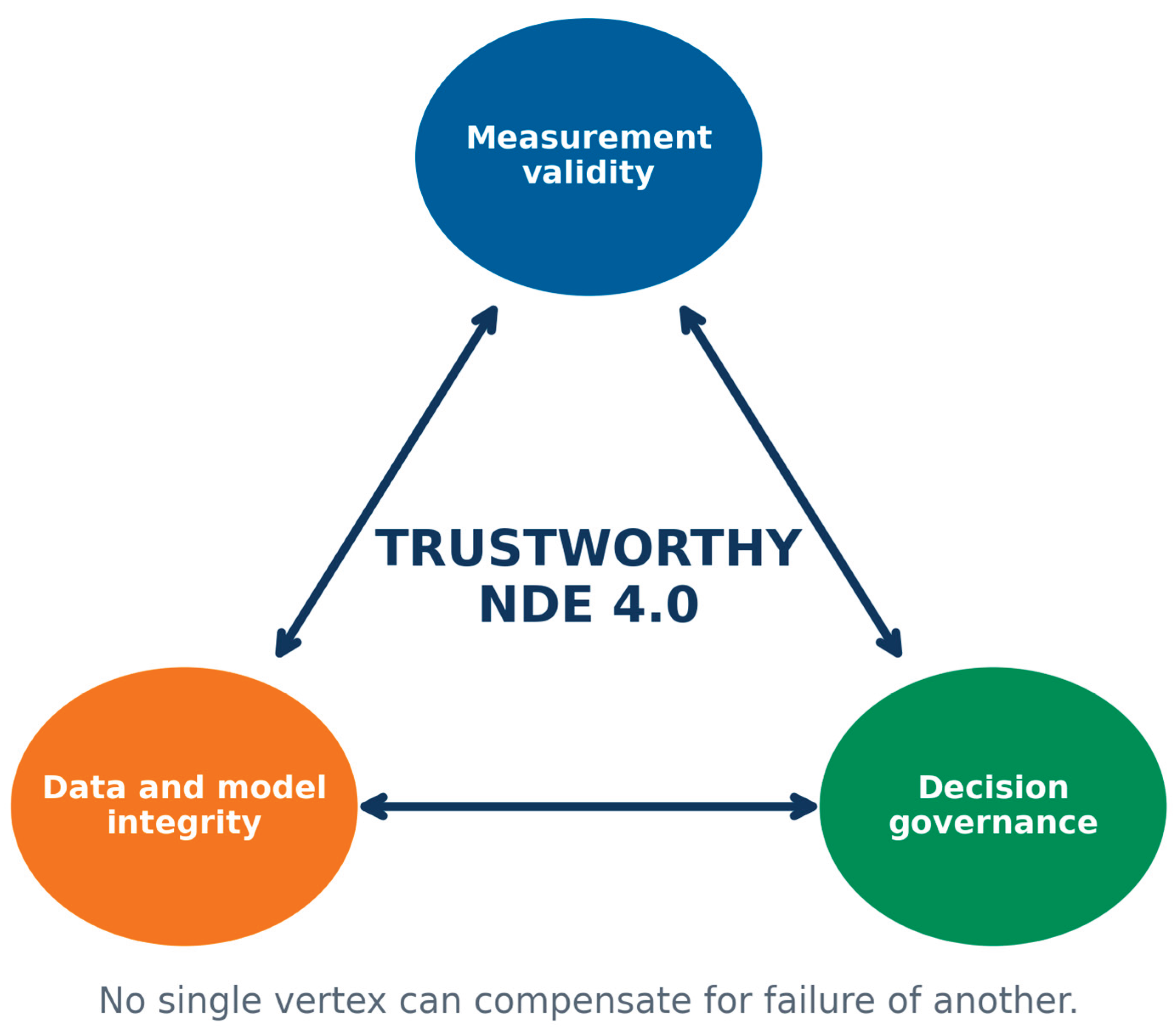
Figure 5.
Trust triangle for AI-enabled NDE. Measurement validity, information/model integrity, and decision governance are jointly necessary.
Figure 5.
Trust triangle for AI-enabled NDE. Measurement validity, information/model integrity, and decision governance are jointly necessary.
9. Cross-Sector Implications
The cross-sector analysis is used as a conceptual stress test rather than evidence of universal validation. The five sectors differ in flaw morphology, inspection access, regulatory structure, consequence of error, and frequency of measurement; the purpose is to determine whether the same assurance questions recur despite these differences.
9.1. Aerospace
Aerospace NDE combines tight defect tolerances, complex composite and metallic structures, fleet-level configuration control, and stringent qualification. Encoded ultrasonics and structural-health-monitoring data can populate digital records, but transfer across structural variants, repairs, surface conditions, and equipment remains a measurement challenge [10,46]. The assurance stack therefore emphasizes independent specimen partitioning, geometry-conditioned uncertainty, reference truth, and configuration-linked evidence. For automated decisions, performance should be reported by flaw morphology and location, not only by pooled image accuracy.
9.2. Nuclear Systems
Nuclear inspection is a demanding environment for AI-assisted NDE because weld examination is performed under codified procedures and reliability requirements. The systematic review by Sun et al. found that dataset representativeness, performance reporting, and transfer to field data remain central issues in machine-learning analysis of ultrasonic weld examinations [9]. Learned assistance can support data review and consistency, but a qualified implementation must preserve raw data, calibration, examination volume, essential variables, software configuration, and review authority. The defer pathway is particularly important: the model should route unfamiliar geometry, noise, or indications to qualified personnel rather than force a binary result.
9.3. Rail and Transportation
Rail inspection operates at scale and under changing vehicle, track, and environmental conditions. Vehicle-based monitoring combines multiple sensing principles and requires reliable localization and contextual interpretation [13]. Sensor fusion may improve coverage but creates registration, synchronization, and prevalence challenges. Continuous drift monitoring and route-conditioned validation may therefore be more informative than a single global accuracy. Measurement evidence should connect each indication to track position, vehicle state, sensor health, and subsequent verification.
9.4. Civil Infrastructure
For bridges and concrete structures, heterogeneous materials, access, environmental variability, and uncertain ground truth dominate. Structural-health-monitoring research has long emphasized that environmental and operational variability can obscure damage-sensitive features [47]. Digital twins can organize inspection and monitoring data, but model updating should preserve uncertainty rather than convert sparse observations into visually precise damage maps [5,36]. Measurement planning should identify which observations materially reduce uncertainty in structural decisions. This turns the digital twin from a display platform into an experiment-design and evidence-fusion tool.
9.5. Additive Manufacturing
Additive manufacturing links in-process monitoring, machine logs, material pedigree, post-process NDE, and mechanical performance. In-situ monitoring can observe process signatures associated with subsurface or internal defects, but the relationship between an observed anomaly and a verified defect remains process-, material-, and geometry-dependent [48]. Qualification should therefore distinguish process anomalies from measured defects and from demonstrated performance consequences. Data fusion is valuable only when each modality’s registration, sensitivity, and uncertainty are preserved.
10. Standards and Governance Landscape
These foundations are complementary, not interchangeable. VIM/GUM establish measurement concepts and uncertainty; ISO/IEC 17025 addresses laboratory competence; DICONDE supports structured NDE data exchange; NIST AI RMF and ISO/IEC 23894 address AI risk; ISO/IEC 42001 addresses AI management systems; IEC 62443 addresses industrial automation and control-system cybersecurity; and POD/MAPOD methods address detection reliability [15,16,17,18,19,20,34,37,38,39,40]. Compliance with any one of these does not demonstrate the complete sensor-to-decision assurance case. A qualified NDE 4.0 system must assemble application-specific evidence across these domains.
Standards gap. Among the standards and assurance documents reviewed in Table 8, the authors did not identify a single NDE-specific document that operationalizes physical measurement uncertainty, AI-related uncertainty, domain-shift monitoring, POD evidence, digital provenance, and bounded decision authority in one integrated method. The relevant documents instead provide complementary building blocks for particular parts of that chain [15,16,17,18,19,20,34,37,38,39,40]. The proposed framework therefore addresses an integration gap between established assurance domains; it is not presented as a new consensus standard.
Table 8.
Complementary standards for NDE 4.0 assurance.
| Need | Relevant foundation | Contribution to NDE 4.0 | Remaining gap |
|---|---|---|---|
| Measurement terminology | VIM; GUM [15,16] | Measurand, traceability, uncertainty concepts | Operational guidance for learned inverse models |
| Laboratory competence | ISO/IEC 17025 [17] | Calibration/testing competence and records | Connected field systems and updated software |
| NDE data exchange | ASTM E2339/DICONDE [34] | Structured imaging and metadata exchange | Cross-modality semantics and decision provenance |
| AI risk management | NIST AI RMF [37]; ISO/IEC 23894 [38] | Lifecycle risk, governance, monitoring | NDE-specific qualification thresholds |
| AI management systems | ISO/IEC 42001 [39] | Organizational controls and accountability | Adequacy of individual measurement results |
| Cybersecurity | IEC 62443 series [40] | Industrial control-system security lifecycle | Measurement-specific integrity threats |
| Detection reliability | MIL-HDBK-1823A [18] and MAPOD [19,20,42] | POD design, analysis, confidence bounds | AI/OOD/adaptive-model integration |
| Digital twins | ISO 23247 series [49] | Manufacturing digital-twin framework | Standard representation of NDE uncertainty |
11. A Risk-Proportional Transition Roadmap
11.1. Digitize Without Losing Context
For organizations beginning an NDE 4.0 transition, a practical early priority is reliable digital capture and contextual data preservation before expanding AI-enabled decision support. Organizations should retain raw or minimally processed data where practicable, standardize identifiers and coordinate frames, link calibration and procedure revisions, and verify that exported records can be reopened and interpreted independently. Digitizing only the final report preserves little of the measurement evidence required for reproducibility, later analytics, or model requalification.
11.2. Connect Through Interoperable Meaning
Where systems are expected to exchange or reuse NDE data, defined formats, controlled vocabularies, and interoperability tests should be considered. Cross-vendor round-trip tests should verify units, orientation, amplitude reference, processing state, and component identity. Access control, retention, and cybersecurity should be established before cloud-scale aggregation.
11.3. Quantify Performance and Uncertainty
Before AI outputs are granted decision authority, the baseline inspection process and proposed system should be characterized under representative conditions using task-appropriate measures such as POD, sizing error, false-call burden, repeatability, reproducibility, and uncertainty. This stage often reveals that improving data quality and procedural consistency provides more value than adopting a complex model.
11.4. Deploy Assistance with Calibrated Reliance
AI may then support completeness checks, candidate detection, segmentation, characterization, or prioritization. Outputs should be interpreted within the validated domain and accompanied by appropriate confidence, calibration, or uncertainty information. Where deferral is operationally permitted, the system should support a predefined abstention or escalation path. Human-factor trials should assess whether the interface improves decisions or merely changes error patterns.
11.5. Qualify Bounded Autonomy
The proposed roadmap recommends limiting automatic disposition to a defined and validated operating envelope with appropriate input-quality checks, configuration control, security controls, and surveillance. For systems that support automated disposition, cases outside the validated envelope should follow a predefined fallback pathway, such as reacquisition, alternate inspection, or qualified human review. Adaptive updates require controlled change, comparison with the previous model, rollback, and renewed approval.
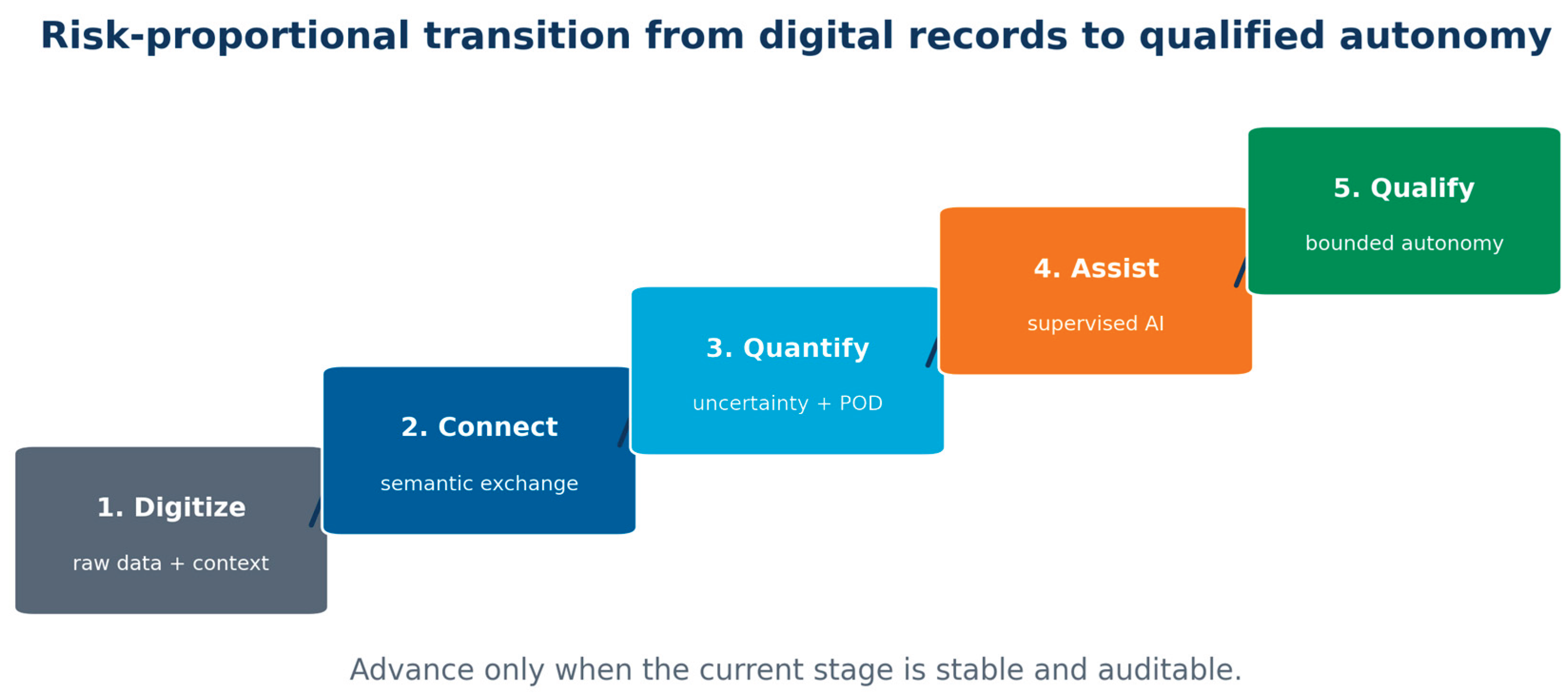
Figure 6.
Five-stage transition roadmap. Each stage adds capability only after the preceding evidence chain is stable
Figure 6.
Five-stage transition roadmap. Each stage adds capability only after the preceding evidence chain is stable
12. Research Agenda
Several methodological changes would accelerate progress. First, datasets should preserve component-level provenance, reference-truth uncertainty, and nuisance variables rather than only cropped images and class labels. Second, benchmark challenges should include hidden cross-instrument and cross-site tests. Third, negative results and boundary conditions should be publishable because they define the validated domain. Fourth, comparisons should be made at the system level - human alone, AI alone, and the designed human-AI team under the same operational constraints. Fifth, uncertainty methods should be evaluated by empirical coverage and decision utility, not by visual plausibility alone.
Table 9.
Measurement-centered research agenda.
| Priority research question | Needed method | Reportable outcome |
|---|---|---|
| How should uncertainty propagate through learned inverse models? | Hybrid GUM, Bayesian/ensemble, conformal and interval methods tested on physical standards | Coverage, calibration error, size-conditioned intervals |
| How can domain shift be detected before performance loss? | Cross-site longitudinal studies with known interventions | Detection delay, false alarms, residual performance |
| What is the minimum interoperable NDE evidence model? | Multi-vendor ontology and round-trip exchange benchmark | Semantic preservation and reproducibility score |
| When does AI improve the human-system POD? | Controlled reader studies with time, confidence, and interface conditions | System-level POD, false calls, workload, reliance calibration |
| How can simulation support qualification? | Validated forward models plus quantified discrepancy and targeted physical trials | MAPOD confidence and transfer limits |
| How should models abstain? | Risk-based selective prediction and OOD benchmarks | Risk-coverage curve and safe deferral rate |
| How can digital twins request informative inspection? | Value-of-information and active-sensing experiments | Uncertainty reduction per inspection cost |
| How should cybersecurity enter qualification? | Threat-informed fault injection into data and configuration chains | Detection, resilience, recovery, evidential integrity |
13. Discussion
The “hammer to high tech” metaphor can mislead if progress is equated with computational complexity. A simple inspection with a qualified operator may provide limited information but a comparatively transparent evidence chain; a connected array interpreted by an opaque model may provide richer information while leaving its operating boundary poorly defined. The objective is not to romanticize traditional inspection but to preserve procedural and metrological clarity while exploiting modern sensing and computation. In this framework, progress is evaluated by the amount of trustworthy, decision-relevant information generated within a demonstrated operating domain, rather than by algorithmic sophistication alone.
The framework also changes how digital twins should be evaluated. A detailed three-dimensional representation alone does not establish a digital twin’s measurement value; that value also depends on traceable state updating, uncertainty treatment, and relevance to inspection or maintenance decisions. A digital shadow receiving one-way data may be sufficient for some applications; insisting on a fully bidirectional twin can add complexity without corresponding measurement value [5,36,49].
Explainability should likewise be treated as one assurance mechanism among several. For a high-dimensional sensor, an explanation may help an expert identify shortcut learning or check consistency with known physics. Explainability outputs, by themselves, do not demonstrate sensitivity to rare flaws, robustness across instruments, calibrated uncertainty, or adequate POD. The strongest assurance case combines physical understanding, statistical evidence, software verification, representative validation, transparent limitations, and operational monitoring.
This review has limitations. The proposed assurance stack and qualification levels are conceptual and require empirical evaluation across modalities and sectors. The review is integrative rather than systematic, so it does not claim exhaustive literature coverage or permit quantitative prevalence estimates. Standards continue to evolve, and regulatory sectors may require different evidence or terminology. Some uncertainty sources - particularly dataset shift and model-form inadequacy - may not be reducible to a single scalar budget. These limitations define the next validation tasks rather than weakening the central premise that AI-enabled NDE requires an explicit sensor-to-decision assurance case.
14. Conclusion
NDE 4.0 should be understood as a transformation of measurement evidence rather than a collection of enabling technologies. For applications that rely on these technologies to support measurement-based engineering decisions, their contribution to a defensible measurement system depends on traceability, uncertainty characterization, intended-use validation, interoperability, security, and auditability appropriate to the risk and use case. The six-layer metrological-assurance architecture identifies where evidence can fail; the uncertainty taxonomy extends attention beyond the instrument to processing, reference truth, learned inference, domain shift, and human decision making; and the digital evidence record and qualification V-model translate those principles into deployable controls.
The central engineering requirement is simple to state but demanding to demonstrate: as decision authority increases, the assurance case should generally expand in scope and strength, including evidence appropriate to the added consequence and operating envelope. For AI-enabled NDE, relevant evidence may include representative POD or sizing performance, uncertainty characterization, provenance, validated domain-monitoring or input-quality checks, qualified decision rules, change management, and post-deployment surveillance. The proposed framework does not establish a consensus standard; it provides a testable structure for future experiments, qualification programmes, and standards development. The credible path from “hammer to high tech” is therefore a transition from data-rich inspection toward evidence-rich measurement.
Author Contributions
Conceptualization: K. Sharma, A. Kumar, V. Yadav; methodology: K. Sharma; writing--original draft: K. Sharma; writing--review and editing: K. Sharma A. Kumar, V. Yadav, S,Dhar, R.S.Raghuvanshi; visualization: K. Sharma; supervision: K.Sharma,V. Yadav and R.S.Raghuvanshi. All authors have read and agreed to the published version of the manuscript.
Funding
This research received no external funding.
Data Availability Statement
No new experimental datasets were generated or analysed in this review. All information discussed is derived from the cited literature, standards, and publicly available technical sources.
Conflicts of Interest
Kuldeep Sharma is affiliated with Dura-Bond Industries; Ashok Kumar is affiliated with Welspun Pipes Inc.; Sambit Dhar and R.S.Raghuvanshi are independent researchers and Vineet Yadav is affiliated with Born Inc. The authors declare that the manuscript presents a literature-based technical review and that no commercial product, client project, or proprietary inspection dataset is promoted. The affiliations could be perceived as potential competing interests because the authors work in industries that use NDE technologies; however, the authors report no financial sponsorship or external funding connected with this review.
Novelty and significance statement
This review develops a measurement-science architecture for AI-enabled NDE rather than another catalogue of NDE 4.0 technologies. Its original contribution is the integration of six assurance layers - physical measurand, instrument, signal, information, inference, and decision - with an end-to-end uncertainty taxonomy, a minimum digital evidence record, and a qualification V-model. The framework explicitly connects classical metrological traceability and NDE reliability with model validation, domain-shift control, data provenance, safe deferral, and decision governance. A worked uncertainty example and a comparison with established metrology, POD/MAPOD, digital-twin, and trustworthy-AI frameworks make the proposed scope and limitations testable and distinguishable from existing approaches.
Abbreviations
The following abbreviations are used in this manuscript:
| Abbreviation | Definition |
| AI | Artificial Intelligence |
| AIoT | Artificial Intelligence of Things |
| ASTM | ASTM International (formerly American Society for Testing and Materials) |
| BIPM | International Bureau of Weights and Measures (Bureau International des Poids et Mesures) |
| DCC | Digital Calibration Certificate |
| DICONDE | Digital Imaging and Communication in Nondestructive Evaluation |
| GUM | Guide to the Expression of Uncertainty in Measurement |
| IEC | International Electrotechnical Commission |
| IEEE | Institute of Electrical and Electronics Engineers |
| ISO | International Organization for Standardization |
| JCGM | Joint Committee for Guides in Metrology |
| MAPOD | Model-Assisted Probability of Detection |
| NDE | Nondestructive Evaluation |
| NDT | Nondestructive Testing |
| NIST | National Institute of Standards and Technology |
| OOD | Out-of-Distribution |
| PAUT | Phased-Array Ultrasonic Testing |
| POD | Probability of Detection |
| RMF | Risk Management Framework |
| SNR | Signal-to-Noise Ratio |
| UQ | Uncertainty Quantification |
| UT | Ultrasonic Testing |
| VIM | International Vocabulary of Metrology |
References
- Shirmohammadi, Shervin, Fan Wang, and Cheng-Hsin Hsu. “Review and performance evaluation of uncertainty quantification in data-driven AI-assisted measurements.” IEEE Open Journal of Instrumentation and Measurement (2025). [CrossRef]
- Vrana, J., Meyendorf, N., Ida, N., Singh, R. (2022). Introduction to NDE 4.0. In: Meyendorf, N., Ida, N., Singh, R., Vrana, J. (eds) Handbook of Nondestructive Evaluation 4.0. Springer, Cham. [CrossRef]
- Vrana, J., Singh, R. NDE 4.0—A Design Thinking Perspective. J Nondestruct Eval 40, 8 (2021). [CrossRef]
- Vrana, Johannes, Ripi Singh, Tjibbe Bouma, Niels Westendorp, Holger Haßdenteufel, and Bernd Valeske. “The NDE Value Alliance: Architecting the Trust and Interoperability Framework to Accelerate NDE 4.0 Through Collaborative Standardization.” NDT. net. Online resource 31, no. 7 (2026).
- Middleton, C.A., Nguyen, T. & Patterson, E.A. NDE 4.0 and Digital Twins in Industry: Current User Experiences and Future Development. J Nondestruct Eval 45, 107 (2026). [CrossRef]
- Bond, Leonard J. “Through the looking glass: the future for NDE?.” In AIP Conference Proceedings, vol. 1581, no. 1, pp. 21-35. American Institute of Physics, 2014. [CrossRef]
- Sharma, Kuldeep, Ashok Kumar, Vineet Yadav, Sambit Dhar, and Dipak K. Banerjee. “From Detection to Prediction: The NDE 4.0 Transition.” NDT 4, no. 3 (2026): 17. [CrossRef]
- Keprate, Arvind, and RM Chandima Ratnayake. “Probability of detection as a metric for quantifying NDE capability: the state of the art.” J. Pipeline Eng 14, no. 3 (2015): 199-209.
- Sun, Hongbin, Pradeep Ramuhalli, and Richard E. Jacob. “Machine learning for ultrasonic nondestructive examination of welding defects: A systematic review.” Ultrasonics 127 (2023): 106854. [CrossRef]
- Pyle, Richard J., Rhodri LT Bevan, Robert R. Hughes, Rosen K. Rachev, Amine Ait Si Ali, and Paul D. Wilcox. “Deep learning for ultrasonic crack characterization in NDE.” IEEE Transactions on Ultrasonics, Ferroelectrics, and Frequency Control 68, no. 5 (2020): 1854-1865. [CrossRef]
- Nsengiyumva, Walter, Shuncong Zhong, Longhui Zheng, Wei Liang, Bing Wang, Yi Huang, Xuefeng Chen, and Yaochun Shen. “Sensing and nondestructive testing applications of terahertz spectroscopy and imaging systems: State-of-the-art and state-of-the-practice.” IEEE Transactions on Instrumentation and Measurement 72 (2023): 1-83. [CrossRef]
- Abou-Khousa, Mohamed A., Mohammed Saif Ur Rahman, Kristen M. Donnell, and Mohammad Tayeb Al Qaseer. “Detection of surface cracks in metals using microwave and millimeter-wave nondestructive testing techniques—A review.” IEEE Transactions on Instrumentation and Measurement 72 (2023): 1-18. [CrossRef]
- Fernández-Bobadilla, Héctor A., and Ullrich Martin. “Modern tendencies in vehicle-based condition monitoring of the railway track.” IEEE Transactions on Instrumentation and Measurement 72 (2023): 1-44. [CrossRef]
- Fu, Hailing, Jing Rao, Fang Deng, Yihan Wang, Bowen Zhao, Zhuowen Liu, Hong Guan, Paweł H. Malinowski, and Lijun Xu. “Aiot: Artificial intelligence and the internet of things for monitoring and prognosis of systems and structures.” IEEE Transactions on Instrumentation and Measurement 74 (2025): 1-32. [CrossRef]
- BIPM, IEC, ILAC IFCC, IUPAP IUPAC, and OIML ISO. “The international vocabulary of metrology—basic and general concepts and associated terms (VIM), 3rd edn. JCGM 200: 2012.” JCGM (Joint Committee for Guides in Metrology) (2012).
- Jcgm, J. C. G. M. “Evaluation of measurement data—Guide to the expression of uncertainty in measurement.” Int. Organ. Stand. Geneva ISBN 50 (2008): 134. [CrossRef]
- Miguel, Anna Luísa Ribeiro, Renata Pereira Lopes Moreiraa, and André Fernando de Oliveira. “ISO/IEC 17025: History and introduction of concepts.” Química Nova 44, no. 6 (2021): 792-796. [CrossRef]
- Annis, C. “Nondestructive evaluation system reliability assessment (MIL-HDBK-1823A).” Arlington, Virginia: US Department of Defence (2009).
- Thompson, R. Bruce. “A unified approach to the model-assisted determination of probability of detection.” In AIP Conference Proceedings, vol. 975, no. 1, pp. 1685-1692. American Institute of Physics, 2008. [CrossRef]
- Calmon, Pierre, Olivier Mesnil, Roberto Miorelli, Xavier Artusi, Bastien Chapuis, and Oscar D’almeida. “Model assisted probability of detection for guided wave imaging structural health monitoring.” In Structural Health Monitoring 2019. DEStech Publications, Inc., 2019. [CrossRef]
- Barbosa, Carlos Roberto H., Manuel C. Sousa, Maria Fatima L. Almeida, and Rodrigo F. Calili. 2022. “Smart Manufacturing and Digitalization of Metrology: A Systematic Literature Review and a Research Agenda” Sensors 22, no. 16: 6114. [CrossRef]
- Mustapää, Tuukka, Pekka Nikander, Daniel Hutzschenreuter, and Raine Viitala. 2020. “Metrological Challenges in Collaborative Sensing: Applicability of Digital Calibration Certificates” Sensors 20, no. 17: 4730. [CrossRef]
- Hackel, Siegfried, Frank Härtig, Thorsten Schrader, Alexander Scheibner, Jan Loewe, Lutz Doering, Benjamin Gloger, Justin Jagieniak, Daniel Hutzschenreuter, and Gamze Söylev-Öktem. “The fundamental architecture of the DCC.” Measurement: Sensors 18 (2021): 100354. [CrossRef]
- Begoli, E., Bhattacharya, T. & Kusnezov, D. The need for uncertainty quantification in machine-assisted medical decision making. Nat Mach Intell 1, 20–23 (2019). [CrossRef]
- Gal, Yarin, and Zoubin Ghahramani. “Dropout as a bayesian approximation: Representing model uncertainty in deep learning.” In international conference on machine learning, pp. 1050-1059. PMLR, 2016.
- Kendall, Alex, and Yarin Gal. “What uncertainties do we need in bayesian deep learning for computer vision?.” Advances in neural information processing systems 30 (2017).
- Guo, Chuan, Geoff Pleiss, Yu Sun, and Kilian Q. Weinberger. “On calibration of modern neural networks.” In International conference on machine learning, pp. 1321-1330. PMLR, 2017.
- Angelopoulos, Anastasios N., and Stephen Bates. “Conformal prediction: A gentle introduction.” Foundations and Trends in Machine Learning 16, no. 4 (2023): 494-591.
- Quiñonero-Candela, Joaquin, Masashi Sugiyama, Anton Schwaighofer, and Neil D. Lawrence, eds. Dataset shift in machine learning. Mit Press, 2008.
- Hendrycks, Dan, and Kevin Gimpel. “A baseline for detecting misclassified and out-of-distribution examples in neural networks.” arXiv preprint arXiv:1610.02136 (2016).
- Shirmohammadi, Shervin, and Hussein Al Osman. “Machine learning in measurement part 1: Error contribution and terminology confusion.” IEEE Instrumentation & Measurement Magazine 24, no. 2 (2021): 84-92. [CrossRef]
- Al Osman, Hussein, and Shervin Shirmohammadi. “Machine learning in measurement part 2: Uncertainty quantification.” IEEE Instrumentation & Measurement Magazine 24, no. 3 (2021): 23-27. [CrossRef]
- Khanafer, Mounib, and Shervin Shirmohammadi. “Applied AI in instrumentation and measurement: The deep learning revolution.” IEEE Instrumentation & Measurement Magazine 23, no. 6 (2020): 10-17. [CrossRef]
- Howard, Patrick, Lloyd Arrowood, and Matthias Jobst. “A standard practice for digital ndt data exchange and storage.” In Conference Proceeding. 2009.
- Tao, Fei, He Zhang, Ang Liu, and Andrew YC Nee. “Digital twin in industry: State-of-the-art.” IEEE Transactions on industrial informatics 15, no. 4 (2018): 2405-2415. [CrossRef]
- Willcox, Karen, D. Bingham, C. Chung, J. Chung, C. Cruz-Neira, C. Grant, J. Kinter et al. “Foundational research gaps and future directions for digital twins.” National Academies of Sciences (2023).
- Tabassi, E. Artificial Intelligence Risk Management Framework (AI RMF 1.0). NIST AI 100-1, National Institute of Standards and Technology, Gaithersburg, MD, 2023. [CrossRef]
- ISO/IEC 23894:2023. Information technology - Artificial intelligence - Guidance on risk management. International Organization for Standardization / International Electrotechnical Commission, 2023.
- ISO/IEC 42001:2023. Information technology - Artificial intelligence - Management system. International Organization for Standardization / International Electrotechnical Commission, 2023.
- IEC 62443 series. Security for industrial automation and control systems. International Electrotechnical Commission, Geneva. (Relevant parts include IEC 62443-2-1 and IEC 62443-3-x.).
- Metrology, J. C. “Evaluation of Measurement Data-Supplement 1 to the Guide to the Expression of Uncertainty in Measurement-Propagation of Distributions Using a Monte Carlo Method.” Bureau International des Poids et Mesures (BIPM), Sèvres, France, Supplement to the GUM. Number JCGM 101 (2008): 2008.
- Rummel, W.D. (1984). Human Factors Considerations in the Assessment of Nondestructive Evaluation (NDE) Reliability. In: Thompson, D.O., Chimenti, D.E. (eds) Review of Progress in Quantitative Nondestructive Evaluation. Springer, Boston, MA. [CrossRef]
- Hoffmann, Gary D., Thomas Ellis, Haiping Su, Alok Shrestha, Julia A. Barsi, Roseanne Dominguez, Eric Fraim, James Jacobson, Steven Platnick, G. Thomas Arnold, and et al. 2026. “A NIST-Traceable Lab-to-Sky Spectral and Radiometric Calibration for NASA’s High-Altitude Airborne Hyperspectral Pushbroom Imager for Cloud and Aerosol Research and Development (PICARD)” Remote Sensing 18, no. 8: 1168. [CrossRef]
- Ye, Jiaxing, and Nobuyuki Toyama. “Benchmarking deep learning models for automatic ultrasonic imaging inspection.” IEEE Access 9 (2021): 36986-36994. [CrossRef]
- Ai, Hleg. “High-level expert group on artificial intelligence.” Ethics guidelines for trustworthy AI 6, no. 15.3 (2019): 2024.
- Giurgiutiu, V., Soutis, C. Enhanced Composites Integrity Through Structural Health Monitoring. Appl Compos Mater 19, 813–829 (2012). [CrossRef]
- Worden, Keith, Charles R. Farrar, Graeme Manson, and Gyuhae Park. “The fundamental axioms of structural health monitoring.” Proceedings: Mathematical, Physical and Engineering Sciences (2007): 1639-1664.
- AbouelNour, Youssef, and Nikhil Gupta. “In-situ monitoring of sub-surface and internal defects in additive manufacturing: A review.” Materials & Design 222 (2022): 111063. [CrossRef]
- Shao, Guodong, Simon Frechette, and Vijay Srinivasan. “An analysis of the new ISO 23247 series of standards on digital twin framework for manufacturing.” In International manufacturing science and engineering conference, vol. 87240, p. V002T07A001. American Society of Mechanical Engineers, 2023. [CrossRef]
- Gum, J. C. G. M. “6: 2020; Guide to the Expression of Uncertainty in Measurement—Part 6: Developing and Using Measurement Models.” Joint Committee for Guides in Metrology: Sèvres, France (2020).
- Janzen, Katharina, and Daniel Heißelmann. “Development of digital calibration certificates for coordinate metrology applications.” Measurement: Sensors 38 (2025): 101478. [CrossRef]
- Schönhals, Shanna, Muhammed-Ali Demir, Lutz Doering, Benjamin Gloger, Siegfried Hackel, Wiebke Heeren, Justin Jagieniak et al. “Harmonisation processes and practical implementation of machine-interpretable digital calibration certificates.” Measurement: Sensors 38 (2025): 101470. [CrossRef]
Disclaimer/Publisher’s Note: The statements, opinions and data contained in all publications are solely those of the individual author(s) and contributor(s) and not of MDPI and/or the editor(s). MDPI and/or the editor(s) disclaim responsibility for any injury to people or property resulting from any ideas, methods, instructions or products referred to in the content. |
© 2026 by the authors. Licensee MDPI, Basel, Switzerland. This article is an open access article distributed under the terms and conditions of the Creative Commons Attribution (CC BY) license (http://creativecommons.org/licenses/by/4.0/).
Copyright: This open access article is published under a Creative Commons CC BY 4.0 license, which permit the free download, distribution, and reuse, provided that the author and preprint are cited in any reuse.