

Submitted:
06 October 2026
Posted:
09 October 2026
You are already at the latest version
Abstract
Pharmaceutical indication and pharmacist prescribing have become strategies for expanding the capacity of primary care, particularly in the management of minor symptoms and low-complexity clinical conditions. This narrative review, guided by the SANRA domains, integrated scientific, regulatory, and institutional evidence identified through PubMed/MEDLINE, ScienceDirect, and Google Scholar, supplemented by grey literature from regulatory bodies, health services, and professional organizations, to comparatively characterize regulatory and practice models described across jurisdictions. Four main configurations were identified: pharmaceutical indication, protocol-based models, collaborative prescribing, and independent prescribing, with heterogeneous implementation internationally. Available evidence reports favorable outcomes in some services, including improved accessibility, high user satisfaction, and a potential shift in consultations from other healthcare settings to community pharmacy; however, heterogeneity in study designs, settings, and outcome measures, together with the predominance of observational and implementation studies, limits the certainty of these findings. Rather than demonstrating the superiority of a particular level of professional autonomy, the literature consistently shows that structured models incorporate clinical protocols, eligibility criteria, red-flag assessment, safety-netting, referral, and documentation. Effective implementation also requires consideration of professional training, care integration, documentation systems, and sustainable funding mechanisms. In Latin America and Costa Rica, the literature documents frequent pharmaceutical consultation and indication practices, although with variable levels of formalization and standardization.
Keywords:
community pharmacy
; pharmaceutical indication
; pharmacist prescribing
; minor ailments
; primary health care
; pharmaceutical services
1. Introduction
Consultations for minor symptoms and self-limiting clinical conditions account for a substantial share of the demand for care in primary care and may lead to the use of medical consultations and other health services for problems that, under appropriate clinical criteria, could initially be assessed at other points of care. In this context, community pharmacy represents a setting of interest for the management of certain low-complexity consultations through services that may include initial assessment, therapeutic guidance, supply or indication of medicines within the permitted framework, and referral when the clinical situation exceeds the pharmacist’s scope [1,2].
Pharmacist involvement in these consultations may follow different professional and regulatory mechanisms. Pharmaceutical indication refers to a professional process of assessing a consultation or health problem in which the pharmacist may recommend non-pharmacological measures, medicines that can legally be used without a prescription, or other appropriate interventions, in addition to referring the patient when appropriate [3,4]. In contrast, pharmacist prescribing encompasses models in which there is formal authority to initiate, modify, continue, or discontinue treatments within the limits established by the regulatory framework and the applicable professional competencies [5,6,7]. In addition, protocol-based or collaborative mechanisms may exist in which access to certain medicines depends on protocols, agreements, clinical pathways, or other specific authorizations. Therefore, pharmaceutical indication, protocol-based supply, and pharmacist prescribing should not be used as interchangeable terms.
The configuration of these roles is markedly heterogeneous across jurisdictions. The international literature describes differences in the terminology used, the powers granted to pharmacists, the clinical conditions covered, the medicines accessible, training and registration requirements, and the degree of integration with other health professionals and services [6,7,8,9]. Moreover, different models may coexist within the same country across states, provinces, or territories, as is particularly the case in the United States and Canada [8,10,11]. Consequently, the breadth of the pharmacist’s role cannot be interpreted through a single universal scale of autonomy, nor does the existence of a protocol necessarily imply pharmacist prescribing. Comparing models requires analyzing the specific powers granted to the professional and the legal and clinical mechanism through which the intervention takes place.
Although the literature on the expansion of pharmacists’ scope of practice has grown, the evidence relevant to community pharmacy is dispersed across studies of minor ailment services, implementation evaluations, reviews of specific prescribing modalities, and regulatory or institutional documents specific to each jurisdiction [1,4,5,6,7,8,12,13]. This fragmentation makes it difficult to integrate into a single comparative framework three dimensions that are conceptually distinct but operationally interdependent: the regulatory model, the clinical scope, and the mechanism through which the pharmacist can facilitate access to medicines. This difficulty is particularly relevant when jurisdictions with formalized models are compared with settings such as Latin America and Central America, where the practice of pharmaceutical consultation and indication is documented but shows variable degrees of structuring, regulation, and traceability [14,15,16,17].
In this context, the aim of this narrative review is to critically analyze and integrate the available scientific, regulatory, and institutional evidence on pharmaceutical indication and pharmacist prescribing in primary care, with particular emphasis on community pharmacy and the management of minor symptoms or low-complexity clinical conditions. Specifically, it seeks to describe and compare the main regulatory and practice models identified in the literature, characterize their clinical scope and mechanisms of access to medicines, examine the associated safety and referral criteria, and analyze the main elements of documentation, integration, and implementation described across different healthcare settings.
2. Materials and Methods
2.1. Study Design and Methodological Framework
A narrative literature review with a descriptive, analytical, and comparative approach was conducted to critically integrate scientific, regulatory, and institutional evidence on pharmaceutical indication and pharmacist prescribing in primary care. This design was chosen because of the heterogeneity of the phenomenon of interest, which encompasses different regulatory models, professional scopes, clinical interventions, health policy documents, and implementation experiences whose terminology and characteristics vary across jurisdictions.
The purpose of the review was not to estimate a pooled effect or to perform a quantitative synthesis of results, but rather to organize and critically analyze the available literature in order to identify recurrent regulatory and practice configurations, differences between healthcare settings, relevant clinical and operational components, and evidence gaps. The preparation and critical revision of the manuscript were guided by the domains of the Scale for the Assessment of Narrative Review Articles (SANRA) [18], used as a quality framework for the narrative review and not as a tool for assessing the methodological quality of individual sources.
2.2. Thematic Scope and Analytical Framework
The review focused on pharmaceutical indication and the different modalities of pharmacist prescribing developed in primary care, particularly in community pharmacy and in the management of minor symptoms or self-limiting clinical conditions.
To organize the literature comparatively, the different mechanisms through which pharmacists participate in therapeutic decision-making were considered as analytical axes, including pharmaceutical indication, protocol-based models, collaborative prescribing (including supplementary or dependent modalities when this terminology was used by the source), and independent prescribing. These categories were used as a framework for organizing the evidence and not as a universal hierarchical scale of professional autonomy.
Likewise, when described by the sources consulted, the following were analyzed: the clinical scope of the models, the conditions or symptoms addressed, the mechanisms of access to or use of medicines, the inclusion, exclusion, and referral criteria, training requirements, documentation and follow-up, integration with other health services, and implementation or funding mechanisms.
2.3. Information Sources and Search Strategy
The scientific literature was identified through searches in PubMed/MEDLINE, ScienceDirect, and Google Scholar, selected for their coverage of literature related to the health sciences, pharmacy practice, primary care, and health services. The searches aimed to locate publications related to pharmaceutical indication, pharmacist prescribing, community pharmacy, and the management of minor symptoms.
Terms and keyword combinations related to pharmacist prescribing, independent prescribing, supplementary prescribing, collaborative prescribing, pharmaceutical indication, community pharmacy, primary care, minor ailments, Pharmacy First, and pharmacist-led services were used, as well as equivalent Spanish terms related to pharmaceutical indication (indicación farmacéutica), pharmacist prescribing (prescripción farmacéutica), community pharmacy (farmacia comunitaria), and primary care (atención primaria). The combinations were adapted to the characteristics of each information source.
The identification of literature was supplemented by reviewing the reference lists of relevant publications and by consulting regulatory, institutional, and professional documents related to the models analyzed. Given the narrative nature of the review, the search aimed to identify sources relevant to a critical and comparative synthesis, without seeking the exhaustiveness of a systematic review.
2.4. Grey Literature and Regulatory Sources
Owing to the regulatory nature of the topic, the scientific literature was supplemented with normative and institutional documents from health authorities, regulatory bodies, health services, and professional organizations. These sources were used mainly to describe the legal framework, professional scope, and operational characteristics of pharmaceutical indication or pharmacist prescribing models in specific jurisdictions.
For statements related to professional competencies, authorized conditions, or regulatory mechanisms, official or primary sources were prioritized over secondary sources when available. Because some countries show internal regulatory variation across states, provinces, or territories, information was interpreted at the jurisdictional level described by the source consulted, and automatic extrapolation of local provisions to the country as a whole was avoided.
2.5. Inclusion Criteria
Sources related to pharmaceutical indication, pharmacist prescribing, the management of minor symptoms, and the expansion of the pharmacist’s clinical role in community pharmacy or primary care were considered. Priority was given to publications providing information on regulatory models, clinical scope, conditions treated, safety and referral mechanisms, professional training, documentation, care integration, or service implementation.
Original articles, observational and implementation studies, systematic reviews, scoping reviews, and relevant narrative reviews were included, as well as pertinent guidelines, regulatory documents, legislation, professional guidance, and institutional documents. Literature published between 2015 and 2026 was prioritized because of recent changes in the scope of pharmacy practice; however, earlier publications were retained when considered relevant for describing background, fundamental concepts, or practice models still pertinent to the interpretation of current evidence. Publications in English, Spanish, and Portuguese were considered.
2.6. Exclusion Criteria
Sources focused exclusively on hospital or highly specialized settings were excluded when their results were not applicable or comparable to community pharmacy or primary care. Publications limited to conventional dispensing of medicines, general health education, or pharmaceutical activities not directly related to the clinical assessment and management of minor symptoms, pharmacist prescribing, or the expansion of professional scope were also excluded.
Duplicate documents, publications with insufficient content to contribute to the objectives of the review, and sources whose subject matter was peripheral or not directly relevant to the regulatory, clinical, or operational synthesis developed were also excluded.
2.7. Selection and Prioritization of Sources
The sources identified were selected according to their relevance to the objectives and thematic scope of the review. Priority was given to publications providing directly relevant information on regulatory and pharmacy practice models, the management of minor symptoms, the clinical scope of interventions, safety and referral mechanisms, and the components of implementation, documentation, and care integration.
Selection was carried out through a narrative appraisal of the thematic relevance and contribution of each source to the synthesis developed. When several publications addressed the same model or regulatory aspect, priority was given to the sources most directly related to the review question, the most recent publications, and, for regulatory or professional-scope statements, documents from health authorities, regulatory bodies, or competent professional organizations.
Systematic and scoping reviews were used mainly to contextualize the overall state of the evidence and to identify relevant literature, whereas original studies were used to support clinical outcomes, implementation experiences, or specific service characteristics where appropriate. Regulatory and institutional documents were used primarily to describe the regulatory situation and the professional competencies in force in the jurisdictions analyzed.
To structure the synthesis presented in this manuscript, the relevant information from the selected sources was organized narratively according to the analytical axes described in Section 2.2: regulatory or practice model, clinical scope, mechanisms of access to medicines, safety and referral criteria, documentation and follow-up, and care integration and implementation. Comparisons between jurisdictions were made qualitatively, preserving where necessary the terminology specific to each regulatory framework and avoiding the assumption of equivalence between professional categories or mechanisms of access to medicines that were not directly comparable. No quantitative synthesis of results or formal risk-of-bias assessment of individual studies was performed.
2.8. Statement on the Use of AI Tools
During the preparation and revision of the manuscript, ChatGPT (OpenAI) was used as a support tool for language editing, structural organization, and the location and verification of certain bibliographic and regulatory sources. The sources used were verified by the authors by consulting the original documents before their incorporation into the manuscript. The tool was not used to generate primary data or to perform statistical analyses. The final selection of sources, their interpretation, the methodological decisions, and the conclusions were made and approved by the authors, who take full responsibility for the scientific content of the manuscript.
2.9. Methodological Rigor and Quality Criteria of the Narrative Review
The development and critical revision of the manuscript were guided by the domains of the Scale for the Assessment of Narrative Review Articles (SANRA). This instrument assesses six components relevant to the quality of a narrative review: justification of the article’s importance, statement of the aims, description of the literature search, appropriateness of the references used, quality of the scientific reasoning, and appropriate presentation of relevant data and results.
In line with these domains, efforts were made to maintain an explicit relationship between the objectives of the review, the sources selected, and the synthesis developed; to distinguish regulatory statements from clinical or implementation evidence; to prioritize sources directly relevant to each type of statement; and to express the conclusions in accordance with the nature and limitations of the available evidence.
3. Results and Discussion
3.1. Overview of the Evidence
In the management of minor symptoms, the literature shows a widespread activity in community pharmacy, albeit with considerable variability in service structure, quality of the clinical process, and implementation. A systematic review conducted in developing countries identified frequent consultations for minor ailments, but also a lack of specific protocols and heterogeneity in information gathering and counseling [12]. For its part, a study conducted in Switzerland on pharmacist-prescribed medicines identified clinically relevant therapeutic options, together with implementation barriers related to documentation, professional training, and costs for patients [13]. Overall, the diversity of designs, settings, and outcome measures limits direct comparison between studies and the formulation of definitive conclusions on the relative effectiveness of the different models [5,12,13].
Beyond the outcomes observed in individual services, recent literature places the expansion of pharmacist prescribing roles in a context of growing demand for care and the search for strategies to improve access to care and make broader use of pharmacists’ clinical competencies [6,7,10]. However, the existence of regulatory authority does not by itself determine the effective implementation of the service. Available reviews recurrently identify factors related to training, funding, care integration, professional acceptance, workflow, and access to clinical information as determinants of implementation [6,7]. When these roles are incorporated into primary care teams, the delineation of responsibilities, interprofessional coordination, and clinical governance also become relevant to patient safety [19].
From an international perspective, the available evidence shows a prominent representation of jurisdictions with formalized models of expanded pharmacist scope, including the United Kingdom, Canada, the United States, and Australia [6,7,8,9]. However, the modalities described are not uniform and may differ substantially in regulatory authority, clinical conditions treated, medicines covered, professional requirements, and implementation mechanisms; this variability can be observed even across states, provinces, or territories within the same country [6,8]. Consequently, the evidence is better suited to characterizing and comparing regulatory and practice configurations than to establishing a general hierarchy between models. On this basis, the following sections separately examine the regulatory mechanism, clinical scope, access to medicines, and safety and implementation components.
Figure 1 illustrates the diversity of regulatory mechanisms present in selected jurisdictions. Although different models may expand the pharmacist’s capacity to intervene in the management of clinical conditions or to facilitate access to medicines, the professional powers and legal mechanisms underpinning these interventions are not necessarily equivalent. This heterogeneity forms the basis for the analytical typology developed in the next section.
3.2. Typology of the Regulatory Models Identified
For analytical purposes, the evidence reviewed was organized into four recurrent regulatory and practice configurations: pharmaceutical indication, protocol-based models, collaborative prescribing, and independent prescribing. These categories do not represent a universal hierarchical scale of professional autonomy, nor are they necessarily mutually exclusive, since the same jurisdiction may combine different modalities depending on the care setting, the clinical condition, and the applicable regulatory framework.
3.2.1. Pharmaceutical Indication
Pharmaceutical indication is a modality of clinical care developed mainly in community pharmacy in response to consultations related to minor symptoms, self-limiting conditions, or self-care needs. In this context, the pharmacist assesses the reason for consultation and the relevant clinical information to determine whether an intervention within their scope of competence is appropriate, which may include non-pharmacological measures, indication of non-prescription medicines when appropriate, health education, or referral to another professional or level of care.
The scope and formal recognition of this activity vary across jurisdictions. In more structured models, the intervention is supported by standardized procedures, inclusion and exclusion criteria, identification of red flags, and defined referral and documentation mechanisms. Literature from Central America and Costa Rica shows that pharmaceutical indication is part of community practice, although its degree of standardization and regulatory formalization is heterogeneous [15,16].
3.2.2. Protocol-Based Models
Protocol-based models comprise forms of practice in which the pharmacist’s actions are delimited by clinical protocols, care pathways, decision algorithms, lists of medicines, or other mechanisms previously established by a health authority or by the corresponding regulatory framework. These instruments may define eligible conditions, inclusion and exclusion criteria, permitted interventions, and the circumstances requiring referral.
Depending on the jurisdiction and the regulatory instrument used, these models may allow the pharmacist to recommend over-the-counter medicines, supply certain prescription-only medicines under protocol-based authorization or, where the legal framework so provides, prescribe within a previously delimited scope. For this reason, protocol-based supply of a medicine and pharmacist prescribing were not considered automatically equivalent in this review.
These models make it possible to structure the care of defined clinical conditions through standardized processes of assessment, treatment, documentation, and referral. Their scope should be interpreted according to the specific regulation of each jurisdiction, avoiding inferring a degree of professional autonomy solely from the existence of a protocol [20].
3.2.3. Collaborative Prescribing
Collaborative prescribing comprises models in which the pharmacist performs certain pharmacotherapeutic functions within a formal agreement established with one or more authorized prescribers. The agreement or regulatory framework defines the delegated functions, the populations or conditions covered, and the limits of the pharmacist’s actions.
Depending on the jurisdiction and the scope of the agreement, these functions may include patient assessment and the ability to initiate, modify, continue, monitor, or discontinue treatments, as well as to order or interpret certain tests related to pharmacotherapy. The pharmacist’s authority derives from the collaborative agreement and the legal framework that enables it; therefore, this model should be distinguished from independent prescribing.
The effective implementation of these models also depends on organizational and interprofessional factors, including clarity in role definition, trust between professionals, availability of resources, shared documentation mechanisms, and integration of the pharmacist into the care team [25].
3.2.4. Independent Prescribing
Independent prescribing corresponds to a model in which the pharmacist can assess the patient and make prescribing decisions under their own professional responsibility, without requiring individual authorization from another prescriber for each therapeutic decision, always within the scope permitted by the applicable legislation and their clinical competence [6].
The scope of this authority is not uniform across jurisdictions and may vary according to the clinical conditions treated, the medicines covered, the practice setting, and the requirements for training, accreditation, or professional registration. Therefore, the existence of independent prescribing should not be interpreted as unrestricted authorization to prescribe, but rather as a competency exercised within defined regulatory and professional limits [6].
The literature also describes differences between jurisdictions in the effective implementation of this competency and highlights the relevance of factors such as clinical training, infrastructure, care integration, remuneration mechanisms, and organizational support [6].
3.3. Pharmacy Services for Minor Ailments and Primary Care
Pharmacy services aimed at managing minor symptoms and low-complexity clinical conditions are one of the main areas of expansion of clinical practice in community pharmacy. The literature describes models that combine clinical assessment, inclusion and exclusion criteria, identification of red flags, pharmacological or non-pharmacological intervention, and referral when the problem exceeds the scope of the service. The way in which pharmacists can access or facilitate medicines varies across jurisdictions, ranging from the indication of non-prescription medicines to protocol-based supply or prescribing within specific legal frameworks [20].
A widely structured example is Pharmacy First in England, which uses national clinical pathways for seven common conditions and allows, depending on the applicable pathway, management through self-care, over-the-counter medicines, or the supply of certain prescription-only medicines within the framework of the service. This mechanism should be distinguished from independent prescribing, which constitutes a separate professional authority whose incorporation into national community pharmacy services is expanding [20].
Table 1 presents selected international examples of these models and their regulatory and operational characteristics. Owing to the regulatory variability within some countries, the comparison is made at the appropriate jurisdictional level where applicable and is not intended to be an exhaustive inventory of all existing models.
The comparison shows that the expansion of the pharmacist’s role does not follow a single regulatory progression. Jurisdictions with structured clinical services may use different legal mechanisms, including pharmaceutical indication, protocol-based dispensing of medicines without an individual medical prescription, prescribing under specific protocols or agreements, and independent prescribing. Therefore, professional scope should be interpreted on the basis of the specific powers recognized in each jurisdiction rather than through a generic classification of low, moderate, or high autonomy.
3.4. Low-Complexity Clinical Conditions and Minor Ailments
Consultations for minor symptoms and self-limiting clinical conditions are one of the main areas in which clinical pharmacy services have been developed in primary care [1]. Their management in community pharmacy has been described for various common problems, including respiratory and ear, nose, and throat symptoms, gastrointestinal disorders, musculoskeletal pain, dermatological conditions, and other self-care consultations, although the specific scope varies according to the service and the jurisdiction [30].
Rather than depending on a hierarchical progression of professional autonomy, the pharmacist’s problem-solving capacity in these scenarios is conditioned by the definition of the clinical scope, the availability of protocols or practice standards, the adequate identification of red flags, the selection of permitted interventions, and the existence of clear referral mechanisms. Studies of minor ailment services show that the quality of management may vary according to the criteria used to assess it, highlighting the importance of having clinical standards appropriate to the community pharmacy setting [30,31]. Consequently, the conditions treated should be interpreted in relation to the specific clinical and regulatory framework of the service, and not as indicators of a supposed universal level of pharmacist autonomy or complexity.
3.5. Mechanisms of Access to Medicines in the Models Analyzed
Access to medicines within the models analyzed depends on the regulatory framework of each jurisdiction and cannot be interpreted solely on the basis of the therapeutic category of the medicine. The mechanisms identified include the indication or dispensing of non-prescription medicines, the dispensing of certain medicines subject to specific conditions of pharmaceutical intervention, the protocol-based supply of prescription-only medicines, and various modalities of pharmacist prescribing.
Because the legal classification of medicines may vary according to jurisdiction, clinical indication, formulation, strength, and the applicable regulatory instrument, Table 2 presents selected examples of access mechanisms and is not intended to be an exhaustive formulary of medicines authorized for pharmacists.
The comparison shows that different regulatory mechanisms may lead to apparently similar care outcomes (for example, facilitating access to treatment from community pharmacy) without the pharmacist’s legal powers being equivalent. A medicine may be available without a prescription, require direct pharmacist intervention, be supplied under a specific protocol, or be subject to pharmacist prescribing, depending on the jurisdiction and the clinical context. Therefore, international comparison should focus on the regulatory mechanism and the clinical scope of the intervention, rather than assuming equivalence between therapeutic categories or between lists of medicines from different countries.
3.6. Clinical Criteria, Red Flags, and Pharmacist Resolution Threshold
The safety of pharmacy services aimed at managing minor symptoms depends on a clear delineation between situations that can be resolved within the pharmacy and those requiring assessment by another professional or level of care. In structured models, protocols and clinical pathways may incorporate eligibility criteria, severity assessment, risk factors, and red flags, in addition to defining permitted interventions and the circumstances requiring referral [37].
The identification of red flags and referral are part of the care process itself and should not be interpreted as a failure of the pharmacy service. When the consultation exceeds the clinical or regulatory scope of the model, relevant risk factors are present, or the course does not correspond to a self-limiting condition, referral is the mechanism for safely escalating care. Similarly, safety-netting advice makes it possible to inform the patient about the expected course, the signs or symptoms requiring reassessment, and the circumstances in which additional care should be sought [38].
Consequently, the pharmacist resolution threshold is neither a fixed characteristic nor a universal measure of professional autonomy. It depends on the condition treated, patient characteristics, the scope defined by the service, the professional’s competencies, and the regulatory framework applicable in each jurisdiction.
3.7. Documentation, Follow-Up, and Continuity of Care
Clinical documentation is an important component of structured pharmacy models, as it allows the recording of the assessment performed, therapeutic decisions, recommendations provided, and, where appropriate, referral or follow-up criteria. The degree of documentation required varies across services and jurisdictions; therefore, it should not be assumed that all models have the same level of integration with health system clinical records.
In formally integrated services, documentation may form part of the continuity-of-care mechanism. For example, Pharmacy First in England requires recording information on patient eligibility, assessment findings, the therapeutic decision, and safety-netting advice, in addition to transmitting relevant information on the outcome of the consultation to the patient’s general practice [20].
In acute or self-limiting conditions, follow-up does not necessarily involve a scheduled consultation. It is often structured through advice on the expected course, reassessment criteria, red flags, and the need for referral when the expected improvement does not occur. These mechanisms make it possible to incorporate continuity and safety into the episode of care without assuming that all pharmacy services have longitudinal follow-up or interoperable access to the clinical record.
3.8. Evidence Gaps
The literature reviewed shows a heterogeneous evidence base in terms of designs, care settings, practice definitions, and outcomes assessed. The available reviews bring together observational studies, implementation evaluations, and experiences developed under different regulatory frameworks, which limits direct comparison between jurisdictions and between pharmacy practice modalities [6,7].
In addition, important differences persist in the terminology used to describe pharmaceutical indication, protocol-based supply, collaborative prescribing, and independent prescribing. This heterogeneity makes it difficult to establish uniform comparisons of clinical outcomes, safety, service utilization, and costs, particularly when professional competencies vary across jurisdictions or change over time [6,8].
Consequently, the available evidence makes it possible to describe models and implementation experiences but is insufficient to establish a universal hierarchy among them or to determine that one regulatory configuration is superior to the others. Comparative evaluations with homogeneous definitions, standardized clinical and economic outcomes, and greater representation of currently understudied settings are needed [8].
3.9. Functional Integration, Implementation Barriers, and Funding
The effective implementation of expanded clinical roles for pharmacists does not depend exclusively on their regulatory authorization. The literature reviewed recurrently identifies barriers related to clinical training, time availability and workflow organization, access to relevant clinical information, documentation, clarity of professional roles, interprofessional acceptance and integration, and organizational support [6,7,25]. These difficulties may arise even when an enabling regulatory framework exists. In the Swiss context, for example, documentation requirements, the need for additional training, and costs borne by patients have been described as practical obstacles [13].
Conversely, the facilitators described include a clear delineation of roles and responsibilities, adequate training for the authorized clinical scope, availability of protocols or support tools, functional access to clinical information, documentation and communication mechanisms, and effective integration with other professionals and levels of care [6,7,25]. These components should not be interpreted as identical requirements for all models, but rather as supports whose relevance depends on the clinical scope, the regulatory mechanism, and the organizational context in which the service is delivered. Consequently, the existence of a formal professional competency should be distinguished from the operational capacity of the system to incorporate it consistently into practice.
Funding and remuneration are also cross-cutting components of implementation. The absence of sustainable funding mechanisms may limit the adoption or continuity of services that require additional professional time, documentation, follow-up, or coordination with other members of the health system [6,7,39]. The specific remuneration mechanisms vary across jurisdictions and types of service; therefore, the existence of clinical or prescriptive authority does not necessarily imply that an associated funding model exists. Overall, the sustainability of these roles depends on the interaction between regulatory authorization, clinical capacity, operational resources, care integration, and mechanisms that allow service delivery to be sustained in practice.
3.10. Interpretation of the Findings
Overall, the literature reviewed shows that the expansion of the pharmacist’s clinical role in primary care has developed through diverse regulatory and organizational mechanisms. Services aimed at managing minor symptoms represent a particularly relevant area because of the frequency of these consultations and the possibility of resolving certain low-complexity episodes outside other points of care [1,2]. However, the heterogeneity of studies and regulatory frameworks precludes assuming that the outcomes observed in one jurisdiction are directly transferable to another.
The international comparison also shows that pharmacist scope cannot be adequately described through a single scale of autonomy [9]. Indication, protocol-based supply, collaborative prescribing, and independent prescribing models may coexist and respond to different legal mechanisms. Consequently, the evaluation of each model should consider the specific powers granted to the pharmacist, the clinical conditions covered, the mechanisms of access to medicines, the training required, and the safety, documentation, and referral processes accompanying the intervention [5,6,7,8,9].
Recurrently, the literature and regulatory models reviewed incorporate elements such as clinical protocols, eligibility criteria, identification of red flags, safety-netting, referral, and documentation. These components should be interpreted as mechanisms intended to delimit and structure clinical practice, but the available evidence does not allow it to be established that a particular level of professional authority is, by itself, superior to another in terms of clinical outcomes. Comparison between models requires studies with more homogeneous definitions and outcome measures.
In Latin America and Costa Rica, the available literature documents a widespread practice of pharmaceutical consultation and indication in community pharmacy and points to differences between observed practice and the degree of regulatory formalization. These findings provide a basis for discussing strategies for clinical standardization, regulation, documentation, training, and coordination with other primary care services, but do not allow the assumption that a specific regulatory model should be transferred directly from other jurisdictions [14,15,16,17]. In Costa Rica, a specific regulatory example of pharmaceutical indication is Executive Decree No. 41722-S, which authorizes the dispensing of oral emergency contraceptives without a medical prescription, exclusively in establishments holding a pharmacy sanitary operating permit and with the advice of the pharmacist in charge, thus constituting a non-prescription medicine restricted to sale in pharmacies [41].
The experience of jurisdictions in which the expansion of professional scope is still under discussion also provides information on the conditions perceived as necessary for eventual implementation. In Sweden, for example, a national survey on the possible introduction of non-medical prescribing showed that participating pharmacists identified regulatory clarity, training, access to clinical information, delineation of competencies, and interprofessional integration as relevant; at the same time, they expressed concerns related to professional liability and workload. These results represent professional perceptions of a potential model and not evidence of the effectiveness of an already implemented service [40].
3.11. Limitations of the Review
This review has limitations inherent to its narrative design. Although multiple scientific, regulatory, and institutional sources were used and explicit criteria were established for their selection and prioritization, no prospective and fully reproducible record of all search strategies and of each document selection decision was available. Consequently, the review cannot be considered exhaustive, and relevant publications or regulatory documents may not have been identified. The findings should be interpreted as a critical and comparative synthesis of the literature located and not as a systematic inventory of all available evidence.
The selection and synthesis of sources were carried out through a narrative appraisal of their relevance and contribution to the objectives of the review, without a formal selection process by independent reviewers or a structured risk-of-bias assessment of individual studies. Although synthesis reviews, relevant original studies, and primary regulatory sources for normative statements were prioritized, this approach may introduce subjectivity into the selection and weighting of evidence. For this reason, the conclusions were formulated descriptively, and the studies reviewed were not used to establish pooled estimates of effectiveness or hierarchical comparisons between models.
An additional limitation derives from the marked terminological and regulatory heterogeneity across jurisdictions. Concepts such as pharmaceutical indication, protocol-based supply, collaborative prescribing, supplementary prescribing, and independent prescribing do not necessarily have legal or operational equivalents across health systems. Likewise, the legal classification of medicines and the powers granted to pharmacists may vary across states, provinces, or territories within the same country. Although the review sought to preserve these differences and avoid equating distinct regulatory mechanisms, this heterogeneity inevitably limits direct comparability between jurisdictions.
Finally, the synthesis may be influenced by the greater availability of scientific literature and institutional documentation from jurisdictions with more developed or better documented pharmacy models. The consideration of sources in English, Spanish, and Portuguese may also have limited the identification of evidence published exclusively in other languages. Moreover, regulatory frameworks and pharmacy services evolve rapidly, so certain provisions, competencies, or programs described could change after the sources were consulted. Consequently, the regulatory comparisons should be interpreted as a characterization based on the documentation available and verified during the preparation of this review, and not as a definitive or permanent legal classification of each jurisdiction.
4. Conclusions
The literature reviewed shows that pharmaceutical indication and pharmacist prescribing are part of a progressive expansion of the clinical role of community pharmacy and primary care, especially in the management of minor symptoms and low-complexity conditions. The models described show considerable heterogeneity in their regulatory basis, clinical scope, mechanisms of access to medicines, and level of integration within the health system.
For analytical purposes, these models can be organized into configurations of pharmaceutical indication, protocol-based practice, collaborative prescribing, and independent prescribing. However, these categories do not represent a universal hierarchical scale, nor do they allow the clinical superiority of one model over another to be assumed. The available evidence suggests that structured care processes—including eligibility criteria, identification of red flags, referral, documentation, and follow-up mechanisms—are recurrent elements in formalized services.
The implementation of these roles requires consideration not only of the pharmacist’s regulatory authority, but also of professional training, infrastructure, interprofessional coordination, documentation systems, and the funding mechanisms available in each context. Owing to the variability across jurisdictions, international models should be interpreted according to their specific legal and organizational framework and not automatically transferred between health systems.
In Latin America and Costa Rica, the available literature documents a frequent practice of pharmaceutical consultation and indication in community pharmacy, together with variable degrees of formalization and standardization. This scenario presents opportunities to strengthen the definition of clinical scope, care protocols, documentation, training, and referral mechanisms, without assuming that a single regulatory configuration is necessarily applicable to all countries in the region.
Finally, important gaps in comparative evidence persist, especially in relation to clinical outcomes, safety, service utilization, costs, and the sustainability of the models. Future research should incorporate prospective designs, more homogeneous definitions of interventions, and evaluations conducted in currently underrepresented settings, particularly in Latin America.
Author Contributions
Conceptualization, E.Z.-M., L.C.M.-B. and J.M.-J.; methodology, E.Z.-M., L.C.M.-B., S.A.-C. and J.A.C.-G.; validation, E.Z.-M., Y.Q.-R., J.G.-G. and J.M.-J.; formal analysis, E.Z.-M., L.C.M.-B., Y.Q.-R., J.G.-G. and J.M.-J.; investigation, E.Z.-M., L.C.M.-B., A.H.-C., K.C.-M., S.S.-C., Y.Q.-R., J.G.-G., S.A.-C., J.A.C.-G. and J.M.-J.; data curation, E.Z.-M., K.C.-M., S.S.-C., S.A.-C. and J.A.C.-G.; writing—original draft preparation, E.Z.-M., L.C.M.-B., A.H.-C., K.C.-M., S.S.-C., Y.Q.-R., J.G.-G., S.A.-C., J.A.C.-G. and J.M.-J.; writing—review and editing, E.Z.-M., L.C.M.-B., A.H.-C., K.C.-M., S.S.-C., Y.Q.-R., J.G.-G., S.A.-C., J.A.C.-G. and J.M.-J.; visualization, E.Z.-M., K.C.-M. and S.A.-C.; supervision, E.Z.-M., Y.Q.-R. and J.M.-J.; project administration, E.Z.-M., L.C.M.-B. and J.M.-J. All authors have read and agreed to the published version of the manuscript.
Funding
This research received no external funding.
Institutional Review Board Statement
Not applicable.
Informed Consent Statement
Not applicable.
Data Availability Statement
No primary datasets were generated or analyzed in this study. All documentary sources used (scientific articles, reviews, regulatory documents, and institutional reports) are duly cited in the References section and are accessible through the databases and institutional repositories indicated. The synthesis data presented in Table 1 and Table 2 were prepared by the authors on the basis of the cited sources.
Acknowledgments
During the preparation and revision of this manuscript, the authors used ChatGPT (OpenAI) for language editing, structural organization, and the identification and verification of selected bibliographic and regulatory sources. All sources incorporated into the manuscript were verified against the original documents. The authors reviewed and edited the output and take full responsibility for the content of this publication.
Conflicts of Interest
The authors declare no conflicts of interest.
Abbreviations
The following abbreviations are used in this manuscript:
| AI | Artificial intelligence |
| CCS | Common Conditions Service |
| LTBI | Latent tuberculosis infection |
| MEDLINE | Medical Literature Analysis and Retrieval System Online |
| MNSRM | Medicamentos não sujeitos a receita médica (non-prescription medicines) |
| MNSRM-EF | Medicamentos não sujeitos a receita médica de dispensa exclusiva em farmácia (non-prescription medicines dispensed exclusively in pharmacies) |
| NHS | National Health Service |
| OTC | Over-the-counter |
| PEP | Post-exposure prophylaxis |
| PGD | Patient Group Direction |
| POM | Prescription-only medicine |
| PrEP | Pre-exposure prophylaxis |
| SANRA | Scale for the Assessment of Narrative Review Articles |
| SUS | Sistema Único de Saúde (Brazilian Unified Health System) |
| TPT | Tuberculosis preventive treatment |
| TROD | Test rapide d’orientation diagnostique (rapid diagnostic orientation test) |
References
- Paudyal, V.; Watson, M.C.; Sach, T.; Porteous, T.; Bond, C.M.; Wright, D.J.; Cleland, J.; Barton, G.; Holland, R. Are Pharmacy-Based Minor Ailment Schemes a Substitute for Other Service Providers?: A Systematic Review. Br. J. Gen. Pract. 2013, 63, e472–e481. [Google Scholar] [CrossRef] [PubMed]
- Fielding, S.; Porteous, T.; Ferguson, J.; Maskrey, V.; Blyth, A.; Paudyal, V.; Barton, G.; Holland, R.; Bond, C.M.; Watson, M.C. Estimating the Burden of Minor Ailment Consultations in General Practices and Emergency Departments through Retrospective Review of Routine Data in North East Scotland. Fam. Pract. 2015, 32, 165–172. [Google Scholar] [CrossRef] [PubMed]
- Ordem dos Farmacêuticos. Boas Práticas de Farmácia Comunitária – Norma específica sobre indicação farmacêutica; Ordem dos Farmacêuticos, 2018; p. 6. [Google Scholar]
- Foro de Atención Farmacéutica-Farmacia Comunitaria (Foro AF-FC), panel de expertos. Guía práctica para los Servicios Profesionales Farmacéuticos Asistenciales desde la Farmacia Comunitaria; Consejo General de Colegios Oficiales de Farmacéuticos: Madrid, 2024; ISBN 978-84-09-57269-4. [Google Scholar]
- Piraux, A.; Bonnan, D.; Ramond-Roquin, A.; Faure, S. The Community Pharmacist as an Independent Prescriber: A Scoping Review. J. Am. Pharm. Assoc. 2024, 64, 102192. [Google Scholar] [CrossRef] [PubMed]
- Mesbahi, Z.; Piquer-Martinez, C.; Benrimoj, S.I.; Martinez-Martinez, F.; Amador-Fernandez, N.; Zarzuelo, M.J.; Dineen-Griffin, S.; Garcia-Cardenas, V. Pharmacists as Independent Prescribers in Community Pharmacy: A Scoping Review. Res. Soc. Adm. Pharm. 2025, 21, 142–153. [Google Scholar] [CrossRef] [PubMed]
- Clemens, S.; Eisl-Raudaschl, L.; Pachmayr, J.; Rose, O. Community Pharmacist Prescribing: Roles and Competencies—A Systematic Review and Implications. Pharmacy 2025, 13, 157. [Google Scholar] [CrossRef] [PubMed]
- Ahmed, S.; Kung, J.; Chiang, V.; Poudel, A.; Olufemi-Yusuf, D.; Faruquee, C.F.; Makowsky, M.; Nissen, L.; Guirguis, L. Mapping the U.S. Literature on Pharmacists Prescribing to Initiate Medications: A Scoping Review of Terminology, Responsibilities, and Alignment with International Models. J. Am. Pharm. Assoc. 2026, 66, 102952. [Google Scholar] [CrossRef] [PubMed]
- International Pharmaceutical Federation (FIP). Advanced Practice and Specialisation in Pharmacy: Global Report 2015; International Pharmaceutical Federation (FIP): The Hague, 2015; p. 78. [Google Scholar]
- Nakhla, N.; Leung, V.; Schwartz, K.L. Expansion of Pharmacist Prescribing Could Help Improve Health Care Access and Quality. Can. Fam. Physician 2024, 70, 441–443. [Google Scholar] [CrossRef] [PubMed]
- Canadian Pharmacists Association. Pharmacists’ Scope of Practice in Canada; Canadian Pharmacists Association, 2025; p. 1. [Google Scholar]
- Yusuff, K.B.; Makhlouf, A.M.; Ibrahim, M.I. Community Pharmacists’ Management of Minor Ailments in Developing Countries: A Systematic Review of Types, Recommendations, Information Gathering and Counselling Practices. Int. J. Clin. Pract. 2021, 75, e14424. [Google Scholar] [CrossRef] [PubMed]
- Amador-Fernández, N.; Botnaru, I.; Allemann, S.S.; Kälin, V.; Berger, J. Clinical Relevance and Implementation into Daily Practice of Pharmacist-Prescribed Medication for the Management of Minor Ailments. Front. Pharmacol. 2024, 14, 1256172. [Google Scholar] [CrossRef] [PubMed]
- Zavaleta-Monestel, E.; Gómez-Martínez, J.C.; Martínez-Martínez, F.; Escudero-Correa, A.; Soderlund, L.-A.; Mora-Jiménez, J.; Arguedas-Chacón, S. From Informal Practice to Structured Care: Pharmaceutical Indication and Minor Ailment Management in Latin American Community Pharmacy. Front. Public Health 2026, 14, 1790792. [Google Scholar] [CrossRef] [PubMed]
- Zavaleta-Monestel, E.; Villalobos-Madriz, J.A.; Serrano-Arias, B.; Arguedas-Chacón, S.; Diaz-Madriz, J.P.; Ferreto-Meza, M.A.; Romero-Chavarría, B.M.; Zumbado-Amerling, P. Assessing Pharmaceutical Consultations: Comparing Pharmacy-Recommended Medications for Minor Ailments and Regulatory Compliance in a Latin American Healthcare Network. Explor. Res. Clin. Soc. Pharm. 2023, 11, 100300. [Google Scholar] [CrossRef] [PubMed]
- Badilla-Baltodano, B.; Orellana, K.; Martínez-Martínez, F.; Martínez De Haase, L.; Monge-Bogantes, L.; Liere-Godoy, A. Estudio Descriptivo Inicial Relativo a Indicación Farmacéutica En Farmacias Comunitarias En Países de Centroamérica. Farm. Comunitarios 2025, 17, 30–40 28. [Google Scholar] [CrossRef]
- Zavaleta-Monestel, E.; Monge-Bogantes, L.C.; Mora-Jiménez, J.; Arguedas-Chacón, S. Governing Access to Medicines in Central America: Community Pharmacy, Patient Safety, and Lessons from Spain. Front. Health Serv. 2026, 6, 1781501. [Google Scholar] [CrossRef] [PubMed]
- Baethge, C.; Goldbeck-Wood, S.; Mertens, S. SANRA—a Scale for the Quality Assessment of Narrative Review Articles. Res. Integr. Peer Rev. 2019, 4, 5. [Google Scholar] [CrossRef] [PubMed]
- Luzón-Oliver, L.; Astier-Peña, M.P. La Prescripción de Medicamentos En Los Equipos de Atención Primaria: El Reto de La Multidisciplinariedad y La Seguridad Del Paciente. Aten. Primaria 2026, 58, 103449. [Google Scholar] [CrossRef] [PubMed]
- N. H. S. England Community Pharmacy Advanced Service Specification: NHS Pharmacy First Service 2023.
- N. H. S. England Pharmacy First: Supporting Access to NHS Care. Available online: https://www.england.nhs.uk/long-read/pharmacy-first-supporting-access-to-nhs-care/ (accessed on 11 September 2026).
- République française. République française Arrêté du 17 juin 2024 fixant les modalités de délivrance de médicaments sans ordonnance après la réalisation d’un test rapide d’orientation diagnostique, les modalités de formation spécifique des pharmaciens d’officine en la matière et précisant les conditions de recours à une ordonnance de dispensation conditionnelle - LégifranceArrêté du 17 juin 2024 fixant les modalités de délivrance de médicaments sans ordonnance après la réalisation d’un test rapide d’orientation diagnostique, les modalités de formation spécifique des pharmaciens d’officine en la matière et précisant les conditions de recours à une ordonnance de dispensation conditionnelle - Légifrance; 2024; Vol. 0142. [Google Scholar]
- Queensland Health. Professional practice Prescribing in community pharmacy; Queensland Health: Australia, 2025; p. 16. [Google Scholar]
- Ministério da Saúde. Recomendações técnicas aos farmacêuticos para acolher, orientar e prescrever o tratamento da Infecção Latente pelo Mycobacterium tuberculosis (ILTB) ou Tratamento Preventivo da Tuberculose (TPT); Ministério da Saúde: Brasília, DF, 2024; p. 11. [Google Scholar]
- Jorgenson, D.; Laubscher, T.; Lyons, B.; Palmer, R. Integrating Pharmacists into Primary Care Teams: Barriers and Facilitators. Int. J. Pharm. Pract. 2014, 22, 292–299. [Google Scholar] [CrossRef] [PubMed]
- INFARMED, I.P. Lista de DCI identificadas pelo Infarmed como MNSRM/MNSRM-EF e protocolos de dispensa (se aplicável). Available online: https://www.infarmed.pt/web/infarmed/entidades/medicamentos-uso-humano/autorizacao-de-introducao-no-mercado/alteracoes_transferencia_titular_aim/lista_dci (accessed on 9 September 2026).
- Medicinal Products (Prescription and Control of Supply) (Amendment) (No. 3) Regulations 2025; 2025; Vol. S.I. No. 502/2025Medicinal Products (Prescription and Control of Supply) (Amendment) (No. 3) Regulations 2025; 2025; Vol. S.I. No. 502/2025.
- Pharmaceutical Society of Ireland Common Conditions Service. Available online: https://www.psi.ie/information-and-resources/common-conditions-service (accessed on 9 September 2026).
- Federal Office of Public Health (FOPH) Simplified Provision of List B Medicinal Products. Available online: https://www.bag.admin.ch/en/simplified-provision-of-list-b-medicinal-products (accessed on 9 September 2026).
- Boag, L.; Maclure, K.; Boyter, A.; Cunningham, S.; Akram, G.; McQuillan, H.; Stewart, D. Public Perceptions and Experiences of the Minor Ailment Service in Community Pharmacy in Scotland. Pharm. Pract. 2021, 19, 2152. [Google Scholar] [CrossRef] [PubMed]
- Ayele, A.A.; Mekuria, A.B.; Tegegn, H.G.; Gebresillassie, B.M.; Mekonnen, A.B.; Erku, D.A. Management of Minor Ailments in a Community Pharmacy Setting: Findings from Simulated Visits and Qualitative Study in Gondar Town, Ethiopia. PLoS ONE 2018, 13, e0190583. [Google Scholar] [CrossRef] [PubMed]
- NHS Business Services Authority Pharmacy First June 2025. Available online: https://www.nhsbsa.nhs.uk/pharmacy-first-june-2025 (accessed on 11 September 2026).
- Ontario. Reglamento de Ontario 256/24; The Ontario Gazette: Canadá, 2024. [Google Scholar]
- Ontario College of Pharmacists. Minor Ailments Prescribing; Toronto, Canadá, 2026. [Google Scholar]
- Pharmacy Council of New Zealand Pharmacist Scopes of Practice. Available online: https://pharmacycouncil.org.nz/public/pharmacist-scopes-of-practice/ (accessed on 9 September 2026).
- Pharmacy Council of New Zealand Pharmacist Prescribers. Available online: https://pharmacycouncil.org.nz/pharmacist/pharmacist-prescribers/ (accessed on 9 September 2026).
- Inch, J.; Porteous, T.; Maskrey, V.; Blyth, A.; Burr, J.; Cleland, J.; Wright, D.J.; Holland, R.; Bond, C.M.; Watson, M.C. It’s Not What You Do It’s the Way That It’s Measured: Quality Assessment of Minor Ailment Management in Community Pharmacies. Int. J. Pharm. Pract. 2017, 25, 253–262. [Google Scholar] [CrossRef] [PubMed]
- Taylor, J.G.; Joubert, R. Pharmacist-Led Minor Ailment Programs: A Canadian Perspective. Int. J. Gen. Med. 2016, 9, 291–302. [Google Scholar] [CrossRef] [PubMed]
- Mossialos, E.; Courtin, E.; Naci, H.; Benrimoj, S.; Bouvy, M.; Farris, K.; Noyce, P.; Sketris, I. From “Retailers” to Health Care Providers: Transforming the Role of Community Pharmacists in Chronic Disease Management. Health Policy 2015, 119, 628–639. [Google Scholar] [CrossRef] [PubMed]
- Ljungdahl, N.; Kälvemark-Sporrong, S.; Tranberg, A.; Kempen, T. Pharmacists’ Views on Potential Non-Medical Prescribing for Pharmacists in Sweden: A Nationwide Survey Study. Int. J. Clin. Pharm. 2025, 48, 501–512. [Google Scholar] [CrossRef] [PubMed]
- Poder Ejecutivo de Costa Rica; Ministerio de Salud. Decreto Ejecutivo N° 41722-S. Dispensación de los Anticonceptivos Orales de Emergencia; La Gaceta: San José, Costa Rica, 2019; Available online: http://www.pgrweb.go.cr/scij/Busqueda/Normativa/Normas/nrm_texto_completo.aspx?param1=NRTC&nValor1=1&nValor2=88768&nValor3=116208&strTipM=TC (accessed on 2 October 2026).
Figure 1.
Selected geographical examples of regulatory models of pharmaceutical indication, protocol-based supply, and pharmacist prescribing in primary care. Source: prepared by the authors based on references [4,8,10,11,14,15,16,20,21,22,23,24]
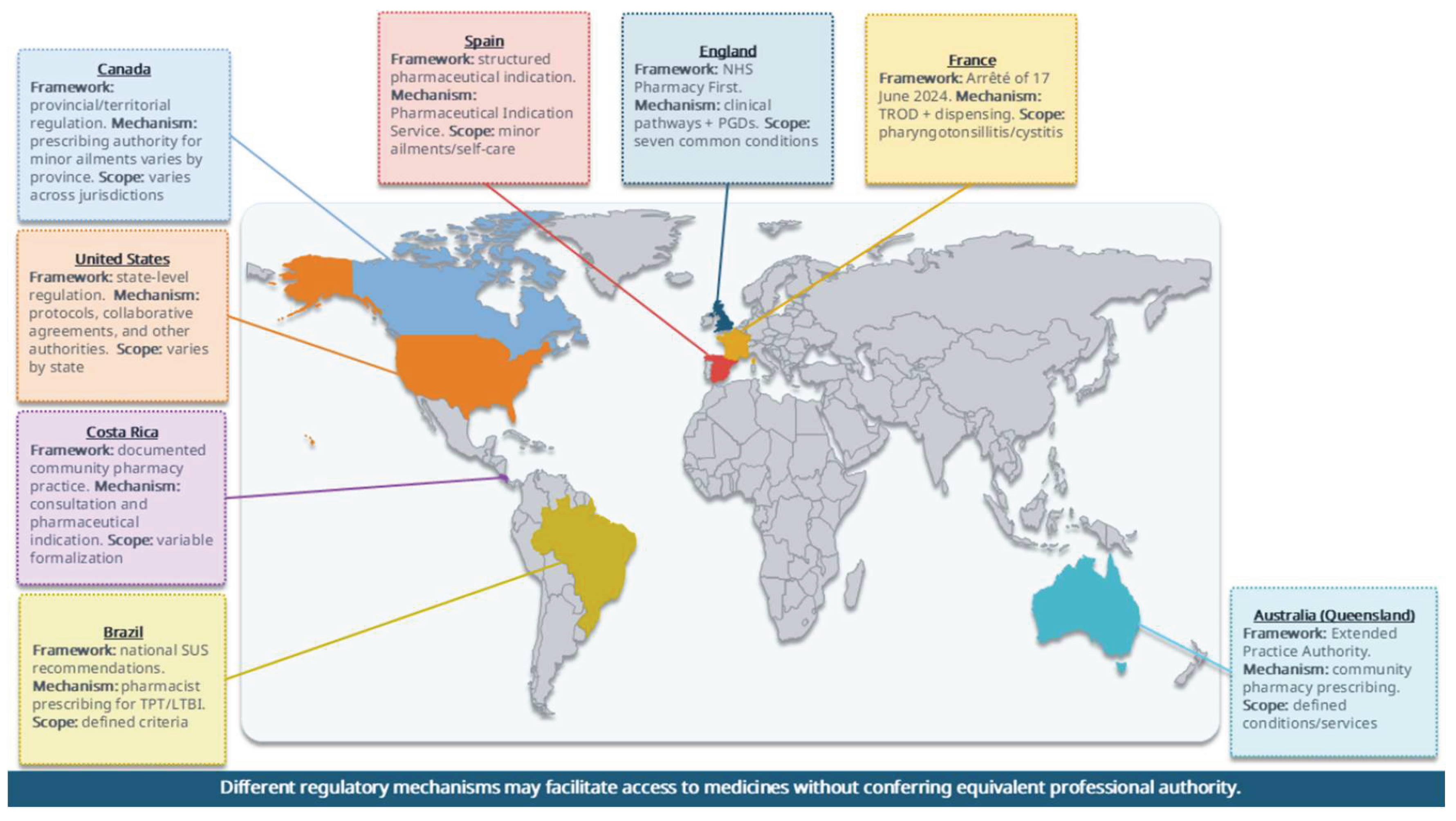

Table 1.
Selected international examples of pharmaceutical indication, protocol-based supply, and pharmacist prescribing models in primary care.
Table 1.
Selected international examples of pharmaceutical indication, protocol-based supply, and pharmacist prescribing models in primary care.
| Jurisdiction | Regulatory Framework or Practice Model | Selected Clinical Scope | Mechanism of Access to Medicines | Pharmacist Functions | Supporting Evidence |
| United States |
Predominantly state-level regulation, with variability in terminology and scope. Collaborative practice agreements, state protocols, and specific authorities by medicine or service are described. |
Depending on the state, may include contraception, naloxone, PrEP/PEP, smoking cessation, and other preventive interventions. | Variable according to state legislation: collaborative agreements, protocols, formularies, or other specific authorities. There is no single national model. | Assessment, initiation or supply of treatments, and follow-up within the scope authorized by each jurisdiction. | [8] |
| Canada | Provincial or territorial regulation. All jurisdictions have some degree of prescriptive or therapeutic modification authority, but its scope and requirements differ. | Minor ailments, smoking cessation, therapeutic renewal or adaptation, and other activities depending on the province. | Prescribing, adaptation, renewal, or substitution according to provincial legislation. Specific lists of conditions and medicines may exist for minor ailments. | Assess, prescribe, or adapt within the authorized scope; provide education, follow-up, and referral. | [10,11] |
| England | Pharmacy First as a national service based on clinical pathways; independent prescribing exists in parallel as a distinct professional competency. | Pharmacy First comprises seven clinical pathways for common conditions; independent prescribing may be used in other services when the professional is qualified and acts within their competence. | Pharmacy First may include supply of medicines through clinical pathways and PGDs. Independent prescribing constitutes a separate authority. | Clinical assessment, identification of red flags, therapeutic decision, safety-netting, documentation, and referral; prescribing when the pharmacist holds the corresponding authority. | [6,21] |
| France | National protocol-based model for certain conditions, regulated through specific rules on assessment, rapid testing, and dispensing. | Group A streptococcal pharyngotonsillitis and acute uncomplicated cystitis in eligible populations. | Dispensing of specific antibiotics without a medical prescription after a positive TROD, within established lists and criteria. Should not automatically be equated with independent prescribing. | Eligibility assessment, performance and interpretation of the TROD, selection among permitted medicines, patient information, documentation, and referral when appropriate. | [22] |
| Portugal | Structured model of indicação farmacêutica and dispensing of MNSRM/MNSRM-EF in community pharmacy. | Minor symptoms, self-care, and conditions covered by specific dispensing protocols. | Non-prescription medicines; certain MNSRM-EF require pharmaceutical intervention and application of dispensing protocols. Not a general pharmacist prescribing model. | Clinical interview, problem assessment, therapeutic recommendation, protocol-based dispensing when appropriate, and referral. | [3,26] |
| Australia (Queensland) | State regulation. In Queensland, certain community pharmacy prescribing services operate under an Extended Practice Authority and specific training requirements. | Includes various common acute conditions and health and wellness services defined by the state authority. | Prescribing and supply within the conditions, medicines, and requirements delimited by the Extended Practice Authority. | Clinical assessment, prescribing when appropriate, treatment, documentation, follow-up, and referral. | [23] |
| Costa Rica | The literature consulted documents a frequent practice of pharmaceutical consultation and indication in community pharmacy, but does not describe a consolidated pharmacist prescribing framework for minor ailments comparable to the formalized models of other jurisdictions. | Consultations for minor symptoms and selection/recommendation of treatments in community pharmacy. | Empirical literature has documented recommendations of both over-the-counter and prescription-only medicines, revealing differences between observed practice and the applicable regulatory framework. | Assessment of the consultation, therapeutic recommendation, education, and referral according to documented practice. | [14,15,16] |
| Spain | Pharmaceutical Indication Service recognized within the Professional Pharmaceutical Care Services in community pharmacy. | Minor symptoms and self-care situations that can be addressed within the pharmacist’s scope. | Recommendation and indication of medicines or products that can legally be dispensed without a prescription; referral when appropriate. Not a general pharmacist prescribing model. | Interview, assessment, identification of referral criteria, recommendation, health education, and recording according to the service model. | [4] |
| Ireland | Common Conditions Service (CCS), a structured national community pharmacy service with specific protocols. | Eight conditions: allergic rhinitis, cold sores, conjunctivitis, impetigo, oral thrush, shingles (herpes zoster), uncomplicated cystitis, and vulvovaginal candidiasis. | Pharmacist prescribing within protocols and criteria defined for the CCS. | Eligibility assessment, prescribing when appropriate, information, referral, and documentation in accordance with national protocols. | [27,28] |
| Switzerland | Regulated model of simplified dispensing of certain Category B medicines without a medical prescription, including the List B+ framework for common diseases. | Indications and medicines specifically defined by federal regulation. | The pharmacist may dispense certain medicines formally subject to prescription without a medical prescription, under the established conditions. | In-person assessment, dispensing decision within the permitted framework, and mandatory documentation. |
[29] |
Table 2.
Selected examples of mechanisms of access to medicines in primary care pharmacy models.
| Jurisdiction/Service | Selected Condition or Scope | Regulatory Mechanism | Access to Medicines | Main Limits of the Model | Source |
| England (Pharmacy First) | Seven clinical pathways for common conditions | National clinical pathways + PGDs | Self-care/OTC and certain POMs via PGD depending on the clinical pathway | Supply via PGD is not automatically equivalent to independent prescribing | [20,32] |
| Canada (Ontario) | Provincially defined minor ailments | Provincial prescribing authority | Prescribing of medicines specified for each minor ailment | Scope is provincial; Ontario should not be extrapolated to all of Canada | [33,34] |
| Australia (Queensland) | Common acute conditions and certain health/wellness services | Extended Practice Authority | Prescribing/supply within the scope of the state authority | Requires training and compliance with state conditions | [23] |
| United States—state pharmacist prescribing models | Variable according to the state, the service, and the applicable authority; covers different conditions and pharmacotherapy initiation activities. | Protocol-based prescribing models predominate, including collaborative practice agreements and state protocols; formulary-based models and other specific authorities have also been described. | Selection and initiation of medicines within previously defined protocols, formularies, or authorities, according to the legislation and model applicable in each jurisdiction. | There is no uniform national model; terminology, pharmacist responsibilities, conditions treated, and medicines covered vary across states and practice settings. |
[8] |
| New Zealand—Pharmacist Prescriber Scope of Practice | Area of practice defined by the clinical competence and professional scope of the pharmacist prescriber, applicable in different care settings. | Specific scope of practice with registration as a Pharmacist Prescriber and practice within a collaborative health team. | The pharmacist prescriber may issue prescriptions to initiate or modify pharmacotherapy, including continuation, modification, or discontinuation of treatment, within their scope of competence. | Does not act as a primary diagnostician; requires postgraduate training and specific registration, must practice within their competence and a collaborative setting, and, as a designated prescriber, is subject to the applicable list of medicines. | [35,36] |
| Spain (Pharmaceutical Indication Service) | Minor symptoms/self-care | Structured pharmaceutical indication | Authorized medicines that do not require a prescription | Does not constitute general pharmacist prescribing |
[4] |
| Portugal—MNSRM/MNSRM-EF | Symptoms/indications covered by protocol | Indicação farmacêutica + dispensa exclusiva em farmácia | MNSRM and certain MNSRM-EF under intervention/protocol | Does not constitute a general authority to prescribe prescription-only medicines | [3,26] |
| Costa Rica—Oral emergency contraception (Executive Decree No. 41722-S) | Oral emergency contraception within 72 h after unprotected intercourse or contraceptive failure | National executive decree authorizing dispensing without a medical prescription | Oral emergency contraceptives dispensed without a prescription, exclusively in establishments with a pharmacy sanitary operating permit and with the advice of the pharmacist in charge (regente) | Restricted to oral emergency contraceptives; does not establish a general pharmacist prescribing authority | [41] |
| Brazil—Tuberculosis Preventive Treatment (TPT/LTBI) in the SUS | Latent Mycobacterium tuberculosis infection and tuberculosis preventive treatment in eligible patients according to national recommendations. | Pharmacist prescribing within the SUS in accordance with national technical recommendations of the Ministério da Saúde. | The pharmacist may assess the indication, adjust a previous prescription, and prescribe the preventive treatment regimens included in the Ministry of Health recommendations. | Practice is limited to TPT/LTBI and to the current criteria and recommendations of the Ministério da Saúde; this source does not establish a general pharmacist prescribing authority for other conditions or medicines. | [24] |
| Ireland (Common Conditions Service) | Eight common conditions | Prescribing linked to the CCS and national protocols | OTC and, where appropriate, POMs through protocol-based pharmacist prescribing | Only conditions, patients, and treatments covered by the protocols | [27,28] |
| France | Group A streptococcal pharyngotonsillitis and acute uncomplicated cystitis | TROD + national dispensing framework | Certain antibiotics may be dispensed without a prescription after a positive test | Strict criteria for eligibility, training, testing, and permitted medicines | [22] |
| Switzerland—List B+ | Common diseases included in federal regulation | Simplified dispensing of certain Category B medicines | Certain medicines formally subject to prescription may be dispensed without a prescription | In-person assessment by the pharmacist, dispensing restricted to the defined indications and medicines, and mandatory documentation. | [29] |
Abbreviations: CCS: Common Conditions Service; LTBI: latent Mycobacterium tuberculosis infection; MNSRM: medicamentos não sujeitos a receita médica (non-prescription medicines); MNSRM-EF: medicamentos não sujeitos a receita médica de dispensa exclusiva em farmácia (non-prescription medicines dispensed exclusively in pharmacies); OTC: over-the-counter; PGD: Patient Group Direction; POM: prescription-only medicine; SUS: Sistema Único de Saúde; TPT: tuberculosis preventive treatment; TROD: test rapide d’orientation diagnostique. Source: prepared by the authors based on the cited references.
Disclaimer/Publisher’s Note: The statements, opinions and data contained in all publications are solely those of the individual author(s) and contributor(s) and not of MDPI and/or the editor(s). MDPI and/or the editor(s) disclaim responsibility for any injury to people or property resulting from any ideas, methods, instructions or products referred to in the content. |
© 2026 by the authors. Licensee MDPI, Basel, Switzerland. This article is an open access article distributed under the terms and conditions of the Creative Commons Attribution (CC BY) license (http://creativecommons.org/licenses/by/4.0/).
Copyright: This open access article is published under a Creative Commons CC BY 4.0 license, which permit the free download, distribution, and reuse, provided that the author and preprint are cited in any reuse.