

Submitted:
04 October 2026
Posted:
09 October 2026
You are already at the latest version
Abstract
Human forensic biobanks preserve biological materials and associated information for forensic investigation, evidence retention, research, quality assurance, method development, and training, yet the terminology, purposes, governance, and operating models of these resources remain heterogeneous across forensic disciplines. This scoping review will map how human forensic biobanks and related forensic imaging or data repositories are defined, established, operated, governed, and used. The review will follow the Arksey and O’Malley framework with refinements by Levac and colleagues and will be reported in accordance with PRISMA-ScR. PubMed, Scopus, CINAHL, PsycINFO, and Embase will be searched without date, geographic, or search-language restrictions, supplemented by reference-list and forward-citation searching. Eligible evidence will describe established human biological collections, retained biological evidence repositories, or qualifying forensic digital repositories with documented forensic purposes. Two reviewers will independently screen records; data will be charted using a piloted form and verified by a second reviewer. Findings will be synthesized descriptively and narratively, with publications distinguished from unique resources and physical, digital, and hybrid models mapped separately. The review is expected to characterize resource purposes, populations, specimens, and data types, governance, access, quality management, sustainability, and reported applications, while identifying implementation challenges and reporting gaps. By organizing a fragmented literature around the underlying resources rather than individual analytical findings, the review will provide a structured evidence base for future forensic biobank development, governance, and research.
Keywords:
forensic biobanks
; biological specimen banks
; forensic sciences
; biological evidence preservation
; forensic imaging
; digital repositories
; biobank governance
; scoping review protocol
Introduction
Background
Biobanks preserve human biological material and associated information for subsequent use. In forensic settings, retained specimens can support investigations and research across pathology, toxicology, microbiology, clinical chemistry, and genetics, rather than serving only DNA identification or population-frequency analysis [1]. Preserving biological evidence also enables later examination and re-examination, making specimen integrity, traceability, and appropriate retention important beyond the initial investigation [2].
The usefulness of a collection depends on documented acquisition and processing, suitable preservation, quality control, and reliable links between specimens and relevant information [1,2]. Digital pathology and postmortem imaging introduce additional questions about data organization, standardization, access, and reuse. The literature on postmortem imaging biobanks also describes repositories in which images and metadata are the principal resources [3]. Physical biobanks, their linked digital components, and stand-alone imaging or data repositories therefore require explicit differentiation.
Governance requires attention to the purposes for which material was originally collected, the basis for its retention, and the conditions governing subsequent use. Relevant considerations include consent or other applicable authorization, confidentiality, access decisions, secondary use, and the boundaries between research and forensic investigation [1,4,5]. Evidence preservation additionally raises questions about tracking, chain of custody, and disposition [2].
Objectives
A previous systematic review examined secondary forensic uses of medical biobanks [6]. The present scoping review will instead map the definitions, purposes, establishment, operations, governance, and applications of human forensic biobanks across forensic disciplines, while distinguishing them from related digital repositories and the secondary uses of other biobanks. Its focus is the underlying resource, not individual analytical findings.
Methods
Review design
The review will follow the five core stages of Arksey and O’Malley’s scoping review framework [7], incorporating relevant methodological refinements proposed by Levac and colleagues [8]. The completed review will be reported using the PRISMA extension for Scoping Reviews [PRISMA-ScR) [9]. The protocol will be made publicly accessible before formal screening. Amendments to eligibility criteria, search methods, or charting procedures will be dated and explained.
Biobank definition and scope
For this review, a human forensic biobank is an organized physical collection of human biological material retained for one or more documented forensic purposes, together with associated information where available. Eligible purposes include forensic investigation and casework, evidence retention and re-examination, research, reference-data generation, method development or validation, quality assurance, and forensic training. A collection need not have a genetic component or a research-only mission.
Eligible reports need not use the exact term “forensic biobank.” They must describe, or clearly connect to, an organized retained resource rather than only specimens collected and temporarily stored for a single analysis. Physical collections may include tissues, organs, body fluids, cells, molecular derivatives, bones, teeth, or other human biological material.
The scope encompasses all human forensic disciplines, including forensic pathology and medicolegal autopsy, toxicology, genetics, anthropology, odontology, microbiology, clinical forensic medicine, imaging, and multidisciplinary collections. Forensic psychiatry, psychology, or other specialties are eligible when the report concerns a qualifying human biological or case-derived resource with a documented forensic purpose. These examples do not form a closed list.
Related digital resources: To capture the full range of models described in the literature, organized repositories of human forensic images and specimen- or case-derived biological, morphological, or analytical data will also be eligible when retained for subsequent forensic use. These will be mapped separately as digital repositories, not assumed to be physical biobanks. Linked physical and digital components of the same resource will not be double-counted.
Eligibility will be determined by the reported purpose of the collection or its documented forensic application, not solely by an author’s affiliation, an autopsy origin, or a potential future forensic use. General clinical or postmortem collections do not become forensic biobanks merely because some samples were obtained through a medical examiner or after death.
Stage 1: Identifying the Research Question
Aim: To map the definitions, purposes, characteristics, establishment processes, governance arrangements, operational practices, and reported applications of human forensic biobanks across all forensic disciplines, including related forensic imaging and data repositories.
Primary review question: How are human forensic biobanks defined, established, operated, governed, and used, as described in the available literature?
Secondary questions:
1. What definitions, purposes, donor or case populations, specimen types, and associated datasets characterize the reported resources?
2. What approaches are described for recruitment or case selection, consent or other authorization, collection, processing, storage, quality control, data management, and access?
3. What applications, implementation challenges, future development plans, and reporting gaps are identified?
Stage 2: Identifying Relevant Evidence Sources
PubMed, Scopus, CINAHL, PsycINFO, and Embase will be searched, subject to institutional access. Reference lists and forward citations of included reports will also be checked. Searches will combine broad forensic and medicolegal terms with terms for biobanks, retained biological collections, and related imaging or data repositories, using database-specific subject headings and keywords (Table 1).
The broad search terms may retrieve non-forensic autopsy collections; eligibility will be decided during screening rather than inferred from the search terms alone.
Search Strategy Management
The search strategy will be peer-reviewed using the PRESS guidelines before execution [10]. Bibliographic records will be imported into Covidence or an equivalent review-management platform, where duplicate records will be identified automatically and checked manually [11]. A master repository register will be maintained in Microsoft Excel for resource-level deduplication and status tracking.
Stage 3: Evidence Selection
The biobank or repository will be the unit of mapping; publications will be sources of information about that resource. Dedicated forensic resources, related digital repositories, and secondary forensic uses of non-forensic biobanks will be distinguished. We will follow the PCC framework (Table 2).
Eligibility criteria
Inclusion: Original research articles and institutional reports describing an established collection that meets the review definition. Resource-specific descriptions within other publication types will also be considered. Reports need only address one or more review domains; incomplete reporting on storage, governance, or access will not, on its own, lead to exclusion.
Organized repositories of retained human biological evidence will be eligible when their physical holdings or collection arrangements are described, including repositories maintained for casework, future re-examination, or cold-case investigations. Human skeletal, dental, tissue, fluid, cell, and molecular collections are eligible when a forensic purpose is documented. Research access is not a prerequisite for including an otherwise eligible operational collection.
Exclusion: Analytical studies without evidence of an organized retained collection or eligible digital repository; temporary sample storage solely for a single analysis; nonhuman-only collections; non-biological forensic resources such as weapon collections or digital-device evidence; and clinical, postmortem, or general teaching collections without a documented forensic purpose or application. Purely conceptual proposals without an established resource will not be included in the resource inventory. Offender or crime-scene profile databases described only for routine matching, without information about retained biological material or on their use as a reusable research/reference resource, will also be excluded.
Reviews and general ethical discussions without resource-specific information about an eligible collection will not be added to the biobank inventory, but their references may identify relevant reports. No publication date, geographic, or search language restrictions will apply. Translation will be sought where feasible; reports that cannot be assessed will be documented.
Screening
After deduplication, two reviewers will independently screen titles and abstracts, followed by full texts, against the eligibility criteria. Disagreements will be resolved by discussion or a third reviewer. Reasons for full-text exclusion will be recorded, and selection will be presented in a PRISMA flow diagram (Figure 1).
Stage 4: Data Charting
A structured charting form will be piloted using 4 studies. One reviewer will extract the information in Microsoft Excel, and a second reviewer will verify it against the source.

Table 3.
Proposed data-charting and repository-mapping fields.
| Field | Description |
| Study ID | The author’s last name with the year of publication |
| Source type | Journal article, methods paper, protocol, guideline, report, directory, official website, policy, or other source. |
| Repository name and aliases | Official name, former names, abbreviations, and network or site relationships. |
| Country and jurisdiction | Country, region, medicolegal system, and relevant statutory jurisdiction. |
| Host institution and structure | Hosting organization: single-site, centralized, distributed, networked, or federated model. |
| Establishment and status | Year established; active-confirmed, active-unverified, inactive/legacy, proposed/in development, or unclear; date status checked. |
| Resource category | Physical-specimen forensic biobank, data-centered linked forensic repository, or hybrid; record material type, acquisition pathway, and organizational model separately. |
| Forensic purposes and supported functions | Documented casework, evidentiary retention/re-examination, cold-case review, identification, forensic kinship, quality assurance/control, method development/validation, forensic education, or forensic research; supporting source and whether the purpose applies to the whole resource or an identifiable collection. Record all stated purposes. |
| Demographic and phenotypic data | Age, sex/gender, ancestry/ethnicity, geography, socioeconomic or lifestyle variables, and physical phenotype. |
| Authorized-user eligibility and review | Authorized operational and research users; statutory or institutional approval, external/international eligibility, scientific review, ethics approval, proposal requirements and selection criteria, as applicable. |
| Agreements, costs, and restrictions | Material-transfer agreement, data-use agreement, fees, publication rules, commercial use, export,t and cross-border limitations. |
| Consent or legal basis | Individual or premortem consent, broad/tiered/dynamic consent, next-of-kin authorization, statutory authority, waiver, anonymized us,e or other legal basis. |
| Governance and oversight | Custodian, steering/scientific committee, ethics committee, public representation, conflicts of interest, and accountability. |
| Retention, withdrawal, and destruction | Retention authority and periods, legal holds, case closure, consent withdrawal where applicable, authorized destruction, and legacy material management. |
| Quality management | SOPs, accreditation/certification, staff training, equipment monitoring, proficiency testing, forensic method validation and QC, tissue and assay QC, PMI, pH, RIN, fixation, and freeze-thaw data. |
| Biosafety and biosecurity | Containment level, risk assessment, PPE, decontamination, infectious-risk pathways, access control, and emergency procedures. |
| Sustainability | Funding model, workforce, infrastructure, succession planning, storage capacity, and long-term continuity. |
| Next-generation implications | Reported strengths, limitations, innovations, missing functions, and proposed design features. |
Stage 5: Collating, Summarizing, and Reporting the Results
Findings will be presented in summary tables and a narrative organized around the review questions. Simple counts will describe reported resource characteristics where appropriate, distinguishing publications from unique resources. No meta-analysis is planned.
Resources will be classified primarily by their reported purposes, distinguishing the original collection purpose, retention purpose, and subsequent applications. These are review-level coding categories, not a claimed consensus taxonomy. Categories will be refined during charting, and a resource may have more than one purpose.
Forensic disciplines, specimen types, and donor/case sources will be mapped as additional characteristics rather than treated as substitutes for the purpose. Reported applications, implementation challenges, development plans, and reporting gaps will be summarized.
Ethics and dissemination
The review will use published reports and will not collect individual-level participant data. Findings will be submitted for peer-reviewed publication and presented at relevant scientific meetings.
Limitations
This review may have several limitations, including inconsistent terminology for forensic biobanks and related repositories, which may make some relevant resources difficult to identify. The review will also depend on information available in published articles, institutional reports, and other accessible sources, so practices that are not publicly documented may be missed. Although no date, geographic, or search-language restrictions will be applied, some reports may still be unavailable or not accessible. In addition, differences in forensic systems, legal frameworks, institutional structures, and reporting practices may limit direct comparisons between identified resources. Because this is a scoping review, the findings will be descriptive, and no meta-analysis is planned.
Project Timeline
Table 4.
Proposed project timeline.
| Stage | Activities | Duration | Indicative timing |
| Planning and protocol development | Finalize scope, team roles, operational definitions, and protocol registration | 4 weeks | Weeks 1-4 |
| Search development | PRESS review, database translation, and pilot searches | 3 weeks | Weeks 5-7 |
| Search execution | Run database, grey literature,e and official-site searches; deduplicate | 3 weeks | Weeks 8-10 |
| Title and abstract screening | Calibration and independent screening | 4 weeks | Weeks 11-14 |
| Full-text and website assessment | Eligibility decisions, exclusions,s and initial resource deduplication | 5 weeks | Weeks 15-19 |
| Data charting and verification | Pilot charting, full extraction, master repository profiles, and status verification | 7 weeks | Weeks 20-26 |
| Analysis and framework development | Descriptive summaries, narrative synthesis, maps,s and evidence-to-design matrix | 6 weeks | Weeks 27-32 |
| Report writing | Draft, internal review, and manuscript finalization | 4 weeks | Weeks 33-36 |
| Dissemination | Journal submission, presentations, stakeholder outputs, and repository dataset | 5+ weeks | Weeks 37-41+ |
Funding
None to declare.
Acknowledgments
None to declare.
Conflicts of Interest
None to declare.
References
- Wiskott, K.; Gilardi, F.; Michaud, K.; Augsburger, M.; Castiglioni, C.; Carminati, A.; et al. Creation of a Forensic Pathology Biobank in Switzerland: which issues and research opportunities? Int. J. Leg. Med. 2022, 136, 919–922. [Google Scholar] [CrossRef]
- Technical Working Group on Biological Evidence Preservation. The Biological Evidence Preservation Handbook: Best Practices for Evidence Handlers; National Institute of Standards and Technology: Gaithersburg, MD, 2013; p. NISTIR 7928. [Google Scholar] [CrossRef]
- De-Giorgio, F.; Benedetti, B.; Mancino, M.; Sala, E.; Pascali, V.L. Post-Mortem imaging biobanks: Building data for reproducibility, standardization, and AI integration. Eur. J. Radiol. 2025, 185, 112011. [Google Scholar] [CrossRef]
- Machado, H.; Silva, S. Public participation in genetic databases: crossing the boundaries between biobanks and forensic DNA databases through the principle of solidarity. J. Med. Ethics 2015, 41(10), 820–824. [Google Scholar] [CrossRef]
- de Groot, N.F.; van Beers, B.C.; Decock, L.; Meynen, G. Accessing medical biobanks to solve crimes: ethical considerations. J. Med. Ethics 2021, 47(7), 502–509. [Google Scholar] [CrossRef]
- Sguazzi, G.; Fasani, G.; Reno, F.; Gino, S. Biobanks: archives or resources? Their secondary use in forensic purposes: a systematic review. Forensic Sci. 2024, 4, 42–61. [Google Scholar] [CrossRef]
- Arksey, H.; O’Malley, L. Scoping studies: towards a methodological framework. Int. J. Soc. Res. Methodol. 2005, 8(1), 19–32. [Google Scholar] [CrossRef]
- Levac, D.; Colquhoun, H.; O’Brien, K.K. Scoping studies: advancing the methodology. Implement Sci. 2010, 5, 69. [Google Scholar] [CrossRef]
- Tricco, A.C.; Lillie, E.; Zarin, W.; O’Brien, K.K.; Colquhoun, H.; Levac, D.; et al. PRISMA extension for scoping reviews (PRISMA-ScR): checklist and explanation. Ann. Intern Med. 2018, 169(7), 467–473. [Google Scholar] [CrossRef]
- McGowan, J.; Sampson, M.; Salzwedel, D.M.; Cogo, E.; Foerster, V.; Lefebvre, C. PRESS peer review of electronic search strategies: 2015 guideline statement. J. Clin. Epidemiol. 2016, 75, 40–46. [Google Scholar] [CrossRef]
- Covidence systematic review software; Veritas Health Innovation: Melbourne, Australia; Available online: https://www.covidence.org/ (accessed on 20 September 2026).
- Rethlefsen, M.L.; Kirtley, S.; Waffenschmidt, S.; Ayala, A.P.; Moher, D.; Page, M.J.; et al. PRISMA-S: an extension to the PRISMA Statement for Reporting Literature Searches in Systematic Reviews. Syst. Rev. 2021, 10, 39. [Google Scholar] [CrossRef]
Figure 1.
PRISMA-ScR flow diagram.
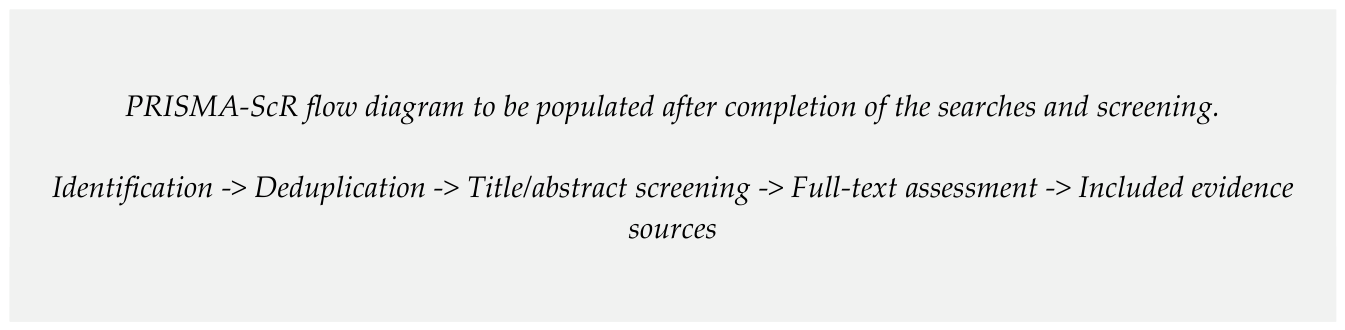
Table 1.
Draft database search strategies.
| Database or source | Search strategy |
| PubMed | ((((((((((((((((((((((((((((((((“Forensic Sciences”[Mesh]) OR (“Forensic Anthropology”[Mesh])) OR (“Forensic Imaging”[Mesh])) OR (“Forensic Microbiology”[Mesh])) OR (“Forensic Genetics”[Mesh])) OR (“Forensic Toxicology”[Mesh])) OR (“Forensic Pathology”[Mesh])) OR (“Forensic Medicine”[Mesh])) OR (“Body Remains”[Mesh])) OR (“Postmortem Imaging”[Mesh])) OR (“DNA Fingerprinting”[Mesh])) OR (“DNA Contamination”[Mesh])) OR (“Biometric Identification”[Mesh])) OR (“Forensic Psychology”[Mesh])) OR (“Forensic Entomology”[Mesh])) OR (“Forensic Psychiatry”[Mesh])) OR (forensic medicine)) OR (legal medicine)) OR (medicolegal)) OR (medico-legal)) OR (forensic pathology)) OR (forensic genetic*)) OR (forensic toxicolog*)) OR (autops*)) OR (postmortem)) OR (post-mortem)) OR (medical examiner*)) OR (coroner*)) OR (death investigation*)) OR (human identification)) OR (disaster victim identification)) OR (“Coroners and Medical Examiners”[MeSH])) OR (“Autopsy”[Mesh]) OR (“Postmortem Imaging”[Mesh]) AND ((((((((((((((((((biobank*) OR (bio-bank*)) OR (“UK Biobank”[Mesh])) OR (“Biological Specimen Banks”[Mesh])) OR (biospecimen bank*)) OR (biospecimen repositor*)) OR (biological repositor*)) OR (specimen repositor*)) OR (sample bank*)) OR (tissue bank*)) OR (tissue archive*)) OR (postmortem biobank*)) OR (autopsy biobank*)) OR (postmortem tissue bank*)) OR (digital repositor*)) OR (imaging repositor*)) OR (pathology repositor*)) OR (whole-slide image repositor*)) |
| Embase | “(‘forensic science’ OR ‘forensic anthropology’ OR ‘forensic imaging’ OR ‘forensic microbiology’ OR ‘forensic genetics’ OR ‘forensic toxicology’ OR ‘forensic pathology’ OR ‘forensic medicine’ OR ‘body remains’ OR ‘postmortem imaging’ OR ‘dna fingerprinting’ OR ‘dna contamination’ OR ‘biometric identification’ OR ‘forensic psychology’ OR ‘forensic entomology’ OR ‘forensic psychiatry’ OR ‘coroner’ OR ‘autopsy’ OR ‘medicolegal aspect’ OR ‘skeleton’) AND (‘biobank’ OR ‘uk biobank’ OR ‘tissue bank’)” |
| Scopus | ( TITLE-ABS-KEY ( “forensic science*” OR “forensic anthropolog*” OR “forensic imag*” OR “forensic microbiolog*” OR “forensic genetic*” OR “forensic toxicolog*” OR “forensic patholog*” OR “forensic medic*” OR “legal medic*” OR medicolegal OR “medico legal” OR “body remain*” OR “human remain*” OR “skeletal remain*” OR “postmortem imag*” OR “post mortem imag*” OR “DNA fingerprint*” OR “DNA profil*” OR “DNA typ*” OR “DNA contaminat*” OR “biometric identif*” OR “forensic psycholog*” OR “forensic entomolog*” OR “forensic psychiatr*” OR autops* OR postmortem OR “post mortem” OR “medical examiner*” OR coroner* OR “death investigat*” OR “human identif*” OR “disaster victim identif*” ) AND TITLE-ABS-KEY ( biobank* OR “bio bank*” OR “UK Biobank” OR “biological specimen bank*” OR “biological substance bank*” OR biorepositor* OR bioresource* OR “biospecimen bank*” OR “biospecimen repositor*” OR “biological repositor*” OR “biological specimen repositor*” OR “specimen repositor*” OR “sample bank*” OR “tissue bank*” OR “tissue repositor*” OR “tissue archiv*” OR “postmortem biobank*” OR “post mortem biobank*” OR “autopsy biobank*” OR “postmortem tissue bank*” OR “post mortem tissue bank*” OR “digital repositor*” OR “imaging repositor*” OR “pathology repositor*” OR “whole slide image repositor*” ) ) |
| CINAHL | ( “forensic science*” OR “forensic anthropolog*” OR “forensic imag*” OR “forensic microbiolog*” OR “forensic genetic*” OR “forensic toxicolog*” OR “forensic patholog*” OR “forensic medic*” OR “legal medic*” OR medicolegal OR “medico legal” OR “body remain*” OR “human remain*” OR “skeletal remain*” OR “postmortem imag*” OR “post mortem imag*” OR “DNA fingerprint*” OR “DNA profil*” OR “DNA typ*” OR “DNA contaminat*” OR “biometric identif*” OR “forensic psycholog*” OR “forensic entomolog*” OR “forensic psychiatr*” OR autops* OR postmortem OR “post mortem” OR “medical examiner*” OR coroner* OR “death investigat*” OR “human identif*” OR “disaster victim identif*” ) AND ( biobank* OR “bio bank*” OR “UK Biobank” OR “biological specimen bank*” OR “biological substance bank*” OR biorepositor* OR bioresource* OR “biospecimen bank*” OR “biospecimen repositor*” OR “biological repositor*” OR “biological specimen repositor*” OR “specimen repositor*” OR “sample bank*” OR “tissue bank*” OR “tissue repositor*” OR “tissue archiv*” OR “postmortem biobank*” OR “post mortem biobank*” OR “autopsy biobank*” OR “postmortem tissue bank*” OR “post mortem tissue bank*” OR “digital repositor*” OR “imaging repositor*” OR “pathology repositor*” OR “whole slide image repositor*” ) |
| PsycINFO | ( “forensic science*” OR “forensic anthropolog*” OR “forensic imag*” OR “forensic microbiolog*” OR “forensic genetic*” OR “forensic toxicolog*” OR “forensic patholog*” OR “forensic medic*” OR “legal medic*” OR medicolegal OR “medico legal” OR “body remain*” OR “human remain*” OR “skeletal remain*” OR “postmortem imag*” OR “post mortem imag*” OR “DNA fingerprint*” OR “DNA profil*” OR “DNA typ*” OR “DNA contaminat*” OR “biometric identif*” OR “forensic psycholog*” OR “forensic entomolog*” OR “forensic psychiatr*” OR autops* OR postmortem OR “post mortem” OR “medical examiner*” OR coroner* OR “death investigat*” OR “human identif*” OR “disaster victim identif*” ) AND ( biobank* OR “bio bank*” OR “UK Biobank” OR “biological specimen bank*” OR “biological substance bank*” OR biorepositor* OR bioresource* OR “biospecimen bank*” OR “biospecimen repositor*” OR “biological repositor*” OR “biological specimen repositor*” OR “specimen repositor*” OR “sample bank*” OR “tissue bank*” OR “tissue repositor*” OR “tissue archiv*” OR “postmortem biobank*” OR “post mortem biobank*” OR “autopsy biobank*” OR “postmortem tissue bank*” OR “post mortem tissue bank*” OR “digital repositor*” OR “imaging repositor*” OR “pathology repositor*” OR “whole slide image repositor*” ) |
Table 2.
Population–Concept–Context framework.
| Element | Scope |
| Population | Human donors, decedents, cases, and biological material or case-derived data represented in eligible resources, without restrictions by age, sex, nationality, or ethnolinguistic group. Living-donor, postmortem, and mixed collections are eligible. |
| Concept | Resource definitions and purposes; establishment; recruitment or acquisition; consent or other authorization; processing; preservation; storage; associated data; governance; quality control; access; applications; and reported challenges. |
| Context | All human forensic disciplines and documented forensic purposes in any country or institutional setting, including research, casework, evidence retention, reference resources, validation, quality assurance, and forensic training. |
Disclaimer/Publisher’s Note: The statements, opinions and data contained in all publications are solely those of the individual author(s) and contributor(s) and not of MDPI and/or the editor(s). MDPI and/or the editor(s) disclaim responsibility for any injury to people or property resulting from any ideas, methods, instructions or products referred to in the content. |
© 2026 by the authors. Licensee MDPI, Basel, Switzerland. This article is an open access article distributed under the terms and conditions of the Creative Commons Attribution (CC BY) license.
Copyright: This open access article is published under a Creative Commons CC BY 4.0 license, which permit the free download, distribution, and reuse, provided that the author and preprint are cited in any reuse.