

Submitted:
07 October 2026
Posted:
09 October 2026
You are already at the latest version
Abstract
Face presentation attacks remain a challenge for face recognition under long stand-off distances, cross-device capture, and partial occlusion. We introduce the MORSE-Face dataset for controlled evaluation under these factors. Collected between January 2025 and February 2026, it includes 250 participants across 283 sessions in indoor and outdoor environments, captured using a DSLR and a smartphone at distances from 1m to 100m. The dataset contains over 15,700 images and 15,700 videos (approximately 1.3TB) with demographic annotations (age, gender, race). It includes live samples, structured occlusions (hair changes, facial obstructions, eyewear), and presentation attacks using 2D artifacts (printed photos, cloth masks) and 3D masks (3D printed and silicone), with conditions recorded both with and without additional props under matched distance and environment. Baseline Rank-1 recognition experiments show near-saturated performance at short range (1--10m) under same-device conditions, with degradation at longer distances and under cross-device scenarios. Indoor and outdoor results show distance-dependent trends, with performance also influenced by environmental conditions, while occlusion introduces distance-dependent degradation across prop categories. A baseline PAD experiment using a ResNet-50 classifier on live, props, and spoof samples shows high separability with minor confusion between live and prop categories. MORSE-Face highlights the gap between short-range evaluation and real-world deployment and supports research in distance-aware recognition, cross-device matching, occlusion sensitivity, and PAD with demographic analysis.
Keywords:
face recognition
; presentation detection attack
; face dataset
; face biometrics
1. Introduction
Face recognition systems are increasingly deployed beyond controlled laboratory environments, where they must operate across varying stand-off distances, heterogeneous acquisition devices, and partial occlusions. These factors introduce measurable performance shifts: accuracy that is stable at short range often degrades with increased distance or cross-device matching. The presence of presentation attacks further complicates evaluation.

Table 1.
Face Datasets with Occlusion/Props Relevant to This Study
| Dataset | Year | Subj. | Imgs | Vids | Env. | Devices | Max-Dist. | Multi-Dist. | Occlusion/Props | Primary Use |
|---|---|---|---|---|---|---|---|---|---|---|
| CelebA-HQ [1] | 2018 | 10K | 30K | 0 | Web | Mixed | Short | No | Pose, accessories | Face synthesis |
| CelebAMask-HQ [2] | 2020 | 10K | 30K | 0 | Web | Mixed / Unknown | Short | No | Facial parts,accessories | Parsing/segmentation |
| F/E/M Face Databases [3,4,5] | 2013–2016 | 1.08K | ~10K | 0 | Indoor | Camera | Short | No | Expression,makeup | Recognition |
| WIDER FACE [6] | 2016 | – | 32.2K | 0 | Unconstrained | Web images | Mixed | Yes | Natural occlusion | Detection |
| MALF [7] | 2015 | – | 5.25K | 0 | Unconstrained | Web images | Mixed | Yes | Nat. occlusion | Detection |
| FDDB [8] | 2010 | – | 2.85K | 0 | Unconstrained | Web images | Mixed | Yes | Nat. occlusion | Detection |
| LFW + AFLW2000 [9,10] | 2015 | 5.7K | ~13K | 2K | Unconstrained | Web images | Short | No | Pose, occlusion | Recognition / Pose |
| FFHQ [11] | 2019 | – | 70K | 0 | Web | Mixed / Unknown | Short | No | Occlusion, accessories | Face generation |
| CelebA [12] | 2015 | 10K | 202K | 0 | Web | Mixed / Unknown | Short | No | Occlusion, accessories | Attributes / recognition |
| CMU Multi-PIE [13] | 2010 | 337 | 750K | 0 | Controlled | Multi-camera | Short | No | Pose, expression | Recognition |
| EasyPortrait [14] | 2024 | 13.7K | 40K | 0 | Indoor | Camera | Short | No | Pose,accessories, partial occ. | Parsing / segmentation |
| FaceOcc [15] | 2022 | – | 32K | 0 | Indoor + Outdoor | Camera | Short | No | Heavy occlusion | Occlusion analysis |
| FRGC [16] | 2005 | 466 | 50K | 0 | Controlled | Camera | Short | No | Expression, illumination | Recognition |
| MORSE-Face (Ours) | 2026 | 250 | 15.7K | 15.7K | Indoor + Outdoor | DSLR + Mobile | 100 m | Yes | Hair/facial/ eyewear occlusions | Recognition / PAD / Demo. Analysis |
Unconstrained face recognition has been studied extensively. Early benchmarks such as Labeled Faces in the Wild (LFW) [17] established evaluation under natural variability, while later datasets including IJB-A [18] and FRVT [19] expanded to more challenging imagery and demographic analysis. However, distance is rarely treated as a primary variable with predefined stand-off points extending to tens of meters.
Presentation attack detection (PAD) has similarly progressed with standardized terminology and evaluation protocols under ISO/IEC 30107 [20]. Public datasets such as CASIA-FASD [21], Replay-Attack [22], OULU-NPU [23], CASIA-SURF [24], and CelebA-Spoof [25] support benchmarking of 2D and 3D attacks, while LivDet-Face provides large-scale evaluation [26]. However, most datasets are collected at short distances under controlled indoor conditions, with limited emphasis on cross-device variability and long-range acquisition. Operational deployments such as surveillance, transportation hubs, and perimeter monitoring often require recognition at 50–100 m. At these distances, reduced resolution, motion blur, and environmental variability degrade image quality, while cross-device matching introduces sensor-domain shifts. These challenges motivate datasets that explicitly structure distance, device heterogeneity, and attack conditions.
The MORSE-Face dataset, introduced in this work, addresses this gap. It includes 250 subjects across 283 sessions in indoor and outdoor environments, using a DSLR and a smartphone. Data are captured at fixed distances of 1 m, 10 m, 50 m, 75 m, and 100 m. The dataset contains both images and videos under three presentation categories: live, live with props, and spoof. Props introduce controlled occlusions (hair changes, facial obstructions, eyewear), while spoof conditions include 2D attacks (printed photographs, cloth masks) and 3D attacks (3D printed and silicone masks). Several configurations are recorded with and without props, enabling analysis of interactions between occlusion, attack type, distance, and device, as illustrated in Figure 1. MORSE-Face also provides demographic metadata (age, gender, race), enabling subgroup analysis, bias evaluation, and attribute prediction alongside recognition and PAD tasks. In addition to the Rank-1 recognition baseline, we provide a preliminary PAD baseline using a ResNet-50 classifier to distinguish live, props, and spoof samples. The main contributions of this work are summarized as follows:
Multi-distance benchmark: Fixed stand-off distances (1–100 m) for controlled evaluation.
Multi-session, multi-environment: 283 sessions across indoor and outdoor settings with overlapping subjects.
Cross-device acquisition: DSLR and smartphone data enabling sensor-domain analysis.
Integrated presentation conditions: Unified live, occlusion, 2D, and 3D attack scenarios with baseline PAD validation.
Image and video data: Supports both frame-level (static) and temporal modeling.
Demographic metadata: Age, gender, and race annotations for subgroup analysis.
Table 2.
Comparative Overview of PAD-Focused Face Datasets Including MORSE-Face
| Dataset | Year | Subj. | Imgs | Vids | Env. | Devices | Max Dist. | Multi-Dist. | Occlusion / Props | Spoof Types |
|---|---|---|---|---|---|---|---|---|---|---|
| NUAA [27] | 2010 | 15 | 9.1K | 0 | Indoor | Camera | Short | No | No | |
| Replay-Attack [22] | 2012 | 50 | 0 | 1.3K | Indoor | Webcam | Short | No | No | Print, replay |
| PADISI-Face Dataset [28,29] | 2022 | – | – | – | Indoor | Color + multispectral | Short | No | No | Print, replay, mask |
| HQ-WMCA Dataset [30] | 2021 | 51 | – | 2.9K | Indoor | Color+Depth+Thermal +NIR+SWIR | Short | No | No | Print, replay, mask, partial |
| SiW [31] | 2018 | 165 | – | 4.4K | Indoor | RGB camera | Short | No | No | Print, replay |
| OULU-NPU [23] | 2017 | 55 | – | 4.9K | Indoor | mobile devices | Short | No | No | Print, video replay |
| iBeta Dataset [32] | 2024 | – | – | 5K+ | Indoor | iOS + Android | Short | No | No | 3D resin mask |
| MSU-MFSD [33] | 2015 | 35 | – | 440 | Indoor | Mobile + laptop | Short | No | No | Print, video replay |
| CASIA-SURF[24] | 2019 | 1K | – | 21K | Indoor | RGB + Depth + IR | Short | No | No | |
| HKBU-MARs [34] | 2016–2018 | 12–16 | – | 120–1008 | Indoor | Webcam + mobile | Short | No | No | 3D masks |
| Silicone Mask PAD Dataset [35] | 2024 | – | – | ~10K | Indoor + Outdoor | Multi-device camera | Short | No | Hair, glasses, wigs, beards | 3D silicone mask |
| 3D R M Dataset [36] | 2023 | 5 | – | ~2K | Indoor | Camera | Short | No | No | 3D resin mask |
| WMCA (Wide Multi-Channel Attack) [37] | 2020 | 72 | – | 2.0K | Indoor | RGB + Depth + NIR + Thermal | Short | No | Eyeglasses, obfuscation | Print, replay, mannequin, paper, silicone, rigid, transparent |
| HQ-WMCA (High-Quality Wide Multi-Channel Attack) [38] | 2021 | 51 | – | 2.9K | Indoor | RGB + Depth + Thermal + NIR + SWIR | 0.5–0.6 m | No | No | Print, replay, silicone, rigid, paper, mannequin, transparent |
| CSMAD [39] | 2017 | 14 | 17 | 246 | Indoor | Multi-sensor | Short | No | No | 3D silicone mask |
| CASIA-FASD [21] | 2012 | 50 | 0 | 600 | Indoor | Camera | Short | No | No | Print, replay |
| CelebA-Spoof [25] | 2020 | 10.1K | 625K | 0 | Indoor + In-the-wild | Camera | Short | No | No | Print, replay |
| MORSE-Face (Ours) | 2026 | 250 | 15.7K | 15.7K | Indoor + Outdoor | DSLR + Mobile | 100 m | Yes | Hair/facial/ eyewear occlusions | 2D (Print/Cloth), 3D (Rigid/Silicone) |
2. Related Work
Face recognition and presentation attack detection (PAD) have been widely studied using datasets collected in controlled or web-based settings. While these datasets have advanced algorithm development, many do not reflect operational conditions involving long stand-off distances, cross-device capture, structured occlusion, and diverse spoof types, which are often treated as secondary rather than core factors. Since MORSE-Face integrates these dimensions within a unified protocol, prior work is reviewed with emphasis on them.
2.1. Face and Occlusion Datasets
Many datasets support recognition, verification, detection, parsing, and anti-spoofing. Large-scale web-collected datasets such as MS-Celeb-1M [40], YFD [41], WIDER FACE [6], UMDFaces [42], LFW [17], and CelebA [12] are widely used for recognition and attribution. LFW contains 13,233 images of 5,749 individuals at 250×250 resolution, while YFD [41] includes 3,425 videos from 1,595 subjects; however, neither captures long-range conditions. Other large-scale datasets, including CASIA-WebFace [43], CelebFaces [12], MS-Celeb-1M [40], and FFHQ [11], provide scale and high-quality imagery but are not designed for distance-aware evaluation. MobileFaces [44] introduces limited distance variation (2–10 m) with 1,914 images from 87 subjects, which remains insufficient for long-range analysis. FRGC [16] includes 50,000 recordings for high-resolution and 3D recognition but is not publicly available.
Datasets focusing on occlusion and segmentation provide additional variation but lack distance structure. EasyPortrait [14] includes real-world variations such as accessories, pose, and partial occlusions, while FaceOcc [15] and CelebAMask-HQ [2] (derived from CelebA-HQ [1]) provide annotated occlusions including facial masks, glasses, and synthetic occlusion regions. Although these improve robustness to occlusion, they do not support multi-distance or cross-device analysis. In contrast, MORSE-Face integrates controlled multi-distance acquisition (1–100 m), cross-device capture (DSLR and mobile), and structured occlusion categories (hair alterations, facial obstructions, and eyewear) within a unified framework (Table 1).
2.2. Presentation Attack Detection Datasets
Face anti-spoofing aims to distinguish genuine from fake presentations, motivating dedicated PAD datasets. CelebA-Spoof [25] contains 625,537 images from 10,777 subjects with print, replay, and 3D attacks across indoor and outdoor settings. CASIA-SURF [24] includes 1,000 subjects and 21,000 videos with multi-modal data, while CASIA-FASD [21] provides 600 videos from 50 subjects. OULU-NPU [23] contains 5,940 videos from 55 subjects under varying illumination and devices, and Replay-Attack [22] includes 1,300 attack videos under different lighting conditions. LivDet-Face [26] provides standardized evaluation but does not incorporate multi-distance or cross-device acquisition.
Additional datasets include iBeta (1,500 subjects, 3,000 replay attacks) and MSU-MFSD [33] (55 subjects) for cross-device and illumination studies. Advanced datasets such as WMCA [37] (1,941 videos, 72 subjects) and HQ-WMCA [38] (2,904 videos, 51 subjects) incorporate multi-channel sensing. PADISI-Face [28] includes 360 subjects and 2,029 captures with nine attack types, while HKBU-MARs [34] focuses on realistic 3D mask attacks. Despite these advances, most datasets remain limited to short-range and controlled settings. In contrast, MORSE-Face introduces long-range acquisition (up to 100 m), cross-device capture, and combined occlusion and spoof conditions within a unified protocol, enabling more realistic PAD evaluation (Table 2).
3. MORSE-Face Dataset
3.1. Overview
MORSE-Face is a structured dataset designed for controlled analysis of acquisition conditions. Data were collected at Clarkson University from January 2025 to February 2026 and include 250 participants across 283 sessions. Many subjects appear in multiple sessions, with a subset recorded in both indoor and outdoor environments, enabling analysis of intra-subject variation under changing lighting and background. Indoor sessions used controlled illumination, while outdoor sessions introduced natural variability.
Two devices were used consistently: a DSLR camera and a smartphone, enabling cross-device analysis. Distance was treated as a primary variable, with captures at 1 m, 10 m, 50 m, 75 m, and 100 m, collected for each subject and device when feasible.
The dataset contains over 15,700 images and 15,700 videos (approximately 1.3 TB). Images support recognition and frame-level PAD, while videos enable temporal analysis. Presentation conditions include live, live with props (hair changes, facial obstructions, eyewear), and spoof (2D: printed photos, cloth masks; 3D: printed and silicone masks), with some spoof conditions captured both with and without props to enable combined analysis across distance and device.
Metadata (age, gender, race) support subgroup and demographic analysis. Data are organized hierarchically by subject, session, device, distance, and presentation type, enabling reproducible protocol design. MORSE-Face is published on IEEE DataPort [45] (DOI: 10.21227/pw2z-ya50). Access to the dataset is controlled, and researchers may obtain access, including sample data, upon reasonable request for research purposes.
3.2. Data Collection Procedure
Data collection was conducted at Clarkson University between 2025 and 2026 with participants recruited from the Clarkson University community. All data were collected under institutional ethical guidelines with IRB approval (Approval No.: 25-01.3), and written informed consent was obtained from all participants.
Most subjects participated in either indoor or outdoor sessions, while 33 contributed to both, enabling cross-environment evaluation without added inter-subject variability [18]. Indoor sessions used controlled lighting, whereas outdoor sessions introduced natural variation. Subjects stood at fixed positions with distances measured using a tape, starting at 1 m and proceeding sequentially.
Data were captured using a Canon EOS 90D DSLR and a Samsung Galaxy S24 Ultra smartphone, supporting cross-device analysis [46]. Both images and short videos were recorded; during video capture, subjects performed slight head movement to introduce motion cues relevant for PAD [21]. All presentation types (live, props, spoof) were recorded, with indoor sessions covering up to 75 m and outdoor sessions extending to 100 m.
Data were organized hierarchically with structured filenames encoding subject, session, device, distance, and condition. Metadata (age, gender, race) were compiled to support subgroup analysis [46]. The dataset was collected, stored, and processed following standard privacy and data protection practices, and is shared in a controlled manner to support reproducibility while maintaining participant confidentiality.
3.3. Demographic Characteristics of Subjects
The dataset includes 250 participants with demographic attributes recorded under informed consent. Gender distribution is 58.4% male and 41.6% female. Age distribution includes 151 subjects (18–30), 74 (31–40), 11 (41–50), 4 (51–60), and 10 (60+). Racial composition includes Asian (42.0%), Black (27.7%), White (20.9%), Middle Eastern (4.4%), Hispanic or Latino (3.8%), Mixed (0.8%), and American Indian (0.4%). Approximately 67% of participants did not wear eyewear, while others varied across conditions, supporting occlusion analysis. These annotations enable subgroup evaluation beyond aggregate performance.
4. Baseline Experiments: Recognition and PAD Protocols
4.1. Baseline Recognition Pipeline and Experimental Design
To establish baseline performance characteristics of MORSE-Face under controlled variations, we implemented a face recognition evaluation pipeline based on deep face embeddings and nearest-neighbor identification. The evaluation is reported using Rank-1 identification accuracy, a standard metric in face recognition benchmarks [18,19].
In addition to recognition evaluation, a complementary baseline PAD experiment is conducted to assess the separability of live, prop, and spoof presentations under the same dataset conditions.
4.1.1. Model and Feature Representation
Face representations were computed using the FaceAnalysis module from the InsightFace toolkit [47], with the pretrained buffalo_l model package. For each input image, the pipeline detects faces, selects a single face instance for embedding extraction, and produces a fixed-length feature vector. Similarity between two faces is computed using cosine similarity in the embedding space, which is a common choice for deep face recognition systems and closely related to the angular-margin training objectives used in modern recognition models [48]. Because some images may contain multiple detected faces (e.g., background bystanders in outdoor captures), we apply a deterministic selection rule: among all detected faces, we choose the instance with the largest bounding-box area and extract its embedding. This rule is simple, reproducible, and consistent with the intended capture protocol where the subject is expected to be the dominant face in the frame.
4.1.2. Implementation Details
All processing was performed using Python with the following key dependencies: InsightFace (v0.7.3), ONNX Runtime (v1.16.3), OpenCV, NumPy, Pandas, and Matplotlib. Inference was executed either on CPU or GPU depending on availability of the appropriate ONNX Runtime backend [49]. All embeddings were stored as single-precision floating point vectors. Prior to similarity computation, embeddings were -normalized to ensure cosine similarity is well-defined and scale-invariant. During preprocessing, each filename was parsed to recover structured attributes (subject identifier, environment/session, device, distance, and presentation category), enabling protocol construction directly from the dataset organization. Images that failed to load or for which no face was detected were treated as failed recognition attempts (i.e., counted as errors) in the evaluation. All such cases were logged to ensure transparency and reproducibility.
4.1.3. Matching Rule and Rank-1 Decision
Let denote a probe embedding and denote a gallery embedding. Cosine similarity is computed as:
where embeddings are -normalized in practice. For each probe, the system identifies the gallery subject associated with the maximum similarity score across all gallery entries. The prediction is correct if the predicted subject identifier matches the probe subject identifier. Rank-1 accuracy is then computed as the fraction of probes correctly identified under this rule [18,19].
4.2. Experimental Protocols
Using fixed enrollment, probe sets were varied to evaluate distance, device, occlusion, and environmental effects using Rank-1 accuracy.
4.2.1. Fixed Enrollment Setting
Unless otherwise specified, enrollment (gallery) is fixed to a single live image captured at 1 m using the DSLR camera. One gallery image per subject is selected deterministically. This fixed enrollment serves as a stable reference across all evaluations.
4.2.2. Protocol 1: Live-Only Distance Evaluation
This protocol evaluates how recognition accuracy changes with capture distance using only live probe images. Probes include live images from both DSLR (camera) and mobile devices, grouped by capture distance. Evaluations are performed under different session scopes: indoor (probes drawn from indoor live images only), outdoor (probes drawn from outdoor live images only). Accuracy is reported at available probe distances (1 m, 10 m, 50 m, 75 m, 100 m), depending on session coverage. This protocol isolates the effect of stand-off distance in mixed-device probe conditions.
4.2.3. Protocol 2: Occlusion (Props) Impact Evaluation
This protocol measures how prop-based occlusions affect recognition under increasing distance. The enrollment remains fixed (1 m live DSLR). Probes include live images and Props-1, Props-2, and Props-3. Results are reported separately by prop category, probe distance, probe device (DSLR vs. mobile), and session scope (indoor/outdoor). This protocol isolates the interaction between occlusion severity and capture distance under same- and cross-device probing.
4.2.4. Protocol 3: Device Resolution Analysis
To examine device-driven quality differences, recognition performance is compared between high-resolution DSLR probes (Canon EOS 90D: 6960×4640, fixed focal length 55 mm) and lower-resolution mobile probes (Samsung Galaxy S24 Ultra: 3000×4000, 3× zoom for images and 2× zoom for video). Enrollment remains fixed to 1 m live DSLR. Probes are restricted to indoor live images to control environmental variation. Accuracy is evaluated across distances to isolate the effect of spatial resolution, optical zoom, and sensor characteristics (e.g., optics and focal length) on long-range recognition performance.
4.2.5. Protocol 4: Cross-Environment Matching
This protocol evaluates generalization across environments by swapping the session used for enrollment and probing.
Two directions are tested:
Indoor enrollment → Outdoor probes
Outdoor enrollment → Indoor probes
Enrollment uses a 1 m live DSLR image from the source environment, while probes consist of live images from the target environment across available distances and devices. This protocol measures performance degradation caused by environmental domain shift.
4.2.6. Protocol 5: Baseline PAD Evaluation
To complement the recognition experiments, a baseline PAD evaluation is conducted to distinguish between live, prop, and spoof presentations. A ResNet-50 classifier [50] is trained on face images preprocessed using RetinaFace for face cropping.
The dataset is split into subject-disjoint training and testing sets (13,049 training images and approximately 700 testing images) to ensure identity-independent evaluation. The model is trained using standard data augmentation techniques, including random cropping, horizontal flipping, color jittering, and Gaussian blur, and optimized using cross-entropy loss.
Evaluation is performed using classification accuracy and confusion matrix analysis. This protocol provides an initial assessment of presentation attack detectability under varying occlusion and spoof conditions within MORSE-Face.
5. Baseline Experiments: Results and Analysis
Unless otherwise stated, results use Rank-1 identification accuracy with fixed 1 m live DSLR enrollment.
5.1. Indoor: Live Recognition vs. Distance
We evaluate indoor recognition using a 1 m live DSLR enrollment image per subject () and probing with all indoor live images (DSLR + mobile) across distances. As shown in Figure 2, recognition is saturated at short range and degrades at longer distances: Rank-1 is at 1 m and 10 m, decreases to at 50 m, and drops to at 75 m.
This decline is primarily driven by lower-resolution mobile probes (Table 4). DSLR probes maintain accuracy across 1–75 m, whereas mobile probes drop from at 50 m to at 75 m.
5.2. Indoor: Live vs. Props (Occlusion) Across Distance
We compare indoor live and prop categories (Props-1/2/3) under the same 1 m live DSLR enrollment (Figure 2).
For DSLR probes, performance remains across 1–75 m for both live and prop categories (Table 4), indicating minimal impact of occlusion under same-device conditions.
For mobile probes, performance degrades significantly with distance. At 50 m, Rank-1 decreases from (live) to (Props-1), (Props-2), and (Props-3). At 75 m, performance drops further to , , and , compared to for live. This indicates that occlusion effects become significant at longer distances, especially under cross-device conditions.
Table 3.
Rank-1 (%) for live images across gallery/probe device and distance. “–” = unavailable.
| Sc. | Gal. | Dist. | Probe DSLR | Probe Mobile | ||||||||
| 1m | 10m | 50m | 75m | 100m | 1m | 10m | 50m | 75m | 100m | |||
| In | DSLR | 1m | 100 | 100 | 100 | 100 | – | 100 | 100 | 92.31 | 32.17 | – |
| 10m | 100 | 100 | 100 | 100 | – | 100 | 100 | 92.44 | 32.48 | – | ||
| 50m | 100 | 100 | 100 | 100 | – | 100 | 100 | 95.08 | 34.17 | – | ||
| 75m | 100 | 100 | 100 | 100 | – | 100 | 100 | 91.80 | 45.00 | – | ||
| Mob. | 1m | 100 | 100 | 100 | 100 | – | 100 | 100 | 91.23 | 33.04 | – | |
| 10m | 100 | 100 | 100 | 100 | – | 100 | 100 | 92.44 | 33.33 | – | ||
| 50m | 88.03 | 92.44 | 94.26 | 93.44 | – | 91.23 | 91.60 | 100 | 30.00 | – | ||
| 75m | 35.65 | 39.31 | 35.00 | 42.50 | – | 33.93 | 35.04 | 37.50 | 100 | – | ||
| Out | DSLR | 1m | 100 | 100 | 100 | – | 100 | 100 | 100 | 100 | – | 81.94 |
| 10m | 100 | 100 | 100 | – | 100 | 100 | 100 | 100 | – | 85.16 | ||
| 50m | 100 | 100 | 100 | – | 100 | 100 | 100 | 100 | – | 84.62 | ||
| 100m | 100 | 100 | 100 | – | 100 | 100 | 100 | 100 | – | 87.82 | ||
| Mob. | 1m | 100 | 100 | 100 | – | 100 | 100 | 100 | 100 | – | 81.17 | |
| 10m | 100 | 100 | 100 | – | 100 | 100 | 100 | 100 | – | 87.74 | ||
| 50m | 100 | 100 | 100 | – | 100 | 100 | 100 | 100 | – | 87.82 | ||
| 100m | 85.81 | 89.03 | 87.82 | – | 93.59 | 86.36 | 89.03 | 91.67 | – | 100 | ||
5.3. Outdoor: Live Recognition vs. Distance
Outdoor recognition is evaluated using a 1 m live DSLR enrollment () and probing with all outdoor live images. Figure 3 shows a flatter trend than indoor, with Rank-1 at for 1–50 m and at 100 m.
DSLR probes maintain accuracy across all distances (Table 4), while the reduction at 100 m is driven by mobile probes, which achieve .
5.4. Outdoor: Live vs. Props (Occlusion) Across Distance
Figure 3 compares outdoor live and prop conditions under 1 m live DSLR enrollment.
For DSLR probes, performance remains near-saturated: at 1–50 m and – at 100 m (Table 4).
For mobile probes at 100 m, occlusion has a strong impact. Live accuracy is , while Props-1 drops to , Props-2 to , and Props-3 to . This suggests that at extended outdoor ranges, the combination of lower resolution (mobile) and occlusion is more damaging than distance alone.
Table 4.
Prop impact on Rank-1 (%) with 1 m DSLR enrollment. “–” = unavailable.
| Scope | Cond | DSLR | Mobile | ||||||||
| 1m | 10m | 50m | 75m | 100m | 1m | 10m | 50m | 75m | 100m | ||
| In | Live | 100 | 100 | 100 | 100 | – | 100 | 100 | 92.31 | 32.17 | – |
| P1 | 100 | 100 | 100 | 100 | – | 100 | 100 | 76.92 | 13.79 | – | |
| P2 | 100 | 100 | 100 | 100 | – | 100 | 98.29 | 64.66 | 15.24 | – | |
| P3 | 100 | 100 | 100 | 100 | – | 100 | 100 | 75.00 | 17.27 | – | |
| Out | Live | 100 | 100 | 100 | – | 100 | 100 | 100 | 100 | – | 81.94 |
| P1 | 100 | 100 | 100 | – | 99.35 | 100 | 100 | 98.73 | – | 37.09 | |
| P2 | 100 | 100 | 100 | – | 99.35 | 100 | 100 | 93.67 | – | 55.24 | |
| P3 | 100 | 100 | 100 | – | 100 | 100 | 100 | 98.72 | – | 58.67 | |
5.5. High-Resolution vs. Low-Resolution Probes (Indoor Example)
To isolate the device-driven resolution effect, we compare indoor probing with DSLR (high-resolution) versus mobile (lower effective facial detail at distance) under the same 1 m live DSLR enrollment. Figure 4 shows a clean separation: DSLR probes remain at across 1–75 m, while mobile probes drop from (1 m and 10 m) to (50 m) and then to (75 m). This aligns with the device-specific live results in Table 4 and supports the interpretation that long-range failures in mixed-device settings are primarily driven by low-resolution mobile probes.
5.6. Cross-Environment Matching
We evaluate cross-environment generalization by swapping enrollment and probe environments (Figure 5). Indoor → outdoor yields at 1–50 m and at 100 m. Outdoor → indoor yields at 1 m and 10 m, at 50 m, and at 75 m. The stronger outdoor performance may be attributed to more favorable lighting conditions, which can improve facial visibility. The larger drop at indoor 75 m aligns with earlier results, where long-range indoor performance is more sensitive to mobile probes and environmental variability.
Table 3 summarizes the main distance trends from Figure 2 and Figure 3 when using 1 m live DSLR enrollment and probing with all live images in the corresponding session scope. Table 4 reports the full prop-wise Rank-1 breakdown by session, probe device, and distance (with the enrollment fixed to 1 m live DSLR).
5.7. Baseline PAD Experiment (Live, Props, Spoof)
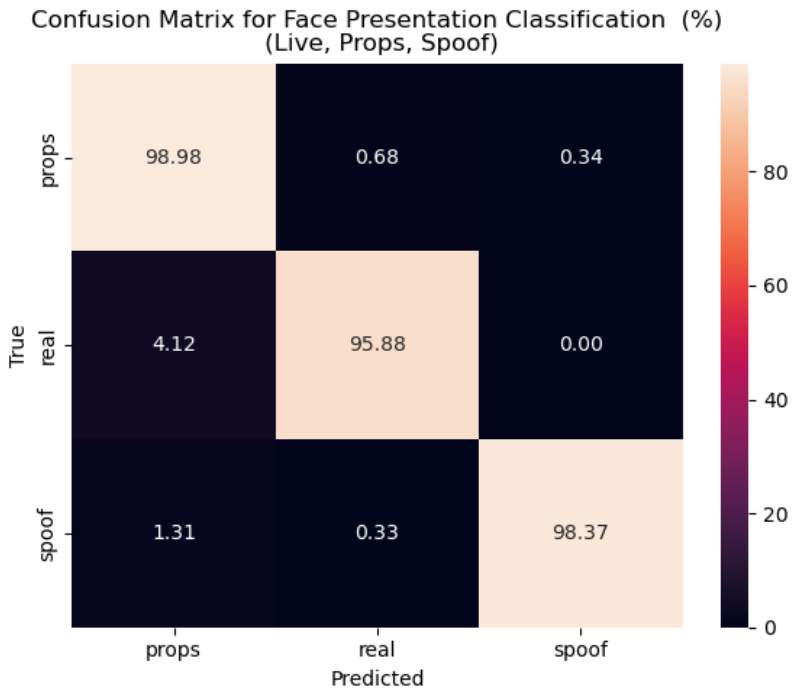
To demonstrate PAD capability, we conducted a baseline classification experiment using live, props, and spoof samples. Face regions were extracted with RetinaFace [51] using our publicly available preprocessing implementation [52], and a ResNet-50 [50] model pretrained on ImageNet was fine-tuned for three-class classification. The model was trained on 13,049 images and evaluated on a subject-disjoint test set of approximately 700 images. Figure 6 shows that the model achieves accuracy for live, for props, and for spoof samples. Most errors occur between live and props, while spoof samples remain highly distinguishable. These results indicate that MORSE-Face supports PAD analysis with diverse attack types, while more detailed evaluation across distance and device is left for future work.
6. Discussion
The experimental results show how recognition performance varies with distance, device, presentation condition, and environment. Distance and device characteristics are key factors: performance is saturated at short range (1–10 m) but degrades beyond mid-range, with the largest drops at long distances, consistent with prior findings on resolution and facial scale effects [19,53]. Device heterogeneity introduces additional differences due to resolution disparity, with higher-resolution DSLR probes maintaining stable performance at longer distances, while lower-resolution mobile probes degrade, and the gap widening with distance, reflecting sensor and optics limitations [54]. Presentation conditions further affect robustness: prop-based occlusions cause gradual, type-dependent degradation in recognition accuracy, whereas spoof conditions are evaluated separately through the PAD experiment as distinct presentation attack classes rather than factors affecting recognition accuracy, consistent with prior PAD studies [55,56]. Environmental variation introduces additional complexity, as cross-environment matching shows asymmetric generalization due to differences in illumination, background, and long-range acquisition conditions [17,57]. While MORSE-Face enables controlled multi-factor analysis, several extensions could strengthen future work: increased spoof diversity and scale, including additional attack types and higher sample counts, would improve realism and PAD evaluation [25,56]; more fine-grained distance and focal variations would support continuous modeling of resolution effects; improved demographic balance would enhance fairness analysis [58]; and extending the acquisition protocol to include profile and side-view images would enable complementary ear biometric analysis, including ear segmentation and recognition [59,60]. Overall, MORSE-Face provides a unified framework for studying distance-aware recognition, cross-device performance, occlusion robustness, and integrated recognition–PAD evaluation, with potential for further impact through expanded coverage and diversity.
7. Conclusion
This work introduced MORSE-Face, a multi-session dataset for controlled face recognition and PAD evaluation across distance, device, presentation condition, and environment. Baseline results show strong short-range recognition with degradation at extended distances, particularly for lower-resolution mobile probes. Presentation conditions influence robustness differently, with prop-based occlusions causing gradual performance decline, while spoof artifacts are evaluated separately through the PAD experiment as distinct presentation attack classes, and cross-environment matching reveals limited generalization due to domain variation. These findings highlight the need for distance-aware evaluation, cross-sensor robustness, and realistic presentation conditions in face recognition assessment. MORSE-Face provides a unified framework through structured acquisition and rich metadata supporting demographic and bias studies, with future work focusing on expanding spoof diversity, increasing subject scale, improving demographic balance, and extending longitudinal coverage to further enhance its value for recognition, PAD, fairness analysis, and real-world benchmarking.
Acknowledgments
This work was supported in part by the United States Air Force (USAF) under Grant FA864924P0022, with additional funding from the Center for Advanced Materials Processing (CAMP).
References
- Karras, T.; Aila, T.; Laine, S.; Lehtinen, J. Progressive Growing of GANs for Improved Quality, Stability, and Variation. In Proceedings of the International Conference on Learning Representations (ICLR), 2018.
- Lee, C.H.; Liu, Z.; Wu, L.; Luo, P. MaskGAN: Towards Diverse and Interactive Facial Image Manipulation. In Proceedings of the IEEE Conference on Computer Vision and Pattern Recognition (CVPR), 2020.
- Rujirakul, K.; So-In, C.; Arnonkijpanich, B. PEM-PCA: A Parallel Expectation-Maximization PCA Face Recognition Architecture. The Scientific World Journal 2014, 2014, 1–16.
- Rujirakul, K.; So-In, C.; Arnonkijpanich, B.; Sunat, K.; Pualsanguan, S. PFP-PCA: Parallel Fixed Point PCA Face Recognition. In Proceedings of the International Conference on Intelligent Systems, Modelling and Simulation (ISMS), 2013, pp. 409–414.
- So-In, C.; Rujirakul, K. wPFP-PCA: Weighted Parallel Fixed Point PCA Face Recognition. International Arab Journal of Information Technology 2016, 13.
- Yang, S.; Luo, P.; Loy, C.C.; Tang, X. WIDER FACE: A Face Detection Benchmark. In Proceedings of the IEEE Conference on Computer Vision and Pattern Recognition (CVPR), 2016.
- Yang, B.; Yan, J.; Lei, Z.; Li, S.Z. Fine-grained Evaluation on Face Detection in the Wild. In Proceedings of the Automatic Face and Gesture Recognition (FG), 11th IEEE International Conference on. IEEE, 2015.
- Jain, V.; Learned-Miller, E. FDDB: A Benchmark for Face Detection in Unconstrained Settings. In Proceedings of the Technical Report, University of Massachusetts Amherst, 2010.
- Hassner, T.; Harel, S.; Paz, E.; Enbar, R. Effective face frontalization in unconstrained images. In Proceedings of the Proceedings of the IEEE Conference on Computer Vision and Pattern Recognition (CVPR), 2015, pp. 4295–4304.
- Zhu, X.; Lei, Z.; Yan, J.; Yi, D.; Li, S.Z. High-fidelity pose and expression normalization for face recognition in the wild. In Proceedings of the Proceedings of the IEEE Conference on Computer Vision and Pattern Recognition (CVPR), 2015, pp. 787–796.
- Karras, T.; Laine, S.; Aittala, M.; Hellsten, J.; Lehtinen, J.; Aila, T. Flickr-Faces-HQ Dataset (FFHQ). https://github.com/NVlabs/ffhq-dataset, 2019. NVIDIA Research.
- Liu, Z.; Luo, P.; Wang, X.; Tang, X. Deep Learning Face Attributes in the Wild. In Proceedings of the Proceedings of the IEEE International Conference on Computer Vision (ICCV), 2015.
- Gross, R.; Matthews, I.; Cohn, J.F.; Kanade, T.; Baker, S. Multi-PIE. Image and Vision Computing 2010, 28, 807–813.
- Kvanchiani, K.; Petrova, E.; Efremyan, K.; Sautin, A.; Kapitanov, A. EasyPortrait – Face Parsing and Portrait Segmentation Dataset, 2024, [arXiv:cs.CV/2304.13509].
- Yin, X.; Chen, L. FaceOcc: A Diverse, High-quality Face Occlusion Dataset for Human Face Extraction, 2022, [arXiv:cs.CV/2201.08425].
- Phillips, P.J.; Flynn, P.J.; Scruggs, T.; Bowyer, K.W.; Chang, J.; Hoffman, K.; Marques, J.; Min, J.; Worek, W. Overview of the Face Recognition Grand Challenge. In Proceedings of the Proceedings of the IEEE Computer Society Conference on Computer Vision and Pattern Recognition (CVPR), 2005, pp. 947–954.
- Huang, G.B.; Ramesh, M.; Berg, T.; Learned-Miller, E. Labeled Faces in the Wild: A Database for Studying Face Recognition in Unconstrained Environments. Technical report, University of Massachusetts, Amherst, 2007.
- Klare, B.F.; Klein, B.; Taborsky, E.; Blanton, A.; Cheney, J.; Allen, K.; Grother, P.; Mah, A.; Jain, A.K. Pushing the Frontiers of Unconstrained Face Detection and Recognition: IARPA Janus Benchmark A. In Proceedings of the CVPR, 2015.
- Grother, P.; Ngan, M.; Hanaoka, K. Face Recognition Vendor Test (FRVT). Technical report, NIST, 2018.
- ISO/IEC 30107-1:2016 Information Technology – Biometric Presentation Attack Detection, International Organization for Standardization Std., 2016.
- Zhang, Z.; Yan, J.; Liu, S.; Lei, Z.; Yi, D.; Li, S.Z. A Face Antispoofing Database with Diverse Attacks. In Proceedings of the ICB, 2012.
- Chingovska, I.; Anjos, A.; Marcel, S. The Replay-Attack Database. In Proceedings of the BIOSIG, 2012.
- Boulkenafet, Z.; Komulainen, J.; Li, L.; Feng, X.; Hadid, A. OULU-NPU: A Mobile Face Presentation Attack Database with Real-World Variations. In Proceedings of the 12th IEEE International Conference on Automatic Face Gesture Recognition (FG 2017), 2017, pp. 612–618. [CrossRef]
- Zhang, S.; Liu, A.; Wan, J.; Liang, Y.; Guo, G.; Escalera, S.; Escalante, H.J.; Li, S.Z. CASIA-SURF: A Large-scale Multi-modal Benchmark for Face Anti-spoofing. In Proceedings of the IEEE Conference on Computer Vision and Pattern Recognition Workshops (CVPRW), 2019, pp. 1–9.
- Zhang, Y.; Yin, Z.; Li, D.; Liu, Y.; Liu, X. CelebA-Spoof: Large-Scale Face Anti-Spoofing Dataset with Rich Annotations. In Proceedings of the CVPR, 2020.
- Igene, L.; Hossain, A.; Uddin Chowdhury, M.Z.; Rezaie, H.; Rollins, A.; Dykes, J.; Vijaykumar, R.; Komaty, A.; Marcel, S.; Schuckers, S.; et al. Face Liveness Detection Competition (LivDet-Face) - 2024. In Proceedings of the 2024 IEEE International Joint Conference on Biometrics (IJCB), 2024, pp. 1–9. [CrossRef]
- Tan, X.; Li, Y.; Liu, J.; Jiang, L. Face Liveness Detection from a Single Image with Sparse Low Rank Bilinear Discriminative Model. In Proceedings of the Proceedings of the 11th European Conference on Computer Vision (ECCV), Crete, Greece, September 2010.
- Rostami, M.; Spinoulas, L.; Hussein, M.; Mathai, J.; Abd-Almageed, W. Detection and Continual Learning of Novel Face Presentation Attacks. In Proceedings of the Proceedings of the IEEE/CVF International Conference on Computer Vision (ICCV), October 2021, pp. 14851–14860.
- Spinoulas, L.; Hussein, M.E.; Geissbühler, D.; Mathai, J.; Almeida, O.G.; Clivaz, G.; Marcel, S.; AbdAlmageed, W. Multispectral Biometrics System Framework: Application to Presentation Attack Detection. IEEE Sensors Journal 2021, 21, 15022–15041. [CrossRef]
- Heusch, G.; George, A.; Geissbühler, D.; Mostaani, Z.; Marcel, S. Deep Models and Shortwave Infrared Information to Detect Face Presentation Attacks. IEEE Transactions on Biometrics, Behavior, and Identity Science 2020.
- Liu, Y.; Jourabloo, A.; Liu, X. Learning Deep Models for Face Anti-Spoofing: Binary or Auxiliary Supervision. In Proceedings of the Proceedings of the IEEE Conference on Computer Vision and Pattern Recognition (CVPR), 2018.
- iBeta Quality Assurance. iBeta Level 3 High-Fidelity Resin Mask Anti-Spoofing Dataset. https://www.ibeta.com, 2024. Commercial face presentation attack detection dataset with 5,000+ high-fidelity 3D mask attack videos under active liveness prompts.
- Wen, D.; Han, H.; Jain, A.K. Face Spoof Detection With Image Distortion Analysis. IEEE Transactions on Information Forensics and Security 2015, 10, 746–761. [CrossRef]
- Liu, S.Q.; Lan, X.; Yuen, P.C. Multi-Channel Remote Photoplethysmography Correspondence Feature for 3D Mask Face Presentation Attack Detection. IEEE Transactions on Information Forensics and Security 2021, 16, 2683–2696. [CrossRef]
- Axon Lab. Silicone Mask Biometric Attack Dataset. https://axonlab.ai/dataset/silicone-mask-attack-data/, 2024. Accessed: 2026-03-07.
- AxonLab. 3D Resin Mask Dataset for Liveness Detection. https://axonlab.ai/dataset/high-fidelity-3d-resin-mask/, 2023. Accessed: 2026-03-07.
- George, A.; Mostaani, Z.; Geissenbuhler, D.; Nikisins, O.; Anjos, A.; Marcel, S. Biometric Face Presentation Attack Detection With Multi-Channel Convolutional Neural Network. IEEE Transactions on Information Forensics and Security 2020, 15, 42–55. [CrossRef]
- Mostaani, Z.; George, A.; Heusch, G.; Geissbuhler, D.; Marcel, S. The High-Quality Wide Multi-Channel Attack (HQ-WMCA) database, 2020, [arXiv:cs.CV/2009.09703].
- Bhattacharjee, S.; Mohammadi, A.; Marcel, S. Spoofing Deep Face Recognition with Custom Silicone Masks. In Proceedings of the 2018 IEEE 9th International Conference on Biometrics Theory, Applications and Systems (BTAS). IEEE Press, 2018, p. 1–7. [CrossRef]
- Guo, Y.; Zhang, L.; Hu, Y.; He, X.; Gao, J. MS-Celeb-1M: A Dataset and Benchmark for Large-Scale Face Recognition, 2016, [arXiv:cs.CV/1607.08221].
- Wolf, L.; Hassner, T.; Maoz, I. Face recognition in unconstrained videos with matched background similarity. In Proceedings of the CVPR 2011, 2011, pp. 529–534. [CrossRef]
- Nanduri, A.; Bansal, A.; Ranjan, R.; Castillo, C.D.; Chellappa, R. UMDFaces: An Annotated Face Dataset for Training Deep Networks. In Proceedings of the 2016 IEEE Winter Conference on Applications of Computer Vision (WACV), 2016, pp. 1–9. [CrossRef]
- Yi, D.; Lei, Z.; Liao, S.; Li, S.Z. Learning Face Representation from Scratch. CoRR 2014, abs/1411.7923, [1411.7923].
- Rathore, U.; Agarwal, A. An Unconstrained Dataset for Face Recognition Across Distance, Pose, and Resolution. In Proceedings of the Proceedings of the IEEE International Conference on Pattern Recognition (ICPR), 2024.
- Chowdhury, M.Z.U.; Igene, L.; Shoemaker, A.; Ayeni, K.; Inyang, A.A.; Estabrook, P.; Isaacson, P.; Yagayandi, V.; Welbeck, J.; Johnson, P.; et al. MORSE-Face Dataset: A Multi-Distance, Occlusion-Rich, Real and Spoof Evaluation Face Dataset, 2026. IEEE DataPort. [CrossRef]
- Grother, P.; Ngan, M.; Hanaoka, K. Face Recognition Vendor Test (FRVT) Part 3: Demographic Effects. Technical report, National Institute of Standards and Technology (NIST), 2019.
- Guo, J.; Zhu, X.; et al. InsightFace: 2D and 3D Face Analysis Project. IEEE Transactions on Pattern Analysis and Machine Intelligence 2021. Software and models used via the InsightFace toolkit (FaceAnalysis, pretrained model packs).
- Deng, J.; Guo, J.; Xue, N.; Zafeiriou, S. ArcFace: Additive Angular Margin Loss for Deep Face Recognition. In Proceedings of the Proceedings of the IEEE/CVF Conference on Computer Vision and Pattern Recognition (CVPR), 2019.
- ONNX Runtime: Cross-platform, high performance scoring engine for Open Neural Network Exchange (ONNX) models. https://onnxruntime.ai/. Accessed 2026-03-04.
- He, K.; Zhang, X.; Ren, S.; Sun, J. Deep Residual Learning for Image Recognition. In Proceedings of the Proceedings of the IEEE Conference on Computer Vision and Pattern Recognition (CVPR), 2016.
- Deng, J.; Guo, J.; Zhou, Y.; Shi, J.; Kotsia, I.; Zafeiriou, S. RetinaFace: Single-stage Dense Face Localisation in the Wild. arXiv preprint arXiv:1905.00641 2019.
- Chowdhury, M.Z.U. Face Detection by RetinaFace, 2026. [CrossRef]
- Phillips, P.J.; Grother, P.; Ngan, M.; Hanaoka, K. Face Recognition Vendor Test (FRVT): Ongoing. Technical report, NIST, 2018.
- Best-Rowden, L.; Jain, A.K. Unconstrained face recognition: Identifying a person of interest from a media collection. In Proceedings of the BTAS, 2013.
- Galbally, J.; Marcel, S.; Fierrez, J. Biometric antispoofing methods: A survey in face recognition. IEEE Access 2014.
- Liu, A.; Wan, J.; Escalera, S.; Tan, Z.; Li, S.Z. Face antispoofing: A survey. In Proceedings of the IJCB, 2018.
- Maze, B.; Adams, J.; Duncan, G.; et al.. IARPA Janus Benchmark–C: Face Dataset and Protocol. In Proceedings of the IJCB, 2018.
- Drozdowski, P.; Rathgeb, C.; Dantcheva, A.; Damer, N.; Busch, C. Demographic Bias in Biometrics: A Survey on an Emerging Challenge. IEEE TBIOM 2020.
- Chowdhury, M.Z.U.; Shoemaker, A.; Ndumgouo, I.M.N.; Schuckers, S. End-to-End Pixel-Wise Ear Segmentation with U-Net and ResNet-50 Encoder. Preprints 2026. [CrossRef]
- Hossain, A.; Sultan, T.; Chowdhury, M.Z.U.; Schuckers, S. Deep Learning Approach for Ear Recognition and Longitudinal Evaluation in Children. In Proceedings of the 2024 International Conference of the Biometrics Special Interest Group (BIOSIG), 2024, pp. 1–7. [CrossRef]
Figure 1.
Example images of a single subject across multiple distances and presentation conditions.
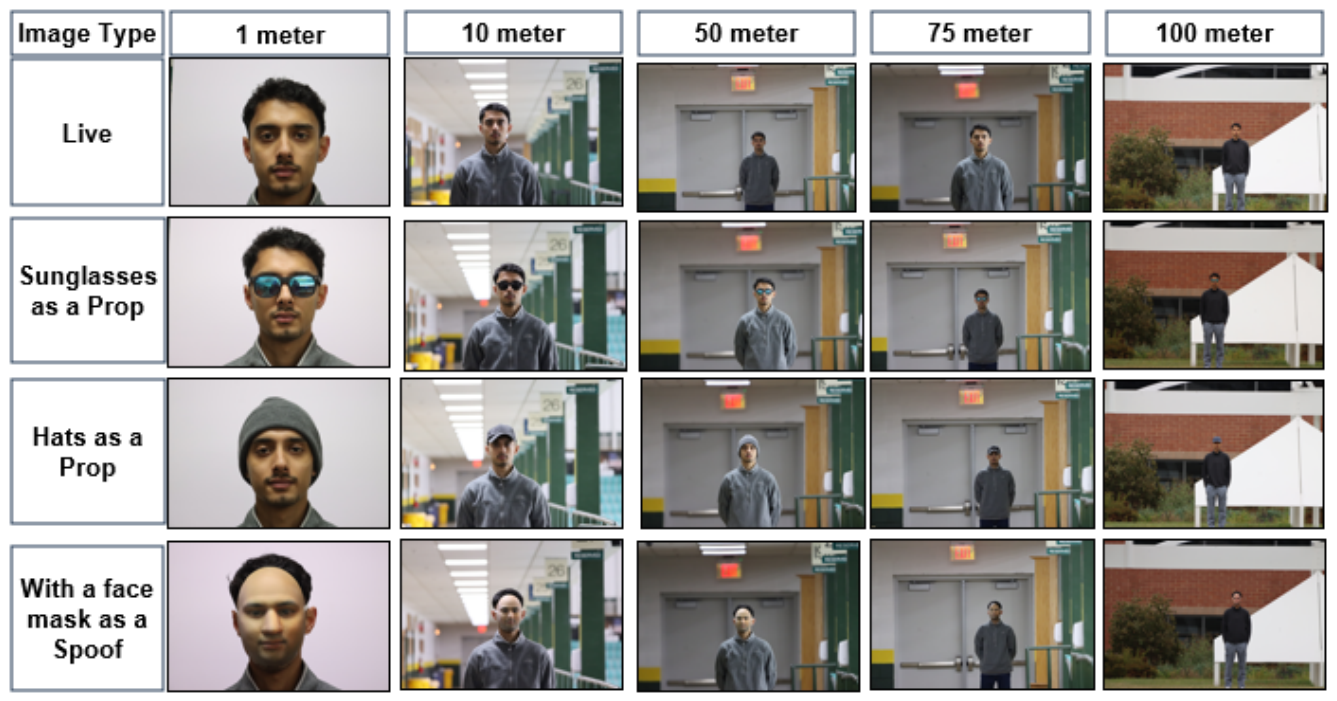
Figure 2.
Indoor Rank-1 accuracy vs. distance under fixed enrollment (1 m DSLR), comparing live and prop-based presentation conditions.
Figure 2.
Indoor Rank-1 accuracy vs. distance under fixed enrollment (1 m DSLR), comparing live and prop-based presentation conditions.
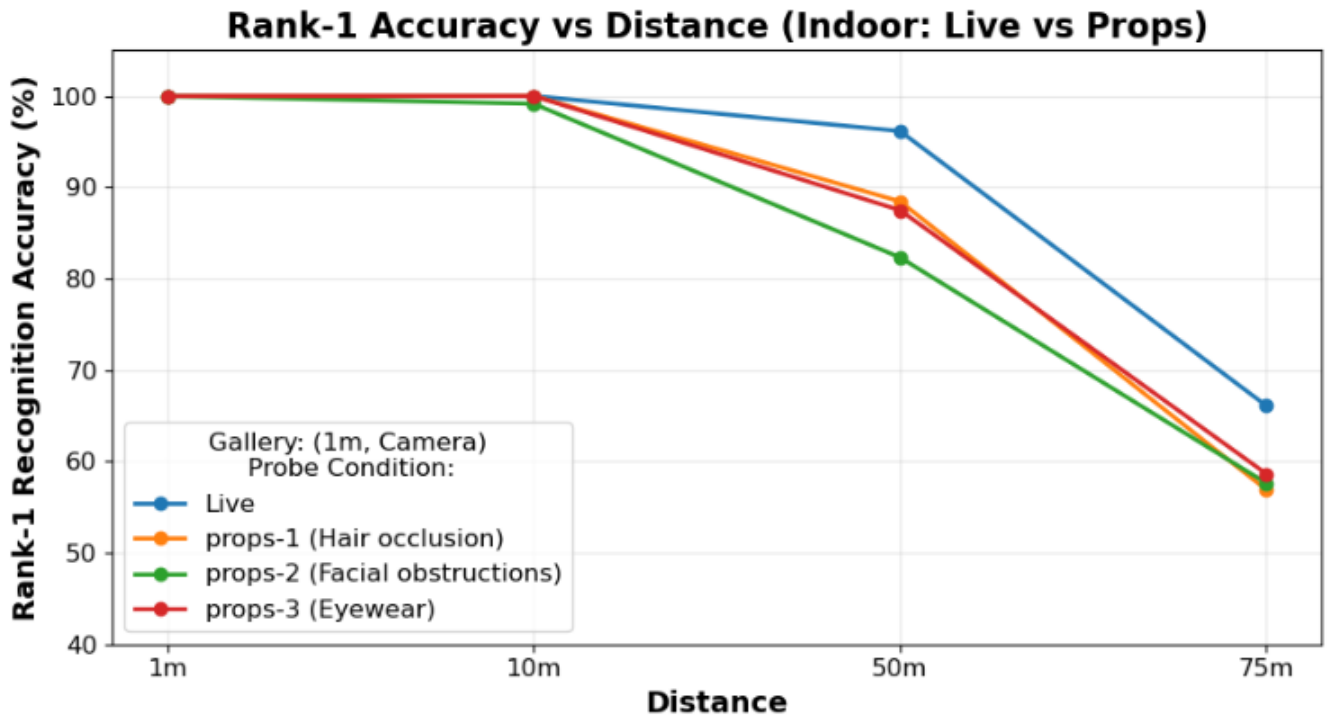
Figure 3.
Outdoor Rank-1 accuracy vs. distance (1 m DSLR enrollment), comparing live and prop-based presentation conditions.
Figure 3.
Outdoor Rank-1 accuracy vs. distance (1 m DSLR enrollment), comparing live and prop-based presentation conditions.
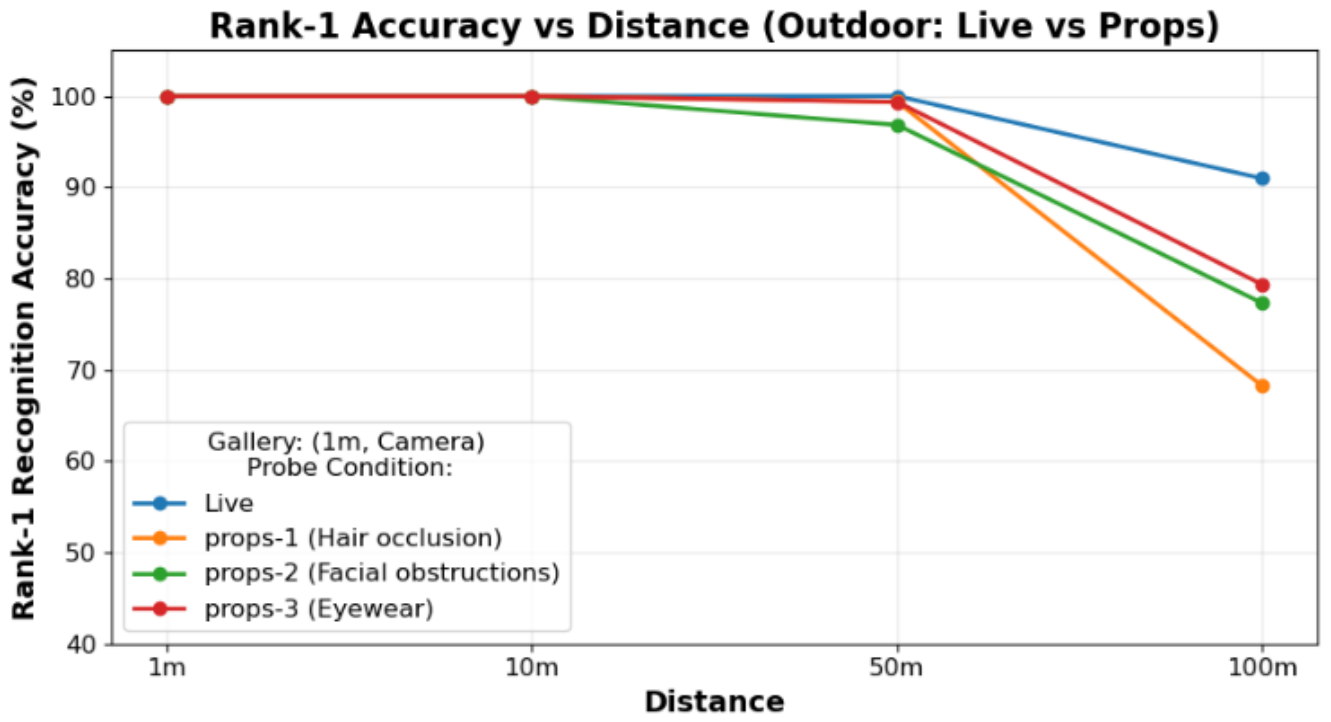
Figure 4.
Indoor: high-resolution (DSLR) vs. low-resolution (mobile) probes under fixed enrollment (1 m live DSLR).
Figure 4.
Indoor: high-resolution (DSLR) vs. low-resolution (mobile) probes under fixed enrollment (1 m live DSLR).
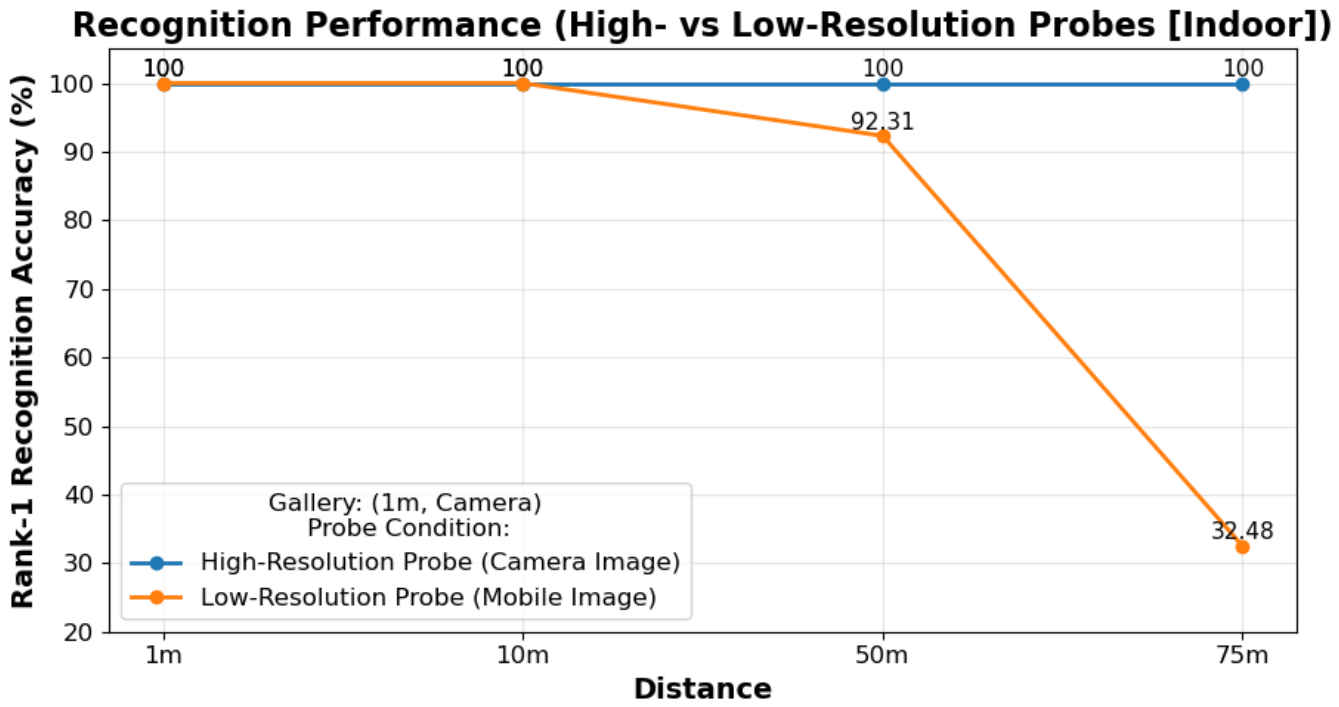
Figure 5.
Cross-environment matching: enrollment uses 1 m live DSLR from one environment and probes come from the other environment.
Figure 5.
Cross-environment matching: enrollment uses 1 m live DSLR from one environment and probes come from the other environment.
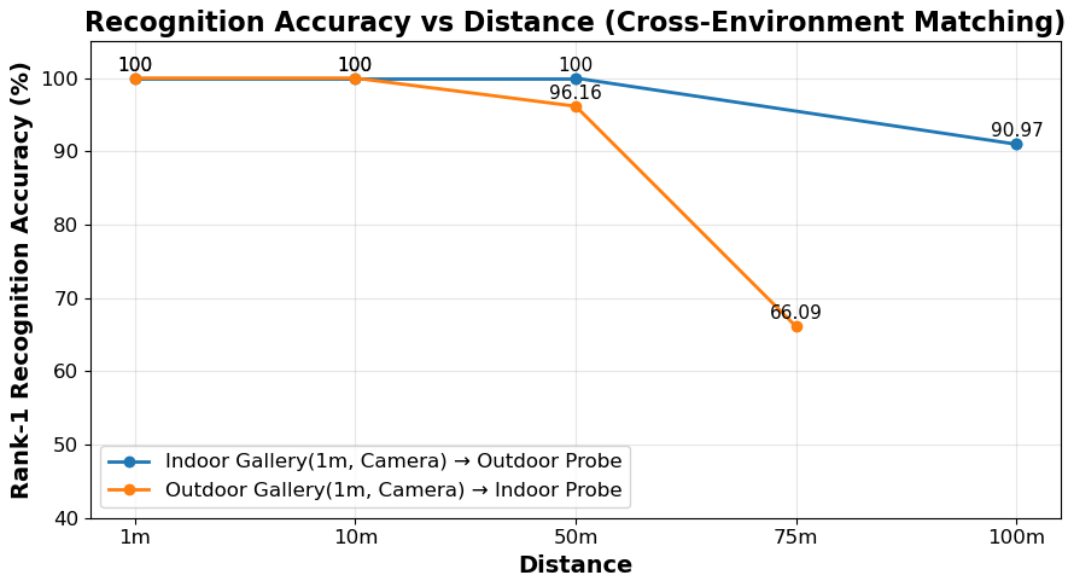
Figure 6.
Confusion matrix for presentation classification (live, props, spoof).
Disclaimer/Publisher’s Note: The statements, opinions and data contained in all publications are solely those of the individual author(s) and contributor(s) and not of MDPI and/or the editor(s). MDPI and/or the editor(s) disclaim responsibility for any injury to people or property resulting from any ideas, methods, instructions or products referred to in the content. |
© 2026 by the authors. Licensee MDPI, Basel, Switzerland. This article is an open access article distributed under the terms and conditions of the Creative Commons Attribution (CC BY) license (http://creativecommons.org/licenses/by/4.0/).
Copyright: This open access article is published under a Creative Commons CC BY 4.0 license, which permit the free download, distribution, and reuse, provided that the author and preprint are cited in any reuse.